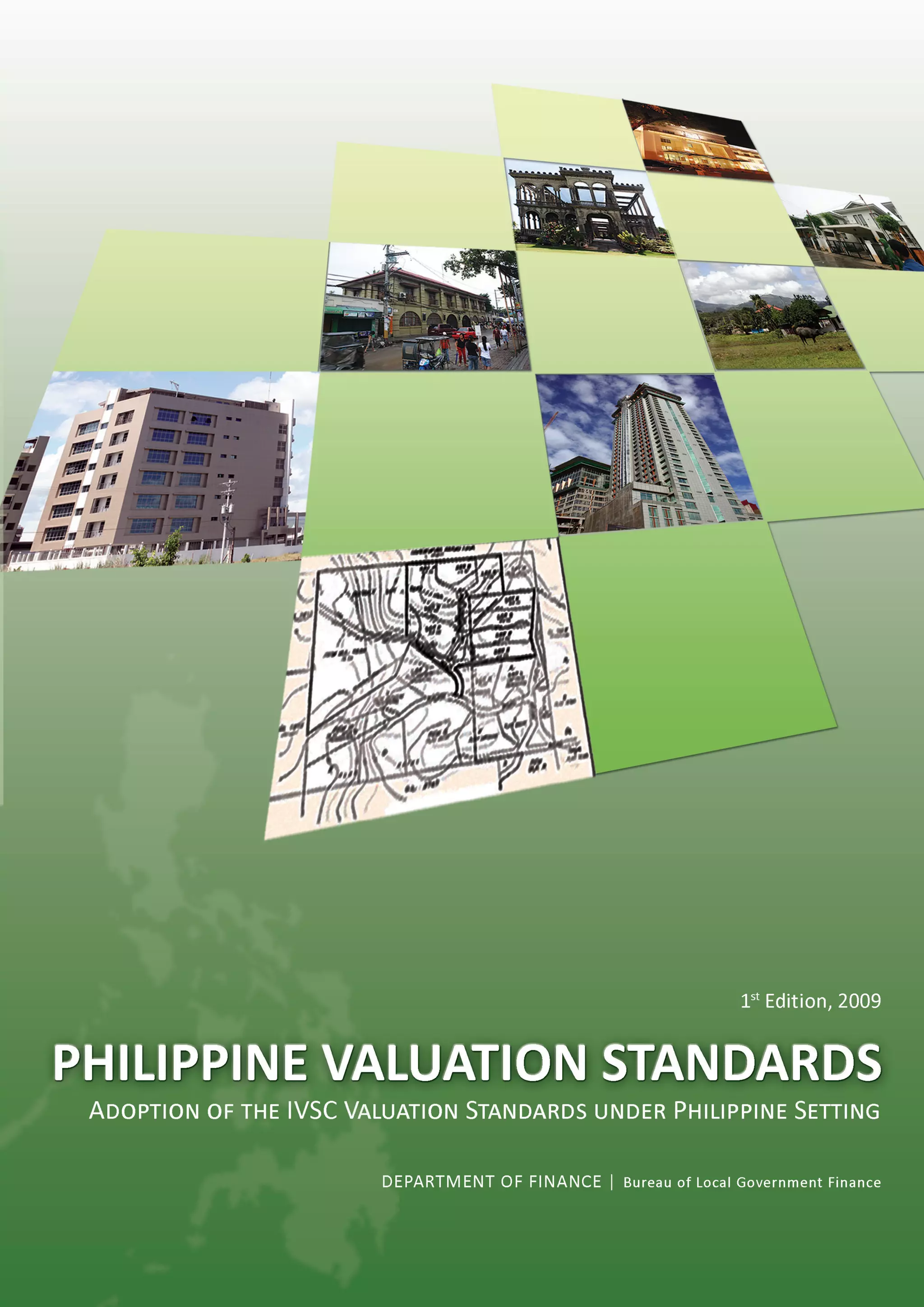
PHILIPPINE VALUATION
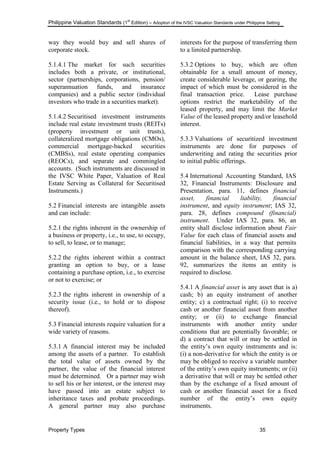
STANDARDS
Bureau of Local Government Finance
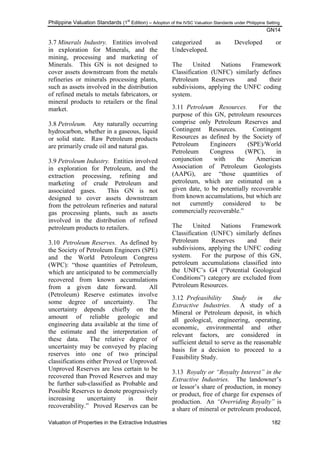
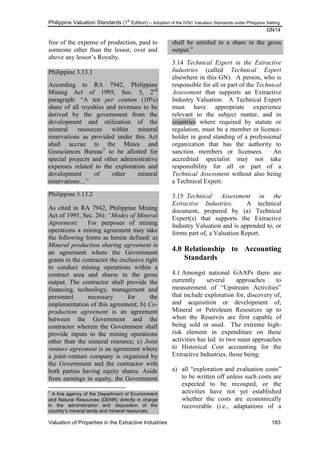
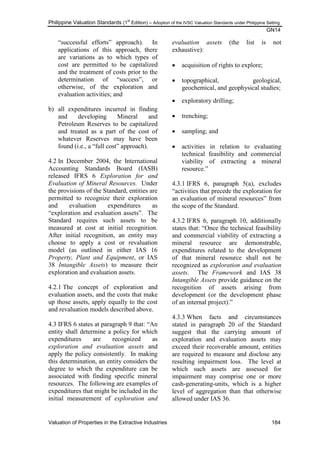
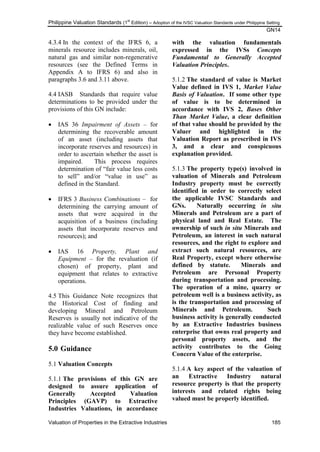
DEPARTMENT OF FINANCE
Adoption of the IVSC Valuation Standards
under Philippine Setting
1st
Edition, 2009
PHILIPPINE VALUATION STANDARDS, 1st
Edition
Adoption of the IVSC Valuation Standards Under Philippine Setting
Copyright © Bureau of Local Government Finance, 2009
8F, EDPC Bldg., BSP Complex, Roxas Blvd.
1004 Metro Manila, Philippines
Telefax: + 632 524-6324
Web: www.blgf.gov.ph
Email: blgf@blgf.gov.ph
First Printing, January 2010.
Second Printing, April 2010
All rights reserved.
No part of this book may be reproduced in any form or by any means without
express permission of the copyright owners and the publisher.
ISBN 978 - 971 - 94098 - 2 - 3
Printed in the Philippines.
Republic of the Philippines
DEPARTMENT OF FINANCE
Roxas Boulevard Corner Pablo Ocampo, Sr. Street
Manila 1004
DEPARTMENT ORDER NO. 37-09
19 October 2009
SUBJECT:	 Prescribing the Philippine Valuation Standards (1st
Edition) –		
		 Adoption of the IVSC Valuation Standards under Philippine Setting
TO:		 All Regional Directors of the Bureau of Local Government Finance,
		 Provincial, City and Municipal Assessors and other concerned DOF	
		 agencies
	 WHEREAS, Sections 33 (1) and (2) of Executive Order No. 292, series of 1987, otherwise
known as the “Administrative Code of 1987” provide that the Bureau of Local Government Finance
(BLGF) shall “Assist in the formulation and implementation of policies on local government
revenue administration and fund management; Exercise administrative and technical supervision
and coordination over treasury and assessment operation of local governments”;
	 WHEREAS, Section 201 of the Local Government Code of 1991 and Article 291 of its
Implementing Rules and Regulations (IRR) provide that the Department of Finance (DOF) shall
promulgate the necessary rules and regulations for the classification, appraisal and assessment of
real property;
		
	 WHEREAS, the Philippine Government has committed to pursue economic growth by
improving among others, procedures for valuing real property through the Land Administration
and Management Project (LAMP), an inter-Agency undertaking of which the DOF is one of the
departments tasked to promote reform in property valuation;
	 WHEREAS, the DOF through BLGF and the National Tax Research Center (NTRC), is
implementing real property valuation and taxation reforms under Component 4 of the second phase
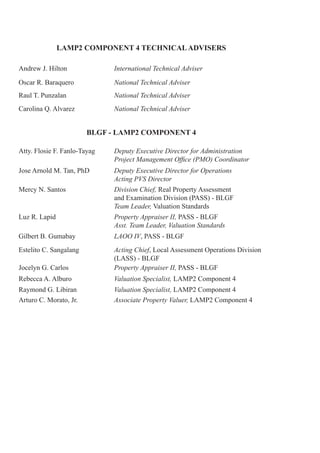
of the Land Administration and Management Project (LAMP 2), which aims to: “Improve the
quality of government and private sector appraisal performance through the adoption of Uniform
Valuation Standards and a single valuation base for taxation; Pursue property taxation reforms; and
Lay the foundation through education and training for the future expansion of property valuation
and appraisal activities”;
		
	 WHEREAS, the DOF through the BLGF and in conjunction with a broad-based group of
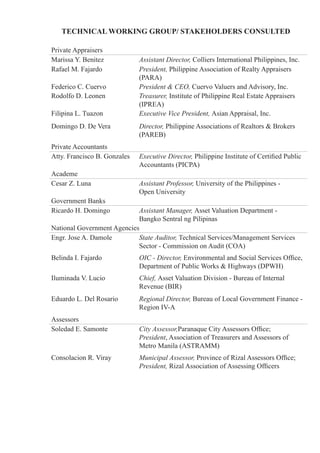
stakeholders, through a series of Technical Working Groups and Exposure Workshops, concluded
that the International Valuation Standards (IVS) is the most appropriate valuation standards for
valuation under Philippine setting;
	 WHEREAS, adaptation to Philippine setting had been incorporated to the IVS to reflect
national laws, policies and Philippine conditions; nonetheless, in case any conflict arises in the
implementation of the Philippine Valuation Standards, domestic laws shall take precedence over
the standards and principles advocated therein.
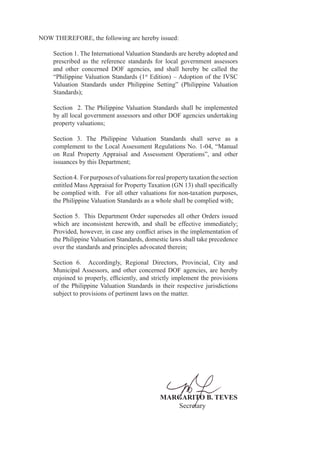
NOW THEREFORE, the following are hereby issued:
Section 1. The International Valuation Standards are hereby adopted and
prescribed as the reference standards for local government assessors
and other concerned DOF agencies, and shall hereby be called the
“Philippine Valuation Standards (1st
Edition) – Adoption of the IVSC
Valuation Standards under Philippine Setting” (Philippine Valuation
Standards);
Section 2. The Philippine Valuation Standards shall be implemented
by all local government assessors and other DOF agencies undertaking
property valuations;
Section 3. The Philippine Valuation Standards shall serve as a
complement to the Local Assessment Regulations No. 1-04, “Manual
on Real Property Appraisal and Assessment Operations”, and other
issuances by this Department;
Section4. Forpurposesofvaluationsforrealpropertytaxationthesection
entitled Mass Appraisal for Property Taxation (GN 13) shall specifically
be complied with. For all other valuations for non-taxation purposes,
the Philippine Valuation Standards as a whole shall be complied with;
Section 5. This Department Order supersedes all other Orders issued
which are inconsistent herewith, and shall be effective immediately;
Provided, however, in case any conflict arises in the implementation of
the Philippine Valuation Standards, domestic laws shall take precedence
over the standards and principles advocated therein;
Section 6. Accordingly, Regional Directors, Provincial, City and
Municipal Assessors, and other concerned DOF agencies, are hereby
enjoined to properly, efficiently, and strictly implement the provisions
of the Philippine Valuation Standards in their respective jurisdictions
subject to provisions of pertinent laws on the matter.
MARGARITO B. TEVES
Secretary
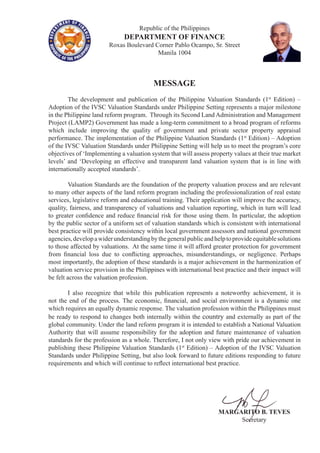
Republic of the Philippines
DEPARTMENT OF FINANCE
Roxas Boulevard Corner Pablo Ocampo, Sr. Street
Manila 1004
MESSAGE
	 The development and publication of the Philippine Valuation Standards (1st
Edition) –
Adoption of the IVSC Valuation Standards under Philippine Setting represents a major milestone
in the Philippine land reform program. Through its Second Land Administration and Management
Project (LAMP2) Government has made a long-term commitment to a broad program of reforms
which include improving the quality of government and private sector property appraisal
performance. The implementation of the Philippine Valuation Standards (1st
Edition) – Adoption
of the IVSC Valuation Standards under Philippine Setting will help us to meet the program’s core
objectives of ‘Implementing a valuation system that will assess property values at their true market
levels’ and ‘Developing an effective and transparent land valuation system that is in line with
internationally accepted standards’.
	 Valuation Standards are the foundation of the property valuation process and are relevant
to many other aspects of the land reform program including the professionalization of real estate
services, legislative reform and educational training. Their application will improve the accuracy,
quality, fairness, and transparency of valuations and valuation reporting, which in turn will lead
to greater confidence and reduce financial risk for those using them. In particular, the adoption
by the public sector of a uniform set of valuation standards which is consistent with international
best practice will provide consistency within local government assessors and national government
agencies,developawiderunderstandingbythegeneralpublicandhelptoprovideequitablesolutions
to those affected by valuations. At the same time it will afford greater protection for government
from financial loss due to conflicting approaches, misunderstandings, or negligence. Perhaps
most importantly, the adoption of these standards is a major achievement in the harmonization of
valuation service provision in the Philippines with international best practice and their impact will
be felt across the valuation profession.
	 I also recognize that while this publication represents a noteworthy achievement, it is
not the end of the process. The economic, financial, and social environment is a dynamic one
which requires an equally dynamic response. The valuation profession within the Philippines must
be ready to respond to changes both internally within the country and externally as part of the
global community. Under the land reform program it is intended to establish a National Valuation
Authority that will assume responsibility for the adoption and future maintenance of valuation
standards for the profession as a whole. Therefore, I not only view with pride our achievement in
publishing these Philippine Valuation Standards (1st
Edition) – Adoption of the IVSC Valuation
Standards under Philippine Setting, but also look forward to future editions responding to future
requirements and which will continue to reflect international best practice.
MARGARITO B. TEVES
Secretary
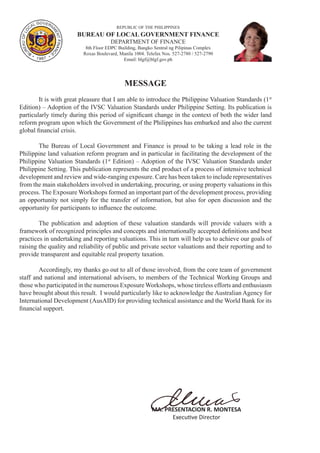
REPUBLIC OF THE PHILIPPINES
BUREAU OF LOCAL GOVERNMENT FINANCE
DEPARTMENT OF FINANCE
8th Floor EDPC Building, Bangko Sentral ng Pilipinas Complex
Roxas Boulevard, Manila 1004. Telefax Nos. 527-2780 / 527-2790
Email: blgf@blgf.gov.ph
MESSAGE
	 It is with great pleasure that I am able to introduce the Philippine Valuation Standards (1st
Edition) – Adoption of the IVSC Valuation Standards under Philippine Setting. Its publication is
particularly timely during this period of significant change in the context of both the wider land
reform program upon which the Government of the Philippines has embarked and also the current
global financial crisis.
	 The Bureau of Local Government and Finance is proud to be taking a lead role in the
Philippine land valuation reform program and in particular in facilitating the development of the
Philippine Valuation Standards (1st
Edition) – Adoption of the IVSC Valuation Standards under
Philippine Setting. This publication represents the end product of a process of intensive technical
development and review and wide-ranging exposure. Care has been taken to include representatives
from the main stakeholders involved in undertaking, procuring, or using property valuations in this
process. The Exposure Workshops formed an important part of the development process, providing
an opportunity not simply for the transfer of information, but also for open discussion and the
opportunity for participants to influence the outcome.
	 The publication and adoption of these valuation standards will provide valuers with a
framework of recognized principles and concepts and internationally accepted definitions and best
practices in undertaking and reporting valuations. This in turn will help us to achieve our goals of
raising the quality and reliability of public and private sector valuations and their reporting and to
provide transparent and equitable real property taxation.
	 Accordingly, my thanks go out to all of those involved, from the core team of government
staff and national and international advisers, to members of the Technical Working Groups and
those who participated in the numerous Exposure Workshops, whose tireless efforts and enthusiasm
have brought about this result. I would particularly like to acknowledge the Australian Agency for
International Development (AusAID) for providing technical assistance and the World Bank for its
financial support.
MA. PRESENTACION R. MONTESA
Executive Director
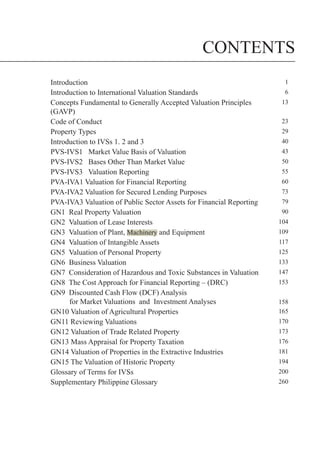
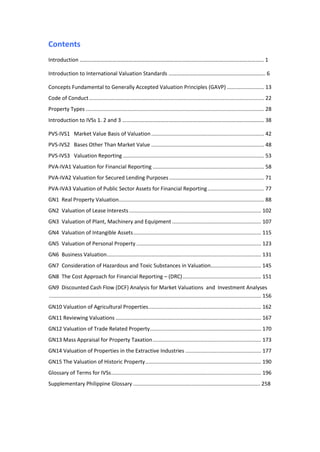
CONTENTS
Introduction 1
Introduction to International Valuation Standards 6
Concepts Fundamental to Generally Accepted Valuation Principles
(GAVP)
13
Code of Conduct 23
Property Types 29
Introduction to IVSs 1. 2 and 3 40
PVS-IVS1 Market Value Basis of Valuation 43
PVS-IVS2 Bases Other Than Market Value 50
PVS-IVS3 Valuation Reporting 55
PVA-IVA1 Valuation for Financial Reporting 60
PVA-IVA2 Valuation for Secured Lending Purposes 73
PVA-IVA3 Valuation of Public Sector Assets for Financial Reporting 79
GN1 Real Property Valuation 90
GN2 Valuation of Lease Interests 104
GN3 Valuation of Plant, Machinery and Equipment 109
GN4 Valuation of Intangible Assets 117
GN5 Valuation of Personal Property 125
GN6 Business Valuation 133
GN7 Consideration of Hazardous and Toxic Substances in Valuation 147
GN8 The Cost Approach for Financial Reporting – (DRC) 153
GN9 Discounted Cash Flow (DCF) Analysis
for Market Valuations and Investment Analyses 158
GN10 Valuation of Agricultural Properties 165
GN11 Reviewing Valuations 170
GN12 Valuation of Trade Related Property 173
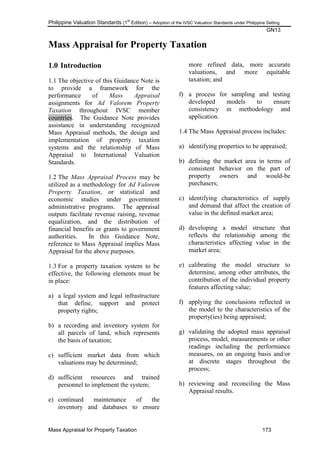
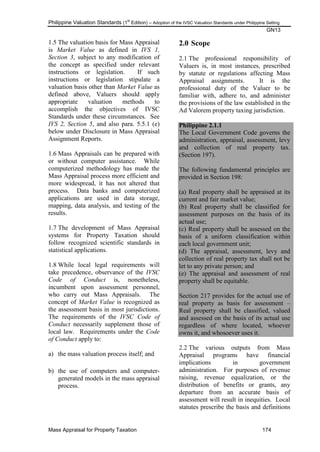
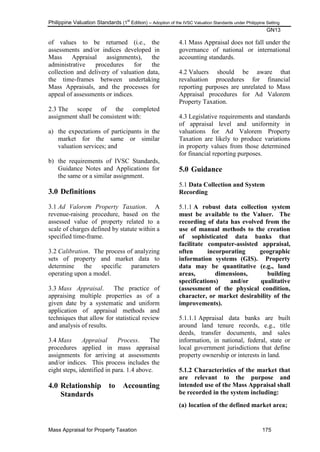
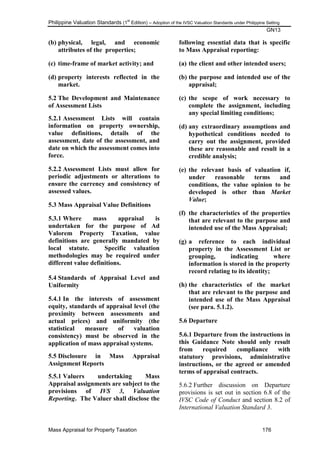
GN13 Mass Appraisal for Property Taxation 176
GN14 Valuation of Properties in the Extractive Industries 181
GN15 The Valuation of Historic Property 194
Glossary of Terms for IVSs 200
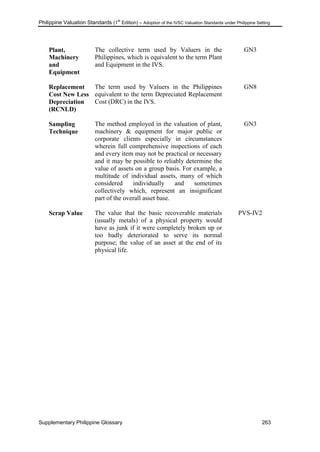
Supplementary Philippine Glossary 260
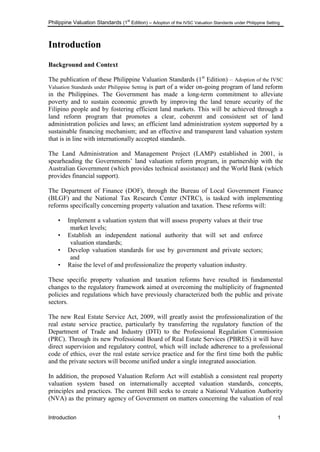
Contents
Introduction ………………………………………………………………………………………………………………….….. 1
Introduction to International Valuation Standards …………………………………………………………….. 6
Concepts Fundamental to Generally Accepted Valuation Principles (GAVP) ......................... 13
Code of Conduct...................................................................................................................... 22
Property Types ........................................................................................................................ 28
Introduction to IVSs 1. 2 and 3 ………….………………………………………………………….…………………… 38
PVS-IVS1 Market Value Basis of Valuation............................................................................ 42
PVS-IVS2 Bases Other Than Market Value ............................................................................ 48
PVS-IVS3 Valuation Reporting ............................................................................................... 53
PVA-IVA1 Valuation for Financial Reporting ........................................................................... 58
PVA-IVA2 Valuation for Secured Lending Purposes................................................................ 71
PVA-IVA3 Valuation of Public Sector Assets for Financial Reporting...................................... 77
GN1 Real Property Valuation.................................................................................................. 88
GN2 Valuation of Lease Interests......................................................................................... 102
GN3 Valuation of Plant, Machinery and Equipment ............................................................ 107
GN4 Valuation of Intangible Assets...................................................................................... 115
GN5 Valuation of Personal Property .................................................................................... 123
GN6 Business Valuation........................................................................................................ 131
GN7 Consideration of Hazardous and Toxic Substances in Valuation.................................. 145
GN8 The Cost Approach for Financial Reporting – (DRC)..................................................... 151
GN9 Discounted Cash Flow (DCF) Analysis for Market Valuations and Investment Analyses
............................................................................................................................................... 156
GN10 Valuation of Agricultural Properties............................................................................ 162
GN11 Reviewing Valuations .................................................................................................. 167
GN12 Valuation of Trade Related Property........................................................................... 170
GN13 Mass Appraisal for Property Taxation......................................................................... 173
GN14 Valuation of Properties in the Extractive Industries ................................................... 177
GN15 The Valuation of Historic Property.............................................................................. 190
Glossary of Terms for IVSs..................................................................................................... 196
Supplementary Philippine Glossary ..................................................................................... 258
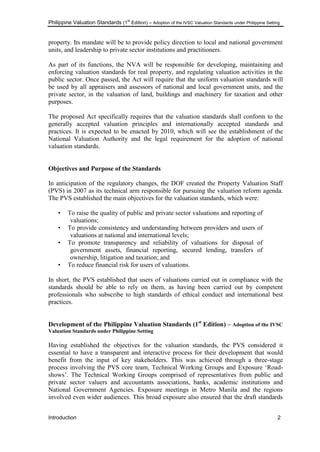
Philippine Valuation Standards (1
st
Edition) – Adoption of the IVSC Valuation Standards under Philippine Setting
Introduction 1
Introduction
Background and Context
The publication of these Philippine Valuation Standards (1st
Edition) – Adoption of the IVSC
Valuation Standards under Philippine Setting is part of a wider on-going program of land reform
in the Philippines. The Government has made a long-term commitment to alleviate
poverty and to sustain economic growth by improving the land tenure security of the
Filipino people and by fostering efficient land markets. This will be achieved through a
land reform program that promotes a clear, coherent and consistent set of land
administration policies and laws; an efficient land administration system supported by a
sustainable financing mechanism; and an effective and transparent land valuation system
that is in line with internationally accepted standards.
The Land Administration and Management Project (LAMP) established in 2001, is
spearheading the Governments‘ land valuation reform program, in partnership with the
Australian Government (which provides technical assistance) and the World Bank (which
provides financial support).
The Department of Finance (DOF), through the Bureau of Local Government Finance
(BLGF) and the National Tax Research Center (NTRC), is tasked with implementing
reforms specifically concerning property valuation and taxation. These reforms will:
• Implement a valuation system that will assess property values at their true
market levels;
• Establish an independent national authority that will set and enforce
valuation standards;
• Develop valuation standards for use by government and private sectors;
and
• Raise the level of and professionalize the property valuation industry.
These specific property valuation and taxation reforms have resulted in fundamental
changes to the regulatory framework aimed at overcoming the multiplicity of fragmented
policies and regulations which have previously characterized both the public and private
sectors.
The new Real Estate Service Act, 2009, will greatly assist the professionalization of the
real estate service practice, particularly by transferring the regulatory function of the
Department of Trade and Industry (DTI) to the Professional Regulation Commission
(PRC). Through its new Professional Board of Real Estate Services (PBRES) it will have
direct supervision and regulatory control, which will include adherence to a professional
code of ethics, over the real estate service practice and for the first time both the public
and the private sectors will become unified under a single integrated association.
In addition, the proposed Valuation Reform Act will establish a consistent real property
valuation system based on internationally accepted valuation standards, concepts,
principles and practices. The current Bill seeks to create a National Valuation Authority
(NVA) as the primary agency of Government on matters concerning the valuation of real
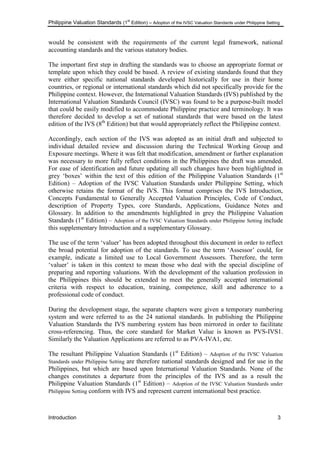
Philippine Valuation Standards (1
st
Edition) – Adoption of the IVSC Valuation Standards under Philippine Setting
Introduction 2
property. Its mandate will be to provide policy direction to local and national government
units, and leadership to private sector institutions and practitioners.
As part of its functions, the NVA will be responsible for developing, maintaining and
enforcing valuation standards for real property, and regulating valuation activities in the
public sector. Once passed, the Act will require that the uniform valuation standards will
be used by all appraisers and assessors of national and local government units, and the
private sector, in the valuation of land, buildings and machinery for taxation and other
purposes.
The proposed Act specifically requires that the valuation standards shall conform to the
generally accepted valuation principles and internationally accepted standards and
practices. It is expected to be enacted by 2010, which will see the establishment of the
National Valuation Authority and the legal requirement for the adoption of national
valuation standards.
Objectives and Purpose of the Standards
In anticipation of the regulatory changes, the DOF created the Property Valuation Staff
(PVS) in 2007 as its technical arm responsible for pursuing the valuation reform agenda.
The PVS established the main objectives for the valuation standards, which were:
• To raise the quality of public and private sector valuations and reporting of
valuations;
• To provide consistency and understanding between providers and users of
valuations at national and international levels;
• To promote transparency and reliability of valuations for disposal of
government assets, financial reporting, secured lending, transfers of
ownership, litigation and taxation; and
• To reduce financial risk for users of valuations.
In short, the PVS established that users of valuations carried out in compliance with the
standards should be able to rely on them, as having been carried out by competent
professionals who subscribe to high standards of ethical conduct and international best
practices.
Development of the Philippine Valuation Standards (1st
Edition) – Adoption of the IVSC
Valuation Standards under Philippine Setting
Having established the objectives for the valuation standards, the PVS considered it
essential to have a transparent and interactive process for their development that would
benefit from the input of key stakeholders. This was achieved through a three-stage
process involving the PVS core team, Technical Working Groups and Exposure ‗Road-
shows‘. The Technical Working Groups comprised of representatives from public and
private sector valuers and accountants associations, banks, academic institutions and
National Government Agencies. Exposure meetings in Metro Manila and the regions
involved even wider audiences. This broad exposure also ensured that the draft standards
Philippine Valuation Standards (1
st
Edition) – Adoption of the IVSC Valuation Standards under Philippine Setting
Introduction 3
would be consistent with the requirements of the current legal framework, national
accounting standards and the various statutory bodies.
The important first step in drafting the standards was to choose an appropriate format or
template upon which they could be based. A review of existing standards found that they
were either specific national standards developed historically for use in their home
countries, or regional or international standards which did not specifically provide for the
Philippine context. However, the International Valuation Standards (IVS) published by the
International Valuation Standards Council (IVSC) was found to be a purpose-built model
that could be easily modified to accommodate Philippine practice and terminology. It was
therefore decided to develop a set of national standards that were based on the latest
edition of the IVS (8th
Edition) but that would appropriately reflect the Philippine context.
Accordingly, each section of the IVS was adopted as an initial draft and subjected to
individual detailed review and discussion during the Technical Working Group and
Exposure meetings. Where it was felt that modification, amendment or further explanation
was necessary to more fully reflect conditions in the Philippines the draft was amended.
For ease of identification and future updating all such changes have been highlighted in
grey ‗boxes‘ within the text of this edition of the Philippine Valuation Standards (1st
Edition) – Adoption of the IVSC Valuation Standards under Philippine Setting, which
otherwise retains the format of the IVS. This format comprises the IVS Introduction,
Concepts Fundamental to Generally Accepted Valuation Principles, Code of Conduct,
description of Property Types, core Standards, Applications, Guidance Notes and
Glossary. In addition to the amendments highlighted in grey the Philippine Valuation
Standards (1st
Edition) – Adoption of the IVSC Valuation Standards under Philippine Setting include
this supplementary Introduction and a supplementary Glossary.
The use of the term ‗valuer‘ has been adopted throughout this document in order to reflect
the broad potential for adoption of the standards. To use the term ‗Assessor‘ could, for
example, indicate a limited use to Local Government Assessors. Therefore, the term
‗valuer‘ is taken in this context to mean those who deal with the special discipline of
preparing and reporting valuations. With the development of the valuation profession in
the Philippines this should be extended to meet the generally accepted international
criteria with respect to education, training, competence, skill and adherence to a
professional code of conduct.
During the development stage, the separate chapters were given a temporary numbering
system and were referred to as the 24 national standards. In publishing the Philippine
Valuation Standards the IVS numbering system has been mirrored in order to facilitate
cross-referencing. Thus, the core standard for Market Value is known as PVS-IVS1.
Similarly the Valuation Applications are referred to as PVA-IVA1, etc.
The resultant Philippine Valuation Standards (1st
Edition) – Adoption of the IVSC Valuation
Standards under Philippine Setting are therefore national standards designed and for use in the
Philippines, but which are based upon International Valuation Standards. None of the
changes constitutes a departure from the principles of the IVS and as a result the
Philippine Valuation Standards (1st
Edition) – Adoption of the IVSC Valuation Standards under
Philippine Setting conform with IVS and represent current international best practice.
Philippine Valuation Standards (1
st
Edition) – Adoption of the IVSC Valuation Standards under Philippine Setting
Introduction 4
Copyright
These Philippine Valuation Standards (1st
Edition) – Adoption of the IVSC Valuation Standards
under Philippine Setting are based upon the International Valuation Standards and as such it
has been necessary to obtain permission for the right to reproduce them within this
publication. The IVSC is fully supportive of this approach and has provided the following
statement:
• ‗‗Copyright © 2009 by the International Valuation Standards Council. All
rights reserved, subject to permission having been granted to the
Department of Finance to reproduce the 8th edition of the International
Valuation Standards (2007) within the Philippine Valuation Standards (1st
Edition) – Adoption of the IVSC Valuation Standards under Philippine
Setting.
• No responsibility is accepted by the IVSC for the accuracy of information
contained in the text as republished, the English version of the IVSC
Standards as published by the IVSC from time to time being the only
official version of the IVSC Standards.
• The full text of the official version may be obtained from the IVSC
International Headquarters, 12 Great George Street, London SW1P 3AD,
UK. http://www.ivsc.org ―
Scope and Application of Philippine Valuation Standards (1st
Edition) – Adoption of the
IVSC Valuation Standards under Philippine Setting
These valuation standards comprise a series of recognized concepts and principles,
internationally accepted definitions and guidance notes, and best practice in the
procurement, undertaking and reporting of valuations. Although the individual standards,
applications and guidance notes were developed as 24 separate sections, the three
principal elements of the Philippine Valuation Standards (1st
Edition) – Adoption of the IVSC
Valuation Standards under Philippine Setting, that is, the three core Standards, Applications and
Guidance Notes are a component part of the whole and each has equal weight. Therefore,
all valuations prepared in compliance with these standards must conform to the principles
and procedures contained in the entire document. Together they constitute an ‗umbrella‘
or ‗framework‘ for those involved in undertaking, procuring or using valuations in the
Philippines. They are not intended to describe different valuation techniques in detail or
prescribe specific methods of valuation for different purposes – for these references must
be made to appropriate technical text books, training materials and educational courses.
Through the Secretary of Finance Department Order, and the offices of the Bureau of
Local Government Finance, implementation of these standards by all local government
assessors and other concerned DOF agencies is mandatory.
Where LGUs undertake or procure valuations for non-taxation purposes the standards
shall apply in their entirety.
For the purpose of annual real property revisions, Guidance Note 13, Mass Appraisal for
Property Taxation, specifically provides that the mass appraisal process may be utilized as
a methodology for Ad Valorem property taxation, whereby value is determined in
Philippine Valuation Standards (1
st
Edition) – Adoption of the IVSC Valuation Standards under Philippine Setting
Introduction 5
accordance with the requirements proscribed by statute or legislation. The standards
recognize and provide for such statutory valuations notwithstanding that the required
valuation methodology may produce results which differ from Market Value as defined in
the standards, or as required for financial reporting or accounting purposes. Despite this
provision, valuers undertaking valuations for real property tax purposes should not depart
from the generality of the standards with regard to generally accepted valuation concepts
and principles and the code of conduct.
National Government Agencies (NGAs) are subject to their respective statutory directives
– legislation, implementing rules and regulations, orders, etc. The Secretary of Finance
does not have jurisdiction to mandate the adoption of these standards by NGAs, however,
individual NGAs may adopt these standards voluntarily once appropriate statutory
amendments or directives have been issued. Prior to their formal adoption by NGAs, these
standards may be used as a guidance and example of best practice.
Private sector valuers are required to comply with these standards when undertaking
valuations for non-taxation purposes on behalf of LGUs, and where instructed by NGAs
or other public or private sector clients. Forthcoming institutional reforms may require all
valuations in the Philippines to be undertaken in compliance with these standards and it is
hoped that, due to the inclusive nature of the process in their development, private sector
valuers will also see fit to adopt them in advance of the planned institutional reforms.
The scope of the standards is therefore wide-reaching and their impact will be felt across
the valuation profession. Of particular importance will be the impact of the standards on
valuation education, training and professional development as they will become one of the
cornerstones for all future education and training programs.
Future Maintenance of the Standards
Amendments and updates to the Philippine Valuation Standards (1st
Edition) – Adoption of
the IVSC Valuation Standards under Philippine Setting will be published in response to changing
requirements as and when necessary. Such requirements may result from changing
conditions within the Philippines, or changes in the global context. Such amendments and
updates may take the form of either supplementary papers or new editions replacing this
edition in its entirety, at the discretion of the responsible authority at the time.
Philippine Valuation Standards (1
st
Edition) – Adoption of the IVSC Valuation Standards under Philippine Setting
Introduction to International Valuation Standards 6
The International Valuation Standards Committee
Introduction
Rapid economic changes taking place in the 1970s served to enhance the recognition
given by market participants to the importance of professional property valuations. The
quickening pace in the globalization of investment markets further underscored the need
for internationally accepted standards for reporting the value of property. It became
obvious that without international valuation standards there was considerable potential for
confusion. Differences of viewpoints among national professional valuation bodies might
lead to unintentional misunderstandings. In response to this situation, members of a
technical committee of the Royal Institution of Chartered Surveyors (RICS) and
representatives of U.S. appraisal organizations began a dialogue in the late 1970s, which
led to the founding of The International Assets Valuation Standards Committee (TIAVSC)
in 1981. The Committee changed its name in 1994 to the International Valuations
Standards Committee (IVSC). The objectives of the Committee are twofold:
 To formulate and publish, in the public interest, valuation Standards for property
valuation and to promote their worldwide acceptance; and
 To harmonies Standards among the world‘s States1
and to identify and make
disclosure of differences in statements and/or applications of Standards as they
occur.
The IVSC has long recognized the diversity of purposes for which property valuations are
required, including use in financial statements, decisions on loans and mortgages secured
by property, transactions involving transfers or ownership, and litigation and tax
settlements. Beyond Standards, the IVSC began publishing Applications dealing with
valuation for financial reporting and secured lending purposes, as well as Guidance Notes
regarding specific valuation issues and the applications of Standards in more specific
business and service-providing situations. In particular, the IVSC has sought that the
International Valuation Standards (IVSs) be recognized in accounting and other reporting
standards, and that Valuers recognize what is needed from them under standards of other
disciplines.
In 2003, the IVSC became an incorporated association, comprising professional valuation
associations from around the world, and bound by Articles of Incorporation.
1
Throughout this document, the word ‗State‘ conveys the same meaning as it is used by the United Nations,
which recognizes and refers to its member States, i.e., politically organized communities having their own
apparatus of government and occupying sovereign territory. However, the term ‗country‘ has been
substituted in this publication.
Philippine Valuation Standards (1
st
Edition) – Adoption of the IVSC Valuation Standards under Philippine Setting
Introduction to International Valuation Standards 7
The IVSC has undertaken eight revisions of the International Valuations Standards, which
were published in 1985, 1994/97, 2000, 2001, 2003, 2005 and 2007. The evolution of
these Standards attests to the recognition by IVSC that change is inevitable and continuous
even when gradual and not easily discernible. The ongoing development of Standards
reflects s the commitment of the IVSC to ensure that fundamental valuation definitions
and guidance stay current in a dynamic world.
Membership and Organization
The International Valuation Standards Committee has become a truly international body in
terms of both its membership and mission. The Committee, which was founded with a
membership of twenty national associations, has grown by the year 2007 to include
associations with member or observer status representing 52 countries. Member
associations in these States subscribe to IVSC objectives concerning valuation and must
have a sufficient number of their members capable of conducting valuations that comply
with Standards. Member associations support the Standards and Guidance Notes
published by IVSC and endeavor to secure recognition of the Standards where appropriate
in their respective States.
Member associations are enjoined to disclose to the IVSC any significant differences
between domestic and International Standards so that such differences can be reported to
the international community. The IVSC recognizes that Valuers must act legally and
comply with the laws and regulations of the States in which they practice. Member
associations work with controlling and regulatory authorities, both statutory and
voluntary, and other professional societies to ensure that valuations comply with the IVSC
Standards and Guidance Notes. They also play an educative and consultative role in the
area of valuation standards within their respective States.
Achievements of IVSC
The International Valuation Standards Committee is a Non-Government Organization
(NGO) member of the United Nations, having been granted Roster status with the United
Nations Economic and Social Council in May 1985. The IVSC works cooperatively with
Member States and maintain liaison with international agencies, such as the Organizations
for Economic Cooperation and Development (OECD), the World Bank, the International
Monetary Fund (IMF), the World Trade Organization (WTO), the Commission of the
European Union, and the Bank for International Settlements (BIS), and the International
Organization of Security Commissions (IOSCO). The IVSC also maintains a close
relationship with the International Accounting Standards Board (IASB), the International
Federation of Accountants (IFAC)—the International Public Sector Accounting Standards
Board and the International Auditing and Assurance Standards Board.
IVSC provides the accounting profession with advice and counsel relating to valuation,
seeks to coordinate its Standards and work programs with those related professional
Philippine Valuation Standards (1
st
Edition) – Adoption of the IVSC Valuation Standards under Philippine Setting
Introduction to International Valuation Standards 8
discipline in the public interest, and cooperates international bodies in determining and
promulgating new Standards. In order to ensure that the international standards governing
valuation practice are consistent with the requirements of Valuers under international
financial reporting standards, the IVSC annually reviews each new edition of the
International Financial Reporting Standards (IFRSs), which include the International
Accounting Standards (IASs), promulgated by the International Accounting Standards
Board (IASB), and the International Public Sector Accounting Standards (IPSAS),
promulgated by the International Public Sector Accounting Standards Board. The IVSs
make reference to these accounting standards wherever they apply to the work of Valuers.
The IVSC publishes White Papers and Technical Papers at its website. At the time this
edition was released, the following papers were available: two White Papers, Valuation in
Emerging Markets and the Valuation in Emerging Markets and The Valuation of Real
Estate Serving as Collateral for Securitised Instruments; and one Technical Paper, Mass
Appraisal for Property Taxation.
Headquarters
The IVSC‘s international headquarters are in London.
12 Great George Street
London
United Kingdom SW1P 3AD
Telephone: 44 1442 879306
Facsimile: 44 1442 879306
Philippine Valuation Standards (1
st
Edition) – Adoption of the IVSC Valuation Standards under Philippine Setting
Introduction to International Valuation Standards 9
The International Valuation Standards
Objectives and Scope
The development of the International Valuation Standards (IVS) has been guided by three
principal objectives:
 To facilitate cross-border transactions and contribute to the viability of
international property markets by promoting transparency in financial reporting as
well as the reliability of valuations performed to secure loans and mortgages, for
transactions involving transfers of ownership, and for settlements in litigation or
tax matters;
 To serve as a professional benchmark, or beacon, for Valuers around the world,
thereby enabling them to respond to the demands of international property markets
for reliable valuations and to meet the financial reporting requirements of the
global business community; and
 To provide Standards of valuation and financial reporting that meet the needs of
emerging and newly industrialized countries.
Users of valuations under IVS should be able to rely on such valuations as having been
carried out by competent professionals who subscribe to high standards of ethical conduct.
As the scope of valuation practice becomes broader, the term property valuation has
gained currency over the more restrictive term asset valuation, a term referring to
valuations performed primarily for use in financial reporting. A Professional Property
Valuer is a person who possesses the necessary qualifications, ability, and experience to
estimate property value for a diversity of purposes including transactions involving
transfers of property ownership, property considered as collateral to secure loans and
mortgages, property subject to litigation or pending settlement of taxes, and property
treated as fixed assets in financial reporting. A Professional Property Valuer may also
possess the specific expertise to perform valuations of other categories of property, i.e.,
personal property, businesses, and financial interests.
The International Valuation Standards represent accepted, or best, practice in the
Valuation profession, also known as Generally Accepted Valuation Principles (GAVP).
Valuer compliance with the IVSs may be voluntary, mandated by law or regulation, or at
the instruction of clients, intended users and/or national societies or organizations. Having
no enforcement power of its own, the IVSC looks to national institutes and financial
professionals and authorities to enforce standards. It is intended that the International
Valuation Standards and the national standards of respective Member States shall be
complementary and mutually supportive. The IVSC advocates that differences between
statements and/or applications of national and International Valuation Standards be
disclosed.
Philippine Valuation Standards (1
st
Edition) – Adoption of the IVSC Valuation Standards under Philippine Setting
Introduction to International Valuation Standards 10
Detailed examination of methodology and its application to specific property types or
markets is the province of specialist education and literature. For this reason, the IVSC
encourages all professional Valuers to avail themselves of continuing education programs
throughout their careers. The International Valuation Standards prescribe what Valuers do
rather than explain how specific procedures or methodologies are applied. The IVS
recognize that every application is tied in a specific valuation problem, the solution of
which depends on the Valuer‘s ability to select relevant techniques and exercise
appropriate judgment.
Where the standards of other disciplines, such as accounting, may apply to Valuations, the
IVSC advises property Valuers to understand the accounting use to which their valuations
are put.
Organization of the International Standards
Various valuation principles and techniques are understood within the valuation
profession and are well established throughout the global business community. The
abbreviated discussions of such principles and techniques included in the Standards,
Applications, and Guidance Notes should not be considered exhaustive. Therefore, it is
important to the understanding and use of these Standards that, although the individual
Standards, Applications, or Guidance Notes may be published as separate sections, each is
a component part of the entirety. Thus, definitions, preface statements, valuation
concepts and principles, and other common elements are to be understood as
pertaining to each component. Although an attempt has been made to develop each part
of the Standards document as a self-contained item, the requirements of the IVSC Code of
Conduct and IVS 3, Valuation Reporting, apply to all elements. Thus, the reader will
benefit most from reading the entire document. Extensive cross-referencing facilitates the
task of tracing related areas throughout the text. The Standards, Applications, and
Guidance Notes include both paragraphs in bold plain type and bold type, which
have equal authority. Paragraphs in bold type indicate the main principles.
Technical Papers published on the IVSC website supplement the Standards, Applications,
and Guidance Notes but are not considered as integral to the Standards document.
Structure of Standards, Applications, Guidance Notes, and Commentary
The International Valuation Standards Committee (IVSC) recognizes the complexity of
professional valuation procedures, the diversity of property situations, the difficulty other
professional disciplines may have in interpreting valuation activities, problems in the
usage and translation of terminology, and the paramount need of the public for well-
founded professional valuations developed in accordance with generally accepted
standards. Accordingly, the content and format of these Standards have been designed
with these issues in mind and an understanding of the structure of the Standards is,
therefore, important to their application. The organization of the Standards follows:
1. Introduction - The introduction offers an overview of the origins of the
International Valuation Standards, the work of the International Valuations
Philippine Valuation Standards (1
st
Edition) – Adoption of the IVSC Valuation Standards under Philippine Setting
Introduction to International Valuation Standards 11
Committee, and the general context of the Standards. The organization of the
Standards is explained and their intended applicability is discussed.
2. Concepts Fundamental to Generally Accepted Valuation Principles - A full
discussion of the body of knowledge constituting valuation methods and practices is
beyond the scope of these Standards. To foster understanding among professional
disciplines and to alleviate difficulties arising from language barriers, this section aims
at providing commentary on basic, legal, economic, and conceptual frameworks upon
which the valuation discipline and its Standards are based. Comprehension of these
concepts and principles is crucial to understanding valuation and to the application of
these Standards.
3. Code of Conduct – A code of conduct addresses the ethical and competency
requirements of Valuers in professional practice. Ethical conduct serves the public
interest, sustains the trust financial institutions necessarily place in the services of
Valuers, and works to the benefit of the valuation profession itself. It ensures that the
results of valuations are reliable, consistent, and unbiased.
4. Property Types – Real property is distinguished from personal property,
businesses, and financial interests. These four property types and the distinctions
between them are discussed.
5. Introduction to the Standards – This introductory section discusses differences
between the Market Value Basis and Bases Other Than Market Value and the
importance of clearly and informatively communicating the valuation. After the
valuation is completed, the Valuer has to clearly explain the results and to
communicate how those results were obtained.
6. Standards – Within the organization of Standards, Applications, and Guidance
Notes, the Standards are considered as most fundamental and permanent. IVSC
Standards 1 and 2 deal respectively with Market Value and Bases Other Than Market
Value. Standard 3 sets forth the requirements for Valuation Reporting. The Standards
also serve as a foundation for the International Valuation Applications (IVAs), which
deal with the application of valuation for financial reporting and lending.
7. Applications – The application of both private and public sector asset valuation to
financial statements or related accounts, and to decisions involving loan or mortgage
security is described.
8. Guidance Notes – Issues that relate to the application of the Standards frequently
arise in valuation practice and from those who use valuation services. The Guidance
Notes provide guidance on specific valuation issues and how Standards are to be
applied in more specific business and service-providing situations. The Guidance
Notes complement and expand on the Standards and Applications, with which they
have equal importance. Compliance with the Guidance Notes as with the Standards
and Applications is, therefore, mandatory for all Valuers preparing assignments under
the International Valuation Standards.
9. Glossary – The glossary provides a summary of all terms are defined in the
Standards, Applications and Guidance Notes.
Philippine Valuation Standards (1
st
Edition) – Adoption of the IVSC Valuation Standards under Philippine Setting
Introduction to International Valuation Standards 12
The three principal elements of the International Valuation Standards, i.e., the
Standards, Applications and Guidance Notes, have equal weight, and all valuations
prepared in compliance with the IVSs must conform to the principles and
procedures elaborated throughout the entire document.
The Committee will continue to develop Standards, Applications and Guidance Notes as
the users of valuations and the market require.
Philippine Valuation Standards (1
st
Edition) – Adoption of the IVSC Valuation Standards under Philippine Setting
Concepts Fundamental to Generally Accepted Valuation Principles 13
Concepts Fundamental to Generally Accepted Valuation
Principles (GAVP)
1.0 Introduction
1.1 The experience of Valuers and dialogue
among nations through the International
Valuation Standards Committee (IVSC)
have demonstrated that, with few
exceptions, there is common worldwide
agreement regarding fundamentals that
underpin the valuation discipline. Local
laws and economic circumstances may, on
occasion, require special (and sometimes
limited) applications, but fundamentals of
valuation methods and techniques are
generally similar throughout the world. It is
an objective of the International Valuation
Standards Committee to avow and promote
these fundamentals.
1.2 IVSC‘s Standards, Applications and
Guidance Notes (GNs) are based on these
fundamentals, but it is the position of the
Committee that it is inappropriate to
attempt to articulate all appropriate
fundamentals within the body of each
Standard. Instead, this section supplements
each Standard and provides an overview of
fundamentals that are particularly important
to understanding the valuation profession
and to applying the Standards.
2.0 Land and Property Concepts
2.1 Land is essential to our lives and our
existence. Its importance brings land into
focus for consideration by lawyers,
geographers, sociologists, and economists.
As each of these disciplines relates to land
and to uses of land, the societies and
nations of our world are affected.
2.2 Valuation of land as if vacant or of land
and improvements to or on the land, is an
economic concept. Whether vacant or
improved, land is also referred to as real
estate. Value is created by real estate‘s
utility, or capacity to satisfy the needs and
wants of human societies. Contributing to
value are real estate‘s general uniqueness,
durability, fixity of location, relatively
limited supply, and the specific utility of a
given site.
2.3 Property is a legal concept
encompassing all the interests, rights and
benefits related to ownership. Property
consists of the rights of ownership, which
entitle the owner to a specific interest or
interests in what is owned. To distinguish
between real estate, which is a physical
entity, and its ownership, which is a legal
concept, the ownership of real estate is
called real property. The combination of
rights associated with the ownership of real
property is, in some countries, referred to as
the bundle of rights. The bundle-of-rights
concept likens property ownership to a
bundle of sticks with each stick
representing a distinct and separate right of
the property owner, e.g., the right to use, to
sell, to lease, to give away, or to choose to
exercise all or none of these rights.
2.4 Ownership of an interest in items other
than real estate is referred to as personal
property. The word property, used without
further qualification or identification, may
refer to real property, personal property, or
other types of property such as businesses
and financial interests, or a combination
thereof. (See Section 3 below and Property
Types).
2.5 Property Valuers, Asset Valuers, and
Appraisers are those who deal with the
special discipline of economics associated
with preparing and reporting valuations. As
professionals, Valuers must meet rigorous
tests of education, training, competence,
and demonstrated skills. They must also
exhibit and maintain a Code of Conduct
(ethics and competency) and Standards of
Philippine Valuation Standards (1
st
Edition) – Adoption of the IVSC Valuation Standards under Philippine Setting
Concepts Fundamental to Generally Accepted Valuation Principles 14
professional practice and follow Generally
Accepted Valuation Principles (GAVP).
2.6 Price changes over time result from
specific and general effects of economic
and social forces. General forces may cause
changes in price levels and in the relative
purchasing power of money. Operating on
their own momentum, specific forces such
as technological change may generate shifts
in supply and demand, and can create
significant price changes.
2.7 Many recognized principles are applied
in valuing real estate. They include the
principles of supply and demand;
competition; substitution; anticipation, or
expectation; change; and others. Common
to all these principles is their direct or
indirect effect on the degree of utility and
productivity of a property. Consequently, it
may be stated that the utility of real estate
reflects the combined influence of all
market forces that come to bear upon the
value of property.
3.0 Real Estate, Property, and
Asset Concepts
3.1 Real estate is defined as the physical
land and those human-made items, which
attach to the land. It is the physical, tangible
―thing‖ which can be seen and touched,
together with all additions on, above, or
below the ground. Local laws within each
country prescribe the basis for
distinguishing real estate from personal
property. Although these legal concepts
may not be recognized in all countries, they
are adopted here to distinguish important
terms and concepts.
3.2 Real property includes all the rights,
interests, and benefits related to the
ownership of real estate. An interest or
interests in real property is normally
demonstrated by some evidence of
ownership (e.g., a title deed) separate from
the physical real estate. Real property is a
non-physical concept.
3.3 Personal property includes interests in
tangible and intangible items which are not
real estate. Items of tangible personal
property are not permanently affixed to real
estate and are generally characterized by
their moveability.
3.4 In accounting terminology, assets are
resources controlled by an entity as a result
of past events and from which some future
economic benefits are expected to flow to
the entity. Ownership of an asset is itself an
intangible. However, the asset owned may
be either tangible or intangible.
3.4.1 The future economic benefits
embodied in an asset may flow to the entity
in a number of ways. For example, an asset
may be: (a) used singly or in combination
with other assets in the production of goods
or services to be sold by the entity; (b)
exchanged for other assets; (c) used to settle
a liability; or (d) distributed to the owners
of the entity. (International Financial
Reporting Standards [IFRSs], Framework,
55)
3.4.2 An asset is recognized in the balance
sheet when it is probable that the future
economic benefits will flow to the entity
and the asset has a cost or value that can be
measured reliably. (IFRSs, Framework, 89)
3.5 International Financial Reporting
Standards distinguish among tangible and
intangible assets. Of particular importance
are the following terms and concepts:
3.5.1 Current assets. Assets not intended
for use on a continuing basis in the
activities of an entity. Examples include
stocks, obligations owed to the entity, short-
term investments, and cash in bank and in
hand. In certain circumstances real estate,
normally treated as a fixed asset, may be
treated as a current asset. Examples include
land or improved real estate held in
inventory for sale.
3.5.2 Non-current assets (fixed, or long-
term, assets). These are tangible and
Philippine Valuation Standards (1
st
Edition) – Adoption of the IVSC Valuation Standards under Philippine Setting
Concepts Fundamental to Generally Accepted Valuation Principles 15
intangible assets which fall into the
following two broad categories:
3.5.2.1 Property, plant, machinery and
equipment. Assets intended for use on a
continuing basis in the activities of an entity
including land and buildings; plant and
equipment; and other categories of assets,
suitably identified; less accumulated
depreciation. Property, plant, machinery
and equipment are tangible or physical
assets.
Philippine 3.5.2.1.1
In the Philippines, the term „Plant‟ is not in
general use. ‗Machinery and Equipment‘ is
the collective term adopted by Valuers,
while ‗Plant and Equipment‘ is adopted by
Accountants. Reference to „Plant and
Equipment‟ in the IVS is therefore extended
to „Plant, Machinery and Equipment‟.
3.5.2.2 Other non-current assets. Assets not
intended for use on a continuing basis in the
activities of an entity, but expected to be
held in long-term ownership including
long-term investments; long-term
receivables; goodwill; expenditures carried
forward; and patents, trademarks, and
similar assets. This asset category includes
both tangible, or physical assets and
intangible, or non-physical assets.
Intangible assets are considered items of
intangible personal property, and may
include management and marketing skill,
credit rating, goodwill, and various legal
rights or instruments (patents, trademarks,
copyrights, franchises, and contracts).
3.5.3 Where either historic or current cost
accounting conventions are upheld, a
distinction is drawn between operational
and investment assets. Operational assets
are considered requisite to the operations of
the going concern or corporation.
Investment assets that are owned by a
corporation are considered extraneous to
the operational requirements of the
corporate owner.
3.6 Accounting terminology differs
somewhat from terms more common to
Valuers. Within the classifications
discussed in para. 3, Valuers of real
property are principally involved with fixed
assets. Technically it is the ownership of the
asset, or the right of ownership, that is
valued rather than the tangible or intangible
asset itself. This concept distinguishes the
economic concept of valuing an asset
objectively based upon its ability to be
purchased and sold in a marketplace from
some subjective concept such as assuming
an intrinsic or other than Market Value
basis. The objective market concept does,
however, have special applications for
limited or non-market property valuation as
discussed in International Valuation
Standard 2.
3.7 The term depreciation is used in
different contexts in valuation and in
financial reporting. In the context of asset
valuation, depreciation, refers to the
adjustments made to the cost of reproducing
or replacing the asset to reflect physical
deterioration and functional (technical) and
external (economic) obsolescence in order
to estimate the value of the asset in a
hypothetical exchange in the market when
there is no direct sales evidence available
(see para. 9.2.1.3, Concepts Fundamental to
Generally Accepted Valuation Principles).
In financial reporting depreciation refers to
the charge made against income to reflect
the systematic allocation of the depreciable
amount of an asset over its useful life to the
entity. It is specific to the particular entity
and its utilization of the asset, and is not
necessarily affected by the market.
4.0 Price, Cost, Market, and Value
4.1 Imprecision or vagueness of language,
particularly in an international community,
can and does lead to misinterpretations and
misunderstandings. This is particularly a
problem where words commonly used in a
language also have specific meanings
within a given discipline. That is the case
with the terms price, cost, market, and
Philippine Valuation Standards (1
st
Edition) – Adoption of the IVSC Valuation Standards under Philippine Setting
Concepts Fundamental to Generally Accepted Valuation Principles 16
value as they are used in the valuation
discipline.
4.2 Price is a term used for the amount
asked, offered, or paid for a good or
service. Sale price is an historical fact,
whether it is publicly disclosed or kept
confidential. Because of the financial
capabilities, motivations, or special interests
of a given buyer and/or seller, the price paid
for goods or services may or may not have
any relation to the value which might be
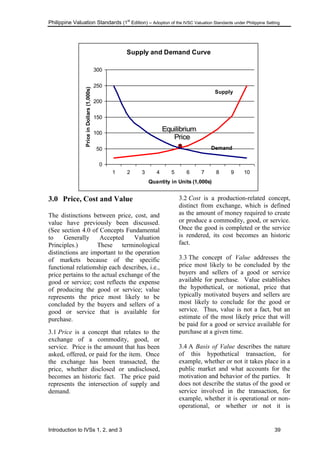
ascribed to the goods or services by others.
Price is, however, generally an indication of
a relative value placed upon the goods or
services by the particular buyer and/or
seller under particular circumstances.
4.3 Cost is the price paid for goods or
services or the amount required to create or
produce the good or service. When that
good or service has been completed, its cost
is an historical fact. The price paid for a
good or service becomes its cost to the
buyer.
4.4 A market is the environment in which
goods and services trade between buyers
and sellers through a price mechanism. The
concept of a market implies that goods
and/or services may be traded among
buyers and sellers without undue restriction
on their activities. Each party will respond
to supply-demand relationships and other
price-setting factors as well as to the party‘s
own capacities and knowledge,
understanding of the relative utility of the
goods and/or services, and individual needs
and desires. A market can be local,
regional, national, or international.
4.5 Value is an economic concept referring
to the price most likely to be concluded by
the buyers and sellers of a good or service
that is available for purchase. Value is not a
fact, but an estimate of the likely price to be
paid for goods and services at a given time
in accordance with a particular definition of
value. The economic concept of value
reflects a market‘s view of the benefits that
accrue to one who owns the goods or
receives the services as of the effective date
of valuation.
4.6 Value is therefore a hypothetical price,
and the hypothesis on which the value is
estimated is determined by the valuation
basis adopted. A Basis of Value is defined
in IVS 2 as a statement of the fundamental
measurement principles of a valuation on a
specified date. A Basis of Value defines the
nature of the hypothetical transaction, e.g.,
whether or not there is exposure to a
market, and the assumed motivation and
behavior of the parties. A Basis of Value is
not a description of the method or approach
used to produce the estimate, and neither
does it describe the state or condition in
which the asset is assumed to be
transferred. It is of paramount importance
to the use and understanding of valuations
that the Basis of Value be clearly disclosed,
and that it is a basis that is appropriate to
the particular valuation assignment. A
change in the Basis of Value can have a
material effect on the valuation.
4.7 Professional Valuers, who possess
intimate knowledge of a property market;
understand the interaction of participants in
the market; and are, thereby, able to judge
the most likely prices to be concluded
between buyers and sellers of property in
that market avoid the unqualified term
value by preceding the term with some
adjective describing the particular type of
value involved. Market Value is the most
common type of value associated with
property valuations and is discussed in
International Valuation Standard 1.
4.8 The value concept contemplates a
monetary sum associated with a transaction.
However, sale of the property valued is not
a condition requisite to estimating the price
for which property should sell if it were
sold on the date of valuation under
conditions prescribed in the definition of
Market Value.
4.9 The Market Value of real estate is a
representation of its market-recognized
Philippine Valuation Standards (1
st
Edition) – Adoption of the IVSC Valuation Standards under Philippine Setting
Concepts Fundamental to Generally Accepted Valuation Principles 17
utility rather than its purely physical status.
The utility of assets to a given entity or
individual may differ from that which
would be recognized by the market or by a
particular industry. (Refer to 5.0 below)
4.9.1 Considerations similar to those
expressed above are applied to the valuation
of property other than real estate. Financial
reporting will require application of Market
Value methods and a clear distinction
between such methods and methods used to
estimate values other than Market Value.
4.10 The total cost of a property includes
all direct and indirect costs of its
production. If supplemental capital costs are
incurred by a purchaser subsequent to
acquisition, they will be added to the
historical acquisition cost for cost
accounting purposes. Depending upon how
the utility of such costs is perceived by the
market, they may or may not be fully
reflected in the property‘s Market Value.
4.11 A cost estimate for a property may be
based on either an estimate of reproduction
cost or replacement cost. Reproduction cost
is the cost to create a virtual replica of a
property using identical or, if identical
materials are not available, similar
materials. A replacement cost estimate
envisions a modern equivalent of
comparable utility, employing the design,
technology and materials that are currently
used in the market.
5.0 Market Value
5.1 The concept of Market Value reflects
the collective perceptions and actions of a
market and is the basis for valuing most
resources in market-based economies.
Although precise definitions may vary, the
Market Value concept is commonly
understood and applied.
5.2 Market Value is defined as:
The estimated amount for which a property
should exchange on the date of valuation
between a willing buyer and a willing seller
in an arm‘s-length transaction after proper
marketing wherein the parties had each
acted knowledgeably, prudently, and
without compulsion.
5.3 It is important to stress that the
professionally derived Market Value
estimate is an objective valuation of
identified ownership rights to specific
property as of a given date. Implicit within
this definition is the concept of a general
market comprising the activity and
motivation of many participants rather than
the preconceived view or vested interest of
a particular individual. Market Value is a
market-supported estimate developed in
accordance with these Standards.
5.4 Real property is distinguished from
most goods and services because of the
relatively longer period required to market
what is a relatively illiquid commodity in
order to achieve a price that represents its
Market Value. This characteristically longer
exposure time, the absence of a ‗spot
market‘ (a market in which commodities
are available for immediate sale), and the
nature and diversity of properties and
property markets give rise to the need for
Professional Valuers and Valuation
Standards.
5.5 In some countries, the legal term Fair
Market Value is used synonymously with
the term Market Value. Fair Market Value
should not be confused with the accounting
term, Fair Value. (See para. 8.1 below.)
The IVSC position is that the term Market
Value never requires further qualification
and that all countries should move toward
compliance with this usage.
6.0 Highest and Best Use
6.1 Land is regarded as a permanent asset,
but improvements upon or to the land have
a finite life. Because of the immobility of
land, each real estate parcel possesses a
unique location. Land‘s permanence also
means that it will normally be expected to
Philippine Valuation Standards (1
st
Edition) – Adoption of the IVSC Valuation Standards under Philippine Setting
Concepts Fundamental to Generally Accepted Valuation Principles 18
outlast uses and improvements, which have
a finite life.
6.1.1 The unique characteristics of land
determine its optimal utility. When
improved land is valued separately from
improvements to or upon the land,
economic principles require that
improvements to or on the land be valued as
they contribute to or detract from the total
value of the property. Thus, the Market
Value of land based upon the ―highest and
best use‖ concept reflects the utility and the
permanence of land in the context of a
market, with improvements constituting the
difference between land value alone and
total Market Value as improved.
6.2 Most properties are valued as a
combination of land and improvements. In
such cases, the Valuer will normally
estimate Market Value by considering the
highest and best use of the property as
improved.
6.3 Highest and best use is defined as:
The most probable use of a property which
is physically possible, appropriately
justified, legally permissible, financially
feasible, and which results in the highest
value of the property being valued.
6.4 A use that is not legally permissible or
physically possible cannot be considered a
highest and best use. A use that is both
legally permissible and physically possible
may nevertheless require an explanation by
the Valuer justifying why that use is
reasonably probable. Once analysis
establishes that one or more uses are
reasonably probable uses, they are then
tested for financial feasibility. The use that
results in the highest value, in keeping with
the other tests, is the highest and best use.
6.5 Application of this definition permits
Valuers to assess the effects of deterioration
and obsolescence in buildings, the most
appropriate improvements for land, the
feasibility of rehabilitation and renovation
projects, and many other valuation
situations.
6.6 In markets characterized by extreme
volatility or severe disequilibrium between
supply and demand, the highest and best
use of a property may be a holding for
future use. In other situations, where several
types of potential highest and best use are
identifiable, the Valuer should discuss such
alternative uses and anticipated future
income and expense levels. Where land use
and zoning are in a state of change, the
immediate highest and best use of a
property may be an interim use.
6.7 The concept of highest and best use is a
fundamental and integral part of Market
Value estimates.
7.0 Utility
7.1 The key criterion in the valuation of any
real or personal property is its utility.
Procedures employed in the valuation
process have the common objective of
defining and quantifying the degree of
utility or usefulness of the property valued.
This process calls for interpretation of the
utility concept.
7.2 Utility is a relative, or comparative
term, rather than an absolute condition. For
example, the utility of agricultural land is
ordinarily measured by its productive
capacity. Its value is a function of the
quantity and quality of produce, which the
land will yield in an agricultural sense, or of
the quantity and quality of buildings
essential to the agricultural operation. If the
land has development potential, however,
its productivity is measured by how
productively it will support a residential,
commercial, industrial, or mixed use.
Consequently, land value is established by
evaluating its utility in terms of the legal,
physical, functional, economic, and
environmental factors that govern its
productive capacity.
Philippine Valuation Standards (1
st
Edition) – Adoption of the IVSC Valuation Standards under Philippine Setting
Concepts Fundamental to Generally Accepted Valuation Principles 19
7.3 Fundamentally, property valuation is
governed by the way specific property is
used and/or how it would ordinarily be
traded in the market. For some property,
optimum utility is achieved if the property
in question is operated on an individual
basis. Other property has greater utility if
operated as part of a group of properties,
e.g., properties owned and managed by a
business entity such as a chain of multiple
retail outlets, fast food restaurants, or
hotels. Therefore, a distinction must be
made between a property‘s utility viewed
individually and when considered as a part
of a group. A Valuer will regard the
property as the market views it, whether as
a discrete entity or as part of an aggregate
or portfolio. Typically, the Valuer estimates
and reports the value of the property as an
individual entity. If the value of the
property, taken as part of an aggregate or
portfolio, is other than its individual value,
such value should be considered and
reported.
7.4 An individual property may possess an
additional, or special, value above its value
as a separate entity by reason of its physical
or functional association with an adjoining
property owned by others or its
attractiveness to a purchaser with other
special interests. The extent or amount of
such additional, or special, value is
generally reported separately from Market
Value.
8.0 Other Important Concepts
8.1 The expression Market Value and the
term Fair Value as it commonly appears in
accounting standards are generally
compatible, if not in every instance exactly
equivalent concepts. Fair Value, an
accounting concept, is defined in
International Financial Reporting Standards
and other accounting standards as the
amount for which an asset could be
exchanged, or a liability settled, between
knowledgeable, willing parties in an arm‘s
length transaction. Fair Value is generally
used for reporting both Market and Non-
Market Values in financial statements.
Where the Market Value of an asset can be
established, this value will equate to Fair
Value.
8.2 Specialized property is property that is
rarely, if ever, sold in the market except by
way of a sale of the business or entity of
which it is part, due to uniqueness arising
from its specialized nature and design, its
configuration, size, location, or otherwise.
Where there is limited or no directly
comparable market information for Valuers
to consider, the valuation process may
become more complex. However, it is the
Valuer‘s responsibility to develop data and
reasoning from the market to support and/or
explain the value conclusion. Each of the
valuation methods may be applied, and all
applicable methods should be considered.
Where possible, the Valuer develops land
value, cost, and accumulated depreciation
estimates from market information, and
explains the basis for the value estimate.
8.3 Where normal market conditions are
disrupted or suspended, or where supply
and demand imbalances lead to market
prices that do not meet the Market Value
definition, the Valuer may face a difficult
valuation problem. By using the Market
Value concept and definition, and by
applying market data and reasoning to the
valuation process, Valuers ensure the
relevance and usefulness of asset values
reported in financial statements. As
availability and/or applicability of market
data decrease, the valuation assignment
may require a higher degree of professional
Valuer vigilance, experience, and judgment.
8.4 A Valuer may be required to apply a
particular definition of Market Value to
meet legal or statutory requirements. If so
required, the Valuer must make specific
disclosure of the fact and describe the
impact of any differences upon the value
estimated. Where an assignment is
undertaken in accordance with International
Valuation Standards, the term Market Value
will always conform to the IVS definition.
Philippine Valuation Standards (1
st
Edition) – Adoption of the IVSC Valuation Standards under Philippine Setting
Concepts Fundamental to Generally Accepted Valuation Principles 20
8.5 All valuation reports should make clear
the purpose and intended use of the
valuation. In addition to other reporting
requirements, where financial reporting is
involved the report should specifically
identify the asset class into which each
asset is placed and the basis for such
placement. Each asset class should be
explicitly explained.
8.6 The estimation and reporting of
property and asset values, and related
guidance, are the scope of these
International Valuation Standards,
Applications, and related Guidance Notes.
How the results of valuations are to be
compiled, conveyed, and incorporated with
the findings of other professionals is of
crucial importance to Valuers. Proper
understanding of terminology is essential
for Valuers and those who read their
reports. The sound use of experience and
expertise and correct application of
methodology are also essential. These
Standards are intended to serve the common
objectives of those who prepare property
and asset valuations and those who must
rely on their results.
9.0 Valuation Approaches
9.1 In order to estimate the price implied by
the appropriate Basis of Value, the Valuer
will need to apply one or more valuation
approaches. A valuation approach or
method refers to generally accepted
analytical methodologies that are in
common use.
9.2 Market based valuations normally
employ one or more of the valuation
approaches by applying the economic
principle of substitution, using market-
derived data. This principle holds that a
prudent person would not pay more for a
good or service than the cost of acquiring
an equally satisfactory substitute good or
service, in the absence of the complicating
factors of time, greater risk, or
inconvenience. The lowest cost of the best
alternative, whether a substitute or the
original, tends to establish Market Value.
9.2.1 Market based valuation approaches
include:
9.2.1.1 Sales Comparison Approach. This
comparative approach considers the sales of
similar or substitute properties and related
market data, and establishes a value
estimate by processes involving
comparison. In general, a property being
valued (a subject property) is compared
with sales of similar properties that have
been transacted in the market. Listings and
offerings may also be considered.
9.2.1.2 Income Capitalization Approach.
This comparative approach considers
income and expense data relating to the
property being valued and estimates value
through a capitalization process.
Capitalization relates income (usually a net
income figure) and a defined value type by
converting an income amount into a value
estimate. This process may consider direct
relationships (known as capitalization
rates), yield or discount rates (reflecting
measures of return on investment), or both.
In general, the principle of substitution
holds that the income stream which
produces the highest return commensurate
with a given level of risk leads to the most
probable value figure.
9.2.1.3 Cost Approach. This comparative
approach considers the possibility that, as
an alternative to the purchase of a given
property, one could acquire a modern
equivalent asset that would provide equal
utility. In a real estate context, this would
involve the cost of acquiring equivalent
land and constructing an equivalent new
structure. Unless undue time,
inconvenience, and risk are involved, the
price that a buyer would pay for the asset
being valued would not be more than the
cost of the modern equivalent. Often the
asset being valued will be less attractive
than the cost of the modern equivalent
because of age or obsolescence. A
Philippine Valuation Standards (1
st
Edition) – Adoption of the IVSC Valuation Standards under Philippine Setting
Concepts Fundamental to Generally Accepted Valuation Principles 21
depreciation adjustment is required to the
replacement cost to reflect this. (See GN 8,
The Cost Approach for Financial
Reporting-(DRC).)
9.3 Valuations developed for purposes other
than establishing Market Value may apply
similar approaches. For example:
9.3.1 An entity may apply a cost approach
to compare the cost of other buildings with
the cost of a proposed building to the entity,
thereby ascertaining the bargain or
premium accruing a particular property at
variance with the market at large. This
application focuses on a particular property
and what may be a non-market cost.
9.3.2 An owner of land may pay a premium
price for adjacent property. In applying a
sales comparison approach to determine a
maximum price that owner is willing to pay
for adjacent land, a Valuer arrives at a
figure that may well exceed its Market
Value. Such an estimate is called Special
Value.
9.3.3 An investor may apply a rate of return
that is non-market and particular only to
that investor. In applying an income
capitalization approach to determine the
price that investor is willing to pay for a
particular investment based on the
investor‘s anticipated rate of return, a
Valuer arrives at an estimate of Investment
Value or Worth rather than Market Value.
9.4 Each valuation approach has alternative
methods of application. The Valuer‘s
expertise and training, local standards,
market requirements, and available data
combine to determine which method or
methods are applied. The reason for having
alternative approaches and methods is to
provide the Valuer with a series of
analytical procedures which will ultimately
be weighed and reconciled into a final value
estimate, depending upon the particular
type of value involved.
9.5 Valuation approaches and methods are
generally common to virtually all types of
valuation, including real property, personal
property, businesses, and financial interests.
However, valuation of different types of
property involves different sources of data
that appropriately reflect the market in
which the property (and/or service or
business) is to be valued. For example,
individual buildings are commonly sold and
valued in the relevant real estate market
whereas the values of the shares of stock in
a property company that owns a number of
buildings are reflected by pricing in the
relevant shares market.
Philippine Valuation Standards (1
st
Edition) – Adoption of the IVSC Valuation Standards under Philippine Setting
Code of Conduct 22
Code of Conduct
1.0 Introduction
It is fundamental to the operation of
International Valuation Standards that
valuations performed in compliance
therewith should be provided by honest and
competent Professional Valuers, free of bias
or self-interest, whose reports are clear, will
not mislead, and will disclose all matters
essential to the proper understanding of the
valuation. Valuers should always promote
and preserve public trust in the valuation
profession.
Philippine 1.1
Private Sector realty services practitioners
comprising real estate salesmen, real estate
brokers, real estate appraisers and real
estate consultants are currently regulated by
the National Code of Ethics for Real Estate
Service Practitioners (NCERESP) which are
complementary to this Code of Conduct.
Philippine 1.2
The Public Sector, and particularly
Assessors and their staff, must:
i) Promote and preserve public trust
inherent in the assessment service;
ii) Maintain a high standard of honesty and
integrity and conduct their activities in a
manner not detrimental to the government,
the public and their profession; and
iii) Ensure that all of their staff, persons or
subordinates adhere to this Code of
Conduct.
2.0 Scope
2.1 Valuers comply with these Standards
either by choice or by requirement placed
upon them by law or regulation or at the
instructions of clients, intended users, and/or
national societies or organizations. A
valuation claiming to be prepared under
International Valuation Standards binds the
Valuer to follow this Code of Conduct.
2.2 This Code does not have any formal
authority in law, neither is it intended to be
other than complementary to the rules, by-
laws and regulations of national societies or
organizations controlling or monitoring the
activities of the Valuers.
2.3 Valuations prepared under these
Standards would only normally be
acceptable to end users when prepared by a
trained professional member of a recognized
national professional body that itself
enforces standards of qualification,
competence, experience, ethics, and
disclosure in valuation. In those countries
where the infrastructure does not yet exist
for a trained and regulated profession of
valuation, primary responsibility lies with
the client users to satisfy themselves as to
the suitability of Valuers to undertake the
task.
3.0 Definitions
3.1 Assumptions are suppositions taken to be
true. Assumptions involve facts, conditions,
or situations affecting the subject of, or
approach to, a valuation but which may be
capable or worthy of verification. They are
matters that, once declared, are to be
accepted in understanding the valuation. All
assumptions underlying a valuation should
be reasonable.
All valuations are dependent to some degree
on adoption of assumptions. In particular,
the definition of Market Value incorporates
assumptions to ensure consistency of
approach and the Valuer may need to make
further assumptions in respect of facts which
Philippine Valuation Standards (1
st
Edition) – Adoption of the IVSC Valuation Standards under Philippine Setting
Code of Conduct 23
cannot be known or facts which could be
determined.
3.2 Limiting Conditions are constraints
imposed on valuations.
Limiting conditions may be imposed:
by clients (e.g., where the Valuer is not
permitted to investigate fully one or more of
the significant factors likely to affect
valuation);
by the Valuer (e.g., where the client may not
publish the whole or any part of the
valuation report or valuation certificate
without the Valuer‘s prior written approval
of the form and context in which it may
appear); or
by local statutory law.
3.3 A Valuer is a person who possesses the
necessary qualifications, ability, and
experience to execute a valuation. In some
countries, licensing is required before a
person can act as a Valuer.
The Valuer shall be a person of good repute
who:
 has obtained an appropriate degree at a
recognized center of learning, or an
equivalent academic qualification;
 has suitable experience and is competent
in valuing in the market and category of
the asset;
 is aware of, understands, and can
correctly employ those recognized
methods and techniques that are
necessary to produce a credible
valuation;
 is a member of a recognized national
professional valuation body;
 pursues a programme of professional
learning throughout his or her career;
and
 follows all the requirements of this Code
of Conduct.
If, in any country, there are no appropriate
academic qualifications as stated above, the
Valuer should have a sufficient level of
training and experience in the valuation and
be either:
a member of a recognized national
professional valuation body;
or licensed by government or appointed by
the Courts or an Authority of an equivalent
status.
In some countries, to practice as a Valuer a
licence or certification by an independent
body is required by law.
3.4 An Internal Valuer is a Valuer who is in
the employ of either the entity that owns the
assets or the accounting firm responsible for
preparing the entity‘s financial record and/or
reports. An Internal Valuer is generally
capable of meeting all the requirements of
independence and professional objectivity
required under this Code of Conduct, but for
reasons of public presentation and regulation
may not always be acceptable to fill the role
of independent Valuer in certain types of
assignments.
3.5 An External Valuer is a Valuer who,
together with any associates, has no material
links with the client, an agent acting on
behalf of the client, or the subject of the
assignment.
3.6 Since all Valuers undertaking
assignments under International Valuation
Standards must meet the requirements of
impartiality, professional objectivity and
disclosure required under this Code of
Conduct, such Valuers should meet the
requirements for independence which may
attach to many assignments. With some
clients, and in certain countries, additional
restraints on who may undertake a valuation
for a specific purpose may be applied by
regulation or law. It is not the purpose of
Philippine Valuation Standards (1
st
Edition) – Adoption of the IVSC Valuation Standards under Philippine Setting
Code of Conduct 24
this Code to define different degrees of
independence beyond the standard of
independence already required under this
Code. Raymond G
4.0 Ethics
Valuers should at all times maintain a high
standard of honesty and integrity and
conduct their activities in a manner not
detrimental to their clients, the public, their
profession, or their respective national
professional valuation body.
4.1 Integrity
4.1.1 A Valuer must not act in a manner that
is misleading or fraudulent.
4.1.2 A Valuer must not knowingly develop
and communicate a report that contains
false, inaccurate, or biased opinions and
analysis.
4.1.3 A Valuer must not contribute to, or
participate in, a valuation service that other
reasonable Valuers would not regard to be
ethical or justified.
4.1.4 A Valuer must act legally and comply
with the laws and regulations of the country
in which he or she practices or where an
assignment is undertaken.
4.1.5 A Valuer must not claim, or knowingly
let pass, erroneous interpretation of
professional qualifications that he or she
does not possess.
4.1.6 A Valuer should not knowingly use
false, misleading or exaggerated claims or
advertising in an effort to secure
assignments.
4.1.7 A Valuer shall ensure that any staff
person or subordinate assisting with the
assignment adhere to this Code of Conduct.
4.2 Conflicts of Interest
4.2.1 A Valuer must not act for two or more
parties in the same matter, except with the
written consent of those concerned.
4.2.2 A Valuer must take all reasonable
precautions to ensure that no conflicts of
duty arise between the interests of his or her
clients and those of other clients, the Valuer,
his or her firm, relatives, friends, or
associates. Potential conflicts should be
disclosed in writing before accepting
instructions. Any such conflicts of which
the Valuer subsequently becomes aware
must be disclosed immediately. If such
conflicts come to the attention of the Valuer
after completion of the valuation, disclosure
must be made within a reasonable time.
4.3 Confidentiality
4.3.1 A Valuer must at all times deal
with client‘s affairs with proper discretion
and confidentiality.
4.3.2 A Valuer must not disclose sensitive
factual data obtained from a client, or the
results of an assignment prepared for a
client, to anyone other than those
specifically authorized by the client except
when legally required to do so as in
situations where a Valuer must comply with
certain quasi-judicial proceedings within the
recognized national professional valuation
body of which the Valuer is a member.
4.4 Impartiality
4.4.1 A Valuer must perform an assignment
with the strictest independence, objectivity,
and impartiality, and without
accommodation of personal interests.
4.4.2 A Valuer must not accept an
assignment that includes the reporting of
predetermined opinions and conclusions.
4.4.3 Fees connected with an assignment
must not depend on the predetermined
outcome of any valuation or other
Philippine Valuation Standards (1
st
Edition) – Adoption of the IVSC Valuation Standards under Philippine Setting
Code of Conduct 25
independent, objective advice contained in
the valuation report.
4.4.4 Whether the Valuer‘s fee is or is not
contingent upon any aspect of the report
must be disclosed.
4.4.5 A Valuer must not rely upon critical
information supplied by a client, or any
other party, without appropriate
qualification or confirmation from an
independent source unless the nature and
extent of such reliance is specified as a
limiting condition.
4.4.6 A Valuer should not accept an
assignment to report on assumed
hypothetical conditions that are unlikely to
be realized in any reasonable timescale.
4.4.7 Hypothetical conditions that are a
reasonable possibility may be reported on
provided they are accompanied by some
discussion both of the prospects of realizing
the hypothesis and a consideration of value
that reflects the true situation prevailing,
e.g., a situation where a client wants to
know what the value of land will be pending
detoxification.
4.4.8 A Valuer should not use or rely on
unsupported conclusions based on prejudice
of any kind or report conclusions reflecting
an opinion that such prejudice is necessary
to maintain or maximise value.
4.4.9 In reviewing another Valuer‘s report, a
Valuer shall exhibit impartial judgment and
justify his or her reasons for agreeing or
disagreeing with the conclusion of the
report.
5.0 Competence
A Valuer must have the knowledge, skill,
and experience to complete the assignment
efficiently in relation to an acceptable
professional standard. Only those Valuers
able to conform to the definition of the
Valuer set out in Definitions (para. 3.3
above) should undertake work in connection
with these Standards.
5.1 Acceptance of Instructions
5.1.1 Prior to accepting an assignment or
entering into an agreement to perform any
assignment, a Valuer must properly identify
the problem to be addressed and be certain
he or she has the experience and knowledge,
or in the event of an assignment overseas,
will be able to associate with a professional
possessing the experience and knowledge of
the market forces, language, and law to
complete the assignment competently.
5.2 Outside Assistance
5.2.1 When engaging the services of outside
assistance necessary to complement a
Valuer‘s own skills, a Valuer should first
establish that those assisting have the
requisite skills and ethical principles.
5.2.2 The client‘s consent should be
obtained when outside assistance is required,
and the identity of the assistants and extent
of their role should be disclosed in the
Valuer‘s report.
5.3 Efficiency and Diligence
5.3.1 Valuer should act promptly and
efficiently in carrying out the client‘s
instructions and should keep the client
informed of the Valuer‘s progress.
5.3.2 Instructions should be declined where
circumstances preclude sufficient diligent
enquiry, quality of work, and completion
within a reasonable time.
5.3.3 Before the valuation is reported,
written instructions should be received from
the client and/or confirmed in writing by a
Valuer in sufficient detail to avoid any
misinterpretation.
5.3.4 A Valuer should make diligent
enquiries and investigations to ensure that
Philippine Valuation Standards (1
st
Edition) – Adoption of the IVSC Valuation Standards under Philippine Setting
Code of Conduct 26
the data for analysis in the valuation are
correct and can be relied upon.
5.3.5 A Valuer should prepare a work file
for each assignment which, upon
completion, should contain a true copy, in
paper or electronic form (suitably backed-
up), of all written reports, correspondence,
and memoranda plus adequate file notes
which substantiate the Valuer‘s opinion by
way of enquiry, objective comparison,
deduction, and calculation.
5.3.6 The work file for each assignment
should be retained for a period of at least
five years after completion of the
assignment.
6.0 Disclosure
It is essential that Valuers develop and
communicate their analyses, opinions, and
conclusions to users of their services
through reports that are meaningful and not
misleading and that disclose anything that
might be taken to affect objectivity.
6.1 The valuation report should set out a
clear and accurate description of the scope
of the assignment and its purpose and
intended use, disclosing any assumptions,
hypothetical scenarios, or limiting
conditions that directly affect the valuations
and, where appropriate, indicating their
effect on the value.
6.2 The valuation report must provide
sufficient information to describe the work
performed, the conclusions reached, and the
context in which they were shaped.
6.3 A Valuer must disclose any direct or
indirect personal or corporate relationship
with the property or company that is the
subject of any assignment and that might
lead to a potential conflict of interest.
6.4 Where a Valuer is acting as an Internal
Valuer, the relationship with the entity
controlling the asset should be disclosed in
the valuation report.
6.5 Where a Valuer is acting as an External
Valuer but also has worked in a fee-earning
capacity for the client, such relationship
must be disclosed lest a third party, having
to rely on the valuation, deem the Valuer‘s
objectivity compromised.
6.6 Any limitations to the quality of the
service that a Valuer is able to offer must be
disclosed whether this is due to externally
imposed constraints or peculiar to the Valuer
or the assignment. Where outside assistance
has been sought the Valuer must disclose the
identity of the assistants, the extent of
reliance on, and the nature of, such
assistance.
6.7 A Valuer must place a restriction against
the publication of a valuation or its
conclusions without consent so that the
Valuer can keep a measure of control over
the form and context in which his or her
valuations are publicly disclosed.
6.8 A Valuer should disclose any departures
from the International Valuation Standards.
6.8.1 Standards are devised for the
generality of situations and cannot cater to
every eventuality. There will be occasions
where departure from Standards is
inescapable. When such situations arise,
departure would be unlikely to constitute a
breach of these Standards, provided such
departure is reasonable, complies with the
principles of ethics and measures of
competence, and a rationale for such
departure is provided in the valuation report.
7.0 Reporting of Values
Valuation assignments may deal with one or
more properties. The style of the valuation
report must be tailored to the nature of the
assignment and the needs of the client while
meeting certain minimum requirements as to
content.
Philippine Valuation Standards (1
st
Edition) – Adoption of the IVSC Valuation Standards under Philippine Setting
Code of Conduct 27
7.1 This paragraph sets out the minimum
contents of any report or certificate. The
following items must be included. (Also see
para. 5.1 of IVS 3, Valuation Reporting.)
 the identity of the Valuer and the date of
the report;
 the identity of the client;
 the instructions, date of the value
estimate, purpose and intended use of
the valuation;
 the basis of the valuation, including type
and definition of value;
 the identity, tenure, and location (s) of
the interest(s) to be valued;
 the date and extent of inspections;
 the scope and extent of the work used to
develop the valuation;
 any assumptions and limiting conditions,
and any special, unusual, or
extraordinary assumptions;
 a compliance statement that the
valuation has been performed in
accordance with these Standards and any
required disclosures;
 the professional qualification and
signature of the Valuer; and
 as required in some countries, specific
certification by the Valuer in the
prescribed form.
7.2 The use of the valuation and the
complexity of the property determine the
level of detail appropriate to the report.
Where a single or complex property is being
reported, it may be appropriate for the report
to go into greater detail on the data upon
which the valuation is based and the
reasoning behind the conclusions. Where a
report is being prepared for a portfolio of
properties for use in an audit function, the
level of detailed data required for each of the
properties within the portfolio may be less
extensive.
7.3 This section is not to be taken to
represent the enquiries, research and
analysis needed to perform a proper
valuation, merely the minimum that must be
presented in the report.
Philippine Valuation Standards (1
st
Edition) – Adoption of the IVSC Valuation Standards under Philippine Setting
Property Types 28
Property Types
1.0 Introduction
Real property represents a considerable
portion of the world‘s wealth, and its
valuation is fundamental to the viability of
global property and financial markets. Real
property has to be distinguished from other
categories of property, namely personal
property, businesses, and financial interests.
Without further qualification or
identification, the word property may refer
to all or any of these categories. Because
Valuers often encounter assignments
involving property types other than real
property or properties whose value includes
several property categories, an understanding
of each property type and its distinguishing
characteristics is essential. While the
customary division of property into four
discrete categories has long been recognized,
new entities and instruments have
proliferated over recent decades. The
accepted frame of reference has readily
accommodated these new classes of property
and familiarity with specialized property
type and interests is becoming ever more
integral to valuation practice. The
International Valuation Standards
Committee recognizes the following four
property types: real property, personal
property, businesses and financial interests.
2.0 Real Property
2.1 Real Property is an interest in real estate.
This interest is normally recorded in a
formal document, such as a title deed or
lease. Therefore, property is a legal concept
distinct from real estate, which represents a
physical asset. Real property encompasses
all the rights, interests, and benefits related
to the ownership of real estate. In contrast,
real estate encompasses the land itself, all
things naturally occurring on the land, and
all things attached to the land, such as
buildings and site improvements.
Philippine 2.1
A definition of immovable or real property
is provided in Article Nos. 414 (1) & 415,
Book II of the Civil Code. Reference is
made to real rights over immovable
property, however no reference is made
regarding to interests in immovable property.
(see Supplementary Philippine Glossary)
2.1.1 The term realty is sometimes used to
distinguish either real property or real estate
from items of personal property, which in
certain countries are legally referred to as
personalty.
2.2 The combination of all the rights
associated with the ownership of real
property is sometimes referred to as the
bundle of rights. These can include the right
to use, to occupy, to enter, to sell, to lease, to
bequeath, to give away, or to choose to
exercise any or none of the above-
mentioned. In many situations, specific
rights may be separated from the bundle and
transferred, leased, or alienated by the
country.
2.2.1 Rights or interests in real property
derive from legal estates. Legal estates are
defined by the laws of the country in which
they exist. Legal estates are usually subject
to outside limitations imposed by the
country, such as taxation (assessments/
ratings), compulsory acquisition (eminent
domain/ compulsory purchase/
condemnation), regulation (police power/
planning/zoning), or appropriation by
government in cases of intestacy
(escheat/bona vacantia).
2.2.2 Absolute ownership subject only to
limitations imposed by the country is known
as a fee simple estate, or freehold.
2.2.3 Leases are contractual arrangements,
which create other estates in real property.
Under a lease, the landlord, or lessor,
Philippine Valuation Standards (1
st
Edition) – Adoption of the IVSC Valuation Standards under Philippine Setting
Property Types 29
maintains the ownership interest, known in
some countries as the leased fee estate, with
the right of use and occupancy being
conveyed or granted to a tenant, or lessee.
The interest which the tenant, or lessee,
acquires under the lease, known in some
countries as the leasehold estate, is the right
of use and occupancy for a stated term under
certain conditions.
2.2.3.1 Subleaseholds are created when the
tenant or lessee in a prior lease conveys to a
third party, a sublessee, the interest that the
tenant, or lessee, enjoys, i.e., the right to use
and occupy the property.
2.2.3.2 A Valuer analyzes whether any terms
or conditions in a lease may affect property
value.
2.2.4 Besides restrictions by the country,
other lawful limitations may be imposed
upon the rights inherent in the ownership of
real property.
2.2.4.1 Deed restrictions and restrictive
covenants, which run with the land, may
affect the use, development, and conveyance
of ownership.
2.2.4.2 Easements are non- possessory
(incorporeal) interests in landed property
conveying use, but not ownership, of a
portion of that property. Rights-of-way or
privileges, acquired through use or contract,
to pass over a portion or strip of landed
property owned by another.
2.2.5 Other important ownership and
financial interests may be associated with
real property.
2.2.5.1 Partial or fractional interests in real
property rights are created by legal divisions
of the ownership interest. For example,
property is not only owned in sole
proprietorships. It may also be held by
corporations (shareholders), partnerships,
joint tenancies, and tenancies in common.
2.2.5.2 Trusts create another type of interest
in real property rights. The interest of a
beneficiary under a trust is known as the
equitable or equity interest as opposed to the
legal interest of the trustee(s). (A
beneficiary is said to hold equitable title
while legal title is held by the trustee[s].)
2.2.5.3 Security or financial interests are
created by mortgage pledges where the
property is used as collateral to secure
finance or a charge is taken over the
property. An owners‘ equity portion in the
property is considered a separate financial
interest.
2.3 Real property, in the terminology of
accounting, usually falls into the category of
fixed, or long-term, assets. Sometimes, real
property may be considered a current asset,
e.g., where land or improved real estate is
held in inventory for sale.
2.3.1 The asset is the interest held in the real
estate, i.e., the asset is the real property.
2.3.2 It is the ownership of the asset that is
valued rather than the real estate as a
physical entity.
2.3.3 Where the ownership of an asset is
purchased and sold in a marketplace, market
participants ascribe specific values to
ownership of particular interests in real
estate. These values ascribed by market
participants form the objective basis for
estimating the Market Value of real property.
2.4 Valuation of real property is undertaken
for a variety of reasons, which include the
following categories, financial reporting,
transactions involving transfers of
ownership, loans and mortgages to be
secured by property, litigation, tax matters,
and counseling or investment decision
making. With the exception of the last
category, Market Value is the value basis in
all the following groupings:
Philippine Valuation Standards (1
st
Edition) – Adoption of the IVSC Valuation Standards under Philippine Setting
Property Types 30
2.4.1 Valuations of fixed assets prepared for
financial statements and related accounts to
reflect the effect of changing prices or
current values;
2.4.2 Valuations to assist a prospective buyer
in setting an offering, to assist a prospective
seller in establishing an acceptable asking
price, or to help both parties in determining
the sale price for a proposed transaction;
valuations to establish the basis for
reorganizing or merging the ownership of
multiple properties;
2.4.3 Valuations required to estimate the
value of collateral property offered for a
proposed mortgage loan or to establish a
basis for insuring or underwriting a loan on
the property;
2.4.4 Valuations performed in compulsory
acquisition (eminent domain/condemnation
proceedings), in litigation or arbitration
involving disputes over contracts and partial
interests, and settlements of damages caused
by environmental accidents or violations;
2.4.5 Valuations required to estimate
assessed value/rating; to separate assets into
depreciable and non-depreciable items and,
thereby estimate applicable depreciation; or
to determine gift or inheritance taxes;
2.4.6 Valuations and ancillary assignments
performed for a broad spectrum of clients,
e.g., investors, insurers, claims adjusters,
auctioneers or liquidators, and zoning boards
(on the probable effects of planning
proposals) as well as for a diversity of
purposes, e.g., market or feasibility analyses,
cost/benefit analyses, determination of book
value for new stock issues (or revisions
thereof), and the setting of prospective rent
schedules and lease provisions.
2.5 In any valuation of real property, the
relevant characteristics of the property must
be identified. Property characteristics
include:
2.5.1 the location, the physical and legal
description, and the economic or income-
producing attributes;
2.5.2 the real property interest (fee
simple/freehold, leased fee, leasehold,
subleasehold) to be valued;
2.5.3 any personal property, trade fixtures, or
intangible items that are not real property but
that are included in the valuation (see Para.
3.2 below);
2.5.4 any known easements, restrictions,
encumbrances, leases, covenants, or special
assessments/ratings on the property or other
items of similar nature; and
2.5.5 Whether the subject property is a
partial or fractional interest or a physical
segment of a larger land parcel.
2.6 The valuation of real property may be
influenced by special considerations, such
as:
2.6.1 A requirement to analyze the merger of
estates (Synergistic Value) or the separation
of property interests (Component Value);
2.6.2 The effects of likely zoning changes
and infrastructure development, e.g., the
extension of public utility systems or
accessed corridors;
2.6.3 Depressed markets characterized by
weak demand, oversupply, and few sale
transactions, where estimates of Market
Value may be difficult to support on the
basis of current or historical evidence. In
such circumstances, the focus of market
participants may shift to other indicators of
property value or performance.
3.0 Personal Property
3.1 Personal Property refers to ownership of
an interest in items other than real estate.
These items can be tangible, such as a
chattel, or intangible, such as a debt or
patent. Tangible personal property
Philippine Valuation Standards (1
st
Edition) – Adoption of the IVSC Valuation Standards under Philippine Setting
Property Types 31
represents interests in items that are not
permanently attached or affixed to real estate
and are generally characterized by their
moveability. In some countries, items of
personal property are legally recognized as
personalty in distinction to realty (see
Property Types, para. 2.1.1).
Philippine 3.1.1
A definition of movable or personal
property is provided in Article Nos. 414-(2)
& 416, Book II of the Civil Code (see
Supplementary Philippine Glossary)
3.2 Examples of personal property includes
interests in:
3.2.1 Identifiable, portable, and tangible
objects considered by the general public to
be personal, e.g., furnishing, collectibles,
and appliances. Ownership of the current
assets of a business, trade inventories, and
supplies is considered to be personal
property.
3.2.1.1 In some countries, the above are
referred to as goods and chattels personal.
3.2.2 Non-realty fixtures, also called trade
fixtures or tenant‟s fixtures (fixtures and
fittings), are attached to the property by the
tenant and used in conducting the trade or
business. Leasehold improvements, or
tenant‟s improvements, are fixed
improvements or additions to the land or
buildings, installed and paid for by the
tenants to meet the tenant‘s needs. Trade or
tenant‘s fixtures are removable by the tenant
upon expiration of the lease. Their removal
causes no serious damage to the real estate.
Leasehold or tenant‘s improvements are
finishings or fittings, such as partitions and
outlets constructed on site. The useful life of
tenant‘s improvements may be shorter or
longer than the term of the lease. If longer
than the lease term, the tenant may be
entitled to compensation reflecting the extent
to which the leasehold improvements have
increased the value of the rented premises.
3.2.2.1 By extension, the above category
may include specialized, non-permanent
buildings, machinery and equipment.
3.2.2.2 In some countries, the term
Furniture, Fixtures and Equipment (FF&Es)
comprises both of the categories described in
para. 3.2.1 and 3.2.2.
3.2.3 Net working capital and securities, or
net current assets, are the sum of liquid
assets less short-term liabilities. Net
working capital may include cash,
marketable securities, and liquid supplies
less current liabilities such as accounts
payable and short-term loans.
3.2.4 Intangible assets are interest held in
intangible entities. Examples of intangible
property interests include the right to recover
a debt and the right to profit from an idea. It
is the right, i.e., to recover or to profit, as
distinct from the intangible entity itself, i.e.,
the debt or the idea, which is the property
and to which value is ascribed.
3.3 A valuation that includes both personal
property and real property must identify the
personal property and consider its effects on
the value estimate given.
3.3.1 Valuations of personal property can be
an element of a larger assignment. The
definition of value by which the personal
property is valued must be consistent with
the purpose of the property valuation,
whether that purpose is to sell, to renovate,
or to demolish the property. Personal
property may be valued according to its
Market Value under various assumptions,
e.g., that the personal property is included
among the assets of a hotel that was sold as a
going concern, or that the personal property
was among the assets of a hotel, which went
out of business, and consequently were to be
liquidated or sold for salvage. (See IVS 2,
para. 6.9.)
3.3.2 A Valuer must be able to distinguish
personal property from real property and on
occasion may be required to exclude it, e.g.,
Philippine Valuation Standards (1
st
Edition) – Adoption of the IVSC Valuation Standards under Philippine Setting
Property Types 32
in assignments undertaken for government-
related functions such as taxation or
compulsory acquisition.
3.3.3 In a valuation of business assets, the
Valuer must consider whether such assets
are to be valued as part of a going concern or
as separate assets.
3.4 A Valuer should be familiar with local
customs regarding whether an item is
considered personal property or real
property. In certain circumstances, a
securely affixed item, normally treated as
personal property, may revert to real
property upon termination of occupancy,
especially if its removal and relocation
would result in costly damage to the item
itself or the building in which it is located.
3.5 The techniques used in the three
valuation approaches may be applied to the
valuation of personal property. (See GN 5,
Valuation of Personal Property.)
3.5.1 If a Valuer finds that personal property
included in the property subject to valuation
is either superior or inferior to that typically
found in comparable properties, the Valuer
should make allowance for the differing
contributory value of the personal property.
3.5.2 In certain assignments, a Valuer may
have to determine the degree of physical
deterioration, functional obsolescence, and
external obsolescence afflicting items of
personal property. Such a determination will
also consider the remaining economic life of
the building(s) with which the related
personal property is associated.
4.0 Businesses
4.1 A business is any commercial, industrial,
service or investment entity pursuing an
economic activity. Businesses are generally
profit-making entities operating to provide
consumers with products or services.
Closely related to the concept or business
entity are the terms operating company,
which is a business that performs an
economic activity by making, selling, or
trading a product or service, and going
concern, which is an entity normally viewed
as continuing in operation in the foreseeable
future with neither the intention nor
necessity of liquidation or of curtailing
materially the scale of its operations.
4.2 Business entities are constituted as legal
entities. A business may be unincorporated
or incorporated.
4.2.1 Examples of unincorporated entities
include sole proprietorships, joint ventures,
and general and limited partnerships.
4.2.2 Examples of incorporated entities
include closely held corporations, or close
companies, and publicly-held corporations,
or public companies and some joint ventures
whose stock are available to and held by the
public.
4.2.3 Other legal forms of business entities
include trust arrangements whereby control
is vested in either individual trustees or
corporate trustees, and multiple entities
combining parent and associate or subsidiary
corporations, partnership interests, and
trusteeships.
4.3 Business entities cut across an extremely
broad range of economic activities,
encompassing both private and public
sectors. Business activities include
manufacturing, wholesaling, retailing,
lodging, health care, and financial, legal,
educational and social services, among
others. Business entities established to
provide infrastructure services to the public,
i.e., public utilities, are in many countries set
up as corporations controlled but not owned
by the government.
4.3.1 Investment business or holding
companies, which maintain the controlling
interest in subsidiary companies by virtue of
ownership of stock in those companies,
include property and agricultural businesses,
among others.
Philippine Valuation Standards (1
st
Edition) – Adoption of the IVSC Valuation Standards under Philippine Setting
Property Types 33
4.3.2 Properties such as hotels; fuel stations;
restaurants; and movie theatres, or cinemas,
variously called properties associated with a
business entity, properties with trading
potential, trade related properties or
operational entities, are valued at Market
Value, but their Market Value includes value
components constituting land, buildings,
personal property, intangible assets, and the
business itself. Because these properties are
commonly sold in the market as an operating
package, separate identification of land,
building, and other values may be difficult,
so additional care should be taken to identify
the property components included in the
valuation. (See GN 12, Valuation of Trade
Related Property.)
4.4 Under the terminology of accounting,
both tangible and intangible assets are
included among the assets of a business
entity:
4.4.1 Tangible assets include current assets,
and long-term assets such as realty, fixtures,
equipment, and tangible personal property.
4.4.2 Intangible assets, which are considered
intangible personal property, include
management skill, marketing know-how,
credit rating, an assembled work force, an
operational plant, goodwill, and ownership
of various legal rights and instrument (e.g.,
patents, copyrights, franchises and
contracts).
4.4.2.1 Goodwill may include two distinct
components, goodwill that is property-
specific, or inherent within the property and
transferable to a new owner on sale of the
property, and personal goodwill that is
associated with the proprietor or manager.
4.5 The valuation of businesses (see the
Guidance Note on Business Valuation, GN
6, para. 5.0) is undertaken for a variety of
purposes including:
4.5.1 The acquisition of and disposition of
an individual business, a business merger, or
the estimation of the value of the capital
stock owned by the shareholders in the
business.
4.5.2 Business valuations are often used as a
basis for allocating and reflecting the Value
in Use of the various assets of a business.
Business valuations may also provide the
basis for estimating the extent of
obsolescence of specified fixed assets of a
business.
4.6 Business valuations may be based on the
Market Value of the business entity. The
Market Value of a business is not necessarily
equivalent to the Value in Use of the
business. Valuations done for financial
reporting are generally required to report
Fair Value, which may or may not be
equivalent to Market Value. In such
situations, a Valuer should indicate whether
the value satisfies or does not satisfy both
Market Value and Fair Value definitions.
(See Concepts Fundamental to Generally
Accepted Valuation Principles, para. 8.1).
Valuations of going concerns (defined in
Property Types, para. 4.1) are generally
based on Value in Use. For financial
reporting purposes, Value in Use has a
specific meaning under International
Accounting Standard 36, Impairment of
Assets, which distinguishes the term from its
common usage in valuation practice.
4.7 A Valuer must clearly define the
business (e.g., operating company, holding
company, trading company), business
ownership interest, or security (e.g., closely
held or publicly held company stock, and
investment trust shares) being valued.
4.7.1 An ownership interest may be
undivided, divided among shareholders,
and/or involve a majority interest and
minority interest.
4.7.2 A Valuer must consider the rights,
privileges and conditions that attach to the
ownership interest, whether held in corporate
form, partnership from, or as a
proprietorship.
Philippine Valuation Standards (1
st
Edition) – Adoption of the IVSC Valuation Standards under Philippine Setting
Property Types 34
4.8 Business valuations employ three
approaches to value. Valuers commonly
reconcile the indications derived from two or
more of these approaches and associated
methods, (See the Guidance Note on
Business Valuation, GN 6, para. 5.14.)
5.0 Financial Interests
5.1 Financial interests in property result
from the legal division of ownership
interests in businesses and real property
(e.g., partnerships, syndications,
corporations, cotenancies, joint ventures),
from the contractual grant of an optional
right to buy or sell property (e.g., realty
stocks, or other financial instruments) at a
stated price within a specified period, or
from the creation or investment instruments
secured by pooled real estate assets.
5.1.1 Ownership interests may be legally
divided to create partnerships, in which two
or more persons jointly own a business or
property and share in its profits or losses.
5.1.1.1 A general partnership is an
ownership arrangement in which all partners
share in investment gains and losses and
each is fully responsible for all liabilities.
Philippine 5.1.1.1.1
See Supplementary Philippine Glossary for
definition cited in Article 1775, Book V of
the Civil Code.
5.1.1.2 .A limited partnership is an
ownership arrangement consisting of general
and limited partners; the general partners
manage the business and assume full liability
for partnership debt while the limited
partners are passive and liable only to the
extent of their own capital contributions.
Philippine 5.1.1.2.1
See Supplementary Philippine Glossary for
definition cited in Article 1775, Book V of
the Civil Code.
5.1.2 Other legal entities related to
partnerships are syndications and joint
ventures.
5.1.2.1 A syndication is often organized by a
general partner. Investors in the syndication
become limited partners. A syndication pools
funds for the acquisition and development of
real estate projects or other business ventures.
5.1.2.2 A joint venture is a combination of
two or more entities that join to undertake a
specific project. A joint venture differs from
a partnership in that it is limited in duration
and project-specific.
Philippine 5.1.2.2.1
A joint venture is a form of partnership and
should thus be governed by the law of
partnerships. (Aurbach vs. Sanitary Wares
Manufacturing Corp., 180 SCRA 130 [1989])
5.1.3 An option is an agreement to keep
open an offer to buy, sell, or lease real
property for a specified period and at a stated
price. An option creates a contractual right,
the exercise of which is generally contingent
upon the fulfillment of specified conditions.
The holder may or may not ultimately choose
to exercise the option. In this respect, an
option differs from a contract to buy or sell a
property. Purchase options may also be
written into leases. Purchase options often
contain the provision that certain parts of all
rents paid may be applied to the purchase
price.
Philippine 5.1.3.1
See Supplementary Philippine Glossary for
definition cited in Article 1324, Book IV of
the Civil Code.
5.1.4 Real estate investment through the
ownership of securities, or instruments
securing both debt and equity positions,
represent an alternative to the direct
ownership of property. Investors are able to
own and trade shares of an interest in a
property or pool or properties in the same
Philippine Valuation Standards (1
st
Edition) – Adoption of the IVSC Valuation Standards under Philippine Setting
Property Types 35
way they would buy and sell shares of
corporate stock.
5.1.4.1 The market for such securities
includes both a private, or institutional,
sector (partnerships, corporations, pension/
superannuation funds, and insurance
companies) and a public sector (individual
investors who trade in a securities market).
5.1.4.2 Securitised investment instruments
include real estate investment trusts (REITs)
(property investment or unit trusts),
collateralized mortgage obligations (CMOs),
commercial mortgage-backed securities
(CMBSs), real estate operating companies
(REOCs), and separate and commingled
accounts. (Such instruments are discussed in
the IVSC White Paper, Valuation of Real
Estate Serving as Collateral for Securitised
Instruments.)
5.2 Financial interests are intangible assets
and can include:
5.2.1 the rights inherent in the ownership of
a business or property, i.e., to use, to occupy,
to sell, to lease, or to manage;
5.2.2 the rights inherent within a contract
granting an option to buy, or a lease
containing a purchase option, i.e., to exercise
or not to exercise; or
5.2.3 the rights inherent in ownership of a
security issue (i.e., to hold or to dispose
thereof).
5.3 Financial interests require valuation for a
wide variety of reasons.
5.3.1 A financial interest may be included
among the assets of a partner. To establish
the total value of assets owned by the
partner, the value of the financial interest
must be determined. Or a partner may wish
to sell his or her interest, or the interest may
have passed into an estate subject to
inheritance taxes and probate proceedings.
A general partner may also purchase
interests for the purpose of transferring them
to a limited partnership.
5.3.2 Options to buy, which are often
obtainable for a small amount of money,
create considerable leverage, or gearing, the
impact of which must be considered in the
final transaction price. Lease purchase
options restrict the marketability of the
leased property, and may limit the Market
Value of the leased property and/or leasehold
interest.
5.3.3 Valuations of securitized investment
instruments are done for purposes of
underwriting and rating the securities prior
to initial public offerings.
5.4 International Accounting Standard, IAS
32, Financial Instruments: Disclosure and
Presentation, para. 11, defines financial
asset, financial liability, financial
instrument, and equity instrument; IAS 32,
para. 28, defines compound (financial)
instrument. Under IAS 32, para. 86, an
entity shall disclose information about Fair
Value for each class of financial assets and
financial liabilities, in a way that permits
comparison with the corresponding carrying
amount in the balance sheet, IAS 32, para.
92, summarizes the items an entity is
required to disclose.
5.4.1 A financial asset is any asset that is a)
cash; b) an equity instrument of another
entity; c) a contractual right; (i) to receive
cash or another financial asset from another
entity; or (ii) to exchange financial
instruments with another entity under
conditions that are potentially favorable; or
d) a contract that will or may be settled in
the entity‘s own equity instruments and is:
(i) a non-derivative for which the entity is or
may be obliged to receive a variable number
of the entity‘s own equity instruments; or (ii)
a derivative that will or may be settled other
than by the exchange of a fixed amount of
cash or another financial asset for a fixed
number of the entity‘s own equity
instruments.
Philippine Valuation Standards (1
st
Edition) – Adoption of the IVSC Valuation Standards under Philippine Setting
Property Types 36
5.4.1.1 Common examples of financial
assets representing a contractual right to
receive cash in the future are a) trade
accounts receivable; b) notes receivable;
c) loans receivable; and d) bonds
receivable.1
5.4.2 A financial liability is any liability that
is: (a) a contractual obligation (i) to deliver
cash or another financial asset to another
entity; or (ii) to exchange financial assets or
financial liabilities with another entity under
conditions that are potentially unfavorable to
the entity; or (b) a contract that will or may
be settled in the entity‘s own equity
instruments and is (i) a non-derivative for
which the entity is or may be obliged to
deliver a variable number of the entity‘s own
equity instruments; or (ii) a derivative that
will or may be settled other than by the
exchange of a fixed amount of cash or
another financial asset for as fixed number
of the entity‘s own equity instruments. For
this purpose the entity‘s own equity
instruments do not include instruments that
are themselves contracts for the future
receipt or delivery of the entity‘s own equity
instruments. (An entity may have a
contractual obligation that it can settle by
delivery of cash or another financial asset,
exchange of financial assets and liabilities,
or by payment in the form of its own equity
instruments, either non-derivative or
derivative.)
5.4.2.1 Common examples of financial
liabilities representing a contractual
obligation to deliver cash in the future are a)
trade accounts payable; b) notes payable; c)
loans payable; and d) bonds payable.2
5.4.3 A financial instrument is any contract
that gives rise to both a financial asset of one
entity and a financial liability or equity
instrument of another entity. Financial
1
The words “and payable” were deleted from
IVS 5.4.1.1
2
The words “receivable and” were deleted
from IVS 5.4.2.1
instruments range from traditional primary
instruments such as bonds to various forms
of derivative financial instruments.
5.4.3.1 Derivative financial instruments give
one party a contractual right to exchange
financial assets with another party under
conditions that are potentially favorable, or a
contractual obligation to exchange financial
assets with another party under conditions
that are potentially unfavorable. However,
they generally do not result in a transfer of
the underlying primary financial instrument
on inception of the contract, nor does such a
transfer necessarily take place on maturity of
the contract. (IAS 32, AG 16)
5.4.3.2 Derivative financial instruments
create rights and obligations, effectively
transferring between the parties to the
instrument one or more of the financial risks
inherent in an underlying financial
instrument. (IAS 32, AG 16)
5.4.3.3 Many other types of derivative
financial instruments embody a right or
obligation to make a future exchange,
including interest rate and currency swaps,
interest rate caps, collars and floors, loan
commitments, note issuance facilities, and
letters of credit. (IAS 32, AG 19)
5.4.3.4 A finance lease is regarded as a
financial instrument but an operating lease is
not regarded as a financial instrument. (IAS
32, AG 9)
5.4.4 An equity instrument is any contract
that evidences a residual interest in the assets
of an entity after deducting all its liabilities.
5.4.4.1 Examples of equity instruments
include non-puttable ordinary shares, some
types of preference shares, and warrants or
written call options that allow the holder to
subscribe for or purchase a fixed number of
non-puttable ordinary shares in the issuing
entity in exchange for a fixed amount of cash
or another financial asset (IAS 32, AG 13).
Philippine Valuation Standards (1
st
Edition) – Adoption of the IVSC Valuation Standards under Philippine Setting
Property Types 37
5.4.4.2 A purchased call option or other
similar contract acquired by an entity that
gives it the right to reacquire a fixed number
of its own equity instruments in exchange
for delivering a fixed amount of cash or
another financial asset is not a financial asset
of the entity (IAS 32, AG 14).
5.4.5 A compound (financial) instrument is a
financial instrument that, from the issuer‘s
perspective, contains both a liability and an
equity element.
5.5 The value of the assemblage of all the
various financial interests in a property may
be larger or smaller than simply the sum of
the individual interests in that property.
5.5.1 The value of the 100% ownership
interest (inclusive of all shareholders or
partners) in income-generating properties
held by partnerships or syndications will
likely exceed the aggregate value of minority
interests in the properties. Similarly, the
value of a REIT portfolio, representing an
assemblage of various properties, is likely to
differ from simply the sum of the values of
all the properties that make up the portfolio,
a consequence attributable to the specific
assemblage of properties in the portfolio
and/or the management of the portfolio.
5.5.2 A Valuer estimates the value of the
entirety or whole interest in the property
before dealing with the disaggregated or
fragmented ownership interests.
5.5.3 In assignments involving financial
interests, a Valuer must clearly identify the
exact ownership interest being valued,
whether it be a majority or minority
ownership interest in a business or property,
a contractual right, or a majority or minority
ownership interest in securitized real estate
investment. The Valuer must examine the
contractual arrangements between parties or
articles of association (articles of
incorporation or articles of partnership) to
verify the percentage share or stake that the
financial interest in the property represents.
5.6 The valuation of financial interests
involves highly specialized considerations.
Therefore, a Valuer must adapt the valuation
approach or approaches to the nature of the
financial interest subject to valuation.
5.6.1 All three approaches may be
appropriate to the valuation of property held
by general partnerships.
5.6.1.1 When comparable sales are analyzed
in the sales comparison approach, the
Valuer determines whether non-realty items
were included in the purchase price. If non-
realty items were included, they should be
identified and their effect on value
considered and estimated.
5.6.2 In situations where a general partner
has acquired interests in partnership or
syndications for sale as limited partnership
interests, the Valuer considers the effect of
non-realty items on the transaction price.
These items may include special financing,
guarantees of occupancy or income, and
management services.
5.6.3 Options to buy are considered at the
cost to the buyer when the option is
exercised. Thus, the cost of an option to buy
that has been exercised is to be added to the
sale price of the realty. A Valuer considers
the effect of leverage, or gearing, produced
by a purchase option on the final transaction
price for a property. When a purchase
option in a lease is exercised and past rent
payments are credited to the purchase price,
such payments are treated as installment
payments.
5.6.4 Units or shares in securitized real
estate investment are priced in markets
where such securities are traded. Valuations
of real estate assets held as part of a package
of investment instruments may be required
for underwriting or rating purposes prior to
an initial public offering. In such situations,
a Valuer applies those approaches and
methods consistent with the income-
generating characteristics of the real estate.
Philippine Valuation Standards (1
st
Edition) – Adoption of the IVSC Valuation Standards under Philippine Setting
Introduction to IVSs 1, 2, and 3 38
Introduction to International Valuation Standards
1, 2, and 3
Developing and Communicating
the Valuation
Valuations are developed on the basis of
the Market Value of an asset or on bases
other than Market Value. Central to all
valuations are the concepts of market,
price, cost and value. These concepts are
relevant both to valuations based on
Market Value and those based on non-
market criteria. Of equal importance to
the work of Valuers is clear
communication of the results of the
valuation and an understanding of how
those results have been obtained. A well
prepared Valuation Report fulfills these
functions. It is only appropriate, therefore,
that the International Valuation Standards
should address each of these three
fundamental aspects of valuation: IVS 1,
Market Value Basis of Valuation; IVS 2,
Bases Other Than Market Value; and IVS
3, Valuation Reporting.
Bases of Value
1.0 Introduction
At the most fundamental level, value is
created and sustained by the inter-
relationship of four factors that are
associated with any product, service, or
commodity. These are utility, scarcity,
desire, and purchasing power.
1.1 The working of the economic principle
of supply and demand reflects the complex
interaction of the four factors of value.
The supply of a good or service is affected
by its utility and desirability. The
availability of the good or service is
limited by its scarcity and effective checks
on the purchasing power of likely
consumers. The demand for a good or
service is, likewise, created by its utility,
influenced by its scarcity and desirability
and restrained by limits on purchasing
power.
1.2 The utility for which a good or service
is produced and the scarcity, or limited
availability, of the good or service are
generally considered supply-related
factors. Consumer preferences and
purchasing power, which reflect desire for
the good or service and define the
affordability of the item, are generally
considered demand-related factors.
2.0 Markets
A market is an environment in which
goods, services, and commodities are
traded between buyers and sellers through
a price mechanism. The concept of a
market implies the ability of buyers and
sellers to carry on their activities without
restriction.
2.1 The principle of supply and demand
states that the price of a good or service, or
commodity varies inversely with the
supply of the item and directly with the
demand for the item.
2.2 In property markets, supply represents
the quantity of property interests that are
available for sale or lease at various prices
in a given market within a given period of
time, assuming labor and production costs
remain constant.
2.3 Demand constitutes the number of
possible buyers or renters seeking specific
types of property interests at various prices
in a given market within a given period of
time, assuming other factors such as
population, income, future prices, and
consumer preferences remain constant.
Philippine Valuation Standards (1
st
Edition) – Adoption of the IVSC Valuation Standards under Philippine Setting
Introduction to IVSs 1, 2, and 3 39
Supply and Demand Curve
0
50
100
150
200
250
300
1 2 3 4 5 6 7 8 9 10
Quantity in Units (1,000s)
PriceinDollars(1,000s)
Supply
Demand
3.0 Price, Cost and Value
The distinctions between price, cost, and
value have previously been discussed.
(See section 4.0 of Concepts Fundamental
to Generally Accepted Valuation
Principles.) These terminological
distinctions are important to the operation
of markets because of the specific
functional relationship each describes, i.e.,
price pertains to the actual exchange of the
good or service; cost reflects the expense
of producing the good or service; value
represents the price most likely to be
concluded by the buyers and sellers of a
good or service that is available for
purchase.
3.1 Price is a concept that relates to the
exchange of a commodity, good, or
service. Price is the amount that has been
asked, offered, or paid for the item. Once
the exchange has been transacted, the
price, whether disclosed or undisclosed,
becomes an historic fact. The price paid
represents the intersection of supply and
demand.
3.2 Cost is a production-related concept,
distinct from exchange, which is defined
as the amount of money required to create
or produce a commodity, good, or service.
Once the good is completed or the service
is rendered, its cost becomes an historic
fact.
3.3 The concept of Value addresses the
price most likely to be concluded by the
buyers and sellers of a good or service
available for purchase. Value establishes
the hypothetical, or notional, price that
typically motivated buyers and sellers are
most likely to conclude for the good or
service. Thus, value is not a fact, but an
estimate of the most likely price that will
be paid for a good or service available for
purchase at a given time.
3.4 A Basis of Value describes the nature
of this hypothetical transaction, for
example, whether or not it takes place in a
public market and what accounts for the
motivation and behavior of the parties. It
does not describe the status of the good or
service involved in the transaction, for
example, whether it is operational or non-
operational, or whether or not it is
Philippine Valuation Standards (1
st
Edition) – Adoption of the IVSC Valuation Standards under Philippine Setting
Introduction to IVSs 1, 2, and 3 40
aggregated with other assets. A Basis of
Valuation will, therefore, usually need to
be accompanied by additional assumptions
in order to adequately define the valuation
hypothesis adopted. Different
accompanying assumptions may result in
different values for the same asset, and
therefore, it is vital that these be clearly
understood and expressed.
4.0 Bases of Value
The concept of Market Value is tied to the
collective perception and behavior of
market participants. It recognizes diverse
factors that may influence transactions in a
market, and distinguishes these from other
intrinsic or non-market considerations
affecting value. Market Value is market-
based and therefore, all inputs should be
developed from market data.
4.1 Market-based valuations of property
assume the operation of a market in which
transactions occur without restriction by
non-market forces.
4.1.1 Market-based valuations must
determine the highest and best use, or
most probable use of the property asset,
which is a significant determinant of
value.
4.1.2 Market-based valuations are
developed from data specific to the
appropriate market(s) and through
methods and procedures that try to reflect
the deductive processes of participants in
those markets.
4.1.3 Market-based valuations may be
performed by application of the sales
comparison, income capitalization, and
cost approaches to value. The data and
criteria employed in each of these
approaches must be derived from the
market.
4.2 Besides the hypothetical exchange
value concluded by two typically
motivated market participants, valuations
of property may also use measurement
principles that consider alternative
economic utility or function(s) of an asset,
value attributable to unusual or atypical
motivation on the part of the parties to a
transaction, or value specified by statutory
or contractual law.
4.2.1 Examples of bases of value other
than Market Value are Fair Value,
Investment Value, Special Value, and
Synergistic Value. The additional
assumptions required in applying these
bases are often more specific than those
required for establishing Market Value as
they may relate to the circumstances of a
particular party. For this reason, a
valuation reported on one of these bases
should ensure that it cannot be construed
as Market Value.
4.2.2 Valuations performed on bases other
Market Value must employ appropriate
procedures and analyze sufficient data to
produce a reasonable estimate of value.
5.0 Communicating the Results of
the Valuation
5.1 The content and presentation of the
Valuation Report are of critical importance
to
5.1.1 communicating the value conclusion
to the client and user(s) of the valuation,
and
5.1.2 confirming the basis of the valuation,
the purpose of the valuation, and any
assumptions or limiting conditions
underlying the valuation.
5.2 To help guide the reader through the
procedures and evidence used by the
Valuer in developing the valuation, the
Valuation Report may also provide the
analytical processes and empirical data
used to arrive at the value conclusion.
Philippine Valuation Standards (1
st
Edition) – Adoption of the IVSC Valuation Standards under Philippine Setting
Introduction to IVSs 1, 2, and 3 41
5.3 Other essential information contained
in the Valuation Report includes:
5.3.1 the name of the Valuer and the date
as of which the value estimate applies,
5.3.2 the property and property rights or
interests subject to the valuation,
5.3.3 the dates of the valuation and
valuation report,
5.3.4 the extent of the inspection,
5.3.5 the applicability of these Standards
and any required disclosures.
Philippine Valuation Standards (1
st
Edition) – Adoption of the IVSC Valuation Standards under Philippine Setting
PVS-IVS 1
Market Value Basis of Valuation 42
Market Value Basis of Valuation
This Standard should be read in the
context of the background material and
implementation guidance contained in
Concepts Fundamental to Generally
Accepted Valuation Principles (GAVP);
1.0 Introduction
1.1 The objective of this Standard is to
provide a common definition of Market
Value. This Standard also explains the
general criteria relating to this definition
and to its application in the valuation of
property when the purpose and intended
use of the valuation calls for estimation of
Market Value.
1.2 Market Value is a representation of
value in exchange, or the amount a
property would bring if offered for sale in
the (open) market at the date of valuation
under circumstances that meet the
requirements of the Market Value
definition. To estimate Market Value, a
Valuer must first determine highest and
best use, or most probable use. (See
International Valuation Standards [IVSs],
Concepts fundamental to Generally
Accepted Valuation Principles, paras. 6.3,
6.4, 6.5.) That use may be for continuation
of a property‘s existing use or for some
alternative use. These determinations are
made from market evidence.
1.3 Market Value is estimated through
application of valuation methods and
procedures that reflect the nature of
property and the circumstances under
which given property would most likely
trade in the market. The most common
methods used to estimate Market Value
include the sales comparison approach,
the income approach, including discounted
cash flow analysis, and the cost approach.
1.4 All Market Value measurement
methods, techniques, and procedures will,
if applicable and if appropriately and
correctly applied, lead to a common
expression of Market Value when based on
market-derived criteria. Sales comparisons
or other market comparisons should evolve
from market observations.
The income capitalization approach,
including discounted cash flow analysis,
should be based on market-determined
cash flows and market- derived rates of
return. Construction costs and
depreciation should be determined by
reference to an analysis of market-based
estimates of costs and accumulated
depreciation. Although data availability
and circumstances relating to the market or
the property itself will determine which
valuation methods are most relevant and
appropriate, the outcome of using any of
the foregoing procedures must be Market
Value if each method is based on market-
derived data.
1.5 The manner in which property would
ordinarily trade in the market distinguishes
the applicability of the various methods of
procedures of estimating Market Value.
When based on market information, each
method is a comparative method. In each
valuation situation one or more methods
are generally most representative of (open)
market activities. The Valuer will consider
each method in every Market Value
engagement and will determine which
methods are most appropriate.
2.0 Scope
2.1 IVS 1 applies to the Market Value of
property, normally real estate and related
elements. It requires that the property
under consideration be viewed as if for sale
on the market, in contrast to being
evaluated for some other purpose.
Philippine Valuation Standards (1
st
Edition) – Adoption of the IVSC Valuation Standards under Philippine Setting
PVS-IVS 1
Market Value Basis of Valuation 43
3.0 Definitions
3.1 Market Value is defined for the
purpose of these Standards as follows:
Market Value is the estimated amount for
which a property should exchange on the
date of valuation between a willing buyer
and a willing seller in an arm’s-length
transaction after proper marketing
wherein the parties had each acted
knowledgeably, prudently, and without
compulsion.
3.2 The term property is used because the
focus of these Standards is the valuation of
property. Because these Standards
encompass financial reporting, the term
asset may be substituted for general
application of the definition. Each element
of the definition has its own conceptual
framework.
3.2.1 “The estimated amount...” refers to a
price expressed in terms of money
(normally in the local currency), payable
for the property in an arm‘s-length market
transaction. Market Value is measured as
the most probable price reasonably
obtainable in the market on the date of
valuation in keeping with the Market Value
definition. It is the best price reasonably
obtainable by the seller and the most
advantageous price reasonably obtainable
by the buyer. This estimate specifically
excludes an estimated price inflated or
deflated by special terms or circumstance
such as atypical financing, sale and
leaseback arrangements, special
considerations or concessions granted by
anyone associated with the sale, or any
element of Special Value (defined in IVSC
Standard 2, para. 3.5).
3.2.2 “…a property should exchange…”
refers to the fact that the value of a
property is an estimated amount rather than
a predetermined amount or actual sale
price. It is the price at which the market
expects a transaction that meets all other
elements of the Market Value definition
should be completed on the date of
valuation.
3.2.3 “…on the date of valuation…”
requires that the estimated Market Value is
time-specific as of a given date. Because
markets and market conditions may
change, the estimated value may be
incorrect or inappropriate at another time.
The valuation amount will reflect the
actual market state and circumstances as of
the effective valuation date, not as of either
a past or future date. The definition also
assumes simultaneous exchange and
completion of the contract of sale without
any variation in price that might otherwise
be made.
3.2.4 “…between a willing buyer…” refers
to one who is motivated, but not compelled
to buy. This buyer is neither over-eager
nor determined to buy at any price. This
buyer is also one who purchases in
accordance with the realities of the current
market and with current market
expectations, rather than in relation to an
imaginary or hypothetical market that
cannot be demonstrated or anticipated to
exist. The assumed buyer would not pay a
higher price than the market requires. The
present property owner is included among
those who constitute ―the market.‖ A
Valuer must not make unrealistic
assumptions about market conditions nor
assume a level of Market Value above that
which is reasonably obtainable.
3.2.5 “…a willing seller…” is neither an
over-eager nor a forced seller, prepared to
sell at any price, nor one prepared to hold
out for a price not considered reasonable in
the current market. The willing seller is
motivated to sell the property at market
terms for the best price attainable in the
(open) market after proper marketing,
whatever that price may be. The factual
circumstances of the actual property owner
are not a part of this consideration because
the ―willing seller‖ is a hypothetical owner.
Philippine Valuation Standards (1
st
Edition) – Adoption of the IVSC Valuation Standards under Philippine Setting
PVS-IVS 1
Market Value Basis of Valuation 44
3.2.6 “…in an arm‟s-length transaction…”
is one between parties who do not have a
particular or special relationship (for
example, parent and subsidiary companies
or landlord and tenant) that may make the
price level uncharacteristic of the market or
inflated because of an element of Special
Value. (See IVS 2, para. 3.8.) The Market
Value transaction is presumed to be
between unrelated parties, each acting
independently.
3.2.7 “…after proper marketing…” means
that the property would be exposed to the
market in the most appropriate manner to
effect its disposal at the best price
reasonably obtainable in accordance with
the Market Value definition. The length of
exposure time may vary with market
conditions, but must be sufficient to allow
the property to be brought to the attention
of an adequate number of potential
purchasers. The exposure period occurs
prior to the valuation date.
3.2.8 “…wherein the parties had each
acted knowledgeably and prudently…”
presumes that both the willing buyer and
the willing seller are reasonably informed
about the nature and characteristics of the
property, its actual and potential uses, and
the state of the market as of the date of
valuation. Each is further presumed to act
for self-interest with that knowledge, and
prudently to seek the best price for their
respective positions in the transaction.
Prudence is assessed by referring to the
state of the market at the date of valuation,
not with benefit of hindsight at some later
date. It is not necessarily imprudent for a
seller to sell property in a market with
falling prices at a price that is lower than
previous market levels. In such cases, as is
true for other purchase and sale situations
in markets with changing prices, the
prudent buyer or seller will act in
accordance with the best market
information available at the time.
3.2.9 “…and without compulsion…”
establishes that each party is motivated to
undertake the transaction, but neither is
forced or unduly coerced to complete it.
3.3 Market Value is understood as the
value of an asset estimated without regard
to costs of sale or purchase and without
offset for any associated taxes.
3.4 Highest and Best Use (HABU). The
most probable use of a property which is
physically possible, appropriately justified,
legally permissible, financially feasible,
and which results in the highest value of
the property being valued.
4.0 Relationship to Accounting
Standards
4.1 Valuation for financial reporting,
which is the focus of International
Valuation and Application 1 (IVA 1),
should be read in conjunction with this
standard.
4.1.1 IVA 1, Valuation for Financial
Reporting, provides guidance to Valuers,
Accountants, and the Public regarding
valuation standards affecting accountancy.
The Fair Value of fixed assets is usually
their Market Value. (See Concepts
Fundamental to Generally Accepted
Valuation Principles, para. 8.1.)
4.2 There are numerous examples of terms
used interchangeably by Valuers and
Accountants. Some lead to
misunderstandings and possible Standards
abuses. IVS 1 defines Market Value and
discusses criteria for establishing Market
Value. Other important terms are defined
in IVSs 1 and 2 and contribute to the more
specific requirements discussed in IVA 1,
Valuation for Financial Reporting.
5.0 Statement of Standard
To perform valuations that comply with
these Standards and Generally Accepted
Philippine Valuation Standards (1
st
Edition) – Adoption of the IVSC Valuation Standards under Philippine Setting
PVS-IVS 1
Market Value Basis of Valuation 45
Valuation Principles (GAVP), it is
mandatory that Valuers adhere to all
sections of the Code of Conduct
pertaining to Ethics, Competence,
Disclosure, and Reporting (sections 4, 5,
6, and 7).
5.1 In performing and reporting a
Market Value estimate, the Valuer shall
5.1.1 completely and understandably set
forth the valuation in a manner that will
not be misleading;
5.1.2 ensure that the estimate of Market
Value is based on market-derived data;
5.1.3 ensure that the estimate of Market
Value is undertaken using appropriate
methods and techniques;
5.1.4 provide sufficient information to
permit those who read and rely on the
report to fully understand its data,
reasoning, analyses, and conclusions;
and
5.1.5 comply with the requirements of
IVS 3 in reporting the valuation.
Accordingly, the Valuer shall
5.1.5.1 define the value being estimated
and state the purpose and intended use
of the valuation, the effective date of
valuation, and the date of the report;
5.1.5.2 clearly identify and describe the
property and property rights or
interests being valued;
5.1.5.3 describe the scope/extent of the
work undertaken and the extent to
which the property was inspected;
5.1.5.4 state any assumptions and
limiting conditions upon which the
valuation is based;
5.1.5.5 fully and completely explain the
valuation bases/approaches applied and
the reasons for their applications and
conclusions; and
5.1.5.6 include a signed Compliance
Statement attesting to the Valuers‟
objectivity, professional contributions,
non-bias, non-contingency of
professional fees or other compensation,
as well as Standards‟ applicability, and
other disclosures.
6.0 Discussion
6.1 The Market Value concept and
definition are fundamental to all valuation
practice. A brief summary of essential
economic and procedural foundations is
presented in Concepts Fundamental to
Generally Accepted Valuation Principles
and Code of Conduct, the documents upon
which these Standards are predicated.
6.2 The concept of Market Value is not
dependent on an actual transaction taking
place on the date of valuation. Rather,
Market Value is an estimate of the price
that should be realized in a sale at the
valuation date under conditions of the
Market Value definition. Market Value is
a representation of the price to which a
buyer and seller would agree at that time
under the Market Value definition, each
previously having had time for
investigation of other market opportunities
and alternatives, and notwithstanding the
fact that it may take some time to prepare
formal contracts and related closing
documentation.
6.3 The concept of Market Value presumes
a price negotiated in an open and
competitive market, a circumstance that
occasionally gives rise to the use of the
adjective open before the words Market
Value. The words open and competitive
have no absolute meaning. The market for
one property could be an international
market or a local market. The market
could consist of numerous buyers and
sellers, or could be one characterized by a
Philippine Valuation Standards (1
st
Edition) – Adoption of the IVSC Valuation Standards under Philippine Setting
PVS-IVS 1
Market Value Basis of Valuation 46
limited number of participants. The
market in which the property is exposed
for sale is not a definitionally restrictive or
constricted market. Stated conversely, the
omission of the word open does not
indicate that a transaction would be private
or closed.
6.4 Market valuations are generally based
on information regarding comparable
properties. The Valuation Process requires
a Valuer to conduct adequate and relevant
research, to perform competent analyses,
and to draw informed and supportable
judgments. In this process, Valuers do not
accept data without question but should
consider all pertinent market evidence,
trends, comparable transactions, and other
information. Where market data are
limited, or essentially non-existent (as for
example with specialized properties), the
Valuer must make proper disclosure of
situation and must state whether the
estimate is in any way limited by
inadequacy of data. All valuations require
exercise of a Valuer‘s judgment, but
reports should disclose whether the Valuer
bases the Market Value estimate on market
evidence, or whether the estimate is more
heavily based upon the Valuer‘s judgment
because of the nature of the property and
lack of comparable market data.
6.5 Because changing conditions are
characteristic of markets, Valuers must
consider whether available data reflect and
meet the criteria for Market Value.
6.5.1 Periods of rapid changes in market
condition are typified by rapidly changing
prices, a condition commonly referred to as
disequilibrium. A period of disequilibrium
may continue over a period of years and
can constitute the current and expected
future market condition. In other
circumstances, rapid economic change may
give rise to erratic market data. If some
sales are out of line with the market, the
Valuer will generally give them less
weight. It may still be possible for the
Valuer to judge from available data where
the realistic level of the market is.
Individual transaction prices may not be
evidence of Market Value, but analysis of
such market data should be taken into
consideration in the Valuation Process.
6.5.2 In poor or falling markets there may
or may not be a large number of ―willing
sellers.‖ Some, but not necessarily all,
transactions may involve elements of
financial (or other) duress or conditions
that reduce or eliminate the practical
willingness of certain owners to sell.
Valuers must take into account all
pertinent factors in such market conditions
and attach such weight to individual
transactions that they believe proper to
reflect the market. Liquidators and
receivers are normally under a duty to
obtain the best price in asset disposals.
Sales, however, may take place without
proper marketing or a reasonable
marketing period. The Valuer must judge
such transactions to determine the degree
to which they meet the requirements of the
Market Value definition and the weight
that such data should be given.
6.5.3 During periods of market transition
characterized by rapidly rising or falling
prices, there is a risk of over- or under-
valuation if undue weight is given to
historic information or if unwarranted
assumptions are made regarding future
markets. In these circumstances Valuers
must carefully analyze and reflect the
actions and attitudes of the market and take
care that they fully disclose the results of
their investigations and findings in their
reports.
6.6 The concept of Market Value also
presumes that in a Market Value
transaction a property will be freely and
adequately exposed on the (open) market
for a reasonable period of time and with
reasonable publicity. This exposure is
presumed to occur prior to the effective
date of value. Markets for fixed assets
Philippine Valuation Standards (1
st
Edition) – Adoption of the IVSC Valuation Standards under Philippine Setting
PVS-IVS 1
Market Value Basis of Valuation 47
typically differ from those available from
stocks/shares, bonds, and other current
assets. Fixed assets tend to be unique.
They are usually sold less frequently and in
markets which are less formal and more
inefficient than, for example, markets for
listed securities. Further, fixed assets are
less liquid. For these reasons, and because
fixed assets do not commonly trade on a
public exchange, the application of the
concept of Market Value requires the use
of assumptions such as adequate market
exposure over a reasonable time period to
allow for proper marketing, and
completion of negotiations.
6.7 Revenue producing properties held as
long-term investments by a property
company, pension (or superannuation
fund), property trust, or similar type of
owner are typically valued on the basis of
individual asset disposal pursuant to an
orderly plan. The aggregate value of such
assets viewed or treated as a portfolio or as
an assembled group of properties could
exceed or could be less than the sum of the
Market Value of each asset individually.
6.8 All valuations should refer to the
purpose and intended use of the valuation.
In addition to other reporting requirements,
the Valuer should make it abundantly clear
into which class each asset has been placed
if the function of the valuation is related to
the preparation of financial statements.
6.9 In exceptional circumstances Market
Value may be expressed as a negative
amount. Situations include certain
leasehold properties, some specialized
properties, obsolete properties with
demolition costs exceeding land value,
some properties affected by environmental
contamination, and others.
7.0 Disclosure Requirements
7.1 Valuation Reports must not be
misleading. Valuations conducted for
the purpose of estimating and reporting
Market Value shall meet the
requirements of section 5 above.
Reports shall contain a specific
reference to the definition of Market
Value as set forth in this Standard,
together with specific reference as to
how the property has been viewed in
terms of its utility or its highest and best
use (or most probable use) and a
statement of all substantive assumptions.
7.2 In making Market Value estimates
the Valuer shall clearly identify the
effective date of valuation (the date at
which the value estimate applies), the
purpose and intended use of the
valuation, and such other criteria as are
relevant and appropriate to ensure
adequate and reasonable interpretation
of the Valuer‟s findings, opinions, and
conclusions.
7.3 Although the concept, use, and
application of alternative expressions of
value may be appropriate in certain
circumstances, the Valuer shall ensure
that if such alternative values are
estimated and reported, they should not
be construed as representing Market
Value.
7.4 When valuations are made by an
Internal Valuer, i.e., one who is in the
employ of either the entity that owns the
assets or the accounting firm responsible
for preparing the entity‟s financial
records and/or reports there shall be a
specific disclosure in the Valuation
Report or Certificate of the existence
and nature of any such relationships.
8.0 Departure Provisions
8.1 In following this Standard any
departures must be in accordance with
directions provided in IVS 3, Valuation
Reporting.
Philippine Valuation Standards (1
st
Edition) – Adoption of the IVSC Valuation Standards under Philippine Setting
PVS-IVS 2
Bases Other Than Market Value 48
Bases Other Than Market Value
This Standard should be read in the
context of the background material and
implementation guidance contained in
Concepts Fundamental to Generally
Accepted Valuation Principles;
1.0 Introduction
1.1 The objectives of International
Valuation Standard 2 (IVS 2) are to
identify, explain and distinguish bases of
value other than Market Value and to
establish standards for their application.
1.2 Market Value is the most appropriate
basis of value for a wide range of
applications. However, alternative
valuation bases may be appropriate in
specific circumstances. It is essential that
both the Valuer and users of valuations
clearly understand the distinction between
Market Value and these other bases of
valuation and the effects (if any) that
differences between bases may have on
the applicability of the valuation.
1.3 The concept of Market Value is based
on specific, identified assumptions that are
set out in IVS 1. Other bases of valuation
require the application of different
assumptions, which if not clearly
identified, may result in misinterpretation
of the valuation.
2.0 Scope
2.1 This Standard defines and discusses
the application of valuation bases other
than Market Value for purposes other than
financial reporting.
3.0 Definitions
International Valuation Standards
Definitions
3.1 Basis of Value. A statement of the
fundamental measurement principles of a
valuation on a specified date.
3.2 Fair Value. The amount for which an
asset could be exchanged between
knowledgeable, willing parties in an
arm‘s-length transaction.
―Fair Value, an accounting concept, is
defined in International Financial
Reporting Standards and other accounting
standards as the amount for which an asset
could be exchanged, or a liability settled,
between knowledgeable, willing parties in
an arm‘s length transaction. Fair Value is
generally used for reporting both Market
and Non-Market Values in financial
statements. When undertaking a valuation,
where the Market Value of an asset can be
established, this value will equate to Fair
Value.‖ (See Concepts Fundamental to
Generally Accepted Valuation Principles,
para. 8.1)
3.3 Investment Value, or Worth. The value
of property to a particular investor, or a
class of investors, for identified
investment or operational objectives. This
subjective concept relates specific
property to a specific investor, group of
investors, or entity with identifiable
investment objectives and/or criteria.
3.4 Special Purchaser. A purchaser to
whom a particular asset has Special Value
because of advantages arising from its
ownership that would not be available to
general purchasers in the market.
3.5 Special Value. An amount above the
Market Value that reflects particular
attributes of an asset that are only of value
to a Special Purchaser.
Philippine Valuation Standards (1
st
Edition) – Adoption of the IVSC Valuation Standards under Philippine Setting
PVS-IVS 2
Bases Other Than Market Value 49
3.6 Synergistic Value4
. An additional
element of value created by the
combination of two or more interests
where the value of the combined interest is
worth more than the sum of the original
interests.
4.0 Relationship to Accounting
Standards
4.1 For most purposes, valuations under
International Financial Reporting
Standards require the use of fair value.
This is a specific application of Fair Value
that may require more restrictive
assumptions than are required in general
use. International Valuation Application
1, Valuation for Financial Reporting,
discusses the specific valuation
requirements under accounting standards.
5.0 Statement of Standard
To perform valuations that comply with
these Standards and Generally
Accepted Valuation Principles (GAVP),
it is mandatory that Valuers adhere to
all sections of the Code of Conduct
pertaining to Ethics, Competence,
Disclosure and Reporting (sections 4, 5,
6, and 7).
5.1 When carrying out a valuation
under this standard the Valuer shall
ensure that
5.1.1 the estimate of value is based on
data and circumstances appropriate to
the valuation;
5.1.2 the estimate of value is undertaken
using appropriate methods and
techniques;
5.1.3 the valuation is developed on the
basis of sufficient information to
4
Synergistic Value or Plottage Value may also be
known as Marriage Value.
support the analyses and conclusions
therein.
5.2 In reporting an estimate of value
under this standard the Valuer shall
5.2.1 comply with all the requirements
of International Valuation Standard 3,
Valuation Reporting. In particular, the
Valuer shall report the valuation in a
manner that will not be misleading (IVS
3, 5.1.1);
5.2.2 define the basis or bases of value
used and state the purpose and
intended use of the valuation, the
effective date of valuation, and the date
of the report (IVS 3, 5.1.2 and 5.1.3);
5.2.3 clearly identify and describe the
property and property rights and
interests valued and the scope of work
undertaken to develop the valuation
conclusion (IVS 3, 5.1.4 and 5.1.5);
5.2.4 specify all assumptions and
limiting conditions upon which the
valuation is based (IVS 3, 5.1.6 and
5.1.7);
5.2.5 clearly distinguish the assumptions
that are different from or additional to
those underlying an estimate of Market
Value;
5.2.6 fully explain the valuation
approaches and procedures that have
been applied and the reasoning that
supports the analyses, opinions and
conclusions in the report (IVS 3, 5.1.8);
5.2.7 include a statement that the
valuation has been performed in
accordance with IVSs, disclose any
departure from the specific
requirements of the IVSs and provide
an explanation for such departure. (IVS
3, 5.1.10)
Philippine Valuation Standards (1
st
Edition) – Adoption of the IVSC Valuation Standards under Philippine Setting
PVS-IVS 2
Bases Other Than Market Value 50
6.0 Discussion
6.1 A Basis of Valuation describes the
fundamental measurement principles of a
valuation. These principles may vary
depending on the purpose of the valuation.
A Basis of Valuation is not a statement of
the method used, nor a description of the
state of an asset or assets when exchanged.
Market Value is the most commonly
required basis and is defined and discussed
in IVS 1. This Standard defines and
discusses other valuation bases. These fall
into three principal categories:
6.1.1 The first category reflects the
benefits that an entity enjoys from
ownership of an asset. The value is
specific to that entity. Although under
some circumstances, it may be the same as
the amount that could be realized from
sale of the asset, this value essentially
reflects the benefits received by holding
the asset, and therefore does not
necessarily involve a hypothetical
exchange. Investment Value, or Worth,
fall into this category. Differences
between the value of an asset to a
particular entity and the Market Value
provide the motivation for buyers or
sellers to enter the market place.
6.1.2 The second category represents price
that would be reasonably agreed between
two specific parties for the exchange of an
asset. Although the parties may be
unconnected and negotiating at arm‘s-
length, the asset is not necessarily exposed
in the wider market and the price agreed
may be one that reflects the specific
advantages (or disadvantages) of
ownership to the parties involved rather
than the market at large. This category
includes Fair Value, Special Value and
Synergistic Value.
6.1.3 The third category is value
determined in accordance with a definition
set out in a statute or a contract.
6.2 The application of Fair Value under
accounting standards is discussed in IVA
1. In accounting standards, Fair Value is
normally equated to Market Value.
6.3 For other purposes, Fair Value can be
distinguished from Market Value. Fair
Value requires the assessment of the price
that is fair between two specific parties
taking into account the respective
advantages or disadvantages that each will
gain from the transaction.
6.4 Fair Value is a broader concept than
Market Value. Although in many cases the
price that is fair between two parties will
equate to that obtainable in the general
market, there will be cases where the
assessment of Fair Value will involve
taking into account matters that have to be
disregarded in the assessment of Market
Value.
6.5 A common application of Fair Value
is for assessing the price that is fair for the
shareholding in a business, where
particular synergies between two specific
parties may mean that the price that is fair
between them is different from the price
that might be obtainable in the wider
market. In contrast, Market Value requires
any element of Special Value, of which
Synergistic Value is an example, to be
disregarded.
6.6 Special Value can arise where an asset
has attributes that make it more attractive
to a particular buyer, or to a limited
category of buyers, than to the general
body of buyers in a market. These
attributes can include the physical,
geographic, economic or legal
characteristics of an asset. Market Value
requires the disregard of any element of
Special Value because at any given date it
is only assumed that there is a willing
buyer, not a particular willing buyer.
6.7 Synergistic Value can be a type of
Special Value that specifically arises from
Philippine Valuation Standards (1
st
Edition) – Adoption of the IVSC Valuation Standards under Philippine Setting
PVS-IVS 2
Bases Other Than Market Value 51
the combination of two or more assets to
create a new asset that has a higher value
than the sum of the individual assets.
6.8 When Special Value is reported, it
should always be clearly distinguished
from Market Value.
6.9 A Basis of Valuation should not be
confused with assumptions that may also
be required to clarify the application of the
basis to a specific situation. Some terms
that are often used to describe a valuation
are not distinct bases of value as they
describe the state of the asset or the
circumstances under which it is assumed
to be exchanged, rather than the
underlying measurement objective. The
value may be measured on one of the
bases defined in section 3, or on the basis
of Market Value, see IVS 1. Examples of
such terms that are in common use
include:
6.9.1 Going Concern Value: This
describes a situation where an entire
business is transferred as an operational
entity. Alternative valuation scenarios to a
going concern could include a transfer of
all the assets as a whole but following the
closure of the business, or a transfer of
specific assets currently used in the
business as individual items.
6.9.2 Liquidation Value: This describes a
situation where a group of assets
employed together in a business are
offered for sale separately, usually
following a closure of business. Although
often associated with a forced sale (see
6.11 below), these terms have distinct
meanings. There is no reason why assets
cannot be liquidated by an orderly sale
following proper marketing.
6.9.3 Salvage Value: This describes the
value of an asset that has reached the end
of its economic life for the purpose it was
made. The asset may still have value for
an alternative use or for recycling.
Philippine 6.9.3.1
Scrap Value: the value that the basic
recoverable materials (usually metals) of a
physical property would have as junk if it
were completely broken up or too badly
deteriorated to serve its normal purpose;
the value of an asset at the end of its
physical life.
6.10Terms such as those in 6.9 should not
be used without further qualification.
Used alone, they are insufficient as a
reporting basis. By way of illustration, a
business that is a going concern may have
one value to a specific party (Investment
Value), another value between two
specific parties reflecting business
synergies (Fair Value), and yet another
value in the market (Market Value). It is
therefore necessary to state the underlying
valuation basis by the use of expressions
such as “Market Value as a going
concern‖, ―Market Value for the
liquidation of the assets‖ or “Fair Value as
a going concern.‖
6.11The term ―forced sale‖ is often used
in circumstances where a seller is under
compulsion to sell and/or a proper
marketing period is not available. The
price obtainable in these circumstances
will not meet the definition of Market
Value. The price that could be obtained in
these circumstances will depend upon the
nature of the pressure on the seller or the
reasons why proper marketing cannot be
undertaken. It may also reflect the
consequences for the seller of failing to
sell within a specified period. Unless the
nature of, and reason for, the constraints
on the vendor are known, the price
obtainable in a forced sale cannot
realistically be predicted. The price that a
seller will accept in a forced sale will
reflect its particular circumstances rather
than those of the hypothetical willing
seller in the Market Value definition. The
price obtainable in a forced sale will bear
only a coincidental relationship to Market
Value, or any of the other bases defined in
Philippine Valuation Standards (1
st
Edition) – Adoption of the IVSC Valuation Standards under Philippine Setting
PVS-IVS 2
Bases Other Than Market Value 52
this standard. It is not a Basis of Valuation
as the forced sale is a description of the
situation under which the transfer takes
place, not a distinct measurement
objective.
6.12The third category of valuation bases
comprises those set by statute, regulation
or contract. Statutory bases are often
prescribed for taxation purposes.
Examples of private contracts, prescribing
valuation definitions and assumptions,
include criteria for setting the price
payable under an option or for reviewing
the payments made under a lease. The
detailed interpretation of both statutory
and contract provisions are often subject to
precedent, established by court decisions.
Although many of the bases defined by
statute and contract may appear similar to
bases defined in these standards, unless
unequivocal reference is made to these
standards, their detailed application may
require an approach different from that
required by these Standards. Further
discussion of statutory or contractual
valuation bases is outside the scope of
International Standards.
6.13All valuations will involve different
assumptions, which must be clearly
identified by the Valuer and reported with
the valuation. In some situations, it may
be appropriate to provide alternative
valuations based on alternative
assumptions to illustrate the effect of these
assumptions.
7.0 Disclosure Requirements
7.1 Valuation Reports must not be
misleading. All valuations shall meet
the requirements of section 5 above.
The Code of Conduct requires that the
purpose and intended use of any
valuation be clearly reported, and that
full disclosure be made of the basis for
the valuation estimate, its applicability,
and its limitations.
7.2 If a valuation by an Internal Valuer
is made, there shall be a specific
disclosure in the Valuation Report of
the existence and nature of any such
relationship. (IVS 3, 7.1).
7.3 If a Valuer is involved in a valuation
assignment in a capacity other than as a
Valuer, for example, as an independent
or impartial agent, as a consultant or
advisor to a business entity, or as a
mediator, the Valuer should disclose the
specific role taken in each assignment.
(IVS 3, 7.2)
7.4 The Valuer shall disclose the
regulatory framework and any
departure required from these
Standards to comply with local
legislations, regulation (including
accounting rules), or custom. (IVS 3,
7.3)
8.0 Departure Provisions
8.1 In following this Standard any
departures must be in accordance with
directions provided in IVS 3, Valuation
Reporting.
Philippine Valuation Standards (1
st
Edition) – Adoption of the IVSC Valuation Standards under Philippine Setting
PVS-IVS 3
Valuation Reporting 53
Valuation Reporting
1.0 Introduction
1.1 The critical importance of a Valuation
Report, the final step in the valuation
process, lies in communicating the value
conclusion and confirming the basis of the
valuation, the purpose of the valuation,
and any assumptions or limiting
conditions underlying the valuation. The
analytical processes and empirical data
used to arrive at the value conclusion may
also be included in the Valuation Report to
guide the reader through the procedures
and evidence that the Valuer used to
develop the valuation.
1.2 The Valuation Report indicates the
value conclusion. It contains the name of
the Valuer and the date of the valuation. It
identifies the property and property rights
subject to the valuation, the basis of the
valuation, and the intended use of the
valuation. It discloses all underlying
assumptions and limiting conditions,
specifies the dates of valuation and
reporting, describes the extent of
inspection, refers to the applicability of
these Standards and any required
disclosures, and includes the Valuer‘s
signature.
1.3 Because of the key role of the
Valuation Report in communicating the
conclusion of a valuation to users and
third-party readers, this Standard sets forth
the following as its principal objective.
1.3.1 To discuss reporting requirements
consistent with professional best practice.
1.3.2 To identify essential elements to be
included in Valuation Reports.
2.0 Scope
2.1 The reporting requirements addressed
in this Standard apply to all types of
Valuation Reports.
2.2 Compliance with these reporting
requirements is incumbent upon both
Internal and External Valuers.
2.3 Some instructions involving valuations
undertaken for specific purposes and
property types, e.g., financial reporting,
and lending, may differ from those given
for other assignments. The reader is
advised to consult those sections of the
International Valuation Standards (IVSs)
that address these situations, i.e.,
International Valuation Applications 1 and
2 (IVA 1 and IVA 2).
3.0 Definitions
3.1 Compliance Statement. An affirmative
statement attesting to the fact that the
Valuer has followed the ethical and
professional requirements of the IVSC
Code of Conduct in performing the
assignment.
3.2 Oral Report. The results of a
valuation, verbally communicated to a
client or presented before a court either as
expert testimony or by means of
deposition. A report communicated orally
to a client must be supported by a work
file and at a minimum followed up by a
written summary of the valuation.
3.3 Special, unusual, or extraordinary
assumptions. Before completing the
acquisition of a property, a prudent
purchaser in the market typically exercises
due diligence by making customary
enquiries about the property. It is normal
for a Valuer to make assumptions as to the
most likely outcome of this due diligence
process and to rely on actual information
regarding such matters as provided by the
client. Special, unusual, or extraordinary
assumptions may be any additional
assumptions relating to matters covered in
the due diligence process, or may relate to
Philippine Valuation Standards (1
st
Edition) – Adoption of the IVSC Valuation Standards under Philippine Setting
PVS-IVS 3
Valuation Reporting 54
other issues, such as the identity of the
purchaser, the physical state of the
property, the presence of environmental
pollutants (e.g., ground water
contamination), or the ability to redevelop
the property. (See para. 5.1.7 below.)
3.4 Specifications for the Valuation
Assignment. The first step in the
Valuation Process, which establishes the
context and scope/extent of the assignment
and resolves any ambiguity involving the
valuation issue or problem. A Valuer
ensures that the analyses, information and
conclusions presented in the report fit the
specifications for the assignment. The
specifications for the valuation assignment
include the following seven elements:
3.4.1 An identification of the real, personal
(plant, machinery, equipment, furniture
and fixtures), business or other property
subject to the valuation and other classes
of property included in the valuation
besides the primary property category;
3.4.2 An identification of the property
rights (sole proprietorship, partnership, or
partial interest) to be valued;
3.4.3 The intended use of the valuation
and any related limitation; and the
identification of any subcontractors or
agents and their contribution;
3.4.4 A definition of the basis or type of
value sought;
3.4.5 The date as of which the value
estimate applies and the date of the
intended report;
3.4.6 An identification of the scope/extent
of the valuation and of the report; and
3.4.7 An identification of any contingent
and limiting conditions upon which the
valuation is based.
3.5 Valuation Report. A document that
records the instructions for the assignment,
the basis and purpose of the valuation, and
the results of the analysis that led to the
opinion of value. A Valuation Report may
also explain the analytical processes
undertaken in carrying out the valuation,
and present meaningful information used
in the analysis. Valuation Reports can be
either oral or written. The type, content
and length of a report vary according to
the intended user, legal requirements, the
property type, and the nature and
complexity of the assignment.
3.6 Written Report. The results of a
valuation communicated to a client in
writing, which includes electronic
communication. Written reports may be
detailed narrative documents containing
all pertinent materials examined and
analyses performed to arrive at a value
conclusion or abbreviated pertinent
narrative documents, including periodic
updates of value, forms used by
governmental and other agencies, or letters
to clients.
4.0 Relationship to Accounting
Standards
4.1 Where applicable, the Valuation
Report shall meet or exceed the
requirements of the International Financial
Reporting Standards (IFRSs)/International
Accounting Standards (IASs) and the
International Public Sector Accounting
Standards (IPSASs).
4.2 Valuation for Financial Reporting,
which is the focus of IVA 1, should be
read in conjunction with this Standard.
5.0 Statement of Standard
To perform valuations that comply with
these Standards and Generally
Accepted Valuation Principles (GAVP),
it is mandatory that Valuers adhere to
all sections of the IVS Code of Conduct
Philippine Valuation Standards (1
st
Edition) – Adoption of the IVSC Valuation Standards under Philippine Setting
PVS-IVS 3
Valuation Reporting 55
pertaining to Ethics, Competence,
Disclosure, and Reporting (sections 4, 5,
6, and 7).
5.1 Each Valuation Report shall
5.1.1 clearly and accurately set forth the
conclusions of the valuation in a manner
that is not misleading;
5.1.2 identify the client, the intended
use of the valuation, and relevant dates;
5.1.2.1 the date as of which the value
estimate applies,
5.1.2.2 the date of the report, and
5.1.2.3 the date of the inspection;
5.1.3 specify the basis of the valuation,
including type and definition of value;
5.1.3.1 When any component of the
valuation is valued on more than one
basis of value, a clear distinction must
be made between the bases.
5.1.4 identify and describe the
5.1.4.1 property rights or interests to be
valued,
5.1.4.2 physical and legal characteristics
of the property, and
5.1.4.3 classes of property included in
the valuation other than the primary
property category;
5.1.5 describe the scope/extent of the
work used to develop the valuation;
5.1.6 specify all assumptions and
limiting conditions upon which the
value conclusion is contingent;
5.1.7 identify special, unusual, or
extraordinary assumptions and address
the probability that such conditions will
occur;
5.1.8 include a description of the
information and data examined, the
market analysis performed, the
valuation approaches and procedures
followed, and the reasoning that
supports the analyses, opinions, and
conclusions in the report;
5.1.9 contain a clause specifically
prohibiting the publication of the report
in whole or in part, or any reference
thereto, or to the valuation figures
contained therein, or to the names and
professional affiliation of the Valuers,
without the written approval of the
Valuer;
5.1.10 include a Compliance Statement
that the valuation has been performed
in accordance with IVSs, disclose any
departure from the specific
requirements of the IVSs and provide
an explanation for such departure in
accordance with the IVS Code of
Conduct;
5.1.11 include the name, professional
qualifications, and signature of the
Valuer.
Philippine 5.1.11.1
It is accepted practice for External
Valuers to stamp their official dry seal
and indicate their license number in a
report for security purposes.
Philippine 5.1.11.2
It is accepted practice to attach to the
valuation report an accompanying
plat/location plan, photographs, and
copies of covering title, tax declaration
and survey plan of the property being
valued.
5.2 When Valuation Reports are
transmitted electronically, a Valuer
Philippine Valuation Standards (1
st
Edition) – Adoption of the IVSC Valuation Standards under Philippine Setting
PVS-IVS 3
Valuation Reporting 56
shall take reasonable steps to protect
the integrity of the data/text in the
report and to ensure that no errors
occur in transmission. Software should
provide for security of transmission.
5.2.1 The origin, date and time of the
sending as well as the destination, date
and time of receipt should be identified.
Software should allow confirmation that
the quantity of data/text transmitted
corresponds to that received and should
render the report as „read-only‟ to all
except the author.
5.2.2 The Valuer should ensure that the
digital signature(s) is/are protected and
fully under the Valuer‟s control by
means of passwords, Personal
Identification Numbers (PIN),
hardware devices (secure cards), or
other means. A signature affixed to a
report electronically is considered as
authentic and carries the same level of
responsibility as a written signature on
a paper copy report.
5.2.3 A true electronic and/or paper
copy of an electronically transmitted
report must be retained by the Valuer
for the period required by law in his or
her jurisdiction, in any event not less
than five years. Files of the records of
electronically transmitted reports may
be kept on electronic, magnetic, or other
media.
5.3 The presentation of a Valuation
Report is decided by the Valuer and the
client based on the instructions or
specifications for the assignment.
5.4 The type, content, and length of a
report depend on the intended user of
the report, legal requirements, property
type, and the nature and complexity of
the valuation issue or problem.
5.5 For all Valuation Reports, sufficient
documentation must be retained in the
work file to support the results and
conclusions of the valuation and must
be held for a period of at least five years
after completion.
6.0 Discussion
6.1 The context in which a valuation
figure is reported is as important as the
basis and accuracy of the figure itself. The
value conclusion should make reference to
the market evidence, and procedures and
reasoning that support that conclusion.
6.2 Communicating the answer to the
valuation question in a consistent and
logical manner demands a methodical
approach that enables the user to
understand the processes followed and
their relevance to the conclusion.
6.3 The report should convey to the reader
a clear understanding of the opinions
being expressed by the Valuer and also be
readable and intelligible to someone with
no prior knowledge of the property.
6.4 The report should demonstrate clarity,
transparency, and consistency of approach.
6.5 The Valuer should exercise caution
before permitting the valuation to be used
other than for the originally agreed
purpose.
7.0 Disclosure Requirements
7.1 When valuations are made by an
Internal Valuer, specific disclosure shall
be made in the Valuation Report of the
existence and nature of the relationship
between the Valuer and the entity
controlling the asset.
7.2 If a Valuer is involved in a valuation
assignment in a capacity other than as a
Valuer, for example, as an independent
or impartial agent, as a consultant or
advisor to a business entity, or as a
Philippine Valuation Standards (1
st
Edition) – Adoption of the IVSC Valuation Standards under Philippine Setting
PVS-IVS 3
Valuation Reporting 57
mediator, the Valuer should disclose the
specific role taken in each assignment.
7.3 The Valuer shall disclose the
regulatory framework and any
departure required from these
Standards to comply with local
legislation, regulation (including
accounting rules), or custom.
8.0 Departure Provisions
8.1 No departure is permissible from
the requirements that each Valuation
Report clearly and accurately set forth
the conclusions of the valuation, and
clearly disclose any assumptions and
limiting conditions, which affect the
valuation and value conclusion.
8.2 If a Valuer is asked to perform an
assignment that departs from these
requirements or calls for something less
than, or different from, the work
normally performed in compliance with
the IVSs and the IVSC Code of
Conduct, the Valuer should accept and
perform such services only when the
following conditions can be met:
8.2.1 The Valuer determines that the
instructions will not tend to mislead the
intended users.
8.2.2 The Valuer determines that the
valuation is not so limited that the
results are no longer reliable and
credible for the intended purpose and
use of the valuation.
8.2.3 The Valuer advises the client that
the instructions for the assignment
involve a departure from the Standards
that must be disclosed in full in the
Valuation Report.
8.3 In any circumstances involving a
departure from the reporting of Market
Value, the Valuer should clearly identify
that the valuation reported is other than
Market Value.
Philippine Valuation Standards (1
st
Edition) – Adoption of the IVSC Valuation Standards under Philippine Setting
PVA-IVA1
Valuation for Financial Reporting 58
Valuation for Financial Reporting
Material for this Application is drawn
from International Financial Reporting
Standards (IFRSs) published by the
International Accounting Standards Board
(IASB). IFRSs comprise individually
numbered standards. Those originally
published before 2004 are denoted IASs
(International Accounting Standards) 1-41.
Those published subsequently are prefixed
as IFRSs. Extracts from IFRSs are
reproduced in this publication of the
International Valuation Standards (IVSs)
with the permission of IASB.
The approved text of the IFRSs is that
published by IASB in the English
language, and copies may be obtained
directly from IASB, 30 Cannon Street,
London EC4M 6HX, United Kingdom, E-
mail: publications@iasb.org.uk
IFRSs, Exposure Drafts and other
publications of the IASB are protected by
the copyright of the IASB.
―IFRS‖, ―IAS‖, ―IASC‖, ―IASB‖ and
―International Accounting Standards‖ are
Trade Marks of the IASB and should not
be used without the approval of the
International Accounting Standards Board.
1.0 Introduction
1.1 The objective of this Application is to
explain the principles that apply to
valuations prepared for use in financial
statements and related accounts of
business entities. Valuers undertaking
work of this nature should have an
understanding of the accounting concepts
and principles underlying the relevant
International Accounting Standards.
1.2 The Valuer‘s adherence to market-
based definitions, objectivity, and full
disclosure of relevant matters within a
pertinent and user-friendly format are
fundamental to the requirements of
valuation for financial reporting.
2.0 Scope
2.1 This Application applies to all
valuations of asset classes included in any
financial statement, which fall within the
skills and expertise of Valuers.
2.2 IVSs facilitate cross-border
transactions and the viability of global
markets through harmonization and
transparency in financial reporting. As
such this Application is developed in the
context of International Financial
Reporting Standards (IFRSs) as at 31
March 2004.
2.3 IFRSs adopt two models for the
recognition of property assets in the
balance sheet: a cost model, and a fair
value model. Where the fair value model
is applied, a current revaluation of the
asset is required, and this Application
focuses on these particular circumstances
where Market Values are to be reported.
2.4 Legislative, regulatory, accounting, or
jurisprudence requirements may oblige
modification of this Application in some
countries or under certain conditions. Any
departure due to such circumstances must
be referred to and clearly explained in the
Valuation Report.
3.0 Definitions
International Valuation Standards
Definitions
3.1 Depreciated Replacement Cost. The
current cost of replacing an asset with its
modern equivalent asset less deductions
Philippine Valuation Standards (1
st
Edition) – Adoption of the IVSC Valuation Standards under Philippine Setting
PVA-IVA1
Valuation for Financial Reporting 59
for physical deterioration and all relevant
forms of obsolescence and optimization.
3.2 Improvements. Buildings, structures
or modifications to land, of a permanent
nature, involving expenditures of labor
and capital, and intended to enhance the
value or utility of the property.
Improvements have differing patterns of
use and economic lives.
3.3 Market Value. The estimated amount
for which a property should exchange on
the date of valuation between a willing
buyer and willing seller in an arm‘s-length
transaction after proper marketing wherein
the parties had each acted knowledgeably,
prudently, and without compulsion (IVS 1,
para. 3.1).
3.4 Specialized Property. A property that
is rarely if ever sold in the market, except
by way of sale of the business or entity of
which it is part, due to uniqueness arising
from its specialized nature and design, its
configuration, size, location, or otherwise.
International Financial Reporting
Standards Definitions
3.5 Carrying Amount. The amount at
which an asset is recognized after
deducting any accumulated depreciation
(amortization) and accumulated
impairment losses thereon (IAS 36, para.
6).
3.6 Cash-Generating Unit. The smallest
identifiable group of assets that generates
cash inflows that are largely independent
of the cash inflows from other assets or
group of assets (IAS 36, para. 6).
3.7 Depreciable Amount. The cost of an
asset, or other amount substituted for cost
(in the financial statements), less its
residual value (IAS 16, para. 6).
3.8 Depreciation. The systematic
allocation of the depreciable amount of an
asset over its useful life (IAS 16, para. 6;
IAS 36, para. 6).
3.9 Economic Life. Either
a) the period over which an asset is
expected to be economically usable by one
or more users; or
b) the number of production or similar
units expected to be obtained from the
asset by one or more users (IAS 17, para.
4).
3.10 Fair Value. The amount for which
an asset could be exchanged or a liability
settled between knowledgeable willing
parties in an arm‘s-length transaction
((IAS 16, para. 6).
3.11 Fair Value Less Costs to Sell. The
amount obtainable from the sale of an
asset or cash-generating unit in an arm‘s-
length transaction between
knowledgeable, willing parties, less the
costs of disposal (IAS 36, para. 6).
3.12 Impairment Loss. The amount by
which the carrying amount of an asset or
cash-generating unit exceeds its
recoverable amount (IAS 36, para. 6).
3.13 Investment Property. Property (land
or building, or part of a building, or both)
held (by the owner or by the lessee under a
finance lease) to earn rentals or for capital
appreciation, or both, rather than for:
a) use in the production or supply of
goods or services or for administrative
purposes, or
b) sale in the ordinary course of business
(IAS 40, para. 5).
3.14 Net Realizable Value. The estimated
selling price in the ordinary course of
business, less the estimated costs of
completion and the estimated costs
necessary to make the sale (IAS 2, para.
6). Net realizable value refers to the net
Philippine Valuation Standards (1
st
Edition) – Adoption of the IVSC Valuation Standards under Philippine Setting
PVA-IVA1
Valuation for Financial Reporting 60
amount that an entity expects to realize
from the sale of inventory in the ordinary
course of business. Fair Value reflects the
amount for which the same inventory
could be exchanged between
knowledgeable and willing buyers and
sellers in the market place. The former is
an entity-specific value; the latter is not.
Net realizable value for inventories may
not equal fair value less costs to sell (IAS
2, para. 7).
3.15 Owner-Occupied Property. Property
held (by the owner or by the lessee under a
finance lease) for use in the production or
supply of goods or services or for
administrative purposes (IAS 40, para. 5).
3.16 Property, Plant, and Equipment.
Tangible items that
a) are held for use in the production or
supply of goods or services, for rental to
others, or for administrative purposes; and
b) are expected to be used during more
than one period. (IAS 16, para. 6).
3.17 Recoverable Amount. The
recoverable amount of an asset or cash-
generating unit is the higher of its fair
value less costs to sell and its value in use
(IAS 36, para. 6).
3.18 Residual Value. The estimated
amount that an entity would currently
obtain from disposal of an asset, after
deducting the estimated costs of disposal,
if the asset were already of the age and in
the condition expected at the end of its
useful life (IAS 16, para. 6).
3.19 Revalued Amount. The fair value of
an asset at the date of the revaluation less
any subsequent accumulated depreciation
and subsequent accumulated impairment
losses (IAS 16, para. 31).
3.20 Useful life. Either
a) the period over which an asset is
expected to be available for use by an
entity; or
b) the number of production or similar
units expected to be obtained from the
asset by an entity (IAS 16, para. 6; IAS 36,
para. 6; IAS 38, para. 8).
In regard to leases, useful life is defined
as:
The estimated remaining period, from the
commencement of the lease term, without
limitation by the lease term, over which
the economic benefits embodied in the
asset are expected to be consumed by the
entity (IAS 17, para. 4).
3.21 Value in Use. The present value of
the future cash flows expected to be
derived from an asset or cash-generating
unit (IAS 36, para. 6).
4.0 Relationship to Accounting
Standards
4.1 This Application applies the principles
developed in IVS 1, IVS 2, and IVS 3 to
the requirements of IASs/IFRSs.
4.2 This Application focuses on valuation
requirements under IAS 16, Property,
Plant and Equipment; IAS 17, Leases; and
IAS 40, Investment Property. Reference is
also made to valuation requirements under
IAS 36, Impairment of Assets, IAS 2,
Inventories; and IFRS 5, Non-current
Assets Held for Sale and Discontinued
Operations.
4.3 IASB is currently undertaking
fundamental reviews of both the
measurement of assets and liabilities in
financial statements and of lease
accounting. Although this Application has
been updated to reflect the revisions made
to various standards in 2003 as part of the
IASB ―Improvements Project‖, further
changes may be necessary as a result of
these continuing review projects.
Philippine Valuation Standards (1
st
Edition) – Adoption of the IVSC Valuation Standards under Philippine Setting
PVA-IVA1
Valuation for Financial Reporting 61
5.0 Application
To perform valuations that comply with
this Application and Generally
Accepted Valuation Principles (GAVP),
it is essential that Valuers adhere to all
sections of the IVS Code of Conduct
pertaining to Ethics, Competence,
Disclosure, and Reporting (sections 4, 5,
6, and 7).
5.1 Classification of Assets. Valuers
shall obtain from the directors of the
owning entity a list of assets to be
valued, designating them as operational
assets, i.e., assets requisite to the
operations of the entity, or non-
operational assets, being properties held
for future development, investment, or
assets surplus to the operations of the
entity.
5.2 Applicable Standards. The
classification of assets determines which
IAS or IFRS applies. IAS 16 requires
non-current property and plant assets
held for the production or supply of
goods or services to be recognized
initially in the balance sheet at cost and
thereafter carried in accordance with
either the cost model or fair value model
described in 5.3. Other accounting
standards that require or permit the
valuation of tangible assets include:
 Investment Property – IAS 40
 Leases – IAS 17
 Impairment of Assets – IAS 36
 Inventories – IAS 2
 Business Combinations – IFRS 3
 Non-current Assets Held for Sale
and Discontinued Operations – IFRS 5
5.3 IAS 16, Cost and Fair Value
5.3.1 IAS 16 deals with the cost model in
paragraph 30 as follows:
“After recognition as an asset, an item
of property, plant, and equipment shall
be carried at its cost less any
accumulated depreciation and any
accumulated impairment losses.”
5.3.2 The fair value model, which
requires regular revaluations, is
explained in paragraph 31 as follows:
“After recognition as an asset, an item
of property, plant and equipment whose
fair value can be measured reliably
shall be carried at a revalued amount,
being its fair value at the date of the
revaluation less any subsequent
accumulated depreciation and
subsequent accumulated impairment
losses. Revaluations shall be made with
sufficient regularity to ensure that the
carrying amount does not differ
materially from that which would be
determined using fair value at the
balance sheet date.”
5.3.3 Fair value is not necessarily
synonymous with Market Value. It is
used throughout IFRSs in differing
contexts.
5.3.4 Financial statements are produced
on the assumption that the entity is a
going concern unless management
either intends to liquidate the entity or
cease trading, or has no realistic
alternative but to do so. (IAS 1, para.
23). This assumptions therefore
underlies the application of fair value to
property, plant, machinery, and
equipment, except in cases where it is
clear that there is either an intention to
dispose of a particular asset or that
option of disposal has to be considered,
e.g., when undertaking an impairment
review.
Philippine Valuation Standards (1
st
Edition) – Adoption of the IVSC Valuation Standards under Philippine Setting
PVA-IVA1
Valuation for Financial Reporting 62
5.4 Valuations under IAS 16.
Where an entity adopts the fair value
revaluation option under IAS 16, the
assets are included in the balance sheet
at their fair value as follows:
a) “The fair value of land and
buildings is usually determined from
market-based evidence by appraisal
that is normally undertaken by
professionally qualified Valuers. The
fair value of items of plant and
equipment is usually their Market Value
determined by appraisal” (IAS 16, para.
32).
b) “If there is no market-based
evidence of fair value because of the
specialized nature of the item of
property, plant and equipment and the
item is rarely sold, except as a part of a
continuing business, an entity may need
to estimate fair value using an income
or depreciated replacement cost
approach” (IAS 16, para. 33).
5.4.1 IVSC consider that a professional
Valuer undertaking an appraisal for
this purpose should report the Market
Value of the asset. Any assumptions or
qualifications made in applying Market
Value should be discussed with the
entity and disclosed in the report.
5.4.2 The valuation conclusion shall be
reported in accordance with IVS 3,
Valuation Reporting. Valuers shall
ensure that reports include sufficient
information for the entity to meet the
requirements of IAS 16, para. 77, when
preparing financial statements:
a) the effective date of the revaluation;
b) whether an Independent Valuer was
involved (Note, IVSC interprets this as
an External Valuer);
c) the methods and significant
assumptions applied;
d) the extent to which the values were
determined directly by reference to
observable prices in an active market or
recent market transactions on arm‟s-
length terms, or were estimated using
other valuation techniques.
5.5 Valuations under IAS 40 –
Investment Property.
Where an entity opts to account for
investment property using the fair value
model, IVSC considers that the
requirements of this model are met by
the Valuer adopting Market Value.
Further guidance on Investment
Property is provided at para. 6.7.
5.5.1 IAS 40, para. 75, requires amongst
others the following disclosures, which
the Valuer should include in the Report
in addition to the requirements of IVS
3:
a) the methods and significant
assumptions applied in determining the
fair value of investment property,
including a statement whether the
determination of fair value was
supported by market evidence or was
more heavily based on other factors
(which the entity should disclose)
because of the nature of the property
and lack of comparable market data;
and
b) the extent to which the fair value of
investment property (as measured or
disclosed in the financial statements) is
based on a valuation by an Independent
Valuer (IVSC interprets this as an
External Valuer), who holds a
recognized and relevant professional
qualification and who has recent
experience in the location and category
of the investment property being
valued.
Philippine Valuation Standards (1
st
Edition) – Adoption of the IVSC Valuation Standards under Philippine Setting
PVA-IVA1
Valuation for Financial Reporting 63
5.6 Valuation Requirements for Leased
Assets – IAS 17
5.6.1 Leased assets are classified under
IAS 17 as either finance leases or
operating leases (see para. 6.6.1 below
and Addendum A). If a lease is
classified as a finance lease, the fair
value of the asset is required to establish
the amount of the asset and liability
recorded by the entity on its balance
sheet. (IAS 17, para. 20).
5.6.2 For leases of land and buildings
special rules apply, which are described
in para. 6.6.3. For all property, other
than investment property, land and
buildings have to be considered
separately for classification as either a
finance lease or an operating lease.
5.6.3 IAS 40 allows Investment Property
held by a lessee to be accounted for as a
finance lease under IAS 17, subject to
further special rules. Firstly, no
allocation is made between the land and
buildings. Secondly, the fair value is
recognized as the value subject to the
lessee‟s future liabilities under the lease.
5.6.4 IVSC considers that in each case
the requirement to establish the fair
value of the leased asset under IAS 17,
para. 20, is met by the Valuer reporting
the Market Value. For leases of real
estate, this is the Market Value of the
lease interest held by the lessee. For
leases of other assets, it is normally the
Market Value of the asset
unencumbered by the lease, as the
liability is recorded separately.
5.7 Valuation of Impaired Assets – IAS
36
5.7.1 Impairment arises where there is a
permanent decrease in the value of an
asset below its carrying amount. The
entity is required to write down the
carrying amount of an impaired asset to
the higher of its value in use or fair
value less costs to sell. The
requirements are discussed further at
para. 6.8.2.
5.8 Valuations after Business
Combinations – IFRS 3
5.8.1 Where a business acquires or is
merged with another, the acquirer has
to account for the assets and liabilities
of the acquiree at their fair value as of
the acquisition date. For identifiable
assets and liabilities, IVSC considers
that the Valuer should report the
Market Value as they existed at the date
of acquisition.
5.9 Surplus Assets – IFRS 5
5.9.1 Under IFRS 5, Non-Current Assets
Held for Sale and Discontinued
Operations. Surplus assets are to be
separately identified. Such assets may
be accounted for individually or as a
“disposal group”, i.e., a group of assets
to be disposed of together by sale or
otherwise, and the liabilities directly
associated with those assets that will
also be transferred in the transaction.
Surplus assets are to be initially
accounted for at the lower of the
carrying amount and the fair value less
costs to sell, and subsequently at fair
value less cost to sell. Valuers should
therefore ascertain whether surplus
assets are to be valued as individual
items, or as a group or portfolio of
assets that will be disposed of in a single
transaction, and report the Market
Value with the appropriate
assumptions.
5.10 Properties Held for Sale in the
Ordinary Course of Business – IAS 2
5.10.1 Valuations of properties held for
sale in the ordinary course of business
should comply with the requirements of
IAS 2, Inventories. These properties
Philippine Valuation Standards (1
st
Edition) – Adoption of the IVSC Valuation Standards under Philippine Setting
PVA-IVA1
Valuation for Financial Reporting 64
are measured at the lower of cost and
net realizable value. Net realizable value
is the Market Value less the costs of sale.
5.11 Selling Costs
5.11.1 When instructed to value
impaired or surplus assets, or assets
that are held for sale in the course of
business, the Valuer must report their
Market Value without deducting selling
costs. If the client requests the Valuer
to advise on the costs to sell the assets,
such costs are to be reported separately.
5.12 Biological Assets – IAS 41
5.12.1 These include Agricultural and
Forestry assets. The Valuer should
value these assets in accordance with
the guidance in GN 10.
5.13 Co-operation with Auditors.
Subject to first obtaining the consent of
their client, Valuers shall discuss and
explain their valuations openly with the
entity‟s auditors.
6.0 Discussion
6.1 Identification of Asset Class
Separate disclosures are required for each
class of property, plant and equipment.
IAS 16, para. 73, requires that financial
statements shall disclose for each class the
measurement basis used for determining
the gross carrying amount, the
depreciation method used, and the useful
lives or the deprecation rates used. A class
of property, plant or equipment is a
grouping of assets of a similar nature and
use. The following are examples of
separate classes (IAS 16, para. 37):
a) land;
b) land and buildings;
c) machinery;
d) ships;
e) aircraft;
f) motor vehicles;
g) furniture and fixtures;
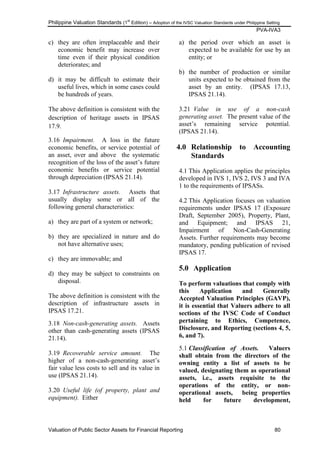
h) office equipment.
When an item is revalued, the entire class
to which it belongs should be revalued in
order to avoid both selective revaluations
and the reporting of a mix of costs and fair
values as at different dates. An asset class
for this purpose is a grouping of assets of a
similar nature and use in an entity‘s
operation.
6.2 Depreciation – IAS 16
6.2.1 IAS 16, paras. 43 – 62, sets out the
requirements for an entity to account for
the depreciation of property, plant and
machinery assets. Valuers may be
requested to allocate value between
different elements of an asset, to advise on
the residual value or to advise on the
future life of an asset.
6.2.2 Elements of cost. Any part of an
item, which has a cost that is significant in
relation to the total cost of the item, has to
be depreciated separately. Where parts
have a similar useful life and will
depreciate at a similar rate, they may be
grouped in determining the depreciation
charge. Valuers may be consequently
requested to allocate a valuation they have
provided to the different component parts
of an asset in order to enable the entity to
depreciate them separately.
6.2.3 Residual Value. The residual value
is deducted from the carrying amount of
the asset to determine the amount the
entity has to depreciate. If the
management policy of the entity involves
disposal after a specific time, the useful
life of an asset may be less than its
economic life. IAS 16, para. 58,
recognizes that land normally has an
unlimited useful life and therefore should
be accounted for separately. It also
Philippine Valuation Standards (1
st
Edition) – Adoption of the IVSC Valuation Standards under Philippine Setting
PVA-IVA1
Valuation for Financial Reporting 65
provides that an increase in the value of
land should not affect the determination of
the depreciable amount of the building.
6.2.4 Future life. A Valuer can advise on
the remaining economic life of the asset.
When reporting the economic life of
buildings, improvements, plant, machinery
and equipment, it should be stated that this
is not necessarily the same as the useful
life to the entity, which is subject to any
policy of the entity on future disposal or
renewal.
6.2.5 Reporting Requirements: When
providing allocations, or estimating the
residual value of an element of an asset
based on an apportionment of the value of
the completes asset, the Valuer should
state that the figures provided are
hypothetical allocations of the value of the
whole item prepared solely for calculating
the appropriate rate of depreciation in the
entity‘s financial statements, and that these
figures should not be relied upon for any
other purpose.
6.3 Alternative Use Value
If an owner-occupied property has
potential for an alternative use, which
would result in its value in isolation from
the business being higher than its value as
part of the cash-generating unit to which it
belongs, the Valuer shall report the Market
Value for that alternative use. A statement
should also be made that the value for the
alternative use takes no account of issues
such as business closure or disruption and
the associated costs that would be incurred
in achieving the alternative use, and that
these should be considered by the entity
when deciding the appropriate amount to
adopt as fair value.
6.4 Specialized Property
Both IVSs and IAS 16 recognize that there
are categories of assets for which market-
based evidence may be unavailable
because of their specialized nature. It
endorses the application of either an
income or depreciated replacement cost
approach to the valuation of these assets.
The choice of approach is not dictated by
the type of asset but by the presence or
absence of market evidence. For further
discussion and guidance on the use of
these approaches see paras. 5.12 and 5.13
of GN 1 and section 5 of GN 8.
6.5 Frequency of Revaluation
Paragraph 31 of IAS 16 states:
―Revaluations shall be made with
sufficient regularity to ensure that the
carrying amount does not differ materially
from that which would be determined
using fair value at the balance sheet date.‖
6.6 IAS 17 – Leased Property, Plant and
Equipment
6.6.1 IAS 17 deals with the accounting for
assets that are held under a lease. All
leases require classification as either
operating leases or finance leases (see
para. 5.6.1 above and Addendum A).
Different accounting treatments apply to
each type of lease. A finance lease is
recorded in a lessee‘s balance sheet as
both an asset and a liability at amounts
equal to the fair value of the asset or, if
lower, the present value of the minimum
lease payments, each determined as at the
inception of the lease. Any initial direct
costs incurred by the lessee are added to
the amount recognized as an asset.
6.6.2 Valuers may be required to advise on
the fair value of the asset at the inception
of the lease to enable a lessee to account
for the asset correctly in accordance with
IAS 17.
6.6.3 Special provisions apply to leases of
land and buildings, IAS 17, para. 14, states
that ―because a characteristic of land is
that it normally has an indefinite economic
life … a lease of land will be an operating
Philippine Valuation Standards (1
st
Edition) – Adoption of the IVSC Valuation Standards under Philippine Setting
PVA-IVA1
Valuation for Financial Reporting 66
lease‖. Where a lease is of land and
buildings, these elements have to be
considered separately for the purposes of
lease classification (IAS 17, para. 15).
Most leases of real property will grant the
lessee rights to occupy both the land and
buildings, following which the interest in
both elements reverts to the lessor. If the
lessee has to maintain the building and
hand it back to the lessor in good repair, it
is probable that both elements will
correctly be classified as operating leases
(see Addendum A). If both elements are
not considered to share the same
classification, the minimum lease
payments (including any initial capital
payment) are allocated between the land
and buildings elements in proportion to the
relative fair values of the leasehold
interests in the two elements at the
inception of the lease. If the lease
payments cannot be reliably allocated the
entire lease is treated as a finance lease,
unless it is clear that both elements are
operating leases (IAS 17, para. 16). This
allocation is not required in the case of a
lessee‘s interest accounted for as
investment property (IAS 17, para. 18).
6.6.4 For further guidance on Leasehold
interests, see Addendum A.
6.7 IAS 40 – Investment Property
6.7.1 IAS 40 defines an investment
property as a property (land or a
building—or part of a building—or both)
held by the owner, or by a lessee under a
finance lease, to earn rentals, or for capital
appreciation or both. It excludes owner-
occupied property used for the production
or supply of goods and services, or for
administrative purposes, and also property
held for sale in the ordinary course of
business.
6.7.1.1 If part of a property is held as an
investment property and part is owner-
occupied, or if the parts could be sold or
leased separately, the parts are accounted
for separately. If the parts could not be
sold separately, the property is an
investment property only if an
insignificant proportion is held for the
production or supply of goods or services
or for administrative purposes (IAS 40,
para. 10).
6.7.1.2 Property leased to a subsidiary or
parent under an inter-company leasing
arrangement does not qualify as
investment property in the consolidated
financial statements of the group, but may
be treated as such in the individual
financial statements of the lessor entity
(IAS 40, para. 15).
6.7.2 Investment Property is measured
initially at cost. After initial recognition
an entity may choose to adopt either:
a) The Fair Value Model. Investment
property should be measured at fair value
and changes recognized in the profit and
loss statement; or
b) The Cost Model. The ―historic‖ cost
model is in accordance with the model
described in IAS 16. An entity that
chooses the (historic) cost model should
nonetheless disclose the fair value of its
investment property.
6.7.2.1 The fair value model is described
in detail in IAS 40, paras. 33 – 55. The
Market Value of the entity‘s interest in the
investment property derived in accordance
with IVS 1 accords with these detailed
requirements. The Market Value will
reflect any current leases, current cash
flows and any reasonable assumptions
about future rental income or outgoings.
6.7.3 Leasehold investment property. A
property held under a lease, rather than
owned outright, and that otherwise meets
the definition of an investment property,
may be accounted for using the fair value
model. If this option is taken for one such
property held under a lease, all property
Philippine Valuation Standards (1
st
Edition) – Adoption of the IVSC Valuation Standards under Philippine Setting
PVA-IVA1
Valuation for Financial Reporting 67
classified as investment property shall be
accounted for using the fair value model
(IAS 40, para. 6).
6.7.3.1 IAS 40, para. 50(d), recognizes
that the fair value of an investment
property held under a lease will reflect the
net income after deduction of future lease
liabilities. Although the entity is required
to add to the reported fair value any
recognized leased liability to arrive at the
carrying amount for accounting purposes,
this does not affect the requirement for the
Valuer to report Market Value.
6.7.3.2 At initial recognition an
investment property held under a lease
shall be accounted for as though it were a
finance lease under IAS 17, para. 20, i.e.,
at the fair value of the property, or if
lower, at the present value of the minimum
lease payments. Any capital sum paid to
acquire the property interest is treated as
part of the minimum lease payments and is
therefore included in the cost of the asset
(IAS 40, para. 25).
6.7.3.3 Subsequent measurement of an
investment property held under an
operating lease requires the fair value
model to be adopted (see para. 6.6.3.1
above).
6.7.4 External Valuations. Entities are
encouraged, but not required, to determine
the fair value of investment property on
the basis of a valuation by an Independent
(External) Valuer who holds a recognized
and relevant professional qualification and
who has recent experience in the location
and category of the investment property
being valued (IAS 40, para. 26).
6.8 Other Requirements under IASs
6.8.1 Portfolios: A collection or
aggregation of properties held by a single
ownership and jointly managed is referred
to as a portfolio. The Market Value of
such assets viewed or treated as a portfolio
or as an assembled group of properties
could exceed or could be less than the sum
of the Market Value of each asset
individually. Where this is the case, it
should be reported separately to the
directors or trustees.
6.8.2 Impairment: An entity is required,
under IAS 36, Impairment of Assets, to
review, at each balance sheet date,
whether there is any indication that a
tangible asset may be impaired.
Impairment might be indicated by, for
example, a reduction in the value of the
asset because of market or technological
changes, obsolescence of the asset, asset
underperformance in comparison to the
expected return, or an intention to
discontinue or restructure operations. If
impairment is considered to have arisen,
the carrying amount of the asset, derived
from either its historic cost or an earlier
valuation should be written down to the
recoverable amount, which is the higher of
the asset‘s value in use or its fair value
less costs to sell. Value in use reflects the
value that the entity will obtain from the
asset throughout its remaining useful life
to the business and its eventual disposal.
Although entity-specific, the valuation
inputs for the value in use of an asset
should be market determined wherever
possible. However, if the value an entity
can obtain from the continued use of an
asset is less than the net proceeds that
could be obtained from its immediate
retirement and disposal, the carrying
amount should reflect this latter figure.
The fair value less costs to sell of an asset
is its Market Value less the reasonably
anticipated selling costs.
6.8.3 Disrupted Markets: When markets
are disrupted or suspended, Valuers must
be vigilant in their analyses as explained in
IVS 1, paragraph 6.5. Under IAS 29,
Financial Reporting in Hyperinflationary
Economies, Valuers may be required to
assess balance sheet value.
Philippine Valuation Standards (1
st
Edition) – Adoption of the IVSC Valuation Standards under Philippine Setting
PVA-IVA1
Valuation for Financial Reporting 68
7.0 Disclosure Requirements
7.1 The Valuer shall make all
disclosures required under IVS 3,
Valuation Reporting.
7.2 For disclosures required under
IFRSs/IASs, see paragraphs 5.4.2, 5.5.1
and 6.1 above.
7.3 The Valuer shall disclose the
regulatory framework and any
departure required from these
Standards to comply with local
legislation, regulation (including
accounting rules), or custom.
8.0 Departure Provisions
8.1 In following this Application any
departures must be in accordance with
directions made in IVS 3, Valuation
Reporting
Philippine Valuation Standards (1
st
Edition) – Adoption of the IVSC Valuation Standards under Philippine Setting
PVA-IVA1
Valuation for Financial Reporting 69
Addendum A
Further Guidance on Lease Accounting
Lease Classification
Land and Building Allocation
Lease Classification
Under IAS 17, leases have to be classified
for inclusion in financial statements as
either operating leases or finance leases:
A finance lease is a lease that transfers
substantially all the risks and rewards
incidental to ownership of an asset. Title
may or may not be eventually transferred.
An operating lease is a lease other than a
finance lease.
The following examples are listed in IAS
17, paras. 10-11, as situations that could
be indicative of a finance lease, either
individually or in combination. These are
not absolute tests but illustrations, i.e., one
or more of these circumstances may arise,
but the lease would still not be classified
as a finance lease if it is clear from the
overall context that substantially all the
risks and rewards of ownership have not
been transferred from the lessor to the
lessee.
a) the lease transfers ownership of the
asset to the lessee by the end of the lease
term;
b) the lessee has the option to purchase
the asset on advantageous terms;
c) the lease term is for the major part of
the economic life of the asset even if title
is not transferred;
d) at the inception of the lease the present
value of the minimum lease payments
amounts to at least substantially all of the
fair value of the leased asset;
e) the leased assets are of such a
specialized nature that only the lessee can
use them without major modifications;
f) if the lessee can cancel the lease, the
lessor‘s losses associated with the
cancellation are borne by the lessee;
g) gains or losses from the fluctuation in
the fair value of the residual accrue to the
lessee;
h) the lessee has the ability to continue
the lease for a secondary period at a rent
that is substantially lower than market
rent.
If it is concluded that substantially all the
risks and rewards of ownership are not
transferred to the lessee, then the lease is
an operating lease.
As classification does involve an
assessment of the degree to which
economic benefits are transferred by a
lease, Valuers are likely to be requested to
provide advice to assist classification by
lessor and lessees. IVSC considers that in
the majority of cases, a qualitative
assessment of the lease terms will quickly
indicate the correct classification without
the need for detailed calculation of the
value of the different lease interests. The
relative values of the lessor‘s and lessee‘s
interests are not a key factor in
classification; the key test is whether the
lessor has transferred substantially all the
risks and rewards of ownership.
Philippine Valuation Standards (1
st
Edition) – Adoption of the IVSC Valuation Standards under Philippine Setting
PVA-IVA1
Valuation for Financial Reporting 70
Land and Building Allocation
Where a lease is of land and buildings
together, IAS 17, para. 15, requires that
the two elements be considered separately
for the purposes of classification. If it
appears that the buildings element could
be a finance lease, it will be necessary to
make an allocation of the initial rent based
on the relative fair value of the leasehold
interests in each element at the inception
of the lease (IAS 17, para. 16).
In most leases of real property, the interest
in the land and buildings is not
distinguishable, and in any event the
interest in both normally reverts to the
lessor at the end of the lease. There are
often provisions for the rent to be
reviewed periodically to reflect changes in
the Market Value of the property and also
an obligation on the lessee to hand the
buildings back to the lessor in good repair.
These are all clear indicators that the
lessor has not transferred substantially all
the risks and rewards of ownership of
either the buildings or the land to the
lessee.
Consequently, finance leases of real
property will generally arise only where
the lease is clearly designed as a way of
funding the eventual purchase of the land,
buildings, or both by the lessee, often by
means of an option to acquire the lessor‘s
interest for a nominal sum after the rental
payments have been made. Occasionally
leases that are not clearly structured as
finance agreements may meet some of the
criteria of a finance lease, for example,
where the rental payments do not reflect
the underlying value of the property. In
those cases a more detailed analysis of the
value of the risks and benefits transferred
may be required in order to confirm or
rebut their classification.
Under IAS 17, para. 17, allocation
between the land and buildings elements
of an investment property held under a
lease in not required. Under IAS 40, even
though the investor may hold the
investment property under an operating
lease, the whole is accounted for as though
it were a finance lease.
Where a lease is of a self-contained plot of
land and the building upon it, allocating
the rent to each element is a task that could
be undertaken reliably where there is an
active market for land for similar
development in the locality. In other
situations, for example where the lease is
part of a multi-let building with no
identifiable land attributable to any
particular lease, reliable allocation may be
impossible. IAS 17, para. 16, recognizes
that such cases can arise and makes the
proviso that where a reliable allocation
cannot be made, the whole lease should be
treated as a finance lease, unless it is clear
that both elements are operating leases. If
it were clear that both elements were
operating leases from the outset, the
allocation exercise would not be
necessary.
In practice, leases of part of a multi-let
building will normally be operating leases
and the whole property will be classified
as investment property by the lessor. In
such cases allocation will be unnecessary.
In cases where the buildings element is
clearly a finance lease, the land element is
likely to be identifiable. It will be
comparatively rare for the buildings
element to meet the criteria for
classification as a finance lease and for the
land element not be clearly identifiable. In
such cases, the Valuer should not attempt
an allocation based on unreliable criteria,
but should advise that the allocation
cannot be reliably made. The entity will
then have to treat the whole as a finance
lease.
Philippine Valuation Standards (1
st
Edition) – Adoption of the IVSC Valuation Standards under Philippine Setting
PVA-IVA2
Valuation for Secured Lending Purposes 71
Valuation for Secured Lending Purposes
1.0 Introduction
1.1 The objective of International
Valuation Application 2 (IVA 2) is to
provide a framework for valuations of
assets that are to be offered or taken as
loan security.
1.2 It is important that Valuers
consistently apply accepted valuation
principles within the scope of these
standards, providing clear, independent
and objective opinions that are relevant to
the needs of valuation users.
2.0 Scope
2.1 This Application applies in all
circumstances where valuations are
required of assets that are, or are proposed
to be, held as security for lending. The
lending may be done by different means,
including mortgage or other forms of fixed
or floating charge.
3.0 Definitions
International Valuation Standards
Definitions
3.1 Market Value. The estimated amount
for which a property should exchange on
the date of valuation between a willing
buyer and willing seller in arm‘s-length
transaction after proper marketing wherein
the parties had each acted knowledgeably,
prudently, and without compulsion (IVS 1,
para. 3.1).
3.2 Mortgage. A pledge of an interest in
property as security or collateral for
repayment of a loan with provision for
redemption on repayment. In the event the
borrower (mortgagor) defaults, the lender
(mortgagee) has the power to recover the
property pledged.
3.3 Specialized Property. A property that
is rarely if ever sold in the market, except
by way of sale of the business or entity of
which it is part, due to uniqueness arising
from its specialized nature and design, its
configuration, size, location, or otherwise.
3.4 Trade Related Property. Certain
classes of real property, which are
designed for a specific type of business
and that are normally bought and sold to
the market, having regard to their trading
potential.
European Union Legislation Definition
3.5 Mortgage Lending Value. The value
of the property as determined by a prudent
assessment of the future marketability of
the property taking into account long term
sustainable aspects of the property, the
normal and local market conditions, and
the current use and alternative appropriate
uses of the property. Speculative elements
shall not be taken into account in the
assessment of the mortgage lending value.
The mortgage lending value shall be
documented in a clear and transparent
manner. (This definition is from Directive
2006/48/EC of the European Parliament.)
4.0 Relationship to Accounting
Standards
4.1 A valuation prepared for lending
purposes will not necessarily be the same
as one made for accounting purposes,
particularly one made for financial
reporting purposes. Although a similar
base such as Market Value may be
applicable, the assumptions on which the
valuation is based may be different.
Philippine Valuation Standards (1
st
Edition) – Adoption of the IVSC Valuation Standards under Philippine Setting
PVA-IVA2
Valuation for Secured Lending Purposes 72
4.2 By way of example, the underlying
principle of many valuations for financial
reporting is the presumption that the entity
will continue as a going concern.
However, this would not usually be
appropriate for valuations undertaken for
lending purposes. Such a presumption has
particular implications for specialized
assets where the value and marketability
of the secured property, separate from the
business of which it forms part, may be
limited.
5.0 Application
To perform valuations that comply with
this Application and Generally
Accepted Valuation Principles (GAVP),
Valuers shall adhere to all sections of
the IVS Code of Conduct pertaining to
Ethics, Competence, Disclosure, and
Reporting (sections 4, 5, 6, and 7).
5.1 In performing valuations of
property for lending purposes, Valuers
will normally provide the Market Value
of such property in accordance with
these International Valuation
Standards.
5.2 If the circumstances are such that a
departure from the Market Value basis
is justified, the departure shall be
clearly set out and explained in the
Valuation Report along with the
identification and definition of the
alternative basis used and an
explanation of the reasons for the
departure. If there is a material
difference between the Market Value of
the property and alternative value, this
should be reported.
5.3 The valuation opinion shall be
reported in accordance with IVS 3,
Valuation Reporting.
5.4 In addition to fulfilling the
requirements of IVS 3, Valuation
Reports for secured lending of real
property will normally include
comment where relevant, on the
following items:
5.4.1 current activity and trends in the
relevant market;
5.4.2 historic, current and anticipated
future demand for the category of
property in the locality;
5.4.3 the potential and likely demand
for alternative uses;
5.4.4 both the current marketability of
the property and if requested, the
likelihood of its sustainability;
5.4.5 any impact of foreseeable events
(at the date of valuation) on the value of
the security;
5.4.6 the valuation approach adopted;
and the extent of market-based evidence
in support of the valuation.
5.5 Valuations for lending purposes may
be required on an assumption there has
been a change in the state or condition
of the property, for example, the
assumed development of a new building,
or upgrade of a building. Such a
valuation will normally be provided on
the assumption that the change has
occurred at the valuation date. It is not
a projection of the value at the date in
the future when the change will have
actually occurred. The report must
make it clear that the valuation is based
on the assumption that the change
specified had already been made at the
valuation date. Use of the term Market
Value without a modifier in these
circumstances can be misleading. The
term “Market Value as if complete” is
an example of a suitable modification of
Market Value that may be used in these
circumstances.
Philippine Valuation Standards (1
st
Edition) – Adoption of the IVSC Valuation Standards under Philippine Setting
PVA-IVA2
Valuation for Secured Lending Purposes 73
5.6 A valuation of a property may also
be required on the assumption that an
estimated occupancy level had been
achieved. This should also reflect the
realistic expectations and perceptions of
market participants as at the date of the
report.
5.7 Corporate and individual loans from
banks and other financial institutions
are often secured by specific property
assets. Valuers need to have a general
understanding of the requirements of
such institutions, and possibly the
structure of loan terms and agreements.
Lenders will usually require that the
terms of loan be kept confidential, but
this does not relieve the Valuer of the
obligation to have a general
understanding of the lending process.
6.0 Discussion
6.1 At the outset of an assignment, the
Valuer needs to clearly identify the
property that is to serve as the security.
Particular care is required to distinguish
between property types where real
property and personal property are
combined.
6.2 The manner in which property would
ordinarily trade in the market will
determine the applicability of the various
approaches to assessing Market Value.
Based upon market information, each
approach is a comparative method, and the
use of more than one method may be
required.
6.3 Each relevant valuation method will, if
appropriately and correctly applied, lead to
a similar result. All valuation methods
should be based on market observations.
Construction costs and depreciation, where
they apply, should be determined by
reference to an analysis of market-based
estimates of costs and accumulated
depreciation. The use of an income
method, particularly discounted cash flow
techniques, will also be based on market-
determined cash flows and market-derived
rates of return.
6.4 Occasionally a lender may request a
valuation on a basis other than Market
Value. IVS 2 addresses the types, use and
reporting of some common alternative
bases of valuation. The Valuer should
ensure that an alternative basis is not
confused with Market Value. Although
there may be circumstances where an
alternative basis is appropriate for secured
lending, users of such valuations should be
made aware that such value may not be
realizable if the alternative assumptions
made are no longer applicable.
6.5 Investment Properties
6.5.1 Income-producing properties are
usually valued as individual properties.
Lending institutions may also wish to have
a property assessed as part of a portfolio of
properties. In such instances, the
distinction between the value of the
individual property, assuming it is sold
individually, and its value as part of the
portfolio should be clearly expressed.
6.5.2 Although the Valuer should
comment on the expected demand and
marketability of the property over the life
of the loan (see para. 5.4 above), it is
normally outside the scope of the
valuation exercise to advise on the ability
of a tenant to meet future lease obligations
beyond comment on the market‘s current
perception of the tenant‘s quality.
6.6 Owner-Occupied Properties
6.6.1 Owner-occupied properties valued
for lending purposes will normally be
valued on the assumption that the property
is transferred unencumbered by the
owner‘s occupancy, i.e., that the buyer is
entitled to full legal control and
Philippine Valuation Standards (1
st
Edition) – Adoption of the IVSC Valuation Standards under Philippine Setting
PVA-IVA2
Valuation for Secured Lending Purposes 74
possession. This does not preclude
consideration of the existing owner as part
of the market, but it does require that any
special advantage attributable to the
owner‘s occupancy, which may be
reflected in a valuation of the business, be
excluded from the valuation.
6.7 Leases Between Related or Connected
Parties
6.7.1 Caution is required where property
offered as security is subject to a lease to a
party connected to the borrower. If the
Valuer considers that the lease creates a
more favorable income stream than would
be obtainable on a letting to an
unconnected third party in an arm‘s-length
transaction, the lender should be alerted
and it may be appropriate to disregard the
existence of the lease in a valuation of the
property as security.
6.8 Sales Incentives
6.8.1 It is not uncommon for a seller of
property, especially developers of real
property, to offer incentives to buyers.
Examples of such incentives include rental
income guarantees, contributions to the
buyer‘s removal or fitting out costs, or the
supply of personal property such as
furnishings or equipment. Market Value
ignores any price inflated by special
considerations or concessions (IVS 1,
para. 3.2.1). It may also be appropriate to
alert the lender as to the effect that any
incentives being offered have on the actual
selling prices achieved.
6.9 Specialized Properties
6.9.1 Specialized properties by definition
may have limited marketability and
significant value only as part of a business
(see Concepts Fundamental to Generally
Accepted Valuation Principles, para. 8.2).
For loan security purposes, such properties
will normally be valued on a vacant
possession basis (see para. 6.6.1 above)
and a valuation based on the highest and
best use alternative use is usually
applicable. This will involve
consideration of the costs and risks that
would be involved in achieving that use.
Lenders may not consider specialized
property to be suitable as a security for
lending purposes.
6.9.2 A valuation may be required of a
specialized property where the property is
part of a going-concern business. The
lender should be alerted to the valuation
being dependent on the continuing
profitability (or otherwise) of the going
concern. If the value on a vacant
possession basis is potentially lower, this
should be drawn to the attention of the
lender.
6.10 Trade Related Properties
6.10.1 Certain classes of property,
including but not limited to hotels and
other trading businesses, where the
property is approved and purpose-
designed for only that use, are usually
valued based on profitability but excluding
Personal Goodwill (see GN 12, para.
3.3.2). In such cases, the lender should be
made aware of the significant difference in
value that may exist between an operating
concern and a non-operating concern
where the business is closed, the inventory
is removed, licenses (and other intangible
assets such as certificates, franchise
agreements, or permits) are removed or are
in jeopardy, and any other circumstances
exist that may impair future profitability
and value.
6.10.2 If the income from a property is
critically dependent on a tenant or tenants
from a single sector or industry or some
other factor, which could cause future
income instability, the Valuer should
address these factors in the Valuation
Report. In certain cases, an assessment of
Philippine Valuation Standards (1
st
Edition) – Adoption of the IVSC Valuation Standards under Philippine Setting
PVA-IVA2
Valuation for Secured Lending Purposes 75
the value of the property based on an
alternative use, assuming vacant
possession, may be appropriate.
6.11 Development Properties
6.11.1 Properties held for redevelopment
or sites intended for development of
buildings should be valued taking into
account existing and potential
development entitlements and controls.
Any assumptions as to planning issues and
other material factors must be reasonable,
validated by market behavior and
explicitly stated in the Valuation Report.
6.11.2 The approach to the valuation of
development properties will depend on the
state of development of the property at the
date of valuation and may take into
account the degree to which the
development is pre-sold or pre-leased.
The valuation approach may need to be
discussed with the lender prior to
undertaking the valuation. Care should be
taken by the Valuer to:
6.11.2.1 make a reasoned estimate of the
development period from the date of
valuation. The effect of additional
development requirements on costs and
revenues, using present value discounting
where appropriate, will be reflected in the
analysis;
6.11.2.2 evaluate as far as is possible at
the date of valuation, market behavior
during the period of the development;
6.11.2.3 consider and outline the risks
associated with the development; and
6.11.2.4 consider and disclose any known
special relationships between the parties
involved in the development.
6.12 Wasting Assets
6.12.1 Specific lending issues arise in
relation to the valuation of wasting assets
such as mines or quarries. The lender‘s
attention needs to be drawn to the risk
associated with this type of a wasting asset
and the planned program for its extraction
or use.
6.12.2 Property rental that exceeds the
current market or economic rent may
constitute a wasting asset because any
value attributable to this factor diminishes
as the term of the lease decreases.
6.13 The Valuer
6.13.1 The nature and scope of the
Valuer‘s engagement should be clear to
the Valuer and user of the valuation.
Valuers should be aware of the risk
associated with valuations for lending
purposes where miscommunication,
misunderstanding or error may lead to a
dispute or litigation between the lender
and the Valuer.
6.13.2 In some jurisdictions financial
services legislation requires licencing or
registration of advisers when advice is
related not only to the value of property,
but also to securities issues such as equity,
participatory interests, collective
investment schemes, or syndicated loans.
Valuers may be restricted in the advice
they can provide in these jurisdictions.
6.13.3 In undertaking the valuations for
lending purposes, it is particularly
important that the Valuer be independent
of the borrower.
6.13.4 It is important that the Valuer
possess appropriate experience in relation
to the particular property type and locale
for the property involved, or if not, seek
expert assistance.
Philippine Valuation Standards (1
st
Edition) – Adoption of the IVSC Valuation Standards under Philippine Setting
PVA-IVA2
Valuation for Secured Lending Purposes 76
6.14 Forced Sales and Limited Marketing
or Disposal Periods
6.14.1 Lending institutions may request
valuations on a forced, or liquidation, sale
basis or impose a time limit for disposal of
the security. Because the impact of a
constraint on the price obtainable will
depend upon the specific circumstances
under which the sale takes place, it is not
realistic for the Valuer to speculate on a
price that could be obtained without either
knowledge of the reasons for the
constraint, or the circumstances under
which the property might be offered for
sale. An alternative valuation may be
provided based on defined assumptions,
but the Valuer should draw the lender‘s
attention to the fact that this opinion is
valid only at the valuation date, and may
not be relied upon in the event of a future
default, when both market conditions and
the sale circumstances may be different.
6.15 Lenders‟ Solvency Ratios
6.15.1 Major banks and other lenders are
normally subject to regulations that limit
the total amount they can lend as a
proportion of the lenders‘ assets, known as
the solvency ratio. In the International
context, the Basle II Accord sets out rules
for the minimum solvency ratios to be
maintained by lending institutions and
how those ratios are to be calculated. The
value of assets over which the lender holds
security is used in calculating the solvency
ratio.
6.15.2 In exceptional circumstances for
well-developed and long-established
markets, the Basle II Accord requires the
estimation of the Market Value and
Mortgage Lending Value of a security
backed by commercial real estate. A
preferential risk weight of 50% is assigned
to the tranche of a secured loan that does
not exceed the lower of 50% of the Market
Value or 60% of the Mortgage Lending
Value.
6.15.3 Mortgage Lending Value is a
long-term, risk assessment technique. As
such, it is not a basis of value. MLV is a
technique that is primarily used by banks
in a number of European countries.
Further information on Mortgage Lending
Value is available on the IVSC website.
7.0 Disclosure Requirements
7.1 In reporting Market Value for
lending security purposes, the Valuer
shall make all disclosures required
under IVS 3, Valuation Reporting.
7.2 The basis of Valuer‟s engagement is
to be clearly set out in any reports to be
used by third parties. All reports
should be presented in a way that would
not be considered by a reasonable
person to be misleading.
7.3 The Valuer shall disclose the
regulatory framework and any
departure required from these
Standards to comply with local
legislation, regulation, or custom.
8.0 Departure Provisions
8.1 In following this Application any
departures must be in accordance with
directions provided in IVS 3, Valuation
Reporting.
Philippine Valuation Standards (1
st
Edition) – Adoption of the IVSC Valuation Standards under Philippine Setting
PVA-IVA3
Valuation of Public Sector Assets for Financial Reporting 77
Valuation of Public Sector Assets for Financial Reporting
1.0 Introduction
1.1 Public sector assets are those assets
owned and/or controlled by governmental
or quasi-governmental entities to provide
goods or services to the general public.
The principles that apply to the valuation
of public sector assets are essentially the
same as for any other assets.
1.2 The valuation of public sector assets
may be undertaken for a range of purposes
including financial reporting, privatization
planning, loan origination, bond issuance,
and cost-benefit or economic analyses
performed by governments and quasi-
government entities either to determine
whether a public sector asset is being used
and managed efficiently or to set pricing
for monopoly services.
1.3 The International Federation of
Accountants‘ International Public Sector
Accounting Standards Board (IPSASB)
develops accounting standards for public
sector entities, referred to as International
Public Sector Accounting Standards
(IPSASs). IPSASs, which apply to accrual
accounting, are based on the International
Financial Reporting Standards (IFRSs),
issued by the International Accounting
Standards Board (IASB). IPSASs cover
public sector specific financial reporting
issues, some of which are not addressed by
IFRSs.
1.4 IVA 1 generally addresses the
application of valuation bases to
accounting principles in the context of
IFRSs. Because of parallels between
IPSASs and IFRSs, this Application
necessarily repeats some of the content of
IVA 1 while also addressing the specific
requirements for the valuation of public
sector assets and their treatment in
financial reporting.
1.5 Property in the public sector comprises
conventional cash-generating and non-
cash-generating property assets as well as
specialized property assets, including
heritage and conservation assets,
infrastructure assets, public buildings,
public utility plants, and recreational
assets. As with private sector assets,
public sector assets fall into operational
and non-operational categories. Non-
operational assets include investment and
surplus assets.
2.0 Scope
2.1 This Application applies to all
valuations of public sector asset classes,
included in any financial statement, which
fall within the skills and expertise of
Valuers (with the exception of valuations
of Government Business Enterprises or
GBEs that are performed according to
IVA 1).
2.2 IVSs facilitate cross-border
transactions and the viability of global
markets through harmonization and
transparency in financial reporting. As
such, this Application is developed in the
context of International Public Sector
Accounting Standards (IPSASs). In
September 2005, the IPSAS Board issued
an Exposure Draft of eleven IPSASs that
had been updated to converge with the
amended International Accounting
Standards issued by IASB in December
2003 as part of its General Improvements
Project. This Application is developed in
the context of the proposed revisions to
IPSASs contained within this Exposure
Draft.
2.3 IPSASs and IFRSs adopt two models
for the recognition of property assets in the
balance sheet: a cost model, and a fair
value model. Where the fair value model
is applied, a current revaluation of the
Philippine Valuation Standards (1
st
Edition) – Adoption of the IVSC Valuation Standards under Philippine Setting
PVA-IVA3
Valuation of Public Sector Assets for Financial Reporting 78
asset is required and this Application
focuses on these particular circumstances
where Market Values are to be reported.
2.4 Legislative, regulatory, accounting, or
jurisprudence requirements may require
the modification of this Application in
some countries or under certain
conditions. Any departure due to such
circumstances must be referred to and
clearly explained in the Valuation Report.
3.0 Definitions
International Valuation Standards
Definitions
3.1 Depreciated Replacement Cost. The
current cost of replacing an asset with its
modern equivalent asset less deductions
for physical deterioration and all relevant
forms of obsolescence and optimization.
3.2 Market Value. The estimated amount
for which a property should exchange on
the date of valuation between a willing
buyer and willing seller in an arm‘s-length
transaction after proper marketing wherein
the parties had each acted knowledgeably,
prudently, and without compulsion (IVS 1,
para. 3.1).
3.3 Obsolescence. A loss in value due to a
decrease in the usefulness of property
caused by decay, changes in technology,
people‘s behavioral patterns and tastes, or
environmental changes. Obsolescence is
sometimes classified according to items of
outmoded design and functionality, items
with structural design unable to meet
current code requirements, and factors
arising outside the asset, such as changes
in user demand.
3.4 Optimization. The process by which a
least cost replacement option is
determined for the remaining service
potential of an asset. It is a process of
adjusting the replacement cost to reflect
that an asset may be technically obsolete
or over-engineered, or the asset may have
a greater capacity than that required.
Hence optimization minimizes, rather than
maximizes, a resulting valuation where
alternative lower cost replacement options
are available.
3.5 Public Building. A building that
serves some community or social function
and is held in public ownership. Examples
include courthouses, municipal centers,
schools, prisons, police stations, military
facilities, libraries, hospitals, clinics, and
social or public housing.
3.6 Public sector asset. An asset, owned
and/or controlled by a governmental or
quasi-governmental entity, for the
provision of some public service or good.
Public sector assets comprise different
asset types, including conventional assets
as well as heritage and conservation assets,
infrastructure assets, public utility plants,
recreational assets, and public buildings
(e.g., military facilities), each category of
which constitutes property, plant and
equipment within the meaning of IPSASs
and IFRSs.
Public sector assets typically include:
a) assets, which have atypical tenure, are
irreplaceable, are non-cash-generating,
or provide goods or services in the
absence of any market competition;
b) land with restrictions on its sale or
leasing; and
c) land, which is designated for a
specialized use that is not necessarily
its highest and best use.
See also Heritage assets, Infrastructure
assets, Public building, Public utility, and
Recreational assets.
3.7 Public Utility. A property that:
Philippine Valuation Standards (1
st
Edition) – Adoption of the IVSC Valuation Standards under Philippine Setting
PVA-IVA3
Valuation of Public Sector Assets for Financial Reporting 79
a) produces a service or good for general
public consumption; and
b) is usually a monopoly or quasi-
monopoly provider subject to some
form of governmental control.
3.8 Recreational assets. Properties held
in public ownership that:
a) are managed by or on behalf of
national, municipal, or local
governmental authorities; and
b) provide for recreational use by the
general public.
Examples include parks; playgrounds;
greenbelts; walks and trails; swimming
pools; playing courts; fields and courses;
and other properties equipped with
recreational and athletic facilities.
3.9 Service potential. The capacity of an
asset to continue to provide goods and
services in accordance with the entity‘s
objectives.
3.10Value of improvements. The value
added to the land by improvements such as
buildings, structure or modifications to the
land, of a permanent nature, involving
expenditures of labor and capital, and
intended to enhance the value or utility of
the property. Improvements have
differing patterns of use and economic
lives.
International Public Sector Accounting
Standards Definitions
3.11 Cash-Generating Assets. Assets
held to generate a commercial return.
(IPSAS 21.14).
3.12 Depreciable Amount. The cost of an
asset, or other amount substituted for cost,
less its residual value (IPSAS 17.13).
3.13 Depreciation. The systematic
allocation of the depreciable amount of an
asset over its useful life (IPSAS 17.13,
IPSAS 21.14).
3.14 Government business enterprise
(GBE). An entity that has all of the
following characteristics:
a) is an entity with the power to contract
in its own name;
b) has been assigned the financial and
operational authority to carry on a
business;
c) sells goods and services, in the normal
course of its business, to other entities
at a profit or full cost recovery;
d) is not reliant on continuing
government funding to be a going
concern (other than purchases of
outputs at arm‘s length); and
e) is controlled by a public service entity.
(IPSAS 21.14).
3.15 Heritage assets. Assets having some
cultural, environmental or historical
significance. Heritage assets may include
historical buildings and monuments,
archeological sites, conservation areas and
nature reserves, and works of art. Heritage
assets often display the following
characteristics (although these
characteristics are not necessarily limited
to heritage assets):
a) their economic benefit in cultural,
environmental, educational and
historic terms is unlikely to be fully
reflected in a financial value based
purely on market price;
b) legal and/or statutory obligations may
impose prohibitions or severe
restrictions on disposal by sale;
Philippine Valuation Standards (1
st
Edition) – Adoption of the IVSC Valuation Standards under Philippine Setting
PVA-IVA3
Valuation of Public Sector Assets for Financial Reporting 80
c) they are often irreplaceable and their
economic benefit may increase over
time even if their physical condition
deteriorates; and
d) it may be difficult to estimate their
useful lives, which in some cases could
be hundreds of years.
The above definition is consistent with the
description of heritage assets in IPSAS
17.9.
3.16 Impairment. A loss in the future
economic benefits, or service potential of
an asset, over and above the systematic
recognition of the loss of the asset‘s future
economic benefits or service potential
through depreciation (IPSAS 21.14).
3.17 Infrastructure assets. Assets that
usually display some or all of the
following general characteristics:
a) they are part of a system or network;
b) they are specialized in nature and do
not have alternative uses;
c) they are immovable; and
d) they may be subject to constraints on
disposal.
The above definition is consistent with the
description of infrastructure assets in
IPSAS 17.21.
3.18 Non-cash-generating assets. Assets
other than cash-generating assets (IPSAS
21.14).
3.19 Recoverable service amount. The
higher of a non-cash-generating asset‘s
fair value less costs to sell and its value in
use (IPSAS 21.14).
3.20 Useful life (of property, plant and
equipment). Either
a) the period over which an asset is
expected to be available for use by an
entity; or
b) the number of production or similar
units expected to be obtained from the
asset by an entity. (IPSAS 17.13,
IPSAS 21.14).
3.21 Value in use of a non-cash
generating asset. The present value of the
asset‘s remaining service potential.
(IPSAS 21.14).
4.0 Relationship to Accounting
Standards
4.1 This Application applies the principles
developed in IVS 1, IVS 2, IVS 3 and IVA
1 to the requirements of IPSASs.
4.2 This Application focuses on valuation
requirements under IPSAS 17 (Exposure
Draft, September 2005), Property, Plant,
and Equipment; and IPSAS 21,
Impairment of Non-Cash-Generating
Assets. Further requirements may become
mandatory, pending publication of revised
IPSAS 17.
5.0 Application
To perform valuations that comply with
this Application and Generally
Accepted Valuation Principles (GAVP),
it is essential that Valuers adhere to all
sections of the IVSC Code of Conduct
pertaining to Ethics, Competence,
Disclosure, and Reporting (sections 4, 5,
6, and 7).
5.1 Classification of Assets. Valuers
shall obtain from the directors of the
owning entity a list of assets to be
valued, designating them as operational
assets, i.e., assets requisite to the
operations of the entity, or non-
operational assets, being properties
held for future development,
Philippine Valuation Standards (1
st
Edition) – Adoption of the IVSC Valuation Standards under Philippine Setting
PVA-IVA3
Valuation of Public Sector Assets for Financial Reporting 81
investment, or assets surplus to the
operations of the entity.
5.2 Applicable Standards. The
classification of assets determines which
IPSAS applies. IPSAS 17, paras. 26 and
27, requires non-current property, plant
and equipment assets held for the
production or supply of goods or
services to be measured upon
recognition at cost, or where an item is
acquired through a non-exchange
transaction, its cost shall be measured at
its fair value at the date of acquisition.
IPSAS 17, para. 42 requires that after
recognition, such assets be carried in
accordance with either the cost model
or revaluation (fair value) model
described in 5.3. Other accounting
standards that require or permit the
valuation of tangible assets include:
 Leases – IPSAS 13
 Investment Property – IPSAS 16
 Impairment of Non-Cash
Generating Assets – IPSAS 21
5.3 IPSAS 17, Cost and Fair Value
5.3.1 IPSAS 17 deals with the cost
model in paragraph 43 as follows:
“After recognition as an asset, an item
of property, plant and equipment shall
be carried at its cost less any
accumulated depreciation and any
accumulated impairment losses.”
5.3.2 The fair value model, which
requires regular revaluations, is
explained in paragraph 44 as follows:
“After recognition as an asset, an item
of property, plant and equipment whose
fair value can be measured reliably
shall be carried at a revalued amount,
being its fair value at the date of the
revaluation less any subsequent
accumulated depreciation and
subsequent accumulated impairment
losses. Revaluations shall be made with
sufficient regularity to ensure that the
carrying amount does not differ
materially from that which would be
determined using fair value at the
reporting date.”
5.3.3 Fair value is not necessarily
synonymous with Market Value. It is
used throughout IPSASs in differing
contexts.
5.3.4 Financial statements are produced
on the assumption that the entity is a
going concern unless management
either intends to liquidate the entity or
cease operation, or has no realistic
alternative but to do so. This
assumption therefore underlies the
application of fair value to property,
plant and equipment, except in cases
where it is clear that there is either an
intention to dispose of a particular asset
or that option of disposal has to be
considered, e.g., when undertaking an
impairment review.
5.4 Valuations under IPSAS 17
Where an entity adopts the fair value
revaluation option under IPSAS 17, the
assets are included in the balance sheet
at their fair value as follows:
a) “The fair value of items of property
is usually determined from market-
based evidence by appraisal. The
fair value of items of plant and
equipment is usually their Market
Value determined by appraisal”
(IPSAS 17, para. 45).
b) “If no market evidence is available
to determine the Market Value in an
active and liquid market of an item
of property, the fair value of the
item may be established by reference
to other items with similar
Philippine Valuation Standards (1
st
Edition) – Adoption of the IVSC Valuation Standards under Philippine Setting
PVA-IVA3
Valuation of Public Sector Assets for Financial Reporting 82
characteristics, in similar
circumstances and location…”
(IPSAS 17, para. 47).
c) “If there is no market-based
evidence of fair value because of the
specialized nature of the item of
plant and equipment, an entity may
need to estimate fair value using …
depreciated replacement cost, or the
restoration cost or service unit
approaches…” (IPSAS 17, para. 48).
(See paras. 6.5, 6.6, and 6.7 below.)
5.4.1 IVSC considers that a professional
Valuer undertaking an appraisal under
5.4 (a) to (c) above should report the
Market Value of the asset. Any
assumptions or qualifications made in
applying Market Value should be
discussed with the entity and disclosed
in the report.
Where a reliable assessment of Market
Value is not possible, the Valuer must
disclose the basis for this conclusion to
the reporting entity.
5.4.2 The valuation conclusion shall be
reported in accordance with IVS 3,
Valuation Reporting. Valuers shall
ensure that reports include sufficient
information for the entity to meet the
requirements of IPSAS 17, para. 92,
when preparing financial statements:
a) the effective date of the revaluation;
b) whether an Independent Valuer was
involved (Note, IVSC interprets this
as an External Valuer);
c) the methods applied and significant
assumptions made …; and
d) the extent to which the asset‟s fair
values were determined directly by
reference to observable prices in an
active market or recent market
transactions on arm‟s length terms,
or were estimated using other
valuation techniques.
5.5 Valuations under IPSAS 16 –
Investment Property
All public sector investment property is
valued in accordance with IVA 1.
5.6 Valuation Requirements for Leased
Assets – IPSAS 13
5.6.1 Leased assets are classified under
IPSAS 13 as either finance leases or
operating leases. (For further
explanation, see IVA 1, para. 6.6.1 and
Addendum A.) If a lease is classified as
a finance lease, the fair value of the
asset is required to establish the amount
of the asset and liability recorded by the
entity on its balance sheet (IPSAS 13,
para. 20).
5.6.2 For leases of land and buildings
special rules apply. (See IVA 1, para.
6.6.3.) For all property, other than
investment property, land and buildings
have to be considered separately for
classification as either a finance lease or
an operating lease.
5.6.3 IVSC considers that in each case
the requirement to establish the fair
value of the leased asset under IPSAS
13, para. 28, is met by the Valuer
reporting the Market Value. For leases
of real estate, this is the Market Value of
the lease interest held by the lessee.
For leases of other assets, it is normally
the Market Value of the asset
unencumbered by the lease, as the
liability is recorded separately.
5.7 Valuation of Impaired Non-Cash
Generating Assets – IPSAS 21
5.7.1 Impairment arises where there is a
permanent decrease in the recoverable
service amount of an asset below its
Philippine Valuation Standards (1
st
Edition) – Adoption of the IVSC Valuation Standards under Philippine Setting
PVA-IVA3
Valuation of Public Sector Assets for Financial Reporting 83
carrying amount. IPSAS 21, para. 48,
requires that if, and only if, the
recoverable service amount of an asset
is less than its carrying amount, the
carrying amount of the asset shall be
reduced to its recoverable service
amount. That reduction is an
impairment loss. IPSAS 21, para. 51,
further states that when the amount
estimated for an impairment loss is
greater than the carrying amount of the
asset to which it relates, an entity shall
recognize a liability if, and only if, that
is required by another IPSAS.
5.7.2 The entity is required to write
down the carrying amount of impaired
cash-generating assets to the higher of
their value in use or fair value less costs
to sell. The requirements for cash-
generating assets are discussed further
in IVA 1, para. 6.8.2.
5.8 Valuations after Business
Combinations
5.8.1 Where a governmental or quasi-
governmental entity acquires or is
merged with another, the acquirer has
to account for the assets and liabilities
of the acquiree at their fair value as of
the acquisition date. For identifiable
assets and liabilities, IVSC considers
that the Valuer should report their
Market Value as they existed at the date
of acquisition.
5.9 Surplus Assets
5.9.1 Surplus assets are to be separately
identified. Such assets may be
accounted for individually or as a
“disposal group”, i.e., a group of assets
to be disposed of together, by sale or
otherwise, and the liabilities directly
associated with those assets that will
also be transferred in the transaction.
Surplus assets are to be initially
accounted for at the lower of the
carrying amount and the fair value less
costs to sell, and subsequently at fair
value less cost to sell. Valuers should
therefore ascertain whether surplus
assets are to be valued as individual
items, or as a group or portfolio of
assets that will be disposed of in a single
transaction, and report the Market
Value with the appropriate
assumptions.
5.10 Properties Held for Sale in the
Ordinary Course of Business – IPSAS 12
Inventories
5.10.1 Valuations of properties held for
sale in the ordinary course of business
should comply with the requirements of
IPSAS 12, Inventories. These
properties are measured at the lower of
cost and net realizable value. Net
realizable value is the estimated selling
price in the ordinary course of
operations less the estimated costs of
completion and the estimated costs
necessary to make the sale, exchange or
distribution.
5.11 Selling Costs
5.11.1 When instructed to value
impaired or surplus assets, or assets
that are held for sale in the ordinary
course of business, the Valuer must
report their Market Value without
deducting selling costs. If the client
requests the Valuer to advise on the
costs to sell the assets, such costs are to
be reported separately.
5.12 Non-Agricultural Biological Assets
5.12.1 These include naturally
occurring flora and fauna. The Valuer
should value these assets in accordance
with the guidance in GN 10.
5.13 Co-operation with Auditors.
Subject to first obtaining the consent of
their client, Valuers shall discuss and
Philippine Valuation Standards (1
st
Edition) – Adoption of the IVSC Valuation Standards under Philippine Setting
PVA-IVA3
Valuation of Public Sector Assets for Financial Reporting 84
explain their valuations openly with the
entity‟s auditors.
6.0 Discussion
IPSAS 17 and 21 provide the following
clarification, which is useful in
understanding the correct application for
public sector accounting.
6.1 Absence of Market Evidence – IPSAS
17
“For some public sector assets, it may be
difficult to establish their Market Value
because of the absence of market
transactions for these assets. Some public
sector entities may have significant
holdings of these assets‖. (IPSAS 17,
para. 46).
6.1.1 ―If no market evidence is available to
determine the Market Value in an active
and liquid market of an item of property,
the fair value of the item may be
established by reference to other items
with similar characteristics, in similar
circumstances and location. For example,
the fair value of vacant government land
that has been held for a long period during
which time there have been few
transactions may be estimated by reference
to the Market Value of land with similar
features and topography in a similar
location for which market evidence is
available. In the case of specialized
buildings and other man-made structures,
fair value may be estimated by using
depreciated replacement cost, or the
restoration cost or the service units
approach (see IPSAS 21). In many cases,
the depreciated replacement cost of an
asset can be established by reference to the
buying price of similar asset with similar
remaining service potential in an active
and liquid market. In some cases, an
asset‘s reproduction cost will be the best
indicator of its replacement cost. For
example, in the event of loss, a parliament
building may be reproduced rather than
replaced with alternative accommodation
because of its significance to the
community‖. (IPSAS 17, para. 47)
6.1.2 ―If there is no market-based evidence
of fair value because of the specialized
nature of the item of plant and equipment,
an entity may need to estimate fair value
using depreciated replacement cost, or the
restoration cost or service units approaches
(see IPSAS 21). The depreciated
replacement cost of an item of plant or
equipment may be established by
reference to the market buying price of
components used to produce the assets or
indexed price for the same or similar asset
based on a price for a previous period.
When an indexed price method is used,
judgment is required to determine whether
technology has changed significantly over
the period, and whether the capacity of the
reference asset is the same as the asset
being valued‖. (IPSAS 17, para. 48).
6.2 Government Business Enterprises
(GBEs) – IPSAS 21
“GBEs include both trading enterprises,
such as utilities, and financial enterprises,
such as financial institutions. GBEs are, in
substance, no different from entities
conducting similar activities in the private
sector. GBEs generally operate to make
profit, although some may have limited
community service obligations under
which they are required to provide some
individuals and organizations in the
community with goods and services at
either no charge or a significantly reduced
charge‖. (IPSAS 21, para. 15).
Philippine 6.2.1
GBEs comprise the Government Owned
and Controlled Corporations (GOCCs) and
Government Financial Institutions (GFIs)
of the National Government and Economic
Enterprises (EEs) of the Local
Government Units.
Philippine Valuation Standards (1
st
Edition) – Adoption of the IVSC Valuation Standards under Philippine Setting
PVA-IVA3
Valuation of Public Sector Assets for Financial Reporting 85
6.3 Cash-Generating Assets – IPSAS 21
―Cash-generating assets are those that are
held to generate a commercial return. An
asset generates a commercial return when
it is deployed in a manner consistent with
that adopted by a profit-oriented entity.
Holding an asset to generate a
‗commercial return‘ indicates that an
entity intends to generate positive cash
inflows from the asset (or of the unit of
which the asset is a part) and earn a return
that reflects the risk involved in holding
the asset‖. (IPSAS 21, para. 16)
―Assets held by GBEs are cash-generating
assets. Public sector entities other than
GBEs may hold assets to generate a
commercial return. For the purposes of
this Standard [IPSAS 21], an asset held by
a non-GBE public sector entity is
classified as a cash-generating asset if the
asset (or unit of which the asset is a part)
is operated with the objective of
generating a commercial return through
the provision of goods and or services to
external parties‖. (IPSAS 21, para. 17).
6.4 Value in Use – IPSAS 21
―The value in use of a non-cash generating
asset is the present value of the asset‘s
remaining service potential. ‗Value in use‘
in this Standard [IPSAS 21] refers to
‗value in use of a non-cash-generating
asset‘ unless otherwise specified. The
present value of the remaining service
potential of the asset is determined using
any one of the approaches identified in
paragraph 41 to 45, as appropriate‖.
(IPSAS 21, para. 40).
6.5 Depreciated Replacement Cost
Approach – IPSAS 21
―Under this approach, the present value of
the remaining service potential of an asset
is determined as the depreciated
replacement cost of the asset. The
replacement cost of an asset is the cost to
replace the asset‘s gross service potential.
This cost is depreciated to reflect the asset
in its used condition. An asset may be
replaced either through reproduction
(replication) of the existing asset or
through replacement of its gross service
potential. The depreciated replacement
cost is measured as the reproduction or
replacement cost of the asset, whichever is
lower, less accumulated depreciation
calculated on the basis of such cost, to
reflect the already consumed or expired
service potential of the asset‖. (IPSAS 21,
para. 41).
―The replacement cost and reproduction
cost of an asset are determined on an
‗optimized‘ basis. The rationale is that the
entity would not replace or reproduce the
asset with a like asset if the asset to be
replaced or reproduced is an overdesigned
or overcapacity asset. Overdesigned
assets contain features which are
unnecessary for the goods or services the
asset provides. Overcapacity assets are
assets that have a greater capacity than is
necessary to meet the demand for goods or
services the asset provides. The
determination of the replacement cost or
reproduction cost of an asset on an
optimized basis thus reflects the service
potential required of the asset‖. (IPSAS
21, para. 42).
―In certain cases, standby or surplus
capacity is held for safety or other reasons.
This arises from the need to ensure that
service capacity is available in the
particular circumstances of the entity. For
example, the fire department needs to have
fire engines on standby to deliver services
in emergencies. Such surplus or standby
capacity is part of the required service
potential of the asset‖. (IPSAS 21, para.
43).
6.6 Restoration Cost Approach – IPSAS 21
―Restoration cost is the cost of restoring
the service potential of an asset to its pre-
impaired level. Under this approach, the
present value of the remaining service
Philippine Valuation Standards (1
st
Edition) – Adoption of the IVSC Valuation Standards under Philippine Setting
PVA-IVA3
Valuation of Public Sector Assets for Financial Reporting 86
potential of the asset is determined by
subtracting the estimated restoration cost
of the asset from the current cost of
replacing the remaining service potential
of the asset before impairment. The latter
cost is usually determined as the
depreciated reproduction or replacement
cost of the asset whichever is lower‖.
(IPSAS 21, para. 44).
6.7 Service Units Approach – IPSAS 21
―Under this approach, the present value of
the remaining service potential of the asset
is determined by reducing the current cost
of the remaining service potential of the
asset before impairment to conform with
the reduced number of service units
expected from the asset in its impaired
state. As in the restoration cost approach,
the current cost of replacing the remaining
service potential of the asset before
impairment is usually determined as the
depreciated reproduction or replacement
cost of the asset before impairment,
whichever is lower‖. (IPSAS 21, para.
45).
6.8 Other Considerations
6.8.1 Heritage Assets. ―Some heritage
assets have service potential other than
their heritage value, for example, an
historic building being used for office
accommodation. In these cases, they may
be recognized and measured on the same
basis as other items of property, plant and
equipment. For other heritage assets, their
service potential is limited to their heritage
characteristics, for example, monuments
and ruins. The existence of alternative
service potential can affect the choice of
measurement base‖. (IPSAS 17, para. 10)
6.8.2 Non-Agricultural Biological Assets.
Naturally occurring flora and fauna
include special conservation assets, which
may or may not be protected. Some are so
significant that they have international
recognition while others may reflect the
environment in its natural state.
6.8.3 Absence of Free Cash Flows to
Monopolies. Some public sector entities
can be classed as monopolies. While
monopoly service providers often generate
cash flows, these cash flows cannot be
considered reflective of market levels
since there is no market evidence against
which to check the characteristic
circularity of cash flow, yield, and value.
Thus, a critical feature that differentiates
certain classes of public sector assets from
private sector assets is the absence of
―free‖ cash flows to such public sector
entities. In some cases it may be
appropriate to use the cost approach either
as the primary valuation method or as a
cross check to establish that the rate of
return being earned from the assets being
valued is reasonable. This application
does not apply to government business
enterprises (GBEs), which are valued
according to IVA 1.
6.8.4 Test of Adequate Service Potential.
As non-cash generating assets have no free
cash flows to test the adequate profitability
of a public sector asset, the concept of
service potential becomes the test of an
asset‘s performance. Service Potential is a
measure of the suitability of the asset to
continue meeting the objectives of the
entity. This suitability may be assessed by
reference to financial, social or political
considerations. The measurement may be
tangible, for example the number of
visitors to a museum or users of a public
library, or intangible, e.g., the social
benefits of maintaining an otherwise
uneconomic facility in a particular
location.
Where a non-cash-generating asset is
measured by reference to depreciated
replacement cost, it is subject to the test of
adequate service potential in order to
determine whether the asset is impaired.
(Also see GN 8, para. 5.11.)
6.8.5 Frequency of Revaluations.
―Revaluations shall be made with
Philippine Valuation Standards (1
st
Edition) – Adoption of the IVSC Valuation Standards under Philippine Setting
PVA-IVA3
Valuation of Public Sector Assets for Financial Reporting 87
sufficient regularity to ensure that the
carrying amount does not differ materially
from that which would be determined
using fair value at the reporting date…‖
(IPSAS 17, para. 44)
In volatile markets the entity may be
required to revalue annually whereas in
more stable markets revaluations may be
required every three to five years.
7.0 Disclosure Requirements
7.1 The Valuer shall make all
disclosures required under IVS 3,
Valuation Reporting.
7.2 For disclosures required under
International Public Sector Accounting
Standards (IPSASs), see paragraph
5.4.2 above.
7.3 The Valuer shall disclose the
regulatory framework, and any
departure required from these
Standards to comply with local
legislation, regulation (including
accounting rules), or custom.
7.4 When no reliable measurement is
possible, disclosure must be made to the
reporting entity. (See para. 5.4.1 above.)
8.0 Departure Provisions
8.1 In following this Application any
departures must be in accordance with
directions given in IVS 3, Valuation
Reporting.
Philippine Valuation Standards (1
st
Edition) – Adoption of the IVSC Valuation Standards under Philippine Setting
GN1
Real Property Valuation 88
Real Property Valuation
1.0 Introduction
1.1 The International Valuation Standards
Committee‘s (IVSC) Concepts
Fundamental to Generally Accepted
Valuation Principles set forth terms and
concepts that are fundamental to all
valuations. The purpose of Guidance Note
1 (GN 1) is to amplify those fundamentals
so they may be better understood in
valuations of real property.
1.2 Real Property constitutes a substantial
portion of the world‘s wealth. If the
operations of property markets are to be
established on dependable valuations,
there must be generally agreed upon
Standards by which Market Value and
other value types are determined and
reported by Valuers. Correct
understanding and proper application of
these Standards will inevitably promote
the viability of international and domestic
transactions in real property, improve the
relative position of real property among
other investment alternatives, and reduce
the instances of fraud and abuse.
1.3 The term property in a legal sense may
be defined as ownership rather than the
physical entity of land, buildings, and
tangible personal items. In this context,
the IVSC identifies four general property
types:
1.3.1 Real Property (GN 1)
1.3.2 Personal Property (GNs 3, 4, and 5)
1.3.3 Businesses (GN 6)
1.3.4 Financial Interests
1.4 As with other property types, there are
commonly agreed upon and generally
accepted methods for valuing real
property. It is important to the Valuer and
the users of valuation services that proper
methods be thoroughly understood,
competently applied, and satisfactorily
explained. By meeting this objective,
Valuers contribute to the soundness and
reliability of Market Value estimates and,
thereby, the well-being of the markets in
which they practice.
1.5 Promotion of understanding and
avoidance of abuses in the market require
that the Valuer and user of valuation
services carefully distinguish between the
types of property. Failure to do so can
result in improper or ill-advised market
decisions and misrepresentations of
reported values. Over- or under-reporting
of value is a common result where
property types are confused or mixed. The
same is true when terminology is indistinct
or inadequate.
1.6 Real Property Valuers recognize the
complexities of markets and the real estate
bought and sold therein. Differences in
real estate markets and between individual
properties are reflected accurately and
reliably where Generally Accepted
Valuation Principles (GAVP) are
followed.
1.7 In all IVSC member countries, it is
recognized that the valuation of real
property requires special education,
training, and experience. Just as the
emergence of professional valuation
societies at the national level attests to a
market need for competent and highly
ethical Valuers within each country, the
globalization of property markets and the
establishment of IVSC reflect the market
need for Valuers to adopt consistent
methods throughout the world. GN 1,
Real Property, provides an international
framework for the application of generally
accepted methods used for real property
valuation.
Philippine Valuation Standards (1
st
Edition) – Adoption of the IVSC Valuation Standards under Philippine Setting
GN1
Real Property Valuation 89
1.8 The relationship between GNs 6 and
12, pertaining to business and trade related
property (TRP) valuation, and GN 1,
pertaining to real property valuation, must
be clearly understood. Real property is
valued as a distinct ―entity,‖ i.e., as
physical assets to which particular
ownership rights apply. For example, an
office building, a residence, a factory, or
other property types generally incorporate
an underlying land component. Business
or TRP valuation, however, values a
business entity or TRP asset of which real
property may be a component. The
Market Value of real property is always
valued in accordance with International
Valuation Standard 1 (IVS 1). When a
real property value estimate is
incorporated as an element of a business
valuation, it is a Market Value estimate of
the real property. As discussed in GN 1,
this convention is distinct from the
unacceptable practice of purportedly
developing a Market Value estimate for
real property as an allocation of the value
of a going concern.
1.9 It is not the objective of GN 1 to
provide specific Guidance as to how a
given valuation should be performed or to
supersede the qualifications for and
procedures applied by Valuers. These are
addressed within the training programs of
each country. It is the IVSC‘s intent to
establish a framework and requirements
for real property valuation that will serve
to harmonize worldwide valuation
practices.
2.0 Scope
2.1 This GN is provided to assist in the
course of rendering or using real property
valuations.
2.2 Principal elements of GN 1 include
2.2.1 an identification of key terms and
definitions;
2.2.2 a summary of the Valuation Process
and its rationale;
2.2.3 an elaboration on the importance of
principles and concepts;
2.2.4 a discussion of proper disclosure and
reporting requirements;
2.2.5 examples of abuses and
misunderstandings; and
2.2.6 a presentation of real property
Guidance.
2.3 The specific application of quantitative
and qualitative valuation procedures is
beyond the scope of GN 1. It is important
to stress, however, that Valuers are trained
in such procedures, and that the
procedures are included in generally
accepted practices. In application, Valuers
commonly apply several procedures in
each valuation and then reconcile the
results into a final indication of Market
Value or other specified value.
3.0 Definitions
3.1 Concepts Fundamental to Generally
Accepted Valuation Principles defines the
concepts of land and property; real estate,
property, and asset; price, cost, and value;
Market Value; highest and best use, and
utility. The Glossary of Terms further
defines many of the concepts and technical
terms used throughout the Standards and
Guidance Notes. The following
definitions are specific to GN 1 and are
included here for reader convenience.
3.2 Comparable Data. Data generally
used in a valuation analysis to develop
value estimates. Comparable Data relate
to properties that have characteristics
similar to those of the property being
valued (the subject property). Such data
include sale price, rents, income and
expenses, and market-derived
capitalization and yield/discount rates.
Philippine Valuation Standards (1
st
Edition) – Adoption of the IVSC Valuation Standards under Philippine Setting
GN1
Real Property Valuation 90
3.3 Elements of Comparison. Specific
characteristics of properties and
transactions that cause the prices paid for
real estate to vary. Elements of
comparison include, but are not limited to,
the following: property rights conveyed,
financing terms, conditions of sale, market
conditions, location, and physical and
economic characteristics. (See para. 5.22
of this document for a full presentation of
Elements of Comparison.)
3.4 Highest and Best Use. The most
probable use of a property which is
physically possible, appropriately justified,
legally permissible, financially feasible,
and which results in the highest value of
the property being valued. (See Concepts
Fundamental to Generally Accepted
Valuation Principles, section 6.)
3.5 A Market. The environment in which
goods, services and commodities trade
between buyers and sellers through a price
mechanism.
3.6 Market Value. Definitions are
included in Concepts Fundamental to
Generally Accepted Valuation Principles
and International Valuation Standard 1,
section 3. [The estimated amount for
which a property should exchange on the
date of valuation between a willing buyer
and a willing seller in an arm‘s-length
transaction after proper marketing
wherein the parties had each acted
knowledgeably, prudently and without
compulsion.]
3.7 Property Rights. The rights that are
related to the ownership of real estate.
These include the right to develop or not
develop the land, to lease it to others, to
sell it, to give it away, to farm it, to mine
it, to alter its topography, to subdivide it,
to assemble it, to use it for waste disposal,
or to choose to exercise none of these
rights. The combination of these property
rights is sometimes referred to as the
bundle of rights inherent in the ownership
of real estate. Property rights are typically
subject to public or private restrictions
such as easements, rights`-of-ways,
specified development density, zoning and
other restrictions that may encumber the
property.
3.8 Real Estate. Land and all things that
are a natural part of the land, e.g., trees
and minerals, as well as all things that are
attached by people, e.g., buildings and site
improvements. All permanent building
attachments such as plumbing, heating and
cooling systems; electrical wiring; and
built-in items like elevators, or lifts, are
also part of the real estate. Real estate
includes all attachments, both below and
above the ground. (See also Concepts
Fundamental to Generally Accepted
Valuation Principles as well as in Glossary
of Terms.)
3.9 Real Property. All the rights, interests,
and benefits related to the ownership of
real estate. Real property is a legal
concept distinct from real estate, which is
a physical asset. There may also be
potential limitations upon ownership rights
to real property. (See Property Types,
paras. 2.2.1 and 2.2.4.)
3.10 Units of Comparison. Typically a
factor produced by two components,
which reflects precise differences between
properties and facilitates analysis in the
three approaches to value, e.g., price per
square meter or square foot, or the ratio of
a property‘s sale price to its net income
(net income multiplier/years‘ purchase).
3.11 The Cost Approach. One of the
approaches to value commonly applied in
Market Value estimates and many other
valuation situations.
Depreciated replacement cost is an
application of the cost approach used in
assessing the value of specialized assets
for financial reporting purposes, where
direct market evidence is limited. (See
Philippine Valuation Standards (1
st
Edition) – Adoption of the IVSC Valuation Standards under Philippine Setting
GN1
Real Property Valuation 91
GN 8, The Cost Approach for Financial
Reporting-(DRC).)
4.0 Relationship to Accounting
Standards
4.1 For a general discussion of the
accounting requirements for real property
valuations, and the utility of Market Value
in promoting the objectivity and
comparability of real property valuations,
see International Valuation Application 1.
5.0 Guidance
5.1 Value, in its broadest sense, is defined
as the relationship between something
owned and an individual or individuals
who wish(es) to own it. To distinguish
between the broad subjective relationships
that may occur among people, Valuers
must identify a particular type of value as
the basis of any valuation. Market Value
is the most common value type, but
valuation bases other than Market Value
also exist. (See Introduction to Standards
1, 2 and 3; and IVSs 1 and 2.)
5.1.1 Market Value has evolved in concept
and definition under the influence of
market forces and in response to various
principles of real estate economics. By
applying a definition of value such as
Market Value in valuations, Valuers and
the users of their services are afforded
an objective plan of analysis.
5.1.2 When Market Value is the purpose
of a valuation, the Valuer shall apply
definitions, processes, and methods
consistent with IVS 1.
5.2 Where a type of value other than
Market Value is the purpose of a
valuation, the Valuer shall apply the
appropriate definition of value and shall
follow IVS 2 and applicable GNs. It is
the responsibility of the Valuer to avoid
potential misunderstandings or
misapplications of the valuation
estimate in situations where a value
other than Market Value is the purpose
of the assignment. Proper disclosures,
identification and definition of terms, and
stated limitations on the applicability of
the valuation and the Valuation Report
normally ensure compliance.
5.3 GN Figure 1-1 illustrates the
Valuation Process as it is applied in many
countries. The process reflects Generally
Accepted Valuation Principles (GAVP)
and is approximated in virtually all
countries, whether or not the particular
steps are explicitly followed. The
principles from which this process derives
are common to all countries. Although the
process may be used for either Market
Value or applications founded on other
bases of value, Market Value applications
require the development of valuations
solely on the basis of market data.
5.4 A valuation must be distinguished
from a Valuation Report. Valuation
includes all of the research, data,
reasoning, analysis, and conclusions
necessary to arrive at a value estimate.
A Valuation Report communicates
those processes and conclusions.
Although requirements differ among
countries, it is a requisite under these
Standards that adequate records be
kept to demonstrate that a Valuation
Process was followed and that the
conclusions are credible and reliable.
These records must be available in case
reasonable enquiry is subsequently
made. (See IVS Code of Conduct, para.
5.3.5 and 5.3.6.) In practice, some forms
of reporting may incompletely represent
the entire basis for the valuation. If the
report is in any way limited, the Valuer
will generally identify and distinguish
between the scope of the valuation and
that of the Valuation Report.
5.5 It is appropriate and customary that
a client’s instruction (para. 5.6 below) be
stated in writing in a letter or contract
Philippine Valuation Standards (1
st
Edition) – Adoption of the IVSC Valuation Standards under Philippine Setting
GN1
Real Property Valuation 92
for services. In Market Value situations it
is also common for the independence, or
external status of the Valuer to be
established in an affirmative statement.
The agreement also sets forth the business
relationship between the Valuer and the
client, fee and payment terms, special
directives and limitations, an identification
of the Standards to be applied, and other
pertinent matters.
5.6 As GN Figure 1-1 indicates, a Valuer
and the valuation client must agree on
the context and scope of the valuation.
The definition of the assignment includes
5.6.1 an identification of the real estate
involved in the valuation;
5.6.2 an identification of the property
rights to be valued;
5.6.3 the intended use of the valuation,
and any related limitations;
5.6.4 the identification of any
subcontractors or agents and their
contribution;
5.6.5 a definition of or the basis of the
value sought;
5.6.6 the date as of which the value
estimate will apply; and the date of the
intended report;
5.6.7 an identification of the
scope/extent of the valuation and of the
report; and
5.6.8 an identification of any contingent
and limiting conditions upon which the
valuation is based.
5.7 In performing the steps of a
preliminary analysis, and data selection
and collection, suggested in the
Valuation Process, the Valuer becomes
familiar with the general market and
subject property, thereby proceeding to
a position from which more specific
analyses can be made.
5.7.1 General economic data are collected
at the neighborhood, city, regional, and
even national and international levels,
depending on the property involved.
Social, economic, governmental, and
environmental factors that may have
bearing on Market Value (or other defined
value type) are examined to better
understand the particular property. Any
other specific forces that must be
considered are investigated in detail.
5.7.2 Property-specific data, or data more
directly relevant to the property being
valued and to comparable properties are
also gathered and examined. These
include site and improvement data, cost
and depreciation data, income and expense
data, capitalization and yield rate data,
ownership and utilization histories, and
other information determined to be
significant and generally considered by
buyers and sellers in their negotiations and
transactions.
5.7.3 Supply and demand data
characteristic of the most probable market
for the property are analyzed to develop an
inventory of properties that compete with
the subject property for market share as
well as an inventory of existing properties
to be adapted or new properties to be built,
which will increase the competitive
supply. Markets are analyzed to determine
market trends, relationships between
supply and demand, absorption rates, and
other market-specific information.
5.8 Once the above data are gathered and
analyzed, the Valuer will be able to
determine possible land uses for the
subject property. Because different real
estate parcels may have different use
potentials, the first requisite step toward
selecting sales and other comparable
Philippine Valuation Standards (1
st
Edition) – Adoption of the IVSC Valuation Standards under Philippine Setting
GN1
Real Property Valuation 93
DEFINITION OF THE ASSIGNMENT
Guidance Note Figure 1-1
The Valuation Process
IDENTIFY
REAL
ESTATE
USE OF THE
VALUATION
IDENTIFY
PROPERTY
RIGHTS
DEFINE
VALUE
SCOPE OF
THE
ASSIGNMENT
OTHER
LIMITING
CONDITIONS
DATE OF
VALUE
RECONCILIATION OF VALUE INDICATIONS AND FINAL VALUE ESTIMATE
REPORT OF DEFINED VALUE
HIGHEST AND BEST USE
Land as though vacant
Property as improved
Specified in terms of Use, Time and Market Participants
LAND VALUE ESTIMATE
PRELIMINARY ANALYSIS AND DATA SELECTION AND COLLECTION
GENERAL
(Regional, city and
neighborhood)
SOCIAL
ECONOMIC
GOVERNMENTAL
ENVIRONMENTAL
SPECIFIC
(Subject and comparable data)
COST AND DEPRECIATION
INCOME AND EXPENSE
CAPITALIZATION RATE
HISTORY OF OWNERSHIP
USE OF PROPERTY
COMPETITIVE SUPPLY AND
DEMAND
(The subject market)
INVENTORY AND
COMPETITIVE PROPERTIES
SALES AND LISTINGS
VACANCIES AND OFFERINGS
DEMAND STUDIES
ABSORPTION RATE
APPLICABLE VALUATION APPROACH(ES)
SALES
COMPARISON
APPROACH
COST
APPROACH
INCOME
CAPITALIZATION
APPROACH
RECONCILIATION OF VALUE INDICATIONS AND FINAL VALUE ESTIMATE
REPORT OF DEFINED VALUE
Philippine Valuation Standards (1
st
Edition) – Adoption of the IVSC Valuation Standards under Philippine Setting
GN1
Real Property Valuation 94
data is to determine the highest and best
use (HABU) of the subject property.
The Valuer considers both the highest
and best use of the land as though vacant
and the highest and best use of the
property as improved. (See the discussion
of HABU in Concepts Fundamental to
Generally Accepted Valuation Principles,
para. 6.0 et seq.)
5.8.1 The concept of HABU is based on
the notion that although two or more
parcels of real estate may have physical
similarities and closely resemble one
another, there may be significant
differences in how they can be used. How
a property can be optimally utilized is a
foundation for determining its Market
Value.
5.8.2 Basic determinants of HABU
include the answers to the following
questions:
 Is the suggested use a reasonable and
likely one?
 Is the use legal, or is there a reasonable
likelihood that a legal entitlement for
the use can be obtained?
 Is the property physically suited to the
use or can it be adapted to the use?
 Is the suggested use financially
feasible? And
 Of those uses that meet the first four
tests, is the selected HABU the most
productive use of the land?
5.9 Several methods are used for land
valuation. Their applicability differs
according to the type of value estimated
and availability of data. For Market
Value estimates, any method chosen
must be supported by market data.
(See para. 5.25 et seq.)
5.10 In many, but not all, countries three
valuation approaches are recognized in
the Valuation Process: sales
comparison, income capitalization, and
cost. While a well-evidenced market may
make the cost approach less relevant, a
lack of comparable data may cause the
cost approach to be predominant. The
laws of some countries preclude or limit
the application of one or more of the three
approaches. Unless there are such
restrictions, or unless there are other
compelling reasons for a particular
omission, it is reasonable for the Valuer
to consider each approach. In some
countries, the use of each approach is
mandated unless the Valuer can
demonstrate a lack of supporting data or
other valid reason for omission of a
particular approach. Each approach is
based, in part, on the Principle of
Substitution, which holds that when
several similar or commensurate
commodities, goods or services are
available, the one with the lowest price
attracts the greatest demand and widest
distribution. In simple terms, the price of
a property established by a given market is
limited by the prices commonly paid for
properties that compete with it for market
share, the financial alternatives of
investing money elsewhere, and the cost of
building a new property or adapting an old
property to a use similar to that of the
subject property (property being valued).
Philippine 5.10.1
Private appraisers also use Offered
Listings and Inferential Opinion Surveys
in cases of limited or scarce comparable
data (see Concepts Fundamental to
Generally Accepted Valuation Principles,
para. 9.2.1.1). In such cases the use of
such data should be clearly disclosed.
5.11 The sales comparison approach
recognizes that property prices are
determined by the market. Market Value
can, therefore, be calculated from a
Philippine Valuation Standards (1
st
Edition) – Adoption of the IVSC Valuation Standards under Philippine Setting
GN1
Real Property Valuation 95
study of market prices for properties
that compete with one another for
market share. The comparative
processes applied are fundamental to the
Valuation Process. (See Concepts
Fundamental to Generally Accepted
Valuation Principles, para. 9.2.1.1)
5.11.1 When data are available, the
sales comparison approach is the most
direct and systematic approach to
estimating value.
5.11.2 When data are insufficient, the
applicability of the sales comparison
approach may be limited. Insufficient
research by the Valuer, however, is not an
excuse for omission of this approach
where data are available or could
reasonably be developed. (See section
5.23 et seq. for discussion of market
research, data verification, adjustment
procedure, and reconciliation of
indications.)
5.11.3 After sales data are gathered and
verified, one or more units of
comparison are selected and analyzed.
Units of comparison use two components
to produce a factor (e.g., the price per
measurement unit or a ratio such as that
produced by dividing a property‘s sale
price by its net income, i.e., net income
multiplier, or years‘ purchase) that reflects
precise differences between properties.
The units of comparison that buyers and
sellers in a given market use in making
their purchase and sale decisions take on
special relevance and may be afforded
greater weight.
5.11.4 Elements of comparison are the
specific characteristics of properties and
transactions that cause the prices paid
for real estate to vary. They are crucial
considerations in the sales comparison
approach.
5.11.5 To make direct comparisons
between a comparable sale property
and the subject property, a Valuer shall
consider possible adjustments based on
differences in the elements of
comparison. Adjustments can narrow the
differences between each comparable and
the subject. Valuers apply quantitative
and/or qualitative methods to analyze
differences and estimate adjustments.
5.12 The income capitalization approach
can be applied in both Market Value
assignments and other types of
valuations. However, for Market Value
applications, it is necessary to develop
and analyze relevant market
information. This focus differs distinctly
from the development of subjective
information for a specific owner or the
reflection or viewpoint of a particular
analyst or investor.
5.12.1 The income capitalization
approach is based on the same principles
that apply to other valuation approaches.
In particular, it perceives value as created
by the expectation of future benefits
(income streams). Income capitalization
employs processes that consider the
present value of anticipated future income
benefits.
5.12.2 As with other approaches, the
income capitalization approach can be
used reliably only when relevant
comparative data are available. When
such information is not available, the
approach may be used for general analysis
but not for the purpose of direct market
comparison. The income capitalization
approach is particularly important for
properties that are purchased and sold
on the basis of their earnings
capabilities and characteristics and in
situations where there is market
evidence to support the various
elements incorporated into the analysis.
Nonetheless, the mathematical precision of
the procedures used in the approach must
not be mistaken as an indication of the
precise accuracy of the results.
Philippine Valuation Standards (1
st
Edition) – Adoption of the IVSC Valuation Standards under Philippine Setting
GN1
Real Property Valuation 96
5.12.3 Market research is important to
the income capitalization approach in a
number of ways. In addition to providing
specific data that will be processed,
market research also furnishes
qualitative information to determine
comparability and to assist in weighing
the applicability of the results of the
analysis. Thus, the approach is not merely
quantitative, or mathematical, but requires
qualitative assessments as well.
5.12.4 Once appropriate market research
is completed and comparable data are
collected and verified, Valuers analyze
the income and expense statement
provided for the subject property. This
step involves a study of the historical
incomes and expenses of the property
under consideration and of other
competing properties for which data are
available. Subsequently, a cash flow
(based upon a reconstructed operating
statement) is developed that reflects
market expectations, eliminates the
special experiences of a particular
owner, and provides a format that
assists further analysis. The purpose of
this step is to estimate the income that can
be earned by the property, which will be
capitalized into an indication of value.
This estimate may reflect income and
expenses for only a single year or a
series of years.
5.12.5 Following the development of a
cash flow (based on a reconstructed
operating statement), the Valuer must
choose a means of capitalization. Direct
capitalization applies an overall rate, or
all risks yield, which, when divided into
a single year‟s or stabilized net
operating income, produces a value
indication. Direct capitalization is used
in particularly, well-evidenced markets.
Yield capitalization considers the time
value of money, and is applied to a
series of net operating incomes for a
period of years. A method called
discounted cash flow analysis (DCF) is a
prominent example of yield
capitalization. (See Guidance Note 9).
Either direct capitalization or yield
capitalization (or both) can be applied to
estimate Market Value if the capitalization
and yield rates are appropriately supported
by the market. If applied correctly, both
procedures should result in the same value
estimate.
5.12.6 Reconstructed operating
statements specify that the income
projection is subject to the assumption
that the property is run by a reasonably
efficient operator or average competent
management.
5.13The cost approach, also known as the
contractor‘s method, is recognized in most
countries. In any application, the cost
approach establishes value by estimating
the costs of acquiring land and building
a new property with equal utility or
adapting an old property to the same
use with no undue expense resulting
from delay. The cost of land is added to
the total cost of construction. (Where
applicable, an estimate of entrepreneurial
incentive, or developer‘s profit/loss, is
commonly added to construction costs.)
The cost approach establishes the upper
limit of what the market would normally
pay for a given property when it is new.
For an older property, some allowance
for various forms of accrued
depreciation (physical deterioration;
functional, or technical, obsolescence;
and economic, or external obsolescence)
is deducted to estimate a price that
approximates Market Value. Depending
upon the extent of market data available
for the calculations, the cost approach
may produce a direct indication of Market
Value. The cost approach is very useful in
estimating the Market Value of proposed
construction, special-purpose properties,
and other properties that are not frequently
exchanged in the market. (See also GN 8,
The Cost Approach for Financial
Reporting- (DRC).)
Philippine Valuation Standards (1
st
Edition) – Adoption of the IVSC Valuation Standards under Philippine Setting
GN1
Real Property Valuation 97
5.14 The three approaches to value are
independent of one another even though
each approach is based on the same
economic principles. All three approaches
are intended to develop an indication of
value, but the final value conclusion
depends on consideration of all data and
processes employed and the
reconciliation of the value indications
derived from different approaches into
a final estimate of value. As shown in
GN Figure 1-1, the reconciliation process
is followed by a report of defined value.
5.15 The requirements for valuation
reports are addressed in the IVSC Code
of Conduct, and IVS 3, Valuation
Reporting.
5.16 Where there is sufficient market
data to support the valuation, Market
Value is derived. In other
circumstances, where there is
insufficient market data or special
instructions have been given, the result
will be a value other than Market Value.
5.17 The existence of different types of
value must not confuse Valuers or the
users of valuation services. Market
Value, the value type most commonly
sought in the market, is distinct from all
other value types. Each of the other
value types has its own rationale and
application and shall be investigated
only in an appropriate context. By
proper reporting, adequate disclosure and
discussion, and the assurance that the
value type identified in the valuation
report suits the intended purpose and use
of the valuation, the Valuer assists in the
market in its reliance on valuations.
5.18 The terms market and markets
imply properties, buyers, sellers, and
some degree of competition. If a
property chosen for comparison does not,
or cannot, compete in the same market as
the property being valued, it is likely that
the comparison property belongs to a
different market.
5.19 The totality of private ownership
rights associated with a particular property
is referred to as a freehold interest, a fee
simple interest, or by other appropriate
terms depending on the country.
5.20 In any analysis of comparable
data, it is essential that the properties
from which the comparable data are
collected have characteristics similar to
the property being valued. These
include legal, physical, locational, and use
characteristics that are consistent with
those of the subject property and reflect
conditions in the market where the subject
property competes. Differences shall be
noted and analyzed to develop adjustments
in all three valuation approaches.
5.20.1 In the sales comparison
approach, comparable sales data are
adjusted to reflect the differences between
each comparable property and the subject
property. Elements of comparison
include real property rights conveyed,
financing terms, conditions of sale,
expenditures made immediately after
purchase, market conditions, location,
physical characteristics, economic
characteristics, use, and non-realty
components of a sale.
5.20.2 In the income capitalization
approach, comparable data include
rental, income, expense, and capitalization
and yield rate data. The categories of
comparable income and expense data used
in projections of future income and
expenses and in the development of
capitalization and yield rates must be
identical.
5.20.3 In the cost approach, comparable
data refer to the costs of building or
development, and adjustments are made to
account for differences in quantities,
qualities, and utility. In addition, analysis
Philippine Valuation Standards (1
st
Edition) – Adoption of the IVSC Valuation Standards under Philippine Setting
GN1
Real Property Valuation 98
of comparable land data and comparable
depreciation estimates is undertaken.
5.21 Suitable units of comparison are
selected to conduct proper analyses.
Different units of comparison may be
used, depending on the property type and
focus of the analyses. Office buildings
and warehouse properties can be compared
using price per square meter or square foot
of leasable or lettable area. In some
markets, comparison of warehouse
properties may use price per cubic meter
or cubic foot; apartments can be compared
using price per apartment unit or flat; and
agricultural properties can be compared
using crop yield per hectare or per acre or
supportable Animal Units (AU) per
hectare or per acre. Units of comparison
are only useful when they are
consistently selected and applied to the
subject property and the comparable
properties in each analysis and most
closely reflect the units of comparison
used by buyers and sellers in a
particular market.
5.22 Elements of comparison identify
specific characteristics of properties and
transactions that may explain price
variations. Market analysis identifies
which elements are especially sensitive.
The following elements of comparison
are considered as basic in comparable
sales analysis.
5.22.1 Real property rights conveyed. A
precise identification of the real property
rights conveyed in each comparable
transaction, selected for analysis, is
essential because the transaction price is
always predicated on the property interest
conveyed.
5.22.2 Financing terms. Where different
financing arrangements can cause the price
paid for one property to differ from that of
another identical property, the types and
conditions of financing arrangements in
the transaction shall be fully understood,
analyzed, and accounted for.
5.22.3 Conditions of sale. The special
motivations of the parties to the
transaction in many situations can affect
the prices paid and even render some
transactions as non-market. Examples of
special conditions of sale include a higher
price paid by a buyer because the parcel
had synergistic, or marriage, value; a
lower price paid because a seller was in a
hurry to conclude the sale; a financial,
business, or family relationship between
the parties involved in the transaction;
unusual tax considerations; lack of
exposure of the property in the (open)
market; or the prospect of lengthy
litigation proceedings.
5.22.4 Expenditures made immediately
after the purchase are expenditures that
would have to be made upon purchase of
the property and that a knowledgeable
buyer may negotiate into the purchase
price. Examples include the cost to repair
or replace structures or parts of structures,
the cost to remediate environmental
contamination, or the costs associated with
zoning changes to permit development.
5.22.5 Market conditions. Market
conditions at the time of the sales
transaction of a comparable property may
differ from those on the valuation date of
the property being valued. Factors that
impact market conditions include rapidly
appreciating or depreciating property
values, changes in tax laws, building
restrictions or moratoriums, fluctuations in
supply and demand, or any combination of
forces working in concert to alter market
conditions from one date to another.
5.22.6 Location. The locations of the
comparable sale properties and the subject
property are compared to ascertain
whether location and the immediate
environs are influencing the prices paid.
Extreme locational differences may
Philippine Valuation Standards (1
st
Edition) – Adoption of the IVSC Valuation Standards under Philippine Setting
GN1
Real Property Valuation 99
indicate that a transaction is not truly
comparable and should be disqualified.
5.22.7 Physical characteristics.
Attributes such as the size, construction
quality, and physical condition of the
subject property and the comparable
properties are described and analyzed by
the Valuer. If the physical characteristics
of a comparable property vary from those
of the subject property, each of the
differences is considered, and the Valuer
shall adjust for the impact of each of these
differences on value.
5.22.8 Economic characteristics.
Qualities such as income, operating
expenses, lease provisions, management,
and tenant mix are used to analyze
income-producing properties.
5.22.9 Use. Zoning and other restrictions
or limitations affect the use of a property.
If there is a difference in the current use or
highest and best use of a comparable
property and that of the subject property,
its impact on value shall be carefully
considered. Generally, only properties
with the same or similar highest and best
uses are used in comparable analysis.
5.22.10 Non-realty components of sale.
Personal property, business interests, or
other items that do not constitute real
property may be included in either the
transaction price or the ownership interest
in the property being valued. These
components shall be analyzed separately
from the real property. Typical examples
of personal property are furniture, fixtures,
and equipment (FF&E) in a hotel or
restaurant.
5.23 In applying the sales comparison
approach, a Valuer follows a systematic
procedure. The Valuer will:
5.23.1 Research the market to develop
appropriate market information for similar
properties that compete with the subject
for market share; this information will
vary among different property types but
will commonly include the property type,
date of sale, size, location, zoning, and
other relevant information.
5.23.2 Verify the information by
confirming that it is accurate and that the
terms and conditions of sale are consistent
with Market Value requirements; where
differences occur, the Valuer will
determine whether the data warrant only
general consideration.
5.23.3 Select relevant units of
comparison (e.g., price per meter or per
square foot; price per room; income
multiplier, or years‘ purchase; or others)
and develop a comparative analysis for
each unit.
5.23.4 Compare the sale properties with
the subject property using the elements
of comparison and adjusting the sale price
of each comparable property when data
are available to support such adjustments.
As an alternative, the Valuer may use the
sales data to bracket or determine a
probable range of values for the property.
If the data are found not to be sufficiently
comparable, the sale property shall be
eliminated as a comparable.
5.23.5 Reconcile the results into a value
indication. Where market conditions are
indefinite, or when an array of the sales
data shows varying degrees of
comparability, it may be advisable to
develop a range of value indications.
5.24 Highest and best use underlies the
analysis for all Market Value
assignments. An understanding of real
estate market behavior and dynamics is
essential to the determination of a
property‘s highest and best use. Since
market forces create Market Value, the
interaction between market forces and
highest and best use is of fundamental
importance. Highest and best use
Philippine Valuation Standards (1
st
Edition) – Adoption of the IVSC Valuation Standards under Philippine Setting
GN1
Real Property Valuation 100
identifies the most profitable use among
potential uses to which the property can
be put, and is, therefore, market-driven.
5.24.1 It is possible that the highest and
best use (HABU) of land as though it were
vacant and the HABU of an improved
parcel of land are different. In many
countries, it may be illegal to demolish
buildings even if a more productive use is
possible. Where demolition and site
clearance are legal and possible, the costs
associated with them might make new
construction economically unfeasible.
Thus, it is possible that there is a
difference between the HABU of land as
though vacant and that of the property as
improved. The Valuer must analyze and
report these considerations, and clearly
distinguish which HABU was selected.
The Valuer must also provide support for
the HABU selection.
5.24.2 In many countries, it is necessary
to make a land value estimate based on the
HABU as though there were no
improvements on the land. This HABU
determination is, of course, necessary if
the land is vacant, but it also provides an
economic basis for judging the
productivity of the improvements when
they are present. The practice also
involves analyzing market information to
determine the extent of accrued
depreciation that may be present in the
improvements. In other countries, or in
situations where there is little, if any,
market information on vacant land sales, it
is possible that land value may not be
estimated. Local standards within each
country prescribe practice in these
situations, but in any event such
restrictions shall be fully and clearly
understood.
5.25 The primary methods of valuing
land are:
5.25.1 A sales comparison technique for
land valuation involves direct comparison
of the subject property with similar land
parcels for which actual data on recent
market transactions are available.
Although sales are the most important,
analysis of listings and prices offered for
similar parcels that compete with the
subject may contribute to greater
understanding of the market.
5.25.2 A subdivision development
technique may also be applied to land
valuation. This process entails projecting
the subdivision of a particular property
into a series of lots, developing incomes
and expenses associated with the process,
and discounting the resulting net incomes
into an indication of value. This technique
may be supportable in some situations, but
is subject to a number of assumptions that
may be exceedingly difficult to associate
with the Market Value definition. Caution
is advised in the development of
supportable assumptions, of which the
Valuer is advised to make full disclosure.
Where direct land comparisons are not
available, the following methods can be
applied with caution.
5.25.3 Allocation is an indirect
comparison technique that develops a ratio
between land value and improvement
value or some other relationship between
property components. The result is a
measure that allocates a total market price
between the land and improvements for
comparative purposes.
5.25.4 Extraction is another indirect
comparison technique (sometimes called
abstraction). It provides a value estimate
of improvements by applying a cost less
depreciation analysis and extracting the
result from the total price of otherwise
comparable properties. The residual is an
indication of possible land value.
5.25.5 The land residual technique for
land valuation also applies income and
expense data as elements in its analysis. A
Philippine Valuation Standards (1
st
Edition) – Adoption of the IVSC Valuation Standards under Philippine Setting
GN1
Real Property Valuation 101
financial analysis is made of the net
income that can be obtained by an income-
producing use and a deduction from the
net income is made for the financial return
required by the improvements. The
remaining income is considered residual to
the land and is capitalized into a value
indication. The method is limited to
income-producing properties and is most
applicable to newer properties for which
fewer assumptions are required.
5.25.6 Land can also be valued by
ground rent capitalization. If the land is
capable of independently producing a
ground rental, that rent may be capitalized
into Market Value indication where
sufficient market data are available. Care
must be taken, however, not to be misled
by special terms and conditions in a
ground-rent lease that may not necessarily
be representative of the particular market.
In addition, since ground leases may have
been drawn up many years before the
valuation date, the rents quoted therein
may be outdated, and current income
capitalization rates may be hard to obtain.
5.26 A real estate market may be
defined as the interaction of individuals or
entities that exchange real property rights
for other assets, typically money. Specific
real estate markets are defined by the
property type, location, income-producing
potential, typical tenant characteristics,
attitudes and motivations of typical
investors, or other attributes recognized by
those individuals or entities participating
in the exchange of real property. In turn,
real estate markets are subject to a broad
variety of social, economic, governmental,
and environmental influences.
5.26.1 In comparison to markets in
goods, securities, or commodities, real
estate markets are still considered
inefficient. This feature is attributable to
a variety of factors including the relatively
inelastic supply and the fixed location of
real estate. Consequently, the supply of
real estate does not adjust quickly in
response to changes in market demand.
5.26.2 Investment in real estate, which
is relatively illiquid, involves large sums
of money for which appropriate financing
might not be readily available. Valuers
shall recognize these inefficiencies, and
their understanding of the particular
characteristics of a real estate market
and/or sub-market shall produce a credible
and objective analysis for the clients they
serve.
5.27 The use of the cost approach can be
appropriate when properties are new or of
relatively new construction, provided
estimates of items such as land value and
depreciation are validated by market
evidence. In depressed markets, economic
or external obsolescence must be factored
into the indication of value derived from
the cost approach.
Philippine Valuation Standards (1
st
Edition) – Adoption of the IVSC Valuation Standards under Philippine Setting
GN2
Valuation of Lease Interests 102
Valuation of Lease Interests
1.0 Introduction
1.1 International Valuation Standards
(IVSs) Concepts Fundamental to
Generally Accepted Valuation Principles
(GAVP) distinguish between real estate,
the physical tangible ―thing‖ (see
Concepts Fundamental to GAVP 3.0), and
real property which pertains to the rights,
interests, and benefits related to the
ownership of real estate. Lease interests
are a form of real property, arising from
the contractual relationship (the terms of
which are conveyed by a lease) between a
lessor, one who owns the property leased
to another, and a lessee, or tenant, one who
typically receives a non-permanent right to
use the leased property in return for rental
payments or other valuable economic
consideration.
1.2 To avoid misunderstandings or
misrepresentations, Valuers and users of
valuation services should recognize the
important distinction between the physical
and the legal issues involved in
considering the value of lease interests.
1.3 This class of ownership is, as for the
fee simple or freehold interest, common to
all types of property assets valued. A
piece of real estate may comprise one or
more property interests, each of which will
have a Market Value provided it is capable
of being freely exchanged.
1.4 In no circumstances is it considered
proper to value different property interests
in the same piece of real estate separately
and then to aggregate their values as an
indication of the real estate‟s total value.
Lease contracts establish unique legal
estates that are different from fee simple,
or freehold, ownership.
1.5 International Financial Reporting
Standards (IFRSs) (including International
Accounting Standards (IASs)) contain
specific accounting requirements for
property that is either held under a lease,
or subject to a lease.
1.6 The relationships between different
legal interests in the same property can be
complex and can be made more confusing
by the different terminology used to
describe the various interests. This
Guidance Note (GN) seeks to address and
clarify these issues. The diagram on the
following page illustrates the relationship
between lease interests.
2.0 Scope
2.1 This GN sets out definitions,
principles, and important considerations in
the valuation of and related reporting for
lease interests.
2.2 This GN is to be applied with
particular reference to IVSs Concepts
Fundamental to Generally Accepted
Valuation Principles and to IVSs 1 and 2,
and IVAs 1, 2, and 3.
2.3 This GN applies in countries where a
lessee holds an interest in land and/or
buildings, which is regarded as a separate
legal estate. A lease interest is subordinate
to a superior interest, which itself may be
either another lease interest for a longer
term or the ultimate fee simple, or
freehold, interest.
3.0 Definitions
3.1 Terms basic to the definition and
valuation of legal interests include the
following:
Philippine Valuation Standards (1
st
Edition) – Adoption of the IVSC Valuation Standards under Philippine Setting
GN2
Valuation of Lease Interests 103
3.1.1 Freehold Interest. A fee simple
estate, representing the perpetual
ownership in land.
3.1.2 Freehold subject to leasehold or
Lease Interest/s, has the same meaning as
Leased Fee Interest, representing the
ownership interest of a lessor owning real
estate that is subject to (a) lease(s) to
others.
3.1.3 Ground Lease. Usually a long-term
lease of land with the lessee permitted to
improve or build on the land and to enjoy
those benefits for the term of the lease.
3.1.4 Headlease, or Master Lease. A lease
to a single entity that is intended to be the
holder of subsequent leases to sublessees
that will be the tenants in possession of the
leased premises.
3.1.5 Headleasehold Interest has the same
meaning as Sandwich Lessor Interest. The
holder of a headlease or master lease.
3.1.6 Lease. A contract arrangement in
which rights of use and possession are
conveyed from a property‘s title owner
(called the landlord, or lessor) in return for
a promise by another (called a tenant, or
lessee) to pay rents as prescribed by the
lease. In practice the rights and the duties
of the parties can be complex, and are
dependent on the specified terms of their
contract.
3.1.7 Leasehold or Lease Interest, also
known as Lessee Interest, Tenant‟s
Interest, or Leasehold Estate. The
ownership interest that is created by the
terms of a lease rather than the underlying
rights of real estate ownership. The lease
interest is subject to the terms of a specific
lease arrangement, expires within a
specified time, and may be capable of
subdivision, or subleasing to other parties.
3.1.8 Lessor Interest. The interest held by
the lessor in any of the circumstances set
out in paras. 3.1.2, 3.1.4, or 3.1.5 above.
3.1.9 Marriage Value, Synergistic Value,
Plottage Value or Merged Interests Value.
The excess value, if any, produced by a
merging of two or more interests in a
property, over-and-above the sum of the
values of those individual interests.
3.1.10 Rent Types
3.1.10.1 Market Rent. The estimated
amount for which a property, or space
within a property, should lease on the date
of valuation between a willing lessor and a
willing lessee on appropriate lease terms
in an arm‘s-length transaction, after proper
marketing wherein the parties had each
acted knowledgeably, prudently, and
without compulsion.
Whenever Market Rent is provided, the
―appropriate lease terms‖ which it reflects
should also be stated.
3.1.10.2 Contract Rent, or Passing Rent.
The rent specified by a given lease
arrangement; although a given contract
rent may equate to the Market Rent, in
practice they may differ substantially,
particularly for older leases with fixed
rental terms.
3.1.10.3 Turnover Rent or Participation
Rent. Any form of lease rental
arrangement in which the lessor receives a
form of rental that is based on the earnings
of the lessee. Percentage rent is an
example of a turnover rent.
3.1.11 Sale and Leaseback. A
simultaneous sale of real estate and lease of
the same property to the seller. The buyer
becomes the lessor, or landlord, and the
seller becomes the lessee, or tenant.
Because there may be unique
circumstances or relationships between the
parties, sale and leaseback transactions may
or may not involve typical market terms.
Philippine Valuation Standards (1
st
Edition) – Adoption of the IVSC Valuation Standards under Philippine Setting
GN2
Valuation of Lease Interests 104
Hierarchy of Property Rights
YEARS
0 ∞
ENTITY A
ENTITY B
ENTITY C
ENTITY D
THE VALUER MUST IDENTIFY THE PROPERTY INTEREST TO BE VALUED ALONG WITH
THE PERTINENT RIGHTS AND RESTRICTIONS.
FREEHOLD OR FEE
SIMPLE ABSOLUTELY
HELD BY ENTITY A
THE ABSOLUTE RIGHT TO SELL, LEASE/LET, OR USE
THE SUBJECT PROPERTY IN PERPETUITY, SUBJECT
ONLY TO COUNTRY RESTRICTIONS.
LEASE INTEREST,
LEASEHOLD, OR
TENANCY HELD BY
ENTITY B
THE RIGHT TO OCCUPY AND USE THE
PROPERTY FOR SPECIFIC PERIOD AND
FOR A SPECIFIED CONSIDERATION AS SET
OUT IN A LEASE BETWEEN ENTITY A AND
ENTITY B.
SUBLEASE INTEREST,
SUBLEASEHOLD, OR
TENANCY HELD BY
ENTITY C
THE RIGHT TO OCCUPY AND USE
THE PROPERTY FOR A SPECIFIC
PERIOD AND FOR A SPECIFIED
CONSIDERATION AS SET OUT IN A
LEASE BETWEEN ENTITY B AND
ENTITY C.
THE RIGHTS SPECIFIED IN THE
SUBORDINATE LEASE CANNOT
EXCEED THE RIGHTS GRANTED IN
THE LEASE BETWEEN A & B.
SUBORDINATE
SUBLEASE
INTEREST HELD
BY ENTITY D
THE RIGHT TO OCCUPY
AND USE THE PROPERTY
FOR A SPECIFIC PERIOD
AND FOR A SPECIFIED
CONSIDERATION AS SET
OUT IN A LEASE BETWEEN
ENTITY C AND ENTITY D.
THE RIGHTS SPECIFIED IN
THE SUBORDINATE LEASE
CANNOT EXCEED THE
RIGHTS GRANTED IN THE
LEASE BETWEEN B & C.
Philippine Valuation Standards (1
st
Edition) – Adoption of the IVSC Valuation Standards under Philippine Setting
GN2
Valuation of Lease Interests 105
4.0 Relationship to Accounting
Standards
4.1 Leased property is accounted for
differently from freehold property, plant
and equipment under IFRSs/IASs. The
valuation requirements are summarized
in IVA 1 and Addendum A to IVA 1.
5.0 Guidance
5.1 Leasehold or lease interests are
valued on the same general principles
as freeholds, but with recognition of
the differences created by the lease
contract encumbering the freehold
interest, which may cause the interest
to be unmarketable or restricted.
5.2 Leasehold or lease interests, in
particular, are often subject to
restrictive covenants or alienation
provisions.
5.3 Freeholds subject to an operating
lease are for accounting purposes
generally considered investment
property, and as such are valued on the
basis of Market Value. Headleasehold
interests are also commonly valued on
the basis of Market Value.
5.4 In some countries a lessee may
have a statutory right to purchase the
lessor‟s interest, usually the freehold,
or may have an absolute or conditional
right to a renewal of the lease for a
term of years. The Valuer should
draw attention to the existence of
statutory rights and indicate in the
Valuation Report whether or not
regard has been paid to them.
5.5 The importance of the distinction
between the physical matter and the
legal interest in it is critical to
valuation. For example, a lease might
specify that the lessee has no right to sell
or transfer the leasehold interest, causing
it to be unmarketable during the term of
the lease. Its value to the lessee,
therefore, lies solely in the rights of use
and occupancy. The leasehold value
may be expressed in monetary terms
but is not a Market Value as the
interest cannot be sold in the market.
However, the lessor‟s interest (leased
fee value) does have a Market Value,
based on the value of the rental income
during the lease together with any
residual value remaining at the end of
the lease.
5.6 Each legal interest in a property
shall be valued as a separate entity and
not treated as though merged with
another interest. Any calculation of
merged interests value, synergistic value
or marriage value should be referred to
in supplementary advice only and may be
undertaken as a valuation based on
specific assumptions only and where the
Valuer‘s Report is appropriately
qualified.
5.7 Restrictive or onerous lease
covenants may adversely affect the
Market Value of a lease interest. The
Valuer must draw attention in the
Valuation Report to the existence of
such circumstances. The most common
situation where this adverse effect arises
involves restrictions on assignment, or on
the right to sublet.
5.8 Inter-Company Leases
5.8.1 Where a property is subject to a
lease or tenancy agreement between
two companies in the same group, it is
acceptable to take account of the
existence of that agreement, provided
the relationship between two parties is
disclosed in the report, and that the
agreement is on arm‟s-length in
accordance with normal commercial
practice. When the valuation is being
undertaken for inclusion in a financial
statement, it is acceptable to reflect any
Philippine Valuation Standards (1
st
Edition) – Adoption of the IVSC Valuation Standards under Philippine Setting
GN2
Valuation of Lease Interests 106
inter-company leases provided the
interests of one of the parties to the lease
are being valued. However, if the
interest of the group is being valued for
inclusion in its consolidated accounts, the
existence of any inter-company leases
should be disregarded. (International
Accounting Standard 40, para. B21).
5.9 Leasehold Alterations
5.9.1 When valuing any property
interest that is subject to a lease, it is
important that Valuers establish
whether any alterations or adaptations
have been made to the property by the
lessee. If so the following questions
need to be addressed:
a) has the lessee complied with any
lease conditions or restrictions
relating to the alterations?
b) what is the impact of any state laws
on the rights of the parties in
relation to the alterations?
c) are the alterations obligatory or
voluntary? (see below)
d) is there any obligation on the lessor
to compensate the lessee for the
cost or value of the work, or on the
lessee to remove the alterations at
the lease end?
5.9.2 Leasehold alterations fall into
two main categories:
a) Obligatory alterations: These
usually arise where a property is
leased in a basic state or
constructed to a “shell”
specification that is not suitable for
occupation without the lessee
undertaking further building or
fitting-out work. The lease will
often impose a condition that such
work be carried out by the lessee
within a certain timescale.
b) Voluntary alterations: Typically
these arise where a property is
leased in a completed state ready
for immediate occupation, but
where the lessee elects to undertake
work to improve or adapt the
accommodation to suit the lessee‟s
own particular requirements.
Although the tenant may regard these
as alterations, the general market may
not.
5.9.3 Obligatory alterations will
usually have a beneficial impact on the
Market Rent. Voluntary alterations
may have a beneficial, neutral or
detrimental effect on the Market Rent,
depending upon their nature and
degree of specialization. The degree to
which the impact on the Market Rent is
reflected in the value of either the
lessor‘s or the lessee‘s interest will
depend upon the answers to the questions
in 5.9.1.
5.10 Negative Market Values
5.10.1 Where lease interests are
liabilities to an undertaking, they may
have a negative Market Value.
5.11 General
Due to the relative complexity of
leasehold or lease interest valuations, it
is essential that the client or the
client‟s legal advisor provide the
Valuer with either copies of all the
leases or, for multi-tenanted property,
typical sample leases together with a
summary of lease terms on the other
leases.
Philippine Valuation Standards (1
st
Edition) – Adoption of the IVSC Valuation Standards under Philippine Setting
GN3
Valuation of Plant, Machinery and Equipment 107
Valuation of Plant, Machinery and Equipment
1.0 Introduction
Philippine 1.0.1
In the Philippines, the term „Plant‟ is not
in general use. ‗Machinery and
Equipment‘ is the collective term adopted
by Valuers, while ‗Plant and Equipment‘
is adopted by Accountants. Reference to
„Plant and Equipment‟ in this Guidance
Note has therefore been extended to
„Plant, Machinery and Equipment‟.
1.1 Plant, machinery and equipment
collectively constitute a general class of
tangible property assets. International
Valuation Application 1 (IVA 1) deals
with valuation requirements for financial
reporting purposes. This Guidance Note
provides additional information to assist
in the application of the International
Valuation Standards to plant, machinery
and equipment assets.
1.2 Plant, machinery and equipment
assets have particular characteristics that
distinguish them from most types of real
property and that influence both the
approach to and reporting their value.
Plant, machinery and equipment are
normally capable of being moved or
relocated and often will depreciate at a
significantly faster rate than real property.
Frequently, the value will differ notably
depending on whether an item of plant,
machinery or equipment is valued in
combination with other assets within an
operational unit or whether it is valued as
an individual item for exchange, and
whether it may be considered as either in-
situ (in place) or for removal.
2.0 Scope
2.1 This Guidance Note focuses on the
application of the approaches, principles
and bases described in the Standards to
the valuation of plant, machinery and
equipment. The following Guidance
Notes may also be relevant to the
valuation of plant, machinery and
equipment:
GN 4, Valuation of Intangible Assets
GN 5, Valuation of Personal Property
GN 6, Business Valuation
GN 7, Consideration of Hazardous and
Toxic Substances in Valuation
GN 8, The Cost Approach for Financial
Reporting – (DRC)
2.2 This Guidance Note applies to the
valuation of the plant, machinery and
equipment assets of both private sector
and public sector entities.
3.0 Definitions
International Valuation Standards
Definitions
3.1 Fair Value. The amount for which an
asset could be exchanged between
knowledgeable willing parties in an
arm‘s-length transaction.
3.2 Market Value. The estimated amount
for which a property should exchange on
the date of valuation between a willing
buyer and a willing seller in an arm‘s-
length transaction after proper marketing
wherein the parties had each acted
knowledgeably, prudently and without
compulsion.
3.3 Plant and Equipment. Tangible
assets, other than realty, that:
a) are held by an entity for use in the
production or supply of goods, or
Philippine Valuation Standards (1
st
Edition) – Adoption of the IVSC Valuation Standards under Philippine Setting
GN3
Valuation of Plant, Machinery and Equipment 108
services, for rental by others, or for
administrative purposes; and
b) are expected to be used over a period
of time.
The categories of plant and equipment
are:
Plant. Assets that are inextricably
combined with others and that may
include specialized buildings, machinery
and equipment.
Philippine 3.3.1
Notwithstanding that the term „Plant‟ is
not in general use, it is accepted practice
to include specialized buildings and
structures which cover machinery in the
‗Machinery and Equipment‘ category. In
such circumstances the valuation report
must clearly state this.
Machinery. Individual machines or a
collection of machines. A machine is an
apparatus used for a specific process in
connection with the operation of the
entity.
Equipment. Other assets that are used to
assist the operation of the enterprise or
entity.
International Financial Reporting
Standards Definitions
3.4 Finance Lease. A lease that transfers
substantially all the risks and rewards
incidental to ownership of an asset. Title
may or may not be eventually transferred
(IAS 17, para. 4).
3.5 Operating Lease. A lease other than
finance lease (IAS 17, para.4)
3.6 Property, Plant and Equipment.
Tangible items that:
a) are held for use in the production or
supply of goods or services, for rental
to others, or for administrative
purposes, and
b) are expected to be used during more
than one (accounting) period. (IAS
16, para. 6)
4.0 Relationship to Accounting
Standards
4.1 Under International Financial
Reporting Standards (IFRS), Property,
Plant and Equipment may be included on
an entity‘s balance sheet at either cost
less depreciation less impairment or at
fair value at the date of revaluation less
depreciation less impairment (IAS 16,
paras. 29, 30 and 31). The fair value of
items of plant and equipment is usually
their Market Value determined by
appraisal (IAS 16, para. 32). Plant,
machinery and equipment, together with
other fixed assets, may be subject to other
IFRS, including IAS 2, Inventories; IAS
17, Leases; IAS 36, Impairment of
Assets; IFRS 3, Business Combinations;
and IFRS 5, Non-Current Assets Held for
Sale and Discontinued Operations.
4.2 International Valuation Application
(IVA) 1, Valuation for Financial
Reporting, sets out the valuation and
valuation reporting requirements under
the various IFRS referred to above.
4.3 International Public Sector
Accounting Standards (IPSASs) require
that after recognition, items of Property,
Plant and Equipment be carried at either
cost less any accumulated depreciation
and any accumulated impairment losses,
or at a revalued amount being the fair
value at the date of revaluation less any
subsequent accumulated depreciation and
subsequent accumulated impairment
losses (IPSAS 17, paras. 43 and 44),
IPSAS 21, Impairment of Non-Cash-
Generating Assets, may also apply to
plant, machinery and equipment, together
with other fixed assets; International
Philippine Valuation Standards (1
st
Edition) – Adoption of the IVSC Valuation Standards under Philippine Setting
GN3
Valuation of Plant, Machinery and Equipment 109
Valuation Application 3, Valuation of
Public Sector Assets for Financial
Reporting, sets out the valuation and
valuation reporting requirements under
IPSASs.
4.4 The valuation approach and
assumptions applicable to a valuation of
plant, machinery and equipment for
inclusion in a financial statement may be
different from those appropriate for
another purpose. A clear distinction
should be made if values for different
purposes are reported in the same
document. Different valuation
assumptions may be appropriate under
different IFRSs and IPSASs and therefore
it is important for the Valuer to be
familiar with the basic requirements of
the relevant standard, and to discuss the
appropriate assumptions with the client
before proceeding.
5.0 Guidance
5.1 Valuations of plant, machinery and
equipment can be carried out using
any of the following approaches:
5.1.1 sales comparison approach.
Philippine 5.1.1.1
Due to the lack of direct sales evidence
the use of the sales comparison approach
is often limited to individual free-
standing machines such as lathes and
generators, and motor vehicles.
5.1.2 cost approach (depreciated
replacement cost) (see GN 8); and
Philippines 5.1.2.1
Machinery and equipment valuations are
usually carried out using the Depreciated
Replacement Cost approach to reach a
valuation conclusion.
International Guidance Note No.8
provides guidance in the use of the Cost
Approach for Financial Reporting. It
states that depreciated replacement cost
is an application of the cost approach
used in assessing the value of specialized
assets for financial reporting purposes,
where direct market evidence is limited.
It is used where there is insufficient data
to arrive at Market Value by means of
market-based evidence. International
Accounting Standard (IAS) 16 Property,
Plant and Equipment, paragraph 33,
provides that in the absence of market-
related evidence an entity may need to
estimate the Fair Value of a specialized
asset using a depreciated replacement
cost approach.
In the absence of direct market evidence
depreciated replacement cost is regarded
as an acceptable method of determining
value and since the publication of the IVS
seventh edition (2005) depreciated
replacement cost is recognized as a
market-based methodology.
Where the depreciated replacement cost
method has been used this must be clearly
stated and the valuation conclusion must
be reported in accordance with IVS 3,
Valuation Reporting. Such statements
should include that the valuation
conclusion is subject to the test of
adequate profitability, in accordance with
GN8 5.10.
Plant, machinery and equipment that is
commonly traded in the market must be
distinguished from specialized assets.
Insurance Valuations – It is recognized
that where the cost approach is adopted
for valuations for insurance purposes, the
approach and assumptions used will be
different to those adopted when
undertaking valuations for financial
reporting. The valuation conclusion using
the cost approach for insurance valuations
will therefore not equate to Market Value.
5.1.3 income capitalization approach.
Philippine Valuation Standards (1
st
Edition) – Adoption of the IVSC Valuation Standards under Philippine Setting
GN3
Valuation of Plant, Machinery and Equipment 110
Philippine 5.1.3.1
In practice, this approach in the valuation
of machinery and equipment is not
adopted. It is recognized that it is rarely
possible to identify an income stream and
allocate it to individual assets. As a result,
it is generally very difficult, if not
impossible, to determine values for
individual assets by reference to the
income approach. It is also arguable that
any cash flow based valuation will, by
default, include more than just the plant,
machinery and equipment assets. It is
almost impossible to distinguish between
goodwill and fixed assets when adopting
a cash flow approach to valuation and as
a result some other valuation approach is
usually required in order to identify
values for the various components. These
will either be the market comparison
approach or the depreciated replacement
cost approach. It is therefore unlikely that
the income capitalization approach will
be relevant in the Philippine context.
5.2 For many purposes, including
compliance with IFRSs, the most
appropriate basis of value is Market
Value. However, Market Value simply
stipulates that an exchange is assumed
to take place on an arm‟s length basis
between knowledgeable and willing
parties; it is silent as to how the
particular asset is to be presented for
sale or any of the other specific
circumstances that could have a
fundamental effect on the valuation.
When undertaking a valuation of
plant, machinery and equipment, the
Valuer must therefore, establish and
state the additional assumptions that
are appropriate, having regard to the
nature of the asset and the purpose of
the valuation. These assumptions may
include the state of the business in
which the plant, machinery and
equipment are currently utilized, or
the extent to which individual items are
aggregated with other assets.
Examples of assumptions that may be
appropriate in different circumstances,
or for different valuation purposes
include:
5.2.1 That the plant, machinery and
equipment are valued as a whole, in-
situ (in place) and as part of the
business as a going concern;
Philippine 5.2.1.1
This equates to Value for Continued Use,
where machinery and equipment
valuations are usually carried out on the
premise of Value for Continued Use as
part of a going concern, that is, as
continuing in operation for the
foreseeable future. It is assumed that the
entity has neither the intention nor the
necessity of liquidation or curtailing
materially the scale of its operation.
Implicit in the application of this premise
is:
Both buyer and seller contemplate
retention of the asset at its present
location for continuation of the use for
which it was designed and built, or to
which it is currently adapted. The values
are not intended to represent the amount
that might be realized from piecemeal
disposition of the asset in the
marketplace.
The application of the Value for
Continued Use / Value in Use premise is
generally appropriate when:
The asset is fulfilling an economic
demand for the service which it provides
or houses; the asset has significant
remaining life expectancy; there is
responsible ownership and competent
management; diversion of the asset to an
alternate use would not be economically
feasible; continuation of existing use by
present or similar users is practical; and
due consideration is given to the asset‘s
functional utility for its present use. This
Philippine Valuation Standards (1
st
Edition) – Adoption of the IVSC Valuation Standards under Philippine Setting
GN3
Valuation of Plant, Machinery and Equipment 111
premise does not have regard to the
asset‘s Highest and Best Use or the
monetary amount that might be realized
upon its sale.
5.2.2 That the plant, machinery and
equipment are valued in-situ but on the
assumption that the business is closed;
or
5.2.3 That the plant, machinery and
equipment are valued as individual
items for removal from their current
location.
Philippine 5.2.3.1
This equates to ‗Liquidation Value‘.
For assets in the public sector, the
assumption equivalent to a business
continuing as a going concern is that
the public sector assets will continue to
be used for the provision of the
relevant public good or service.
5.3 The list of assumptions above is not
comprehensive. Because of the diverse
nature and transportability of much
plant, machinery and equipment,
Market Value will need appropriate
qualifying assumptions to describe the
state and circumstances in which the
asset is offered to the market. These
assumptions should be discussed with
the client and must be included in the
report. Frequently, it may be appropriate
to report on more than one set of
assumptions, e.g., in order to illustrate the
effect of business closure or cessation of
operations on the Market Value of plant,
machinery and equipment assets, where
closure or cessation is not yet definite.
5.4 Other factors that can affect the
Market Value of plant, machinery and
equipment include:
5.4.1 the costs of installation and
commissioning where plant, machinery
and equipment are valued in situ;
5.4.2 where they are valued for
removal, any allowance made for the
costs of decommissioning, removal, and
possible reinstatement following
removal, and which party is to bear
those costs. In some cases, these costs
can be substantial and therefore the
Valuer should reach an agreement with
the client as to how they should be
reflected and which specific
assumption(s) are to be made.
5.5 Factors such as finite sources or
raw materials, the limited life of the
buildings or limited tenure of the land
and buildings housing the plant, and
statutory restrictions or environmental
legislation can also have a significant
impact on the value of plant and
equipment. These factors will need to be
taken into account by the Valuer and any
necessary assumptions will have to be
made.
5.6 Some plant, machinery and
equipment connected with the supply
or provision of services to a building
will normally be included in any
exchange of the real estate interest.
Examples include plant for the supply of
electricity, gas, heating, cooling or
ventilation and equipment such as
elevators. Although the value of these
items would normally be reflected in the
value of the real estate interest, for
certain purposes, such as depreciation
accounting, it may be necessary to
value these items separately. Where
this is the case, the Valuer should make
it clear that the separate valuation and
treatment of these items will affect the
value of the real estate interest. When
different Valuers are employed to
carry out valuations of real estate
assets and plant, machinery and
equipment assets at the same location,
careful liaison is necessary to avoid
either omissions or double counting.
Philippine Valuation Standards (1
st
Edition) – Adoption of the IVSC Valuation Standards under Philippine Setting
GN3
Valuation of Plant, Machinery and Equipment 112
5.7 Intangible assets fall outside the
definition of plant, machinery and
equipment. However, intangible assets
may have an impact on the value of
plant, machinery and equipment; For
example, the value of patterns and dies is
often inextricably linked to associated
intellectual property rights. In such
cases, the Valuer should establish what
assumptions are appropriate as to the
availability of those intangible assets
before reporting a valuation. Operating
software, technical data, production
records and patents are examples of
intangible assets that can have an impact
on the value of plant, machinery and
equipment depending on whether or not
they are included in the transfer.
Philippine 5.7.1 Current Assets Not
Normally Included
Current Assets such as stock, work-in-
progress, finished goods, cash, etc., are in
general those assets which would in the
ordinary course of the entity‘s operations
be consumed or converted into cash
within twelve months of the end of the
last reporting period of the entity. They
would not normally be included in a
valuation of plant, machinery and
equipment that are classed as non-current
assets.
5.8 An item of plant, machinery and
equipment may be subject to financing
arrangement, such as a finance lease.
Accordingly, the asset cannot be sold
without the lender or lessor being paid
any balance outstanding under the
arrangement. This payment may or may
not exceed the unencumbered value of
the item. Items of plant, machinery and
equipment subject to such
arrangements should be separately
identified from assets that are
unencumbered, and their value
separately reported. Items which are
subject to operating leases or are
otherwise the property of third parties
are normally excluded as the benefits
of ownership are not transferred to the
lessee. Guidance on Finance and
Operating Leases is included in
Addendum 1 to IVA 1.
Philippine 5.8.1
It is recognized that finance leases may
apply to whole production plants and
motor vehicles, but rarely to individual
machines.
5.9 Market Value does not imply any
particular method of sale, as for example,
by private treaty, tender, auction, etc.
The conceptual framework in IVS 1
makes it clear that Market Value assumes
a sale after proper marketing in the most
appropriate manner. It is implicit in this
definition that the method of sale will be
the one that will achieve the highest price
for the asset or the defined group of
assets in a given set of circumstances. A
willing and knowledgeable seller would
not voluntarily choose a method of sale
that did not maximize the price.
However, if the exchange is to take
place under circumstances prevented
the seller from choosing the optimal
method of disposal, the anticipated
realization will not be the Market Value
unless the constraint on the seller was
one common to all sales in that
particular market at that time. A
constraint specific to a particular seller
or asset, coupled with a requirement to
sell subject to that constraint, may
result in a forced sale.
5.10 Plant, machinery and equipment
assets are more likely to be subject to
forced sale circumstances than real
estate interests. For example, assets
sometimes have to be disposed of in a
time frame that precludes proper
marketing because the current owner of
the assets has to vacate or surrender the
land and buildings where they are
located. If such a scenario has actually
arisen, or is reasonably foreseeable, it
Philippine Valuation Standards (1
st
Edition) – Adoption of the IVSC Valuation Standards under Philippine Setting
GN3
Valuation of Plant, Machinery and Equipment 113
may be appropriate for the Valuer to
provide advice on the price that could
be anticipated or that should be
accepted, although before doing so the
Valuer will need to establish the exact
nature of the constraint on the vendor
and understand the consequence for
the vendor of failing to dispose of the
assets within the stipulated time limit.
For example, the assets may be subject to
forfeit or the owner may be subject to a
specific financial penalty. It may also be
necessary to consider any alternatives to
sale, for example, the practicality and
cost of removing the items to another
location for disposal. Without
knowledge of the actual anticipated
circumstances, the Valuer cannot give
meaningful advice since the exchange
may fall outside the definition of
Market Value. Assumptions regarding
the realization of a transfer under
forced sale circumstances must be
carefully considered and clearly
stipulated.
Philippine 5.11 Materiality
Information is material if its omission or
misstatement could influence the
decisions or assessments of users of that
information.
Materiality with regard to the valuation of
items of low value depends upon the
nature or size of the item in the particular
circumstances. Items that are considered
de minimus may be aggregated and/or
carried as inventory and recognized as an
expense as consumed (that is, they are not
required to be valued).
Philippine 5.12 Inspection of Mobile
Assets
On occasions it may be impractical, due
to the location of certain assets, for all
assets to be inspected. This may be
because the assets are mobile assets
and/or located in remote and inaccessible
areas. Clients often operate fleets or
groups of similar assets and it may be
possible to inspect a representative
sample of similar equipment sufficient to
enable the Valuer to establish a realistic
view of the quality and value of the entire
fleet. Such assets might include motor
vehicles, cranes, forklift trucks,
locomotives, rolling stock, etc. but could
include a wide variety of plant &
equipment assets.
Philippine 5.13 Sampling Techniques for
‗Low-Value‘ Items
Plant, machinery & equipment valuations
for major public or corporate clients
generally include a multitude of
individual assets, many of which
considered individually and sometimes
collectively, represent an insignificant
part of the overall asset base. In such
circumstances, full comprehensive
inspections of each and every item may
not be practical or necessary and it may
be possible to reliably determine the
value of such assets on a group basis
using sampling techniques.
When sampling techniques are adopted it
is of great importance that the procedures
adopted allow for the identification of
any deficiencies in the integrity of the
base data used. Where such deficiencies
are identified additional steps should be
taken to ensure that the integrity of the
data is improved sufficiently to minimize
the risk of any material misstatements of
value. Sample sizes and composition
should be determined in conjunction with
the entity‘s management or auditors to
ensure that they pass scrutiny.
Provided the value reported is unlikely to
result in a material misstatement of the
overall values reported, and/or the value
of the sampled assets is immaterial in the
context of the overall valuation, then
sampling can be an appropriate procedure
as part of a formal valuation.
Philippine Valuation Standards (1
st
Edition) – Adoption of the IVSC Valuation Standards under Philippine Setting
GN3
Valuation of Plant, Machinery and Equipment 114
Great care should be taken when applying
sampling procedures. It is of vital
importance that the procedures employed
are sufficiently detailed and flexible to
allow for variations in equipment types,
ages and condition. It would not be
acceptable for instance to value one asset
by scrutiny and then value all others of
that type at the same value regardless of
variations in age, size, condition, etc.
When sampling techniques are used the
Valuer will not have physically verified
the existence or condition of every asset.
A cautionary note to the reader should be
included to this effect stating that the
Valuer has not verified and is not
attesting to the existence or condition of
all of the subject assets.
Philippine Valuation Standards (1
st
Edition) – Adoption of the IVSC Valuation Standards under Philippine Setting
GN4
Valuation of Intangible Assets 115
Valuation of Intangible Assets
1.0 Introduction
1.1 The International Valuation Standards
Committee (IVSC) adopted this Guidance
Note (GN) to improve the consistency and
quality of intangible asset valuations
among the international community for the
benefit of users of financial statements and
users of intangible asset valuations.
1.2 Intangible asset valuations are
commonly sought and performed on the
Market Value basis of valuation applying
the provisions of International Valuation
Standard 1 (IVS 1). Where other bases of
valuation are used with proper explanation
and disclosure, the provisions of IVS 2 are
applied.
1.3 In general, the concepts, processes,
and methods applied in the valuation of
intangible assets are the same as those for
other types of valuations. Certain terms
may have different meanings or uses.
Those differences become important
disclosures wherever they are used. This
GN sets forth important definitions used in
valuations of intangible assets.
1.4 Care should be taken by Valuers and
users of valuation services to distinguish
between the value of individual,
identifiable intangible assets and going
concern considerations, including those
encountered in the valuation of real
property interests. An example of the
latter is valuations of trade related
property.
2.0 Scope
2.1 This GN is provided to assist in the
course of rendering or using valuations of
intangible assets.
2.2 In addition to the elements that are
common to other GNs to the International
Valuation Standards, this GN contains a
more expansive discussion of the
intangible asset valuation process. This is
included to typify what is commonly
involved in valuations of intangible assets
and to provide a basis of comparison with
other types of valuations, but the
discussion should not be considered as
either mandatory or limiting except as
provided in this GN or otherwise in the
IVSs.
2.3 Because other basic valuation
principles, the International Valuation
Standards, and Guidance Notes are also
applicable to valuations of intangible
assets, this GN should be understood to
incorporate all other applicable portions of
the IVSs.
3.0 Definitions
3.1 Book Value
3.1.1 With respect to assets, the capitalized
cost of an asset less accumulated
depreciation, depletion, or amortization as
it appears on the account books of the
business.
3.1.2 With respect to a business entity, the
difference between total assets (net of
depreciation, depletion, and amortization)
and total liabilities of a business as they
appear on the balance sheet. In this case,
book value is synonymous with net book
value, net worth, and shareholder‟s equity.
3.2 Business Entity. A commercial,
industrial, or service organization pursuing
an economic activity.
3.3 Capitalization
Philippine Valuation Standards (1
st
Edition) – Adoption of the IVSC Valuation Standards under Philippine Setting
GN4
Valuation of Intangible Assets 116
3.3.1 At a given date, the conversion into
the equivalent capital value of net income
or a series of net receipts, actual or
estimated, over a period.
3.3.2 In business valuation, the term refers
to the capital structure of a business of a
business entity.
3.3.3 In business valuation, this term also
refers to the recognition of an expenditure
as a capital asset rather than a periodic
expense.
3.4 Capitalization Factor. Any multiple or
divisor used to convert income into capital
value.
3.5 Capitalization Rate. Any divisor
(usually expressed as a percentage) that is
used to convert income into capital value.
3.6 Cash Flow
3.6.1 Gross Cash Flow: Net income after
taxes, plus non-cash items such as
depreciation and amortization.
3.6.2 Net Cash Flow: During an operating
period, that amount of cash that remains
after all cash needs of the business have
been satisfied. Net cash flow is typically
defined as being cash available to equity
or invested capital.
3.6.3 Equity Net Cash Flow: Net income
after taxes, plus depreciation and other
non-cash charges, less increases in
working capital, less capital expenditures,
less decreases in invested capital debt
principal, plus increases in invested capital
debt principal.
3.6.4 Invested Capital Net Cash Flow:
Equity net cash flow, plus interest
payments net of tax adjustment, less net
increases in debt principal.
3.7 Discount Rate. A rate of return used to
convert a monetary sum, payable or
receivable in the future, into present value.
A weighted average of the discount rate
applied to intangibles and the discount rate
applied to tangible should correlate with
the weighted average cost of capital for the
business.
3.8 Economic Life. The period over which
property may be profitably used.
Economic life may vary by country
depending on the level of industrial
development and regulatory atmosphere in
each country.
3.9 Effective Date. The date as of which
the Valuer‘s opinion of value applies.
(Also referred to as Valuation Date, and/or
As Of Date.)
3.10 Enterprise. See Business Entity.
3.11 Going Concern. An operating
business.
The entity is normally viewed as a going
concern, that is, as continuing in operation
for the foreseeable future. It is assumed
that the entity has neither the intention nor
the necessity of liquidation or of curtailing
materially the scale of its operations. (IAS
1, 23-24, Framework, 23)
3.12 Goodwill.
3.12.1 Future economic benefits arising
from assets that are not capable of being
individually identified and separately
recognized. (IFRS 3, Appendix A).
3.12.2 Personal Goodwill. The value of
profit over and above market expectations,
which would be extinguished upon sale of
the trade related property, together with
those financial factors related specifically
to the current operator of the business,
such as taxation, depreciation policy,
borrowing costs and the capital invested in
the business.
Philippine Valuation Standards (1
st
Edition) – Adoption of the IVSC Valuation Standards under Philippine Setting
GN4
Valuation of Intangible Assets 117
3.12.3 Transferable Goodwill. That
intangible asset that arises as a result of
property specific name and reputation,
customer patronage, location, products,
and similar factors, which generate
economic benefits. It is inherent to the
trade related property, and will transfer to
a new owner on sale.
3.13 Income Capitalization Approach. A
general way of estimating a value
indication of an intangible asset using one
or more methods wherein a value is
estimated by converting anticipated
benefits into capital value.
3.14 Intangible Assets. Assets that
manifest themselves by their economic
properties. They do not have physical
substance; they grant rights and privileges
to their owner and usually generate
income for their owner. Intangible Assets
can be categorized as arising from Rights,
Relationships, Grouped Intangibles, or
Intellectual Property.
3.14.1 Rights exist according to the terms
of a contract, written or unwritten, that is
of economic benefit to the parties.
Examples are supply contracts,
distribution contracts, providing contracts,
and licensing permits, among others.
3.14.2 Relationships between parties are
normally non-contractual, can be short-
lived, and can have great value to the
parties. Examples are assembled
workforce, customer relationships,
supplier relationships, distributor
relationships, and structural relationships
between parties, among others.
3.14.3 Grouped Intangibles are the
residual intangible asset value left after all
identifiable intangible assets have been
valued and deducted from total intangible
asset value. Alternative concepts include
patronage, excess earnings, and residual
value. Grouped intangibles are often
called goodwill. Goodwill has, at various
times, been said to be the tendency for
customers to return to a place business, the
extra income generated by a business over
and above a fair return to the identified
assets, and/or the extra value of the entity
as a whole over and above the aggregate
value of its constituent identifiable assets.
3.14.4 Intellectual Property is a special
classification of intangible assets because
it is usually protected by law from
unauthorized use by others. Examples are
brand names, or tradenames; copyrights;
patents; trademarks; trade secrets, or
know-how; among others.
3.14.5 In general, the accounting
profession limits the recognition of
individual intangible assets to those that
are commonly recognizable, have a
statutory or contractual remaining life,
and/or must be individually transferable
and separable from the business.
3.15 Intangible Property. The rights and
privileges granted to the owner of
intangible assets.
3.16 Legal Life. The life of the intangible
assets allowed by law.
3.17 Market Approach. A general way of
estimating a value indication for an
intangible asset using one or more
methods that compare the subject to
similar assets that have been sold.
3.18 Market Value. See IVS 1, para. 3.1.
[The estimated amount for which a
property should exchange on the date of
valuation between a willing buyer and a
willing seller in an arm‘s-length
transaction after proper marketing wherein
the parties had each acted knowledgeably,
prudently, and without compulsion.]
3.19 Rate of Return. An amount of
income (loss) and/or change in value
realized or anticipated on an investment,
Philippine Valuation Standards (1
st
Edition) – Adoption of the IVSC Valuation Standards under Philippine Setting
GN4
Valuation of Intangible Assets 118
expressed as a percentage of that
investment.
3.20 Replacement Cost New. The current
cost of a similar new item having the
nearest equivalent utility as the item being
appraised.
3.21 Report Date. The date of the
Valuation Report. May be the same as or
different from the valuation date.
3.22 Reproduction Cost New. The current
cost of an identical new item.
3.23 Valuation Approach. In general, a
way of estimating value using one or more
specific valuation methods. (See Asset
Based Approach, Market Approach, and
Income Capitalization Approach
definitions).
3.24 Valuation Method. Within valuation
approaches, a specific way to estimate a
value.
3.25 Valuation Procedure. The act,
manner, and technique of performing the
steps of a valuation method.
3.26 Valuation Ratio. A factor wherein a
value or price serves as the numerator and
financial, operating, or physical data serve
as the denominator.
3.27 Value in Use. This value type
focuses on the value that specific property
contributes to the entity of which it is a
part without regard to the property‘s
highest and best use or the monetary
amount that might be realized upon its
sale. Value in use is the value a specific
property has for a specific use to a specific
user and is, therefore, non-market related.
4.0 Relationship to Accounting
Standards
4.1 Intangible asset valuations are
commonly used as a basis for making
allocations of value for various assets to
aid in the establishment or restatement of
financial statements. In this context,
Intangible Asset Valuers reflect the
Market Value of all components of a
business‘s balance sheet in order to meet
accounting Standards, having regard to the
convention that reflects the effect of
changing prices.
4.2 International Accounting Standard 38
(IAS 38) prescribes the accounting
treatment for intangible assets, discusses
the criteria an intangible asset must meet
for recognition, specifies the carrying
amount of intangible assets, and sets forth
requirements for disclosures about
intangible assets.
5.0 Guidance
5.1 Valuations of intangible assets may
be required for a number of possible
uses including acquisitions and
dispositions of business or parts of
businesses, mergers, sale of an
intangible asset, financial reporting and
the like.
5.1.1 Where the purpose of the
valuation requires a Market Value
estimate, the Valuer shall apply
definitions, processes, and
methodologies consistent with their
provision in IVS 1.
5.1.2 When an engagement calls for a
value basis other than Market Value, the
Valuer shall clearly identify the type of
value involved, define such value, and
take steps necessary to distinguish the
value estimate from a Market Value
estimate.
5.2 If, in the opinion of the Valuer, certain
aspects of an engagement indicate that a
departure from any provision of the
International Valuation Standards or of
this GN is necessary and appropriate, such
departure should be considered for
Philippine Valuation Standards (1
st
Edition) – Adoption of the IVSC Valuation Standards under Philippine Setting
GN4
Valuation of Intangible Assets 119
disclosure along with the reason for
invoking the departure.
5.3 The Valuer shall take steps to assure
that all data sources relied on are
reliable and appropriate to the
valuation undertaking. In many
instances it will be beyond the scope of the
Valuer‘s services to perform a complete
verification of secondary or tertiary data
sources. Accordingly, the Valuer shall
verify the accuracy and reasonableness of
data sources as are customary in the
markets and locale of the valuation.
5.4 Valuers of intangible assets must
frequently rely on information received
from a client or from a client‟s
representatives. The source of any such
data relied upon must be cited by the
Valuer in oral or written reports, and
the data shall be reasonably verified
wherever possible. The requirements
for Valuation Reports are addressed in
the IVSC Code of Conduct (section 7),
and IVS 3, Valuation Reporting.
5.5 Although many of the principles,
methods, and techniques of intangible
asset valuation are similar to those used in
other fields of valuation, valuations of
intangible assets require special education,
training, skills, and experience.
5.6 A description of the valuation
assignment must include:
5.6.1 identification of the intangible
asset(s), or the ownership interest in the
intangible asset(s), to be valued;
5.6.2 the effective date of the valuation;
5.6.3 the definition of value;
5.6.4 the owner of the interest; and
5.6.5 the purpose and use of the
valuation.
5.7 Factors to be considered by the
Intangible Asset Valuer include:
5.7.1 The rights, privileges, or
conditions that attach to the ownership
interest
5.7.1.1 Ownership rights are set forth in
various legal documents. In various
countries, or in some legal jurisdictions,
these documents may be called patents,
trademarks, brands, know-how, databases,
and copyrights, to name a few.
5.7.1.2 Whoever owns the interest is
bound by the documents that record such
interest in the intangible assets. There
may be rights and conditions contained in
an agreement or exchange of
correspondence, and these rights may or
may not be transferrable to a new owner of
the interest.
5.7.2 Remaining economic life and/or
legal life of the intangible asset.
5.7.3 The earnings capacity of the
intangible assets.
5.7.4 The nature and history of the
intangible assets. Since value resides in
the benefits of future ownership, history is
valuable in that it may give a guide to the
expectations of the intangible assets for
the future.
5.7.5 The economic outlook that may
affect the subject intangible assets,
including political outlook and
government policy. Matters such as the
exchange rate and inflation and interest
rates may affect intangible assets that
operate in different sectors of the economy
quite differently.
5.7.6 The condition and outlook of the
specific industry, which may affect the
subject intangible assets.
Philippine Valuation Standards (1
st
Edition) – Adoption of the IVSC Valuation Standards under Philippine Setting
GN4
Valuation of Intangible Assets 120
5.7.7 Intangible value may also be
contained in undifferentiated assets,
often called goodwill. Note that goodwill
value in this context is similar to goodwill
in the accounting sense in that both are the
residual value (historical cost in
accounting terms) after all other assets
have been taken into account.
5.7.8 Prior transactions in ownership
interests of the subject intangible assets.
5.7.9 Other market data, e.g., rates of
return on alternative investments, etc.
5.7.10 The market prices for
acquisition of similar intangible assets
interests or intangible assets.
5.7.10.1 Often, particularly in the use of
acquisition transactions, adequate
information is difficult or impossible to
obtain. While the actual transaction price
may be known, the Valuer may not know
what warranties and indemnities were
given by the seller, what terms were given
or received, or what impact taxation
planning had on the transaction.
5.7.10.2 Comparable data should always
be used with care, and numerous
adjustments may need to be made.
5.7.11 Adjustment of historical
financial statement to estimate the
economic abilities of and prospects for
the intangible assets.
5.7.12 Any other information the
Valuer believes to be relevant.
5.8 Intangible asset valuation
approaches.
5.8.1 Market (sales comparison)
approach to intangible asset valuation.
5.8.1.1 The market approach compares
the subject to similar intangible assets
or intangible asset ownership interests
and securities that have been sold in the
open market.
5.8.1.2 The two most common sources of
data used in the market approach are
markets in which ownership interests of
similar intangible assets are traded and
prior transactions in the ownership of
the subject intangible assets.
5.8.1.2.1 There must be a reasonable
basis for comparison with and reliance
upon the similar intangible assets in the
market approach. These similar
intangible assets should be in the same
industry as the subject or in an industry
that responds to the same economic
variables. The comparison must be made
in a meaningful manner and must not be
misleading.
5.8.1.3 Through analysis of acquisitions
of intangible assets, the Valuer often
computes valuation ratios, which are
usually price divided by some measure
of income or net assets. Care must be
used in calculating and selecting these
ratios.
5.8.1.3.1 The ratio(s) selected must
provide meaningful information about the
value of the intangible assets.
5.8.1.3.2 The data on the similar intangible
assets used to compute the ratio must be
accurate.
5.8.1.3.3 The calculation of ratios must be
accurate.
5.8.1.3.4 If the data are averaged, the time
period considered and the averaging
method must be appropriate.
5.8.1.3.5 All calculations must be done in
the same way for both the similar
intangible assets and the subject intangible
assets.
Philippine Valuation Standards (1
st
Edition) – Adoption of the IVSC Valuation Standards under Philippine Setting
GN4
Valuation of Intangible Assets 121
5.8.1.3.6 The price data used in the ratio(s)
must be valid as of the valuation date and
representative of the market at that time.
5.8.1.3.7 Where appropriate, adjustments
may need to be made to render the similar
intangible assets and the subject intangible
assets more comparable.
5.8.1.3.8 Adjustments may need to be
made for unusual, non-recurring, and non-
operating items.
5.8.1.3.9 The selected ratios must be
appropriate given the differences in risk
and expectations of the similar intangible
assets and the subject intangible assets.
5.8.1.3.10 Several value indications may
be calculated since several valuation
multiples may be selected and applied to
the subject intangible assets.
5.8.1.4 When prior transactions in the
subject intangible assets are used to
provide valuation guidance,
adjustments may need to be made for
the passage of time and for changed
circumstances in the economy, the
industry, and the intangible assets.
5.8.2 Income capitalization approach to
intangible asset valuation
5.8.2.1The income approach estimates
the value of an intangible asset or of
intangible asset ownership interests by
calculating the present value of
anticipated benefits. The two most
common income approach methods are
(direct) capitalization of income and
discounted cash flow analysis (DCF).
5.8.2.1.1 In (direct) capitalization of
income, a representative income level is
divided by a capitalization rate or
multiplied by an income multiple
(capitalization factor) to convert the
income into value.
5.8.2.1.2 Income is typically allocated to
the various intangible assets by the Valuer.
Care must be taken so that the income
allocated to all of the individual assets
does not exceed the income available to all
assets.
5.8.2.1.3 In theory, income can consist of
a variety of types of income and cash flow.
In practice, the income measure is usually
pre-tax income or post-tax income. If the
capitalization methods are used, the
economic life of the assets must be
infinite, or very long.
5.8.2.1.4 In DCF analysis and/or
dividend method, cash receipts are
estimated for each of several future
periods. These receipts are converted to
value by the application of a discount
rate, using present value techniques.
Many definitions of cash flow could be
used. Discounting methods are most
commonly used for intangible assets with
finite economic lives. The time period
covered by the discounting methods is
normally the shorter of the economic
life or the legal life (the definable period
over which the asset or interest therein
is legally protected).
5.8.2.1.4.1 Economic life is measured as
the period when the intangible assets can
be expected to give the owner an
economic return on the assets. An
example is computer software that may
have an expected life of 36 months before
it is necessary to replace it with an updated
version.
5.8.2.1.4.2 Legal life is measured as the
period when the intangible asset can be
protected by law. An example is a patent
that has a definable life at its inception and
that slowly, over time, goes to zero.
5.8.2.1.5 Capitalization rates and
discount rates are derived from the
market and are expressed as price
multiples (derived from data on
publicly traded businesses or
Philippine Valuation Standards (1
st
Edition) – Adoption of the IVSC Valuation Standards under Philippine Setting
GN4
Valuation of Intangible Assets 122
transactions) or an interest rate
(derived from data on alternative
investments).
5.8.2.2 Anticipated income or benefits
are converted to value using
calculations that consider the expected
growth and timing of the benefits, the
risk associated with the benefit stream,
and the time value of money.
5.8.3 The cost approach, often called the
cost to recreate, is also known as the
adjusted asset approach.
5.8.3.1 A cost-based approach is founded
on the Principle of substitution, i.e., an
asset is worth no more than it would cost
to replace all of its constituent parts.
5.8.3.2 In the execution of the cost
approach, the cost of each item in the
creation of the assets, including
developer‟s profit, must be estimated
using the knowledge possessed as of the
valuation date.
5.9 Reconciliation processes
5.9.1 The value conclusion shall be
based upon
5.9.1.1 the definition of value, and
5.9.1.2 all relevant information as of the
valuation date necessary in view of the
scope of the assignment.
5.9.2 The value conclusion shall also be
based on value indications from the
valuation methods performed.
5.9.2.1 The selection of and reliance on
the appropriate approaches, methods, and
procedures depend on the judgment of the
Valuer.
5.9.2.2 The Valuer must use judgment
when determining the relative weight to be
given to each of the value indications
derived during application of the
Valuation Process. The Valuer should
provide the rationale and justification for
the valuation methods used and for the
weighting of the methods relied on in
reaching the reconciled value conclusion.
Philippine Valuation Standards (1
st
Edition) – Adoption of the IVSC Valuation Standards under Philippine Setting
GN5
Valuation of Personal Property 123
Valuation of Personal Property
1.0 Introduction
1.1 The objective of this Guidance Note
(GN) is to improve the consistency and
quality of personal property valuations for
the benefit of users of personal property
valuation services.
1.2 Personal property valuations are
commonly sought and performed on the
Market Value basis of valuation, applying
the provisions of International Valuation
Standard 1 (IVS 1). Where other bases of
valuation are used, the provisions of IVS 2
are applied, subject to proper disclosure
and explanation.
1.3 While certain terms may have
alternative definitions, and the
applicability of specific methods may
diverge, the theory, concepts, and
processes applied in the valuation of
personal property are fundamentally the
same as those for other types of
valuations. Whenever terms that have
different meanings are used, it is important
that those differences be disclosed. This
GN sets forth important definitions used in
personal property valuations.
1.4 Care should be taken by Valuers and
users of valuation services to distinguish
among the market components and
corresponding Market Values of personal
properties. One example of such
differentiation is the Market Value of
properties sold at auction vs. that of
properties sold by or acquired from private
dealers where the negotiated price is not
publicly disclosed. Another example
would be the Market Value of personal
property sold wholesale vs. the Market
Value of the same item(s) sold retail.
2.0 Scope
2.1 This GN is provided to assist in the
course of rendering or using personal
property valuations.
2.2 In addition to the elements that are
common to other Applications and
Guidance Notes in the International
Valuation Standards, this GN contains an
expanded discussion of the Valuation
Process for personal properties. This is
included to typify what is commonly
involved in personal property valuations
and to provide a basis of comparison with
other types of valuations.
2.3 Plant, Machinery and Equipment
(PM&E) is a category of personal
property, but PM&E valuation is dealt
with under GN 3.
3.0 Definitions
3.1 Auction Price. The price that is the
final accepted bid at a public auction; may
or may not include any fees or
commissions. See also Hammer Price,
Private Treaty Sale.
3.2 Collectibles. Broad descriptive term
for objects collected because of the
interest they arouse owing to their rarity,
novelty, or uniqueness. In some countries,
the term may be applied to fine art,
antiques, gems and jewelry, musical
instruments, numismatic and philatelic
collections, rare books, and archival
materials, among others. Elsewhere the
term is normally used for these and a wide
variety of other items not found in any
other category.
3.3 Cost Approach. A comparative
approach to the value of property or
another asset that considers as a substitute
Philippine Valuation Standards (1
st
Edition) – Adoption of the IVSC Valuation Standards under Philippine Setting
GN5
Valuation of Personal Property 124
for the purchase of a given property, the
possibility of constructing another
property that is equivalent to the original
or one that could furnish equal utility with
no undue cost resulting from delay. The
Valuer‘s estimate is based on the
reproduction or replacement cost of the
subject property asset, less total (accrued)
depreciation.
3.4 Cost Approach for Valuing Fine Art.
A comparative approach to the value of
fine art that considers as a substitute for
the purchase of a given work of fine art the
possibility of creating another work of fine
art that replaces the original. The Valuer‘s
estimate is based on the reproduction or
replacement cost of the subject work of
fine art, and the nature of the replacement,
i.e., whether it be new for old, indemnity
basis, a replica, or a facsimile.
New for old refers to the cost of
purchasing the same item or, if
unavailable, an item similar in nature and
condition in the retail market for new
works of fine art.
Indemnity basis refers to the cost of
replacing an item with a similar item in
similar condition in the second-hand retail
market for art and antiques.
A replica is a copy of the original item, as
near as possible to the original in terms of
nature, quality, and age of materials but
created by means of modern construction
methods.
A facsimile is an exact copy of the original
item, created with materials of closely
similar nature, quality, and age and using
construction methods of the original
period.
3.5 Fixtures and fittings. The totality of
improvements integral to a property,
valued collectively. See Trade Fixtures or
Tenant‘s Fixtures.
3.6 Furniture, Fixtures and Equipment,
(FF&E). A term used in North America to
refer to tangible personal property plus
trade fixtures and leasehold improvements.
See also Personal Property.
Philippine 3.6.1
Equipment is usually categorized for
example; office equipment, laboratory
equipment, etc., to distinguish it from
machinery and equipment. See para. 3.15
below.
3.7 Goods and Chattels Personal. In
certain countries, a term used for
identifiable, portable, and tangible objects
considered by the public to be personal
property. See also Personal Property.
3.8 Hammer Price. The accepted and
announced bid, exclusive of any fees or
commissions and therefore, not necessarily
the purchase price. See also Auction
Price, Private Treaty Sale.
3.9 Income Capitalization Approach. A
comparative approach to value that
considers income and expense data
relating to the property being valued and
estimates value through a capitalization
process.
3.10 Intrinsic Value. The amount
considered, on the basis of an evaluation
of available facts, to be the ―true‖ or ―real‖
worth of an item. A long-term, Non-
Market Value concept that smoothes short-
term price fluctuations.
3.11 Leasehold Improvements or Tenant‟s
Improvements. Fixed improvements or
additions to land or buildings, installed by
and paid for by the tenant to meet the
tenant‘s needs; typically removable by the
tenant upon expiration of the lease;
removal causes no material damage to the
real estate. See also Personal Property,
Trade Fixtures or Tenant‘s Fixtures.
Philippine Valuation Standards (1
st
Edition) – Adoption of the IVSC Valuation Standards under Philippine Setting
GN5
Valuation of Personal Property 125
3.12 Market Value. See IVS 1, para. 3.1.
[The estimated amount for which a
property should exchange on the date of
valuation between a willing buyer and a
willing seller in an arm‘s-length
transaction after proper marketing wherein
the parties had each acted knowledgeably,
prudently, and without compulsion.]
3.13 Personal Property. See Concepts
Fundamental to GAVP, para. 3.3.
[Includes interests in tangible and
intangible items which are not real estate.
Items of tangible property are not
permanently affixed to real estate and are
generally characterized by their
moveability.] Personal property is a legal
concept referring to all rights, interests,
and benefits related to ownership of items
other than real estate. In certain countries,
items of personal property are legally
designated as personalty in distinction to
realty, which may either refer to real
property or real estate. Items of personal
property can be tangible, such as a chattel;
or intangible, such as a debt or patent.
Items of tangible personal property
typically are not permanently affixed to
real estate and are generally characterized
by their movability. See also Collectibles,
Fixtures and Fittings; Furniture, Fixtures
and Equipment (FF&E), Goods and
Chattels Personal; Leasehold
Improvements or Tenant‘s Improvements;
Plant, Machinery and Equipment; Trade
Fixtures or Tenant‘s Fixtures.
3.14 Personalty. A legal term used in
certain countries to designate items of
personal property in distinction to realty,
which may either refer to real property or
real estate. Personalty includes tangible
and intangible items that are not real
estate. See also Personal Property.
3.15 Plant, Machinery and Equipment.
Tangible Assets, other than realty, that:
(a) are held by an entity for use in the
production or supply of goods or
services, for rental by others, or for
administrative purposes; and
(b) are expected to be used over a period
of time.
The categories of plant, machinery and
equipment are:
Plant. Assets that are inextricably
combined with others and that may
include specialized buildings, machinery
and equipment.
Machinery. Individual machines or a
collection of machines. A machine is an
apparatus used for a specific process in
connection with the operation of the entity.
Equipment. Other assets that are used to
assist the operation of the enterprise or
entity.
3.16 Private Treaty Sale. A sale
negotiated and transacted between persons
rather than by public auction or another
method. The sale price paid in a private
treaty sale is generally not known except
by the parties to the transaction. See also
Auction Price, Hammer Price.
3.17 Professional Property Valuer. A
person who possesses necessary
qualifications, ability and experience to
estimate property value for a diversity of
purposes including transactions involving
transfers or property ownership, property
considered as collateral to secure loans
and mortgages, property subject to
litigation or pending settlement on taxes,
and property treated as fixed assets in
financial reporting.
3.18 Sales Comparison Approach. A
general way of estimating a value
indication for personal property or an
ownership interest in personal property,
using one or more methods that compare
the subject to similar properties or to
ownership interests in similar properties.
This approach to the valuation of personal
Philippine Valuation Standards (1
st
Edition) – Adoption of the IVSC Valuation Standards under Philippine Setting
GN5
Valuation of Personal Property 126
property is dependent upon the Valuer‘s
market knowledge and experience as well
as recorded data on comparable items.
3.19 Trade Fixtures or Tenant‟s Fixtures.
Non-realty fixtures attached to the
property by the tenant and used in
conducting the trade or business. See also
Leasehold Improvements or Tenant‘s
Improvements, Personal Property.
3.20 Valuation Approach. In general, a
way of estimating value that employs one
or more specific valuation methods.
Depending on the nature and purpose of
the property, three valuation approaches
may be applied. These are the sales
comparison, income capitalization, and
cost approaches. Their application will
enable the Valuer to determine Market
Value or a value other than Market Value.
3.21 Valuation Method. Within the
valuation approaches, a specific way to
estimate value.
3.22 Valuation Procedure/Process. The
act, manner, and technique or performing
the steps of a valuation method.
4.0 Relationship to Accounting
Standards
4.1 In some instances the valuation of
personal property undertaken in
conjunction with the valuation of real
property and/or a business provides a basis
for determining the extent of depreciation
or obsolescence of certain fixed assets. In
this application, the personal property
valuation per se may or may not be the
principal reason for the valuation, but the
combination of services by a Personal
Property Valuer, a Business Valuer and/or
a Real Property Valuer, is necessary to
properly allocate and reflect the Market
Value of assets to be included in a
financial statement.
5.0 Guidance
5.1 Personal property valuations may be
required for a number of possible uses
including financial reporting,
acquisitions and disposals/dispositions,
insurance, and taxation.
5.1.1 Where the purpose of the valuation
requires a Market Value estimate, the
Valuer shall apply definitions, processes,
and methodologies consistent with their
provision in IVS 1.
5.1.2 When an engagement calls for a
value basis other than Market Value,
e.g., insurable value, the Valuer shall
clearly identify the type of value involved,
define such value, and take steps necessary
to distinguish the value estimate from a
Market Value estimate as consistent with
IVS 2.
5.2 Steps shall be taken by the Valuer to
assure that all data sources relied upon
are reliable and appropriate to the
valuation undertaking. In many
instances, it will be beyond the scope of
the Valuer‘s services to perform a
complete verification of secondary or
tertiary data sources. Accordingly, the
Valuer shall take reasonable steps to verify
the accuracy and reasonableness of data
sources as is customary in the market(s)
and locale of the valuation.
5.3 It is common for personal property
valuations to require that the Personal
Property Valuer call for and rely upon the
services of other Professional Property
Valuers and/or other professionals. Thus,
the parameters of responsibility relating
to the classification of property items
must be established between Valuers of
different disciplines to ensure that
nothing has been omitted or double
entered. A common example is reliance
upon a Real Property Valuer to value the
real estate components of a property.
Where the services of other experts are
Philippine Valuation Standards (1
st
Edition) – Adoption of the IVSC Valuation Standards under Philippine Setting
GN5
Valuation of Personal Property 127
relied upon, the Personal Property
Valuer shall
5.3.1 take verification steps as are
reasonably necessary to ensure that
such services are competently
performed and that the conclusions
relied upon are reasonable and credible,
or
5.3.2 disclose the fact that no such
verification steps were taken.
5.4 Personal Property Valuers must
frequently rely upon information
received from a client or from a client‟s
representatives. The source of any such
data relied upon shall be cited by the
Valuer in oral or written reports, and
the data shall be reasonably verified
wherever possible.
5.5 Although many of the principles,
methods, and techniques of personal
property valuation are similar to those in
other fields of valuation, personal
property valuations require special
education, training, skill and
experience.
5.6 Requirements for Valuation Reports
are addressed in the IVSC Code of
Conduct, and IVS 3, Valuation
Reporting. For personal property the
valuation report must include:
5.6.1 Identification of the property and
owner or ownership interest to be
valued (location of the object of
personal property and address of the
owner);
5.6.2 The effective date of the valuation;
5.6.3 The basis or definition of value;
5.6.4 Identification of the owner of
interest or instructing party (n.b., in
some countries, the identity of the owner
of interest may not be made known for
reason of confidentiality);
5.6.5 The purpose and use of the
valuation;
5.6.6 The conditions of the valuation;
5.6.7 Liens and encumbrances on the
property; and
5.6.8 A Compliance Statement (signed
and dated).
5.7 Factors to be considered (but not
necessarily reported) by the Personal
Property Valuer include:
5.7.1 Rights, privileges, or conditions
that attach to the ownership of the
subject property.
5.7.1.1 Ownership rights are set forth in
various legal documents.
5.7.1.2 Rights and conditions contained in
an owner‘s agreement or exchange of
correspondence; these rights may or may
not be transferable to a new owner of the
subject property.
5.7.1.3 The documents may contain
restrictions on the transfer of the property
and may contain provisions governing the
basis of valuation that has to be adopted in
the event of transfer of the property.
5.7.2 The nature of the property and
history of its ownership (provenance).
5.7.2.1 Previous sales or transfers of the
property
5.7.3 The economic outlook that may
affect the subject property, including
political outlook and government policy.
5.7.4 The condition and outlook of a
market specific to the trade of personal
Philippine Valuation Standards (1
st
Edition) – Adoption of the IVSC Valuation Standards under Philippine Setting
GN5
Valuation of Personal Property 128
properties that may affect the subject
property.
5.7.5 Whether or not the subject
property has intangible value.
5.7.5.1 If intangible value is inherent/
intrinsic in the personal property, the
Valuer must ensure that the intangible
value is fully reflected, whether the
identifiable intangible has been valued
separately or not.
5.7.5.1.1 Intangible value, insofar as can
be reasoned, should be distinguished from
the value of the tangible property.
5.7.5.2 It is essential that the Valuer be
aware of the legal restrictions and
conditions that arise through the laws of
the country in which the property exists.
5.7.5.3 Often, particularly in the use of
acquisition transactions, adequate
information is difficult to obtain. While
the actual transaction price may be known,
the Valuer may not know what warranties
and indemnities were given by the seller,
whether cash or other assets were taken
from the seller prior to acquisition, how
value should be allocated among the assets
acquired, or what impact taxation planning
had on the transaction.
5.7.5.4 For the reasons explained in para.
5.7.5.3, comparable data should always be
used with care, and adjustments may need
to be made. When using published
auction results, it must be borne in mind
that those results may represent
transactions for a small market sector.
Adjustments may be needed for
differences due to differing market levels.
5.7.6 Any other information the Valuer
believes is relevant.
5.8 Personal property valuations
performed by means of the sales
comparison approach.
5.8.1 The sales comparison approach
compares the subject property to similar
properties and/or property ownership
interests that have been sold/offered in
open markets.
5.8.2 The two most common sources of
data used in the sales comparison
approach are published auction results and
transactions reported by firms regularly
engaged in the trade of similar properties.
5.8.3 There must be a reasonable basis for
comparison with and reliance upon the
similar properties in the sales comparison
approach. These similar properties should
be regularly traded in the same market as
the subject or in a market that responds to
the same economic variables. The
comparison must be made in a meaningful
manner and must not be misleading.
Factors to be considered in whether a
reasonable basis for comparison exists
include:
5.8.3.1 Similarity to the subject property in
terms of qualitative and quantitative
descriptive characteristics.
5.8.3.2 Amount and verifiability of data on
the similar property.
5.8.3.3 Whether the price of the similar
property represents an arm‘s-length
transaction.
5.8.3.4 A thorough, unbiased search for
similar properties is necessary to establish
the independence and reliability of the
valuation. The search should include
simple, objective criteria for selecting
similar properties.
5.8.3.5 A comparative analysis of
qualitative and quantitative similarities
and differences between similar properties
and the subject property must be made.
5.8.3.6 Where appropriate, adjustments
may need to be made to render the value
Philippine Valuation Standards (1
st
Edition) – Adoption of the IVSC Valuation Standards under Philippine Setting
GN5
Valuation of Personal Property 129
of the similar properties more comparable
to the subject property. Adjustments may
need to be made for unusual, non-
recurring and unique items.
5.8.3.7 Appropriate adjustments for
differences in the subject property‘s
ownership and the ownership of similar
properties with regard to the character and
influence of such provenance or
marketability/saleability or lack thereof,
must be made, if applicable.
5.8.4 When prior transactions of the
subject property are used to provide
valuation guidance, adjustments may need
to be made for the passage of time, for
changes in the subject property, and for
changed circumstances in the economy,
industry, scholarly appreciation, and the
business in which such properties are
traded.
5.8.5 Anecdotal valuation rules, or rules of
thumb, may be useful in the valuation of a
property or ownership interest in an item
of personal property. However, value
indications derived from the use of such
rules should not be given substantial
weight unless it can be shown that buyers
and sellers place substantial reliance on
them.
5.9 Personal property valuations
performed by means of the income
capitalization approach.
5.9.1 The Income Capitalization Approach
to value considers income and expense
data relating to the property being valued
and estimates value through a
capitalization process.
5.9.2 The application of the income
capitalization approach may be
appropriate in the valuation of furniture,
fixtures, and equipment (FF&E) essential
to the operation of properties such as
hotels, furnished apartments and care
facilities.
5.9.2.1 FF&E may be subject to heavy use
and, therefore, require periodic
replacement to maintain the attractiveness
and utility of the facility.
5.9.2.2 The useful lives of items of FF&E
are estimated on the basis of their quality,
durability, and the amount of use they
receive. A weighted average for the useful
lives of items of FF&E may then be
calculated.
5.9.2.3 An estimate of the future
replacement cost of the items of FF&E is
divided by this figure to arrive at an
annual replacement allowance/renewal
fund. The replacement allowance/renewal
fund is included among the entity‘s
operating expenses/ outgoings.
5.10 Personal property valuations
performed by means of the cost
approach.
5.10.1 The cost approach considers as a
substitute for the purchase of a given item
of personal property, the possibility of
creating another item equivalent to the
original or one that could furnish equal
utility with no undue cost resulting from
delay.
5.10.2 The Valuer‘s estimate is based on
the reproduction or replacement cost of the
subject property or asset.
5.10.2.1 Replacement cost refers to what
one might expect to pay for an object of
similar age, size, color, and condition.
Generally, it seeks to establish the cost of
an alternative example or of a replica, or
copy, of the original item, as near as
possible to the original in terms of nature,
quality, and age of materials but created
by means of modern construction
methods.
5.10.2.1.1 In the case of assets such as
valuable antiques or paintings,
Philippine Valuation Standards (1
st
Edition) – Adoption of the IVSC Valuation Standards under Philippine Setting
GN5
Valuation of Personal Property 130
replacement may be impractical regardless
of the cost.
5.10.2.1.2 Reproduction cost refers to
what one might expect to pay for a
facsimile, or exact copy, of the original
item, created with materials of closely
similar nature, quality, and age and using
construction methods of the original
period.
5.10.2.1.3 Over time some items of
personal property that do not suffer
physical depreciation may appreciate since
current cost to replace or reproduce such
items typically outpaces increases in their
current price.
5.10.3 The application of the cost
approach is especially appropriate in
valuations of personal property such as
manufactured products or items for which
multiple copies exist, e.g., prints, porcelain
figurines, or products turned out by a mint.
5.11 Reconciliation processes
5.11.1 The value conclusion shall be
based upon
5.11.1.1 the definition of value;
5.11.1.2 the purpose and intended use of
the valuation; and
5.11.1.3 all relevant information as of the
valuation date necessary in view of the
scope of the assignment.
5.11.2 The value conclusion shall also be
based on value estimates from the
valuation methods performed
5.11.2.1 The selection of and reliance on
the appropriate approaches, methods, and
procedures depend on the judgment of the
Valuer.
5.11.2.2 The Valuer must use judgment
when determining the relative weight to be
given to each of the value estimates during
the Valuation Process. The Valuer should
provide the rationale and justification for
the valuation methods used and for the
weighting of the methods relied on in
reaching the value reconciliation when
requested.
Philippine Valuation Standards (1
st
Edition) – Adoption of the IVSC Valuation Standards under Philippine Setting
GN6
Business Valuation 131
Business Valuation
1.0 Introduction
1.1 The International Valuation Standards
Committee (IVSC) adopted this Guidance
Note (GN) to improve the consistency and
quality of business valuations among the
international community for the benefit of
users of financial statements and users of
business valuations.
1.2 Business valuations are commonly
sought and performed on the Market Value
basis of valuation applying the provisions
of International Valuation Standard 1 (IVS
1). Where other bases of valuations are
used, with proper explanation and
disclosure, the provisions of IVS 2 are
applied.
1.3 In general the concepts, processes and
methods applied in the valuation of
businesses are the same as those for other
types of valuations. Certain terms may
have different meanings or uses. Those
differences become important disclosures
wherever they are used. This GN sets
forth important definitions used in
business valuations.
1.4 Care should be taken by Valuers and
users of valuation services to distinguish
between the value of a business entity or
trade related property, the valuation of
assets owned by such entity, and various
possible applications of business or going
concern considerations encountered in the
valuation of real property interests. An
example of the latter is valuations of trade
related property. (See Property Types,
para. 4.3.2.)
2.0 Scope
2.1 This GN is provided to assist in the
course of rendering or using business
valuations.
2.2 In addition to the elements that are
common to other GNs to the International
Valuation Standards, this GN contains
more expansive discussion of the business
valuation process. This is included to
typify what is commonly involved in
business valuations and to provide a basis
of comparison with other types of
valuations, but the discussion should not
be considered as either mandatory or
limiting except as provided in this GN or
otherwise in the International Valuation
Standards.
2.3 Because other basic valuation
principles, International Valuation
Standards, and Guidance Notes are also
applicable to business valuations, this GN
should be understood to incorporate all
other applicable portions of the IVSs.
3.0 Definitions
3.1 Adjusted Book Value. The book value
that results when one or more asset or
liability amounts are added, deleted or
changed from the reported book amounts.
3.2 Asset-based Approach. A means of
estimating the value of a business and/or
equity interest using methods based on the
Market Value of individual business assets
less liabilities.
3.3 Book Value
3.3.1 With respect to assets, the capitalized
cost of an asset less accumulated
depreciation, depletion, or amortization as
it appears on the account books of the
business.
3.3.2 With respect to a business entity, the
difference between total assets (net of
depreciation, depletion, and amortization)
and total liabilities of a business as they
Philippine Valuation Standards (1
st
Edition) – Adoption of the IVSC Valuation Standards under Philippine Setting
GN6
Business Valuation 132
appear on the balance sheet. In this case,
book value is synonymous with net book
value, net worth, and shareholder‟s equity.
3.4 Business Entity. A commercial,
industrial, service, or investment entity
pursuing an economic activity.
3.5 Business Valuation. The act or process
of arriving at an opinion or estimation of
the value of a business or entity or an
interest therein.
3.6 Business Valuer. A person who, by
education, training, and experience is
qualified to perform a valuation of a
business, business ownership interest,
security and/or intangible assets.
3.7 Capitalization
3.7.1 At a given date, the conversion into
the equivalent capital value of net income
or a series of net receipts, actual or
estimated, over a period.
3.7.2 In business valuation, the term refers
to the capital structure of a business entity.
3.7.3 In business valuation, this term also
refers to the recognition of an expenditure
as a capital asset rather than a periodic
expense.
3.8 Capitalization Factor. Any multiple
used to convert income into value.
3.9 Capitalization Rate. Any divisor
(usually expressed as a percentage) that is
used to convert income into value.
3.10 Capital Structure. The composition
of the invested capital.
3.11 Cash Flow.
3.11.1 Gross Cash Flow: Net income
after taxes, plus non-cash items such as
depreciation and amortization.
3.11.2 Net Cash Flow: During an
operating period, that amount of cash that
remains after all cash needs of the business
have been satisfied. Net cash flow is
typically defined as being cash available to
equity or invested capital.
3.11.3 Equity Net Cash Flow: Net income
after taxes, plus depreciation and other
non-cash charges, less increases in
working capital, less capital expenditures,
less decreases in invested capital debt
principal, plus increases in invested capital
debt principal.
3.11.4 Invested Capital Net Cash Flow:
Equity net cash flow, plus interest
payments net of tax adjustment, less net
increases in debt principal.
3.12 Control. The power to direct the
management and policies of a business.
3.13 Control Premium. The additional
value inherent in the control interest that
reflects its power of control, as contrasted
to a minority interest.
3.14 Discount for Lack of Control. An
amount or percentage deducted from a pro
rata share of the value at 100% of an
equity interest in a business to reflect the
absence of some or all of the powers of
control.
3.15 Discount Rate. A rate of return used
to convert a monetary sum, payable or
receivable in the future, into present value.
3.16 Economic Life. The period over
which property may be profitably used.
3.17 Effective Date. The date as of which
the Valuer‘s opinion of value applies
(Also referred to as Valuation Date, and/or
As Of Date).
3.18 Enterprise. See Business Entity.
3.19 Going Concern
Philippine Valuation Standards (1
st
Edition) – Adoption of the IVSC Valuation Standards under Philippine Setting
GN6
Business Valuation 133
3.19.1 An operating business.
3.19.2 A premise of valuation, under
which Valuers and accountants consider a
business as an established entity that will
continue in operation indefinitely. The
premise of a going concern serves as an
alternative to the premise of liquidation.
Adoption of a going concern premise
allows the business to be valued above
liquidation value and is essential to the
development of Market Value for the
business.
3.19.3 The entity is normally viewed as a
going concern, that is, as continuing in
operation in the foreseeable future. It is
assumed that the entity has neither the
intention nor the necessity of liquidation
or of curtailing materially the scope of its
operations. (IAS 1, 23-24, Framework,
23).
3.20 Goodwill
3.20.1 Future economic benefits arising
from assets that are not capable of being
individually identified and separately
recognized. (IFRS 3, Appendix A).
3.20.2 Personal Goodwill. The value of
profit over and above market expectations,
which could be extinguished upon sale of
the trade related property, together with
those financial factors related specifically
to the current operator of the business, such
as taxation, depreciation policy, borrowing
costs and the capital invested in the
business.
3.20.3 Transferable Goodwill. That
intangible asset that arises as a result of
property-specific name and reputation,
customer patronage, location, products,
and similar factors, which generate
economic benefits. It is inherent to the
trade related property, and will transfer to
a new owner on sale.
3.21 Holding Company. A business that
receives returns on its assets.
3.22 Income Capitalization Approach. A
general way of estimating a value
indication of a business, business
ownership interest, or security using one
or more methods wherein a value is
estimated by converting anticipated
benefits into capital value.
3.23 Invested Capital. The sum of the
debt and equity in a business on a long-
term basis.
3.24 Majority Control. The degree of
control provided by a majority position.
3.25 Majority Interest. Ownership
position greater than 50% of the voting
interest in a business.
3.26 Market Approach. A general way of
estimating value indication of a business,
business ownership interest, or security
using one or more methods that compare
the subject to similar businesses, business
ownership interests, or securities that have
been sold.
3.27 Market Value. See IVS 1, para. 3.1
[The estimated amount for which a
property should exchange on the date of
valuation between a willing buyer and a
willing seller in an arm‘s-length
transaction after proper marketing wherein
the parties had each acted knowledgeably,
prudently, and without compulsion.]
3.28 Marketability Discount. An amount
or percentage deducted from an equity
interest to reflect lack of marketability.
3.29 Minority Discount. A Discount for
lack of control applicable to a minority
interest.
Philippine Valuation Standards (1
st
Edition) – Adoption of the IVSC Valuation Standards under Philippine Setting
GN6
Business Valuation 134
3.30 Minority Interest. Ownership
position less than 50% of the voting
interest in a business.
3.31 Net Assets. Total assets less total
liabilities.
3.32 Net Income. Revenue less expenses,
including taxes.
3.33 Operating Company. A business
that performs an economic activity by
making, selling, or trading a product or
service.
3.34 Rate of Return. An amount of
income (loss) and/or change in value
realized or anticipated on an investment,
expressed as a percentage of that
investment.
3.35 Replacement Cost New. The current
cost of a similar new item having the
nearest equivalent utility as the item being
appraised.
3.36 Report Date. The date of the
Valuation Report. May be the same as or
different from the Valuation Date.
3.37 Reproduction Cost New. The current
cost of an identical new item.
3.38 Valuation Approach. In general, a
way of estimating value using one or more
specific valuation methods. (See Market
Approach, Income Capitalization
Approach, and Asset Based Approach
definitions.)
3.39 Valuation Method. Within
approaches, a specific way to estimate
value.
3.40 Valuation Procedure. The act,
manner, and technique of performing the
steps of a valuation method.
3.41 Valuation Ratio. A factor wherein a
value or price serves as the numerator and
financial, operating, or physical data
serves as the denominator.
3.42 Working Capital. The amount by
which current assets exceed current
liabilities.
4.0 Relationship to Accounting
Standards
4.1 Business valuations are commonly
used as a basis for making allocations of
various assets to aid in the establishment
or restatement of financial statements. In
this context, business Valuers reflect the
Market Value of all components of a
business‘s balance sheet in order to meet
Accounting Standards, having regard to
the convention that reflects the effect of
changing prices.
4.2 In some instances the business
valuation provides a basis for estimating
the extent of obsolescence of certain fixed
assets. In this application the business
valuation may or may not be the principal
reason for the valuation, but the
combination of services by the Business
Valuer and, for example, a Real Property
Valuer, is necessary to properly allocate
and reflect the Market Value of assets to
appear in a financial statement.
4.3 Other considerations relative to the
relationship of business valuations and
Accounting Standards are similar to the
provisions discussed in International
Valuation Application 1 (IVA 1).
5.0 Guidance
5.1 Business valuations may be required
for a number of possible uses, including
acquisitions and dispositions of
individual businesses, mergers,
valuation of shareholder ownings, and
the like.
Philippine Valuation Standards (1
st
Edition) – Adoption of the IVSC Valuation Standards under Philippine Setting
GN6
Business Valuation 135
5.1.1 Where the purpose of the
valuation requires a Market Value
estimate, the Valuer shall apply
definitions, processes, and
methodologies consistent with their
provision in IVS 1.
5.1.2 When an engagement calls for a
value basis other than Market Value, the
Valuer shall clearly identify the type of
value involved, define such value, and
take steps necessary to distinguish the
value estimate from a Market Value
estimate.
5.2 If, in the opinion of the Valuer,
certain aspects of an engagement
indicate that a departure from any
provision of IVSs or of this Guidance, is
necessary and appropriate, such
departure shall be disclosed and the
reason for invoking the departure
clearly set forth in all Valuation Reports
(oral or written) issued by the Valuer.
The requirements for Valuation
Reports are addressed in the IVSC
Code of Conduct and IVS 3, Valuation
Reporting.
5.3 The Valuer shall take steps to assure
that all data sources relied upon are
reliable and appropriate in the
valuation undertaking. In many
instances it will be beyond the scope of the
Valuer‘s services to perform a complete
verification of secondary or tertiary data
sources. Accordingly, the Valuer shall
verify the accuracy and reasonableness of
data sources as is customary in the markets
and locale of the valuation.
5.4 Business Valuers must often rely
upon the services of Professional
Property Valuers and/or other experts.
A common example is reliance upon a
Real Property Valuer to value the real
estate components owned by a business.
Where the services of other experts are
relied upon, the Business Valuer shall
5.4.1 take such verification steps as are
necessary to assure that such services are
competently performed and that the
conclusions relied upon are reasonable and
credible, or
5.4.2 disclose the fact that no such steps
were taken.
5.5 Business Valuers must frequently
rely upon information received from a
client or from a client‟s representatives.
The source of any such data relied upon
shall be cited by the Valuer in oral or
written Valuation Reports, and the data
shall be reasonably verified wherever
possible.
5.6 Although many of the principles,
methods, and techniques of business
valuation are similar to other fields of
valuation, business valuations require
special education, training, skills, and
experience.
5.7 Going concern has several meanings in
accounting and valuation. In some
contexts, going concern serves as a
premise under which Valuers and
accountants consider a business as an
established entity that will continue in
operation indefinitely.
5.7.1 The premise of a going concern
serves as an alternative to the premise
of liquidation. Adoption of a going
concern premise allows the business to
be valued above liquidation value and is
essential to the development of the
Market Value of the business.
5.7.1.1 In liquidations, the value of most
intangible assets (e.g., goodwill) tends
toward zero, and the value of all tangible
assets reflects the circumstance of
liquidation. Expenses associated with
liquidation (sales fee, commissions, taxes,
other closing costs, administrative costs
during close-out, and loss of value in
inventory) are also calculated and
Philippine Valuation Standards (1
st
Edition) – Adoption of the IVSC Valuation Standards under Philippine Setting
GN6
Business Valuation 136
deducted from the estimate of business
value.
5.8 Awareness of current market
activity, and knowledge about relevant
economic developments and trends are
essential for competent business
valuations. In order to estimate the
Market Value of a business, Business
Valuers identify and assess the impact of
such considerations in their valuations and
Valuation Reports.
5.9 A description of the business
valuation assignment must include
5.9.1 Identification of the business,
business ownership interest, or security
to be valued;
5.9.2 the effective date of the valuation;
5.9.3 the definition of value;
5.9.4 the owner of the interest; and
5.9.5 the purpose and use of the
valuation.
5.10 Factors to be considered by the
Valuer in the valuation of a business
include:
5.10.1 The rights, privileges, or
conditions that attach to the ownership
interest, whether held in corporate
form, partnership form, or
proprietorship.
5.10.1.1 Ownership rights are set forth in
various legal documents. In various
countries these documents may be called
articles of association and/or the capital
clause in the memorandum of the business,
articles of incorporation, bylaws,
partnership agreements, and shareholder
agreements, to name a few.
5.10.1.2 Whoever owns the interest is
bound by the business‘s documents. There
may be rights and conditions contained in
an owner‘s agreement or exchange of
correspondence, and these rights may or
may not be transferrable to a new owner of
the interest.
5.10.1.3 The documents may contain
restrictions on the transfer of the interest
and may contain provisions governing the
basis of valuation that has to be adopted in
the event of transfer of the interest. For
example, the documents may stipulate that
the interest to be transferred should be
valued as a pro rata fraction of the value of
the entire issued share capital even though
the interest to be transferred represents a
minority interest. In each case the rights
of the interest being valued and the rights
attaching to any other class of interest
must be considered at the outset.
5.10.2 The nature of the business and
history of the business. Since value
resides in the benefit of future ownership,
history is valuable in that it may give
guidance as to the expectations of the
business for the future.
5.10.3 The economic outlook that may
affect the subject business, including
political outlook and government policy.
Matters such as exchange rates, inflation
and interest rates may affect businesses
that operate in different sectors of the
economy quite differently.
5.10.4 The condition and outlook of the
specific industry that may affect the
subject business.
5.10.5 The assets, liabilities, and equity
and financial condition of the business.
5.10.6 The earnings and dividend
paying capacity of the business.
5.10.7 Whether or not the business has
intangible value.
Philippine Valuation Standards (1
st
Edition) – Adoption of the IVSC Valuation Standards under Philippine Setting
GN6
Business Valuation 137
5.10.7.1 Intangible value may be
embodied in identifiable intangible assets
such as patents, trademarks, copyrights,
brands, know-how, databases, etc.
5.10.7.2 Intangible value may also be
contained in undifferentiated assets, often
called “goodwill.” Note that goodwill
value in this context is similar to goodwill
in the accounting sense in that both are the
residual value after all other assets have
been taken into account.
5.10.7.3 If the business has intangible
assets, the Valuer must ensure that the
value of the intangibles is fully reflected,
whether the identifiable intangible assets
have been valued separately or not.
5.10.8 Prior transactions in the
ownership interests of the subject
business.
5.10.9 The relative size of the
ownership interest to be valued
5.10.9.1 There are different levels of
control or lack of control resulting from
differences in the size of ownership
interests. In some instances effective
control may be obtained with less than
50% of the voting rights. Even if one
person owns more than 50% of the voting
rights and has operational control, there
may be certain actions, such as winding
the business up (i.e., putting everything in
order before the business may be
dissolved), that may require more than
50% affirmative vote, and may require an
affirmative vote of all owners.
5.10.9.2 It is essential that the Valuer be
aware of the legal restrictions and
conditions that arise through the laws of
the State in which the business exists.
5.10.10 Other market data, e.g., rates of
return on alternative investments,
advantages of control, disadvantages of
lack of liquidity, etc.
5.10.11 The market prices of publicly
traded stocks or partnership interests,
acquisition prices for business interests,
or businesses engaged in the same or
similar lines of business.
5.10.11.1 Often, particularly in the use of
acquisition transactions, adequate
information is difficult or impossible to
obtain. While the actual transaction price
may be known, the Valuer may not know
what warranties and indemnities were
given by the seller, what terms were given
or received, whether cash or other assets
were taken from the business prior to
acquisition, or what impact taxation
planning had on the transaction.
5.10.11.2 Comparable data should always
be used with care, and inevitably
numerous adjustments need to be made.
When using market prices that reflect
public trading, the Valuer must bear in
mind that the market prices are from
transactions for small minority holdings.
The price for the acquisition of an entire
business represents 100% of the business.
Adjustments must be made for differences
arising due to different levels of control.
5.10.12 Any other information the
Valuer believes to be relevant.
5.11 Use of financial statements
5.11.1 There are three goals of financial
analysis and adjustment:
5.11.1.1 Understanding of the
relationships existing in the profit and
loss statement and the balance sheet,
including trends over time, to assess the
risk inherent in the business operations
and the prospects for future
performance.
5.11.1.2 Comparison with similar
businesses to assess risk and value
parameters.
Philippine Valuation Standards (1
st
Edition) – Adoption of the IVSC Valuation Standards under Philippine Setting
GN6
Business Valuation 138
5.11.1.3 Adjustment of historical
financial statements to estimate the
economic abilities of and prospects for
the business.
5.12 To aid in understanding the
economics of and risk in a business
interest, financial statements should be
analyzed in terms of 1) money, 2)
percentages (percentage of sales for
items in the income statement and
percentage of total assets for items in
the balance sheet), and 3) financial
ratios.
5.12.1 Analysis in terms of money as
stated in the financial statements is used to
establish trends and relationships between
income and expense accounts in a business
interest over time. These trends and
relationships are used to assess the
expected income flow in the future, along
with the capital needed to allow the
business to provide that income flow.
5.12.2 Analysis in terms of percentages
compares accounts in the profit and loss
statement to revenues, and accounts in the
balance sheets to total assets. Percentage
analysis is used to compare the trends in
relationships, i.e., between revenue and
expense items, or between balance sheet
amounts, for the subject business over
time and among similar businesses.
5.12.3 Analysis in terms of financial
ratios is used to compare the relative risk
of the subject business over time and
among similar businesses.
5.13 For estimates of the Market Value
of a business, common adjustments to
the financial record of the business are
made to more closely approximate
economic reality of both the income
stream and the balance sheet.
5.13.1 Financial statement adjustments
should be made to reported financial
information for items that are relevant
and significant to the valuation process.
Adjustments may be appropriate for the
following reasons:
5.13.1.1 To adjust revenues and
expenses to levels that are reasonably
representative of expected continuing
operations.
5.13.1.2 To present financial data of the
subject and guideline comparison
businesses on a consistent basis
5.13.1.3 To adjust from reported values
to Market Values.
5.13.1.4 To adjust for non-operating
assets and liabilities and the related
revenue and expenses.
5.13.1.5 To adjust for non-economic
revenue or expense.
5.13.2 Whether an adjustment is
appropriate, or not, may depend on the
degree of control held by the ownership
interest under valuation. For
controlling interests, including an
ownership interest of 100%, most
adjustments may be appropriate if the
owner could make the changes implied by
the adjustment. For valuation of minority
interests, whose owners do not have the
ability to change most items, the Valuer
should be careful to reflect reality when
considering potential adjustments.
Common adjustments include:
5.13.2.1 Elimination of the impact of
non-recurring events from the income
statement and balance sheet, if any.
Since these events are not likely to recur, a
buyer of the interest would not expect to
incur them, and would not include them in
the income stream. Adjustments may be
required in taxes. These types of
adjustments are typically appropriate for
both majority and minority interest
valuations. Examples of non-recurring
items include:
Philippine Valuation Standards (1
st
Edition) – Adoption of the IVSC Valuation Standards under Philippine Setting
GN6
Business Valuation 139
5.13.2.1.1 Strikes, if unusual
5.13.2.1.2 New plant startup
5.13.2.1.3 Weather phenomena such as
floods, cyclones, etc.
5.13.2.2 The Valuer should be wary of
adjusting for non-recurring items
whenever non-recurring items arise in
most years, but in each year they
appear to be the result of different
events. Many businesses have non-
recurring items every year, and the Valuer
should make contingency provisions for
these expenses.
5.13.2.3 Elimination of the impact of
non-operating items from the balance
sheet and the income statement in the
context of valuation of a controlling
shareholder‘s interest. In the context of a
minority shareholder‘s interest, these
adjustments may not be appropriate. If
non-operating items are on the balance
sheet, they should be removed and valued
separately from the operating business.
Non-operating items should be valued at
Market Value. Tax adjustments may be
required. Costs of sale should be taken
into account. Adjustments to the income
statement should include removal of both
income and expense arising from the non-
operating assets, including tax impacts.
Examples of non-operating items and
the appropriate adjustments include:
5.13.2.3.1 Non-essential personnel.
Eliminate compensation expense and taxes
related to compensation expense and
adjust income taxes. The Valuer should
be wary of adjusting for items such as
non-essential personnel in arriving at a
maintainable profits figure. Unless the
Valuer knows that the acquirer, or
whoever the Valuer is acting for, actually
has the controlling power to make the
change and intends to get rid of non-
essential personnel, there is a danger of
overvaluing the business if the expenses
are added back to profit.
5.13.2.3.2 Non-essential assets.
Eliminate the value of the non-essential
asset(s) and any associated assets and
liabilities from the balance sheet. (After
the business has been valued, the value of
the non-essential asset(s) is added to
reconciled business value net of costs of
disposal, including taxes if any.).
Eliminate income statement impact of
owning the non-essential asset(s),
including support expenses (in the case of
an airplane, the fuel, crew, hangar, taxes,
maintenance, etc.) and revenue (charter or
rental income).
5.13.2.3.3 Redundant assets (surplus or
not necessary to the requirements of the
business) should be discussed in the
Valuation Report similarly with non-
operating items. Such redundant assets
may principally include: unemployed
licenses, franchises, copyrights and
patents; investments in land, rental
buildings and excess equipment;
investments in other businesses; a
marketable securities portfolio; and,
excess cash or term deposits. The net
realizable value of redundant assets (net of
income tax and selling costs) must be
added as inflow to operating net cash flow,
especially in the first year of the specified
forecast period.
5.13.2.4 Depreciation may need to be
adjusted from the tax or accounting
deprecation shown in the reported
financial statements to an estimate that
compares more accurately to depreciation
used in similar businesses. Tax
adjustments may subsequently need to be
made.
5.13.2.5 Inventory accounting may need
to be adjusted to more accurately compare
to similar businesses, whose accounts may
be kept on a different basis from the
subject business, or to more accurately
reflect economic reality. Inventory
adjustments may be different when
considering the income statement and
Philippine Valuation Standards (1
st
Edition) – Adoption of the IVSC Valuation Standards under Philippine Setting
GN6
Business Valuation 140
when considering the balance sheet. For
example, first-in-first-out (a method of
costing inventory that assumes the first
acquired stock will be the first sold) may
most accurately represent the value of the
inventory when constructing a Market
Value balance sheet. But, when
examining the income statement, last-in-
first-out (a method of costing inventory
that assumes the most recently acquired
stock will be the first sold) may more
accurately represent the income level in
times of inflation or deflation. Tax
adjustments may subsequently need to be
made.
5.13.2.6 Compensation of the owner(s)
may need to be adjusted to reflect the
market cost of replacing the labor of the
owner(s). Severance pay for non-
essential personnel may need to be
considered. Tax adjustments may need
to be made. Service contracts may need
to be looked at carefully to adjust for the
value (rather than the face amount of the
cost) of terminating contracts with senior
personnel.
5.13.2.7 Cost of items leased, rented or
otherwise contracted from related
parties may need to be adjusted to reflect
the Market Value payments. Tax
adjustments may subsequently need to be
made.
5.13.3 Some adjustments that would be
made in the context of valuation of the
entire business might not be made in the
context of valuation of a non-controlling
interest in that entity since the non-
controlling interest would not have the
ability to exert an influence that would
warrant adjustment.
5.13.4 Financial statement adjustments
are made for the purpose of assisting
the Valuer in reaching a valuation
conclusion. If the Valuer is acting as a
consultant to either the buyer or seller in a
proposed transaction, the adjustments
should be understood by the client. For
example, the proposing purchaser should
understand that the value derived after
adjustments may represent the maximum
that should be paid. If the purchaser does
not believe the financial or operational
improvements can be made, a lesser price
may be appropriate.
5.13.5 Adjustments made should be
fully described and supported. The
Valuer should be very careful in making
adjustments to the historical record. Such
adjustments should be discussed fully with
the client. The Valuer should make
adjustments only after sufficient access to
the business to support their validity.
5.14 Business valuation approaches
5.14.1 The Market approach to business
valuation.
5.14.1.1 The market approach compares
the subject to similar businesses,
business ownership interests, and
securities that have been sold in the
market.
5.14.1.2 The three most common
sources of data used in the market
approach are public stock markets in
which ownership interests of similar
businesses are traded, the acquisition
market in which entire businesses are
bought and sold, and prior transactions
in the ownership of the subject business.
5.14.1.3 There must be a reasonable
basis for comparison with and reliance
upon the similar businesses in the
market approach. These similar
businesses should be in the same industry
as the subject or in an industry that
responds to the same economic variables.
The comparison must be made in a
meaningful manner and must not be
misleading. Factors to be considered in
whether a reasonable basis for comparison
exists include:
Philippine Valuation Standards (1
st
Edition) – Adoption of the IVSC Valuation Standards under Philippine Setting
GN6
Business Valuation 141
5.14.1.3.1 Similarity to the subject
business in terms of qualitative and
quantitative business characteristics.
5.14.1.3.2 Amount and verifiability of
data on the similar business.
5.14.1.3.3 Whether the price of the similar
business represents an arm‘s-length
transaction.
5.14.1.3.3.1 A thorough, unbiased
search for similar businesses is necessary
to establish the independence and
reliability of the valuation. The search
should include simple, objective criteria
for selecting similar businesses.
5.14.1.3.3.2 A comparative analysis of
qualitative and quantitative similarities
and differences between similar businesses
and the subject business must be made.
5.14.1.4 Through analysis of the
publicly traded businesses or
acquisitions, the Valuer often computes
valuation ratios, which are usually price
divided by some measure of income or
net assets. Care must be used in
calculating and selecting these ratios.
5.14.1.4.1 The ratio must provide
meaningful information about the value of
the business.
5.14.1.4.2 The data from the similar
businesses used to compute the ratio must
be accurate.
5.14.1.4.3 The calculation of ratios must
be accurate.
5.14.1.4.4 If the data are averaged, the
time period considered and averaging
method must be appropriate.
5.14.1.4.5 All calculations must be done
in the same way for both the similar
businesses and the subject business.
5.14.1.4.6 The price data used in the ratio
must be valid as of the valuation date.
5.14.1.4.7 Where appropriate, adjustments
may need to be made to render the similar
businesses and the subject business more
comparable.
5.14.1.4.8 Adjustments may need to be
made for unusual, non-recurring, and non-
operating items.
5.14.1.4.9 The selected ratios must be
appropriate given the differences in risk
and expectations of the similar businesses
and the subject business.
5.14.1.4.10 Several value indications may
be derived since several valuation
multiples may be selected and applied to
the subject business.
5.14.1.4.11 Appropriate adjustments for
differences in the subject ownership
interest and interests in the similar
businesses with regard to control or lack of
control, or marketability or lack of
marketability, must be made, if applicable.
5.14.1.5 When prior transactions in the
subject business are used to provide
valuation guidance, adjustments may
need to be made for the passage of time
and for changed circumstances in the
economy, the industry, and the business.
5.14.1.6 Anecdotal valuation rules, or
rules of thumb, may be useful in the
valuation of a business, business
ownership interest, or security. However,
value indications derived from the use of
such rules should not be given substantial
weight unless it can be shown that buyers
and sellers place significant reliance on
them.
5.14.2 Income capitalization approach to
business valuation.
Philippine Valuation Standards (1
st
Edition) – Adoption of the IVSC Valuation Standards under Philippine Setting
GN6
Business Valuation 142
5.14.2.1 The income capitalization
approach estimates the value of a
business, business ownership interest or
security by calculating the present value
of anticipated benefits. The two most
common income approach methods are
capitalization of income and discounted
cash flow analysis or dividends method.
5.14.2.1.1 In (direct) capitalization of
income, a representative income level is
divided by a capitalization rate or
multiplied by an income multiple to
convert the income into value. In theory,
income can be a variety of definitions of
income and cash flow. In practice, the
income measured is usually either pre-tax
income or post-tax income. The
capitalization rate must be appropriate for
the definition of income used.
5.14.2.1.2 In discounted cash flow
analysis and/or dividends method, cash
receipts are estimated for each of
several future periods. These receipts
are converted to value by the
application of a discount rate using
present value techniques. Many
definitions of cash flow could be used. In
practice, net cash flow (cash flow that
could be distributed to shareholders), or
actual dividends (particularly in the case
of minority shareholders) are normally
used. The discount rate must be
appropriate for the definition of cash flow
used.
5.14.2.1.3 Capitalization rates and
discount rates are derived from the
market and are expressed as a price
multiple (derived from data on publicly
traded businesses or transactions) or an
interest rate (derived from data on
alternative investments).
5.14.2.2 Anticipated income or benefits
are converted to value using
calculations that consider the expected
growth and timing of the benefits, the
risk associated with the benefits stream,
and the time value of money.
5.14.2.2.1 Anticipated income or
benefits should be estimated considering
the capital structure and historical
performance of the business, expected
outlook for the business, and industry
and economic factors.
5.14.2.2.2 The income approach
requires the estimation of a
capitalization rate, when capitalizing
income to arrive at value, or a discount
rate, when discounting cash flow. In
estimating the appropriate rate, the Valuer
should consider such factors as the level of
interest rates, rates of return expected by
investors on similar investments, and the
risk inherent in the anticipated benefit
stream.
5.14.2.2.3 In capitalization methods
that employ discounting, expected
growth is explicitly considered in the
estimate of the future benefit stream.
5.14.2.2.4 In capitalization methods
that do not employ discounting,
expected growth is included in the
capitalization rate. The relationship,
stated as a formula, is discount rate minus
long-term growth rate equals capitalization
rate (R = Y - ∆a where R is the
capitalization rate; Y is the discount, or
yield, rate; and ∆a is the annualised
change in value).
5.14.2.2.5 The capitalization rate or
discount rate should be consistent with
the type of anticipated benefits used.
For example, pre-tax rates should be used
with pre-tax benefits; net after-income tax
rates should be used with net after-
income-tax benefit streams; and net cash
flow rates should be used with net cash
flow benefits.
5.14.2.2.6 When the forecast income is
expressed in nominal terms (current
Philippine Valuation Standards (1
st
Edition) – Adoption of the IVSC Valuation Standards under Philippine Setting
GN6
Business Valuation 143
prices), nominal rates must be used, and
when the forecast income is expressed in
real terms (level prices), real rates must
be used. Similarly, the expected long-
term growth rate of income should be
documented and clearly expressed in
nominal or real terms.
5.14.3 Asset-based business valuation
approach.
5.14.3.1 In business valuation the asset-
based approach may be similar to the
cost approach used by Valuers of
different types of assets.
5.14.3.2 The asset-based approach is
founded on the principle of substitution,
i.e., an asset is worth no more than it
would cost to replace all of its constituent
parts.
5.14.3.3 In the execution of the asset-
based approach, the cost basis balance
sheet is replaced with a balance sheet
that reports all assets, tangible and
intangible, and all liabilities at Market
Value or some other appropriate
current value. Taxes may need to be
considered. If market or liquidation values
apply, costs of sale and other expenses
may need to be considered.
5.14.3.4 The asset-based approach
should be considered in valuation of
controlling interests in business entities
that involve one or more of the
following:
5.14.3.4.1 An investment or holding
business, such as a property business or
a farming business
5.14.3.4.2 A business valued on a basis
other than as a going-concern
5.14.3.5 The asset-based approach
should not be the sole valuation
approach used in assignments relating
to operating businesses appraised as
going concerns unless it is customarily
used by sellers and buyers. In such
cases, the Valuer must support the
selection of this approach.
5.14.3.6 If the valuation of an operating
business is not on a going concern basis,
the assets should be valued on a Market
Value basis or on a basis that assumes a
shortened time period for exposure in
the market, if that is appropriate. All
costs related to the sale of the assets or the
closing of the business need to be taken
into account in this type of valuation.
Intangible assets such as goodwill may not
have value under these circumstances,
although other intangible assets such as
patents, trademarks, or brands may retain
their value.
5.14.3.7 If the holding business simply
holds property and receives investment
income from the property, Market
Values should be obtained for each
property.
5.14.3.8 If an investment holding
business is to be valued, the securities
(both quoted and unquoted), the
liquidity of the interest, and the size of
the interest may be relevant and may lead
to a deviation from the quoted price.
5.15 Reconciliation processes
5.15.1 The value conclusion shall be
based upon:
5.15.1.1 the definition of value;
5.15.1.2 the purpose and intended use
of the valuation; and
5.15.1.3 all relevant information as of
the valuation date necessary in view of
the scope of the assignment.
5.15.2 The value conclusion shall also
be based on value estimates from the
valuation methods performed.
Philippine Valuation Standards (1
st
Edition) – Adoption of the IVSC Valuation Standards under Philippine Setting
GN6
Business Valuation 144
5.15.2.1 The selection of and reliance on
the appropriate approaches, methods and
procedures depends on the judgment of the
Valuer.
5.15.2.2 The Valuer must use judgment
when estimating the relative weight to be
given to each of the value estimates
reached during the Valuation Process. The
Valuer should provide the rationale and
justification for the valuation methods
used and for the weighting of the methods
relied on in reaching the reconciled value.
Philippine Valuation Standards (1
st
Edition) – Adoption of the IVSC Valuation Standards under Philippine Setting
GN7
Consideration of Hazardous & Toxic Substances in Valuation 145
Consideration of Hazardous and Toxic Substances in
Valuation
1.0 Introduction
1.1 The objective of this Guidance Note
(GN) is to assist Valuers in preparing
valuations when specific hazardous or toxic
substances may influence property values.
1.2 Hazardous and toxic substances are
included among a number of possible
environmental factors that, when
appropriate, are specifically considered by
Valuers. This GN is limited to
consideration of hazardous and toxic
substances because other environmental
factors that may be encountered in
valuations typically have less involvement
with scientific and associated technical
issues, including related law.
1.3 This GN addresses general concepts,
principles, and considerations that guide
Valuers in preparing valuations when
hazardous or toxic materials that may
influence property values are present. It
also discusses concepts that must be
understood by accountants, regulatory
authorities, and other users of valuation
services.
1.4 Valuers rarely have special
qualifications in legal, scientific, or other
technical areas that involve evaluating risks
associated with hazardous or toxic
substances. When considering the market
effects of such risks in property valuations,
Valuers commonly rely upon other experts‘
advice. As specified in the IVSC Code of
Conduct, paras. 5.2 and 6.6, significant
reliance upon other experts‘ advice must be
disclosed and explained in the context of
the property addressed in the Valuation
Report.
1.5 Fundamental to the application of this
GN are the Valuer's adherence to market-
based valuations, objectivity, and full
disclosure of relevant matters. Similarly,
Valuers are obliged to write Valuation
Reports that may be reasonably understood
by clients and others. The obligation for
clarity and full disclosure is particularly
important when scientific, technical, and
legal issues are involved.
1.6 This GN also provides for proper
treatment and disclosure of hazardous and
toxic substance issues when valuing
specialized properties and in other
situations, which preclude the application
of Market Value concepts.
2.0 Scope
2.1 This GN applies to all valuations of
property including plant, machinery and
equipment. Special provisions of the GN
should be observed when hazardous or
toxic substances that may influence the
property‘s Market Value or other defined
value are known or reasonably believed to
be present.
3.0 Definitions
3.1 Hazardous or toxic substances within
the context of this GN involve specific
materials that, by their presence or
proximity, may have adverse effect on
property value because of their potential to
cause harm to life-forms. Such materials
may be incorporated into improvements to
or on the site, or they may be found in or
on the land. They may also be offsite, but
nearby. In some instances they may be
airborne.
Philippine Valuation Standards (1
st
Edition) – Adoption of the IVSC Valuation Standards under Philippine Setting
GN7
Consideration of Hazardous & Toxic Substances in Valuation 146
3.1.1 In a more general use beyond this
GN, environmental factors may be
characterized as influences external to the
property being valued which may have
positive effect, negative effect, or no effect
at all on the property‘s value. Hazardous
or toxic substances may be found either on
or off the site of the property valued.
3.2 Hazardous substance within the context
of a valuation is any material within,
around, or near the property being valued
that has sufficient form, quantity, and bio-
availability to create a negative impact on
the property‘s Market Value.
3.3 Toxic describes the status of a material,
whether gas, liquid, or solid, that in its
form, quantity, and location at the date of
valuation has capacity to cause harm to
life-forms. Toxicity refers to the degree or
extent of such capacity.
4.0 Relationship to Accounting
Standards
4.1 While the expressions Market Value
and Fair Value may not always be
synonymous (see International Valuation
Standards 1 and 2 [IVSs 1 and 2] and
International Valuation Application 1 [IVA
1]), each type of value reflects market
behavior under conditions contained within
the respective definitions. To the extent
that property values reported under either
type of value may be affected by hazardous
or toxic substances, proper disclosure and
the application of proper valuation
procedures to the circumstances are
necessary in making and reporting
valuations.
4.2 This GN is applicable to all
circumstances involving public disclosure
of property values, whether reported
individually or in the aggregate, when
hazardous or toxic substances may have
adverse effect on such values. In addition
to the possible effect of such considerations
on the properties valued, it is possible that
there are other accompanying issues such
as curative or restoration costs,
maintenance or monitoring costs, third-
party or regulatory liabilities, and the like.
Thus, proper disclosure and handling are
essential in valuations used for preparation
of financial statements and related
accounts.
4.3 In the ordinary course of conducting an
asset valuation, the Valuer will be
instructed by the Directors of the entity as
provided in IVA 1. Any special
instructions to the Valuer concerning the
handling of hazardous or toxic substance
issues that may have negative impact upon
property value are, under IVA 1, important
disclosures to be discussed by the Valuer in
the Valuation Report. Such disclosures
shall be accompanied by the Valuer‘s
explanation of how the issues are handled
in the Valuation Process; any assumptions
that are made; and the effect, if any, such
considerations have upon the value
reported.
4.4 Although the value effects of hazardous
or toxic substances are derived from the
market in a Market Value assignment, such
effects may not be as readily discerned
when valuing property for which a
Depreciated Replacement Cost method is
appropriate. To comply with IVA 1 when
applying the DRC method, Valuers should
apply the principles of this GN to the extent
possible and should fully disclose the
extent of their analysis and the basis for
their conclusions.
4.5 The accounting definition of
impairment loss is the amount by which the
carrying amount of an asset or a cash-
generating unit exceeds its recoverable
amount (IAS 36, para. 6). The negative
impact of hazardous or toxic materials that
are present in a property may contribute to
its impairment. The impairment loss
incurred by a property where such
Philippine Valuation Standards (1
st
Edition) – Adoption of the IVSC Valuation Standards under Philippine Setting
GN7
Consideration of Hazardous & Toxic Substances in Valuation 147
substances are present may include the
adverse effect of those substances upon
property value. (See para. 5.4 below.)
5.0 Guidance
5.1 In dealing with a client or
prospective client in matters pertaining
to the valuation of property when known
or reasonably discoverable
environmental conditions that may have
adverse influence on the property values
are present, the Valuer should disclose to
the client the extent of his or her
knowledge, experience, and competency
to deal with the situation.
5.1.1 If the environmental factors are
known or are suspected to exist at the time
the Valuer and prospective client are
discussing the potential engagement, the
Valuer should satisfy himself or herself that
the client understands the Valuer‘s
competency and disclosure obligations and
that undertaking the engagement will in no
way compromise these obligations.
5.1.2 If the environmental factors are
discovered after commencing the
engagement, the Valuer should make
known to the client the knowledge,
experience, and competency disclosures
specified by this Guidance, and should then
comply with all other IVSs disclosure
requirements.
5.2 Recognizing that many
environmental situations will require
advice on physical, legal, scientific, and
other technical issues, if the engagement
is otherwise acceptable to both the client
and the Valuer, the Valuer should take
the necessary steps to complete the
assignment competently. These steps
may include appropriate personal study;
association with another Valuer who has
the requisite knowledge, experience, and
competency; or obtaining the professional
assistance of others who possess the
requisite knowledge, experience, and
competency.
5.3 Disclosure of the existence of any
hazardous or toxic substance that may
have adverse effect upon a property‟s
value is included among the general
reporting requirements of IVSs 1, 2, and
3. Also required is the Valuer‟s
disclosure regarding how that factor has
been dealt with in the engagement. If the
engagement calls for valuation of the
property as though no such environmental
factor existed, full disclosure must be made
of the limiting assumption, and reporting
must comply with the statements above.
(See paras. 5.1 and 5.2.) The
requirements for valuation reports are
addressed in the Code of Conduct and
IVS 3, Valuation Reporting.
5.4 Where impairment is present in a
property, the Valuer should estimate the
value of the property as if the
impairment had been removed. Where
possible, the Valuer should identify the
cost of remediation; but if this is not
possible, the Valuer should disclose the
fact that the property is impaired.
5.5 If a property is valued as if
unaffected by hazardous substances, and
such substances are known or suspected
to exist, the Valuation Report should
contain a qualification that clearly limits
the scope of the valuation, an
appropriate statement of purpose,
properly qualified conclusions, and a
restriction against use of the valuation
conclusion without accompanying
disclosure of the qualification and its
explanation.
5.6 The names and nature of expert
assistance of others who contributed
specific information concerning effects of
environmental factors on the property
valued should be acknowledged in the
Valuation Report.
Philippine Valuation Standards (1
st
Edition) – Adoption of the IVSC Valuation Standards under Philippine Setting
GN7
Consideration of Hazardous & Toxic Substances in Valuation 148
5.7 When there are no known
environmental factors that may have
adverse effect on property value, the
Valuer should, as a matter of routine
practice, include within the Valuation
Report a contingent and limiting
condition or other disclaimer affirming
that the valuation was made on the
assumption that no such factors were
known to exist at the date of valuation,
but if such factors did exist they could
well have an adverse effect on value.
5.8 There is growing worldwide concern
about the effects of hazardous and toxic
substances upon lives and property. Many
potential hazards have been recently
identified, and others are likely to be added
over time as new and additional discoveries
are made and subsequent controls are
invoked by governments or are required by
the market.
5.9 Some hazardous or toxic substances
can have material effect on property values.
However, as Valuers normally deal with
Market Values, it is the market‟s reaction
to these substances that is at issue in
Market Value engagements. Over time,
substances once believed to have no
adverse effect on property value may be
determined to have such an effect.
Conversely, materials once believed to
have substantial effect may be found to
have little or no property value effect, or to
have such effect only under certain market
conditions.
5.10 The handling of physical, legal,
scientific, and technical issues involved
with hazardous or toxic substances is
frequently beyond the skill of the Valuer.
However, the Valuer‟s role in
consideration of such factors will be
facilitated if
5.10.1 situations involving
environmentally sensitive substances are
recognized and dealt with in accordance
with this Guidance, whether they are
encountered prior to undertaking an
engagement or subsequent to its
commencement;
5.10.2 proper reliance is placed upon the
professional advice and assistance of
others when special skills, knowledge,
training, and experience are required,
and any such assistance is acknowledged
and explained in the Valuation Report;
5.10.3 proper treatment is given to the
influence of hazardous or toxic
substances in the Valuation Process, or
alternatively, if the Valuation Process is
to exclude consideration of such matters,
proper disclosure is made of any
assumptions made, the purpose of the
analysis, and the likely effect of the
assumptions on the defined value;
5.10.4reasonable effort is made to ensure
that reports and the value estimates they
contain are not misleading and can be
reasonably used only for the purpose for
which they are intended.
5.11Valuers are expected to correctly apply
those recognized methods and techniques
that are necessary to comply with this
Guidance. When valuing property subject
to some hazardous or toxic substance that
adversely influences property value, the
Valuer should apply those processes
necessary to adequately reflect any such
value losses, taking care to neither over- or
understate the value effects. In a Market
Value engagement, it is the Valuer‟s
responsibility to reflect the market effect
of the particular condition or
circumstance.
5.12Valuers are cautioned that there can be
considerable controversy among legal,
scientific, and other technical experts upon
whose advice the Valuer may need to rely.
Particular differences may be found in the
methods experts use to determine the extent
of clean-up, maintenance, or monitoring
Philippine Valuation Standards (1
st
Edition) – Adoption of the IVSC Valuation Standards under Philippine Setting
GN7
Consideration of Hazardous & Toxic Substances in Valuation 149
that may be associated with hazardous or
toxic substances and the costs required to
accomplish such clean-up, maintenance, or
monitoring.
5.12.1 Engagements may require
valuation of the affected property under
an assumption that any value effect of
the hazardous or toxic substances is
excluded from the reported value. Such
engagements are acceptable, provided that
the resulting valuation is not misleading,
that the client is informed of and agrees to
this limiting assumption, and that the
Valuation Report clearly sets forth the
limitation and the reasons therefore.
5.12.2 Because of technical issues
frequently involved in environmental
matters, it is common for Valuers, directly
or through the client, to seek the counsel of
and rely upon the opinions of those who
hold appropriate qualifications to evaluate
problems involving hazardous or toxic
substances. Valuers should disclose the
level and nature of reliance placed upon
such opinions.
5.13 Valuers and users of valuation
services should recognize that the effect of
a particular hazardous or toxic substance
may vary widely with differences in
properties, locations, and markets. Adverse
value effects may range from none to those
that are more than costs of cure and
remediation. The latter may occur, for
example, where highest and best use of the
property affected is changed by the
condition and where marketability or other
usefulness of the property is altered. In any
case, it is the role of the Valuer to
research and reflect the effects of the
environmental factor on a particular
property in its market.
5.14 In the typical valuation engagement,
the Valuer will not have the skills to make
legal, scientific, or technical findings
regarding hazardous or toxic substances, or
other environmental factors that may have
adverse effect on value. It is important to
the credibility and usefulness of the
reported value that if any such conditions
exist, they be properly considered and
reported.
5.14.1 When the Valuer knows that a
hazardous or toxic substance is present
in the property specified in a valuation
engagement, the Valuer should follow all
requirements of this Guidance.
Normally, any technical experts upon
whose advice the Valuer may rely will be
engaged by the client or by others.
5.14.2 When the Valuer has some
reason to believe that a potentially
adverse hazardous or toxic substance
may be present, the Valuer should
immediately make the client aware of the
concern and request that the client take
steps to resolve pertinent questions. By
handling this concern on a private,
confidential basis, the Valuer keeps
information confidential that in itself could
affect the property involved.
5.15 Guidelines for Valuers‘
responsibilities to observe, locate, and
identify hazardous or toxic substances or
circumstances may vary from time to time
within and among jurisdictions. In general,
determination of the nature, extent and
physical effects of environmental
conditions is beyond the scope of service of
Valuers.
5.16 In dealing with hazardous or toxic
substances, the Valuer should research
all related issues in a confidential
manner so as not to raise undue
speculation concerning the property.
5.17 It is common for individuals
unfamiliar with hazardous or toxic
substances issues to assume that if there is
a physical effect of such substances, there
must be an adverse economic reaction.
Market experience shows there can be, and
frequently are, important differences
Philippine Valuation Standards (1
st
Edition) – Adoption of the IVSC Valuation Standards under Philippine Setting
GN7
Consideration of Hazardous & Toxic Substances in Valuation 150
between general public perceptions and
actual market effects of the presence of
such substances. The Valuer‟s role is to
avoid such generally held but possibly
erroneous assumptions and to carefully
consider all significant factors, perform
competent market research, and reflect
relevant market attitudes towards the
situation in Valuation Reports.
Philippine Valuation Standards (1
st
Edition) – Adoption of the IVSC Valuation Standards under Philippine Setting
GN8
The Cost Approach for Financial Reporting – (DRC) 151
The Cost Approach for Financial Reporting – (DRC)
1.0 Introduction
1.1 The purpose of this Guidance Note
(GN) is to assist users and preparers of
Valuation Reports in the interpretation of
the meaning and application of depreciated
replacement cost for financial reporting
purposes.
1.2 Depreciated replacement cost is an
application of the cost approach that may
be used in arriving at the value of
specialized assets for financial reporting
purposes. Depreciated replacement cost
may be the more applicable approach when
comparable sales data is insufficient but
sufficient market data exists concerning
costs and accrued depreciation. As an
application of the cost approach, it is based
on the principle of substitution.
2.0 Scope
2.1 This GN provides background to the
use of depreciated replacement cost in
connection with International Valuation
Application 1 (IVA 1), Valuation for
Financial Reporting.
2.2 The depreciated replacement cost
approach is also discussed in GN 3
(Valuation of Plant, Machinery and
Equipment) and IVA 3 (Valuation of
Public Sector Assets for Financial
Reporting).
3.0 Definitions
3.1 Depreciated Replacement Cost. The
current cost of replacing an asset with its
modern equivalent asset less deductions for
physical deterioration and all relevant
forms of obsolescence and optimization.
Philippine 3.1.1
The Depreciated Replacement Cost (DRC)
is commonly known as Replacement Cost
New Less Depreciation (RCNLD).
3.2 Improvements. Buildings, structures, or
some modifications to land, of a permanent
nature, involving expenditures of labor and
capital, and intended to enhance the value
or utility of the property. Improvements
may have differing patterns of use and
economic lives.
3.3 Modern Equivalent Asset. An asset
which has a similar function and equivalent
productive capacity to the asset being
valued, but of a current design and
constructed or made using current materials
and techniques.
3.4 Optimization. The process by which a
least cost replacement option is determined
for the remaining service potential of an
asset. It is a process of adjusting the
replacement cost to reflect that an asset
may be technically obsolete or over-
engineered, or the asset may have a greater
capacity than that required. Hence
optimization minimizes, rather than
maximizes, a resulting valuation where
alternative lower cost replacement options
are available.
3.5 Plant, Machinery and Equipment.
Tangible assets, other than realty, that:
a) are held by an entity for use in the
production or supply of goods or
services, for rental by others, or for
administrative purposes; and
b) are expected to be used over a period
of time.
The categories of plant, machinery and
equipment are:
Philippine Valuation Standards (1
st
Edition) – Adoption of the IVSC Valuation Standards under Philippine Setting
GN8
The Cost Approach for Financial Reporting – (DRC) 152
Plant. Assets that are inextricably
combined with others and that may include
specialized buildings, machinery, and
equipment.
Machinery. Individual machines or a
collection of machines. A machine is an
apparatus used for a specific process in
connection with the operation of the entity.
Equipment. Other assets that are used to
assist the operation of the enterprise or
entity.
3.6 Service Potential. The capacity of an
asset to continue to provide goods and
services in accordance with the entity‘s
objectives.
3.7 Specialized Property. A property that
is rarely, if ever, sold in the market, except
by way of a sale of the business or entity of
which it is part, due to uniqueness arising
from its specialized nature and design, its
configuration, size, location, or otherwise.
4.0 Relationship to Accounting
Standards
4.1 Depreciated replacement cost is used
where there is insufficient market data to
arrive at Market Value by means of market-
based evidence.
4.1.1 International Accounting Standard
(IAS) 16, Property, Plant and Equipment,
paragraph 33, provides that in the absence
of market-based evidence an entity may
need to estimate the fair value of a
specialized asset using an income or a
depreciated replacement cost approach.
4.1.2 International Public Sector
Accounting Standard (IPSAS) 17, Property,
Plant and Equipment, paragraphs 42 and
43, prescribe the use of depreciated
replacement cost for valuing specialized
buildings and other man-made structures as
well as items of plant and equipment of a
specialized nature.
4.2 The application of Fair Value under
accounting standards is discussed in IVA 1.
In accounting standards, Fair Value is
normally equated to Market Value.
5.0 Guidance
5.1 The classification of an asset as
specialized should not automatically lead to
the conclusion that a depreciated
replacement cost valuation must be
adopted. Even though an asset may be
specialized, it may be possible if
sufficient direct market evidence exists
to undertake a valuation of the
specialized property using the sales
comparison approach and/or the income
capitalization approach.
5.2 In the absence of sufficient direct
market evidence, depreciated replacement
cost is regarded as an acceptable method
of arriving at the value of specialized
assets but must incorporate market
observations by the Valuer with regard
to current costs and depreciation rates.
The method is based on the same
theoretical transaction between rational
informed parties as the Market Value
concept.
5.3 The Valuer estimates the cost of a
modern equivalent asset at the relevant
valuation date. This may involve
estimating the cost of having a suitable
asset commissioned to order. The
replacement cost needs to reflect all
incidental costs that would be incurred, for
example for design, delivery, installation
and commissioning. In the case of
specialized property, the cost of acquiring
land suitable for the development of an
equivalent specialized facility in the market
should be included, together with the cost
of all improvements that would be required
to the land.
5.4 The Valuer then estimates
depreciation by comparing the modern
equivalent asset with the asset being
Philippine Valuation Standards (1
st
Edition) – Adoption of the IVSC Valuation Standards under Philippine Setting
GN8
The Cost Approach for Financial Reporting – (DRC) 153
valued. Depreciation rates may be all-
encompassing or analyzed separately
for:
 Physical deterioration
 Functional obsolescence
 External obsolescence
5.4.1 In estimating the physical
deterioration of the actual asset resulting
from wear and tear over time, including
any lack of maintenance, different
valuation methods may be used for
estimating the amount required to
rectify the physical condition of the
improvements. Estimates of specific
elements of depreciation and contractors‘
charges can be used or direct unit value
comparisons between properties in similar
condition.
5.4.2 Functional obsolescence can be
caused by advances in technology that
result in new assets being capable of a
more efficient delivery of goods and
services. Modern production methods may
render previously existing assets fully or
partially obsolete in terms of current cost
equivalency. The application of the
optimization process will account for many
elements of functional obsolescence.
5.4.3 Obsolescence resulting from
external influences may affect the value
of the asset. External factors include
changed economic conditions, which affect
the supply of and demand for goods and
services produced by the asset or the costs
of its operation. External factors also
include the cost and reasonable availability
of raw materials, utilities, and labor.
5.4.4 When valuing specialized property it
is not appropriate to depreciate the cost
of replacing the land element.
5.5 In the application of depreciated
replacement cost, the Valuer shall ensure
that the key elements of a market
transaction have been considered. These
include:
5.5.1 an understanding of the asset, its
function, and its environment;
5.5.2 research and analysis to determine
the remaining physical life (to estimate
physical deterioration) and economic life
of the asset;
5.5.3 knowledge of changes in
preferences, technical innovations,
and/or market standards that may affect
the asset (to estimate functional
obsolescence);
5.5.4 an analysis of potential external
changes that may affect the asset (to
estimate external obsolescence);
5.5.5 familiarity with the class of
property through access to available
market data;
5.5.6 knowledge of construction
techniques and materials (to estimate the
cost of a modern equivalent asset); and
5.5.7 sufficient knowledge to determine
the impact of external obsolescence on
the value of the improvements.
5.6 Depreciation rates and estimates of
future economic life are influenced by
market trends and/or the entity‟s
intentions. Valuers should identify these
trends and intentions and be capable of
using them to support the depreciation rates
applied. The application of depreciated
replacement cost should replicate the
deductive process of a potential buyer with
a limited market for reference.
5.7 In the final stage of the process Valuers
should consider if the actual asset has any
additional features not reflected in the cost
of the modern equivalent asset and make
any appropriate further adjustments. An
example would be a specialized property
Philippine Valuation Standards (1
st
Edition) – Adoption of the IVSC Valuation Standards under Philippine Setting
GN8
The Cost Approach for Financial Reporting – (DRC) 154
where there is the possibility of a more
valuable use in the future when the
improvements have reached the end of their
economic life.
5.8 If it is clear that the result based on
the depreciated replacement cost method
is materially lower than a readily
identifiable alternative use that is both
financially and legally feasible at the
date of valuation, the Market Value
based on that alternative use shall be
reported. This should include a
statement that the value for the
alternative use takes no account of
matters such as business closure or
disruption and any associated costs that
would be incurred. The alternative use
value will be evident from sales
comparison and its valuation is not part
of the depreciated replacement cost
application but a separate valuation.
5.9 If the Valuer considers that the value
of the asset would be materially different
if it ceases to be part of the going
concern, a statement to this effect should
be included in the report.
5.10 Where the value of a specialized
asset is estimated by the depreciated
replacement cost method, a statement
should be made that it is subject to a test
of adequate profitability in relation to
the whole of the assets held by a for-
profit entity or the cash-generating unit.
The reasons why this statement is
necessary are explained in Addendum A.
5.11 For not-for-profit public sector
entities, the reference to a test of
adequate profitability is replaced by a
test of adequate service potential, which
should be justifiable by the entity.
Governments place particular emphasis on
the test of adequate service potential in
asset reporting as many agencies utilize
public sector assets in the context of a
service obligation to the general public.
(The application of depreciated
replacement cost to the valuation of public
sector assets and the test of adequate
service potential are discussed at greater
length in IVA 3, Valuation of Public Sector
Assets for Financial Reporting in
paragraphs 5.4, 6.1, 6.5, and 6.8.4.)
5.12 The valuation conclusion shall be
reported in accordance with IVS 3,
Valuation Reporting.
5.12.1 The Valuer reports the result as
Market Value subject to the test of
adequate profitability or justified service
potential, a test which is the
responsibility of the entity.
5.12.2 In reporting the value the Valuer
shall identify the valuation method as
depreciated replacement cost noting that
the value can only be adopted in the
accounts of the entity if the relevant test
of either adequate profitability or service
potential is applied and met.
Philippine Valuation Standards (1
st
Edition) – Adoption of the IVSC Valuation Standards under Philippine Setting
GN8
The Cost Approach for Financial Reporting – (DRC) 155
Addendum A: Profitability Test When Reporting DRC
1. Accounting standards require entities
to periodically review their assets for
―impairment‖, which is a permanent loss
in the value of the asset to the entity. The
appropriate figure to be included in the
balance sheet for an asset following an
―impairment review‖ is the higher of
either its ―Value in Use‖ or its ―Fair
Value‖ less costs to sell. In simple terms
this means that the amount in the balance
sheet should be written down to the higher
of either the current value of the future
benefits that will be derived by the entity
from the continued use of the asset or the
proceeds it would derive from the asset‘s
immediate retirement and disposal.
2. The Market Value of an asset derived
by reference to the sales of similar assets
will usually approximate to the sum that
the entity could obtain from the retirement
and sale of the asset. If the Value in Use
of the asset is lower than a Market Value
based on sales comparisons, the latter
figure can safely be relied upon as the base
figure for inclusion in the accounts; it is an
amount recoverable by the entity
regardless of whether it continues to use or
retire the asset.
3. In contrast, DRC is used to value
assets, which are rarely, if ever, sold
except as part of a sale of the entire
operation of which they form part. The
assumption that there will be demand for
the use for which the asset is currently
employed is an inherent feature of the
approach. As a consequence, a Market
Value derived using this approach will
often not equate to the figure that would
be obtained if the asset were retired and
sold. If the Value in Use is lower than a
Market Value arrived at using a DRC
approach, the latter figure cannot be relied
upon as the base figure, as it may not bear
any relation to the amount that would be
received following a cessation of
operations.
4. Although the possibility that a
valuation derived using a DRC approach
would be materially affected by a
cessation of operations is covered by the
disclosure requirement in 5.9, the
requirement in 5.12.1 to indicate
additionally that the valuation is subject to
―adequate profitability‖ emphasizes to the
entity that even if the Value in Use of the
asset is lower than the reported Market
Value, it may still be higher than the Net
Realizable Value on cessation. It may
therefore be necessary to write the
reported Market Value down to the Value
in Use in an impairment review.
5. The need to consider impairment is
also a requirement of public sector
accounting. However, in the public sector,
assets are held for service delivery rather
than profit. A valuation of a public sector
asset using the cost approach has to be
reported to be subject to a continuing
requirement to use the asset for the
provision of the service in question, i.e.,
that it has adequate service potential. This
requirement may arise from political or
social considerations rather than purely
economic criteria. Combined with any
appropriate disclosure under 5.9, this
emphasizes to users that the valuation
cannot be relied upon as an indication of
the amount that could be recovered if the
service was discontinued and the asset
retired.
Philippine Valuation Standards (1
st
Edition) – Adoption of the IVSC Valuation Standards under Philippine Setting
GN9
Discounted Cash Flow Analysis for Market Valuations and Investment Analyses 156
Discounted Cash Flow (DCF) Analysis for Market
Valuations and Investment Analyses
1.0 Introduction
1.1 Discounted cash flow (DCF) analysis
is a financial modeling technique based on
explicit assumptions regarding the
prospective income and expenses of a
property or business. Such assumptions
pertain to the quantity, quality, variability,
timing, and duration of inflows and
outflows that are discounted to present
value. DCF analysis, with appropriate and
supportable data and discount rates, is one
of the accepted methodologies within the
income capitalization approach to
valuation. DCF analysis has gained
widespread application due in part to the
advancement of computer technology.
DCF analysis is applied in valuations of
real property, businesses and intangible
assets; in investment analyses; and as an
accounting procedure to estimate value in
use. The use of DCF analysis has
increased substantially in institutional,
investment property and business
valuation sectors and is frequently
required by clients, underwriters, financial
advisers and administrators, and portfolio
managers.
1.2 DCF valuations, as with other income-
based valuations, are established on
analysis of historical data and assumptions
about future market conditions affecting
supply, demand, income, expenses, and
the potential for risk. These assumptions
determine the earning capability of a
property or business upon which the
pattern of its income and
expenditures/outgoings is projected.
1.3 The objective of this Guidance Note
(GN) is to prescribe Generally Accepted
Valuation Principles (GAVP), best
practice, and due diligence measures for
Valuers to follow in performing DCF
analysis for market and non-market based
valuations and to distinguish between
applications of DCF analysis in these two
different types of valuation assignments.
2.0 Scope
2.1 This GN applies to market and non-
market valuations developed by means of
DCF analysis. It discusses the structure
and components of DCF models and the
reporting requirements for valuations
based on DCF analysis.
2.2 The scope of this GN extends to the
reasonableness and supportability of the
assumptions upon which the DCF analyses
are based. Assumptions made in any
valuation directly affect the value
conclusion. In accordance with the IVSC
Code of Conduct, all assumptions
underlying a valuation should be likely,
reasonable, and supportable.
3.0 Definitions
3.1 Discount Rate. A rate of return used to
convert a monetary sum, payable or
receivable in the future, into present value.
Theoretically it should reflect the
opportunity cost of capital, i.e., the rate of
return the capital can earn if put to other
uses having similar risk.
3.2 Discounted Cash Flow Analysis
(DCF). A financial modeling technique
based on explicit assumptions regarding
the prospective cash flow to a property or
business. As an accepted methodology
within the income approach to valuation,
DCF analysis involves the projection of a
series of periodic cash flows either to an
operating property, a development
property, or a business. To this projected
cash flow series, an appropriate, market-
Philippine Valuation Standards (1
st
Edition) – Adoption of the IVSC Valuation Standards under Philippine Setting
GN9
Discounted Cash Flow Analysis for Market Valuations and Investment Analyses 157
derived discount rate is applied to
establish an indication of the present value
of the income stream associated with the
property or business. In the case of
operating real properties, periodic cash
flow is typically estimated as gross income
less vacancy and collection losses and less
operating expenses/outgoings. The series
of periodic net operating incomes, along
with an estimate of the reversion/terminal
value/exit value, anticipated at the end of
the projection period, is then discounted.
In the case of development properties,
estimates of capital outlays, development
costs, and anticipated sales income are
estimated to arrive at a series of net cash
flows that are then discounted over the
projected development and marketing
periods. In the case of a business,
estimates of periodic cash flows and the
value of the business at the end of the
projection period are discounted. The
most widely used applications of DCF
analysis are the Present Value (PV), or Net
Present Value (NPV) and the Internal Rate
of Return (IRR) of cash flows.
3.3 Financial Modeling. The projection of
a business‘ or property‘s periodic income
or cash flow pattern from which measures
of financial return can be calculated.
Income or cash flow projections are
generated through the use of a financial
model that takes into account historical
relationships between income, expense,
and capital amounts as well as projections
of those variables. Financial modeling
may also be used as a management tool to
test expectations for property performance,
to gauge the integrity and stability of the
DCF model or as a method to replicate the
steps taken by investors in making
decisions involving the purchase, sale, or
holding of a property or business.
3.4 Internal Rate of Return (IRR). The
discount rate that equates the present value
of the net cash flows of a project with the
present value of the capital investment. It
is the rate at which the Net Present Value
(NPV) equals zero. The IRR reflects both
the return on the invested capital and the
return of the original investment, which
are basic considerations of potential
investors. Therefore, deriving the IRR
from analysis of market transactions of
similar properties having comparable
income patterns is a proper method for
developing market discount rates for use
in valuations to arrive at Market Value.
3.5 Investment Analysis. A study
undertaken for the purposes of
development and investment, the
evaluation of investment performance, or
the analysis of a transaction involving
investment properties. Investment
analyses are variously called (economic)
feasibility studies, market or marketability
analyses, or financial projection studies.
3.6 Net Present Value (NPV). The
measure of the difference between the
discounted revenues, or inflows, and the
costs, or outflows, in a discounted cash
flow analysis.
There is little real distinction between
NPV and Present Value (PV). NPV is
normally used to describe the differences
between all discounted inflows and
outflows while PV is often used where the
initial outlay or price is not included in the
cash flow. In a valuation that is done to
arrive at Market Value, where discounted
cash flows and the discount rate are
market derived, the resulting NPV should
be indicative of the Market Value and is
often termed PV rather than NPV.
4.0 Relationship to Accounting
Standards
4.1 Discounting is a standard procedure
employed by accountants in considering
the time value of money.
4.2 The International Financial Reporting
Standards (IFRSs) prescribe a discounting
procedure to estimate the value in use of
Philippine Valuation Standards (1
st
Edition) – Adoption of the IVSC Valuation Standards under Philippine Setting
GN9
Discounted Cash Flow Analysis for Market Valuations and Investment Analyses 158
an asset. An estimate of the value in use
involves a) estimating the future cash
inflows and outflows to be derived from
the continuing use of the asset and from its
ultimate disposal and b) applying the
appropriate discount rate to these future
cash flows. (IAS 36, para. 31)
4.3 IAS 36, para. 55 states that ―the
discount rate (rates) shall be a pre-tax rate
(rates) that reflect(s) current market
assessments of: (a) the time value of
money; and (b) the risks specific to the
asset for which the future cash flow
estimates have not been adjusted‖. It is
also true that other measures of income or
cash flow may be used so long as the
discount rate(s) are appropriately matched
with the income flow(s).
5.0 Guidance
5.1 Discounted cash flow models are
structured upon a specified term, or
duration. In real property analysis,
although events such as rent reviews,
lease renewal/reletting, redevelopment,
or refurbishment can affect the analysis
term, this term is typically driven by
market behavior that is characteristic of
the class of property and its market
sector. For example, the analysis term
for investment properties typically runs
between five and ten years. The Valuer,
however, should be fully aware of the
implications of different holding
periods, e.g., a short holding period
makes the appraisal conclusion more
dependent upon the estimate of the
terminal value at the expense of the
periodic cash flow.
The frequency of inflows and outflows
(monthly, quarterly, annually) should
also be market derived. As with other
accepted methodologies, inflows and
outflows should be appropriate and
reasonably supported. The correct
discount rate needs to be applied to the
cash flow. If the frequency of the time
points selected for the cash flow are, for
example, quarterly, the discount rate
must be the effective quarterly rate and
not a nominal rate. As each time period
within a cash flow is in fact set off by
time points, the Valuer must seek to
place the various cash flows at the
correct point in time within the cash
flow. Often the frequency of the cash
flow is decided by the time points at
which rent is collected. If other events
take place at more frequent times, the
Valuer must decide whether to include
them at the time point before or after
they actually occur. Expenses/
outgoings may be placed at the
accounting point in time rather than the
point of time at which they are carried
out. The obvious best solution is to have
a cash flow frequency that matches the
timing of the most frequent aspect of the
periodic cash flow.
The initial period (time interval) of a
real property cash flow study is
described as period 0 and this period is
not discounted. Any inflows or outflows
that are expected to occur within this
time period should be included in
period 0. Net income or expenses can be
placed in period 0 and should be
incorporated in this period if the cash
receipts or payments take place during
this period. For example, many
investment properties receive net
income monthly. Therefore, if annual
intervals are used, the net income
receivable in the initial year must be
placed in period 0, regardless of
whether a beginning or end period
calculation is adopted.
Selection of the method for calculating
the reversion/terminal value/exit value
depends upon practices in the subject
market as normally, it represents an
estimate of the Market Value of the
property at the termination date.
Valuers should mirror those market
practices and fully disclose the chosen
method(s) and its (their) application.
Philippine Valuation Standards (1
st
Edition) – Adoption of the IVSC Valuation Standards under Philippine Setting
GN9
Discounted Cash Flow Analysis for Market Valuations and Investment Analyses 159
Market Value is understood as the
present value of the future benefits of
ownership. Thus, for an investment
property, this normally means that cash
flows/values at the time point of the
terminal valuation (or depending on the
method adopted, beyond the terminal
valuation date) should be used rather
than those in the period up to that date.
A reversion/terminal value/exit value
can be based on a projection of the net
income for the year following the last
year of the DCF analysis.
As with all other components of DCF
analysis, the discount rate should also
reflect market data, i.e., other market
derived discount rates. Discount rates
should be selected from comparable
properties or businesses in the market.
In order for these properties to be
comparable, the revenue, expenses, risk,
inflation, real rates of return, and
income projections for the properties
must be similar to those of the subject
property.
5.1.1 Present value calculations of cash
flows are most often calculated using
appropriate discount rates for each
class of cash flows. When non-annual
time interval studies, such as monthly or
daily intervals, are used, the annual
discount rate must be adjusted to an
effective and equivalent discount rate
for the selected time interval. A
reversion/ terminal value/exit value is
capitalized at a terminal capitalization
rate, or reversion yield, and discounted
to present value at an appropriate
discount rate. In many instances, a
single discount rate is used for all cash
flows.
5.1.2 The cash flows and sale prices of
comparable properties may be analyzed
to derive market discount rates or
internal rates of return (IRR).
5.1.3 DCF model cash flow can be
developed both gross or net of tax and
gross or net of debt financing, and in
real (inflation or cost-index deflated) or
nominal terms. The discount rate will
therefore be based on the assumptions
of the cash flow, gross or net of tax and
gross or net of debt financing, and in
real or nominal terms. Analyses of the
market evidence to determine discount
rate or cash flows must be based on the
same assumptions.
5.2 In keeping with the IVSC Code of
Conduct, it is incumbent on the Valuer
to identify the components of DCF
analysis, including the following:
5.2.1 a projection period wherein the
commencement date of cash flow and
the number and term of periods are
specified;
5.2.2 the components of cash inflow and
cash outflow grouped by category and
the reason behind their selection;
5.2.2.1 for real property valuation, cash
inflow includes income from rents and
tenant services adjusted for collection,
incentives and vacancy loss in the case
of completed or built properties, and for
income from sales, adjusted for cost of
sales, in the case of development
properties.
5.2.2.2 for real property valuation, cash
outflow includes fixed and variable
expenses, replacement
allowance/renewal fund, and capital
expenditures, where applicable; for
development properties, the hard and
soft costs should be identified.
5.2.2.3 for business valuation, the cash
flow most often includes all cash inflows
and outflows, of both an operating
nature and a capital nature. The
discounted cash flow then represents the
money that an investor could remove
from the business while leaving
Philippine Valuation Standards (1
st
Edition) – Adoption of the IVSC Valuation Standards under Philippine Setting
GN9
Discounted Cash Flow Analysis for Market Valuations and Investment Analyses 160
adequate cash to fund its operation and
growth.
5.2.3 debt finance or debt service
(payment of interest and principal) per
period and the annual effective rate at
which periodic interest is calculated, if
applicable;
5.2.4 net cash flows per period (the sum
of inflows less the sum of outflows);
5.2.5 the discount rate or rates that are
applied to the net cash flows and the
reasoning behind and support for their
selection;
5.2.6 the terminal capitalization rate/
reversion yield that is applied to
calculate the reversion/terminal value/
exit value and the reasoning behind its
selection; and
5.2.7 a list of all assumptions underlying
the analysis.
5.3 DCF analysis makes use of available
market evidence and typically reflects
the thought processes, expectations, and
perceptions of investors and other
market participants. As a forecasting
technique, DCF analysis should not be
judged on the basis of whether or not
the specific DCF forecast was ultimately
realized but rather on the degree of
market support for the DCF forecast at
that time it was made.
5.3.1 When DCF is used to develop a
Market Value estimate, the valuation
should meet all criteria for Market
Value estimates as set forth in IVS 1.
5.4 Where a client provides the Valuer
with specific requirements that do not
correspond to those for Market Value
estimates as to holding period, financing
terms, taxation, or discount rate, the
resultant value estimate is to be
considered Non-Market Value. The
result is an estimate of investment
value/worth specific to the assumptions
provided rather than an estimate of
Market Value.
5.5 DCF analysis may also be used to
test the validity of conventional views by
analysis of varying assumptions. The
result of this type of sensitivity analysis
is investment value/worth.
If DCF is used in this way, the results
should be identified as a value other
than Market Value, and the valuation
should meet all criteria for non-market
based valuations as set forth in IVS 2.
5.6 A Valuer should carry out sufficient
research to ensure that cash flow
projections and the assumptions that
are the basis for the DCF model are
appropriate and reasonable for the
subject market.
5.6.1 As an example, the lease-by-lease
analysis to support the cash flow
projection for a multi-tenanted property
should address contract/passing rent and
market rent, lease expiration and lease
review dates, rent escalations/stepped
rents, operating expenses/outgoings,
expense pass-throughs/recoverable costs,
lease incentives, leasing costs, vacancy
allowances, capital expenditures, and any
other specific provisions that apply.
5.6.2 Assumptions of growth or decline in
income must be premised on analysis of
economic and market conditions. Changes
in operating expenses/outgoings should
reflect all expense trends and specific
trends for significant expense items.
5.6.3 The results of a DCF analysis should
be tested and checked for errors and
reasonableness.
5.7 To derive discount and terminal
capitalization rates, a Valuer makes use
of various sources of data and
Philippine Valuation Standards (1
st
Edition) – Adoption of the IVSC Valuation Standards under Philippine Setting
GN9
Discounted Cash Flow Analysis for Market Valuations and Investment Analyses 161
information on real estate and capital
markets. In addition to data on the
income streams and resale prices of
comparable properties or businesses,
surveys of investor opinion and rates of
return are useful in selecting discount rates
provided that the market for the subject
property is consistent with the market for
the property acquired by the investors
consulted in the survey.
5.8 It is the responsibility of the Valuer
to ensure that the controlling input is
consistent with market evidence and the
prevailing market outlook. Further, the
Valuer who supervises the construction
of the DCF model or selection of a
proprietary model is responsible for the
integrity of that model in terms of
theoretical and mathematical
correctness, the magnitude of the cash
flows, and the appropriateness of all
inputs. A Valuer must have suitable
experience and market knowledge to
structure cash flow and provide other
inputs to the model.
5.9 In reporting the results of a DCF
analysis, a Valuer shall follow the
requirements of the IVSC Code of
Conduct and IVS 3, Valuation
Reporting.
5.9.1 Disclosures must be made under
those circumstances described in IVS 3,
paragraphs 5.1.10, 7.0 and 8.2.3.
5.9.2 Inherent in DCF analysis are the
explicit assumptions that are used as
inputs for the analysis. To provide
users of valuation services the ability to
replicate the results, the Valuer must
disclose the assumptions and support
for their use in developing the DCF
model. Using real property examples,
these include but are not limited to
5.9.2.1 the commencement date, term,
and frequency employed in the model;
5.9.2.2 the projected rent and other
income and the rate at which income is
projected to change;
5.9.2.3 the projected operating expenses
and the rate at which expenses are
projected to change;
5.9.2.4 the treatment of lease
expirations/break costs, vacancies, and
collection losses; and
5.9.2.5 the discount rate and terminal
capitalization rate or reversion yield.
5.9.3 The Valuer must
5.9.3.1 indicate the annual effective rate
at which periodic interest is calculated,
where finance debt or debt service
(payment of interest and principal) is a
component of the projected periodic
cash flow;
5.9.3.2 specify the rate(s) of taxation
used, where applicable;
5.9.3.3 explain the reasoning behind any
provision for lease incentives, where
applicable;
5.9.3.4 explain the treatment of any
capital expenditures incurred in the
acquisition or improvement of property
or business assets;
5.9.3.5 explain the basis for the adopted
terminal capitalization rate/reversion
yield and the adopted discount rate or
the effective, equivalent rate (if
appropriate); and
5.9.3.6 identify the cash flow model by
name of the developer or, if proprietary
software, by product name and version;
describe the methods and assumptions
inherent in the model; and specify the
dates on which the model was developed
and employed.
Philippine Valuation Standards (1
st
Edition) – Adoption of the IVSC Valuation Standards under Philippine Setting
GN10
Valuation of Agricultural Properties 162
Valuation of Agricultural Properties
1.0 Introduction
1.1 In many regions of the world, lands
devoted to the production of agricultural
commodities are the major economic asset
and, frequently, the sole economic base of
a region.
1.2 Lands devoted to agricultural use are
thus a principal subject of valuation
services for a multitude of reasons
including private and public transfer of
ownership, taxation, determination of
collateral for financing, and economic,
land-use, and investment studies. Reliable
valuations of agricultural lands are
essential to ensure the availability of
capital necessary to support the continuity
of the economic base, to promote the
productive use of the land, to maintain the
confidence of capital markets, and to meet
the needs for general financial reporting.
1.3 Providing a reliable and accurate
valuation service for agricultural
properties requires that the Valuer have a
sound knowledge and understanding of the
physical and economic elements that affect
the productive capacity of agricultural
lands and the value of the commodities
produced thereon.
1.4 The physical and economic
characteristics of agricultural lands differ
from those of non-agricultural or urban
environments in degree of importance.
1.4.1 Soils in an urban environment must
be suitable for bearing the improvements
that stand upon them. In agricultural
properties, the soil is the principal agent in
production, varying in its capacity to
support a given amount of a particular
commodity or class of commodities.
1.4.2 In urban environments, the economic
use of a property and/or the amenities it
provides may remain unchanged over a
period of years and may even be
guaranteed by contractual arrangements.
While for some agricultural properties, the
same use may extend over a long duration
(e.g., forests harvested after 25 years), for
others, the economic benefits can vary
from year to year, depending on the
commodities the property is capable of
producing.
1.4.3 The income stream associated with
agricultural property will vary from year
to year, depending on the type of
agriculture for which it is used, the
commodities produced, and the cyclical
nature of the commodity markets.
2.0 Scope
2.1 This GN encompasses
2.1.1 Those characteristics of value
associated with agricultural properties, and
2.1.2 The basic requirements of the
Valuation Standards and Applications as
they apply to the valuation of agricultural
properties.
3.0 Definitions
The agricultural uses of properties may be
classified in several broad groups
definitions of which follow:
3.1 Crop(ping) Farms. Agricultural
properties used for growing commodities
that are typically planted and harvested
within a twelve-month cycle. Properties
used for annual crop production may grow
more than one type of annual crop over the
same period and may or may not make use
of irrigation to produce the crops. Some
commodities are annual crops that may be
left in the ground beyond a twelve-month
cycle, per contract provisions or in
Philippine Valuation Standards (1
st
Edition) – Adoption of the IVSC Valuation Standards under Philippine Setting
GN10
Valuation of Agricultural Properties 163
circumstances where market conditions
are unfavorable. These crops will last for
more than one year after harvest but are
considered less than permanent. Also see
irrigated land (para. 3.4), perennial
plantings (para. 3.6).
3.2 Dairy Farms. Agricultural properties
used for the production of milk from cows,
carabaos, goats, etc. or for other dairy
products. These properties usually have
extensive structural improvements (barns,
milking parlors, silos) and equipment
(feed bins, milking machines). Feed may
be produced on the property, imported, or
supplied by both sources.
3.3 Forestry/Timberland. Agricultural
property used for the growing of non-
orchard trees that are periodically
harvested over extended growing periods
(10 to 20 or more years). Considered to be
agricultural properties because they
produce a crop, i.e., wood, even though
that crop requires a long-term growing
period. Also see perennial plantings.
Philippine 3.3.1
There are also non-orchard trees
periodically harvested over growing
periods of less than 10 years (e.g.
Gemelina trees).
3.4 Irrigated Land. Lands used to produce
crops of forage for livestock and which
require the application of water other than
that from natural rainfall, are called
irrigated crop(ping) farms or irrigated
grazing land. Properties that lack a water
source other than natural rainfall are
referred to as dry land agricultural
properties.
3.5 Livestock Ranches/ Stations.
Agricultural properties used to raise and
feed animals such as cattle, sheep, pigs,
goats, horses, or combinations thereof.
The actual use of these properties can take
many forms. The animals may be bred,
raised, and sold within the operation of the
property. Young animals may be acquired
from outside the property and then raised
within the property. The animals may be
raised for consumptive use or for breeding
stock. Feed for the animals may be
produced on the property, imported, or
supplied by both sources. Properties used
for the production and feeding of livestock
have significant capital investment in the
structural improvements (pens, livestock
shelters, sheds, division fencing) and the
livestock, which may or may not be
depreciable depending on the laws and
regulations of the local jurisdiction.
3.6 Perennial Plantings. Crops grown
from plantings that have a life extending
beyond one year or one-crop cycle.
Examples are vineyards and orchards.
These types of properties can have
significant capital investment in the
plantings, which represent a depreciable
asset. Also see forestry/timberland (para.
3.3).
3.7 Specialized Livestock Facilities. See
dairy farms, livestock ranches/stations.
3.8 Specialized, or Special Purpose
Properties. Agricultural properties that do
not typically produce a crop but are used
for the handling, processing, or storage of
crops following harvest. These properties
frequently have a small land base that is
extensively developed with structural
improvements (grain elevators) and
equipment (lifting machinery). Properties
may also be classified as special purpose
by the nature of the commodity produced.
Examples are truck farms, poultry farms,
farms that produce certified crop seeds or
fresh cut flowers, and racehorse breeding
or training stables.
3.9 Agricultural Activity. Management by
an entity of the biological transformation
of biological assets for sale, into
agricultural produce, or into additional
biological assets. (See International
Philippine Valuation Standards (1
st
Edition) – Adoption of the IVSC Valuation Standards under Philippine Setting
GN10
Valuation of Agricultural Properties 164
Philippine 3.12
Agricultural Land as defined in R.A.
7160, Local Government Code of 1991,
Sec. 199, para. (d): ―is land devoted
principally to the planting of trees,
raising of crops, livestock and poultry,
dairying, salt making, inland fishing and
similar aqua-cultural activities, and
other agricultural activities, and is not
classified as mineral, timber, residential,
commercial or industrial land.‖
Accounting Standard 41 [IAS 41],
Agriculture., para.5).
3.10 Biological Asset. A living animal or
plant. (IAS 41, para. 5).
3.11 Integrated Unit. An agricultural
entity that has common ownership of all or
part of the processes involving the
production and marketing of its products
and/or commodities.
Philippine 3.13
Integrated Forest Management Agreement
(IFMA) as defined in DENR
Administrative Order No. 99-53: ―is a
production sharing contract entered into by
and between the DENR and a qualified
applicant wherein the DENR grants to the
latter the exclusive right to develop,
manage, protect and utilize a specified
area of forestland and forest resources
therein for a period of 25 years and may be
renewed for another 25-year period,
consistent with the principle of sustainable
development and in accordance with an
approved Comprehensive Development
and Management Plan (CDMP) and under
which both parties share in its produce.‖
4.0 Relationship to Accounting
Standards
4.1 International Accounting Standards 16
(Property, Plant and Equipment), 40
(Investment Property), and 41
(Agriculture) apply to the valuation of
agricultural property. An entity follows
IAS 16 or IAS 40, depending on which
standard is appropriate in the
circumstances. IAS 16 requires that land
be measured either at its cost less any
accumulated depreciation and accumulated
impairment losses or at a revalued amount.
IAS 40 requires land that is investment
property to be measured at its fair value, or
cost less any accumulated depreciation and
accumulated impairment losses. IAS 41,
which establishes no new principles for
land related to agricultural activity,
requires that biological assets physically
attached to land (e.g., trees in a plantation
forest) be measured at their fair value less
estimated point-of-sale costs, separately
from the land.
4.2 IAS 41 acknowledges that there may
be no separate market for biological assets
attached to the land but that an active
market may exist for the combined assets,
i.e., the biological assets, raw land, and
land improvements, as a package. An
entity may, therefore, use information
regarding the combined assets to
determine fair value for the biological
assets. The fair value of raw land and land
improvements may be deducted from the
fair value of the combined assets to arrive
at the fair value of the biological assets.
(See IAS 41, para. 25.) IAS 41 also gives
guidance on how to determine fair value
for a biological asset or agricultural
produce where an active market exists as
well as in the absence of an active market.
4.3 Agricultural property assets can be
classified as:
 Land
 Structural improvements
 Plant, machinery and equipment
(attached to the land)
Philippine Valuation Standards (1
st
Edition) – Adoption of the IVSC Valuation Standards under Philippine Setting
GN10
Valuation of Agricultural Properties 165
 Plant, machinery and equipment (not
attached to the land)
 Biological assets (attached to the land)
 Biological assets (not attached to the
land)
The Fair Value/Market Value of biological
assets is the contributory, or added, value
they give to the land. IAS 41 requires that
biological assets be measured upon initial
recognition and at each balance sheet date.
4.4 IAS 16 recommends frequent
revaluations, stating that every three to
five years may be sufficient. IAS 40
requires revaluation on an annual basis.
5.0 Guidance
5.1 Diverse forms of commodity
production and methods of operation
are characteristic of agricultural
properties. These properties may also
represent various combinations of land,
buildings, equipment, and crop
plantings. Generally Accepted
Valuation Principles (GAVP) are as
applicable to agricultural properties as
they are to the valuation of other forms
of real property.
5.1.1 The Valuer must have competence in
valuing the various assets that comprise
the property. (See IVSC Code of Conduct,
section 5, Competence.)
5.2 Market Value must be recognized as
the fundamental basis of valuation (IVS
1).
5.2.1 The Valuer shall arrive at the Market
Value for the agricultural property,
ensuring that the valuation is market-
derived.
5.2.2 For financial reporting, the Valuer
shall apportion the Market Value in
accordance with the requirements of the
IAS. For guidance, the reader is referred
to IVA 1.
5.3 Where other bases of valuation are
used, they must be distinguished from
the Market Value basis.
5.3.1 When estimating values other than
Market Value as required for financial
reporting, depreciation schedules, or tax
purposes, the Valuer must ensure that the
distinction is clearly defined and noted.
5.4 Non-Realty Elements
5.4.1 When the valuation is made of an
agricultural property that may include non-
realty elements such as livestock, stored
crops, and equipment, the Valuer needs to
understand when a crop or other
commodity is real property and when it
may become personal property. Timber
for example, is part of the real property
while growing but becomes personal
property when it is removed from the land.
5.5 The Valuer must understand the
unique nature of agricultural
productive factors, commodity markets,
production practices, and cycles in the
market region.
5.5.1 In the valuation of agricultural
properties, the physical and environmental
aspects of the property assume special
importance. These include features such
as climate, soil types and their productive
capability, the availability or absence of
water for irrigation, and the
feeding/carrying capacity for livestock.
External factors to be considered include
the availability and adequacy of support
facilities required for storage, processing,
and transportation. The relative
importance of these factors will vary
depending upon the type of agriculture for
which the property is suited or used. The
Valuer needs to consider both internal and
external factors in making a determination
Philippine Valuation Standards (1
st
Edition) – Adoption of the IVSC Valuation Standards under Philippine Setting
GN10
Valuation of Agricultural Properties 166
of which class of agricultural use the
property is best suited for.
5.5.2 In keeping with the definition of
Market Value, a highest and best use
analysis of the property should always be
conducted in order 1) to warrant that an
agricultural use is to be continued,
especially when it appears that another
land use, e.g., subdivision development
occasioned by encroaching
urban/suburban expansion, might be more
appropriate, and 2) to determine whether
the specific agricultural use is to be
continued.
5.5.3 Where the Valuer is specifically
instructed to ignore uses other than the
current agricultural use, the resulting
valuation will not necessarily indicate the
Market Value of the property, and this
should be fully disclosed.
5.6 The estimate of stabilised income to
the agricultural property must be based
on the crop patterns and cycles in the
market area.
5.6.1 The cash flow to agricultural
properties is a function of both the
production cycle followed on the property
and cyclical forces such as commodity
markets. The Valuer should understand
the impact of these cycles on cash flows.
The valuation of the property must be
based on the stabilised pattern of income
that is consistent with the production
cycles commonly practiced in the region
in which the property is located.
5.7 The Valuer of agricultural property
that has more than one physical
component of class of agricultural use
must clearly state whether the value of
each component or use is its value
contribution as part of the whole
property or its value as a separate, free-
standing component.
5.7.1 The various components of a whole
property may have value as separate parts
which is greater or lesser than their value
as part of the whole. The Valuer must
determine whether each component is to
be valued individually or as part of the
whole property.
5.7.2 Agricultural properties may be
managed to simultaneously produce more
than one class of commodity based on
different physical conditions within the
property or on management decisions. In
the valuation of agricultural properties on
which crops of more than one agricultural
classification are cultivated and harvested
at different times, the value of each
agricultural classification must be based
on its contribution to total property value
and not its stand-alone value.
5.7.3 The agricultural use of the property
may require extensive building
improvements, e.g., barns, silos, dairy
machinery. Such improvements, while
requisite to the proper operation of the
property, are frequently secondary to the
principal land asset. Their value must be
based on their contribution to the total
value of the property regardless of their
cost or other measure.
Typically, such improvements have a
value in use, i.e., their contributory value
to the enterprise/entity. On those
occasions where an allocation of value
between the assets may be required, such
an allocation is not to be taken as an
indication of the individual value of the
improvements as separate assets.
5.8 The requirements for valuation
reports are addressed in the IVSC Code
of Conduct and IVS 3, Valuation
Reporting.
Philippine Valuation Standards (1
st
Edition) – Adoption of the IVSC Valuation Standards under Philippine Setting
GN11
Reviewing Valuations 167
Reviewing Valuations
1.0 Introduction
1.1 A valuation review is a review of a
Valuer‘s work undertaken by another
Valuer exercising impartial judgment.
1.2 Because of the need to ensure the
accuracy, appropriateness, and quality of
Valuation Reports, valuation reviews have
become an integral part of professional
practice. In a valuation review, the
correctness, consistency, reasonableness,
and completeness of the valuation are
considered.
1.2.1 A valuation review may call for
input from experts with specialist
knowledge of construction costs, property
income, legal and tax matters, or
environmental problems.
1.2.2 A valuation review provides a
credibility check on the valuation under
review, and tests its strength by focusing
upon
1.2.2.1 The apparent adequacy and
relevance of the data used and enquiries
made;
1.2.2.2 The appropriateness of the
methods and techniques employed;
1.2.2.3 Whether the analysis, opinions,
and conclusions are appropriate and
reasonable; and
1.2.2.4 Whether the overall product
presented meets or exceeds Generally
Accepted Valuation Principles (GAVP).
1.3 Valuations reviews are performed for a
variety of reasons, including:
1.3.1 Due diligence required of financial
reporting and asset management;
1.3.2 Expert testimony in legal proceeding
and circumstances;
1.3.3 A basis for business decisions; and
1.3.4 Determination of whether a report
complies with regulatory requirements,
where
1.3.4.1 Valuations are used as part of the
mortgage lending process, especially
mortgages insured or regulated by the
government; and
1.3.4.2 It is necessary to test whether
Valuers have met regulatory standards and
requirements within their jurisdiction.
2.0 Scope
2.1 The requirements in this GN apply to
the development and reporting of
valuation reviews.
2.2 Compliance with this GN is incumbent
upon any Valuer who, in a supervisory or
managerial capacity, signs a valuation
review, thereby accepting responsibility
for the contents of that review.
3.0 Definitions
3.1 Administrative (Compliance) Review.
A valuation review performed by a client
or user of valuation service as an exercise
in due diligence when the valuation is to
be used for purposes of decision-making
such as underwriting, purchasing, or
selling the property. A Valuer may, on
occasion, perform an administrative
review to assist a client with these
functions. An administrative review is also
undertaken to ensure that a valuation
meets or exceeds the compliance
requirements or guidelines of the specific
Philippine Valuation Standards (1
st
Edition) – Adoption of the IVSC Valuation Standards under Philippine Setting
GN11
Reviewing Valuations 168
market and, at a minimum, conforms to
Generally Accepted Valuation Principles
(GAVP).
3.2 Desk Review. A valuation review that
is limited to the data presented in the
report, which may or may not be
independently confirmed. Generally
performed using a checklist of items. The
reviewer checks for the accuracy of
calculation, the reasonableness of data, the
appropriateness of methodology, and
compliance with client guidelines,
regulatory requirements, and professional
standards. Also see field review.
3.3 Field Review. A valuation review that
includes inspection of the exterior and
sometimes the interior of the subject
property and possibly inspection of the
comparable properties to confirm the data
provided in the report. Generally
performed using a checklist that covers the
items examined in a desk review and may
also include confirmation of market data,
research to gather additional data, and
verification of the software used in
preparing the report. Also see desk review.
3.4 Technical Review. A valuation review
performed by a Valuer to form an opinion
as to whether the analyses, opinions, and
conclusions in the report under review are
appropriate, reasonable, and supportable.
3.5 Valuation Review. A valuation
assignment that covers a range of types
and purposes. The principal characteristic
of all valuation reviews have in common is
that one Valuer exercises impartial
judgment in considering the work of
another Valuer. A valuation review may
support the same value conclusion in the
valuation under review or it may result in
disagreement with that value conclusion.
Valuation reviews provide a credibility
check on the valuation as well as check on
the strength of the work of the Valuer who
developed it, as regards the Valuer‘s
knowledge, experience, and independence.
In some countries a valuation review may
also be an update done by a Valuer of the
same valuation firm that carried out the
original valuation.
Valuation organizations around the world
distinguish between various types of
review, e.g., administrative (compliance)
reviews, technical reviews, desk reviews,
field reviews, reviews to ensure that a
valuation has been carried out in
accordance with professional standards
(where the bases of valuation used in the
valuation under review are accepted),
reviews that muster general market
information to support or contest the value
conclusion, and reviews that examine the
specific data in the valuation under review
with comparable data from a sample
group.
4.0 Relationship to Accounting
Standards
4.1 The relationship between accounting
standards and valuation practice is
discussed in IVA 1.
5.0 Guidance
5.1 In developing a valuation review, the
Review Valuer shall
5.1.1 identify the client and intended
users of the Valuation Review, the
intended use of the Review Valuer‟s
opinions and conclusions, and the
purpose of the assignment;
5.1.2 identify the subject property, the
date of the valuation review, the
property and ownership interest valued
in the report under review, the date of
the report under review, the effective
date of the opinion in the report under
review, and the Valuer(s) who
completed the report under review;
Philippine Valuation Standards (1
st
Edition) – Adoption of the IVSC Valuation Standards under Philippine Setting
GN11
Reviewing Valuations 169
5.1.3 identify the scope of the review
process to be performed;
5.1.4 identify all assumptions and
limiting conditions in the valuation
review;
5.1.5 develop an opinion as to the
completeness of the report under review
within the scope of work applicable to
the assignment;
5.1.6 develop an opinion as to the
apparent adequacy and relevance of the
data and any adjustments;
5.1.7 develop an opinion as to the
appropriateness of the methods and
techniques used and develop the reason
for agreement or any disagreement with
the report under review; and
5.1.8 develop an opinion as to whether
the analyses, opinions, and conclusions
in the work under review are
appropriate, reasonable, and
supportable.
5.2 In reporting the result of a valuation
review, the Review Valuer shall
5.2.1 state the identity of the client and
intended users, the intended use of the
assignment results, and the purpose of
the assignment;
5.2.2 state the information that must be
identified in accordance with
paragraphs 5.1.1-5.1.4 above;
5.2.3 state the nature, extent, and detail
of the review process undertaken;
5.2.4 state the opinions, reasons and
conclusions required in paragraphs
5.1.5-5.1.8 above;
5.2.5 indicate whether all known
pertinent information is included; and
5.2.6 include a signed Compliance
Statement in the review report.
5.3 The Review Valuer shall not
consider events affecting the property
or market that occurred subsequent to a
valuation, but only information that was
readily available in the market at the
time of the valuation.
5.4 Reasons for agreement or
disagreement with the conclusions of a
valuation report should be fully
explained by the Review Valuer.
5.4.1 Where the Review Valuer agrees
with the conclusions of a valuation report,
reasons for such agreement should be fully
explained and disclosed.
5.4.2 Where the Review Valuer does not
agree with the conclusions of a valuation
report, the reasons for such disagreement
should be fully explained and disclosed.
5.4.3 Where the Review Valuer is not in
possession of all the facts and information
on which the Valuer relied, the Review
Valuer must disclose the limitations of his
or her conclusions.
5.5 Where the scope of the work
undertaken is sufficient to constitute a new
valuation, such valuation must conform to
the requirement of the International
Valuation Standards and IVSC Code of
Conduct.
Philippine Valuation Standards (1
st
Edition) – Adoption of the IVSC Valuation Standards under Philippine Setting
GN12
Valuation of Trade Related Property 170
Valuation of Trade Related Property
1.0 Introduction
1.1 Trade Related Properties (TRPs) are
individual properties, such as hotels, fuel
stations, and restaurants that usually
change hands in the marketplace while
remaining operational. These assets
include not only land and buildings, but
also fixtures and fittings (furniture,
fixtures and equipment) and a business
component made up of intangible assets,
including transferable goodwill.
1.2 This Guidance Note provides direction
on the valuation of TRPs as operating
assets as well as the allocation of TRP
value into its main components.
Component values are usually required for
depreciation and tax purposes. This
Guidance Note should also be read in
conjunction with the Guidance Notes cited
in para. 2.1 below.
1.3 Some concepts involved in the
valuation of a business not classed as a
TRP (see GN 6, Business Valuation) must
be distinguished from those involved in
the valuation of Trade Related Property.
(Also see paras. 5.6 and 5.7.2 below.)
2.0 Scope
2.1 This Guidance Note focuses on TRP
valuation. For further insight into the
application of valuation principles, the
following IVSs Guidance Notes should be
consulted:
2.1.1 GN 1, Real Property Valuation,
2.1.2 GN 3, Valuation of Plant, Machinery
and Equipment,
2.1.3 GN 4, Valuation of Intangible
Assets,
2.1.4 GN 5, Valuation of Personal
Property,
2.1.5 GN 6, Business Valuation,
2.1.6 GN 10, Discounted Cash Flow
Analysis for Market Valuations and
Investment Analyses.
3.0 Definitions
3.1 Capitalization. At a given date the
conversion into the equivalent capital
value of net income or a series of net
receipts, actual or estimated, over a period.
3.2 Discounted Cash Flow. A financial
modeling technique based on explicit
assumptions regarding the prospective
cash flow to a property or business. The
most widely used applications of DCF
analysis are the Internal Rate of Return
(IRR) and Net Present Value (NPV).
3.3 Goodwill.
3.3.1 Future economic benefits arising
from assets that are not capable of being
individually identified and separately
recognized. (IFRS 3, Appendix A).
3.3.2 Personal Goodwill. The value of
profit generated over and above market
expectations, which would be extinguished
upon sale of the trade related property,
together with those financial factors
related specifically to the current operator
of the business, such as taxation,
depreciation policy, borrowing costs and
the capital invested in the business.
3.3.3 Transferrable Goodwill. That
intangible asset that arises as a result of
property-specific name and reputation,
customer patronage, location, products,
and similar factors, which generate
economic benefits. It is inherent to the
Philippine Valuation Standards (1
st
Edition) – Adoption of the IVSC Valuation Standards under Philippine Setting
GN12
Valuation of Trade Related Property 171
trade related property, and will transfer to
a new owner on sale.
3.4 Reasonably Efficient Operator, or
Average Competent Management. A
market based concept whereby a potential
purchaser, and thus the Valuer, estimates
the maintainable level of trade and future
profitability that can be achieved by a
competent operator of a business
conducted on the premises, acting in an
efficient manner. The concept involves
the trading potential rather than the actual
level of trade under the existing ownership
so it excludes personal goodwill.
3.5 Trade Related Property. Certain
classes of real property, which are
designed for a specific type of business
and that are normally bought and sold in
the market, having regard to their trading
potential.
4.0 Relationship to Accounting
Standards
4.1 Under International Financial
Reporting Standards (IFRSs), like other
types of real property, a TRP may be
carried on an entity‘s balance sheet at
either cost or at fair value (see IVA 1). It
may be necessary to allocate the value of a
TRP between its different components for
depreciation purposes.
5.0 Guidance
5.1 This Guidance Note describes that
category of property referred to as TRPs
and explains how TRPs are valued in
accordance with International
Valuation Standard 1, Market Value
Basis of Valuation.
5.2 When performing a TRP valuation, the
Valuer may also find relevant guidance
in the six Guidance Notes cited in para.
2.1 above. If the valuation is for
inclusion in a Financial Statement, the
Valuer should refer to IVA 1, Valuation
for Financial Reporting.
5.3 TRPs are considered as individual
trading concerns and typically are
valued on the basis of their potential
Earnings Before Interest, Taxes,
Depreciation and Amortization
(EBITDA), as adjusted to reflect the
trading of a reasonably efficient
operator and often on the basis of either
DCF methodology or by use of a
capitalization rate applied to the
EBITDA.
5.4 Valuations of TRPs are usually
based on assumptions that there will be
a continuation of trading by a
Reasonably Efficient Operator, with the
benefit of existing licenses, trade
inventory, fixtures, fittings and
equipment, and with adequate working
capital. The value of the property
including transferrable goodwill is
derived from an estimated maintainable
level of trade. If the valuation is
required on any other assumption, the
Valuer should make such assumption
explicit through disclosure. While the
actual trading performance may be the
starting point for the assessment of the
fair maintainable level of trade,
adjustments should be made for
atypical revenues or costs so as to reflect
the trade of a reasonably efficient
operator.
5.5 Profit generated, in excess of market
expectations that may be attributed to
the manager is not included. The
manager‟s particular tax position,
depreciation policy, borrowing costs
and capital invested in the business are
not considered for the purpose of
establishing a common basis to compare
different properties under different
managers.
5.6 Although the concepts and
techniques are similar to those often
Philippine Valuation Standards (1
st
Edition) – Adoption of the IVSC Valuation Standards under Philippine Setting
GN12
Valuation of Trade Related Property 172
used in the valuation of a large-scale
business, to the extent that the valuation
of a TRP does not usually consider tax,
depreciation, borrowing costs and
capital invested in the business, the
valuation is based on different inputs
from those of a valuation of a sizable
business.
5.7 The valuation conclusion may need
to be broken down between the
different asset components for the
purposes of financial reporting, for
property taxation or, when required, for
property lending purposes.
5.7.1 The components of TRP entity
value are typically:
5.7.1.1 land;
5.7.1.2 building(s);
5.7.1.3 fixtures and fittings (furniture,
fixtures and equipment), including
software;
5.7.1.4 inventory, which may or may not
be included (this should be disclosed);
5.7.1.5 intangible assets, including
transferrable goodwill; and
5.7.1.6 any licenses and permits
required to trade.
5.7.2 Items such as working capital and
debt are considered in valuing equity
for business, but equity is not valued for
TRPs. TRPs may, however, comprise part
of a business.
5.7.3 An estimation of the individual
values of the components can only
represent an apportionment, unless
direct market evidence is available for
one or more of these components to
isolate component value from the
overall TRP value.
5.8 TRPs are by their nature, specialized
assets that are usually designed for a
specific use. Changes in market
circumstances, whether structural to the
industry or due to the local competition
or another reason, can have a material
impact on value.
5.9 It is necessary to distinguish
between the asset value of a Trade
Related Property and the ownership
value of the business. In order to
undertake a valuation of a TRP, a Valuer
will require sufficient knowledge of the
specific market sector so as to be able to
judge the trading potential achievable
by a Reasonably Efficient Operator, as
well as knowledge of the value of the
individual component elements.
Philippine Valuation Standards (1
st
Edition) – Adoption of the IVSC Valuation Standards under Philippine Setting
GN13
Mass Appraisal for Property Taxation 173
Mass Appraisal for Property Taxation
1.0 Introduction
1.1 The objective of this Guidance Note is
to provide a framework for the
performance of Mass Appraisal
assignments for Ad Valorem Property
Taxation throughout IVSC member
countries. The Guidance Note provides
assistance in understanding recognized
Mass Appraisal methods, the design and
implementation of property taxation
systems and the relationship of Mass
Appraisal to International Valuation
Standards.
1.2 The Mass Appraisal Process may be
utilized as a methodology for Ad Valorem
Property Taxation, or statistical and
economic studies under government
administrative programs. The appraisal
outputs facilitate revenue raising, revenue
equalization, and the distribution of
financial benefits or grants to government
authorities. In this Guidance Note,
reference to Mass Appraisal implies Mass
Appraisal for the above purposes.
1.3 For a property taxation system to be
effective, the following elements must be
in place:
a) a legal system and legal infrastructure
that define, support and protect
property rights;
b) a recording and inventory system for
all parcels of land, which represents
the basis of taxation;
c) sufficient market data from which
valuations may be determined;
d) sufficient resources and trained
personnel to implement the system;
e) continued maintenance of the
inventory and databases to ensure
more refined data, more accurate
valuations, and more equitable
taxation; and
f) a process for sampling and testing
developed models to ensure
consistency in methodology and
application.
1.4 The Mass Appraisal process includes:
a) identifying properties to be appraised;
b) defining the market area in terms of
consistent behavior on the part of
property owners and would-be
purchasers;
c) identifying characteristics of supply
and demand that affect the creation of
value in the defined market area;
d) developing a model structure that
reflects the relationship among the
characteristics affecting value in the
market area;
e) calibrating the model structure to
determine, among other attributes, the
contribution of the individual property
features affecting value;
f) applying the conclusions reflected in
the model to the characteristics of the
property(ies) being appraised;
g) validating the adopted mass appraisal
process, model, measurements or other
readings including the performance
measures, on an ongoing basis and/or
at discrete stages throughout the
process;
h) reviewing and reconciling the Mass
Appraisal results.
Philippine Valuation Standards (1
st
Edition) – Adoption of the IVSC Valuation Standards under Philippine Setting
GN13
Mass Appraisal for Property Taxation 174
1.5 The valuation basis for Mass Appraisal
is Market Value as defined in IVS 1,
Section 3, subject to any modification of
the concept as specified under relevant
instructions or legislation. If such
instructions or legislation stipulate a
valuation basis other than Market Value as
defined above, Valuers should apply
appropriate valuation methods to
accomplish the objectives of IVSC
Standards under these circumstances. See
IVS 2, Section 5, and also para. 5.5.1 (e)
below under Disclosure in Mass Appraisal
Assignment Reports.
1.6 Mass Appraisals can be prepared with
or without computer assistance. While
computerized methodology has made the
Mass Appraisal process more efficient and
more widespread, it has not altered that
process. Data banks and computerized
applications are used in data storage,
mapping, data analysis, and testing of the
results.
1.7 The development of Mass Appraisal
systems for Property Taxation should
follow recognized scientific standards in
statistical applications.
1.8 While local legal requirements will
take precedence, observance of the IVSC
Code of Conduct is, nonetheless,
incumbent upon assessment personnel,
who carry out Mass Appraisals. The
concept of Market Value is recognized as
the assessment basis in most jurisdictions.
The requirements of the IVSC Code of
Conduct necessarily supplement those of
local law. Requirements under the Code
of Conduct apply to:
a) the mass valuation process itself; and
b) the use of computers and computer-
generated models in the mass appraisal
process.
2.0 Scope
2.1 The professional responsibility of
Valuers is, in most instances, prescribed
by statute or regulations affecting Mass
Appraisal assignments. It is the
professional duty of the Valuer to be
familiar with, adhere to, and administer
the provisions of the law established in the
Ad Valorem property taxing jurisdiction.
Philippine 2.1.1
The Local Government Code governs the
administration, appraisal, assessment, levy
and collection of real property tax.
(Section 197).
The following fundamental principles are
provided in Section 198:
(a) Real property shall be appraised at its
current and fair market value;
(b) Real property shall be classified for
assessment purposes on the basis of its
actual use;
(c) Real property shall be assessed on the
basis of a uniform classification within
each local government unit;
(d) The appraisal, assessment, levy and
collection of real property tax shall not be
let to any private person; and
(e) The appraisal and assessment of real
property shall be equitable.
Section 217 provides for the actual use of
real property as basis for assessment –
Real property shall be classified, valued
and assessed on the basis of its actual use
regardless of where located, whoever
owns it, and whosoever uses it.
2.2 The various outputs from Mass
Appraisal programs have financial
implications in government
administration. For purposes of revenue
raising, revenue equalization, or the
distribution of benefits or grants, any
departure from an accurate basis of
assessment will result in inequities. Local
statutes prescribe the basis and definitions
Philippine Valuation Standards (1
st
Edition) – Adoption of the IVSC Valuation Standards under Philippine Setting
GN13
Mass Appraisal for Property Taxation 175
of values to be returned (i.e., the
assessments and/or indices developed in
Mass Appraisal assignments), the
administrative procedures for the
collection and delivery of valuation data,
the time-frames between undertaking
Mass Appraisals, and the processes for
appeal of assessments or indices.
2.3 The scope of the completed
assignment shall be consistent with:
a) the expectations of participants in the
market for the same or similar
valuation services; and
b) the requirements of IVSC Standards,
Guidance Notes and Applications for
the same or a similar assignment.
3.0 Definitions
3.1 Ad Valorem Property Taxation. A
revenue-raising procedure, based on the
assessed value of property related to a
scale of charges defined by statute within a
specified time-frame.
3.2 Calibration. The process of analyzing
sets of property and market data to
determine the specific parameters
operating upon a model.
3.3 Mass Appraisal. The practice of
appraising multiple properties as of a
given date by a systematic and uniform
application of appraisal methods and
techniques that allow for statistical review
and analysis of results.
3.4 Mass Appraisal Process. The
procedures applied in mass appraisal
assignments for arriving at assessments
and/or indices. This process includes the
eight steps, identified in para. 1.4 above.
4.0 Relationship to Accounting
Standards
4.1 Mass Appraisal does not fall under the
governance of national or international
accounting standards.
4.2 Valuers should be aware that
revaluation procedures for financial
reporting purposes are unrelated to Mass
Appraisal procedures for Ad Valorem
Property Taxation.
4.3 Legislative requirements and standards
of appraisal level and uniformity in
valuations for Ad Valorem Property
Taxation are likely to produce variations
in property values from those determined
for financial reporting purposes.
5.0 Guidance
5.1 Data Collection and System
Recording
5.1.1 A robust data collection system
must be available to the Valuer. The
recording of data has evolved from the
use of manual methods to the creation
of sophisticated data banks that
facilitate computer-assisted appraisal,
often incorporating geographic
information systems (GIS). Property
data may be quantitative (e.g., land
areas, dimensions, building
specifications) and/or qualitative
(assessment of the physical condition,
character, or market desirability of the
improvements).
5.1.1.1 Appraisal data banks are built
around land tenure records, e.g., title
deeds, transfer documents, and sales
information, in national, federal, state or
local government jurisdictions that define
property ownership or interests in land.
5.1.2 Characteristics of the market that
are relevant to the purpose and
intended use of the Mass Appraisal shall
be recorded in the system including:
(a) location of the defined market area;
Philippine Valuation Standards (1
st
Edition) – Adoption of the IVSC Valuation Standards under Philippine Setting
GN13
Mass Appraisal for Property Taxation 176
(b) physical, legal, and economic
attributes of the properties;
(c) time-frame of market activity; and
(d) property interests reflected in the
market.
5.2 The Development and Maintenance
of Assessment Lists
5.2.1 Assessment Lists will contain
information on property ownership,
value definitions, details of the
assessment, date of the assessment, and
date on which the assessment comes into
force.
5.2.2 Assessment Lists must allow for
periodic adjustments or alterations to
ensure the currency and consistency of
assessed values.
5.3 Mass Appraisal Value Definitions
5.3.1 Where mass appraisal is
undertaken for the purpose of Ad
Valorem Property Taxation, value
definitions are generally mandated by
local statute. Specific valuation
methodologies may be required under
different value definitions.
5.4 Standards of Appraisal Level and
Uniformity
5.4.1 In the interests of assessment
equity, standards of appraisal level (the
proximity between assessments and
actual prices) and uniformity (the
statistical measure of valuation
consistency) must be observed in the
application of mass appraisal systems.
5.5 Disclosure in Mass Appraisal
Assignment Reports
5.5.1 Valuers undertaking Mass
Appraisal assignments are subject to the
provisions of IVS 3, Valuation
Reporting. The Valuer shall disclose the
following essential data that is specific
to Mass Appraisal reporting:
(a) the client and other intended users;
(b) the purpose and intended use of the
appraisal;
(c) the scope of work necessary to
complete the assignment, including
any special limiting conditions;
(d) any extraordinary assumptions and
hypothetical conditions needed to
carry out the assignment, provided
these are reasonable and result in a
credible analysis;
(e) the relevant basis of valuation if,
under reasonable terms and
conditions, the value opinion to be
developed is other than Market
Value;
(f) the characteristics of the properties
that are relevant to the purpose and
intended use of the Mass Appraisal;
(g) a reference to each individual
property in the Assessment List or
grouping, indicating where
information is stored in the property
record relating to its identity;
(h) the characteristics of the market
that are relevant to the purpose and
intended use of the Mass Appraisal
(see para. 5.1.2).
5.6 Departure
5.6.1 Departure from the instructions in
this Guidance Note should only result
from required compliance with
statutory provisions, administrative
instructions, or the agreed or amended
terms of appraisal contracts.
5.6.2 Further discussion on Departure
provisions is set out in section 6.8 of the
IVSC Code of Conduct and section 8.2 of
International Valuation Standard 3.
Philippine Valuation Standards (1
st
Edition) – Adoption of the IVSC Valuation Standards under Philippine Setting
GN14
Valuation of Properties in the Extractive Industries 177
Valuation of Properties in the Extractive Industries
1.0 Introduction
1.1 The purpose of this Guidance Note
(GN) is to provide clarification and
guidance on the valuation of assets or
property interests (rights) held by entities
involved in the Extractive Industries. It
distinguishes among the various property
interests that must be recognized, and
discusses concepts that should be
understood by financial reporting and
regulatory authorities, courts, financiers,
investors, participants in natural resource
transactions, and other users of valuation
services for property involved in the
Extractive Industries.
1.2 Reliable valuations of Extractive
Industries assets, including interests
(rights) in natural resource properties, are
essential to ensure the availability of
capital necessary to support the continuity
of the Extractive Industries component of
the world‘s economic base, to promote
the productive use of Mineral and
Petroleum natural resources, and to
maintain the confidence of capital
markets.
1.3 Extractive Industries comprise the
Minerals Industry and Petroleum
Industry, but do not include activities
focused on the extraction of water from
the earth.
1.4 The Minerals and Petroleum
Industries are characterized by the
extraction from the earth of natural
resources, which may pass through a
series of ownership, processing and
measurement stages. It is important to
Valuers and the users of valuation
services that distinctions are made among
real property, personal property, and
business interests involved in these
stages. Financial reporting requires the
recognition of various asset
classifications into which these interests
may fall. Additionally, clear and precise
understanding of these distinctions is
necessary for valuations to be performed
and used in the public interest, regardless
of the application.
1.5 Valuations in the Extractive Industries
often must rely heavily on information
provided by (a) Technical Expert(s) or
other accredited specialist(s) specific to
the industry.
1.6 A typical characteristic of the
Extractive Industries that sets them apart
from other industries or economic sectors
is the depletion or wasting of natural
resources, that can be replaced in their
original state by natural actions following
extraction only in special cases. Special
cases of natural replacement may occur
for water transported minerals and
geothermal fluid. The means of
production is extraction from the earth of
natural resources that form part of the
Real Estate.
1.6.1 The ultimate quantity and quality of
material of economic interest that might
be extracted from an Extractive Industry
natural resource property is often not
known at the Effective Date of Valuation.
1.7 Examples of depleting or wasting
natural resources include, but are not
limited to:
1.7.1 metallic Mineral deposits containing
metals such as copper, aluminum, gold,
iron, manganese, nickel, cobalt, zinc,
lead, silver, tin, tungsten, uranium, and
platinum group metals;
1.7.2 non-metallic Mineral deposits such
as coal, potash, phosphates, sulphur,
magnesium, limestone, salt, mineral
sands, diamonds and other gemstones;
Philippine Valuation Standards (1
st
Edition) – Adoption of the IVSC Valuation Standards under Philippine Setting
GN14
Valuation of Properties in the Extractive Industries 178
1.7.3 construction materials such as sand,
gravel, crushed stone, and dimension
stone;
1.7.4 Petroleum deposits including oil,
natural gas, natural gas liquids, other
gases, heavy oil, and oil sands.
1.8 There are contrasts between the
production and transportation phases of
the Minerals and Petroleum Industries
that must be understood:
1.8.1 Items 1.7.1, 1.7.2 and 1.7.3 above
include products of the Mineral Industry,
which extracts valuable mineralization,
generally by mining in a surface mine
(open pit, open-cast, open-cut, or strip
mine; a quarry used to produce
construction material is also considered a
surface mine), or an underground mine.
Some extraction is undertaken through
wells, for example, sulphur extraction,
and in situ leaching (solution mining) of
various salts and uranium minerals.
Some extraction is also done by dredging
the floors of bodies of water, such as for
gravel, mineral sands, diamonds, and
alluvial gold. Extraction of mineral
products from water, such as halite
(common salt) and magnesium, is also
part of the Mineral Industry.
1.8.2 The Minerals Industry generally has
a planned extraction phase, though this
phase is often extended through Mineral
Reserve additions. Once extraction is
completed, no more known economically
recoverable asset remains in place at that
time.
1.8.3 The raw materials cited in para.
1.7.4 above are produced by the
Petroleum Industry, which extracts
valuable product generally through wells
drilled into the earth‘s crust. Some
extraction is also undertaken using
mining methods, for example, open pit
mining of oil sand and oil shale. The
extraction of a solid asset is more labor
intensive than the extraction of fluid
asset. A single person may operate oil
and gas extraction by pumps or valves,
with the occasional need for well
maintenance or well work-over crews.
1.8.4 The Petroleum Industry frequently
has more than one economical extraction
phase for crude oil. At the conclusion of
the initial (primary) extraction phase,
much of the initial Petroleum Reserve of
crude oil may remain. Secondary and/or
enhanced recovery methods are often
applied to recover more oil and natural
gas. Generally, a large percent of the
initial oil in place remains in place at the
conclusion of production operations.
1.8.5 Another significant difference
between the Minerals and Petroleum
Industries relates to land surface
requirements for processing plant and
infrastructure. Relatively little surface
area is required for oil or gas well
operations. A mining operation often
requires a larger land area for stockpiles
and disposal of waste material, as well as
an open pit if applicable.
1.8.6 Crude oil, natural gas, and refined
Petroleum products are more often than
not transported to market or port by
pipeline. In contrast, a mined product is
generally transported to market or port by
rail or truck, resulting in differing start-up
costs and environmental impacts.
1.9 The Minerals and Petroleum
Industries are both major industries
throughout the world. Their products are
essential in all modern economies by
provision of raw and refined materials for
other downstream industries, such as
energy generation, construction,
manufacturing, transport and
communications.
1.10 Exploration of Minerals and
Petroleum properties is a high-risk
activity. Considerable work and study
Philippine Valuation Standards (1
st
Edition) – Adoption of the IVSC Valuation Standards under Philippine Setting
GN14
Valuation of Properties in the Extractive Industries 179
must be undertaken to determine the
technical and economic viability of
production. The larger majority of
Mineral and Petroleum properties do not
reach the production stage.
1.11 The projected net earnings derived
or potentially derived from an Extractive
Industry natural resource property is its
main source of value. The net earnings
may vary from year to year, depending on
the type of natural resource commodity,
the cyclical nature of the commodity
markets and prices, and variations in
production rate and costs.
1.12 Mineral and Petroleum natural
resource properties are valued primarily
based on the presence of Mineral or
Petroleum Reserves, and Mineral or
Petroleum Resources, or the potential for
discovery of Resources. The quantity and
quality of such Reserves/Resources may
vary over time due to changing economic
and technical advances, as well as
exploration success. Nevertheless, they
are ultimately finite and will deplete over
time.
1.13 The fixed assets and specialized
plant, machinery and equipment (see
Glossary for definitions) used in the
extraction and processing of raw products
of the Extractive Industries, may retain
relatively little or no value when
separated from production at the site.
1.14 Exploration Properties have asset
value derived from their potential for the
existence and discovery of economically
viable Mineral or Petroleum deposits
contained within. Exploration Property
interests are bought and sold in the
market. Many of these transactions
involve partial interest arrangements,
such as farm-in, option or joint venture
arrangements.
1.14.1 The value of an Exploration
Property is largely dependent upon
surface and subsurface geological and
related information, and its interpretation.
Little may be known about the
characteristics of a deposit that may be
contained within the property until the
deposit is discovered and explored.
1.14.2 Extractive Industries deposits are
often located in remote areas and are
generally substantially or completely
buried below the land surface, and
sometimes below the floor of bodies of
water or under the sea.
1.15 The residual value of the real
property interest, plant, machinery and
equipment as well as environmental
reclamation requirements (as liabilities
and property improvements), are pertinent
factors in the valuation process for
Extractive Industries properties.
2.0 Scope
2.1 This Guidance Note provides specific
guidance for the valuation of assets and
interests of the Extractive Industries. It
provides supplemental guidance for
application of the International Valuation
Standards (IVSs 1, 2 and 3), International
Valuation Applications (IVAS 1, 2, and
3) and Guidance Notes (GNs). In doing
so, it specifically supplements the
following GNs for their application to the
Extractive Industries;
GN 1 Real Property Valuation;
GN 2 Valuation of Lease Interests;
GN 3 Valuation of Plant, Machinery and
Equipment;
GN 4 Valuation of Intangible Assets;
GN 6 Business Valuation
GN 8 The Cost Approach for Financial
Reporting-(DRC); and
Philippine Valuation Standards (1
st
Edition) – Adoption of the IVSC Valuation Standards under Philippine Setting
GN14
Valuation of Properties in the Extractive Industries 180
GN 9 Discounted Cash Flow Analysis for
Market Valuations and Investment
Analyses.
2.2 The ownership of, or rights to, an
industrial water supply and water storage
system, can form an important component
in the valuation of Properties in the
Extractive Industries. Water rights may
attach to land or may be obtained
elsewhere. Adequate rights and facilities
for transportation and storage of off-site
water may be required for a reliable water
supply. Valuation of the contribution of
such rights poses special problems that
must be addressed by the Valuer.
However, this GN does not provide
specific guidance for valuation of water
ownership, rights, transportation and
storage.
2.3 Where mark-to-market financial
reporting procedures apply or are
contemplated. Valuers should observe
the provisions of IVA 1, Valuation for
Financial Reporting, in conjunction with
this GN. In some countries, securities
exchanges and administrations may have
specific reporting requirements for the
Minerals and Petroleum Industries that
override IVSs provisions.
2.4 While providing supplemental
guidance for the conduct and reporting of
valuations of Extractive Industries
property and interests in accordance with
para. 2.1 above, the provisions of this GN
do not replace provisions elsewhere in the
current edition of the International
Valuation Standards.
3.0 Definitions
3.1 Extractive Industries. Those
industries involved in the finding,
extracting and associated processing of
natural resources located on, in or near
the earth‘s crust. They are composed of
the Minerals Industry and the Petroleum
Industry. They do not include the
industry sector focused on extraction of
water from the earth, but they do include
extraction of geothermal fluid for its
energy content.
3.2 Exploration Property or Area. A
Mineral or Petroleum real property
interest that is being actively explored for
Mineral deposits or Petroleum
accumulations, but for which economic
viability has not been demonstrated.
Philippine 3.2.1
Mining Area as defined in Republic Act
(RA) 7942, Philippine Mining Act of
1995, Section 3, paragraph (ae): ―means a
portion of the contract area identified by
the contractor for purposes of
development, mining, utilization, and
sites for support facilities or in the
immediate vicinity of the mining
operations.‖
3.3 Feasibility Study in the Extractive
Industries. A comprehensive study of a
Mineral deposit or Petroleum
accumulation, in which all geological,
engineering, operating, economic,
marketing, environmental, regulatory and
other relevant factors are considered in
sufficient detail. The study could
reasonably serve as the basis for a final
decision by a proponent or financial
institution to proceed with, or finance, the
development of the prospective property
for Mineral or Petroleum production. See
also Prefeasibility Study.
3.4 Mineral. Any naturally occurring
material useful to, and/or having a value
placed on it by humankind, and found in
or on the earth‘s crust. For the purposes
of this GN, Minerals include metallic or
non-metallic minerals, industrial
minerals, aggregates, precious stones and
fuel minerals; but Minerals do not include
Petroleum, which is defined separately.
Philippine Valuation Standards (1
st
Edition) – Adoption of the IVSC Valuation Standards under Philippine Setting
GN14
Valuation of Properties in the Extractive Industries 181
Philippine 3.4.1
Minerals as defined in RA 7942,
Philippine Mining Act of 1995, Section 3:
paragraph (aa): ―refers to all naturally
occurring inorganic substance in solid,
gas, liquid, or any intermediate state
excluding energy materials such as coal,
petroleum, natural gas, radioactive
materials, and geothermal energy.‖
Philippine 3.4.2
Mineral Lands as defined in RA 7160,
Local Government Code, 1991, Section
199, paragraph (p): ―are lands in which
minerals, metallic or non-metallic, exist
in sufficient quantity or grade to justify
the necessary expenditures to extract and
utilize such materials.‖
3.5 Mineral Reserve. As defined by the
Combined [Mineral] Reserves
International Reporting Standard
Committee (CRIRSCO): ―the
economically mineable part of a
Measured and/or Indicated Mineral
Resource. It includes diluting materials
and allowances for losses, which may
occur when the material is mined.
Appropriate assessments that may include
Feasibility Studies, have been carried out,
and include consideration of, and
modification by, realistically assumed
mining, metallurgical, economic,
marketing, legal, environmental, social
and governmental factors. These
assessments demonstrate at the time of
reporting that extraction is justified.
Mineral Reserves are subdivided in order
of increasing confidence into Probable
Mineral Reserves and Proved Mineral
Reserves.‖
The United Nations Framework
Classification (UNFC) similarly defines a
Mineral Reserve and its subdivisions,
applying the UNFC coding system.
Entities electing to adopt the UNFC or
other definitions of Mineral Reserve for
public financial reporting purposes must
reconcile the Mineral Reserves to the
CRIRSCO Proved and Probable Mineral
Reserve categories for valuation
purposes.
Philippine 3.5.1
Mineral Reservations as defined in RA
7942, Philippine Mining Act of 1995,
Section 5: paragraph (bb): ―refer to areas
established and proclaimed as such by the
President upon the recommendation of the
Director through the Secretary, including
all submerged lands within the contiguous
zone and Exclusive Economic Zone.‖
3.6 Mineral Resources. As defined by
CRIRSCO: ―a concentration of
occurrence of material of intrinsic
economic interest in or on the earth‘s
crust (a deposit) in such form and
quantity that there are reasonable
prospects for eventual economic
extraction. The location, quantity, grade,
geological characteristics and continuity
of a Mineral Resource are known,
estimated or interpreted from specific
geological evidence and knowledge.
Mineral Resources are subdivided, in
order of increasing geological confidence,
into Inferred, Indicated and Measured
categories. Portions of a deposit that do
not have reasonable prospects for
eventual economic extraction must not be
included in a Mineral Resource.‖
The United Nations Framework
Classification (UNFC) similarly defines a
Mineral Resource and its subdivision,
applying the UNFC coding system. For
the purposes of this GN, mineralization
classified into the UNFC‘s G4
(―Reconnaissance Study‖) category, is
excluded from a Mineral Resource.
Entities electing to adopt the UNFC or
other definitions of Mineral Resources for
public financial reporting purposes must
reconcile the Mineral Resources to the
CRIRSCO Inferred, Indicated and
Measured Mineral Resource categories
for valuation purposes.
Philippine Valuation Standards (1
st
Edition) – Adoption of the IVSC Valuation Standards under Philippine Setting
GN14
Valuation of Properties in the Extractive Industries 182
3.7 Minerals Industry. Entities involved
in exploration for Minerals, and the
mining, processing and marketing of
Minerals. This GN is not designed to
cover assets downstream from the metals
refineries or minerals processing plants,
such as assets involved in the distribution
of refined metals to metals fabricators, or
mineral products to retailers or the final
market.
3.8 Petroleum. Any naturally occurring
hydrocarbon, whether in a gaseous, liquid
or solid state. Raw Petroleum products
are primarily crude oil and natural gas.
3.9 Petroleum Industry. Entities involved
in exploration for Petroleum, and the
extraction processing, refining and
marketing of crude Petroleum and
associated gases. This GN is not
designed to cover assets downstream
from the petroleum refineries and natural
gas processing plants, such as assets
involved in the distribution of refined
petroleum products to retailers.
3.10 Petroleum Reserves. As defined by
the Society of Petroleum Engineers (SPE)
and the World Petroleum Congress
(WPC): ―those quantities of Petroleum,
which are anticipated to be commercially
recovered from known accumulations
from a given date forward. All
(Petroleum) Reserve estimates involve
some degree of uncertainty. The
uncertainty depends chiefly on the
amount of reliable geologic and
engineering data available at the time of
the estimate and the interpretation of
these data. The relative degree of
uncertainty may be conveyed by placing
reserves into one of two principal
classifications either Proved or Unproved.
Unproved Reserves are less certain to be
recovered than Proved Reserves and may
be further sub-classified as Probable and
Possible Reserves to denote progressively
increasing uncertainty in their
recoverability.‖ Proved Reserves can be
categorized as Developed or
Undeveloped.
The United Nations Framework
Classification (UNFC) similarly defines
Petroleum Reserves and their
subdivisions, applying the UNFC coding
system.
3.11 Petroleum Resources. For the
purpose of this GN, petroleum resources
comprise only Petroleum Reserves and
Contingent Resources. Contingent
Resources as defined by the Society of
Petroleum Engineers (SPE)/World
Petroleum Congress (WPC), in
conjunction with the American
Association of Petroleum Geologists
(AAPG), are ―those quantities of
petroleum, which are estimated on a
given date, to be potentially recoverable
from known accumulations, but which are
not currently considered to be
commercially recoverable.‖
The United Nations Framework
Classification (UNFC) similarly defines
Petroleum Reserves and their
subdivisions, applying the UNFC coding
system. For the purpose of this GN,
petroleum accumulations classified into
the UNFC‘s G4 (―Potential Geological
Conditions‖) category are excluded from
Petroleum Resources.
3.12 Prefeasibility Study in the
Extractive Industries. A study of a
Mineral or Petroleum deposit, in which
all geological, engineering, operating,
economic, environmental and other
relevant factors, are considered in
sufficient detail to serve as the reasonable
basis for a decision to proceed to a
Feasibility Study.
3.13 Royalty or “Royalty Interest” in the
Extractive Industries. The landowner‘s
or lessor‘s share of production, in money
or product, free of charge for expenses of
production. An “Overriding Royalty” is
a share of mineral or petroleum produced,
Philippine Valuation Standards (1
st
Edition) – Adoption of the IVSC Valuation Standards under Philippine Setting
GN14
Valuation of Properties in the Extractive Industries 183
free of the expense of production, paid to
someone other than the lessor, over and
above any lessor‘s Royalty.
Philippine 3.13.1
According to RA 7942, Philippine
Mining Act of 1995, Sec. 5, 2nd
paragraph: ―A ten per centum (10%)
share of all royalties and revenues to be
derived by the government from the
development and utilization of the
mineral resources within mineral
reservations as provided under this Act
shall accrue to the Mines and
Geosciences Bureau5
to be allotted for
special projects and other administrative
expenses related to the exploration and
development of other mineral
reservations…‖
Philippine 3.13.2
As cited in RA 7942, Philippine Mining
Act of 1995, Sec. 26): “Modes of Mineral
Agreement: For purposes of mining
operations a mining agreement may take
the following forms as herein defined: a)
Mineral production sharing agreement is
an agreement where the Government
grants to the contractor the exclusive right
to conduct mining operations within a
contract area and shares in the gross
output. The contractor shall provide the
financing, technology, management and
personnel necessary for the
implementation of this agreement; b) Co-
production agreement is an agreement
between the Government and the
contractor wherein the Government shall
provide inputs to the mining operations
other than the mineral resource; c) Joint
venture agreement is an agreement where
a joint-venture company is organized by
the Government and the contractor with
both parties having equity shares. Aside
from earnings in equity, the Government
5
A line agency of the Department of Environment
and Natural Resources (DENR) directly in charge
in the administration and disposition of the
country’s mineral lands and mineral resources;
shall be entitled to a share in the gross
output.‖
3.14 Technical Expert in the Extractive
Industries (called Technical Expert
elsewhere in this GN). A person, who is
responsible for all or part of the Technical
Assessment that supports an Extractive
Industry Valuation. A Technical Expert
must have appropriate experience
relevant to the subject matter, and in
countries where required by statute or
regulation, must be a member or licence-
holder in good standing of a professional
organization that has the authority to
sanction members or licensees. An
accredited specialist may not take
responsibility for all or part of a
Technical Assessment without also being
a Technical Expert.
3.15 Technical Assessment in the
Extractive Industries. A technical
document, prepared by (a) Technical
Expert(s) that supports the Extractive
Industry Valuation and is appended to, or
forms part of, a Valuation Report.
4.0 Relationship to Accounting
Standards
4.1 Amongst national GAAPs there are
currently several approaches to
measurement of ―Upstream Activities‖
that include exploration for, discovery of,
and acquisition or development of,
Mineral or Petroleum Resources up to
when the Reserves are first capable of
being sold or used. The extreme high-
risk element in expenditure on these
activities has led to two main approaches
to Historical Cost accounting for the
Extractive Industries, those being:
a) all ―exploration and evaluation costs‖
to be written off unless such costs are
expected to be recouped, or the
activities have not yet established
whether the costs are economically
recoverable (i.e., adaptations of a
Philippine Valuation Standards (1
st
Edition) – Adoption of the IVSC Valuation Standards under Philippine Setting
GN14
Valuation of Properties in the Extractive Industries 184
―successful efforts‖ approach). In
applications of this approach, there
are variations as to which types of
cost are permitted to be capitalized
and the treatment of costs prior to the
determination of ―success‖, or
otherwise, of the exploration and
evaluation activities; and
b) all expenditures incurred in finding
and developing Mineral and
Petroleum Reserves to be capitalized
and treated as a part of the cost of
whatever Reserves may have been
found (i.e., a ―full cost‖ approach).
4.2 In December 2004, the International
Accounting Standards Board (IASB)
released IFRS 6 Exploration for and
Evaluation of Mineral Resources. Under
the provisions of the Standard, entities are
permitted to recognize their exploration
and evaluation expenditures as
―exploration and evaluation assets‖. The
Standard requires such assets to be
measured at cost at initial recognition.
After initial recognition, an entity may
choose to apply a cost or revaluation
model (as outlined in either IAS 16
Property, Plant and Equipment, or IAS
38 Intangible Assets) to measure their
exploration and evaluation assets.
4.2.1 The concept of exploration and
evaluation assets, and the costs that make
up those assets, apply equally to the cost
and revaluation models described above.
4.3 IFRS 6 states at paragraph 9 that: ―An
entity shall determine a policy for which
expenditures are recognized as
exploration and evaluation assets and
apply the policy consistently. In making
this determination, an entity considers the
degree to which the expenditure can be
associated with finding specific mineral
resources. The following are examples of
expenditures that might be included in the
initial measurement of exploration and
evaluation assets (the list is not
exhaustive):
 acquisition of rights to explore;
 topographical, geological,
geochemical, and geophysical studies;
 exploratory drilling;
 trenching;
 sampling; and
 activities in relation to evaluating
technical feasibility and commercial
viability of extracting a mineral
resource.‖
4.3.1 IFRS 6, paragraph 5(a), excludes
―activities that precede the exploration for
an evaluation of mineral resources‖ from
the scope of the Standard.
4.3.2 IFRS 6, paragraph 10, additionally
states that: ―Once the technical feasibility
and commercial viability of extracting a
mineral resource are demonstrable,
expenditures related to the development
of that mineral resource shall not be
recognized as exploration and evaluation
assets. The Framework and IAS 38
Intangible Assets provide guidance on the
recognition of assets arising from
development (or the development phase
of an internal project).‖
4.3.3 When facts and circumstances
stated in paragraph 20 of the Standard
suggest that the carrying amount of
exploration and evaluation assets may
exceed their recoverable amount, entities
are required to measure and disclose any
resulting impairment loss. The level at
which such assets are assessed for
impairment may comprise one or more
cash-generating-units, which is a higher
level of aggregation than that otherwise
allowed under IAS 36.
Philippine Valuation Standards (1
st
Edition) – Adoption of the IVSC Valuation Standards under Philippine Setting
GN14
Valuation of Properties in the Extractive Industries 185
4.3.4 In the context of the IFRS 6, a
minerals resource includes minerals, oil,
natural gas and similar non-regenerative
resources (see the Defined Terms in
Appendix A to IFRS 6) and also in
paragraphs 3.6 and 3.11 above.
4.4 IASB Standards that require value
determinations to be provided under the
provisions of this GN include:
 IAS 36 Impairment of Assets – for
determining the recoverable amount
of an asset (including assets that
incorporate reserves and resources) in
order to ascertain whether the asset is
impaired. This process requires
determination of ―fair value less costs
to sell‖ and/or ―value in use‖ as
defined in the Standard.
 IFRS 3 Business Combinations – for
determining the carrying amount of
assets that were acquired in the
acquisition of a business (including
assets that incorporate reserves and
resources); and
 IAS 16 Property, Plant and
Equipment – for the revaluation (if
chosen) of property, plant and
equipment that relates to extractive
operations.
4.5 This Guidance Note recognizes that
the Historical Cost of finding and
developing Mineral and Petroleum
Reserves is usually not indicative of the
realizable value of such Reserves once
they have become established.
5.0 Guidance
5.1 Valuation Concepts
5.1.1 The provisions of this GN are
designed to assure application of
Generally Accepted Valuation
Principles (GAVP) to Extractive
Industries Valuations, in accordance
with the valuation fundamentals
expressed in the IVSs Concepts
Fundamental to Generally Accepted
Valuation Principles.
5.1.2 The standard of value is Market
Value defined in IVS 1, Market Value
Basis of Valuation. If some other type
of value is to be determined in
accordance with IVS 2, Bases Other
Than Market Value, a clear definition
of that value should be provided by the
Valuer and highlighted in the
Valuation Report as prescribed in IVS
3, and a clear and conspicuous
explanation provided.
5.1.3 The property type(s) involved in
valuation of Minerals and Petroleum
Industry property must be correctly
identified in order to correctly select
the applicable IVSC Standards and
GNs. Naturally occurring in situ
Minerals and Petroleum are a part of
physical land and Real Estate. The
ownership of such in situ Minerals and
Petroleum, an interest in such natural
resources, and the right to explore and
extract such natural resources, are
Real Property, except where otherwise
defined by statute. Minerals and
Petroleum are Personal Property
during transportation and processing.
The operation of a mine, quarry or
petroleum well is a business activity, as
is the transportation and processing of
Minerals and Petroleum. Such
business activity is generally conducted
by an Extractive Industries business
enterprise that owns real property and
personal property assets, and the
activity contributes to the Going
Concern Value of the enterprise.
5.1.4 A key aspect of the valuation of
an Extractive Industry natural
resource property is that the property
interests and related rights being
valued must be properly identified.
Philippine Valuation Standards (1
st
Edition) – Adoption of the IVSC Valuation Standards under Philippine Setting
GN14
Valuation of Properties in the Extractive Industries 186
5.1.5 A Market Valuation of an
Extractive Industry property as Real
Property must be based on the Highest
and Best Use (HABU) of the property.
This requires consideration of non-
Minerals or non-Petroleum uses for the
property, if such uses are possible.
Consideration must also be given to a
change in exploration, development or
operating strategy, or potential for
leasing the property, in order to
maximise its economic benefit.
5.1.6 In determining the HABU, the
Valuer should determine the most
probable use that is physically possible,
appropriately justified, legally
permissible, financially feasible, and
which results in the highest value of the
property being valued.
5.1.7 In conducting a Market
Valuation, the three Valuation
Approaches are generally available for
consideration:
(a) Sales Comparison Approach
(termed Market Approach for
Business Valuations), generally by
indirect means (see para. 5.3.1
below);
(b) Income (Capitalization) Approach,
including market-related
discounted cash flow;
(c) Cost Approach (termed Asset-
Based Approach for Business
Valuations), including depreciated
replacement cost and equivalent
cost analysis.
5.1.8 Where one or more of the above
Valuation Approaches has been
applied in preference to others, the
reason must be stated.
5.1.9 As applied to Mineral and
Petroleum natural resource property
interests, the appropriate Valuation
Methods employed depend upon the
stage of exploration or development of
the property. For convenience, such
Mineral and Petroleum properties can be
categorized as four main types, though
the categorization is sometimes the
subject of the opinion of a Valuer or
Technical Expert.
 Exploration properties;
 Resource properties;
 Development properties;
 Production properties.
5.1.10 Exploration Properties are defined
at para. 3.2.
5.1.11 Resource properties contain a
Mineral Resource or Petroleum Resource
but have not been demonstrated by a
Prefeasibility Study or a Feasibility Study
to be economically viable.
5.1.12 Development properties, in
general, have been demonstrated by a
Feasibility Study to be economically
viable but are not yet in production.
5.1.13 Production properties contain a
Mineral or Petroleum producing
operation active at the time of Valuation.
5.1.14 The different stages of exploration
and development carry different levels of
risk. The risk pertains to the likelihood of
eventual or continued Mineral or
Petroleum production. As an Exploration
Property is advanced to a Resource
property, to a Development property, and
to a Production property, more technical
information is collected, enabling
technical analysis, including
Prefeasibility and Feasibility Studies, to
be carried out, and thereby reducing the
risk factor, as the amount of capital
investment at risk rapidly increases.
5.1.15 The results from the Valuation
Approaches and Methods employed
Philippine Valuation Standards (1
st
Edition) – Adoption of the IVSC Valuation Standards under Philippine Setting
GN14
Valuation of Properties in the Extractive Industries 187
must be weighed and reconciled into a
concluding opinion of value. The
reasons for giving a higher weighting to
one Approach or Method over another
must be stated.
5.2 Competence and Impartiality
5.2.1 Valuations prepared under this
Guidance Note shall comply with all
provisions of the IVSC Code of Conduct.
5.2.2 To develop a Valuation of an
Extractive Industry asset or interest, the
Valuer must have competence relevant to
the subject asset or interest, or retain the
services of (an) appropriately skilled
Technical Expert(s).
5.2.3 Providing a reliable and accurate
valuation typically requires the Valuer to
have specialized training, or assistance
from (a) Technical Expert(s) or other
accredited specialist(s), in geology,
Resource and Reserve estimation,
engineering, and economic and
environmental aspects relevant to the
subject natural resource type and
geographic setting. The defined term
Technical Expert includes ―Competent
Person‖, ―Independent Valuer‖, and
similar requirements that may apply in
some countries, if the intended use of the
Valuation Report is related to public
financial reporting or other regulatory
purpose.
5.2.4 The Valuer is responsible for the
decision to rely on a Technical
Assessment, data, or opinion provided
by other experts or specialists. This
includes responsibility for conducting
reasonable verification that those
persons are appropriately qualified
and competent and that their work is
credible.
5.3 Special Considerations of
Extractive Industries Valuations
5.3.1 Each Mineral deposit, Petroleum
accumulation and Exploration Property is
unique. Therefore, direct comparison of
Mineral or Petroleum natural resource
property transaction is often difficult or
inappropriate. However, sales analysis is
an important valuation tool. Sales
adjustment or ratio analysis can
frequently be applied for indirect sales
comparison purposes. Sales analysis and
other market analysis can often yield
market factors such as a market discount
rate, a risk factor or uncertainty factor
that may be used in the Income
Approach.
5.3.2 For a Valuation Report to provide
an estimate of Market Value, the
valuation analysis must be based on
market evidence and current expectations
and perceptions of market participants for
the property valued, and such market
evidence must be consistently applied in
the Valuer‘s analysis.
5.3.3 The method most commonly used
by businesses for investment decision-
making within the Extractive Industries is
net present value analysis/discounted cash
flow analysis (NPV analysis/DCF
analysis). The Valuer is cautioned that
this and other methods, such as those
based on option theory, will yield other
than Market Value estimates of
Investment Value or Value in Use, unless
great care is taken to assure that a Market
Value estimate is obtained. For the
Valuer to report a Market Value estimate
resulting from such an analysis, all inputs
and assumptions must reflect available
market-based evidence and current
expectations and perceptions of market
participants, in accordance with GN 9.
Any departure from the requirements and
analysis protocol of GN 9 must be
specified.
5.3.4 The Market Value of Extractive
Industries‘ natural resource properties and
businesses are usually more or less than
Philippine Valuation Standards (1
st
Edition) – Adoption of the IVSC Valuation Standards under Philippine Setting
GN14
Valuation of Properties in the Extractive Industries 188
the value of the sum of their parts or
component values. For example, the
Market Value of a real estate tract owned
in fee simple, that contains a Mineral
deposit, is rarely the sum of the
independent values of the Minerals, land
surface, and plant, machinery and
equipment. Similar situations may often
occur in the Petroleum Industry.
5.3.5 For a producing Mineral or
Petroleum Industry natural resource
property, there may be separate
ownership rights over component parts
utilized by the enterprise, such as the
Reserve, Royalties, and plant, machinery
and equipment. It is important for a
Valuer of the enterprise to correctly
recognize these. There may also be a
requirement to provide valuations of the
separate ownership interests.
5.3.6 Material data relied on in
developing the value estimate should be
verified for accuracy whenever
reasonable to do so. This may include
selective review of drill hole
information and samples and related
analytical data for a subject natural
resource property, and confirmation of
published information pertaining to
transactions of similar properties.
5.3.7 If there is more than one estimate
of the quantity and quality of
Resources and Reserves for a subject
natural resource property, the Valuer
shall decide which estimates it is
appropriate to disclose and discuss,
and which estimate to use as the basis
in the Valuation process, and shall state
the reasons. A critique of alternative
estimates may be submitted with the
Valuation Report.
5.3.8 The Valuer shall take account of,
and make reference to other matters that
have a material impact on the Valuation.
Dependent on the property type and
rights being valued, these may include:
 the status of tenements, rights and
other interests;
 all Mineral or Petroleum deposits
within the boundaries of the
tenements or rights;
 access to markets and the quality and
quantity of product that can be sold;
 services and infrastructures, and any
toll arrangements, fees or liabilities
related thereto;
 environmental assessments and
rehabilitation liabilities;
 any Native Title or Ancestral Domain
Title aspects;
 capital and operating costs;
 timing and completion of capital
projects;
 residual value estimates;
 material agreements and statutory/
legal requirements;
 taxation and Royalties;
 liabilities and financial exposures;
 site rehabilitation, reclamation and
closure costs;
 any other aspect that has a material
bearing on the Valuation.
5.4 Disclosure in Extractive Industries
Valuation Reports
5.4.1 The Valuation Report shall
properly identify the property type(s),
specific property interest(s) and related
rights being valued as specified in IVS
3.
Philippine Valuation Standards (1
st
Edition) – Adoption of the IVSC Valuation Standards under Philippine Setting
GN14
Valuation of Properties in the Extractive Industries 189
5.4.2 The Valuation Report shall
disclose the name, professional
qualifications and relevant industry
experience of the Valuer, and other
Technical Expert(s) whose Technical
Assessment has been relied upon to
support the Valuation.
5.4.3 The Valuation Report shall be
supported by disclosure of relevant
Extractive Industries Codes, Standards
or Rules of Practice applicable to the
Valuation and supporting Technical
Assessment. All estimates of a Mineral
or Petroleum Resource or Reserve
disclosed in the valuation report or
supporting Technical Assessment shall
abide by the definitions provided in
Section 3 above, and the classification
systems referenced in those definitions,
unless jurisdictional or other
reasonable cause is disclosed.
5.4.4 Maps, geological sections,
diagrams, and photographs shall be
included in the Valuation Report, if
appropriate and possible, to aid the
communication of information.
Relevant technical information
supporting the Valuation of a subject
natural resource property(ies),
including estimates of Resources and
Reserves being valued, shall be
disclosed and discussed in a Technical
Assessment.
5.4.5 The Valuation Report shall
disclose whether or not the entity
employing/retaining the Valuer, or the
owner of the subject asset or its
operating management, has provided
the Valuer with a statement that all
available data and information
requested by the Valuer or otherwise
relevant to the Valuation have been
supplied to the Valuer.
Philippine Valuation Standards (1
st
Edition) – Adoption of the IVSC Valuation Standards under Philippine Setting
GN15
The Valuation of Historic Property 190
The Valuation of Historic Property
1.0 Introduction
1.1 Historic properties are assets that
embody a cultural, historic, and/ or
architectural heritage.
1.2 Historic properties may have legal or
statutory protection because of their
cultural and economic importance. Many
governments have enacted measures to
safeguard specific historic properties or to
protect whole areas of special architectural
or historic interest.
1.3 Private organizations play a significant
role in promoting historic preservation and
education about historic properties. In some
cases, historic properties also bring
economic benefits through increased
tourism in the communities where they are
located.
1.4 The valuation of historic properties
requires consideration of a variety of
factors that are associated with the
importance of these properties, including
the legal and statutory protections to which
they are subject; the various restraints upon
their use, alteration and disposal; and
possible financial grants or rate/tax
exemption to the owners of such properties
in some jurisdictions.
1.5 The costs to restore and maintain
historic properties may be considerable and
these costs, in turn, affect the value of
properties.
1.6 The assessment of the highest and
best use of historic properties will depend
on the specific restrictions that apply to
them. In some situations, the use of
historic properties is limited to restoration
for non-commercial use while in others,
adaptation to some other use, including
commercial use, is permissible.
2.0 Scope
2.1 This Guidance Note covers real
property that has cultural and historic
significance, specifically focusing upon
historic buildings and sites. It does not
address either natural heritage assets or
heritage assets that are personal property,
e.g., works of art. (Guidance Note 5 offers
direction on the valuation of personal
property.)
2.2 This Guidance Note applies to the
valuation of historic properties in both
public and private sectors. Historic
properties owned either by public sector or
private sector entities are distinguished by
similar cultural characteristics, and share
common problems in regard to restoration
and/or adaptation. But the specific legal
and statutory protections that apply to
private and public historic properties and
other restraints upon their use, alteration
and disposal may differ.
2.3 Historic property is a broad term,
encompassing many property types. Some
historic properties have been restored to
their original condition; some have been
partially restored (e.g., the building façade);
and others have not been restored. Historic
property also includes properties partially
adapted to current standards (e.g., the
interior space), and properties that have
been extensively modernised. All historic
properties (buildings and/or sites) have
some degree of historic character. This
Guidance Note addresses properties having
historic character to some degree or other.
Philippine Valuation Standards (1
st
Edition) – Adoption of the IVSC Valuation Standards under Philippine Setting
GN15
The Valuation of Historic Property 191
3.0 Definitions
International Valuation Standards
Definitions
3.1 Historic House Owner Associations.
Not-for-profit membership associations that
promote the preservation of historic
properties and provide their owner-
members with advice on matters such as
the management, repair, maintenance,
taxation and insurance of historic
properties.
3.2 Historic Property. Real property
publicly recognized or officially designated
by a government-chartered body as having
cultural or historic importance because of
its association with an historic event or
period, with an architectural style, or with
the nation‘s heritage. Four characteristics
are commonly associated with historic
properties: 1) their historic, architectural
and/or cultural importance; 2) the statutory
or legal protection to which they may be
subject; 3) restraints and limitations placed
upon their use, alteration and disposal; and
4) the frequent obligation in some
jurisdictions that they be accessible to the
public. The terms, historic property and
heritage asset, often overlap but are not in
all cases equivalent. See also Heritage
Asset, Publicly Designated Historic
Properties.
3.3 Listing of (Heritage) Buildings or
Historic Properties Register. A recording
of officially designated historic properties.
Not all historic properties are necessarily
listed in registers. Many properties publicly
recognized as having cultural and historic
importance also qualify as historic
properties.
3.4 Preservation Incentives. Incentives to
the owners of historic properties, primarily
fiscal in nature, to promote the restoration
and maintenance of such properties.
Examples may include exemptions on
inheritance taxes for conservation
properties gifted to heritage trusts,
government subsidies, exemptions in
municipal rates/taxes, investment tax
credits to owners of historic properties,
transferable development rights and
deductions taken on conservation
easements donated to nonprofit
organizations.
3.5 Publicly Designated Historic
Properties. Those properties, the historic
status of which is officially recognized by
government-chartered bodies to identify
historic properties and to promote historic
preservation. Such bodies may be
established by national/federal,
state/provincial, or county/municipal
governments. Local non-governmental
historical societies may also designate
historic properties and maintain private
historic property lists or registers that
confer many of the same benefits while
remaining exempt from government
restrictions. See also Listing of (Heritage)
Buildings or Historic Register.
International Public Sector Accounting
Standards Definition
3.6 Heritage Asset. An asset having some
cultural, environmental, or historical
significance. Heritage assets may include
historical buildings and monuments,
archeological sites, conservation areas and
natural reserves, and works of art. Heritage
assets often display the following
characteristics (although these
characteristics are not necessarily limited to
heritage assets):
a) Their economic benefit in cultural,
educational and historic terms is
unlikely to be fully reflected in a
financial value based purely on market
price;
b) Legal and/or statutory obligations may
impose prohibitions or severe
restrictions on disposal by sale;
Philippine Valuation Standards (1
st
Edition) – Adoption of the IVSC Valuation Standards under Philippine Setting
GN15
The Valuation of Historic Property 192
c) They are often irreplaceable and their
economic benefits may increase over
time even if their physical condition
deteriorates; and
d) It may be difficult to estimate their
useful lives, which in some cases could
be hundreds of years.
The above definition is consistent with the
description of heritage and conservation
assets in IPSAS 17.9 (n.b., IPSAS 17 does
not currently contain a formal definition of
heritage assets).
Definitions from the UNESCO Glossary
of World Heritage Terms
3.7 Cultural Heritage. Three groups of
assets are recognized:
1. Monuments: architectural works, works
of monumental sculpture and painting,
elements or structures of an
archaeological nature, inscriptions, cave
dwellings and combinations of features,
which are of outstanding universal
value from the point of view of history,
art or science;
2. Groups of buildings: groups of separate
or connected buildings which, because
of their architecture, their homogeneity
or their place in the landscape, are of
outstanding universal value from the
point of view of history, art or science:
and
3. Sites: works of man or the combined
works of nature and man, and areas
including archaeological sites, which
are of outstanding universal value from
the historical, aesthetic, ethnological or
anthropological point of view.
World Heritage Convention, Article I,
UNESCO, 1972
3.8 Cultural Property. Property inscribed in
the World Heritage List after having met at
least one of the cultural heritage criteria
and the test of authenticity. (World
Heritage Convention, Article II, UNESCO,
1972)
Philippine 3.9
Classifications of Historic Sites and
Structures
As cited in the National Historic Act of the
Philippines (Presidential Decree No. 260
and Presidential Decree No. 1505) and of
the Flag and Heraldic Code of the
Philippines, otherwise known as Republic
Act No. 8491:
Under existing procedures, the framework
adopted by the National Historical Institute
(NHI) in the classification of historic sites
and structures for preservation consists
of the following:
1. National Shrine – historic site or object
hallowed and honored for their history
or association, e.g.: Rizal Shrine-
Calamba, Laguna; Rizal Shrine-Fort
Santiago, Intramuros, Manila;
Aguinaldo Shrine, Kawit, Cavite;
Pinaglabanan Memorial Shrine, San
Juan, Metro Manila; Quezon Memorial
Shrine, Quezon City; and, Mabini
Shrine, Tanauan, Batangas.
2. National Monuments – objects,
structures or sites dedicated to
memorialize or give reverence to a
special historic personage or event, e.g:
Rizal National Monument, Rizal Park;
A. Bonifacio National Monument,
Caloocan City.
3. National Landmarks – sites or
structures that are associated with an
event, achievement, characteristic, or
modification that makes a turning point
or stage in Philippine history, e.g.:
Paoay Church Historical Landmark
[also a World Heritage Site], Ilocos
Norte; Miagao Church Historical
Landmark [also a World Heritage Site],
Iloilo; Barasoain Church Historical
Philippine Valuation Standards (1
st
Edition) – Adoption of the IVSC Valuation Standards under Philippine Setting
GN15
The Valuation of Historic Property 193
Landmark, Malolos, Bulacan; Sheik
Mahkdum Historical Landmark, Tawi-
Tawi; Taal (Town Center) Historical
Landmark; and, Pila (Town Center)
Historical Landmark, Pila, Laguna.
4. Heritage Houses – houses of ancestry
with notable historical and cultural
significance, e.g.: Syquia Mansion,
Vigan City, Ilocos Sur; Houses in Silay
City, Negros Occidental.
5. Historic Sites – natural areas or places
with historical significance, and places
recognized, marked or declared such as;
Biak-na-Bato, San Miguel, Bulacan;
Pamitinan Cave, Montalban, Rizal.
6. Classified – structures and sites not
falling under the above five categories
and marked are listed as Classified and
recorded in the NHI's National Registry
of Historic Structures. E.g.: All
Philippine colonial churches which are
more than 50 years old, with or without
the official historical marker of the
National Historical Institute, by virtue
of NHI Board Resolution No. 3, s.1991.
All sites and structures must fall within the
NHI Criteria for Identification of Historic
Sites and Structures. In the identification
procedure, all sites and structures must, at
least be 50 years old and display a high
degree of authenticity to qualify for
consideration.
4.0 Relationship to Accounting
Standards
4.1 International Public Sector Accounting
Standard 17 (Property, Plant and
Equipment) does not require an entity to
recognize heritage assets that would
otherwise meet the definition of, and
recognition criteria for, property, plant and
equipment. If an entity does recognize
heritage assets, it must apply the disclosure
requirements of IPSAS 17 and may, but is
not required to, apply the measurement
requirements of IPSAS 17 (paras. 2 and 8).
The IPSAS Discussion Paper on Heritage
Assets (January 2006) requires the
valuation of heritage assets where this is
practicable. However, where valuation is
impracticable, an entity would be required
to make relevant disclosures, including
reasons why valuation is not practicable.
4.2 This Guidance Note considers historic
structures as a category of heritage and
conservation assets.
5.0 Guidance
5.1 The valuation of historic properties
involves special considerations dealing
with the nature of older construction
methods and materials, the current
efficiency and performance of such
properties in terms of modern equivalent
assets, the appropriateness of methods
used to repair, restore, refurbish, or
rehabilitate the properties, and the
character and extent of legal and
statutory protections affecting the
properties.
5.2 The sales comparison, cost and
income capitalization approaches may be
employed in the valuation of historic
properties. The selection of the approach
or approaches to be used depends on the
availability of data required to apply
that or those approaches
5.2.1 In applying the sales comparison
approach, the historic nature of the
property may change the order of
priority normally given to attributes of
comparable properties. It is especially
important that the Valuer find
comparable properties with historic
features similar to those of the subject.
Criteria for the selection of comparable
properties include similarity in location
(i.e., in zoning, permissible use, legal
protection, and concentration of historic
properties), architectural style, property
size, and the specific cultural or historic
associations of the subject property. A
Philippine Valuation Standards (1
st
Edition) – Adoption of the IVSC Valuation Standards under Philippine Setting
GN15
The Valuation of Historic Property 194
variety of adjustments may have to be
made to the comparable sales. These
involve differences in location, costs of
restoration or rehabilitation, or specific
encumbrances. Adjustments are made in
the following situations:
5.2.1.1 when costs must be incurred to
restore or rehabilitate the subject property,
but not the comparable sales; and
5.2.1.2 where the specific encumbrances
upon the subject, e.g., restrictive covenants
or preservation easements, differ from
those upon the comparable properties.
5.2.2 Historic properties having a
commercial use are often valued by
means of the income capitalization
approach. Where the distinctive
architecture and ambiance of an historic
property contribute to its drawing power
under an income-producing use and that
income-producing use is considered to be
the highest and best use of the historic
property, the valuation will address the
following:
5.2.2.1 All work proposed to restore, adapt
or rehabilitate the historic property must
meet existing zoning requirements and
covenant obligations.
5.2.2.2 Where listed building consents or a
zoning variance and/or building code
exemptions are required, the projected
timeframe to obtain such authorization
needs to be taken into consideration.
5.2.2.3 The income capitalization approach
should consider the cost effectiveness of an
income-producing historic property in
terms of the rental and/or commercial
income the property is able to generate. In
particular, it should address the additional
costs involved in maintaining the property,
especially those costs incurred due to
functional obsolescence or reserves set
aside for any required sinking fund.
5.2.3 When applying the cost approach
to historic property, the Valuer needs to
consider whether the historic features of
a building would be of intrinsic value in
the market for that property. Some
historic buildings will be of value simply
because of their symbolic status, for
example a famous art gallery where the
building is as, or more, important than
the function it fulfills. In other words,
the service potential of such a building is
inseparable from its historic features.
The modern equivalent of such
properties would need to reflect either
the cost of reproducing a replica, or if
this is not possible because the original
materials or techniques are no longer
available, the cost of the modern
building with a similarly distinctive and
high specification.
In many cases the historic features will
add no value, or be viewed as an
encumbrance by a purchaser in the
market, for example a hospital operating
in an historic building. In such cases the
modern equivalent would reflect the cost
of a new building constructed to a
conventional modern specification.
In all cases the adjustments for physical
deterioration and functional
obsolescence will need to reflect factors
such as the higher cost of maintenance
associated with historic property and the
loss of flexibility for adapting the
building to the changing needs of an
occupier.
The land or site, upon which an historic
property stands, may be subject to
constraints upon its use. In turn, any
such constraints will affect land and
overall property value.
5.3 Historic, or heritage assets, for which
there is no reliable or relevant sales
evidence, which have no potential for
generating income, and which would or
could not be replaced may be incapable
of reliable valuation. An example could
be a partially ruined building with no
income generating potential. Where a
Philippine Valuation Standards (1
st
Edition) – Adoption of the IVSC Valuation Standards under Philippine Setting
GN15
The Valuation of Historic Property 195
reliable assessment of value is not
possible, the Valuer must disclose the
reasons for this conclusion in the report.
5.4 Legal measures to safeguard historic
properties may limit or restrict the use,
intensity of use or alteration of an
historic property. Examples include
restrictive covenants that run with the
land regardless of the owner;
preservation easements that prohibit
certain physical changes, usually based
on the condition of the property at the
time the easement was acquired or
immediately after proposed restoration
of the property; and conservation
easements that limit the future use of a
property so as to protect open space,
natural features, or wildlife habitat.
5.4.1 Restrictive covenants and
preservation easements, whether existing
or proposed, may have a major influence
on the highest and best use of an historic
property, and thereby have a significant
effect on property value. Preservation
easements can be donated, purchased, or
obtained by compulsory
acquisition/eminent domain.
5.5 The valuation conclusion shall be
reported in accordance with IVS 3,
Valuation Reporting.
Philippine Valuation Standards (1
st
Edition) – Adoption of the IVSC Valuation Standards under Philippine Setting
Glossary of Terms for IVSs 196
Glossary of Terms
International Valuation Standards, International Financial Reporting
Standards and International Accounting Standards referred to in the
Glossary are:
IVS (8th
Edition)
 Introduction
 Concepts Fundamental to Generally Accepted Valuation Principles
 Code of Conduct
 Property Types
 International Valuation Standards:
IVS 1: Market Value Basis of Valuation
IVS 2: Bases other than Market Value
IVS 3: Valuation Reporting
 International Valuation Applications:
IVA 1: Valuation for Financial Reporting
IVA 2: Valuation for Secured Lending Purposes
IVA 3: Valuation of Public Sector Assets for Financial Reporting
 Guidance Notes:
GN 1: Real Property Valuation
GN 2: Valuation of Lease Interests
GN 3: Valuation of Plant and Equipment
GN 4: Valuation of Intangible Assets
GN 5: Valuation of Personal Property
GN 6: Business Valuation
GN 7: Consideration of Hazardous and Toxic Substances in Valuation
GN 8: Cost Approach for Financial Reporting – (DRC)
GN 9: Discounted Cash Flow Analysis for Market Valuations and
Investment Analyses
GN 10:Valuation of Agricultural Properties
GN 11:Reviewing Valuations
GN 12:Valuation of Trade Related Property
GN 13:Mass Appraisal for Property Taxation
Philippine Valuation Standards (1
st
Edition) – Adoption of the IVSC Valuation Standards under Philippine Setting
Glossary of Terms for IVSs 197
GN 14:Valuation of Properties in the Extractive Industries
GN 15:The Valuation of Historic Property
IFRS & IAS
 Framework for the Preparation and Presentation of Financial Statements
 IFRS 3, Business Combinations
 IFRS 5, Non-Current Assets Held for Sale and Discontinued Operations
 IFRS 6, Exploration for and Evaluation of Mineral Resources
 IAS 1, Presentation of Financial Statements
 IAS 2, Inventories
 IAS 16, Property, Plant and Equipment
 IAS 17, Leases
 IAS 27, Consolidated and Separate Financial Statements
 IAS 31, Interests in Joint Ventures
 IAS 32, Financial Instruments: Disclosure and Presentation
 IAS 36, Impairment of Assets
 IAS 38, Intangible Assets
 IAS 39, Financial Instruments: Recognition and Measurements
 IAS 40, Investment Property
 IAS 41, Agriculture
International Public Sector Accounting Standards (IPSAS)
 IPSAS 16, Investment Property
 IPSAS 17, Property, Plant and Equipment
 IPSAS 21, Impairment of Non-Cash-Generating Assets
The UNESCO document referred to in the Glossary
World Heritage Convention, Articles I and II
Philippine Valuation Standards (1
st
Edition) – Adoption of the IVSC Valuation Standards under Philippine Setting
Glossary of Terms for IVSs 198
Adjusted
Book Value
The book value that results when one or more
asset or liability amounts are added, deleted or
changed from the reported book amounts.
GN6, 3.1
Administrative
(Compliance)
Review
A valuation review performed by a client or user
of valuation services as an exercise in due
diligence when the valuation is to be used for
purposes of decision-making such as
underwriting, purchasing, or selling the
property. A Valuer may, on occasion, perform
an administrative review to assist a client with
these functions. An administrative review is
also undertaken to ensure that a valuation meets
or exceeds the compliance requirements or
guidelines of the specific market and, at a
minimum, conforms to Generally Accepted
Valuation Principles (GAVP).
GN11, 3.2
Ad Valorem
Property
Taxation
A revenue-raising procedure, based on the
assessed value of property related to a scale of
charges defined by statute within a specified
timeframe.
See also Assessed, Rateable, or Taxable Value.
GN13, 3.1
Agricultural
Activity
Management by an entity of the biological
transformation of biological assets for sale, into
agricultural produce, or into additional
biological assets.
IAS41, 5
All Risk Yield
(ARY)
See capitalization rate.
Appraiser See Professional Property Valuer.
Annuity A series of payments made or received at
intervals either for life or for a fixed number of
periods.
Arm‟s-Length
Transaction
A transaction between parties who do not have a
particular or special relationship (for example,
parent and subsidiary companies or landlord and
tenant) that may make the price level
uncharacteristic of the market or inflated
because of an element of Special Value. The
Market Value transaction is presumed to be
IVS1, 3.2.6
Philippine Valuation Standards (1
st
Edition) – Adoption of the IVSC Valuation Standards under Philippine Setting
Glossary of Terms for IVSs 199
between unrelated parties, each acting
independently.
Assessed,
Rateable, or
Taxable Value
A value which is based upon definitions
contained within applicable laws relating to the
assessment, rating, and/or taxation of property.
Although some jurisdictions may cite market
value as the assessment basis, required valuation
methodology may produce results, which differ
from market value as defined herein. The term,
assessed value, is North American usage;
rateable value is Commonwealth usage.
See also Ad Valorem Property Taxation.
Asset i) A resource owned or controlled by an
entity as a result or past events and from
which some future economic benefit(s)
can be expected to flow to the entity.
Ownership of an asset is itself an
intangible. However, the asset owned
may be either tangible or intangible.
ii) A resource controlled by an entity as a
result of past events, and from which
future economic benefits are expected to
flow to the entity.
iii) An item of property, plant and
equipment should be recognized as an
asset when:
a) it is probable that future economic
benefits associated with the asset
will flow to the entity; and
b) the cost of the asset to the entity can
be measured reliably.
The term is used to denote real and personal
property, both tangible and intangible.
Ownership of an asset is itself an intangible.
See also Current Assets, Fixed or Long-term
Assets, Investment Asset, Operational Asset,
Specialized Asset, Surplus Asset.
Concepts
Fundamental to
Generally Accepted
Valuation
Principles, 3.4
IAS Framework
49(a); IAS38, 8
Asset-Based A means of estimating the value of a business
and/or equity interest using methods based on
GN6, 3.2
Philippine Valuation Standards (1
st
Edition) – Adoption of the IVSC Valuation Standards under Philippine Setting
Glossary of Terms for IVSs 200
Approach the Market Value of individual business assets
less liabilities.
An approach to value that examines the balance
sheet of the business that reports all assets,
tangible and intangible, and all liabilities at
Market Value, or some other appropriate current
value. The asset-based approach should not be
the sole valuation approach used in assignments
involving operating businesses appraised as
going concerns unless it is customarily used by
sellers and buyers.
GN6, 5.14, 3.3,
5.14.3.5
Assumptions Suppositions taken to be true. Assumptions
involve facts, conditions, or situations affecting
the subject of, or approach to, a valuation but
which may not be capable or worthy of
verification. They are matters that, once
declared, are to be accepted in understanding the
valuation. All assumptions underlying a
valuation should be reasonable.
See also Special, Unusual, or Extraordinary
Assumptions.
Code of Conduct
3.1
Auction Price The price that is the final accepted bid at a
public auction; may or may not include any fees
or commissions.
See also Hammer Price, Private Treaty Sale.
GN5, 3.1
Average
Competent
Management
See Reasonably Efficient Operator.
Basis of Value A statement of the fundamental measurement
principles of a valuation on a specified date.
IVS2, 3.1
Biological Asset A living animal or plant. IAS41, 5
Book Value With respect to assets, the capitalized cost of an
asset less accumulated depreciated, depletion or
amortization as it appears on the account books
of the business.
With respect to a business entity, the difference
between total assets (net of depreciation,
GN4, 3.1.1; GN6,
3.3.1
GN4, 3.1.2; GN6,
Philippine Valuation Standards (1
st
Edition) – Adoption of the IVSC Valuation Standards under Philippine Setting
Glossary of Terms for IVSs 201
depletion and amortization) and total liabilities
of a business as they appear on the balance
sheet. It is synonymous with net book value, net
worth and shareholder‘s equity.
See also Adjusted Book Value.
3.3.2
Business Entity A commercial, industrial, service or investment
entity pursuing an economic activity; generally,
a profit-making entity. A business entity may be
unincorporated (sole proprietorships,
partnerships) or incorporated (closely-held or
publicly held), or take the form of trust
arrangements, or multiple entities. The
ownership interest in a business may be
undivided, divided among shareholders, and/or
involve a majority interest and minority interest.
See also Going Concern, Holding Company or
Investment, Business, Operating Company,
Trade Related Property.
Property Types, 4.1,
4.2, 4.7, 4.8; GN6,
3.4
Business
Valuation
The act or process of arriving at an opinion or
estimation of the value of a business or entity or
an interest therein.
GN6, 3.5
Business
Valuer
A person, who by education, training and
experience is qualified to perform a valuation of
a business, business ownership interest, security
and /or intangible assets.
GN6, 3.6
Calibration The process of analyzing sets of property and
market data to determine the specific parameters
operating upon a model.
GN13, 3.2
Capitalization i) At a given date, the conversion into the
equivalent capital value of net income or a
series of net receipts, actual or estimated,
over a period.
ii) In business valuation, the term refers to the
capital structure of a business entity.
iii) In business valuation, this term also refers
to the recognition of an expenditure as a
capital asset rather than a periodic expense.
Method of arriving at the value of a property by
GN4, 3.3; GN6,
3.7; GN12, 3.1
Philippine Valuation Standards (1
st
Edition) – Adoption of the IVSC Valuation Standards under Philippine Setting
Glossary of Terms for IVSs 202
reference to net returns and an expected
percentage yield or return. In some countries,
capitalization refers to the conversion of a
stream of income into capital value using a
single conversion factor.
Capitalization
Factor
Any multiple or divisor used to convert income
into capital value.
See also Capitalization Rate, Income Multiplier,
Valuation Ratio.
GN4, 3.4; GN6, 3.8
Capitalization
Rate (All Risks
Yield)
Any divisor (usually expressed as a percentage)
that is used to convert income into capital value.
The interest rate or yield at which the annual net
income from an investment is capitalized to
ascertain its capital value at a given date.
The term, overall capitalization rate, is North
American usage; all risks yield is
Commonwealth usage.
See also Terminal Capitalization Rate.
GN4, 3.5;GN6, 3.9
Capital
Structure
The composition of invested capital. GN6, 3.10
Carrying
Amount
The amount at which an asset is recognized after
deducting any accumulated depreciation
(amortization) and accumulated impairment
losses thereon.
The amount at which an asset is recognized in
the statement of financial position.
See also net carrying amount.
IAS16, 6; IAS36, 6;
IAS38, 8
IPSAS16, 6
Cash
Generating
Assets
Assets held to generate a commercial return. IPSAS21.14
Cash Flow The actual or estimated periodic net income
produced by the revenues and expenditures/
Philippine Valuation Standards (1
st
Edition) – Adoption of the IVSC Valuation Standards under Philippine Setting
Glossary of Terms for IVSs 203
outgoings in the operation and ultimate resale of
an income-producing property.
Gross Cash Flow: Net income after taxes, plus
non-cash items such as depreciation and
amortization.
Net Cash Flow: During an operating period,
that amount of cash that remains after all cash
needs of the business have been satisfied. Net
cash flow is typically defined as being cash
available to equity or invested capital.
Equity Net Cash Flow: Net income after taxes,
plus depreciation and other non-cash charges,
less increases in working capital, less capital
expenditures, less decreases in invested capital
dept principal, plus increases in invested capital
debt principal.
Invested Capital Net Cash Flow: Equity net
cash flow, plus interest payments net of tax
adjustment, less net increases in debt principal.
GN4, 3.6.1; GN6,
3.11.1
GN4, 3.6.2; GN6,
3.11.2
GN4, 3.6.3; GN6,
3.11.3
GN4, 3.6.4; GN6,
3.11.4
Cash
Generating
Unit
The smallest identifiable group of assets that
generates cash inflows that are largely
independent of the cash inflows from other
assets or groups of assets.
IAS36, 6
Certification of
Value
The statement of a valuation in a proscribed
format to meet statutory or regulatory
requirements.
See also Compliance Statement, Valuation
Report.
Collectibles Broad descriptive term for objects collected
because of the interest they arouse owing to their
rarity, novelty, or uniqueness. In some
countries, the term may be applied to fine art,
antiques, gems and jewelry, musical
instruments, numismatic and philatelic
collections, rate books, and archival materials,
among others. Elsewhere the term is normally
used for these and a wide variety of other items
not found in any other category.
GN5, 3.2
Philippine Valuation Standards (1
st
Edition) – Adoption of the IVSC Valuation Standards under Philippine Setting
Glossary of Terms for IVSs 204
Comparable
Data
Data generally used in a valuation analysis to
develop a value estimates; comparable data
relate to properties that characteristics similar to
those of the property being valued (the subject
property). Such data include sales prices, rents,
income and expenses, and market derived
capitalization and yield/discount rates.
GN1, 3.2
Comparable
Sales Method
(Market or
Direct Market
Comparison
Method)
See Sales Comparison Approach.
Compliance
Review
See Administrative Review.
Compliance
Statement
An affirmative statement attesting to the fact
that the Valuer has followed the ethical and
professional requirements of the IVSC Code of
conduct in performing the assignment, IVS 3,
5.1.10 and 5.1.10.1 deal with the contents of a
compliance statement.
IVS3, 3.1
Component
Value
The value of those components created by the
separation of property interests.
See also Marriage Value.
Property Types,
2.6.1
Compulsory
Acquisition/
Purchases/
Expropriation
In accordance with statutory procedures and
practices, the government‘s taking of private
property for public use upon the payment of
compensation as provided by the statute.
The term, compulsory acquisition/ purchase, is
Commonwealth usage. The term, expropriation,
is used in the Philippines. The terms,
condemnation and damages, are used in North
America.
See also Condemnation.
Condemnation The act or process of enforcing the right of
eminent domain. In condemnation, the loss in
value to the remainder, resulting from a partial
Philippine Valuation Standards (1
st
Edition) – Adoption of the IVSC Valuation Standards under Philippine Setting
Glossary of Terms for IVSs 205
taking, is known as damages.
The terms, condemnation and damages, are
North American usage.
See also Compulsory Acquisition/ Purchase.
Conservation
of Assets
See Heritage and Conservation Assets.
Contract Rent
or Passing Rent
The rent specified by a given lease arrangement;
although a given contract rent may equate to the
Market Rent, in practice they may differ
substantially, particularly for older leases with
fixed rental terms.
The term, contract rent is North American usage;
passing rent is Commonwealth usage.
GN2, 3.1.10.2
Contractor‟s
Method
See Cost Approach.
Control The power to direct the management and
policies of a business.
GN6, 3.12
Control
Premium
The additional value inherent in the control
interest that reflects its power of control, as
contrasted to a minority interest. See also
Discount for Lack of Control.
GN6, 3.13
Cost i) The price paid for goods or services
becomes its cost to the buyer
ii) The amount required to create or produce
the good or service.
Cost is a production-related concept, distinct
from exchange. Once the good is completed or
the service is rendered, its cost becomes an
historic fact.
The total cost of a property includes all direct
and indirect costs of its production.
See also Price, Value.
Concepts
Fundamental to
Generally Accepted
Valuation
Principles, 4.3,
4.10; Introduction
to IVSs1, 2, and 3,
3.2
Cost Approach One of the approaches to value commonly
applied in Market Value estimates and many
GN1, 3.11
Philippine Valuation Standards (1
st
Edition) – Adoption of the IVSC Valuation Standards under Philippine Setting
Glossary of Terms for IVSs 206
other valuation situations.
A comparative approach to the value of property
or another asset, that considers as a substitute for
the purchase of a given property, the possibility
of constructing another property that is an
equivalent to the original or one that could
furnish equal utility with no undue cost resulting
from delay. The Valuer‘s estimate is based on
the reproduction or replacement cost of the
subject property or asset, less total (accrued)
depreciation.
The cost approach establishes the value of a real
property by estimating the cost of acquiring land
and building a new property with equal utility or
adapting an old property to the same use with no
undue cost due to delay. An estimate of
entrepreneurial incentive or developer‘s
profit/loss is commonly added to land and
construction costs. For older properties, the cost
approach develops an estimate of depreciation
including items of physical deterioration and
functional obsolescence.
See also Depreciated Replacement Cost,
Depreciation, Replacement Cost, Reproduction
Cost.
GN5, 3.3
Property Types,
2.7.3
Cost Approach
for Valuing
Fine Art
A comparative approach to the value of fine art
that considers as a substitute for the purchase of
a given work of fine art the possibility of
creating another work of fine art that replaces
the original. The Valuer‘s estimate is based on
the reproduction or replacement cost of the
subject work of fine art, and the nature of the
replacement, i.e., whether it be new for old,
indemnity basis, a replica, or a facsimile.
―New for old‖ refers to the cost of purchasing
the same item, if unavailable, an item similar in
nature and condition in the retail market for new
works of fine art.
―Indemnity basis‖ refers to the cost of replacing
an item with similar item in similar condition in
GN5, 3.4
Philippine Valuation Standards (1
st
Edition) – Adoption of the IVSC Valuation Standards under Philippine Setting
Glossary of Terms for IVSs 207
the second-hand retail market for art and
antiques.
A ―replica‖ is a copy of the original item, as
near as possible to the original in terms of
nature, quality, and age of materials but created
by means of modern construction methods.
A ―facsimile‖ is an exact copy of the original
item, created with materials of a closely similar
nature, quality, and age and using construction
methods of the original period.
Cost Model After recognition as an asset, an item of
property, plant, machinery and equipment shall
be carried at its cost less any accumulated
depreciation and any accumulated impairment
losses.
See also Revaluation Model.
IAS16, 30
Crop(ping)
Farms
Agricultural properties used for growing
commodities that are typically planted and
harvested within a twelve-month cycle.
Properties used for annual crop production may
grow more than one type of annual crop over the
same period and may or may not make use of
irrigation to produce the crops. Some
commodities are annual crops that may be left in
the ground beyond a twelve-month cycle, per
contract provisions or in circumstances where
market conditions are unfavorable. These crops
will last for more than one year after harvest but
are considered less than permanent.
See also Irrigated Land, Perennial Plantings.
GN10, 3.1
Cultural
Heritage
Three groups of (cultural heritage) assets are
recognized:
1. Monuments; architectural works, works of
monumental sculpture and painting,
elements or structures of an architectural
nature, inscriptions, cave dwellings and
combinations of features, which are of
outstanding universal value from the point
of view of history, art or science;
World Heritage
Convention, Article
1, UNESCO
Philippine Valuation Standards (1
st
Edition) – Adoption of the IVSC Valuation Standards under Philippine Setting
Glossary of Terms for IVSs 208
2. Groups of buildings, groups of separate or
connected buildings which, because of their
architecture, their homogeneity or their
place in the landscape, are of outstanding
universal value from the point of view of
history, art or science; and
3. Sites, works of man or the combined works
of nature and man, and areas including
archeological sites, which are of
outstanding universal value from the
historical, aesthetic, ethnological or
anthropological point of view.
Cultural
Property
Property inscribed in the World Heritage List
after having met at least one of the cultural
heritage criteria and the test of authenticity.
World Heritage
Convention, Article
II, UNESCO
Current Assets i) Assets not intended for use on a continuing
basis in the activities of the entity such as
stocks, obligations owed to the entity, short-
term investments, and cash in ban and in
hand. In certain circumstances real estate,
normally treated as a fixed asset may be
treated as a current asset. Examples include
improved real estate held in inventory for
sale.
ii) An asset which satisfies any of the
following criteria:
a) it is expected to be realized in, or is held
for sale or consumption in, the entity‘s
normal operating cycle;
b) it is held primarily for the purpose of being
traded;
c) it is expected to be realized within twelve
months after the balance sheet date; or
d) it is cash or cash equivalent (as defined in
IAS 7 Cash Flow Statements) unless it is
restricted from being exchanged or used to
settle a liability for at least twelve months
after the balance sheet date.
All other assets shall be classified as non-
current.
Concepts
Fundamental to
Generally Accepted
Valuation
Principles, 3.5.1
IAS1, 57
Philippine Valuation Standards (1
st
Edition) – Adoption of the IVSC Valuation Standards under Philippine Setting
Glossary of Terms for IVSs 209
See also Non-Current Assets.
Dairy Farms Agricultural properties used for the production
of milk from cows or for other dairy products.
These properties usually have extensive
structural improvements (barns, milking parlors,
silos) and equipment (feed bins, milking
machines). Feed may be produced on the
property, imported, or supplied by both sources.
GN10, 3.2
Damages See Condemnation.
Debenture Written acknowledgement or evidence of a debt,
especially stock issued as security by a company
for borrowed money.
Deed
Restrictions
and Restrictive
Covenants
Lawful limitations, which run with the land, and
may affect the use, development, and
conveyance of ownership.
Property Types,
2.2.4.1
Depreciable
Amount
i) the cost of an asset, or other amount
substituted for cost (in the financial
statements), less its residual value
ii) that element of an asset that depreciates
over its useful life. The depreciable amount
represents the wasting element of the asset,
the balance being the residual amount.
However, leasehold land would also be
depreciable.
IAS16, 6; IAS36, 6;
IAS38, 8; IPSAS17
13
Depreciated
Replacement
Cost
An application of the cost approach used in
assessing the value of specialized assets for
financial reporting purposes, where direct
market evidence is limited or unavailable.
The current cost of replacing an asset with its
modern equivalent asset less deductions for
physical deterioration and all relevant forms of
obsolescence and optimization.
See also Cost Approach.
Concepts
Fundamental to
Generally Accepted
Valuation
Principles, 9.4
IVA1, 3.1; IVA3,
3.1; GN8, 3.1
Depreciation i) In the context of asset valuation,
depreciation refers to the adjustments made
to the costs of reproducing or replacing the
asset to reflect physical deterioration and
Concepts
Fundamental to
Generally Accepted
Philippine Valuation Standards (1
st
Edition) – Adoption of the IVSC Valuation Standards under Philippine Setting
Glossary of Terms for IVSs 210
functional (technical) and economic
(external) obsolescence in order to estimate
the value of the asset in a hypothetical
exchange in the market when there is no
direct sales evidence available. In financial
reporting, depreciation refers to the charge
made against income to reflect the
systematic allocation of the depreciable
amount of an asset over its useful life to the
entity. It is specific to a particular entity
and its utilization of the asset, and is not
necessarily affected by the market.
ii) The systematic allocation of the depreciable
amount of an asset over its useful life.
Valuation
Principles, 3.7
IAS16, 6; IAS 36,
6; IPSAS17. 13;
IPSAS21, 14
Desk Review A valuation review that is limited to the data
presented in the report, which may or may not
be independently confirmed. Generally
performed using a checklist of items. The
reviewer checks for the accuracy of calculations,
the reasonableness of data, the appropriateness
of methodology, and compliance with client
guidelines, regulatory requirements, and
professional standards.
See also Field Review.
GN11, 3.4
Develop To carry out any building, engineering, mining
or other operations in, on, over or under the land
or the making of any material change in the use
of any building or land.
Discount for
Lack of
Control
An amount or percentage deducted from a pro-
rata share of the value of 100 percent of an
equity interest in a business, to reflect the
absence of some or all of the powers of control.
See also Control Premium.
GN6, 3.14
Discount Rate A rate of return used to convert a monetary sum,
payable or receivable in the future, into present
value. Theoretically it should reflect the
opportunity cost of a capital, i.e., the rate of
return the capital can earn if put to other uses
having similar risk.
GN9, 3.1
Philippine Valuation Standards (1
st
Edition) – Adoption of the IVSC Valuation Standards under Philippine Setting
Glossary of Terms for IVSs 211
Discounted
Cash Flow
(DCF) Analysis
A financial modeling technique based on
explicit assumptions regarding the prospective
cash flow to a property or business. As an
accepted methodology within the income
approach to valuation. DCF analysis involves
the projection of a series of periodic cash flows
either to an operating property, a development
property, or a business. To this projected cash
flow series, an appropriate, market-derived
discount rate is applied to establish an indication
of the present value of the income stream
associated with the property or business. In the
case of operating real properties, periodic cash
flow is typically estimated as gross income less
vacancy and collection losses and less operating
expenses/outgoings. The series of periodic net
operating incomes, along with an estimate of the
reversion/terminal value/exit value, anticipated
at the end of the projection period, is then
discounted. In the case of development
properties, estimates of capital outlays,
development costs, and anticipated sales income
are estimated to arrive at a series of net cash
flows that are then discounted over the projected
development and marketing periods. In the case
of business, estimates of periodic cash flows and
the value of the business at the end of the
projection period are discounted. The most
widely used applications of DCF analysis are the
Present Value (PV), or Net Present Value
(NPV), and the internal rate of return (IRR) of
cash flows.
GN9, 3.2; GN12,
3.2
Dividends
Method
See Discounted Cash Flow Analysis.
Easement No possessory (incorporeal) interest in landed
property conveying use, but not ownership, of a
portion of that property.
See also Rights of Way.
Property Types,
2.2.4.2
Economic Life Either
i) the period over which an asset is expected
to be economically usable by one or more
IAS17, 4
Philippine Valuation Standards (1
st
Edition) – Adoption of the IVSC Valuation Standards under Philippine Setting
Glossary of Terms for IVSs 212
users;
or
ii) the number of production or similar units
expected to be obtained from the asset by
one or more users.
Economic
Obsolescence
See External Obsolescence.
Economic Rent See Market Rent.
Elements of
Comparison
Specific characteristics of properties and
transactions that cause the prices paid for real
estate to vary. Elements of comparison include,
but are not limited to, the following: property
rights conveyed, financing terms, conditions of
sale, market conditions, location, and physical
and economic characteristics.
GN1, 3.3
Equipment See Plant, Machinery and Equipment.
Equitable or
Equity Interest
The interest of a beneficiary under a trust as
opposed to the legal interest of the trustee(s).
A beneficiary is said to hold equitable title while
legal title is held by the trustee(s).
Property Types,
2.2.5.2
Exploration
Property or
Area
A Mineral or Petroleum real property interest
that is being actively explored for Mineral
deposits or Petroleum accumulations, but for
which economic viability has not been
demonstrated.
GN14, 3.2
External
Obsolescence
A loss in value due to factors outside the subject
asset.
External obsolescence is also called economic,
environmental or locational obsolescence.
Examples of external obsolescence are changes
in competition or in surrounding land uses like
an industrial plant near a residential area. It is
deemed incurable as the expense to cure the
problem is impractical.
External
Valuer
A Valuer who, together with any associates, has
no material links with the client, an agent acting
on behalf of a client, or the subject of the
Code of Conduct,
3.5
Philippine Valuation Standards (1
st
Edition) – Adoption of the IVSC Valuation Standards under Philippine Setting
Glossary of Terms for IVSs 213
assignment.
See also Independent Valuer, Internal Valuer.
Extractive
Industries
Those industries involved in the finding,
extracting and associated processing of natural
resources located on, or near the earth‘s crust.
They are composed of the Minerals Industry and
the Petroleum Industry. They do not include the
industry sector focused on extraction of water
from the earth, but they do include extraction of
geothermal fluid for its energy content.
GN14, 3.1
Fair Value The amount for which an asset could be
exchanged between knowledgeable, willing
parties in an arm‘s-length transaction.
IVS2, 3.2; GN3, 3.1
Fair Value Less
Costs to Sell
The amount obtainable from the sale of an asset
or cash-generating unit in arm‘s-length
transaction between knowledgeable, willing
parties, less the costs of disposal.
IAS 36, 6
Fair Value
Model
See Revaluation Model.
Feasibility
Study in the
Extractive
Industries
A comprehensive study of a Mineral deposit or
Petroleum accumulation, in which all
geological, engineering, operating, economic,
marketing, environmental, regulatory and other
relevant factors are considered in sufficient
detail. The study could reasonably serve as the
basis for a final decision by a proponent or
financial institution to proceed with, or finance,
the development of the prospective property for
Mineral or Petroleum production.
See also Prefeasibility Study in the Extractive
Industries.
GN14, 3.3
Fee Simple
(Estate)
Absolute ownership subject only to limitations
imposed by the country; also called a freehold.
Property Types,
2.2.2
Field Review A valuation review that includes inspection of
the exterior and sometimes the interior of the
subject property and possibly inspection of the
comparable properties to confirm the data
provided in the report. Generally performed
GN11, 3.5
Philippine Valuation Standards (1
st
Edition) – Adoption of the IVSC Valuation Standards under Philippine Setting
Glossary of Terms for IVSs 214
using a checklist that covers the items examined
in a desk review and may also include
confirmation of market data, research to gather
additional data, and verification of the software
used in preparing the report.
See also Desk Review.
Finance Lease A lease that transfers substantially all the risks
and rewards incident to ownership of an asset.
Title may or may eventually be transferred.
See also Operating Lease.
IAS17, 4
Financial Asset Any asset that is
a) cash;
b) an equity instrument of another entity;
c) a contractual right:
i) to receive cash or another financial asset
from another entity; or
ii) to exchange financial instruments with
another entity under conditions that are
potentially favorable to the entity; or
d) a contract that will or may be settled in the
entity‘s own equity instruments and is:
i) a non-derivative for which the entity is
or may be obliged to receive a variable
number of the entity‘s own equity
instruments; or
ii) a derivative that will or may be settled
other than by the exchange of a fixed
amount of cash or another financial asset
for a fixed number of the entity‘s own
equity instruments. For this purpose the
entity‘s own equity instruments do not
include instruments that are themselves
contracts for the future receipt or
delivery of the entity‘s own equity
instruments.
IAS32, 11
Financial
Instrument
Any contract that gives rise to a financial asset
of one entity and a financial liability or equity
IAS32, 11
Philippine Valuation Standards (1
st
Edition) – Adoption of the IVSC Valuation Standards under Philippine Setting
Glossary of Terms for IVSs 215
instrument of another entity.
Financial
Interests
The interests created by mortgage pledges where
the property is used as collateral to secure
finance or a charge is taken over the property.
An owner‘s equity position is considered a
separate financial interest.
Financial interests result from the legal division
of ownership interests in businesses and real
property (e.g., partnerships, syndications,
corporations, cotenancies, joint ventures), from
the contractual grant of an option to buy or sell
property (e.g., realty, stocks, or other financial
instruments) at a stated price within a specified
period, or from the creation of investment
instruments secured by pooled real estate assets.
Property Types,
2.2.5.3
Property Types, 5.1
Financial
Liability
Any liability that is
(a) a contractual obligation
i) to deliver cash or another financial
asset to another entity; or
ii) to exchange financial assets or
financial liabilities with another
entity under conditions that are
potentially unfavorable to the entity.
(b) a contract that will or may be settled in
the entity‘s own equity instruments and is:
i) a non-derivative for which the entity
is or may be obliged to deliver a
variable number of the entity‘s own
equity instruments; or
ii) a derivative that will or may be
settled other than by the exchange of
a fixed amount of cash or another
financial asset for a fixed number of
the entity‘s own equity instruments.
For this purpose the entity‘s own
equity instruments do not include
instruments that are themselves
contracts for the future receipt or
delivery of the entity‘s own equity
instruments.
IAS32, 11
Philippine Valuation Standards (1
st
Edition) – Adoption of the IVSC Valuation Standards under Philippine Setting
Glossary of Terms for IVSs 216
Financial
Modeling
The projection of a business‘ or property‘s
periodic income or cash flow pattern from
which measures of financial return can be
calculated. Income or cash flow projections are
generated through the use of a financial model
that takes into account historical relationships
between income, expense, and capital amounts
as well as projections of those variables.
Financial modeling may also be used as a
management tool to test expectations for
property performances, to gauge the integrity
and stability of the DCF model, or as a method
to replicate the steps taken by investors in
making decisions involving the purchase, sale,
or holding of a property, or business.
See also Discounted Cash Flow Analysis.
GN9, 3.3
Financial
Statements
i) A complete set or financial statements
(which) comprises;
a) balance sheet;
b) income statement;
c) a statement showing either:
(i) all changes in equity; or
(ii) changes in equity other than those
arising from transactions with
equity holders acting in their
capacity as equity holders;
d) a cash flow statement; and
e) notes, comprising a summary of
significant accounting policies and
other explanatory notes.
ii) In accounting, these comprise the balance
sheet and income and expenditure statement
(Profit and Loss Account). They are written
statements of the financial position of a
person or company;
iii) Financial records of prescribed content and
form for publication in the interests of
common information needs of a wide range
of third party users who are not necessarily
identifiable. There is a measure of public
IAS1, 8
Philippine Valuation Standards (1
st
Edition) – Adoption of the IVSC Valuation Standards under Philippine Setting
Glossary of Terms for IVSs 217
accountability associated with financial
statements that are developed within a
regulatory framework of accounting
standards and the law. Financial statements
are used to report the financial position and
performance of an entity.
Fixed or Long-
term Assets
See Non-Current Assets.
Fixtures and
Fittings
The totality of improvements integral to a
property, valued collectively.
See Trade Fixtures or Tenant‘s Fixtures.
GN5, 3.5
Forced Sale A circumstance where a seller is under
compulsion to sell and/or a proper marketing
period is not available. The price obtainable
under these circumstances will not meet the
definition of Market Value. Rather the price
obtainable will depend on the nature of the
pressure on the seller or the reasons why proper
marketing cannot be undertaken. The price may
also reflect the consequences for the seller of
failing to sell within a specified period. The
price obtainable in a force sale typically cannot
be predicted, but will reflect the particular
circumstances of the forced sale rather than a
hypothetical exchange where the seller is acting
without compulsion and/or the transaction
occurs after a proper marketing period.
IVS2, 6.11
Forestry/
Timberland
Agricultural property used for the growing of
non-orchard trees that are periodically harvested
over extended growing periods (10 to 20 years).
Considered to be agricultural properties because
they produce a crop, i.e., wood, even though that
crop requires a long-term growing period.
Also see Perennial Planting.
GN10, 3.3
Fractional
Interests
See Partial Interests.
Freehold Absolute ownership subject to limitations
imposed by the country; also known as a fee
Property Types
2.2.2
Philippine Valuation Standards (1
st
Edition) – Adoption of the IVSC Valuation Standards under Philippine Setting
Glossary of Terms for IVSs 218
simple estate.
An estate held for perpetuity.
Freehold
Interest
A fee simple estate, representing the perpetual
ownership in land.
GN2, 3.1.1
Freehold
subject to
Lease Interest/s
Has the same meaning as leased fee interest,
representing the ownership interest of a lessor
owning estate that is subject to (a) lease(s) to
others.
GN2, 3.1.2
Functional
Obsolescence
A loss in value within a structure due to changes
in tastes, preferences, technical innovations, or
market standards.
Functional obsolescence includes excess capital
costs and excess operating costs. It may be
curable or incurable.
Also called Technical Obsolescence.
Furniture,
Fixtures, and
Equipment
(FF&E)
Tangible personal property plus trade fixtures
and leasehold improvements.
See also Personal Property.
Property Types,
3.2.2.2; GN 5, 3.6
GAVP Generally Accepted Valuation Principles; best
practice in the Valuation profession.
Introduction/IVS
Objectives and
Scope
Going Concern The entity is normally viewed as a going
concern, that is, as continuing in operation for
the foreseeable future. It is assumed that the
entity has neither the intention nor the necessity
of liquidation or of curtailing materially the
scale of its operations.
An operating business.
Going concern also serves as a valuation
premise, under which Valuers and accountants
consider a business as an established entity that
will continue in operation indefinitely. The
premise of a going concern serves as an
alternative to the premise of liquidation.
IAS Framework 23;
IAS 1, 23-24
GN4, 3.11; GN6,
3.19.1
GN6, 3.19.2, 5.7.1
Philippine Valuation Standards (1
st
Edition) – Adoption of the IVSC Valuation Standards under Philippine Setting
Glossary of Terms for IVSs 219
Goods and
Chattels
Personal
In certain countries, the term used for
identifiable, portable, and tangible objects
considered by the general public to be personal
property.
See also Personal Property.
Property Types,
3.2.1; GN 5, 3.7
Goodwill i) An intangible but marketable asset based on
the probability that customers will continue
to resort to the same premises where the
business is carried on under a particular
name, or where goods are sold or services
provided under a trade name, with the
continuing prospect of earning an
acceptable profit being likely.
ii) Goodwill may include two distinct
components; goodwill that is property
specific, or inherent within the property and
transferable to a new owner on sale of the
property, and personal goodwill that is
associated with the proprietor or manager.
(In such case, the goodwill element will be
extinguished upon sale of the property.)
iii) Future economic benefits arising from
assets that are capable of being individually
identified and separately recognized.
See also Personal Goodwill, Transferable
Goodwill.
Property Types,
4.4.2.1
IFRS 3, Appendix
A
Government
Business
Enterprise
(GBE)
An entity that has all of the following
characteristics:
a) is an entity with the power to contract in its
own name;
b) has been assigned the financial and
operational authority to carry on a business;
c) sells goods and services, in the normal
course of its business, to other entities at a
profit or full cost recovery;
d) is not reliant on continuing government
funding to be a going concern (other than
purchases of outputs at arm‘s- length); and
e) is controlled by a public service entity.
IPSAS21, 14
Philippine Valuation Standards (1
st
Edition) – Adoption of the IVSC Valuation Standards under Philippine Setting
Glossary of Terms for IVSs 220
Ground Lease Usually long-term lease or land with the lessee
permitted to improve or build on the land and to
enjoy those benefits for the term of the lease.
GN2, 3.1.3
Hammer Price The accepted and announced bid, exclusive of
any fees or commissions and, therefore, not
necessarily the purchase price.
See also Auction Price, Private Treaty Sale.
GN5, 3.8
Hazardous
Substance
In the context of valuation, any material within,
around, or near the property being valued that
has sufficient form, quantity, and bio-
availability to create a negative impact on the
property‘s Market Value.
GN7, 3.2
Headlease or
Master Lease
A lease to a single entity that is intended to be
the holder of subsequent lease to sublessees that
will be the tenants in possession of the leased
premises.
Headlease is Commonwealth usage; master
lease is North American usage.
GN2, 3.1.4
Headleasehold
Interest or
Sandwich
Lessor Interest
The holder of a headlease or master lease.
Headleasehold interest in Commonwealth usage;
sandwich lease is North American usage.
GN2, 3.1.5
Heritage Asset An asset having some cultural, environmental or
historical significance. Heritage assets include
historical buildings and monuments,
archeological sites, conservation areas and
nature reserves, and works of art. Heritage
assets often display the following characteristics
(although these characteristics are not
necessarily limited to heritage assets):
a) their economic benefit in cultural,
educational and historic terms is unlikely to
be fully reflected in a financial value based
purely on market price;
b) legal and/or statutory obligations may
impose prohibitions or severe restrictions on
disposal by sale;
Philippine Valuation Standards (1
st
Edition) – Adoption of the IVSC Valuation Standards under Philippine Setting
Glossary of Terms for IVSs 221
c) they are often irreplaceable and their
economic benefit may increase over time
even if their physical condition deteriorates;
and
d) it may be difficult to estimate their useful
lives, which in some cases could be
hundreds of years.
This definition is consistent with the definition
of heritage assets in IPSAS 17, 9.
Highest and
Best Use
The most probable use of a property which is
physically possible, appropriately justified,
legally permissible, financially feasible, and
which results in the highest value of the property
being valued.
See also Market Value.
Concepts
Fundamental to
Generally Accepted
Valuation
Principles, 6.3
Historic
(Historical)
Cost
Convention
(Accounting)
i) The traditional accounting convention for
the compilation of financial statements on
the basis of costs actually incurred by the
current owner. The use of such accounting
convention may not reflect the underlying
value of the assets at the date of the annual
accounts.
ii) Assets are recorded at the amount of cash or
cash equivalents paid or the fair value of the
consideration given to acquire them at the
time of their acquisition. Liabilities are
recorded at the amount of proceeds received
in exchange for the obligation, or in some
circumstances (for example, income taxes),
at the amounts of cash or cash equivalents,
expected to be paid to satisfy the liability in
the normal course of business.
See also Current Cost Convention.
IAS Framework,
100(a)
Historic House
Owner
Associations
Not-for-profit membership associations that
promote the preservation of historic properties,
and provide their owner-members with advice
on matters such as the management, repair,
maintenance, taxation and insurance of historic
properties.
GN15, 3.1
Philippine Valuation Standards (1
st
Edition) – Adoption of the IVSC Valuation Standards under Philippine Setting
Glossary of Terms for IVSs 222
Historic
Property
Real property publicly recognized or officially
designated by a government-chartered body as
having cultural or historic importance because of
its association with an historic event or period,
with an architectural style, or with the nation‘s
heritage. Four characteristics are commonly
associated with historic properties: 1) their
historic, architectural and/ or cultural
importance; 2) the statutory or legal protection
to which they may be subject; 3) restraints and
limitations placed upon their use, alteration and
disposal; and 4) the frequent obligation in some
jurisdictions that they be accessible to the
public. The terms, historic property and heritage
asset, often overlap but are not in all cases
equivalent.
See also Heritage Assets, Publicly Designated
Historic Properties.
GN15, 3.2
Holding
Company or
Investment
Business
An entity which maintains the controlling
interest in subsidiary companies by virtue of
ownership of stock in those companies.
A business which receives returns on its assets.
Property Types,
4.3.1
GN6, 3.2.1
Impairment A loss in the future economic benefits, or
service potential of an asset, over and above the
systematic recognition of the loss of the asset‘s
future economic benefits or service potential
through depreciation.
IPSAS21, 14
Impairment
Loss
The amount by which the carrying amount of an
asset or a cash-generating unit exceeds its
recoverable amount.
IAS36, 6
Improvements Buildings, structures, or some modifications to
land, of a permanent nature, involving
expenditures of labor and capital, intended to
enhance the value or utility of the property.
Improvements have differing patterns of use and
economic lives.
See also Land, Value of Improvements.
IVA1, 3.2; GN 8,
3.2
Philippine Valuation Standards (1
st
Edition) – Adoption of the IVSC Valuation Standards under Philippine Setting
Glossary of Terms for IVSs 223
Income
Capitalization
Approach
A comparative approach to value that considers
income and expense data relating to the property
being valued and estimates value through a
capitalization process. Capitalization relates
income (usually net income) and a defined value
type by converting an income amount into a
value estimate. This process may consider
direct relationships (whereby an overall
capitalization rate or all risks yield is applied to
a single year‘s income), yield or discount rates
(reflecting measures of return on investment)
applied to a series of incomes over a projected
period, or both. The income approach reflects
the principles of substitution and anticipation.
Concepts
Fundamental to
Generally Accepted
Valuation
Principles, 9.2.1.2;
Property Types,
2.7.2.1; GN1,
5.12.1; GN5, 3.9
Income
Multiplier or
Years‟
Purchase
The ratio between the sale price or value of a
property and the average annual income or
income expectancy; may be based on gross or
net income. It is applied to income to arrive at a
capital value.
The term, income multiplier, is North American
usage; years‘ purchase is Commonwealth usage.
See also Capitalization Factor, Investment
Method, Valuation Ratio.
Independent
Valuer
A Valuer who meets the specific requirements
of independence, which may attach to many
assignments, and are applied by regulation or by
law with some clients and in certain countries.
See also External Valuer.
Code of Conduct,
3.6; IVA2, 6.8.3
Infrastructure
Assets
Assets that usually display some or all of the
following general characteristics:
a) they are part of a system or network;
b) they are specialized in nature and do not
have alternative uses;
c) they are immovable; and
d) they may be subject to constraints at time of
disposal.
The above definition is consistent with the
definition of infrastructure assets in IPSAS 17,
Philippine Valuation Standards (1
st
Edition) – Adoption of the IVSC Valuation Standards under Philippine Setting
Glossary of Terms for IVSs 224
21.
Intangible
Assets
Assets that manifest themselves by their
economic properties; they do not have physical
substance; they grant rights and privileges to
their owner; and usually generate income for
their owner. Intangible Assets can be
categorized as arising from Rights;
Relationships; Grouped Intangibles; or
Intellectual Property Rights.
In general, the accounting profession limits the
recognition of individual intangible assets to
those that are: commonly recognizable; have a
statutory or contractual remaining life; and/or
must be individually transferable and separable
from the business.
An identifiable non-monetary asset without
physical substance.
GN4, 3.14, 3.14.5
IAS38, 8
Intangible
Property
The rights and privileges granted to the owner of
intangible assets.
GN4, 3.15
Integrated Unit An agricultural entity that has common
ownership of all or part of the processes
involving the production and marketing of its
products and/or commodities.
GN10, 3.9
Internal Rate
of Return
(IRR)
The discount rate that equates the present value
of the net cash flows of a project with the
present value of the capital investment. It is the
rate at which the Net Present Value (NPV)
equals zero. The IRR reflects both the return on
the invested capital and the return of the original
investment, which are basic considerations of
potential investors. Therefore, deriving the IRR
from analysis of market transactions of similar
properties having comparable income patterns is
a proper method for developing market discount
rates for use in valuations to arrive at Market
Value.
Used in discounted cash flow analysis to find the
implied or expected rate of return of the project,
the IRR is the rate of return which gives a zero
GN9, 3.4
Philippine Valuation Standards (1
st
Edition) – Adoption of the IVSC Valuation Standards under Philippine Setting
Glossary of Terms for IVSs 225
net present value (NPV).
Internal Valuer A Valuer who is in the employ of either the
entity that owns the assets or the accounting firm
responsible for preparing the entity‘s financial
records and/or reports. An Internal Valuer is
generally capable of meeting all the
requirements of independence and professional
objectivity required under the Code of Conduct,
but for reasons or public presentation and
regulation may not always be acceptable to fill
the role of Independent Valuer in certain types
of assignments.
See also External Valuer.
Code of Conduct,
3.4
Intrinsic Value The amount considered on the basis of an
evaluation of available facts, to be the ―true‖ or
―real‖ worth of an item. A Long-term, Non-
Market Value concepts that smoothes short-term
price fluctuations.
GN5, 3.10
Invested
Capital
The sum of the debt and equity in a business on
a long-term basis.
GN6, 3.23
Invested Cash
Flow
See Cash Flow.
Investment
Analysis
A study undertaken for the purposes of
development and investment. The evaluation of
investment performance, or the analysis of a
transaction involving investment properties.
Investment analyses are variously called
(economic) feasibility studies, market or
marketability analyses, or financial projection
studies.
GN9, 3.5
Investment
Asset
An asset owned by a corporation and considered
extraneous to the operational requirements of the
corporate owner.
Land and/or buildings held to earn a present or
future rental income and/or for the preservation
or gain of capital value or both. It is not held for
use in the production or supply of goods or
services or for administrative purposes, or for
Concepts
Fundamental to
Generally Accepted
Valuation
Principles, 3.5.3
Philippine Valuation Standards (1
st
Edition) – Adoption of the IVSC Valuation Standards under Philippine Setting
Glossary of Terms for IVSs 226
sale in the ordinary course of business.
See also Operational Asset.
Investment
Method
A valuation procedure that capitalizes expected
future income or utility as a basis for estimating
the Market Value of the subject asset.
The underlying assumption is that one investor
will pay no more for the subject asset than
would have to be paid for another asset with an
income stream of comparable amount, duration,
and certainty.
See also Income Capitalization Approach.
Investment
Property
i) Property (land or building – or part of a
building – or both) held (by the owner or by
the lessee under a finance lease) to earn
rentals or for capital appreciation or both,
rather than for:
a) use in the production or supply of goods
or services or for administrative
purposes; or
b) sale in the ordinary course of operations.
ii) In real estate, property owned for the
purpose of leasing to a third party, for
possible future occupation by the owner, or
for future development to earn rental
income or profit on resale.
IAS40, 5; IPSAS16,
6
Investment
Value or Worth
The value of property to a particular investor, or
a class of investors, for identified investment or
operational objectives. This subjective concept
relates specific property to a specific investor,
group of investors, or entity with identifiable
investment objectives and/or criteria.
The investment value, or worth, of a property
asset may be higher or lower than the Market
Value of the property asset. The term
investment value, or worth, should not be
confused with the Market Value of an
investment property.
The term, investment value, is North American
IVS3, 3.3
Philippine Valuation Standards (1
st
Edition) – Adoption of the IVSC Valuation Standards under Philippine Setting
Glossary of Terms for IVSs 227
usage; worth is Commonwealth usage.
Irrigated Land Lands used to produce crops or forage for
livestock and which require the application of
water other than that from natural rainfall, are
called irrigated crop(ping) farms or irrigated
grazing land. Properties that lack a water source
other than natural rainfall are referred to as dry
land agricultural properties.
GN10, 3.4
Joint Venture A combination of two or more entities that join
to undertake a specific project; differs from a
partnership in that it is limited in duration and
project specific.
A contractual arrangement whereby two or more
parties undertake an economic activity which is
subject to joint control.
Property Types,
5.1.2.2
IAS31, 3
Land Valuation of land as if vacant, and of land and
improvements to or on the land, is an economic
concept. Whether vacant or improved, land is
also referred to as real estate.
The earth‘s surface, the space beneath which
extends to the centre of the earth, and the space
above which extends to the sky.
The ownership of land and the rights attached to
the ownership are subject to the laws of a
particular country.
See also Improvements, Property, Real Estate,
Real Property.
Concepts
Fundamental to
Generally Accepted
Valuation
Principles, 2.1.2.2
Lease i) A contract arrangement in which rights of
use and possession are conveyed from a
property‘s title owner (called the landlord,
or lessor) in return for a promise by another
(called a tenant or lessee) to pay rents as
prescribed by the lease. In practice the
rights and the duties of the parties can be
complex, and are dependent upon the
specified terms of their contract.
ii) An agreement whereby the lessor conveys
to the lessee in return for a payment or
series of payments the right to use an asset
for an agreed period of time.
GN2, 3.1.6
IAS17, 4
Philippine Valuation Standards (1
st
Edition) – Adoption of the IVSC Valuation Standards under Philippine Setting
Glossary of Terms for IVSs 228
Lease Interest Also known as Lessee Interest, Tenant‘s
Interest, or Leasehold Estate. The ownership
interest that is created by the terms of a lease
rather than the underlying rights of real estate
ownership. The lease interest is subject to the
terms of a specific lease arrangement, expires
within a specified time, and may be capable of
subdivision, or subleasing to other parties.
GN2, 3.1.7
Lease Fee
Estate
The ownership interest that the landlord or
lessor maintains in a property under a lease with
the rights of use and occupancy being conveyed
or granted to a tenant or lessee.
The ownership interest in a leased property.
Compare Leasehold Estate.
Property Types,
2.2.3
Leasehold
Estate
The interest which a tenant or lessee acquires
under a lease including rights of use and
occupancy for a stated term under certain
conditions (e.g., the payment of a premium
and/or rent).
Leaseholds may be of various duration such as
25 years, 60 years and 99 years, etc.
Property Types,
2.2.3
Leasehold
Improvements
or Tenant‟s
Improvements
Fixed improvements or additions to land or
buildings, installed by and paid for by the tenant
to meet the tenant‘s needs; typically removable
by the tenant upon expiration of the lease;
removal causes no material damage to the real
estate.
See also Personal Property, Trade Fixtures or
Tenant‘s Fixtures
Property Types,
3.2.2; GN5, 3.11
Leasehold
Interest
See Lease Interest.
Legal Estates Rights or interests in real property derive from
legal estates; legal estates are defined by the
laws of the country in which they exist, and are
usually subject to outside limitations imposed by
the country, e.g., taxation, compulsory
Property Types,
2.2.1
Philippine Valuation Standards (1
st
Edition) – Adoption of the IVSC Valuation Standards under Philippine Setting
Glossary of Terms for IVSs 229
acquisition, regulation, or appropriation in cases
of intestacy.
Legal Life The life of the intangible asset allowed by law
(i.e., the period of legal or contractual protection
of the intangible asset).
GN4, 3.16;
5.8.2.1.4.2
Lessee A person to whom a property is rented under a
lease. The lessee is commonly called a tenant.
Lessee Interest See Lease Interest.
Lessor One who owns the rights to use an asset, which
is transferred to another (lessee) under a lease
agreement. The lessor is usually referred to as
the landlord.
Lessor Interest The interest held by the lessor to any of the
circumstances set out in (in the provisions of) a
Freehold subject to Lease Interest/s, a Headlease
or Master Lease, or a Headleasehold Interest.
GN2, 3.1.8
Limiting
Conditions
Constraints which are imposed on valuations by
clients, the Valuer, or local statutory law.
Code of Conduct,
3.2
Liquidation
Value
The value of assets estimated with regard to
specific circumstances under which the assets
are sold. Liquidation value describes a situation
where a group of assets employed together in a
business are offered for sale separately, usually
following a closure of the business. Although
associated with forced sale, these terms have
distinct meanings. There is no reason why
assets cannot be liquidated by an orderly sale
following proper marketing.
IVS2, 6.9.2
Listing of
(Heritage)
Buildings or
Historic
Properties
Register
A recording of officially designated historic
properties. Not all historic properties are
necessarily listed in registers. Many historic
properties publicly recognized as having cultural
and historic importance also qualify as historic
properties.
GN15, 3.3
Livestock
Ranches/
Agricultural properties used to raise and feed
animals such as cattle, sheep, pigs, goats, horses,
GN10, 3.5
Philippine Valuation Standards (1
st
Edition) – Adoption of the IVSC Valuation Standards under Philippine Setting
Glossary of Terms for IVSs 230
Stations or combinations thereof. The actual use of these
properties can take many forms. The animals
may be bred, raised, and sold within the
operation of the property. Young animals may
be acquired from outside the property and then
raised within the property. The animals may be
raised for consumptive use or for breeding stock.
Feed for the animals may be produced on the
property, imported, or supplied by both sources.
Properties used for the production and feeding
of livestock have significant capital investment
in the structural improvements (pens, livestock
shelters, sheds, division fencing) and the
livestock, which may or may not be depreciable
depending on the laws and regulations of the
local jurisdiction.
Loan Security An asset which is legally nominated to be
available to a tender for realization and recovery
of money owed following default by the
borrower.
Machinery See Plant, Machinery and Equipment.
Majority
Control
The degree of control provided by a majority
position.
GN6, 3.24
Majority
Interest
Ownership position greater than 50% of the
voting interest in a business.
GN6, 3.25
Market Rent The estimated amount for which a property, or
space within a property, should lease on the date
of valuation between a willing lessor and a
willing lessee on appropriate terms in an arm‘s-
length transaction, after proper marketing
wherein the parties had each acted
knowledgeably, prudently and without
compulsion. Whenever Market Rent is
provided, the ―appropriate lease terms‖ which it
reflects should also be stated.
GN2, 3.10.1
Market Value The estimated amount for which a property
should exchange on the date of valuation
between a willing buyer and a willing seller in
an arm‘s-length transaction after proper
IVS1, 3.1
Philippine Valuation Standards (1
st
Edition) – Adoption of the IVSC Valuation Standards under Philippine Setting
Glossary of Terms for IVSs 231
marketing wherein the parties had each acted
knowledgeably, prudently, and without
compulsion.
See also Highest and Best Use.
Marketability
Discount
An amount or percentage deducted from an
equity interest to reflect lack of marketability.
GN6, 3.28
Mortgage
Value
See Synergistic Value.
Mass Appraisal The practice of appraising multiple properties as
of a given date by a systematic and uniform
application of appraisal methods and techniques
that allow for statistical review and analysis of
results.
GN13, 3.3
Master Lease See Headlease.
Mineral Any naturally occurring material useful to,
and/or having a value placed on it by
humankind, and found in or on the earth‘s crust.
For the purposes of GN 14, Minerals include
metallic or non-metallic minerals, industrial
minerals, aggregates, precious stones and fuel
minerals, but Minerals do not include Petroleum,
which is defined separately.
See also Petroleum.
GN14, 3.4
Mineral
Reserve
As defined by the Combined [Mineral] Reserves
International Reporting Standard Committee
(CRIRSCO): ―the economically mineable part of
a Measured and/or Indicated Mineral Resource.
It includes diluting materials and allowances for
losses, which may occur when the material is
mined. Appropriate assessments that may
include Feasibility Studies, have been carried
out, and include consideration of, and
modification by, realistically assumed mining,
metallurgical, economic, marketing, legal,
environmental, social and governmental factors.
These assessments demonstrate at the time of
reporting that extraction is justified. Mineral
Reserves are subdivided in order of increasing
GN14, 3.5
Philippine Valuation Standards (1
st
Edition) – Adoption of the IVSC Valuation Standards under Philippine Setting
Glossary of Terms for IVSs 232
confidence into Probable Mineral Reserves and
Proved Mineral Reserves.‖
Mineral
Resource
As defined by CRIRSCO: ―a concentration of
occurrence of material of intrinsic economic
interest in or on the earth‘s crust (a deposit) in
such form and quantity that there are reasonable
prospects for eventual economic extraction. The
location, quantity, grade, geological
characteristics and continuity of a Mineral
Resource are known, estimated or interpreted
from specific geological evidence and
knowledge. Mineral Resources are subdivided,
in order of increasing geological confidence,
into Inferred, Indicated and Measured
categories. Portions of a deposit that do not
have reasonable prospects for eventual
economic extraction must not be included in a
Mineral Resource.‖
GN14, 3.6
Minerals
Industry
Entities involved in exploration for Minerals,
and the mining, processing and marketing of
Minerals. This GN 14 is not designed to cover
assets downstream from the metals refineries or
minerals processing plants, such as assets
involved in the distribution of refined metals to
metal fabricators, or mineral products to retailers
or the final market.
GN14, 3.7
Minority
Discount
A discount for lack of control applicable to a
minority interest.
GN6, 3.29
Minority
Interest
Ownership position of less than 50% of the
voting interest in a business.
That portion of the profit and loss and net assets
of a subsidiary attributable to equity interests
that are not owned, directly or indirectly through
subsidiaries, by the parent.
GN6, 3.30
IAS27, 4; IFRS 3,
A
Modern
Equivalent
Asset (MEA)
An asset which has a similar function and
equivalent productive capacity to the asset being
valued, but of a current design and constructed
or made using current materials and techniques.
The term, modern equivalent asset, is
GN8, 3.3
Philippine Valuation Standards (1
st
Edition) – Adoption of the IVSC Valuation Standards under Philippine Setting
Glossary of Terms for IVSs 233
Commonwealth usage.
Mortgage A pledge of an interest in property as security or
collateral for repayment of a loan with provision
for redemption on repayment. In the event the
borrower (mortgagor) defaults, the lender
(mortgagee) has the power to recover the
property pledged.
IVA2, 3.2
Mortgage
Lending Value
(MLV)
The value of the property as determined by a
prudent assessment of the future marketability of
the property taking into account long- term
sustainable aspects of the property, the normal
and local market conditions, and the current use
and alternative appropriate uses of the property.
Speculative elements shall not be taken into
account in the assessment of mortgage lending
value. The mortgage lending value shall be
documented in a transparent and clear manner.
Directive 2006/48/
EC of the European
Parliament
Net Present
Value (NPV)
The measure of the differences between the
discounted revenues, or inflows, and the costs,
or outflows, in a discounted cash flow analysis.
GN9, 3.6
Net Realizable
Value
The estimated selling price of an asset in the
ordinary course of business, less the estimated
costs of completion and the estimated costs
necessary to make the sale.
Net realizable value refers to the net amount that
an entity expects to realize from the sale of
inventory in the ordinary course of business.
Fair value reflects the amount for which the
same inventory could be exchanged between
knowledgeable and willing buyers and sellers in
the marketplace. The former is an entity-
specific value; the latter is not. Net realizable
value for inventories may not equal fair value
less costs to sell.
IAS2, 6; 2, 7
Non-Cash-
Generating
Assets
Assets other than cash-generating assets. IPSAS21.14
Philippine Valuation Standards (1
st
Edition) – Adoption of the IVSC Valuation Standards under Philippine Setting
Glossary of Terms for IVSs 234
Non-Current
Assets
Tangible and intangible assets, which fall into
two broad categories, namely property, plant,
and equipment, and other non-current assets.
Also called fixed, or long-term assets.
Concepts
Fundamental to
Generally Accepted
Valuation
Principles, 3.5.2
Obsolescence A loss in value due to a decrease in the
usefulness of property caused by decay, changes
in technology, people‘s behavioural patterns and
tastes, or environmental changes. Obsolescence
is sometimes classified according to items of
outmoded design and functionality, items with
structural design unable to meet current code
requirements, and factors arising outside the
asset, such as changes in user demand.
IVA3, 3.3
Operating
Company
A business that performs an economic activity
by making, selling, or trading a product or
service.
GN6,3.33
Operating
Lease
A lease other than a finance lease.
See also Finance Lease.
IAS17, 4
Operational
Asset
An asset considered requisite to the operations
of a going concern or corporation.
See also Investment Asset.
Concepts
Fundamental to
Generally Accepted
Valuation
Principles, 3.5.3
Optimization The process by which a least cost replacement
option is determined for the remaining service
potential of an asset. It is a process of adjusting
the replacement cost to reflect that an asset may
be technically obsolete or over-engineered, or
the asset may have a greater capacity than that
required. Hence, optimization minimizes, rather
than maximizes, a resulting valuation where
alternative lower cost replacement options are
available.
IVA3, 3.4; GN8,
3.4
Option An agreement to keep open an offer to buy, sell,
or lease real property for a specified period at a
stated price. An option creates a contractual
right, the exercise of which is generally
Property Types,
5.1.3
Philippine Valuation Standards (1
st
Edition) – Adoption of the IVSC Valuation Standards under Philippine Setting
Glossary of Terms for IVSs 235
contingent upon the fulfillment of specified
conditions.
Oral Report The results of a valuation, verbally
communicated to a client or presented before a
court either as expert testimony or by means of
deposition. A report communicated orally to a
client should be supported by a work file and at
a minimum followed by a written summary of
valuation.
See also Written Report.
IVS3, 3.2
Owner-
Occupied
Property
Property held (by the owner or by the lessee
under a finance lease) for use in the production
or supply of goods or services or for
administrative purposes.
IAS40, 5;
IPSAS16, 6
Partial or
Fractional
Interest
Rights in real property created by legal divisions
of the ownership interest. For example, real
property is not only owned in sole
proprietorships, but may also be held by
corporations (shareholders), partnerships, joint
tenancies, and tenancies in common.
Property Types,
2.2.5.1
Participation
Rent
See Turnover Rent.
Partnership An ownership interest in which two or more
persons jointly own a business or property and
share its profits and losses. Partnerships may be
general or limited.
Property Types,
5.1.1
Passing Rent See Contract Rent.
Percentage
Rent
See Turnover Rent.
Perennial
Plantings
Crops grown from plantings that have a life
extending beyond one year or one crop cycle.
Examples are vineyards and orchards. These
types of properties can have significant capital
investment in the plantings, which represent a
depreciable asset. Also see forestry/timberland.
GN10, 3.6
Personal
Goodwill
The value of profit generated over and above
market expectations, which would be
GN4, 3.12.2; GN6,
3.20.2; GN12, 3.3.2
Philippine Valuation Standards (1
st
Edition) – Adoption of the IVSC Valuation Standards under Philippine Setting
Glossary of Terms for IVSs 236
extinguished upon sale of the trade related
property, together with those financial factors
related specifically to the current operator of the
business, such as taxation, depreciation, policy,
borrowing costs and the capital invested in the
business.
See also Goodwill, Transferable Goodwill.
Personal
Property
A legal concept referring to all rights, interests,
and benefits related to ownership of items other
than real estate. In certain countries, items of
personal property are legally designated as
personalty in distinction to realty, which may
either refer to real property or real estate. Items
of personal property can be tangible, such as
chattel, or intangible, such as a debt or patent.
Items of tangible personal property typically are
not permanently affixed to real estate and are
generally characterized by their moveability.
Personal property includes interests in tangible
and intangible items, which are not real estate.
GN5, 3.13
Concepts
Fundamental to
Generally Accepted
Valuation
Principles, 2.4
Personalty A legal term used in certain countries to
designate items of personal property in
distinction to realty, which may either reflect to
real property or real estate. Personalty includes
tangible and intangible items, which are not real
estate.
See also Personal Property, Realty.
GN5, 3.14
Petroleum Any naturally occurring hydrocarbon, whether
in a gaseous, liquid or solid state. Raw
Petroleum products are primarily crude oil and
natural gas.
See also Extractive Industries.
GN14, 3.8
Petroleum
Industry
Entities involved in exploration for Petroleum,
and the extraction, processing, and marketing of
crude Petroleum and associated gases. GN 14 is
GN14, 3.9
Philippine Valuation Standards (1
st
Edition) – Adoption of the IVSC Valuation Standards under Philippine Setting
Glossary of Terms for IVSs 237
not designed to cover assets downstream from
the petroleum refineries and natural gas
processing plants, such as assets involved in the
distribution of refined petroleum products to
retailers.
Petroleum
Reserves
As defined by the Society of Petroleum
Engineers (SPE) and the World Petroleum
Congress (WPC): ―those quantities of
Petroleum, which are anticipated to be
commercially recovered from known
accumulations for a given date forward. All
(Petroleum) Reserve estimates involve some
degree of uncertainty. The uncertainty depends
chiefly on the amount of reliable geologic and
engineering data available at the time of the
estimate and the interpretation of these data.
The relative degree of uncertainty may be
conveyed by placing reserves into one of two
principal classifications, either Proved or
Unproved. Unproved Reserves are less certain to
be recovered than Proved Reserves and may be
further sub-classified as Probable and Possible
Reserves to denote progressively increasing
uncertainty in their recoverability. Proved
Reserves can be categorized as Developed or
Undeveloped. ‖
GN14, 3.10
Petroleum
Resources
For the purpose of GN 14, petroleum resources
comprise only Petroleum Reserves and
Contingent Resources. Contingent Resources as
defined by the Society of Petroleum Engineers
(SPE)/World Petroleum Congress (WPC), in
conjunction with the American Association of
Petroleum Geologists (AAPG), are ―those
quantities of petroleum, which are estimated on
a given date, to be potentially recoverable from
known accumulations, but which are not
currently considered to be commercially
recoverable.‖
GN14, 3.11
Plant See Plant, Machinery and Equipment.
Plant,
Machinery and
Tangible assets, other than realty, that: GN3, 3.3; GN5,
Philippine Valuation Standards (1
st
Edition) – Adoption of the IVSC Valuation Standards under Philippine Setting
Glossary of Terms for IVSs 238
Equipment a) are held by an entity for use in the
production or supply of goods or services,
for rental to others, or for administrative
purposes; and
b) are expected to be used over a period of
time.
The categories of plant, machinery and
equipment are:
Plant. Assets that are inextricably combined
with others and that may include specialized
buildings, machinery and equipment.
Machinery. Individual machines or a collection
of machines. A machine is an apparatus used
for a specific process in connection with the
operation of the entity.
Equipment. Other assets that are used to assist
the operation of the enterprise or entity.
Tangible items that:
a) are held for use in the production or supply
of goods or services, for rental to others, or
for administrative purposes, and
b) are expected to be used during more than one
(accounting) period.
See also Personal Property.
3.15; GN8, 3.5
I IAS 16.6
Plant and
Machinery
See Plant and Equipment
Portfolio An assemblage of the various properties held or
managed by a single entity.
Prefeasibility
Study in the
Extractive
Industries
A study of a Mineral or Petroleum deposit, in
which all geological, engineering, operating,
economic, environmental and other relevant
factors, are considered in sufficient detail to
serve as the reasonable basis for a decision to
proceed as a Feasibility Study.
See also Feasibility Study in the Extractive
GN14, 3.12
Philippine Valuation Standards (1
st
Edition) – Adoption of the IVSC Valuation Standards under Philippine Setting
Glossary of Terms for IVSs 239
Industries.
Present Value See Net Present Value.
Preservation
Incentives
Incentives to the owners of historic properties,
primarily fiscal in nature, to promote the
restoration and maintenance of such properties.
Examples may include exemptions on
inheritance taxes for conservation properties
gifted to heritage trusts, government subsidies,
exemptions in municipal rates/taxes, investment
tax credits to owners of historic properties,
transferable development rights and deductions
taken on conservation easements donated to
nonprofit organizations.
GN15, 3.4
Price An amount asked, offered, or paid for a good or
service.
The concept of price relates to the exchange of a
commodity, good or service. Price is the
amount asked, offered, or paid for the item.
Once the exchange has been transacted, the
price, whether disclosed or undisclosed,
becomes an historic fact. The price paid
represents the intersection of supply and
demand.
See also Cost, Value.
Concepts
Fundamental to
Generally Accepted
Valuation
Principles, 4.2
Introduction to
IVSs 1, 2, and 3,
3.1
Principle of
Substitution
A prudent person will not pay more for a good
or service than the cost of acquiring an equally
satisfactory substitute good or service, in the
absence of the complicating factors of time,
greater risk, or inconvenience. The lowest cost
of the best alternative, whether a substitute or
the original, tends to establish Market Value.
This principle is fundamental to the three
approaches to Market Value.
Concepts
Fundamental to
Generally Accepted
Valuation
Principles, 9.2
Private Treaty
Sale
A sale negotiated and transacted between
persons rather than by public auction or another
GN5, 3.16
Philippine Valuation Standards (1
st
Edition) – Adoption of the IVSC Valuation Standards under Philippine Setting
Glossary of Terms for IVSs 240
method. The sale price paid in a private treaty
sale is generally not known except by the parties
to the transaction.
See also Auction Price, Hammer Price.
Professional
Property
Valuer
A person who possesses the necessary
qualifications, ability, and experience to
estimate property value for a diversity of
purposes including transactions involving
transfers of property ownership, property
considered as collateral to secure loans and
mortgages, property subject to litigation or
pending settlement on taxes, and property
treated as fixed assets in financial reporting. A
Professional Property Valuer may also possess
the specific expertise to perform valuations of
other categories of property, i.e., personal
property, businesses, and financial interests.
See also External Valuer, Independent Valuer,
Internal Valuer, Valuer.
Introduction/IVS
Objectives and
Scope, GN 5, 3.17
Property A legal concept encompassing all the interests,
rights and benefits related to ownership.
Property consists of the private rights of
ownership, which entitle the owner to a specific
interest or interests in what is owned. To
distinguish between real estate, a physical entity,
and its ownership, a legal concept, the
ownership of real estate is called real property.
Ownership of an interest in an item other than
real estate is referred to as personal property.
The International Valuation Standards
Committee recognizes the following four
property types: real property, personal property,
businesses and financial interests.
See also Personal Property, Real Property.
Concepts
Fundamental to
Generally Accepted
Valuation
Principles, 2.3, 2.4
Property Types, 1.0
Property
Company
A holding company in real property.
Philippine Valuation Standards (1
st
Edition) – Adoption of the IVSC Valuation Standards under Philippine Setting
Glossary of Terms for IVSs 241
Property,
Plant,
Machinery and
Equipment
(PPM&E)
i) Assets intended for use on a continuing
basis in the activities of an entity including
land and buildings; plant, machinery and
equipment; and other categories of assets,
suitably identified; less accumulated
depreciation. Property, plant, machinery and
equipment are tangible or physical assets.
ii) Tangible items that: a) are held for use in
the production or supply of goods or
services, for rental to others, or for
administrative purposes; and b) are
expected to be used during more than one
period.
Concepts
Fundamental to
Generally Accepted
Valuation
Principles, 3.5.2.1
IAS16, 6; IPSAS17,
12
Property
Rights
The rights that are related to the ownership of
the real estate. These include the right to
develop or not develop the land, to lease it to
others, to sell it, to give away, to farm it, to mine
it, to alter its topography, to subdivide it, to
assemble it, to use it for waste disposal, or to
choose to exercise none of these rights. The
combination of property rights is sometimes
referred to as the bundle of rights. Property
rights are typically subject to public and private
restrictions such as easements, rights of way,
specified development density, zoning and other
restrictions that may encumber the property.
GN1, 3.7
Property with
Trading
Potential
See Trade Related Property.
Public Building A building that serves some community or
social function and is held in public ownership.
Examples include courthouses, municipal
centers, schools, prisons, police stations,
military facilities, libraries, hospitals, clinics,
and social or public housing.
IVA3, 3.5
Public Sector
Asset
A property, owned and/or controlled by
governmental or quasi-governmental entity, for
the provision of some public service or good.
Public sector assets comprise different asset
types including conventional assets as well as
heritage and conservation assets, infrastructure
IVA3, 3.6
Philippine Valuation Standards (1
st
Edition) – Adoption of the IVSC Valuation Standards under Philippine Setting
Glossary of Terms for IVSs 242
assets, public utility plants, recreational assets,
and public buildings (e.g., military facilities),
each category of which constitutes property,
plant and equipment within the meaning of
IPSASs and IFRSs.
Public sector assets typically include:
a) assets, which have atypical tenure, are
irreplaceable, are non-cash-generating, or
provide goods or services in the absence of
any market competition;
b) land with restrictions on its sale or leasing;
and
c) land, which is designated for a specialized
use that is not necessarily its highest and
best use.
See also Heritage Assets, Infrastructure Assets,
Public Building, Public Utility, and Recreational
Assets.
Public Utility A property that:
a) produces a service or good for general
public consumption; and
b) is usually a monopoly or quasi-monopoly
provider subject to some form of
governmental control.
IVA3, 3.7
Publicly
Designated
Historic
Properties
Those properties, the historic status of which is
officially recognized by government-chartered
bodies to identify historic properties and to
promote historic preservation. Such bodies may
be established by national/federal, state/
provincial, or country/municipal governments.
Local non-governmental historical societies may
also designate historic properties and maintain
private historic property lists or registers that
confer many of the same benefits while
remaining exempt from governmental
restrictions.
See also Listing of (Heritage) Buildings or
Historic Registers.
GN15, 3.5
Philippine Valuation Standards (1
st
Edition) – Adoption of the IVSC Valuation Standards under Philippine Setting
Glossary of Terms for IVSs 243
Rate of Return An amount of income (loss) and/or change in
value realized or anticipated on an investment,
expressed as a percentage of that investment.
GN4, 3.19; GN6,
3.34
Real Estate Land and all things that are a natural part of the
land, e.g., trees and minerals, as well as things
that are attached to the land by people, e.g.,
buildings and site improvements. All permanent
building attachments such as plumbing, heating
and cooling systems; electrical wiring; and built-
in items like elevators, or lifts, are also part of
real estate. Real estate includes all attachments,
both below and above the ground.
See also Improvements, Land, Real Property.
GN1, 3.8
Real Property All the rights, interests, and benefits related to
the ownership of real estate. Real property is a
legal concept distinct from real estate, which is a
physical asset. There may also be potential
limitations upon ownership rights to real
property.
See also Property, Real Estate.
GN1, 3.9
Realty A term used to distinguish either real property or
real estate from items of personal property,
which in certain countries are legally referred to
as personalty.
See also Personalty.
The term, realty, is North American usage.
Property Types,
2.1.1
Reasonably
Efficient
Operator, or
Average
Competent
Management
A market-based concept whereby a potential
purchaser, and thus the Valuer, estimates the
maintainable level of trade and future
profitability that can be achieved by a competent
operator of a business conducted on the
premises, acting in an efficient manner. The
concept involves the trading potential rather than
the actual level of trade under the existing
ownership, so that it excludes personal goodwill.
GN12, 3.4
Philippine Valuation Standards (1
st
Edition) – Adoption of the IVSC Valuation Standards under Philippine Setting
Glossary of Terms for IVSs 244
Recognition The process of incorporating in the balance
sheet or income statement an item that meets the
definition of an element and satisfies the
following criteria for recognition:
a) it is probable that any future economic
benefit associated with the item will flow to
or from the entity; and
b) the item has a cost or value that can be
measured with reliability.
IAS Framework,
82, 83
Recoverable
Amount
The recoverable amount of an asset or a cash-
generating unit is the higher of its fair value less
costs to sell and its value in use.
IAS36, 6
Recoverable
Costs
See Expense Pass-throughs.
Recoverable
Service Value
The higher of a non-cash-generating asset‘s fair
value less costs to sell and its value in use.
IPSAS21, 14
Recreational
Assets
Properties held in public ownership that:
a) are managed by or on behalf of national,
municipal, or local governmental
authorities; and
b) provide for recreational use by the
general public.
Examples include parks; playgrounds;
greenbelts; walks and trails; swimming pools;
playing courts; fields and courses; and other
properties equipped with recreational and
athletic facilities.
IVA3, 3.8
Rent(al) See Contract Rent, Market Rent, Turnover Rent.
Rent
Escalations or
Stepped Rents
Upward rental adjustments based on some
external change or indexing, and specified in a
lease clause.
Replacement
Cost (New)
A replacement cost estimate envisions
constructing a structure of comparable utility,
employing the design and materials that are
currently used in the market.
Concepts
Fundamental to
Generally Accepted
Valuation
Principles, 4.11
Philippine Valuation Standards (1
st
Edition) – Adoption of the IVSC Valuation Standards under Philippine Setting
Glossary of Terms for IVSs 245
The current cost of a similar new item having
the nearest equivalent utility as the item being
appraised.
The cost of replacing an asset with an equally
satisfactory substitute asset; normally derived
from the current acquisition cost of a similar
asset, new or used, or of an equivalent
productive capacity or service potential.
replacement cost assumes the use of modern
materials, techniques and designs.
See also Modern Equivalent Asset,
Reproduction Cost.
GN4, 3.20; GN6,
3.35
Report Date The date of valuation report. May be the same
or different from the valuation date.
GN4, 3.21; GN6,
3.36
Reproduction
Cost (New)
The cost to create a virtual replica of the existing
structure, employing the same design and
similar building materials.
The current cost of an identical new item.
In the market for fine art, reproduction cost is
equivalent to the cost of creating a facsimile of
the original item.
See also Cost Approach for Valuing Fine Art,
Replacement Cost.
Concepts
Fundamental to
Generally Accepted
Valuation
Principles, 4.11
GN4, 3.22,; GN6,
3.37
Residual Value The estimated amount that an entity would
currently obtain from disposal of an asset, after
deducting the estimated costs of disposal, if the
asset were already of the age and in the
condition expected at the end of its useful life.
The net amount which the entity expects to
obtain for an asset at the end of its useful life
after deducting the expected costs of disposal.
The remaining value of an asset at the end of a
prescribed period of time (in this definition
residual value is similar to scrap value).
IAS16, 6
IPSAS17, 12
Philippine Valuation Standards (1
st
Edition) – Adoption of the IVSC Valuation Standards under Philippine Setting
Glossary of Terms for IVSs 246
Revaluation
Model
After recognition as an asset, an item of
property, plant and equipment whose fair value
can be measured reliably shall be carried at a
revalued amount, being its fair value at the date
of the revaluation less any subsequent
accumulated depreciation and subsequent
accumulated impairment loss. Revaluations
shall be made with sufficient regularity to ensure
that the carrying amount does not differ
materially from that which would be determined
using fair value at the balance sheet date.
See also Cost Model.
IAS16, 31
Revalued
Amount
The fair value of an asset at the date of a
revaluation less any subsequent accumulated
depreciation and subsequent accumulated
impairment losses.
The value of a property, plant and equipment as
established by appraisal or valuation normally
undertaken by professionally qualified Valuers.
IAS16, 31
Reversion
Yield
See Terminal Capitalization Rate.
Rights of Way Rights or privileges, acquired through use or
contract, to pass over a portion or strip of landed
property owned by another.
Property Types,
2.2.4.2
Royalty or
“Royalty
Interest” in the
Extractive
Industries
The landowner‘s or lessor‘s share of production,
in money or product, free of charge for expenses
of production. An ―Overriding Royalty‖ is a
share of mineral or petroleum produced, free of
the expense of production, paid to someone
other than the lessor, over and above any
lessor‘s Royalty.
GN14, 3.13
Sale and
Leaseback
A simultaneous sale of real estate and lease of
the same property to the seller. The buyer
becomes the lessor, or landlord, and the seller
becomes the lessee, or tenant. Because there
may be unique circumstances or relationships
between the parties, sale and leaseback
transactions may or may not involve typical
GN2, 3.1.11
Philippine Valuation Standards (1
st
Edition) – Adoption of the IVSC Valuation Standards under Philippine Setting
Glossary of Terms for IVSs 247
market terms.
Sales
Comparison
Approach
A comparative approach to value that considers
the sales of similar or substitute properties and
related market data, and establishes a value
estimate by processes involving comparison. In
general, a property being valued (a subject
property) is compared with sales of similar
properties that have been transacted in the
market. Listings and offerings may also be
considered.
A general way of estimating a value indication
for personal property or an ownership interest in
personal property, using one or more methods
that compare the subject to similar properties or
to ownership interests in similar properties. This
approach to the valuation of personal property is
dependent upon the Valuer‘s market knowledge
and experience as well as recorded data on
comparable items
Concepts
Fundamental to
Generally Accepted
Valuation
Principles, 9.2.1.2
GN5, 3.18
Salvage Value The value of an asset estimated with regard to
the specific circumstances under which the asset
is sold. Salvage value describes the value of an
asset that has reached the end of its economic
life for the purpose it was made. The asset may
still have value for an alternative use or for
recycling.
IVS2, 6.9.3
Sandwich
Lessor Interest
See Headleasehold Interest.
Securitised
Investment
Instruments
Instruments securing both debt and equity
positions, representing an alternative to the
direct ownership of property. Investors are able
to own and trade shares of an interest in a
property or pool of properties in the same way
they would buy and sell shares of corporate
stock. The market for such securities includes
both a private, or institutional, sector and a
public sector; examples include real estate
investment trusts (REITs), collateralized
mortgage obligations (CMOs), commercial
mortgage-backed securities (CMBs), real estate
Property Types,
5.1.4; 5.1.4.1;
5.1.4.2
Philippine Valuation Standards (1
st
Edition) – Adoption of the IVSC Valuation Standards under Philippine Setting
Glossary of Terms for IVSs 248
operating companies (REOCs) and separate and
commingled funds.
Service
Potential
The capacity of an asset to continue to provide
goods and services in accordance with the
entity‘s objectives.
In the public sector, the concept of service
potential takes the place of the test of adequate
profitability applied in the private sector.
IVA3, 3.9, GN8,
3.6
Special
Purchaser
A purchaser to whom a particular asset has
Special Value because of advantages arising
from its ownership that would not be available
to general purchasers in the market.
See also Special Value.
IVS2, 3.4
Special,
Unusual, or
Extraordinary
Assumptions
Before completing the acquisition of a property,
a prudent purchaser in the market typically
exercises due diligence by making customary
enquiries about the property. It is normal for a
Valuer to make assumptions as to the most
likely outcome of this due diligence process and
to rely on actual information regarding such
matters as provided by the client. Special,
unusual, or extraordinary assumptions may be
any additional assumptions relating to matters
covered in the due diligence process, or may
relate to other issues, such as the identity of the
purchaser, the physical state of the property, the
presence of environmental pollutants (e.g.,
ground water contamination), or the ability to
redevelop the property.
See also Assumptions.
IVS3, 3.5
Specialized
Livestock
Facilities
See Dairy Farms, Livestock Ranches/Stations.
Specialized or
Special
Purpose
Agricultural
Properties
Agricultural properties that do not typically
produce a crop but are used for the handling,
processing, or storage of crops following
harvest. These properties frequently have a
small land base that is extensively developed
GN10, 3.8
Philippine Valuation Standards (1
st
Edition) – Adoption of the IVSC Valuation Standards under Philippine Setting
Glossary of Terms for IVSs 249
with structural improvements (grain elevators)
and equipment (lifting machinery). Properties
may also be classified as special purpose by the
nature of the commodity produced. Examples
are truck farms, poultry farms, farms that
produce certified crop seeds or fresh cut
flowers, and racehorse breeding or training
stables.
Specialized
Property
A property that is rarely if ever sold in the
market, except by way of sale of the business or
entity of which it is part, due to uniqueness
arising from its specialized nature and design, its
configuration, size, location, or otherwise.
Examples of specialized properties include
refineries, power stations, docks, specialized
manufacturing facilities, public facilities,
churches, museums, and properties located in
particular geographical locations for operational
or business reasons.
IVA1, 3.4; IVA2,
3.3; GN8, 3.7
Specialized
Trading
Property (STP)
See Trade Related Property.
Special Value An amount above the Market Value that reflects
particular attributes of an asset that are only of
value to a Special Purchaser.
See also Synergistic Value.
IVS 2, 3.5
Specifications
for the
Valuation
Assignment
The first step in the Valuation Process, which
establishes the context and scope/extent of the
assignment and resolves any ambiguity
involving the valuation issue or problem. A
Valuer ensures that the analyses, information
and conclusions presented in the report fit the
specifications for the assignment. The
specifications for the value assignment include
the following seven elements:
1. An identification of the real, personal (plant
and machinery; furniture, fixtures, and
equipment), business or other property
subject to the valuation and other classes of
property included in the valuation besides
IVS3, 3.4
Philippine Valuation Standards (1
st
Edition) – Adoption of the IVSC Valuation Standards under Philippine Setting
Glossary of Terms for IVSs 250
the primary property category;
2. An identification of the property rights (sole
proprietorship, partnership, or partial
interest) to be valued;
3. The intended use of the valuation and any
related limitation; and the identification of
any subcontractors or agents and their
contribution;
4. A definition of the basis or type of value
sought;
5. The date as of which the value estimate
applies and the date of the intended report;
6. An identification of the scope/extent of the
valuation and of the report; and
7. An identification of any contingent and
limiting conditions upon which the
valuation is based.
Stepped Rents See Rent Escalations.
Subleasehold A leasehold position created when a tenant or
lessee in a prior lease conveys to a third party, a
sublessee, the interest that the tenant, or lessee,
enjoys.
See also Headlease or Master Lease,
Headleasehold Interest.
Property Types,
2.2.3.1
Subsequent
Costs
Under the recognition principle in IAS 16, 7, an
entity recognizes in the carrying amount of an
item of property, plant and equipment the cost of
replacing part of such an item when that cost is
incurred if the recognition criteria are met.
IAS16, 13
Substitution See Principle of Substitution.
Summation
Approach
See Cost Approach.
Syndication Legal entity related to a partnership; often
organized by a general partner with investors as
limited partners, whereby funds are pooled for
the acquisition and development of real estate
Property Types,
5.1.2; 5.1.2.1
Philippine Valuation Standards (1
st
Edition) – Adoption of the IVSC Valuation Standards under Philippine Setting
Glossary of Terms for IVSs 251
projects or business ventures.
Synergistic
Value
An additional element of value created by the
combination of two or more interest where the
value of the combined interests is worth more
than the sum of the original interests.
Also called Marriage Value.
IVS2, 3.6
Tangible Assets Assets with a physical manifestation.
Examples include land and buildings, plant and
machinery, fixtures and fittings, tools and
equipment, and assets in the course of
construction and development.
Technical
Assessment in
the Extractive
Industries.
A technical document, prepared by (a) Technical
Expert(s) that supports the Extractive Industry
Valuation and is appended to, or forms part of, a
Valuation Report.
GN14, 3.15
Technical
Expert in the
Extractive
Industries
A person, who is responsible for all or part of
the Technical Assessment that supports an
Extractive Industry Valuation. A Technical
Expert must have appropriate experience
relevant to the subject matter, and in countries
where required by statute or regulation, must be
a member or licence-holder in good standing of
a professional organization that has the authority
to sanction members or licensees. An accredited
specialist may not take responsibility for all or
part of a Technical Assessment without also
being a Technical Expert.
GN14, 3.14
Technical
Obsolescence
Term used by PP&E Valuers for Functional
Obsolescence.
Technical
Review
A valuation review performed by a Valuer to
form an opinion as to whether the analyses,
opinions, and conclusions in the report under
review are appropriate, reasonable, and
supportable.
GN11, 3.3
Tenant‟s
Interest
See Lease Interest.
Philippine Valuation Standards (1
st
Edition) – Adoption of the IVSC Valuation Standards under Philippine Setting
Glossary of Terms for IVSs 252
Terminal
Capitalization
Rate or
Reversion
Yield
The capitalization rate used to convert income
into an indication of the anticipated value of the
property at the end of the holding period of
property resale value.
In North America, the terminal capitalization
rate is also called a residual capitalization rate or
a coming-out capitalization rate. In the
Commonwealth, it is known as a reversion yield.
Timberland See Forestry/Timberland.
Toxic The status of a material, whether gas, liquid, or
solid, that in its form, quantity, and location at
the date of valuation has capacity to cause harm
to life-forms. Toxicity refers to the degree or
extent of such capacity.
GN7, 3.3
Trade Fixtures
or Tenant‟s
Fixtures
Non-realty fixtures attached to property by the
tenant and used in conducting the trade or
business.
See also Leasehold Improvements or Tenant‘s
Improvements, Personal Property.
Property Types,
3.2.2; GN5, 3.19
Trade Related
Property
Certain classes of real property, which are
designed for a specific types of business and that
are normally bought and sold in the market,
having regard to their trading potential.
IVA2, 3.4; GN12,
3.5
Trading
Potential
Future profits to be derived from the sale of
goods and products, e.g., fuel, food and drink, or
the provision of specialized facilities for
lodging, parking, gaming, or entertainment.
Trading potential is associated with a category
of properties (fuel stations, restaurants, hotels,
casinos, cinemas and theatres), the market value
of which includes not only land, buildings, and
personal property but also intangibles, such as
goodwill, and the business itself.
Transferable
Goodwill
That intangible asset that arises as a result of
property-specific name and reputation, customer
patronage, location, products and similar factors,
which generate economic benefits. It is inherent
to the trade related property, and will transfer to
GN4, 3.12.3; GN6,
3.20.3; GN12, 3.3.3
Philippine Valuation Standards (1
st
Edition) – Adoption of the IVSC Valuation Standards under Philippine Setting
Glossary of Terms for IVSs 253
a new owner on sale.
See also Goodwill, Personal Goodwill.
Turnover Rent
or
Participation
Rent
Any form of lease rental arrangement in which
the lessor receives a form of rental that is based
upon the earnings of the lessee. Percentage rent
is an example of a turnover rent.
GN2, 3.1.10.3
Units(s) of
Comparison
Typically a factor produced by two components,
which reflects precise differences between
properties and facilitates analysis in the three
approaches to value, e.g., price per square meter
or square foot, or the ratio of a property‘s sale
price to its net income (Net Income
Multiplier/Years‘ Purchase).
GN1, 3.10
Useful Life
(of Property,
Plant and
Equipment)
Either
a) the period over which an asset is expected
to be available for use by an entity; or
b) the number of production or similar units
expected to be obtained from the asset by an
entity.
In regard to leases, useful life is defined as:
The estimated remaining period, from the
commencement of the lease term, without
limitation by the lease term, over which the
economic benefits embodied in the asset are
expected to be consumed by the entity.
IAS16, 6; IAS 36,
6; IAS38, 8;
IPSAS17.13;
IPSAS21. 14
IAS17, 4
Utility A relative or comparative term rather than an
absolute condition, that refers to the degree of
usefulness of a property.
The utility of agricultural land is measured by its
productive capacity. If the land has
development potential, its productivity is
measured by how well it will support a
residential, commercial, industrial, or mixed use.
Optimum utility is achieved for some property if
operated on an individual basis. Other property
has greater utility if operated as part of a group
of properties, or held and managed within an
Concepts
Fundamental to
Generally Accepted
Valuation
Principles, 7.1, 7.2,
7.3. 7.6, 7.7
Philippine Valuation Standards (1
st
Edition) – Adoption of the IVSC Valuation Standards under Philippine Setting
Glossary of Terms for IVSs 254
aggregate or portfolio of properties.
Utility is generally measured from a long-term
perspective, ordinarily over the useful life of a
property or group of properties. When a
property may not have a readily discernible
degree of utility at the date of valuation, full
disclosure of the value definition, supporting
data, and extent of special assumptions or
limiting conditions is required.
Vacant
Possession
In real estate this refers to a right to possession
of land or built-up property in respect of which
there is no current occupant.
The term, vacant possession, is Commonwealth
usage.
Valuation The process of estimating value.
Valuation
Approach
In general, a way of estimating value using one
or more specific valuation methods. Depending
on the nature and purpose of the property, three
valuation approaches may be applied. These are
the sales comparison, income capitalization, and
cost approaches. Their application will enable
the Valuer to determine Market Value or a value
other than Market Value.
See Asset-Based Approach, Cost Approach,
Income Capitalization Approach, Principle of
Substitution, Sales Comparison Approach.
GN4, 3.23; GN 5,
3.20; GN 6, 3.38
Valuation
Assignment
See Specifications for the Valuation
Assignment.
Valuation Brief See Specification for the Valuation Assignment.
Valuation Date The date as of which the Valuer‘s opinion of
value applies.
Valuation
Method
Within valuation approaches, a specific way to
estimate a value.
GN4, 3.24; GN 5,
3.21; GN6, 3.39
Valuation
Procedure/
Process
The act, manner, and technique of performing
the steps of a valuation method.
GN4, 3.25; GN 5,
3.22; GN6, 3.40
Philippine Valuation Standards (1
st
Edition) – Adoption of the IVSC Valuation Standards under Philippine Setting
Glossary of Terms for IVSs 255
Valuation
Ratio
A factor wherein a value or price serves as the
numerator and financial, operating, or physical
data serve as the denominator.
See also Capitalization Factor, Income
Multiplier.
GN4, 3.26; GN 6,
3.41
Valuation
Report
A document that records the instructions for the
assignment, the basis and purpose of the
valuation, and the results of the analysis that led
to the opinion of value. A Valuation Report
may also explain the analytical processes
undertaken in carrying out the valuation, and
present meaningful information used in the
analysis. Valuation Reports can be either oral or
written. The type, content and length of a report
vary according to the intended user, legal
requirements, the property type, and the nature
and complexity of the assignment.
IVS3, 3.5
Valuation
Review
A Valuation assignment that covers a range of
types and purposes. The principal characteristic
all valuation reviews have in common is that one
Valuer exercises impartial judgment in
considering the work of another Valuer. A
valuation review may support the same value
conclusion in the valuation under review or it
may result in disagreement with that value
conclusion. Valuation reviews provide a
credibility check on the valuation as well as a
check on the strength of the work of the Valuer
who developed it, as regards the Valuer‘s
knowledge, experience, and independence.
Valuation organizations around the world
distinguish between various types of reviews,
e.g., administrative (compliance) reviews,
technological reviews, desk reviews, field
reviews, reviews to ensure that a valuation has
been carried out in accordance with professional
standards (where the bases of valuation used in
the valuation under review are accepted),
reviews that muster general market information
GN11, 3.1
Philippine Valuation Standards (1
st
Edition) – Adoption of the IVSC Valuation Standards under Philippine Setting
Glossary of Terms for IVSs 256
to support or contest the value conclusion, and
reviews that examine the specific data in the
valuation under review with comparable data
from a sample group.
Valuation
Standards
The International Valuation Standards (IVSs),
unless otherwise specified.
Value The price most likely to be concluded by the
buyers and sellers or a good or service that is
available for purchase. Value establishes the
hypothetical or notional price that buyers and
sellers are most likely to conclude for the good
or service. Thus, value is not a fact, but an
estimate of the likely price to be paid for a good
or service available for purchase at a given time.
See also Cost, Price.
Introduction to
IVSs
1, 2 and 3, 3.3
Value in
Exchange
i) The value as recognized by a market in
which exchange of asset ownership
hypothetically, or notionally, takes place.
The IVSC definition of Market Value
appropriate for financial reporting is based
upon the principle of value in exchange, not
value in use.
ii) The value, in terms of cash, or a property
which is bartered for another asset or assets.
Cash being the yardstick by which the
comparative value of each unit can be
assessed.
IVS2, 6.1
Value in Use i) The present value of estimated future cash
flows expected to arise from the continuing
use of an asset and from its disposal at the
end of its useful life.
ii) The present value of the future cash flows
expected to be derived from an asset or
cash-generating unit.
It should be noted that the above definitions,
which apply to financial reporting, consider the
value of an asset at the end of its useful life.
This meaning differs from the way the term is
commonly used in valuation practice.
IFRS5, Appendix A
IAS16, 6
Philippine Valuation Standards (1
st
Edition) – Adoption of the IVSC Valuation Standards under Philippine Setting
Glossary of Terms for IVSs 257
Value in Use of
a Non-Cash-
Generating
Asset
The present value of the asset‘s remaining
service potential.
IPSAS21, 14
Value of
Improvements
The value added to the land by improvements
such as buildings, structure or modifications to
the land, of a permanent nature, involving
expenditures of labor and capital, and intended
to enhance the value or utility of the property.
Improvements have different patterns of use and
economic lives.
See also Improvements.
IVA3, 3.10
Valuer One who possesses the necessary qualifications,
ability, and experience to execute a valuation.
In some countries, licensing is required before
one can act as a Valuer.
See also Professional Property Valuer.
Code of Conduct,
3.3
Wasting Asset An asset which in real terms will generally
depreciate in value over time.
Examples include leaseholds and extractive
interests.
Working
Capital
The amount by which current assets exceed
current liabilities.
GN6, 3.42
Worth See Investment Value.
Written Report The results of a valuation communicated to a
client in writing, which includes electronic
communication. Written reports may be
detailed narrative documents containing all
pertinent materials examined and analyses
performed to arrive at a value conclusion or
abbreviated pertinent narrative documents,
including periodic updates of value, forms used
by governmental and other agencies, or letters to
clients.
See also Oral Report.
IVS3, 3.6
Philippine Valuation Standards (1
st
Edition) – Adoption of the IVSC Valuation Standards under Philippine Setting
Supplementary Philippine Glossary 258
Agricultural
Lands
Lands devoted principally to the planting of
trees, raising of crops, livestock and poultry,
dairying, salt making, inland fishing and similar
aqua-cultural activities, and other agricultural
activities and is not classified as mineral, timber,
residential, commercial or industrial land.‖ (Sec.
199, para. (d), Local Government Code, R.A.
7160).
GN10
Ancestral
Domain Title
Certificate of title(s) covering ancestral lands
actually possessed, occupied or utilized by
Indigenous Cultural Communities or through their
ancestors in accordance with their customs and
traditions, which is defined and delineated by law.
(RA 7942, Philippine Mining Act of 1995, Sec.
3).
GN14
Classified Structures and sites not falling under the above
five categories and marked are listed as
Classified and recorded in the NHI's National
Registry of Historic Structures. e.g.: All
Philippine colonial churches which are more
than 50 years old, with or without the official
historical marker of the National Historical
Institute, by virtue of NHI Board Resolution No.
3, s.1991.
GN15
Co-
Production
Agreement
An agreement between the Government and the
contractor wherein the Government shall provide
inputs to the mining operations other than the
mineral resource. (RA 7942, Philippine Mining
Act of 1995, Sec. 26).
GN14
Economic
Enterprises
The term used in the Philippines applicable to
business enterprise(s) of the local government
units which is equivalent to the term
Government Business Enterprise in the IVS.
PVA-IVA3
General
Partnership
Is one where all the partners are general partners
(that is, they are liable even with respect to their
individual properties, after the assets of the
partnership have been exhausted). (Art. 1775,
Book V of the Civil Code.)
Government
Financial
Institutions
The term used in the Philippines applicable to
financial institutions owned and controlled by
the national government which is equivalent to
the term Government Business Enterprise in the
IVS.
PVA-IVA3
Philippine Valuation Standards (1
st
Edition) – Adoption of the IVSC Valuation Standards under Philippine Setting
Supplementary Philippine Glossary 259
Government
Owned and
Controlled
Corporations
The term used in the Philippines applicable to
corporations owned and controlled by the
national government which is equivalent to the
term Government Business Enterprise in the
IVS.
PVA-IVA3
Heritage
Houses
Houses of ancestry with notable historical and
cultural significance.
GN15
Historic Sites Natural areas or places with historical
significance, and places recognized, marked or
declared.
GN15
Immovable or
Real Property
The following are immovable property:
(1) Land, buildings, roads and constructions of
all kinds adhered to the soil;
(2) Trees, plants, and growing fruits, while they
are attached to the land or form an integral part
of an immovable;
(3) Everything attached to an immovable in a
fixed manner, in such a way that it cannot be
separated therefrom without breaking the
material or deterioration of the object;
(4) Statues, reliefs, paintings or other objects for
use or ornamentation, placed in buildings or on
lands by the owner of the immovable in such a
manner that it reveals the intention to attach
them permanently to the tenements;
(5) Machinery, receptacles, instruments or
implements intended by the owner of the
tenement for an industry or works which may be
carried on in a building or on a piece of land, and
which tend directly to meet the needs of the said
industry or works;
(6) Animal houses, pigeon-houses, beehives, fish
ponds or breeding places of similar nature, in
case their owner has placed them or preserves
them with the intention to have them
permanently attached to the land, and forming a
permanent part of it; the animals in these places
are included;
(7) Fertilizer actually used on a piece of land;
(8) Mines, quarries, and slag dumps, while the
matter thereof forms part of the bed, and waters
Property Types
Philippine Valuation Standards (1
st
Edition) – Adoption of the IVSC Valuation Standards under Philippine Setting
Supplementary Philippine Glossary 260
either running or stagnant;
(9) Docks and structures which, though floating,
are intended by their nature and object to remain
at a fixed place on a river, lake, or coast;
(10) Contracts for public works, and servitudes
and other real rights over immovable property.
(Article Nos. 414(1) & 415, Book II of the Civil
Code)
Integrated
Forest
Management
Agreement
(IFMA)
A production sharing contract entered into by
and between the DENR and a qualified applicant
wherein the DENR grants to the latter the
exclusive right to develop, manage, protect and
utilize a specified area of forestland and forest
resources therein for a period of 25 years and
may be renewed for another 25-year period,
consistent with the principle of sustainable
development and in accordance with an
approved Comprehensive Development and
Management Plan (CDMP) and under which
both parties share in its produce. (DENR
Administrative Order No. 99-53)
GN10
Joint Venture Is a form of partnership and should thus be
governed by the law of partnerships. (Aurbach
vs. Sanitary Wares Manufacturing Corp., 180
SCRA 130 [1989])
Property Types
Joint Venture
Agreement
An agreement where a joint-venture company is
organized by the Government and the contractor
with both parties having equity shares. Aside
from earnings in equity, the Government shall be
entitled to a share in the gross output. (RA 7942,
Philippine Mining Act of 1995, Sec. 26).
GN14
Limited
Partnership
Is one where at least one partner is a general
partner and the others are limited partners. (A
limited partner is one whose liability is limited
only up to the extent of his contribution. (Art.
1775, Book V of the Civil Code.)
Property Types
Materiality Information is material if its omission or
misstatement could influence the decisions or
assessments of users of that information.
Materiality with regard to valuation of items of
low value depends upon the nature or size of the
item in the particular circumstances. Items that
GN3
Philippine Valuation Standards (1
st
Edition) – Adoption of the IVSC Valuation Standards under Philippine Setting
Supplementary Philippine Glossary 261
are considered de minimus may be aggregated
and/or carried as inventory and recognized as an
expense as consumed (that is, they are not
required to be valued.)
Minerals Refers to all naturally occurring inorganic
substance in solid, gas, liquid, or any
intermediate state excluding energy materials
such as coal, petroleum, natural gas, radioactive
materials, and geothermal energy. (RA 7942,
Philippine Mining Act of 1995, Section 3:
paragraph ‗aa‘).
GN14
Mineral
Lands
Lands in which minerals, metallic or non-
metallic, exist in sufficient quantity or grade to
justify the necessary expenditures to extract and
utilize such materials. (RA 7160, Local
Government Code, 1991, Section 199, paragraph
p).
GN14
Mineral
Production
Sharing
Agreement
An agreement where the Government grants to
the contractor the exclusive right to conduct
mining operations within a contract area and
shares in the gross output. The contractor shall
provide the financing, technology, management
and personnel necessary for the implementation
of this agreement. (RA 7942, Philippine Mining
Act of 1995, Sec. 26).
GN14
Mineral
Resources
Refer to areas established and proclaimed as such
by the President upon the recommendation of the
Director through the Secretary, including all
submerged lands within the contiguous zone and
Exclusive Economic Zone.
GN14
Mining Area A portion of the contract area identified by the
contractor for purposes of development, mining,
utilization, and sites for support facilities or in
the immediate vicinity of the mining operations.
[Republic Act (RA) 7942, Philippine Mining Act
of 1995, Section 3, paragraph ‗ae‘].
GN14
National
Landmarks
Sites or structures that are associated with an
event, achievement, characteristic, or
modification that makes a turning point or stage
in Philippine history.
GN15
National
Monuments
Objects, structures or sites dedicated to
memorialize or give reverence to a special
historic personage or event.
GN15
Philippine Valuation Standards (1
st
Edition) – Adoption of the IVSC Valuation Standards under Philippine Setting
Supplementary Philippine Glossary 262
National
Shrine
Historic site or object hallowed and honored for
their history or association.
GN15
Option It is a contract granting a person the privilege to
buy or not to buy certain objects at any time
within the agreed period at a fixed price.
(Comment (3) under Article 1324, Book IV of
the Civil Code.)
Property Types
Plottage
Value
The increase in value resulting from adding an
adjacent parcel or parcels to an existing parcel.
The Dictionary of Real Estate Appraisal defines
―plottage‖: as the increment of value created
when two or more sites are combined to produce
greater utility.
PVS-IVS2
Personal
Property
The following things are deemed to be personal
property:
(1) Those movables susceptible of appropriation
which are not included in the preceding article;
(2) Real property which by any special provision
of law is considered as personal property;
(3) Forces of nature which are brought under
control by science; and
(4) In general, all things which can be
transported from place to place without
impairment of the real property to which they are
fixed. (335a)
Art. 417. The following are also considered as
personal property:
(1) Obligations and actions which have for their
object movables or demandable sums; and
(2) Shares of stock of agricultural, commercial
and industrial entities, although they may have
real estate. (336a)
Art. 418. Movable property is either consumable
or nonconsumable. To the first class belong
those movables which cannot be used in a
manner appropriate to their nature without their
being consumed; to the second class belong all
the others.
(Art. 416, Chapter 2, Book II of the Civil Code)
Property Types
Philippine Valuation Standards (1
st
Edition) – Adoption of the IVSC Valuation Standards under Philippine Setting
Supplementary Philippine Glossary 263
Plant,
Machinery
and
Equipment
The collective term used by Valuers in the
Philippines, which is equivalent to the term Plant
and Equipment in the IVS.
GN3
Replacement
Cost New Less
Depreciation
(RCNLD)
The term used by Valuers in the Philippines
equivalent to the term Depreciated Replacement
Cost (DRC) in the IVS.
GN8
Sampling
Technique
The method employed in the valuation of plant,
machinery & equipment for major public or
corporate clients especially in circumstances
wherein full comprehensive inspections of each
and every item may not be practical or necessary
and it may be possible to reliably determine the
value of assets on a group basis. For example, a
multitude of individual assets, many of which
considered individually and sometimes
collectively which, represent an insignificant
part of the overall asset base.
GN3
Scrap Value The value that the basic recoverable materials
(usually metals) of a physical property would
have as junk if it were completely broken up or
too badly deteriorated to serve its normal
purpose; the value of an asset at the end of its
physical life.
PVS-IV2
Private Appraisers
Marissa Y. Benitez Assistant Director, Colliers International Philippines, Inc.
Rafael M. Fajardo President, Philippine Association of Realty Appraisers
(PARA)
Federico C. Cuervo President & CEO, Cuervo Valuers and Advisory, Inc.
Rodolfo D. Leonen Treasurer, Institute of Philippine Real Estate Appraisers
(IPREA)
Filipina L. Tuazon Executive Vice President, Asian Appraisal, Inc.
Domingo D. De Vera Director, Philippine Associations of Realtors & Brokers
(PAREB)
Private Accountants
Atty. Francisco B. Gonzales Executive Director, Philippine Institute of Certified Public
Accountants (PICPA)
Academe
Cesar Z. Luna Assistant Professor, University of the Philippines -
Open University
Government Banks
Ricardo H. Domingo Assistant Manager, Asset Valuation Department -
Bangko Sentral ng Pilipinas
National Government Agencies
Engr. Jose A. Damole State Auditor, Technical Services/Management Services
Sector - Commission on Audit (COA)
Belinda I. Fajardo OIC - Director, Environmental and Social Services Office,
Department of Public Works & Highways (DPWH)
Iluminada V. Lucio Chief, Asset Valuation Division - Bureau of Internal
Revenue (BIR)
Eduardo L. Del Rosario Regional Director, Bureau of Local Government Finance -
Region IV-A
Assessors
Soledad E. Samonte City Assessor,Paranaque City Assessors Office;
President, Association of Treasurers and Assessors of
Metro Manila (ASTRAMM)
Consolacion R. Viray Municipal Assessor, Province of Rizal Assessors Office;
President, Rizal Association of Assessing Officers
TECHNICAL WORKING GROUP/ STAKEHOLDERS CONSULTED
LAMP2 COMPONENT 4 TECHNICALADVISERS
Andrew J. Hilton International Technical Adviser
Oscar R. Baraquero National Technical Adviser
Raul T. Punzalan National Technical Adviser
Carolina Q. Alvarez National Technical Adviser
Atty. Flosie F. Fanlo-Tayag Deputy Executive Director for Administration
Project Management Office (PMO) Coordinator
Jose Arnold M. Tan, PhD Deputy Executive Director for Operations
Acting PVS Director
Mercy N. Santos Division Chief, Real Property Assessment
and Examination Division (PASS) - BLGF
Team Leader, Valuation Standards
Luz R. Lapid Property Appraiser II, PASS - BLGF
Asst. Team Leader, Valuation Standards
Gilbert B. Gumabay LAOO IV, PASS - BLGF
Estelito C. Sangalang Acting Chief, Local Assessment Operations Division
(LASS) - BLGF
Jocelyn G. Carlos Property Appraiser II, PASS - BLGF
Rebecca A. Alburo Valuation Specialist, LAMP2 Component 4
Raymond G. Libiran Valuation Specialist, LAMP2 Component 4
Arturo C. Morato, Jr. Associate Property Valuer, LAMP2 Component 4
BLGF - LAMP2 COMPONENT 4
Philippine Valuation Standards Manual

Philippine Valuation Standards Manual

  • 3.
    PHILIPPINE VALUATION STANDARDS Bureau ofLocal Government Finance DEPARTMENT OF FINANCE Adoption of the IVSC Valuation Standards under Philippine Setting 1st Edition, 2009
  • 4.
    PHILIPPINE VALUATION STANDARDS,1st Edition Adoption of the IVSC Valuation Standards Under Philippine Setting Copyright © Bureau of Local Government Finance, 2009 8F, EDPC Bldg., BSP Complex, Roxas Blvd. 1004 Metro Manila, Philippines Telefax: + 632 524-6324 Web: www.blgf.gov.ph Email: blgf@blgf.gov.ph First Printing, January 2010. Second Printing, April 2010 All rights reserved. No part of this book may be reproduced in any form or by any means without express permission of the copyright owners and the publisher. ISBN 978 - 971 - 94098 - 2 - 3 Printed in the Philippines.
  • 5.
    Republic of thePhilippines DEPARTMENT OF FINANCE Roxas Boulevard Corner Pablo Ocampo, Sr. Street Manila 1004 DEPARTMENT ORDER NO. 37-09 19 October 2009 SUBJECT: Prescribing the Philippine Valuation Standards (1st Edition) – Adoption of the IVSC Valuation Standards under Philippine Setting TO: All Regional Directors of the Bureau of Local Government Finance, Provincial, City and Municipal Assessors and other concerned DOF agencies WHEREAS, Sections 33 (1) and (2) of Executive Order No. 292, series of 1987, otherwise known as the “Administrative Code of 1987” provide that the Bureau of Local Government Finance (BLGF) shall “Assist in the formulation and implementation of policies on local government revenue administration and fund management; Exercise administrative and technical supervision and coordination over treasury and assessment operation of local governments”; WHEREAS, Section 201 of the Local Government Code of 1991 and Article 291 of its Implementing Rules and Regulations (IRR) provide that the Department of Finance (DOF) shall promulgate the necessary rules and regulations for the classification, appraisal and assessment of real property; WHEREAS, the Philippine Government has committed to pursue economic growth by improving among others, procedures for valuing real property through the Land Administration and Management Project (LAMP), an inter-Agency undertaking of which the DOF is one of the departments tasked to promote reform in property valuation; WHEREAS, the DOF through BLGF and the National Tax Research Center (NTRC), is implementing real property valuation and taxation reforms under Component 4 of the second phase of the Land Administration and Management Project (LAMP 2), which aims to: “Improve the quality of government and private sector appraisal performance through the adoption of Uniform Valuation Standards and a single valuation base for taxation; Pursue property taxation reforms; and Lay the foundation through education and training for the future expansion of property valuation and appraisal activities”; WHEREAS, the DOF through the BLGF and in conjunction with a broad-based group of stakeholders, through a series of Technical Working Groups and Exposure Workshops, concluded that the International Valuation Standards (IVS) is the most appropriate valuation standards for valuation under Philippine setting; WHEREAS, adaptation to Philippine setting had been incorporated to the IVS to reflect national laws, policies and Philippine conditions; nonetheless, in case any conflict arises in the implementation of the Philippine Valuation Standards, domestic laws shall take precedence over the standards and principles advocated therein.
  • 6.
    NOW THEREFORE, thefollowing are hereby issued: Section 1. The International Valuation Standards are hereby adopted and prescribed as the reference standards for local government assessors and other concerned DOF agencies, and shall hereby be called the “Philippine Valuation Standards (1st Edition) – Adoption of the IVSC Valuation Standards under Philippine Setting” (Philippine Valuation Standards); Section 2. The Philippine Valuation Standards shall be implemented by all local government assessors and other DOF agencies undertaking property valuations; Section 3. The Philippine Valuation Standards shall serve as a complement to the Local Assessment Regulations No. 1-04, “Manual on Real Property Appraisal and Assessment Operations”, and other issuances by this Department; Section4. Forpurposesofvaluationsforrealpropertytaxationthesection entitled Mass Appraisal for Property Taxation (GN 13) shall specifically be complied with. For all other valuations for non-taxation purposes, the Philippine Valuation Standards as a whole shall be complied with; Section 5. This Department Order supersedes all other Orders issued which are inconsistent herewith, and shall be effective immediately; Provided, however, in case any conflict arises in the implementation of the Philippine Valuation Standards, domestic laws shall take precedence over the standards and principles advocated therein; Section 6. Accordingly, Regional Directors, Provincial, City and Municipal Assessors, and other concerned DOF agencies, are hereby enjoined to properly, efficiently, and strictly implement the provisions of the Philippine Valuation Standards in their respective jurisdictions subject to provisions of pertinent laws on the matter. MARGARITO B. TEVES Secretary
  • 7.
    Republic of thePhilippines DEPARTMENT OF FINANCE Roxas Boulevard Corner Pablo Ocampo, Sr. Street Manila 1004 MESSAGE The development and publication of the Philippine Valuation Standards (1st Edition) – Adoption of the IVSC Valuation Standards under Philippine Setting represents a major milestone in the Philippine land reform program. Through its Second Land Administration and Management Project (LAMP2) Government has made a long-term commitment to a broad program of reforms which include improving the quality of government and private sector property appraisal performance. The implementation of the Philippine Valuation Standards (1st Edition) – Adoption of the IVSC Valuation Standards under Philippine Setting will help us to meet the program’s core objectives of ‘Implementing a valuation system that will assess property values at their true market levels’ and ‘Developing an effective and transparent land valuation system that is in line with internationally accepted standards’. Valuation Standards are the foundation of the property valuation process and are relevant to many other aspects of the land reform program including the professionalization of real estate services, legislative reform and educational training. Their application will improve the accuracy, quality, fairness, and transparency of valuations and valuation reporting, which in turn will lead to greater confidence and reduce financial risk for those using them. In particular, the adoption by the public sector of a uniform set of valuation standards which is consistent with international best practice will provide consistency within local government assessors and national government agencies,developawiderunderstandingbythegeneralpublicandhelptoprovideequitablesolutions to those affected by valuations. At the same time it will afford greater protection for government from financial loss due to conflicting approaches, misunderstandings, or negligence. Perhaps most importantly, the adoption of these standards is a major achievement in the harmonization of valuation service provision in the Philippines with international best practice and their impact will be felt across the valuation profession. I also recognize that while this publication represents a noteworthy achievement, it is not the end of the process. The economic, financial, and social environment is a dynamic one which requires an equally dynamic response. The valuation profession within the Philippines must be ready to respond to changes both internally within the country and externally as part of the global community. Under the land reform program it is intended to establish a National Valuation Authority that will assume responsibility for the adoption and future maintenance of valuation standards for the profession as a whole. Therefore, I not only view with pride our achievement in publishing these Philippine Valuation Standards (1st Edition) – Adoption of the IVSC Valuation Standards under Philippine Setting, but also look forward to future editions responding to future requirements and which will continue to reflect international best practice. MARGARITO B. TEVES Secretary
  • 8.
    REPUBLIC OF THEPHILIPPINES BUREAU OF LOCAL GOVERNMENT FINANCE DEPARTMENT OF FINANCE 8th Floor EDPC Building, Bangko Sentral ng Pilipinas Complex Roxas Boulevard, Manila 1004. Telefax Nos. 527-2780 / 527-2790 Email: blgf@blgf.gov.ph MESSAGE It is with great pleasure that I am able to introduce the Philippine Valuation Standards (1st Edition) – Adoption of the IVSC Valuation Standards under Philippine Setting. Its publication is particularly timely during this period of significant change in the context of both the wider land reform program upon which the Government of the Philippines has embarked and also the current global financial crisis. The Bureau of Local Government and Finance is proud to be taking a lead role in the Philippine land valuation reform program and in particular in facilitating the development of the Philippine Valuation Standards (1st Edition) – Adoption of the IVSC Valuation Standards under Philippine Setting. This publication represents the end product of a process of intensive technical development and review and wide-ranging exposure. Care has been taken to include representatives from the main stakeholders involved in undertaking, procuring, or using property valuations in this process. The Exposure Workshops formed an important part of the development process, providing an opportunity not simply for the transfer of information, but also for open discussion and the opportunity for participants to influence the outcome. The publication and adoption of these valuation standards will provide valuers with a framework of recognized principles and concepts and internationally accepted definitions and best practices in undertaking and reporting valuations. This in turn will help us to achieve our goals of raising the quality and reliability of public and private sector valuations and their reporting and to provide transparent and equitable real property taxation. Accordingly, my thanks go out to all of those involved, from the core team of government staff and national and international advisers, to members of the Technical Working Groups and those who participated in the numerous Exposure Workshops, whose tireless efforts and enthusiasm have brought about this result. I would particularly like to acknowledge the Australian Agency for International Development (AusAID) for providing technical assistance and the World Bank for its financial support. MA. PRESENTACION R. MONTESA Executive Director
  • 9.
    CONTENTS Introduction 1 Introduction toInternational Valuation Standards 6 Concepts Fundamental to Generally Accepted Valuation Principles (GAVP) 13 Code of Conduct 23 Property Types 29 Introduction to IVSs 1. 2 and 3 40 PVS-IVS1 Market Value Basis of Valuation 43 PVS-IVS2 Bases Other Than Market Value 50 PVS-IVS3 Valuation Reporting 55 PVA-IVA1 Valuation for Financial Reporting 60 PVA-IVA2 Valuation for Secured Lending Purposes 73 PVA-IVA3 Valuation of Public Sector Assets for Financial Reporting 79 GN1 Real Property Valuation 90 GN2 Valuation of Lease Interests 104 GN3 Valuation of Plant, Machinery and Equipment 109 GN4 Valuation of Intangible Assets 117 GN5 Valuation of Personal Property 125 GN6 Business Valuation 133 GN7 Consideration of Hazardous and Toxic Substances in Valuation 147 GN8 The Cost Approach for Financial Reporting – (DRC) 153 GN9 Discounted Cash Flow (DCF) Analysis for Market Valuations and Investment Analyses 158 GN10 Valuation of Agricultural Properties 165 GN11 Reviewing Valuations 170 GN12 Valuation of Trade Related Property 173 GN13 Mass Appraisal for Property Taxation 176 GN14 Valuation of Properties in the Extractive Industries 181 GN15 The Valuation of Historic Property 194 Glossary of Terms for IVSs 200 Supplementary Philippine Glossary 260
  • 10.
    Contents Introduction ………………………………………………………………………………………………………………….….. 1 Introductionto International Valuation Standards …………………………………………………………….. 6 Concepts Fundamental to Generally Accepted Valuation Principles (GAVP) ......................... 13 Code of Conduct...................................................................................................................... 22 Property Types ........................................................................................................................ 28 Introduction to IVSs 1. 2 and 3 ………….………………………………………………………….…………………… 38 PVS-IVS1 Market Value Basis of Valuation............................................................................ 42 PVS-IVS2 Bases Other Than Market Value ............................................................................ 48 PVS-IVS3 Valuation Reporting ............................................................................................... 53 PVA-IVA1 Valuation for Financial Reporting ........................................................................... 58 PVA-IVA2 Valuation for Secured Lending Purposes................................................................ 71 PVA-IVA3 Valuation of Public Sector Assets for Financial Reporting...................................... 77 GN1 Real Property Valuation.................................................................................................. 88 GN2 Valuation of Lease Interests......................................................................................... 102 GN3 Valuation of Plant, Machinery and Equipment ............................................................ 107 GN4 Valuation of Intangible Assets...................................................................................... 115 GN5 Valuation of Personal Property .................................................................................... 123 GN6 Business Valuation........................................................................................................ 131 GN7 Consideration of Hazardous and Toxic Substances in Valuation.................................. 145 GN8 The Cost Approach for Financial Reporting – (DRC)..................................................... 151 GN9 Discounted Cash Flow (DCF) Analysis for Market Valuations and Investment Analyses ............................................................................................................................................... 156 GN10 Valuation of Agricultural Properties............................................................................ 162 GN11 Reviewing Valuations .................................................................................................. 167 GN12 Valuation of Trade Related Property........................................................................... 170 GN13 Mass Appraisal for Property Taxation......................................................................... 173 GN14 Valuation of Properties in the Extractive Industries ................................................... 177 GN15 The Valuation of Historic Property.............................................................................. 190 Glossary of Terms for IVSs..................................................................................................... 196 Supplementary Philippine Glossary ..................................................................................... 258
  • 12.
    Philippine Valuation Standards(1 st Edition) – Adoption of the IVSC Valuation Standards under Philippine Setting Introduction 1 Introduction Background and Context The publication of these Philippine Valuation Standards (1st Edition) – Adoption of the IVSC Valuation Standards under Philippine Setting is part of a wider on-going program of land reform in the Philippines. The Government has made a long-term commitment to alleviate poverty and to sustain economic growth by improving the land tenure security of the Filipino people and by fostering efficient land markets. This will be achieved through a land reform program that promotes a clear, coherent and consistent set of land administration policies and laws; an efficient land administration system supported by a sustainable financing mechanism; and an effective and transparent land valuation system that is in line with internationally accepted standards. The Land Administration and Management Project (LAMP) established in 2001, is spearheading the Governments‘ land valuation reform program, in partnership with the Australian Government (which provides technical assistance) and the World Bank (which provides financial support). The Department of Finance (DOF), through the Bureau of Local Government Finance (BLGF) and the National Tax Research Center (NTRC), is tasked with implementing reforms specifically concerning property valuation and taxation. These reforms will: • Implement a valuation system that will assess property values at their true market levels; • Establish an independent national authority that will set and enforce valuation standards; • Develop valuation standards for use by government and private sectors; and • Raise the level of and professionalize the property valuation industry. These specific property valuation and taxation reforms have resulted in fundamental changes to the regulatory framework aimed at overcoming the multiplicity of fragmented policies and regulations which have previously characterized both the public and private sectors. The new Real Estate Service Act, 2009, will greatly assist the professionalization of the real estate service practice, particularly by transferring the regulatory function of the Department of Trade and Industry (DTI) to the Professional Regulation Commission (PRC). Through its new Professional Board of Real Estate Services (PBRES) it will have direct supervision and regulatory control, which will include adherence to a professional code of ethics, over the real estate service practice and for the first time both the public and the private sectors will become unified under a single integrated association. In addition, the proposed Valuation Reform Act will establish a consistent real property valuation system based on internationally accepted valuation standards, concepts, principles and practices. The current Bill seeks to create a National Valuation Authority (NVA) as the primary agency of Government on matters concerning the valuation of real
  • 13.
    Philippine Valuation Standards(1 st Edition) – Adoption of the IVSC Valuation Standards under Philippine Setting Introduction 2 property. Its mandate will be to provide policy direction to local and national government units, and leadership to private sector institutions and practitioners. As part of its functions, the NVA will be responsible for developing, maintaining and enforcing valuation standards for real property, and regulating valuation activities in the public sector. Once passed, the Act will require that the uniform valuation standards will be used by all appraisers and assessors of national and local government units, and the private sector, in the valuation of land, buildings and machinery for taxation and other purposes. The proposed Act specifically requires that the valuation standards shall conform to the generally accepted valuation principles and internationally accepted standards and practices. It is expected to be enacted by 2010, which will see the establishment of the National Valuation Authority and the legal requirement for the adoption of national valuation standards. Objectives and Purpose of the Standards In anticipation of the regulatory changes, the DOF created the Property Valuation Staff (PVS) in 2007 as its technical arm responsible for pursuing the valuation reform agenda. The PVS established the main objectives for the valuation standards, which were: • To raise the quality of public and private sector valuations and reporting of valuations; • To provide consistency and understanding between providers and users of valuations at national and international levels; • To promote transparency and reliability of valuations for disposal of government assets, financial reporting, secured lending, transfers of ownership, litigation and taxation; and • To reduce financial risk for users of valuations. In short, the PVS established that users of valuations carried out in compliance with the standards should be able to rely on them, as having been carried out by competent professionals who subscribe to high standards of ethical conduct and international best practices. Development of the Philippine Valuation Standards (1st Edition) – Adoption of the IVSC Valuation Standards under Philippine Setting Having established the objectives for the valuation standards, the PVS considered it essential to have a transparent and interactive process for their development that would benefit from the input of key stakeholders. This was achieved through a three-stage process involving the PVS core team, Technical Working Groups and Exposure ‗Road- shows‘. The Technical Working Groups comprised of representatives from public and private sector valuers and accountants associations, banks, academic institutions and National Government Agencies. Exposure meetings in Metro Manila and the regions involved even wider audiences. This broad exposure also ensured that the draft standards
  • 14.
    Philippine Valuation Standards(1 st Edition) – Adoption of the IVSC Valuation Standards under Philippine Setting Introduction 3 would be consistent with the requirements of the current legal framework, national accounting standards and the various statutory bodies. The important first step in drafting the standards was to choose an appropriate format or template upon which they could be based. A review of existing standards found that they were either specific national standards developed historically for use in their home countries, or regional or international standards which did not specifically provide for the Philippine context. However, the International Valuation Standards (IVS) published by the International Valuation Standards Council (IVSC) was found to be a purpose-built model that could be easily modified to accommodate Philippine practice and terminology. It was therefore decided to develop a set of national standards that were based on the latest edition of the IVS (8th Edition) but that would appropriately reflect the Philippine context. Accordingly, each section of the IVS was adopted as an initial draft and subjected to individual detailed review and discussion during the Technical Working Group and Exposure meetings. Where it was felt that modification, amendment or further explanation was necessary to more fully reflect conditions in the Philippines the draft was amended. For ease of identification and future updating all such changes have been highlighted in grey ‗boxes‘ within the text of this edition of the Philippine Valuation Standards (1st Edition) – Adoption of the IVSC Valuation Standards under Philippine Setting, which otherwise retains the format of the IVS. This format comprises the IVS Introduction, Concepts Fundamental to Generally Accepted Valuation Principles, Code of Conduct, description of Property Types, core Standards, Applications, Guidance Notes and Glossary. In addition to the amendments highlighted in grey the Philippine Valuation Standards (1st Edition) – Adoption of the IVSC Valuation Standards under Philippine Setting include this supplementary Introduction and a supplementary Glossary. The use of the term ‗valuer‘ has been adopted throughout this document in order to reflect the broad potential for adoption of the standards. To use the term ‗Assessor‘ could, for example, indicate a limited use to Local Government Assessors. Therefore, the term ‗valuer‘ is taken in this context to mean those who deal with the special discipline of preparing and reporting valuations. With the development of the valuation profession in the Philippines this should be extended to meet the generally accepted international criteria with respect to education, training, competence, skill and adherence to a professional code of conduct. During the development stage, the separate chapters were given a temporary numbering system and were referred to as the 24 national standards. In publishing the Philippine Valuation Standards the IVS numbering system has been mirrored in order to facilitate cross-referencing. Thus, the core standard for Market Value is known as PVS-IVS1. Similarly the Valuation Applications are referred to as PVA-IVA1, etc. The resultant Philippine Valuation Standards (1st Edition) – Adoption of the IVSC Valuation Standards under Philippine Setting are therefore national standards designed and for use in the Philippines, but which are based upon International Valuation Standards. None of the changes constitutes a departure from the principles of the IVS and as a result the Philippine Valuation Standards (1st Edition) – Adoption of the IVSC Valuation Standards under Philippine Setting conform with IVS and represent current international best practice.
  • 15.
    Philippine Valuation Standards(1 st Edition) – Adoption of the IVSC Valuation Standards under Philippine Setting Introduction 4 Copyright These Philippine Valuation Standards (1st Edition) – Adoption of the IVSC Valuation Standards under Philippine Setting are based upon the International Valuation Standards and as such it has been necessary to obtain permission for the right to reproduce them within this publication. The IVSC is fully supportive of this approach and has provided the following statement: • ‗‗Copyright © 2009 by the International Valuation Standards Council. All rights reserved, subject to permission having been granted to the Department of Finance to reproduce the 8th edition of the International Valuation Standards (2007) within the Philippine Valuation Standards (1st Edition) – Adoption of the IVSC Valuation Standards under Philippine Setting. • No responsibility is accepted by the IVSC for the accuracy of information contained in the text as republished, the English version of the IVSC Standards as published by the IVSC from time to time being the only official version of the IVSC Standards. • The full text of the official version may be obtained from the IVSC International Headquarters, 12 Great George Street, London SW1P 3AD, UK. http://www.ivsc.org ― Scope and Application of Philippine Valuation Standards (1st Edition) – Adoption of the IVSC Valuation Standards under Philippine Setting These valuation standards comprise a series of recognized concepts and principles, internationally accepted definitions and guidance notes, and best practice in the procurement, undertaking and reporting of valuations. Although the individual standards, applications and guidance notes were developed as 24 separate sections, the three principal elements of the Philippine Valuation Standards (1st Edition) – Adoption of the IVSC Valuation Standards under Philippine Setting, that is, the three core Standards, Applications and Guidance Notes are a component part of the whole and each has equal weight. Therefore, all valuations prepared in compliance with these standards must conform to the principles and procedures contained in the entire document. Together they constitute an ‗umbrella‘ or ‗framework‘ for those involved in undertaking, procuring or using valuations in the Philippines. They are not intended to describe different valuation techniques in detail or prescribe specific methods of valuation for different purposes – for these references must be made to appropriate technical text books, training materials and educational courses. Through the Secretary of Finance Department Order, and the offices of the Bureau of Local Government Finance, implementation of these standards by all local government assessors and other concerned DOF agencies is mandatory. Where LGUs undertake or procure valuations for non-taxation purposes the standards shall apply in their entirety. For the purpose of annual real property revisions, Guidance Note 13, Mass Appraisal for Property Taxation, specifically provides that the mass appraisal process may be utilized as a methodology for Ad Valorem property taxation, whereby value is determined in
  • 16.
    Philippine Valuation Standards(1 st Edition) – Adoption of the IVSC Valuation Standards under Philippine Setting Introduction 5 accordance with the requirements proscribed by statute or legislation. The standards recognize and provide for such statutory valuations notwithstanding that the required valuation methodology may produce results which differ from Market Value as defined in the standards, or as required for financial reporting or accounting purposes. Despite this provision, valuers undertaking valuations for real property tax purposes should not depart from the generality of the standards with regard to generally accepted valuation concepts and principles and the code of conduct. National Government Agencies (NGAs) are subject to their respective statutory directives – legislation, implementing rules and regulations, orders, etc. The Secretary of Finance does not have jurisdiction to mandate the adoption of these standards by NGAs, however, individual NGAs may adopt these standards voluntarily once appropriate statutory amendments or directives have been issued. Prior to their formal adoption by NGAs, these standards may be used as a guidance and example of best practice. Private sector valuers are required to comply with these standards when undertaking valuations for non-taxation purposes on behalf of LGUs, and where instructed by NGAs or other public or private sector clients. Forthcoming institutional reforms may require all valuations in the Philippines to be undertaken in compliance with these standards and it is hoped that, due to the inclusive nature of the process in their development, private sector valuers will also see fit to adopt them in advance of the planned institutional reforms. The scope of the standards is therefore wide-reaching and their impact will be felt across the valuation profession. Of particular importance will be the impact of the standards on valuation education, training and professional development as they will become one of the cornerstones for all future education and training programs. Future Maintenance of the Standards Amendments and updates to the Philippine Valuation Standards (1st Edition) – Adoption of the IVSC Valuation Standards under Philippine Setting will be published in response to changing requirements as and when necessary. Such requirements may result from changing conditions within the Philippines, or changes in the global context. Such amendments and updates may take the form of either supplementary papers or new editions replacing this edition in its entirety, at the discretion of the responsible authority at the time.
  • 17.
    Philippine Valuation Standards(1 st Edition) – Adoption of the IVSC Valuation Standards under Philippine Setting Introduction to International Valuation Standards 6 The International Valuation Standards Committee Introduction Rapid economic changes taking place in the 1970s served to enhance the recognition given by market participants to the importance of professional property valuations. The quickening pace in the globalization of investment markets further underscored the need for internationally accepted standards for reporting the value of property. It became obvious that without international valuation standards there was considerable potential for confusion. Differences of viewpoints among national professional valuation bodies might lead to unintentional misunderstandings. In response to this situation, members of a technical committee of the Royal Institution of Chartered Surveyors (RICS) and representatives of U.S. appraisal organizations began a dialogue in the late 1970s, which led to the founding of The International Assets Valuation Standards Committee (TIAVSC) in 1981. The Committee changed its name in 1994 to the International Valuations Standards Committee (IVSC). The objectives of the Committee are twofold:  To formulate and publish, in the public interest, valuation Standards for property valuation and to promote their worldwide acceptance; and  To harmonies Standards among the world‘s States1 and to identify and make disclosure of differences in statements and/or applications of Standards as they occur. The IVSC has long recognized the diversity of purposes for which property valuations are required, including use in financial statements, decisions on loans and mortgages secured by property, transactions involving transfers or ownership, and litigation and tax settlements. Beyond Standards, the IVSC began publishing Applications dealing with valuation for financial reporting and secured lending purposes, as well as Guidance Notes regarding specific valuation issues and the applications of Standards in more specific business and service-providing situations. In particular, the IVSC has sought that the International Valuation Standards (IVSs) be recognized in accounting and other reporting standards, and that Valuers recognize what is needed from them under standards of other disciplines. In 2003, the IVSC became an incorporated association, comprising professional valuation associations from around the world, and bound by Articles of Incorporation. 1 Throughout this document, the word ‗State‘ conveys the same meaning as it is used by the United Nations, which recognizes and refers to its member States, i.e., politically organized communities having their own apparatus of government and occupying sovereign territory. However, the term ‗country‘ has been substituted in this publication.
  • 18.
    Philippine Valuation Standards(1 st Edition) – Adoption of the IVSC Valuation Standards under Philippine Setting Introduction to International Valuation Standards 7 The IVSC has undertaken eight revisions of the International Valuations Standards, which were published in 1985, 1994/97, 2000, 2001, 2003, 2005 and 2007. The evolution of these Standards attests to the recognition by IVSC that change is inevitable and continuous even when gradual and not easily discernible. The ongoing development of Standards reflects s the commitment of the IVSC to ensure that fundamental valuation definitions and guidance stay current in a dynamic world. Membership and Organization The International Valuation Standards Committee has become a truly international body in terms of both its membership and mission. The Committee, which was founded with a membership of twenty national associations, has grown by the year 2007 to include associations with member or observer status representing 52 countries. Member associations in these States subscribe to IVSC objectives concerning valuation and must have a sufficient number of their members capable of conducting valuations that comply with Standards. Member associations support the Standards and Guidance Notes published by IVSC and endeavor to secure recognition of the Standards where appropriate in their respective States. Member associations are enjoined to disclose to the IVSC any significant differences between domestic and International Standards so that such differences can be reported to the international community. The IVSC recognizes that Valuers must act legally and comply with the laws and regulations of the States in which they practice. Member associations work with controlling and regulatory authorities, both statutory and voluntary, and other professional societies to ensure that valuations comply with the IVSC Standards and Guidance Notes. They also play an educative and consultative role in the area of valuation standards within their respective States. Achievements of IVSC The International Valuation Standards Committee is a Non-Government Organization (NGO) member of the United Nations, having been granted Roster status with the United Nations Economic and Social Council in May 1985. The IVSC works cooperatively with Member States and maintain liaison with international agencies, such as the Organizations for Economic Cooperation and Development (OECD), the World Bank, the International Monetary Fund (IMF), the World Trade Organization (WTO), the Commission of the European Union, and the Bank for International Settlements (BIS), and the International Organization of Security Commissions (IOSCO). The IVSC also maintains a close relationship with the International Accounting Standards Board (IASB), the International Federation of Accountants (IFAC)—the International Public Sector Accounting Standards Board and the International Auditing and Assurance Standards Board. IVSC provides the accounting profession with advice and counsel relating to valuation, seeks to coordinate its Standards and work programs with those related professional
  • 19.
    Philippine Valuation Standards(1 st Edition) – Adoption of the IVSC Valuation Standards under Philippine Setting Introduction to International Valuation Standards 8 discipline in the public interest, and cooperates international bodies in determining and promulgating new Standards. In order to ensure that the international standards governing valuation practice are consistent with the requirements of Valuers under international financial reporting standards, the IVSC annually reviews each new edition of the International Financial Reporting Standards (IFRSs), which include the International Accounting Standards (IASs), promulgated by the International Accounting Standards Board (IASB), and the International Public Sector Accounting Standards (IPSAS), promulgated by the International Public Sector Accounting Standards Board. The IVSs make reference to these accounting standards wherever they apply to the work of Valuers. The IVSC publishes White Papers and Technical Papers at its website. At the time this edition was released, the following papers were available: two White Papers, Valuation in Emerging Markets and the Valuation in Emerging Markets and The Valuation of Real Estate Serving as Collateral for Securitised Instruments; and one Technical Paper, Mass Appraisal for Property Taxation. Headquarters The IVSC‘s international headquarters are in London. 12 Great George Street London United Kingdom SW1P 3AD Telephone: 44 1442 879306 Facsimile: 44 1442 879306
  • 20.
    Philippine Valuation Standards(1 st Edition) – Adoption of the IVSC Valuation Standards under Philippine Setting Introduction to International Valuation Standards 9 The International Valuation Standards Objectives and Scope The development of the International Valuation Standards (IVS) has been guided by three principal objectives:  To facilitate cross-border transactions and contribute to the viability of international property markets by promoting transparency in financial reporting as well as the reliability of valuations performed to secure loans and mortgages, for transactions involving transfers of ownership, and for settlements in litigation or tax matters;  To serve as a professional benchmark, or beacon, for Valuers around the world, thereby enabling them to respond to the demands of international property markets for reliable valuations and to meet the financial reporting requirements of the global business community; and  To provide Standards of valuation and financial reporting that meet the needs of emerging and newly industrialized countries. Users of valuations under IVS should be able to rely on such valuations as having been carried out by competent professionals who subscribe to high standards of ethical conduct. As the scope of valuation practice becomes broader, the term property valuation has gained currency over the more restrictive term asset valuation, a term referring to valuations performed primarily for use in financial reporting. A Professional Property Valuer is a person who possesses the necessary qualifications, ability, and experience to estimate property value for a diversity of purposes including transactions involving transfers of property ownership, property considered as collateral to secure loans and mortgages, property subject to litigation or pending settlement of taxes, and property treated as fixed assets in financial reporting. A Professional Property Valuer may also possess the specific expertise to perform valuations of other categories of property, i.e., personal property, businesses, and financial interests. The International Valuation Standards represent accepted, or best, practice in the Valuation profession, also known as Generally Accepted Valuation Principles (GAVP). Valuer compliance with the IVSs may be voluntary, mandated by law or regulation, or at the instruction of clients, intended users and/or national societies or organizations. Having no enforcement power of its own, the IVSC looks to national institutes and financial professionals and authorities to enforce standards. It is intended that the International Valuation Standards and the national standards of respective Member States shall be complementary and mutually supportive. The IVSC advocates that differences between statements and/or applications of national and International Valuation Standards be disclosed.
  • 21.
    Philippine Valuation Standards(1 st Edition) – Adoption of the IVSC Valuation Standards under Philippine Setting Introduction to International Valuation Standards 10 Detailed examination of methodology and its application to specific property types or markets is the province of specialist education and literature. For this reason, the IVSC encourages all professional Valuers to avail themselves of continuing education programs throughout their careers. The International Valuation Standards prescribe what Valuers do rather than explain how specific procedures or methodologies are applied. The IVS recognize that every application is tied in a specific valuation problem, the solution of which depends on the Valuer‘s ability to select relevant techniques and exercise appropriate judgment. Where the standards of other disciplines, such as accounting, may apply to Valuations, the IVSC advises property Valuers to understand the accounting use to which their valuations are put. Organization of the International Standards Various valuation principles and techniques are understood within the valuation profession and are well established throughout the global business community. The abbreviated discussions of such principles and techniques included in the Standards, Applications, and Guidance Notes should not be considered exhaustive. Therefore, it is important to the understanding and use of these Standards that, although the individual Standards, Applications, or Guidance Notes may be published as separate sections, each is a component part of the entirety. Thus, definitions, preface statements, valuation concepts and principles, and other common elements are to be understood as pertaining to each component. Although an attempt has been made to develop each part of the Standards document as a self-contained item, the requirements of the IVSC Code of Conduct and IVS 3, Valuation Reporting, apply to all elements. Thus, the reader will benefit most from reading the entire document. Extensive cross-referencing facilitates the task of tracing related areas throughout the text. The Standards, Applications, and Guidance Notes include both paragraphs in bold plain type and bold type, which have equal authority. Paragraphs in bold type indicate the main principles. Technical Papers published on the IVSC website supplement the Standards, Applications, and Guidance Notes but are not considered as integral to the Standards document. Structure of Standards, Applications, Guidance Notes, and Commentary The International Valuation Standards Committee (IVSC) recognizes the complexity of professional valuation procedures, the diversity of property situations, the difficulty other professional disciplines may have in interpreting valuation activities, problems in the usage and translation of terminology, and the paramount need of the public for well- founded professional valuations developed in accordance with generally accepted standards. Accordingly, the content and format of these Standards have been designed with these issues in mind and an understanding of the structure of the Standards is, therefore, important to their application. The organization of the Standards follows: 1. Introduction - The introduction offers an overview of the origins of the International Valuation Standards, the work of the International Valuations
  • 22.
    Philippine Valuation Standards(1 st Edition) – Adoption of the IVSC Valuation Standards under Philippine Setting Introduction to International Valuation Standards 11 Committee, and the general context of the Standards. The organization of the Standards is explained and their intended applicability is discussed. 2. Concepts Fundamental to Generally Accepted Valuation Principles - A full discussion of the body of knowledge constituting valuation methods and practices is beyond the scope of these Standards. To foster understanding among professional disciplines and to alleviate difficulties arising from language barriers, this section aims at providing commentary on basic, legal, economic, and conceptual frameworks upon which the valuation discipline and its Standards are based. Comprehension of these concepts and principles is crucial to understanding valuation and to the application of these Standards. 3. Code of Conduct – A code of conduct addresses the ethical and competency requirements of Valuers in professional practice. Ethical conduct serves the public interest, sustains the trust financial institutions necessarily place in the services of Valuers, and works to the benefit of the valuation profession itself. It ensures that the results of valuations are reliable, consistent, and unbiased. 4. Property Types – Real property is distinguished from personal property, businesses, and financial interests. These four property types and the distinctions between them are discussed. 5. Introduction to the Standards – This introductory section discusses differences between the Market Value Basis and Bases Other Than Market Value and the importance of clearly and informatively communicating the valuation. After the valuation is completed, the Valuer has to clearly explain the results and to communicate how those results were obtained. 6. Standards – Within the organization of Standards, Applications, and Guidance Notes, the Standards are considered as most fundamental and permanent. IVSC Standards 1 and 2 deal respectively with Market Value and Bases Other Than Market Value. Standard 3 sets forth the requirements for Valuation Reporting. The Standards also serve as a foundation for the International Valuation Applications (IVAs), which deal with the application of valuation for financial reporting and lending. 7. Applications – The application of both private and public sector asset valuation to financial statements or related accounts, and to decisions involving loan or mortgage security is described. 8. Guidance Notes – Issues that relate to the application of the Standards frequently arise in valuation practice and from those who use valuation services. The Guidance Notes provide guidance on specific valuation issues and how Standards are to be applied in more specific business and service-providing situations. The Guidance Notes complement and expand on the Standards and Applications, with which they have equal importance. Compliance with the Guidance Notes as with the Standards and Applications is, therefore, mandatory for all Valuers preparing assignments under the International Valuation Standards. 9. Glossary – The glossary provides a summary of all terms are defined in the Standards, Applications and Guidance Notes.
  • 23.
    Philippine Valuation Standards(1 st Edition) – Adoption of the IVSC Valuation Standards under Philippine Setting Introduction to International Valuation Standards 12 The three principal elements of the International Valuation Standards, i.e., the Standards, Applications and Guidance Notes, have equal weight, and all valuations prepared in compliance with the IVSs must conform to the principles and procedures elaborated throughout the entire document. The Committee will continue to develop Standards, Applications and Guidance Notes as the users of valuations and the market require.
  • 24.
    Philippine Valuation Standards(1 st Edition) – Adoption of the IVSC Valuation Standards under Philippine Setting Concepts Fundamental to Generally Accepted Valuation Principles 13 Concepts Fundamental to Generally Accepted Valuation Principles (GAVP) 1.0 Introduction 1.1 The experience of Valuers and dialogue among nations through the International Valuation Standards Committee (IVSC) have demonstrated that, with few exceptions, there is common worldwide agreement regarding fundamentals that underpin the valuation discipline. Local laws and economic circumstances may, on occasion, require special (and sometimes limited) applications, but fundamentals of valuation methods and techniques are generally similar throughout the world. It is an objective of the International Valuation Standards Committee to avow and promote these fundamentals. 1.2 IVSC‘s Standards, Applications and Guidance Notes (GNs) are based on these fundamentals, but it is the position of the Committee that it is inappropriate to attempt to articulate all appropriate fundamentals within the body of each Standard. Instead, this section supplements each Standard and provides an overview of fundamentals that are particularly important to understanding the valuation profession and to applying the Standards. 2.0 Land and Property Concepts 2.1 Land is essential to our lives and our existence. Its importance brings land into focus for consideration by lawyers, geographers, sociologists, and economists. As each of these disciplines relates to land and to uses of land, the societies and nations of our world are affected. 2.2 Valuation of land as if vacant or of land and improvements to or on the land, is an economic concept. Whether vacant or improved, land is also referred to as real estate. Value is created by real estate‘s utility, or capacity to satisfy the needs and wants of human societies. Contributing to value are real estate‘s general uniqueness, durability, fixity of location, relatively limited supply, and the specific utility of a given site. 2.3 Property is a legal concept encompassing all the interests, rights and benefits related to ownership. Property consists of the rights of ownership, which entitle the owner to a specific interest or interests in what is owned. To distinguish between real estate, which is a physical entity, and its ownership, which is a legal concept, the ownership of real estate is called real property. The combination of rights associated with the ownership of real property is, in some countries, referred to as the bundle of rights. The bundle-of-rights concept likens property ownership to a bundle of sticks with each stick representing a distinct and separate right of the property owner, e.g., the right to use, to sell, to lease, to give away, or to choose to exercise all or none of these rights. 2.4 Ownership of an interest in items other than real estate is referred to as personal property. The word property, used without further qualification or identification, may refer to real property, personal property, or other types of property such as businesses and financial interests, or a combination thereof. (See Section 3 below and Property Types). 2.5 Property Valuers, Asset Valuers, and Appraisers are those who deal with the special discipline of economics associated with preparing and reporting valuations. As professionals, Valuers must meet rigorous tests of education, training, competence, and demonstrated skills. They must also exhibit and maintain a Code of Conduct (ethics and competency) and Standards of
  • 25.
    Philippine Valuation Standards(1 st Edition) – Adoption of the IVSC Valuation Standards under Philippine Setting Concepts Fundamental to Generally Accepted Valuation Principles 14 professional practice and follow Generally Accepted Valuation Principles (GAVP). 2.6 Price changes over time result from specific and general effects of economic and social forces. General forces may cause changes in price levels and in the relative purchasing power of money. Operating on their own momentum, specific forces such as technological change may generate shifts in supply and demand, and can create significant price changes. 2.7 Many recognized principles are applied in valuing real estate. They include the principles of supply and demand; competition; substitution; anticipation, or expectation; change; and others. Common to all these principles is their direct or indirect effect on the degree of utility and productivity of a property. Consequently, it may be stated that the utility of real estate reflects the combined influence of all market forces that come to bear upon the value of property. 3.0 Real Estate, Property, and Asset Concepts 3.1 Real estate is defined as the physical land and those human-made items, which attach to the land. It is the physical, tangible ―thing‖ which can be seen and touched, together with all additions on, above, or below the ground. Local laws within each country prescribe the basis for distinguishing real estate from personal property. Although these legal concepts may not be recognized in all countries, they are adopted here to distinguish important terms and concepts. 3.2 Real property includes all the rights, interests, and benefits related to the ownership of real estate. An interest or interests in real property is normally demonstrated by some evidence of ownership (e.g., a title deed) separate from the physical real estate. Real property is a non-physical concept. 3.3 Personal property includes interests in tangible and intangible items which are not real estate. Items of tangible personal property are not permanently affixed to real estate and are generally characterized by their moveability. 3.4 In accounting terminology, assets are resources controlled by an entity as a result of past events and from which some future economic benefits are expected to flow to the entity. Ownership of an asset is itself an intangible. However, the asset owned may be either tangible or intangible. 3.4.1 The future economic benefits embodied in an asset may flow to the entity in a number of ways. For example, an asset may be: (a) used singly or in combination with other assets in the production of goods or services to be sold by the entity; (b) exchanged for other assets; (c) used to settle a liability; or (d) distributed to the owners of the entity. (International Financial Reporting Standards [IFRSs], Framework, 55) 3.4.2 An asset is recognized in the balance sheet when it is probable that the future economic benefits will flow to the entity and the asset has a cost or value that can be measured reliably. (IFRSs, Framework, 89) 3.5 International Financial Reporting Standards distinguish among tangible and intangible assets. Of particular importance are the following terms and concepts: 3.5.1 Current assets. Assets not intended for use on a continuing basis in the activities of an entity. Examples include stocks, obligations owed to the entity, short- term investments, and cash in bank and in hand. In certain circumstances real estate, normally treated as a fixed asset, may be treated as a current asset. Examples include land or improved real estate held in inventory for sale. 3.5.2 Non-current assets (fixed, or long- term, assets). These are tangible and
  • 26.
    Philippine Valuation Standards(1 st Edition) – Adoption of the IVSC Valuation Standards under Philippine Setting Concepts Fundamental to Generally Accepted Valuation Principles 15 intangible assets which fall into the following two broad categories: 3.5.2.1 Property, plant, machinery and equipment. Assets intended for use on a continuing basis in the activities of an entity including land and buildings; plant and equipment; and other categories of assets, suitably identified; less accumulated depreciation. Property, plant, machinery and equipment are tangible or physical assets. Philippine 3.5.2.1.1 In the Philippines, the term „Plant‟ is not in general use. ‗Machinery and Equipment‘ is the collective term adopted by Valuers, while ‗Plant and Equipment‘ is adopted by Accountants. Reference to „Plant and Equipment‟ in the IVS is therefore extended to „Plant, Machinery and Equipment‟. 3.5.2.2 Other non-current assets. Assets not intended for use on a continuing basis in the activities of an entity, but expected to be held in long-term ownership including long-term investments; long-term receivables; goodwill; expenditures carried forward; and patents, trademarks, and similar assets. This asset category includes both tangible, or physical assets and intangible, or non-physical assets. Intangible assets are considered items of intangible personal property, and may include management and marketing skill, credit rating, goodwill, and various legal rights or instruments (patents, trademarks, copyrights, franchises, and contracts). 3.5.3 Where either historic or current cost accounting conventions are upheld, a distinction is drawn between operational and investment assets. Operational assets are considered requisite to the operations of the going concern or corporation. Investment assets that are owned by a corporation are considered extraneous to the operational requirements of the corporate owner. 3.6 Accounting terminology differs somewhat from terms more common to Valuers. Within the classifications discussed in para. 3, Valuers of real property are principally involved with fixed assets. Technically it is the ownership of the asset, or the right of ownership, that is valued rather than the tangible or intangible asset itself. This concept distinguishes the economic concept of valuing an asset objectively based upon its ability to be purchased and sold in a marketplace from some subjective concept such as assuming an intrinsic or other than Market Value basis. The objective market concept does, however, have special applications for limited or non-market property valuation as discussed in International Valuation Standard 2. 3.7 The term depreciation is used in different contexts in valuation and in financial reporting. In the context of asset valuation, depreciation, refers to the adjustments made to the cost of reproducing or replacing the asset to reflect physical deterioration and functional (technical) and external (economic) obsolescence in order to estimate the value of the asset in a hypothetical exchange in the market when there is no direct sales evidence available (see para. 9.2.1.3, Concepts Fundamental to Generally Accepted Valuation Principles). In financial reporting depreciation refers to the charge made against income to reflect the systematic allocation of the depreciable amount of an asset over its useful life to the entity. It is specific to the particular entity and its utilization of the asset, and is not necessarily affected by the market. 4.0 Price, Cost, Market, and Value 4.1 Imprecision or vagueness of language, particularly in an international community, can and does lead to misinterpretations and misunderstandings. This is particularly a problem where words commonly used in a language also have specific meanings within a given discipline. That is the case with the terms price, cost, market, and
  • 27.
    Philippine Valuation Standards(1 st Edition) – Adoption of the IVSC Valuation Standards under Philippine Setting Concepts Fundamental to Generally Accepted Valuation Principles 16 value as they are used in the valuation discipline. 4.2 Price is a term used for the amount asked, offered, or paid for a good or service. Sale price is an historical fact, whether it is publicly disclosed or kept confidential. Because of the financial capabilities, motivations, or special interests of a given buyer and/or seller, the price paid for goods or services may or may not have any relation to the value which might be ascribed to the goods or services by others. Price is, however, generally an indication of a relative value placed upon the goods or services by the particular buyer and/or seller under particular circumstances. 4.3 Cost is the price paid for goods or services or the amount required to create or produce the good or service. When that good or service has been completed, its cost is an historical fact. The price paid for a good or service becomes its cost to the buyer. 4.4 A market is the environment in which goods and services trade between buyers and sellers through a price mechanism. The concept of a market implies that goods and/or services may be traded among buyers and sellers without undue restriction on their activities. Each party will respond to supply-demand relationships and other price-setting factors as well as to the party‘s own capacities and knowledge, understanding of the relative utility of the goods and/or services, and individual needs and desires. A market can be local, regional, national, or international. 4.5 Value is an economic concept referring to the price most likely to be concluded by the buyers and sellers of a good or service that is available for purchase. Value is not a fact, but an estimate of the likely price to be paid for goods and services at a given time in accordance with a particular definition of value. The economic concept of value reflects a market‘s view of the benefits that accrue to one who owns the goods or receives the services as of the effective date of valuation. 4.6 Value is therefore a hypothetical price, and the hypothesis on which the value is estimated is determined by the valuation basis adopted. A Basis of Value is defined in IVS 2 as a statement of the fundamental measurement principles of a valuation on a specified date. A Basis of Value defines the nature of the hypothetical transaction, e.g., whether or not there is exposure to a market, and the assumed motivation and behavior of the parties. A Basis of Value is not a description of the method or approach used to produce the estimate, and neither does it describe the state or condition in which the asset is assumed to be transferred. It is of paramount importance to the use and understanding of valuations that the Basis of Value be clearly disclosed, and that it is a basis that is appropriate to the particular valuation assignment. A change in the Basis of Value can have a material effect on the valuation. 4.7 Professional Valuers, who possess intimate knowledge of a property market; understand the interaction of participants in the market; and are, thereby, able to judge the most likely prices to be concluded between buyers and sellers of property in that market avoid the unqualified term value by preceding the term with some adjective describing the particular type of value involved. Market Value is the most common type of value associated with property valuations and is discussed in International Valuation Standard 1. 4.8 The value concept contemplates a monetary sum associated with a transaction. However, sale of the property valued is not a condition requisite to estimating the price for which property should sell if it were sold on the date of valuation under conditions prescribed in the definition of Market Value. 4.9 The Market Value of real estate is a representation of its market-recognized
  • 28.
    Philippine Valuation Standards(1 st Edition) – Adoption of the IVSC Valuation Standards under Philippine Setting Concepts Fundamental to Generally Accepted Valuation Principles 17 utility rather than its purely physical status. The utility of assets to a given entity or individual may differ from that which would be recognized by the market or by a particular industry. (Refer to 5.0 below) 4.9.1 Considerations similar to those expressed above are applied to the valuation of property other than real estate. Financial reporting will require application of Market Value methods and a clear distinction between such methods and methods used to estimate values other than Market Value. 4.10 The total cost of a property includes all direct and indirect costs of its production. If supplemental capital costs are incurred by a purchaser subsequent to acquisition, they will be added to the historical acquisition cost for cost accounting purposes. Depending upon how the utility of such costs is perceived by the market, they may or may not be fully reflected in the property‘s Market Value. 4.11 A cost estimate for a property may be based on either an estimate of reproduction cost or replacement cost. Reproduction cost is the cost to create a virtual replica of a property using identical or, if identical materials are not available, similar materials. A replacement cost estimate envisions a modern equivalent of comparable utility, employing the design, technology and materials that are currently used in the market. 5.0 Market Value 5.1 The concept of Market Value reflects the collective perceptions and actions of a market and is the basis for valuing most resources in market-based economies. Although precise definitions may vary, the Market Value concept is commonly understood and applied. 5.2 Market Value is defined as: The estimated amount for which a property should exchange on the date of valuation between a willing buyer and a willing seller in an arm‘s-length transaction after proper marketing wherein the parties had each acted knowledgeably, prudently, and without compulsion. 5.3 It is important to stress that the professionally derived Market Value estimate is an objective valuation of identified ownership rights to specific property as of a given date. Implicit within this definition is the concept of a general market comprising the activity and motivation of many participants rather than the preconceived view or vested interest of a particular individual. Market Value is a market-supported estimate developed in accordance with these Standards. 5.4 Real property is distinguished from most goods and services because of the relatively longer period required to market what is a relatively illiquid commodity in order to achieve a price that represents its Market Value. This characteristically longer exposure time, the absence of a ‗spot market‘ (a market in which commodities are available for immediate sale), and the nature and diversity of properties and property markets give rise to the need for Professional Valuers and Valuation Standards. 5.5 In some countries, the legal term Fair Market Value is used synonymously with the term Market Value. Fair Market Value should not be confused with the accounting term, Fair Value. (See para. 8.1 below.) The IVSC position is that the term Market Value never requires further qualification and that all countries should move toward compliance with this usage. 6.0 Highest and Best Use 6.1 Land is regarded as a permanent asset, but improvements upon or to the land have a finite life. Because of the immobility of land, each real estate parcel possesses a unique location. Land‘s permanence also means that it will normally be expected to
  • 29.
    Philippine Valuation Standards(1 st Edition) – Adoption of the IVSC Valuation Standards under Philippine Setting Concepts Fundamental to Generally Accepted Valuation Principles 18 outlast uses and improvements, which have a finite life. 6.1.1 The unique characteristics of land determine its optimal utility. When improved land is valued separately from improvements to or upon the land, economic principles require that improvements to or on the land be valued as they contribute to or detract from the total value of the property. Thus, the Market Value of land based upon the ―highest and best use‖ concept reflects the utility and the permanence of land in the context of a market, with improvements constituting the difference between land value alone and total Market Value as improved. 6.2 Most properties are valued as a combination of land and improvements. In such cases, the Valuer will normally estimate Market Value by considering the highest and best use of the property as improved. 6.3 Highest and best use is defined as: The most probable use of a property which is physically possible, appropriately justified, legally permissible, financially feasible, and which results in the highest value of the property being valued. 6.4 A use that is not legally permissible or physically possible cannot be considered a highest and best use. A use that is both legally permissible and physically possible may nevertheless require an explanation by the Valuer justifying why that use is reasonably probable. Once analysis establishes that one or more uses are reasonably probable uses, they are then tested for financial feasibility. The use that results in the highest value, in keeping with the other tests, is the highest and best use. 6.5 Application of this definition permits Valuers to assess the effects of deterioration and obsolescence in buildings, the most appropriate improvements for land, the feasibility of rehabilitation and renovation projects, and many other valuation situations. 6.6 In markets characterized by extreme volatility or severe disequilibrium between supply and demand, the highest and best use of a property may be a holding for future use. In other situations, where several types of potential highest and best use are identifiable, the Valuer should discuss such alternative uses and anticipated future income and expense levels. Where land use and zoning are in a state of change, the immediate highest and best use of a property may be an interim use. 6.7 The concept of highest and best use is a fundamental and integral part of Market Value estimates. 7.0 Utility 7.1 The key criterion in the valuation of any real or personal property is its utility. Procedures employed in the valuation process have the common objective of defining and quantifying the degree of utility or usefulness of the property valued. This process calls for interpretation of the utility concept. 7.2 Utility is a relative, or comparative term, rather than an absolute condition. For example, the utility of agricultural land is ordinarily measured by its productive capacity. Its value is a function of the quantity and quality of produce, which the land will yield in an agricultural sense, or of the quantity and quality of buildings essential to the agricultural operation. If the land has development potential, however, its productivity is measured by how productively it will support a residential, commercial, industrial, or mixed use. Consequently, land value is established by evaluating its utility in terms of the legal, physical, functional, economic, and environmental factors that govern its productive capacity.
  • 30.
    Philippine Valuation Standards(1 st Edition) – Adoption of the IVSC Valuation Standards under Philippine Setting Concepts Fundamental to Generally Accepted Valuation Principles 19 7.3 Fundamentally, property valuation is governed by the way specific property is used and/or how it would ordinarily be traded in the market. For some property, optimum utility is achieved if the property in question is operated on an individual basis. Other property has greater utility if operated as part of a group of properties, e.g., properties owned and managed by a business entity such as a chain of multiple retail outlets, fast food restaurants, or hotels. Therefore, a distinction must be made between a property‘s utility viewed individually and when considered as a part of a group. A Valuer will regard the property as the market views it, whether as a discrete entity or as part of an aggregate or portfolio. Typically, the Valuer estimates and reports the value of the property as an individual entity. If the value of the property, taken as part of an aggregate or portfolio, is other than its individual value, such value should be considered and reported. 7.4 An individual property may possess an additional, or special, value above its value as a separate entity by reason of its physical or functional association with an adjoining property owned by others or its attractiveness to a purchaser with other special interests. The extent or amount of such additional, or special, value is generally reported separately from Market Value. 8.0 Other Important Concepts 8.1 The expression Market Value and the term Fair Value as it commonly appears in accounting standards are generally compatible, if not in every instance exactly equivalent concepts. Fair Value, an accounting concept, is defined in International Financial Reporting Standards and other accounting standards as the amount for which an asset could be exchanged, or a liability settled, between knowledgeable, willing parties in an arm‘s length transaction. Fair Value is generally used for reporting both Market and Non- Market Values in financial statements. Where the Market Value of an asset can be established, this value will equate to Fair Value. 8.2 Specialized property is property that is rarely, if ever, sold in the market except by way of a sale of the business or entity of which it is part, due to uniqueness arising from its specialized nature and design, its configuration, size, location, or otherwise. Where there is limited or no directly comparable market information for Valuers to consider, the valuation process may become more complex. However, it is the Valuer‘s responsibility to develop data and reasoning from the market to support and/or explain the value conclusion. Each of the valuation methods may be applied, and all applicable methods should be considered. Where possible, the Valuer develops land value, cost, and accumulated depreciation estimates from market information, and explains the basis for the value estimate. 8.3 Where normal market conditions are disrupted or suspended, or where supply and demand imbalances lead to market prices that do not meet the Market Value definition, the Valuer may face a difficult valuation problem. By using the Market Value concept and definition, and by applying market data and reasoning to the valuation process, Valuers ensure the relevance and usefulness of asset values reported in financial statements. As availability and/or applicability of market data decrease, the valuation assignment may require a higher degree of professional Valuer vigilance, experience, and judgment. 8.4 A Valuer may be required to apply a particular definition of Market Value to meet legal or statutory requirements. If so required, the Valuer must make specific disclosure of the fact and describe the impact of any differences upon the value estimated. Where an assignment is undertaken in accordance with International Valuation Standards, the term Market Value will always conform to the IVS definition.
  • 31.
    Philippine Valuation Standards(1 st Edition) – Adoption of the IVSC Valuation Standards under Philippine Setting Concepts Fundamental to Generally Accepted Valuation Principles 20 8.5 All valuation reports should make clear the purpose and intended use of the valuation. In addition to other reporting requirements, where financial reporting is involved the report should specifically identify the asset class into which each asset is placed and the basis for such placement. Each asset class should be explicitly explained. 8.6 The estimation and reporting of property and asset values, and related guidance, are the scope of these International Valuation Standards, Applications, and related Guidance Notes. How the results of valuations are to be compiled, conveyed, and incorporated with the findings of other professionals is of crucial importance to Valuers. Proper understanding of terminology is essential for Valuers and those who read their reports. The sound use of experience and expertise and correct application of methodology are also essential. These Standards are intended to serve the common objectives of those who prepare property and asset valuations and those who must rely on their results. 9.0 Valuation Approaches 9.1 In order to estimate the price implied by the appropriate Basis of Value, the Valuer will need to apply one or more valuation approaches. A valuation approach or method refers to generally accepted analytical methodologies that are in common use. 9.2 Market based valuations normally employ one or more of the valuation approaches by applying the economic principle of substitution, using market- derived data. This principle holds that a prudent person would not pay more for a good or service than the cost of acquiring an equally satisfactory substitute good or service, in the absence of the complicating factors of time, greater risk, or inconvenience. The lowest cost of the best alternative, whether a substitute or the original, tends to establish Market Value. 9.2.1 Market based valuation approaches include: 9.2.1.1 Sales Comparison Approach. This comparative approach considers the sales of similar or substitute properties and related market data, and establishes a value estimate by processes involving comparison. In general, a property being valued (a subject property) is compared with sales of similar properties that have been transacted in the market. Listings and offerings may also be considered. 9.2.1.2 Income Capitalization Approach. This comparative approach considers income and expense data relating to the property being valued and estimates value through a capitalization process. Capitalization relates income (usually a net income figure) and a defined value type by converting an income amount into a value estimate. This process may consider direct relationships (known as capitalization rates), yield or discount rates (reflecting measures of return on investment), or both. In general, the principle of substitution holds that the income stream which produces the highest return commensurate with a given level of risk leads to the most probable value figure. 9.2.1.3 Cost Approach. This comparative approach considers the possibility that, as an alternative to the purchase of a given property, one could acquire a modern equivalent asset that would provide equal utility. In a real estate context, this would involve the cost of acquiring equivalent land and constructing an equivalent new structure. Unless undue time, inconvenience, and risk are involved, the price that a buyer would pay for the asset being valued would not be more than the cost of the modern equivalent. Often the asset being valued will be less attractive than the cost of the modern equivalent because of age or obsolescence. A
  • 32.
    Philippine Valuation Standards(1 st Edition) – Adoption of the IVSC Valuation Standards under Philippine Setting Concepts Fundamental to Generally Accepted Valuation Principles 21 depreciation adjustment is required to the replacement cost to reflect this. (See GN 8, The Cost Approach for Financial Reporting-(DRC).) 9.3 Valuations developed for purposes other than establishing Market Value may apply similar approaches. For example: 9.3.1 An entity may apply a cost approach to compare the cost of other buildings with the cost of a proposed building to the entity, thereby ascertaining the bargain or premium accruing a particular property at variance with the market at large. This application focuses on a particular property and what may be a non-market cost. 9.3.2 An owner of land may pay a premium price for adjacent property. In applying a sales comparison approach to determine a maximum price that owner is willing to pay for adjacent land, a Valuer arrives at a figure that may well exceed its Market Value. Such an estimate is called Special Value. 9.3.3 An investor may apply a rate of return that is non-market and particular only to that investor. In applying an income capitalization approach to determine the price that investor is willing to pay for a particular investment based on the investor‘s anticipated rate of return, a Valuer arrives at an estimate of Investment Value or Worth rather than Market Value. 9.4 Each valuation approach has alternative methods of application. The Valuer‘s expertise and training, local standards, market requirements, and available data combine to determine which method or methods are applied. The reason for having alternative approaches and methods is to provide the Valuer with a series of analytical procedures which will ultimately be weighed and reconciled into a final value estimate, depending upon the particular type of value involved. 9.5 Valuation approaches and methods are generally common to virtually all types of valuation, including real property, personal property, businesses, and financial interests. However, valuation of different types of property involves different sources of data that appropriately reflect the market in which the property (and/or service or business) is to be valued. For example, individual buildings are commonly sold and valued in the relevant real estate market whereas the values of the shares of stock in a property company that owns a number of buildings are reflected by pricing in the relevant shares market.
  • 33.
    Philippine Valuation Standards(1 st Edition) – Adoption of the IVSC Valuation Standards under Philippine Setting Code of Conduct 22 Code of Conduct 1.0 Introduction It is fundamental to the operation of International Valuation Standards that valuations performed in compliance therewith should be provided by honest and competent Professional Valuers, free of bias or self-interest, whose reports are clear, will not mislead, and will disclose all matters essential to the proper understanding of the valuation. Valuers should always promote and preserve public trust in the valuation profession. Philippine 1.1 Private Sector realty services practitioners comprising real estate salesmen, real estate brokers, real estate appraisers and real estate consultants are currently regulated by the National Code of Ethics for Real Estate Service Practitioners (NCERESP) which are complementary to this Code of Conduct. Philippine 1.2 The Public Sector, and particularly Assessors and their staff, must: i) Promote and preserve public trust inherent in the assessment service; ii) Maintain a high standard of honesty and integrity and conduct their activities in a manner not detrimental to the government, the public and their profession; and iii) Ensure that all of their staff, persons or subordinates adhere to this Code of Conduct. 2.0 Scope 2.1 Valuers comply with these Standards either by choice or by requirement placed upon them by law or regulation or at the instructions of clients, intended users, and/or national societies or organizations. A valuation claiming to be prepared under International Valuation Standards binds the Valuer to follow this Code of Conduct. 2.2 This Code does not have any formal authority in law, neither is it intended to be other than complementary to the rules, by- laws and regulations of national societies or organizations controlling or monitoring the activities of the Valuers. 2.3 Valuations prepared under these Standards would only normally be acceptable to end users when prepared by a trained professional member of a recognized national professional body that itself enforces standards of qualification, competence, experience, ethics, and disclosure in valuation. In those countries where the infrastructure does not yet exist for a trained and regulated profession of valuation, primary responsibility lies with the client users to satisfy themselves as to the suitability of Valuers to undertake the task. 3.0 Definitions 3.1 Assumptions are suppositions taken to be true. Assumptions involve facts, conditions, or situations affecting the subject of, or approach to, a valuation but which may be capable or worthy of verification. They are matters that, once declared, are to be accepted in understanding the valuation. All assumptions underlying a valuation should be reasonable. All valuations are dependent to some degree on adoption of assumptions. In particular, the definition of Market Value incorporates assumptions to ensure consistency of approach and the Valuer may need to make further assumptions in respect of facts which
  • 34.
    Philippine Valuation Standards(1 st Edition) – Adoption of the IVSC Valuation Standards under Philippine Setting Code of Conduct 23 cannot be known or facts which could be determined. 3.2 Limiting Conditions are constraints imposed on valuations. Limiting conditions may be imposed: by clients (e.g., where the Valuer is not permitted to investigate fully one or more of the significant factors likely to affect valuation); by the Valuer (e.g., where the client may not publish the whole or any part of the valuation report or valuation certificate without the Valuer‘s prior written approval of the form and context in which it may appear); or by local statutory law. 3.3 A Valuer is a person who possesses the necessary qualifications, ability, and experience to execute a valuation. In some countries, licensing is required before a person can act as a Valuer. The Valuer shall be a person of good repute who:  has obtained an appropriate degree at a recognized center of learning, or an equivalent academic qualification;  has suitable experience and is competent in valuing in the market and category of the asset;  is aware of, understands, and can correctly employ those recognized methods and techniques that are necessary to produce a credible valuation;  is a member of a recognized national professional valuation body;  pursues a programme of professional learning throughout his or her career; and  follows all the requirements of this Code of Conduct. If, in any country, there are no appropriate academic qualifications as stated above, the Valuer should have a sufficient level of training and experience in the valuation and be either: a member of a recognized national professional valuation body; or licensed by government or appointed by the Courts or an Authority of an equivalent status. In some countries, to practice as a Valuer a licence or certification by an independent body is required by law. 3.4 An Internal Valuer is a Valuer who is in the employ of either the entity that owns the assets or the accounting firm responsible for preparing the entity‘s financial record and/or reports. An Internal Valuer is generally capable of meeting all the requirements of independence and professional objectivity required under this Code of Conduct, but for reasons of public presentation and regulation may not always be acceptable to fill the role of independent Valuer in certain types of assignments. 3.5 An External Valuer is a Valuer who, together with any associates, has no material links with the client, an agent acting on behalf of the client, or the subject of the assignment. 3.6 Since all Valuers undertaking assignments under International Valuation Standards must meet the requirements of impartiality, professional objectivity and disclosure required under this Code of Conduct, such Valuers should meet the requirements for independence which may attach to many assignments. With some clients, and in certain countries, additional restraints on who may undertake a valuation for a specific purpose may be applied by regulation or law. It is not the purpose of
  • 35.
    Philippine Valuation Standards(1 st Edition) – Adoption of the IVSC Valuation Standards under Philippine Setting Code of Conduct 24 this Code to define different degrees of independence beyond the standard of independence already required under this Code. Raymond G 4.0 Ethics Valuers should at all times maintain a high standard of honesty and integrity and conduct their activities in a manner not detrimental to their clients, the public, their profession, or their respective national professional valuation body. 4.1 Integrity 4.1.1 A Valuer must not act in a manner that is misleading or fraudulent. 4.1.2 A Valuer must not knowingly develop and communicate a report that contains false, inaccurate, or biased opinions and analysis. 4.1.3 A Valuer must not contribute to, or participate in, a valuation service that other reasonable Valuers would not regard to be ethical or justified. 4.1.4 A Valuer must act legally and comply with the laws and regulations of the country in which he or she practices or where an assignment is undertaken. 4.1.5 A Valuer must not claim, or knowingly let pass, erroneous interpretation of professional qualifications that he or she does not possess. 4.1.6 A Valuer should not knowingly use false, misleading or exaggerated claims or advertising in an effort to secure assignments. 4.1.7 A Valuer shall ensure that any staff person or subordinate assisting with the assignment adhere to this Code of Conduct. 4.2 Conflicts of Interest 4.2.1 A Valuer must not act for two or more parties in the same matter, except with the written consent of those concerned. 4.2.2 A Valuer must take all reasonable precautions to ensure that no conflicts of duty arise between the interests of his or her clients and those of other clients, the Valuer, his or her firm, relatives, friends, or associates. Potential conflicts should be disclosed in writing before accepting instructions. Any such conflicts of which the Valuer subsequently becomes aware must be disclosed immediately. If such conflicts come to the attention of the Valuer after completion of the valuation, disclosure must be made within a reasonable time. 4.3 Confidentiality 4.3.1 A Valuer must at all times deal with client‘s affairs with proper discretion and confidentiality. 4.3.2 A Valuer must not disclose sensitive factual data obtained from a client, or the results of an assignment prepared for a client, to anyone other than those specifically authorized by the client except when legally required to do so as in situations where a Valuer must comply with certain quasi-judicial proceedings within the recognized national professional valuation body of which the Valuer is a member. 4.4 Impartiality 4.4.1 A Valuer must perform an assignment with the strictest independence, objectivity, and impartiality, and without accommodation of personal interests. 4.4.2 A Valuer must not accept an assignment that includes the reporting of predetermined opinions and conclusions. 4.4.3 Fees connected with an assignment must not depend on the predetermined outcome of any valuation or other
  • 36.
    Philippine Valuation Standards(1 st Edition) – Adoption of the IVSC Valuation Standards under Philippine Setting Code of Conduct 25 independent, objective advice contained in the valuation report. 4.4.4 Whether the Valuer‘s fee is or is not contingent upon any aspect of the report must be disclosed. 4.4.5 A Valuer must not rely upon critical information supplied by a client, or any other party, without appropriate qualification or confirmation from an independent source unless the nature and extent of such reliance is specified as a limiting condition. 4.4.6 A Valuer should not accept an assignment to report on assumed hypothetical conditions that are unlikely to be realized in any reasonable timescale. 4.4.7 Hypothetical conditions that are a reasonable possibility may be reported on provided they are accompanied by some discussion both of the prospects of realizing the hypothesis and a consideration of value that reflects the true situation prevailing, e.g., a situation where a client wants to know what the value of land will be pending detoxification. 4.4.8 A Valuer should not use or rely on unsupported conclusions based on prejudice of any kind or report conclusions reflecting an opinion that such prejudice is necessary to maintain or maximise value. 4.4.9 In reviewing another Valuer‘s report, a Valuer shall exhibit impartial judgment and justify his or her reasons for agreeing or disagreeing with the conclusion of the report. 5.0 Competence A Valuer must have the knowledge, skill, and experience to complete the assignment efficiently in relation to an acceptable professional standard. Only those Valuers able to conform to the definition of the Valuer set out in Definitions (para. 3.3 above) should undertake work in connection with these Standards. 5.1 Acceptance of Instructions 5.1.1 Prior to accepting an assignment or entering into an agreement to perform any assignment, a Valuer must properly identify the problem to be addressed and be certain he or she has the experience and knowledge, or in the event of an assignment overseas, will be able to associate with a professional possessing the experience and knowledge of the market forces, language, and law to complete the assignment competently. 5.2 Outside Assistance 5.2.1 When engaging the services of outside assistance necessary to complement a Valuer‘s own skills, a Valuer should first establish that those assisting have the requisite skills and ethical principles. 5.2.2 The client‘s consent should be obtained when outside assistance is required, and the identity of the assistants and extent of their role should be disclosed in the Valuer‘s report. 5.3 Efficiency and Diligence 5.3.1 Valuer should act promptly and efficiently in carrying out the client‘s instructions and should keep the client informed of the Valuer‘s progress. 5.3.2 Instructions should be declined where circumstances preclude sufficient diligent enquiry, quality of work, and completion within a reasonable time. 5.3.3 Before the valuation is reported, written instructions should be received from the client and/or confirmed in writing by a Valuer in sufficient detail to avoid any misinterpretation. 5.3.4 A Valuer should make diligent enquiries and investigations to ensure that
  • 37.
    Philippine Valuation Standards(1 st Edition) – Adoption of the IVSC Valuation Standards under Philippine Setting Code of Conduct 26 the data for analysis in the valuation are correct and can be relied upon. 5.3.5 A Valuer should prepare a work file for each assignment which, upon completion, should contain a true copy, in paper or electronic form (suitably backed- up), of all written reports, correspondence, and memoranda plus adequate file notes which substantiate the Valuer‘s opinion by way of enquiry, objective comparison, deduction, and calculation. 5.3.6 The work file for each assignment should be retained for a period of at least five years after completion of the assignment. 6.0 Disclosure It is essential that Valuers develop and communicate their analyses, opinions, and conclusions to users of their services through reports that are meaningful and not misleading and that disclose anything that might be taken to affect objectivity. 6.1 The valuation report should set out a clear and accurate description of the scope of the assignment and its purpose and intended use, disclosing any assumptions, hypothetical scenarios, or limiting conditions that directly affect the valuations and, where appropriate, indicating their effect on the value. 6.2 The valuation report must provide sufficient information to describe the work performed, the conclusions reached, and the context in which they were shaped. 6.3 A Valuer must disclose any direct or indirect personal or corporate relationship with the property or company that is the subject of any assignment and that might lead to a potential conflict of interest. 6.4 Where a Valuer is acting as an Internal Valuer, the relationship with the entity controlling the asset should be disclosed in the valuation report. 6.5 Where a Valuer is acting as an External Valuer but also has worked in a fee-earning capacity for the client, such relationship must be disclosed lest a third party, having to rely on the valuation, deem the Valuer‘s objectivity compromised. 6.6 Any limitations to the quality of the service that a Valuer is able to offer must be disclosed whether this is due to externally imposed constraints or peculiar to the Valuer or the assignment. Where outside assistance has been sought the Valuer must disclose the identity of the assistants, the extent of reliance on, and the nature of, such assistance. 6.7 A Valuer must place a restriction against the publication of a valuation or its conclusions without consent so that the Valuer can keep a measure of control over the form and context in which his or her valuations are publicly disclosed. 6.8 A Valuer should disclose any departures from the International Valuation Standards. 6.8.1 Standards are devised for the generality of situations and cannot cater to every eventuality. There will be occasions where departure from Standards is inescapable. When such situations arise, departure would be unlikely to constitute a breach of these Standards, provided such departure is reasonable, complies with the principles of ethics and measures of competence, and a rationale for such departure is provided in the valuation report. 7.0 Reporting of Values Valuation assignments may deal with one or more properties. The style of the valuation report must be tailored to the nature of the assignment and the needs of the client while meeting certain minimum requirements as to content.
  • 38.
    Philippine Valuation Standards(1 st Edition) – Adoption of the IVSC Valuation Standards under Philippine Setting Code of Conduct 27 7.1 This paragraph sets out the minimum contents of any report or certificate. The following items must be included. (Also see para. 5.1 of IVS 3, Valuation Reporting.)  the identity of the Valuer and the date of the report;  the identity of the client;  the instructions, date of the value estimate, purpose and intended use of the valuation;  the basis of the valuation, including type and definition of value;  the identity, tenure, and location (s) of the interest(s) to be valued;  the date and extent of inspections;  the scope and extent of the work used to develop the valuation;  any assumptions and limiting conditions, and any special, unusual, or extraordinary assumptions;  a compliance statement that the valuation has been performed in accordance with these Standards and any required disclosures;  the professional qualification and signature of the Valuer; and  as required in some countries, specific certification by the Valuer in the prescribed form. 7.2 The use of the valuation and the complexity of the property determine the level of detail appropriate to the report. Where a single or complex property is being reported, it may be appropriate for the report to go into greater detail on the data upon which the valuation is based and the reasoning behind the conclusions. Where a report is being prepared for a portfolio of properties for use in an audit function, the level of detailed data required for each of the properties within the portfolio may be less extensive. 7.3 This section is not to be taken to represent the enquiries, research and analysis needed to perform a proper valuation, merely the minimum that must be presented in the report.
  • 39.
    Philippine Valuation Standards(1 st Edition) – Adoption of the IVSC Valuation Standards under Philippine Setting Property Types 28 Property Types 1.0 Introduction Real property represents a considerable portion of the world‘s wealth, and its valuation is fundamental to the viability of global property and financial markets. Real property has to be distinguished from other categories of property, namely personal property, businesses, and financial interests. Without further qualification or identification, the word property may refer to all or any of these categories. Because Valuers often encounter assignments involving property types other than real property or properties whose value includes several property categories, an understanding of each property type and its distinguishing characteristics is essential. While the customary division of property into four discrete categories has long been recognized, new entities and instruments have proliferated over recent decades. The accepted frame of reference has readily accommodated these new classes of property and familiarity with specialized property type and interests is becoming ever more integral to valuation practice. The International Valuation Standards Committee recognizes the following four property types: real property, personal property, businesses and financial interests. 2.0 Real Property 2.1 Real Property is an interest in real estate. This interest is normally recorded in a formal document, such as a title deed or lease. Therefore, property is a legal concept distinct from real estate, which represents a physical asset. Real property encompasses all the rights, interests, and benefits related to the ownership of real estate. In contrast, real estate encompasses the land itself, all things naturally occurring on the land, and all things attached to the land, such as buildings and site improvements. Philippine 2.1 A definition of immovable or real property is provided in Article Nos. 414 (1) & 415, Book II of the Civil Code. Reference is made to real rights over immovable property, however no reference is made regarding to interests in immovable property. (see Supplementary Philippine Glossary) 2.1.1 The term realty is sometimes used to distinguish either real property or real estate from items of personal property, which in certain countries are legally referred to as personalty. 2.2 The combination of all the rights associated with the ownership of real property is sometimes referred to as the bundle of rights. These can include the right to use, to occupy, to enter, to sell, to lease, to bequeath, to give away, or to choose to exercise any or none of the above- mentioned. In many situations, specific rights may be separated from the bundle and transferred, leased, or alienated by the country. 2.2.1 Rights or interests in real property derive from legal estates. Legal estates are defined by the laws of the country in which they exist. Legal estates are usually subject to outside limitations imposed by the country, such as taxation (assessments/ ratings), compulsory acquisition (eminent domain/ compulsory purchase/ condemnation), regulation (police power/ planning/zoning), or appropriation by government in cases of intestacy (escheat/bona vacantia). 2.2.2 Absolute ownership subject only to limitations imposed by the country is known as a fee simple estate, or freehold. 2.2.3 Leases are contractual arrangements, which create other estates in real property. Under a lease, the landlord, or lessor,
  • 40.
    Philippine Valuation Standards(1 st Edition) – Adoption of the IVSC Valuation Standards under Philippine Setting Property Types 29 maintains the ownership interest, known in some countries as the leased fee estate, with the right of use and occupancy being conveyed or granted to a tenant, or lessee. The interest which the tenant, or lessee, acquires under the lease, known in some countries as the leasehold estate, is the right of use and occupancy for a stated term under certain conditions. 2.2.3.1 Subleaseholds are created when the tenant or lessee in a prior lease conveys to a third party, a sublessee, the interest that the tenant, or lessee, enjoys, i.e., the right to use and occupy the property. 2.2.3.2 A Valuer analyzes whether any terms or conditions in a lease may affect property value. 2.2.4 Besides restrictions by the country, other lawful limitations may be imposed upon the rights inherent in the ownership of real property. 2.2.4.1 Deed restrictions and restrictive covenants, which run with the land, may affect the use, development, and conveyance of ownership. 2.2.4.2 Easements are non- possessory (incorporeal) interests in landed property conveying use, but not ownership, of a portion of that property. Rights-of-way or privileges, acquired through use or contract, to pass over a portion or strip of landed property owned by another. 2.2.5 Other important ownership and financial interests may be associated with real property. 2.2.5.1 Partial or fractional interests in real property rights are created by legal divisions of the ownership interest. For example, property is not only owned in sole proprietorships. It may also be held by corporations (shareholders), partnerships, joint tenancies, and tenancies in common. 2.2.5.2 Trusts create another type of interest in real property rights. The interest of a beneficiary under a trust is known as the equitable or equity interest as opposed to the legal interest of the trustee(s). (A beneficiary is said to hold equitable title while legal title is held by the trustee[s].) 2.2.5.3 Security or financial interests are created by mortgage pledges where the property is used as collateral to secure finance or a charge is taken over the property. An owners‘ equity portion in the property is considered a separate financial interest. 2.3 Real property, in the terminology of accounting, usually falls into the category of fixed, or long-term, assets. Sometimes, real property may be considered a current asset, e.g., where land or improved real estate is held in inventory for sale. 2.3.1 The asset is the interest held in the real estate, i.e., the asset is the real property. 2.3.2 It is the ownership of the asset that is valued rather than the real estate as a physical entity. 2.3.3 Where the ownership of an asset is purchased and sold in a marketplace, market participants ascribe specific values to ownership of particular interests in real estate. These values ascribed by market participants form the objective basis for estimating the Market Value of real property. 2.4 Valuation of real property is undertaken for a variety of reasons, which include the following categories, financial reporting, transactions involving transfers of ownership, loans and mortgages to be secured by property, litigation, tax matters, and counseling or investment decision making. With the exception of the last category, Market Value is the value basis in all the following groupings:
  • 41.
    Philippine Valuation Standards(1 st Edition) – Adoption of the IVSC Valuation Standards under Philippine Setting Property Types 30 2.4.1 Valuations of fixed assets prepared for financial statements and related accounts to reflect the effect of changing prices or current values; 2.4.2 Valuations to assist a prospective buyer in setting an offering, to assist a prospective seller in establishing an acceptable asking price, or to help both parties in determining the sale price for a proposed transaction; valuations to establish the basis for reorganizing or merging the ownership of multiple properties; 2.4.3 Valuations required to estimate the value of collateral property offered for a proposed mortgage loan or to establish a basis for insuring or underwriting a loan on the property; 2.4.4 Valuations performed in compulsory acquisition (eminent domain/condemnation proceedings), in litigation or arbitration involving disputes over contracts and partial interests, and settlements of damages caused by environmental accidents or violations; 2.4.5 Valuations required to estimate assessed value/rating; to separate assets into depreciable and non-depreciable items and, thereby estimate applicable depreciation; or to determine gift or inheritance taxes; 2.4.6 Valuations and ancillary assignments performed for a broad spectrum of clients, e.g., investors, insurers, claims adjusters, auctioneers or liquidators, and zoning boards (on the probable effects of planning proposals) as well as for a diversity of purposes, e.g., market or feasibility analyses, cost/benefit analyses, determination of book value for new stock issues (or revisions thereof), and the setting of prospective rent schedules and lease provisions. 2.5 In any valuation of real property, the relevant characteristics of the property must be identified. Property characteristics include: 2.5.1 the location, the physical and legal description, and the economic or income- producing attributes; 2.5.2 the real property interest (fee simple/freehold, leased fee, leasehold, subleasehold) to be valued; 2.5.3 any personal property, trade fixtures, or intangible items that are not real property but that are included in the valuation (see Para. 3.2 below); 2.5.4 any known easements, restrictions, encumbrances, leases, covenants, or special assessments/ratings on the property or other items of similar nature; and 2.5.5 Whether the subject property is a partial or fractional interest or a physical segment of a larger land parcel. 2.6 The valuation of real property may be influenced by special considerations, such as: 2.6.1 A requirement to analyze the merger of estates (Synergistic Value) or the separation of property interests (Component Value); 2.6.2 The effects of likely zoning changes and infrastructure development, e.g., the extension of public utility systems or accessed corridors; 2.6.3 Depressed markets characterized by weak demand, oversupply, and few sale transactions, where estimates of Market Value may be difficult to support on the basis of current or historical evidence. In such circumstances, the focus of market participants may shift to other indicators of property value or performance. 3.0 Personal Property 3.1 Personal Property refers to ownership of an interest in items other than real estate. These items can be tangible, such as a chattel, or intangible, such as a debt or patent. Tangible personal property
  • 42.
    Philippine Valuation Standards(1 st Edition) – Adoption of the IVSC Valuation Standards under Philippine Setting Property Types 31 represents interests in items that are not permanently attached or affixed to real estate and are generally characterized by their moveability. In some countries, items of personal property are legally recognized as personalty in distinction to realty (see Property Types, para. 2.1.1). Philippine 3.1.1 A definition of movable or personal property is provided in Article Nos. 414-(2) & 416, Book II of the Civil Code (see Supplementary Philippine Glossary) 3.2 Examples of personal property includes interests in: 3.2.1 Identifiable, portable, and tangible objects considered by the general public to be personal, e.g., furnishing, collectibles, and appliances. Ownership of the current assets of a business, trade inventories, and supplies is considered to be personal property. 3.2.1.1 In some countries, the above are referred to as goods and chattels personal. 3.2.2 Non-realty fixtures, also called trade fixtures or tenant‟s fixtures (fixtures and fittings), are attached to the property by the tenant and used in conducting the trade or business. Leasehold improvements, or tenant‟s improvements, are fixed improvements or additions to the land or buildings, installed and paid for by the tenants to meet the tenant‘s needs. Trade or tenant‘s fixtures are removable by the tenant upon expiration of the lease. Their removal causes no serious damage to the real estate. Leasehold or tenant‘s improvements are finishings or fittings, such as partitions and outlets constructed on site. The useful life of tenant‘s improvements may be shorter or longer than the term of the lease. If longer than the lease term, the tenant may be entitled to compensation reflecting the extent to which the leasehold improvements have increased the value of the rented premises. 3.2.2.1 By extension, the above category may include specialized, non-permanent buildings, machinery and equipment. 3.2.2.2 In some countries, the term Furniture, Fixtures and Equipment (FF&Es) comprises both of the categories described in para. 3.2.1 and 3.2.2. 3.2.3 Net working capital and securities, or net current assets, are the sum of liquid assets less short-term liabilities. Net working capital may include cash, marketable securities, and liquid supplies less current liabilities such as accounts payable and short-term loans. 3.2.4 Intangible assets are interest held in intangible entities. Examples of intangible property interests include the right to recover a debt and the right to profit from an idea. It is the right, i.e., to recover or to profit, as distinct from the intangible entity itself, i.e., the debt or the idea, which is the property and to which value is ascribed. 3.3 A valuation that includes both personal property and real property must identify the personal property and consider its effects on the value estimate given. 3.3.1 Valuations of personal property can be an element of a larger assignment. The definition of value by which the personal property is valued must be consistent with the purpose of the property valuation, whether that purpose is to sell, to renovate, or to demolish the property. Personal property may be valued according to its Market Value under various assumptions, e.g., that the personal property is included among the assets of a hotel that was sold as a going concern, or that the personal property was among the assets of a hotel, which went out of business, and consequently were to be liquidated or sold for salvage. (See IVS 2, para. 6.9.) 3.3.2 A Valuer must be able to distinguish personal property from real property and on occasion may be required to exclude it, e.g.,
  • 43.
    Philippine Valuation Standards(1 st Edition) – Adoption of the IVSC Valuation Standards under Philippine Setting Property Types 32 in assignments undertaken for government- related functions such as taxation or compulsory acquisition. 3.3.3 In a valuation of business assets, the Valuer must consider whether such assets are to be valued as part of a going concern or as separate assets. 3.4 A Valuer should be familiar with local customs regarding whether an item is considered personal property or real property. In certain circumstances, a securely affixed item, normally treated as personal property, may revert to real property upon termination of occupancy, especially if its removal and relocation would result in costly damage to the item itself or the building in which it is located. 3.5 The techniques used in the three valuation approaches may be applied to the valuation of personal property. (See GN 5, Valuation of Personal Property.) 3.5.1 If a Valuer finds that personal property included in the property subject to valuation is either superior or inferior to that typically found in comparable properties, the Valuer should make allowance for the differing contributory value of the personal property. 3.5.2 In certain assignments, a Valuer may have to determine the degree of physical deterioration, functional obsolescence, and external obsolescence afflicting items of personal property. Such a determination will also consider the remaining economic life of the building(s) with which the related personal property is associated. 4.0 Businesses 4.1 A business is any commercial, industrial, service or investment entity pursuing an economic activity. Businesses are generally profit-making entities operating to provide consumers with products or services. Closely related to the concept or business entity are the terms operating company, which is a business that performs an economic activity by making, selling, or trading a product or service, and going concern, which is an entity normally viewed as continuing in operation in the foreseeable future with neither the intention nor necessity of liquidation or of curtailing materially the scale of its operations. 4.2 Business entities are constituted as legal entities. A business may be unincorporated or incorporated. 4.2.1 Examples of unincorporated entities include sole proprietorships, joint ventures, and general and limited partnerships. 4.2.2 Examples of incorporated entities include closely held corporations, or close companies, and publicly-held corporations, or public companies and some joint ventures whose stock are available to and held by the public. 4.2.3 Other legal forms of business entities include trust arrangements whereby control is vested in either individual trustees or corporate trustees, and multiple entities combining parent and associate or subsidiary corporations, partnership interests, and trusteeships. 4.3 Business entities cut across an extremely broad range of economic activities, encompassing both private and public sectors. Business activities include manufacturing, wholesaling, retailing, lodging, health care, and financial, legal, educational and social services, among others. Business entities established to provide infrastructure services to the public, i.e., public utilities, are in many countries set up as corporations controlled but not owned by the government. 4.3.1 Investment business or holding companies, which maintain the controlling interest in subsidiary companies by virtue of ownership of stock in those companies, include property and agricultural businesses, among others.
  • 44.
    Philippine Valuation Standards(1 st Edition) – Adoption of the IVSC Valuation Standards under Philippine Setting Property Types 33 4.3.2 Properties such as hotels; fuel stations; restaurants; and movie theatres, or cinemas, variously called properties associated with a business entity, properties with trading potential, trade related properties or operational entities, are valued at Market Value, but their Market Value includes value components constituting land, buildings, personal property, intangible assets, and the business itself. Because these properties are commonly sold in the market as an operating package, separate identification of land, building, and other values may be difficult, so additional care should be taken to identify the property components included in the valuation. (See GN 12, Valuation of Trade Related Property.) 4.4 Under the terminology of accounting, both tangible and intangible assets are included among the assets of a business entity: 4.4.1 Tangible assets include current assets, and long-term assets such as realty, fixtures, equipment, and tangible personal property. 4.4.2 Intangible assets, which are considered intangible personal property, include management skill, marketing know-how, credit rating, an assembled work force, an operational plant, goodwill, and ownership of various legal rights and instrument (e.g., patents, copyrights, franchises and contracts). 4.4.2.1 Goodwill may include two distinct components, goodwill that is property- specific, or inherent within the property and transferable to a new owner on sale of the property, and personal goodwill that is associated with the proprietor or manager. 4.5 The valuation of businesses (see the Guidance Note on Business Valuation, GN 6, para. 5.0) is undertaken for a variety of purposes including: 4.5.1 The acquisition of and disposition of an individual business, a business merger, or the estimation of the value of the capital stock owned by the shareholders in the business. 4.5.2 Business valuations are often used as a basis for allocating and reflecting the Value in Use of the various assets of a business. Business valuations may also provide the basis for estimating the extent of obsolescence of specified fixed assets of a business. 4.6 Business valuations may be based on the Market Value of the business entity. The Market Value of a business is not necessarily equivalent to the Value in Use of the business. Valuations done for financial reporting are generally required to report Fair Value, which may or may not be equivalent to Market Value. In such situations, a Valuer should indicate whether the value satisfies or does not satisfy both Market Value and Fair Value definitions. (See Concepts Fundamental to Generally Accepted Valuation Principles, para. 8.1). Valuations of going concerns (defined in Property Types, para. 4.1) are generally based on Value in Use. For financial reporting purposes, Value in Use has a specific meaning under International Accounting Standard 36, Impairment of Assets, which distinguishes the term from its common usage in valuation practice. 4.7 A Valuer must clearly define the business (e.g., operating company, holding company, trading company), business ownership interest, or security (e.g., closely held or publicly held company stock, and investment trust shares) being valued. 4.7.1 An ownership interest may be undivided, divided among shareholders, and/or involve a majority interest and minority interest. 4.7.2 A Valuer must consider the rights, privileges and conditions that attach to the ownership interest, whether held in corporate form, partnership from, or as a proprietorship.
  • 45.
    Philippine Valuation Standards(1 st Edition) – Adoption of the IVSC Valuation Standards under Philippine Setting Property Types 34 4.8 Business valuations employ three approaches to value. Valuers commonly reconcile the indications derived from two or more of these approaches and associated methods, (See the Guidance Note on Business Valuation, GN 6, para. 5.14.) 5.0 Financial Interests 5.1 Financial interests in property result from the legal division of ownership interests in businesses and real property (e.g., partnerships, syndications, corporations, cotenancies, joint ventures), from the contractual grant of an optional right to buy or sell property (e.g., realty stocks, or other financial instruments) at a stated price within a specified period, or from the creation or investment instruments secured by pooled real estate assets. 5.1.1 Ownership interests may be legally divided to create partnerships, in which two or more persons jointly own a business or property and share in its profits or losses. 5.1.1.1 A general partnership is an ownership arrangement in which all partners share in investment gains and losses and each is fully responsible for all liabilities. Philippine 5.1.1.1.1 See Supplementary Philippine Glossary for definition cited in Article 1775, Book V of the Civil Code. 5.1.1.2 .A limited partnership is an ownership arrangement consisting of general and limited partners; the general partners manage the business and assume full liability for partnership debt while the limited partners are passive and liable only to the extent of their own capital contributions. Philippine 5.1.1.2.1 See Supplementary Philippine Glossary for definition cited in Article 1775, Book V of the Civil Code. 5.1.2 Other legal entities related to partnerships are syndications and joint ventures. 5.1.2.1 A syndication is often organized by a general partner. Investors in the syndication become limited partners. A syndication pools funds for the acquisition and development of real estate projects or other business ventures. 5.1.2.2 A joint venture is a combination of two or more entities that join to undertake a specific project. A joint venture differs from a partnership in that it is limited in duration and project-specific. Philippine 5.1.2.2.1 A joint venture is a form of partnership and should thus be governed by the law of partnerships. (Aurbach vs. Sanitary Wares Manufacturing Corp., 180 SCRA 130 [1989]) 5.1.3 An option is an agreement to keep open an offer to buy, sell, or lease real property for a specified period and at a stated price. An option creates a contractual right, the exercise of which is generally contingent upon the fulfillment of specified conditions. The holder may or may not ultimately choose to exercise the option. In this respect, an option differs from a contract to buy or sell a property. Purchase options may also be written into leases. Purchase options often contain the provision that certain parts of all rents paid may be applied to the purchase price. Philippine 5.1.3.1 See Supplementary Philippine Glossary for definition cited in Article 1324, Book IV of the Civil Code. 5.1.4 Real estate investment through the ownership of securities, or instruments securing both debt and equity positions, represent an alternative to the direct ownership of property. Investors are able to own and trade shares of an interest in a property or pool or properties in the same
  • 46.
    Philippine Valuation Standards(1 st Edition) – Adoption of the IVSC Valuation Standards under Philippine Setting Property Types 35 way they would buy and sell shares of corporate stock. 5.1.4.1 The market for such securities includes both a private, or institutional, sector (partnerships, corporations, pension/ superannuation funds, and insurance companies) and a public sector (individual investors who trade in a securities market). 5.1.4.2 Securitised investment instruments include real estate investment trusts (REITs) (property investment or unit trusts), collateralized mortgage obligations (CMOs), commercial mortgage-backed securities (CMBSs), real estate operating companies (REOCs), and separate and commingled accounts. (Such instruments are discussed in the IVSC White Paper, Valuation of Real Estate Serving as Collateral for Securitised Instruments.) 5.2 Financial interests are intangible assets and can include: 5.2.1 the rights inherent in the ownership of a business or property, i.e., to use, to occupy, to sell, to lease, or to manage; 5.2.2 the rights inherent within a contract granting an option to buy, or a lease containing a purchase option, i.e., to exercise or not to exercise; or 5.2.3 the rights inherent in ownership of a security issue (i.e., to hold or to dispose thereof). 5.3 Financial interests require valuation for a wide variety of reasons. 5.3.1 A financial interest may be included among the assets of a partner. To establish the total value of assets owned by the partner, the value of the financial interest must be determined. Or a partner may wish to sell his or her interest, or the interest may have passed into an estate subject to inheritance taxes and probate proceedings. A general partner may also purchase interests for the purpose of transferring them to a limited partnership. 5.3.2 Options to buy, which are often obtainable for a small amount of money, create considerable leverage, or gearing, the impact of which must be considered in the final transaction price. Lease purchase options restrict the marketability of the leased property, and may limit the Market Value of the leased property and/or leasehold interest. 5.3.3 Valuations of securitized investment instruments are done for purposes of underwriting and rating the securities prior to initial public offerings. 5.4 International Accounting Standard, IAS 32, Financial Instruments: Disclosure and Presentation, para. 11, defines financial asset, financial liability, financial instrument, and equity instrument; IAS 32, para. 28, defines compound (financial) instrument. Under IAS 32, para. 86, an entity shall disclose information about Fair Value for each class of financial assets and financial liabilities, in a way that permits comparison with the corresponding carrying amount in the balance sheet, IAS 32, para. 92, summarizes the items an entity is required to disclose. 5.4.1 A financial asset is any asset that is a) cash; b) an equity instrument of another entity; c) a contractual right; (i) to receive cash or another financial asset from another entity; or (ii) to exchange financial instruments with another entity under conditions that are potentially favorable; or d) a contract that will or may be settled in the entity‘s own equity instruments and is: (i) a non-derivative for which the entity is or may be obliged to receive a variable number of the entity‘s own equity instruments; or (ii) a derivative that will or may be settled other than by the exchange of a fixed amount of cash or another financial asset for a fixed number of the entity‘s own equity instruments.
  • 47.
    Philippine Valuation Standards(1 st Edition) – Adoption of the IVSC Valuation Standards under Philippine Setting Property Types 36 5.4.1.1 Common examples of financial assets representing a contractual right to receive cash in the future are a) trade accounts receivable; b) notes receivable; c) loans receivable; and d) bonds receivable.1 5.4.2 A financial liability is any liability that is: (a) a contractual obligation (i) to deliver cash or another financial asset to another entity; or (ii) to exchange financial assets or financial liabilities with another entity under conditions that are potentially unfavorable to the entity; or (b) a contract that will or may be settled in the entity‘s own equity instruments and is (i) a non-derivative for which the entity is or may be obliged to deliver a variable number of the entity‘s own equity instruments; or (ii) a derivative that will or may be settled other than by the exchange of a fixed amount of cash or another financial asset for as fixed number of the entity‘s own equity instruments. For this purpose the entity‘s own equity instruments do not include instruments that are themselves contracts for the future receipt or delivery of the entity‘s own equity instruments. (An entity may have a contractual obligation that it can settle by delivery of cash or another financial asset, exchange of financial assets and liabilities, or by payment in the form of its own equity instruments, either non-derivative or derivative.) 5.4.2.1 Common examples of financial liabilities representing a contractual obligation to deliver cash in the future are a) trade accounts payable; b) notes payable; c) loans payable; and d) bonds payable.2 5.4.3 A financial instrument is any contract that gives rise to both a financial asset of one entity and a financial liability or equity instrument of another entity. Financial 1 The words “and payable” were deleted from IVS 5.4.1.1 2 The words “receivable and” were deleted from IVS 5.4.2.1 instruments range from traditional primary instruments such as bonds to various forms of derivative financial instruments. 5.4.3.1 Derivative financial instruments give one party a contractual right to exchange financial assets with another party under conditions that are potentially favorable, or a contractual obligation to exchange financial assets with another party under conditions that are potentially unfavorable. However, they generally do not result in a transfer of the underlying primary financial instrument on inception of the contract, nor does such a transfer necessarily take place on maturity of the contract. (IAS 32, AG 16) 5.4.3.2 Derivative financial instruments create rights and obligations, effectively transferring between the parties to the instrument one or more of the financial risks inherent in an underlying financial instrument. (IAS 32, AG 16) 5.4.3.3 Many other types of derivative financial instruments embody a right or obligation to make a future exchange, including interest rate and currency swaps, interest rate caps, collars and floors, loan commitments, note issuance facilities, and letters of credit. (IAS 32, AG 19) 5.4.3.4 A finance lease is regarded as a financial instrument but an operating lease is not regarded as a financial instrument. (IAS 32, AG 9) 5.4.4 An equity instrument is any contract that evidences a residual interest in the assets of an entity after deducting all its liabilities. 5.4.4.1 Examples of equity instruments include non-puttable ordinary shares, some types of preference shares, and warrants or written call options that allow the holder to subscribe for or purchase a fixed number of non-puttable ordinary shares in the issuing entity in exchange for a fixed amount of cash or another financial asset (IAS 32, AG 13).
  • 48.
    Philippine Valuation Standards(1 st Edition) – Adoption of the IVSC Valuation Standards under Philippine Setting Property Types 37 5.4.4.2 A purchased call option or other similar contract acquired by an entity that gives it the right to reacquire a fixed number of its own equity instruments in exchange for delivering a fixed amount of cash or another financial asset is not a financial asset of the entity (IAS 32, AG 14). 5.4.5 A compound (financial) instrument is a financial instrument that, from the issuer‘s perspective, contains both a liability and an equity element. 5.5 The value of the assemblage of all the various financial interests in a property may be larger or smaller than simply the sum of the individual interests in that property. 5.5.1 The value of the 100% ownership interest (inclusive of all shareholders or partners) in income-generating properties held by partnerships or syndications will likely exceed the aggregate value of minority interests in the properties. Similarly, the value of a REIT portfolio, representing an assemblage of various properties, is likely to differ from simply the sum of the values of all the properties that make up the portfolio, a consequence attributable to the specific assemblage of properties in the portfolio and/or the management of the portfolio. 5.5.2 A Valuer estimates the value of the entirety or whole interest in the property before dealing with the disaggregated or fragmented ownership interests. 5.5.3 In assignments involving financial interests, a Valuer must clearly identify the exact ownership interest being valued, whether it be a majority or minority ownership interest in a business or property, a contractual right, or a majority or minority ownership interest in securitized real estate investment. The Valuer must examine the contractual arrangements between parties or articles of association (articles of incorporation or articles of partnership) to verify the percentage share or stake that the financial interest in the property represents. 5.6 The valuation of financial interests involves highly specialized considerations. Therefore, a Valuer must adapt the valuation approach or approaches to the nature of the financial interest subject to valuation. 5.6.1 All three approaches may be appropriate to the valuation of property held by general partnerships. 5.6.1.1 When comparable sales are analyzed in the sales comparison approach, the Valuer determines whether non-realty items were included in the purchase price. If non- realty items were included, they should be identified and their effect on value considered and estimated. 5.6.2 In situations where a general partner has acquired interests in partnership or syndications for sale as limited partnership interests, the Valuer considers the effect of non-realty items on the transaction price. These items may include special financing, guarantees of occupancy or income, and management services. 5.6.3 Options to buy are considered at the cost to the buyer when the option is exercised. Thus, the cost of an option to buy that has been exercised is to be added to the sale price of the realty. A Valuer considers the effect of leverage, or gearing, produced by a purchase option on the final transaction price for a property. When a purchase option in a lease is exercised and past rent payments are credited to the purchase price, such payments are treated as installment payments. 5.6.4 Units or shares in securitized real estate investment are priced in markets where such securities are traded. Valuations of real estate assets held as part of a package of investment instruments may be required for underwriting or rating purposes prior to an initial public offering. In such situations, a Valuer applies those approaches and methods consistent with the income- generating characteristics of the real estate.
  • 49.
    Philippine Valuation Standards(1 st Edition) – Adoption of the IVSC Valuation Standards under Philippine Setting Introduction to IVSs 1, 2, and 3 38 Introduction to International Valuation Standards 1, 2, and 3 Developing and Communicating the Valuation Valuations are developed on the basis of the Market Value of an asset or on bases other than Market Value. Central to all valuations are the concepts of market, price, cost and value. These concepts are relevant both to valuations based on Market Value and those based on non- market criteria. Of equal importance to the work of Valuers is clear communication of the results of the valuation and an understanding of how those results have been obtained. A well prepared Valuation Report fulfills these functions. It is only appropriate, therefore, that the International Valuation Standards should address each of these three fundamental aspects of valuation: IVS 1, Market Value Basis of Valuation; IVS 2, Bases Other Than Market Value; and IVS 3, Valuation Reporting. Bases of Value 1.0 Introduction At the most fundamental level, value is created and sustained by the inter- relationship of four factors that are associated with any product, service, or commodity. These are utility, scarcity, desire, and purchasing power. 1.1 The working of the economic principle of supply and demand reflects the complex interaction of the four factors of value. The supply of a good or service is affected by its utility and desirability. The availability of the good or service is limited by its scarcity and effective checks on the purchasing power of likely consumers. The demand for a good or service is, likewise, created by its utility, influenced by its scarcity and desirability and restrained by limits on purchasing power. 1.2 The utility for which a good or service is produced and the scarcity, or limited availability, of the good or service are generally considered supply-related factors. Consumer preferences and purchasing power, which reflect desire for the good or service and define the affordability of the item, are generally considered demand-related factors. 2.0 Markets A market is an environment in which goods, services, and commodities are traded between buyers and sellers through a price mechanism. The concept of a market implies the ability of buyers and sellers to carry on their activities without restriction. 2.1 The principle of supply and demand states that the price of a good or service, or commodity varies inversely with the supply of the item and directly with the demand for the item. 2.2 In property markets, supply represents the quantity of property interests that are available for sale or lease at various prices in a given market within a given period of time, assuming labor and production costs remain constant. 2.3 Demand constitutes the number of possible buyers or renters seeking specific types of property interests at various prices in a given market within a given period of time, assuming other factors such as population, income, future prices, and consumer preferences remain constant.
  • 50.
    Philippine Valuation Standards(1 st Edition) – Adoption of the IVSC Valuation Standards under Philippine Setting Introduction to IVSs 1, 2, and 3 39 Supply and Demand Curve 0 50 100 150 200 250 300 1 2 3 4 5 6 7 8 9 10 Quantity in Units (1,000s) PriceinDollars(1,000s) Supply Demand 3.0 Price, Cost and Value The distinctions between price, cost, and value have previously been discussed. (See section 4.0 of Concepts Fundamental to Generally Accepted Valuation Principles.) These terminological distinctions are important to the operation of markets because of the specific functional relationship each describes, i.e., price pertains to the actual exchange of the good or service; cost reflects the expense of producing the good or service; value represents the price most likely to be concluded by the buyers and sellers of a good or service that is available for purchase. 3.1 Price is a concept that relates to the exchange of a commodity, good, or service. Price is the amount that has been asked, offered, or paid for the item. Once the exchange has been transacted, the price, whether disclosed or undisclosed, becomes an historic fact. The price paid represents the intersection of supply and demand. 3.2 Cost is a production-related concept, distinct from exchange, which is defined as the amount of money required to create or produce a commodity, good, or service. Once the good is completed or the service is rendered, its cost becomes an historic fact. 3.3 The concept of Value addresses the price most likely to be concluded by the buyers and sellers of a good or service available for purchase. Value establishes the hypothetical, or notional, price that typically motivated buyers and sellers are most likely to conclude for the good or service. Thus, value is not a fact, but an estimate of the most likely price that will be paid for a good or service available for purchase at a given time. 3.4 A Basis of Value describes the nature of this hypothetical transaction, for example, whether or not it takes place in a public market and what accounts for the motivation and behavior of the parties. It does not describe the status of the good or service involved in the transaction, for example, whether it is operational or non- operational, or whether or not it is
  • 51.
    Philippine Valuation Standards(1 st Edition) – Adoption of the IVSC Valuation Standards under Philippine Setting Introduction to IVSs 1, 2, and 3 40 aggregated with other assets. A Basis of Valuation will, therefore, usually need to be accompanied by additional assumptions in order to adequately define the valuation hypothesis adopted. Different accompanying assumptions may result in different values for the same asset, and therefore, it is vital that these be clearly understood and expressed. 4.0 Bases of Value The concept of Market Value is tied to the collective perception and behavior of market participants. It recognizes diverse factors that may influence transactions in a market, and distinguishes these from other intrinsic or non-market considerations affecting value. Market Value is market- based and therefore, all inputs should be developed from market data. 4.1 Market-based valuations of property assume the operation of a market in which transactions occur without restriction by non-market forces. 4.1.1 Market-based valuations must determine the highest and best use, or most probable use of the property asset, which is a significant determinant of value. 4.1.2 Market-based valuations are developed from data specific to the appropriate market(s) and through methods and procedures that try to reflect the deductive processes of participants in those markets. 4.1.3 Market-based valuations may be performed by application of the sales comparison, income capitalization, and cost approaches to value. The data and criteria employed in each of these approaches must be derived from the market. 4.2 Besides the hypothetical exchange value concluded by two typically motivated market participants, valuations of property may also use measurement principles that consider alternative economic utility or function(s) of an asset, value attributable to unusual or atypical motivation on the part of the parties to a transaction, or value specified by statutory or contractual law. 4.2.1 Examples of bases of value other than Market Value are Fair Value, Investment Value, Special Value, and Synergistic Value. The additional assumptions required in applying these bases are often more specific than those required for establishing Market Value as they may relate to the circumstances of a particular party. For this reason, a valuation reported on one of these bases should ensure that it cannot be construed as Market Value. 4.2.2 Valuations performed on bases other Market Value must employ appropriate procedures and analyze sufficient data to produce a reasonable estimate of value. 5.0 Communicating the Results of the Valuation 5.1 The content and presentation of the Valuation Report are of critical importance to 5.1.1 communicating the value conclusion to the client and user(s) of the valuation, and 5.1.2 confirming the basis of the valuation, the purpose of the valuation, and any assumptions or limiting conditions underlying the valuation. 5.2 To help guide the reader through the procedures and evidence used by the Valuer in developing the valuation, the Valuation Report may also provide the analytical processes and empirical data used to arrive at the value conclusion.
  • 52.
    Philippine Valuation Standards(1 st Edition) – Adoption of the IVSC Valuation Standards under Philippine Setting Introduction to IVSs 1, 2, and 3 41 5.3 Other essential information contained in the Valuation Report includes: 5.3.1 the name of the Valuer and the date as of which the value estimate applies, 5.3.2 the property and property rights or interests subject to the valuation, 5.3.3 the dates of the valuation and valuation report, 5.3.4 the extent of the inspection, 5.3.5 the applicability of these Standards and any required disclosures.
  • 53.
    Philippine Valuation Standards(1 st Edition) – Adoption of the IVSC Valuation Standards under Philippine Setting PVS-IVS 1 Market Value Basis of Valuation 42 Market Value Basis of Valuation This Standard should be read in the context of the background material and implementation guidance contained in Concepts Fundamental to Generally Accepted Valuation Principles (GAVP); 1.0 Introduction 1.1 The objective of this Standard is to provide a common definition of Market Value. This Standard also explains the general criteria relating to this definition and to its application in the valuation of property when the purpose and intended use of the valuation calls for estimation of Market Value. 1.2 Market Value is a representation of value in exchange, or the amount a property would bring if offered for sale in the (open) market at the date of valuation under circumstances that meet the requirements of the Market Value definition. To estimate Market Value, a Valuer must first determine highest and best use, or most probable use. (See International Valuation Standards [IVSs], Concepts fundamental to Generally Accepted Valuation Principles, paras. 6.3, 6.4, 6.5.) That use may be for continuation of a property‘s existing use or for some alternative use. These determinations are made from market evidence. 1.3 Market Value is estimated through application of valuation methods and procedures that reflect the nature of property and the circumstances under which given property would most likely trade in the market. The most common methods used to estimate Market Value include the sales comparison approach, the income approach, including discounted cash flow analysis, and the cost approach. 1.4 All Market Value measurement methods, techniques, and procedures will, if applicable and if appropriately and correctly applied, lead to a common expression of Market Value when based on market-derived criteria. Sales comparisons or other market comparisons should evolve from market observations. The income capitalization approach, including discounted cash flow analysis, should be based on market-determined cash flows and market- derived rates of return. Construction costs and depreciation should be determined by reference to an analysis of market-based estimates of costs and accumulated depreciation. Although data availability and circumstances relating to the market or the property itself will determine which valuation methods are most relevant and appropriate, the outcome of using any of the foregoing procedures must be Market Value if each method is based on market- derived data. 1.5 The manner in which property would ordinarily trade in the market distinguishes the applicability of the various methods of procedures of estimating Market Value. When based on market information, each method is a comparative method. In each valuation situation one or more methods are generally most representative of (open) market activities. The Valuer will consider each method in every Market Value engagement and will determine which methods are most appropriate. 2.0 Scope 2.1 IVS 1 applies to the Market Value of property, normally real estate and related elements. It requires that the property under consideration be viewed as if for sale on the market, in contrast to being evaluated for some other purpose.
  • 54.
    Philippine Valuation Standards(1 st Edition) – Adoption of the IVSC Valuation Standards under Philippine Setting PVS-IVS 1 Market Value Basis of Valuation 43 3.0 Definitions 3.1 Market Value is defined for the purpose of these Standards as follows: Market Value is the estimated amount for which a property should exchange on the date of valuation between a willing buyer and a willing seller in an arm’s-length transaction after proper marketing wherein the parties had each acted knowledgeably, prudently, and without compulsion. 3.2 The term property is used because the focus of these Standards is the valuation of property. Because these Standards encompass financial reporting, the term asset may be substituted for general application of the definition. Each element of the definition has its own conceptual framework. 3.2.1 “The estimated amount...” refers to a price expressed in terms of money (normally in the local currency), payable for the property in an arm‘s-length market transaction. Market Value is measured as the most probable price reasonably obtainable in the market on the date of valuation in keeping with the Market Value definition. It is the best price reasonably obtainable by the seller and the most advantageous price reasonably obtainable by the buyer. This estimate specifically excludes an estimated price inflated or deflated by special terms or circumstance such as atypical financing, sale and leaseback arrangements, special considerations or concessions granted by anyone associated with the sale, or any element of Special Value (defined in IVSC Standard 2, para. 3.5). 3.2.2 “…a property should exchange…” refers to the fact that the value of a property is an estimated amount rather than a predetermined amount or actual sale price. It is the price at which the market expects a transaction that meets all other elements of the Market Value definition should be completed on the date of valuation. 3.2.3 “…on the date of valuation…” requires that the estimated Market Value is time-specific as of a given date. Because markets and market conditions may change, the estimated value may be incorrect or inappropriate at another time. The valuation amount will reflect the actual market state and circumstances as of the effective valuation date, not as of either a past or future date. The definition also assumes simultaneous exchange and completion of the contract of sale without any variation in price that might otherwise be made. 3.2.4 “…between a willing buyer…” refers to one who is motivated, but not compelled to buy. This buyer is neither over-eager nor determined to buy at any price. This buyer is also one who purchases in accordance with the realities of the current market and with current market expectations, rather than in relation to an imaginary or hypothetical market that cannot be demonstrated or anticipated to exist. The assumed buyer would not pay a higher price than the market requires. The present property owner is included among those who constitute ―the market.‖ A Valuer must not make unrealistic assumptions about market conditions nor assume a level of Market Value above that which is reasonably obtainable. 3.2.5 “…a willing seller…” is neither an over-eager nor a forced seller, prepared to sell at any price, nor one prepared to hold out for a price not considered reasonable in the current market. The willing seller is motivated to sell the property at market terms for the best price attainable in the (open) market after proper marketing, whatever that price may be. The factual circumstances of the actual property owner are not a part of this consideration because the ―willing seller‖ is a hypothetical owner.
  • 55.
    Philippine Valuation Standards(1 st Edition) – Adoption of the IVSC Valuation Standards under Philippine Setting PVS-IVS 1 Market Value Basis of Valuation 44 3.2.6 “…in an arm‟s-length transaction…” is one between parties who do not have a particular or special relationship (for example, parent and subsidiary companies or landlord and tenant) that may make the price level uncharacteristic of the market or inflated because of an element of Special Value. (See IVS 2, para. 3.8.) The Market Value transaction is presumed to be between unrelated parties, each acting independently. 3.2.7 “…after proper marketing…” means that the property would be exposed to the market in the most appropriate manner to effect its disposal at the best price reasonably obtainable in accordance with the Market Value definition. The length of exposure time may vary with market conditions, but must be sufficient to allow the property to be brought to the attention of an adequate number of potential purchasers. The exposure period occurs prior to the valuation date. 3.2.8 “…wherein the parties had each acted knowledgeably and prudently…” presumes that both the willing buyer and the willing seller are reasonably informed about the nature and characteristics of the property, its actual and potential uses, and the state of the market as of the date of valuation. Each is further presumed to act for self-interest with that knowledge, and prudently to seek the best price for their respective positions in the transaction. Prudence is assessed by referring to the state of the market at the date of valuation, not with benefit of hindsight at some later date. It is not necessarily imprudent for a seller to sell property in a market with falling prices at a price that is lower than previous market levels. In such cases, as is true for other purchase and sale situations in markets with changing prices, the prudent buyer or seller will act in accordance with the best market information available at the time. 3.2.9 “…and without compulsion…” establishes that each party is motivated to undertake the transaction, but neither is forced or unduly coerced to complete it. 3.3 Market Value is understood as the value of an asset estimated without regard to costs of sale or purchase and without offset for any associated taxes. 3.4 Highest and Best Use (HABU). The most probable use of a property which is physically possible, appropriately justified, legally permissible, financially feasible, and which results in the highest value of the property being valued. 4.0 Relationship to Accounting Standards 4.1 Valuation for financial reporting, which is the focus of International Valuation and Application 1 (IVA 1), should be read in conjunction with this standard. 4.1.1 IVA 1, Valuation for Financial Reporting, provides guidance to Valuers, Accountants, and the Public regarding valuation standards affecting accountancy. The Fair Value of fixed assets is usually their Market Value. (See Concepts Fundamental to Generally Accepted Valuation Principles, para. 8.1.) 4.2 There are numerous examples of terms used interchangeably by Valuers and Accountants. Some lead to misunderstandings and possible Standards abuses. IVS 1 defines Market Value and discusses criteria for establishing Market Value. Other important terms are defined in IVSs 1 and 2 and contribute to the more specific requirements discussed in IVA 1, Valuation for Financial Reporting. 5.0 Statement of Standard To perform valuations that comply with these Standards and Generally Accepted
  • 56.
    Philippine Valuation Standards(1 st Edition) – Adoption of the IVSC Valuation Standards under Philippine Setting PVS-IVS 1 Market Value Basis of Valuation 45 Valuation Principles (GAVP), it is mandatory that Valuers adhere to all sections of the Code of Conduct pertaining to Ethics, Competence, Disclosure, and Reporting (sections 4, 5, 6, and 7). 5.1 In performing and reporting a Market Value estimate, the Valuer shall 5.1.1 completely and understandably set forth the valuation in a manner that will not be misleading; 5.1.2 ensure that the estimate of Market Value is based on market-derived data; 5.1.3 ensure that the estimate of Market Value is undertaken using appropriate methods and techniques; 5.1.4 provide sufficient information to permit those who read and rely on the report to fully understand its data, reasoning, analyses, and conclusions; and 5.1.5 comply with the requirements of IVS 3 in reporting the valuation. Accordingly, the Valuer shall 5.1.5.1 define the value being estimated and state the purpose and intended use of the valuation, the effective date of valuation, and the date of the report; 5.1.5.2 clearly identify and describe the property and property rights or interests being valued; 5.1.5.3 describe the scope/extent of the work undertaken and the extent to which the property was inspected; 5.1.5.4 state any assumptions and limiting conditions upon which the valuation is based; 5.1.5.5 fully and completely explain the valuation bases/approaches applied and the reasons for their applications and conclusions; and 5.1.5.6 include a signed Compliance Statement attesting to the Valuers‟ objectivity, professional contributions, non-bias, non-contingency of professional fees or other compensation, as well as Standards‟ applicability, and other disclosures. 6.0 Discussion 6.1 The Market Value concept and definition are fundamental to all valuation practice. A brief summary of essential economic and procedural foundations is presented in Concepts Fundamental to Generally Accepted Valuation Principles and Code of Conduct, the documents upon which these Standards are predicated. 6.2 The concept of Market Value is not dependent on an actual transaction taking place on the date of valuation. Rather, Market Value is an estimate of the price that should be realized in a sale at the valuation date under conditions of the Market Value definition. Market Value is a representation of the price to which a buyer and seller would agree at that time under the Market Value definition, each previously having had time for investigation of other market opportunities and alternatives, and notwithstanding the fact that it may take some time to prepare formal contracts and related closing documentation. 6.3 The concept of Market Value presumes a price negotiated in an open and competitive market, a circumstance that occasionally gives rise to the use of the adjective open before the words Market Value. The words open and competitive have no absolute meaning. The market for one property could be an international market or a local market. The market could consist of numerous buyers and sellers, or could be one characterized by a
  • 57.
    Philippine Valuation Standards(1 st Edition) – Adoption of the IVSC Valuation Standards under Philippine Setting PVS-IVS 1 Market Value Basis of Valuation 46 limited number of participants. The market in which the property is exposed for sale is not a definitionally restrictive or constricted market. Stated conversely, the omission of the word open does not indicate that a transaction would be private or closed. 6.4 Market valuations are generally based on information regarding comparable properties. The Valuation Process requires a Valuer to conduct adequate and relevant research, to perform competent analyses, and to draw informed and supportable judgments. In this process, Valuers do not accept data without question but should consider all pertinent market evidence, trends, comparable transactions, and other information. Where market data are limited, or essentially non-existent (as for example with specialized properties), the Valuer must make proper disclosure of situation and must state whether the estimate is in any way limited by inadequacy of data. All valuations require exercise of a Valuer‘s judgment, but reports should disclose whether the Valuer bases the Market Value estimate on market evidence, or whether the estimate is more heavily based upon the Valuer‘s judgment because of the nature of the property and lack of comparable market data. 6.5 Because changing conditions are characteristic of markets, Valuers must consider whether available data reflect and meet the criteria for Market Value. 6.5.1 Periods of rapid changes in market condition are typified by rapidly changing prices, a condition commonly referred to as disequilibrium. A period of disequilibrium may continue over a period of years and can constitute the current and expected future market condition. In other circumstances, rapid economic change may give rise to erratic market data. If some sales are out of line with the market, the Valuer will generally give them less weight. It may still be possible for the Valuer to judge from available data where the realistic level of the market is. Individual transaction prices may not be evidence of Market Value, but analysis of such market data should be taken into consideration in the Valuation Process. 6.5.2 In poor or falling markets there may or may not be a large number of ―willing sellers.‖ Some, but not necessarily all, transactions may involve elements of financial (or other) duress or conditions that reduce or eliminate the practical willingness of certain owners to sell. Valuers must take into account all pertinent factors in such market conditions and attach such weight to individual transactions that they believe proper to reflect the market. Liquidators and receivers are normally under a duty to obtain the best price in asset disposals. Sales, however, may take place without proper marketing or a reasonable marketing period. The Valuer must judge such transactions to determine the degree to which they meet the requirements of the Market Value definition and the weight that such data should be given. 6.5.3 During periods of market transition characterized by rapidly rising or falling prices, there is a risk of over- or under- valuation if undue weight is given to historic information or if unwarranted assumptions are made regarding future markets. In these circumstances Valuers must carefully analyze and reflect the actions and attitudes of the market and take care that they fully disclose the results of their investigations and findings in their reports. 6.6 The concept of Market Value also presumes that in a Market Value transaction a property will be freely and adequately exposed on the (open) market for a reasonable period of time and with reasonable publicity. This exposure is presumed to occur prior to the effective date of value. Markets for fixed assets
  • 58.
    Philippine Valuation Standards(1 st Edition) – Adoption of the IVSC Valuation Standards under Philippine Setting PVS-IVS 1 Market Value Basis of Valuation 47 typically differ from those available from stocks/shares, bonds, and other current assets. Fixed assets tend to be unique. They are usually sold less frequently and in markets which are less formal and more inefficient than, for example, markets for listed securities. Further, fixed assets are less liquid. For these reasons, and because fixed assets do not commonly trade on a public exchange, the application of the concept of Market Value requires the use of assumptions such as adequate market exposure over a reasonable time period to allow for proper marketing, and completion of negotiations. 6.7 Revenue producing properties held as long-term investments by a property company, pension (or superannuation fund), property trust, or similar type of owner are typically valued on the basis of individual asset disposal pursuant to an orderly plan. The aggregate value of such assets viewed or treated as a portfolio or as an assembled group of properties could exceed or could be less than the sum of the Market Value of each asset individually. 6.8 All valuations should refer to the purpose and intended use of the valuation. In addition to other reporting requirements, the Valuer should make it abundantly clear into which class each asset has been placed if the function of the valuation is related to the preparation of financial statements. 6.9 In exceptional circumstances Market Value may be expressed as a negative amount. Situations include certain leasehold properties, some specialized properties, obsolete properties with demolition costs exceeding land value, some properties affected by environmental contamination, and others. 7.0 Disclosure Requirements 7.1 Valuation Reports must not be misleading. Valuations conducted for the purpose of estimating and reporting Market Value shall meet the requirements of section 5 above. Reports shall contain a specific reference to the definition of Market Value as set forth in this Standard, together with specific reference as to how the property has been viewed in terms of its utility or its highest and best use (or most probable use) and a statement of all substantive assumptions. 7.2 In making Market Value estimates the Valuer shall clearly identify the effective date of valuation (the date at which the value estimate applies), the purpose and intended use of the valuation, and such other criteria as are relevant and appropriate to ensure adequate and reasonable interpretation of the Valuer‟s findings, opinions, and conclusions. 7.3 Although the concept, use, and application of alternative expressions of value may be appropriate in certain circumstances, the Valuer shall ensure that if such alternative values are estimated and reported, they should not be construed as representing Market Value. 7.4 When valuations are made by an Internal Valuer, i.e., one who is in the employ of either the entity that owns the assets or the accounting firm responsible for preparing the entity‟s financial records and/or reports there shall be a specific disclosure in the Valuation Report or Certificate of the existence and nature of any such relationships. 8.0 Departure Provisions 8.1 In following this Standard any departures must be in accordance with directions provided in IVS 3, Valuation Reporting.
  • 59.
    Philippine Valuation Standards(1 st Edition) – Adoption of the IVSC Valuation Standards under Philippine Setting PVS-IVS 2 Bases Other Than Market Value 48 Bases Other Than Market Value This Standard should be read in the context of the background material and implementation guidance contained in Concepts Fundamental to Generally Accepted Valuation Principles; 1.0 Introduction 1.1 The objectives of International Valuation Standard 2 (IVS 2) are to identify, explain and distinguish bases of value other than Market Value and to establish standards for their application. 1.2 Market Value is the most appropriate basis of value for a wide range of applications. However, alternative valuation bases may be appropriate in specific circumstances. It is essential that both the Valuer and users of valuations clearly understand the distinction between Market Value and these other bases of valuation and the effects (if any) that differences between bases may have on the applicability of the valuation. 1.3 The concept of Market Value is based on specific, identified assumptions that are set out in IVS 1. Other bases of valuation require the application of different assumptions, which if not clearly identified, may result in misinterpretation of the valuation. 2.0 Scope 2.1 This Standard defines and discusses the application of valuation bases other than Market Value for purposes other than financial reporting. 3.0 Definitions International Valuation Standards Definitions 3.1 Basis of Value. A statement of the fundamental measurement principles of a valuation on a specified date. 3.2 Fair Value. The amount for which an asset could be exchanged between knowledgeable, willing parties in an arm‘s-length transaction. ―Fair Value, an accounting concept, is defined in International Financial Reporting Standards and other accounting standards as the amount for which an asset could be exchanged, or a liability settled, between knowledgeable, willing parties in an arm‘s length transaction. Fair Value is generally used for reporting both Market and Non-Market Values in financial statements. When undertaking a valuation, where the Market Value of an asset can be established, this value will equate to Fair Value.‖ (See Concepts Fundamental to Generally Accepted Valuation Principles, para. 8.1) 3.3 Investment Value, or Worth. The value of property to a particular investor, or a class of investors, for identified investment or operational objectives. This subjective concept relates specific property to a specific investor, group of investors, or entity with identifiable investment objectives and/or criteria. 3.4 Special Purchaser. A purchaser to whom a particular asset has Special Value because of advantages arising from its ownership that would not be available to general purchasers in the market. 3.5 Special Value. An amount above the Market Value that reflects particular attributes of an asset that are only of value to a Special Purchaser.
  • 60.
    Philippine Valuation Standards(1 st Edition) – Adoption of the IVSC Valuation Standards under Philippine Setting PVS-IVS 2 Bases Other Than Market Value 49 3.6 Synergistic Value4 . An additional element of value created by the combination of two or more interests where the value of the combined interest is worth more than the sum of the original interests. 4.0 Relationship to Accounting Standards 4.1 For most purposes, valuations under International Financial Reporting Standards require the use of fair value. This is a specific application of Fair Value that may require more restrictive assumptions than are required in general use. International Valuation Application 1, Valuation for Financial Reporting, discusses the specific valuation requirements under accounting standards. 5.0 Statement of Standard To perform valuations that comply with these Standards and Generally Accepted Valuation Principles (GAVP), it is mandatory that Valuers adhere to all sections of the Code of Conduct pertaining to Ethics, Competence, Disclosure and Reporting (sections 4, 5, 6, and 7). 5.1 When carrying out a valuation under this standard the Valuer shall ensure that 5.1.1 the estimate of value is based on data and circumstances appropriate to the valuation; 5.1.2 the estimate of value is undertaken using appropriate methods and techniques; 5.1.3 the valuation is developed on the basis of sufficient information to 4 Synergistic Value or Plottage Value may also be known as Marriage Value. support the analyses and conclusions therein. 5.2 In reporting an estimate of value under this standard the Valuer shall 5.2.1 comply with all the requirements of International Valuation Standard 3, Valuation Reporting. In particular, the Valuer shall report the valuation in a manner that will not be misleading (IVS 3, 5.1.1); 5.2.2 define the basis or bases of value used and state the purpose and intended use of the valuation, the effective date of valuation, and the date of the report (IVS 3, 5.1.2 and 5.1.3); 5.2.3 clearly identify and describe the property and property rights and interests valued and the scope of work undertaken to develop the valuation conclusion (IVS 3, 5.1.4 and 5.1.5); 5.2.4 specify all assumptions and limiting conditions upon which the valuation is based (IVS 3, 5.1.6 and 5.1.7); 5.2.5 clearly distinguish the assumptions that are different from or additional to those underlying an estimate of Market Value; 5.2.6 fully explain the valuation approaches and procedures that have been applied and the reasoning that supports the analyses, opinions and conclusions in the report (IVS 3, 5.1.8); 5.2.7 include a statement that the valuation has been performed in accordance with IVSs, disclose any departure from the specific requirements of the IVSs and provide an explanation for such departure. (IVS 3, 5.1.10)
  • 61.
    Philippine Valuation Standards(1 st Edition) – Adoption of the IVSC Valuation Standards under Philippine Setting PVS-IVS 2 Bases Other Than Market Value 50 6.0 Discussion 6.1 A Basis of Valuation describes the fundamental measurement principles of a valuation. These principles may vary depending on the purpose of the valuation. A Basis of Valuation is not a statement of the method used, nor a description of the state of an asset or assets when exchanged. Market Value is the most commonly required basis and is defined and discussed in IVS 1. This Standard defines and discusses other valuation bases. These fall into three principal categories: 6.1.1 The first category reflects the benefits that an entity enjoys from ownership of an asset. The value is specific to that entity. Although under some circumstances, it may be the same as the amount that could be realized from sale of the asset, this value essentially reflects the benefits received by holding the asset, and therefore does not necessarily involve a hypothetical exchange. Investment Value, or Worth, fall into this category. Differences between the value of an asset to a particular entity and the Market Value provide the motivation for buyers or sellers to enter the market place. 6.1.2 The second category represents price that would be reasonably agreed between two specific parties for the exchange of an asset. Although the parties may be unconnected and negotiating at arm‘s- length, the asset is not necessarily exposed in the wider market and the price agreed may be one that reflects the specific advantages (or disadvantages) of ownership to the parties involved rather than the market at large. This category includes Fair Value, Special Value and Synergistic Value. 6.1.3 The third category is value determined in accordance with a definition set out in a statute or a contract. 6.2 The application of Fair Value under accounting standards is discussed in IVA 1. In accounting standards, Fair Value is normally equated to Market Value. 6.3 For other purposes, Fair Value can be distinguished from Market Value. Fair Value requires the assessment of the price that is fair between two specific parties taking into account the respective advantages or disadvantages that each will gain from the transaction. 6.4 Fair Value is a broader concept than Market Value. Although in many cases the price that is fair between two parties will equate to that obtainable in the general market, there will be cases where the assessment of Fair Value will involve taking into account matters that have to be disregarded in the assessment of Market Value. 6.5 A common application of Fair Value is for assessing the price that is fair for the shareholding in a business, where particular synergies between two specific parties may mean that the price that is fair between them is different from the price that might be obtainable in the wider market. In contrast, Market Value requires any element of Special Value, of which Synergistic Value is an example, to be disregarded. 6.6 Special Value can arise where an asset has attributes that make it more attractive to a particular buyer, or to a limited category of buyers, than to the general body of buyers in a market. These attributes can include the physical, geographic, economic or legal characteristics of an asset. Market Value requires the disregard of any element of Special Value because at any given date it is only assumed that there is a willing buyer, not a particular willing buyer. 6.7 Synergistic Value can be a type of Special Value that specifically arises from
  • 62.
    Philippine Valuation Standards(1 st Edition) – Adoption of the IVSC Valuation Standards under Philippine Setting PVS-IVS 2 Bases Other Than Market Value 51 the combination of two or more assets to create a new asset that has a higher value than the sum of the individual assets. 6.8 When Special Value is reported, it should always be clearly distinguished from Market Value. 6.9 A Basis of Valuation should not be confused with assumptions that may also be required to clarify the application of the basis to a specific situation. Some terms that are often used to describe a valuation are not distinct bases of value as they describe the state of the asset or the circumstances under which it is assumed to be exchanged, rather than the underlying measurement objective. The value may be measured on one of the bases defined in section 3, or on the basis of Market Value, see IVS 1. Examples of such terms that are in common use include: 6.9.1 Going Concern Value: This describes a situation where an entire business is transferred as an operational entity. Alternative valuation scenarios to a going concern could include a transfer of all the assets as a whole but following the closure of the business, or a transfer of specific assets currently used in the business as individual items. 6.9.2 Liquidation Value: This describes a situation where a group of assets employed together in a business are offered for sale separately, usually following a closure of business. Although often associated with a forced sale (see 6.11 below), these terms have distinct meanings. There is no reason why assets cannot be liquidated by an orderly sale following proper marketing. 6.9.3 Salvage Value: This describes the value of an asset that has reached the end of its economic life for the purpose it was made. The asset may still have value for an alternative use or for recycling. Philippine 6.9.3.1 Scrap Value: the value that the basic recoverable materials (usually metals) of a physical property would have as junk if it were completely broken up or too badly deteriorated to serve its normal purpose; the value of an asset at the end of its physical life. 6.10Terms such as those in 6.9 should not be used without further qualification. Used alone, they are insufficient as a reporting basis. By way of illustration, a business that is a going concern may have one value to a specific party (Investment Value), another value between two specific parties reflecting business synergies (Fair Value), and yet another value in the market (Market Value). It is therefore necessary to state the underlying valuation basis by the use of expressions such as “Market Value as a going concern‖, ―Market Value for the liquidation of the assets‖ or “Fair Value as a going concern.‖ 6.11The term ―forced sale‖ is often used in circumstances where a seller is under compulsion to sell and/or a proper marketing period is not available. The price obtainable in these circumstances will not meet the definition of Market Value. The price that could be obtained in these circumstances will depend upon the nature of the pressure on the seller or the reasons why proper marketing cannot be undertaken. It may also reflect the consequences for the seller of failing to sell within a specified period. Unless the nature of, and reason for, the constraints on the vendor are known, the price obtainable in a forced sale cannot realistically be predicted. The price that a seller will accept in a forced sale will reflect its particular circumstances rather than those of the hypothetical willing seller in the Market Value definition. The price obtainable in a forced sale will bear only a coincidental relationship to Market Value, or any of the other bases defined in
  • 63.
    Philippine Valuation Standards(1 st Edition) – Adoption of the IVSC Valuation Standards under Philippine Setting PVS-IVS 2 Bases Other Than Market Value 52 this standard. It is not a Basis of Valuation as the forced sale is a description of the situation under which the transfer takes place, not a distinct measurement objective. 6.12The third category of valuation bases comprises those set by statute, regulation or contract. Statutory bases are often prescribed for taxation purposes. Examples of private contracts, prescribing valuation definitions and assumptions, include criteria for setting the price payable under an option or for reviewing the payments made under a lease. The detailed interpretation of both statutory and contract provisions are often subject to precedent, established by court decisions. Although many of the bases defined by statute and contract may appear similar to bases defined in these standards, unless unequivocal reference is made to these standards, their detailed application may require an approach different from that required by these Standards. Further discussion of statutory or contractual valuation bases is outside the scope of International Standards. 6.13All valuations will involve different assumptions, which must be clearly identified by the Valuer and reported with the valuation. In some situations, it may be appropriate to provide alternative valuations based on alternative assumptions to illustrate the effect of these assumptions. 7.0 Disclosure Requirements 7.1 Valuation Reports must not be misleading. All valuations shall meet the requirements of section 5 above. The Code of Conduct requires that the purpose and intended use of any valuation be clearly reported, and that full disclosure be made of the basis for the valuation estimate, its applicability, and its limitations. 7.2 If a valuation by an Internal Valuer is made, there shall be a specific disclosure in the Valuation Report of the existence and nature of any such relationship. (IVS 3, 7.1). 7.3 If a Valuer is involved in a valuation assignment in a capacity other than as a Valuer, for example, as an independent or impartial agent, as a consultant or advisor to a business entity, or as a mediator, the Valuer should disclose the specific role taken in each assignment. (IVS 3, 7.2) 7.4 The Valuer shall disclose the regulatory framework and any departure required from these Standards to comply with local legislations, regulation (including accounting rules), or custom. (IVS 3, 7.3) 8.0 Departure Provisions 8.1 In following this Standard any departures must be in accordance with directions provided in IVS 3, Valuation Reporting.
  • 64.
    Philippine Valuation Standards(1 st Edition) – Adoption of the IVSC Valuation Standards under Philippine Setting PVS-IVS 3 Valuation Reporting 53 Valuation Reporting 1.0 Introduction 1.1 The critical importance of a Valuation Report, the final step in the valuation process, lies in communicating the value conclusion and confirming the basis of the valuation, the purpose of the valuation, and any assumptions or limiting conditions underlying the valuation. The analytical processes and empirical data used to arrive at the value conclusion may also be included in the Valuation Report to guide the reader through the procedures and evidence that the Valuer used to develop the valuation. 1.2 The Valuation Report indicates the value conclusion. It contains the name of the Valuer and the date of the valuation. It identifies the property and property rights subject to the valuation, the basis of the valuation, and the intended use of the valuation. It discloses all underlying assumptions and limiting conditions, specifies the dates of valuation and reporting, describes the extent of inspection, refers to the applicability of these Standards and any required disclosures, and includes the Valuer‘s signature. 1.3 Because of the key role of the Valuation Report in communicating the conclusion of a valuation to users and third-party readers, this Standard sets forth the following as its principal objective. 1.3.1 To discuss reporting requirements consistent with professional best practice. 1.3.2 To identify essential elements to be included in Valuation Reports. 2.0 Scope 2.1 The reporting requirements addressed in this Standard apply to all types of Valuation Reports. 2.2 Compliance with these reporting requirements is incumbent upon both Internal and External Valuers. 2.3 Some instructions involving valuations undertaken for specific purposes and property types, e.g., financial reporting, and lending, may differ from those given for other assignments. The reader is advised to consult those sections of the International Valuation Standards (IVSs) that address these situations, i.e., International Valuation Applications 1 and 2 (IVA 1 and IVA 2). 3.0 Definitions 3.1 Compliance Statement. An affirmative statement attesting to the fact that the Valuer has followed the ethical and professional requirements of the IVSC Code of Conduct in performing the assignment. 3.2 Oral Report. The results of a valuation, verbally communicated to a client or presented before a court either as expert testimony or by means of deposition. A report communicated orally to a client must be supported by a work file and at a minimum followed up by a written summary of the valuation. 3.3 Special, unusual, or extraordinary assumptions. Before completing the acquisition of a property, a prudent purchaser in the market typically exercises due diligence by making customary enquiries about the property. It is normal for a Valuer to make assumptions as to the most likely outcome of this due diligence process and to rely on actual information regarding such matters as provided by the client. Special, unusual, or extraordinary assumptions may be any additional assumptions relating to matters covered in the due diligence process, or may relate to
  • 65.
    Philippine Valuation Standards(1 st Edition) – Adoption of the IVSC Valuation Standards under Philippine Setting PVS-IVS 3 Valuation Reporting 54 other issues, such as the identity of the purchaser, the physical state of the property, the presence of environmental pollutants (e.g., ground water contamination), or the ability to redevelop the property. (See para. 5.1.7 below.) 3.4 Specifications for the Valuation Assignment. The first step in the Valuation Process, which establishes the context and scope/extent of the assignment and resolves any ambiguity involving the valuation issue or problem. A Valuer ensures that the analyses, information and conclusions presented in the report fit the specifications for the assignment. The specifications for the valuation assignment include the following seven elements: 3.4.1 An identification of the real, personal (plant, machinery, equipment, furniture and fixtures), business or other property subject to the valuation and other classes of property included in the valuation besides the primary property category; 3.4.2 An identification of the property rights (sole proprietorship, partnership, or partial interest) to be valued; 3.4.3 The intended use of the valuation and any related limitation; and the identification of any subcontractors or agents and their contribution; 3.4.4 A definition of the basis or type of value sought; 3.4.5 The date as of which the value estimate applies and the date of the intended report; 3.4.6 An identification of the scope/extent of the valuation and of the report; and 3.4.7 An identification of any contingent and limiting conditions upon which the valuation is based. 3.5 Valuation Report. A document that records the instructions for the assignment, the basis and purpose of the valuation, and the results of the analysis that led to the opinion of value. A Valuation Report may also explain the analytical processes undertaken in carrying out the valuation, and present meaningful information used in the analysis. Valuation Reports can be either oral or written. The type, content and length of a report vary according to the intended user, legal requirements, the property type, and the nature and complexity of the assignment. 3.6 Written Report. The results of a valuation communicated to a client in writing, which includes electronic communication. Written reports may be detailed narrative documents containing all pertinent materials examined and analyses performed to arrive at a value conclusion or abbreviated pertinent narrative documents, including periodic updates of value, forms used by governmental and other agencies, or letters to clients. 4.0 Relationship to Accounting Standards 4.1 Where applicable, the Valuation Report shall meet or exceed the requirements of the International Financial Reporting Standards (IFRSs)/International Accounting Standards (IASs) and the International Public Sector Accounting Standards (IPSASs). 4.2 Valuation for Financial Reporting, which is the focus of IVA 1, should be read in conjunction with this Standard. 5.0 Statement of Standard To perform valuations that comply with these Standards and Generally Accepted Valuation Principles (GAVP), it is mandatory that Valuers adhere to all sections of the IVS Code of Conduct
  • 66.
    Philippine Valuation Standards(1 st Edition) – Adoption of the IVSC Valuation Standards under Philippine Setting PVS-IVS 3 Valuation Reporting 55 pertaining to Ethics, Competence, Disclosure, and Reporting (sections 4, 5, 6, and 7). 5.1 Each Valuation Report shall 5.1.1 clearly and accurately set forth the conclusions of the valuation in a manner that is not misleading; 5.1.2 identify the client, the intended use of the valuation, and relevant dates; 5.1.2.1 the date as of which the value estimate applies, 5.1.2.2 the date of the report, and 5.1.2.3 the date of the inspection; 5.1.3 specify the basis of the valuation, including type and definition of value; 5.1.3.1 When any component of the valuation is valued on more than one basis of value, a clear distinction must be made between the bases. 5.1.4 identify and describe the 5.1.4.1 property rights or interests to be valued, 5.1.4.2 physical and legal characteristics of the property, and 5.1.4.3 classes of property included in the valuation other than the primary property category; 5.1.5 describe the scope/extent of the work used to develop the valuation; 5.1.6 specify all assumptions and limiting conditions upon which the value conclusion is contingent; 5.1.7 identify special, unusual, or extraordinary assumptions and address the probability that such conditions will occur; 5.1.8 include a description of the information and data examined, the market analysis performed, the valuation approaches and procedures followed, and the reasoning that supports the analyses, opinions, and conclusions in the report; 5.1.9 contain a clause specifically prohibiting the publication of the report in whole or in part, or any reference thereto, or to the valuation figures contained therein, or to the names and professional affiliation of the Valuers, without the written approval of the Valuer; 5.1.10 include a Compliance Statement that the valuation has been performed in accordance with IVSs, disclose any departure from the specific requirements of the IVSs and provide an explanation for such departure in accordance with the IVS Code of Conduct; 5.1.11 include the name, professional qualifications, and signature of the Valuer. Philippine 5.1.11.1 It is accepted practice for External Valuers to stamp their official dry seal and indicate their license number in a report for security purposes. Philippine 5.1.11.2 It is accepted practice to attach to the valuation report an accompanying plat/location plan, photographs, and copies of covering title, tax declaration and survey plan of the property being valued. 5.2 When Valuation Reports are transmitted electronically, a Valuer
  • 67.
    Philippine Valuation Standards(1 st Edition) – Adoption of the IVSC Valuation Standards under Philippine Setting PVS-IVS 3 Valuation Reporting 56 shall take reasonable steps to protect the integrity of the data/text in the report and to ensure that no errors occur in transmission. Software should provide for security of transmission. 5.2.1 The origin, date and time of the sending as well as the destination, date and time of receipt should be identified. Software should allow confirmation that the quantity of data/text transmitted corresponds to that received and should render the report as „read-only‟ to all except the author. 5.2.2 The Valuer should ensure that the digital signature(s) is/are protected and fully under the Valuer‟s control by means of passwords, Personal Identification Numbers (PIN), hardware devices (secure cards), or other means. A signature affixed to a report electronically is considered as authentic and carries the same level of responsibility as a written signature on a paper copy report. 5.2.3 A true electronic and/or paper copy of an electronically transmitted report must be retained by the Valuer for the period required by law in his or her jurisdiction, in any event not less than five years. Files of the records of electronically transmitted reports may be kept on electronic, magnetic, or other media. 5.3 The presentation of a Valuation Report is decided by the Valuer and the client based on the instructions or specifications for the assignment. 5.4 The type, content, and length of a report depend on the intended user of the report, legal requirements, property type, and the nature and complexity of the valuation issue or problem. 5.5 For all Valuation Reports, sufficient documentation must be retained in the work file to support the results and conclusions of the valuation and must be held for a period of at least five years after completion. 6.0 Discussion 6.1 The context in which a valuation figure is reported is as important as the basis and accuracy of the figure itself. The value conclusion should make reference to the market evidence, and procedures and reasoning that support that conclusion. 6.2 Communicating the answer to the valuation question in a consistent and logical manner demands a methodical approach that enables the user to understand the processes followed and their relevance to the conclusion. 6.3 The report should convey to the reader a clear understanding of the opinions being expressed by the Valuer and also be readable and intelligible to someone with no prior knowledge of the property. 6.4 The report should demonstrate clarity, transparency, and consistency of approach. 6.5 The Valuer should exercise caution before permitting the valuation to be used other than for the originally agreed purpose. 7.0 Disclosure Requirements 7.1 When valuations are made by an Internal Valuer, specific disclosure shall be made in the Valuation Report of the existence and nature of the relationship between the Valuer and the entity controlling the asset. 7.2 If a Valuer is involved in a valuation assignment in a capacity other than as a Valuer, for example, as an independent or impartial agent, as a consultant or advisor to a business entity, or as a
  • 68.
    Philippine Valuation Standards(1 st Edition) – Adoption of the IVSC Valuation Standards under Philippine Setting PVS-IVS 3 Valuation Reporting 57 mediator, the Valuer should disclose the specific role taken in each assignment. 7.3 The Valuer shall disclose the regulatory framework and any departure required from these Standards to comply with local legislation, regulation (including accounting rules), or custom. 8.0 Departure Provisions 8.1 No departure is permissible from the requirements that each Valuation Report clearly and accurately set forth the conclusions of the valuation, and clearly disclose any assumptions and limiting conditions, which affect the valuation and value conclusion. 8.2 If a Valuer is asked to perform an assignment that departs from these requirements or calls for something less than, or different from, the work normally performed in compliance with the IVSs and the IVSC Code of Conduct, the Valuer should accept and perform such services only when the following conditions can be met: 8.2.1 The Valuer determines that the instructions will not tend to mislead the intended users. 8.2.2 The Valuer determines that the valuation is not so limited that the results are no longer reliable and credible for the intended purpose and use of the valuation. 8.2.3 The Valuer advises the client that the instructions for the assignment involve a departure from the Standards that must be disclosed in full in the Valuation Report. 8.3 In any circumstances involving a departure from the reporting of Market Value, the Valuer should clearly identify that the valuation reported is other than Market Value.
  • 69.
    Philippine Valuation Standards(1 st Edition) – Adoption of the IVSC Valuation Standards under Philippine Setting PVA-IVA1 Valuation for Financial Reporting 58 Valuation for Financial Reporting Material for this Application is drawn from International Financial Reporting Standards (IFRSs) published by the International Accounting Standards Board (IASB). IFRSs comprise individually numbered standards. Those originally published before 2004 are denoted IASs (International Accounting Standards) 1-41. Those published subsequently are prefixed as IFRSs. Extracts from IFRSs are reproduced in this publication of the International Valuation Standards (IVSs) with the permission of IASB. The approved text of the IFRSs is that published by IASB in the English language, and copies may be obtained directly from IASB, 30 Cannon Street, London EC4M 6HX, United Kingdom, E- mail: publications@iasb.org.uk IFRSs, Exposure Drafts and other publications of the IASB are protected by the copyright of the IASB. ―IFRS‖, ―IAS‖, ―IASC‖, ―IASB‖ and ―International Accounting Standards‖ are Trade Marks of the IASB and should not be used without the approval of the International Accounting Standards Board. 1.0 Introduction 1.1 The objective of this Application is to explain the principles that apply to valuations prepared for use in financial statements and related accounts of business entities. Valuers undertaking work of this nature should have an understanding of the accounting concepts and principles underlying the relevant International Accounting Standards. 1.2 The Valuer‘s adherence to market- based definitions, objectivity, and full disclosure of relevant matters within a pertinent and user-friendly format are fundamental to the requirements of valuation for financial reporting. 2.0 Scope 2.1 This Application applies to all valuations of asset classes included in any financial statement, which fall within the skills and expertise of Valuers. 2.2 IVSs facilitate cross-border transactions and the viability of global markets through harmonization and transparency in financial reporting. As such this Application is developed in the context of International Financial Reporting Standards (IFRSs) as at 31 March 2004. 2.3 IFRSs adopt two models for the recognition of property assets in the balance sheet: a cost model, and a fair value model. Where the fair value model is applied, a current revaluation of the asset is required, and this Application focuses on these particular circumstances where Market Values are to be reported. 2.4 Legislative, regulatory, accounting, or jurisprudence requirements may oblige modification of this Application in some countries or under certain conditions. Any departure due to such circumstances must be referred to and clearly explained in the Valuation Report. 3.0 Definitions International Valuation Standards Definitions 3.1 Depreciated Replacement Cost. The current cost of replacing an asset with its modern equivalent asset less deductions
  • 70.
    Philippine Valuation Standards(1 st Edition) – Adoption of the IVSC Valuation Standards under Philippine Setting PVA-IVA1 Valuation for Financial Reporting 59 for physical deterioration and all relevant forms of obsolescence and optimization. 3.2 Improvements. Buildings, structures or modifications to land, of a permanent nature, involving expenditures of labor and capital, and intended to enhance the value or utility of the property. Improvements have differing patterns of use and economic lives. 3.3 Market Value. The estimated amount for which a property should exchange on the date of valuation between a willing buyer and willing seller in an arm‘s-length transaction after proper marketing wherein the parties had each acted knowledgeably, prudently, and without compulsion (IVS 1, para. 3.1). 3.4 Specialized Property. A property that is rarely if ever sold in the market, except by way of sale of the business or entity of which it is part, due to uniqueness arising from its specialized nature and design, its configuration, size, location, or otherwise. International Financial Reporting Standards Definitions 3.5 Carrying Amount. The amount at which an asset is recognized after deducting any accumulated depreciation (amortization) and accumulated impairment losses thereon (IAS 36, para. 6). 3.6 Cash-Generating Unit. The smallest identifiable group of assets that generates cash inflows that are largely independent of the cash inflows from other assets or group of assets (IAS 36, para. 6). 3.7 Depreciable Amount. The cost of an asset, or other amount substituted for cost (in the financial statements), less its residual value (IAS 16, para. 6). 3.8 Depreciation. The systematic allocation of the depreciable amount of an asset over its useful life (IAS 16, para. 6; IAS 36, para. 6). 3.9 Economic Life. Either a) the period over which an asset is expected to be economically usable by one or more users; or b) the number of production or similar units expected to be obtained from the asset by one or more users (IAS 17, para. 4). 3.10 Fair Value. The amount for which an asset could be exchanged or a liability settled between knowledgeable willing parties in an arm‘s-length transaction ((IAS 16, para. 6). 3.11 Fair Value Less Costs to Sell. The amount obtainable from the sale of an asset or cash-generating unit in an arm‘s- length transaction between knowledgeable, willing parties, less the costs of disposal (IAS 36, para. 6). 3.12 Impairment Loss. The amount by which the carrying amount of an asset or cash-generating unit exceeds its recoverable amount (IAS 36, para. 6). 3.13 Investment Property. Property (land or building, or part of a building, or both) held (by the owner or by the lessee under a finance lease) to earn rentals or for capital appreciation, or both, rather than for: a) use in the production or supply of goods or services or for administrative purposes, or b) sale in the ordinary course of business (IAS 40, para. 5). 3.14 Net Realizable Value. The estimated selling price in the ordinary course of business, less the estimated costs of completion and the estimated costs necessary to make the sale (IAS 2, para. 6). Net realizable value refers to the net
  • 71.
    Philippine Valuation Standards(1 st Edition) – Adoption of the IVSC Valuation Standards under Philippine Setting PVA-IVA1 Valuation for Financial Reporting 60 amount that an entity expects to realize from the sale of inventory in the ordinary course of business. Fair Value reflects the amount for which the same inventory could be exchanged between knowledgeable and willing buyers and sellers in the market place. The former is an entity-specific value; the latter is not. Net realizable value for inventories may not equal fair value less costs to sell (IAS 2, para. 7). 3.15 Owner-Occupied Property. Property held (by the owner or by the lessee under a finance lease) for use in the production or supply of goods or services or for administrative purposes (IAS 40, para. 5). 3.16 Property, Plant, and Equipment. Tangible items that a) are held for use in the production or supply of goods or services, for rental to others, or for administrative purposes; and b) are expected to be used during more than one period. (IAS 16, para. 6). 3.17 Recoverable Amount. The recoverable amount of an asset or cash- generating unit is the higher of its fair value less costs to sell and its value in use (IAS 36, para. 6). 3.18 Residual Value. The estimated amount that an entity would currently obtain from disposal of an asset, after deducting the estimated costs of disposal, if the asset were already of the age and in the condition expected at the end of its useful life (IAS 16, para. 6). 3.19 Revalued Amount. The fair value of an asset at the date of the revaluation less any subsequent accumulated depreciation and subsequent accumulated impairment losses (IAS 16, para. 31). 3.20 Useful life. Either a) the period over which an asset is expected to be available for use by an entity; or b) the number of production or similar units expected to be obtained from the asset by an entity (IAS 16, para. 6; IAS 36, para. 6; IAS 38, para. 8). In regard to leases, useful life is defined as: The estimated remaining period, from the commencement of the lease term, without limitation by the lease term, over which the economic benefits embodied in the asset are expected to be consumed by the entity (IAS 17, para. 4). 3.21 Value in Use. The present value of the future cash flows expected to be derived from an asset or cash-generating unit (IAS 36, para. 6). 4.0 Relationship to Accounting Standards 4.1 This Application applies the principles developed in IVS 1, IVS 2, and IVS 3 to the requirements of IASs/IFRSs. 4.2 This Application focuses on valuation requirements under IAS 16, Property, Plant and Equipment; IAS 17, Leases; and IAS 40, Investment Property. Reference is also made to valuation requirements under IAS 36, Impairment of Assets, IAS 2, Inventories; and IFRS 5, Non-current Assets Held for Sale and Discontinued Operations. 4.3 IASB is currently undertaking fundamental reviews of both the measurement of assets and liabilities in financial statements and of lease accounting. Although this Application has been updated to reflect the revisions made to various standards in 2003 as part of the IASB ―Improvements Project‖, further changes may be necessary as a result of these continuing review projects.
  • 72.
    Philippine Valuation Standards(1 st Edition) – Adoption of the IVSC Valuation Standards under Philippine Setting PVA-IVA1 Valuation for Financial Reporting 61 5.0 Application To perform valuations that comply with this Application and Generally Accepted Valuation Principles (GAVP), it is essential that Valuers adhere to all sections of the IVS Code of Conduct pertaining to Ethics, Competence, Disclosure, and Reporting (sections 4, 5, 6, and 7). 5.1 Classification of Assets. Valuers shall obtain from the directors of the owning entity a list of assets to be valued, designating them as operational assets, i.e., assets requisite to the operations of the entity, or non- operational assets, being properties held for future development, investment, or assets surplus to the operations of the entity. 5.2 Applicable Standards. The classification of assets determines which IAS or IFRS applies. IAS 16 requires non-current property and plant assets held for the production or supply of goods or services to be recognized initially in the balance sheet at cost and thereafter carried in accordance with either the cost model or fair value model described in 5.3. Other accounting standards that require or permit the valuation of tangible assets include:  Investment Property – IAS 40  Leases – IAS 17  Impairment of Assets – IAS 36  Inventories – IAS 2  Business Combinations – IFRS 3  Non-current Assets Held for Sale and Discontinued Operations – IFRS 5 5.3 IAS 16, Cost and Fair Value 5.3.1 IAS 16 deals with the cost model in paragraph 30 as follows: “After recognition as an asset, an item of property, plant, and equipment shall be carried at its cost less any accumulated depreciation and any accumulated impairment losses.” 5.3.2 The fair value model, which requires regular revaluations, is explained in paragraph 31 as follows: “After recognition as an asset, an item of property, plant and equipment whose fair value can be measured reliably shall be carried at a revalued amount, being its fair value at the date of the revaluation less any subsequent accumulated depreciation and subsequent accumulated impairment losses. Revaluations shall be made with sufficient regularity to ensure that the carrying amount does not differ materially from that which would be determined using fair value at the balance sheet date.” 5.3.3 Fair value is not necessarily synonymous with Market Value. It is used throughout IFRSs in differing contexts. 5.3.4 Financial statements are produced on the assumption that the entity is a going concern unless management either intends to liquidate the entity or cease trading, or has no realistic alternative but to do so. (IAS 1, para. 23). This assumptions therefore underlies the application of fair value to property, plant, machinery, and equipment, except in cases where it is clear that there is either an intention to dispose of a particular asset or that option of disposal has to be considered, e.g., when undertaking an impairment review.
  • 73.
    Philippine Valuation Standards(1 st Edition) – Adoption of the IVSC Valuation Standards under Philippine Setting PVA-IVA1 Valuation for Financial Reporting 62 5.4 Valuations under IAS 16. Where an entity adopts the fair value revaluation option under IAS 16, the assets are included in the balance sheet at their fair value as follows: a) “The fair value of land and buildings is usually determined from market-based evidence by appraisal that is normally undertaken by professionally qualified Valuers. The fair value of items of plant and equipment is usually their Market Value determined by appraisal” (IAS 16, para. 32). b) “If there is no market-based evidence of fair value because of the specialized nature of the item of property, plant and equipment and the item is rarely sold, except as a part of a continuing business, an entity may need to estimate fair value using an income or depreciated replacement cost approach” (IAS 16, para. 33). 5.4.1 IVSC consider that a professional Valuer undertaking an appraisal for this purpose should report the Market Value of the asset. Any assumptions or qualifications made in applying Market Value should be discussed with the entity and disclosed in the report. 5.4.2 The valuation conclusion shall be reported in accordance with IVS 3, Valuation Reporting. Valuers shall ensure that reports include sufficient information for the entity to meet the requirements of IAS 16, para. 77, when preparing financial statements: a) the effective date of the revaluation; b) whether an Independent Valuer was involved (Note, IVSC interprets this as an External Valuer); c) the methods and significant assumptions applied; d) the extent to which the values were determined directly by reference to observable prices in an active market or recent market transactions on arm‟s- length terms, or were estimated using other valuation techniques. 5.5 Valuations under IAS 40 – Investment Property. Where an entity opts to account for investment property using the fair value model, IVSC considers that the requirements of this model are met by the Valuer adopting Market Value. Further guidance on Investment Property is provided at para. 6.7. 5.5.1 IAS 40, para. 75, requires amongst others the following disclosures, which the Valuer should include in the Report in addition to the requirements of IVS 3: a) the methods and significant assumptions applied in determining the fair value of investment property, including a statement whether the determination of fair value was supported by market evidence or was more heavily based on other factors (which the entity should disclose) because of the nature of the property and lack of comparable market data; and b) the extent to which the fair value of investment property (as measured or disclosed in the financial statements) is based on a valuation by an Independent Valuer (IVSC interprets this as an External Valuer), who holds a recognized and relevant professional qualification and who has recent experience in the location and category of the investment property being valued.
  • 74.
    Philippine Valuation Standards(1 st Edition) – Adoption of the IVSC Valuation Standards under Philippine Setting PVA-IVA1 Valuation for Financial Reporting 63 5.6 Valuation Requirements for Leased Assets – IAS 17 5.6.1 Leased assets are classified under IAS 17 as either finance leases or operating leases (see para. 6.6.1 below and Addendum A). If a lease is classified as a finance lease, the fair value of the asset is required to establish the amount of the asset and liability recorded by the entity on its balance sheet. (IAS 17, para. 20). 5.6.2 For leases of land and buildings special rules apply, which are described in para. 6.6.3. For all property, other than investment property, land and buildings have to be considered separately for classification as either a finance lease or an operating lease. 5.6.3 IAS 40 allows Investment Property held by a lessee to be accounted for as a finance lease under IAS 17, subject to further special rules. Firstly, no allocation is made between the land and buildings. Secondly, the fair value is recognized as the value subject to the lessee‟s future liabilities under the lease. 5.6.4 IVSC considers that in each case the requirement to establish the fair value of the leased asset under IAS 17, para. 20, is met by the Valuer reporting the Market Value. For leases of real estate, this is the Market Value of the lease interest held by the lessee. For leases of other assets, it is normally the Market Value of the asset unencumbered by the lease, as the liability is recorded separately. 5.7 Valuation of Impaired Assets – IAS 36 5.7.1 Impairment arises where there is a permanent decrease in the value of an asset below its carrying amount. The entity is required to write down the carrying amount of an impaired asset to the higher of its value in use or fair value less costs to sell. The requirements are discussed further at para. 6.8.2. 5.8 Valuations after Business Combinations – IFRS 3 5.8.1 Where a business acquires or is merged with another, the acquirer has to account for the assets and liabilities of the acquiree at their fair value as of the acquisition date. For identifiable assets and liabilities, IVSC considers that the Valuer should report the Market Value as they existed at the date of acquisition. 5.9 Surplus Assets – IFRS 5 5.9.1 Under IFRS 5, Non-Current Assets Held for Sale and Discontinued Operations. Surplus assets are to be separately identified. Such assets may be accounted for individually or as a “disposal group”, i.e., a group of assets to be disposed of together by sale or otherwise, and the liabilities directly associated with those assets that will also be transferred in the transaction. Surplus assets are to be initially accounted for at the lower of the carrying amount and the fair value less costs to sell, and subsequently at fair value less cost to sell. Valuers should therefore ascertain whether surplus assets are to be valued as individual items, or as a group or portfolio of assets that will be disposed of in a single transaction, and report the Market Value with the appropriate assumptions. 5.10 Properties Held for Sale in the Ordinary Course of Business – IAS 2 5.10.1 Valuations of properties held for sale in the ordinary course of business should comply with the requirements of IAS 2, Inventories. These properties
  • 75.
    Philippine Valuation Standards(1 st Edition) – Adoption of the IVSC Valuation Standards under Philippine Setting PVA-IVA1 Valuation for Financial Reporting 64 are measured at the lower of cost and net realizable value. Net realizable value is the Market Value less the costs of sale. 5.11 Selling Costs 5.11.1 When instructed to value impaired or surplus assets, or assets that are held for sale in the course of business, the Valuer must report their Market Value without deducting selling costs. If the client requests the Valuer to advise on the costs to sell the assets, such costs are to be reported separately. 5.12 Biological Assets – IAS 41 5.12.1 These include Agricultural and Forestry assets. The Valuer should value these assets in accordance with the guidance in GN 10. 5.13 Co-operation with Auditors. Subject to first obtaining the consent of their client, Valuers shall discuss and explain their valuations openly with the entity‟s auditors. 6.0 Discussion 6.1 Identification of Asset Class Separate disclosures are required for each class of property, plant and equipment. IAS 16, para. 73, requires that financial statements shall disclose for each class the measurement basis used for determining the gross carrying amount, the depreciation method used, and the useful lives or the deprecation rates used. A class of property, plant or equipment is a grouping of assets of a similar nature and use. The following are examples of separate classes (IAS 16, para. 37): a) land; b) land and buildings; c) machinery; d) ships; e) aircraft; f) motor vehicles; g) furniture and fixtures; h) office equipment. When an item is revalued, the entire class to which it belongs should be revalued in order to avoid both selective revaluations and the reporting of a mix of costs and fair values as at different dates. An asset class for this purpose is a grouping of assets of a similar nature and use in an entity‘s operation. 6.2 Depreciation – IAS 16 6.2.1 IAS 16, paras. 43 – 62, sets out the requirements for an entity to account for the depreciation of property, plant and machinery assets. Valuers may be requested to allocate value between different elements of an asset, to advise on the residual value or to advise on the future life of an asset. 6.2.2 Elements of cost. Any part of an item, which has a cost that is significant in relation to the total cost of the item, has to be depreciated separately. Where parts have a similar useful life and will depreciate at a similar rate, they may be grouped in determining the depreciation charge. Valuers may be consequently requested to allocate a valuation they have provided to the different component parts of an asset in order to enable the entity to depreciate them separately. 6.2.3 Residual Value. The residual value is deducted from the carrying amount of the asset to determine the amount the entity has to depreciate. If the management policy of the entity involves disposal after a specific time, the useful life of an asset may be less than its economic life. IAS 16, para. 58, recognizes that land normally has an unlimited useful life and therefore should be accounted for separately. It also
  • 76.
    Philippine Valuation Standards(1 st Edition) – Adoption of the IVSC Valuation Standards under Philippine Setting PVA-IVA1 Valuation for Financial Reporting 65 provides that an increase in the value of land should not affect the determination of the depreciable amount of the building. 6.2.4 Future life. A Valuer can advise on the remaining economic life of the asset. When reporting the economic life of buildings, improvements, plant, machinery and equipment, it should be stated that this is not necessarily the same as the useful life to the entity, which is subject to any policy of the entity on future disposal or renewal. 6.2.5 Reporting Requirements: When providing allocations, or estimating the residual value of an element of an asset based on an apportionment of the value of the completes asset, the Valuer should state that the figures provided are hypothetical allocations of the value of the whole item prepared solely for calculating the appropriate rate of depreciation in the entity‘s financial statements, and that these figures should not be relied upon for any other purpose. 6.3 Alternative Use Value If an owner-occupied property has potential for an alternative use, which would result in its value in isolation from the business being higher than its value as part of the cash-generating unit to which it belongs, the Valuer shall report the Market Value for that alternative use. A statement should also be made that the value for the alternative use takes no account of issues such as business closure or disruption and the associated costs that would be incurred in achieving the alternative use, and that these should be considered by the entity when deciding the appropriate amount to adopt as fair value. 6.4 Specialized Property Both IVSs and IAS 16 recognize that there are categories of assets for which market- based evidence may be unavailable because of their specialized nature. It endorses the application of either an income or depreciated replacement cost approach to the valuation of these assets. The choice of approach is not dictated by the type of asset but by the presence or absence of market evidence. For further discussion and guidance on the use of these approaches see paras. 5.12 and 5.13 of GN 1 and section 5 of GN 8. 6.5 Frequency of Revaluation Paragraph 31 of IAS 16 states: ―Revaluations shall be made with sufficient regularity to ensure that the carrying amount does not differ materially from that which would be determined using fair value at the balance sheet date.‖ 6.6 IAS 17 – Leased Property, Plant and Equipment 6.6.1 IAS 17 deals with the accounting for assets that are held under a lease. All leases require classification as either operating leases or finance leases (see para. 5.6.1 above and Addendum A). Different accounting treatments apply to each type of lease. A finance lease is recorded in a lessee‘s balance sheet as both an asset and a liability at amounts equal to the fair value of the asset or, if lower, the present value of the minimum lease payments, each determined as at the inception of the lease. Any initial direct costs incurred by the lessee are added to the amount recognized as an asset. 6.6.2 Valuers may be required to advise on the fair value of the asset at the inception of the lease to enable a lessee to account for the asset correctly in accordance with IAS 17. 6.6.3 Special provisions apply to leases of land and buildings, IAS 17, para. 14, states that ―because a characteristic of land is that it normally has an indefinite economic life … a lease of land will be an operating
  • 77.
    Philippine Valuation Standards(1 st Edition) – Adoption of the IVSC Valuation Standards under Philippine Setting PVA-IVA1 Valuation for Financial Reporting 66 lease‖. Where a lease is of land and buildings, these elements have to be considered separately for the purposes of lease classification (IAS 17, para. 15). Most leases of real property will grant the lessee rights to occupy both the land and buildings, following which the interest in both elements reverts to the lessor. If the lessee has to maintain the building and hand it back to the lessor in good repair, it is probable that both elements will correctly be classified as operating leases (see Addendum A). If both elements are not considered to share the same classification, the minimum lease payments (including any initial capital payment) are allocated between the land and buildings elements in proportion to the relative fair values of the leasehold interests in the two elements at the inception of the lease. If the lease payments cannot be reliably allocated the entire lease is treated as a finance lease, unless it is clear that both elements are operating leases (IAS 17, para. 16). This allocation is not required in the case of a lessee‘s interest accounted for as investment property (IAS 17, para. 18). 6.6.4 For further guidance on Leasehold interests, see Addendum A. 6.7 IAS 40 – Investment Property 6.7.1 IAS 40 defines an investment property as a property (land or a building—or part of a building—or both) held by the owner, or by a lessee under a finance lease, to earn rentals, or for capital appreciation or both. It excludes owner- occupied property used for the production or supply of goods and services, or for administrative purposes, and also property held for sale in the ordinary course of business. 6.7.1.1 If part of a property is held as an investment property and part is owner- occupied, or if the parts could be sold or leased separately, the parts are accounted for separately. If the parts could not be sold separately, the property is an investment property only if an insignificant proportion is held for the production or supply of goods or services or for administrative purposes (IAS 40, para. 10). 6.7.1.2 Property leased to a subsidiary or parent under an inter-company leasing arrangement does not qualify as investment property in the consolidated financial statements of the group, but may be treated as such in the individual financial statements of the lessor entity (IAS 40, para. 15). 6.7.2 Investment Property is measured initially at cost. After initial recognition an entity may choose to adopt either: a) The Fair Value Model. Investment property should be measured at fair value and changes recognized in the profit and loss statement; or b) The Cost Model. The ―historic‖ cost model is in accordance with the model described in IAS 16. An entity that chooses the (historic) cost model should nonetheless disclose the fair value of its investment property. 6.7.2.1 The fair value model is described in detail in IAS 40, paras. 33 – 55. The Market Value of the entity‘s interest in the investment property derived in accordance with IVS 1 accords with these detailed requirements. The Market Value will reflect any current leases, current cash flows and any reasonable assumptions about future rental income or outgoings. 6.7.3 Leasehold investment property. A property held under a lease, rather than owned outright, and that otherwise meets the definition of an investment property, may be accounted for using the fair value model. If this option is taken for one such property held under a lease, all property
  • 78.
    Philippine Valuation Standards(1 st Edition) – Adoption of the IVSC Valuation Standards under Philippine Setting PVA-IVA1 Valuation for Financial Reporting 67 classified as investment property shall be accounted for using the fair value model (IAS 40, para. 6). 6.7.3.1 IAS 40, para. 50(d), recognizes that the fair value of an investment property held under a lease will reflect the net income after deduction of future lease liabilities. Although the entity is required to add to the reported fair value any recognized leased liability to arrive at the carrying amount for accounting purposes, this does not affect the requirement for the Valuer to report Market Value. 6.7.3.2 At initial recognition an investment property held under a lease shall be accounted for as though it were a finance lease under IAS 17, para. 20, i.e., at the fair value of the property, or if lower, at the present value of the minimum lease payments. Any capital sum paid to acquire the property interest is treated as part of the minimum lease payments and is therefore included in the cost of the asset (IAS 40, para. 25). 6.7.3.3 Subsequent measurement of an investment property held under an operating lease requires the fair value model to be adopted (see para. 6.6.3.1 above). 6.7.4 External Valuations. Entities are encouraged, but not required, to determine the fair value of investment property on the basis of a valuation by an Independent (External) Valuer who holds a recognized and relevant professional qualification and who has recent experience in the location and category of the investment property being valued (IAS 40, para. 26). 6.8 Other Requirements under IASs 6.8.1 Portfolios: A collection or aggregation of properties held by a single ownership and jointly managed is referred to as a portfolio. The Market Value of such assets viewed or treated as a portfolio or as an assembled group of properties could exceed or could be less than the sum of the Market Value of each asset individually. Where this is the case, it should be reported separately to the directors or trustees. 6.8.2 Impairment: An entity is required, under IAS 36, Impairment of Assets, to review, at each balance sheet date, whether there is any indication that a tangible asset may be impaired. Impairment might be indicated by, for example, a reduction in the value of the asset because of market or technological changes, obsolescence of the asset, asset underperformance in comparison to the expected return, or an intention to discontinue or restructure operations. If impairment is considered to have arisen, the carrying amount of the asset, derived from either its historic cost or an earlier valuation should be written down to the recoverable amount, which is the higher of the asset‘s value in use or its fair value less costs to sell. Value in use reflects the value that the entity will obtain from the asset throughout its remaining useful life to the business and its eventual disposal. Although entity-specific, the valuation inputs for the value in use of an asset should be market determined wherever possible. However, if the value an entity can obtain from the continued use of an asset is less than the net proceeds that could be obtained from its immediate retirement and disposal, the carrying amount should reflect this latter figure. The fair value less costs to sell of an asset is its Market Value less the reasonably anticipated selling costs. 6.8.3 Disrupted Markets: When markets are disrupted or suspended, Valuers must be vigilant in their analyses as explained in IVS 1, paragraph 6.5. Under IAS 29, Financial Reporting in Hyperinflationary Economies, Valuers may be required to assess balance sheet value.
  • 79.
    Philippine Valuation Standards(1 st Edition) – Adoption of the IVSC Valuation Standards under Philippine Setting PVA-IVA1 Valuation for Financial Reporting 68 7.0 Disclosure Requirements 7.1 The Valuer shall make all disclosures required under IVS 3, Valuation Reporting. 7.2 For disclosures required under IFRSs/IASs, see paragraphs 5.4.2, 5.5.1 and 6.1 above. 7.3 The Valuer shall disclose the regulatory framework and any departure required from these Standards to comply with local legislation, regulation (including accounting rules), or custom. 8.0 Departure Provisions 8.1 In following this Application any departures must be in accordance with directions made in IVS 3, Valuation Reporting
  • 80.
    Philippine Valuation Standards(1 st Edition) – Adoption of the IVSC Valuation Standards under Philippine Setting PVA-IVA1 Valuation for Financial Reporting 69 Addendum A Further Guidance on Lease Accounting Lease Classification Land and Building Allocation Lease Classification Under IAS 17, leases have to be classified for inclusion in financial statements as either operating leases or finance leases: A finance lease is a lease that transfers substantially all the risks and rewards incidental to ownership of an asset. Title may or may not be eventually transferred. An operating lease is a lease other than a finance lease. The following examples are listed in IAS 17, paras. 10-11, as situations that could be indicative of a finance lease, either individually or in combination. These are not absolute tests but illustrations, i.e., one or more of these circumstances may arise, but the lease would still not be classified as a finance lease if it is clear from the overall context that substantially all the risks and rewards of ownership have not been transferred from the lessor to the lessee. a) the lease transfers ownership of the asset to the lessee by the end of the lease term; b) the lessee has the option to purchase the asset on advantageous terms; c) the lease term is for the major part of the economic life of the asset even if title is not transferred; d) at the inception of the lease the present value of the minimum lease payments amounts to at least substantially all of the fair value of the leased asset; e) the leased assets are of such a specialized nature that only the lessee can use them without major modifications; f) if the lessee can cancel the lease, the lessor‘s losses associated with the cancellation are borne by the lessee; g) gains or losses from the fluctuation in the fair value of the residual accrue to the lessee; h) the lessee has the ability to continue the lease for a secondary period at a rent that is substantially lower than market rent. If it is concluded that substantially all the risks and rewards of ownership are not transferred to the lessee, then the lease is an operating lease. As classification does involve an assessment of the degree to which economic benefits are transferred by a lease, Valuers are likely to be requested to provide advice to assist classification by lessor and lessees. IVSC considers that in the majority of cases, a qualitative assessment of the lease terms will quickly indicate the correct classification without the need for detailed calculation of the value of the different lease interests. The relative values of the lessor‘s and lessee‘s interests are not a key factor in classification; the key test is whether the lessor has transferred substantially all the risks and rewards of ownership.
  • 81.
    Philippine Valuation Standards(1 st Edition) – Adoption of the IVSC Valuation Standards under Philippine Setting PVA-IVA1 Valuation for Financial Reporting 70 Land and Building Allocation Where a lease is of land and buildings together, IAS 17, para. 15, requires that the two elements be considered separately for the purposes of classification. If it appears that the buildings element could be a finance lease, it will be necessary to make an allocation of the initial rent based on the relative fair value of the leasehold interests in each element at the inception of the lease (IAS 17, para. 16). In most leases of real property, the interest in the land and buildings is not distinguishable, and in any event the interest in both normally reverts to the lessor at the end of the lease. There are often provisions for the rent to be reviewed periodically to reflect changes in the Market Value of the property and also an obligation on the lessee to hand the buildings back to the lessor in good repair. These are all clear indicators that the lessor has not transferred substantially all the risks and rewards of ownership of either the buildings or the land to the lessee. Consequently, finance leases of real property will generally arise only where the lease is clearly designed as a way of funding the eventual purchase of the land, buildings, or both by the lessee, often by means of an option to acquire the lessor‘s interest for a nominal sum after the rental payments have been made. Occasionally leases that are not clearly structured as finance agreements may meet some of the criteria of a finance lease, for example, where the rental payments do not reflect the underlying value of the property. In those cases a more detailed analysis of the value of the risks and benefits transferred may be required in order to confirm or rebut their classification. Under IAS 17, para. 17, allocation between the land and buildings elements of an investment property held under a lease in not required. Under IAS 40, even though the investor may hold the investment property under an operating lease, the whole is accounted for as though it were a finance lease. Where a lease is of a self-contained plot of land and the building upon it, allocating the rent to each element is a task that could be undertaken reliably where there is an active market for land for similar development in the locality. In other situations, for example where the lease is part of a multi-let building with no identifiable land attributable to any particular lease, reliable allocation may be impossible. IAS 17, para. 16, recognizes that such cases can arise and makes the proviso that where a reliable allocation cannot be made, the whole lease should be treated as a finance lease, unless it is clear that both elements are operating leases. If it were clear that both elements were operating leases from the outset, the allocation exercise would not be necessary. In practice, leases of part of a multi-let building will normally be operating leases and the whole property will be classified as investment property by the lessor. In such cases allocation will be unnecessary. In cases where the buildings element is clearly a finance lease, the land element is likely to be identifiable. It will be comparatively rare for the buildings element to meet the criteria for classification as a finance lease and for the land element not be clearly identifiable. In such cases, the Valuer should not attempt an allocation based on unreliable criteria, but should advise that the allocation cannot be reliably made. The entity will then have to treat the whole as a finance lease.
  • 82.
    Philippine Valuation Standards(1 st Edition) – Adoption of the IVSC Valuation Standards under Philippine Setting PVA-IVA2 Valuation for Secured Lending Purposes 71 Valuation for Secured Lending Purposes 1.0 Introduction 1.1 The objective of International Valuation Application 2 (IVA 2) is to provide a framework for valuations of assets that are to be offered or taken as loan security. 1.2 It is important that Valuers consistently apply accepted valuation principles within the scope of these standards, providing clear, independent and objective opinions that are relevant to the needs of valuation users. 2.0 Scope 2.1 This Application applies in all circumstances where valuations are required of assets that are, or are proposed to be, held as security for lending. The lending may be done by different means, including mortgage or other forms of fixed or floating charge. 3.0 Definitions International Valuation Standards Definitions 3.1 Market Value. The estimated amount for which a property should exchange on the date of valuation between a willing buyer and willing seller in arm‘s-length transaction after proper marketing wherein the parties had each acted knowledgeably, prudently, and without compulsion (IVS 1, para. 3.1). 3.2 Mortgage. A pledge of an interest in property as security or collateral for repayment of a loan with provision for redemption on repayment. In the event the borrower (mortgagor) defaults, the lender (mortgagee) has the power to recover the property pledged. 3.3 Specialized Property. A property that is rarely if ever sold in the market, except by way of sale of the business or entity of which it is part, due to uniqueness arising from its specialized nature and design, its configuration, size, location, or otherwise. 3.4 Trade Related Property. Certain classes of real property, which are designed for a specific type of business and that are normally bought and sold to the market, having regard to their trading potential. European Union Legislation Definition 3.5 Mortgage Lending Value. The value of the property as determined by a prudent assessment of the future marketability of the property taking into account long term sustainable aspects of the property, the normal and local market conditions, and the current use and alternative appropriate uses of the property. Speculative elements shall not be taken into account in the assessment of the mortgage lending value. The mortgage lending value shall be documented in a clear and transparent manner. (This definition is from Directive 2006/48/EC of the European Parliament.) 4.0 Relationship to Accounting Standards 4.1 A valuation prepared for lending purposes will not necessarily be the same as one made for accounting purposes, particularly one made for financial reporting purposes. Although a similar base such as Market Value may be applicable, the assumptions on which the valuation is based may be different.
  • 83.
    Philippine Valuation Standards(1 st Edition) – Adoption of the IVSC Valuation Standards under Philippine Setting PVA-IVA2 Valuation for Secured Lending Purposes 72 4.2 By way of example, the underlying principle of many valuations for financial reporting is the presumption that the entity will continue as a going concern. However, this would not usually be appropriate for valuations undertaken for lending purposes. Such a presumption has particular implications for specialized assets where the value and marketability of the secured property, separate from the business of which it forms part, may be limited. 5.0 Application To perform valuations that comply with this Application and Generally Accepted Valuation Principles (GAVP), Valuers shall adhere to all sections of the IVS Code of Conduct pertaining to Ethics, Competence, Disclosure, and Reporting (sections 4, 5, 6, and 7). 5.1 In performing valuations of property for lending purposes, Valuers will normally provide the Market Value of such property in accordance with these International Valuation Standards. 5.2 If the circumstances are such that a departure from the Market Value basis is justified, the departure shall be clearly set out and explained in the Valuation Report along with the identification and definition of the alternative basis used and an explanation of the reasons for the departure. If there is a material difference between the Market Value of the property and alternative value, this should be reported. 5.3 The valuation opinion shall be reported in accordance with IVS 3, Valuation Reporting. 5.4 In addition to fulfilling the requirements of IVS 3, Valuation Reports for secured lending of real property will normally include comment where relevant, on the following items: 5.4.1 current activity and trends in the relevant market; 5.4.2 historic, current and anticipated future demand for the category of property in the locality; 5.4.3 the potential and likely demand for alternative uses; 5.4.4 both the current marketability of the property and if requested, the likelihood of its sustainability; 5.4.5 any impact of foreseeable events (at the date of valuation) on the value of the security; 5.4.6 the valuation approach adopted; and the extent of market-based evidence in support of the valuation. 5.5 Valuations for lending purposes may be required on an assumption there has been a change in the state or condition of the property, for example, the assumed development of a new building, or upgrade of a building. Such a valuation will normally be provided on the assumption that the change has occurred at the valuation date. It is not a projection of the value at the date in the future when the change will have actually occurred. The report must make it clear that the valuation is based on the assumption that the change specified had already been made at the valuation date. Use of the term Market Value without a modifier in these circumstances can be misleading. The term “Market Value as if complete” is an example of a suitable modification of Market Value that may be used in these circumstances.
  • 84.
    Philippine Valuation Standards(1 st Edition) – Adoption of the IVSC Valuation Standards under Philippine Setting PVA-IVA2 Valuation for Secured Lending Purposes 73 5.6 A valuation of a property may also be required on the assumption that an estimated occupancy level had been achieved. This should also reflect the realistic expectations and perceptions of market participants as at the date of the report. 5.7 Corporate and individual loans from banks and other financial institutions are often secured by specific property assets. Valuers need to have a general understanding of the requirements of such institutions, and possibly the structure of loan terms and agreements. Lenders will usually require that the terms of loan be kept confidential, but this does not relieve the Valuer of the obligation to have a general understanding of the lending process. 6.0 Discussion 6.1 At the outset of an assignment, the Valuer needs to clearly identify the property that is to serve as the security. Particular care is required to distinguish between property types where real property and personal property are combined. 6.2 The manner in which property would ordinarily trade in the market will determine the applicability of the various approaches to assessing Market Value. Based upon market information, each approach is a comparative method, and the use of more than one method may be required. 6.3 Each relevant valuation method will, if appropriately and correctly applied, lead to a similar result. All valuation methods should be based on market observations. Construction costs and depreciation, where they apply, should be determined by reference to an analysis of market-based estimates of costs and accumulated depreciation. The use of an income method, particularly discounted cash flow techniques, will also be based on market- determined cash flows and market-derived rates of return. 6.4 Occasionally a lender may request a valuation on a basis other than Market Value. IVS 2 addresses the types, use and reporting of some common alternative bases of valuation. The Valuer should ensure that an alternative basis is not confused with Market Value. Although there may be circumstances where an alternative basis is appropriate for secured lending, users of such valuations should be made aware that such value may not be realizable if the alternative assumptions made are no longer applicable. 6.5 Investment Properties 6.5.1 Income-producing properties are usually valued as individual properties. Lending institutions may also wish to have a property assessed as part of a portfolio of properties. In such instances, the distinction between the value of the individual property, assuming it is sold individually, and its value as part of the portfolio should be clearly expressed. 6.5.2 Although the Valuer should comment on the expected demand and marketability of the property over the life of the loan (see para. 5.4 above), it is normally outside the scope of the valuation exercise to advise on the ability of a tenant to meet future lease obligations beyond comment on the market‘s current perception of the tenant‘s quality. 6.6 Owner-Occupied Properties 6.6.1 Owner-occupied properties valued for lending purposes will normally be valued on the assumption that the property is transferred unencumbered by the owner‘s occupancy, i.e., that the buyer is entitled to full legal control and
  • 85.
    Philippine Valuation Standards(1 st Edition) – Adoption of the IVSC Valuation Standards under Philippine Setting PVA-IVA2 Valuation for Secured Lending Purposes 74 possession. This does not preclude consideration of the existing owner as part of the market, but it does require that any special advantage attributable to the owner‘s occupancy, which may be reflected in a valuation of the business, be excluded from the valuation. 6.7 Leases Between Related or Connected Parties 6.7.1 Caution is required where property offered as security is subject to a lease to a party connected to the borrower. If the Valuer considers that the lease creates a more favorable income stream than would be obtainable on a letting to an unconnected third party in an arm‘s-length transaction, the lender should be alerted and it may be appropriate to disregard the existence of the lease in a valuation of the property as security. 6.8 Sales Incentives 6.8.1 It is not uncommon for a seller of property, especially developers of real property, to offer incentives to buyers. Examples of such incentives include rental income guarantees, contributions to the buyer‘s removal or fitting out costs, or the supply of personal property such as furnishings or equipment. Market Value ignores any price inflated by special considerations or concessions (IVS 1, para. 3.2.1). It may also be appropriate to alert the lender as to the effect that any incentives being offered have on the actual selling prices achieved. 6.9 Specialized Properties 6.9.1 Specialized properties by definition may have limited marketability and significant value only as part of a business (see Concepts Fundamental to Generally Accepted Valuation Principles, para. 8.2). For loan security purposes, such properties will normally be valued on a vacant possession basis (see para. 6.6.1 above) and a valuation based on the highest and best use alternative use is usually applicable. This will involve consideration of the costs and risks that would be involved in achieving that use. Lenders may not consider specialized property to be suitable as a security for lending purposes. 6.9.2 A valuation may be required of a specialized property where the property is part of a going-concern business. The lender should be alerted to the valuation being dependent on the continuing profitability (or otherwise) of the going concern. If the value on a vacant possession basis is potentially lower, this should be drawn to the attention of the lender. 6.10 Trade Related Properties 6.10.1 Certain classes of property, including but not limited to hotels and other trading businesses, where the property is approved and purpose- designed for only that use, are usually valued based on profitability but excluding Personal Goodwill (see GN 12, para. 3.3.2). In such cases, the lender should be made aware of the significant difference in value that may exist between an operating concern and a non-operating concern where the business is closed, the inventory is removed, licenses (and other intangible assets such as certificates, franchise agreements, or permits) are removed or are in jeopardy, and any other circumstances exist that may impair future profitability and value. 6.10.2 If the income from a property is critically dependent on a tenant or tenants from a single sector or industry or some other factor, which could cause future income instability, the Valuer should address these factors in the Valuation Report. In certain cases, an assessment of
  • 86.
    Philippine Valuation Standards(1 st Edition) – Adoption of the IVSC Valuation Standards under Philippine Setting PVA-IVA2 Valuation for Secured Lending Purposes 75 the value of the property based on an alternative use, assuming vacant possession, may be appropriate. 6.11 Development Properties 6.11.1 Properties held for redevelopment or sites intended for development of buildings should be valued taking into account existing and potential development entitlements and controls. Any assumptions as to planning issues and other material factors must be reasonable, validated by market behavior and explicitly stated in the Valuation Report. 6.11.2 The approach to the valuation of development properties will depend on the state of development of the property at the date of valuation and may take into account the degree to which the development is pre-sold or pre-leased. The valuation approach may need to be discussed with the lender prior to undertaking the valuation. Care should be taken by the Valuer to: 6.11.2.1 make a reasoned estimate of the development period from the date of valuation. The effect of additional development requirements on costs and revenues, using present value discounting where appropriate, will be reflected in the analysis; 6.11.2.2 evaluate as far as is possible at the date of valuation, market behavior during the period of the development; 6.11.2.3 consider and outline the risks associated with the development; and 6.11.2.4 consider and disclose any known special relationships between the parties involved in the development. 6.12 Wasting Assets 6.12.1 Specific lending issues arise in relation to the valuation of wasting assets such as mines or quarries. The lender‘s attention needs to be drawn to the risk associated with this type of a wasting asset and the planned program for its extraction or use. 6.12.2 Property rental that exceeds the current market or economic rent may constitute a wasting asset because any value attributable to this factor diminishes as the term of the lease decreases. 6.13 The Valuer 6.13.1 The nature and scope of the Valuer‘s engagement should be clear to the Valuer and user of the valuation. Valuers should be aware of the risk associated with valuations for lending purposes where miscommunication, misunderstanding or error may lead to a dispute or litigation between the lender and the Valuer. 6.13.2 In some jurisdictions financial services legislation requires licencing or registration of advisers when advice is related not only to the value of property, but also to securities issues such as equity, participatory interests, collective investment schemes, or syndicated loans. Valuers may be restricted in the advice they can provide in these jurisdictions. 6.13.3 In undertaking the valuations for lending purposes, it is particularly important that the Valuer be independent of the borrower. 6.13.4 It is important that the Valuer possess appropriate experience in relation to the particular property type and locale for the property involved, or if not, seek expert assistance.
  • 87.
    Philippine Valuation Standards(1 st Edition) – Adoption of the IVSC Valuation Standards under Philippine Setting PVA-IVA2 Valuation for Secured Lending Purposes 76 6.14 Forced Sales and Limited Marketing or Disposal Periods 6.14.1 Lending institutions may request valuations on a forced, or liquidation, sale basis or impose a time limit for disposal of the security. Because the impact of a constraint on the price obtainable will depend upon the specific circumstances under which the sale takes place, it is not realistic for the Valuer to speculate on a price that could be obtained without either knowledge of the reasons for the constraint, or the circumstances under which the property might be offered for sale. An alternative valuation may be provided based on defined assumptions, but the Valuer should draw the lender‘s attention to the fact that this opinion is valid only at the valuation date, and may not be relied upon in the event of a future default, when both market conditions and the sale circumstances may be different. 6.15 Lenders‟ Solvency Ratios 6.15.1 Major banks and other lenders are normally subject to regulations that limit the total amount they can lend as a proportion of the lenders‘ assets, known as the solvency ratio. In the International context, the Basle II Accord sets out rules for the minimum solvency ratios to be maintained by lending institutions and how those ratios are to be calculated. The value of assets over which the lender holds security is used in calculating the solvency ratio. 6.15.2 In exceptional circumstances for well-developed and long-established markets, the Basle II Accord requires the estimation of the Market Value and Mortgage Lending Value of a security backed by commercial real estate. A preferential risk weight of 50% is assigned to the tranche of a secured loan that does not exceed the lower of 50% of the Market Value or 60% of the Mortgage Lending Value. 6.15.3 Mortgage Lending Value is a long-term, risk assessment technique. As such, it is not a basis of value. MLV is a technique that is primarily used by banks in a number of European countries. Further information on Mortgage Lending Value is available on the IVSC website. 7.0 Disclosure Requirements 7.1 In reporting Market Value for lending security purposes, the Valuer shall make all disclosures required under IVS 3, Valuation Reporting. 7.2 The basis of Valuer‟s engagement is to be clearly set out in any reports to be used by third parties. All reports should be presented in a way that would not be considered by a reasonable person to be misleading. 7.3 The Valuer shall disclose the regulatory framework and any departure required from these Standards to comply with local legislation, regulation, or custom. 8.0 Departure Provisions 8.1 In following this Application any departures must be in accordance with directions provided in IVS 3, Valuation Reporting.
  • 88.
    Philippine Valuation Standards(1 st Edition) – Adoption of the IVSC Valuation Standards under Philippine Setting PVA-IVA3 Valuation of Public Sector Assets for Financial Reporting 77 Valuation of Public Sector Assets for Financial Reporting 1.0 Introduction 1.1 Public sector assets are those assets owned and/or controlled by governmental or quasi-governmental entities to provide goods or services to the general public. The principles that apply to the valuation of public sector assets are essentially the same as for any other assets. 1.2 The valuation of public sector assets may be undertaken for a range of purposes including financial reporting, privatization planning, loan origination, bond issuance, and cost-benefit or economic analyses performed by governments and quasi- government entities either to determine whether a public sector asset is being used and managed efficiently or to set pricing for monopoly services. 1.3 The International Federation of Accountants‘ International Public Sector Accounting Standards Board (IPSASB) develops accounting standards for public sector entities, referred to as International Public Sector Accounting Standards (IPSASs). IPSASs, which apply to accrual accounting, are based on the International Financial Reporting Standards (IFRSs), issued by the International Accounting Standards Board (IASB). IPSASs cover public sector specific financial reporting issues, some of which are not addressed by IFRSs. 1.4 IVA 1 generally addresses the application of valuation bases to accounting principles in the context of IFRSs. Because of parallels between IPSASs and IFRSs, this Application necessarily repeats some of the content of IVA 1 while also addressing the specific requirements for the valuation of public sector assets and their treatment in financial reporting. 1.5 Property in the public sector comprises conventional cash-generating and non- cash-generating property assets as well as specialized property assets, including heritage and conservation assets, infrastructure assets, public buildings, public utility plants, and recreational assets. As with private sector assets, public sector assets fall into operational and non-operational categories. Non- operational assets include investment and surplus assets. 2.0 Scope 2.1 This Application applies to all valuations of public sector asset classes, included in any financial statement, which fall within the skills and expertise of Valuers (with the exception of valuations of Government Business Enterprises or GBEs that are performed according to IVA 1). 2.2 IVSs facilitate cross-border transactions and the viability of global markets through harmonization and transparency in financial reporting. As such, this Application is developed in the context of International Public Sector Accounting Standards (IPSASs). In September 2005, the IPSAS Board issued an Exposure Draft of eleven IPSASs that had been updated to converge with the amended International Accounting Standards issued by IASB in December 2003 as part of its General Improvements Project. This Application is developed in the context of the proposed revisions to IPSASs contained within this Exposure Draft. 2.3 IPSASs and IFRSs adopt two models for the recognition of property assets in the balance sheet: a cost model, and a fair value model. Where the fair value model is applied, a current revaluation of the
  • 89.
    Philippine Valuation Standards(1 st Edition) – Adoption of the IVSC Valuation Standards under Philippine Setting PVA-IVA3 Valuation of Public Sector Assets for Financial Reporting 78 asset is required and this Application focuses on these particular circumstances where Market Values are to be reported. 2.4 Legislative, regulatory, accounting, or jurisprudence requirements may require the modification of this Application in some countries or under certain conditions. Any departure due to such circumstances must be referred to and clearly explained in the Valuation Report. 3.0 Definitions International Valuation Standards Definitions 3.1 Depreciated Replacement Cost. The current cost of replacing an asset with its modern equivalent asset less deductions for physical deterioration and all relevant forms of obsolescence and optimization. 3.2 Market Value. The estimated amount for which a property should exchange on the date of valuation between a willing buyer and willing seller in an arm‘s-length transaction after proper marketing wherein the parties had each acted knowledgeably, prudently, and without compulsion (IVS 1, para. 3.1). 3.3 Obsolescence. A loss in value due to a decrease in the usefulness of property caused by decay, changes in technology, people‘s behavioral patterns and tastes, or environmental changes. Obsolescence is sometimes classified according to items of outmoded design and functionality, items with structural design unable to meet current code requirements, and factors arising outside the asset, such as changes in user demand. 3.4 Optimization. The process by which a least cost replacement option is determined for the remaining service potential of an asset. It is a process of adjusting the replacement cost to reflect that an asset may be technically obsolete or over-engineered, or the asset may have a greater capacity than that required. Hence optimization minimizes, rather than maximizes, a resulting valuation where alternative lower cost replacement options are available. 3.5 Public Building. A building that serves some community or social function and is held in public ownership. Examples include courthouses, municipal centers, schools, prisons, police stations, military facilities, libraries, hospitals, clinics, and social or public housing. 3.6 Public sector asset. An asset, owned and/or controlled by a governmental or quasi-governmental entity, for the provision of some public service or good. Public sector assets comprise different asset types, including conventional assets as well as heritage and conservation assets, infrastructure assets, public utility plants, recreational assets, and public buildings (e.g., military facilities), each category of which constitutes property, plant and equipment within the meaning of IPSASs and IFRSs. Public sector assets typically include: a) assets, which have atypical tenure, are irreplaceable, are non-cash-generating, or provide goods or services in the absence of any market competition; b) land with restrictions on its sale or leasing; and c) land, which is designated for a specialized use that is not necessarily its highest and best use. See also Heritage assets, Infrastructure assets, Public building, Public utility, and Recreational assets. 3.7 Public Utility. A property that:
  • 90.
    Philippine Valuation Standards(1 st Edition) – Adoption of the IVSC Valuation Standards under Philippine Setting PVA-IVA3 Valuation of Public Sector Assets for Financial Reporting 79 a) produces a service or good for general public consumption; and b) is usually a monopoly or quasi- monopoly provider subject to some form of governmental control. 3.8 Recreational assets. Properties held in public ownership that: a) are managed by or on behalf of national, municipal, or local governmental authorities; and b) provide for recreational use by the general public. Examples include parks; playgrounds; greenbelts; walks and trails; swimming pools; playing courts; fields and courses; and other properties equipped with recreational and athletic facilities. 3.9 Service potential. The capacity of an asset to continue to provide goods and services in accordance with the entity‘s objectives. 3.10Value of improvements. The value added to the land by improvements such as buildings, structure or modifications to the land, of a permanent nature, involving expenditures of labor and capital, and intended to enhance the value or utility of the property. Improvements have differing patterns of use and economic lives. International Public Sector Accounting Standards Definitions 3.11 Cash-Generating Assets. Assets held to generate a commercial return. (IPSAS 21.14). 3.12 Depreciable Amount. The cost of an asset, or other amount substituted for cost, less its residual value (IPSAS 17.13). 3.13 Depreciation. The systematic allocation of the depreciable amount of an asset over its useful life (IPSAS 17.13, IPSAS 21.14). 3.14 Government business enterprise (GBE). An entity that has all of the following characteristics: a) is an entity with the power to contract in its own name; b) has been assigned the financial and operational authority to carry on a business; c) sells goods and services, in the normal course of its business, to other entities at a profit or full cost recovery; d) is not reliant on continuing government funding to be a going concern (other than purchases of outputs at arm‘s length); and e) is controlled by a public service entity. (IPSAS 21.14). 3.15 Heritage assets. Assets having some cultural, environmental or historical significance. Heritage assets may include historical buildings and monuments, archeological sites, conservation areas and nature reserves, and works of art. Heritage assets often display the following characteristics (although these characteristics are not necessarily limited to heritage assets): a) their economic benefit in cultural, environmental, educational and historic terms is unlikely to be fully reflected in a financial value based purely on market price; b) legal and/or statutory obligations may impose prohibitions or severe restrictions on disposal by sale;
  • 91.
    Philippine Valuation Standards(1 st Edition) – Adoption of the IVSC Valuation Standards under Philippine Setting PVA-IVA3 Valuation of Public Sector Assets for Financial Reporting 80 c) they are often irreplaceable and their economic benefit may increase over time even if their physical condition deteriorates; and d) it may be difficult to estimate their useful lives, which in some cases could be hundreds of years. The above definition is consistent with the description of heritage assets in IPSAS 17.9. 3.16 Impairment. A loss in the future economic benefits, or service potential of an asset, over and above the systematic recognition of the loss of the asset‘s future economic benefits or service potential through depreciation (IPSAS 21.14). 3.17 Infrastructure assets. Assets that usually display some or all of the following general characteristics: a) they are part of a system or network; b) they are specialized in nature and do not have alternative uses; c) they are immovable; and d) they may be subject to constraints on disposal. The above definition is consistent with the description of infrastructure assets in IPSAS 17.21. 3.18 Non-cash-generating assets. Assets other than cash-generating assets (IPSAS 21.14). 3.19 Recoverable service amount. The higher of a non-cash-generating asset‘s fair value less costs to sell and its value in use (IPSAS 21.14). 3.20 Useful life (of property, plant and equipment). Either a) the period over which an asset is expected to be available for use by an entity; or b) the number of production or similar units expected to be obtained from the asset by an entity. (IPSAS 17.13, IPSAS 21.14). 3.21 Value in use of a non-cash generating asset. The present value of the asset‘s remaining service potential. (IPSAS 21.14). 4.0 Relationship to Accounting Standards 4.1 This Application applies the principles developed in IVS 1, IVS 2, IVS 3 and IVA 1 to the requirements of IPSASs. 4.2 This Application focuses on valuation requirements under IPSAS 17 (Exposure Draft, September 2005), Property, Plant, and Equipment; and IPSAS 21, Impairment of Non-Cash-Generating Assets. Further requirements may become mandatory, pending publication of revised IPSAS 17. 5.0 Application To perform valuations that comply with this Application and Generally Accepted Valuation Principles (GAVP), it is essential that Valuers adhere to all sections of the IVSC Code of Conduct pertaining to Ethics, Competence, Disclosure, and Reporting (sections 4, 5, 6, and 7). 5.1 Classification of Assets. Valuers shall obtain from the directors of the owning entity a list of assets to be valued, designating them as operational assets, i.e., assets requisite to the operations of the entity, or non- operational assets, being properties held for future development,
  • 92.
    Philippine Valuation Standards(1 st Edition) – Adoption of the IVSC Valuation Standards under Philippine Setting PVA-IVA3 Valuation of Public Sector Assets for Financial Reporting 81 investment, or assets surplus to the operations of the entity. 5.2 Applicable Standards. The classification of assets determines which IPSAS applies. IPSAS 17, paras. 26 and 27, requires non-current property, plant and equipment assets held for the production or supply of goods or services to be measured upon recognition at cost, or where an item is acquired through a non-exchange transaction, its cost shall be measured at its fair value at the date of acquisition. IPSAS 17, para. 42 requires that after recognition, such assets be carried in accordance with either the cost model or revaluation (fair value) model described in 5.3. Other accounting standards that require or permit the valuation of tangible assets include:  Leases – IPSAS 13  Investment Property – IPSAS 16  Impairment of Non-Cash Generating Assets – IPSAS 21 5.3 IPSAS 17, Cost and Fair Value 5.3.1 IPSAS 17 deals with the cost model in paragraph 43 as follows: “After recognition as an asset, an item of property, plant and equipment shall be carried at its cost less any accumulated depreciation and any accumulated impairment losses.” 5.3.2 The fair value model, which requires regular revaluations, is explained in paragraph 44 as follows: “After recognition as an asset, an item of property, plant and equipment whose fair value can be measured reliably shall be carried at a revalued amount, being its fair value at the date of the revaluation less any subsequent accumulated depreciation and subsequent accumulated impairment losses. Revaluations shall be made with sufficient regularity to ensure that the carrying amount does not differ materially from that which would be determined using fair value at the reporting date.” 5.3.3 Fair value is not necessarily synonymous with Market Value. It is used throughout IPSASs in differing contexts. 5.3.4 Financial statements are produced on the assumption that the entity is a going concern unless management either intends to liquidate the entity or cease operation, or has no realistic alternative but to do so. This assumption therefore underlies the application of fair value to property, plant and equipment, except in cases where it is clear that there is either an intention to dispose of a particular asset or that option of disposal has to be considered, e.g., when undertaking an impairment review. 5.4 Valuations under IPSAS 17 Where an entity adopts the fair value revaluation option under IPSAS 17, the assets are included in the balance sheet at their fair value as follows: a) “The fair value of items of property is usually determined from market- based evidence by appraisal. The fair value of items of plant and equipment is usually their Market Value determined by appraisal” (IPSAS 17, para. 45). b) “If no market evidence is available to determine the Market Value in an active and liquid market of an item of property, the fair value of the item may be established by reference to other items with similar
  • 93.
    Philippine Valuation Standards(1 st Edition) – Adoption of the IVSC Valuation Standards under Philippine Setting PVA-IVA3 Valuation of Public Sector Assets for Financial Reporting 82 characteristics, in similar circumstances and location…” (IPSAS 17, para. 47). c) “If there is no market-based evidence of fair value because of the specialized nature of the item of plant and equipment, an entity may need to estimate fair value using … depreciated replacement cost, or the restoration cost or service unit approaches…” (IPSAS 17, para. 48). (See paras. 6.5, 6.6, and 6.7 below.) 5.4.1 IVSC considers that a professional Valuer undertaking an appraisal under 5.4 (a) to (c) above should report the Market Value of the asset. Any assumptions or qualifications made in applying Market Value should be discussed with the entity and disclosed in the report. Where a reliable assessment of Market Value is not possible, the Valuer must disclose the basis for this conclusion to the reporting entity. 5.4.2 The valuation conclusion shall be reported in accordance with IVS 3, Valuation Reporting. Valuers shall ensure that reports include sufficient information for the entity to meet the requirements of IPSAS 17, para. 92, when preparing financial statements: a) the effective date of the revaluation; b) whether an Independent Valuer was involved (Note, IVSC interprets this as an External Valuer); c) the methods applied and significant assumptions made …; and d) the extent to which the asset‟s fair values were determined directly by reference to observable prices in an active market or recent market transactions on arm‟s length terms, or were estimated using other valuation techniques. 5.5 Valuations under IPSAS 16 – Investment Property All public sector investment property is valued in accordance with IVA 1. 5.6 Valuation Requirements for Leased Assets – IPSAS 13 5.6.1 Leased assets are classified under IPSAS 13 as either finance leases or operating leases. (For further explanation, see IVA 1, para. 6.6.1 and Addendum A.) If a lease is classified as a finance lease, the fair value of the asset is required to establish the amount of the asset and liability recorded by the entity on its balance sheet (IPSAS 13, para. 20). 5.6.2 For leases of land and buildings special rules apply. (See IVA 1, para. 6.6.3.) For all property, other than investment property, land and buildings have to be considered separately for classification as either a finance lease or an operating lease. 5.6.3 IVSC considers that in each case the requirement to establish the fair value of the leased asset under IPSAS 13, para. 28, is met by the Valuer reporting the Market Value. For leases of real estate, this is the Market Value of the lease interest held by the lessee. For leases of other assets, it is normally the Market Value of the asset unencumbered by the lease, as the liability is recorded separately. 5.7 Valuation of Impaired Non-Cash Generating Assets – IPSAS 21 5.7.1 Impairment arises where there is a permanent decrease in the recoverable service amount of an asset below its
  • 94.
    Philippine Valuation Standards(1 st Edition) – Adoption of the IVSC Valuation Standards under Philippine Setting PVA-IVA3 Valuation of Public Sector Assets for Financial Reporting 83 carrying amount. IPSAS 21, para. 48, requires that if, and only if, the recoverable service amount of an asset is less than its carrying amount, the carrying amount of the asset shall be reduced to its recoverable service amount. That reduction is an impairment loss. IPSAS 21, para. 51, further states that when the amount estimated for an impairment loss is greater than the carrying amount of the asset to which it relates, an entity shall recognize a liability if, and only if, that is required by another IPSAS. 5.7.2 The entity is required to write down the carrying amount of impaired cash-generating assets to the higher of their value in use or fair value less costs to sell. The requirements for cash- generating assets are discussed further in IVA 1, para. 6.8.2. 5.8 Valuations after Business Combinations 5.8.1 Where a governmental or quasi- governmental entity acquires or is merged with another, the acquirer has to account for the assets and liabilities of the acquiree at their fair value as of the acquisition date. For identifiable assets and liabilities, IVSC considers that the Valuer should report their Market Value as they existed at the date of acquisition. 5.9 Surplus Assets 5.9.1 Surplus assets are to be separately identified. Such assets may be accounted for individually or as a “disposal group”, i.e., a group of assets to be disposed of together, by sale or otherwise, and the liabilities directly associated with those assets that will also be transferred in the transaction. Surplus assets are to be initially accounted for at the lower of the carrying amount and the fair value less costs to sell, and subsequently at fair value less cost to sell. Valuers should therefore ascertain whether surplus assets are to be valued as individual items, or as a group or portfolio of assets that will be disposed of in a single transaction, and report the Market Value with the appropriate assumptions. 5.10 Properties Held for Sale in the Ordinary Course of Business – IPSAS 12 Inventories 5.10.1 Valuations of properties held for sale in the ordinary course of business should comply with the requirements of IPSAS 12, Inventories. These properties are measured at the lower of cost and net realizable value. Net realizable value is the estimated selling price in the ordinary course of operations less the estimated costs of completion and the estimated costs necessary to make the sale, exchange or distribution. 5.11 Selling Costs 5.11.1 When instructed to value impaired or surplus assets, or assets that are held for sale in the ordinary course of business, the Valuer must report their Market Value without deducting selling costs. If the client requests the Valuer to advise on the costs to sell the assets, such costs are to be reported separately. 5.12 Non-Agricultural Biological Assets 5.12.1 These include naturally occurring flora and fauna. The Valuer should value these assets in accordance with the guidance in GN 10. 5.13 Co-operation with Auditors. Subject to first obtaining the consent of their client, Valuers shall discuss and
  • 95.
    Philippine Valuation Standards(1 st Edition) – Adoption of the IVSC Valuation Standards under Philippine Setting PVA-IVA3 Valuation of Public Sector Assets for Financial Reporting 84 explain their valuations openly with the entity‟s auditors. 6.0 Discussion IPSAS 17 and 21 provide the following clarification, which is useful in understanding the correct application for public sector accounting. 6.1 Absence of Market Evidence – IPSAS 17 “For some public sector assets, it may be difficult to establish their Market Value because of the absence of market transactions for these assets. Some public sector entities may have significant holdings of these assets‖. (IPSAS 17, para. 46). 6.1.1 ―If no market evidence is available to determine the Market Value in an active and liquid market of an item of property, the fair value of the item may be established by reference to other items with similar characteristics, in similar circumstances and location. For example, the fair value of vacant government land that has been held for a long period during which time there have been few transactions may be estimated by reference to the Market Value of land with similar features and topography in a similar location for which market evidence is available. In the case of specialized buildings and other man-made structures, fair value may be estimated by using depreciated replacement cost, or the restoration cost or the service units approach (see IPSAS 21). In many cases, the depreciated replacement cost of an asset can be established by reference to the buying price of similar asset with similar remaining service potential in an active and liquid market. In some cases, an asset‘s reproduction cost will be the best indicator of its replacement cost. For example, in the event of loss, a parliament building may be reproduced rather than replaced with alternative accommodation because of its significance to the community‖. (IPSAS 17, para. 47) 6.1.2 ―If there is no market-based evidence of fair value because of the specialized nature of the item of plant and equipment, an entity may need to estimate fair value using depreciated replacement cost, or the restoration cost or service units approaches (see IPSAS 21). The depreciated replacement cost of an item of plant or equipment may be established by reference to the market buying price of components used to produce the assets or indexed price for the same or similar asset based on a price for a previous period. When an indexed price method is used, judgment is required to determine whether technology has changed significantly over the period, and whether the capacity of the reference asset is the same as the asset being valued‖. (IPSAS 17, para. 48). 6.2 Government Business Enterprises (GBEs) – IPSAS 21 “GBEs include both trading enterprises, such as utilities, and financial enterprises, such as financial institutions. GBEs are, in substance, no different from entities conducting similar activities in the private sector. GBEs generally operate to make profit, although some may have limited community service obligations under which they are required to provide some individuals and organizations in the community with goods and services at either no charge or a significantly reduced charge‖. (IPSAS 21, para. 15). Philippine 6.2.1 GBEs comprise the Government Owned and Controlled Corporations (GOCCs) and Government Financial Institutions (GFIs) of the National Government and Economic Enterprises (EEs) of the Local Government Units.
  • 96.
    Philippine Valuation Standards(1 st Edition) – Adoption of the IVSC Valuation Standards under Philippine Setting PVA-IVA3 Valuation of Public Sector Assets for Financial Reporting 85 6.3 Cash-Generating Assets – IPSAS 21 ―Cash-generating assets are those that are held to generate a commercial return. An asset generates a commercial return when it is deployed in a manner consistent with that adopted by a profit-oriented entity. Holding an asset to generate a ‗commercial return‘ indicates that an entity intends to generate positive cash inflows from the asset (or of the unit of which the asset is a part) and earn a return that reflects the risk involved in holding the asset‖. (IPSAS 21, para. 16) ―Assets held by GBEs are cash-generating assets. Public sector entities other than GBEs may hold assets to generate a commercial return. For the purposes of this Standard [IPSAS 21], an asset held by a non-GBE public sector entity is classified as a cash-generating asset if the asset (or unit of which the asset is a part) is operated with the objective of generating a commercial return through the provision of goods and or services to external parties‖. (IPSAS 21, para. 17). 6.4 Value in Use – IPSAS 21 ―The value in use of a non-cash generating asset is the present value of the asset‘s remaining service potential. ‗Value in use‘ in this Standard [IPSAS 21] refers to ‗value in use of a non-cash-generating asset‘ unless otherwise specified. The present value of the remaining service potential of the asset is determined using any one of the approaches identified in paragraph 41 to 45, as appropriate‖. (IPSAS 21, para. 40). 6.5 Depreciated Replacement Cost Approach – IPSAS 21 ―Under this approach, the present value of the remaining service potential of an asset is determined as the depreciated replacement cost of the asset. The replacement cost of an asset is the cost to replace the asset‘s gross service potential. This cost is depreciated to reflect the asset in its used condition. An asset may be replaced either through reproduction (replication) of the existing asset or through replacement of its gross service potential. The depreciated replacement cost is measured as the reproduction or replacement cost of the asset, whichever is lower, less accumulated depreciation calculated on the basis of such cost, to reflect the already consumed or expired service potential of the asset‖. (IPSAS 21, para. 41). ―The replacement cost and reproduction cost of an asset are determined on an ‗optimized‘ basis. The rationale is that the entity would not replace or reproduce the asset with a like asset if the asset to be replaced or reproduced is an overdesigned or overcapacity asset. Overdesigned assets contain features which are unnecessary for the goods or services the asset provides. Overcapacity assets are assets that have a greater capacity than is necessary to meet the demand for goods or services the asset provides. The determination of the replacement cost or reproduction cost of an asset on an optimized basis thus reflects the service potential required of the asset‖. (IPSAS 21, para. 42). ―In certain cases, standby or surplus capacity is held for safety or other reasons. This arises from the need to ensure that service capacity is available in the particular circumstances of the entity. For example, the fire department needs to have fire engines on standby to deliver services in emergencies. Such surplus or standby capacity is part of the required service potential of the asset‖. (IPSAS 21, para. 43). 6.6 Restoration Cost Approach – IPSAS 21 ―Restoration cost is the cost of restoring the service potential of an asset to its pre- impaired level. Under this approach, the present value of the remaining service
  • 97.
    Philippine Valuation Standards(1 st Edition) – Adoption of the IVSC Valuation Standards under Philippine Setting PVA-IVA3 Valuation of Public Sector Assets for Financial Reporting 86 potential of the asset is determined by subtracting the estimated restoration cost of the asset from the current cost of replacing the remaining service potential of the asset before impairment. The latter cost is usually determined as the depreciated reproduction or replacement cost of the asset whichever is lower‖. (IPSAS 21, para. 44). 6.7 Service Units Approach – IPSAS 21 ―Under this approach, the present value of the remaining service potential of the asset is determined by reducing the current cost of the remaining service potential of the asset before impairment to conform with the reduced number of service units expected from the asset in its impaired state. As in the restoration cost approach, the current cost of replacing the remaining service potential of the asset before impairment is usually determined as the depreciated reproduction or replacement cost of the asset before impairment, whichever is lower‖. (IPSAS 21, para. 45). 6.8 Other Considerations 6.8.1 Heritage Assets. ―Some heritage assets have service potential other than their heritage value, for example, an historic building being used for office accommodation. In these cases, they may be recognized and measured on the same basis as other items of property, plant and equipment. For other heritage assets, their service potential is limited to their heritage characteristics, for example, monuments and ruins. The existence of alternative service potential can affect the choice of measurement base‖. (IPSAS 17, para. 10) 6.8.2 Non-Agricultural Biological Assets. Naturally occurring flora and fauna include special conservation assets, which may or may not be protected. Some are so significant that they have international recognition while others may reflect the environment in its natural state. 6.8.3 Absence of Free Cash Flows to Monopolies. Some public sector entities can be classed as monopolies. While monopoly service providers often generate cash flows, these cash flows cannot be considered reflective of market levels since there is no market evidence against which to check the characteristic circularity of cash flow, yield, and value. Thus, a critical feature that differentiates certain classes of public sector assets from private sector assets is the absence of ―free‖ cash flows to such public sector entities. In some cases it may be appropriate to use the cost approach either as the primary valuation method or as a cross check to establish that the rate of return being earned from the assets being valued is reasonable. This application does not apply to government business enterprises (GBEs), which are valued according to IVA 1. 6.8.4 Test of Adequate Service Potential. As non-cash generating assets have no free cash flows to test the adequate profitability of a public sector asset, the concept of service potential becomes the test of an asset‘s performance. Service Potential is a measure of the suitability of the asset to continue meeting the objectives of the entity. This suitability may be assessed by reference to financial, social or political considerations. The measurement may be tangible, for example the number of visitors to a museum or users of a public library, or intangible, e.g., the social benefits of maintaining an otherwise uneconomic facility in a particular location. Where a non-cash-generating asset is measured by reference to depreciated replacement cost, it is subject to the test of adequate service potential in order to determine whether the asset is impaired. (Also see GN 8, para. 5.11.) 6.8.5 Frequency of Revaluations. ―Revaluations shall be made with
  • 98.
    Philippine Valuation Standards(1 st Edition) – Adoption of the IVSC Valuation Standards under Philippine Setting PVA-IVA3 Valuation of Public Sector Assets for Financial Reporting 87 sufficient regularity to ensure that the carrying amount does not differ materially from that which would be determined using fair value at the reporting date…‖ (IPSAS 17, para. 44) In volatile markets the entity may be required to revalue annually whereas in more stable markets revaluations may be required every three to five years. 7.0 Disclosure Requirements 7.1 The Valuer shall make all disclosures required under IVS 3, Valuation Reporting. 7.2 For disclosures required under International Public Sector Accounting Standards (IPSASs), see paragraph 5.4.2 above. 7.3 The Valuer shall disclose the regulatory framework, and any departure required from these Standards to comply with local legislation, regulation (including accounting rules), or custom. 7.4 When no reliable measurement is possible, disclosure must be made to the reporting entity. (See para. 5.4.1 above.) 8.0 Departure Provisions 8.1 In following this Application any departures must be in accordance with directions given in IVS 3, Valuation Reporting.
  • 99.
    Philippine Valuation Standards(1 st Edition) – Adoption of the IVSC Valuation Standards under Philippine Setting GN1 Real Property Valuation 88 Real Property Valuation 1.0 Introduction 1.1 The International Valuation Standards Committee‘s (IVSC) Concepts Fundamental to Generally Accepted Valuation Principles set forth terms and concepts that are fundamental to all valuations. The purpose of Guidance Note 1 (GN 1) is to amplify those fundamentals so they may be better understood in valuations of real property. 1.2 Real Property constitutes a substantial portion of the world‘s wealth. If the operations of property markets are to be established on dependable valuations, there must be generally agreed upon Standards by which Market Value and other value types are determined and reported by Valuers. Correct understanding and proper application of these Standards will inevitably promote the viability of international and domestic transactions in real property, improve the relative position of real property among other investment alternatives, and reduce the instances of fraud and abuse. 1.3 The term property in a legal sense may be defined as ownership rather than the physical entity of land, buildings, and tangible personal items. In this context, the IVSC identifies four general property types: 1.3.1 Real Property (GN 1) 1.3.2 Personal Property (GNs 3, 4, and 5) 1.3.3 Businesses (GN 6) 1.3.4 Financial Interests 1.4 As with other property types, there are commonly agreed upon and generally accepted methods for valuing real property. It is important to the Valuer and the users of valuation services that proper methods be thoroughly understood, competently applied, and satisfactorily explained. By meeting this objective, Valuers contribute to the soundness and reliability of Market Value estimates and, thereby, the well-being of the markets in which they practice. 1.5 Promotion of understanding and avoidance of abuses in the market require that the Valuer and user of valuation services carefully distinguish between the types of property. Failure to do so can result in improper or ill-advised market decisions and misrepresentations of reported values. Over- or under-reporting of value is a common result where property types are confused or mixed. The same is true when terminology is indistinct or inadequate. 1.6 Real Property Valuers recognize the complexities of markets and the real estate bought and sold therein. Differences in real estate markets and between individual properties are reflected accurately and reliably where Generally Accepted Valuation Principles (GAVP) are followed. 1.7 In all IVSC member countries, it is recognized that the valuation of real property requires special education, training, and experience. Just as the emergence of professional valuation societies at the national level attests to a market need for competent and highly ethical Valuers within each country, the globalization of property markets and the establishment of IVSC reflect the market need for Valuers to adopt consistent methods throughout the world. GN 1, Real Property, provides an international framework for the application of generally accepted methods used for real property valuation.
  • 100.
    Philippine Valuation Standards(1 st Edition) – Adoption of the IVSC Valuation Standards under Philippine Setting GN1 Real Property Valuation 89 1.8 The relationship between GNs 6 and 12, pertaining to business and trade related property (TRP) valuation, and GN 1, pertaining to real property valuation, must be clearly understood. Real property is valued as a distinct ―entity,‖ i.e., as physical assets to which particular ownership rights apply. For example, an office building, a residence, a factory, or other property types generally incorporate an underlying land component. Business or TRP valuation, however, values a business entity or TRP asset of which real property may be a component. The Market Value of real property is always valued in accordance with International Valuation Standard 1 (IVS 1). When a real property value estimate is incorporated as an element of a business valuation, it is a Market Value estimate of the real property. As discussed in GN 1, this convention is distinct from the unacceptable practice of purportedly developing a Market Value estimate for real property as an allocation of the value of a going concern. 1.9 It is not the objective of GN 1 to provide specific Guidance as to how a given valuation should be performed or to supersede the qualifications for and procedures applied by Valuers. These are addressed within the training programs of each country. It is the IVSC‘s intent to establish a framework and requirements for real property valuation that will serve to harmonize worldwide valuation practices. 2.0 Scope 2.1 This GN is provided to assist in the course of rendering or using real property valuations. 2.2 Principal elements of GN 1 include 2.2.1 an identification of key terms and definitions; 2.2.2 a summary of the Valuation Process and its rationale; 2.2.3 an elaboration on the importance of principles and concepts; 2.2.4 a discussion of proper disclosure and reporting requirements; 2.2.5 examples of abuses and misunderstandings; and 2.2.6 a presentation of real property Guidance. 2.3 The specific application of quantitative and qualitative valuation procedures is beyond the scope of GN 1. It is important to stress, however, that Valuers are trained in such procedures, and that the procedures are included in generally accepted practices. In application, Valuers commonly apply several procedures in each valuation and then reconcile the results into a final indication of Market Value or other specified value. 3.0 Definitions 3.1 Concepts Fundamental to Generally Accepted Valuation Principles defines the concepts of land and property; real estate, property, and asset; price, cost, and value; Market Value; highest and best use, and utility. The Glossary of Terms further defines many of the concepts and technical terms used throughout the Standards and Guidance Notes. The following definitions are specific to GN 1 and are included here for reader convenience. 3.2 Comparable Data. Data generally used in a valuation analysis to develop value estimates. Comparable Data relate to properties that have characteristics similar to those of the property being valued (the subject property). Such data include sale price, rents, income and expenses, and market-derived capitalization and yield/discount rates.
  • 101.
    Philippine Valuation Standards(1 st Edition) – Adoption of the IVSC Valuation Standards under Philippine Setting GN1 Real Property Valuation 90 3.3 Elements of Comparison. Specific characteristics of properties and transactions that cause the prices paid for real estate to vary. Elements of comparison include, but are not limited to, the following: property rights conveyed, financing terms, conditions of sale, market conditions, location, and physical and economic characteristics. (See para. 5.22 of this document for a full presentation of Elements of Comparison.) 3.4 Highest and Best Use. The most probable use of a property which is physically possible, appropriately justified, legally permissible, financially feasible, and which results in the highest value of the property being valued. (See Concepts Fundamental to Generally Accepted Valuation Principles, section 6.) 3.5 A Market. The environment in which goods, services and commodities trade between buyers and sellers through a price mechanism. 3.6 Market Value. Definitions are included in Concepts Fundamental to Generally Accepted Valuation Principles and International Valuation Standard 1, section 3. [The estimated amount for which a property should exchange on the date of valuation between a willing buyer and a willing seller in an arm‘s-length transaction after proper marketing wherein the parties had each acted knowledgeably, prudently and without compulsion.] 3.7 Property Rights. The rights that are related to the ownership of real estate. These include the right to develop or not develop the land, to lease it to others, to sell it, to give it away, to farm it, to mine it, to alter its topography, to subdivide it, to assemble it, to use it for waste disposal, or to choose to exercise none of these rights. The combination of these property rights is sometimes referred to as the bundle of rights inherent in the ownership of real estate. Property rights are typically subject to public or private restrictions such as easements, rights`-of-ways, specified development density, zoning and other restrictions that may encumber the property. 3.8 Real Estate. Land and all things that are a natural part of the land, e.g., trees and minerals, as well as all things that are attached by people, e.g., buildings and site improvements. All permanent building attachments such as plumbing, heating and cooling systems; electrical wiring; and built-in items like elevators, or lifts, are also part of the real estate. Real estate includes all attachments, both below and above the ground. (See also Concepts Fundamental to Generally Accepted Valuation Principles as well as in Glossary of Terms.) 3.9 Real Property. All the rights, interests, and benefits related to the ownership of real estate. Real property is a legal concept distinct from real estate, which is a physical asset. There may also be potential limitations upon ownership rights to real property. (See Property Types, paras. 2.2.1 and 2.2.4.) 3.10 Units of Comparison. Typically a factor produced by two components, which reflects precise differences between properties and facilitates analysis in the three approaches to value, e.g., price per square meter or square foot, or the ratio of a property‘s sale price to its net income (net income multiplier/years‘ purchase). 3.11 The Cost Approach. One of the approaches to value commonly applied in Market Value estimates and many other valuation situations. Depreciated replacement cost is an application of the cost approach used in assessing the value of specialized assets for financial reporting purposes, where direct market evidence is limited. (See
  • 102.
    Philippine Valuation Standards(1 st Edition) – Adoption of the IVSC Valuation Standards under Philippine Setting GN1 Real Property Valuation 91 GN 8, The Cost Approach for Financial Reporting-(DRC).) 4.0 Relationship to Accounting Standards 4.1 For a general discussion of the accounting requirements for real property valuations, and the utility of Market Value in promoting the objectivity and comparability of real property valuations, see International Valuation Application 1. 5.0 Guidance 5.1 Value, in its broadest sense, is defined as the relationship between something owned and an individual or individuals who wish(es) to own it. To distinguish between the broad subjective relationships that may occur among people, Valuers must identify a particular type of value as the basis of any valuation. Market Value is the most common value type, but valuation bases other than Market Value also exist. (See Introduction to Standards 1, 2 and 3; and IVSs 1 and 2.) 5.1.1 Market Value has evolved in concept and definition under the influence of market forces and in response to various principles of real estate economics. By applying a definition of value such as Market Value in valuations, Valuers and the users of their services are afforded an objective plan of analysis. 5.1.2 When Market Value is the purpose of a valuation, the Valuer shall apply definitions, processes, and methods consistent with IVS 1. 5.2 Where a type of value other than Market Value is the purpose of a valuation, the Valuer shall apply the appropriate definition of value and shall follow IVS 2 and applicable GNs. It is the responsibility of the Valuer to avoid potential misunderstandings or misapplications of the valuation estimate in situations where a value other than Market Value is the purpose of the assignment. Proper disclosures, identification and definition of terms, and stated limitations on the applicability of the valuation and the Valuation Report normally ensure compliance. 5.3 GN Figure 1-1 illustrates the Valuation Process as it is applied in many countries. The process reflects Generally Accepted Valuation Principles (GAVP) and is approximated in virtually all countries, whether or not the particular steps are explicitly followed. The principles from which this process derives are common to all countries. Although the process may be used for either Market Value or applications founded on other bases of value, Market Value applications require the development of valuations solely on the basis of market data. 5.4 A valuation must be distinguished from a Valuation Report. Valuation includes all of the research, data, reasoning, analysis, and conclusions necessary to arrive at a value estimate. A Valuation Report communicates those processes and conclusions. Although requirements differ among countries, it is a requisite under these Standards that adequate records be kept to demonstrate that a Valuation Process was followed and that the conclusions are credible and reliable. These records must be available in case reasonable enquiry is subsequently made. (See IVS Code of Conduct, para. 5.3.5 and 5.3.6.) In practice, some forms of reporting may incompletely represent the entire basis for the valuation. If the report is in any way limited, the Valuer will generally identify and distinguish between the scope of the valuation and that of the Valuation Report. 5.5 It is appropriate and customary that a client’s instruction (para. 5.6 below) be stated in writing in a letter or contract
  • 103.
    Philippine Valuation Standards(1 st Edition) – Adoption of the IVSC Valuation Standards under Philippine Setting GN1 Real Property Valuation 92 for services. In Market Value situations it is also common for the independence, or external status of the Valuer to be established in an affirmative statement. The agreement also sets forth the business relationship between the Valuer and the client, fee and payment terms, special directives and limitations, an identification of the Standards to be applied, and other pertinent matters. 5.6 As GN Figure 1-1 indicates, a Valuer and the valuation client must agree on the context and scope of the valuation. The definition of the assignment includes 5.6.1 an identification of the real estate involved in the valuation; 5.6.2 an identification of the property rights to be valued; 5.6.3 the intended use of the valuation, and any related limitations; 5.6.4 the identification of any subcontractors or agents and their contribution; 5.6.5 a definition of or the basis of the value sought; 5.6.6 the date as of which the value estimate will apply; and the date of the intended report; 5.6.7 an identification of the scope/extent of the valuation and of the report; and 5.6.8 an identification of any contingent and limiting conditions upon which the valuation is based. 5.7 In performing the steps of a preliminary analysis, and data selection and collection, suggested in the Valuation Process, the Valuer becomes familiar with the general market and subject property, thereby proceeding to a position from which more specific analyses can be made. 5.7.1 General economic data are collected at the neighborhood, city, regional, and even national and international levels, depending on the property involved. Social, economic, governmental, and environmental factors that may have bearing on Market Value (or other defined value type) are examined to better understand the particular property. Any other specific forces that must be considered are investigated in detail. 5.7.2 Property-specific data, or data more directly relevant to the property being valued and to comparable properties are also gathered and examined. These include site and improvement data, cost and depreciation data, income and expense data, capitalization and yield rate data, ownership and utilization histories, and other information determined to be significant and generally considered by buyers and sellers in their negotiations and transactions. 5.7.3 Supply and demand data characteristic of the most probable market for the property are analyzed to develop an inventory of properties that compete with the subject property for market share as well as an inventory of existing properties to be adapted or new properties to be built, which will increase the competitive supply. Markets are analyzed to determine market trends, relationships between supply and demand, absorption rates, and other market-specific information. 5.8 Once the above data are gathered and analyzed, the Valuer will be able to determine possible land uses for the subject property. Because different real estate parcels may have different use potentials, the first requisite step toward selecting sales and other comparable
  • 104.
    Philippine Valuation Standards(1 st Edition) – Adoption of the IVSC Valuation Standards under Philippine Setting GN1 Real Property Valuation 93 DEFINITION OF THE ASSIGNMENT Guidance Note Figure 1-1 The Valuation Process IDENTIFY REAL ESTATE USE OF THE VALUATION IDENTIFY PROPERTY RIGHTS DEFINE VALUE SCOPE OF THE ASSIGNMENT OTHER LIMITING CONDITIONS DATE OF VALUE RECONCILIATION OF VALUE INDICATIONS AND FINAL VALUE ESTIMATE REPORT OF DEFINED VALUE HIGHEST AND BEST USE Land as though vacant Property as improved Specified in terms of Use, Time and Market Participants Specified in terms of Use, Time and Market Participants LAND VALUE ESTIMATE PRELIMINARY ANALYSIS AND DATA SELECTION AND COLLECTION GENERAL (Regional, city and neighborhood) SOCIAL ECONOMIC GOVERNMENTAL ENVIRONMENTAL SPECIFIC (Subject and comparable data) COST AND DEPRECIATION INCOME AND EXPENSE CAPITALIZATION RATE HISTORY OF OWNERSHIP USE OF PROPERTY COMPETITIVE SUPPLY AND DEMAND (The subject market) INVENTORY AND COMPETITIVE PROPERTIES SALES AND LISTINGS VACANCIES AND OFFERINGS DEMAND STUDIES ABSORPTION RATE APPLICABLE VALUATION APPROACH(ES) SALES COMPARISON APPROACH COST APPROACH INCOME CAPITALIZATION APPROACH RECONCILIATION OF VALUE INDICATIONS AND FINAL VALUE ESTIMATE REPORT OF DEFINED VALUE
  • 105.
    Philippine Valuation Standards(1 st Edition) – Adoption of the IVSC Valuation Standards under Philippine Setting GN1 Real Property Valuation 94 data is to determine the highest and best use (HABU) of the subject property. The Valuer considers both the highest and best use of the land as though vacant and the highest and best use of the property as improved. (See the discussion of HABU in Concepts Fundamental to Generally Accepted Valuation Principles, para. 6.0 et seq.) 5.8.1 The concept of HABU is based on the notion that although two or more parcels of real estate may have physical similarities and closely resemble one another, there may be significant differences in how they can be used. How a property can be optimally utilized is a foundation for determining its Market Value. 5.8.2 Basic determinants of HABU include the answers to the following questions:  Is the suggested use a reasonable and likely one?  Is the use legal, or is there a reasonable likelihood that a legal entitlement for the use can be obtained?  Is the property physically suited to the use or can it be adapted to the use?  Is the suggested use financially feasible? And  Of those uses that meet the first four tests, is the selected HABU the most productive use of the land? 5.9 Several methods are used for land valuation. Their applicability differs according to the type of value estimated and availability of data. For Market Value estimates, any method chosen must be supported by market data. (See para. 5.25 et seq.) 5.10 In many, but not all, countries three valuation approaches are recognized in the Valuation Process: sales comparison, income capitalization, and cost. While a well-evidenced market may make the cost approach less relevant, a lack of comparable data may cause the cost approach to be predominant. The laws of some countries preclude or limit the application of one or more of the three approaches. Unless there are such restrictions, or unless there are other compelling reasons for a particular omission, it is reasonable for the Valuer to consider each approach. In some countries, the use of each approach is mandated unless the Valuer can demonstrate a lack of supporting data or other valid reason for omission of a particular approach. Each approach is based, in part, on the Principle of Substitution, which holds that when several similar or commensurate commodities, goods or services are available, the one with the lowest price attracts the greatest demand and widest distribution. In simple terms, the price of a property established by a given market is limited by the prices commonly paid for properties that compete with it for market share, the financial alternatives of investing money elsewhere, and the cost of building a new property or adapting an old property to a use similar to that of the subject property (property being valued). Philippine 5.10.1 Private appraisers also use Offered Listings and Inferential Opinion Surveys in cases of limited or scarce comparable data (see Concepts Fundamental to Generally Accepted Valuation Principles, para. 9.2.1.1). In such cases the use of such data should be clearly disclosed. 5.11 The sales comparison approach recognizes that property prices are determined by the market. Market Value can, therefore, be calculated from a
  • 106.
    Philippine Valuation Standards(1 st Edition) – Adoption of the IVSC Valuation Standards under Philippine Setting GN1 Real Property Valuation 95 study of market prices for properties that compete with one another for market share. The comparative processes applied are fundamental to the Valuation Process. (See Concepts Fundamental to Generally Accepted Valuation Principles, para. 9.2.1.1) 5.11.1 When data are available, the sales comparison approach is the most direct and systematic approach to estimating value. 5.11.2 When data are insufficient, the applicability of the sales comparison approach may be limited. Insufficient research by the Valuer, however, is not an excuse for omission of this approach where data are available or could reasonably be developed. (See section 5.23 et seq. for discussion of market research, data verification, adjustment procedure, and reconciliation of indications.) 5.11.3 After sales data are gathered and verified, one or more units of comparison are selected and analyzed. Units of comparison use two components to produce a factor (e.g., the price per measurement unit or a ratio such as that produced by dividing a property‘s sale price by its net income, i.e., net income multiplier, or years‘ purchase) that reflects precise differences between properties. The units of comparison that buyers and sellers in a given market use in making their purchase and sale decisions take on special relevance and may be afforded greater weight. 5.11.4 Elements of comparison are the specific characteristics of properties and transactions that cause the prices paid for real estate to vary. They are crucial considerations in the sales comparison approach. 5.11.5 To make direct comparisons between a comparable sale property and the subject property, a Valuer shall consider possible adjustments based on differences in the elements of comparison. Adjustments can narrow the differences between each comparable and the subject. Valuers apply quantitative and/or qualitative methods to analyze differences and estimate adjustments. 5.12 The income capitalization approach can be applied in both Market Value assignments and other types of valuations. However, for Market Value applications, it is necessary to develop and analyze relevant market information. This focus differs distinctly from the development of subjective information for a specific owner or the reflection or viewpoint of a particular analyst or investor. 5.12.1 The income capitalization approach is based on the same principles that apply to other valuation approaches. In particular, it perceives value as created by the expectation of future benefits (income streams). Income capitalization employs processes that consider the present value of anticipated future income benefits. 5.12.2 As with other approaches, the income capitalization approach can be used reliably only when relevant comparative data are available. When such information is not available, the approach may be used for general analysis but not for the purpose of direct market comparison. The income capitalization approach is particularly important for properties that are purchased and sold on the basis of their earnings capabilities and characteristics and in situations where there is market evidence to support the various elements incorporated into the analysis. Nonetheless, the mathematical precision of the procedures used in the approach must not be mistaken as an indication of the precise accuracy of the results.
  • 107.
    Philippine Valuation Standards(1 st Edition) – Adoption of the IVSC Valuation Standards under Philippine Setting GN1 Real Property Valuation 96 5.12.3 Market research is important to the income capitalization approach in a number of ways. In addition to providing specific data that will be processed, market research also furnishes qualitative information to determine comparability and to assist in weighing the applicability of the results of the analysis. Thus, the approach is not merely quantitative, or mathematical, but requires qualitative assessments as well. 5.12.4 Once appropriate market research is completed and comparable data are collected and verified, Valuers analyze the income and expense statement provided for the subject property. This step involves a study of the historical incomes and expenses of the property under consideration and of other competing properties for which data are available. Subsequently, a cash flow (based upon a reconstructed operating statement) is developed that reflects market expectations, eliminates the special experiences of a particular owner, and provides a format that assists further analysis. The purpose of this step is to estimate the income that can be earned by the property, which will be capitalized into an indication of value. This estimate may reflect income and expenses for only a single year or a series of years. 5.12.5 Following the development of a cash flow (based on a reconstructed operating statement), the Valuer must choose a means of capitalization. Direct capitalization applies an overall rate, or all risks yield, which, when divided into a single year‟s or stabilized net operating income, produces a value indication. Direct capitalization is used in particularly, well-evidenced markets. Yield capitalization considers the time value of money, and is applied to a series of net operating incomes for a period of years. A method called discounted cash flow analysis (DCF) is a prominent example of yield capitalization. (See Guidance Note 9). Either direct capitalization or yield capitalization (or both) can be applied to estimate Market Value if the capitalization and yield rates are appropriately supported by the market. If applied correctly, both procedures should result in the same value estimate. 5.12.6 Reconstructed operating statements specify that the income projection is subject to the assumption that the property is run by a reasonably efficient operator or average competent management. 5.13The cost approach, also known as the contractor‘s method, is recognized in most countries. In any application, the cost approach establishes value by estimating the costs of acquiring land and building a new property with equal utility or adapting an old property to the same use with no undue expense resulting from delay. The cost of land is added to the total cost of construction. (Where applicable, an estimate of entrepreneurial incentive, or developer‘s profit/loss, is commonly added to construction costs.) The cost approach establishes the upper limit of what the market would normally pay for a given property when it is new. For an older property, some allowance for various forms of accrued depreciation (physical deterioration; functional, or technical, obsolescence; and economic, or external obsolescence) is deducted to estimate a price that approximates Market Value. Depending upon the extent of market data available for the calculations, the cost approach may produce a direct indication of Market Value. The cost approach is very useful in estimating the Market Value of proposed construction, special-purpose properties, and other properties that are not frequently exchanged in the market. (See also GN 8, The Cost Approach for Financial Reporting- (DRC).)
  • 108.
    Philippine Valuation Standards(1 st Edition) – Adoption of the IVSC Valuation Standards under Philippine Setting GN1 Real Property Valuation 97 5.14 The three approaches to value are independent of one another even though each approach is based on the same economic principles. All three approaches are intended to develop an indication of value, but the final value conclusion depends on consideration of all data and processes employed and the reconciliation of the value indications derived from different approaches into a final estimate of value. As shown in GN Figure 1-1, the reconciliation process is followed by a report of defined value. 5.15 The requirements for valuation reports are addressed in the IVSC Code of Conduct, and IVS 3, Valuation Reporting. 5.16 Where there is sufficient market data to support the valuation, Market Value is derived. In other circumstances, where there is insufficient market data or special instructions have been given, the result will be a value other than Market Value. 5.17 The existence of different types of value must not confuse Valuers or the users of valuation services. Market Value, the value type most commonly sought in the market, is distinct from all other value types. Each of the other value types has its own rationale and application and shall be investigated only in an appropriate context. By proper reporting, adequate disclosure and discussion, and the assurance that the value type identified in the valuation report suits the intended purpose and use of the valuation, the Valuer assists in the market in its reliance on valuations. 5.18 The terms market and markets imply properties, buyers, sellers, and some degree of competition. If a property chosen for comparison does not, or cannot, compete in the same market as the property being valued, it is likely that the comparison property belongs to a different market. 5.19 The totality of private ownership rights associated with a particular property is referred to as a freehold interest, a fee simple interest, or by other appropriate terms depending on the country. 5.20 In any analysis of comparable data, it is essential that the properties from which the comparable data are collected have characteristics similar to the property being valued. These include legal, physical, locational, and use characteristics that are consistent with those of the subject property and reflect conditions in the market where the subject property competes. Differences shall be noted and analyzed to develop adjustments in all three valuation approaches. 5.20.1 In the sales comparison approach, comparable sales data are adjusted to reflect the differences between each comparable property and the subject property. Elements of comparison include real property rights conveyed, financing terms, conditions of sale, expenditures made immediately after purchase, market conditions, location, physical characteristics, economic characteristics, use, and non-realty components of a sale. 5.20.2 In the income capitalization approach, comparable data include rental, income, expense, and capitalization and yield rate data. The categories of comparable income and expense data used in projections of future income and expenses and in the development of capitalization and yield rates must be identical. 5.20.3 In the cost approach, comparable data refer to the costs of building or development, and adjustments are made to account for differences in quantities, qualities, and utility. In addition, analysis
  • 109.
    Philippine Valuation Standards(1 st Edition) – Adoption of the IVSC Valuation Standards under Philippine Setting GN1 Real Property Valuation 98 of comparable land data and comparable depreciation estimates is undertaken. 5.21 Suitable units of comparison are selected to conduct proper analyses. Different units of comparison may be used, depending on the property type and focus of the analyses. Office buildings and warehouse properties can be compared using price per square meter or square foot of leasable or lettable area. In some markets, comparison of warehouse properties may use price per cubic meter or cubic foot; apartments can be compared using price per apartment unit or flat; and agricultural properties can be compared using crop yield per hectare or per acre or supportable Animal Units (AU) per hectare or per acre. Units of comparison are only useful when they are consistently selected and applied to the subject property and the comparable properties in each analysis and most closely reflect the units of comparison used by buyers and sellers in a particular market. 5.22 Elements of comparison identify specific characteristics of properties and transactions that may explain price variations. Market analysis identifies which elements are especially sensitive. The following elements of comparison are considered as basic in comparable sales analysis. 5.22.1 Real property rights conveyed. A precise identification of the real property rights conveyed in each comparable transaction, selected for analysis, is essential because the transaction price is always predicated on the property interest conveyed. 5.22.2 Financing terms. Where different financing arrangements can cause the price paid for one property to differ from that of another identical property, the types and conditions of financing arrangements in the transaction shall be fully understood, analyzed, and accounted for. 5.22.3 Conditions of sale. The special motivations of the parties to the transaction in many situations can affect the prices paid and even render some transactions as non-market. Examples of special conditions of sale include a higher price paid by a buyer because the parcel had synergistic, or marriage, value; a lower price paid because a seller was in a hurry to conclude the sale; a financial, business, or family relationship between the parties involved in the transaction; unusual tax considerations; lack of exposure of the property in the (open) market; or the prospect of lengthy litigation proceedings. 5.22.4 Expenditures made immediately after the purchase are expenditures that would have to be made upon purchase of the property and that a knowledgeable buyer may negotiate into the purchase price. Examples include the cost to repair or replace structures or parts of structures, the cost to remediate environmental contamination, or the costs associated with zoning changes to permit development. 5.22.5 Market conditions. Market conditions at the time of the sales transaction of a comparable property may differ from those on the valuation date of the property being valued. Factors that impact market conditions include rapidly appreciating or depreciating property values, changes in tax laws, building restrictions or moratoriums, fluctuations in supply and demand, or any combination of forces working in concert to alter market conditions from one date to another. 5.22.6 Location. The locations of the comparable sale properties and the subject property are compared to ascertain whether location and the immediate environs are influencing the prices paid. Extreme locational differences may
  • 110.
    Philippine Valuation Standards(1 st Edition) – Adoption of the IVSC Valuation Standards under Philippine Setting GN1 Real Property Valuation 99 indicate that a transaction is not truly comparable and should be disqualified. 5.22.7 Physical characteristics. Attributes such as the size, construction quality, and physical condition of the subject property and the comparable properties are described and analyzed by the Valuer. If the physical characteristics of a comparable property vary from those of the subject property, each of the differences is considered, and the Valuer shall adjust for the impact of each of these differences on value. 5.22.8 Economic characteristics. Qualities such as income, operating expenses, lease provisions, management, and tenant mix are used to analyze income-producing properties. 5.22.9 Use. Zoning and other restrictions or limitations affect the use of a property. If there is a difference in the current use or highest and best use of a comparable property and that of the subject property, its impact on value shall be carefully considered. Generally, only properties with the same or similar highest and best uses are used in comparable analysis. 5.22.10 Non-realty components of sale. Personal property, business interests, or other items that do not constitute real property may be included in either the transaction price or the ownership interest in the property being valued. These components shall be analyzed separately from the real property. Typical examples of personal property are furniture, fixtures, and equipment (FF&E) in a hotel or restaurant. 5.23 In applying the sales comparison approach, a Valuer follows a systematic procedure. The Valuer will: 5.23.1 Research the market to develop appropriate market information for similar properties that compete with the subject for market share; this information will vary among different property types but will commonly include the property type, date of sale, size, location, zoning, and other relevant information. 5.23.2 Verify the information by confirming that it is accurate and that the terms and conditions of sale are consistent with Market Value requirements; where differences occur, the Valuer will determine whether the data warrant only general consideration. 5.23.3 Select relevant units of comparison (e.g., price per meter or per square foot; price per room; income multiplier, or years‘ purchase; or others) and develop a comparative analysis for each unit. 5.23.4 Compare the sale properties with the subject property using the elements of comparison and adjusting the sale price of each comparable property when data are available to support such adjustments. As an alternative, the Valuer may use the sales data to bracket or determine a probable range of values for the property. If the data are found not to be sufficiently comparable, the sale property shall be eliminated as a comparable. 5.23.5 Reconcile the results into a value indication. Where market conditions are indefinite, or when an array of the sales data shows varying degrees of comparability, it may be advisable to develop a range of value indications. 5.24 Highest and best use underlies the analysis for all Market Value assignments. An understanding of real estate market behavior and dynamics is essential to the determination of a property‘s highest and best use. Since market forces create Market Value, the interaction between market forces and highest and best use is of fundamental importance. Highest and best use
  • 111.
    Philippine Valuation Standards(1 st Edition) – Adoption of the IVSC Valuation Standards under Philippine Setting GN1 Real Property Valuation 100 identifies the most profitable use among potential uses to which the property can be put, and is, therefore, market-driven. 5.24.1 It is possible that the highest and best use (HABU) of land as though it were vacant and the HABU of an improved parcel of land are different. In many countries, it may be illegal to demolish buildings even if a more productive use is possible. Where demolition and site clearance are legal and possible, the costs associated with them might make new construction economically unfeasible. Thus, it is possible that there is a difference between the HABU of land as though vacant and that of the property as improved. The Valuer must analyze and report these considerations, and clearly distinguish which HABU was selected. The Valuer must also provide support for the HABU selection. 5.24.2 In many countries, it is necessary to make a land value estimate based on the HABU as though there were no improvements on the land. This HABU determination is, of course, necessary if the land is vacant, but it also provides an economic basis for judging the productivity of the improvements when they are present. The practice also involves analyzing market information to determine the extent of accrued depreciation that may be present in the improvements. In other countries, or in situations where there is little, if any, market information on vacant land sales, it is possible that land value may not be estimated. Local standards within each country prescribe practice in these situations, but in any event such restrictions shall be fully and clearly understood. 5.25 The primary methods of valuing land are: 5.25.1 A sales comparison technique for land valuation involves direct comparison of the subject property with similar land parcels for which actual data on recent market transactions are available. Although sales are the most important, analysis of listings and prices offered for similar parcels that compete with the subject may contribute to greater understanding of the market. 5.25.2 A subdivision development technique may also be applied to land valuation. This process entails projecting the subdivision of a particular property into a series of lots, developing incomes and expenses associated with the process, and discounting the resulting net incomes into an indication of value. This technique may be supportable in some situations, but is subject to a number of assumptions that may be exceedingly difficult to associate with the Market Value definition. Caution is advised in the development of supportable assumptions, of which the Valuer is advised to make full disclosure. Where direct land comparisons are not available, the following methods can be applied with caution. 5.25.3 Allocation is an indirect comparison technique that develops a ratio between land value and improvement value or some other relationship between property components. The result is a measure that allocates a total market price between the land and improvements for comparative purposes. 5.25.4 Extraction is another indirect comparison technique (sometimes called abstraction). It provides a value estimate of improvements by applying a cost less depreciation analysis and extracting the result from the total price of otherwise comparable properties. The residual is an indication of possible land value. 5.25.5 The land residual technique for land valuation also applies income and expense data as elements in its analysis. A
  • 112.
    Philippine Valuation Standards(1 st Edition) – Adoption of the IVSC Valuation Standards under Philippine Setting GN1 Real Property Valuation 101 financial analysis is made of the net income that can be obtained by an income- producing use and a deduction from the net income is made for the financial return required by the improvements. The remaining income is considered residual to the land and is capitalized into a value indication. The method is limited to income-producing properties and is most applicable to newer properties for which fewer assumptions are required. 5.25.6 Land can also be valued by ground rent capitalization. If the land is capable of independently producing a ground rental, that rent may be capitalized into Market Value indication where sufficient market data are available. Care must be taken, however, not to be misled by special terms and conditions in a ground-rent lease that may not necessarily be representative of the particular market. In addition, since ground leases may have been drawn up many years before the valuation date, the rents quoted therein may be outdated, and current income capitalization rates may be hard to obtain. 5.26 A real estate market may be defined as the interaction of individuals or entities that exchange real property rights for other assets, typically money. Specific real estate markets are defined by the property type, location, income-producing potential, typical tenant characteristics, attitudes and motivations of typical investors, or other attributes recognized by those individuals or entities participating in the exchange of real property. In turn, real estate markets are subject to a broad variety of social, economic, governmental, and environmental influences. 5.26.1 In comparison to markets in goods, securities, or commodities, real estate markets are still considered inefficient. This feature is attributable to a variety of factors including the relatively inelastic supply and the fixed location of real estate. Consequently, the supply of real estate does not adjust quickly in response to changes in market demand. 5.26.2 Investment in real estate, which is relatively illiquid, involves large sums of money for which appropriate financing might not be readily available. Valuers shall recognize these inefficiencies, and their understanding of the particular characteristics of a real estate market and/or sub-market shall produce a credible and objective analysis for the clients they serve. 5.27 The use of the cost approach can be appropriate when properties are new or of relatively new construction, provided estimates of items such as land value and depreciation are validated by market evidence. In depressed markets, economic or external obsolescence must be factored into the indication of value derived from the cost approach.
  • 113.
    Philippine Valuation Standards(1 st Edition) – Adoption of the IVSC Valuation Standards under Philippine Setting GN2 Valuation of Lease Interests 102 Valuation of Lease Interests 1.0 Introduction 1.1 International Valuation Standards (IVSs) Concepts Fundamental to Generally Accepted Valuation Principles (GAVP) distinguish between real estate, the physical tangible ―thing‖ (see Concepts Fundamental to GAVP 3.0), and real property which pertains to the rights, interests, and benefits related to the ownership of real estate. Lease interests are a form of real property, arising from the contractual relationship (the terms of which are conveyed by a lease) between a lessor, one who owns the property leased to another, and a lessee, or tenant, one who typically receives a non-permanent right to use the leased property in return for rental payments or other valuable economic consideration. 1.2 To avoid misunderstandings or misrepresentations, Valuers and users of valuation services should recognize the important distinction between the physical and the legal issues involved in considering the value of lease interests. 1.3 This class of ownership is, as for the fee simple or freehold interest, common to all types of property assets valued. A piece of real estate may comprise one or more property interests, each of which will have a Market Value provided it is capable of being freely exchanged. 1.4 In no circumstances is it considered proper to value different property interests in the same piece of real estate separately and then to aggregate their values as an indication of the real estate‟s total value. Lease contracts establish unique legal estates that are different from fee simple, or freehold, ownership. 1.5 International Financial Reporting Standards (IFRSs) (including International Accounting Standards (IASs)) contain specific accounting requirements for property that is either held under a lease, or subject to a lease. 1.6 The relationships between different legal interests in the same property can be complex and can be made more confusing by the different terminology used to describe the various interests. This Guidance Note (GN) seeks to address and clarify these issues. The diagram on the following page illustrates the relationship between lease interests. 2.0 Scope 2.1 This GN sets out definitions, principles, and important considerations in the valuation of and related reporting for lease interests. 2.2 This GN is to be applied with particular reference to IVSs Concepts Fundamental to Generally Accepted Valuation Principles and to IVSs 1 and 2, and IVAs 1, 2, and 3. 2.3 This GN applies in countries where a lessee holds an interest in land and/or buildings, which is regarded as a separate legal estate. A lease interest is subordinate to a superior interest, which itself may be either another lease interest for a longer term or the ultimate fee simple, or freehold, interest. 3.0 Definitions 3.1 Terms basic to the definition and valuation of legal interests include the following:
  • 114.
    Philippine Valuation Standards(1 st Edition) – Adoption of the IVSC Valuation Standards under Philippine Setting GN2 Valuation of Lease Interests 103 3.1.1 Freehold Interest. A fee simple estate, representing the perpetual ownership in land. 3.1.2 Freehold subject to leasehold or Lease Interest/s, has the same meaning as Leased Fee Interest, representing the ownership interest of a lessor owning real estate that is subject to (a) lease(s) to others. 3.1.3 Ground Lease. Usually a long-term lease of land with the lessee permitted to improve or build on the land and to enjoy those benefits for the term of the lease. 3.1.4 Headlease, or Master Lease. A lease to a single entity that is intended to be the holder of subsequent leases to sublessees that will be the tenants in possession of the leased premises. 3.1.5 Headleasehold Interest has the same meaning as Sandwich Lessor Interest. The holder of a headlease or master lease. 3.1.6 Lease. A contract arrangement in which rights of use and possession are conveyed from a property‘s title owner (called the landlord, or lessor) in return for a promise by another (called a tenant, or lessee) to pay rents as prescribed by the lease. In practice the rights and the duties of the parties can be complex, and are dependent on the specified terms of their contract. 3.1.7 Leasehold or Lease Interest, also known as Lessee Interest, Tenant‟s Interest, or Leasehold Estate. The ownership interest that is created by the terms of a lease rather than the underlying rights of real estate ownership. The lease interest is subject to the terms of a specific lease arrangement, expires within a specified time, and may be capable of subdivision, or subleasing to other parties. 3.1.8 Lessor Interest. The interest held by the lessor in any of the circumstances set out in paras. 3.1.2, 3.1.4, or 3.1.5 above. 3.1.9 Marriage Value, Synergistic Value, Plottage Value or Merged Interests Value. The excess value, if any, produced by a merging of two or more interests in a property, over-and-above the sum of the values of those individual interests. 3.1.10 Rent Types 3.1.10.1 Market Rent. The estimated amount for which a property, or space within a property, should lease on the date of valuation between a willing lessor and a willing lessee on appropriate lease terms in an arm‘s-length transaction, after proper marketing wherein the parties had each acted knowledgeably, prudently, and without compulsion. Whenever Market Rent is provided, the ―appropriate lease terms‖ which it reflects should also be stated. 3.1.10.2 Contract Rent, or Passing Rent. The rent specified by a given lease arrangement; although a given contract rent may equate to the Market Rent, in practice they may differ substantially, particularly for older leases with fixed rental terms. 3.1.10.3 Turnover Rent or Participation Rent. Any form of lease rental arrangement in which the lessor receives a form of rental that is based on the earnings of the lessee. Percentage rent is an example of a turnover rent. 3.1.11 Sale and Leaseback. A simultaneous sale of real estate and lease of the same property to the seller. The buyer becomes the lessor, or landlord, and the seller becomes the lessee, or tenant. Because there may be unique circumstances or relationships between the parties, sale and leaseback transactions may or may not involve typical market terms.
  • 115.
    Philippine Valuation Standards(1 st Edition) – Adoption of the IVSC Valuation Standards under Philippine Setting GN2 Valuation of Lease Interests 104 Hierarchy of Property Rights YEARS 0 ∞ ENTITY A ENTITY B ENTITY C ENTITY D THE VALUER MUST IDENTIFY THE PROPERTY INTEREST TO BE VALUED ALONG WITH THE PERTINENT RIGHTS AND RESTRICTIONS. FREEHOLD OR FEE SIMPLE ABSOLUTELY HELD BY ENTITY A THE ABSOLUTE RIGHT TO SELL, LEASE/LET, OR USE THE SUBJECT PROPERTY IN PERPETUITY, SUBJECT ONLY TO COUNTRY RESTRICTIONS. LEASE INTEREST, LEASEHOLD, OR TENANCY HELD BY ENTITY B THE RIGHT TO OCCUPY AND USE THE PROPERTY FOR SPECIFIC PERIOD AND FOR A SPECIFIED CONSIDERATION AS SET OUT IN A LEASE BETWEEN ENTITY A AND ENTITY B. SUBLEASE INTEREST, SUBLEASEHOLD, OR TENANCY HELD BY ENTITY C THE RIGHT TO OCCUPY AND USE THE PROPERTY FOR A SPECIFIC PERIOD AND FOR A SPECIFIED CONSIDERATION AS SET OUT IN A LEASE BETWEEN ENTITY B AND ENTITY C. THE RIGHTS SPECIFIED IN THE SUBORDINATE LEASE CANNOT EXCEED THE RIGHTS GRANTED IN THE LEASE BETWEEN A & B. SUBORDINATE SUBLEASE INTEREST HELD BY ENTITY D THE RIGHT TO OCCUPY AND USE THE PROPERTY FOR A SPECIFIC PERIOD AND FOR A SPECIFIED CONSIDERATION AS SET OUT IN A LEASE BETWEEN ENTITY C AND ENTITY D. THE RIGHTS SPECIFIED IN THE SUBORDINATE LEASE CANNOT EXCEED THE RIGHTS GRANTED IN THE LEASE BETWEEN B & C.
  • 116.
    Philippine Valuation Standards(1 st Edition) – Adoption of the IVSC Valuation Standards under Philippine Setting GN2 Valuation of Lease Interests 105 4.0 Relationship to Accounting Standards 4.1 Leased property is accounted for differently from freehold property, plant and equipment under IFRSs/IASs. The valuation requirements are summarized in IVA 1 and Addendum A to IVA 1. 5.0 Guidance 5.1 Leasehold or lease interests are valued on the same general principles as freeholds, but with recognition of the differences created by the lease contract encumbering the freehold interest, which may cause the interest to be unmarketable or restricted. 5.2 Leasehold or lease interests, in particular, are often subject to restrictive covenants or alienation provisions. 5.3 Freeholds subject to an operating lease are for accounting purposes generally considered investment property, and as such are valued on the basis of Market Value. Headleasehold interests are also commonly valued on the basis of Market Value. 5.4 In some countries a lessee may have a statutory right to purchase the lessor‟s interest, usually the freehold, or may have an absolute or conditional right to a renewal of the lease for a term of years. The Valuer should draw attention to the existence of statutory rights and indicate in the Valuation Report whether or not regard has been paid to them. 5.5 The importance of the distinction between the physical matter and the legal interest in it is critical to valuation. For example, a lease might specify that the lessee has no right to sell or transfer the leasehold interest, causing it to be unmarketable during the term of the lease. Its value to the lessee, therefore, lies solely in the rights of use and occupancy. The leasehold value may be expressed in monetary terms but is not a Market Value as the interest cannot be sold in the market. However, the lessor‟s interest (leased fee value) does have a Market Value, based on the value of the rental income during the lease together with any residual value remaining at the end of the lease. 5.6 Each legal interest in a property shall be valued as a separate entity and not treated as though merged with another interest. Any calculation of merged interests value, synergistic value or marriage value should be referred to in supplementary advice only and may be undertaken as a valuation based on specific assumptions only and where the Valuer‘s Report is appropriately qualified. 5.7 Restrictive or onerous lease covenants may adversely affect the Market Value of a lease interest. The Valuer must draw attention in the Valuation Report to the existence of such circumstances. The most common situation where this adverse effect arises involves restrictions on assignment, or on the right to sublet. 5.8 Inter-Company Leases 5.8.1 Where a property is subject to a lease or tenancy agreement between two companies in the same group, it is acceptable to take account of the existence of that agreement, provided the relationship between two parties is disclosed in the report, and that the agreement is on arm‟s-length in accordance with normal commercial practice. When the valuation is being undertaken for inclusion in a financial statement, it is acceptable to reflect any
  • 117.
    Philippine Valuation Standards(1 st Edition) – Adoption of the IVSC Valuation Standards under Philippine Setting GN2 Valuation of Lease Interests 106 inter-company leases provided the interests of one of the parties to the lease are being valued. However, if the interest of the group is being valued for inclusion in its consolidated accounts, the existence of any inter-company leases should be disregarded. (International Accounting Standard 40, para. B21). 5.9 Leasehold Alterations 5.9.1 When valuing any property interest that is subject to a lease, it is important that Valuers establish whether any alterations or adaptations have been made to the property by the lessee. If so the following questions need to be addressed: a) has the lessee complied with any lease conditions or restrictions relating to the alterations? b) what is the impact of any state laws on the rights of the parties in relation to the alterations? c) are the alterations obligatory or voluntary? (see below) d) is there any obligation on the lessor to compensate the lessee for the cost or value of the work, or on the lessee to remove the alterations at the lease end? 5.9.2 Leasehold alterations fall into two main categories: a) Obligatory alterations: These usually arise where a property is leased in a basic state or constructed to a “shell” specification that is not suitable for occupation without the lessee undertaking further building or fitting-out work. The lease will often impose a condition that such work be carried out by the lessee within a certain timescale. b) Voluntary alterations: Typically these arise where a property is leased in a completed state ready for immediate occupation, but where the lessee elects to undertake work to improve or adapt the accommodation to suit the lessee‟s own particular requirements. Although the tenant may regard these as alterations, the general market may not. 5.9.3 Obligatory alterations will usually have a beneficial impact on the Market Rent. Voluntary alterations may have a beneficial, neutral or detrimental effect on the Market Rent, depending upon their nature and degree of specialization. The degree to which the impact on the Market Rent is reflected in the value of either the lessor‘s or the lessee‘s interest will depend upon the answers to the questions in 5.9.1. 5.10 Negative Market Values 5.10.1 Where lease interests are liabilities to an undertaking, they may have a negative Market Value. 5.11 General Due to the relative complexity of leasehold or lease interest valuations, it is essential that the client or the client‟s legal advisor provide the Valuer with either copies of all the leases or, for multi-tenanted property, typical sample leases together with a summary of lease terms on the other leases.
  • 118.
    Philippine Valuation Standards(1 st Edition) – Adoption of the IVSC Valuation Standards under Philippine Setting GN3 Valuation of Plant, Machinery and Equipment 107 Valuation of Plant, Machinery and Equipment 1.0 Introduction Philippine 1.0.1 In the Philippines, the term „Plant‟ is not in general use. ‗Machinery and Equipment‘ is the collective term adopted by Valuers, while ‗Plant and Equipment‘ is adopted by Accountants. Reference to „Plant and Equipment‟ in this Guidance Note has therefore been extended to „Plant, Machinery and Equipment‟. 1.1 Plant, machinery and equipment collectively constitute a general class of tangible property assets. International Valuation Application 1 (IVA 1) deals with valuation requirements for financial reporting purposes. This Guidance Note provides additional information to assist in the application of the International Valuation Standards to plant, machinery and equipment assets. 1.2 Plant, machinery and equipment assets have particular characteristics that distinguish them from most types of real property and that influence both the approach to and reporting their value. Plant, machinery and equipment are normally capable of being moved or relocated and often will depreciate at a significantly faster rate than real property. Frequently, the value will differ notably depending on whether an item of plant, machinery or equipment is valued in combination with other assets within an operational unit or whether it is valued as an individual item for exchange, and whether it may be considered as either in- situ (in place) or for removal. 2.0 Scope 2.1 This Guidance Note focuses on the application of the approaches, principles and bases described in the Standards to the valuation of plant, machinery and equipment. The following Guidance Notes may also be relevant to the valuation of plant, machinery and equipment: GN 4, Valuation of Intangible Assets GN 5, Valuation of Personal Property GN 6, Business Valuation GN 7, Consideration of Hazardous and Toxic Substances in Valuation GN 8, The Cost Approach for Financial Reporting – (DRC) 2.2 This Guidance Note applies to the valuation of the plant, machinery and equipment assets of both private sector and public sector entities. 3.0 Definitions International Valuation Standards Definitions 3.1 Fair Value. The amount for which an asset could be exchanged between knowledgeable willing parties in an arm‘s-length transaction. 3.2 Market Value. The estimated amount for which a property should exchange on the date of valuation between a willing buyer and a willing seller in an arm‘s- length transaction after proper marketing wherein the parties had each acted knowledgeably, prudently and without compulsion. 3.3 Plant and Equipment. Tangible assets, other than realty, that: a) are held by an entity for use in the production or supply of goods, or
  • 119.
    Philippine Valuation Standards(1 st Edition) – Adoption of the IVSC Valuation Standards under Philippine Setting GN3 Valuation of Plant, Machinery and Equipment 108 services, for rental by others, or for administrative purposes; and b) are expected to be used over a period of time. The categories of plant and equipment are: Plant. Assets that are inextricably combined with others and that may include specialized buildings, machinery and equipment. Philippine 3.3.1 Notwithstanding that the term „Plant‟ is not in general use, it is accepted practice to include specialized buildings and structures which cover machinery in the ‗Machinery and Equipment‘ category. In such circumstances the valuation report must clearly state this. Machinery. Individual machines or a collection of machines. A machine is an apparatus used for a specific process in connection with the operation of the entity. Equipment. Other assets that are used to assist the operation of the enterprise or entity. International Financial Reporting Standards Definitions 3.4 Finance Lease. A lease that transfers substantially all the risks and rewards incidental to ownership of an asset. Title may or may not be eventually transferred (IAS 17, para. 4). 3.5 Operating Lease. A lease other than finance lease (IAS 17, para.4) 3.6 Property, Plant and Equipment. Tangible items that: a) are held for use in the production or supply of goods or services, for rental to others, or for administrative purposes, and b) are expected to be used during more than one (accounting) period. (IAS 16, para. 6) 4.0 Relationship to Accounting Standards 4.1 Under International Financial Reporting Standards (IFRS), Property, Plant and Equipment may be included on an entity‘s balance sheet at either cost less depreciation less impairment or at fair value at the date of revaluation less depreciation less impairment (IAS 16, paras. 29, 30 and 31). The fair value of items of plant and equipment is usually their Market Value determined by appraisal (IAS 16, para. 32). Plant, machinery and equipment, together with other fixed assets, may be subject to other IFRS, including IAS 2, Inventories; IAS 17, Leases; IAS 36, Impairment of Assets; IFRS 3, Business Combinations; and IFRS 5, Non-Current Assets Held for Sale and Discontinued Operations. 4.2 International Valuation Application (IVA) 1, Valuation for Financial Reporting, sets out the valuation and valuation reporting requirements under the various IFRS referred to above. 4.3 International Public Sector Accounting Standards (IPSASs) require that after recognition, items of Property, Plant and Equipment be carried at either cost less any accumulated depreciation and any accumulated impairment losses, or at a revalued amount being the fair value at the date of revaluation less any subsequent accumulated depreciation and subsequent accumulated impairment losses (IPSAS 17, paras. 43 and 44), IPSAS 21, Impairment of Non-Cash- Generating Assets, may also apply to plant, machinery and equipment, together with other fixed assets; International
  • 120.
    Philippine Valuation Standards(1 st Edition) – Adoption of the IVSC Valuation Standards under Philippine Setting GN3 Valuation of Plant, Machinery and Equipment 109 Valuation Application 3, Valuation of Public Sector Assets for Financial Reporting, sets out the valuation and valuation reporting requirements under IPSASs. 4.4 The valuation approach and assumptions applicable to a valuation of plant, machinery and equipment for inclusion in a financial statement may be different from those appropriate for another purpose. A clear distinction should be made if values for different purposes are reported in the same document. Different valuation assumptions may be appropriate under different IFRSs and IPSASs and therefore it is important for the Valuer to be familiar with the basic requirements of the relevant standard, and to discuss the appropriate assumptions with the client before proceeding. 5.0 Guidance 5.1 Valuations of plant, machinery and equipment can be carried out using any of the following approaches: 5.1.1 sales comparison approach. Philippine 5.1.1.1 Due to the lack of direct sales evidence the use of the sales comparison approach is often limited to individual free- standing machines such as lathes and generators, and motor vehicles. 5.1.2 cost approach (depreciated replacement cost) (see GN 8); and Philippines 5.1.2.1 Machinery and equipment valuations are usually carried out using the Depreciated Replacement Cost approach to reach a valuation conclusion. International Guidance Note No.8 provides guidance in the use of the Cost Approach for Financial Reporting. It states that depreciated replacement cost is an application of the cost approach used in assessing the value of specialized assets for financial reporting purposes, where direct market evidence is limited. It is used where there is insufficient data to arrive at Market Value by means of market-based evidence. International Accounting Standard (IAS) 16 Property, Plant and Equipment, paragraph 33, provides that in the absence of market- related evidence an entity may need to estimate the Fair Value of a specialized asset using a depreciated replacement cost approach. In the absence of direct market evidence depreciated replacement cost is regarded as an acceptable method of determining value and since the publication of the IVS seventh edition (2005) depreciated replacement cost is recognized as a market-based methodology. Where the depreciated replacement cost method has been used this must be clearly stated and the valuation conclusion must be reported in accordance with IVS 3, Valuation Reporting. Such statements should include that the valuation conclusion is subject to the test of adequate profitability, in accordance with GN8 5.10. Plant, machinery and equipment that is commonly traded in the market must be distinguished from specialized assets. Insurance Valuations – It is recognized that where the cost approach is adopted for valuations for insurance purposes, the approach and assumptions used will be different to those adopted when undertaking valuations for financial reporting. The valuation conclusion using the cost approach for insurance valuations will therefore not equate to Market Value. 5.1.3 income capitalization approach.
  • 121.
    Philippine Valuation Standards(1 st Edition) – Adoption of the IVSC Valuation Standards under Philippine Setting GN3 Valuation of Plant, Machinery and Equipment 110 Philippine 5.1.3.1 In practice, this approach in the valuation of machinery and equipment is not adopted. It is recognized that it is rarely possible to identify an income stream and allocate it to individual assets. As a result, it is generally very difficult, if not impossible, to determine values for individual assets by reference to the income approach. It is also arguable that any cash flow based valuation will, by default, include more than just the plant, machinery and equipment assets. It is almost impossible to distinguish between goodwill and fixed assets when adopting a cash flow approach to valuation and as a result some other valuation approach is usually required in order to identify values for the various components. These will either be the market comparison approach or the depreciated replacement cost approach. It is therefore unlikely that the income capitalization approach will be relevant in the Philippine context. 5.2 For many purposes, including compliance with IFRSs, the most appropriate basis of value is Market Value. However, Market Value simply stipulates that an exchange is assumed to take place on an arm‟s length basis between knowledgeable and willing parties; it is silent as to how the particular asset is to be presented for sale or any of the other specific circumstances that could have a fundamental effect on the valuation. When undertaking a valuation of plant, machinery and equipment, the Valuer must therefore, establish and state the additional assumptions that are appropriate, having regard to the nature of the asset and the purpose of the valuation. These assumptions may include the state of the business in which the plant, machinery and equipment are currently utilized, or the extent to which individual items are aggregated with other assets. Examples of assumptions that may be appropriate in different circumstances, or for different valuation purposes include: 5.2.1 That the plant, machinery and equipment are valued as a whole, in- situ (in place) and as part of the business as a going concern; Philippine 5.2.1.1 This equates to Value for Continued Use, where machinery and equipment valuations are usually carried out on the premise of Value for Continued Use as part of a going concern, that is, as continuing in operation for the foreseeable future. It is assumed that the entity has neither the intention nor the necessity of liquidation or curtailing materially the scale of its operation. Implicit in the application of this premise is: Both buyer and seller contemplate retention of the asset at its present location for continuation of the use for which it was designed and built, or to which it is currently adapted. The values are not intended to represent the amount that might be realized from piecemeal disposition of the asset in the marketplace. The application of the Value for Continued Use / Value in Use premise is generally appropriate when: The asset is fulfilling an economic demand for the service which it provides or houses; the asset has significant remaining life expectancy; there is responsible ownership and competent management; diversion of the asset to an alternate use would not be economically feasible; continuation of existing use by present or similar users is practical; and due consideration is given to the asset‘s functional utility for its present use. This
  • 122.
    Philippine Valuation Standards(1 st Edition) – Adoption of the IVSC Valuation Standards under Philippine Setting GN3 Valuation of Plant, Machinery and Equipment 111 premise does not have regard to the asset‘s Highest and Best Use or the monetary amount that might be realized upon its sale. 5.2.2 That the plant, machinery and equipment are valued in-situ but on the assumption that the business is closed; or 5.2.3 That the plant, machinery and equipment are valued as individual items for removal from their current location. Philippine 5.2.3.1 This equates to ‗Liquidation Value‘. For assets in the public sector, the assumption equivalent to a business continuing as a going concern is that the public sector assets will continue to be used for the provision of the relevant public good or service. 5.3 The list of assumptions above is not comprehensive. Because of the diverse nature and transportability of much plant, machinery and equipment, Market Value will need appropriate qualifying assumptions to describe the state and circumstances in which the asset is offered to the market. These assumptions should be discussed with the client and must be included in the report. Frequently, it may be appropriate to report on more than one set of assumptions, e.g., in order to illustrate the effect of business closure or cessation of operations on the Market Value of plant, machinery and equipment assets, where closure or cessation is not yet definite. 5.4 Other factors that can affect the Market Value of plant, machinery and equipment include: 5.4.1 the costs of installation and commissioning where plant, machinery and equipment are valued in situ; 5.4.2 where they are valued for removal, any allowance made for the costs of decommissioning, removal, and possible reinstatement following removal, and which party is to bear those costs. In some cases, these costs can be substantial and therefore the Valuer should reach an agreement with the client as to how they should be reflected and which specific assumption(s) are to be made. 5.5 Factors such as finite sources or raw materials, the limited life of the buildings or limited tenure of the land and buildings housing the plant, and statutory restrictions or environmental legislation can also have a significant impact on the value of plant and equipment. These factors will need to be taken into account by the Valuer and any necessary assumptions will have to be made. 5.6 Some plant, machinery and equipment connected with the supply or provision of services to a building will normally be included in any exchange of the real estate interest. Examples include plant for the supply of electricity, gas, heating, cooling or ventilation and equipment such as elevators. Although the value of these items would normally be reflected in the value of the real estate interest, for certain purposes, such as depreciation accounting, it may be necessary to value these items separately. Where this is the case, the Valuer should make it clear that the separate valuation and treatment of these items will affect the value of the real estate interest. When different Valuers are employed to carry out valuations of real estate assets and plant, machinery and equipment assets at the same location, careful liaison is necessary to avoid either omissions or double counting.
  • 123.
    Philippine Valuation Standards(1 st Edition) – Adoption of the IVSC Valuation Standards under Philippine Setting GN3 Valuation of Plant, Machinery and Equipment 112 5.7 Intangible assets fall outside the definition of plant, machinery and equipment. However, intangible assets may have an impact on the value of plant, machinery and equipment; For example, the value of patterns and dies is often inextricably linked to associated intellectual property rights. In such cases, the Valuer should establish what assumptions are appropriate as to the availability of those intangible assets before reporting a valuation. Operating software, technical data, production records and patents are examples of intangible assets that can have an impact on the value of plant, machinery and equipment depending on whether or not they are included in the transfer. Philippine 5.7.1 Current Assets Not Normally Included Current Assets such as stock, work-in- progress, finished goods, cash, etc., are in general those assets which would in the ordinary course of the entity‘s operations be consumed or converted into cash within twelve months of the end of the last reporting period of the entity. They would not normally be included in a valuation of plant, machinery and equipment that are classed as non-current assets. 5.8 An item of plant, machinery and equipment may be subject to financing arrangement, such as a finance lease. Accordingly, the asset cannot be sold without the lender or lessor being paid any balance outstanding under the arrangement. This payment may or may not exceed the unencumbered value of the item. Items of plant, machinery and equipment subject to such arrangements should be separately identified from assets that are unencumbered, and their value separately reported. Items which are subject to operating leases or are otherwise the property of third parties are normally excluded as the benefits of ownership are not transferred to the lessee. Guidance on Finance and Operating Leases is included in Addendum 1 to IVA 1. Philippine 5.8.1 It is recognized that finance leases may apply to whole production plants and motor vehicles, but rarely to individual machines. 5.9 Market Value does not imply any particular method of sale, as for example, by private treaty, tender, auction, etc. The conceptual framework in IVS 1 makes it clear that Market Value assumes a sale after proper marketing in the most appropriate manner. It is implicit in this definition that the method of sale will be the one that will achieve the highest price for the asset or the defined group of assets in a given set of circumstances. A willing and knowledgeable seller would not voluntarily choose a method of sale that did not maximize the price. However, if the exchange is to take place under circumstances prevented the seller from choosing the optimal method of disposal, the anticipated realization will not be the Market Value unless the constraint on the seller was one common to all sales in that particular market at that time. A constraint specific to a particular seller or asset, coupled with a requirement to sell subject to that constraint, may result in a forced sale. 5.10 Plant, machinery and equipment assets are more likely to be subject to forced sale circumstances than real estate interests. For example, assets sometimes have to be disposed of in a time frame that precludes proper marketing because the current owner of the assets has to vacate or surrender the land and buildings where they are located. If such a scenario has actually arisen, or is reasonably foreseeable, it
  • 124.
    Philippine Valuation Standards(1 st Edition) – Adoption of the IVSC Valuation Standards under Philippine Setting GN3 Valuation of Plant, Machinery and Equipment 113 may be appropriate for the Valuer to provide advice on the price that could be anticipated or that should be accepted, although before doing so the Valuer will need to establish the exact nature of the constraint on the vendor and understand the consequence for the vendor of failing to dispose of the assets within the stipulated time limit. For example, the assets may be subject to forfeit or the owner may be subject to a specific financial penalty. It may also be necessary to consider any alternatives to sale, for example, the practicality and cost of removing the items to another location for disposal. Without knowledge of the actual anticipated circumstances, the Valuer cannot give meaningful advice since the exchange may fall outside the definition of Market Value. Assumptions regarding the realization of a transfer under forced sale circumstances must be carefully considered and clearly stipulated. Philippine 5.11 Materiality Information is material if its omission or misstatement could influence the decisions or assessments of users of that information. Materiality with regard to the valuation of items of low value depends upon the nature or size of the item in the particular circumstances. Items that are considered de minimus may be aggregated and/or carried as inventory and recognized as an expense as consumed (that is, they are not required to be valued). Philippine 5.12 Inspection of Mobile Assets On occasions it may be impractical, due to the location of certain assets, for all assets to be inspected. This may be because the assets are mobile assets and/or located in remote and inaccessible areas. Clients often operate fleets or groups of similar assets and it may be possible to inspect a representative sample of similar equipment sufficient to enable the Valuer to establish a realistic view of the quality and value of the entire fleet. Such assets might include motor vehicles, cranes, forklift trucks, locomotives, rolling stock, etc. but could include a wide variety of plant & equipment assets. Philippine 5.13 Sampling Techniques for ‗Low-Value‘ Items Plant, machinery & equipment valuations for major public or corporate clients generally include a multitude of individual assets, many of which considered individually and sometimes collectively, represent an insignificant part of the overall asset base. In such circumstances, full comprehensive inspections of each and every item may not be practical or necessary and it may be possible to reliably determine the value of such assets on a group basis using sampling techniques. When sampling techniques are adopted it is of great importance that the procedures adopted allow for the identification of any deficiencies in the integrity of the base data used. Where such deficiencies are identified additional steps should be taken to ensure that the integrity of the data is improved sufficiently to minimize the risk of any material misstatements of value. Sample sizes and composition should be determined in conjunction with the entity‘s management or auditors to ensure that they pass scrutiny. Provided the value reported is unlikely to result in a material misstatement of the overall values reported, and/or the value of the sampled assets is immaterial in the context of the overall valuation, then sampling can be an appropriate procedure as part of a formal valuation.
  • 125.
    Philippine Valuation Standards(1 st Edition) – Adoption of the IVSC Valuation Standards under Philippine Setting GN3 Valuation of Plant, Machinery and Equipment 114 Great care should be taken when applying sampling procedures. It is of vital importance that the procedures employed are sufficiently detailed and flexible to allow for variations in equipment types, ages and condition. It would not be acceptable for instance to value one asset by scrutiny and then value all others of that type at the same value regardless of variations in age, size, condition, etc. When sampling techniques are used the Valuer will not have physically verified the existence or condition of every asset. A cautionary note to the reader should be included to this effect stating that the Valuer has not verified and is not attesting to the existence or condition of all of the subject assets.
  • 126.
    Philippine Valuation Standards(1 st Edition) – Adoption of the IVSC Valuation Standards under Philippine Setting GN4 Valuation of Intangible Assets 115 Valuation of Intangible Assets 1.0 Introduction 1.1 The International Valuation Standards Committee (IVSC) adopted this Guidance Note (GN) to improve the consistency and quality of intangible asset valuations among the international community for the benefit of users of financial statements and users of intangible asset valuations. 1.2 Intangible asset valuations are commonly sought and performed on the Market Value basis of valuation applying the provisions of International Valuation Standard 1 (IVS 1). Where other bases of valuation are used with proper explanation and disclosure, the provisions of IVS 2 are applied. 1.3 In general, the concepts, processes, and methods applied in the valuation of intangible assets are the same as those for other types of valuations. Certain terms may have different meanings or uses. Those differences become important disclosures wherever they are used. This GN sets forth important definitions used in valuations of intangible assets. 1.4 Care should be taken by Valuers and users of valuation services to distinguish between the value of individual, identifiable intangible assets and going concern considerations, including those encountered in the valuation of real property interests. An example of the latter is valuations of trade related property. 2.0 Scope 2.1 This GN is provided to assist in the course of rendering or using valuations of intangible assets. 2.2 In addition to the elements that are common to other GNs to the International Valuation Standards, this GN contains a more expansive discussion of the intangible asset valuation process. This is included to typify what is commonly involved in valuations of intangible assets and to provide a basis of comparison with other types of valuations, but the discussion should not be considered as either mandatory or limiting except as provided in this GN or otherwise in the IVSs. 2.3 Because other basic valuation principles, the International Valuation Standards, and Guidance Notes are also applicable to valuations of intangible assets, this GN should be understood to incorporate all other applicable portions of the IVSs. 3.0 Definitions 3.1 Book Value 3.1.1 With respect to assets, the capitalized cost of an asset less accumulated depreciation, depletion, or amortization as it appears on the account books of the business. 3.1.2 With respect to a business entity, the difference between total assets (net of depreciation, depletion, and amortization) and total liabilities of a business as they appear on the balance sheet. In this case, book value is synonymous with net book value, net worth, and shareholder‟s equity. 3.2 Business Entity. A commercial, industrial, or service organization pursuing an economic activity. 3.3 Capitalization
  • 127.
    Philippine Valuation Standards(1 st Edition) – Adoption of the IVSC Valuation Standards under Philippine Setting GN4 Valuation of Intangible Assets 116 3.3.1 At a given date, the conversion into the equivalent capital value of net income or a series of net receipts, actual or estimated, over a period. 3.3.2 In business valuation, the term refers to the capital structure of a business of a business entity. 3.3.3 In business valuation, this term also refers to the recognition of an expenditure as a capital asset rather than a periodic expense. 3.4 Capitalization Factor. Any multiple or divisor used to convert income into capital value. 3.5 Capitalization Rate. Any divisor (usually expressed as a percentage) that is used to convert income into capital value. 3.6 Cash Flow 3.6.1 Gross Cash Flow: Net income after taxes, plus non-cash items such as depreciation and amortization. 3.6.2 Net Cash Flow: During an operating period, that amount of cash that remains after all cash needs of the business have been satisfied. Net cash flow is typically defined as being cash available to equity or invested capital. 3.6.3 Equity Net Cash Flow: Net income after taxes, plus depreciation and other non-cash charges, less increases in working capital, less capital expenditures, less decreases in invested capital debt principal, plus increases in invested capital debt principal. 3.6.4 Invested Capital Net Cash Flow: Equity net cash flow, plus interest payments net of tax adjustment, less net increases in debt principal. 3.7 Discount Rate. A rate of return used to convert a monetary sum, payable or receivable in the future, into present value. A weighted average of the discount rate applied to intangibles and the discount rate applied to tangible should correlate with the weighted average cost of capital for the business. 3.8 Economic Life. The period over which property may be profitably used. Economic life may vary by country depending on the level of industrial development and regulatory atmosphere in each country. 3.9 Effective Date. The date as of which the Valuer‘s opinion of value applies. (Also referred to as Valuation Date, and/or As Of Date.) 3.10 Enterprise. See Business Entity. 3.11 Going Concern. An operating business. The entity is normally viewed as a going concern, that is, as continuing in operation for the foreseeable future. It is assumed that the entity has neither the intention nor the necessity of liquidation or of curtailing materially the scale of its operations. (IAS 1, 23-24, Framework, 23) 3.12 Goodwill. 3.12.1 Future economic benefits arising from assets that are not capable of being individually identified and separately recognized. (IFRS 3, Appendix A). 3.12.2 Personal Goodwill. The value of profit over and above market expectations, which would be extinguished upon sale of the trade related property, together with those financial factors related specifically to the current operator of the business, such as taxation, depreciation policy, borrowing costs and the capital invested in the business.
  • 128.
    Philippine Valuation Standards(1 st Edition) – Adoption of the IVSC Valuation Standards under Philippine Setting GN4 Valuation of Intangible Assets 117 3.12.3 Transferable Goodwill. That intangible asset that arises as a result of property specific name and reputation, customer patronage, location, products, and similar factors, which generate economic benefits. It is inherent to the trade related property, and will transfer to a new owner on sale. 3.13 Income Capitalization Approach. A general way of estimating a value indication of an intangible asset using one or more methods wherein a value is estimated by converting anticipated benefits into capital value. 3.14 Intangible Assets. Assets that manifest themselves by their economic properties. They do not have physical substance; they grant rights and privileges to their owner and usually generate income for their owner. Intangible Assets can be categorized as arising from Rights, Relationships, Grouped Intangibles, or Intellectual Property. 3.14.1 Rights exist according to the terms of a contract, written or unwritten, that is of economic benefit to the parties. Examples are supply contracts, distribution contracts, providing contracts, and licensing permits, among others. 3.14.2 Relationships between parties are normally non-contractual, can be short- lived, and can have great value to the parties. Examples are assembled workforce, customer relationships, supplier relationships, distributor relationships, and structural relationships between parties, among others. 3.14.3 Grouped Intangibles are the residual intangible asset value left after all identifiable intangible assets have been valued and deducted from total intangible asset value. Alternative concepts include patronage, excess earnings, and residual value. Grouped intangibles are often called goodwill. Goodwill has, at various times, been said to be the tendency for customers to return to a place business, the extra income generated by a business over and above a fair return to the identified assets, and/or the extra value of the entity as a whole over and above the aggregate value of its constituent identifiable assets. 3.14.4 Intellectual Property is a special classification of intangible assets because it is usually protected by law from unauthorized use by others. Examples are brand names, or tradenames; copyrights; patents; trademarks; trade secrets, or know-how; among others. 3.14.5 In general, the accounting profession limits the recognition of individual intangible assets to those that are commonly recognizable, have a statutory or contractual remaining life, and/or must be individually transferable and separable from the business. 3.15 Intangible Property. The rights and privileges granted to the owner of intangible assets. 3.16 Legal Life. The life of the intangible assets allowed by law. 3.17 Market Approach. A general way of estimating a value indication for an intangible asset using one or more methods that compare the subject to similar assets that have been sold. 3.18 Market Value. See IVS 1, para. 3.1. [The estimated amount for which a property should exchange on the date of valuation between a willing buyer and a willing seller in an arm‘s-length transaction after proper marketing wherein the parties had each acted knowledgeably, prudently, and without compulsion.] 3.19 Rate of Return. An amount of income (loss) and/or change in value realized or anticipated on an investment,
  • 129.
    Philippine Valuation Standards(1 st Edition) – Adoption of the IVSC Valuation Standards under Philippine Setting GN4 Valuation of Intangible Assets 118 expressed as a percentage of that investment. 3.20 Replacement Cost New. The current cost of a similar new item having the nearest equivalent utility as the item being appraised. 3.21 Report Date. The date of the Valuation Report. May be the same as or different from the valuation date. 3.22 Reproduction Cost New. The current cost of an identical new item. 3.23 Valuation Approach. In general, a way of estimating value using one or more specific valuation methods. (See Asset Based Approach, Market Approach, and Income Capitalization Approach definitions). 3.24 Valuation Method. Within valuation approaches, a specific way to estimate a value. 3.25 Valuation Procedure. The act, manner, and technique of performing the steps of a valuation method. 3.26 Valuation Ratio. A factor wherein a value or price serves as the numerator and financial, operating, or physical data serve as the denominator. 3.27 Value in Use. This value type focuses on the value that specific property contributes to the entity of which it is a part without regard to the property‘s highest and best use or the monetary amount that might be realized upon its sale. Value in use is the value a specific property has for a specific use to a specific user and is, therefore, non-market related. 4.0 Relationship to Accounting Standards 4.1 Intangible asset valuations are commonly used as a basis for making allocations of value for various assets to aid in the establishment or restatement of financial statements. In this context, Intangible Asset Valuers reflect the Market Value of all components of a business‘s balance sheet in order to meet accounting Standards, having regard to the convention that reflects the effect of changing prices. 4.2 International Accounting Standard 38 (IAS 38) prescribes the accounting treatment for intangible assets, discusses the criteria an intangible asset must meet for recognition, specifies the carrying amount of intangible assets, and sets forth requirements for disclosures about intangible assets. 5.0 Guidance 5.1 Valuations of intangible assets may be required for a number of possible uses including acquisitions and dispositions of business or parts of businesses, mergers, sale of an intangible asset, financial reporting and the like. 5.1.1 Where the purpose of the valuation requires a Market Value estimate, the Valuer shall apply definitions, processes, and methodologies consistent with their provision in IVS 1. 5.1.2 When an engagement calls for a value basis other than Market Value, the Valuer shall clearly identify the type of value involved, define such value, and take steps necessary to distinguish the value estimate from a Market Value estimate. 5.2 If, in the opinion of the Valuer, certain aspects of an engagement indicate that a departure from any provision of the International Valuation Standards or of this GN is necessary and appropriate, such departure should be considered for
  • 130.
    Philippine Valuation Standards(1 st Edition) – Adoption of the IVSC Valuation Standards under Philippine Setting GN4 Valuation of Intangible Assets 119 disclosure along with the reason for invoking the departure. 5.3 The Valuer shall take steps to assure that all data sources relied on are reliable and appropriate to the valuation undertaking. In many instances it will be beyond the scope of the Valuer‘s services to perform a complete verification of secondary or tertiary data sources. Accordingly, the Valuer shall verify the accuracy and reasonableness of data sources as are customary in the markets and locale of the valuation. 5.4 Valuers of intangible assets must frequently rely on information received from a client or from a client‟s representatives. The source of any such data relied upon must be cited by the Valuer in oral or written reports, and the data shall be reasonably verified wherever possible. The requirements for Valuation Reports are addressed in the IVSC Code of Conduct (section 7), and IVS 3, Valuation Reporting. 5.5 Although many of the principles, methods, and techniques of intangible asset valuation are similar to those used in other fields of valuation, valuations of intangible assets require special education, training, skills, and experience. 5.6 A description of the valuation assignment must include: 5.6.1 identification of the intangible asset(s), or the ownership interest in the intangible asset(s), to be valued; 5.6.2 the effective date of the valuation; 5.6.3 the definition of value; 5.6.4 the owner of the interest; and 5.6.5 the purpose and use of the valuation. 5.7 Factors to be considered by the Intangible Asset Valuer include: 5.7.1 The rights, privileges, or conditions that attach to the ownership interest 5.7.1.1 Ownership rights are set forth in various legal documents. In various countries, or in some legal jurisdictions, these documents may be called patents, trademarks, brands, know-how, databases, and copyrights, to name a few. 5.7.1.2 Whoever owns the interest is bound by the documents that record such interest in the intangible assets. There may be rights and conditions contained in an agreement or exchange of correspondence, and these rights may or may not be transferrable to a new owner of the interest. 5.7.2 Remaining economic life and/or legal life of the intangible asset. 5.7.3 The earnings capacity of the intangible assets. 5.7.4 The nature and history of the intangible assets. Since value resides in the benefits of future ownership, history is valuable in that it may give a guide to the expectations of the intangible assets for the future. 5.7.5 The economic outlook that may affect the subject intangible assets, including political outlook and government policy. Matters such as the exchange rate and inflation and interest rates may affect intangible assets that operate in different sectors of the economy quite differently. 5.7.6 The condition and outlook of the specific industry, which may affect the subject intangible assets.
  • 131.
    Philippine Valuation Standards(1 st Edition) – Adoption of the IVSC Valuation Standards under Philippine Setting GN4 Valuation of Intangible Assets 120 5.7.7 Intangible value may also be contained in undifferentiated assets, often called goodwill. Note that goodwill value in this context is similar to goodwill in the accounting sense in that both are the residual value (historical cost in accounting terms) after all other assets have been taken into account. 5.7.8 Prior transactions in ownership interests of the subject intangible assets. 5.7.9 Other market data, e.g., rates of return on alternative investments, etc. 5.7.10 The market prices for acquisition of similar intangible assets interests or intangible assets. 5.7.10.1 Often, particularly in the use of acquisition transactions, adequate information is difficult or impossible to obtain. While the actual transaction price may be known, the Valuer may not know what warranties and indemnities were given by the seller, what terms were given or received, or what impact taxation planning had on the transaction. 5.7.10.2 Comparable data should always be used with care, and numerous adjustments may need to be made. 5.7.11 Adjustment of historical financial statement to estimate the economic abilities of and prospects for the intangible assets. 5.7.12 Any other information the Valuer believes to be relevant. 5.8 Intangible asset valuation approaches. 5.8.1 Market (sales comparison) approach to intangible asset valuation. 5.8.1.1 The market approach compares the subject to similar intangible assets or intangible asset ownership interests and securities that have been sold in the open market. 5.8.1.2 The two most common sources of data used in the market approach are markets in which ownership interests of similar intangible assets are traded and prior transactions in the ownership of the subject intangible assets. 5.8.1.2.1 There must be a reasonable basis for comparison with and reliance upon the similar intangible assets in the market approach. These similar intangible assets should be in the same industry as the subject or in an industry that responds to the same economic variables. The comparison must be made in a meaningful manner and must not be misleading. 5.8.1.3 Through analysis of acquisitions of intangible assets, the Valuer often computes valuation ratios, which are usually price divided by some measure of income or net assets. Care must be used in calculating and selecting these ratios. 5.8.1.3.1 The ratio(s) selected must provide meaningful information about the value of the intangible assets. 5.8.1.3.2 The data on the similar intangible assets used to compute the ratio must be accurate. 5.8.1.3.3 The calculation of ratios must be accurate. 5.8.1.3.4 If the data are averaged, the time period considered and the averaging method must be appropriate. 5.8.1.3.5 All calculations must be done in the same way for both the similar intangible assets and the subject intangible assets.
  • 132.
    Philippine Valuation Standards(1 st Edition) – Adoption of the IVSC Valuation Standards under Philippine Setting GN4 Valuation of Intangible Assets 121 5.8.1.3.6 The price data used in the ratio(s) must be valid as of the valuation date and representative of the market at that time. 5.8.1.3.7 Where appropriate, adjustments may need to be made to render the similar intangible assets and the subject intangible assets more comparable. 5.8.1.3.8 Adjustments may need to be made for unusual, non-recurring, and non- operating items. 5.8.1.3.9 The selected ratios must be appropriate given the differences in risk and expectations of the similar intangible assets and the subject intangible assets. 5.8.1.3.10 Several value indications may be calculated since several valuation multiples may be selected and applied to the subject intangible assets. 5.8.1.4 When prior transactions in the subject intangible assets are used to provide valuation guidance, adjustments may need to be made for the passage of time and for changed circumstances in the economy, the industry, and the intangible assets. 5.8.2 Income capitalization approach to intangible asset valuation 5.8.2.1The income approach estimates the value of an intangible asset or of intangible asset ownership interests by calculating the present value of anticipated benefits. The two most common income approach methods are (direct) capitalization of income and discounted cash flow analysis (DCF). 5.8.2.1.1 In (direct) capitalization of income, a representative income level is divided by a capitalization rate or multiplied by an income multiple (capitalization factor) to convert the income into value. 5.8.2.1.2 Income is typically allocated to the various intangible assets by the Valuer. Care must be taken so that the income allocated to all of the individual assets does not exceed the income available to all assets. 5.8.2.1.3 In theory, income can consist of a variety of types of income and cash flow. In practice, the income measure is usually pre-tax income or post-tax income. If the capitalization methods are used, the economic life of the assets must be infinite, or very long. 5.8.2.1.4 In DCF analysis and/or dividend method, cash receipts are estimated for each of several future periods. These receipts are converted to value by the application of a discount rate, using present value techniques. Many definitions of cash flow could be used. Discounting methods are most commonly used for intangible assets with finite economic lives. The time period covered by the discounting methods is normally the shorter of the economic life or the legal life (the definable period over which the asset or interest therein is legally protected). 5.8.2.1.4.1 Economic life is measured as the period when the intangible assets can be expected to give the owner an economic return on the assets. An example is computer software that may have an expected life of 36 months before it is necessary to replace it with an updated version. 5.8.2.1.4.2 Legal life is measured as the period when the intangible asset can be protected by law. An example is a patent that has a definable life at its inception and that slowly, over time, goes to zero. 5.8.2.1.5 Capitalization rates and discount rates are derived from the market and are expressed as price multiples (derived from data on publicly traded businesses or
  • 133.
    Philippine Valuation Standards(1 st Edition) – Adoption of the IVSC Valuation Standards under Philippine Setting GN4 Valuation of Intangible Assets 122 transactions) or an interest rate (derived from data on alternative investments). 5.8.2.2 Anticipated income or benefits are converted to value using calculations that consider the expected growth and timing of the benefits, the risk associated with the benefit stream, and the time value of money. 5.8.3 The cost approach, often called the cost to recreate, is also known as the adjusted asset approach. 5.8.3.1 A cost-based approach is founded on the Principle of substitution, i.e., an asset is worth no more than it would cost to replace all of its constituent parts. 5.8.3.2 In the execution of the cost approach, the cost of each item in the creation of the assets, including developer‟s profit, must be estimated using the knowledge possessed as of the valuation date. 5.9 Reconciliation processes 5.9.1 The value conclusion shall be based upon 5.9.1.1 the definition of value, and 5.9.1.2 all relevant information as of the valuation date necessary in view of the scope of the assignment. 5.9.2 The value conclusion shall also be based on value indications from the valuation methods performed. 5.9.2.1 The selection of and reliance on the appropriate approaches, methods, and procedures depend on the judgment of the Valuer. 5.9.2.2 The Valuer must use judgment when determining the relative weight to be given to each of the value indications derived during application of the Valuation Process. The Valuer should provide the rationale and justification for the valuation methods used and for the weighting of the methods relied on in reaching the reconciled value conclusion.
  • 134.
    Philippine Valuation Standards(1 st Edition) – Adoption of the IVSC Valuation Standards under Philippine Setting GN5 Valuation of Personal Property 123 Valuation of Personal Property 1.0 Introduction 1.1 The objective of this Guidance Note (GN) is to improve the consistency and quality of personal property valuations for the benefit of users of personal property valuation services. 1.2 Personal property valuations are commonly sought and performed on the Market Value basis of valuation, applying the provisions of International Valuation Standard 1 (IVS 1). Where other bases of valuation are used, the provisions of IVS 2 are applied, subject to proper disclosure and explanation. 1.3 While certain terms may have alternative definitions, and the applicability of specific methods may diverge, the theory, concepts, and processes applied in the valuation of personal property are fundamentally the same as those for other types of valuations. Whenever terms that have different meanings are used, it is important that those differences be disclosed. This GN sets forth important definitions used in personal property valuations. 1.4 Care should be taken by Valuers and users of valuation services to distinguish among the market components and corresponding Market Values of personal properties. One example of such differentiation is the Market Value of properties sold at auction vs. that of properties sold by or acquired from private dealers where the negotiated price is not publicly disclosed. Another example would be the Market Value of personal property sold wholesale vs. the Market Value of the same item(s) sold retail. 2.0 Scope 2.1 This GN is provided to assist in the course of rendering or using personal property valuations. 2.2 In addition to the elements that are common to other Applications and Guidance Notes in the International Valuation Standards, this GN contains an expanded discussion of the Valuation Process for personal properties. This is included to typify what is commonly involved in personal property valuations and to provide a basis of comparison with other types of valuations. 2.3 Plant, Machinery and Equipment (PM&E) is a category of personal property, but PM&E valuation is dealt with under GN 3. 3.0 Definitions 3.1 Auction Price. The price that is the final accepted bid at a public auction; may or may not include any fees or commissions. See also Hammer Price, Private Treaty Sale. 3.2 Collectibles. Broad descriptive term for objects collected because of the interest they arouse owing to their rarity, novelty, or uniqueness. In some countries, the term may be applied to fine art, antiques, gems and jewelry, musical instruments, numismatic and philatelic collections, rare books, and archival materials, among others. Elsewhere the term is normally used for these and a wide variety of other items not found in any other category. 3.3 Cost Approach. A comparative approach to the value of property or another asset that considers as a substitute
  • 135.
    Philippine Valuation Standards(1 st Edition) – Adoption of the IVSC Valuation Standards under Philippine Setting GN5 Valuation of Personal Property 124 for the purchase of a given property, the possibility of constructing another property that is equivalent to the original or one that could furnish equal utility with no undue cost resulting from delay. The Valuer‘s estimate is based on the reproduction or replacement cost of the subject property asset, less total (accrued) depreciation. 3.4 Cost Approach for Valuing Fine Art. A comparative approach to the value of fine art that considers as a substitute for the purchase of a given work of fine art the possibility of creating another work of fine art that replaces the original. The Valuer‘s estimate is based on the reproduction or replacement cost of the subject work of fine art, and the nature of the replacement, i.e., whether it be new for old, indemnity basis, a replica, or a facsimile. New for old refers to the cost of purchasing the same item or, if unavailable, an item similar in nature and condition in the retail market for new works of fine art. Indemnity basis refers to the cost of replacing an item with a similar item in similar condition in the second-hand retail market for art and antiques. A replica is a copy of the original item, as near as possible to the original in terms of nature, quality, and age of materials but created by means of modern construction methods. A facsimile is an exact copy of the original item, created with materials of closely similar nature, quality, and age and using construction methods of the original period. 3.5 Fixtures and fittings. The totality of improvements integral to a property, valued collectively. See Trade Fixtures or Tenant‘s Fixtures. 3.6 Furniture, Fixtures and Equipment, (FF&E). A term used in North America to refer to tangible personal property plus trade fixtures and leasehold improvements. See also Personal Property. Philippine 3.6.1 Equipment is usually categorized for example; office equipment, laboratory equipment, etc., to distinguish it from machinery and equipment. See para. 3.15 below. 3.7 Goods and Chattels Personal. In certain countries, a term used for identifiable, portable, and tangible objects considered by the public to be personal property. See also Personal Property. 3.8 Hammer Price. The accepted and announced bid, exclusive of any fees or commissions and therefore, not necessarily the purchase price. See also Auction Price, Private Treaty Sale. 3.9 Income Capitalization Approach. A comparative approach to value that considers income and expense data relating to the property being valued and estimates value through a capitalization process. 3.10 Intrinsic Value. The amount considered, on the basis of an evaluation of available facts, to be the ―true‖ or ―real‖ worth of an item. A long-term, Non- Market Value concept that smoothes short- term price fluctuations. 3.11 Leasehold Improvements or Tenant‟s Improvements. Fixed improvements or additions to land or buildings, installed by and paid for by the tenant to meet the tenant‘s needs; typically removable by the tenant upon expiration of the lease; removal causes no material damage to the real estate. See also Personal Property, Trade Fixtures or Tenant‘s Fixtures.
  • 136.
    Philippine Valuation Standards(1 st Edition) – Adoption of the IVSC Valuation Standards under Philippine Setting GN5 Valuation of Personal Property 125 3.12 Market Value. See IVS 1, para. 3.1. [The estimated amount for which a property should exchange on the date of valuation between a willing buyer and a willing seller in an arm‘s-length transaction after proper marketing wherein the parties had each acted knowledgeably, prudently, and without compulsion.] 3.13 Personal Property. See Concepts Fundamental to GAVP, para. 3.3. [Includes interests in tangible and intangible items which are not real estate. Items of tangible property are not permanently affixed to real estate and are generally characterized by their moveability.] Personal property is a legal concept referring to all rights, interests, and benefits related to ownership of items other than real estate. In certain countries, items of personal property are legally designated as personalty in distinction to realty, which may either refer to real property or real estate. Items of personal property can be tangible, such as a chattel; or intangible, such as a debt or patent. Items of tangible personal property typically are not permanently affixed to real estate and are generally characterized by their movability. See also Collectibles, Fixtures and Fittings; Furniture, Fixtures and Equipment (FF&E), Goods and Chattels Personal; Leasehold Improvements or Tenant‘s Improvements; Plant, Machinery and Equipment; Trade Fixtures or Tenant‘s Fixtures. 3.14 Personalty. A legal term used in certain countries to designate items of personal property in distinction to realty, which may either refer to real property or real estate. Personalty includes tangible and intangible items that are not real estate. See also Personal Property. 3.15 Plant, Machinery and Equipment. Tangible Assets, other than realty, that: (a) are held by an entity for use in the production or supply of goods or services, for rental by others, or for administrative purposes; and (b) are expected to be used over a period of time. The categories of plant, machinery and equipment are: Plant. Assets that are inextricably combined with others and that may include specialized buildings, machinery and equipment. Machinery. Individual machines or a collection of machines. A machine is an apparatus used for a specific process in connection with the operation of the entity. Equipment. Other assets that are used to assist the operation of the enterprise or entity. 3.16 Private Treaty Sale. A sale negotiated and transacted between persons rather than by public auction or another method. The sale price paid in a private treaty sale is generally not known except by the parties to the transaction. See also Auction Price, Hammer Price. 3.17 Professional Property Valuer. A person who possesses necessary qualifications, ability and experience to estimate property value for a diversity of purposes including transactions involving transfers or property ownership, property considered as collateral to secure loans and mortgages, property subject to litigation or pending settlement on taxes, and property treated as fixed assets in financial reporting. 3.18 Sales Comparison Approach. A general way of estimating a value indication for personal property or an ownership interest in personal property, using one or more methods that compare the subject to similar properties or to ownership interests in similar properties. This approach to the valuation of personal
  • 137.
    Philippine Valuation Standards(1 st Edition) – Adoption of the IVSC Valuation Standards under Philippine Setting GN5 Valuation of Personal Property 126 property is dependent upon the Valuer‘s market knowledge and experience as well as recorded data on comparable items. 3.19 Trade Fixtures or Tenant‟s Fixtures. Non-realty fixtures attached to the property by the tenant and used in conducting the trade or business. See also Leasehold Improvements or Tenant‘s Improvements, Personal Property. 3.20 Valuation Approach. In general, a way of estimating value that employs one or more specific valuation methods. Depending on the nature and purpose of the property, three valuation approaches may be applied. These are the sales comparison, income capitalization, and cost approaches. Their application will enable the Valuer to determine Market Value or a value other than Market Value. 3.21 Valuation Method. Within the valuation approaches, a specific way to estimate value. 3.22 Valuation Procedure/Process. The act, manner, and technique or performing the steps of a valuation method. 4.0 Relationship to Accounting Standards 4.1 In some instances the valuation of personal property undertaken in conjunction with the valuation of real property and/or a business provides a basis for determining the extent of depreciation or obsolescence of certain fixed assets. In this application, the personal property valuation per se may or may not be the principal reason for the valuation, but the combination of services by a Personal Property Valuer, a Business Valuer and/or a Real Property Valuer, is necessary to properly allocate and reflect the Market Value of assets to be included in a financial statement. 5.0 Guidance 5.1 Personal property valuations may be required for a number of possible uses including financial reporting, acquisitions and disposals/dispositions, insurance, and taxation. 5.1.1 Where the purpose of the valuation requires a Market Value estimate, the Valuer shall apply definitions, processes, and methodologies consistent with their provision in IVS 1. 5.1.2 When an engagement calls for a value basis other than Market Value, e.g., insurable value, the Valuer shall clearly identify the type of value involved, define such value, and take steps necessary to distinguish the value estimate from a Market Value estimate as consistent with IVS 2. 5.2 Steps shall be taken by the Valuer to assure that all data sources relied upon are reliable and appropriate to the valuation undertaking. In many instances, it will be beyond the scope of the Valuer‘s services to perform a complete verification of secondary or tertiary data sources. Accordingly, the Valuer shall take reasonable steps to verify the accuracy and reasonableness of data sources as is customary in the market(s) and locale of the valuation. 5.3 It is common for personal property valuations to require that the Personal Property Valuer call for and rely upon the services of other Professional Property Valuers and/or other professionals. Thus, the parameters of responsibility relating to the classification of property items must be established between Valuers of different disciplines to ensure that nothing has been omitted or double entered. A common example is reliance upon a Real Property Valuer to value the real estate components of a property. Where the services of other experts are
  • 138.
    Philippine Valuation Standards(1 st Edition) – Adoption of the IVSC Valuation Standards under Philippine Setting GN5 Valuation of Personal Property 127 relied upon, the Personal Property Valuer shall 5.3.1 take verification steps as are reasonably necessary to ensure that such services are competently performed and that the conclusions relied upon are reasonable and credible, or 5.3.2 disclose the fact that no such verification steps were taken. 5.4 Personal Property Valuers must frequently rely upon information received from a client or from a client‟s representatives. The source of any such data relied upon shall be cited by the Valuer in oral or written reports, and the data shall be reasonably verified wherever possible. 5.5 Although many of the principles, methods, and techniques of personal property valuation are similar to those in other fields of valuation, personal property valuations require special education, training, skill and experience. 5.6 Requirements for Valuation Reports are addressed in the IVSC Code of Conduct, and IVS 3, Valuation Reporting. For personal property the valuation report must include: 5.6.1 Identification of the property and owner or ownership interest to be valued (location of the object of personal property and address of the owner); 5.6.2 The effective date of the valuation; 5.6.3 The basis or definition of value; 5.6.4 Identification of the owner of interest or instructing party (n.b., in some countries, the identity of the owner of interest may not be made known for reason of confidentiality); 5.6.5 The purpose and use of the valuation; 5.6.6 The conditions of the valuation; 5.6.7 Liens and encumbrances on the property; and 5.6.8 A Compliance Statement (signed and dated). 5.7 Factors to be considered (but not necessarily reported) by the Personal Property Valuer include: 5.7.1 Rights, privileges, or conditions that attach to the ownership of the subject property. 5.7.1.1 Ownership rights are set forth in various legal documents. 5.7.1.2 Rights and conditions contained in an owner‘s agreement or exchange of correspondence; these rights may or may not be transferable to a new owner of the subject property. 5.7.1.3 The documents may contain restrictions on the transfer of the property and may contain provisions governing the basis of valuation that has to be adopted in the event of transfer of the property. 5.7.2 The nature of the property and history of its ownership (provenance). 5.7.2.1 Previous sales or transfers of the property 5.7.3 The economic outlook that may affect the subject property, including political outlook and government policy. 5.7.4 The condition and outlook of a market specific to the trade of personal
  • 139.
    Philippine Valuation Standards(1 st Edition) – Adoption of the IVSC Valuation Standards under Philippine Setting GN5 Valuation of Personal Property 128 properties that may affect the subject property. 5.7.5 Whether or not the subject property has intangible value. 5.7.5.1 If intangible value is inherent/ intrinsic in the personal property, the Valuer must ensure that the intangible value is fully reflected, whether the identifiable intangible has been valued separately or not. 5.7.5.1.1 Intangible value, insofar as can be reasoned, should be distinguished from the value of the tangible property. 5.7.5.2 It is essential that the Valuer be aware of the legal restrictions and conditions that arise through the laws of the country in which the property exists. 5.7.5.3 Often, particularly in the use of acquisition transactions, adequate information is difficult to obtain. While the actual transaction price may be known, the Valuer may not know what warranties and indemnities were given by the seller, whether cash or other assets were taken from the seller prior to acquisition, how value should be allocated among the assets acquired, or what impact taxation planning had on the transaction. 5.7.5.4 For the reasons explained in para. 5.7.5.3, comparable data should always be used with care, and adjustments may need to be made. When using published auction results, it must be borne in mind that those results may represent transactions for a small market sector. Adjustments may be needed for differences due to differing market levels. 5.7.6 Any other information the Valuer believes is relevant. 5.8 Personal property valuations performed by means of the sales comparison approach. 5.8.1 The sales comparison approach compares the subject property to similar properties and/or property ownership interests that have been sold/offered in open markets. 5.8.2 The two most common sources of data used in the sales comparison approach are published auction results and transactions reported by firms regularly engaged in the trade of similar properties. 5.8.3 There must be a reasonable basis for comparison with and reliance upon the similar properties in the sales comparison approach. These similar properties should be regularly traded in the same market as the subject or in a market that responds to the same economic variables. The comparison must be made in a meaningful manner and must not be misleading. Factors to be considered in whether a reasonable basis for comparison exists include: 5.8.3.1 Similarity to the subject property in terms of qualitative and quantitative descriptive characteristics. 5.8.3.2 Amount and verifiability of data on the similar property. 5.8.3.3 Whether the price of the similar property represents an arm‘s-length transaction. 5.8.3.4 A thorough, unbiased search for similar properties is necessary to establish the independence and reliability of the valuation. The search should include simple, objective criteria for selecting similar properties. 5.8.3.5 A comparative analysis of qualitative and quantitative similarities and differences between similar properties and the subject property must be made. 5.8.3.6 Where appropriate, adjustments may need to be made to render the value
  • 140.
    Philippine Valuation Standards(1 st Edition) – Adoption of the IVSC Valuation Standards under Philippine Setting GN5 Valuation of Personal Property 129 of the similar properties more comparable to the subject property. Adjustments may need to be made for unusual, non- recurring and unique items. 5.8.3.7 Appropriate adjustments for differences in the subject property‘s ownership and the ownership of similar properties with regard to the character and influence of such provenance or marketability/saleability or lack thereof, must be made, if applicable. 5.8.4 When prior transactions of the subject property are used to provide valuation guidance, adjustments may need to be made for the passage of time, for changes in the subject property, and for changed circumstances in the economy, industry, scholarly appreciation, and the business in which such properties are traded. 5.8.5 Anecdotal valuation rules, or rules of thumb, may be useful in the valuation of a property or ownership interest in an item of personal property. However, value indications derived from the use of such rules should not be given substantial weight unless it can be shown that buyers and sellers place substantial reliance on them. 5.9 Personal property valuations performed by means of the income capitalization approach. 5.9.1 The Income Capitalization Approach to value considers income and expense data relating to the property being valued and estimates value through a capitalization process. 5.9.2 The application of the income capitalization approach may be appropriate in the valuation of furniture, fixtures, and equipment (FF&E) essential to the operation of properties such as hotels, furnished apartments and care facilities. 5.9.2.1 FF&E may be subject to heavy use and, therefore, require periodic replacement to maintain the attractiveness and utility of the facility. 5.9.2.2 The useful lives of items of FF&E are estimated on the basis of their quality, durability, and the amount of use they receive. A weighted average for the useful lives of items of FF&E may then be calculated. 5.9.2.3 An estimate of the future replacement cost of the items of FF&E is divided by this figure to arrive at an annual replacement allowance/renewal fund. The replacement allowance/renewal fund is included among the entity‘s operating expenses/ outgoings. 5.10 Personal property valuations performed by means of the cost approach. 5.10.1 The cost approach considers as a substitute for the purchase of a given item of personal property, the possibility of creating another item equivalent to the original or one that could furnish equal utility with no undue cost resulting from delay. 5.10.2 The Valuer‘s estimate is based on the reproduction or replacement cost of the subject property or asset. 5.10.2.1 Replacement cost refers to what one might expect to pay for an object of similar age, size, color, and condition. Generally, it seeks to establish the cost of an alternative example or of a replica, or copy, of the original item, as near as possible to the original in terms of nature, quality, and age of materials but created by means of modern construction methods. 5.10.2.1.1 In the case of assets such as valuable antiques or paintings,
  • 141.
    Philippine Valuation Standards(1 st Edition) – Adoption of the IVSC Valuation Standards under Philippine Setting GN5 Valuation of Personal Property 130 replacement may be impractical regardless of the cost. 5.10.2.1.2 Reproduction cost refers to what one might expect to pay for a facsimile, or exact copy, of the original item, created with materials of closely similar nature, quality, and age and using construction methods of the original period. 5.10.2.1.3 Over time some items of personal property that do not suffer physical depreciation may appreciate since current cost to replace or reproduce such items typically outpaces increases in their current price. 5.10.3 The application of the cost approach is especially appropriate in valuations of personal property such as manufactured products or items for which multiple copies exist, e.g., prints, porcelain figurines, or products turned out by a mint. 5.11 Reconciliation processes 5.11.1 The value conclusion shall be based upon 5.11.1.1 the definition of value; 5.11.1.2 the purpose and intended use of the valuation; and 5.11.1.3 all relevant information as of the valuation date necessary in view of the scope of the assignment. 5.11.2 The value conclusion shall also be based on value estimates from the valuation methods performed 5.11.2.1 The selection of and reliance on the appropriate approaches, methods, and procedures depend on the judgment of the Valuer. 5.11.2.2 The Valuer must use judgment when determining the relative weight to be given to each of the value estimates during the Valuation Process. The Valuer should provide the rationale and justification for the valuation methods used and for the weighting of the methods relied on in reaching the value reconciliation when requested.
  • 142.
    Philippine Valuation Standards(1 st Edition) – Adoption of the IVSC Valuation Standards under Philippine Setting GN6 Business Valuation 131 Business Valuation 1.0 Introduction 1.1 The International Valuation Standards Committee (IVSC) adopted this Guidance Note (GN) to improve the consistency and quality of business valuations among the international community for the benefit of users of financial statements and users of business valuations. 1.2 Business valuations are commonly sought and performed on the Market Value basis of valuation applying the provisions of International Valuation Standard 1 (IVS 1). Where other bases of valuations are used, with proper explanation and disclosure, the provisions of IVS 2 are applied. 1.3 In general the concepts, processes and methods applied in the valuation of businesses are the same as those for other types of valuations. Certain terms may have different meanings or uses. Those differences become important disclosures wherever they are used. This GN sets forth important definitions used in business valuations. 1.4 Care should be taken by Valuers and users of valuation services to distinguish between the value of a business entity or trade related property, the valuation of assets owned by such entity, and various possible applications of business or going concern considerations encountered in the valuation of real property interests. An example of the latter is valuations of trade related property. (See Property Types, para. 4.3.2.) 2.0 Scope 2.1 This GN is provided to assist in the course of rendering or using business valuations. 2.2 In addition to the elements that are common to other GNs to the International Valuation Standards, this GN contains more expansive discussion of the business valuation process. This is included to typify what is commonly involved in business valuations and to provide a basis of comparison with other types of valuations, but the discussion should not be considered as either mandatory or limiting except as provided in this GN or otherwise in the International Valuation Standards. 2.3 Because other basic valuation principles, International Valuation Standards, and Guidance Notes are also applicable to business valuations, this GN should be understood to incorporate all other applicable portions of the IVSs. 3.0 Definitions 3.1 Adjusted Book Value. The book value that results when one or more asset or liability amounts are added, deleted or changed from the reported book amounts. 3.2 Asset-based Approach. A means of estimating the value of a business and/or equity interest using methods based on the Market Value of individual business assets less liabilities. 3.3 Book Value 3.3.1 With respect to assets, the capitalized cost of an asset less accumulated depreciation, depletion, or amortization as it appears on the account books of the business. 3.3.2 With respect to a business entity, the difference between total assets (net of depreciation, depletion, and amortization) and total liabilities of a business as they
  • 143.
    Philippine Valuation Standards(1 st Edition) – Adoption of the IVSC Valuation Standards under Philippine Setting GN6 Business Valuation 132 appear on the balance sheet. In this case, book value is synonymous with net book value, net worth, and shareholder‟s equity. 3.4 Business Entity. A commercial, industrial, service, or investment entity pursuing an economic activity. 3.5 Business Valuation. The act or process of arriving at an opinion or estimation of the value of a business or entity or an interest therein. 3.6 Business Valuer. A person who, by education, training, and experience is qualified to perform a valuation of a business, business ownership interest, security and/or intangible assets. 3.7 Capitalization 3.7.1 At a given date, the conversion into the equivalent capital value of net income or a series of net receipts, actual or estimated, over a period. 3.7.2 In business valuation, the term refers to the capital structure of a business entity. 3.7.3 In business valuation, this term also refers to the recognition of an expenditure as a capital asset rather than a periodic expense. 3.8 Capitalization Factor. Any multiple used to convert income into value. 3.9 Capitalization Rate. Any divisor (usually expressed as a percentage) that is used to convert income into value. 3.10 Capital Structure. The composition of the invested capital. 3.11 Cash Flow. 3.11.1 Gross Cash Flow: Net income after taxes, plus non-cash items such as depreciation and amortization. 3.11.2 Net Cash Flow: During an operating period, that amount of cash that remains after all cash needs of the business have been satisfied. Net cash flow is typically defined as being cash available to equity or invested capital. 3.11.3 Equity Net Cash Flow: Net income after taxes, plus depreciation and other non-cash charges, less increases in working capital, less capital expenditures, less decreases in invested capital debt principal, plus increases in invested capital debt principal. 3.11.4 Invested Capital Net Cash Flow: Equity net cash flow, plus interest payments net of tax adjustment, less net increases in debt principal. 3.12 Control. The power to direct the management and policies of a business. 3.13 Control Premium. The additional value inherent in the control interest that reflects its power of control, as contrasted to a minority interest. 3.14 Discount for Lack of Control. An amount or percentage deducted from a pro rata share of the value at 100% of an equity interest in a business to reflect the absence of some or all of the powers of control. 3.15 Discount Rate. A rate of return used to convert a monetary sum, payable or receivable in the future, into present value. 3.16 Economic Life. The period over which property may be profitably used. 3.17 Effective Date. The date as of which the Valuer‘s opinion of value applies (Also referred to as Valuation Date, and/or As Of Date). 3.18 Enterprise. See Business Entity. 3.19 Going Concern
  • 144.
    Philippine Valuation Standards(1 st Edition) – Adoption of the IVSC Valuation Standards under Philippine Setting GN6 Business Valuation 133 3.19.1 An operating business. 3.19.2 A premise of valuation, under which Valuers and accountants consider a business as an established entity that will continue in operation indefinitely. The premise of a going concern serves as an alternative to the premise of liquidation. Adoption of a going concern premise allows the business to be valued above liquidation value and is essential to the development of Market Value for the business. 3.19.3 The entity is normally viewed as a going concern, that is, as continuing in operation in the foreseeable future. It is assumed that the entity has neither the intention nor the necessity of liquidation or of curtailing materially the scope of its operations. (IAS 1, 23-24, Framework, 23). 3.20 Goodwill 3.20.1 Future economic benefits arising from assets that are not capable of being individually identified and separately recognized. (IFRS 3, Appendix A). 3.20.2 Personal Goodwill. The value of profit over and above market expectations, which could be extinguished upon sale of the trade related property, together with those financial factors related specifically to the current operator of the business, such as taxation, depreciation policy, borrowing costs and the capital invested in the business. 3.20.3 Transferable Goodwill. That intangible asset that arises as a result of property-specific name and reputation, customer patronage, location, products, and similar factors, which generate economic benefits. It is inherent to the trade related property, and will transfer to a new owner on sale. 3.21 Holding Company. A business that receives returns on its assets. 3.22 Income Capitalization Approach. A general way of estimating a value indication of a business, business ownership interest, or security using one or more methods wherein a value is estimated by converting anticipated benefits into capital value. 3.23 Invested Capital. The sum of the debt and equity in a business on a long- term basis. 3.24 Majority Control. The degree of control provided by a majority position. 3.25 Majority Interest. Ownership position greater than 50% of the voting interest in a business. 3.26 Market Approach. A general way of estimating value indication of a business, business ownership interest, or security using one or more methods that compare the subject to similar businesses, business ownership interests, or securities that have been sold. 3.27 Market Value. See IVS 1, para. 3.1 [The estimated amount for which a property should exchange on the date of valuation between a willing buyer and a willing seller in an arm‘s-length transaction after proper marketing wherein the parties had each acted knowledgeably, prudently, and without compulsion.] 3.28 Marketability Discount. An amount or percentage deducted from an equity interest to reflect lack of marketability. 3.29 Minority Discount. A Discount for lack of control applicable to a minority interest.
  • 145.
    Philippine Valuation Standards(1 st Edition) – Adoption of the IVSC Valuation Standards under Philippine Setting GN6 Business Valuation 134 3.30 Minority Interest. Ownership position less than 50% of the voting interest in a business. 3.31 Net Assets. Total assets less total liabilities. 3.32 Net Income. Revenue less expenses, including taxes. 3.33 Operating Company. A business that performs an economic activity by making, selling, or trading a product or service. 3.34 Rate of Return. An amount of income (loss) and/or change in value realized or anticipated on an investment, expressed as a percentage of that investment. 3.35 Replacement Cost New. The current cost of a similar new item having the nearest equivalent utility as the item being appraised. 3.36 Report Date. The date of the Valuation Report. May be the same as or different from the Valuation Date. 3.37 Reproduction Cost New. The current cost of an identical new item. 3.38 Valuation Approach. In general, a way of estimating value using one or more specific valuation methods. (See Market Approach, Income Capitalization Approach, and Asset Based Approach definitions.) 3.39 Valuation Method. Within approaches, a specific way to estimate value. 3.40 Valuation Procedure. The act, manner, and technique of performing the steps of a valuation method. 3.41 Valuation Ratio. A factor wherein a value or price serves as the numerator and financial, operating, or physical data serves as the denominator. 3.42 Working Capital. The amount by which current assets exceed current liabilities. 4.0 Relationship to Accounting Standards 4.1 Business valuations are commonly used as a basis for making allocations of various assets to aid in the establishment or restatement of financial statements. In this context, business Valuers reflect the Market Value of all components of a business‘s balance sheet in order to meet Accounting Standards, having regard to the convention that reflects the effect of changing prices. 4.2 In some instances the business valuation provides a basis for estimating the extent of obsolescence of certain fixed assets. In this application the business valuation may or may not be the principal reason for the valuation, but the combination of services by the Business Valuer and, for example, a Real Property Valuer, is necessary to properly allocate and reflect the Market Value of assets to appear in a financial statement. 4.3 Other considerations relative to the relationship of business valuations and Accounting Standards are similar to the provisions discussed in International Valuation Application 1 (IVA 1). 5.0 Guidance 5.1 Business valuations may be required for a number of possible uses, including acquisitions and dispositions of individual businesses, mergers, valuation of shareholder ownings, and the like.
  • 146.
    Philippine Valuation Standards(1 st Edition) – Adoption of the IVSC Valuation Standards under Philippine Setting GN6 Business Valuation 135 5.1.1 Where the purpose of the valuation requires a Market Value estimate, the Valuer shall apply definitions, processes, and methodologies consistent with their provision in IVS 1. 5.1.2 When an engagement calls for a value basis other than Market Value, the Valuer shall clearly identify the type of value involved, define such value, and take steps necessary to distinguish the value estimate from a Market Value estimate. 5.2 If, in the opinion of the Valuer, certain aspects of an engagement indicate that a departure from any provision of IVSs or of this Guidance, is necessary and appropriate, such departure shall be disclosed and the reason for invoking the departure clearly set forth in all Valuation Reports (oral or written) issued by the Valuer. The requirements for Valuation Reports are addressed in the IVSC Code of Conduct and IVS 3, Valuation Reporting. 5.3 The Valuer shall take steps to assure that all data sources relied upon are reliable and appropriate in the valuation undertaking. In many instances it will be beyond the scope of the Valuer‘s services to perform a complete verification of secondary or tertiary data sources. Accordingly, the Valuer shall verify the accuracy and reasonableness of data sources as is customary in the markets and locale of the valuation. 5.4 Business Valuers must often rely upon the services of Professional Property Valuers and/or other experts. A common example is reliance upon a Real Property Valuer to value the real estate components owned by a business. Where the services of other experts are relied upon, the Business Valuer shall 5.4.1 take such verification steps as are necessary to assure that such services are competently performed and that the conclusions relied upon are reasonable and credible, or 5.4.2 disclose the fact that no such steps were taken. 5.5 Business Valuers must frequently rely upon information received from a client or from a client‟s representatives. The source of any such data relied upon shall be cited by the Valuer in oral or written Valuation Reports, and the data shall be reasonably verified wherever possible. 5.6 Although many of the principles, methods, and techniques of business valuation are similar to other fields of valuation, business valuations require special education, training, skills, and experience. 5.7 Going concern has several meanings in accounting and valuation. In some contexts, going concern serves as a premise under which Valuers and accountants consider a business as an established entity that will continue in operation indefinitely. 5.7.1 The premise of a going concern serves as an alternative to the premise of liquidation. Adoption of a going concern premise allows the business to be valued above liquidation value and is essential to the development of the Market Value of the business. 5.7.1.1 In liquidations, the value of most intangible assets (e.g., goodwill) tends toward zero, and the value of all tangible assets reflects the circumstance of liquidation. Expenses associated with liquidation (sales fee, commissions, taxes, other closing costs, administrative costs during close-out, and loss of value in inventory) are also calculated and
  • 147.
    Philippine Valuation Standards(1 st Edition) – Adoption of the IVSC Valuation Standards under Philippine Setting GN6 Business Valuation 136 deducted from the estimate of business value. 5.8 Awareness of current market activity, and knowledge about relevant economic developments and trends are essential for competent business valuations. In order to estimate the Market Value of a business, Business Valuers identify and assess the impact of such considerations in their valuations and Valuation Reports. 5.9 A description of the business valuation assignment must include 5.9.1 Identification of the business, business ownership interest, or security to be valued; 5.9.2 the effective date of the valuation; 5.9.3 the definition of value; 5.9.4 the owner of the interest; and 5.9.5 the purpose and use of the valuation. 5.10 Factors to be considered by the Valuer in the valuation of a business include: 5.10.1 The rights, privileges, or conditions that attach to the ownership interest, whether held in corporate form, partnership form, or proprietorship. 5.10.1.1 Ownership rights are set forth in various legal documents. In various countries these documents may be called articles of association and/or the capital clause in the memorandum of the business, articles of incorporation, bylaws, partnership agreements, and shareholder agreements, to name a few. 5.10.1.2 Whoever owns the interest is bound by the business‘s documents. There may be rights and conditions contained in an owner‘s agreement or exchange of correspondence, and these rights may or may not be transferrable to a new owner of the interest. 5.10.1.3 The documents may contain restrictions on the transfer of the interest and may contain provisions governing the basis of valuation that has to be adopted in the event of transfer of the interest. For example, the documents may stipulate that the interest to be transferred should be valued as a pro rata fraction of the value of the entire issued share capital even though the interest to be transferred represents a minority interest. In each case the rights of the interest being valued and the rights attaching to any other class of interest must be considered at the outset. 5.10.2 The nature of the business and history of the business. Since value resides in the benefit of future ownership, history is valuable in that it may give guidance as to the expectations of the business for the future. 5.10.3 The economic outlook that may affect the subject business, including political outlook and government policy. Matters such as exchange rates, inflation and interest rates may affect businesses that operate in different sectors of the economy quite differently. 5.10.4 The condition and outlook of the specific industry that may affect the subject business. 5.10.5 The assets, liabilities, and equity and financial condition of the business. 5.10.6 The earnings and dividend paying capacity of the business. 5.10.7 Whether or not the business has intangible value.
  • 148.
    Philippine Valuation Standards(1 st Edition) – Adoption of the IVSC Valuation Standards under Philippine Setting GN6 Business Valuation 137 5.10.7.1 Intangible value may be embodied in identifiable intangible assets such as patents, trademarks, copyrights, brands, know-how, databases, etc. 5.10.7.2 Intangible value may also be contained in undifferentiated assets, often called “goodwill.” Note that goodwill value in this context is similar to goodwill in the accounting sense in that both are the residual value after all other assets have been taken into account. 5.10.7.3 If the business has intangible assets, the Valuer must ensure that the value of the intangibles is fully reflected, whether the identifiable intangible assets have been valued separately or not. 5.10.8 Prior transactions in the ownership interests of the subject business. 5.10.9 The relative size of the ownership interest to be valued 5.10.9.1 There are different levels of control or lack of control resulting from differences in the size of ownership interests. In some instances effective control may be obtained with less than 50% of the voting rights. Even if one person owns more than 50% of the voting rights and has operational control, there may be certain actions, such as winding the business up (i.e., putting everything in order before the business may be dissolved), that may require more than 50% affirmative vote, and may require an affirmative vote of all owners. 5.10.9.2 It is essential that the Valuer be aware of the legal restrictions and conditions that arise through the laws of the State in which the business exists. 5.10.10 Other market data, e.g., rates of return on alternative investments, advantages of control, disadvantages of lack of liquidity, etc. 5.10.11 The market prices of publicly traded stocks or partnership interests, acquisition prices for business interests, or businesses engaged in the same or similar lines of business. 5.10.11.1 Often, particularly in the use of acquisition transactions, adequate information is difficult or impossible to obtain. While the actual transaction price may be known, the Valuer may not know what warranties and indemnities were given by the seller, what terms were given or received, whether cash or other assets were taken from the business prior to acquisition, or what impact taxation planning had on the transaction. 5.10.11.2 Comparable data should always be used with care, and inevitably numerous adjustments need to be made. When using market prices that reflect public trading, the Valuer must bear in mind that the market prices are from transactions for small minority holdings. The price for the acquisition of an entire business represents 100% of the business. Adjustments must be made for differences arising due to different levels of control. 5.10.12 Any other information the Valuer believes to be relevant. 5.11 Use of financial statements 5.11.1 There are three goals of financial analysis and adjustment: 5.11.1.1 Understanding of the relationships existing in the profit and loss statement and the balance sheet, including trends over time, to assess the risk inherent in the business operations and the prospects for future performance. 5.11.1.2 Comparison with similar businesses to assess risk and value parameters.
  • 149.
    Philippine Valuation Standards(1 st Edition) – Adoption of the IVSC Valuation Standards under Philippine Setting GN6 Business Valuation 138 5.11.1.3 Adjustment of historical financial statements to estimate the economic abilities of and prospects for the business. 5.12 To aid in understanding the economics of and risk in a business interest, financial statements should be analyzed in terms of 1) money, 2) percentages (percentage of sales for items in the income statement and percentage of total assets for items in the balance sheet), and 3) financial ratios. 5.12.1 Analysis in terms of money as stated in the financial statements is used to establish trends and relationships between income and expense accounts in a business interest over time. These trends and relationships are used to assess the expected income flow in the future, along with the capital needed to allow the business to provide that income flow. 5.12.2 Analysis in terms of percentages compares accounts in the profit and loss statement to revenues, and accounts in the balance sheets to total assets. Percentage analysis is used to compare the trends in relationships, i.e., between revenue and expense items, or between balance sheet amounts, for the subject business over time and among similar businesses. 5.12.3 Analysis in terms of financial ratios is used to compare the relative risk of the subject business over time and among similar businesses. 5.13 For estimates of the Market Value of a business, common adjustments to the financial record of the business are made to more closely approximate economic reality of both the income stream and the balance sheet. 5.13.1 Financial statement adjustments should be made to reported financial information for items that are relevant and significant to the valuation process. Adjustments may be appropriate for the following reasons: 5.13.1.1 To adjust revenues and expenses to levels that are reasonably representative of expected continuing operations. 5.13.1.2 To present financial data of the subject and guideline comparison businesses on a consistent basis 5.13.1.3 To adjust from reported values to Market Values. 5.13.1.4 To adjust for non-operating assets and liabilities and the related revenue and expenses. 5.13.1.5 To adjust for non-economic revenue or expense. 5.13.2 Whether an adjustment is appropriate, or not, may depend on the degree of control held by the ownership interest under valuation. For controlling interests, including an ownership interest of 100%, most adjustments may be appropriate if the owner could make the changes implied by the adjustment. For valuation of minority interests, whose owners do not have the ability to change most items, the Valuer should be careful to reflect reality when considering potential adjustments. Common adjustments include: 5.13.2.1 Elimination of the impact of non-recurring events from the income statement and balance sheet, if any. Since these events are not likely to recur, a buyer of the interest would not expect to incur them, and would not include them in the income stream. Adjustments may be required in taxes. These types of adjustments are typically appropriate for both majority and minority interest valuations. Examples of non-recurring items include:
  • 150.
    Philippine Valuation Standards(1 st Edition) – Adoption of the IVSC Valuation Standards under Philippine Setting GN6 Business Valuation 139 5.13.2.1.1 Strikes, if unusual 5.13.2.1.2 New plant startup 5.13.2.1.3 Weather phenomena such as floods, cyclones, etc. 5.13.2.2 The Valuer should be wary of adjusting for non-recurring items whenever non-recurring items arise in most years, but in each year they appear to be the result of different events. Many businesses have non- recurring items every year, and the Valuer should make contingency provisions for these expenses. 5.13.2.3 Elimination of the impact of non-operating items from the balance sheet and the income statement in the context of valuation of a controlling shareholder‘s interest. In the context of a minority shareholder‘s interest, these adjustments may not be appropriate. If non-operating items are on the balance sheet, they should be removed and valued separately from the operating business. Non-operating items should be valued at Market Value. Tax adjustments may be required. Costs of sale should be taken into account. Adjustments to the income statement should include removal of both income and expense arising from the non- operating assets, including tax impacts. Examples of non-operating items and the appropriate adjustments include: 5.13.2.3.1 Non-essential personnel. Eliminate compensation expense and taxes related to compensation expense and adjust income taxes. The Valuer should be wary of adjusting for items such as non-essential personnel in arriving at a maintainable profits figure. Unless the Valuer knows that the acquirer, or whoever the Valuer is acting for, actually has the controlling power to make the change and intends to get rid of non- essential personnel, there is a danger of overvaluing the business if the expenses are added back to profit. 5.13.2.3.2 Non-essential assets. Eliminate the value of the non-essential asset(s) and any associated assets and liabilities from the balance sheet. (After the business has been valued, the value of the non-essential asset(s) is added to reconciled business value net of costs of disposal, including taxes if any.). Eliminate income statement impact of owning the non-essential asset(s), including support expenses (in the case of an airplane, the fuel, crew, hangar, taxes, maintenance, etc.) and revenue (charter or rental income). 5.13.2.3.3 Redundant assets (surplus or not necessary to the requirements of the business) should be discussed in the Valuation Report similarly with non- operating items. Such redundant assets may principally include: unemployed licenses, franchises, copyrights and patents; investments in land, rental buildings and excess equipment; investments in other businesses; a marketable securities portfolio; and, excess cash or term deposits. The net realizable value of redundant assets (net of income tax and selling costs) must be added as inflow to operating net cash flow, especially in the first year of the specified forecast period. 5.13.2.4 Depreciation may need to be adjusted from the tax or accounting deprecation shown in the reported financial statements to an estimate that compares more accurately to depreciation used in similar businesses. Tax adjustments may subsequently need to be made. 5.13.2.5 Inventory accounting may need to be adjusted to more accurately compare to similar businesses, whose accounts may be kept on a different basis from the subject business, or to more accurately reflect economic reality. Inventory adjustments may be different when considering the income statement and
  • 151.
    Philippine Valuation Standards(1 st Edition) – Adoption of the IVSC Valuation Standards under Philippine Setting GN6 Business Valuation 140 when considering the balance sheet. For example, first-in-first-out (a method of costing inventory that assumes the first acquired stock will be the first sold) may most accurately represent the value of the inventory when constructing a Market Value balance sheet. But, when examining the income statement, last-in- first-out (a method of costing inventory that assumes the most recently acquired stock will be the first sold) may more accurately represent the income level in times of inflation or deflation. Tax adjustments may subsequently need to be made. 5.13.2.6 Compensation of the owner(s) may need to be adjusted to reflect the market cost of replacing the labor of the owner(s). Severance pay for non- essential personnel may need to be considered. Tax adjustments may need to be made. Service contracts may need to be looked at carefully to adjust for the value (rather than the face amount of the cost) of terminating contracts with senior personnel. 5.13.2.7 Cost of items leased, rented or otherwise contracted from related parties may need to be adjusted to reflect the Market Value payments. Tax adjustments may subsequently need to be made. 5.13.3 Some adjustments that would be made in the context of valuation of the entire business might not be made in the context of valuation of a non-controlling interest in that entity since the non- controlling interest would not have the ability to exert an influence that would warrant adjustment. 5.13.4 Financial statement adjustments are made for the purpose of assisting the Valuer in reaching a valuation conclusion. If the Valuer is acting as a consultant to either the buyer or seller in a proposed transaction, the adjustments should be understood by the client. For example, the proposing purchaser should understand that the value derived after adjustments may represent the maximum that should be paid. If the purchaser does not believe the financial or operational improvements can be made, a lesser price may be appropriate. 5.13.5 Adjustments made should be fully described and supported. The Valuer should be very careful in making adjustments to the historical record. Such adjustments should be discussed fully with the client. The Valuer should make adjustments only after sufficient access to the business to support their validity. 5.14 Business valuation approaches 5.14.1 The Market approach to business valuation. 5.14.1.1 The market approach compares the subject to similar businesses, business ownership interests, and securities that have been sold in the market. 5.14.1.2 The three most common sources of data used in the market approach are public stock markets in which ownership interests of similar businesses are traded, the acquisition market in which entire businesses are bought and sold, and prior transactions in the ownership of the subject business. 5.14.1.3 There must be a reasonable basis for comparison with and reliance upon the similar businesses in the market approach. These similar businesses should be in the same industry as the subject or in an industry that responds to the same economic variables. The comparison must be made in a meaningful manner and must not be misleading. Factors to be considered in whether a reasonable basis for comparison exists include:
  • 152.
    Philippine Valuation Standards(1 st Edition) – Adoption of the IVSC Valuation Standards under Philippine Setting GN6 Business Valuation 141 5.14.1.3.1 Similarity to the subject business in terms of qualitative and quantitative business characteristics. 5.14.1.3.2 Amount and verifiability of data on the similar business. 5.14.1.3.3 Whether the price of the similar business represents an arm‘s-length transaction. 5.14.1.3.3.1 A thorough, unbiased search for similar businesses is necessary to establish the independence and reliability of the valuation. The search should include simple, objective criteria for selecting similar businesses. 5.14.1.3.3.2 A comparative analysis of qualitative and quantitative similarities and differences between similar businesses and the subject business must be made. 5.14.1.4 Through analysis of the publicly traded businesses or acquisitions, the Valuer often computes valuation ratios, which are usually price divided by some measure of income or net assets. Care must be used in calculating and selecting these ratios. 5.14.1.4.1 The ratio must provide meaningful information about the value of the business. 5.14.1.4.2 The data from the similar businesses used to compute the ratio must be accurate. 5.14.1.4.3 The calculation of ratios must be accurate. 5.14.1.4.4 If the data are averaged, the time period considered and averaging method must be appropriate. 5.14.1.4.5 All calculations must be done in the same way for both the similar businesses and the subject business. 5.14.1.4.6 The price data used in the ratio must be valid as of the valuation date. 5.14.1.4.7 Where appropriate, adjustments may need to be made to render the similar businesses and the subject business more comparable. 5.14.1.4.8 Adjustments may need to be made for unusual, non-recurring, and non- operating items. 5.14.1.4.9 The selected ratios must be appropriate given the differences in risk and expectations of the similar businesses and the subject business. 5.14.1.4.10 Several value indications may be derived since several valuation multiples may be selected and applied to the subject business. 5.14.1.4.11 Appropriate adjustments for differences in the subject ownership interest and interests in the similar businesses with regard to control or lack of control, or marketability or lack of marketability, must be made, if applicable. 5.14.1.5 When prior transactions in the subject business are used to provide valuation guidance, adjustments may need to be made for the passage of time and for changed circumstances in the economy, the industry, and the business. 5.14.1.6 Anecdotal valuation rules, or rules of thumb, may be useful in the valuation of a business, business ownership interest, or security. However, value indications derived from the use of such rules should not be given substantial weight unless it can be shown that buyers and sellers place significant reliance on them. 5.14.2 Income capitalization approach to business valuation.
  • 153.
    Philippine Valuation Standards(1 st Edition) – Adoption of the IVSC Valuation Standards under Philippine Setting GN6 Business Valuation 142 5.14.2.1 The income capitalization approach estimates the value of a business, business ownership interest or security by calculating the present value of anticipated benefits. The two most common income approach methods are capitalization of income and discounted cash flow analysis or dividends method. 5.14.2.1.1 In (direct) capitalization of income, a representative income level is divided by a capitalization rate or multiplied by an income multiple to convert the income into value. In theory, income can be a variety of definitions of income and cash flow. In practice, the income measured is usually either pre-tax income or post-tax income. The capitalization rate must be appropriate for the definition of income used. 5.14.2.1.2 In discounted cash flow analysis and/or dividends method, cash receipts are estimated for each of several future periods. These receipts are converted to value by the application of a discount rate using present value techniques. Many definitions of cash flow could be used. In practice, net cash flow (cash flow that could be distributed to shareholders), or actual dividends (particularly in the case of minority shareholders) are normally used. The discount rate must be appropriate for the definition of cash flow used. 5.14.2.1.3 Capitalization rates and discount rates are derived from the market and are expressed as a price multiple (derived from data on publicly traded businesses or transactions) or an interest rate (derived from data on alternative investments). 5.14.2.2 Anticipated income or benefits are converted to value using calculations that consider the expected growth and timing of the benefits, the risk associated with the benefits stream, and the time value of money. 5.14.2.2.1 Anticipated income or benefits should be estimated considering the capital structure and historical performance of the business, expected outlook for the business, and industry and economic factors. 5.14.2.2.2 The income approach requires the estimation of a capitalization rate, when capitalizing income to arrive at value, or a discount rate, when discounting cash flow. In estimating the appropriate rate, the Valuer should consider such factors as the level of interest rates, rates of return expected by investors on similar investments, and the risk inherent in the anticipated benefit stream. 5.14.2.2.3 In capitalization methods that employ discounting, expected growth is explicitly considered in the estimate of the future benefit stream. 5.14.2.2.4 In capitalization methods that do not employ discounting, expected growth is included in the capitalization rate. The relationship, stated as a formula, is discount rate minus long-term growth rate equals capitalization rate (R = Y - ∆a where R is the capitalization rate; Y is the discount, or yield, rate; and ∆a is the annualised change in value). 5.14.2.2.5 The capitalization rate or discount rate should be consistent with the type of anticipated benefits used. For example, pre-tax rates should be used with pre-tax benefits; net after-income tax rates should be used with net after- income-tax benefit streams; and net cash flow rates should be used with net cash flow benefits. 5.14.2.2.6 When the forecast income is expressed in nominal terms (current
  • 154.
    Philippine Valuation Standards(1 st Edition) – Adoption of the IVSC Valuation Standards under Philippine Setting GN6 Business Valuation 143 prices), nominal rates must be used, and when the forecast income is expressed in real terms (level prices), real rates must be used. Similarly, the expected long- term growth rate of income should be documented and clearly expressed in nominal or real terms. 5.14.3 Asset-based business valuation approach. 5.14.3.1 In business valuation the asset- based approach may be similar to the cost approach used by Valuers of different types of assets. 5.14.3.2 The asset-based approach is founded on the principle of substitution, i.e., an asset is worth no more than it would cost to replace all of its constituent parts. 5.14.3.3 In the execution of the asset- based approach, the cost basis balance sheet is replaced with a balance sheet that reports all assets, tangible and intangible, and all liabilities at Market Value or some other appropriate current value. Taxes may need to be considered. If market or liquidation values apply, costs of sale and other expenses may need to be considered. 5.14.3.4 The asset-based approach should be considered in valuation of controlling interests in business entities that involve one or more of the following: 5.14.3.4.1 An investment or holding business, such as a property business or a farming business 5.14.3.4.2 A business valued on a basis other than as a going-concern 5.14.3.5 The asset-based approach should not be the sole valuation approach used in assignments relating to operating businesses appraised as going concerns unless it is customarily used by sellers and buyers. In such cases, the Valuer must support the selection of this approach. 5.14.3.6 If the valuation of an operating business is not on a going concern basis, the assets should be valued on a Market Value basis or on a basis that assumes a shortened time period for exposure in the market, if that is appropriate. All costs related to the sale of the assets or the closing of the business need to be taken into account in this type of valuation. Intangible assets such as goodwill may not have value under these circumstances, although other intangible assets such as patents, trademarks, or brands may retain their value. 5.14.3.7 If the holding business simply holds property and receives investment income from the property, Market Values should be obtained for each property. 5.14.3.8 If an investment holding business is to be valued, the securities (both quoted and unquoted), the liquidity of the interest, and the size of the interest may be relevant and may lead to a deviation from the quoted price. 5.15 Reconciliation processes 5.15.1 The value conclusion shall be based upon: 5.15.1.1 the definition of value; 5.15.1.2 the purpose and intended use of the valuation; and 5.15.1.3 all relevant information as of the valuation date necessary in view of the scope of the assignment. 5.15.2 The value conclusion shall also be based on value estimates from the valuation methods performed.
  • 155.
    Philippine Valuation Standards(1 st Edition) – Adoption of the IVSC Valuation Standards under Philippine Setting GN6 Business Valuation 144 5.15.2.1 The selection of and reliance on the appropriate approaches, methods and procedures depends on the judgment of the Valuer. 5.15.2.2 The Valuer must use judgment when estimating the relative weight to be given to each of the value estimates reached during the Valuation Process. The Valuer should provide the rationale and justification for the valuation methods used and for the weighting of the methods relied on in reaching the reconciled value.
  • 156.
    Philippine Valuation Standards(1 st Edition) – Adoption of the IVSC Valuation Standards under Philippine Setting GN7 Consideration of Hazardous & Toxic Substances in Valuation 145 Consideration of Hazardous and Toxic Substances in Valuation 1.0 Introduction 1.1 The objective of this Guidance Note (GN) is to assist Valuers in preparing valuations when specific hazardous or toxic substances may influence property values. 1.2 Hazardous and toxic substances are included among a number of possible environmental factors that, when appropriate, are specifically considered by Valuers. This GN is limited to consideration of hazardous and toxic substances because other environmental factors that may be encountered in valuations typically have less involvement with scientific and associated technical issues, including related law. 1.3 This GN addresses general concepts, principles, and considerations that guide Valuers in preparing valuations when hazardous or toxic materials that may influence property values are present. It also discusses concepts that must be understood by accountants, regulatory authorities, and other users of valuation services. 1.4 Valuers rarely have special qualifications in legal, scientific, or other technical areas that involve evaluating risks associated with hazardous or toxic substances. When considering the market effects of such risks in property valuations, Valuers commonly rely upon other experts‘ advice. As specified in the IVSC Code of Conduct, paras. 5.2 and 6.6, significant reliance upon other experts‘ advice must be disclosed and explained in the context of the property addressed in the Valuation Report. 1.5 Fundamental to the application of this GN are the Valuer's adherence to market- based valuations, objectivity, and full disclosure of relevant matters. Similarly, Valuers are obliged to write Valuation Reports that may be reasonably understood by clients and others. The obligation for clarity and full disclosure is particularly important when scientific, technical, and legal issues are involved. 1.6 This GN also provides for proper treatment and disclosure of hazardous and toxic substance issues when valuing specialized properties and in other situations, which preclude the application of Market Value concepts. 2.0 Scope 2.1 This GN applies to all valuations of property including plant, machinery and equipment. Special provisions of the GN should be observed when hazardous or toxic substances that may influence the property‘s Market Value or other defined value are known or reasonably believed to be present. 3.0 Definitions 3.1 Hazardous or toxic substances within the context of this GN involve specific materials that, by their presence or proximity, may have adverse effect on property value because of their potential to cause harm to life-forms. Such materials may be incorporated into improvements to or on the site, or they may be found in or on the land. They may also be offsite, but nearby. In some instances they may be airborne.
  • 157.
    Philippine Valuation Standards(1 st Edition) – Adoption of the IVSC Valuation Standards under Philippine Setting GN7 Consideration of Hazardous & Toxic Substances in Valuation 146 3.1.1 In a more general use beyond this GN, environmental factors may be characterized as influences external to the property being valued which may have positive effect, negative effect, or no effect at all on the property‘s value. Hazardous or toxic substances may be found either on or off the site of the property valued. 3.2 Hazardous substance within the context of a valuation is any material within, around, or near the property being valued that has sufficient form, quantity, and bio- availability to create a negative impact on the property‘s Market Value. 3.3 Toxic describes the status of a material, whether gas, liquid, or solid, that in its form, quantity, and location at the date of valuation has capacity to cause harm to life-forms. Toxicity refers to the degree or extent of such capacity. 4.0 Relationship to Accounting Standards 4.1 While the expressions Market Value and Fair Value may not always be synonymous (see International Valuation Standards 1 and 2 [IVSs 1 and 2] and International Valuation Application 1 [IVA 1]), each type of value reflects market behavior under conditions contained within the respective definitions. To the extent that property values reported under either type of value may be affected by hazardous or toxic substances, proper disclosure and the application of proper valuation procedures to the circumstances are necessary in making and reporting valuations. 4.2 This GN is applicable to all circumstances involving public disclosure of property values, whether reported individually or in the aggregate, when hazardous or toxic substances may have adverse effect on such values. In addition to the possible effect of such considerations on the properties valued, it is possible that there are other accompanying issues such as curative or restoration costs, maintenance or monitoring costs, third- party or regulatory liabilities, and the like. Thus, proper disclosure and handling are essential in valuations used for preparation of financial statements and related accounts. 4.3 In the ordinary course of conducting an asset valuation, the Valuer will be instructed by the Directors of the entity as provided in IVA 1. Any special instructions to the Valuer concerning the handling of hazardous or toxic substance issues that may have negative impact upon property value are, under IVA 1, important disclosures to be discussed by the Valuer in the Valuation Report. Such disclosures shall be accompanied by the Valuer‘s explanation of how the issues are handled in the Valuation Process; any assumptions that are made; and the effect, if any, such considerations have upon the value reported. 4.4 Although the value effects of hazardous or toxic substances are derived from the market in a Market Value assignment, such effects may not be as readily discerned when valuing property for which a Depreciated Replacement Cost method is appropriate. To comply with IVA 1 when applying the DRC method, Valuers should apply the principles of this GN to the extent possible and should fully disclose the extent of their analysis and the basis for their conclusions. 4.5 The accounting definition of impairment loss is the amount by which the carrying amount of an asset or a cash- generating unit exceeds its recoverable amount (IAS 36, para. 6). The negative impact of hazardous or toxic materials that are present in a property may contribute to its impairment. The impairment loss incurred by a property where such
  • 158.
    Philippine Valuation Standards(1 st Edition) – Adoption of the IVSC Valuation Standards under Philippine Setting GN7 Consideration of Hazardous & Toxic Substances in Valuation 147 substances are present may include the adverse effect of those substances upon property value. (See para. 5.4 below.) 5.0 Guidance 5.1 In dealing with a client or prospective client in matters pertaining to the valuation of property when known or reasonably discoverable environmental conditions that may have adverse influence on the property values are present, the Valuer should disclose to the client the extent of his or her knowledge, experience, and competency to deal with the situation. 5.1.1 If the environmental factors are known or are suspected to exist at the time the Valuer and prospective client are discussing the potential engagement, the Valuer should satisfy himself or herself that the client understands the Valuer‘s competency and disclosure obligations and that undertaking the engagement will in no way compromise these obligations. 5.1.2 If the environmental factors are discovered after commencing the engagement, the Valuer should make known to the client the knowledge, experience, and competency disclosures specified by this Guidance, and should then comply with all other IVSs disclosure requirements. 5.2 Recognizing that many environmental situations will require advice on physical, legal, scientific, and other technical issues, if the engagement is otherwise acceptable to both the client and the Valuer, the Valuer should take the necessary steps to complete the assignment competently. These steps may include appropriate personal study; association with another Valuer who has the requisite knowledge, experience, and competency; or obtaining the professional assistance of others who possess the requisite knowledge, experience, and competency. 5.3 Disclosure of the existence of any hazardous or toxic substance that may have adverse effect upon a property‟s value is included among the general reporting requirements of IVSs 1, 2, and 3. Also required is the Valuer‟s disclosure regarding how that factor has been dealt with in the engagement. If the engagement calls for valuation of the property as though no such environmental factor existed, full disclosure must be made of the limiting assumption, and reporting must comply with the statements above. (See paras. 5.1 and 5.2.) The requirements for valuation reports are addressed in the Code of Conduct and IVS 3, Valuation Reporting. 5.4 Where impairment is present in a property, the Valuer should estimate the value of the property as if the impairment had been removed. Where possible, the Valuer should identify the cost of remediation; but if this is not possible, the Valuer should disclose the fact that the property is impaired. 5.5 If a property is valued as if unaffected by hazardous substances, and such substances are known or suspected to exist, the Valuation Report should contain a qualification that clearly limits the scope of the valuation, an appropriate statement of purpose, properly qualified conclusions, and a restriction against use of the valuation conclusion without accompanying disclosure of the qualification and its explanation. 5.6 The names and nature of expert assistance of others who contributed specific information concerning effects of environmental factors on the property valued should be acknowledged in the Valuation Report.
  • 159.
    Philippine Valuation Standards(1 st Edition) – Adoption of the IVSC Valuation Standards under Philippine Setting GN7 Consideration of Hazardous & Toxic Substances in Valuation 148 5.7 When there are no known environmental factors that may have adverse effect on property value, the Valuer should, as a matter of routine practice, include within the Valuation Report a contingent and limiting condition or other disclaimer affirming that the valuation was made on the assumption that no such factors were known to exist at the date of valuation, but if such factors did exist they could well have an adverse effect on value. 5.8 There is growing worldwide concern about the effects of hazardous and toxic substances upon lives and property. Many potential hazards have been recently identified, and others are likely to be added over time as new and additional discoveries are made and subsequent controls are invoked by governments or are required by the market. 5.9 Some hazardous or toxic substances can have material effect on property values. However, as Valuers normally deal with Market Values, it is the market‟s reaction to these substances that is at issue in Market Value engagements. Over time, substances once believed to have no adverse effect on property value may be determined to have such an effect. Conversely, materials once believed to have substantial effect may be found to have little or no property value effect, or to have such effect only under certain market conditions. 5.10 The handling of physical, legal, scientific, and technical issues involved with hazardous or toxic substances is frequently beyond the skill of the Valuer. However, the Valuer‟s role in consideration of such factors will be facilitated if 5.10.1 situations involving environmentally sensitive substances are recognized and dealt with in accordance with this Guidance, whether they are encountered prior to undertaking an engagement or subsequent to its commencement; 5.10.2 proper reliance is placed upon the professional advice and assistance of others when special skills, knowledge, training, and experience are required, and any such assistance is acknowledged and explained in the Valuation Report; 5.10.3 proper treatment is given to the influence of hazardous or toxic substances in the Valuation Process, or alternatively, if the Valuation Process is to exclude consideration of such matters, proper disclosure is made of any assumptions made, the purpose of the analysis, and the likely effect of the assumptions on the defined value; 5.10.4reasonable effort is made to ensure that reports and the value estimates they contain are not misleading and can be reasonably used only for the purpose for which they are intended. 5.11Valuers are expected to correctly apply those recognized methods and techniques that are necessary to comply with this Guidance. When valuing property subject to some hazardous or toxic substance that adversely influences property value, the Valuer should apply those processes necessary to adequately reflect any such value losses, taking care to neither over- or understate the value effects. In a Market Value engagement, it is the Valuer‟s responsibility to reflect the market effect of the particular condition or circumstance. 5.12Valuers are cautioned that there can be considerable controversy among legal, scientific, and other technical experts upon whose advice the Valuer may need to rely. Particular differences may be found in the methods experts use to determine the extent of clean-up, maintenance, or monitoring
  • 160.
    Philippine Valuation Standards(1 st Edition) – Adoption of the IVSC Valuation Standards under Philippine Setting GN7 Consideration of Hazardous & Toxic Substances in Valuation 149 that may be associated with hazardous or toxic substances and the costs required to accomplish such clean-up, maintenance, or monitoring. 5.12.1 Engagements may require valuation of the affected property under an assumption that any value effect of the hazardous or toxic substances is excluded from the reported value. Such engagements are acceptable, provided that the resulting valuation is not misleading, that the client is informed of and agrees to this limiting assumption, and that the Valuation Report clearly sets forth the limitation and the reasons therefore. 5.12.2 Because of technical issues frequently involved in environmental matters, it is common for Valuers, directly or through the client, to seek the counsel of and rely upon the opinions of those who hold appropriate qualifications to evaluate problems involving hazardous or toxic substances. Valuers should disclose the level and nature of reliance placed upon such opinions. 5.13 Valuers and users of valuation services should recognize that the effect of a particular hazardous or toxic substance may vary widely with differences in properties, locations, and markets. Adverse value effects may range from none to those that are more than costs of cure and remediation. The latter may occur, for example, where highest and best use of the property affected is changed by the condition and where marketability or other usefulness of the property is altered. In any case, it is the role of the Valuer to research and reflect the effects of the environmental factor on a particular property in its market. 5.14 In the typical valuation engagement, the Valuer will not have the skills to make legal, scientific, or technical findings regarding hazardous or toxic substances, or other environmental factors that may have adverse effect on value. It is important to the credibility and usefulness of the reported value that if any such conditions exist, they be properly considered and reported. 5.14.1 When the Valuer knows that a hazardous or toxic substance is present in the property specified in a valuation engagement, the Valuer should follow all requirements of this Guidance. Normally, any technical experts upon whose advice the Valuer may rely will be engaged by the client or by others. 5.14.2 When the Valuer has some reason to believe that a potentially adverse hazardous or toxic substance may be present, the Valuer should immediately make the client aware of the concern and request that the client take steps to resolve pertinent questions. By handling this concern on a private, confidential basis, the Valuer keeps information confidential that in itself could affect the property involved. 5.15 Guidelines for Valuers‘ responsibilities to observe, locate, and identify hazardous or toxic substances or circumstances may vary from time to time within and among jurisdictions. In general, determination of the nature, extent and physical effects of environmental conditions is beyond the scope of service of Valuers. 5.16 In dealing with hazardous or toxic substances, the Valuer should research all related issues in a confidential manner so as not to raise undue speculation concerning the property. 5.17 It is common for individuals unfamiliar with hazardous or toxic substances issues to assume that if there is a physical effect of such substances, there must be an adverse economic reaction. Market experience shows there can be, and frequently are, important differences
  • 161.
    Philippine Valuation Standards(1 st Edition) – Adoption of the IVSC Valuation Standards under Philippine Setting GN7 Consideration of Hazardous & Toxic Substances in Valuation 150 between general public perceptions and actual market effects of the presence of such substances. The Valuer‟s role is to avoid such generally held but possibly erroneous assumptions and to carefully consider all significant factors, perform competent market research, and reflect relevant market attitudes towards the situation in Valuation Reports.
  • 162.
    Philippine Valuation Standards(1 st Edition) – Adoption of the IVSC Valuation Standards under Philippine Setting GN8 The Cost Approach for Financial Reporting – (DRC) 151 The Cost Approach for Financial Reporting – (DRC) 1.0 Introduction 1.1 The purpose of this Guidance Note (GN) is to assist users and preparers of Valuation Reports in the interpretation of the meaning and application of depreciated replacement cost for financial reporting purposes. 1.2 Depreciated replacement cost is an application of the cost approach that may be used in arriving at the value of specialized assets for financial reporting purposes. Depreciated replacement cost may be the more applicable approach when comparable sales data is insufficient but sufficient market data exists concerning costs and accrued depreciation. As an application of the cost approach, it is based on the principle of substitution. 2.0 Scope 2.1 This GN provides background to the use of depreciated replacement cost in connection with International Valuation Application 1 (IVA 1), Valuation for Financial Reporting. 2.2 The depreciated replacement cost approach is also discussed in GN 3 (Valuation of Plant, Machinery and Equipment) and IVA 3 (Valuation of Public Sector Assets for Financial Reporting). 3.0 Definitions 3.1 Depreciated Replacement Cost. The current cost of replacing an asset with its modern equivalent asset less deductions for physical deterioration and all relevant forms of obsolescence and optimization. Philippine 3.1.1 The Depreciated Replacement Cost (DRC) is commonly known as Replacement Cost New Less Depreciation (RCNLD). 3.2 Improvements. Buildings, structures, or some modifications to land, of a permanent nature, involving expenditures of labor and capital, and intended to enhance the value or utility of the property. Improvements may have differing patterns of use and economic lives. 3.3 Modern Equivalent Asset. An asset which has a similar function and equivalent productive capacity to the asset being valued, but of a current design and constructed or made using current materials and techniques. 3.4 Optimization. The process by which a least cost replacement option is determined for the remaining service potential of an asset. It is a process of adjusting the replacement cost to reflect that an asset may be technically obsolete or over- engineered, or the asset may have a greater capacity than that required. Hence optimization minimizes, rather than maximizes, a resulting valuation where alternative lower cost replacement options are available. 3.5 Plant, Machinery and Equipment. Tangible assets, other than realty, that: a) are held by an entity for use in the production or supply of goods or services, for rental by others, or for administrative purposes; and b) are expected to be used over a period of time. The categories of plant, machinery and equipment are:
  • 163.
    Philippine Valuation Standards(1 st Edition) – Adoption of the IVSC Valuation Standards under Philippine Setting GN8 The Cost Approach for Financial Reporting – (DRC) 152 Plant. Assets that are inextricably combined with others and that may include specialized buildings, machinery, and equipment. Machinery. Individual machines or a collection of machines. A machine is an apparatus used for a specific process in connection with the operation of the entity. Equipment. Other assets that are used to assist the operation of the enterprise or entity. 3.6 Service Potential. The capacity of an asset to continue to provide goods and services in accordance with the entity‘s objectives. 3.7 Specialized Property. A property that is rarely, if ever, sold in the market, except by way of a sale of the business or entity of which it is part, due to uniqueness arising from its specialized nature and design, its configuration, size, location, or otherwise. 4.0 Relationship to Accounting Standards 4.1 Depreciated replacement cost is used where there is insufficient market data to arrive at Market Value by means of market- based evidence. 4.1.1 International Accounting Standard (IAS) 16, Property, Plant and Equipment, paragraph 33, provides that in the absence of market-based evidence an entity may need to estimate the fair value of a specialized asset using an income or a depreciated replacement cost approach. 4.1.2 International Public Sector Accounting Standard (IPSAS) 17, Property, Plant and Equipment, paragraphs 42 and 43, prescribe the use of depreciated replacement cost for valuing specialized buildings and other man-made structures as well as items of plant and equipment of a specialized nature. 4.2 The application of Fair Value under accounting standards is discussed in IVA 1. In accounting standards, Fair Value is normally equated to Market Value. 5.0 Guidance 5.1 The classification of an asset as specialized should not automatically lead to the conclusion that a depreciated replacement cost valuation must be adopted. Even though an asset may be specialized, it may be possible if sufficient direct market evidence exists to undertake a valuation of the specialized property using the sales comparison approach and/or the income capitalization approach. 5.2 In the absence of sufficient direct market evidence, depreciated replacement cost is regarded as an acceptable method of arriving at the value of specialized assets but must incorporate market observations by the Valuer with regard to current costs and depreciation rates. The method is based on the same theoretical transaction between rational informed parties as the Market Value concept. 5.3 The Valuer estimates the cost of a modern equivalent asset at the relevant valuation date. This may involve estimating the cost of having a suitable asset commissioned to order. The replacement cost needs to reflect all incidental costs that would be incurred, for example for design, delivery, installation and commissioning. In the case of specialized property, the cost of acquiring land suitable for the development of an equivalent specialized facility in the market should be included, together with the cost of all improvements that would be required to the land. 5.4 The Valuer then estimates depreciation by comparing the modern equivalent asset with the asset being
  • 164.
    Philippine Valuation Standards(1 st Edition) – Adoption of the IVSC Valuation Standards under Philippine Setting GN8 The Cost Approach for Financial Reporting – (DRC) 153 valued. Depreciation rates may be all- encompassing or analyzed separately for:  Physical deterioration  Functional obsolescence  External obsolescence 5.4.1 In estimating the physical deterioration of the actual asset resulting from wear and tear over time, including any lack of maintenance, different valuation methods may be used for estimating the amount required to rectify the physical condition of the improvements. Estimates of specific elements of depreciation and contractors‘ charges can be used or direct unit value comparisons between properties in similar condition. 5.4.2 Functional obsolescence can be caused by advances in technology that result in new assets being capable of a more efficient delivery of goods and services. Modern production methods may render previously existing assets fully or partially obsolete in terms of current cost equivalency. The application of the optimization process will account for many elements of functional obsolescence. 5.4.3 Obsolescence resulting from external influences may affect the value of the asset. External factors include changed economic conditions, which affect the supply of and demand for goods and services produced by the asset or the costs of its operation. External factors also include the cost and reasonable availability of raw materials, utilities, and labor. 5.4.4 When valuing specialized property it is not appropriate to depreciate the cost of replacing the land element. 5.5 In the application of depreciated replacement cost, the Valuer shall ensure that the key elements of a market transaction have been considered. These include: 5.5.1 an understanding of the asset, its function, and its environment; 5.5.2 research and analysis to determine the remaining physical life (to estimate physical deterioration) and economic life of the asset; 5.5.3 knowledge of changes in preferences, technical innovations, and/or market standards that may affect the asset (to estimate functional obsolescence); 5.5.4 an analysis of potential external changes that may affect the asset (to estimate external obsolescence); 5.5.5 familiarity with the class of property through access to available market data; 5.5.6 knowledge of construction techniques and materials (to estimate the cost of a modern equivalent asset); and 5.5.7 sufficient knowledge to determine the impact of external obsolescence on the value of the improvements. 5.6 Depreciation rates and estimates of future economic life are influenced by market trends and/or the entity‟s intentions. Valuers should identify these trends and intentions and be capable of using them to support the depreciation rates applied. The application of depreciated replacement cost should replicate the deductive process of a potential buyer with a limited market for reference. 5.7 In the final stage of the process Valuers should consider if the actual asset has any additional features not reflected in the cost of the modern equivalent asset and make any appropriate further adjustments. An example would be a specialized property
  • 165.
    Philippine Valuation Standards(1 st Edition) – Adoption of the IVSC Valuation Standards under Philippine Setting GN8 The Cost Approach for Financial Reporting – (DRC) 154 where there is the possibility of a more valuable use in the future when the improvements have reached the end of their economic life. 5.8 If it is clear that the result based on the depreciated replacement cost method is materially lower than a readily identifiable alternative use that is both financially and legally feasible at the date of valuation, the Market Value based on that alternative use shall be reported. This should include a statement that the value for the alternative use takes no account of matters such as business closure or disruption and any associated costs that would be incurred. The alternative use value will be evident from sales comparison and its valuation is not part of the depreciated replacement cost application but a separate valuation. 5.9 If the Valuer considers that the value of the asset would be materially different if it ceases to be part of the going concern, a statement to this effect should be included in the report. 5.10 Where the value of a specialized asset is estimated by the depreciated replacement cost method, a statement should be made that it is subject to a test of adequate profitability in relation to the whole of the assets held by a for- profit entity or the cash-generating unit. The reasons why this statement is necessary are explained in Addendum A. 5.11 For not-for-profit public sector entities, the reference to a test of adequate profitability is replaced by a test of adequate service potential, which should be justifiable by the entity. Governments place particular emphasis on the test of adequate service potential in asset reporting as many agencies utilize public sector assets in the context of a service obligation to the general public. (The application of depreciated replacement cost to the valuation of public sector assets and the test of adequate service potential are discussed at greater length in IVA 3, Valuation of Public Sector Assets for Financial Reporting in paragraphs 5.4, 6.1, 6.5, and 6.8.4.) 5.12 The valuation conclusion shall be reported in accordance with IVS 3, Valuation Reporting. 5.12.1 The Valuer reports the result as Market Value subject to the test of adequate profitability or justified service potential, a test which is the responsibility of the entity. 5.12.2 In reporting the value the Valuer shall identify the valuation method as depreciated replacement cost noting that the value can only be adopted in the accounts of the entity if the relevant test of either adequate profitability or service potential is applied and met.
  • 166.
    Philippine Valuation Standards(1 st Edition) – Adoption of the IVSC Valuation Standards under Philippine Setting GN8 The Cost Approach for Financial Reporting – (DRC) 155 Addendum A: Profitability Test When Reporting DRC 1. Accounting standards require entities to periodically review their assets for ―impairment‖, which is a permanent loss in the value of the asset to the entity. The appropriate figure to be included in the balance sheet for an asset following an ―impairment review‖ is the higher of either its ―Value in Use‖ or its ―Fair Value‖ less costs to sell. In simple terms this means that the amount in the balance sheet should be written down to the higher of either the current value of the future benefits that will be derived by the entity from the continued use of the asset or the proceeds it would derive from the asset‘s immediate retirement and disposal. 2. The Market Value of an asset derived by reference to the sales of similar assets will usually approximate to the sum that the entity could obtain from the retirement and sale of the asset. If the Value in Use of the asset is lower than a Market Value based on sales comparisons, the latter figure can safely be relied upon as the base figure for inclusion in the accounts; it is an amount recoverable by the entity regardless of whether it continues to use or retire the asset. 3. In contrast, DRC is used to value assets, which are rarely, if ever, sold except as part of a sale of the entire operation of which they form part. The assumption that there will be demand for the use for which the asset is currently employed is an inherent feature of the approach. As a consequence, a Market Value derived using this approach will often not equate to the figure that would be obtained if the asset were retired and sold. If the Value in Use is lower than a Market Value arrived at using a DRC approach, the latter figure cannot be relied upon as the base figure, as it may not bear any relation to the amount that would be received following a cessation of operations. 4. Although the possibility that a valuation derived using a DRC approach would be materially affected by a cessation of operations is covered by the disclosure requirement in 5.9, the requirement in 5.12.1 to indicate additionally that the valuation is subject to ―adequate profitability‖ emphasizes to the entity that even if the Value in Use of the asset is lower than the reported Market Value, it may still be higher than the Net Realizable Value on cessation. It may therefore be necessary to write the reported Market Value down to the Value in Use in an impairment review. 5. The need to consider impairment is also a requirement of public sector accounting. However, in the public sector, assets are held for service delivery rather than profit. A valuation of a public sector asset using the cost approach has to be reported to be subject to a continuing requirement to use the asset for the provision of the service in question, i.e., that it has adequate service potential. This requirement may arise from political or social considerations rather than purely economic criteria. Combined with any appropriate disclosure under 5.9, this emphasizes to users that the valuation cannot be relied upon as an indication of the amount that could be recovered if the service was discontinued and the asset retired.
  • 167.
    Philippine Valuation Standards(1 st Edition) – Adoption of the IVSC Valuation Standards under Philippine Setting GN9 Discounted Cash Flow Analysis for Market Valuations and Investment Analyses 156 Discounted Cash Flow (DCF) Analysis for Market Valuations and Investment Analyses 1.0 Introduction 1.1 Discounted cash flow (DCF) analysis is a financial modeling technique based on explicit assumptions regarding the prospective income and expenses of a property or business. Such assumptions pertain to the quantity, quality, variability, timing, and duration of inflows and outflows that are discounted to present value. DCF analysis, with appropriate and supportable data and discount rates, is one of the accepted methodologies within the income capitalization approach to valuation. DCF analysis has gained widespread application due in part to the advancement of computer technology. DCF analysis is applied in valuations of real property, businesses and intangible assets; in investment analyses; and as an accounting procedure to estimate value in use. The use of DCF analysis has increased substantially in institutional, investment property and business valuation sectors and is frequently required by clients, underwriters, financial advisers and administrators, and portfolio managers. 1.2 DCF valuations, as with other income- based valuations, are established on analysis of historical data and assumptions about future market conditions affecting supply, demand, income, expenses, and the potential for risk. These assumptions determine the earning capability of a property or business upon which the pattern of its income and expenditures/outgoings is projected. 1.3 The objective of this Guidance Note (GN) is to prescribe Generally Accepted Valuation Principles (GAVP), best practice, and due diligence measures for Valuers to follow in performing DCF analysis for market and non-market based valuations and to distinguish between applications of DCF analysis in these two different types of valuation assignments. 2.0 Scope 2.1 This GN applies to market and non- market valuations developed by means of DCF analysis. It discusses the structure and components of DCF models and the reporting requirements for valuations based on DCF analysis. 2.2 The scope of this GN extends to the reasonableness and supportability of the assumptions upon which the DCF analyses are based. Assumptions made in any valuation directly affect the value conclusion. In accordance with the IVSC Code of Conduct, all assumptions underlying a valuation should be likely, reasonable, and supportable. 3.0 Definitions 3.1 Discount Rate. A rate of return used to convert a monetary sum, payable or receivable in the future, into present value. Theoretically it should reflect the opportunity cost of capital, i.e., the rate of return the capital can earn if put to other uses having similar risk. 3.2 Discounted Cash Flow Analysis (DCF). A financial modeling technique based on explicit assumptions regarding the prospective cash flow to a property or business. As an accepted methodology within the income approach to valuation, DCF analysis involves the projection of a series of periodic cash flows either to an operating property, a development property, or a business. To this projected cash flow series, an appropriate, market-
  • 168.
    Philippine Valuation Standards(1 st Edition) – Adoption of the IVSC Valuation Standards under Philippine Setting GN9 Discounted Cash Flow Analysis for Market Valuations and Investment Analyses 157 derived discount rate is applied to establish an indication of the present value of the income stream associated with the property or business. In the case of operating real properties, periodic cash flow is typically estimated as gross income less vacancy and collection losses and less operating expenses/outgoings. The series of periodic net operating incomes, along with an estimate of the reversion/terminal value/exit value, anticipated at the end of the projection period, is then discounted. In the case of development properties, estimates of capital outlays, development costs, and anticipated sales income are estimated to arrive at a series of net cash flows that are then discounted over the projected development and marketing periods. In the case of a business, estimates of periodic cash flows and the value of the business at the end of the projection period are discounted. The most widely used applications of DCF analysis are the Present Value (PV), or Net Present Value (NPV) and the Internal Rate of Return (IRR) of cash flows. 3.3 Financial Modeling. The projection of a business‘ or property‘s periodic income or cash flow pattern from which measures of financial return can be calculated. Income or cash flow projections are generated through the use of a financial model that takes into account historical relationships between income, expense, and capital amounts as well as projections of those variables. Financial modeling may also be used as a management tool to test expectations for property performance, to gauge the integrity and stability of the DCF model or as a method to replicate the steps taken by investors in making decisions involving the purchase, sale, or holding of a property or business. 3.4 Internal Rate of Return (IRR). The discount rate that equates the present value of the net cash flows of a project with the present value of the capital investment. It is the rate at which the Net Present Value (NPV) equals zero. The IRR reflects both the return on the invested capital and the return of the original investment, which are basic considerations of potential investors. Therefore, deriving the IRR from analysis of market transactions of similar properties having comparable income patterns is a proper method for developing market discount rates for use in valuations to arrive at Market Value. 3.5 Investment Analysis. A study undertaken for the purposes of development and investment, the evaluation of investment performance, or the analysis of a transaction involving investment properties. Investment analyses are variously called (economic) feasibility studies, market or marketability analyses, or financial projection studies. 3.6 Net Present Value (NPV). The measure of the difference between the discounted revenues, or inflows, and the costs, or outflows, in a discounted cash flow analysis. There is little real distinction between NPV and Present Value (PV). NPV is normally used to describe the differences between all discounted inflows and outflows while PV is often used where the initial outlay or price is not included in the cash flow. In a valuation that is done to arrive at Market Value, where discounted cash flows and the discount rate are market derived, the resulting NPV should be indicative of the Market Value and is often termed PV rather than NPV. 4.0 Relationship to Accounting Standards 4.1 Discounting is a standard procedure employed by accountants in considering the time value of money. 4.2 The International Financial Reporting Standards (IFRSs) prescribe a discounting procedure to estimate the value in use of
  • 169.
    Philippine Valuation Standards(1 st Edition) – Adoption of the IVSC Valuation Standards under Philippine Setting GN9 Discounted Cash Flow Analysis for Market Valuations and Investment Analyses 158 an asset. An estimate of the value in use involves a) estimating the future cash inflows and outflows to be derived from the continuing use of the asset and from its ultimate disposal and b) applying the appropriate discount rate to these future cash flows. (IAS 36, para. 31) 4.3 IAS 36, para. 55 states that ―the discount rate (rates) shall be a pre-tax rate (rates) that reflect(s) current market assessments of: (a) the time value of money; and (b) the risks specific to the asset for which the future cash flow estimates have not been adjusted‖. It is also true that other measures of income or cash flow may be used so long as the discount rate(s) are appropriately matched with the income flow(s). 5.0 Guidance 5.1 Discounted cash flow models are structured upon a specified term, or duration. In real property analysis, although events such as rent reviews, lease renewal/reletting, redevelopment, or refurbishment can affect the analysis term, this term is typically driven by market behavior that is characteristic of the class of property and its market sector. For example, the analysis term for investment properties typically runs between five and ten years. The Valuer, however, should be fully aware of the implications of different holding periods, e.g., a short holding period makes the appraisal conclusion more dependent upon the estimate of the terminal value at the expense of the periodic cash flow. The frequency of inflows and outflows (monthly, quarterly, annually) should also be market derived. As with other accepted methodologies, inflows and outflows should be appropriate and reasonably supported. The correct discount rate needs to be applied to the cash flow. If the frequency of the time points selected for the cash flow are, for example, quarterly, the discount rate must be the effective quarterly rate and not a nominal rate. As each time period within a cash flow is in fact set off by time points, the Valuer must seek to place the various cash flows at the correct point in time within the cash flow. Often the frequency of the cash flow is decided by the time points at which rent is collected. If other events take place at more frequent times, the Valuer must decide whether to include them at the time point before or after they actually occur. Expenses/ outgoings may be placed at the accounting point in time rather than the point of time at which they are carried out. The obvious best solution is to have a cash flow frequency that matches the timing of the most frequent aspect of the periodic cash flow. The initial period (time interval) of a real property cash flow study is described as period 0 and this period is not discounted. Any inflows or outflows that are expected to occur within this time period should be included in period 0. Net income or expenses can be placed in period 0 and should be incorporated in this period if the cash receipts or payments take place during this period. For example, many investment properties receive net income monthly. Therefore, if annual intervals are used, the net income receivable in the initial year must be placed in period 0, regardless of whether a beginning or end period calculation is adopted. Selection of the method for calculating the reversion/terminal value/exit value depends upon practices in the subject market as normally, it represents an estimate of the Market Value of the property at the termination date. Valuers should mirror those market practices and fully disclose the chosen method(s) and its (their) application.
  • 170.
    Philippine Valuation Standards(1 st Edition) – Adoption of the IVSC Valuation Standards under Philippine Setting GN9 Discounted Cash Flow Analysis for Market Valuations and Investment Analyses 159 Market Value is understood as the present value of the future benefits of ownership. Thus, for an investment property, this normally means that cash flows/values at the time point of the terminal valuation (or depending on the method adopted, beyond the terminal valuation date) should be used rather than those in the period up to that date. A reversion/terminal value/exit value can be based on a projection of the net income for the year following the last year of the DCF analysis. As with all other components of DCF analysis, the discount rate should also reflect market data, i.e., other market derived discount rates. Discount rates should be selected from comparable properties or businesses in the market. In order for these properties to be comparable, the revenue, expenses, risk, inflation, real rates of return, and income projections for the properties must be similar to those of the subject property. 5.1.1 Present value calculations of cash flows are most often calculated using appropriate discount rates for each class of cash flows. When non-annual time interval studies, such as monthly or daily intervals, are used, the annual discount rate must be adjusted to an effective and equivalent discount rate for the selected time interval. A reversion/ terminal value/exit value is capitalized at a terminal capitalization rate, or reversion yield, and discounted to present value at an appropriate discount rate. In many instances, a single discount rate is used for all cash flows. 5.1.2 The cash flows and sale prices of comparable properties may be analyzed to derive market discount rates or internal rates of return (IRR). 5.1.3 DCF model cash flow can be developed both gross or net of tax and gross or net of debt financing, and in real (inflation or cost-index deflated) or nominal terms. The discount rate will therefore be based on the assumptions of the cash flow, gross or net of tax and gross or net of debt financing, and in real or nominal terms. Analyses of the market evidence to determine discount rate or cash flows must be based on the same assumptions. 5.2 In keeping with the IVSC Code of Conduct, it is incumbent on the Valuer to identify the components of DCF analysis, including the following: 5.2.1 a projection period wherein the commencement date of cash flow and the number and term of periods are specified; 5.2.2 the components of cash inflow and cash outflow grouped by category and the reason behind their selection; 5.2.2.1 for real property valuation, cash inflow includes income from rents and tenant services adjusted for collection, incentives and vacancy loss in the case of completed or built properties, and for income from sales, adjusted for cost of sales, in the case of development properties. 5.2.2.2 for real property valuation, cash outflow includes fixed and variable expenses, replacement allowance/renewal fund, and capital expenditures, where applicable; for development properties, the hard and soft costs should be identified. 5.2.2.3 for business valuation, the cash flow most often includes all cash inflows and outflows, of both an operating nature and a capital nature. The discounted cash flow then represents the money that an investor could remove from the business while leaving
  • 171.
    Philippine Valuation Standards(1 st Edition) – Adoption of the IVSC Valuation Standards under Philippine Setting GN9 Discounted Cash Flow Analysis for Market Valuations and Investment Analyses 160 adequate cash to fund its operation and growth. 5.2.3 debt finance or debt service (payment of interest and principal) per period and the annual effective rate at which periodic interest is calculated, if applicable; 5.2.4 net cash flows per period (the sum of inflows less the sum of outflows); 5.2.5 the discount rate or rates that are applied to the net cash flows and the reasoning behind and support for their selection; 5.2.6 the terminal capitalization rate/ reversion yield that is applied to calculate the reversion/terminal value/ exit value and the reasoning behind its selection; and 5.2.7 a list of all assumptions underlying the analysis. 5.3 DCF analysis makes use of available market evidence and typically reflects the thought processes, expectations, and perceptions of investors and other market participants. As a forecasting technique, DCF analysis should not be judged on the basis of whether or not the specific DCF forecast was ultimately realized but rather on the degree of market support for the DCF forecast at that time it was made. 5.3.1 When DCF is used to develop a Market Value estimate, the valuation should meet all criteria for Market Value estimates as set forth in IVS 1. 5.4 Where a client provides the Valuer with specific requirements that do not correspond to those for Market Value estimates as to holding period, financing terms, taxation, or discount rate, the resultant value estimate is to be considered Non-Market Value. The result is an estimate of investment value/worth specific to the assumptions provided rather than an estimate of Market Value. 5.5 DCF analysis may also be used to test the validity of conventional views by analysis of varying assumptions. The result of this type of sensitivity analysis is investment value/worth. If DCF is used in this way, the results should be identified as a value other than Market Value, and the valuation should meet all criteria for non-market based valuations as set forth in IVS 2. 5.6 A Valuer should carry out sufficient research to ensure that cash flow projections and the assumptions that are the basis for the DCF model are appropriate and reasonable for the subject market. 5.6.1 As an example, the lease-by-lease analysis to support the cash flow projection for a multi-tenanted property should address contract/passing rent and market rent, lease expiration and lease review dates, rent escalations/stepped rents, operating expenses/outgoings, expense pass-throughs/recoverable costs, lease incentives, leasing costs, vacancy allowances, capital expenditures, and any other specific provisions that apply. 5.6.2 Assumptions of growth or decline in income must be premised on analysis of economic and market conditions. Changes in operating expenses/outgoings should reflect all expense trends and specific trends for significant expense items. 5.6.3 The results of a DCF analysis should be tested and checked for errors and reasonableness. 5.7 To derive discount and terminal capitalization rates, a Valuer makes use of various sources of data and
  • 172.
    Philippine Valuation Standards(1 st Edition) – Adoption of the IVSC Valuation Standards under Philippine Setting GN9 Discounted Cash Flow Analysis for Market Valuations and Investment Analyses 161 information on real estate and capital markets. In addition to data on the income streams and resale prices of comparable properties or businesses, surveys of investor opinion and rates of return are useful in selecting discount rates provided that the market for the subject property is consistent with the market for the property acquired by the investors consulted in the survey. 5.8 It is the responsibility of the Valuer to ensure that the controlling input is consistent with market evidence and the prevailing market outlook. Further, the Valuer who supervises the construction of the DCF model or selection of a proprietary model is responsible for the integrity of that model in terms of theoretical and mathematical correctness, the magnitude of the cash flows, and the appropriateness of all inputs. A Valuer must have suitable experience and market knowledge to structure cash flow and provide other inputs to the model. 5.9 In reporting the results of a DCF analysis, a Valuer shall follow the requirements of the IVSC Code of Conduct and IVS 3, Valuation Reporting. 5.9.1 Disclosures must be made under those circumstances described in IVS 3, paragraphs 5.1.10, 7.0 and 8.2.3. 5.9.2 Inherent in DCF analysis are the explicit assumptions that are used as inputs for the analysis. To provide users of valuation services the ability to replicate the results, the Valuer must disclose the assumptions and support for their use in developing the DCF model. Using real property examples, these include but are not limited to 5.9.2.1 the commencement date, term, and frequency employed in the model; 5.9.2.2 the projected rent and other income and the rate at which income is projected to change; 5.9.2.3 the projected operating expenses and the rate at which expenses are projected to change; 5.9.2.4 the treatment of lease expirations/break costs, vacancies, and collection losses; and 5.9.2.5 the discount rate and terminal capitalization rate or reversion yield. 5.9.3 The Valuer must 5.9.3.1 indicate the annual effective rate at which periodic interest is calculated, where finance debt or debt service (payment of interest and principal) is a component of the projected periodic cash flow; 5.9.3.2 specify the rate(s) of taxation used, where applicable; 5.9.3.3 explain the reasoning behind any provision for lease incentives, where applicable; 5.9.3.4 explain the treatment of any capital expenditures incurred in the acquisition or improvement of property or business assets; 5.9.3.5 explain the basis for the adopted terminal capitalization rate/reversion yield and the adopted discount rate or the effective, equivalent rate (if appropriate); and 5.9.3.6 identify the cash flow model by name of the developer or, if proprietary software, by product name and version; describe the methods and assumptions inherent in the model; and specify the dates on which the model was developed and employed.
  • 173.
    Philippine Valuation Standards(1 st Edition) – Adoption of the IVSC Valuation Standards under Philippine Setting GN10 Valuation of Agricultural Properties 162 Valuation of Agricultural Properties 1.0 Introduction 1.1 In many regions of the world, lands devoted to the production of agricultural commodities are the major economic asset and, frequently, the sole economic base of a region. 1.2 Lands devoted to agricultural use are thus a principal subject of valuation services for a multitude of reasons including private and public transfer of ownership, taxation, determination of collateral for financing, and economic, land-use, and investment studies. Reliable valuations of agricultural lands are essential to ensure the availability of capital necessary to support the continuity of the economic base, to promote the productive use of the land, to maintain the confidence of capital markets, and to meet the needs for general financial reporting. 1.3 Providing a reliable and accurate valuation service for agricultural properties requires that the Valuer have a sound knowledge and understanding of the physical and economic elements that affect the productive capacity of agricultural lands and the value of the commodities produced thereon. 1.4 The physical and economic characteristics of agricultural lands differ from those of non-agricultural or urban environments in degree of importance. 1.4.1 Soils in an urban environment must be suitable for bearing the improvements that stand upon them. In agricultural properties, the soil is the principal agent in production, varying in its capacity to support a given amount of a particular commodity or class of commodities. 1.4.2 In urban environments, the economic use of a property and/or the amenities it provides may remain unchanged over a period of years and may even be guaranteed by contractual arrangements. While for some agricultural properties, the same use may extend over a long duration (e.g., forests harvested after 25 years), for others, the economic benefits can vary from year to year, depending on the commodities the property is capable of producing. 1.4.3 The income stream associated with agricultural property will vary from year to year, depending on the type of agriculture for which it is used, the commodities produced, and the cyclical nature of the commodity markets. 2.0 Scope 2.1 This GN encompasses 2.1.1 Those characteristics of value associated with agricultural properties, and 2.1.2 The basic requirements of the Valuation Standards and Applications as they apply to the valuation of agricultural properties. 3.0 Definitions The agricultural uses of properties may be classified in several broad groups definitions of which follow: 3.1 Crop(ping) Farms. Agricultural properties used for growing commodities that are typically planted and harvested within a twelve-month cycle. Properties used for annual crop production may grow more than one type of annual crop over the same period and may or may not make use of irrigation to produce the crops. Some commodities are annual crops that may be left in the ground beyond a twelve-month cycle, per contract provisions or in
  • 174.
    Philippine Valuation Standards(1 st Edition) – Adoption of the IVSC Valuation Standards under Philippine Setting GN10 Valuation of Agricultural Properties 163 circumstances where market conditions are unfavorable. These crops will last for more than one year after harvest but are considered less than permanent. Also see irrigated land (para. 3.4), perennial plantings (para. 3.6). 3.2 Dairy Farms. Agricultural properties used for the production of milk from cows, carabaos, goats, etc. or for other dairy products. These properties usually have extensive structural improvements (barns, milking parlors, silos) and equipment (feed bins, milking machines). Feed may be produced on the property, imported, or supplied by both sources. 3.3 Forestry/Timberland. Agricultural property used for the growing of non- orchard trees that are periodically harvested over extended growing periods (10 to 20 or more years). Considered to be agricultural properties because they produce a crop, i.e., wood, even though that crop requires a long-term growing period. Also see perennial plantings. Philippine 3.3.1 There are also non-orchard trees periodically harvested over growing periods of less than 10 years (e.g. Gemelina trees). 3.4 Irrigated Land. Lands used to produce crops of forage for livestock and which require the application of water other than that from natural rainfall, are called irrigated crop(ping) farms or irrigated grazing land. Properties that lack a water source other than natural rainfall are referred to as dry land agricultural properties. 3.5 Livestock Ranches/ Stations. Agricultural properties used to raise and feed animals such as cattle, sheep, pigs, goats, horses, or combinations thereof. The actual use of these properties can take many forms. The animals may be bred, raised, and sold within the operation of the property. Young animals may be acquired from outside the property and then raised within the property. The animals may be raised for consumptive use or for breeding stock. Feed for the animals may be produced on the property, imported, or supplied by both sources. Properties used for the production and feeding of livestock have significant capital investment in the structural improvements (pens, livestock shelters, sheds, division fencing) and the livestock, which may or may not be depreciable depending on the laws and regulations of the local jurisdiction. 3.6 Perennial Plantings. Crops grown from plantings that have a life extending beyond one year or one-crop cycle. Examples are vineyards and orchards. These types of properties can have significant capital investment in the plantings, which represent a depreciable asset. Also see forestry/timberland (para. 3.3). 3.7 Specialized Livestock Facilities. See dairy farms, livestock ranches/stations. 3.8 Specialized, or Special Purpose Properties. Agricultural properties that do not typically produce a crop but are used for the handling, processing, or storage of crops following harvest. These properties frequently have a small land base that is extensively developed with structural improvements (grain elevators) and equipment (lifting machinery). Properties may also be classified as special purpose by the nature of the commodity produced. Examples are truck farms, poultry farms, farms that produce certified crop seeds or fresh cut flowers, and racehorse breeding or training stables. 3.9 Agricultural Activity. Management by an entity of the biological transformation of biological assets for sale, into agricultural produce, or into additional biological assets. (See International
  • 175.
    Philippine Valuation Standards(1 st Edition) – Adoption of the IVSC Valuation Standards under Philippine Setting GN10 Valuation of Agricultural Properties 164 Philippine 3.12 Agricultural Land as defined in R.A. 7160, Local Government Code of 1991, Sec. 199, para. (d): ―is land devoted principally to the planting of trees, raising of crops, livestock and poultry, dairying, salt making, inland fishing and similar aqua-cultural activities, and other agricultural activities, and is not classified as mineral, timber, residential, commercial or industrial land.‖ Accounting Standard 41 [IAS 41], Agriculture., para.5). 3.10 Biological Asset. A living animal or plant. (IAS 41, para. 5). 3.11 Integrated Unit. An agricultural entity that has common ownership of all or part of the processes involving the production and marketing of its products and/or commodities. Philippine 3.13 Integrated Forest Management Agreement (IFMA) as defined in DENR Administrative Order No. 99-53: ―is a production sharing contract entered into by and between the DENR and a qualified applicant wherein the DENR grants to the latter the exclusive right to develop, manage, protect and utilize a specified area of forestland and forest resources therein for a period of 25 years and may be renewed for another 25-year period, consistent with the principle of sustainable development and in accordance with an approved Comprehensive Development and Management Plan (CDMP) and under which both parties share in its produce.‖ 4.0 Relationship to Accounting Standards 4.1 International Accounting Standards 16 (Property, Plant and Equipment), 40 (Investment Property), and 41 (Agriculture) apply to the valuation of agricultural property. An entity follows IAS 16 or IAS 40, depending on which standard is appropriate in the circumstances. IAS 16 requires that land be measured either at its cost less any accumulated depreciation and accumulated impairment losses or at a revalued amount. IAS 40 requires land that is investment property to be measured at its fair value, or cost less any accumulated depreciation and accumulated impairment losses. IAS 41, which establishes no new principles for land related to agricultural activity, requires that biological assets physically attached to land (e.g., trees in a plantation forest) be measured at their fair value less estimated point-of-sale costs, separately from the land. 4.2 IAS 41 acknowledges that there may be no separate market for biological assets attached to the land but that an active market may exist for the combined assets, i.e., the biological assets, raw land, and land improvements, as a package. An entity may, therefore, use information regarding the combined assets to determine fair value for the biological assets. The fair value of raw land and land improvements may be deducted from the fair value of the combined assets to arrive at the fair value of the biological assets. (See IAS 41, para. 25.) IAS 41 also gives guidance on how to determine fair value for a biological asset or agricultural produce where an active market exists as well as in the absence of an active market. 4.3 Agricultural property assets can be classified as:  Land  Structural improvements  Plant, machinery and equipment (attached to the land)
  • 176.
    Philippine Valuation Standards(1 st Edition) – Adoption of the IVSC Valuation Standards under Philippine Setting GN10 Valuation of Agricultural Properties 165  Plant, machinery and equipment (not attached to the land)  Biological assets (attached to the land)  Biological assets (not attached to the land) The Fair Value/Market Value of biological assets is the contributory, or added, value they give to the land. IAS 41 requires that biological assets be measured upon initial recognition and at each balance sheet date. 4.4 IAS 16 recommends frequent revaluations, stating that every three to five years may be sufficient. IAS 40 requires revaluation on an annual basis. 5.0 Guidance 5.1 Diverse forms of commodity production and methods of operation are characteristic of agricultural properties. These properties may also represent various combinations of land, buildings, equipment, and crop plantings. Generally Accepted Valuation Principles (GAVP) are as applicable to agricultural properties as they are to the valuation of other forms of real property. 5.1.1 The Valuer must have competence in valuing the various assets that comprise the property. (See IVSC Code of Conduct, section 5, Competence.) 5.2 Market Value must be recognized as the fundamental basis of valuation (IVS 1). 5.2.1 The Valuer shall arrive at the Market Value for the agricultural property, ensuring that the valuation is market- derived. 5.2.2 For financial reporting, the Valuer shall apportion the Market Value in accordance with the requirements of the IAS. For guidance, the reader is referred to IVA 1. 5.3 Where other bases of valuation are used, they must be distinguished from the Market Value basis. 5.3.1 When estimating values other than Market Value as required for financial reporting, depreciation schedules, or tax purposes, the Valuer must ensure that the distinction is clearly defined and noted. 5.4 Non-Realty Elements 5.4.1 When the valuation is made of an agricultural property that may include non- realty elements such as livestock, stored crops, and equipment, the Valuer needs to understand when a crop or other commodity is real property and when it may become personal property. Timber for example, is part of the real property while growing but becomes personal property when it is removed from the land. 5.5 The Valuer must understand the unique nature of agricultural productive factors, commodity markets, production practices, and cycles in the market region. 5.5.1 In the valuation of agricultural properties, the physical and environmental aspects of the property assume special importance. These include features such as climate, soil types and their productive capability, the availability or absence of water for irrigation, and the feeding/carrying capacity for livestock. External factors to be considered include the availability and adequacy of support facilities required for storage, processing, and transportation. The relative importance of these factors will vary depending upon the type of agriculture for which the property is suited or used. The Valuer needs to consider both internal and external factors in making a determination
  • 177.
    Philippine Valuation Standards(1 st Edition) – Adoption of the IVSC Valuation Standards under Philippine Setting GN10 Valuation of Agricultural Properties 166 of which class of agricultural use the property is best suited for. 5.5.2 In keeping with the definition of Market Value, a highest and best use analysis of the property should always be conducted in order 1) to warrant that an agricultural use is to be continued, especially when it appears that another land use, e.g., subdivision development occasioned by encroaching urban/suburban expansion, might be more appropriate, and 2) to determine whether the specific agricultural use is to be continued. 5.5.3 Where the Valuer is specifically instructed to ignore uses other than the current agricultural use, the resulting valuation will not necessarily indicate the Market Value of the property, and this should be fully disclosed. 5.6 The estimate of stabilised income to the agricultural property must be based on the crop patterns and cycles in the market area. 5.6.1 The cash flow to agricultural properties is a function of both the production cycle followed on the property and cyclical forces such as commodity markets. The Valuer should understand the impact of these cycles on cash flows. The valuation of the property must be based on the stabilised pattern of income that is consistent with the production cycles commonly practiced in the region in which the property is located. 5.7 The Valuer of agricultural property that has more than one physical component of class of agricultural use must clearly state whether the value of each component or use is its value contribution as part of the whole property or its value as a separate, free- standing component. 5.7.1 The various components of a whole property may have value as separate parts which is greater or lesser than their value as part of the whole. The Valuer must determine whether each component is to be valued individually or as part of the whole property. 5.7.2 Agricultural properties may be managed to simultaneously produce more than one class of commodity based on different physical conditions within the property or on management decisions. In the valuation of agricultural properties on which crops of more than one agricultural classification are cultivated and harvested at different times, the value of each agricultural classification must be based on its contribution to total property value and not its stand-alone value. 5.7.3 The agricultural use of the property may require extensive building improvements, e.g., barns, silos, dairy machinery. Such improvements, while requisite to the proper operation of the property, are frequently secondary to the principal land asset. Their value must be based on their contribution to the total value of the property regardless of their cost or other measure. Typically, such improvements have a value in use, i.e., their contributory value to the enterprise/entity. On those occasions where an allocation of value between the assets may be required, such an allocation is not to be taken as an indication of the individual value of the improvements as separate assets. 5.8 The requirements for valuation reports are addressed in the IVSC Code of Conduct and IVS 3, Valuation Reporting.
  • 178.
    Philippine Valuation Standards(1 st Edition) – Adoption of the IVSC Valuation Standards under Philippine Setting GN11 Reviewing Valuations 167 Reviewing Valuations 1.0 Introduction 1.1 A valuation review is a review of a Valuer‘s work undertaken by another Valuer exercising impartial judgment. 1.2 Because of the need to ensure the accuracy, appropriateness, and quality of Valuation Reports, valuation reviews have become an integral part of professional practice. In a valuation review, the correctness, consistency, reasonableness, and completeness of the valuation are considered. 1.2.1 A valuation review may call for input from experts with specialist knowledge of construction costs, property income, legal and tax matters, or environmental problems. 1.2.2 A valuation review provides a credibility check on the valuation under review, and tests its strength by focusing upon 1.2.2.1 The apparent adequacy and relevance of the data used and enquiries made; 1.2.2.2 The appropriateness of the methods and techniques employed; 1.2.2.3 Whether the analysis, opinions, and conclusions are appropriate and reasonable; and 1.2.2.4 Whether the overall product presented meets or exceeds Generally Accepted Valuation Principles (GAVP). 1.3 Valuations reviews are performed for a variety of reasons, including: 1.3.1 Due diligence required of financial reporting and asset management; 1.3.2 Expert testimony in legal proceeding and circumstances; 1.3.3 A basis for business decisions; and 1.3.4 Determination of whether a report complies with regulatory requirements, where 1.3.4.1 Valuations are used as part of the mortgage lending process, especially mortgages insured or regulated by the government; and 1.3.4.2 It is necessary to test whether Valuers have met regulatory standards and requirements within their jurisdiction. 2.0 Scope 2.1 The requirements in this GN apply to the development and reporting of valuation reviews. 2.2 Compliance with this GN is incumbent upon any Valuer who, in a supervisory or managerial capacity, signs a valuation review, thereby accepting responsibility for the contents of that review. 3.0 Definitions 3.1 Administrative (Compliance) Review. A valuation review performed by a client or user of valuation service as an exercise in due diligence when the valuation is to be used for purposes of decision-making such as underwriting, purchasing, or selling the property. A Valuer may, on occasion, perform an administrative review to assist a client with these functions. An administrative review is also undertaken to ensure that a valuation meets or exceeds the compliance requirements or guidelines of the specific
  • 179.
    Philippine Valuation Standards(1 st Edition) – Adoption of the IVSC Valuation Standards under Philippine Setting GN11 Reviewing Valuations 168 market and, at a minimum, conforms to Generally Accepted Valuation Principles (GAVP). 3.2 Desk Review. A valuation review that is limited to the data presented in the report, which may or may not be independently confirmed. Generally performed using a checklist of items. The reviewer checks for the accuracy of calculation, the reasonableness of data, the appropriateness of methodology, and compliance with client guidelines, regulatory requirements, and professional standards. Also see field review. 3.3 Field Review. A valuation review that includes inspection of the exterior and sometimes the interior of the subject property and possibly inspection of the comparable properties to confirm the data provided in the report. Generally performed using a checklist that covers the items examined in a desk review and may also include confirmation of market data, research to gather additional data, and verification of the software used in preparing the report. Also see desk review. 3.4 Technical Review. A valuation review performed by a Valuer to form an opinion as to whether the analyses, opinions, and conclusions in the report under review are appropriate, reasonable, and supportable. 3.5 Valuation Review. A valuation assignment that covers a range of types and purposes. The principal characteristic of all valuation reviews have in common is that one Valuer exercises impartial judgment in considering the work of another Valuer. A valuation review may support the same value conclusion in the valuation under review or it may result in disagreement with that value conclusion. Valuation reviews provide a credibility check on the valuation as well as check on the strength of the work of the Valuer who developed it, as regards the Valuer‘s knowledge, experience, and independence. In some countries a valuation review may also be an update done by a Valuer of the same valuation firm that carried out the original valuation. Valuation organizations around the world distinguish between various types of review, e.g., administrative (compliance) reviews, technical reviews, desk reviews, field reviews, reviews to ensure that a valuation has been carried out in accordance with professional standards (where the bases of valuation used in the valuation under review are accepted), reviews that muster general market information to support or contest the value conclusion, and reviews that examine the specific data in the valuation under review with comparable data from a sample group. 4.0 Relationship to Accounting Standards 4.1 The relationship between accounting standards and valuation practice is discussed in IVA 1. 5.0 Guidance 5.1 In developing a valuation review, the Review Valuer shall 5.1.1 identify the client and intended users of the Valuation Review, the intended use of the Review Valuer‟s opinions and conclusions, and the purpose of the assignment; 5.1.2 identify the subject property, the date of the valuation review, the property and ownership interest valued in the report under review, the date of the report under review, the effective date of the opinion in the report under review, and the Valuer(s) who completed the report under review;
  • 180.
    Philippine Valuation Standards(1 st Edition) – Adoption of the IVSC Valuation Standards under Philippine Setting GN11 Reviewing Valuations 169 5.1.3 identify the scope of the review process to be performed; 5.1.4 identify all assumptions and limiting conditions in the valuation review; 5.1.5 develop an opinion as to the completeness of the report under review within the scope of work applicable to the assignment; 5.1.6 develop an opinion as to the apparent adequacy and relevance of the data and any adjustments; 5.1.7 develop an opinion as to the appropriateness of the methods and techniques used and develop the reason for agreement or any disagreement with the report under review; and 5.1.8 develop an opinion as to whether the analyses, opinions, and conclusions in the work under review are appropriate, reasonable, and supportable. 5.2 In reporting the result of a valuation review, the Review Valuer shall 5.2.1 state the identity of the client and intended users, the intended use of the assignment results, and the purpose of the assignment; 5.2.2 state the information that must be identified in accordance with paragraphs 5.1.1-5.1.4 above; 5.2.3 state the nature, extent, and detail of the review process undertaken; 5.2.4 state the opinions, reasons and conclusions required in paragraphs 5.1.5-5.1.8 above; 5.2.5 indicate whether all known pertinent information is included; and 5.2.6 include a signed Compliance Statement in the review report. 5.3 The Review Valuer shall not consider events affecting the property or market that occurred subsequent to a valuation, but only information that was readily available in the market at the time of the valuation. 5.4 Reasons for agreement or disagreement with the conclusions of a valuation report should be fully explained by the Review Valuer. 5.4.1 Where the Review Valuer agrees with the conclusions of a valuation report, reasons for such agreement should be fully explained and disclosed. 5.4.2 Where the Review Valuer does not agree with the conclusions of a valuation report, the reasons for such disagreement should be fully explained and disclosed. 5.4.3 Where the Review Valuer is not in possession of all the facts and information on which the Valuer relied, the Review Valuer must disclose the limitations of his or her conclusions. 5.5 Where the scope of the work undertaken is sufficient to constitute a new valuation, such valuation must conform to the requirement of the International Valuation Standards and IVSC Code of Conduct.
  • 181.
    Philippine Valuation Standards(1 st Edition) – Adoption of the IVSC Valuation Standards under Philippine Setting GN12 Valuation of Trade Related Property 170 Valuation of Trade Related Property 1.0 Introduction 1.1 Trade Related Properties (TRPs) are individual properties, such as hotels, fuel stations, and restaurants that usually change hands in the marketplace while remaining operational. These assets include not only land and buildings, but also fixtures and fittings (furniture, fixtures and equipment) and a business component made up of intangible assets, including transferable goodwill. 1.2 This Guidance Note provides direction on the valuation of TRPs as operating assets as well as the allocation of TRP value into its main components. Component values are usually required for depreciation and tax purposes. This Guidance Note should also be read in conjunction with the Guidance Notes cited in para. 2.1 below. 1.3 Some concepts involved in the valuation of a business not classed as a TRP (see GN 6, Business Valuation) must be distinguished from those involved in the valuation of Trade Related Property. (Also see paras. 5.6 and 5.7.2 below.) 2.0 Scope 2.1 This Guidance Note focuses on TRP valuation. For further insight into the application of valuation principles, the following IVSs Guidance Notes should be consulted: 2.1.1 GN 1, Real Property Valuation, 2.1.2 GN 3, Valuation of Plant, Machinery and Equipment, 2.1.3 GN 4, Valuation of Intangible Assets, 2.1.4 GN 5, Valuation of Personal Property, 2.1.5 GN 6, Business Valuation, 2.1.6 GN 10, Discounted Cash Flow Analysis for Market Valuations and Investment Analyses. 3.0 Definitions 3.1 Capitalization. At a given date the conversion into the equivalent capital value of net income or a series of net receipts, actual or estimated, over a period. 3.2 Discounted Cash Flow. A financial modeling technique based on explicit assumptions regarding the prospective cash flow to a property or business. The most widely used applications of DCF analysis are the Internal Rate of Return (IRR) and Net Present Value (NPV). 3.3 Goodwill. 3.3.1 Future economic benefits arising from assets that are not capable of being individually identified and separately recognized. (IFRS 3, Appendix A). 3.3.2 Personal Goodwill. The value of profit generated over and above market expectations, which would be extinguished upon sale of the trade related property, together with those financial factors related specifically to the current operator of the business, such as taxation, depreciation policy, borrowing costs and the capital invested in the business. 3.3.3 Transferrable Goodwill. That intangible asset that arises as a result of property-specific name and reputation, customer patronage, location, products, and similar factors, which generate economic benefits. It is inherent to the
  • 182.
    Philippine Valuation Standards(1 st Edition) – Adoption of the IVSC Valuation Standards under Philippine Setting GN12 Valuation of Trade Related Property 171 trade related property, and will transfer to a new owner on sale. 3.4 Reasonably Efficient Operator, or Average Competent Management. A market based concept whereby a potential purchaser, and thus the Valuer, estimates the maintainable level of trade and future profitability that can be achieved by a competent operator of a business conducted on the premises, acting in an efficient manner. The concept involves the trading potential rather than the actual level of trade under the existing ownership so it excludes personal goodwill. 3.5 Trade Related Property. Certain classes of real property, which are designed for a specific type of business and that are normally bought and sold in the market, having regard to their trading potential. 4.0 Relationship to Accounting Standards 4.1 Under International Financial Reporting Standards (IFRSs), like other types of real property, a TRP may be carried on an entity‘s balance sheet at either cost or at fair value (see IVA 1). It may be necessary to allocate the value of a TRP between its different components for depreciation purposes. 5.0 Guidance 5.1 This Guidance Note describes that category of property referred to as TRPs and explains how TRPs are valued in accordance with International Valuation Standard 1, Market Value Basis of Valuation. 5.2 When performing a TRP valuation, the Valuer may also find relevant guidance in the six Guidance Notes cited in para. 2.1 above. If the valuation is for inclusion in a Financial Statement, the Valuer should refer to IVA 1, Valuation for Financial Reporting. 5.3 TRPs are considered as individual trading concerns and typically are valued on the basis of their potential Earnings Before Interest, Taxes, Depreciation and Amortization (EBITDA), as adjusted to reflect the trading of a reasonably efficient operator and often on the basis of either DCF methodology or by use of a capitalization rate applied to the EBITDA. 5.4 Valuations of TRPs are usually based on assumptions that there will be a continuation of trading by a Reasonably Efficient Operator, with the benefit of existing licenses, trade inventory, fixtures, fittings and equipment, and with adequate working capital. The value of the property including transferrable goodwill is derived from an estimated maintainable level of trade. If the valuation is required on any other assumption, the Valuer should make such assumption explicit through disclosure. While the actual trading performance may be the starting point for the assessment of the fair maintainable level of trade, adjustments should be made for atypical revenues or costs so as to reflect the trade of a reasonably efficient operator. 5.5 Profit generated, in excess of market expectations that may be attributed to the manager is not included. The manager‟s particular tax position, depreciation policy, borrowing costs and capital invested in the business are not considered for the purpose of establishing a common basis to compare different properties under different managers. 5.6 Although the concepts and techniques are similar to those often
  • 183.
    Philippine Valuation Standards(1 st Edition) – Adoption of the IVSC Valuation Standards under Philippine Setting GN12 Valuation of Trade Related Property 172 used in the valuation of a large-scale business, to the extent that the valuation of a TRP does not usually consider tax, depreciation, borrowing costs and capital invested in the business, the valuation is based on different inputs from those of a valuation of a sizable business. 5.7 The valuation conclusion may need to be broken down between the different asset components for the purposes of financial reporting, for property taxation or, when required, for property lending purposes. 5.7.1 The components of TRP entity value are typically: 5.7.1.1 land; 5.7.1.2 building(s); 5.7.1.3 fixtures and fittings (furniture, fixtures and equipment), including software; 5.7.1.4 inventory, which may or may not be included (this should be disclosed); 5.7.1.5 intangible assets, including transferrable goodwill; and 5.7.1.6 any licenses and permits required to trade. 5.7.2 Items such as working capital and debt are considered in valuing equity for business, but equity is not valued for TRPs. TRPs may, however, comprise part of a business. 5.7.3 An estimation of the individual values of the components can only represent an apportionment, unless direct market evidence is available for one or more of these components to isolate component value from the overall TRP value. 5.8 TRPs are by their nature, specialized assets that are usually designed for a specific use. Changes in market circumstances, whether structural to the industry or due to the local competition or another reason, can have a material impact on value. 5.9 It is necessary to distinguish between the asset value of a Trade Related Property and the ownership value of the business. In order to undertake a valuation of a TRP, a Valuer will require sufficient knowledge of the specific market sector so as to be able to judge the trading potential achievable by a Reasonably Efficient Operator, as well as knowledge of the value of the individual component elements.
  • 184.
    Philippine Valuation Standards(1 st Edition) – Adoption of the IVSC Valuation Standards under Philippine Setting GN13 Mass Appraisal for Property Taxation 173 Mass Appraisal for Property Taxation 1.0 Introduction 1.1 The objective of this Guidance Note is to provide a framework for the performance of Mass Appraisal assignments for Ad Valorem Property Taxation throughout IVSC member countries. The Guidance Note provides assistance in understanding recognized Mass Appraisal methods, the design and implementation of property taxation systems and the relationship of Mass Appraisal to International Valuation Standards. 1.2 The Mass Appraisal Process may be utilized as a methodology for Ad Valorem Property Taxation, or statistical and economic studies under government administrative programs. The appraisal outputs facilitate revenue raising, revenue equalization, and the distribution of financial benefits or grants to government authorities. In this Guidance Note, reference to Mass Appraisal implies Mass Appraisal for the above purposes. 1.3 For a property taxation system to be effective, the following elements must be in place: a) a legal system and legal infrastructure that define, support and protect property rights; b) a recording and inventory system for all parcels of land, which represents the basis of taxation; c) sufficient market data from which valuations may be determined; d) sufficient resources and trained personnel to implement the system; e) continued maintenance of the inventory and databases to ensure more refined data, more accurate valuations, and more equitable taxation; and f) a process for sampling and testing developed models to ensure consistency in methodology and application. 1.4 The Mass Appraisal process includes: a) identifying properties to be appraised; b) defining the market area in terms of consistent behavior on the part of property owners and would-be purchasers; c) identifying characteristics of supply and demand that affect the creation of value in the defined market area; d) developing a model structure that reflects the relationship among the characteristics affecting value in the market area; e) calibrating the model structure to determine, among other attributes, the contribution of the individual property features affecting value; f) applying the conclusions reflected in the model to the characteristics of the property(ies) being appraised; g) validating the adopted mass appraisal process, model, measurements or other readings including the performance measures, on an ongoing basis and/or at discrete stages throughout the process; h) reviewing and reconciling the Mass Appraisal results.
  • 185.
    Philippine Valuation Standards(1 st Edition) – Adoption of the IVSC Valuation Standards under Philippine Setting GN13 Mass Appraisal for Property Taxation 174 1.5 The valuation basis for Mass Appraisal is Market Value as defined in IVS 1, Section 3, subject to any modification of the concept as specified under relevant instructions or legislation. If such instructions or legislation stipulate a valuation basis other than Market Value as defined above, Valuers should apply appropriate valuation methods to accomplish the objectives of IVSC Standards under these circumstances. See IVS 2, Section 5, and also para. 5.5.1 (e) below under Disclosure in Mass Appraisal Assignment Reports. 1.6 Mass Appraisals can be prepared with or without computer assistance. While computerized methodology has made the Mass Appraisal process more efficient and more widespread, it has not altered that process. Data banks and computerized applications are used in data storage, mapping, data analysis, and testing of the results. 1.7 The development of Mass Appraisal systems for Property Taxation should follow recognized scientific standards in statistical applications. 1.8 While local legal requirements will take precedence, observance of the IVSC Code of Conduct is, nonetheless, incumbent upon assessment personnel, who carry out Mass Appraisals. The concept of Market Value is recognized as the assessment basis in most jurisdictions. The requirements of the IVSC Code of Conduct necessarily supplement those of local law. Requirements under the Code of Conduct apply to: a) the mass valuation process itself; and b) the use of computers and computer- generated models in the mass appraisal process. 2.0 Scope 2.1 The professional responsibility of Valuers is, in most instances, prescribed by statute or regulations affecting Mass Appraisal assignments. It is the professional duty of the Valuer to be familiar with, adhere to, and administer the provisions of the law established in the Ad Valorem property taxing jurisdiction. Philippine 2.1.1 The Local Government Code governs the administration, appraisal, assessment, levy and collection of real property tax. (Section 197). The following fundamental principles are provided in Section 198: (a) Real property shall be appraised at its current and fair market value; (b) Real property shall be classified for assessment purposes on the basis of its actual use; (c) Real property shall be assessed on the basis of a uniform classification within each local government unit; (d) The appraisal, assessment, levy and collection of real property tax shall not be let to any private person; and (e) The appraisal and assessment of real property shall be equitable. Section 217 provides for the actual use of real property as basis for assessment – Real property shall be classified, valued and assessed on the basis of its actual use regardless of where located, whoever owns it, and whosoever uses it. 2.2 The various outputs from Mass Appraisal programs have financial implications in government administration. For purposes of revenue raising, revenue equalization, or the distribution of benefits or grants, any departure from an accurate basis of assessment will result in inequities. Local statutes prescribe the basis and definitions
  • 186.
    Philippine Valuation Standards(1 st Edition) – Adoption of the IVSC Valuation Standards under Philippine Setting GN13 Mass Appraisal for Property Taxation 175 of values to be returned (i.e., the assessments and/or indices developed in Mass Appraisal assignments), the administrative procedures for the collection and delivery of valuation data, the time-frames between undertaking Mass Appraisals, and the processes for appeal of assessments or indices. 2.3 The scope of the completed assignment shall be consistent with: a) the expectations of participants in the market for the same or similar valuation services; and b) the requirements of IVSC Standards, Guidance Notes and Applications for the same or a similar assignment. 3.0 Definitions 3.1 Ad Valorem Property Taxation. A revenue-raising procedure, based on the assessed value of property related to a scale of charges defined by statute within a specified time-frame. 3.2 Calibration. The process of analyzing sets of property and market data to determine the specific parameters operating upon a model. 3.3 Mass Appraisal. The practice of appraising multiple properties as of a given date by a systematic and uniform application of appraisal methods and techniques that allow for statistical review and analysis of results. 3.4 Mass Appraisal Process. The procedures applied in mass appraisal assignments for arriving at assessments and/or indices. This process includes the eight steps, identified in para. 1.4 above. 4.0 Relationship to Accounting Standards 4.1 Mass Appraisal does not fall under the governance of national or international accounting standards. 4.2 Valuers should be aware that revaluation procedures for financial reporting purposes are unrelated to Mass Appraisal procedures for Ad Valorem Property Taxation. 4.3 Legislative requirements and standards of appraisal level and uniformity in valuations for Ad Valorem Property Taxation are likely to produce variations in property values from those determined for financial reporting purposes. 5.0 Guidance 5.1 Data Collection and System Recording 5.1.1 A robust data collection system must be available to the Valuer. The recording of data has evolved from the use of manual methods to the creation of sophisticated data banks that facilitate computer-assisted appraisal, often incorporating geographic information systems (GIS). Property data may be quantitative (e.g., land areas, dimensions, building specifications) and/or qualitative (assessment of the physical condition, character, or market desirability of the improvements). 5.1.1.1 Appraisal data banks are built around land tenure records, e.g., title deeds, transfer documents, and sales information, in national, federal, state or local government jurisdictions that define property ownership or interests in land. 5.1.2 Characteristics of the market that are relevant to the purpose and intended use of the Mass Appraisal shall be recorded in the system including: (a) location of the defined market area;
  • 187.
    Philippine Valuation Standards(1 st Edition) – Adoption of the IVSC Valuation Standards under Philippine Setting GN13 Mass Appraisal for Property Taxation 176 (b) physical, legal, and economic attributes of the properties; (c) time-frame of market activity; and (d) property interests reflected in the market. 5.2 The Development and Maintenance of Assessment Lists 5.2.1 Assessment Lists will contain information on property ownership, value definitions, details of the assessment, date of the assessment, and date on which the assessment comes into force. 5.2.2 Assessment Lists must allow for periodic adjustments or alterations to ensure the currency and consistency of assessed values. 5.3 Mass Appraisal Value Definitions 5.3.1 Where mass appraisal is undertaken for the purpose of Ad Valorem Property Taxation, value definitions are generally mandated by local statute. Specific valuation methodologies may be required under different value definitions. 5.4 Standards of Appraisal Level and Uniformity 5.4.1 In the interests of assessment equity, standards of appraisal level (the proximity between assessments and actual prices) and uniformity (the statistical measure of valuation consistency) must be observed in the application of mass appraisal systems. 5.5 Disclosure in Mass Appraisal Assignment Reports 5.5.1 Valuers undertaking Mass Appraisal assignments are subject to the provisions of IVS 3, Valuation Reporting. The Valuer shall disclose the following essential data that is specific to Mass Appraisal reporting: (a) the client and other intended users; (b) the purpose and intended use of the appraisal; (c) the scope of work necessary to complete the assignment, including any special limiting conditions; (d) any extraordinary assumptions and hypothetical conditions needed to carry out the assignment, provided these are reasonable and result in a credible analysis; (e) the relevant basis of valuation if, under reasonable terms and conditions, the value opinion to be developed is other than Market Value; (f) the characteristics of the properties that are relevant to the purpose and intended use of the Mass Appraisal; (g) a reference to each individual property in the Assessment List or grouping, indicating where information is stored in the property record relating to its identity; (h) the characteristics of the market that are relevant to the purpose and intended use of the Mass Appraisal (see para. 5.1.2). 5.6 Departure 5.6.1 Departure from the instructions in this Guidance Note should only result from required compliance with statutory provisions, administrative instructions, or the agreed or amended terms of appraisal contracts. 5.6.2 Further discussion on Departure provisions is set out in section 6.8 of the IVSC Code of Conduct and section 8.2 of International Valuation Standard 3.
  • 188.
    Philippine Valuation Standards(1 st Edition) – Adoption of the IVSC Valuation Standards under Philippine Setting GN14 Valuation of Properties in the Extractive Industries 177 Valuation of Properties in the Extractive Industries 1.0 Introduction 1.1 The purpose of this Guidance Note (GN) is to provide clarification and guidance on the valuation of assets or property interests (rights) held by entities involved in the Extractive Industries. It distinguishes among the various property interests that must be recognized, and discusses concepts that should be understood by financial reporting and regulatory authorities, courts, financiers, investors, participants in natural resource transactions, and other users of valuation services for property involved in the Extractive Industries. 1.2 Reliable valuations of Extractive Industries assets, including interests (rights) in natural resource properties, are essential to ensure the availability of capital necessary to support the continuity of the Extractive Industries component of the world‘s economic base, to promote the productive use of Mineral and Petroleum natural resources, and to maintain the confidence of capital markets. 1.3 Extractive Industries comprise the Minerals Industry and Petroleum Industry, but do not include activities focused on the extraction of water from the earth. 1.4 The Minerals and Petroleum Industries are characterized by the extraction from the earth of natural resources, which may pass through a series of ownership, processing and measurement stages. It is important to Valuers and the users of valuation services that distinctions are made among real property, personal property, and business interests involved in these stages. Financial reporting requires the recognition of various asset classifications into which these interests may fall. Additionally, clear and precise understanding of these distinctions is necessary for valuations to be performed and used in the public interest, regardless of the application. 1.5 Valuations in the Extractive Industries often must rely heavily on information provided by (a) Technical Expert(s) or other accredited specialist(s) specific to the industry. 1.6 A typical characteristic of the Extractive Industries that sets them apart from other industries or economic sectors is the depletion or wasting of natural resources, that can be replaced in their original state by natural actions following extraction only in special cases. Special cases of natural replacement may occur for water transported minerals and geothermal fluid. The means of production is extraction from the earth of natural resources that form part of the Real Estate. 1.6.1 The ultimate quantity and quality of material of economic interest that might be extracted from an Extractive Industry natural resource property is often not known at the Effective Date of Valuation. 1.7 Examples of depleting or wasting natural resources include, but are not limited to: 1.7.1 metallic Mineral deposits containing metals such as copper, aluminum, gold, iron, manganese, nickel, cobalt, zinc, lead, silver, tin, tungsten, uranium, and platinum group metals; 1.7.2 non-metallic Mineral deposits such as coal, potash, phosphates, sulphur, magnesium, limestone, salt, mineral sands, diamonds and other gemstones;
  • 189.
    Philippine Valuation Standards(1 st Edition) – Adoption of the IVSC Valuation Standards under Philippine Setting GN14 Valuation of Properties in the Extractive Industries 178 1.7.3 construction materials such as sand, gravel, crushed stone, and dimension stone; 1.7.4 Petroleum deposits including oil, natural gas, natural gas liquids, other gases, heavy oil, and oil sands. 1.8 There are contrasts between the production and transportation phases of the Minerals and Petroleum Industries that must be understood: 1.8.1 Items 1.7.1, 1.7.2 and 1.7.3 above include products of the Mineral Industry, which extracts valuable mineralization, generally by mining in a surface mine (open pit, open-cast, open-cut, or strip mine; a quarry used to produce construction material is also considered a surface mine), or an underground mine. Some extraction is undertaken through wells, for example, sulphur extraction, and in situ leaching (solution mining) of various salts and uranium minerals. Some extraction is also done by dredging the floors of bodies of water, such as for gravel, mineral sands, diamonds, and alluvial gold. Extraction of mineral products from water, such as halite (common salt) and magnesium, is also part of the Mineral Industry. 1.8.2 The Minerals Industry generally has a planned extraction phase, though this phase is often extended through Mineral Reserve additions. Once extraction is completed, no more known economically recoverable asset remains in place at that time. 1.8.3 The raw materials cited in para. 1.7.4 above are produced by the Petroleum Industry, which extracts valuable product generally through wells drilled into the earth‘s crust. Some extraction is also undertaken using mining methods, for example, open pit mining of oil sand and oil shale. The extraction of a solid asset is more labor intensive than the extraction of fluid asset. A single person may operate oil and gas extraction by pumps or valves, with the occasional need for well maintenance or well work-over crews. 1.8.4 The Petroleum Industry frequently has more than one economical extraction phase for crude oil. At the conclusion of the initial (primary) extraction phase, much of the initial Petroleum Reserve of crude oil may remain. Secondary and/or enhanced recovery methods are often applied to recover more oil and natural gas. Generally, a large percent of the initial oil in place remains in place at the conclusion of production operations. 1.8.5 Another significant difference between the Minerals and Petroleum Industries relates to land surface requirements for processing plant and infrastructure. Relatively little surface area is required for oil or gas well operations. A mining operation often requires a larger land area for stockpiles and disposal of waste material, as well as an open pit if applicable. 1.8.6 Crude oil, natural gas, and refined Petroleum products are more often than not transported to market or port by pipeline. In contrast, a mined product is generally transported to market or port by rail or truck, resulting in differing start-up costs and environmental impacts. 1.9 The Minerals and Petroleum Industries are both major industries throughout the world. Their products are essential in all modern economies by provision of raw and refined materials for other downstream industries, such as energy generation, construction, manufacturing, transport and communications. 1.10 Exploration of Minerals and Petroleum properties is a high-risk activity. Considerable work and study
  • 190.
    Philippine Valuation Standards(1 st Edition) – Adoption of the IVSC Valuation Standards under Philippine Setting GN14 Valuation of Properties in the Extractive Industries 179 must be undertaken to determine the technical and economic viability of production. The larger majority of Mineral and Petroleum properties do not reach the production stage. 1.11 The projected net earnings derived or potentially derived from an Extractive Industry natural resource property is its main source of value. The net earnings may vary from year to year, depending on the type of natural resource commodity, the cyclical nature of the commodity markets and prices, and variations in production rate and costs. 1.12 Mineral and Petroleum natural resource properties are valued primarily based on the presence of Mineral or Petroleum Reserves, and Mineral or Petroleum Resources, or the potential for discovery of Resources. The quantity and quality of such Reserves/Resources may vary over time due to changing economic and technical advances, as well as exploration success. Nevertheless, they are ultimately finite and will deplete over time. 1.13 The fixed assets and specialized plant, machinery and equipment (see Glossary for definitions) used in the extraction and processing of raw products of the Extractive Industries, may retain relatively little or no value when separated from production at the site. 1.14 Exploration Properties have asset value derived from their potential for the existence and discovery of economically viable Mineral or Petroleum deposits contained within. Exploration Property interests are bought and sold in the market. Many of these transactions involve partial interest arrangements, such as farm-in, option or joint venture arrangements. 1.14.1 The value of an Exploration Property is largely dependent upon surface and subsurface geological and related information, and its interpretation. Little may be known about the characteristics of a deposit that may be contained within the property until the deposit is discovered and explored. 1.14.2 Extractive Industries deposits are often located in remote areas and are generally substantially or completely buried below the land surface, and sometimes below the floor of bodies of water or under the sea. 1.15 The residual value of the real property interest, plant, machinery and equipment as well as environmental reclamation requirements (as liabilities and property improvements), are pertinent factors in the valuation process for Extractive Industries properties. 2.0 Scope 2.1 This Guidance Note provides specific guidance for the valuation of assets and interests of the Extractive Industries. It provides supplemental guidance for application of the International Valuation Standards (IVSs 1, 2 and 3), International Valuation Applications (IVAS 1, 2, and 3) and Guidance Notes (GNs). In doing so, it specifically supplements the following GNs for their application to the Extractive Industries; GN 1 Real Property Valuation; GN 2 Valuation of Lease Interests; GN 3 Valuation of Plant, Machinery and Equipment; GN 4 Valuation of Intangible Assets; GN 6 Business Valuation GN 8 The Cost Approach for Financial Reporting-(DRC); and
  • 191.
    Philippine Valuation Standards(1 st Edition) – Adoption of the IVSC Valuation Standards under Philippine Setting GN14 Valuation of Properties in the Extractive Industries 180 GN 9 Discounted Cash Flow Analysis for Market Valuations and Investment Analyses. 2.2 The ownership of, or rights to, an industrial water supply and water storage system, can form an important component in the valuation of Properties in the Extractive Industries. Water rights may attach to land or may be obtained elsewhere. Adequate rights and facilities for transportation and storage of off-site water may be required for a reliable water supply. Valuation of the contribution of such rights poses special problems that must be addressed by the Valuer. However, this GN does not provide specific guidance for valuation of water ownership, rights, transportation and storage. 2.3 Where mark-to-market financial reporting procedures apply or are contemplated. Valuers should observe the provisions of IVA 1, Valuation for Financial Reporting, in conjunction with this GN. In some countries, securities exchanges and administrations may have specific reporting requirements for the Minerals and Petroleum Industries that override IVSs provisions. 2.4 While providing supplemental guidance for the conduct and reporting of valuations of Extractive Industries property and interests in accordance with para. 2.1 above, the provisions of this GN do not replace provisions elsewhere in the current edition of the International Valuation Standards. 3.0 Definitions 3.1 Extractive Industries. Those industries involved in the finding, extracting and associated processing of natural resources located on, in or near the earth‘s crust. They are composed of the Minerals Industry and the Petroleum Industry. They do not include the industry sector focused on extraction of water from the earth, but they do include extraction of geothermal fluid for its energy content. 3.2 Exploration Property or Area. A Mineral or Petroleum real property interest that is being actively explored for Mineral deposits or Petroleum accumulations, but for which economic viability has not been demonstrated. Philippine 3.2.1 Mining Area as defined in Republic Act (RA) 7942, Philippine Mining Act of 1995, Section 3, paragraph (ae): ―means a portion of the contract area identified by the contractor for purposes of development, mining, utilization, and sites for support facilities or in the immediate vicinity of the mining operations.‖ 3.3 Feasibility Study in the Extractive Industries. A comprehensive study of a Mineral deposit or Petroleum accumulation, in which all geological, engineering, operating, economic, marketing, environmental, regulatory and other relevant factors are considered in sufficient detail. The study could reasonably serve as the basis for a final decision by a proponent or financial institution to proceed with, or finance, the development of the prospective property for Mineral or Petroleum production. See also Prefeasibility Study. 3.4 Mineral. Any naturally occurring material useful to, and/or having a value placed on it by humankind, and found in or on the earth‘s crust. For the purposes of this GN, Minerals include metallic or non-metallic minerals, industrial minerals, aggregates, precious stones and fuel minerals; but Minerals do not include Petroleum, which is defined separately.
  • 192.
    Philippine Valuation Standards(1 st Edition) – Adoption of the IVSC Valuation Standards under Philippine Setting GN14 Valuation of Properties in the Extractive Industries 181 Philippine 3.4.1 Minerals as defined in RA 7942, Philippine Mining Act of 1995, Section 3: paragraph (aa): ―refers to all naturally occurring inorganic substance in solid, gas, liquid, or any intermediate state excluding energy materials such as coal, petroleum, natural gas, radioactive materials, and geothermal energy.‖ Philippine 3.4.2 Mineral Lands as defined in RA 7160, Local Government Code, 1991, Section 199, paragraph (p): ―are lands in which minerals, metallic or non-metallic, exist in sufficient quantity or grade to justify the necessary expenditures to extract and utilize such materials.‖ 3.5 Mineral Reserve. As defined by the Combined [Mineral] Reserves International Reporting Standard Committee (CRIRSCO): ―the economically mineable part of a Measured and/or Indicated Mineral Resource. It includes diluting materials and allowances for losses, which may occur when the material is mined. Appropriate assessments that may include Feasibility Studies, have been carried out, and include consideration of, and modification by, realistically assumed mining, metallurgical, economic, marketing, legal, environmental, social and governmental factors. These assessments demonstrate at the time of reporting that extraction is justified. Mineral Reserves are subdivided in order of increasing confidence into Probable Mineral Reserves and Proved Mineral Reserves.‖ The United Nations Framework Classification (UNFC) similarly defines a Mineral Reserve and its subdivisions, applying the UNFC coding system. Entities electing to adopt the UNFC or other definitions of Mineral Reserve for public financial reporting purposes must reconcile the Mineral Reserves to the CRIRSCO Proved and Probable Mineral Reserve categories for valuation purposes. Philippine 3.5.1 Mineral Reservations as defined in RA 7942, Philippine Mining Act of 1995, Section 5: paragraph (bb): ―refer to areas established and proclaimed as such by the President upon the recommendation of the Director through the Secretary, including all submerged lands within the contiguous zone and Exclusive Economic Zone.‖ 3.6 Mineral Resources. As defined by CRIRSCO: ―a concentration of occurrence of material of intrinsic economic interest in or on the earth‘s crust (a deposit) in such form and quantity that there are reasonable prospects for eventual economic extraction. The location, quantity, grade, geological characteristics and continuity of a Mineral Resource are known, estimated or interpreted from specific geological evidence and knowledge. Mineral Resources are subdivided, in order of increasing geological confidence, into Inferred, Indicated and Measured categories. Portions of a deposit that do not have reasonable prospects for eventual economic extraction must not be included in a Mineral Resource.‖ The United Nations Framework Classification (UNFC) similarly defines a Mineral Resource and its subdivision, applying the UNFC coding system. For the purposes of this GN, mineralization classified into the UNFC‘s G4 (―Reconnaissance Study‖) category, is excluded from a Mineral Resource. Entities electing to adopt the UNFC or other definitions of Mineral Resources for public financial reporting purposes must reconcile the Mineral Resources to the CRIRSCO Inferred, Indicated and Measured Mineral Resource categories for valuation purposes.
  • 193.
    Philippine Valuation Standards(1 st Edition) – Adoption of the IVSC Valuation Standards under Philippine Setting GN14 Valuation of Properties in the Extractive Industries 182 3.7 Minerals Industry. Entities involved in exploration for Minerals, and the mining, processing and marketing of Minerals. This GN is not designed to cover assets downstream from the metals refineries or minerals processing plants, such as assets involved in the distribution of refined metals to metals fabricators, or mineral products to retailers or the final market. 3.8 Petroleum. Any naturally occurring hydrocarbon, whether in a gaseous, liquid or solid state. Raw Petroleum products are primarily crude oil and natural gas. 3.9 Petroleum Industry. Entities involved in exploration for Petroleum, and the extraction processing, refining and marketing of crude Petroleum and associated gases. This GN is not designed to cover assets downstream from the petroleum refineries and natural gas processing plants, such as assets involved in the distribution of refined petroleum products to retailers. 3.10 Petroleum Reserves. As defined by the Society of Petroleum Engineers (SPE) and the World Petroleum Congress (WPC): ―those quantities of Petroleum, which are anticipated to be commercially recovered from known accumulations from a given date forward. All (Petroleum) Reserve estimates involve some degree of uncertainty. The uncertainty depends chiefly on the amount of reliable geologic and engineering data available at the time of the estimate and the interpretation of these data. The relative degree of uncertainty may be conveyed by placing reserves into one of two principal classifications either Proved or Unproved. Unproved Reserves are less certain to be recovered than Proved Reserves and may be further sub-classified as Probable and Possible Reserves to denote progressively increasing uncertainty in their recoverability.‖ Proved Reserves can be categorized as Developed or Undeveloped. The United Nations Framework Classification (UNFC) similarly defines Petroleum Reserves and their subdivisions, applying the UNFC coding system. 3.11 Petroleum Resources. For the purpose of this GN, petroleum resources comprise only Petroleum Reserves and Contingent Resources. Contingent Resources as defined by the Society of Petroleum Engineers (SPE)/World Petroleum Congress (WPC), in conjunction with the American Association of Petroleum Geologists (AAPG), are ―those quantities of petroleum, which are estimated on a given date, to be potentially recoverable from known accumulations, but which are not currently considered to be commercially recoverable.‖ The United Nations Framework Classification (UNFC) similarly defines Petroleum Reserves and their subdivisions, applying the UNFC coding system. For the purpose of this GN, petroleum accumulations classified into the UNFC‘s G4 (―Potential Geological Conditions‖) category are excluded from Petroleum Resources. 3.12 Prefeasibility Study in the Extractive Industries. A study of a Mineral or Petroleum deposit, in which all geological, engineering, operating, economic, environmental and other relevant factors, are considered in sufficient detail to serve as the reasonable basis for a decision to proceed to a Feasibility Study. 3.13 Royalty or “Royalty Interest” in the Extractive Industries. The landowner‘s or lessor‘s share of production, in money or product, free of charge for expenses of production. An “Overriding Royalty” is a share of mineral or petroleum produced,
  • 194.
    Philippine Valuation Standards(1 st Edition) – Adoption of the IVSC Valuation Standards under Philippine Setting GN14 Valuation of Properties in the Extractive Industries 183 free of the expense of production, paid to someone other than the lessor, over and above any lessor‘s Royalty. Philippine 3.13.1 According to RA 7942, Philippine Mining Act of 1995, Sec. 5, 2nd paragraph: ―A ten per centum (10%) share of all royalties and revenues to be derived by the government from the development and utilization of the mineral resources within mineral reservations as provided under this Act shall accrue to the Mines and Geosciences Bureau5 to be allotted for special projects and other administrative expenses related to the exploration and development of other mineral reservations…‖ Philippine 3.13.2 As cited in RA 7942, Philippine Mining Act of 1995, Sec. 26): “Modes of Mineral Agreement: For purposes of mining operations a mining agreement may take the following forms as herein defined: a) Mineral production sharing agreement is an agreement where the Government grants to the contractor the exclusive right to conduct mining operations within a contract area and shares in the gross output. The contractor shall provide the financing, technology, management and personnel necessary for the implementation of this agreement; b) Co- production agreement is an agreement between the Government and the contractor wherein the Government shall provide inputs to the mining operations other than the mineral resource; c) Joint venture agreement is an agreement where a joint-venture company is organized by the Government and the contractor with both parties having equity shares. Aside from earnings in equity, the Government 5 A line agency of the Department of Environment and Natural Resources (DENR) directly in charge in the administration and disposition of the country’s mineral lands and mineral resources; shall be entitled to a share in the gross output.‖ 3.14 Technical Expert in the Extractive Industries (called Technical Expert elsewhere in this GN). A person, who is responsible for all or part of the Technical Assessment that supports an Extractive Industry Valuation. A Technical Expert must have appropriate experience relevant to the subject matter, and in countries where required by statute or regulation, must be a member or licence- holder in good standing of a professional organization that has the authority to sanction members or licensees. An accredited specialist may not take responsibility for all or part of a Technical Assessment without also being a Technical Expert. 3.15 Technical Assessment in the Extractive Industries. A technical document, prepared by (a) Technical Expert(s) that supports the Extractive Industry Valuation and is appended to, or forms part of, a Valuation Report. 4.0 Relationship to Accounting Standards 4.1 Amongst national GAAPs there are currently several approaches to measurement of ―Upstream Activities‖ that include exploration for, discovery of, and acquisition or development of, Mineral or Petroleum Resources up to when the Reserves are first capable of being sold or used. The extreme high- risk element in expenditure on these activities has led to two main approaches to Historical Cost accounting for the Extractive Industries, those being: a) all ―exploration and evaluation costs‖ to be written off unless such costs are expected to be recouped, or the activities have not yet established whether the costs are economically recoverable (i.e., adaptations of a
  • 195.
    Philippine Valuation Standards(1 st Edition) – Adoption of the IVSC Valuation Standards under Philippine Setting GN14 Valuation of Properties in the Extractive Industries 184 ―successful efforts‖ approach). In applications of this approach, there are variations as to which types of cost are permitted to be capitalized and the treatment of costs prior to the determination of ―success‖, or otherwise, of the exploration and evaluation activities; and b) all expenditures incurred in finding and developing Mineral and Petroleum Reserves to be capitalized and treated as a part of the cost of whatever Reserves may have been found (i.e., a ―full cost‖ approach). 4.2 In December 2004, the International Accounting Standards Board (IASB) released IFRS 6 Exploration for and Evaluation of Mineral Resources. Under the provisions of the Standard, entities are permitted to recognize their exploration and evaluation expenditures as ―exploration and evaluation assets‖. The Standard requires such assets to be measured at cost at initial recognition. After initial recognition, an entity may choose to apply a cost or revaluation model (as outlined in either IAS 16 Property, Plant and Equipment, or IAS 38 Intangible Assets) to measure their exploration and evaluation assets. 4.2.1 The concept of exploration and evaluation assets, and the costs that make up those assets, apply equally to the cost and revaluation models described above. 4.3 IFRS 6 states at paragraph 9 that: ―An entity shall determine a policy for which expenditures are recognized as exploration and evaluation assets and apply the policy consistently. In making this determination, an entity considers the degree to which the expenditure can be associated with finding specific mineral resources. The following are examples of expenditures that might be included in the initial measurement of exploration and evaluation assets (the list is not exhaustive):  acquisition of rights to explore;  topographical, geological, geochemical, and geophysical studies;  exploratory drilling;  trenching;  sampling; and  activities in relation to evaluating technical feasibility and commercial viability of extracting a mineral resource.‖ 4.3.1 IFRS 6, paragraph 5(a), excludes ―activities that precede the exploration for an evaluation of mineral resources‖ from the scope of the Standard. 4.3.2 IFRS 6, paragraph 10, additionally states that: ―Once the technical feasibility and commercial viability of extracting a mineral resource are demonstrable, expenditures related to the development of that mineral resource shall not be recognized as exploration and evaluation assets. The Framework and IAS 38 Intangible Assets provide guidance on the recognition of assets arising from development (or the development phase of an internal project).‖ 4.3.3 When facts and circumstances stated in paragraph 20 of the Standard suggest that the carrying amount of exploration and evaluation assets may exceed their recoverable amount, entities are required to measure and disclose any resulting impairment loss. The level at which such assets are assessed for impairment may comprise one or more cash-generating-units, which is a higher level of aggregation than that otherwise allowed under IAS 36.
  • 196.
    Philippine Valuation Standards(1 st Edition) – Adoption of the IVSC Valuation Standards under Philippine Setting GN14 Valuation of Properties in the Extractive Industries 185 4.3.4 In the context of the IFRS 6, a minerals resource includes minerals, oil, natural gas and similar non-regenerative resources (see the Defined Terms in Appendix A to IFRS 6) and also in paragraphs 3.6 and 3.11 above. 4.4 IASB Standards that require value determinations to be provided under the provisions of this GN include:  IAS 36 Impairment of Assets – for determining the recoverable amount of an asset (including assets that incorporate reserves and resources) in order to ascertain whether the asset is impaired. This process requires determination of ―fair value less costs to sell‖ and/or ―value in use‖ as defined in the Standard.  IFRS 3 Business Combinations – for determining the carrying amount of assets that were acquired in the acquisition of a business (including assets that incorporate reserves and resources); and  IAS 16 Property, Plant and Equipment – for the revaluation (if chosen) of property, plant and equipment that relates to extractive operations. 4.5 This Guidance Note recognizes that the Historical Cost of finding and developing Mineral and Petroleum Reserves is usually not indicative of the realizable value of such Reserves once they have become established. 5.0 Guidance 5.1 Valuation Concepts 5.1.1 The provisions of this GN are designed to assure application of Generally Accepted Valuation Principles (GAVP) to Extractive Industries Valuations, in accordance with the valuation fundamentals expressed in the IVSs Concepts Fundamental to Generally Accepted Valuation Principles. 5.1.2 The standard of value is Market Value defined in IVS 1, Market Value Basis of Valuation. If some other type of value is to be determined in accordance with IVS 2, Bases Other Than Market Value, a clear definition of that value should be provided by the Valuer and highlighted in the Valuation Report as prescribed in IVS 3, and a clear and conspicuous explanation provided. 5.1.3 The property type(s) involved in valuation of Minerals and Petroleum Industry property must be correctly identified in order to correctly select the applicable IVSC Standards and GNs. Naturally occurring in situ Minerals and Petroleum are a part of physical land and Real Estate. The ownership of such in situ Minerals and Petroleum, an interest in such natural resources, and the right to explore and extract such natural resources, are Real Property, except where otherwise defined by statute. Minerals and Petroleum are Personal Property during transportation and processing. The operation of a mine, quarry or petroleum well is a business activity, as is the transportation and processing of Minerals and Petroleum. Such business activity is generally conducted by an Extractive Industries business enterprise that owns real property and personal property assets, and the activity contributes to the Going Concern Value of the enterprise. 5.1.4 A key aspect of the valuation of an Extractive Industry natural resource property is that the property interests and related rights being valued must be properly identified.
  • 197.
    Philippine Valuation Standards(1 st Edition) – Adoption of the IVSC Valuation Standards under Philippine Setting GN14 Valuation of Properties in the Extractive Industries 186 5.1.5 A Market Valuation of an Extractive Industry property as Real Property must be based on the Highest and Best Use (HABU) of the property. This requires consideration of non- Minerals or non-Petroleum uses for the property, if such uses are possible. Consideration must also be given to a change in exploration, development or operating strategy, or potential for leasing the property, in order to maximise its economic benefit. 5.1.6 In determining the HABU, the Valuer should determine the most probable use that is physically possible, appropriately justified, legally permissible, financially feasible, and which results in the highest value of the property being valued. 5.1.7 In conducting a Market Valuation, the three Valuation Approaches are generally available for consideration: (a) Sales Comparison Approach (termed Market Approach for Business Valuations), generally by indirect means (see para. 5.3.1 below); (b) Income (Capitalization) Approach, including market-related discounted cash flow; (c) Cost Approach (termed Asset- Based Approach for Business Valuations), including depreciated replacement cost and equivalent cost analysis. 5.1.8 Where one or more of the above Valuation Approaches has been applied in preference to others, the reason must be stated. 5.1.9 As applied to Mineral and Petroleum natural resource property interests, the appropriate Valuation Methods employed depend upon the stage of exploration or development of the property. For convenience, such Mineral and Petroleum properties can be categorized as four main types, though the categorization is sometimes the subject of the opinion of a Valuer or Technical Expert.  Exploration properties;  Resource properties;  Development properties;  Production properties. 5.1.10 Exploration Properties are defined at para. 3.2. 5.1.11 Resource properties contain a Mineral Resource or Petroleum Resource but have not been demonstrated by a Prefeasibility Study or a Feasibility Study to be economically viable. 5.1.12 Development properties, in general, have been demonstrated by a Feasibility Study to be economically viable but are not yet in production. 5.1.13 Production properties contain a Mineral or Petroleum producing operation active at the time of Valuation. 5.1.14 The different stages of exploration and development carry different levels of risk. The risk pertains to the likelihood of eventual or continued Mineral or Petroleum production. As an Exploration Property is advanced to a Resource property, to a Development property, and to a Production property, more technical information is collected, enabling technical analysis, including Prefeasibility and Feasibility Studies, to be carried out, and thereby reducing the risk factor, as the amount of capital investment at risk rapidly increases. 5.1.15 The results from the Valuation Approaches and Methods employed
  • 198.
    Philippine Valuation Standards(1 st Edition) – Adoption of the IVSC Valuation Standards under Philippine Setting GN14 Valuation of Properties in the Extractive Industries 187 must be weighed and reconciled into a concluding opinion of value. The reasons for giving a higher weighting to one Approach or Method over another must be stated. 5.2 Competence and Impartiality 5.2.1 Valuations prepared under this Guidance Note shall comply with all provisions of the IVSC Code of Conduct. 5.2.2 To develop a Valuation of an Extractive Industry asset or interest, the Valuer must have competence relevant to the subject asset or interest, or retain the services of (an) appropriately skilled Technical Expert(s). 5.2.3 Providing a reliable and accurate valuation typically requires the Valuer to have specialized training, or assistance from (a) Technical Expert(s) or other accredited specialist(s), in geology, Resource and Reserve estimation, engineering, and economic and environmental aspects relevant to the subject natural resource type and geographic setting. The defined term Technical Expert includes ―Competent Person‖, ―Independent Valuer‖, and similar requirements that may apply in some countries, if the intended use of the Valuation Report is related to public financial reporting or other regulatory purpose. 5.2.4 The Valuer is responsible for the decision to rely on a Technical Assessment, data, or opinion provided by other experts or specialists. This includes responsibility for conducting reasonable verification that those persons are appropriately qualified and competent and that their work is credible. 5.3 Special Considerations of Extractive Industries Valuations 5.3.1 Each Mineral deposit, Petroleum accumulation and Exploration Property is unique. Therefore, direct comparison of Mineral or Petroleum natural resource property transaction is often difficult or inappropriate. However, sales analysis is an important valuation tool. Sales adjustment or ratio analysis can frequently be applied for indirect sales comparison purposes. Sales analysis and other market analysis can often yield market factors such as a market discount rate, a risk factor or uncertainty factor that may be used in the Income Approach. 5.3.2 For a Valuation Report to provide an estimate of Market Value, the valuation analysis must be based on market evidence and current expectations and perceptions of market participants for the property valued, and such market evidence must be consistently applied in the Valuer‘s analysis. 5.3.3 The method most commonly used by businesses for investment decision- making within the Extractive Industries is net present value analysis/discounted cash flow analysis (NPV analysis/DCF analysis). The Valuer is cautioned that this and other methods, such as those based on option theory, will yield other than Market Value estimates of Investment Value or Value in Use, unless great care is taken to assure that a Market Value estimate is obtained. For the Valuer to report a Market Value estimate resulting from such an analysis, all inputs and assumptions must reflect available market-based evidence and current expectations and perceptions of market participants, in accordance with GN 9. Any departure from the requirements and analysis protocol of GN 9 must be specified. 5.3.4 The Market Value of Extractive Industries‘ natural resource properties and businesses are usually more or less than
  • 199.
    Philippine Valuation Standards(1 st Edition) – Adoption of the IVSC Valuation Standards under Philippine Setting GN14 Valuation of Properties in the Extractive Industries 188 the value of the sum of their parts or component values. For example, the Market Value of a real estate tract owned in fee simple, that contains a Mineral deposit, is rarely the sum of the independent values of the Minerals, land surface, and plant, machinery and equipment. Similar situations may often occur in the Petroleum Industry. 5.3.5 For a producing Mineral or Petroleum Industry natural resource property, there may be separate ownership rights over component parts utilized by the enterprise, such as the Reserve, Royalties, and plant, machinery and equipment. It is important for a Valuer of the enterprise to correctly recognize these. There may also be a requirement to provide valuations of the separate ownership interests. 5.3.6 Material data relied on in developing the value estimate should be verified for accuracy whenever reasonable to do so. This may include selective review of drill hole information and samples and related analytical data for a subject natural resource property, and confirmation of published information pertaining to transactions of similar properties. 5.3.7 If there is more than one estimate of the quantity and quality of Resources and Reserves for a subject natural resource property, the Valuer shall decide which estimates it is appropriate to disclose and discuss, and which estimate to use as the basis in the Valuation process, and shall state the reasons. A critique of alternative estimates may be submitted with the Valuation Report. 5.3.8 The Valuer shall take account of, and make reference to other matters that have a material impact on the Valuation. Dependent on the property type and rights being valued, these may include:  the status of tenements, rights and other interests;  all Mineral or Petroleum deposits within the boundaries of the tenements or rights;  access to markets and the quality and quantity of product that can be sold;  services and infrastructures, and any toll arrangements, fees or liabilities related thereto;  environmental assessments and rehabilitation liabilities;  any Native Title or Ancestral Domain Title aspects;  capital and operating costs;  timing and completion of capital projects;  residual value estimates;  material agreements and statutory/ legal requirements;  taxation and Royalties;  liabilities and financial exposures;  site rehabilitation, reclamation and closure costs;  any other aspect that has a material bearing on the Valuation. 5.4 Disclosure in Extractive Industries Valuation Reports 5.4.1 The Valuation Report shall properly identify the property type(s), specific property interest(s) and related rights being valued as specified in IVS 3.
  • 200.
    Philippine Valuation Standards(1 st Edition) – Adoption of the IVSC Valuation Standards under Philippine Setting GN14 Valuation of Properties in the Extractive Industries 189 5.4.2 The Valuation Report shall disclose the name, professional qualifications and relevant industry experience of the Valuer, and other Technical Expert(s) whose Technical Assessment has been relied upon to support the Valuation. 5.4.3 The Valuation Report shall be supported by disclosure of relevant Extractive Industries Codes, Standards or Rules of Practice applicable to the Valuation and supporting Technical Assessment. All estimates of a Mineral or Petroleum Resource or Reserve disclosed in the valuation report or supporting Technical Assessment shall abide by the definitions provided in Section 3 above, and the classification systems referenced in those definitions, unless jurisdictional or other reasonable cause is disclosed. 5.4.4 Maps, geological sections, diagrams, and photographs shall be included in the Valuation Report, if appropriate and possible, to aid the communication of information. Relevant technical information supporting the Valuation of a subject natural resource property(ies), including estimates of Resources and Reserves being valued, shall be disclosed and discussed in a Technical Assessment. 5.4.5 The Valuation Report shall disclose whether or not the entity employing/retaining the Valuer, or the owner of the subject asset or its operating management, has provided the Valuer with a statement that all available data and information requested by the Valuer or otherwise relevant to the Valuation have been supplied to the Valuer.
  • 201.
    Philippine Valuation Standards(1 st Edition) – Adoption of the IVSC Valuation Standards under Philippine Setting GN15 The Valuation of Historic Property 190 The Valuation of Historic Property 1.0 Introduction 1.1 Historic properties are assets that embody a cultural, historic, and/ or architectural heritage. 1.2 Historic properties may have legal or statutory protection because of their cultural and economic importance. Many governments have enacted measures to safeguard specific historic properties or to protect whole areas of special architectural or historic interest. 1.3 Private organizations play a significant role in promoting historic preservation and education about historic properties. In some cases, historic properties also bring economic benefits through increased tourism in the communities where they are located. 1.4 The valuation of historic properties requires consideration of a variety of factors that are associated with the importance of these properties, including the legal and statutory protections to which they are subject; the various restraints upon their use, alteration and disposal; and possible financial grants or rate/tax exemption to the owners of such properties in some jurisdictions. 1.5 The costs to restore and maintain historic properties may be considerable and these costs, in turn, affect the value of properties. 1.6 The assessment of the highest and best use of historic properties will depend on the specific restrictions that apply to them. In some situations, the use of historic properties is limited to restoration for non-commercial use while in others, adaptation to some other use, including commercial use, is permissible. 2.0 Scope 2.1 This Guidance Note covers real property that has cultural and historic significance, specifically focusing upon historic buildings and sites. It does not address either natural heritage assets or heritage assets that are personal property, e.g., works of art. (Guidance Note 5 offers direction on the valuation of personal property.) 2.2 This Guidance Note applies to the valuation of historic properties in both public and private sectors. Historic properties owned either by public sector or private sector entities are distinguished by similar cultural characteristics, and share common problems in regard to restoration and/or adaptation. But the specific legal and statutory protections that apply to private and public historic properties and other restraints upon their use, alteration and disposal may differ. 2.3 Historic property is a broad term, encompassing many property types. Some historic properties have been restored to their original condition; some have been partially restored (e.g., the building façade); and others have not been restored. Historic property also includes properties partially adapted to current standards (e.g., the interior space), and properties that have been extensively modernised. All historic properties (buildings and/or sites) have some degree of historic character. This Guidance Note addresses properties having historic character to some degree or other.
  • 202.
    Philippine Valuation Standards(1 st Edition) – Adoption of the IVSC Valuation Standards under Philippine Setting GN15 The Valuation of Historic Property 191 3.0 Definitions International Valuation Standards Definitions 3.1 Historic House Owner Associations. Not-for-profit membership associations that promote the preservation of historic properties and provide their owner- members with advice on matters such as the management, repair, maintenance, taxation and insurance of historic properties. 3.2 Historic Property. Real property publicly recognized or officially designated by a government-chartered body as having cultural or historic importance because of its association with an historic event or period, with an architectural style, or with the nation‘s heritage. Four characteristics are commonly associated with historic properties: 1) their historic, architectural and/or cultural importance; 2) the statutory or legal protection to which they may be subject; 3) restraints and limitations placed upon their use, alteration and disposal; and 4) the frequent obligation in some jurisdictions that they be accessible to the public. The terms, historic property and heritage asset, often overlap but are not in all cases equivalent. See also Heritage Asset, Publicly Designated Historic Properties. 3.3 Listing of (Heritage) Buildings or Historic Properties Register. A recording of officially designated historic properties. Not all historic properties are necessarily listed in registers. Many properties publicly recognized as having cultural and historic importance also qualify as historic properties. 3.4 Preservation Incentives. Incentives to the owners of historic properties, primarily fiscal in nature, to promote the restoration and maintenance of such properties. Examples may include exemptions on inheritance taxes for conservation properties gifted to heritage trusts, government subsidies, exemptions in municipal rates/taxes, investment tax credits to owners of historic properties, transferable development rights and deductions taken on conservation easements donated to nonprofit organizations. 3.5 Publicly Designated Historic Properties. Those properties, the historic status of which is officially recognized by government-chartered bodies to identify historic properties and to promote historic preservation. Such bodies may be established by national/federal, state/provincial, or county/municipal governments. Local non-governmental historical societies may also designate historic properties and maintain private historic property lists or registers that confer many of the same benefits while remaining exempt from government restrictions. See also Listing of (Heritage) Buildings or Historic Register. International Public Sector Accounting Standards Definition 3.6 Heritage Asset. An asset having some cultural, environmental, or historical significance. Heritage assets may include historical buildings and monuments, archeological sites, conservation areas and natural reserves, and works of art. Heritage assets often display the following characteristics (although these characteristics are not necessarily limited to heritage assets): a) Their economic benefit in cultural, educational and historic terms is unlikely to be fully reflected in a financial value based purely on market price; b) Legal and/or statutory obligations may impose prohibitions or severe restrictions on disposal by sale;
  • 203.
    Philippine Valuation Standards(1 st Edition) – Adoption of the IVSC Valuation Standards under Philippine Setting GN15 The Valuation of Historic Property 192 c) They are often irreplaceable and their economic benefits may increase over time even if their physical condition deteriorates; and d) It may be difficult to estimate their useful lives, which in some cases could be hundreds of years. The above definition is consistent with the description of heritage and conservation assets in IPSAS 17.9 (n.b., IPSAS 17 does not currently contain a formal definition of heritage assets). Definitions from the UNESCO Glossary of World Heritage Terms 3.7 Cultural Heritage. Three groups of assets are recognized: 1. Monuments: architectural works, works of monumental sculpture and painting, elements or structures of an archaeological nature, inscriptions, cave dwellings and combinations of features, which are of outstanding universal value from the point of view of history, art or science; 2. Groups of buildings: groups of separate or connected buildings which, because of their architecture, their homogeneity or their place in the landscape, are of outstanding universal value from the point of view of history, art or science: and 3. Sites: works of man or the combined works of nature and man, and areas including archaeological sites, which are of outstanding universal value from the historical, aesthetic, ethnological or anthropological point of view. World Heritage Convention, Article I, UNESCO, 1972 3.8 Cultural Property. Property inscribed in the World Heritage List after having met at least one of the cultural heritage criteria and the test of authenticity. (World Heritage Convention, Article II, UNESCO, 1972) Philippine 3.9 Classifications of Historic Sites and Structures As cited in the National Historic Act of the Philippines (Presidential Decree No. 260 and Presidential Decree No. 1505) and of the Flag and Heraldic Code of the Philippines, otherwise known as Republic Act No. 8491: Under existing procedures, the framework adopted by the National Historical Institute (NHI) in the classification of historic sites and structures for preservation consists of the following: 1. National Shrine – historic site or object hallowed and honored for their history or association, e.g.: Rizal Shrine- Calamba, Laguna; Rizal Shrine-Fort Santiago, Intramuros, Manila; Aguinaldo Shrine, Kawit, Cavite; Pinaglabanan Memorial Shrine, San Juan, Metro Manila; Quezon Memorial Shrine, Quezon City; and, Mabini Shrine, Tanauan, Batangas. 2. National Monuments – objects, structures or sites dedicated to memorialize or give reverence to a special historic personage or event, e.g: Rizal National Monument, Rizal Park; A. Bonifacio National Monument, Caloocan City. 3. National Landmarks – sites or structures that are associated with an event, achievement, characteristic, or modification that makes a turning point or stage in Philippine history, e.g.: Paoay Church Historical Landmark [also a World Heritage Site], Ilocos Norte; Miagao Church Historical Landmark [also a World Heritage Site], Iloilo; Barasoain Church Historical
  • 204.
    Philippine Valuation Standards(1 st Edition) – Adoption of the IVSC Valuation Standards under Philippine Setting GN15 The Valuation of Historic Property 193 Landmark, Malolos, Bulacan; Sheik Mahkdum Historical Landmark, Tawi- Tawi; Taal (Town Center) Historical Landmark; and, Pila (Town Center) Historical Landmark, Pila, Laguna. 4. Heritage Houses – houses of ancestry with notable historical and cultural significance, e.g.: Syquia Mansion, Vigan City, Ilocos Sur; Houses in Silay City, Negros Occidental. 5. Historic Sites – natural areas or places with historical significance, and places recognized, marked or declared such as; Biak-na-Bato, San Miguel, Bulacan; Pamitinan Cave, Montalban, Rizal. 6. Classified – structures and sites not falling under the above five categories and marked are listed as Classified and recorded in the NHI's National Registry of Historic Structures. E.g.: All Philippine colonial churches which are more than 50 years old, with or without the official historical marker of the National Historical Institute, by virtue of NHI Board Resolution No. 3, s.1991. All sites and structures must fall within the NHI Criteria for Identification of Historic Sites and Structures. In the identification procedure, all sites and structures must, at least be 50 years old and display a high degree of authenticity to qualify for consideration. 4.0 Relationship to Accounting Standards 4.1 International Public Sector Accounting Standard 17 (Property, Plant and Equipment) does not require an entity to recognize heritage assets that would otherwise meet the definition of, and recognition criteria for, property, plant and equipment. If an entity does recognize heritage assets, it must apply the disclosure requirements of IPSAS 17 and may, but is not required to, apply the measurement requirements of IPSAS 17 (paras. 2 and 8). The IPSAS Discussion Paper on Heritage Assets (January 2006) requires the valuation of heritage assets where this is practicable. However, where valuation is impracticable, an entity would be required to make relevant disclosures, including reasons why valuation is not practicable. 4.2 This Guidance Note considers historic structures as a category of heritage and conservation assets. 5.0 Guidance 5.1 The valuation of historic properties involves special considerations dealing with the nature of older construction methods and materials, the current efficiency and performance of such properties in terms of modern equivalent assets, the appropriateness of methods used to repair, restore, refurbish, or rehabilitate the properties, and the character and extent of legal and statutory protections affecting the properties. 5.2 The sales comparison, cost and income capitalization approaches may be employed in the valuation of historic properties. The selection of the approach or approaches to be used depends on the availability of data required to apply that or those approaches 5.2.1 In applying the sales comparison approach, the historic nature of the property may change the order of priority normally given to attributes of comparable properties. It is especially important that the Valuer find comparable properties with historic features similar to those of the subject. Criteria for the selection of comparable properties include similarity in location (i.e., in zoning, permissible use, legal protection, and concentration of historic properties), architectural style, property size, and the specific cultural or historic associations of the subject property. A
  • 205.
    Philippine Valuation Standards(1 st Edition) – Adoption of the IVSC Valuation Standards under Philippine Setting GN15 The Valuation of Historic Property 194 variety of adjustments may have to be made to the comparable sales. These involve differences in location, costs of restoration or rehabilitation, or specific encumbrances. Adjustments are made in the following situations: 5.2.1.1 when costs must be incurred to restore or rehabilitate the subject property, but not the comparable sales; and 5.2.1.2 where the specific encumbrances upon the subject, e.g., restrictive covenants or preservation easements, differ from those upon the comparable properties. 5.2.2 Historic properties having a commercial use are often valued by means of the income capitalization approach. Where the distinctive architecture and ambiance of an historic property contribute to its drawing power under an income-producing use and that income-producing use is considered to be the highest and best use of the historic property, the valuation will address the following: 5.2.2.1 All work proposed to restore, adapt or rehabilitate the historic property must meet existing zoning requirements and covenant obligations. 5.2.2.2 Where listed building consents or a zoning variance and/or building code exemptions are required, the projected timeframe to obtain such authorization needs to be taken into consideration. 5.2.2.3 The income capitalization approach should consider the cost effectiveness of an income-producing historic property in terms of the rental and/or commercial income the property is able to generate. In particular, it should address the additional costs involved in maintaining the property, especially those costs incurred due to functional obsolescence or reserves set aside for any required sinking fund. 5.2.3 When applying the cost approach to historic property, the Valuer needs to consider whether the historic features of a building would be of intrinsic value in the market for that property. Some historic buildings will be of value simply because of their symbolic status, for example a famous art gallery where the building is as, or more, important than the function it fulfills. In other words, the service potential of such a building is inseparable from its historic features. The modern equivalent of such properties would need to reflect either the cost of reproducing a replica, or if this is not possible because the original materials or techniques are no longer available, the cost of the modern building with a similarly distinctive and high specification. In many cases the historic features will add no value, or be viewed as an encumbrance by a purchaser in the market, for example a hospital operating in an historic building. In such cases the modern equivalent would reflect the cost of a new building constructed to a conventional modern specification. In all cases the adjustments for physical deterioration and functional obsolescence will need to reflect factors such as the higher cost of maintenance associated with historic property and the loss of flexibility for adapting the building to the changing needs of an occupier. The land or site, upon which an historic property stands, may be subject to constraints upon its use. In turn, any such constraints will affect land and overall property value. 5.3 Historic, or heritage assets, for which there is no reliable or relevant sales evidence, which have no potential for generating income, and which would or could not be replaced may be incapable of reliable valuation. An example could be a partially ruined building with no income generating potential. Where a
  • 206.
    Philippine Valuation Standards(1 st Edition) – Adoption of the IVSC Valuation Standards under Philippine Setting GN15 The Valuation of Historic Property 195 reliable assessment of value is not possible, the Valuer must disclose the reasons for this conclusion in the report. 5.4 Legal measures to safeguard historic properties may limit or restrict the use, intensity of use or alteration of an historic property. Examples include restrictive covenants that run with the land regardless of the owner; preservation easements that prohibit certain physical changes, usually based on the condition of the property at the time the easement was acquired or immediately after proposed restoration of the property; and conservation easements that limit the future use of a property so as to protect open space, natural features, or wildlife habitat. 5.4.1 Restrictive covenants and preservation easements, whether existing or proposed, may have a major influence on the highest and best use of an historic property, and thereby have a significant effect on property value. Preservation easements can be donated, purchased, or obtained by compulsory acquisition/eminent domain. 5.5 The valuation conclusion shall be reported in accordance with IVS 3, Valuation Reporting.
  • 207.
    Philippine Valuation Standards(1 st Edition) – Adoption of the IVSC Valuation Standards under Philippine Setting Glossary of Terms for IVSs 196 Glossary of Terms International Valuation Standards, International Financial Reporting Standards and International Accounting Standards referred to in the Glossary are: IVS (8th Edition)  Introduction  Concepts Fundamental to Generally Accepted Valuation Principles  Code of Conduct  Property Types  International Valuation Standards: IVS 1: Market Value Basis of Valuation IVS 2: Bases other than Market Value IVS 3: Valuation Reporting  International Valuation Applications: IVA 1: Valuation for Financial Reporting IVA 2: Valuation for Secured Lending Purposes IVA 3: Valuation of Public Sector Assets for Financial Reporting  Guidance Notes: GN 1: Real Property Valuation GN 2: Valuation of Lease Interests GN 3: Valuation of Plant and Equipment GN 4: Valuation of Intangible Assets GN 5: Valuation of Personal Property GN 6: Business Valuation GN 7: Consideration of Hazardous and Toxic Substances in Valuation GN 8: Cost Approach for Financial Reporting – (DRC) GN 9: Discounted Cash Flow Analysis for Market Valuations and Investment Analyses GN 10:Valuation of Agricultural Properties GN 11:Reviewing Valuations GN 12:Valuation of Trade Related Property GN 13:Mass Appraisal for Property Taxation
  • 208.
    Philippine Valuation Standards(1 st Edition) – Adoption of the IVSC Valuation Standards under Philippine Setting Glossary of Terms for IVSs 197 GN 14:Valuation of Properties in the Extractive Industries GN 15:The Valuation of Historic Property IFRS & IAS  Framework for the Preparation and Presentation of Financial Statements  IFRS 3, Business Combinations  IFRS 5, Non-Current Assets Held for Sale and Discontinued Operations  IFRS 6, Exploration for and Evaluation of Mineral Resources  IAS 1, Presentation of Financial Statements  IAS 2, Inventories  IAS 16, Property, Plant and Equipment  IAS 17, Leases  IAS 27, Consolidated and Separate Financial Statements  IAS 31, Interests in Joint Ventures  IAS 32, Financial Instruments: Disclosure and Presentation  IAS 36, Impairment of Assets  IAS 38, Intangible Assets  IAS 39, Financial Instruments: Recognition and Measurements  IAS 40, Investment Property  IAS 41, Agriculture International Public Sector Accounting Standards (IPSAS)  IPSAS 16, Investment Property  IPSAS 17, Property, Plant and Equipment  IPSAS 21, Impairment of Non-Cash-Generating Assets The UNESCO document referred to in the Glossary World Heritage Convention, Articles I and II
  • 209.
    Philippine Valuation Standards(1 st Edition) – Adoption of the IVSC Valuation Standards under Philippine Setting Glossary of Terms for IVSs 198 Adjusted Book Value The book value that results when one or more asset or liability amounts are added, deleted or changed from the reported book amounts. GN6, 3.1 Administrative (Compliance) Review A valuation review performed by a client or user of valuation services as an exercise in due diligence when the valuation is to be used for purposes of decision-making such as underwriting, purchasing, or selling the property. A Valuer may, on occasion, perform an administrative review to assist a client with these functions. An administrative review is also undertaken to ensure that a valuation meets or exceeds the compliance requirements or guidelines of the specific market and, at a minimum, conforms to Generally Accepted Valuation Principles (GAVP). GN11, 3.2 Ad Valorem Property Taxation A revenue-raising procedure, based on the assessed value of property related to a scale of charges defined by statute within a specified timeframe. See also Assessed, Rateable, or Taxable Value. GN13, 3.1 Agricultural Activity Management by an entity of the biological transformation of biological assets for sale, into agricultural produce, or into additional biological assets. IAS41, 5 All Risk Yield (ARY) See capitalization rate. Appraiser See Professional Property Valuer. Annuity A series of payments made or received at intervals either for life or for a fixed number of periods. Arm‟s-Length Transaction A transaction between parties who do not have a particular or special relationship (for example, parent and subsidiary companies or landlord and tenant) that may make the price level uncharacteristic of the market or inflated because of an element of Special Value. The Market Value transaction is presumed to be IVS1, 3.2.6
  • 210.
    Philippine Valuation Standards(1 st Edition) – Adoption of the IVSC Valuation Standards under Philippine Setting Glossary of Terms for IVSs 199 between unrelated parties, each acting independently. Assessed, Rateable, or Taxable Value A value which is based upon definitions contained within applicable laws relating to the assessment, rating, and/or taxation of property. Although some jurisdictions may cite market value as the assessment basis, required valuation methodology may produce results, which differ from market value as defined herein. The term, assessed value, is North American usage; rateable value is Commonwealth usage. See also Ad Valorem Property Taxation. Asset i) A resource owned or controlled by an entity as a result or past events and from which some future economic benefit(s) can be expected to flow to the entity. Ownership of an asset is itself an intangible. However, the asset owned may be either tangible or intangible. ii) A resource controlled by an entity as a result of past events, and from which future economic benefits are expected to flow to the entity. iii) An item of property, plant and equipment should be recognized as an asset when: a) it is probable that future economic benefits associated with the asset will flow to the entity; and b) the cost of the asset to the entity can be measured reliably. The term is used to denote real and personal property, both tangible and intangible. Ownership of an asset is itself an intangible. See also Current Assets, Fixed or Long-term Assets, Investment Asset, Operational Asset, Specialized Asset, Surplus Asset. Concepts Fundamental to Generally Accepted Valuation Principles, 3.4 IAS Framework 49(a); IAS38, 8 Asset-Based A means of estimating the value of a business and/or equity interest using methods based on GN6, 3.2
  • 211.
    Philippine Valuation Standards(1 st Edition) – Adoption of the IVSC Valuation Standards under Philippine Setting Glossary of Terms for IVSs 200 Approach the Market Value of individual business assets less liabilities. An approach to value that examines the balance sheet of the business that reports all assets, tangible and intangible, and all liabilities at Market Value, or some other appropriate current value. The asset-based approach should not be the sole valuation approach used in assignments involving operating businesses appraised as going concerns unless it is customarily used by sellers and buyers. GN6, 5.14, 3.3, 5.14.3.5 Assumptions Suppositions taken to be true. Assumptions involve facts, conditions, or situations affecting the subject of, or approach to, a valuation but which may not be capable or worthy of verification. They are matters that, once declared, are to be accepted in understanding the valuation. All assumptions underlying a valuation should be reasonable. See also Special, Unusual, or Extraordinary Assumptions. Code of Conduct 3.1 Auction Price The price that is the final accepted bid at a public auction; may or may not include any fees or commissions. See also Hammer Price, Private Treaty Sale. GN5, 3.1 Average Competent Management See Reasonably Efficient Operator. Basis of Value A statement of the fundamental measurement principles of a valuation on a specified date. IVS2, 3.1 Biological Asset A living animal or plant. IAS41, 5 Book Value With respect to assets, the capitalized cost of an asset less accumulated depreciated, depletion or amortization as it appears on the account books of the business. With respect to a business entity, the difference between total assets (net of depreciation, GN4, 3.1.1; GN6, 3.3.1 GN4, 3.1.2; GN6,
  • 212.
    Philippine Valuation Standards(1 st Edition) – Adoption of the IVSC Valuation Standards under Philippine Setting Glossary of Terms for IVSs 201 depletion and amortization) and total liabilities of a business as they appear on the balance sheet. It is synonymous with net book value, net worth and shareholder‘s equity. See also Adjusted Book Value. 3.3.2 Business Entity A commercial, industrial, service or investment entity pursuing an economic activity; generally, a profit-making entity. A business entity may be unincorporated (sole proprietorships, partnerships) or incorporated (closely-held or publicly held), or take the form of trust arrangements, or multiple entities. The ownership interest in a business may be undivided, divided among shareholders, and/or involve a majority interest and minority interest. See also Going Concern, Holding Company or Investment, Business, Operating Company, Trade Related Property. Property Types, 4.1, 4.2, 4.7, 4.8; GN6, 3.4 Business Valuation The act or process of arriving at an opinion or estimation of the value of a business or entity or an interest therein. GN6, 3.5 Business Valuer A person, who by education, training and experience is qualified to perform a valuation of a business, business ownership interest, security and /or intangible assets. GN6, 3.6 Calibration The process of analyzing sets of property and market data to determine the specific parameters operating upon a model. GN13, 3.2 Capitalization i) At a given date, the conversion into the equivalent capital value of net income or a series of net receipts, actual or estimated, over a period. ii) In business valuation, the term refers to the capital structure of a business entity. iii) In business valuation, this term also refers to the recognition of an expenditure as a capital asset rather than a periodic expense. Method of arriving at the value of a property by GN4, 3.3; GN6, 3.7; GN12, 3.1
  • 213.
    Philippine Valuation Standards(1 st Edition) – Adoption of the IVSC Valuation Standards under Philippine Setting Glossary of Terms for IVSs 202 reference to net returns and an expected percentage yield or return. In some countries, capitalization refers to the conversion of a stream of income into capital value using a single conversion factor. Capitalization Factor Any multiple or divisor used to convert income into capital value. See also Capitalization Rate, Income Multiplier, Valuation Ratio. GN4, 3.4; GN6, 3.8 Capitalization Rate (All Risks Yield) Any divisor (usually expressed as a percentage) that is used to convert income into capital value. The interest rate or yield at which the annual net income from an investment is capitalized to ascertain its capital value at a given date. The term, overall capitalization rate, is North American usage; all risks yield is Commonwealth usage. See also Terminal Capitalization Rate. GN4, 3.5;GN6, 3.9 Capital Structure The composition of invested capital. GN6, 3.10 Carrying Amount The amount at which an asset is recognized after deducting any accumulated depreciation (amortization) and accumulated impairment losses thereon. The amount at which an asset is recognized in the statement of financial position. See also net carrying amount. IAS16, 6; IAS36, 6; IAS38, 8 IPSAS16, 6 Cash Generating Assets Assets held to generate a commercial return. IPSAS21.14 Cash Flow The actual or estimated periodic net income produced by the revenues and expenditures/
  • 214.
    Philippine Valuation Standards(1 st Edition) – Adoption of the IVSC Valuation Standards under Philippine Setting Glossary of Terms for IVSs 203 outgoings in the operation and ultimate resale of an income-producing property. Gross Cash Flow: Net income after taxes, plus non-cash items such as depreciation and amortization. Net Cash Flow: During an operating period, that amount of cash that remains after all cash needs of the business have been satisfied. Net cash flow is typically defined as being cash available to equity or invested capital. Equity Net Cash Flow: Net income after taxes, plus depreciation and other non-cash charges, less increases in working capital, less capital expenditures, less decreases in invested capital dept principal, plus increases in invested capital debt principal. Invested Capital Net Cash Flow: Equity net cash flow, plus interest payments net of tax adjustment, less net increases in debt principal. GN4, 3.6.1; GN6, 3.11.1 GN4, 3.6.2; GN6, 3.11.2 GN4, 3.6.3; GN6, 3.11.3 GN4, 3.6.4; GN6, 3.11.4 Cash Generating Unit The smallest identifiable group of assets that generates cash inflows that are largely independent of the cash inflows from other assets or groups of assets. IAS36, 6 Certification of Value The statement of a valuation in a proscribed format to meet statutory or regulatory requirements. See also Compliance Statement, Valuation Report. Collectibles Broad descriptive term for objects collected because of the interest they arouse owing to their rarity, novelty, or uniqueness. In some countries, the term may be applied to fine art, antiques, gems and jewelry, musical instruments, numismatic and philatelic collections, rate books, and archival materials, among others. Elsewhere the term is normally used for these and a wide variety of other items not found in any other category. GN5, 3.2
  • 215.
    Philippine Valuation Standards(1 st Edition) – Adoption of the IVSC Valuation Standards under Philippine Setting Glossary of Terms for IVSs 204 Comparable Data Data generally used in a valuation analysis to develop a value estimates; comparable data relate to properties that characteristics similar to those of the property being valued (the subject property). Such data include sales prices, rents, income and expenses, and market derived capitalization and yield/discount rates. GN1, 3.2 Comparable Sales Method (Market or Direct Market Comparison Method) See Sales Comparison Approach. Compliance Review See Administrative Review. Compliance Statement An affirmative statement attesting to the fact that the Valuer has followed the ethical and professional requirements of the IVSC Code of conduct in performing the assignment, IVS 3, 5.1.10 and 5.1.10.1 deal with the contents of a compliance statement. IVS3, 3.1 Component Value The value of those components created by the separation of property interests. See also Marriage Value. Property Types, 2.6.1 Compulsory Acquisition/ Purchases/ Expropriation In accordance with statutory procedures and practices, the government‘s taking of private property for public use upon the payment of compensation as provided by the statute. The term, compulsory acquisition/ purchase, is Commonwealth usage. The term, expropriation, is used in the Philippines. The terms, condemnation and damages, are used in North America. See also Condemnation. Condemnation The act or process of enforcing the right of eminent domain. In condemnation, the loss in value to the remainder, resulting from a partial
  • 216.
    Philippine Valuation Standards(1 st Edition) – Adoption of the IVSC Valuation Standards under Philippine Setting Glossary of Terms for IVSs 205 taking, is known as damages. The terms, condemnation and damages, are North American usage. See also Compulsory Acquisition/ Purchase. Conservation of Assets See Heritage and Conservation Assets. Contract Rent or Passing Rent The rent specified by a given lease arrangement; although a given contract rent may equate to the Market Rent, in practice they may differ substantially, particularly for older leases with fixed rental terms. The term, contract rent is North American usage; passing rent is Commonwealth usage. GN2, 3.1.10.2 Contractor‟s Method See Cost Approach. Control The power to direct the management and policies of a business. GN6, 3.12 Control Premium The additional value inherent in the control interest that reflects its power of control, as contrasted to a minority interest. See also Discount for Lack of Control. GN6, 3.13 Cost i) The price paid for goods or services becomes its cost to the buyer ii) The amount required to create or produce the good or service. Cost is a production-related concept, distinct from exchange. Once the good is completed or the service is rendered, its cost becomes an historic fact. The total cost of a property includes all direct and indirect costs of its production. See also Price, Value. Concepts Fundamental to Generally Accepted Valuation Principles, 4.3, 4.10; Introduction to IVSs1, 2, and 3, 3.2 Cost Approach One of the approaches to value commonly applied in Market Value estimates and many GN1, 3.11
  • 217.
    Philippine Valuation Standards(1 st Edition) – Adoption of the IVSC Valuation Standards under Philippine Setting Glossary of Terms for IVSs 206 other valuation situations. A comparative approach to the value of property or another asset, that considers as a substitute for the purchase of a given property, the possibility of constructing another property that is an equivalent to the original or one that could furnish equal utility with no undue cost resulting from delay. The Valuer‘s estimate is based on the reproduction or replacement cost of the subject property or asset, less total (accrued) depreciation. The cost approach establishes the value of a real property by estimating the cost of acquiring land and building a new property with equal utility or adapting an old property to the same use with no undue cost due to delay. An estimate of entrepreneurial incentive or developer‘s profit/loss is commonly added to land and construction costs. For older properties, the cost approach develops an estimate of depreciation including items of physical deterioration and functional obsolescence. See also Depreciated Replacement Cost, Depreciation, Replacement Cost, Reproduction Cost. GN5, 3.3 Property Types, 2.7.3 Cost Approach for Valuing Fine Art A comparative approach to the value of fine art that considers as a substitute for the purchase of a given work of fine art the possibility of creating another work of fine art that replaces the original. The Valuer‘s estimate is based on the reproduction or replacement cost of the subject work of fine art, and the nature of the replacement, i.e., whether it be new for old, indemnity basis, a replica, or a facsimile. ―New for old‖ refers to the cost of purchasing the same item, if unavailable, an item similar in nature and condition in the retail market for new works of fine art. ―Indemnity basis‖ refers to the cost of replacing an item with similar item in similar condition in GN5, 3.4
  • 218.
    Philippine Valuation Standards(1 st Edition) – Adoption of the IVSC Valuation Standards under Philippine Setting Glossary of Terms for IVSs 207 the second-hand retail market for art and antiques. A ―replica‖ is a copy of the original item, as near as possible to the original in terms of nature, quality, and age of materials but created by means of modern construction methods. A ―facsimile‖ is an exact copy of the original item, created with materials of a closely similar nature, quality, and age and using construction methods of the original period. Cost Model After recognition as an asset, an item of property, plant, machinery and equipment shall be carried at its cost less any accumulated depreciation and any accumulated impairment losses. See also Revaluation Model. IAS16, 30 Crop(ping) Farms Agricultural properties used for growing commodities that are typically planted and harvested within a twelve-month cycle. Properties used for annual crop production may grow more than one type of annual crop over the same period and may or may not make use of irrigation to produce the crops. Some commodities are annual crops that may be left in the ground beyond a twelve-month cycle, per contract provisions or in circumstances where market conditions are unfavorable. These crops will last for more than one year after harvest but are considered less than permanent. See also Irrigated Land, Perennial Plantings. GN10, 3.1 Cultural Heritage Three groups of (cultural heritage) assets are recognized: 1. Monuments; architectural works, works of monumental sculpture and painting, elements or structures of an architectural nature, inscriptions, cave dwellings and combinations of features, which are of outstanding universal value from the point of view of history, art or science; World Heritage Convention, Article 1, UNESCO
  • 219.
    Philippine Valuation Standards(1 st Edition) – Adoption of the IVSC Valuation Standards under Philippine Setting Glossary of Terms for IVSs 208 2. Groups of buildings, groups of separate or connected buildings which, because of their architecture, their homogeneity or their place in the landscape, are of outstanding universal value from the point of view of history, art or science; and 3. Sites, works of man or the combined works of nature and man, and areas including archeological sites, which are of outstanding universal value from the historical, aesthetic, ethnological or anthropological point of view. Cultural Property Property inscribed in the World Heritage List after having met at least one of the cultural heritage criteria and the test of authenticity. World Heritage Convention, Article II, UNESCO Current Assets i) Assets not intended for use on a continuing basis in the activities of the entity such as stocks, obligations owed to the entity, short- term investments, and cash in ban and in hand. In certain circumstances real estate, normally treated as a fixed asset may be treated as a current asset. Examples include improved real estate held in inventory for sale. ii) An asset which satisfies any of the following criteria: a) it is expected to be realized in, or is held for sale or consumption in, the entity‘s normal operating cycle; b) it is held primarily for the purpose of being traded; c) it is expected to be realized within twelve months after the balance sheet date; or d) it is cash or cash equivalent (as defined in IAS 7 Cash Flow Statements) unless it is restricted from being exchanged or used to settle a liability for at least twelve months after the balance sheet date. All other assets shall be classified as non- current. Concepts Fundamental to Generally Accepted Valuation Principles, 3.5.1 IAS1, 57
  • 220.
    Philippine Valuation Standards(1 st Edition) – Adoption of the IVSC Valuation Standards under Philippine Setting Glossary of Terms for IVSs 209 See also Non-Current Assets. Dairy Farms Agricultural properties used for the production of milk from cows or for other dairy products. These properties usually have extensive structural improvements (barns, milking parlors, silos) and equipment (feed bins, milking machines). Feed may be produced on the property, imported, or supplied by both sources. GN10, 3.2 Damages See Condemnation. Debenture Written acknowledgement or evidence of a debt, especially stock issued as security by a company for borrowed money. Deed Restrictions and Restrictive Covenants Lawful limitations, which run with the land, and may affect the use, development, and conveyance of ownership. Property Types, 2.2.4.1 Depreciable Amount i) the cost of an asset, or other amount substituted for cost (in the financial statements), less its residual value ii) that element of an asset that depreciates over its useful life. The depreciable amount represents the wasting element of the asset, the balance being the residual amount. However, leasehold land would also be depreciable. IAS16, 6; IAS36, 6; IAS38, 8; IPSAS17 13 Depreciated Replacement Cost An application of the cost approach used in assessing the value of specialized assets for financial reporting purposes, where direct market evidence is limited or unavailable. The current cost of replacing an asset with its modern equivalent asset less deductions for physical deterioration and all relevant forms of obsolescence and optimization. See also Cost Approach. Concepts Fundamental to Generally Accepted Valuation Principles, 9.4 IVA1, 3.1; IVA3, 3.1; GN8, 3.1 Depreciation i) In the context of asset valuation, depreciation refers to the adjustments made to the costs of reproducing or replacing the asset to reflect physical deterioration and Concepts Fundamental to Generally Accepted
  • 221.
    Philippine Valuation Standards(1 st Edition) – Adoption of the IVSC Valuation Standards under Philippine Setting Glossary of Terms for IVSs 210 functional (technical) and economic (external) obsolescence in order to estimate the value of the asset in a hypothetical exchange in the market when there is no direct sales evidence available. In financial reporting, depreciation refers to the charge made against income to reflect the systematic allocation of the depreciable amount of an asset over its useful life to the entity. It is specific to a particular entity and its utilization of the asset, and is not necessarily affected by the market. ii) The systematic allocation of the depreciable amount of an asset over its useful life. Valuation Principles, 3.7 IAS16, 6; IAS 36, 6; IPSAS17. 13; IPSAS21, 14 Desk Review A valuation review that is limited to the data presented in the report, which may or may not be independently confirmed. Generally performed using a checklist of items. The reviewer checks for the accuracy of calculations, the reasonableness of data, the appropriateness of methodology, and compliance with client guidelines, regulatory requirements, and professional standards. See also Field Review. GN11, 3.4 Develop To carry out any building, engineering, mining or other operations in, on, over or under the land or the making of any material change in the use of any building or land. Discount for Lack of Control An amount or percentage deducted from a pro- rata share of the value of 100 percent of an equity interest in a business, to reflect the absence of some or all of the powers of control. See also Control Premium. GN6, 3.14 Discount Rate A rate of return used to convert a monetary sum, payable or receivable in the future, into present value. Theoretically it should reflect the opportunity cost of a capital, i.e., the rate of return the capital can earn if put to other uses having similar risk. GN9, 3.1
  • 222.
    Philippine Valuation Standards(1 st Edition) – Adoption of the IVSC Valuation Standards under Philippine Setting Glossary of Terms for IVSs 211 Discounted Cash Flow (DCF) Analysis A financial modeling technique based on explicit assumptions regarding the prospective cash flow to a property or business. As an accepted methodology within the income approach to valuation. DCF analysis involves the projection of a series of periodic cash flows either to an operating property, a development property, or a business. To this projected cash flow series, an appropriate, market-derived discount rate is applied to establish an indication of the present value of the income stream associated with the property or business. In the case of operating real properties, periodic cash flow is typically estimated as gross income less vacancy and collection losses and less operating expenses/outgoings. The series of periodic net operating incomes, along with an estimate of the reversion/terminal value/exit value, anticipated at the end of the projection period, is then discounted. In the case of development properties, estimates of capital outlays, development costs, and anticipated sales income are estimated to arrive at a series of net cash flows that are then discounted over the projected development and marketing periods. In the case of business, estimates of periodic cash flows and the value of the business at the end of the projection period are discounted. The most widely used applications of DCF analysis are the Present Value (PV), or Net Present Value (NPV), and the internal rate of return (IRR) of cash flows. GN9, 3.2; GN12, 3.2 Dividends Method See Discounted Cash Flow Analysis. Easement No possessory (incorporeal) interest in landed property conveying use, but not ownership, of a portion of that property. See also Rights of Way. Property Types, 2.2.4.2 Economic Life Either i) the period over which an asset is expected to be economically usable by one or more IAS17, 4
  • 223.
    Philippine Valuation Standards(1 st Edition) – Adoption of the IVSC Valuation Standards under Philippine Setting Glossary of Terms for IVSs 212 users; or ii) the number of production or similar units expected to be obtained from the asset by one or more users. Economic Obsolescence See External Obsolescence. Economic Rent See Market Rent. Elements of Comparison Specific characteristics of properties and transactions that cause the prices paid for real estate to vary. Elements of comparison include, but are not limited to, the following: property rights conveyed, financing terms, conditions of sale, market conditions, location, and physical and economic characteristics. GN1, 3.3 Equipment See Plant, Machinery and Equipment. Equitable or Equity Interest The interest of a beneficiary under a trust as opposed to the legal interest of the trustee(s). A beneficiary is said to hold equitable title while legal title is held by the trustee(s). Property Types, 2.2.5.2 Exploration Property or Area A Mineral or Petroleum real property interest that is being actively explored for Mineral deposits or Petroleum accumulations, but for which economic viability has not been demonstrated. GN14, 3.2 External Obsolescence A loss in value due to factors outside the subject asset. External obsolescence is also called economic, environmental or locational obsolescence. Examples of external obsolescence are changes in competition or in surrounding land uses like an industrial plant near a residential area. It is deemed incurable as the expense to cure the problem is impractical. External Valuer A Valuer who, together with any associates, has no material links with the client, an agent acting on behalf of a client, or the subject of the Code of Conduct, 3.5
  • 224.
    Philippine Valuation Standards(1 st Edition) – Adoption of the IVSC Valuation Standards under Philippine Setting Glossary of Terms for IVSs 213 assignment. See also Independent Valuer, Internal Valuer. Extractive Industries Those industries involved in the finding, extracting and associated processing of natural resources located on, or near the earth‘s crust. They are composed of the Minerals Industry and the Petroleum Industry. They do not include the industry sector focused on extraction of water from the earth, but they do include extraction of geothermal fluid for its energy content. GN14, 3.1 Fair Value The amount for which an asset could be exchanged between knowledgeable, willing parties in an arm‘s-length transaction. IVS2, 3.2; GN3, 3.1 Fair Value Less Costs to Sell The amount obtainable from the sale of an asset or cash-generating unit in arm‘s-length transaction between knowledgeable, willing parties, less the costs of disposal. IAS 36, 6 Fair Value Model See Revaluation Model. Feasibility Study in the Extractive Industries A comprehensive study of a Mineral deposit or Petroleum accumulation, in which all geological, engineering, operating, economic, marketing, environmental, regulatory and other relevant factors are considered in sufficient detail. The study could reasonably serve as the basis for a final decision by a proponent or financial institution to proceed with, or finance, the development of the prospective property for Mineral or Petroleum production. See also Prefeasibility Study in the Extractive Industries. GN14, 3.3 Fee Simple (Estate) Absolute ownership subject only to limitations imposed by the country; also called a freehold. Property Types, 2.2.2 Field Review A valuation review that includes inspection of the exterior and sometimes the interior of the subject property and possibly inspection of the comparable properties to confirm the data provided in the report. Generally performed GN11, 3.5
  • 225.
    Philippine Valuation Standards(1 st Edition) – Adoption of the IVSC Valuation Standards under Philippine Setting Glossary of Terms for IVSs 214 using a checklist that covers the items examined in a desk review and may also include confirmation of market data, research to gather additional data, and verification of the software used in preparing the report. See also Desk Review. Finance Lease A lease that transfers substantially all the risks and rewards incident to ownership of an asset. Title may or may eventually be transferred. See also Operating Lease. IAS17, 4 Financial Asset Any asset that is a) cash; b) an equity instrument of another entity; c) a contractual right: i) to receive cash or another financial asset from another entity; or ii) to exchange financial instruments with another entity under conditions that are potentially favorable to the entity; or d) a contract that will or may be settled in the entity‘s own equity instruments and is: i) a non-derivative for which the entity is or may be obliged to receive a variable number of the entity‘s own equity instruments; or ii) a derivative that will or may be settled other than by the exchange of a fixed amount of cash or another financial asset for a fixed number of the entity‘s own equity instruments. For this purpose the entity‘s own equity instruments do not include instruments that are themselves contracts for the future receipt or delivery of the entity‘s own equity instruments. IAS32, 11 Financial Instrument Any contract that gives rise to a financial asset of one entity and a financial liability or equity IAS32, 11
  • 226.
    Philippine Valuation Standards(1 st Edition) – Adoption of the IVSC Valuation Standards under Philippine Setting Glossary of Terms for IVSs 215 instrument of another entity. Financial Interests The interests created by mortgage pledges where the property is used as collateral to secure finance or a charge is taken over the property. An owner‘s equity position is considered a separate financial interest. Financial interests result from the legal division of ownership interests in businesses and real property (e.g., partnerships, syndications, corporations, cotenancies, joint ventures), from the contractual grant of an option to buy or sell property (e.g., realty, stocks, or other financial instruments) at a stated price within a specified period, or from the creation of investment instruments secured by pooled real estate assets. Property Types, 2.2.5.3 Property Types, 5.1 Financial Liability Any liability that is (a) a contractual obligation i) to deliver cash or another financial asset to another entity; or ii) to exchange financial assets or financial liabilities with another entity under conditions that are potentially unfavorable to the entity. (b) a contract that will or may be settled in the entity‘s own equity instruments and is: i) a non-derivative for which the entity is or may be obliged to deliver a variable number of the entity‘s own equity instruments; or ii) a derivative that will or may be settled other than by the exchange of a fixed amount of cash or another financial asset for a fixed number of the entity‘s own equity instruments. For this purpose the entity‘s own equity instruments do not include instruments that are themselves contracts for the future receipt or delivery of the entity‘s own equity instruments. IAS32, 11
  • 227.
    Philippine Valuation Standards(1 st Edition) – Adoption of the IVSC Valuation Standards under Philippine Setting Glossary of Terms for IVSs 216 Financial Modeling The projection of a business‘ or property‘s periodic income or cash flow pattern from which measures of financial return can be calculated. Income or cash flow projections are generated through the use of a financial model that takes into account historical relationships between income, expense, and capital amounts as well as projections of those variables. Financial modeling may also be used as a management tool to test expectations for property performances, to gauge the integrity and stability of the DCF model, or as a method to replicate the steps taken by investors in making decisions involving the purchase, sale, or holding of a property, or business. See also Discounted Cash Flow Analysis. GN9, 3.3 Financial Statements i) A complete set or financial statements (which) comprises; a) balance sheet; b) income statement; c) a statement showing either: (i) all changes in equity; or (ii) changes in equity other than those arising from transactions with equity holders acting in their capacity as equity holders; d) a cash flow statement; and e) notes, comprising a summary of significant accounting policies and other explanatory notes. ii) In accounting, these comprise the balance sheet and income and expenditure statement (Profit and Loss Account). They are written statements of the financial position of a person or company; iii) Financial records of prescribed content and form for publication in the interests of common information needs of a wide range of third party users who are not necessarily identifiable. There is a measure of public IAS1, 8
  • 228.
    Philippine Valuation Standards(1 st Edition) – Adoption of the IVSC Valuation Standards under Philippine Setting Glossary of Terms for IVSs 217 accountability associated with financial statements that are developed within a regulatory framework of accounting standards and the law. Financial statements are used to report the financial position and performance of an entity. Fixed or Long- term Assets See Non-Current Assets. Fixtures and Fittings The totality of improvements integral to a property, valued collectively. See Trade Fixtures or Tenant‘s Fixtures. GN5, 3.5 Forced Sale A circumstance where a seller is under compulsion to sell and/or a proper marketing period is not available. The price obtainable under these circumstances will not meet the definition of Market Value. Rather the price obtainable will depend on the nature of the pressure on the seller or the reasons why proper marketing cannot be undertaken. The price may also reflect the consequences for the seller of failing to sell within a specified period. The price obtainable in a force sale typically cannot be predicted, but will reflect the particular circumstances of the forced sale rather than a hypothetical exchange where the seller is acting without compulsion and/or the transaction occurs after a proper marketing period. IVS2, 6.11 Forestry/ Timberland Agricultural property used for the growing of non-orchard trees that are periodically harvested over extended growing periods (10 to 20 years). Considered to be agricultural properties because they produce a crop, i.e., wood, even though that crop requires a long-term growing period. Also see Perennial Planting. GN10, 3.3 Fractional Interests See Partial Interests. Freehold Absolute ownership subject to limitations imposed by the country; also known as a fee Property Types 2.2.2
  • 229.
    Philippine Valuation Standards(1 st Edition) – Adoption of the IVSC Valuation Standards under Philippine Setting Glossary of Terms for IVSs 218 simple estate. An estate held for perpetuity. Freehold Interest A fee simple estate, representing the perpetual ownership in land. GN2, 3.1.1 Freehold subject to Lease Interest/s Has the same meaning as leased fee interest, representing the ownership interest of a lessor owning estate that is subject to (a) lease(s) to others. GN2, 3.1.2 Functional Obsolescence A loss in value within a structure due to changes in tastes, preferences, technical innovations, or market standards. Functional obsolescence includes excess capital costs and excess operating costs. It may be curable or incurable. Also called Technical Obsolescence. Furniture, Fixtures, and Equipment (FF&E) Tangible personal property plus trade fixtures and leasehold improvements. See also Personal Property. Property Types, 3.2.2.2; GN 5, 3.6 GAVP Generally Accepted Valuation Principles; best practice in the Valuation profession. Introduction/IVS Objectives and Scope Going Concern The entity is normally viewed as a going concern, that is, as continuing in operation for the foreseeable future. It is assumed that the entity has neither the intention nor the necessity of liquidation or of curtailing materially the scale of its operations. An operating business. Going concern also serves as a valuation premise, under which Valuers and accountants consider a business as an established entity that will continue in operation indefinitely. The premise of a going concern serves as an alternative to the premise of liquidation. IAS Framework 23; IAS 1, 23-24 GN4, 3.11; GN6, 3.19.1 GN6, 3.19.2, 5.7.1
  • 230.
    Philippine Valuation Standards(1 st Edition) – Adoption of the IVSC Valuation Standards under Philippine Setting Glossary of Terms for IVSs 219 Goods and Chattels Personal In certain countries, the term used for identifiable, portable, and tangible objects considered by the general public to be personal property. See also Personal Property. Property Types, 3.2.1; GN 5, 3.7 Goodwill i) An intangible but marketable asset based on the probability that customers will continue to resort to the same premises where the business is carried on under a particular name, or where goods are sold or services provided under a trade name, with the continuing prospect of earning an acceptable profit being likely. ii) Goodwill may include two distinct components; goodwill that is property specific, or inherent within the property and transferable to a new owner on sale of the property, and personal goodwill that is associated with the proprietor or manager. (In such case, the goodwill element will be extinguished upon sale of the property.) iii) Future economic benefits arising from assets that are capable of being individually identified and separately recognized. See also Personal Goodwill, Transferable Goodwill. Property Types, 4.4.2.1 IFRS 3, Appendix A Government Business Enterprise (GBE) An entity that has all of the following characteristics: a) is an entity with the power to contract in its own name; b) has been assigned the financial and operational authority to carry on a business; c) sells goods and services, in the normal course of its business, to other entities at a profit or full cost recovery; d) is not reliant on continuing government funding to be a going concern (other than purchases of outputs at arm‘s- length); and e) is controlled by a public service entity. IPSAS21, 14
  • 231.
    Philippine Valuation Standards(1 st Edition) – Adoption of the IVSC Valuation Standards under Philippine Setting Glossary of Terms for IVSs 220 Ground Lease Usually long-term lease or land with the lessee permitted to improve or build on the land and to enjoy those benefits for the term of the lease. GN2, 3.1.3 Hammer Price The accepted and announced bid, exclusive of any fees or commissions and, therefore, not necessarily the purchase price. See also Auction Price, Private Treaty Sale. GN5, 3.8 Hazardous Substance In the context of valuation, any material within, around, or near the property being valued that has sufficient form, quantity, and bio- availability to create a negative impact on the property‘s Market Value. GN7, 3.2 Headlease or Master Lease A lease to a single entity that is intended to be the holder of subsequent lease to sublessees that will be the tenants in possession of the leased premises. Headlease is Commonwealth usage; master lease is North American usage. GN2, 3.1.4 Headleasehold Interest or Sandwich Lessor Interest The holder of a headlease or master lease. Headleasehold interest in Commonwealth usage; sandwich lease is North American usage. GN2, 3.1.5 Heritage Asset An asset having some cultural, environmental or historical significance. Heritage assets include historical buildings and monuments, archeological sites, conservation areas and nature reserves, and works of art. Heritage assets often display the following characteristics (although these characteristics are not necessarily limited to heritage assets): a) their economic benefit in cultural, educational and historic terms is unlikely to be fully reflected in a financial value based purely on market price; b) legal and/or statutory obligations may impose prohibitions or severe restrictions on disposal by sale;
  • 232.
    Philippine Valuation Standards(1 st Edition) – Adoption of the IVSC Valuation Standards under Philippine Setting Glossary of Terms for IVSs 221 c) they are often irreplaceable and their economic benefit may increase over time even if their physical condition deteriorates; and d) it may be difficult to estimate their useful lives, which in some cases could be hundreds of years. This definition is consistent with the definition of heritage assets in IPSAS 17, 9. Highest and Best Use The most probable use of a property which is physically possible, appropriately justified, legally permissible, financially feasible, and which results in the highest value of the property being valued. See also Market Value. Concepts Fundamental to Generally Accepted Valuation Principles, 6.3 Historic (Historical) Cost Convention (Accounting) i) The traditional accounting convention for the compilation of financial statements on the basis of costs actually incurred by the current owner. The use of such accounting convention may not reflect the underlying value of the assets at the date of the annual accounts. ii) Assets are recorded at the amount of cash or cash equivalents paid or the fair value of the consideration given to acquire them at the time of their acquisition. Liabilities are recorded at the amount of proceeds received in exchange for the obligation, or in some circumstances (for example, income taxes), at the amounts of cash or cash equivalents, expected to be paid to satisfy the liability in the normal course of business. See also Current Cost Convention. IAS Framework, 100(a) Historic House Owner Associations Not-for-profit membership associations that promote the preservation of historic properties, and provide their owner-members with advice on matters such as the management, repair, maintenance, taxation and insurance of historic properties. GN15, 3.1
  • 233.
    Philippine Valuation Standards(1 st Edition) – Adoption of the IVSC Valuation Standards under Philippine Setting Glossary of Terms for IVSs 222 Historic Property Real property publicly recognized or officially designated by a government-chartered body as having cultural or historic importance because of its association with an historic event or period, with an architectural style, or with the nation‘s heritage. Four characteristics are commonly associated with historic properties: 1) their historic, architectural and/ or cultural importance; 2) the statutory or legal protection to which they may be subject; 3) restraints and limitations placed upon their use, alteration and disposal; and 4) the frequent obligation in some jurisdictions that they be accessible to the public. The terms, historic property and heritage asset, often overlap but are not in all cases equivalent. See also Heritage Assets, Publicly Designated Historic Properties. GN15, 3.2 Holding Company or Investment Business An entity which maintains the controlling interest in subsidiary companies by virtue of ownership of stock in those companies. A business which receives returns on its assets. Property Types, 4.3.1 GN6, 3.2.1 Impairment A loss in the future economic benefits, or service potential of an asset, over and above the systematic recognition of the loss of the asset‘s future economic benefits or service potential through depreciation. IPSAS21, 14 Impairment Loss The amount by which the carrying amount of an asset or a cash-generating unit exceeds its recoverable amount. IAS36, 6 Improvements Buildings, structures, or some modifications to land, of a permanent nature, involving expenditures of labor and capital, intended to enhance the value or utility of the property. Improvements have differing patterns of use and economic lives. See also Land, Value of Improvements. IVA1, 3.2; GN 8, 3.2
  • 234.
    Philippine Valuation Standards(1 st Edition) – Adoption of the IVSC Valuation Standards under Philippine Setting Glossary of Terms for IVSs 223 Income Capitalization Approach A comparative approach to value that considers income and expense data relating to the property being valued and estimates value through a capitalization process. Capitalization relates income (usually net income) and a defined value type by converting an income amount into a value estimate. This process may consider direct relationships (whereby an overall capitalization rate or all risks yield is applied to a single year‘s income), yield or discount rates (reflecting measures of return on investment) applied to a series of incomes over a projected period, or both. The income approach reflects the principles of substitution and anticipation. Concepts Fundamental to Generally Accepted Valuation Principles, 9.2.1.2; Property Types, 2.7.2.1; GN1, 5.12.1; GN5, 3.9 Income Multiplier or Years‟ Purchase The ratio between the sale price or value of a property and the average annual income or income expectancy; may be based on gross or net income. It is applied to income to arrive at a capital value. The term, income multiplier, is North American usage; years‘ purchase is Commonwealth usage. See also Capitalization Factor, Investment Method, Valuation Ratio. Independent Valuer A Valuer who meets the specific requirements of independence, which may attach to many assignments, and are applied by regulation or by law with some clients and in certain countries. See also External Valuer. Code of Conduct, 3.6; IVA2, 6.8.3 Infrastructure Assets Assets that usually display some or all of the following general characteristics: a) they are part of a system or network; b) they are specialized in nature and do not have alternative uses; c) they are immovable; and d) they may be subject to constraints at time of disposal. The above definition is consistent with the definition of infrastructure assets in IPSAS 17,
  • 235.
    Philippine Valuation Standards(1 st Edition) – Adoption of the IVSC Valuation Standards under Philippine Setting Glossary of Terms for IVSs 224 21. Intangible Assets Assets that manifest themselves by their economic properties; they do not have physical substance; they grant rights and privileges to their owner; and usually generate income for their owner. Intangible Assets can be categorized as arising from Rights; Relationships; Grouped Intangibles; or Intellectual Property Rights. In general, the accounting profession limits the recognition of individual intangible assets to those that are: commonly recognizable; have a statutory or contractual remaining life; and/or must be individually transferable and separable from the business. An identifiable non-monetary asset without physical substance. GN4, 3.14, 3.14.5 IAS38, 8 Intangible Property The rights and privileges granted to the owner of intangible assets. GN4, 3.15 Integrated Unit An agricultural entity that has common ownership of all or part of the processes involving the production and marketing of its products and/or commodities. GN10, 3.9 Internal Rate of Return (IRR) The discount rate that equates the present value of the net cash flows of a project with the present value of the capital investment. It is the rate at which the Net Present Value (NPV) equals zero. The IRR reflects both the return on the invested capital and the return of the original investment, which are basic considerations of potential investors. Therefore, deriving the IRR from analysis of market transactions of similar properties having comparable income patterns is a proper method for developing market discount rates for use in valuations to arrive at Market Value. Used in discounted cash flow analysis to find the implied or expected rate of return of the project, the IRR is the rate of return which gives a zero GN9, 3.4
  • 236.
    Philippine Valuation Standards(1 st Edition) – Adoption of the IVSC Valuation Standards under Philippine Setting Glossary of Terms for IVSs 225 net present value (NPV). Internal Valuer A Valuer who is in the employ of either the entity that owns the assets or the accounting firm responsible for preparing the entity‘s financial records and/or reports. An Internal Valuer is generally capable of meeting all the requirements of independence and professional objectivity required under the Code of Conduct, but for reasons or public presentation and regulation may not always be acceptable to fill the role of Independent Valuer in certain types of assignments. See also External Valuer. Code of Conduct, 3.4 Intrinsic Value The amount considered on the basis of an evaluation of available facts, to be the ―true‖ or ―real‖ worth of an item. A Long-term, Non- Market Value concepts that smoothes short-term price fluctuations. GN5, 3.10 Invested Capital The sum of the debt and equity in a business on a long-term basis. GN6, 3.23 Invested Cash Flow See Cash Flow. Investment Analysis A study undertaken for the purposes of development and investment. The evaluation of investment performance, or the analysis of a transaction involving investment properties. Investment analyses are variously called (economic) feasibility studies, market or marketability analyses, or financial projection studies. GN9, 3.5 Investment Asset An asset owned by a corporation and considered extraneous to the operational requirements of the corporate owner. Land and/or buildings held to earn a present or future rental income and/or for the preservation or gain of capital value or both. It is not held for use in the production or supply of goods or services or for administrative purposes, or for Concepts Fundamental to Generally Accepted Valuation Principles, 3.5.3
  • 237.
    Philippine Valuation Standards(1 st Edition) – Adoption of the IVSC Valuation Standards under Philippine Setting Glossary of Terms for IVSs 226 sale in the ordinary course of business. See also Operational Asset. Investment Method A valuation procedure that capitalizes expected future income or utility as a basis for estimating the Market Value of the subject asset. The underlying assumption is that one investor will pay no more for the subject asset than would have to be paid for another asset with an income stream of comparable amount, duration, and certainty. See also Income Capitalization Approach. Investment Property i) Property (land or building – or part of a building – or both) held (by the owner or by the lessee under a finance lease) to earn rentals or for capital appreciation or both, rather than for: a) use in the production or supply of goods or services or for administrative purposes; or b) sale in the ordinary course of operations. ii) In real estate, property owned for the purpose of leasing to a third party, for possible future occupation by the owner, or for future development to earn rental income or profit on resale. IAS40, 5; IPSAS16, 6 Investment Value or Worth The value of property to a particular investor, or a class of investors, for identified investment or operational objectives. This subjective concept relates specific property to a specific investor, group of investors, or entity with identifiable investment objectives and/or criteria. The investment value, or worth, of a property asset may be higher or lower than the Market Value of the property asset. The term investment value, or worth, should not be confused with the Market Value of an investment property. The term, investment value, is North American IVS3, 3.3
  • 238.
    Philippine Valuation Standards(1 st Edition) – Adoption of the IVSC Valuation Standards under Philippine Setting Glossary of Terms for IVSs 227 usage; worth is Commonwealth usage. Irrigated Land Lands used to produce crops or forage for livestock and which require the application of water other than that from natural rainfall, are called irrigated crop(ping) farms or irrigated grazing land. Properties that lack a water source other than natural rainfall are referred to as dry land agricultural properties. GN10, 3.4 Joint Venture A combination of two or more entities that join to undertake a specific project; differs from a partnership in that it is limited in duration and project specific. A contractual arrangement whereby two or more parties undertake an economic activity which is subject to joint control. Property Types, 5.1.2.2 IAS31, 3 Land Valuation of land as if vacant, and of land and improvements to or on the land, is an economic concept. Whether vacant or improved, land is also referred to as real estate. The earth‘s surface, the space beneath which extends to the centre of the earth, and the space above which extends to the sky. The ownership of land and the rights attached to the ownership are subject to the laws of a particular country. See also Improvements, Property, Real Estate, Real Property. Concepts Fundamental to Generally Accepted Valuation Principles, 2.1.2.2 Lease i) A contract arrangement in which rights of use and possession are conveyed from a property‘s title owner (called the landlord, or lessor) in return for a promise by another (called a tenant or lessee) to pay rents as prescribed by the lease. In practice the rights and the duties of the parties can be complex, and are dependent upon the specified terms of their contract. ii) An agreement whereby the lessor conveys to the lessee in return for a payment or series of payments the right to use an asset for an agreed period of time. GN2, 3.1.6 IAS17, 4
  • 239.
    Philippine Valuation Standards(1 st Edition) – Adoption of the IVSC Valuation Standards under Philippine Setting Glossary of Terms for IVSs 228 Lease Interest Also known as Lessee Interest, Tenant‘s Interest, or Leasehold Estate. The ownership interest that is created by the terms of a lease rather than the underlying rights of real estate ownership. The lease interest is subject to the terms of a specific lease arrangement, expires within a specified time, and may be capable of subdivision, or subleasing to other parties. GN2, 3.1.7 Lease Fee Estate The ownership interest that the landlord or lessor maintains in a property under a lease with the rights of use and occupancy being conveyed or granted to a tenant or lessee. The ownership interest in a leased property. Compare Leasehold Estate. Property Types, 2.2.3 Leasehold Estate The interest which a tenant or lessee acquires under a lease including rights of use and occupancy for a stated term under certain conditions (e.g., the payment of a premium and/or rent). Leaseholds may be of various duration such as 25 years, 60 years and 99 years, etc. Property Types, 2.2.3 Leasehold Improvements or Tenant‟s Improvements Fixed improvements or additions to land or buildings, installed by and paid for by the tenant to meet the tenant‘s needs; typically removable by the tenant upon expiration of the lease; removal causes no material damage to the real estate. See also Personal Property, Trade Fixtures or Tenant‘s Fixtures Property Types, 3.2.2; GN5, 3.11 Leasehold Interest See Lease Interest. Legal Estates Rights or interests in real property derive from legal estates; legal estates are defined by the laws of the country in which they exist, and are usually subject to outside limitations imposed by the country, e.g., taxation, compulsory Property Types, 2.2.1
  • 240.
    Philippine Valuation Standards(1 st Edition) – Adoption of the IVSC Valuation Standards under Philippine Setting Glossary of Terms for IVSs 229 acquisition, regulation, or appropriation in cases of intestacy. Legal Life The life of the intangible asset allowed by law (i.e., the period of legal or contractual protection of the intangible asset). GN4, 3.16; 5.8.2.1.4.2 Lessee A person to whom a property is rented under a lease. The lessee is commonly called a tenant. Lessee Interest See Lease Interest. Lessor One who owns the rights to use an asset, which is transferred to another (lessee) under a lease agreement. The lessor is usually referred to as the landlord. Lessor Interest The interest held by the lessor to any of the circumstances set out in (in the provisions of) a Freehold subject to Lease Interest/s, a Headlease or Master Lease, or a Headleasehold Interest. GN2, 3.1.8 Limiting Conditions Constraints which are imposed on valuations by clients, the Valuer, or local statutory law. Code of Conduct, 3.2 Liquidation Value The value of assets estimated with regard to specific circumstances under which the assets are sold. Liquidation value describes a situation where a group of assets employed together in a business are offered for sale separately, usually following a closure of the business. Although associated with forced sale, these terms have distinct meanings. There is no reason why assets cannot be liquidated by an orderly sale following proper marketing. IVS2, 6.9.2 Listing of (Heritage) Buildings or Historic Properties Register A recording of officially designated historic properties. Not all historic properties are necessarily listed in registers. Many historic properties publicly recognized as having cultural and historic importance also qualify as historic properties. GN15, 3.3 Livestock Ranches/ Agricultural properties used to raise and feed animals such as cattle, sheep, pigs, goats, horses, GN10, 3.5
  • 241.
    Philippine Valuation Standards(1 st Edition) – Adoption of the IVSC Valuation Standards under Philippine Setting Glossary of Terms for IVSs 230 Stations or combinations thereof. The actual use of these properties can take many forms. The animals may be bred, raised, and sold within the operation of the property. Young animals may be acquired from outside the property and then raised within the property. The animals may be raised for consumptive use or for breeding stock. Feed for the animals may be produced on the property, imported, or supplied by both sources. Properties used for the production and feeding of livestock have significant capital investment in the structural improvements (pens, livestock shelters, sheds, division fencing) and the livestock, which may or may not be depreciable depending on the laws and regulations of the local jurisdiction. Loan Security An asset which is legally nominated to be available to a tender for realization and recovery of money owed following default by the borrower. Machinery See Plant, Machinery and Equipment. Majority Control The degree of control provided by a majority position. GN6, 3.24 Majority Interest Ownership position greater than 50% of the voting interest in a business. GN6, 3.25 Market Rent The estimated amount for which a property, or space within a property, should lease on the date of valuation between a willing lessor and a willing lessee on appropriate terms in an arm‘s- length transaction, after proper marketing wherein the parties had each acted knowledgeably, prudently and without compulsion. Whenever Market Rent is provided, the ―appropriate lease terms‖ which it reflects should also be stated. GN2, 3.10.1 Market Value The estimated amount for which a property should exchange on the date of valuation between a willing buyer and a willing seller in an arm‘s-length transaction after proper IVS1, 3.1
  • 242.
    Philippine Valuation Standards(1 st Edition) – Adoption of the IVSC Valuation Standards under Philippine Setting Glossary of Terms for IVSs 231 marketing wherein the parties had each acted knowledgeably, prudently, and without compulsion. See also Highest and Best Use. Marketability Discount An amount or percentage deducted from an equity interest to reflect lack of marketability. GN6, 3.28 Mortgage Value See Synergistic Value. Mass Appraisal The practice of appraising multiple properties as of a given date by a systematic and uniform application of appraisal methods and techniques that allow for statistical review and analysis of results. GN13, 3.3 Master Lease See Headlease. Mineral Any naturally occurring material useful to, and/or having a value placed on it by humankind, and found in or on the earth‘s crust. For the purposes of GN 14, Minerals include metallic or non-metallic minerals, industrial minerals, aggregates, precious stones and fuel minerals, but Minerals do not include Petroleum, which is defined separately. See also Petroleum. GN14, 3.4 Mineral Reserve As defined by the Combined [Mineral] Reserves International Reporting Standard Committee (CRIRSCO): ―the economically mineable part of a Measured and/or Indicated Mineral Resource. It includes diluting materials and allowances for losses, which may occur when the material is mined. Appropriate assessments that may include Feasibility Studies, have been carried out, and include consideration of, and modification by, realistically assumed mining, metallurgical, economic, marketing, legal, environmental, social and governmental factors. These assessments demonstrate at the time of reporting that extraction is justified. Mineral Reserves are subdivided in order of increasing GN14, 3.5
  • 243.
    Philippine Valuation Standards(1 st Edition) – Adoption of the IVSC Valuation Standards under Philippine Setting Glossary of Terms for IVSs 232 confidence into Probable Mineral Reserves and Proved Mineral Reserves.‖ Mineral Resource As defined by CRIRSCO: ―a concentration of occurrence of material of intrinsic economic interest in or on the earth‘s crust (a deposit) in such form and quantity that there are reasonable prospects for eventual economic extraction. The location, quantity, grade, geological characteristics and continuity of a Mineral Resource are known, estimated or interpreted from specific geological evidence and knowledge. Mineral Resources are subdivided, in order of increasing geological confidence, into Inferred, Indicated and Measured categories. Portions of a deposit that do not have reasonable prospects for eventual economic extraction must not be included in a Mineral Resource.‖ GN14, 3.6 Minerals Industry Entities involved in exploration for Minerals, and the mining, processing and marketing of Minerals. This GN 14 is not designed to cover assets downstream from the metals refineries or minerals processing plants, such as assets involved in the distribution of refined metals to metal fabricators, or mineral products to retailers or the final market. GN14, 3.7 Minority Discount A discount for lack of control applicable to a minority interest. GN6, 3.29 Minority Interest Ownership position of less than 50% of the voting interest in a business. That portion of the profit and loss and net assets of a subsidiary attributable to equity interests that are not owned, directly or indirectly through subsidiaries, by the parent. GN6, 3.30 IAS27, 4; IFRS 3, A Modern Equivalent Asset (MEA) An asset which has a similar function and equivalent productive capacity to the asset being valued, but of a current design and constructed or made using current materials and techniques. The term, modern equivalent asset, is GN8, 3.3
  • 244.
    Philippine Valuation Standards(1 st Edition) – Adoption of the IVSC Valuation Standards under Philippine Setting Glossary of Terms for IVSs 233 Commonwealth usage. Mortgage A pledge of an interest in property as security or collateral for repayment of a loan with provision for redemption on repayment. In the event the borrower (mortgagor) defaults, the lender (mortgagee) has the power to recover the property pledged. IVA2, 3.2 Mortgage Lending Value (MLV) The value of the property as determined by a prudent assessment of the future marketability of the property taking into account long- term sustainable aspects of the property, the normal and local market conditions, and the current use and alternative appropriate uses of the property. Speculative elements shall not be taken into account in the assessment of mortgage lending value. The mortgage lending value shall be documented in a transparent and clear manner. Directive 2006/48/ EC of the European Parliament Net Present Value (NPV) The measure of the differences between the discounted revenues, or inflows, and the costs, or outflows, in a discounted cash flow analysis. GN9, 3.6 Net Realizable Value The estimated selling price of an asset in the ordinary course of business, less the estimated costs of completion and the estimated costs necessary to make the sale. Net realizable value refers to the net amount that an entity expects to realize from the sale of inventory in the ordinary course of business. Fair value reflects the amount for which the same inventory could be exchanged between knowledgeable and willing buyers and sellers in the marketplace. The former is an entity- specific value; the latter is not. Net realizable value for inventories may not equal fair value less costs to sell. IAS2, 6; 2, 7 Non-Cash- Generating Assets Assets other than cash-generating assets. IPSAS21.14
  • 245.
    Philippine Valuation Standards(1 st Edition) – Adoption of the IVSC Valuation Standards under Philippine Setting Glossary of Terms for IVSs 234 Non-Current Assets Tangible and intangible assets, which fall into two broad categories, namely property, plant, and equipment, and other non-current assets. Also called fixed, or long-term assets. Concepts Fundamental to Generally Accepted Valuation Principles, 3.5.2 Obsolescence A loss in value due to a decrease in the usefulness of property caused by decay, changes in technology, people‘s behavioural patterns and tastes, or environmental changes. Obsolescence is sometimes classified according to items of outmoded design and functionality, items with structural design unable to meet current code requirements, and factors arising outside the asset, such as changes in user demand. IVA3, 3.3 Operating Company A business that performs an economic activity by making, selling, or trading a product or service. GN6,3.33 Operating Lease A lease other than a finance lease. See also Finance Lease. IAS17, 4 Operational Asset An asset considered requisite to the operations of a going concern or corporation. See also Investment Asset. Concepts Fundamental to Generally Accepted Valuation Principles, 3.5.3 Optimization The process by which a least cost replacement option is determined for the remaining service potential of an asset. It is a process of adjusting the replacement cost to reflect that an asset may be technically obsolete or over-engineered, or the asset may have a greater capacity than that required. Hence, optimization minimizes, rather than maximizes, a resulting valuation where alternative lower cost replacement options are available. IVA3, 3.4; GN8, 3.4 Option An agreement to keep open an offer to buy, sell, or lease real property for a specified period at a stated price. An option creates a contractual right, the exercise of which is generally Property Types, 5.1.3
  • 246.
    Philippine Valuation Standards(1 st Edition) – Adoption of the IVSC Valuation Standards under Philippine Setting Glossary of Terms for IVSs 235 contingent upon the fulfillment of specified conditions. Oral Report The results of a valuation, verbally communicated to a client or presented before a court either as expert testimony or by means of deposition. A report communicated orally to a client should be supported by a work file and at a minimum followed by a written summary of valuation. See also Written Report. IVS3, 3.2 Owner- Occupied Property Property held (by the owner or by the lessee under a finance lease) for use in the production or supply of goods or services or for administrative purposes. IAS40, 5; IPSAS16, 6 Partial or Fractional Interest Rights in real property created by legal divisions of the ownership interest. For example, real property is not only owned in sole proprietorships, but may also be held by corporations (shareholders), partnerships, joint tenancies, and tenancies in common. Property Types, 2.2.5.1 Participation Rent See Turnover Rent. Partnership An ownership interest in which two or more persons jointly own a business or property and share its profits and losses. Partnerships may be general or limited. Property Types, 5.1.1 Passing Rent See Contract Rent. Percentage Rent See Turnover Rent. Perennial Plantings Crops grown from plantings that have a life extending beyond one year or one crop cycle. Examples are vineyards and orchards. These types of properties can have significant capital investment in the plantings, which represent a depreciable asset. Also see forestry/timberland. GN10, 3.6 Personal Goodwill The value of profit generated over and above market expectations, which would be GN4, 3.12.2; GN6, 3.20.2; GN12, 3.3.2
  • 247.
    Philippine Valuation Standards(1 st Edition) – Adoption of the IVSC Valuation Standards under Philippine Setting Glossary of Terms for IVSs 236 extinguished upon sale of the trade related property, together with those financial factors related specifically to the current operator of the business, such as taxation, depreciation, policy, borrowing costs and the capital invested in the business. See also Goodwill, Transferable Goodwill. Personal Property A legal concept referring to all rights, interests, and benefits related to ownership of items other than real estate. In certain countries, items of personal property are legally designated as personalty in distinction to realty, which may either refer to real property or real estate. Items of personal property can be tangible, such as chattel, or intangible, such as a debt or patent. Items of tangible personal property typically are not permanently affixed to real estate and are generally characterized by their moveability. Personal property includes interests in tangible and intangible items, which are not real estate. GN5, 3.13 Concepts Fundamental to Generally Accepted Valuation Principles, 2.4 Personalty A legal term used in certain countries to designate items of personal property in distinction to realty, which may either reflect to real property or real estate. Personalty includes tangible and intangible items, which are not real estate. See also Personal Property, Realty. GN5, 3.14 Petroleum Any naturally occurring hydrocarbon, whether in a gaseous, liquid or solid state. Raw Petroleum products are primarily crude oil and natural gas. See also Extractive Industries. GN14, 3.8 Petroleum Industry Entities involved in exploration for Petroleum, and the extraction, processing, and marketing of crude Petroleum and associated gases. GN 14 is GN14, 3.9
  • 248.
    Philippine Valuation Standards(1 st Edition) – Adoption of the IVSC Valuation Standards under Philippine Setting Glossary of Terms for IVSs 237 not designed to cover assets downstream from the petroleum refineries and natural gas processing plants, such as assets involved in the distribution of refined petroleum products to retailers. Petroleum Reserves As defined by the Society of Petroleum Engineers (SPE) and the World Petroleum Congress (WPC): ―those quantities of Petroleum, which are anticipated to be commercially recovered from known accumulations for a given date forward. All (Petroleum) Reserve estimates involve some degree of uncertainty. The uncertainty depends chiefly on the amount of reliable geologic and engineering data available at the time of the estimate and the interpretation of these data. The relative degree of uncertainty may be conveyed by placing reserves into one of two principal classifications, either Proved or Unproved. Unproved Reserves are less certain to be recovered than Proved Reserves and may be further sub-classified as Probable and Possible Reserves to denote progressively increasing uncertainty in their recoverability. Proved Reserves can be categorized as Developed or Undeveloped. ‖ GN14, 3.10 Petroleum Resources For the purpose of GN 14, petroleum resources comprise only Petroleum Reserves and Contingent Resources. Contingent Resources as defined by the Society of Petroleum Engineers (SPE)/World Petroleum Congress (WPC), in conjunction with the American Association of Petroleum Geologists (AAPG), are ―those quantities of petroleum, which are estimated on a given date, to be potentially recoverable from known accumulations, but which are not currently considered to be commercially recoverable.‖ GN14, 3.11 Plant See Plant, Machinery and Equipment. Plant, Machinery and Tangible assets, other than realty, that: GN3, 3.3; GN5,
  • 249.
    Philippine Valuation Standards(1 st Edition) – Adoption of the IVSC Valuation Standards under Philippine Setting Glossary of Terms for IVSs 238 Equipment a) are held by an entity for use in the production or supply of goods or services, for rental to others, or for administrative purposes; and b) are expected to be used over a period of time. The categories of plant, machinery and equipment are: Plant. Assets that are inextricably combined with others and that may include specialized buildings, machinery and equipment. Machinery. Individual machines or a collection of machines. A machine is an apparatus used for a specific process in connection with the operation of the entity. Equipment. Other assets that are used to assist the operation of the enterprise or entity. Tangible items that: a) are held for use in the production or supply of goods or services, for rental to others, or for administrative purposes, and b) are expected to be used during more than one (accounting) period. See also Personal Property. 3.15; GN8, 3.5 I IAS 16.6 Plant and Machinery See Plant and Equipment Portfolio An assemblage of the various properties held or managed by a single entity. Prefeasibility Study in the Extractive Industries A study of a Mineral or Petroleum deposit, in which all geological, engineering, operating, economic, environmental and other relevant factors, are considered in sufficient detail to serve as the reasonable basis for a decision to proceed as a Feasibility Study. See also Feasibility Study in the Extractive GN14, 3.12
  • 250.
    Philippine Valuation Standards(1 st Edition) – Adoption of the IVSC Valuation Standards under Philippine Setting Glossary of Terms for IVSs 239 Industries. Present Value See Net Present Value. Preservation Incentives Incentives to the owners of historic properties, primarily fiscal in nature, to promote the restoration and maintenance of such properties. Examples may include exemptions on inheritance taxes for conservation properties gifted to heritage trusts, government subsidies, exemptions in municipal rates/taxes, investment tax credits to owners of historic properties, transferable development rights and deductions taken on conservation easements donated to nonprofit organizations. GN15, 3.4 Price An amount asked, offered, or paid for a good or service. The concept of price relates to the exchange of a commodity, good or service. Price is the amount asked, offered, or paid for the item. Once the exchange has been transacted, the price, whether disclosed or undisclosed, becomes an historic fact. The price paid represents the intersection of supply and demand. See also Cost, Value. Concepts Fundamental to Generally Accepted Valuation Principles, 4.2 Introduction to IVSs 1, 2, and 3, 3.1 Principle of Substitution A prudent person will not pay more for a good or service than the cost of acquiring an equally satisfactory substitute good or service, in the absence of the complicating factors of time, greater risk, or inconvenience. The lowest cost of the best alternative, whether a substitute or the original, tends to establish Market Value. This principle is fundamental to the three approaches to Market Value. Concepts Fundamental to Generally Accepted Valuation Principles, 9.2 Private Treaty Sale A sale negotiated and transacted between persons rather than by public auction or another GN5, 3.16
  • 251.
    Philippine Valuation Standards(1 st Edition) – Adoption of the IVSC Valuation Standards under Philippine Setting Glossary of Terms for IVSs 240 method. The sale price paid in a private treaty sale is generally not known except by the parties to the transaction. See also Auction Price, Hammer Price. Professional Property Valuer A person who possesses the necessary qualifications, ability, and experience to estimate property value for a diversity of purposes including transactions involving transfers of property ownership, property considered as collateral to secure loans and mortgages, property subject to litigation or pending settlement on taxes, and property treated as fixed assets in financial reporting. A Professional Property Valuer may also possess the specific expertise to perform valuations of other categories of property, i.e., personal property, businesses, and financial interests. See also External Valuer, Independent Valuer, Internal Valuer, Valuer. Introduction/IVS Objectives and Scope, GN 5, 3.17 Property A legal concept encompassing all the interests, rights and benefits related to ownership. Property consists of the private rights of ownership, which entitle the owner to a specific interest or interests in what is owned. To distinguish between real estate, a physical entity, and its ownership, a legal concept, the ownership of real estate is called real property. Ownership of an interest in an item other than real estate is referred to as personal property. The International Valuation Standards Committee recognizes the following four property types: real property, personal property, businesses and financial interests. See also Personal Property, Real Property. Concepts Fundamental to Generally Accepted Valuation Principles, 2.3, 2.4 Property Types, 1.0 Property Company A holding company in real property.
  • 252.
    Philippine Valuation Standards(1 st Edition) – Adoption of the IVSC Valuation Standards under Philippine Setting Glossary of Terms for IVSs 241 Property, Plant, Machinery and Equipment (PPM&E) i) Assets intended for use on a continuing basis in the activities of an entity including land and buildings; plant, machinery and equipment; and other categories of assets, suitably identified; less accumulated depreciation. Property, plant, machinery and equipment are tangible or physical assets. ii) Tangible items that: a) are held for use in the production or supply of goods or services, for rental to others, or for administrative purposes; and b) are expected to be used during more than one period. Concepts Fundamental to Generally Accepted Valuation Principles, 3.5.2.1 IAS16, 6; IPSAS17, 12 Property Rights The rights that are related to the ownership of the real estate. These include the right to develop or not develop the land, to lease it to others, to sell it, to give away, to farm it, to mine it, to alter its topography, to subdivide it, to assemble it, to use it for waste disposal, or to choose to exercise none of these rights. The combination of property rights is sometimes referred to as the bundle of rights. Property rights are typically subject to public and private restrictions such as easements, rights of way, specified development density, zoning and other restrictions that may encumber the property. GN1, 3.7 Property with Trading Potential See Trade Related Property. Public Building A building that serves some community or social function and is held in public ownership. Examples include courthouses, municipal centers, schools, prisons, police stations, military facilities, libraries, hospitals, clinics, and social or public housing. IVA3, 3.5 Public Sector Asset A property, owned and/or controlled by governmental or quasi-governmental entity, for the provision of some public service or good. Public sector assets comprise different asset types including conventional assets as well as heritage and conservation assets, infrastructure IVA3, 3.6
  • 253.
    Philippine Valuation Standards(1 st Edition) – Adoption of the IVSC Valuation Standards under Philippine Setting Glossary of Terms for IVSs 242 assets, public utility plants, recreational assets, and public buildings (e.g., military facilities), each category of which constitutes property, plant and equipment within the meaning of IPSASs and IFRSs. Public sector assets typically include: a) assets, which have atypical tenure, are irreplaceable, are non-cash-generating, or provide goods or services in the absence of any market competition; b) land with restrictions on its sale or leasing; and c) land, which is designated for a specialized use that is not necessarily its highest and best use. See also Heritage Assets, Infrastructure Assets, Public Building, Public Utility, and Recreational Assets. Public Utility A property that: a) produces a service or good for general public consumption; and b) is usually a monopoly or quasi-monopoly provider subject to some form of governmental control. IVA3, 3.7 Publicly Designated Historic Properties Those properties, the historic status of which is officially recognized by government-chartered bodies to identify historic properties and to promote historic preservation. Such bodies may be established by national/federal, state/ provincial, or country/municipal governments. Local non-governmental historical societies may also designate historic properties and maintain private historic property lists or registers that confer many of the same benefits while remaining exempt from governmental restrictions. See also Listing of (Heritage) Buildings or Historic Registers. GN15, 3.5
  • 254.
    Philippine Valuation Standards(1 st Edition) – Adoption of the IVSC Valuation Standards under Philippine Setting Glossary of Terms for IVSs 243 Rate of Return An amount of income (loss) and/or change in value realized or anticipated on an investment, expressed as a percentage of that investment. GN4, 3.19; GN6, 3.34 Real Estate Land and all things that are a natural part of the land, e.g., trees and minerals, as well as things that are attached to the land by people, e.g., buildings and site improvements. All permanent building attachments such as plumbing, heating and cooling systems; electrical wiring; and built- in items like elevators, or lifts, are also part of real estate. Real estate includes all attachments, both below and above the ground. See also Improvements, Land, Real Property. GN1, 3.8 Real Property All the rights, interests, and benefits related to the ownership of real estate. Real property is a legal concept distinct from real estate, which is a physical asset. There may also be potential limitations upon ownership rights to real property. See also Property, Real Estate. GN1, 3.9 Realty A term used to distinguish either real property or real estate from items of personal property, which in certain countries are legally referred to as personalty. See also Personalty. The term, realty, is North American usage. Property Types, 2.1.1 Reasonably Efficient Operator, or Average Competent Management A market-based concept whereby a potential purchaser, and thus the Valuer, estimates the maintainable level of trade and future profitability that can be achieved by a competent operator of a business conducted on the premises, acting in an efficient manner. The concept involves the trading potential rather than the actual level of trade under the existing ownership, so that it excludes personal goodwill. GN12, 3.4
  • 255.
    Philippine Valuation Standards(1 st Edition) – Adoption of the IVSC Valuation Standards under Philippine Setting Glossary of Terms for IVSs 244 Recognition The process of incorporating in the balance sheet or income statement an item that meets the definition of an element and satisfies the following criteria for recognition: a) it is probable that any future economic benefit associated with the item will flow to or from the entity; and b) the item has a cost or value that can be measured with reliability. IAS Framework, 82, 83 Recoverable Amount The recoverable amount of an asset or a cash- generating unit is the higher of its fair value less costs to sell and its value in use. IAS36, 6 Recoverable Costs See Expense Pass-throughs. Recoverable Service Value The higher of a non-cash-generating asset‘s fair value less costs to sell and its value in use. IPSAS21, 14 Recreational Assets Properties held in public ownership that: a) are managed by or on behalf of national, municipal, or local governmental authorities; and b) provide for recreational use by the general public. Examples include parks; playgrounds; greenbelts; walks and trails; swimming pools; playing courts; fields and courses; and other properties equipped with recreational and athletic facilities. IVA3, 3.8 Rent(al) See Contract Rent, Market Rent, Turnover Rent. Rent Escalations or Stepped Rents Upward rental adjustments based on some external change or indexing, and specified in a lease clause. Replacement Cost (New) A replacement cost estimate envisions constructing a structure of comparable utility, employing the design and materials that are currently used in the market. Concepts Fundamental to Generally Accepted Valuation Principles, 4.11
  • 256.
    Philippine Valuation Standards(1 st Edition) – Adoption of the IVSC Valuation Standards under Philippine Setting Glossary of Terms for IVSs 245 The current cost of a similar new item having the nearest equivalent utility as the item being appraised. The cost of replacing an asset with an equally satisfactory substitute asset; normally derived from the current acquisition cost of a similar asset, new or used, or of an equivalent productive capacity or service potential. replacement cost assumes the use of modern materials, techniques and designs. See also Modern Equivalent Asset, Reproduction Cost. GN4, 3.20; GN6, 3.35 Report Date The date of valuation report. May be the same or different from the valuation date. GN4, 3.21; GN6, 3.36 Reproduction Cost (New) The cost to create a virtual replica of the existing structure, employing the same design and similar building materials. The current cost of an identical new item. In the market for fine art, reproduction cost is equivalent to the cost of creating a facsimile of the original item. See also Cost Approach for Valuing Fine Art, Replacement Cost. Concepts Fundamental to Generally Accepted Valuation Principles, 4.11 GN4, 3.22,; GN6, 3.37 Residual Value The estimated amount that an entity would currently obtain from disposal of an asset, after deducting the estimated costs of disposal, if the asset were already of the age and in the condition expected at the end of its useful life. The net amount which the entity expects to obtain for an asset at the end of its useful life after deducting the expected costs of disposal. The remaining value of an asset at the end of a prescribed period of time (in this definition residual value is similar to scrap value). IAS16, 6 IPSAS17, 12
  • 257.
    Philippine Valuation Standards(1 st Edition) – Adoption of the IVSC Valuation Standards under Philippine Setting Glossary of Terms for IVSs 246 Revaluation Model After recognition as an asset, an item of property, plant and equipment whose fair value can be measured reliably shall be carried at a revalued amount, being its fair value at the date of the revaluation less any subsequent accumulated depreciation and subsequent accumulated impairment loss. Revaluations shall be made with sufficient regularity to ensure that the carrying amount does not differ materially from that which would be determined using fair value at the balance sheet date. See also Cost Model. IAS16, 31 Revalued Amount The fair value of an asset at the date of a revaluation less any subsequent accumulated depreciation and subsequent accumulated impairment losses. The value of a property, plant and equipment as established by appraisal or valuation normally undertaken by professionally qualified Valuers. IAS16, 31 Reversion Yield See Terminal Capitalization Rate. Rights of Way Rights or privileges, acquired through use or contract, to pass over a portion or strip of landed property owned by another. Property Types, 2.2.4.2 Royalty or “Royalty Interest” in the Extractive Industries The landowner‘s or lessor‘s share of production, in money or product, free of charge for expenses of production. An ―Overriding Royalty‖ is a share of mineral or petroleum produced, free of the expense of production, paid to someone other than the lessor, over and above any lessor‘s Royalty. GN14, 3.13 Sale and Leaseback A simultaneous sale of real estate and lease of the same property to the seller. The buyer becomes the lessor, or landlord, and the seller becomes the lessee, or tenant. Because there may be unique circumstances or relationships between the parties, sale and leaseback transactions may or may not involve typical GN2, 3.1.11
  • 258.
    Philippine Valuation Standards(1 st Edition) – Adoption of the IVSC Valuation Standards under Philippine Setting Glossary of Terms for IVSs 247 market terms. Sales Comparison Approach A comparative approach to value that considers the sales of similar or substitute properties and related market data, and establishes a value estimate by processes involving comparison. In general, a property being valued (a subject property) is compared with sales of similar properties that have been transacted in the market. Listings and offerings may also be considered. A general way of estimating a value indication for personal property or an ownership interest in personal property, using one or more methods that compare the subject to similar properties or to ownership interests in similar properties. This approach to the valuation of personal property is dependent upon the Valuer‘s market knowledge and experience as well as recorded data on comparable items Concepts Fundamental to Generally Accepted Valuation Principles, 9.2.1.2 GN5, 3.18 Salvage Value The value of an asset estimated with regard to the specific circumstances under which the asset is sold. Salvage value describes the value of an asset that has reached the end of its economic life for the purpose it was made. The asset may still have value for an alternative use or for recycling. IVS2, 6.9.3 Sandwich Lessor Interest See Headleasehold Interest. Securitised Investment Instruments Instruments securing both debt and equity positions, representing an alternative to the direct ownership of property. Investors are able to own and trade shares of an interest in a property or pool of properties in the same way they would buy and sell shares of corporate stock. The market for such securities includes both a private, or institutional, sector and a public sector; examples include real estate investment trusts (REITs), collateralized mortgage obligations (CMOs), commercial mortgage-backed securities (CMBs), real estate Property Types, 5.1.4; 5.1.4.1; 5.1.4.2
  • 259.
    Philippine Valuation Standards(1 st Edition) – Adoption of the IVSC Valuation Standards under Philippine Setting Glossary of Terms for IVSs 248 operating companies (REOCs) and separate and commingled funds. Service Potential The capacity of an asset to continue to provide goods and services in accordance with the entity‘s objectives. In the public sector, the concept of service potential takes the place of the test of adequate profitability applied in the private sector. IVA3, 3.9, GN8, 3.6 Special Purchaser A purchaser to whom a particular asset has Special Value because of advantages arising from its ownership that would not be available to general purchasers in the market. See also Special Value. IVS2, 3.4 Special, Unusual, or Extraordinary Assumptions Before completing the acquisition of a property, a prudent purchaser in the market typically exercises due diligence by making customary enquiries about the property. It is normal for a Valuer to make assumptions as to the most likely outcome of this due diligence process and to rely on actual information regarding such matters as provided by the client. Special, unusual, or extraordinary assumptions may be any additional assumptions relating to matters covered in the due diligence process, or may relate to other issues, such as the identity of the purchaser, the physical state of the property, the presence of environmental pollutants (e.g., ground water contamination), or the ability to redevelop the property. See also Assumptions. IVS3, 3.5 Specialized Livestock Facilities See Dairy Farms, Livestock Ranches/Stations. Specialized or Special Purpose Agricultural Properties Agricultural properties that do not typically produce a crop but are used for the handling, processing, or storage of crops following harvest. These properties frequently have a small land base that is extensively developed GN10, 3.8
  • 260.
    Philippine Valuation Standards(1 st Edition) – Adoption of the IVSC Valuation Standards under Philippine Setting Glossary of Terms for IVSs 249 with structural improvements (grain elevators) and equipment (lifting machinery). Properties may also be classified as special purpose by the nature of the commodity produced. Examples are truck farms, poultry farms, farms that produce certified crop seeds or fresh cut flowers, and racehorse breeding or training stables. Specialized Property A property that is rarely if ever sold in the market, except by way of sale of the business or entity of which it is part, due to uniqueness arising from its specialized nature and design, its configuration, size, location, or otherwise. Examples of specialized properties include refineries, power stations, docks, specialized manufacturing facilities, public facilities, churches, museums, and properties located in particular geographical locations for operational or business reasons. IVA1, 3.4; IVA2, 3.3; GN8, 3.7 Specialized Trading Property (STP) See Trade Related Property. Special Value An amount above the Market Value that reflects particular attributes of an asset that are only of value to a Special Purchaser. See also Synergistic Value. IVS 2, 3.5 Specifications for the Valuation Assignment The first step in the Valuation Process, which establishes the context and scope/extent of the assignment and resolves any ambiguity involving the valuation issue or problem. A Valuer ensures that the analyses, information and conclusions presented in the report fit the specifications for the assignment. The specifications for the value assignment include the following seven elements: 1. An identification of the real, personal (plant and machinery; furniture, fixtures, and equipment), business or other property subject to the valuation and other classes of property included in the valuation besides IVS3, 3.4
  • 261.
    Philippine Valuation Standards(1 st Edition) – Adoption of the IVSC Valuation Standards under Philippine Setting Glossary of Terms for IVSs 250 the primary property category; 2. An identification of the property rights (sole proprietorship, partnership, or partial interest) to be valued; 3. The intended use of the valuation and any related limitation; and the identification of any subcontractors or agents and their contribution; 4. A definition of the basis or type of value sought; 5. The date as of which the value estimate applies and the date of the intended report; 6. An identification of the scope/extent of the valuation and of the report; and 7. An identification of any contingent and limiting conditions upon which the valuation is based. Stepped Rents See Rent Escalations. Subleasehold A leasehold position created when a tenant or lessee in a prior lease conveys to a third party, a sublessee, the interest that the tenant, or lessee, enjoys. See also Headlease or Master Lease, Headleasehold Interest. Property Types, 2.2.3.1 Subsequent Costs Under the recognition principle in IAS 16, 7, an entity recognizes in the carrying amount of an item of property, plant and equipment the cost of replacing part of such an item when that cost is incurred if the recognition criteria are met. IAS16, 13 Substitution See Principle of Substitution. Summation Approach See Cost Approach. Syndication Legal entity related to a partnership; often organized by a general partner with investors as limited partners, whereby funds are pooled for the acquisition and development of real estate Property Types, 5.1.2; 5.1.2.1
  • 262.
    Philippine Valuation Standards(1 st Edition) – Adoption of the IVSC Valuation Standards under Philippine Setting Glossary of Terms for IVSs 251 projects or business ventures. Synergistic Value An additional element of value created by the combination of two or more interest where the value of the combined interests is worth more than the sum of the original interests. Also called Marriage Value. IVS2, 3.6 Tangible Assets Assets with a physical manifestation. Examples include land and buildings, plant and machinery, fixtures and fittings, tools and equipment, and assets in the course of construction and development. Technical Assessment in the Extractive Industries. A technical document, prepared by (a) Technical Expert(s) that supports the Extractive Industry Valuation and is appended to, or forms part of, a Valuation Report. GN14, 3.15 Technical Expert in the Extractive Industries A person, who is responsible for all or part of the Technical Assessment that supports an Extractive Industry Valuation. A Technical Expert must have appropriate experience relevant to the subject matter, and in countries where required by statute or regulation, must be a member or licence-holder in good standing of a professional organization that has the authority to sanction members or licensees. An accredited specialist may not take responsibility for all or part of a Technical Assessment without also being a Technical Expert. GN14, 3.14 Technical Obsolescence Term used by PP&E Valuers for Functional Obsolescence. Technical Review A valuation review performed by a Valuer to form an opinion as to whether the analyses, opinions, and conclusions in the report under review are appropriate, reasonable, and supportable. GN11, 3.3 Tenant‟s Interest See Lease Interest.
  • 263.
    Philippine Valuation Standards(1 st Edition) – Adoption of the IVSC Valuation Standards under Philippine Setting Glossary of Terms for IVSs 252 Terminal Capitalization Rate or Reversion Yield The capitalization rate used to convert income into an indication of the anticipated value of the property at the end of the holding period of property resale value. In North America, the terminal capitalization rate is also called a residual capitalization rate or a coming-out capitalization rate. In the Commonwealth, it is known as a reversion yield. Timberland See Forestry/Timberland. Toxic The status of a material, whether gas, liquid, or solid, that in its form, quantity, and location at the date of valuation has capacity to cause harm to life-forms. Toxicity refers to the degree or extent of such capacity. GN7, 3.3 Trade Fixtures or Tenant‟s Fixtures Non-realty fixtures attached to property by the tenant and used in conducting the trade or business. See also Leasehold Improvements or Tenant‘s Improvements, Personal Property. Property Types, 3.2.2; GN5, 3.19 Trade Related Property Certain classes of real property, which are designed for a specific types of business and that are normally bought and sold in the market, having regard to their trading potential. IVA2, 3.4; GN12, 3.5 Trading Potential Future profits to be derived from the sale of goods and products, e.g., fuel, food and drink, or the provision of specialized facilities for lodging, parking, gaming, or entertainment. Trading potential is associated with a category of properties (fuel stations, restaurants, hotels, casinos, cinemas and theatres), the market value of which includes not only land, buildings, and personal property but also intangibles, such as goodwill, and the business itself. Transferable Goodwill That intangible asset that arises as a result of property-specific name and reputation, customer patronage, location, products and similar factors, which generate economic benefits. It is inherent to the trade related property, and will transfer to GN4, 3.12.3; GN6, 3.20.3; GN12, 3.3.3
  • 264.
    Philippine Valuation Standards(1 st Edition) – Adoption of the IVSC Valuation Standards under Philippine Setting Glossary of Terms for IVSs 253 a new owner on sale. See also Goodwill, Personal Goodwill. Turnover Rent or Participation Rent Any form of lease rental arrangement in which the lessor receives a form of rental that is based upon the earnings of the lessee. Percentage rent is an example of a turnover rent. GN2, 3.1.10.3 Units(s) of Comparison Typically a factor produced by two components, which reflects precise differences between properties and facilitates analysis in the three approaches to value, e.g., price per square meter or square foot, or the ratio of a property‘s sale price to its net income (Net Income Multiplier/Years‘ Purchase). GN1, 3.10 Useful Life (of Property, Plant and Equipment) Either a) the period over which an asset is expected to be available for use by an entity; or b) the number of production or similar units expected to be obtained from the asset by an entity. In regard to leases, useful life is defined as: The estimated remaining period, from the commencement of the lease term, without limitation by the lease term, over which the economic benefits embodied in the asset are expected to be consumed by the entity. IAS16, 6; IAS 36, 6; IAS38, 8; IPSAS17.13; IPSAS21. 14 IAS17, 4 Utility A relative or comparative term rather than an absolute condition, that refers to the degree of usefulness of a property. The utility of agricultural land is measured by its productive capacity. If the land has development potential, its productivity is measured by how well it will support a residential, commercial, industrial, or mixed use. Optimum utility is achieved for some property if operated on an individual basis. Other property has greater utility if operated as part of a group of properties, or held and managed within an Concepts Fundamental to Generally Accepted Valuation Principles, 7.1, 7.2, 7.3. 7.6, 7.7
  • 265.
    Philippine Valuation Standards(1 st Edition) – Adoption of the IVSC Valuation Standards under Philippine Setting Glossary of Terms for IVSs 254 aggregate or portfolio of properties. Utility is generally measured from a long-term perspective, ordinarily over the useful life of a property or group of properties. When a property may not have a readily discernible degree of utility at the date of valuation, full disclosure of the value definition, supporting data, and extent of special assumptions or limiting conditions is required. Vacant Possession In real estate this refers to a right to possession of land or built-up property in respect of which there is no current occupant. The term, vacant possession, is Commonwealth usage. Valuation The process of estimating value. Valuation Approach In general, a way of estimating value using one or more specific valuation methods. Depending on the nature and purpose of the property, three valuation approaches may be applied. These are the sales comparison, income capitalization, and cost approaches. Their application will enable the Valuer to determine Market Value or a value other than Market Value. See Asset-Based Approach, Cost Approach, Income Capitalization Approach, Principle of Substitution, Sales Comparison Approach. GN4, 3.23; GN 5, 3.20; GN 6, 3.38 Valuation Assignment See Specifications for the Valuation Assignment. Valuation Brief See Specification for the Valuation Assignment. Valuation Date The date as of which the Valuer‘s opinion of value applies. Valuation Method Within valuation approaches, a specific way to estimate a value. GN4, 3.24; GN 5, 3.21; GN6, 3.39 Valuation Procedure/ Process The act, manner, and technique of performing the steps of a valuation method. GN4, 3.25; GN 5, 3.22; GN6, 3.40
  • 266.
    Philippine Valuation Standards(1 st Edition) – Adoption of the IVSC Valuation Standards under Philippine Setting Glossary of Terms for IVSs 255 Valuation Ratio A factor wherein a value or price serves as the numerator and financial, operating, or physical data serve as the denominator. See also Capitalization Factor, Income Multiplier. GN4, 3.26; GN 6, 3.41 Valuation Report A document that records the instructions for the assignment, the basis and purpose of the valuation, and the results of the analysis that led to the opinion of value. A Valuation Report may also explain the analytical processes undertaken in carrying out the valuation, and present meaningful information used in the analysis. Valuation Reports can be either oral or written. The type, content and length of a report vary according to the intended user, legal requirements, the property type, and the nature and complexity of the assignment. IVS3, 3.5 Valuation Review A Valuation assignment that covers a range of types and purposes. The principal characteristic all valuation reviews have in common is that one Valuer exercises impartial judgment in considering the work of another Valuer. A valuation review may support the same value conclusion in the valuation under review or it may result in disagreement with that value conclusion. Valuation reviews provide a credibility check on the valuation as well as a check on the strength of the work of the Valuer who developed it, as regards the Valuer‘s knowledge, experience, and independence. Valuation organizations around the world distinguish between various types of reviews, e.g., administrative (compliance) reviews, technological reviews, desk reviews, field reviews, reviews to ensure that a valuation has been carried out in accordance with professional standards (where the bases of valuation used in the valuation under review are accepted), reviews that muster general market information GN11, 3.1
  • 267.
    Philippine Valuation Standards(1 st Edition) – Adoption of the IVSC Valuation Standards under Philippine Setting Glossary of Terms for IVSs 256 to support or contest the value conclusion, and reviews that examine the specific data in the valuation under review with comparable data from a sample group. Valuation Standards The International Valuation Standards (IVSs), unless otherwise specified. Value The price most likely to be concluded by the buyers and sellers or a good or service that is available for purchase. Value establishes the hypothetical or notional price that buyers and sellers are most likely to conclude for the good or service. Thus, value is not a fact, but an estimate of the likely price to be paid for a good or service available for purchase at a given time. See also Cost, Price. Introduction to IVSs 1, 2 and 3, 3.3 Value in Exchange i) The value as recognized by a market in which exchange of asset ownership hypothetically, or notionally, takes place. The IVSC definition of Market Value appropriate for financial reporting is based upon the principle of value in exchange, not value in use. ii) The value, in terms of cash, or a property which is bartered for another asset or assets. Cash being the yardstick by which the comparative value of each unit can be assessed. IVS2, 6.1 Value in Use i) The present value of estimated future cash flows expected to arise from the continuing use of an asset and from its disposal at the end of its useful life. ii) The present value of the future cash flows expected to be derived from an asset or cash-generating unit. It should be noted that the above definitions, which apply to financial reporting, consider the value of an asset at the end of its useful life. This meaning differs from the way the term is commonly used in valuation practice. IFRS5, Appendix A IAS16, 6
  • 268.
    Philippine Valuation Standards(1 st Edition) – Adoption of the IVSC Valuation Standards under Philippine Setting Glossary of Terms for IVSs 257 Value in Use of a Non-Cash- Generating Asset The present value of the asset‘s remaining service potential. IPSAS21, 14 Value of Improvements The value added to the land by improvements such as buildings, structure or modifications to the land, of a permanent nature, involving expenditures of labor and capital, and intended to enhance the value or utility of the property. Improvements have different patterns of use and economic lives. See also Improvements. IVA3, 3.10 Valuer One who possesses the necessary qualifications, ability, and experience to execute a valuation. In some countries, licensing is required before one can act as a Valuer. See also Professional Property Valuer. Code of Conduct, 3.3 Wasting Asset An asset which in real terms will generally depreciate in value over time. Examples include leaseholds and extractive interests. Working Capital The amount by which current assets exceed current liabilities. GN6, 3.42 Worth See Investment Value. Written Report The results of a valuation communicated to a client in writing, which includes electronic communication. Written reports may be detailed narrative documents containing all pertinent materials examined and analyses performed to arrive at a value conclusion or abbreviated pertinent narrative documents, including periodic updates of value, forms used by governmental and other agencies, or letters to clients. See also Oral Report. IVS3, 3.6
  • 269.
    Philippine Valuation Standards(1 st Edition) – Adoption of the IVSC Valuation Standards under Philippine Setting Supplementary Philippine Glossary 258 Agricultural Lands Lands devoted principally to the planting of trees, raising of crops, livestock and poultry, dairying, salt making, inland fishing and similar aqua-cultural activities, and other agricultural activities and is not classified as mineral, timber, residential, commercial or industrial land.‖ (Sec. 199, para. (d), Local Government Code, R.A. 7160). GN10 Ancestral Domain Title Certificate of title(s) covering ancestral lands actually possessed, occupied or utilized by Indigenous Cultural Communities or through their ancestors in accordance with their customs and traditions, which is defined and delineated by law. (RA 7942, Philippine Mining Act of 1995, Sec. 3). GN14 Classified Structures and sites not falling under the above five categories and marked are listed as Classified and recorded in the NHI's National Registry of Historic Structures. e.g.: All Philippine colonial churches which are more than 50 years old, with or without the official historical marker of the National Historical Institute, by virtue of NHI Board Resolution No. 3, s.1991. GN15 Co- Production Agreement An agreement between the Government and the contractor wherein the Government shall provide inputs to the mining operations other than the mineral resource. (RA 7942, Philippine Mining Act of 1995, Sec. 26). GN14 Economic Enterprises The term used in the Philippines applicable to business enterprise(s) of the local government units which is equivalent to the term Government Business Enterprise in the IVS. PVA-IVA3 General Partnership Is one where all the partners are general partners (that is, they are liable even with respect to their individual properties, after the assets of the partnership have been exhausted). (Art. 1775, Book V of the Civil Code.) Government Financial Institutions The term used in the Philippines applicable to financial institutions owned and controlled by the national government which is equivalent to the term Government Business Enterprise in the IVS. PVA-IVA3
  • 270.
    Philippine Valuation Standards(1 st Edition) – Adoption of the IVSC Valuation Standards under Philippine Setting Supplementary Philippine Glossary 259 Government Owned and Controlled Corporations The term used in the Philippines applicable to corporations owned and controlled by the national government which is equivalent to the term Government Business Enterprise in the IVS. PVA-IVA3 Heritage Houses Houses of ancestry with notable historical and cultural significance. GN15 Historic Sites Natural areas or places with historical significance, and places recognized, marked or declared. GN15 Immovable or Real Property The following are immovable property: (1) Land, buildings, roads and constructions of all kinds adhered to the soil; (2) Trees, plants, and growing fruits, while they are attached to the land or form an integral part of an immovable; (3) Everything attached to an immovable in a fixed manner, in such a way that it cannot be separated therefrom without breaking the material or deterioration of the object; (4) Statues, reliefs, paintings or other objects for use or ornamentation, placed in buildings or on lands by the owner of the immovable in such a manner that it reveals the intention to attach them permanently to the tenements; (5) Machinery, receptacles, instruments or implements intended by the owner of the tenement for an industry or works which may be carried on in a building or on a piece of land, and which tend directly to meet the needs of the said industry or works; (6) Animal houses, pigeon-houses, beehives, fish ponds or breeding places of similar nature, in case their owner has placed them or preserves them with the intention to have them permanently attached to the land, and forming a permanent part of it; the animals in these places are included; (7) Fertilizer actually used on a piece of land; (8) Mines, quarries, and slag dumps, while the matter thereof forms part of the bed, and waters Property Types
  • 271.
    Philippine Valuation Standards(1 st Edition) – Adoption of the IVSC Valuation Standards under Philippine Setting Supplementary Philippine Glossary 260 either running or stagnant; (9) Docks and structures which, though floating, are intended by their nature and object to remain at a fixed place on a river, lake, or coast; (10) Contracts for public works, and servitudes and other real rights over immovable property. (Article Nos. 414(1) & 415, Book II of the Civil Code) Integrated Forest Management Agreement (IFMA) A production sharing contract entered into by and between the DENR and a qualified applicant wherein the DENR grants to the latter the exclusive right to develop, manage, protect and utilize a specified area of forestland and forest resources therein for a period of 25 years and may be renewed for another 25-year period, consistent with the principle of sustainable development and in accordance with an approved Comprehensive Development and Management Plan (CDMP) and under which both parties share in its produce. (DENR Administrative Order No. 99-53) GN10 Joint Venture Is a form of partnership and should thus be governed by the law of partnerships. (Aurbach vs. Sanitary Wares Manufacturing Corp., 180 SCRA 130 [1989]) Property Types Joint Venture Agreement An agreement where a joint-venture company is organized by the Government and the contractor with both parties having equity shares. Aside from earnings in equity, the Government shall be entitled to a share in the gross output. (RA 7942, Philippine Mining Act of 1995, Sec. 26). GN14 Limited Partnership Is one where at least one partner is a general partner and the others are limited partners. (A limited partner is one whose liability is limited only up to the extent of his contribution. (Art. 1775, Book V of the Civil Code.) Property Types Materiality Information is material if its omission or misstatement could influence the decisions or assessments of users of that information. Materiality with regard to valuation of items of low value depends upon the nature or size of the item in the particular circumstances. Items that GN3
  • 272.
    Philippine Valuation Standards(1 st Edition) – Adoption of the IVSC Valuation Standards under Philippine Setting Supplementary Philippine Glossary 261 are considered de minimus may be aggregated and/or carried as inventory and recognized as an expense as consumed (that is, they are not required to be valued.) Minerals Refers to all naturally occurring inorganic substance in solid, gas, liquid, or any intermediate state excluding energy materials such as coal, petroleum, natural gas, radioactive materials, and geothermal energy. (RA 7942, Philippine Mining Act of 1995, Section 3: paragraph ‗aa‘). GN14 Mineral Lands Lands in which minerals, metallic or non- metallic, exist in sufficient quantity or grade to justify the necessary expenditures to extract and utilize such materials. (RA 7160, Local Government Code, 1991, Section 199, paragraph p). GN14 Mineral Production Sharing Agreement An agreement where the Government grants to the contractor the exclusive right to conduct mining operations within a contract area and shares in the gross output. The contractor shall provide the financing, technology, management and personnel necessary for the implementation of this agreement. (RA 7942, Philippine Mining Act of 1995, Sec. 26). GN14 Mineral Resources Refer to areas established and proclaimed as such by the President upon the recommendation of the Director through the Secretary, including all submerged lands within the contiguous zone and Exclusive Economic Zone. GN14 Mining Area A portion of the contract area identified by the contractor for purposes of development, mining, utilization, and sites for support facilities or in the immediate vicinity of the mining operations. [Republic Act (RA) 7942, Philippine Mining Act of 1995, Section 3, paragraph ‗ae‘]. GN14 National Landmarks Sites or structures that are associated with an event, achievement, characteristic, or modification that makes a turning point or stage in Philippine history. GN15 National Monuments Objects, structures or sites dedicated to memorialize or give reverence to a special historic personage or event. GN15
  • 273.
    Philippine Valuation Standards(1 st Edition) – Adoption of the IVSC Valuation Standards under Philippine Setting Supplementary Philippine Glossary 262 National Shrine Historic site or object hallowed and honored for their history or association. GN15 Option It is a contract granting a person the privilege to buy or not to buy certain objects at any time within the agreed period at a fixed price. (Comment (3) under Article 1324, Book IV of the Civil Code.) Property Types Plottage Value The increase in value resulting from adding an adjacent parcel or parcels to an existing parcel. The Dictionary of Real Estate Appraisal defines ―plottage‖: as the increment of value created when two or more sites are combined to produce greater utility. PVS-IVS2 Personal Property The following things are deemed to be personal property: (1) Those movables susceptible of appropriation which are not included in the preceding article; (2) Real property which by any special provision of law is considered as personal property; (3) Forces of nature which are brought under control by science; and (4) In general, all things which can be transported from place to place without impairment of the real property to which they are fixed. (335a) Art. 417. The following are also considered as personal property: (1) Obligations and actions which have for their object movables or demandable sums; and (2) Shares of stock of agricultural, commercial and industrial entities, although they may have real estate. (336a) Art. 418. Movable property is either consumable or nonconsumable. To the first class belong those movables which cannot be used in a manner appropriate to their nature without their being consumed; to the second class belong all the others. (Art. 416, Chapter 2, Book II of the Civil Code) Property Types
  • 274.
    Philippine Valuation Standards(1 st Edition) – Adoption of the IVSC Valuation Standards under Philippine Setting Supplementary Philippine Glossary 263 Plant, Machinery and Equipment The collective term used by Valuers in the Philippines, which is equivalent to the term Plant and Equipment in the IVS. GN3 Replacement Cost New Less Depreciation (RCNLD) The term used by Valuers in the Philippines equivalent to the term Depreciated Replacement Cost (DRC) in the IVS. GN8 Sampling Technique The method employed in the valuation of plant, machinery & equipment for major public or corporate clients especially in circumstances wherein full comprehensive inspections of each and every item may not be practical or necessary and it may be possible to reliably determine the value of assets on a group basis. For example, a multitude of individual assets, many of which considered individually and sometimes collectively which, represent an insignificant part of the overall asset base. GN3 Scrap Value The value that the basic recoverable materials (usually metals) of a physical property would have as junk if it were completely broken up or too badly deteriorated to serve its normal purpose; the value of an asset at the end of its physical life. PVS-IV2
  • 275.
    Private Appraisers Marissa Y.Benitez Assistant Director, Colliers International Philippines, Inc. Rafael M. Fajardo President, Philippine Association of Realty Appraisers (PARA) Federico C. Cuervo President & CEO, Cuervo Valuers and Advisory, Inc. Rodolfo D. Leonen Treasurer, Institute of Philippine Real Estate Appraisers (IPREA) Filipina L. Tuazon Executive Vice President, Asian Appraisal, Inc. Domingo D. De Vera Director, Philippine Associations of Realtors & Brokers (PAREB) Private Accountants Atty. Francisco B. Gonzales Executive Director, Philippine Institute of Certified Public Accountants (PICPA) Academe Cesar Z. Luna Assistant Professor, University of the Philippines - Open University Government Banks Ricardo H. Domingo Assistant Manager, Asset Valuation Department - Bangko Sentral ng Pilipinas National Government Agencies Engr. Jose A. Damole State Auditor, Technical Services/Management Services Sector - Commission on Audit (COA) Belinda I. Fajardo OIC - Director, Environmental and Social Services Office, Department of Public Works & Highways (DPWH) Iluminada V. Lucio Chief, Asset Valuation Division - Bureau of Internal Revenue (BIR) Eduardo L. Del Rosario Regional Director, Bureau of Local Government Finance - Region IV-A Assessors Soledad E. Samonte City Assessor,Paranaque City Assessors Office; President, Association of Treasurers and Assessors of Metro Manila (ASTRAMM) Consolacion R. Viray Municipal Assessor, Province of Rizal Assessors Office; President, Rizal Association of Assessing Officers TECHNICAL WORKING GROUP/ STAKEHOLDERS CONSULTED
  • 276.
    LAMP2 COMPONENT 4TECHNICALADVISERS Andrew J. Hilton International Technical Adviser Oscar R. Baraquero National Technical Adviser Raul T. Punzalan National Technical Adviser Carolina Q. Alvarez National Technical Adviser Atty. Flosie F. Fanlo-Tayag Deputy Executive Director for Administration Project Management Office (PMO) Coordinator Jose Arnold M. Tan, PhD Deputy Executive Director for Operations Acting PVS Director Mercy N. Santos Division Chief, Real Property Assessment and Examination Division (PASS) - BLGF Team Leader, Valuation Standards Luz R. Lapid Property Appraiser II, PASS - BLGF Asst. Team Leader, Valuation Standards Gilbert B. Gumabay LAOO IV, PASS - BLGF Estelito C. Sangalang Acting Chief, Local Assessment Operations Division (LASS) - BLGF Jocelyn G. Carlos Property Appraiser II, PASS - BLGF Rebecca A. Alburo Valuation Specialist, LAMP2 Component 4 Raymond G. Libiran Valuation Specialist, LAMP2 Component 4 Arturo C. Morato, Jr. Associate Property Valuer, LAMP2 Component 4 BLGF - LAMP2 COMPONENT 4