Perceptual Biases
• result from the preconceived ideas that
perceivers hold about people and situations.
• It is misinterpretation of presented
information
1. Fundamental attribution
error
• underestimating the influence of external
factors and overestimating the influence
of internal factors when making
judgments about others
Halo and Horn effect
Halo effect
Tendency of forming
a positive overall
impressions based on
one specific positive
trait
Horn effect
Tendency of forming
a negative overall
impressions based on
one specific negative
trait
Horn effect
Halo effect
Horn effect
The similar-to-me effect
• tend to favor/like or give favorable
judgment to those who are similar to us.
• Result of the ability to be able to empathies
and relate better to similar others.
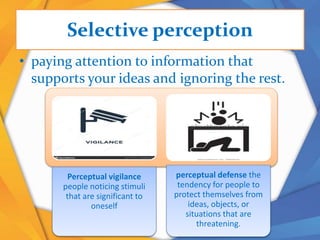
Selective perception
• paying attention to information that
supports your ideas and ignoring the rest.
Perceptual vigilance
people noticing stimuli
that are significant to
oneself
perceptual defense the
tendency for people to
protect themselves from
ideas, objects, or
situations that are
threatening.
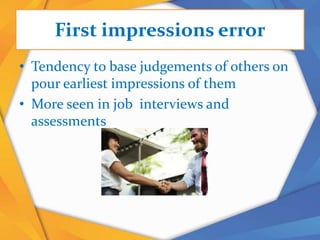
First impressions error
• Tendency to base judgements of others on
pour earliest impressions of them
• More seen in job interviews and
assessments
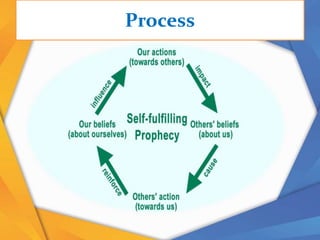
Self fulfilling prophecy
• when a person unknowingly causes a
prediction to come true, due to the simple
fact that he or she expects it to come true
• TYPES
• Pygmalion – positive expectaions
• Golem – negative expectations
Process
Stereotypes
• oversimplified mental picture that is
associated with a particular group
• A belief that all members of specific group
share a similar traits and prone to behave
same way
• Associated with gender, race, commuinty
,work descriptions etc.
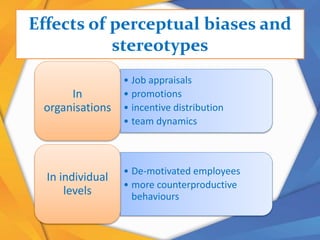
Effects of perceptual biases and
stereotypes
• Job appraisals
• promotions
• incentive distribution
• team dynamics
In
organisations
• De-motivated employees
• more counterproductive
behaviours
In individual
levels

Perceptual biases and stereotyping

  • 2.
    Perceptual Biases • resultfrom the preconceived ideas that perceivers hold about people and situations. • It is misinterpretation of presented information
  • 3.
    1. Fundamental attribution error •underestimating the influence of external factors and overestimating the influence of internal factors when making judgments about others
  • 5.
    Halo and Horneffect Halo effect Tendency of forming a positive overall impressions based on one specific positive trait Horn effect Tendency of forming a negative overall impressions based on one specific negative trait
  • 6.
  • 7.
    The similar-to-me effect •tend to favor/like or give favorable judgment to those who are similar to us. • Result of the ability to be able to empathies and relate better to similar others.
  • 8.
    Selective perception • payingattention to information that supports your ideas and ignoring the rest. Perceptual vigilance people noticing stimuli that are significant to oneself perceptual defense the tendency for people to protect themselves from ideas, objects, or situations that are threatening.
  • 9.
    First impressions error •Tendency to base judgements of others on pour earliest impressions of them • More seen in job interviews and assessments
  • 10.
    Self fulfilling prophecy •when a person unknowingly causes a prediction to come true, due to the simple fact that he or she expects it to come true • TYPES • Pygmalion – positive expectaions • Golem – negative expectations
  • 11.
  • 12.
    Stereotypes • oversimplified mentalpicture that is associated with a particular group • A belief that all members of specific group share a similar traits and prone to behave same way • Associated with gender, race, commuinty ,work descriptions etc.
  • 13.
    Effects of perceptualbiases and stereotypes • Job appraisals • promotions • incentive distribution • team dynamics In organisations • De-motivated employees • more counterproductive behaviours In individual levels