Investigating Claims About the
Digital Natives:
Technology Use Patterns and


                                 © 2012 Penny Thompson
Approaches to Learning
Penny Thompson
Michigan State University
June 18, 2012
© 2012 Penny Thompson
Picture from iStockPhoto
Problem Statement
• Educators receive urgent messages telling them
  to change their teaching to meet the needs of
  the new generation of learners. It is hard for
  educators to know how to respond to these


                                                   © 2012 Penny Thompson
  demands because:
   • The claims are conflicting
   • The claims are not well supported with
     empirical data
Purpose of the Study
• Consolidate the popular press claims into a Popular
  Profile of the Digital Learner (PPDL) in order to
  facilitate investigation of the claims
• Gather data on:
   • patterns of technology use


                                                         © 2012 Penny Thompson
   • whether the digital natives report having the
     characteristics the popular authors are claiming
     for them
   • adaptive and less adaptive manifestations of PPDL
     characteristics
   • relationships between patterns of technology use
     and elements of the PPDL
• (Focus on “interest” rather than “just for grade”)
Literature Review
• Claims made about the digital learners are based on the
  assumption that media exposure and use has
  consequences for thinking and learning, mostly based on
  neural plasticity.


                                                            © 2012 Penny Thompson
• We know learners today are heavily immersed in
  technology (Rideout, Foehr, & Roberts, 2010) so the
  question of whether and how technology use has
  habituated the behaviors and attitudes claimed in the
  PPDL is an important one.
• Existing evidence suggests technology use and
  proficiency is more narrow than the claims suggest
  (Kennedy, Judd, Dalgarno and Waycott, 2010).
“Ten Characteristics of the Games
Generation” (Prensky, 2001a)
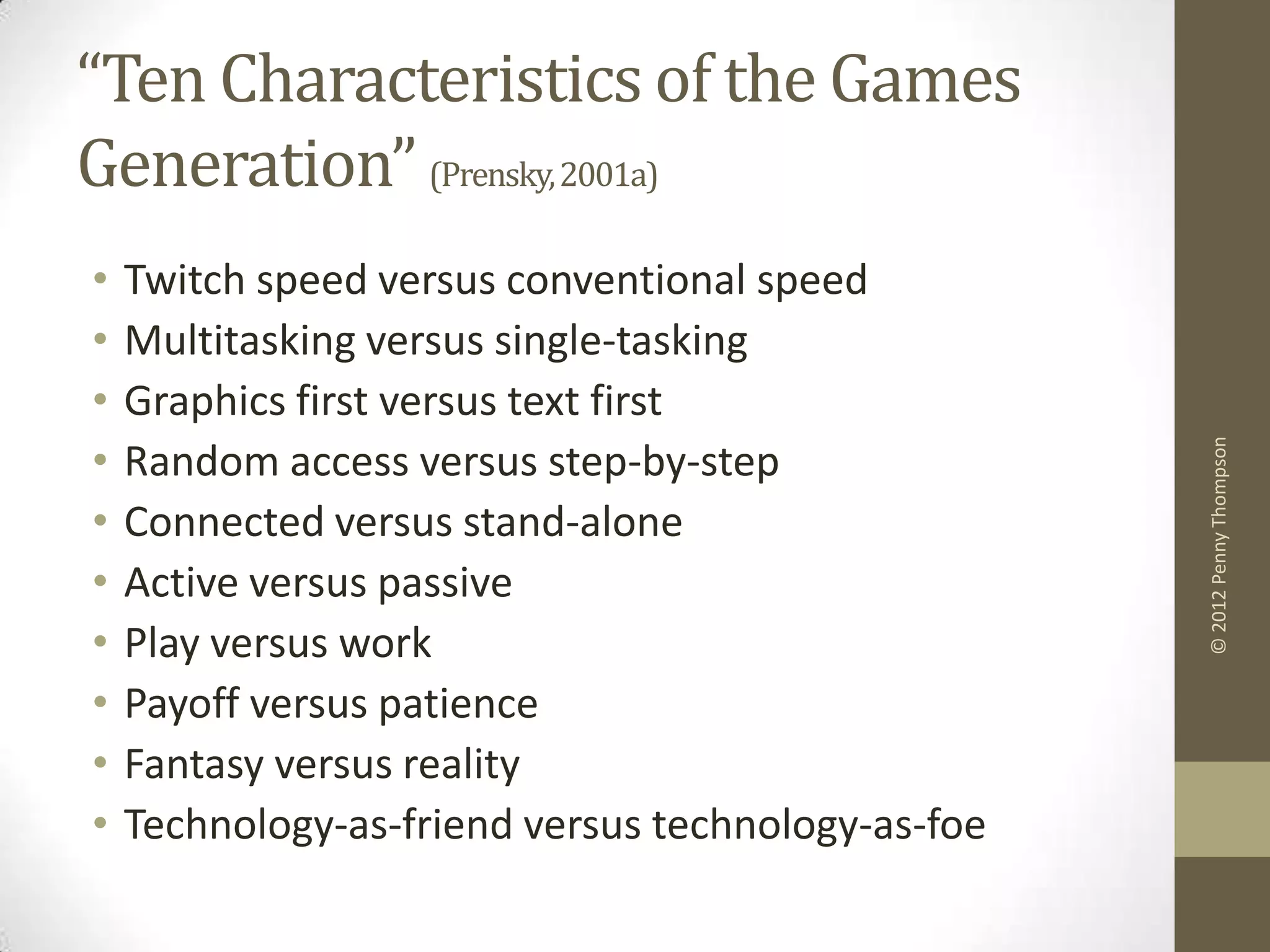
•   Twitch speed versus conventional speed
•   Multitasking versus single-tasking
•   Graphics first versus text first
•


                                                    © 2012 Penny Thompson
    Random access versus step-by-step
•   Connected versus stand-alone
•   Active versus passive
•   Play versus work
•   Payoff versus patience
•   Fantasy versus reality
•   Technology-as-friend versus technology-as-foe
Research Questions
1. What technologies do university freshman use and
   how frequently do they use them?
2. Which of the characteristics of the popular profile
   of the digital learner (PPDL) do students report


                                                         © 2012 Penny Thompson
   having when learning topics in which they have
   personal interest?
3. When learning topics in which they have personal
   interest, do students report habits and behaviors
   that are more adaptive or less adaptive for
   learning?
4. Do students' patterns of technology use correlate
   with their characteristics from the PPDL?
Research Questions, cont.
5. How do learners with different configurations of
   PPDL characteristics describe their own technology
   use and approaches to learning?
  a. What kinds of connections do they see between


                                                        © 2012 Penny Thompson
     their own personal technology use and their
     approaches to learning?
  b. What similarities and differences do they
     describe between their own personal
     approaches to learning and the PPDL claims?
  c. How do they describe their personal reactions to
     the claims being made about their generation?
Methodology
• Survey (Likert-type scale) on technology use,
  digital characteristics, and adaptiveness
  • sent online by Registrar to random sample of 3000
    MSU freshmen
  • 492 responses received, 388 were complete


                                                        © 2012 Penny Thompson
• Analyzed with descriptive and inferential
  statistics
  • Factor analysis of technology use groupings
  • Means and standard deviations
  • Correlations and extreme group analysis
• Semi-structured interviews with selected
  participants
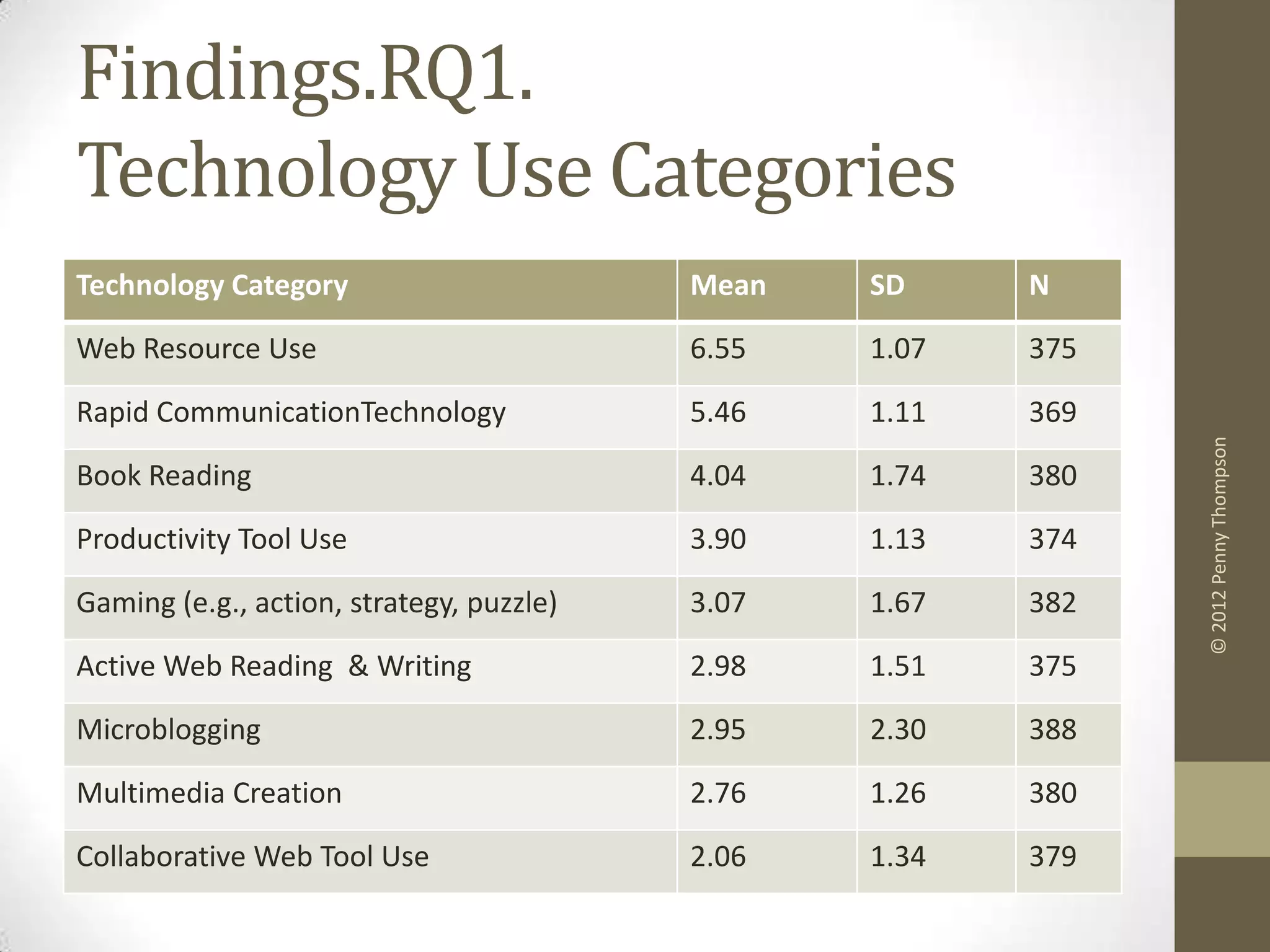
Findings.RQ1.
Technology Use Categories
Technology Category                       Mean   SD     N

Web Resource Use                          6.55   1.07   375

Rapid CommunicationTechnology             5.46   1.11   369


                                                              © 2012 Penny Thompson
Book Reading                              4.04   1.74   380

Productivity Tool Use                     3.90   1.13   374

Gaming (e.g., action, strategy, puzzle)   3.07   1.67   382
Active Web Reading & Writing              2.98   1.51   375

Microblogging                             2.95   2.30   388

Multimedia Creation                       2.76   1.26   380

Collaborative Web Tool Use                2.06   1.34   379
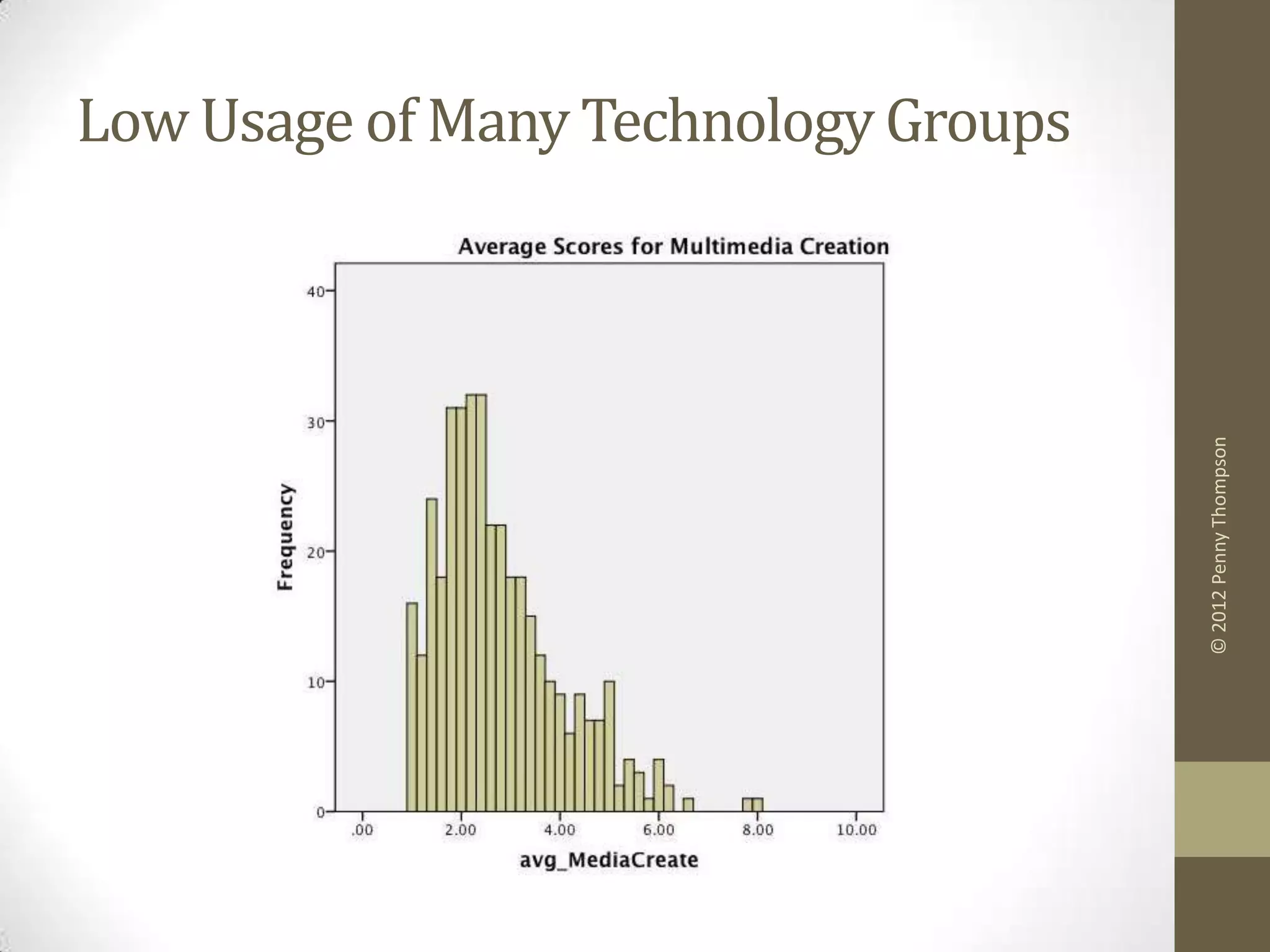
Low Usage of Many Technology Groups


                                      © 2012 Penny Thompson
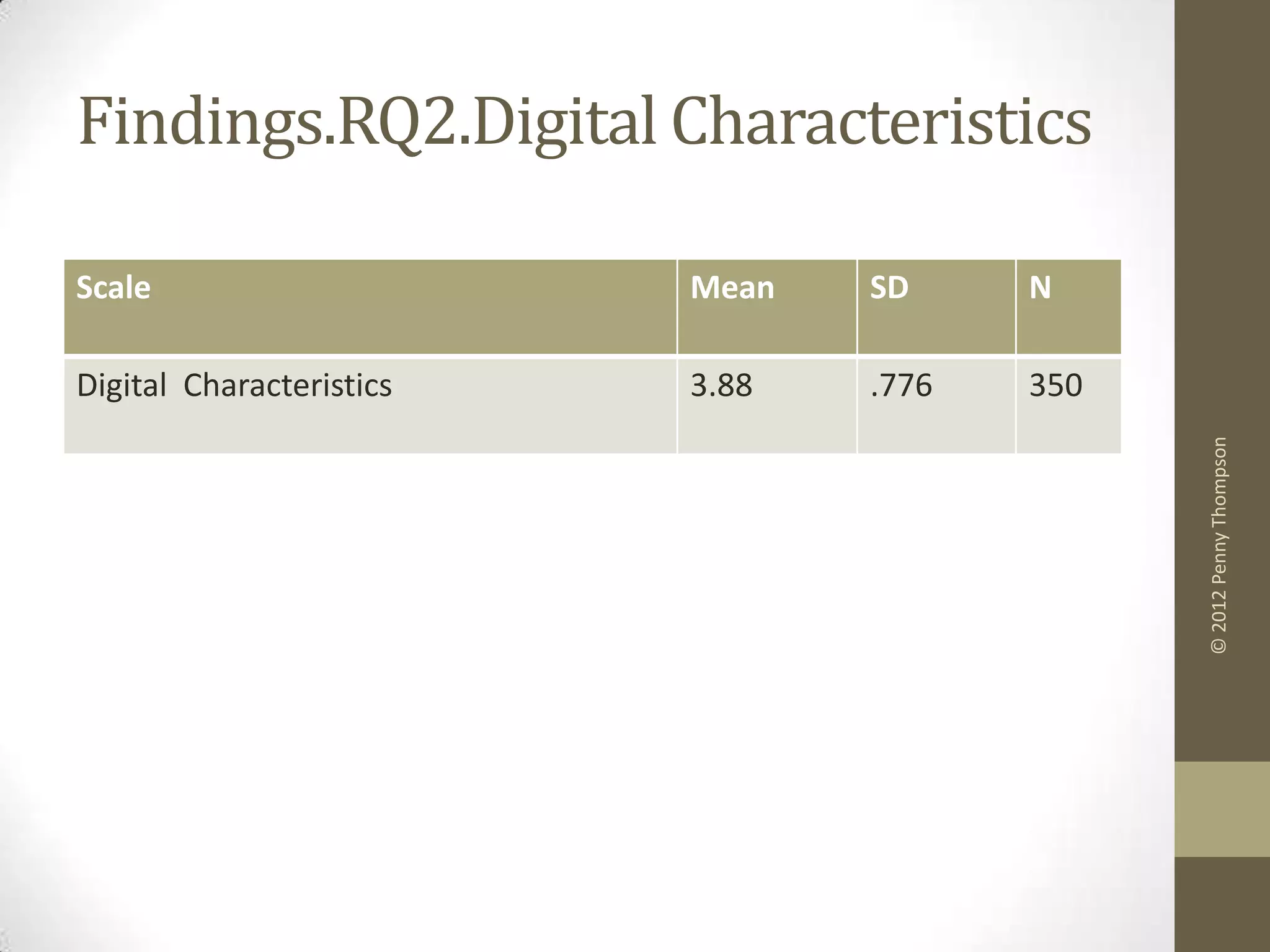
Findings.RQ2.Digital Characteristics

Scale                     Mean   SD     N

Digital Characteristics   3.88   .776   350


                                              © 2012 Penny Thompson
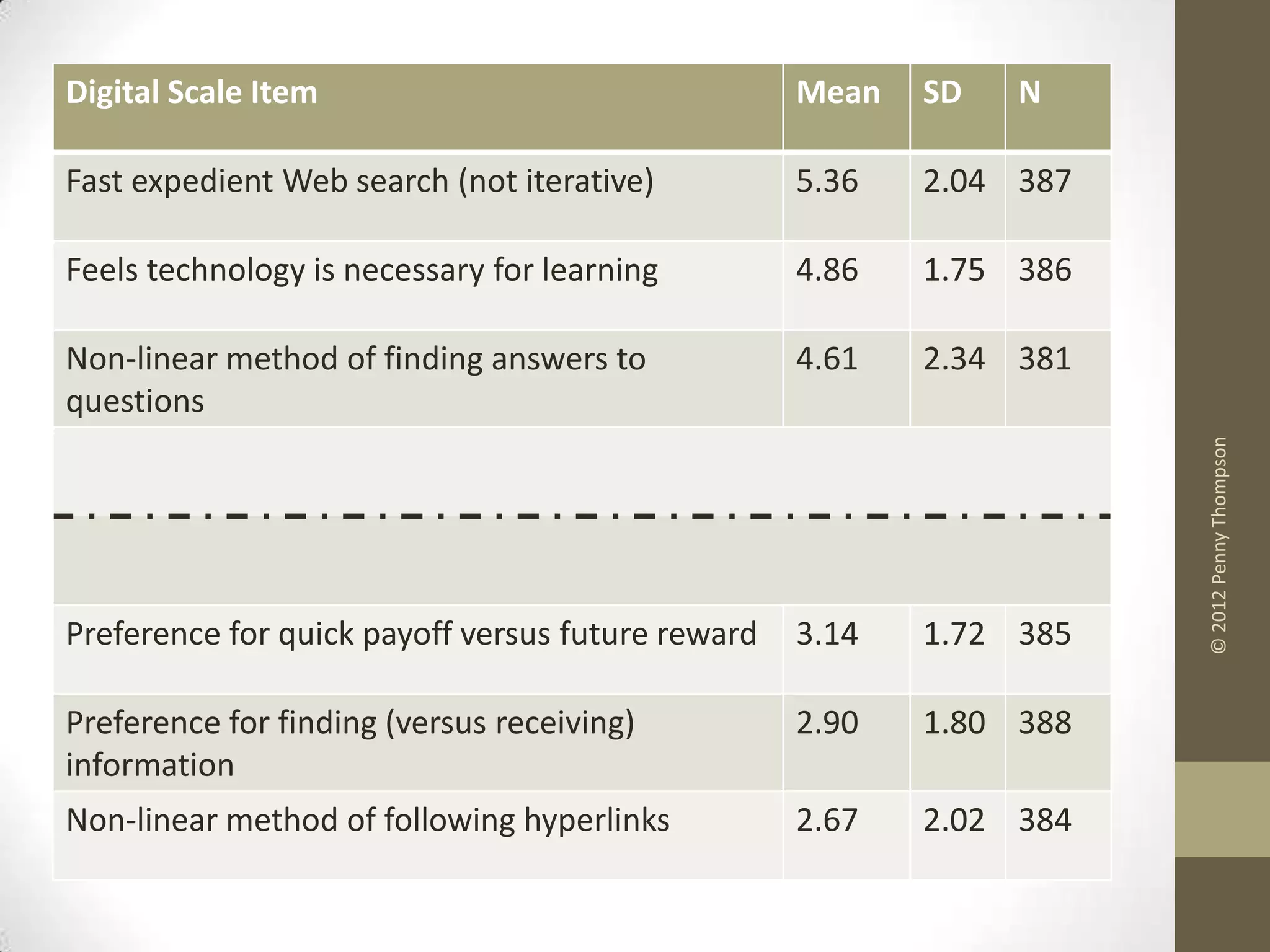
Digital Scale Item                                 Mean   SD   N

Fast expedient Web search (not iterative)          5.36   2.04 387

Feels technology is necessary for learning         4.86   1.75 386

Non-linear method of finding answers to            4.61   2.34 381
questions


                                                                     © 2012 Penny Thompson
Preference for quick payoff versus future reward   3.14   1.72 385

Preference for finding (versus receiving)          2.90   1.80 388
information
Non-linear method of following hyperlinks          2.67   2.02 384
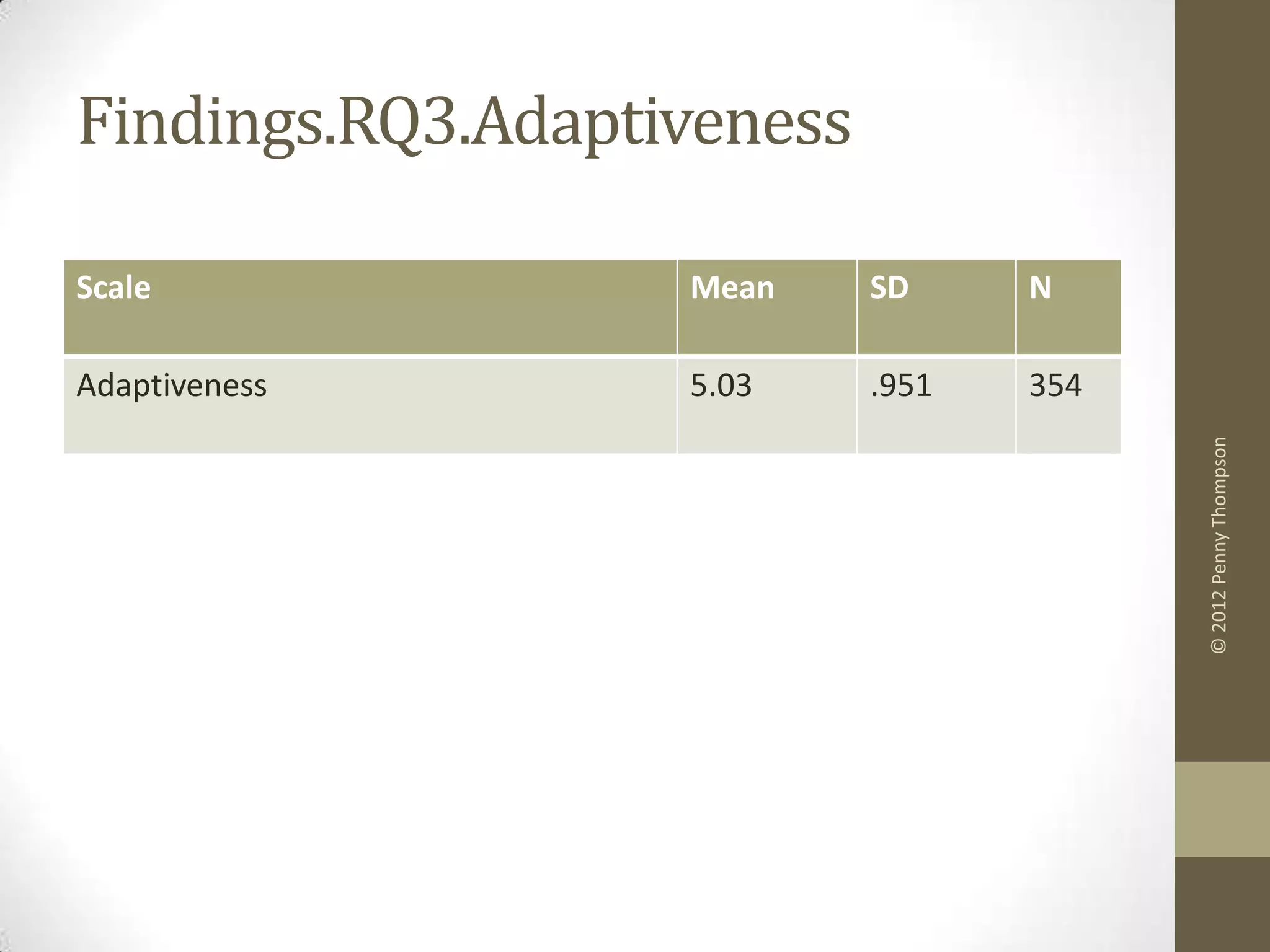
Findings.RQ3.Adaptiveness

Scale              Mean     SD     N

Adaptiveness       5.03     .951   354


                                         © 2012 Penny Thompson
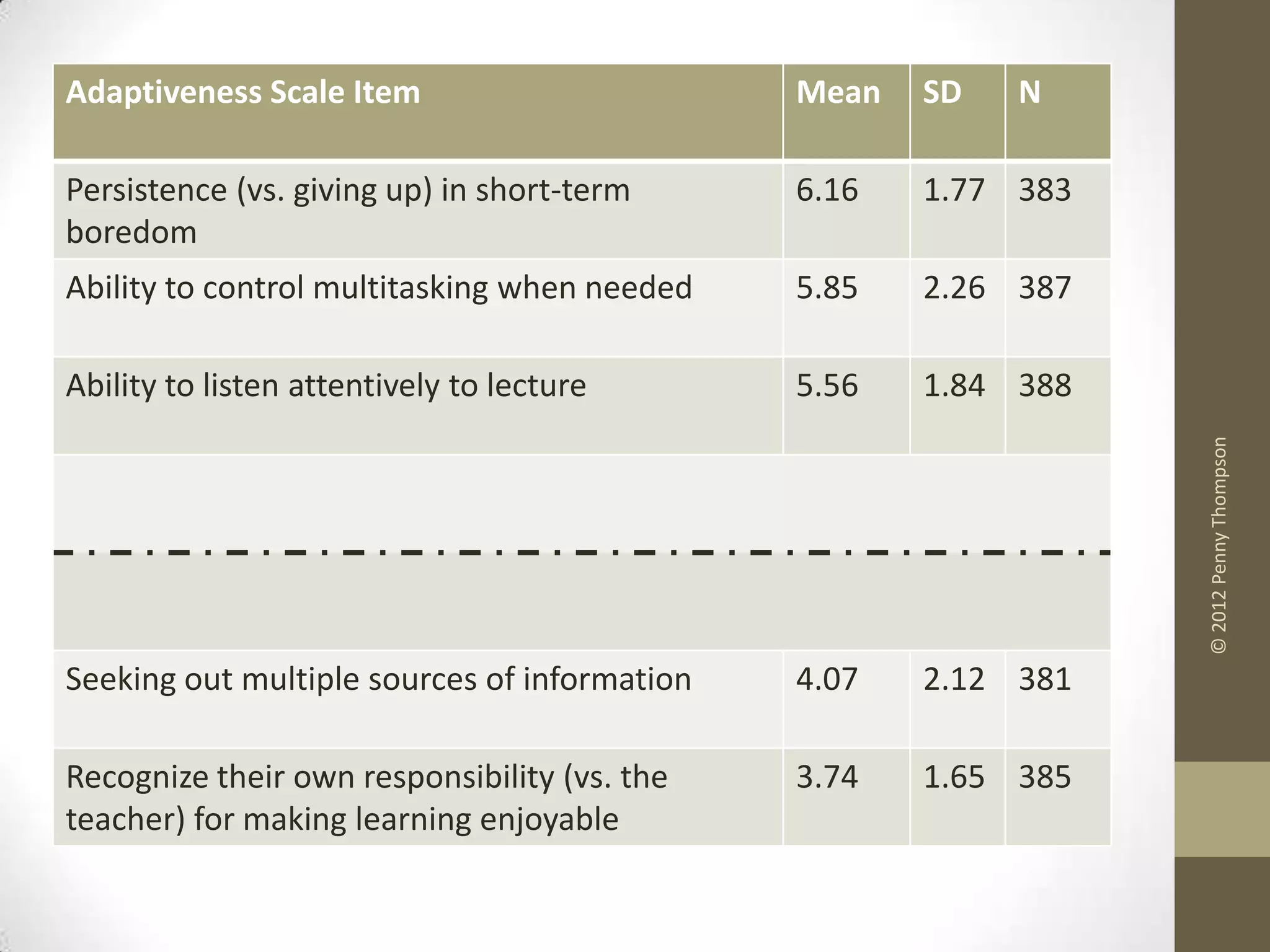
Adaptiveness Scale Item                       Mean   SD   N

Persistence (vs. giving up) in short-term     6.16   1.77 383
boredom
Ability to control multitasking when needed   5.85   2.26 387

Ability to listen attentively to lecture      5.56   1.84 388


                                                                © 2012 Penny Thompson
Seeking out multiple sources of information   4.07   2.12 381

Recognize their own responsibility (vs. the   3.74   1.65 385
teacher) for making learning enjoyable
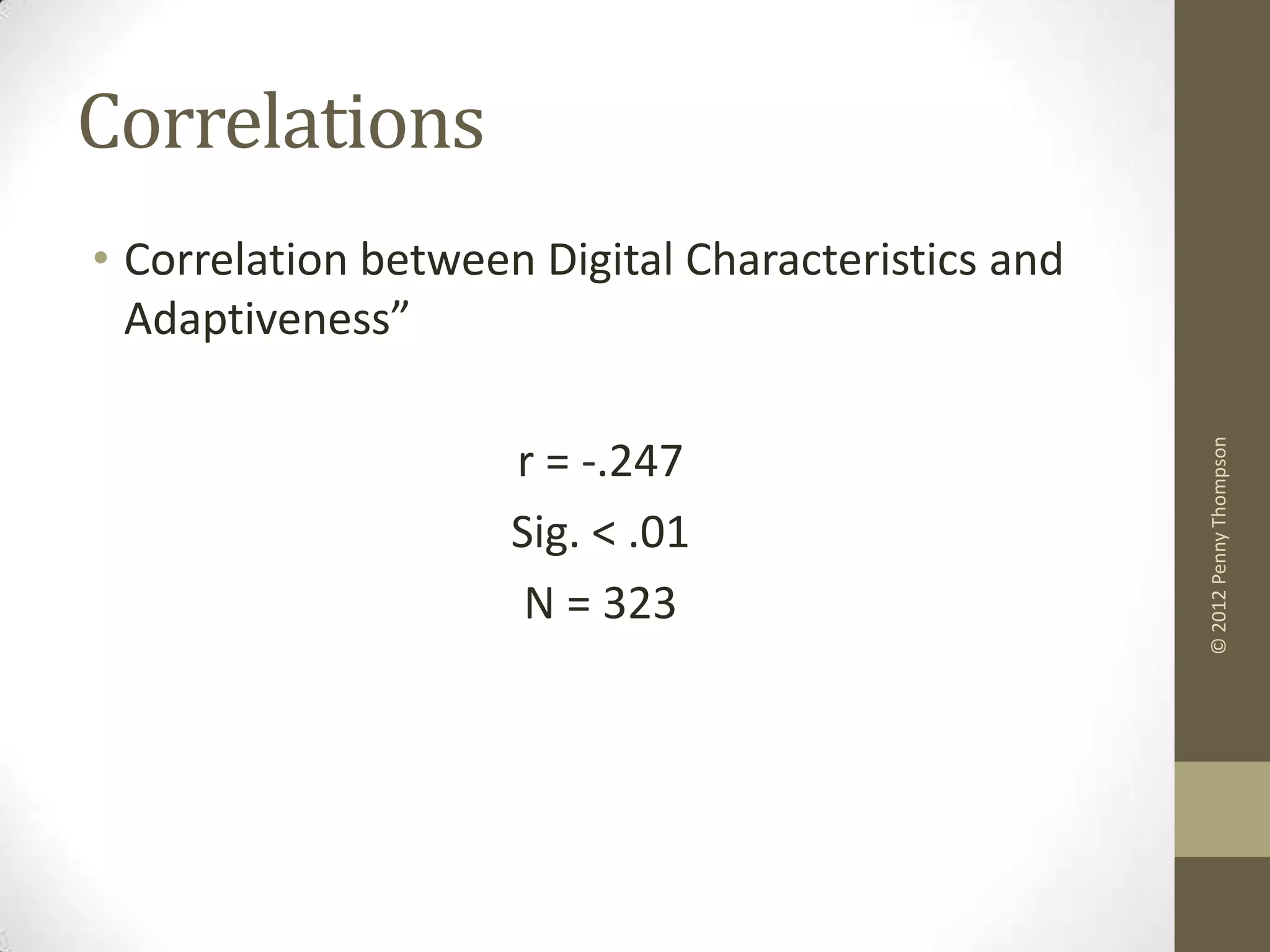
Correlations
• Correlation between Digital Characteristics and
  Adaptiveness”


                                                    © 2012 Penny Thompson
                     r = -.247
                     Sig. < .01
                      N = 323
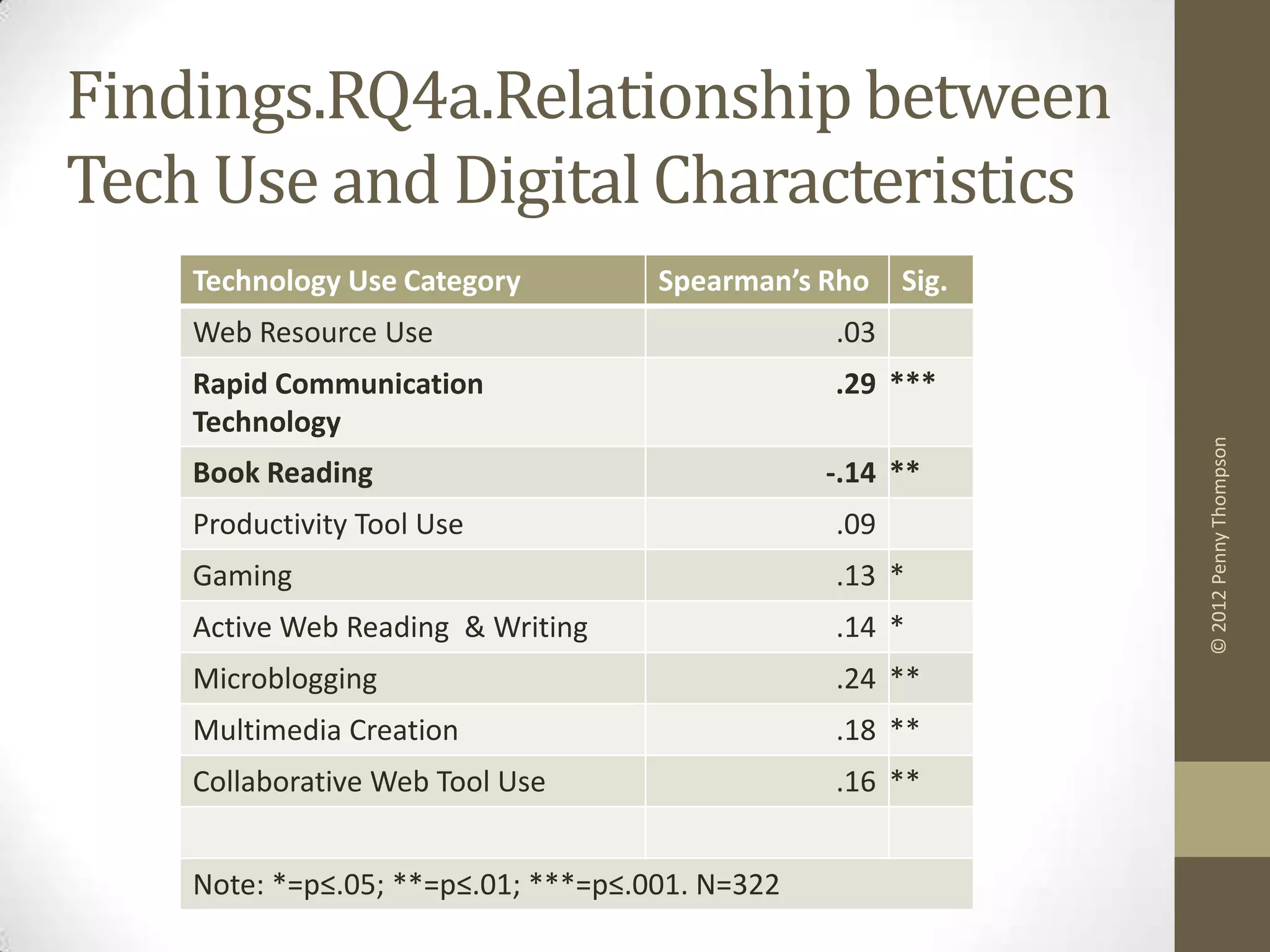
Findings.RQ4a.Relationship between
Tech Use and Digital Characteristics
    Technology Use Category          Spearman’s Rho    Sig.
    Web Resource Use                             .03
    Rapid Communication                          .29 ***
    Technology


                                                              © 2012 Penny Thompson
    Book Reading                                 -.14 **
    Productivity Tool Use                        .09
    Gaming                                       .13 *
    Active Web Reading & Writing                 .14 *
    Microblogging                                .24 **
    Multimedia Creation                          .18 **
    Collaborative Web Tool Use                   .16 **


    Note: *=p≤.05; **=p≤.01; ***=p≤.001. N=322
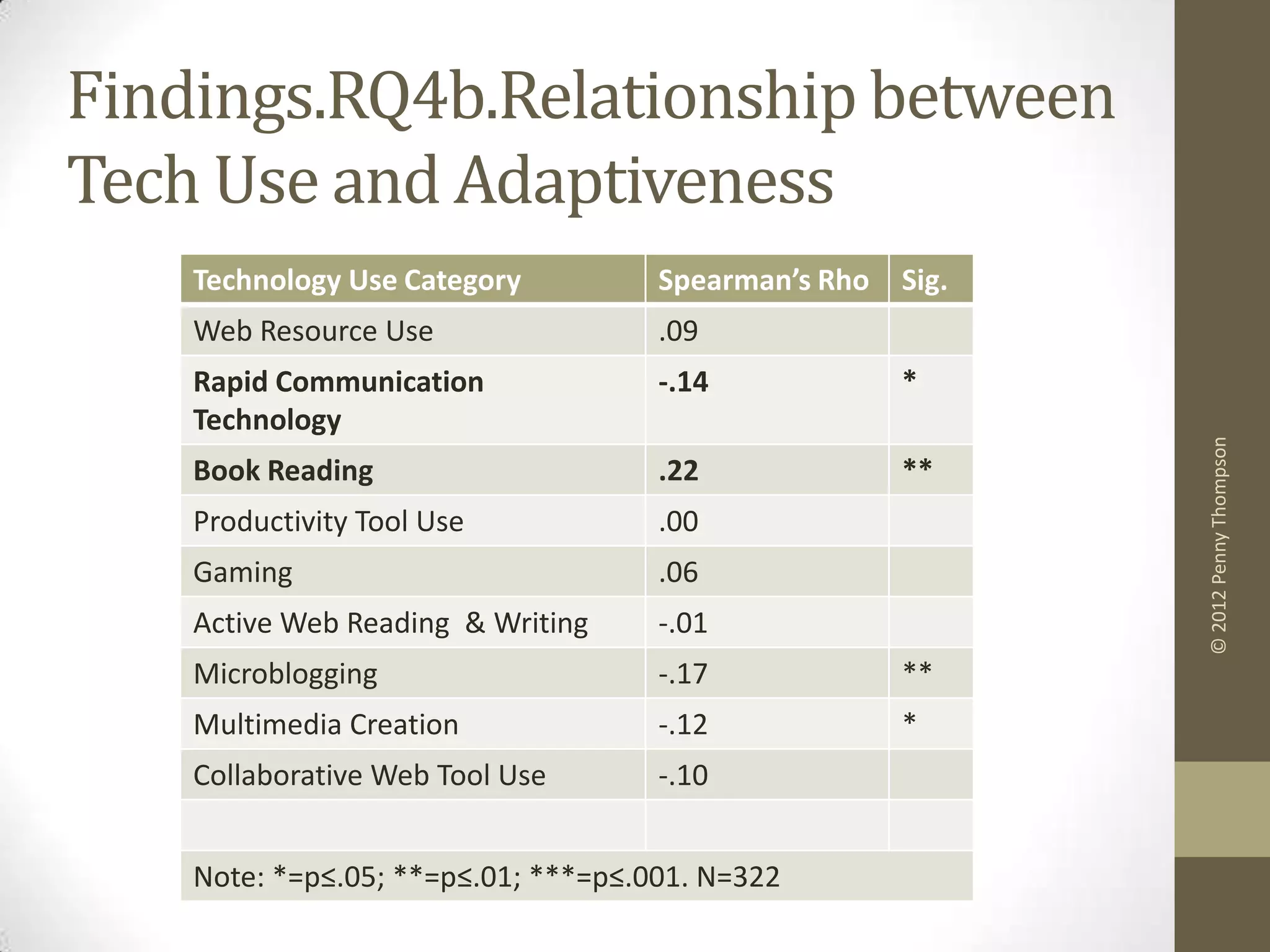
Findings.RQ4b.Relationship between
Tech Use and Adaptiveness
    Technology Use Category          Spearman’s Rho   Sig.
    Web Resource Use                 .09
    Rapid Communication              -.14             *
    Technology


                                                             © 2012 Penny Thompson
    Book Reading                     .22              **
    Productivity Tool Use            .00
    Gaming                           .06
    Active Web Reading & Writing     -.01
    Microblogging                    -.17             **
    Multimedia Creation              -.12             *
    Collaborative Web Tool Use       -.10


    Note: *=p≤.05; **=p≤.01; ***=p≤.001. N=322
The Interviews
• Participants
  • Eight participants, all female, 18 – 20 years old
  • Purposefully chosen based on survey answers
• Coding


                                                        © 2012 Penny Thompson
  • Full interviews transcribed and coded
  • Unit of analysis was Question + Answer
  • Looked for themes directly related to research
    questions while open to new themes
  • Second coder audited 50% - Cohen’s kappa 87%
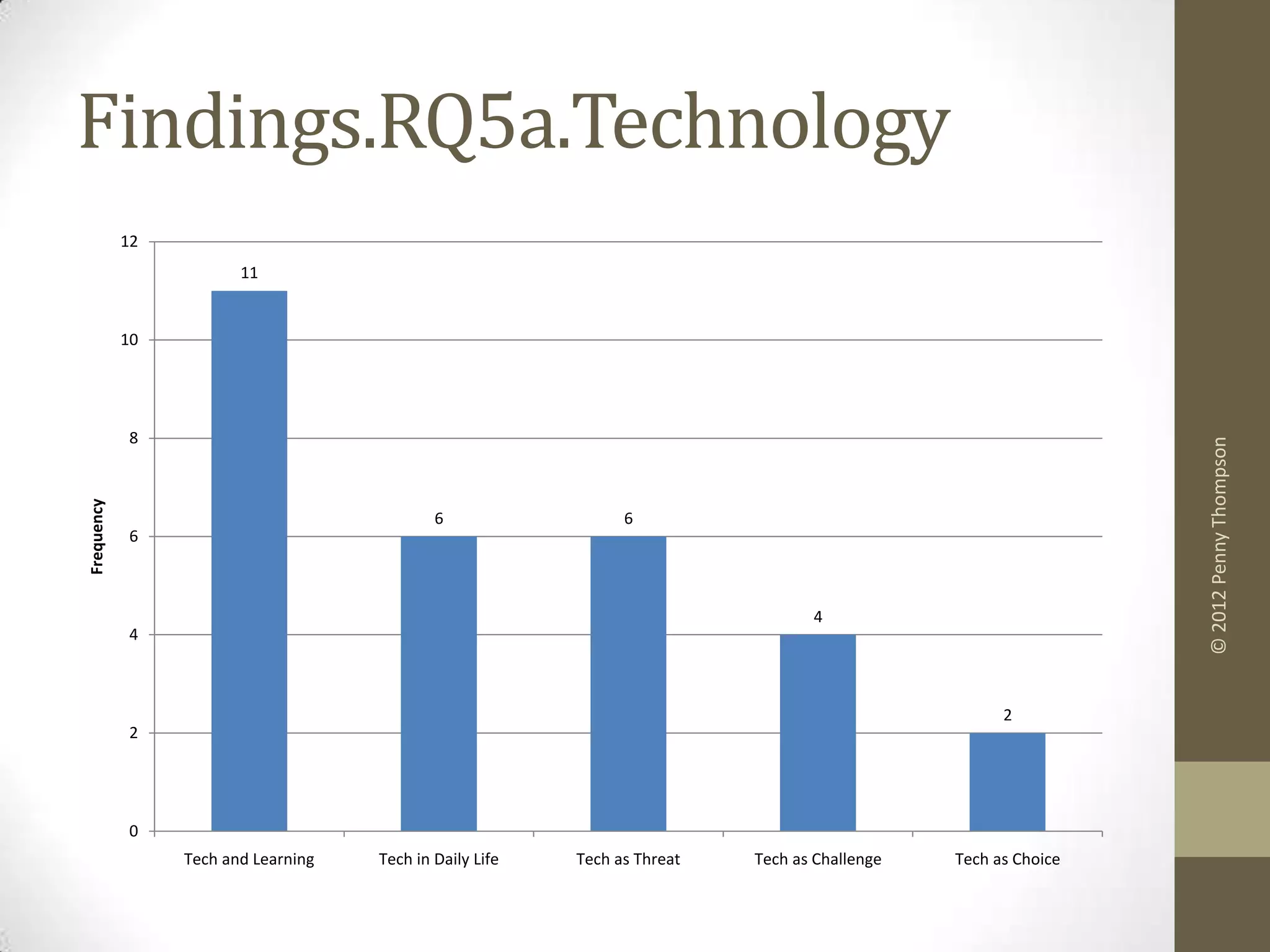
Findings.RQ5a.Technology
            12
                        11


            10


            8


                                                                                                                © 2012 Penny Thompson
Frequency


                                             6                  6
            6


                                                                                  4
            4


                                                                                                     2
            2


            0
                 Tech and Learning   Tech in Daily Life   Tech as Threat   Tech as Challenge   Tech as Choice
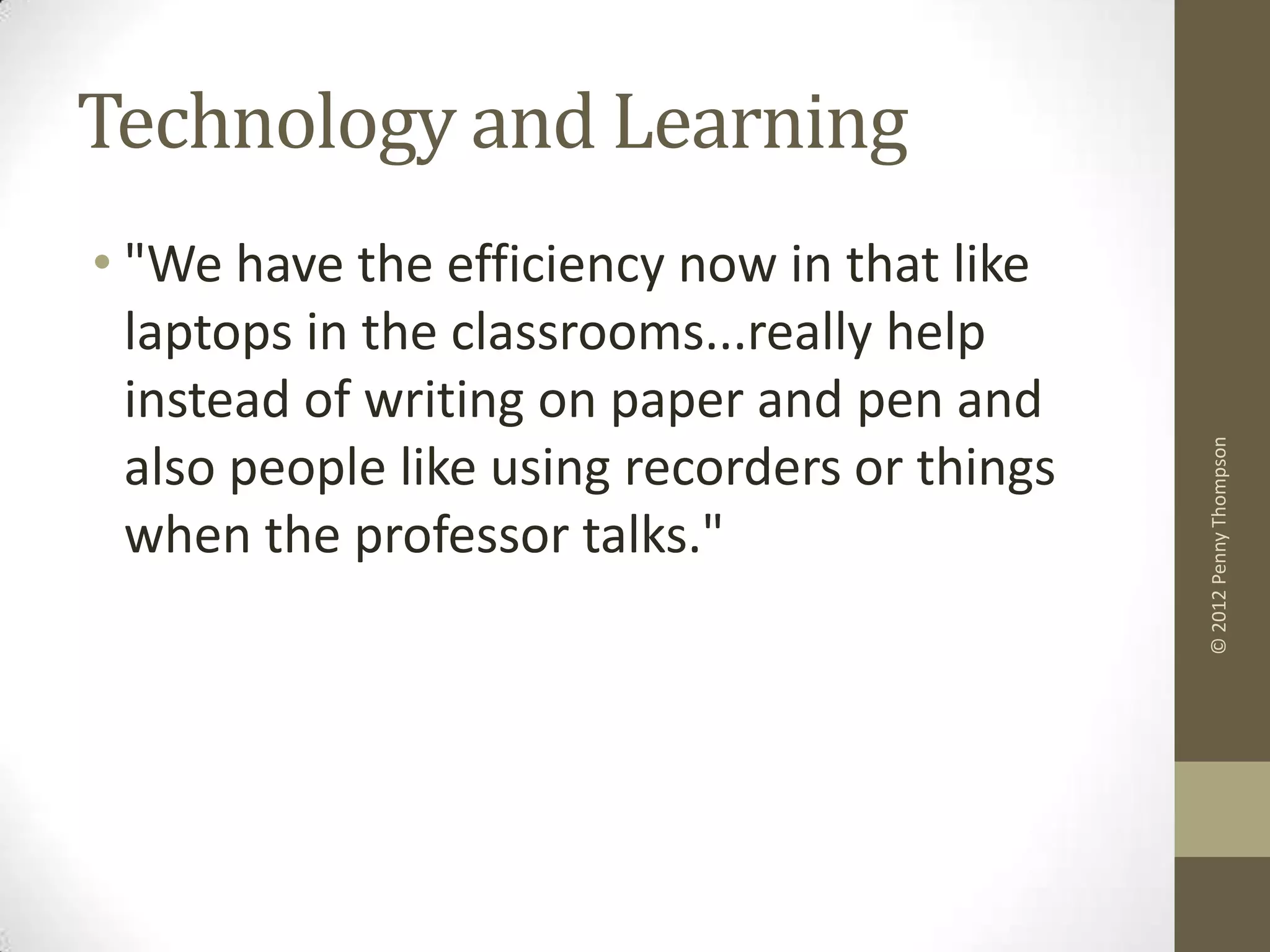
Technology and Learning
• "We have the efficiency now in that like
  laptops in the classrooms...really help
  instead of writing on paper and pen and


                                               © 2012 Penny Thompson
  also people like using recorders or things
  when the professor talks."
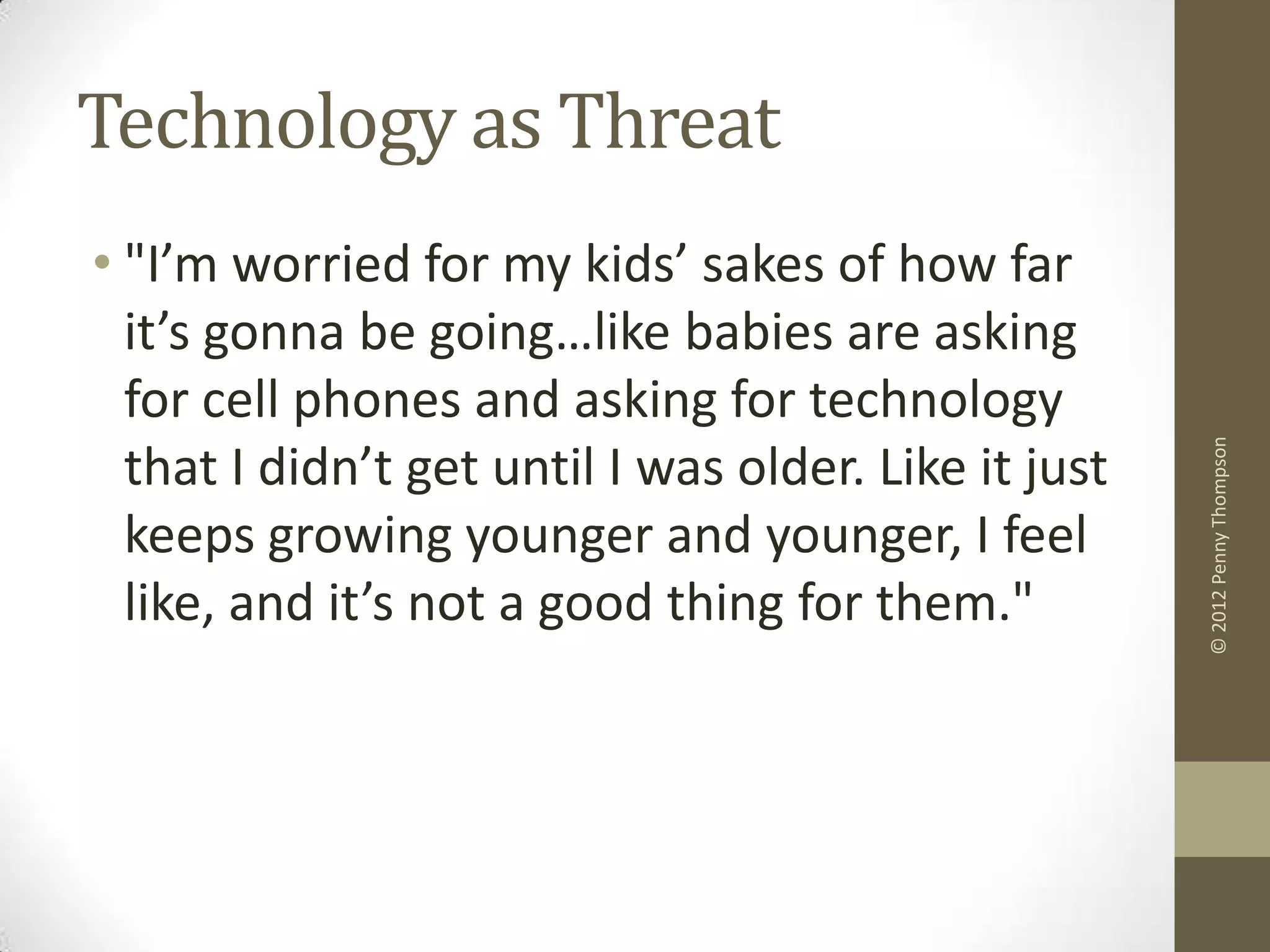
Technology as Threat
• "I’m worried for my kids’ sakes of how far
  it’s gonna be going…like babies are asking
  for cell phones and asking for technology


                                                      © 2012 Penny Thompson
  that I didn’t get until I was older. Like it just
  keeps growing younger and younger, I feel
  like, and it’s not a good thing for them."
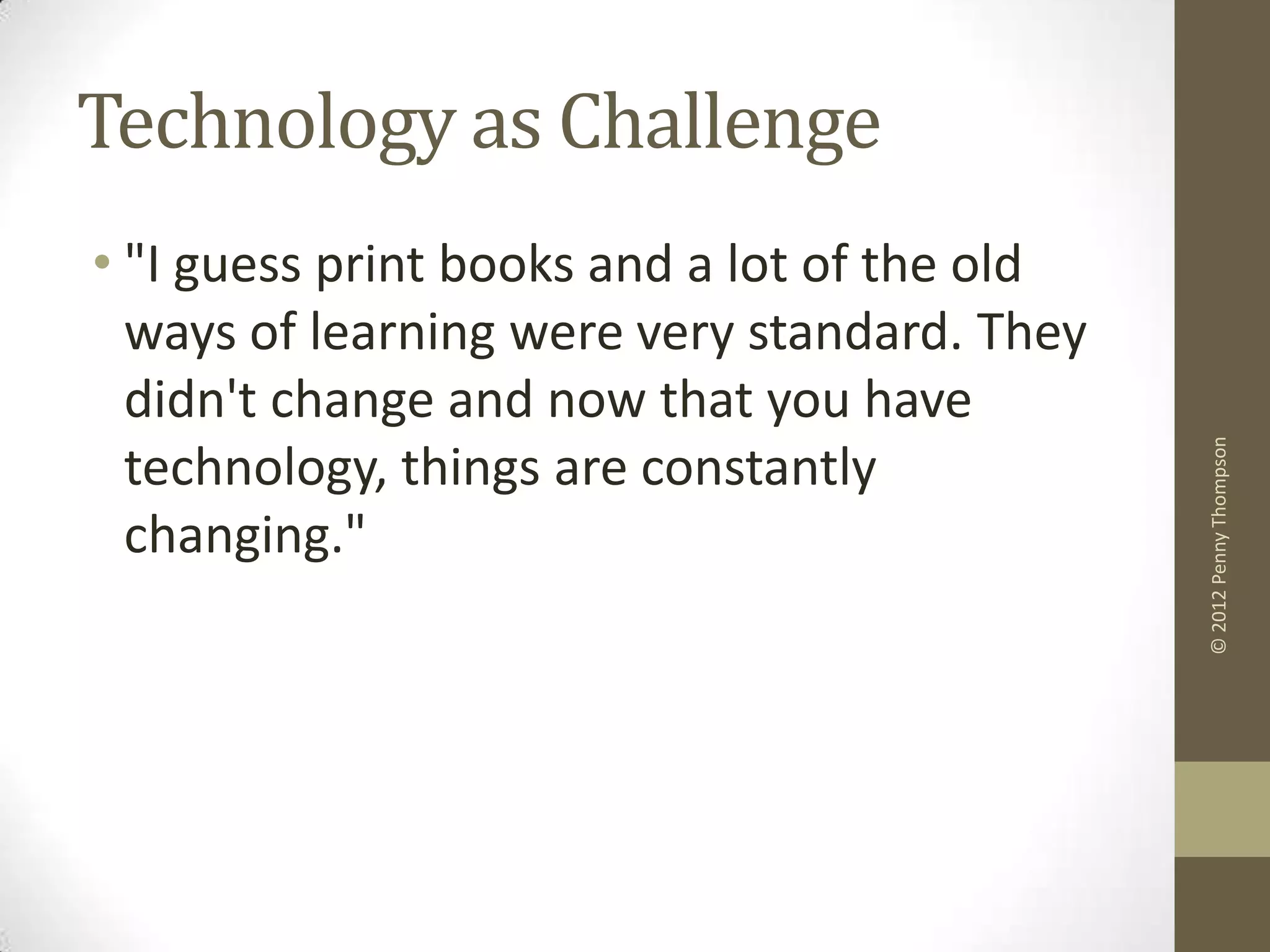
Technology as Challenge
• "I guess print books and a lot of the old
  ways of learning were very standard. They
  didn't change and now that you have


                                              © 2012 Penny Thompson
  technology, things are constantly
  changing."
Technology as Choice
• "I understand the reward and benefit of
  functioning without [technology]. But I do
  use it.”


                                                  © 2012 Penny Thompson
• “Sometimes I feel like I should turn my cell
  phone on more often just because my
  friends are, like, why are you so hard to
  talk to? But…I’ll turn it on when I feel like
  it."
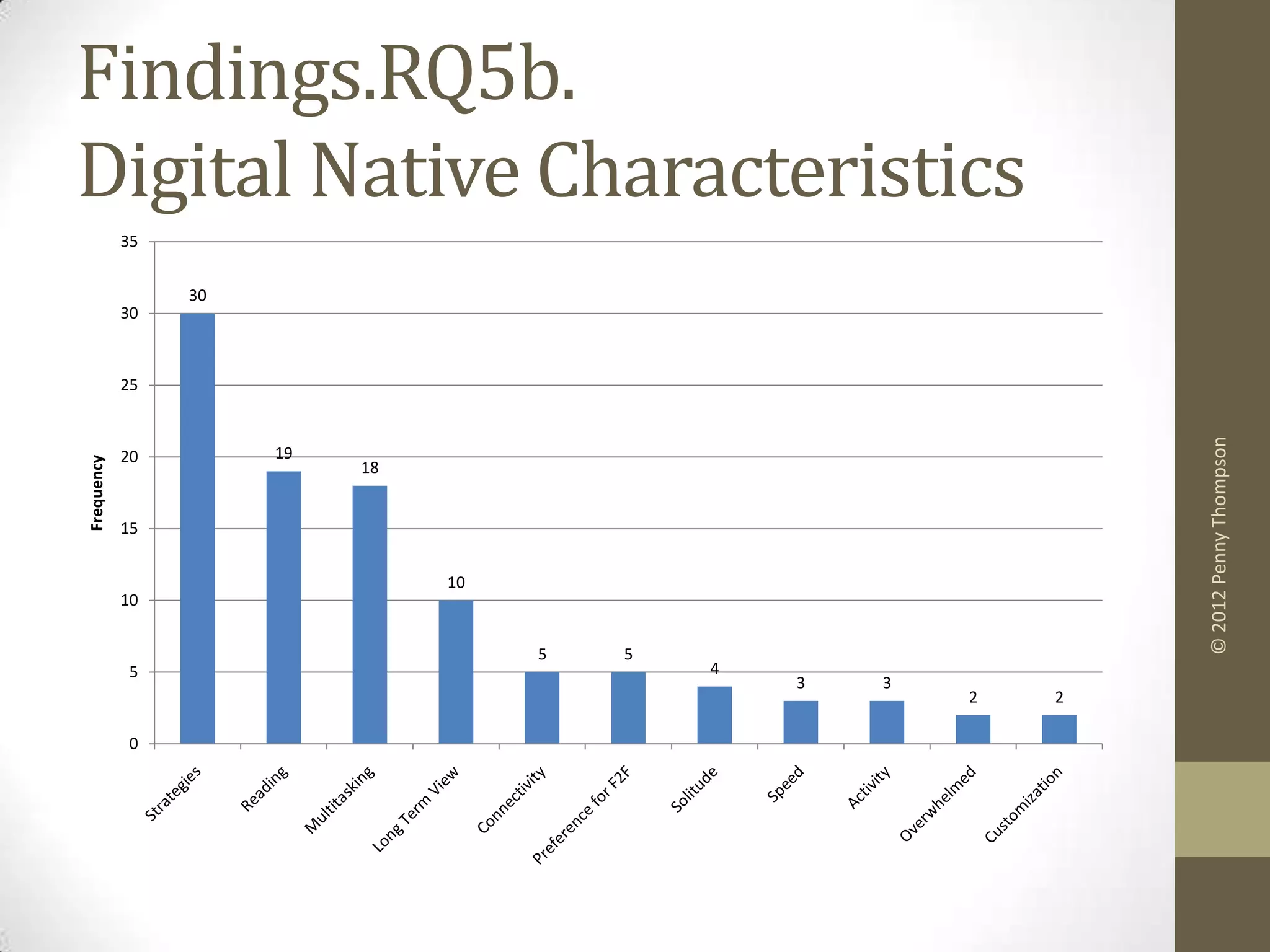
Findings.RQ5b.
Digital Native Characteristics
            35


                 30
            30


            25


                                                                 © 2012 Penny Thompson
            20        19
Frequency


                           18


            15


                                10
            10


                                     5   5
            5                                4
                                                 3   3
                                                         2   2

            0
Strategies
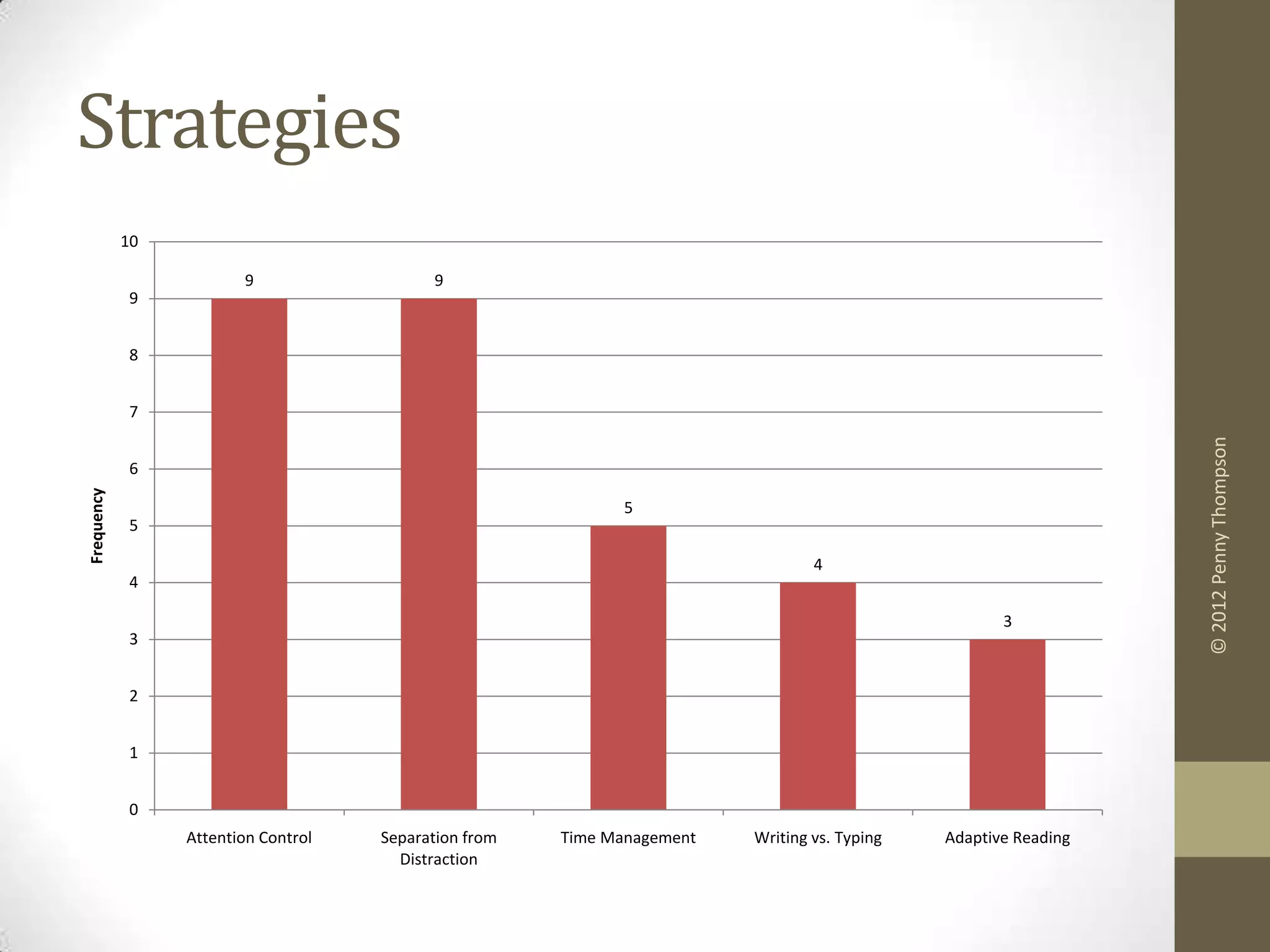
            10

                        9                  9
            9


            8


            7


                                                                                                                 © 2012 Penny Thompson
            6
Frequency


                                                              5
            5

                                                                                 4
            4

                                                                                                     3
            3


            2


            1


            0
                 Attention Control   Separation from   Time Management   Writing vs. Typing   Adaptive Reading
                                       Distraction
Strategies
• Attention Control: "I text a lot more in math cuz
  I'm pretty good at it and I put it away, like if I'm
  doing science cuz it's my worst subject.”
• Separation: "For finals...there’s a website that


                                                          © 2012 Penny Thompson
  you can sign up and it won’t let your computer
  access like those sites you list."
• Time Management: "I kinda' set up...standards
  for myself. If I can finish this chapter, I can check
  [Facebook] for X amount of time."
Strategies, continued
• Writing versus typing: “I started off my first
  semester, like, taking all my notes by typing them
  and I could not remember anything that way so I
  switched over to pen and paper.“


                                                          © 2012 Penny Thompson
• Adaptive reading: "If I'm reading like just a novel
  for fun or something, I'll read really, really fast
  and not really like think about it. But if I'm
  reading like a textbook, I read really, really slow."
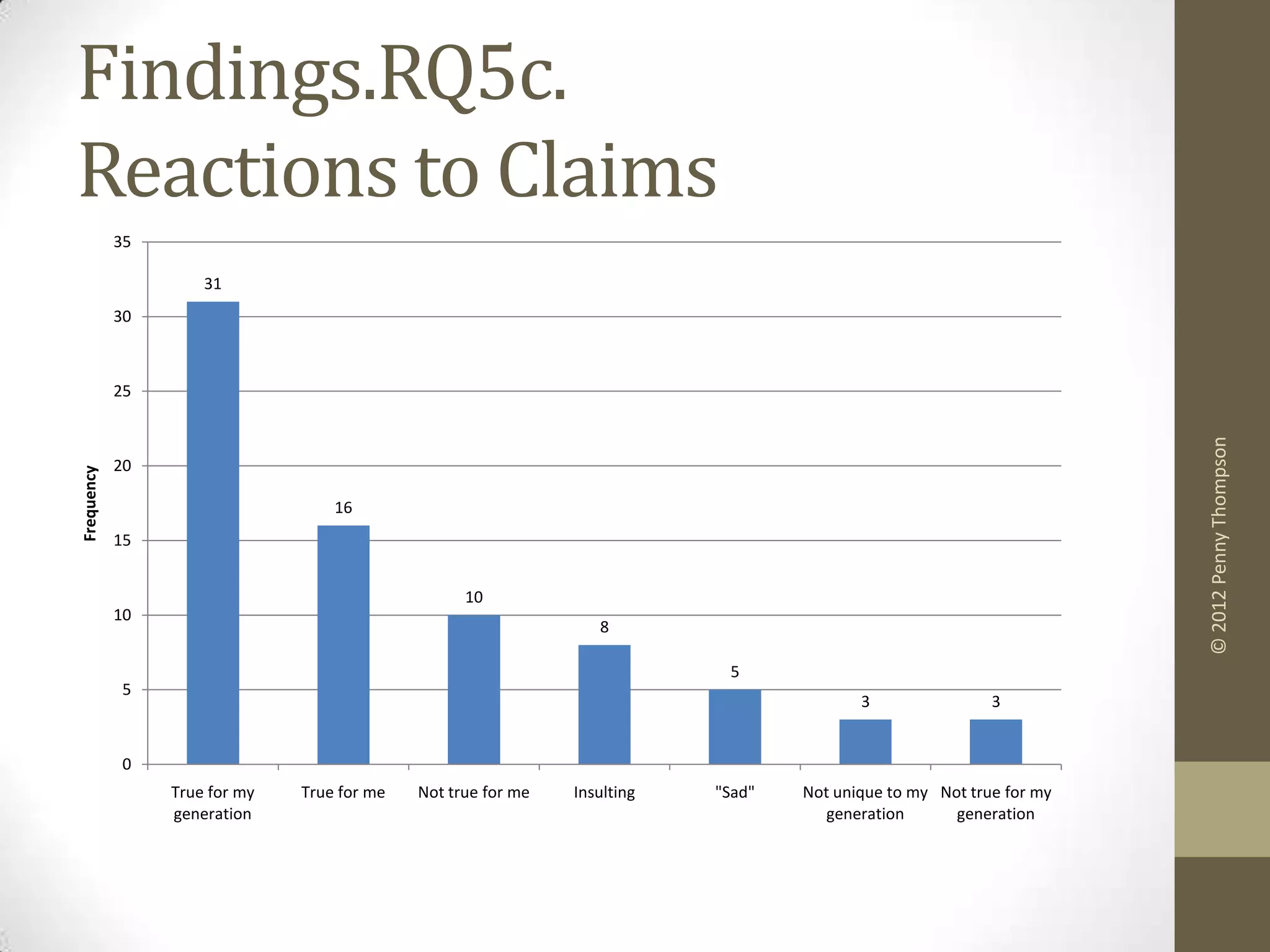
Findings.RQ5c.
Reactions to Claims
            35

                     31
            30


            25


                                                                                                                      © 2012 Penny Thompson
            20
Frequency


                                   16
            15


                                                   10
            10
                                                                  8

                                                                            5
             5
                                                                                          3                3


             0
                 True for my   True for me   Not true for me   Insulting   "Sad"   Not unique to my Not true for my
                 generation                                                           generation      generation
Reactions to Claims
• Insulting:"I think they're not giving us enough
  credit for wanting to learn."
• Sad or embarrassing:"It is kind of embarrassing
  that I come from a generation that can’t read a


                                                      © 2012 Penny Thompson
  book."
• Not unique to any one generation:"Every
  generation of kids our age are gonna' prefer
  games to serious work. So I don’t think that has
  anything to do with our generation specifically."
Conclusions
• Digital Natives use a narrower range of technologies
  than the popular press suggests. Teachers should not
  assume high proficiency with all technologies.
• Digital Natives value technology for speed and
  efficiency but may need help using it for deep


                                                         © 2012 Penny Thompson
  learning.
• Digital Natives want us to engage them but do not
  necessarily demand constant entertainment (at least
  at the university level).
• Technology is probably an influence but not the
  deterministic force claimed by the popular press.
• Heavy use of Rapid Communication Technology
  might signal a need for study skills intervention.
Significance of the Study
• Synthesizes the conflicting popular press claims
• Provides data on technology use patterns of
  digital natives
• Provides a more nuanced understanding of the


                                                       © 2012 Penny Thompson
  digital natives as learners
• Encourages educators to evaluate evidence
  critically when deciding how (or if) to respond to
  the popular “calls to action”
Limitations
• Self-report survey
• Correlations do not tell us the cause or direction
  of an effect
• Digital Characteristics and Adaptiveness scales


                                                       © 2012 Penny Thompson
  need refinement
• Cannot assume interview participants are
  “typical”
Future Research
• Explore the relationship between Rapid
  Communication Technology use and lower
  Adaptiveness scores in more detail
• Comparisons with different age groups


                                                    © 2012 Penny Thompson
• Observational studies to explore correspondence
  between actual performance and self-report
Questions?


                                © 2012 Penny Thompson
       Penny Thompson
    Michigan State University
     thomp850@msu.edu
References
• Bauerlein, M. (2008).The dumbest generation: How the digital age stupefies
  young Americans and jeopardizes our future. New Yourk: Penguin Group
• Ellison, N., Steinfield, C., & Lampe, C. (2011). Connection strategies: Social
  capital implications of Facebook-enabled communication practices. New
  Media & Society, 13(6), 873-892. doi: 10.1177/1461444810385389
• Kennedy, G., Judd, T., Dalgarno, B., &Waycott, J. (2010). Beyond natives and


                                                                                    © 2012 Penny Thompson
  immigrants: exploring types of net generation students. Journal of Computer
  Assisted Learning, 26, 332-343. doi: 10.1111/j.1365-2729.2010.00371.x
• Lohnes, S., &Kinzer, C. (2007). Questioning assumptions about students'
  expectations for technology in college classrooms. Innovate, 3, 5
• Prensky, M. (2001a). Digital game-based learning. New York: McGraw-Hill
• Prensky, M. (2001b). Digital natives, digital immigrants. On the Horizon, 9(5).
• Rideout, V. J., Foehr, U. G., & Roberts, D. F. (2010). Generation M2: Media in
  the lives of 8- to 18-year-olds. Kaiser Family Foundation Retrieved from
  http://www.kff.org/entmedia/mh012010pkg.cfm.

Penny Thompson's Dissertation Defense

  • 1.
    Investigating Claims Aboutthe Digital Natives: Technology Use Patterns and © 2012 Penny Thompson Approaches to Learning Penny Thompson Michigan State University June 18, 2012
  • 2.
    © 2012 PennyThompson Picture from iStockPhoto
  • 3.
    Problem Statement • Educatorsreceive urgent messages telling them to change their teaching to meet the needs of the new generation of learners. It is hard for educators to know how to respond to these © 2012 Penny Thompson demands because: • The claims are conflicting • The claims are not well supported with empirical data
  • 4.
    Purpose of theStudy • Consolidate the popular press claims into a Popular Profile of the Digital Learner (PPDL) in order to facilitate investigation of the claims • Gather data on: • patterns of technology use © 2012 Penny Thompson • whether the digital natives report having the characteristics the popular authors are claiming for them • adaptive and less adaptive manifestations of PPDL characteristics • relationships between patterns of technology use and elements of the PPDL • (Focus on “interest” rather than “just for grade”)
  • 5.
    Literature Review • Claimsmade about the digital learners are based on the assumption that media exposure and use has consequences for thinking and learning, mostly based on neural plasticity. © 2012 Penny Thompson • We know learners today are heavily immersed in technology (Rideout, Foehr, & Roberts, 2010) so the question of whether and how technology use has habituated the behaviors and attitudes claimed in the PPDL is an important one. • Existing evidence suggests technology use and proficiency is more narrow than the claims suggest (Kennedy, Judd, Dalgarno and Waycott, 2010).
  • 6.
    “Ten Characteristics ofthe Games Generation” (Prensky, 2001a) • Twitch speed versus conventional speed • Multitasking versus single-tasking • Graphics first versus text first • © 2012 Penny Thompson Random access versus step-by-step • Connected versus stand-alone • Active versus passive • Play versus work • Payoff versus patience • Fantasy versus reality • Technology-as-friend versus technology-as-foe
  • 7.
    Research Questions 1. Whattechnologies do university freshman use and how frequently do they use them? 2. Which of the characteristics of the popular profile of the digital learner (PPDL) do students report © 2012 Penny Thompson having when learning topics in which they have personal interest? 3. When learning topics in which they have personal interest, do students report habits and behaviors that are more adaptive or less adaptive for learning? 4. Do students' patterns of technology use correlate with their characteristics from the PPDL?
  • 8.
    Research Questions, cont. 5.How do learners with different configurations of PPDL characteristics describe their own technology use and approaches to learning? a. What kinds of connections do they see between © 2012 Penny Thompson their own personal technology use and their approaches to learning? b. What similarities and differences do they describe between their own personal approaches to learning and the PPDL claims? c. How do they describe their personal reactions to the claims being made about their generation?
  • 9.
    Methodology • Survey (Likert-typescale) on technology use, digital characteristics, and adaptiveness • sent online by Registrar to random sample of 3000 MSU freshmen • 492 responses received, 388 were complete © 2012 Penny Thompson • Analyzed with descriptive and inferential statistics • Factor analysis of technology use groupings • Means and standard deviations • Correlations and extreme group analysis • Semi-structured interviews with selected participants
  • 10.
    Findings.RQ1. Technology Use Categories TechnologyCategory Mean SD N Web Resource Use 6.55 1.07 375 Rapid CommunicationTechnology 5.46 1.11 369 © 2012 Penny Thompson Book Reading 4.04 1.74 380 Productivity Tool Use 3.90 1.13 374 Gaming (e.g., action, strategy, puzzle) 3.07 1.67 382 Active Web Reading & Writing 2.98 1.51 375 Microblogging 2.95 2.30 388 Multimedia Creation 2.76 1.26 380 Collaborative Web Tool Use 2.06 1.34 379
  • 11.
    Low Usage ofMany Technology Groups © 2012 Penny Thompson
  • 12.
    Findings.RQ2.Digital Characteristics Scale Mean SD N Digital Characteristics 3.88 .776 350 © 2012 Penny Thompson
  • 13.
    Digital Scale Item Mean SD N Fast expedient Web search (not iterative) 5.36 2.04 387 Feels technology is necessary for learning 4.86 1.75 386 Non-linear method of finding answers to 4.61 2.34 381 questions © 2012 Penny Thompson Preference for quick payoff versus future reward 3.14 1.72 385 Preference for finding (versus receiving) 2.90 1.80 388 information Non-linear method of following hyperlinks 2.67 2.02 384
  • 14.
    Findings.RQ3.Adaptiveness Scale Mean SD N Adaptiveness 5.03 .951 354 © 2012 Penny Thompson
  • 15.
    Adaptiveness Scale Item Mean SD N Persistence (vs. giving up) in short-term 6.16 1.77 383 boredom Ability to control multitasking when needed 5.85 2.26 387 Ability to listen attentively to lecture 5.56 1.84 388 © 2012 Penny Thompson Seeking out multiple sources of information 4.07 2.12 381 Recognize their own responsibility (vs. the 3.74 1.65 385 teacher) for making learning enjoyable
  • 16.
    Correlations • Correlation betweenDigital Characteristics and Adaptiveness” © 2012 Penny Thompson r = -.247 Sig. < .01 N = 323
  • 17.
    Findings.RQ4a.Relationship between Tech Useand Digital Characteristics Technology Use Category Spearman’s Rho Sig. Web Resource Use .03 Rapid Communication .29 *** Technology © 2012 Penny Thompson Book Reading -.14 ** Productivity Tool Use .09 Gaming .13 * Active Web Reading & Writing .14 * Microblogging .24 ** Multimedia Creation .18 ** Collaborative Web Tool Use .16 ** Note: *=p≤.05; **=p≤.01; ***=p≤.001. N=322
  • 18.
    Findings.RQ4b.Relationship between Tech Useand Adaptiveness Technology Use Category Spearman’s Rho Sig. Web Resource Use .09 Rapid Communication -.14 * Technology © 2012 Penny Thompson Book Reading .22 ** Productivity Tool Use .00 Gaming .06 Active Web Reading & Writing -.01 Microblogging -.17 ** Multimedia Creation -.12 * Collaborative Web Tool Use -.10 Note: *=p≤.05; **=p≤.01; ***=p≤.001. N=322
  • 19.
    The Interviews • Participants • Eight participants, all female, 18 – 20 years old • Purposefully chosen based on survey answers • Coding © 2012 Penny Thompson • Full interviews transcribed and coded • Unit of analysis was Question + Answer • Looked for themes directly related to research questions while open to new themes • Second coder audited 50% - Cohen’s kappa 87%
  • 20.
    Findings.RQ5a.Technology 12 11 10 8 © 2012 Penny Thompson Frequency 6 6 6 4 4 2 2 0 Tech and Learning Tech in Daily Life Tech as Threat Tech as Challenge Tech as Choice
  • 21.
    Technology and Learning •"We have the efficiency now in that like laptops in the classrooms...really help instead of writing on paper and pen and © 2012 Penny Thompson also people like using recorders or things when the professor talks."
  • 22.
    Technology as Threat •"I’m worried for my kids’ sakes of how far it’s gonna be going…like babies are asking for cell phones and asking for technology © 2012 Penny Thompson that I didn’t get until I was older. Like it just keeps growing younger and younger, I feel like, and it’s not a good thing for them."
  • 23.
    Technology as Challenge •"I guess print books and a lot of the old ways of learning were very standard. They didn't change and now that you have © 2012 Penny Thompson technology, things are constantly changing."
  • 24.
    Technology as Choice •"I understand the reward and benefit of functioning without [technology]. But I do use it.” © 2012 Penny Thompson • “Sometimes I feel like I should turn my cell phone on more often just because my friends are, like, why are you so hard to talk to? But…I’ll turn it on when I feel like it."
  • 25.
    Findings.RQ5b. Digital Native Characteristics 35 30 30 25 © 2012 Penny Thompson 20 19 Frequency 18 15 10 10 5 5 5 4 3 3 2 2 0
  • 26.
    Strategies 10 9 9 9 8 7 © 2012 Penny Thompson 6 Frequency 5 5 4 4 3 3 2 1 0 Attention Control Separation from Time Management Writing vs. Typing Adaptive Reading Distraction
  • 27.
    Strategies • Attention Control:"I text a lot more in math cuz I'm pretty good at it and I put it away, like if I'm doing science cuz it's my worst subject.” • Separation: "For finals...there’s a website that © 2012 Penny Thompson you can sign up and it won’t let your computer access like those sites you list." • Time Management: "I kinda' set up...standards for myself. If I can finish this chapter, I can check [Facebook] for X amount of time."
  • 28.
    Strategies, continued • Writingversus typing: “I started off my first semester, like, taking all my notes by typing them and I could not remember anything that way so I switched over to pen and paper.“ © 2012 Penny Thompson • Adaptive reading: "If I'm reading like just a novel for fun or something, I'll read really, really fast and not really like think about it. But if I'm reading like a textbook, I read really, really slow."
  • 29.
    Findings.RQ5c. Reactions to Claims 35 31 30 25 © 2012 Penny Thompson 20 Frequency 16 15 10 10 8 5 5 3 3 0 True for my True for me Not true for me Insulting "Sad" Not unique to my Not true for my generation generation generation
  • 30.
    Reactions to Claims •Insulting:"I think they're not giving us enough credit for wanting to learn." • Sad or embarrassing:"It is kind of embarrassing that I come from a generation that can’t read a © 2012 Penny Thompson book." • Not unique to any one generation:"Every generation of kids our age are gonna' prefer games to serious work. So I don’t think that has anything to do with our generation specifically."
  • 31.
    Conclusions • Digital Nativesuse a narrower range of technologies than the popular press suggests. Teachers should not assume high proficiency with all technologies. • Digital Natives value technology for speed and efficiency but may need help using it for deep © 2012 Penny Thompson learning. • Digital Natives want us to engage them but do not necessarily demand constant entertainment (at least at the university level). • Technology is probably an influence but not the deterministic force claimed by the popular press. • Heavy use of Rapid Communication Technology might signal a need for study skills intervention.
  • 32.
    Significance of theStudy • Synthesizes the conflicting popular press claims • Provides data on technology use patterns of digital natives • Provides a more nuanced understanding of the © 2012 Penny Thompson digital natives as learners • Encourages educators to evaluate evidence critically when deciding how (or if) to respond to the popular “calls to action”
  • 33.
    Limitations • Self-report survey •Correlations do not tell us the cause or direction of an effect • Digital Characteristics and Adaptiveness scales © 2012 Penny Thompson need refinement • Cannot assume interview participants are “typical”
  • 34.
    Future Research • Explorethe relationship between Rapid Communication Technology use and lower Adaptiveness scores in more detail • Comparisons with different age groups © 2012 Penny Thompson • Observational studies to explore correspondence between actual performance and self-report
  • 35.
    Questions? © 2012 Penny Thompson Penny Thompson Michigan State University thomp850@msu.edu
  • 36.
    References • Bauerlein, M.(2008).The dumbest generation: How the digital age stupefies young Americans and jeopardizes our future. New Yourk: Penguin Group • Ellison, N., Steinfield, C., & Lampe, C. (2011). Connection strategies: Social capital implications of Facebook-enabled communication practices. New Media & Society, 13(6), 873-892. doi: 10.1177/1461444810385389 • Kennedy, G., Judd, T., Dalgarno, B., &Waycott, J. (2010). Beyond natives and © 2012 Penny Thompson immigrants: exploring types of net generation students. Journal of Computer Assisted Learning, 26, 332-343. doi: 10.1111/j.1365-2729.2010.00371.x • Lohnes, S., &Kinzer, C. (2007). Questioning assumptions about students' expectations for technology in college classrooms. Innovate, 3, 5 • Prensky, M. (2001a). Digital game-based learning. New York: McGraw-Hill • Prensky, M. (2001b). Digital natives, digital immigrants. On the Horizon, 9(5). • Rideout, V. J., Foehr, U. G., & Roberts, D. F. (2010). Generation M2: Media in the lives of 8- to 18-year-olds. Kaiser Family Foundation Retrieved from http://www.kff.org/entmedia/mh012010pkg.cfm.

Editor's Notes

  • #3 Popular press claims people who grew up with digital technology think and learn differently than all previous generationsSome claims optimistic and some pessimistic
  • #5 (Remember to emphasize my interest in the digital natives as LEARNERS)
  • #7 Not just Prensky, but several popular press writers with conflicting interpretations. This was an organizing framework.
  • #8 (These were answered with survey)
  • #10 (example of DC and Adaptiveness)
  • #11 Ranked in descending order to show which technologies are used frequently and which are used little. Describe Web Resource, Rapid Comm. Tech, and Active Web in detail. Others are self-explanatory.
  • #12 Very skewed/floor effect distributions on most technologies. Only Rapid and to some degree books had normal distributions. Web resource had ceiling effect.
  • #14 Only showing top three and bottom three of 15Ranked in descending order to show which qualities the digital natives actually claim for themselvesFast web search at the top &amp; rapid scanning of web much higher than rapid scanning of print = Carr was partially right…But non-linear approach to hyperlinks at the very bottom is surprising.
  • #16 Only showing top three and bottom two of 14Contrary to claims by Bauerlein and others, students report that they can push through short-term boredom and tolerate a lecture under the right circumstances (interest), butThey still see the teacher as having high level of responsibility to make learning enjoyable.
  • #18 Used the non-parametric Spearman Rank correlations since most of the tech use distributions were not normal. Many technology use categories show significant correlation with digital characteristics.Rapid Comm Tech the strongest and Book reading the only one negative
  • #19 Some technologies had significant correlation with adaptivenessBook reading is the only significant positive correlation. Others are all negative, though none are extremely largeExtreme group t-tests confirmed this finding and further highlighted Rapid Communication Technology and book reading as having interesting relationships with adaptiveness.
  • #26 Strategies is the one I’m going to highlight today