The use of an electroactive polymer
and a green inhibitor to prevent
corrosion of mild steel in sea water
Presented by Kerilene Pierre
Supervised by Dr. Raffie Hosein
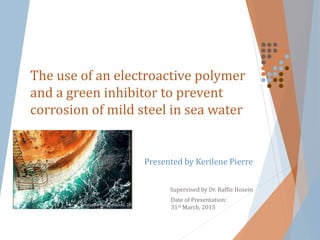
Fernando Burgamaschi, 2010
Date of Presentation:
31st March, 2015
Content
 Introduction
 Project objectives
 Literature survey
 Methodology
 Research question
 Method
 Expected results
 Project’s timeline
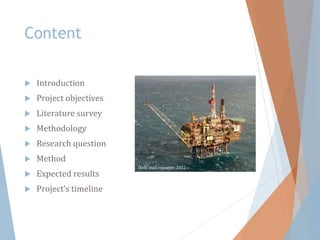
Daily mail reporter, 2012
Introduction:
Corrosion
What is corrosion?
 the destructive attack of a material by a chemical
interaction with its environment (Patni et al., 2013)
Impacts on the oil and gas industry?
Platforms and facilities
 mechanical failure
 economic losses
 intensified at offshore locations
Introduction:
Corrosion Inhibition
CESL provides industrial sectors with various inhibitors,
some have heavy metals and toxins:
 relatively expensive
 not eco-friendly
This study proposes inhibitors:
 Green inhibitor, orange fruit waste
 Electroactive polymer, polypyrrole
Both relatively inexpensive and eco-friendly
Introduction:
Purpose of Study
Resist corrosion of mild steel electrodes in sea water
 with orange fruit waste
 with polypyrrole
New to oil and gas industry:
These inhibitors have not been applied to mild steel
facilities and pipelines.
 industry being forced to find more eco-friendly inhibitors
Project Objectives
 To analyse corrosion of mild steel electrodes in sea
water
 Use open circuit potential data (OCP) to monitor
corrosion
 Use electrochemical impedance spectroscopy (EIS) to
determine resistances of electrodes
 Determine corrosion inhibiting abilities of the two
proposed inhibitors
Literature survey:
Oil & Gas Consultants
Petrotrin’s oil spill in 2013
 corrosion of a slop oil tank (ignored warnings)
Keith Eddy (ICSL) & Stephen Lucas (Trinjet)
recommended Rust Grip paint
 for mild steel infrastructure and underwater pipes
 for deepwater block success
 seals out elements
 costly ($ 1324.80/ gal)
 savings (reduced maintenance) (Khan, 2014)
Literature survey
Case studies: Gulf of Mexico (GOM)
Chevron (Ashworth, 2000)
 amines and amides successful inhibitors
 Smooth passive film reduced drag
 tested on 6 inch, 5mile subsea flowline
Clariant Oil Services (COS, 2014)
 water soluble inhibitor
 flowline at GOM
 film persistent
 60 % reduced corrosion
Literature survey:
Proposed inhibitor
Polypyrrole, good corrosion inhibitor:
 anodic protection, reduced corrosion
 Performance varied
 Longer period for film formation
 Application methods (El-Shazly & Wazzan, 2012)
Some say unsuccessful corrosion inhibitor:
 Did not provide anodic protection
 Steel corroded
 Application method failed (Krstajic et al., 1997)
Literature survey:
Proposed inhibitor
Ascorbic acid, good inhibitor in alkaline sea water:
 protective film forms
 reduces corrosion rate
 by reducing the dissolved metal
 good adhesion to metal surface (Yaro et al., 2013)
The literature indicated a high possibility for success
offshore of the proposed inhibitors
Methodology:
Corrosion monitoring techniques:
 Electrochemical Impedance Spectroscopy (EIS)
 Open circuit potentials (OCP)
 Electrical field signature method ( EFSM)
EIS & OCP
 used extensively to evaluate coatings and corrosion
(Jones, 1996)
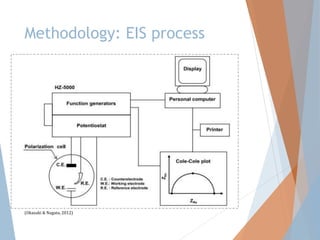
Methodology: EIS process
(Okazaki & Nagata, 2012)
Methodology:
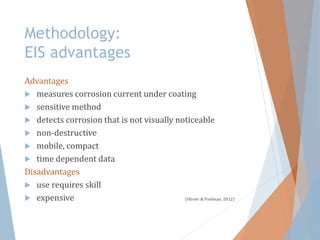
EIS advantages
Advantages
 measures corrosion current under coating
 sensitive method
 detects corrosion that is not visually noticeable
 non-destructive
 mobile, compact
 time dependent data
Disadvantages
 use requires skill
 expensive (Olivier & Poelman, 2012)
Research Question
& Hypothesis
 Research Question:
Can the electroactive polymer and the green inhibitor
coatings applied to mild steel inhibit corrosion in sea
water?
 Hypothesis:
The green inhibitor is not a better corrosion inhibitor
than the electroactive polymer in deep water
environments based on EIS and OCP techniques.
Method
 Cleaning of mild steel rods
 Preparation of orange fruit waste inhibitor
 Preparation of polypyrrole inhibitor
 Preparation of buffer solution
 Treatment and coating of electrodes
 EIS analysis
 EIS data collection with Gamry Software
 Open circuit data collection with multimeter
Expected Results & Discussion
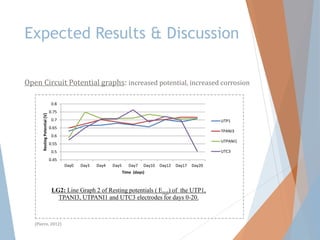
Open Circuit Potential graphs: increased potential, increased corrosion
0.45
0.5
0.55
0.6
0.65
0.7
0.75
0.8
Day0 Day3 Day4 Day5 Day7 Day10 Day12 Day17 Day20
RestingPotential(V)
Time (days)
LG2: Line Graph 2 of Resting potentials ( Erest) of the UTP1,
TPANI3, UTPANI1 and UTC3 electrodes for days 0-20.
UTP1
TPANI3
UTPANI1
UTC3
(Pierre, 2012)
Expected Results & Discussion
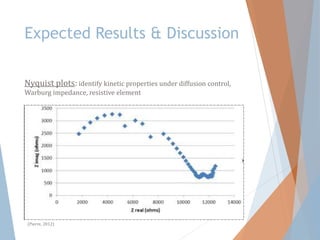
Nyquist plots: identify kinetic properties under diffusion control,
Warburg impedance, resistive element
(Pierre, 2012)
Expected Results & Discussion
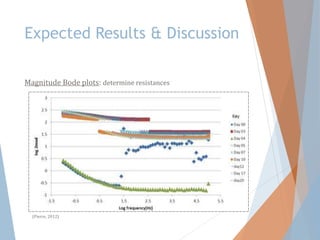
Magnitude Bode plots: determine resistances
(Pierre, 2012)
Expected Results & Discussion
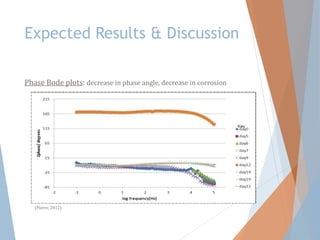
Phase Bode plots: decrease in phase angle, decrease in corrosion
(Pierre, 2012)
Discussion
Corrosion inhibition aided
 Graphs show proof of passive films formed by
corrosion inhibitors
 Application of the inhibitor impacted its success
- methods for best adhesion, increase inhibition
Conclusion of Expected
Results
 Success monitoring corrosion with OCP and EIS
 Corrosion was reduced by inhibitors
-due to passive films
 Oil based enamel paint better than polypyrrole
 Possibly due to application techniques
 Paint had better adhesion
Similar graphs and results are expected for the
inhibitors of this current study to resolve the hypothesis
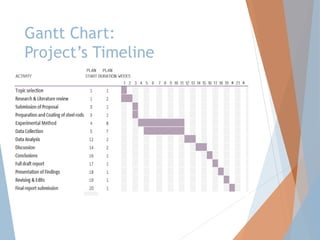
Gantt Chart:
Project’s Timeline
Bibliography
 Ashworth, W. (2000) Drag Reducing Agent for Gas Pipelining Successful in Gulf of Mexico Trial
http://www.ogj.com/articles/print/volume-98/issue-23/transportation/dra-for-gas-pipelining-successful-in-gulf-of-mexico-
trial.html Oil and Gas Journal (accessed 9th March, 2015)
 Badmos, A. and Ajimotokan, H. (2009) The Corrosion of Mild Steel in Orange Juice environment. www.unilorin.edu.ng/publication.
(accessed 12th February, 2015.)
 Chandler, N. (2014) How Faraday Cages Work (2012) http://science.howstuffworks.com/faraday-cage.htm (accessed 16th February
2015.)
 Choi, Y., Farelas, F., Nešić, S., Magalhães, A.; Andrade, C. (2013) Corrosion Behavior of Deep Water Oil Production Tubing Material under
Supercritical CO2 Environment: Part I. Effect of Pressure and Temperature. NACE International. Paper No. 2380. p. 1-12
 Corrosion and Environmental Services Limited (2015) Corrosion Solutions. Corrosion and Environmental Services, Carapichaima,
Trinidad. http://cesltrinidad.com/construction-industrial-water-treatment-chemicals.html (accessed 9th March, 2015)
 Corrosion Doctors (2009) Corrosion Monitoring Techniques. http://www.corrosion-doctors.org/MonitorBasics/Types.htm. (accessed
14th January, 2015)
 El-Shazly, A. and Wazzan, A. (2012) Using Polypyrrole Coating for Improving the Corrosion Resistance of Steel Buried in Corrosive
Mediums. http://www.electrochemsci.org/papers/vol7/7031946.pdf. International Journal of Electrochemical Science. Volume 7.
p.1946 – 1957. (accessed 15th February, 2015)
 Gamry Instruments (2009) Application note: Basics of Electrochemical Impedance Spectroscopy. Gamry Instruments. Sept, 2009. p.1.
http://www.gamry.com/assets/Application-Notes/Basics-of-EIS.pdf. (accessed 17th February, 2015.)
 Hill, J. and Kolb, D. (2001) Chemistry for Changing Times.9th Ed.; Prentice Hall: New Jersey, United States of America. p.27.
 Iloamaeke, M., Onuegbu, U., Umeobika, C., and Umedum, L. (2013) Green Approach to Corrosion Inhibition of Mild Steel Using Emilia
Sonchifolia and Vitex Doniana In 2.5M HCl Medium. International Journal of Science and Modern Engineering. Volume 1. Issue 3. p. 1.
 Iroh, J. and Su, W. (2012) Corrosion performance of polypyrrole coating applied to low carbon steel by an electrochemical process.
Electrochemical Acta 46.2000. p.15-24
 Jones, D. (1996) Principles and Prevention of Corrosion, 2nd ed.; Prentice Hall: New Jersey, United States of America. p.109
 Khan, A. (2014) New Product to Help Prevent Future Oil Spills. Guardian Media Limited Newspaper: Chaguanas, Trinidad.
http://www.guardian.co.tt/business/2014-04-01/new-product-help-prevent-future-oil-spills (Accessed 9th March, 2015)
Bibliography
 Krstajic, N., Grgur, B., Jovanovic, S. and Vojnovic, V. (1997) Polypyrrole. Electrochimica Acta, 42. p.1685.
 Le Minh Duc and Vu Quoc Trung. (2013) Layers of Inhibitor Anion – Doped Polypyrrole for Corrosion Protection of Mild Steel. InTech. p.
145-147.
 Manohar, A., Bretschger. O, Nealson, K. and Mansfeld, F. (2008) The use of electrochemical impedance spectroscopy (EIS) in the
evaluation of the electrochemical properties of a microbial fuel cell. [Online] Bioelectrochemistry: Volume 72. p. 149.
http://www.microbialfuelcell.org/Publications/USC/200.pdf (accessed 20th January, 2015)
 Novocontrol Technologies (2012) Impedance Spectroscopy. http://novocontrol.de/html/introeis.htm (accessed January 22nd, 2015)
 Okazaki, Y. and Nagata, H. (2012).Comparisons of immersion and electrochemical properties of highly biocompatible Ti–15Zr–4Nb–4Ta
alloy and other implantable metals for orthopaedic implants. Science and Technology of Advanced Materials. Volume 8.
 Olivier, M. and Poelman, M. (2012) Use of Electrochemical Impedance Spectroscopy (EIS) for the Evaluation of Electrocoatings
Performances. In Tech. p. 7.
 Papavinasm, S. (1999) 59. Corrosion Inhibitors. CANMET Materials Technology Laboratory: Ottawa, Canada. p. 1089-1104
 Patni, N., Agarwal, S. and Shah, P. (2013) Greener Approach towards Corrosion Inhibition. [Online] Chinese Journal of Engineering;
Volume 2013. 2013. p. 1-4. http://www.hindawi.com/journals/cje/2013/784186/ (accessed January 26th, 2015.)
 Pierre, K. (2012) Comparing Corrosion on Treated and Untreated mild steel surfaces coated with an electroactive polymer or an oil based
enamel paint in a sea water environment. University of the West Indies Campus Library: St. Augustine, Trinidad. p. 13-26.
 Sadeghi, K. (2007) An Overview of Design, Analysis, Construction and Installation of Offshore Petroleum Platforms Suitable for Cyprus
Oil/Gas Fields. Girne American University. Volume 2. p. 1-8
 Singh, Aditya, Ji, G., Prakash, R., Ebenso, E. and Singh, Ashish. (2013) Cephamycin; A Novel Corrosion Inhibitor for Mild Steel Corrosion in
HCl Acid Solution. International Journal of Electrochemical Science. Volume 8. p. 9442-9448.
 Yaro, A., Khadom, A. and Wael, R. (2013) Apricot juice as green corrosion inhibitor of mild steel in phosphoric acid. Alexandria
Engineering Journal. Volume 52. p. 129-135.

PENG6023 res meth pres

  • 1.
    The use ofan electroactive polymer and a green inhibitor to prevent corrosion of mild steel in sea water Presented by Kerilene Pierre Supervised by Dr. Raffie Hosein Fernando Burgamaschi, 2010 Date of Presentation: 31st March, 2015
  • 2.
    Content  Introduction  Projectobjectives  Literature survey  Methodology  Research question  Method  Expected results  Project’s timeline Daily mail reporter, 2012
  • 3.
    Introduction: Corrosion What is corrosion? the destructive attack of a material by a chemical interaction with its environment (Patni et al., 2013) Impacts on the oil and gas industry? Platforms and facilities  mechanical failure  economic losses  intensified at offshore locations
  • 4.
    Introduction: Corrosion Inhibition CESL providesindustrial sectors with various inhibitors, some have heavy metals and toxins:  relatively expensive  not eco-friendly This study proposes inhibitors:  Green inhibitor, orange fruit waste  Electroactive polymer, polypyrrole Both relatively inexpensive and eco-friendly
  • 5.
    Introduction: Purpose of Study Resistcorrosion of mild steel electrodes in sea water  with orange fruit waste  with polypyrrole New to oil and gas industry: These inhibitors have not been applied to mild steel facilities and pipelines.  industry being forced to find more eco-friendly inhibitors
  • 6.
    Project Objectives  Toanalyse corrosion of mild steel electrodes in sea water  Use open circuit potential data (OCP) to monitor corrosion  Use electrochemical impedance spectroscopy (EIS) to determine resistances of electrodes  Determine corrosion inhibiting abilities of the two proposed inhibitors
  • 7.
    Literature survey: Oil &Gas Consultants Petrotrin’s oil spill in 2013  corrosion of a slop oil tank (ignored warnings) Keith Eddy (ICSL) & Stephen Lucas (Trinjet) recommended Rust Grip paint  for mild steel infrastructure and underwater pipes  for deepwater block success  seals out elements  costly ($ 1324.80/ gal)  savings (reduced maintenance) (Khan, 2014)
  • 8.
    Literature survey Case studies:Gulf of Mexico (GOM) Chevron (Ashworth, 2000)  amines and amides successful inhibitors  Smooth passive film reduced drag  tested on 6 inch, 5mile subsea flowline Clariant Oil Services (COS, 2014)  water soluble inhibitor  flowline at GOM  film persistent  60 % reduced corrosion
  • 9.
    Literature survey: Proposed inhibitor Polypyrrole,good corrosion inhibitor:  anodic protection, reduced corrosion  Performance varied  Longer period for film formation  Application methods (El-Shazly & Wazzan, 2012) Some say unsuccessful corrosion inhibitor:  Did not provide anodic protection  Steel corroded  Application method failed (Krstajic et al., 1997)
  • 10.
    Literature survey: Proposed inhibitor Ascorbicacid, good inhibitor in alkaline sea water:  protective film forms  reduces corrosion rate  by reducing the dissolved metal  good adhesion to metal surface (Yaro et al., 2013) The literature indicated a high possibility for success offshore of the proposed inhibitors
  • 11.
    Methodology: Corrosion monitoring techniques: Electrochemical Impedance Spectroscopy (EIS)  Open circuit potentials (OCP)  Electrical field signature method ( EFSM) EIS & OCP  used extensively to evaluate coatings and corrosion (Jones, 1996)
  • 12.
  • 13.
    Methodology: EIS advantages Advantages  measurescorrosion current under coating  sensitive method  detects corrosion that is not visually noticeable  non-destructive  mobile, compact  time dependent data Disadvantages  use requires skill  expensive (Olivier & Poelman, 2012)
  • 14.
    Research Question & Hypothesis Research Question: Can the electroactive polymer and the green inhibitor coatings applied to mild steel inhibit corrosion in sea water?  Hypothesis: The green inhibitor is not a better corrosion inhibitor than the electroactive polymer in deep water environments based on EIS and OCP techniques.
  • 15.
    Method  Cleaning ofmild steel rods  Preparation of orange fruit waste inhibitor  Preparation of polypyrrole inhibitor  Preparation of buffer solution  Treatment and coating of electrodes  EIS analysis  EIS data collection with Gamry Software  Open circuit data collection with multimeter
  • 16.
    Expected Results &Discussion Open Circuit Potential graphs: increased potential, increased corrosion 0.45 0.5 0.55 0.6 0.65 0.7 0.75 0.8 Day0 Day3 Day4 Day5 Day7 Day10 Day12 Day17 Day20 RestingPotential(V) Time (days) LG2: Line Graph 2 of Resting potentials ( Erest) of the UTP1, TPANI3, UTPANI1 and UTC3 electrodes for days 0-20. UTP1 TPANI3 UTPANI1 UTC3 (Pierre, 2012)
  • 17.
    Expected Results &Discussion Nyquist plots: identify kinetic properties under diffusion control, Warburg impedance, resistive element (Pierre, 2012)
  • 18.
    Expected Results &Discussion Magnitude Bode plots: determine resistances (Pierre, 2012)
  • 19.
    Expected Results &Discussion Phase Bode plots: decrease in phase angle, decrease in corrosion (Pierre, 2012)
  • 20.
    Discussion Corrosion inhibition aided Graphs show proof of passive films formed by corrosion inhibitors  Application of the inhibitor impacted its success - methods for best adhesion, increase inhibition
  • 21.
    Conclusion of Expected Results Success monitoring corrosion with OCP and EIS  Corrosion was reduced by inhibitors -due to passive films  Oil based enamel paint better than polypyrrole  Possibly due to application techniques  Paint had better adhesion Similar graphs and results are expected for the inhibitors of this current study to resolve the hypothesis
  • 22.
  • 23.
    Bibliography  Ashworth, W.(2000) Drag Reducing Agent for Gas Pipelining Successful in Gulf of Mexico Trial http://www.ogj.com/articles/print/volume-98/issue-23/transportation/dra-for-gas-pipelining-successful-in-gulf-of-mexico- trial.html Oil and Gas Journal (accessed 9th March, 2015)  Badmos, A. and Ajimotokan, H. (2009) The Corrosion of Mild Steel in Orange Juice environment. www.unilorin.edu.ng/publication. (accessed 12th February, 2015.)  Chandler, N. (2014) How Faraday Cages Work (2012) http://science.howstuffworks.com/faraday-cage.htm (accessed 16th February 2015.)  Choi, Y., Farelas, F., Nešić, S., Magalhães, A.; Andrade, C. (2013) Corrosion Behavior of Deep Water Oil Production Tubing Material under Supercritical CO2 Environment: Part I. Effect of Pressure and Temperature. NACE International. Paper No. 2380. p. 1-12  Corrosion and Environmental Services Limited (2015) Corrosion Solutions. Corrosion and Environmental Services, Carapichaima, Trinidad. http://cesltrinidad.com/construction-industrial-water-treatment-chemicals.html (accessed 9th March, 2015)  Corrosion Doctors (2009) Corrosion Monitoring Techniques. http://www.corrosion-doctors.org/MonitorBasics/Types.htm. (accessed 14th January, 2015)  El-Shazly, A. and Wazzan, A. (2012) Using Polypyrrole Coating for Improving the Corrosion Resistance of Steel Buried in Corrosive Mediums. http://www.electrochemsci.org/papers/vol7/7031946.pdf. International Journal of Electrochemical Science. Volume 7. p.1946 – 1957. (accessed 15th February, 2015)  Gamry Instruments (2009) Application note: Basics of Electrochemical Impedance Spectroscopy. Gamry Instruments. Sept, 2009. p.1. http://www.gamry.com/assets/Application-Notes/Basics-of-EIS.pdf. (accessed 17th February, 2015.)  Hill, J. and Kolb, D. (2001) Chemistry for Changing Times.9th Ed.; Prentice Hall: New Jersey, United States of America. p.27.  Iloamaeke, M., Onuegbu, U., Umeobika, C., and Umedum, L. (2013) Green Approach to Corrosion Inhibition of Mild Steel Using Emilia Sonchifolia and Vitex Doniana In 2.5M HCl Medium. International Journal of Science and Modern Engineering. Volume 1. Issue 3. p. 1.  Iroh, J. and Su, W. (2012) Corrosion performance of polypyrrole coating applied to low carbon steel by an electrochemical process. Electrochemical Acta 46.2000. p.15-24  Jones, D. (1996) Principles and Prevention of Corrosion, 2nd ed.; Prentice Hall: New Jersey, United States of America. p.109  Khan, A. (2014) New Product to Help Prevent Future Oil Spills. Guardian Media Limited Newspaper: Chaguanas, Trinidad. http://www.guardian.co.tt/business/2014-04-01/new-product-help-prevent-future-oil-spills (Accessed 9th March, 2015)
  • 24.
    Bibliography  Krstajic, N.,Grgur, B., Jovanovic, S. and Vojnovic, V. (1997) Polypyrrole. Electrochimica Acta, 42. p.1685.  Le Minh Duc and Vu Quoc Trung. (2013) Layers of Inhibitor Anion – Doped Polypyrrole for Corrosion Protection of Mild Steel. InTech. p. 145-147.  Manohar, A., Bretschger. O, Nealson, K. and Mansfeld, F. (2008) The use of electrochemical impedance spectroscopy (EIS) in the evaluation of the electrochemical properties of a microbial fuel cell. [Online] Bioelectrochemistry: Volume 72. p. 149. http://www.microbialfuelcell.org/Publications/USC/200.pdf (accessed 20th January, 2015)  Novocontrol Technologies (2012) Impedance Spectroscopy. http://novocontrol.de/html/introeis.htm (accessed January 22nd, 2015)  Okazaki, Y. and Nagata, H. (2012).Comparisons of immersion and electrochemical properties of highly biocompatible Ti–15Zr–4Nb–4Ta alloy and other implantable metals for orthopaedic implants. Science and Technology of Advanced Materials. Volume 8.  Olivier, M. and Poelman, M. (2012) Use of Electrochemical Impedance Spectroscopy (EIS) for the Evaluation of Electrocoatings Performances. In Tech. p. 7.  Papavinasm, S. (1999) 59. Corrosion Inhibitors. CANMET Materials Technology Laboratory: Ottawa, Canada. p. 1089-1104  Patni, N., Agarwal, S. and Shah, P. (2013) Greener Approach towards Corrosion Inhibition. [Online] Chinese Journal of Engineering; Volume 2013. 2013. p. 1-4. http://www.hindawi.com/journals/cje/2013/784186/ (accessed January 26th, 2015.)  Pierre, K. (2012) Comparing Corrosion on Treated and Untreated mild steel surfaces coated with an electroactive polymer or an oil based enamel paint in a sea water environment. University of the West Indies Campus Library: St. Augustine, Trinidad. p. 13-26.  Sadeghi, K. (2007) An Overview of Design, Analysis, Construction and Installation of Offshore Petroleum Platforms Suitable for Cyprus Oil/Gas Fields. Girne American University. Volume 2. p. 1-8  Singh, Aditya, Ji, G., Prakash, R., Ebenso, E. and Singh, Ashish. (2013) Cephamycin; A Novel Corrosion Inhibitor for Mild Steel Corrosion in HCl Acid Solution. International Journal of Electrochemical Science. Volume 8. p. 9442-9448.  Yaro, A., Khadom, A. and Wael, R. (2013) Apricot juice as green corrosion inhibitor of mild steel in phosphoric acid. Alexandria Engineering Journal. Volume 52. p. 129-135.