Peer Mentoring
in an Online Learning Program
Ray Schroeder
Associate Vice Chancellor for Online Learning
Director, Center for Online Learning , Research and Service
University of Illinois Springfield


Carrie Levin
Assistant Director
Center for Online Learning, Research and Service
University of Illinois Springfield


Emily Boles
Senior Instructional Developer
Center for Online Learning, Research and Service
University of Illinois Springfield
Need for Mentoring
in Online Programs
Need for Online Mentoring
Informal student-to-student advising
 On campus we have plenty of places where
  students congregate and communicate –
  there are time-honored networks that
  thrive on campuses
 Recall your days as a student – from whom
  and where did you receive informal
  advice?
Need for Online Mentoring
 Where/how does that informal advising take
  place online?
 Commonly we create a “coffee shop” or a “pub”
  in the discussion board
       Does that serve the conversation between students as they
       walk into/out of class – as they chat about …. “Are you
       kidding me, or did old Prof so and so really mean we
       should………?
 NO…. Because old Prof so and so sees that
  conversation!
Need for Online Mentoring
Academic Issues
 For online students, who fills the role of the
  senior student – the one down the dorm
  hall who has taken this class?
 In an online class, who models best student
  responses? Where do you find a student
  who has taken the class who can look over
  your paper?
Need for Online Mentoring
Non-Academic Issues
 Many not purely academic issues arise for
  online students:
 Why is he always picking on my postings?
 I am in a family crisis – too embarrassing to
  tell my professor directly; falling behind
 English is not my first language and I just
  don’t understand what she is writing
Need for Online Mentoring
Confidential communicant
 One of the under-recognized, yet highly
  valued roles of the department secretary is
  as a confidential filter for student concerns
 Is there a liaison person who filters student
  concerns and raises them anonymously to
  the instructor as a departmental secretary
  might?
So, what is an
Online Peer Mentor?
How is a peer mentor
  different from
  a supplemental
    instructor?
What role do online
peer mentors have
  with grading?
What training do
Online Peer Mentors
       have?
How are Online Peer
 Mentors chosen?
What qualities make
 for a good Online
   Peer Mentor?
What are the
advantages for the
   instructor?
What are the
advantages for
  students?
Do Peer Mentors
     work?

  ILCCO/UIS
 2007 Research
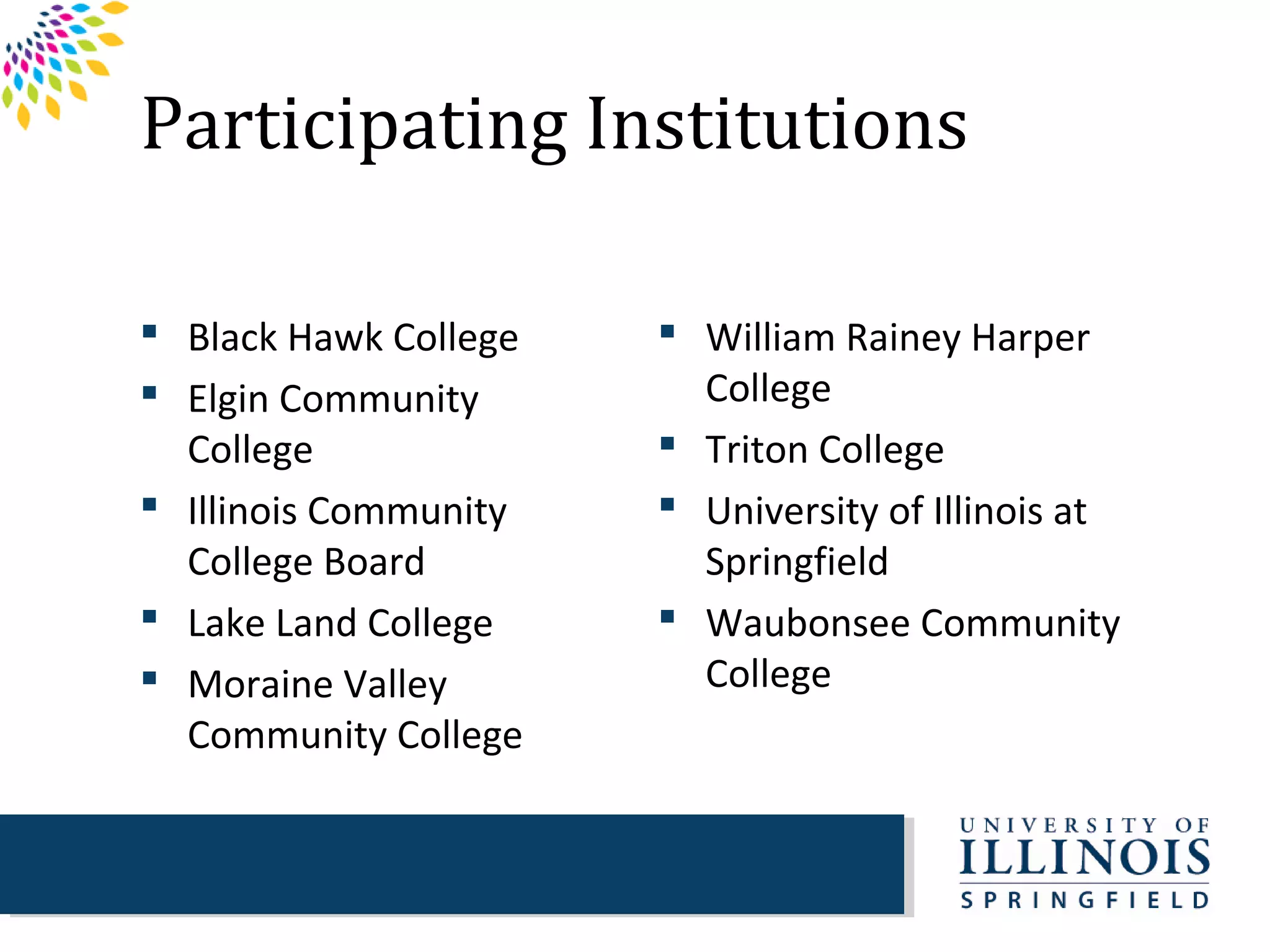
Participating Institutions

 Black Hawk College    William Rainey Harper
 Elgin Community        College
  College               Triton College
 Illinois Community    University of Illinois at
  College Board          Springfield
 Lake Land College     Waubonsee Community
 Moraine Valley         College
  Community College
Research
Seven Illinois community colleges each
identified two “problem” online courses in
which student completion rates were low.

These instructors then selected former
students to become peer mentors in their
courses.
Assessment
Assessing the program itself
 Success of the program requires monitoring
 How do we measure success?
   –   Course completion rates
   –   Student performance – as in grades
   –   Student satisfaction
   –   Faculty satisfaction
   –   Learning effectiveness
 Assessments should be shared with mentors
 Assessments should feed back into class
  development cycle
Results
 The non-completion rate in these courses
  was reduced by 3.48%.
 More significantly, though, student success
  improved.
 The number of failures was reduced by
  3.28%, while the number of A grades and B
  grades increased by 7.20%.
Summary and Conclusions
 Peer mentoring enhances online classes
 Peer mentoring involves close communication
  with both faculty and students
 Assessment and change is essential to success
 If one student per class is retained (tuition
  retained) the cost of the tutor is covered – and all
  benefit! win-win-win!
Establishing a Peer
 Mentor Program
Establishing a Program
Getting Started
 Incremental start is wise
       • Identify a handful of successful faculty members
       • Begin with classes where success is most likely
   Develop best practices
   Refine compensation plan for mentors
   Initiate training program
   Establish an assessment program
       • Assessment program should loop into training program
Establishing a Program
Coordinating program - supporting mentors
 Organizational structure possibilities
      • Center for teaching and learning
      • Online learning center
      • Advising / tutoring center
 More content-centric than techno-centric
 Hosting unit
      • Must support meetings / training
          – Some mentors may be at a distance
      • Provide assistance with challenging issues
Establishing a Program
Selecting peer mentors
 Relationship to faculty member is essential
      • Level of trust must be established
      • Continuous flow of communication
      • UIS effective practice – faculty members choose
 Content knowledge is important
 Compensation issues may arise
      • Graduate Assistants may not be able to receive additional
        compensation
Establishing a Program
Training peer mentors
 Intake training will be required
 Senior mentors may “mentor” others ☺
 Tutoring and counseling staff may make valuable
  contributions
 Assessments of the program should flow into the
  training
 Don’t forget to assess the training itself
Establishing a Program
Compensation for peer mentors
 In order to rely on peer mentors compensation
  should be a part of the program
      • Tutorial/independent study credit a possibility
          – Particularly for those who seek to go into teaching
      • Compensation should reflect the time expectations
          – Eight to ten hours a week may be appropriate
          – Should be monitored by the faculty member
      • $1,200 at $8.00/hour covers 10 hours a week for 15 weeks
Establishing a Program
Confidentiality
 Important aspects of the mentor’s role
 Faculty members need to rely on the
  confidentiality of the mentor
      • For exam material
      • For some class strategies
 Students need to rely on the confidentiality of the
  mentor
      • For personal problems
      • To protect against possible retribution
Center for Online Learning,
Research and Service
University of Illinois at Springfield
One University Plaza
Springfield, IL 62703
217.206.7317
colrs@uis.edu

Peer Mentoring Programs in Online Courses

  • 1.
    Peer Mentoring in anOnline Learning Program
  • 2.
    Ray Schroeder Associate ViceChancellor for Online Learning Director, Center for Online Learning , Research and Service University of Illinois Springfield Carrie Levin Assistant Director Center for Online Learning, Research and Service University of Illinois Springfield Emily Boles Senior Instructional Developer Center for Online Learning, Research and Service University of Illinois Springfield
  • 3.
    Need for Mentoring inOnline Programs
  • 4.
    Need for OnlineMentoring Informal student-to-student advising  On campus we have plenty of places where students congregate and communicate – there are time-honored networks that thrive on campuses  Recall your days as a student – from whom and where did you receive informal advice?
  • 5.
    Need for OnlineMentoring  Where/how does that informal advising take place online?  Commonly we create a “coffee shop” or a “pub” in the discussion board Does that serve the conversation between students as they walk into/out of class – as they chat about …. “Are you kidding me, or did old Prof so and so really mean we should………?  NO…. Because old Prof so and so sees that conversation!
  • 6.
    Need for OnlineMentoring Academic Issues  For online students, who fills the role of the senior student – the one down the dorm hall who has taken this class?  In an online class, who models best student responses? Where do you find a student who has taken the class who can look over your paper?
  • 7.
    Need for OnlineMentoring Non-Academic Issues  Many not purely academic issues arise for online students:  Why is he always picking on my postings?  I am in a family crisis – too embarrassing to tell my professor directly; falling behind  English is not my first language and I just don’t understand what she is writing
  • 8.
    Need for OnlineMentoring Confidential communicant  One of the under-recognized, yet highly valued roles of the department secretary is as a confidential filter for student concerns  Is there a liaison person who filters student concerns and raises them anonymously to the instructor as a departmental secretary might?
  • 9.
    So, what isan Online Peer Mentor?
  • 10.
    How is apeer mentor different from a supplemental instructor?
  • 11.
    What role doonline peer mentors have with grading?
  • 12.
    What training do OnlinePeer Mentors have?
  • 13.
    How are OnlinePeer Mentors chosen?
  • 14.
    What qualities make for a good Online Peer Mentor?
  • 15.
    What are the advantagesfor the instructor?
  • 16.
  • 17.
    Do Peer Mentors work? ILCCO/UIS 2007 Research
  • 18.
    Participating Institutions  BlackHawk College  William Rainey Harper  Elgin Community College College  Triton College  Illinois Community  University of Illinois at College Board Springfield  Lake Land College  Waubonsee Community  Moraine Valley College Community College
  • 19.
    Research Seven Illinois communitycolleges each identified two “problem” online courses in which student completion rates were low. These instructors then selected former students to become peer mentors in their courses.
  • 20.
    Assessment Assessing the programitself  Success of the program requires monitoring  How do we measure success? – Course completion rates – Student performance – as in grades – Student satisfaction – Faculty satisfaction – Learning effectiveness  Assessments should be shared with mentors  Assessments should feed back into class development cycle
  • 21.
    Results  The non-completionrate in these courses was reduced by 3.48%.  More significantly, though, student success improved.  The number of failures was reduced by 3.28%, while the number of A grades and B grades increased by 7.20%.
  • 22.
    Summary and Conclusions Peer mentoring enhances online classes  Peer mentoring involves close communication with both faculty and students  Assessment and change is essential to success  If one student per class is retained (tuition retained) the cost of the tutor is covered – and all benefit! win-win-win!
  • 23.
    Establishing a Peer Mentor Program
  • 24.
    Establishing a Program GettingStarted  Incremental start is wise • Identify a handful of successful faculty members • Begin with classes where success is most likely  Develop best practices  Refine compensation plan for mentors  Initiate training program  Establish an assessment program • Assessment program should loop into training program
  • 25.
    Establishing a Program Coordinatingprogram - supporting mentors  Organizational structure possibilities • Center for teaching and learning • Online learning center • Advising / tutoring center  More content-centric than techno-centric  Hosting unit • Must support meetings / training – Some mentors may be at a distance • Provide assistance with challenging issues
  • 26.
    Establishing a Program Selectingpeer mentors  Relationship to faculty member is essential • Level of trust must be established • Continuous flow of communication • UIS effective practice – faculty members choose  Content knowledge is important  Compensation issues may arise • Graduate Assistants may not be able to receive additional compensation
  • 27.
    Establishing a Program Trainingpeer mentors  Intake training will be required  Senior mentors may “mentor” others ☺  Tutoring and counseling staff may make valuable contributions  Assessments of the program should flow into the training  Don’t forget to assess the training itself
  • 28.
    Establishing a Program Compensationfor peer mentors  In order to rely on peer mentors compensation should be a part of the program • Tutorial/independent study credit a possibility – Particularly for those who seek to go into teaching • Compensation should reflect the time expectations – Eight to ten hours a week may be appropriate – Should be monitored by the faculty member • $1,200 at $8.00/hour covers 10 hours a week for 15 weeks
  • 29.
    Establishing a Program Confidentiality Important aspects of the mentor’s role  Faculty members need to rely on the confidentiality of the mentor • For exam material • For some class strategies  Students need to rely on the confidentiality of the mentor • For personal problems • To protect against possible retribution
  • 30.
    Center for OnlineLearning, Research and Service University of Illinois at Springfield One University Plaza Springfield, IL 62703 217.206.7317 colrs@uis.edu