Pediatric Rotation
12 – 24 Months
Development in children
Second year
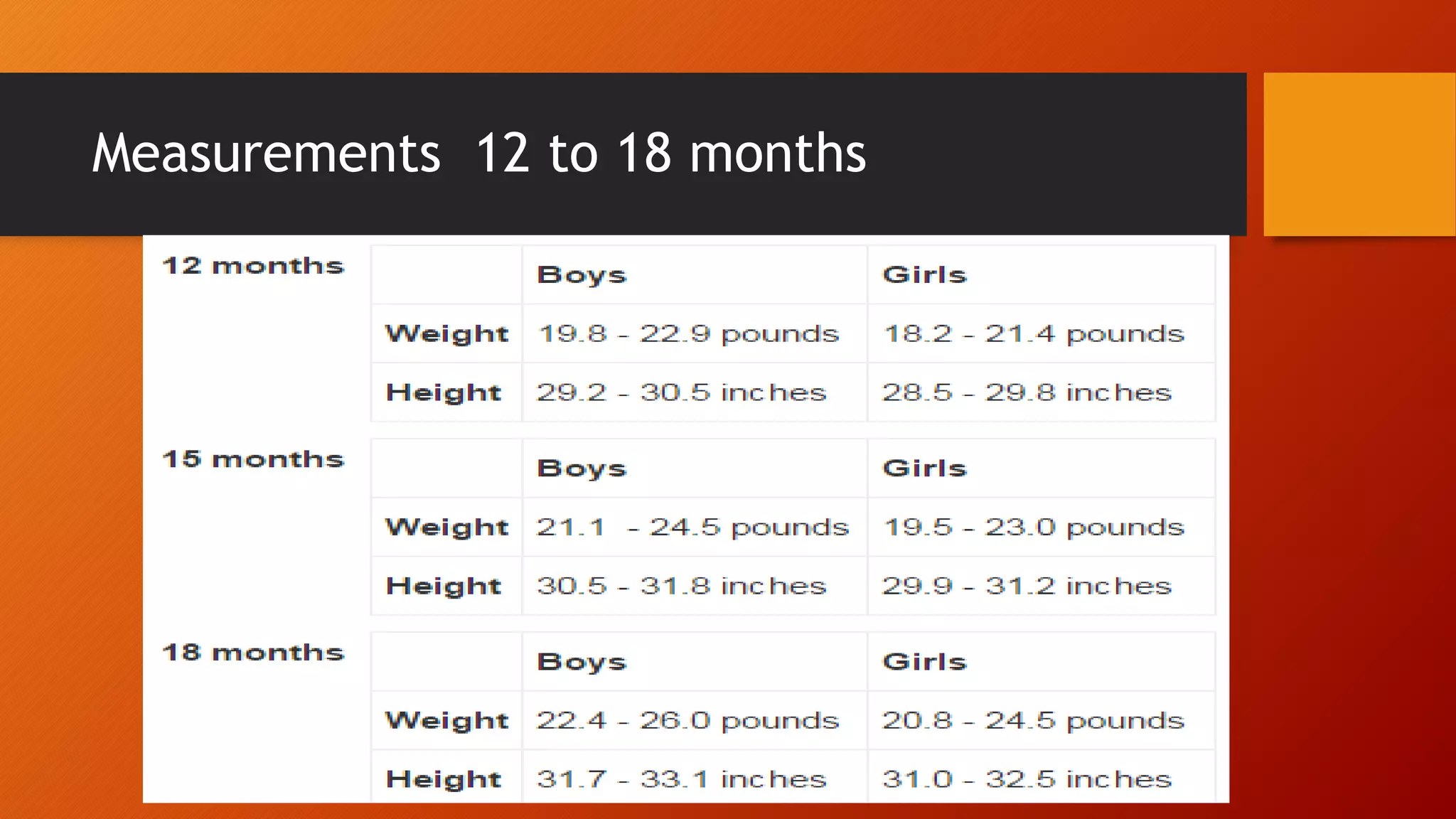
Measurements 12 to 18 months
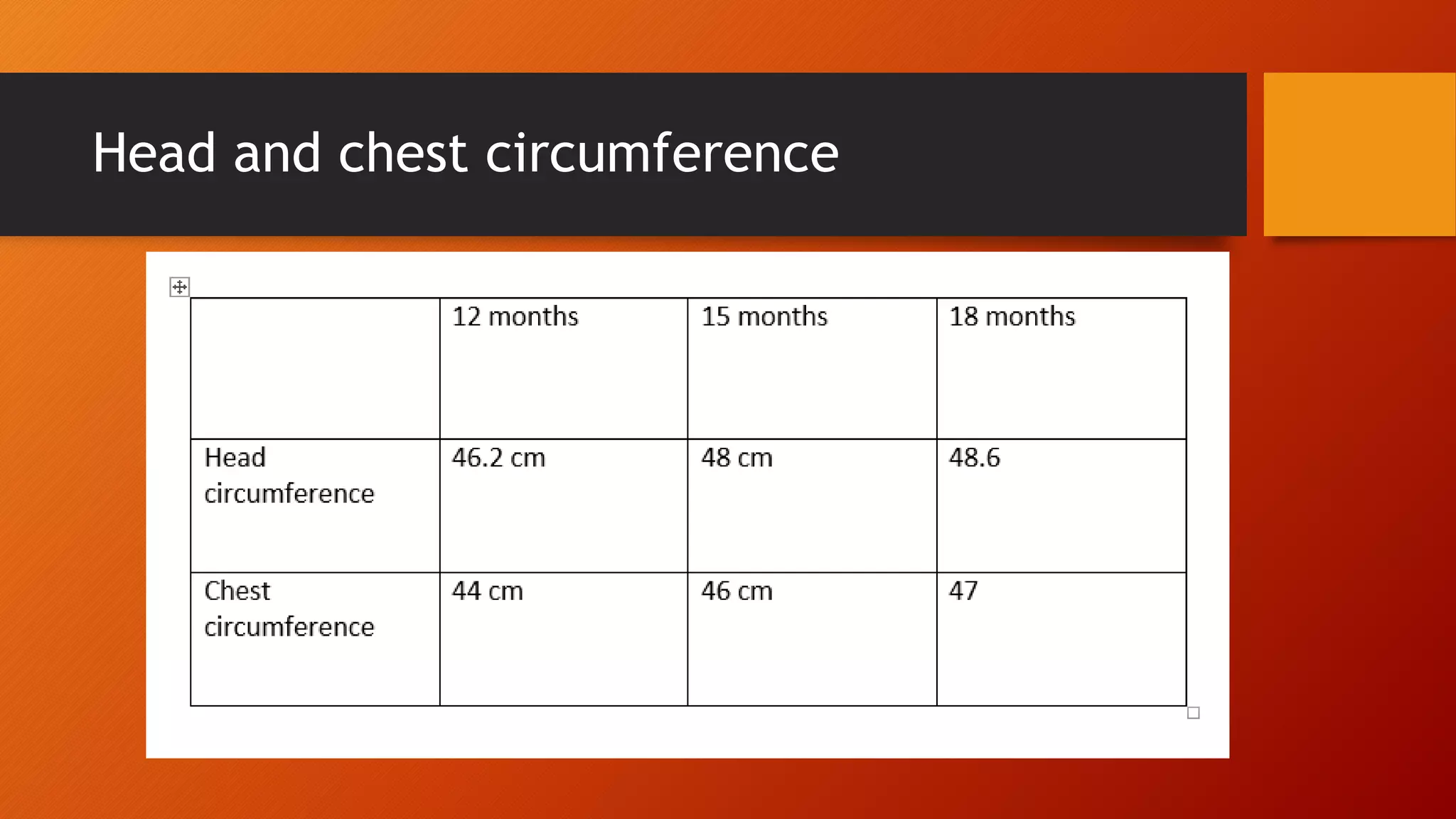
Head and chest circumference
Vital Signs
Physical development
• Toddlers have short legs and long trunk, lumbar lordosis and
protruding abdomen.
• Brain growth occurs in this second year of age also and continuing
myelinization which result in head circumference of 2 cm over the
year.
• The child begins to walk independently at 12 months, some do not
until 15 months.
Patterns of behaviors
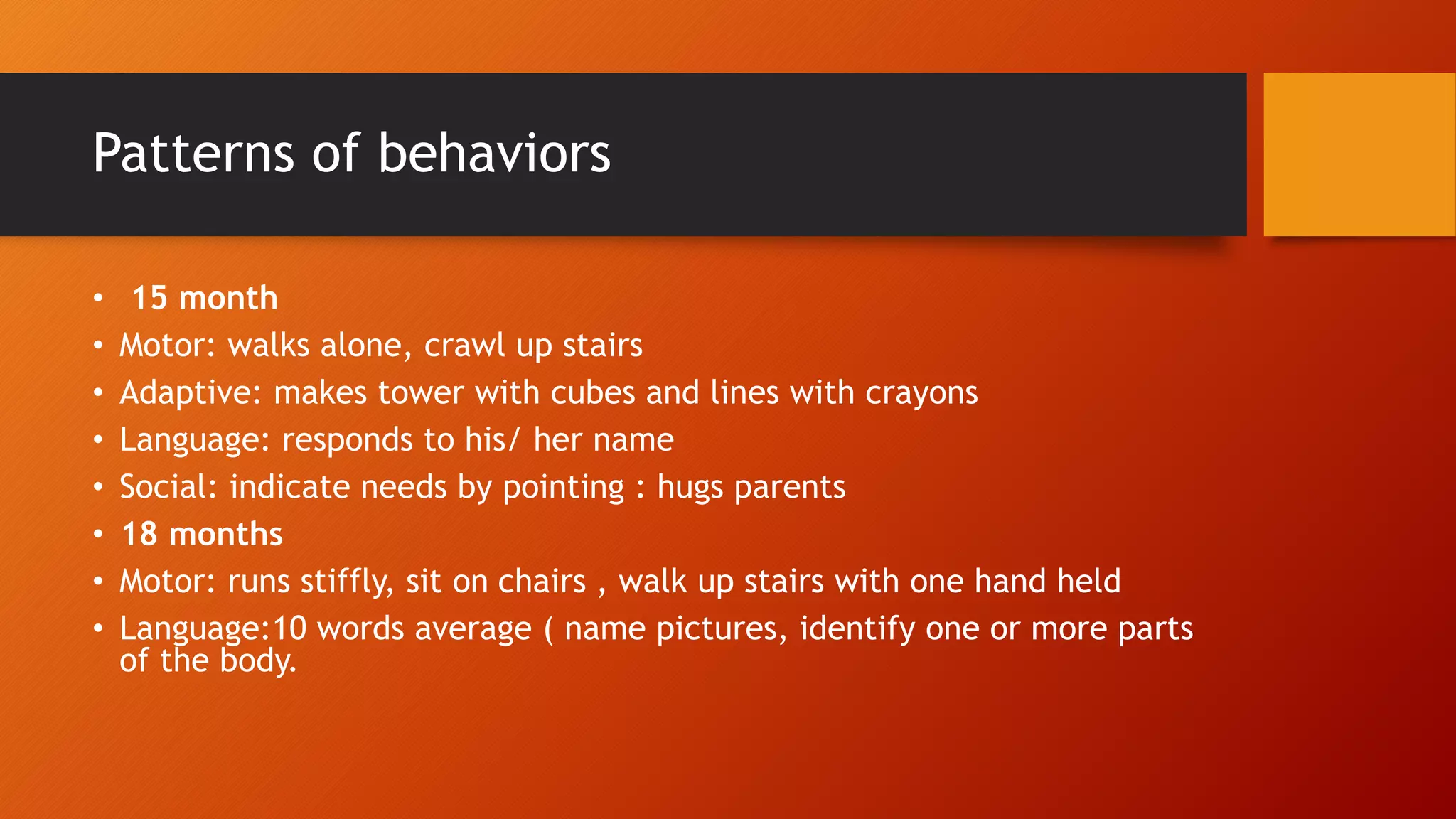
• 15 month
• Motor: walks alone, crawl up stairs
• Adaptive: makes tower with cubes and lines with crayons
• Language: responds to his/ her name
• Social: indicate needs by pointing : hugs parents
• 18 months
• Motor: runs stiffly, sit on chairs , walk up stairs with one hand held
• Language:10 words average ( name pictures, identify one or more parts
of the body.
Patterns of behaviors
• Social: feeds self seek help when in trouble, may complain when
wet or soiled, kisses parents with pucker.
• 24 months
• Motor: runs well, walk up and down stairs, one step at a time,
opens door, climbs on furniture , jumps
• Adaptive: scrible in circular pattern, fold papers.
• Language: puts 3 words together
• Social: handle spoon well, help to undress, listen to stories when
shown pictures.
Emotional development
• Infants who are about to take their first step may be irritable.
Once they start walking their mood changes. Describes as
intoxicated.
• Exploring toddlers orbit around their parents, moving away and
returning for a reassurance touch before moving away again.
• Toddlers who is overly controlled and discouraged form active
exploration will feel doubt, shame, anger and insecurity.
Linguistic development
• Infants are able to speak their first words around 12 months of
age.
• They are able to respond to several statements such as “ no”
“Bye- bye” and “give me”
• By 15 months the child points to major body parts and used 4 to 6
words spontaneously and correctly.
Neurological exam / reflexes
Behavior - Social and Language
Infants this age imitate activities, wave bye-bye, and play pat-a-cake. They can follow
simple instructions especially if the desired action is demonstrated. They feed themselves
finger foods. They usually have one or two meaningful words, usually mama and dada.
• Behavior - Shy
Infants at 12 months of age are often shy and have stranger anxiety. Most of the
neurological exam can be performed with the child on his parent’s lap. The
parent helps reassure the child and facilitates the exam. This infant is shy and
frequently looks to his father for reassurance. The examiner uses toys to try to
engage the child in play and overcome the shyness
• Cranial Nerves
A colorful finger puppet is used to attract the infant’s attention
and test extra ocular range of movement. For testing visual fields,
a finger puppet is again used to get the infant to visually fixate,
and then a dangling measuring tape is used to test peripheral
vision.
• Motor - Tone
Passive range of motion for both the upper and lower extremities
is tested. Transforming the movements into a game makes the
exam less threatening to the infant.
• Motor/Reflexes - Deep Tendon Reflexes
A reflex hammer can be a threatening object to the infant. By
turning the reflex hammer into an imaginary horse and adding
sound effects, the infant is not threatened and cooperates for the
exam. Because using a reflex hammer can be a threat to the child,
deep tendon reflexes are usually done late in the exam and when
the child is on the parent’s lap.
• Motor/Reflexes - Plantar Reflex
At 12 months of age the toes can go up or down. Generally, they
are down going. In this age group it’s hard not to get withdrawal
of the foot. An abnormality of the plantar reflex is most diagnostic
if there is reproducible asymmetry.
• Motor/Coordination - Pincer Grasp
Fine motor coordination of the hand progresses in a definite pattern. At
6-7 months the hand is used as a rake and objects are raked into the
palm with the fingers. At 8-9 months the thumb and the radial fingers
are used to grasp an object and smaller objects are picked up. At 10-12
months, the fine pincer grasp is developed. This enables an infant to
pick up a small object between the distal thumb and index finger.
• Both infants in this exam have developed a pincer grasp. The first infant
uses the pincer grasp to feed himself a cheerio. The second infant
demonstrates a pincer grasp by grabbing the tip of a measuring tape and
pulling the tape out. The pincer grasp should be equal in either hand.
Handedness does not develop until after 12 months of age. Early
handedness and asymmetric fine motor skills are seen with a
hemiparesis.
• Motor - Transition in and out of Sitting
As far as gross motor skills, the infant is able to get in and out of
the sitting position with ease and creeps well.
• Motor - Creeping
Crawling is a commando type of crawl which is an arm over arm
propulsion forward with the trunk on the ground and legs
dragging. Crawling is usually seen at 7 to 9 months. Creeping is
crawling on hands and knees with the trunk off of the ground.
Creeping is usually seen at 8 to 12 months.
• Motor/Gait - Stand, Walks with Support
• The first infant demonstrates the ability to pull himself to a stand
while holding on.
• The second infant can stand, pull to a stand and cruise (not
demonstrated because the baby is upset). Cruising is walking along
a piece of furniture while holding on. It usually develops between
10 to 12 months. Along with cruising, the infant can take steps
while holding on but he’s not ready to walk unsupported.
• Head Circumference
The first attempt to measure the head circumference is easy but
the examiner reads the measurement as 50.6 cm, which is above
the 98th percentile. Second attempt is much more difficult
because the infant doesn’t want the tape measure around his
head. The measurement however is read as 47.7 cm, which is at
the 50th percentile. A third attempt verifies that the 47.7 cm
measurement is correct. Always take at least two measurements
and save the head circumference to the last.
•
Diet
• For children in this age group, the consumption of whole milk is
recommended. Caffeinated foods such as colas, coffee, tea or
chocolate are discouraged. Generally, chopped table foods should
be the basis of the diet. This diet meets the Recommended
Dietary Allowances for 12-18 month olds when iron-fortified baby
cereals are used.
Diet
Snack sugestion
18 to 24 months
• Measurement :
Head and chest circumference
• Head : 47- 48 cm
• Chest: 53 cm
Vitals signs
Linguistic development
• Todllers vocabulary increases from to 10 to 15 words to 50 to 100
at 2 yrs.
• They begin to combine to form sentences.
• At this stage they understand 2- step command such as “ Give me
the ball and get me my shoes”
Reflexes / neurological examination
• Behavior/Mental Status - Wants
At this age, the child indicates his wants by pointing, gesturing
and using vocalizations other than crying. At 18 months, he should
have a vocabulary of 10 or more words and will use single words to
indicate wants. Social interaction at this age is rich and increasing
in complexity as seen in this child.
• Behavior/Mental Status - Understanding
The toddler understands the use of objects and knows how things
work. He’s trying to get the pen to work. He will follow simple
commands, but still needs reinforcement and at times
demonstration.
• Behavior/Mental Status - Points to Pictures
The toddler is asked to point to pictures of a cat, horse, bird and
dog. These pictures are part of the Denver II assessment tool. An
18 month old should be able to point to at least 2 of the pictures.
This toddler identifies 4 pictures and repeats the name of 3.
• Behavior/Mental Status - Points to Body Parts
When asked to point to body parts on the finger puppet, the
toddler identifies eyes and mouth correctly. The naming of 2 body
parts is normal for an 18 month old. Between 18 and 30 months
the toddler should learn to identify 6 out of 8 body parts.
Diet
Diet
• Whole milk
• Other dairy (soft pasteurized cheese, full-fat yogurt and cottage cheese)
• Same food as rest of family, mashed or chopped into bite-size pieces
• Iron-fortified cereals (oats, barley, wheat, mixed cereals)
• Other grains (whole wheat bread, pasta, rice)
• Fruits: melon, papaya, apricot, grapefruit
• Vegetables: broccoli and cauliflower "trees", cooked until soft
• Protein (eggs; cut-up or ground meat or poultry; boneless fish; tofu; beans;
thinly spread smooth peanut butter)
• Citrus and non-citrus juice
• Honey is now okay

Pediatric rotation

  • 1.
    Pediatric Rotation 12 –24 Months Development in children Second year
  • 2.
  • 3.
    Head and chestcircumference
  • 4.
  • 5.
    Physical development • Toddlershave short legs and long trunk, lumbar lordosis and protruding abdomen. • Brain growth occurs in this second year of age also and continuing myelinization which result in head circumference of 2 cm over the year. • The child begins to walk independently at 12 months, some do not until 15 months.
  • 6.
    Patterns of behaviors •15 month • Motor: walks alone, crawl up stairs • Adaptive: makes tower with cubes and lines with crayons • Language: responds to his/ her name • Social: indicate needs by pointing : hugs parents • 18 months • Motor: runs stiffly, sit on chairs , walk up stairs with one hand held • Language:10 words average ( name pictures, identify one or more parts of the body.
  • 7.
    Patterns of behaviors •Social: feeds self seek help when in trouble, may complain when wet or soiled, kisses parents with pucker. • 24 months • Motor: runs well, walk up and down stairs, one step at a time, opens door, climbs on furniture , jumps • Adaptive: scrible in circular pattern, fold papers. • Language: puts 3 words together • Social: handle spoon well, help to undress, listen to stories when shown pictures.
  • 8.
    Emotional development • Infantswho are about to take their first step may be irritable. Once they start walking their mood changes. Describes as intoxicated. • Exploring toddlers orbit around their parents, moving away and returning for a reassurance touch before moving away again. • Toddlers who is overly controlled and discouraged form active exploration will feel doubt, shame, anger and insecurity.
  • 9.
    Linguistic development • Infantsare able to speak their first words around 12 months of age. • They are able to respond to several statements such as “ no” “Bye- bye” and “give me” • By 15 months the child points to major body parts and used 4 to 6 words spontaneously and correctly.
  • 10.
    Neurological exam /reflexes Behavior - Social and Language Infants this age imitate activities, wave bye-bye, and play pat-a-cake. They can follow simple instructions especially if the desired action is demonstrated. They feed themselves finger foods. They usually have one or two meaningful words, usually mama and dada. • Behavior - Shy Infants at 12 months of age are often shy and have stranger anxiety. Most of the neurological exam can be performed with the child on his parent’s lap. The parent helps reassure the child and facilitates the exam. This infant is shy and frequently looks to his father for reassurance. The examiner uses toys to try to engage the child in play and overcome the shyness
  • 11.
    • Cranial Nerves Acolorful finger puppet is used to attract the infant’s attention and test extra ocular range of movement. For testing visual fields, a finger puppet is again used to get the infant to visually fixate, and then a dangling measuring tape is used to test peripheral vision. • Motor - Tone Passive range of motion for both the upper and lower extremities is tested. Transforming the movements into a game makes the exam less threatening to the infant.
  • 12.
    • Motor/Reflexes -Deep Tendon Reflexes A reflex hammer can be a threatening object to the infant. By turning the reflex hammer into an imaginary horse and adding sound effects, the infant is not threatened and cooperates for the exam. Because using a reflex hammer can be a threat to the child, deep tendon reflexes are usually done late in the exam and when the child is on the parent’s lap.
  • 13.
    • Motor/Reflexes -Plantar Reflex At 12 months of age the toes can go up or down. Generally, they are down going. In this age group it’s hard not to get withdrawal of the foot. An abnormality of the plantar reflex is most diagnostic if there is reproducible asymmetry.
  • 14.
    • Motor/Coordination -Pincer Grasp Fine motor coordination of the hand progresses in a definite pattern. At 6-7 months the hand is used as a rake and objects are raked into the palm with the fingers. At 8-9 months the thumb and the radial fingers are used to grasp an object and smaller objects are picked up. At 10-12 months, the fine pincer grasp is developed. This enables an infant to pick up a small object between the distal thumb and index finger. • Both infants in this exam have developed a pincer grasp. The first infant uses the pincer grasp to feed himself a cheerio. The second infant demonstrates a pincer grasp by grabbing the tip of a measuring tape and pulling the tape out. The pincer grasp should be equal in either hand. Handedness does not develop until after 12 months of age. Early handedness and asymmetric fine motor skills are seen with a hemiparesis.
  • 15.
    • Motor -Transition in and out of Sitting As far as gross motor skills, the infant is able to get in and out of the sitting position with ease and creeps well. • Motor - Creeping Crawling is a commando type of crawl which is an arm over arm propulsion forward with the trunk on the ground and legs dragging. Crawling is usually seen at 7 to 9 months. Creeping is crawling on hands and knees with the trunk off of the ground. Creeping is usually seen at 8 to 12 months.
  • 16.
    • Motor/Gait -Stand, Walks with Support • The first infant demonstrates the ability to pull himself to a stand while holding on. • The second infant can stand, pull to a stand and cruise (not demonstrated because the baby is upset). Cruising is walking along a piece of furniture while holding on. It usually develops between 10 to 12 months. Along with cruising, the infant can take steps while holding on but he’s not ready to walk unsupported.
  • 17.
    • Head Circumference Thefirst attempt to measure the head circumference is easy but the examiner reads the measurement as 50.6 cm, which is above the 98th percentile. Second attempt is much more difficult because the infant doesn’t want the tape measure around his head. The measurement however is read as 47.7 cm, which is at the 50th percentile. A third attempt verifies that the 47.7 cm measurement is correct. Always take at least two measurements and save the head circumference to the last. •
  • 18.
    Diet • For childrenin this age group, the consumption of whole milk is recommended. Caffeinated foods such as colas, coffee, tea or chocolate are discouraged. Generally, chopped table foods should be the basis of the diet. This diet meets the Recommended Dietary Allowances for 12-18 month olds when iron-fortified baby cereals are used.
  • 19.
  • 20.
  • 21.
    18 to 24months • Measurement :
  • 22.
    Head and chestcircumference • Head : 47- 48 cm • Chest: 53 cm
  • 23.
  • 24.
    Linguistic development • Todllersvocabulary increases from to 10 to 15 words to 50 to 100 at 2 yrs. • They begin to combine to form sentences. • At this stage they understand 2- step command such as “ Give me the ball and get me my shoes”
  • 25.
    Reflexes / neurologicalexamination • Behavior/Mental Status - Wants At this age, the child indicates his wants by pointing, gesturing and using vocalizations other than crying. At 18 months, he should have a vocabulary of 10 or more words and will use single words to indicate wants. Social interaction at this age is rich and increasing in complexity as seen in this child. • Behavior/Mental Status - Understanding The toddler understands the use of objects and knows how things work. He’s trying to get the pen to work. He will follow simple commands, but still needs reinforcement and at times demonstration.
  • 26.
    • Behavior/Mental Status- Points to Pictures The toddler is asked to point to pictures of a cat, horse, bird and dog. These pictures are part of the Denver II assessment tool. An 18 month old should be able to point to at least 2 of the pictures. This toddler identifies 4 pictures and repeats the name of 3. • Behavior/Mental Status - Points to Body Parts When asked to point to body parts on the finger puppet, the toddler identifies eyes and mouth correctly. The naming of 2 body parts is normal for an 18 month old. Between 18 and 30 months the toddler should learn to identify 6 out of 8 body parts.
  • 27.
  • 28.
    Diet • Whole milk •Other dairy (soft pasteurized cheese, full-fat yogurt and cottage cheese) • Same food as rest of family, mashed or chopped into bite-size pieces • Iron-fortified cereals (oats, barley, wheat, mixed cereals) • Other grains (whole wheat bread, pasta, rice) • Fruits: melon, papaya, apricot, grapefruit • Vegetables: broccoli and cauliflower "trees", cooked until soft • Protein (eggs; cut-up or ground meat or poultry; boneless fish; tofu; beans; thinly spread smooth peanut butter) • Citrus and non-citrus juice • Honey is now okay