










Managing an Asthma
Exacerbation in the ED
Emergency Block
Fatima Farid
Ped Resident Year 3
Case Study
01
“Wheezy & Breathless”
HPI
• Maryam is a 5-year-old girl, known to have asthma, brought to ED by her mother
• Presented with three days’ history of runny nose and cough followed by difficult breathing
today
• Cough has been intermittent throughout the day, worsening at night & preventing her from
sleeping comfortably
• Over the last 3 days, cough has been getting worse & has a whistling sound since yesterday
• Since midnight child has been refusing to lie flat on her back, is unable to speak in sentences
& has been increasingly agitated
Can you share some of
your differentials? 
1. Acute asthma exacerbation
2. Viral bronchitis or
pneumonia
3. Foreign body aspiration
4. Allergic reaction
5. Gastro- esophageal reflux/
aspiration pneumonia
DDx
Systemic Review
• Temperature was not checked at home, but mother didn’t feel her to be warm
• Maryam has not been sleeping or eating well since yesterday
• No skin rash, ear pain or change in bladder/ bowel habits
• No history of choking, cyanosis or apnea
• No recent weight loss appreciated
• Only a herbal cough syrup was given at home
Past Medical Hx
• Diagnosed with asthma last month after she required PICU admission for severe status
asthmaticus
• No intubation/ mechanical ventilation was required
• She was not known to have asthma or any health issues before that
• Since discharge parents were requested to follow in our asthma clinic, but did not attend
because child was “doing fine & the asthma was cured”
• Mother says she never gave Maryam any prophylaxis or her rescue inhaler during current
illness because she believed the herbal syrup was all she needed
Other Hx
• No know allergies to food or drugs
• No previous surgeries or regular home medications
• On normal home diet & fully vaccinated
• Developmentally appropriate, bright, friendly & very intelligent girl
• Born at 36 weeks by LSCS in view of fetal distress. Uneventful antenatal and post- natal
period.
• Only child of non- consanguineous parents. Mother has eczema. No other known illnesses in
the family.
What will we look for in
our examination? 
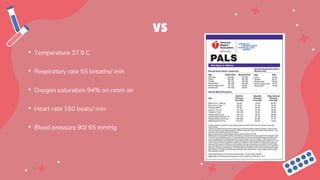
VS
• Temperature 37.9 C
• Respiratory rate 55 breaths/ min
• Oxygen saturation 94% on room air
• Heart rate 160 beats/ min
• Blood pressure 90/ 65 mmHg
General Look
Source: YouTube – Look and listen for wheezing
Findings
Positives Negatives
● Agitated but alert
● Audible wheezes
● Pink on room air
● Well- hydrated
● Subcostal and supra- sternal recessions
● Chest with bilateral equal air entry, loud
wheezes & prolonged expiratory phase
● Normal heart sounds, no murmur
● Abdomen soft and non- tender
with no organomegaly
● No skin rash
● CNS grossly intact
● Normal female genitalia
● Femorals palpable bilaterally
Do you know how to
determine the severity of
an asthma exacerbation? 
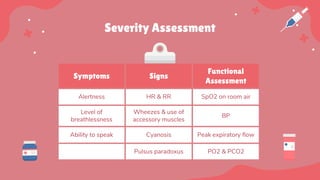
Severity Assessment
Symptoms Signs
Functional
Assessment
Alertness HR & RR SpO2 on room air
Level of
breathlessness
Wheezes & use of
accessory muscles
BP
Ability to speak Cyanosis Peak expiratory flow
Pulsus paradoxus PO2 & PCO2
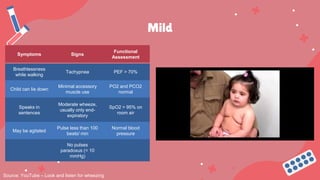
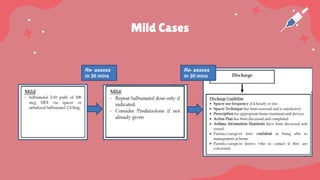
Mild
Symptoms Signs
Functional
Assessment
Breathlessness
while walking
Tachypnea PEF > 70%
Child can lie down
Minimal accessory
muscle use
PO2 and PCO2
normal
Speaks in
sentences
Moderate wheeze,
usually only end-
expiratory
SpO2 > 95% on
room air
May be agitated
Pulse less than 100
beats/ min
Normal blood
pressure
No pulses
paradoxus (< 10
mmHg)
Source: YouTube – Look and listen for wheezing
Moderate
Symptoms Signs
Functional
Assessment
Breathlessness while
at rest – for infants a
shorter and softer cry
with difficulty in
feeding
Tachypnea
PEF 40- 69% or
response to SABA
lasts less than 2
hours
Child prefers to sit
Presence of
accessory muscle use
PO2 > 60 mmHg
PCO2 < 42 mmHg
Speaks in phrases
Loud wheezes
throughout expiration
SpO2 90- 95% on
room air
Usually agitated
Pulse between 100-
120 beats/ min
Normal blood
pressure
May have pulses
paradoxus (10- 25
mmHg)
Source: rolobotrambles.com- the sounds of winter: an audio-visual review of paediatric respiratory disease
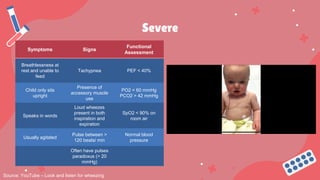
Severe
Source: YouTube – Look and listen for wheezing
Symptoms Signs
Functional
Assessment
Breathlessness at
rest and unable to
feed
Tachypnea PEF < 40%
Child only sits
upright
Presence of
accessory muscle
use
PO2 < 60 mmHg
PCO2 > 42 mmHg
Speaks in words
Loud wheezes
present in both
inspiration and
expiration
SpO2 < 90% on
room air
Usually agitated
Pulse between >
120 beats/ min
Normal blood
pressure
Often have pulses
paradoxus (> 20
mmHg)
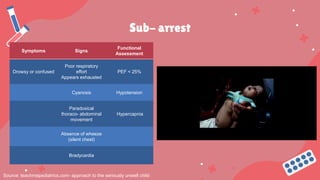
Sub- arrest
Source: teachmepediatrics.com- approach to the seriously unwell child
Symptoms Signs
Functional
Assessment
Drowsy or confused
Poor respiratory
effort
Appears exhausted
PEF < 25%
Cyanosis Hypotension
Paradoxical
thoraco- abdominal
movement
Hypercapnia
Absence of wheeze
(silent chest)
Bradycardia
What is our patient’s
severity? 
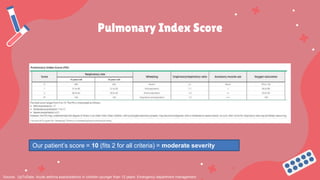
Pulmonary Index Score
Source: UpToDate- Acute asthma exacerbations in children younger than 12 years: Emergency department management
Our patient’s score = 10 (fits 2 for all criteria) = moderate severity
How will we start treating
the child? 
Principles
Reversal of airway obstruction
Correction of hypoxemia &
hypercarbia
Reduction in rate of
hospitalization and recurrence
1
2
3
Initial Mx
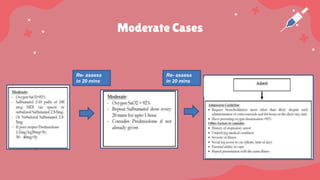
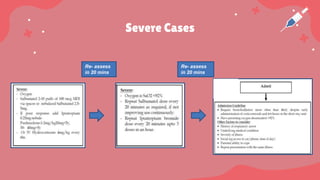
1. Give oxygen to keep saturation > 95%
2. Administer salbutamol and ipratropium bromide nebulization
3. In moderate to severe illness, start either oral prednisolone or IV hydrocortisone
4. Re- assess frequently for response & early detection of deterioration
Nebulization
Ventolin Atrovent
● Salbutamol: Relaxes bronchial smooth muscle by action on
beta- receptors with little effect on heart rate
● Nebulization: 0.15 mg/kg/dose (minimum 2.5 mg) every 20
minutes for 3 doses, then 0.15- 0.3 mg/kg/dose (not to
exceed 10 mg/dose) every 1- 4 hours
● Inhaler: 4- 8 puffs every 20 minutes for 3 doses then every 1-
4 hours
● Onset within 5 minutes / Time to peak 30 minutes / Duration
3- 6 hours
● Ipratropium bromide: Blocks action of acetylcholine at
parasympathetic sites in bronchial smooth muscle causing
bronchodilation
● Nebulization 250- 500 mcg every 20 minutes for one hour, then
as needed as 250 mcg every 1- 8 hours typically with an
increasing dosing interval as patient improves
● Inhaler 4- 8 puffs every 20 minutes as needed for up to 3 hours
● Onset within 15 minutes / Peak effect in 1- 2 hours / Duration
4- 5 hours (nebulization) & 2- 4 hours (inhaler)
Corticosteroid
• Hydrocortisone:
• IV or IM: 0.56- 8 mg/kg/day (or 20- 240 mg/m2/day) in 3 or 4 divided doses
• We use IV 4 mg/kg every 6 hours
• Onset in 1 hour & half- life 2 hours
• Prednisolone:
• Dose is 2 mg/kg/day divided BD
• Max daily dose is 60 mg/ 24 hours (for exacerbations)
• Therapy for moderate cases lasts 5- 7 days & no taper required when stopping
Re- assess
in 20 mins
Re- assess
in 20 mins
Mild Cases
Moderate Cases
Re- assess
in 20 mins
Re- assess
in 20 mins
Severe Cases
Re- assess
in 20 mins
Re- assess
in 20 mins
Do you know the next
steps of treating severe
asthma? 
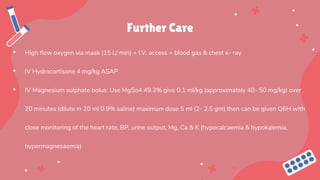
Further Care
• High flow oxygen via mask (15 L/ min) + I.V. access + blood gas & chest x- ray
• IV Hydrocortisone 4 mg/kg ASAP
• IV Magnesium sulphate bolus: Use MgSo4 49.3% give 0.1 ml/kg (approximately 40- 50 mg/kg) over
20 minutes (dilute in 20 ml 0.9% saline) maximum dose 5 ml (2- 2.5 gm) then can be given Q6H with
close monitoring of the heart rate, BP, urine output, Mg, Ca & K (hypocalcaemia & hypokalemia,
hypermagnesaemia)
Magnesium Sulphate
• IV form improves pulmonary function by causing bronchial smooth muscle relaxation independent of
serum magnesium concentration
• Dosage: 50 mg/kg/dose as a single dose (range 25- 75 mg/kg/dose, max dose 2000 mg/dose)
• Onset is immediate & duration 30 minutes
• Some clinicians recommend a saline bolus prior to administration to prevent hypotension
What if the child still
doesn’t improve? 
Sub- arrest Mx
• Call PICU immediately
• Continuous nebulized Ventolin if good inspiratory effort
• Switch to Terbutaline or Epinephrine SQ/ IM if child is not breathing well
• If still poor response start IV Terbutaline + continuous Ventolin nebulization
• Consider non- invasive positive pressure ventilation
• Intubation is very risky in asthmatic children & should only be resorted to if absolutely unavoidable
Epinephrine & Terbutaline
• Epinephrine 0.01 mg/kg (0.01 ml/kg) of 1:1000 SQ or IM (max dose is 0.5 mg)
• Bronchodilator, vasopressor and inotropic effects
• Short acting (around 15 mins) and should be used as a temporizing rather than definitive therapy
• Terbutaline 0.01 mg/kg SQ (max dose 0.4 mg) every 15 minutes for up to 3 doses
• IV Terbutaline can be considered if there is no response to second dose of SQ
• Limited by cardiac intolerance. Monitor continuous 12 lead ECG, cardiac enzymes, urinalysis and
electrolytes
• Only consider in severely ill patients or in those uncooperative with inhaled beta agonists
Intubation
• Potentially dangerous and should be reserved for impending respiratory arrest
• Can increase airway hyper- responsiveness and obstruction
• Indications:
• Deteriorating mental status
• Severe hypoxemia
• Respiratory or cardiac arrest
Alternatives
• IV Salbutamol bolus 10- 15 mcg/kg (single dose maximum 500 mcg) over 10 min in a minimum 5 ml 0.9%
saline. Repeat dose at 10 minutes if still not improving.
• Continuous IV salbutamol infusion 1- 5 mcg/kg/minute (200 mcg/ml solution) with close monitoring of the
heart rate.
• IV Aminophylline bolus 5 mg/kg IV loading dose (maximum dose 500 mg) and make up to 100ml with 0.9%
saline over 30 – 60 minutes with close monitoring of HR, RR, SpO2 and BP.
• If inadequate response to bolus therapy, then start further IV therapy in form of Salbutamol +/- aminophylline
infusion 1 mg/kg/hour.
References
• Harriet Lane Handbook, 21st edition
• Latifa Hospital Guidelines : Management of Asthma
• UpToDate: Acute asthma exacerbations in children younger than 12 years: Emergency department
management
CREDITS: This presentation template was created by Slidesgo,
including icons by Flaticon, and infographics & images by Freepik
Thank you!

Pediatric Asthma Exacerbation Management

  • 1.
    Managing an Asthma Exacerbationin the ED Emergency Block Fatima Farid Ped Resident Year 3
  • 2.
  • 3.
    HPI • Maryam isa 5-year-old girl, known to have asthma, brought to ED by her mother • Presented with three days’ history of runny nose and cough followed by difficult breathing today • Cough has been intermittent throughout the day, worsening at night & preventing her from sleeping comfortably • Over the last 3 days, cough has been getting worse & has a whistling sound since yesterday • Since midnight child has been refusing to lie flat on her back, is unable to speak in sentences & has been increasingly agitated
  • 4.
    Can you sharesome of your differentials? 
  • 5.
    1. Acute asthmaexacerbation 2. Viral bronchitis or pneumonia 3. Foreign body aspiration 4. Allergic reaction 5. Gastro- esophageal reflux/ aspiration pneumonia DDx
  • 6.
    Systemic Review • Temperaturewas not checked at home, but mother didn’t feel her to be warm • Maryam has not been sleeping or eating well since yesterday • No skin rash, ear pain or change in bladder/ bowel habits • No history of choking, cyanosis or apnea • No recent weight loss appreciated • Only a herbal cough syrup was given at home
  • 7.
    Past Medical Hx •Diagnosed with asthma last month after she required PICU admission for severe status asthmaticus • No intubation/ mechanical ventilation was required • She was not known to have asthma or any health issues before that • Since discharge parents were requested to follow in our asthma clinic, but did not attend because child was “doing fine & the asthma was cured” • Mother says she never gave Maryam any prophylaxis or her rescue inhaler during current illness because she believed the herbal syrup was all she needed
  • 8.
    Other Hx • Noknow allergies to food or drugs • No previous surgeries or regular home medications • On normal home diet & fully vaccinated • Developmentally appropriate, bright, friendly & very intelligent girl • Born at 36 weeks by LSCS in view of fetal distress. Uneventful antenatal and post- natal period. • Only child of non- consanguineous parents. Mother has eczema. No other known illnesses in the family.
  • 9.
    What will welook for in our examination? 
  • 10.
    VS • Temperature 37.9C • Respiratory rate 55 breaths/ min • Oxygen saturation 94% on room air • Heart rate 160 beats/ min • Blood pressure 90/ 65 mmHg
  • 11.
    General Look Source: YouTube– Look and listen for wheezing
  • 12.
    Findings Positives Negatives ● Agitatedbut alert ● Audible wheezes ● Pink on room air ● Well- hydrated ● Subcostal and supra- sternal recessions ● Chest with bilateral equal air entry, loud wheezes & prolonged expiratory phase ● Normal heart sounds, no murmur ● Abdomen soft and non- tender with no organomegaly ● No skin rash ● CNS grossly intact ● Normal female genitalia ● Femorals palpable bilaterally
  • 13.
    Do you knowhow to determine the severity of an asthma exacerbation? 
  • 14.
    Severity Assessment Symptoms Signs Functional Assessment AlertnessHR & RR SpO2 on room air Level of breathlessness Wheezes & use of accessory muscles BP Ability to speak Cyanosis Peak expiratory flow Pulsus paradoxus PO2 & PCO2
  • 15.
    Mild Symptoms Signs Functional Assessment Breathlessness while walking TachypneaPEF > 70% Child can lie down Minimal accessory muscle use PO2 and PCO2 normal Speaks in sentences Moderate wheeze, usually only end- expiratory SpO2 > 95% on room air May be agitated Pulse less than 100 beats/ min Normal blood pressure No pulses paradoxus (< 10 mmHg) Source: YouTube – Look and listen for wheezing
  • 16.
    Moderate Symptoms Signs Functional Assessment Breathlessness while atrest – for infants a shorter and softer cry with difficulty in feeding Tachypnea PEF 40- 69% or response to SABA lasts less than 2 hours Child prefers to sit Presence of accessory muscle use PO2 > 60 mmHg PCO2 < 42 mmHg Speaks in phrases Loud wheezes throughout expiration SpO2 90- 95% on room air Usually agitated Pulse between 100- 120 beats/ min Normal blood pressure May have pulses paradoxus (10- 25 mmHg) Source: rolobotrambles.com- the sounds of winter: an audio-visual review of paediatric respiratory disease
  • 17.
    Severe Source: YouTube –Look and listen for wheezing Symptoms Signs Functional Assessment Breathlessness at rest and unable to feed Tachypnea PEF < 40% Child only sits upright Presence of accessory muscle use PO2 < 60 mmHg PCO2 > 42 mmHg Speaks in words Loud wheezes present in both inspiration and expiration SpO2 < 90% on room air Usually agitated Pulse between > 120 beats/ min Normal blood pressure Often have pulses paradoxus (> 20 mmHg)
  • 18.
    Sub- arrest Source: teachmepediatrics.com-approach to the seriously unwell child Symptoms Signs Functional Assessment Drowsy or confused Poor respiratory effort Appears exhausted PEF < 25% Cyanosis Hypotension Paradoxical thoraco- abdominal movement Hypercapnia Absence of wheeze (silent chest) Bradycardia
  • 19.
    What is ourpatient’s severity? 
  • 20.
    Pulmonary Index Score Source:UpToDate- Acute asthma exacerbations in children younger than 12 years: Emergency department management Our patient’s score = 10 (fits 2 for all criteria) = moderate severity
  • 21.
    How will westart treating the child? 
  • 22.
    Principles Reversal of airwayobstruction Correction of hypoxemia & hypercarbia Reduction in rate of hospitalization and recurrence 1 2 3
  • 23.
    Initial Mx 1. Giveoxygen to keep saturation > 95% 2. Administer salbutamol and ipratropium bromide nebulization 3. In moderate to severe illness, start either oral prednisolone or IV hydrocortisone 4. Re- assess frequently for response & early detection of deterioration
  • 24.
    Nebulization Ventolin Atrovent ● Salbutamol:Relaxes bronchial smooth muscle by action on beta- receptors with little effect on heart rate ● Nebulization: 0.15 mg/kg/dose (minimum 2.5 mg) every 20 minutes for 3 doses, then 0.15- 0.3 mg/kg/dose (not to exceed 10 mg/dose) every 1- 4 hours ● Inhaler: 4- 8 puffs every 20 minutes for 3 doses then every 1- 4 hours ● Onset within 5 minutes / Time to peak 30 minutes / Duration 3- 6 hours ● Ipratropium bromide: Blocks action of acetylcholine at parasympathetic sites in bronchial smooth muscle causing bronchodilation ● Nebulization 250- 500 mcg every 20 minutes for one hour, then as needed as 250 mcg every 1- 8 hours typically with an increasing dosing interval as patient improves ● Inhaler 4- 8 puffs every 20 minutes as needed for up to 3 hours ● Onset within 15 minutes / Peak effect in 1- 2 hours / Duration 4- 5 hours (nebulization) & 2- 4 hours (inhaler)
  • 25.
    Corticosteroid • Hydrocortisone: • IVor IM: 0.56- 8 mg/kg/day (or 20- 240 mg/m2/day) in 3 or 4 divided doses • We use IV 4 mg/kg every 6 hours • Onset in 1 hour & half- life 2 hours • Prednisolone: • Dose is 2 mg/kg/day divided BD • Max daily dose is 60 mg/ 24 hours (for exacerbations) • Therapy for moderate cases lasts 5- 7 days & no taper required when stopping
  • 26.
    Re- assess in 20mins Re- assess in 20 mins Mild Cases
  • 27.
    Moderate Cases Re- assess in20 mins Re- assess in 20 mins
  • 28.
    Severe Cases Re- assess in20 mins Re- assess in 20 mins
  • 29.
    Do you knowthe next steps of treating severe asthma? 
  • 30.
    Further Care • Highflow oxygen via mask (15 L/ min) + I.V. access + blood gas & chest x- ray • IV Hydrocortisone 4 mg/kg ASAP • IV Magnesium sulphate bolus: Use MgSo4 49.3% give 0.1 ml/kg (approximately 40- 50 mg/kg) over 20 minutes (dilute in 20 ml 0.9% saline) maximum dose 5 ml (2- 2.5 gm) then can be given Q6H with close monitoring of the heart rate, BP, urine output, Mg, Ca & K (hypocalcaemia & hypokalemia, hypermagnesaemia)
  • 31.
    Magnesium Sulphate • IVform improves pulmonary function by causing bronchial smooth muscle relaxation independent of serum magnesium concentration • Dosage: 50 mg/kg/dose as a single dose (range 25- 75 mg/kg/dose, max dose 2000 mg/dose) • Onset is immediate & duration 30 minutes • Some clinicians recommend a saline bolus prior to administration to prevent hypotension
  • 32.
    What if thechild still doesn’t improve? 
  • 33.
    Sub- arrest Mx •Call PICU immediately • Continuous nebulized Ventolin if good inspiratory effort • Switch to Terbutaline or Epinephrine SQ/ IM if child is not breathing well • If still poor response start IV Terbutaline + continuous Ventolin nebulization • Consider non- invasive positive pressure ventilation • Intubation is very risky in asthmatic children & should only be resorted to if absolutely unavoidable
  • 34.
    Epinephrine & Terbutaline •Epinephrine 0.01 mg/kg (0.01 ml/kg) of 1:1000 SQ or IM (max dose is 0.5 mg) • Bronchodilator, vasopressor and inotropic effects • Short acting (around 15 mins) and should be used as a temporizing rather than definitive therapy • Terbutaline 0.01 mg/kg SQ (max dose 0.4 mg) every 15 minutes for up to 3 doses • IV Terbutaline can be considered if there is no response to second dose of SQ • Limited by cardiac intolerance. Monitor continuous 12 lead ECG, cardiac enzymes, urinalysis and electrolytes • Only consider in severely ill patients or in those uncooperative with inhaled beta agonists
  • 35.
    Intubation • Potentially dangerousand should be reserved for impending respiratory arrest • Can increase airway hyper- responsiveness and obstruction • Indications: • Deteriorating mental status • Severe hypoxemia • Respiratory or cardiac arrest
  • 36.
    Alternatives • IV Salbutamolbolus 10- 15 mcg/kg (single dose maximum 500 mcg) over 10 min in a minimum 5 ml 0.9% saline. Repeat dose at 10 minutes if still not improving. • Continuous IV salbutamol infusion 1- 5 mcg/kg/minute (200 mcg/ml solution) with close monitoring of the heart rate. • IV Aminophylline bolus 5 mg/kg IV loading dose (maximum dose 500 mg) and make up to 100ml with 0.9% saline over 30 – 60 minutes with close monitoring of HR, RR, SpO2 and BP. • If inadequate response to bolus therapy, then start further IV therapy in form of Salbutamol +/- aminophylline infusion 1 mg/kg/hour.
  • 37.
    References • Harriet LaneHandbook, 21st edition • Latifa Hospital Guidelines : Management of Asthma • UpToDate: Acute asthma exacerbations in children younger than 12 years: Emergency department management
  • 38.
    CREDITS: This presentationtemplate was created by Slidesgo, including icons by Flaticon, and infographics & images by Freepik Thank you!