Pediatric Emergencies Mx
Approach
By Fatima Farid
Ped Resident Yr 4
Objectives
• Identify children that require immediate intervention
• Recognize & differentiate between respiratory distress vs failure
• Perform early interventions for respiratory distress & failure
• Learn how to apply team dynamics
Let’s practice together as a team!
2
Do you know how to identify a sick child?
3
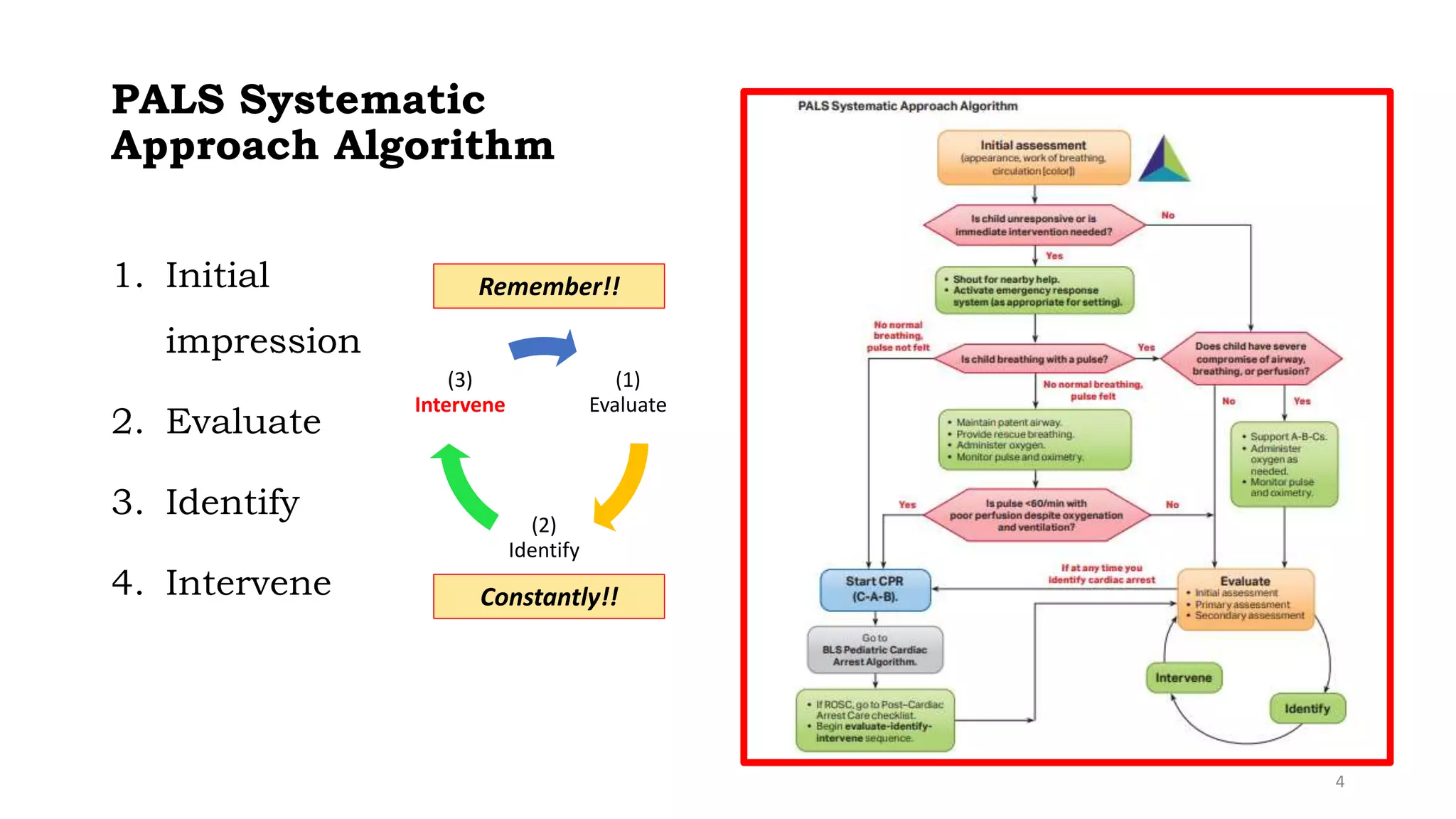
PALS Systematic
Approach Algorithm
1. Initial
impression
2. Evaluate
3. Identify
4. Intervene
4
(1)
Evaluate
(2)
Identify
(3)
Intervene
Constantly!!
Remember!!
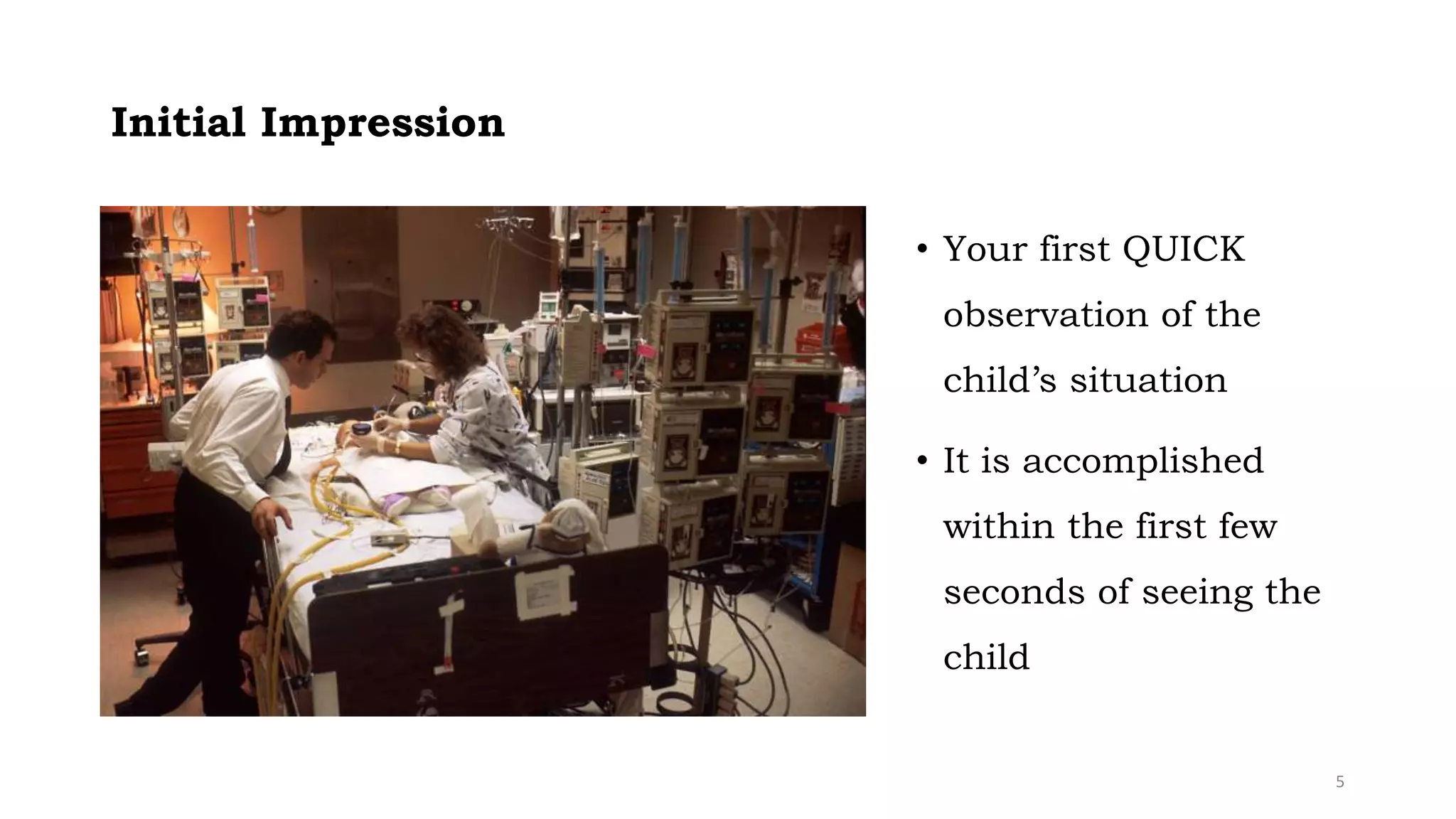
Initial Impression
5
• Your first QUICK
observation of the
child’s situation
• It is accomplished
within the first few
seconds of seeing the
child
PAT - Our tool for initial impression
• The pediatric assessment
triangle (PAT) is used to:
1. Identify the general type of
physiological problem
2. Recognize urgency for
treatment & transport
• Appearance, breathing & colour
are concentrated upon
6
Appearance - TICLS
• Indicates the overall
physiologic status
• T – tone
• I – interactiveness
• C – consolability
• L – look/ gaze/ stare
• S – speech/ cry
7
Breathing
• Position/ posture
• Tripod/ sniffing
• Work of breathing:
• Nasal flaring
• Retractions
• Use of accessory muscles
• Increased, inadequate or absent
respiratory effort
• Breath sounds:
• Wheezing/ stridor/ grunting/ gurgling/
etc
8
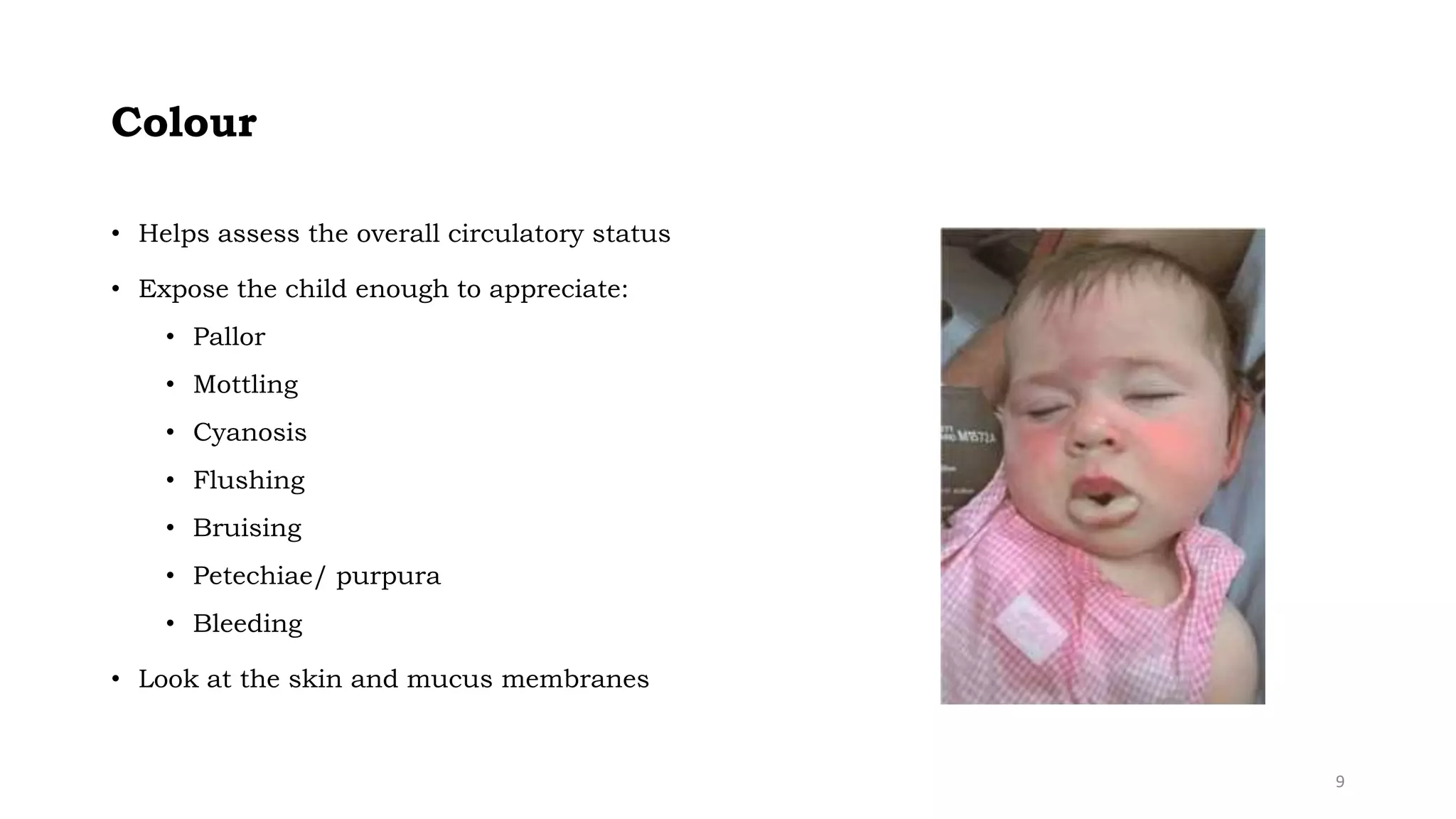
Colour
• Helps assess the overall circulatory status
• Expose the child enough to appreciate:
• Pallor
• Mottling
• Cyanosis
• Flushing
• Bruising
• Petechiae/ purpura
• Bleeding
• Look at the skin and mucus membranes
9
PALS Systematic
Approach Algorithm
1. Initial
impression
2. Evaluate
3. Identify
4. Intervene
10
(1)
Evaluate
(2)
Identify
(3)
Intervene
Constantly!!
Remember!!
Evaluate- Identify- Intervene
• Evaluate:
• Primary assessment
• Secondary assessment
• Diagnostic assessment
• Identify:
• Respiratory vs circulatory vs combined
• Severity (distress/ failure/ shock/ arrest)
• Intervene
• Continue sequence after each intervention or change in patient condition
11
(1)
Evaluate
(2)
Identify
(3)
Intervene
Evaluate - Primary assessment (ABCDE)
Airway
1. Clear
2. Maintainable
3. Non- maintainable
Breathing
1. Rate & pattern
2. Effort
3. Chest expansion & air movement
4. Lung & airway sounds
5. O2 saturation by pulse oximetry
Circulation
1. Heart rate & rhythm
2. Pulses (peripheral and central)
3. Capillary refill time
4. Skin colour and temperature
5. Blood pressure
Disability
1. AVPU
2. GCS
3. Pupil response to light
4. Blood glucose test
Exposure
1. Temperature
2. Trauma
3. Skin rash
4. Extremities
12
(1)
Evaluate
(2)
Identify
(3)
Intervene
Evaluate continued
Secondary assessment
• Focused history: (SAMPLE)
• S- Signs and symptoms
• A- Allergies
• M- Medications
• P- Past medical Hx
• L- Last meal
• E- Event leading up to current
situation
• Focused physical examination
Diagnostics assessments
• ABG/ VBG/ CBG
• Hemoglobin
concentration
• Central venous
O2 saturation
• Arterial lactate
• Central venous
pressure monitor
• Invasive arterial
pressure monitor
• Chest x- ray
• ECG
• Echocardiogram
• Peak expiratory
flow rate
13
PALS Systematic
Approach Algorithm
1. Initial
impression
2. Evaluate
3. Identify
4. Intervene
14
(1)
Evaluate
(2)
Identify
(3)
Intervene
Constantly!!
Remember!!
Identify
Type Severity
Respiratory
• Upper airway obstruction
• Lower airway obstruction
• Lung tissue disease
• Disordered control of breathing
• Respiratory distress
• Respiratory failure
Circulatory
• Hypovolemic shock
• Distributive shock
• Cardiogenic shock
• Obstructive shock
• Compensated shock
• Hypotensive shock
Cardiopulmonary failure
Cardiac arrest
15
Types of respiratory disease
Type Causes Signs
Upper airway obstruction
(nose, pharynx, larynx)
Foreign body aspiration, anaphylaxis, tonsillar
hypertrophy, croup, epiglottitis, pharyngeal/
retropharyngeal/ peritonsillar abscess, tumours,
congenital airway anomalies, thick secretions,
traumatic intubation sequelae
• Increased resp rate & effort
• Stridor
• Change in voice, cry, cough
• Drooling, snoring, gurgling
• Poor chest rise
• Poor air entry
Lower airway obstruction
(lower trachea, bronchi, bronchioles)
Asthma, bronchiolitis
• Increased resp rate & effort
• Decreased air entry
• Prolonged expiratory phase
• Wheezing
• Cough
Lung tissue disease
(parenchyma)
Pneumonia, pulmonary edema, lung contusion,
allergic rxn, toxin, vasculitis, infiltrative dse
• Increased resp rate & effort
• Grunting
• Crackles
• Diminished air entry
• Tachycardia
• Hypoxemia despite administration of O2
Disordered control of
breathing
Seizure, CNS infections, head injury, brain tumour,
hydrocephalus, neuromuscular dse, metabolic
anomalies, drug overdose
• Variable/ irregular resp pattern & effort
• Shallow breathing with inadequate effort
• Central apnea
• Normal or decreased air movement 16
Severity of respiratory disease
17
• Distress:
• Increased respiratory rate, effort and work of breathing
• Child is trying to maintain adequate gas exchange despite
airway obstruction, reduced lung compliance, or lung tissue
disease
• As fatigue develops, adequate gas exchange cannot be
maintained & respiratory failure ensues
Severity of respiratory disease
• Failure:
• Clinical state of inadequate oxygenation, ventilation or both
• Can result from any type of respiratory disease
• When respiratory effort is inadequate, failure can occur without
typical signs of respiratory distress
• Respiratory failure is a clinical state that requires intervention
to prevent deterioration to cardiac arrest
18
Distress vs Failure
19
Resp Distress
1. Awake, alert
2. Tachypneic
3. Nasal flaring
4. Chest wall retractions
5. Audible grunting
Resp Failure
1. Obtunded
2. Marked tachypnea
3. Abdominal breathing
4. Cyanosed
PALS Systematic
Approach Algorithm
1. Initial
impression
2. Evaluate
3. Identify
4. Intervene
20
(1)
Evaluate
(2)
Identify
(3)
Intervene
Constantly!!
Remember!!
Team dynamics – they key to good care
21
Intervention
overview
• Varies according to the
underlying cause
• Oxygen therapy is a
common factor that
should be well-
understood for correct
administration!
22
Oxygen therapy
Indications
Respiratory distress, shock, altered mentation (reduced tissue perfusion
& increased body demands)
O2 delivery to conscious child Ensure child’s comfort & minimize distress
O2 delivery to unconscious child Implement airway protection maneuvers
Types of delivery
Low- flow modes:
• Nasal cannula
• Simple oxygen mask
High- flow modes:
• Non-rebreathing mask with reservoir
• High flow nasal cannula
23
Low- flow modes
• Not tight fitting to airway, hence FiO2 is lower & cannot be fully
controlled as room air mixes during inhalation
• Nasal cannula:
• FiO2 22- 60%
• Flow 0.25- 4 L/min
• Simple face mask:
• FiO2 35- 60%
• Flow 6- 10 L/min
24
High- flow modes
• Reliably delivery oxygen concentration
higher than 60% & flow at minimum 10
L/min
• Non- rebreathing mask:
• FiO2 up to 95%
• Flow 10- 15 L/min
• High- flow nasal cannula:
• Flow 4- 40 L/min as per child’s need
25
PALS Systematic
Approach Algorithm
1. Initial
impression
2. Evaluate
3. Identify
4. Intervene
26
(1)
Evaluate
(2)
Identify
(3)
Intervene
Constantly!!
Remember!!
27
Thanks for
listening!

Pediatric Emergencies Mx Approach

  • 1.
    Pediatric Emergencies Mx Approach ByFatima Farid Ped Resident Yr 4
  • 2.
    Objectives • Identify childrenthat require immediate intervention • Recognize & differentiate between respiratory distress vs failure • Perform early interventions for respiratory distress & failure • Learn how to apply team dynamics Let’s practice together as a team! 2
  • 3.
    Do you knowhow to identify a sick child? 3
  • 4.
    PALS Systematic Approach Algorithm 1.Initial impression 2. Evaluate 3. Identify 4. Intervene 4 (1) Evaluate (2) Identify (3) Intervene Constantly!! Remember!!
  • 5.
    Initial Impression 5 • Yourfirst QUICK observation of the child’s situation • It is accomplished within the first few seconds of seeing the child
  • 6.
    PAT - Ourtool for initial impression • The pediatric assessment triangle (PAT) is used to: 1. Identify the general type of physiological problem 2. Recognize urgency for treatment & transport • Appearance, breathing & colour are concentrated upon 6
  • 7.
    Appearance - TICLS •Indicates the overall physiologic status • T – tone • I – interactiveness • C – consolability • L – look/ gaze/ stare • S – speech/ cry 7
  • 8.
    Breathing • Position/ posture •Tripod/ sniffing • Work of breathing: • Nasal flaring • Retractions • Use of accessory muscles • Increased, inadequate or absent respiratory effort • Breath sounds: • Wheezing/ stridor/ grunting/ gurgling/ etc 8
  • 9.
    Colour • Helps assessthe overall circulatory status • Expose the child enough to appreciate: • Pallor • Mottling • Cyanosis • Flushing • Bruising • Petechiae/ purpura • Bleeding • Look at the skin and mucus membranes 9
  • 10.
    PALS Systematic Approach Algorithm 1.Initial impression 2. Evaluate 3. Identify 4. Intervene 10 (1) Evaluate (2) Identify (3) Intervene Constantly!! Remember!!
  • 11.
    Evaluate- Identify- Intervene •Evaluate: • Primary assessment • Secondary assessment • Diagnostic assessment • Identify: • Respiratory vs circulatory vs combined • Severity (distress/ failure/ shock/ arrest) • Intervene • Continue sequence after each intervention or change in patient condition 11 (1) Evaluate (2) Identify (3) Intervene
  • 12.
    Evaluate - Primaryassessment (ABCDE) Airway 1. Clear 2. Maintainable 3. Non- maintainable Breathing 1. Rate & pattern 2. Effort 3. Chest expansion & air movement 4. Lung & airway sounds 5. O2 saturation by pulse oximetry Circulation 1. Heart rate & rhythm 2. Pulses (peripheral and central) 3. Capillary refill time 4. Skin colour and temperature 5. Blood pressure Disability 1. AVPU 2. GCS 3. Pupil response to light 4. Blood glucose test Exposure 1. Temperature 2. Trauma 3. Skin rash 4. Extremities 12 (1) Evaluate (2) Identify (3) Intervene
  • 13.
    Evaluate continued Secondary assessment •Focused history: (SAMPLE) • S- Signs and symptoms • A- Allergies • M- Medications • P- Past medical Hx • L- Last meal • E- Event leading up to current situation • Focused physical examination Diagnostics assessments • ABG/ VBG/ CBG • Hemoglobin concentration • Central venous O2 saturation • Arterial lactate • Central venous pressure monitor • Invasive arterial pressure monitor • Chest x- ray • ECG • Echocardiogram • Peak expiratory flow rate 13
  • 14.
    PALS Systematic Approach Algorithm 1.Initial impression 2. Evaluate 3. Identify 4. Intervene 14 (1) Evaluate (2) Identify (3) Intervene Constantly!! Remember!!
  • 15.
    Identify Type Severity Respiratory • Upperairway obstruction • Lower airway obstruction • Lung tissue disease • Disordered control of breathing • Respiratory distress • Respiratory failure Circulatory • Hypovolemic shock • Distributive shock • Cardiogenic shock • Obstructive shock • Compensated shock • Hypotensive shock Cardiopulmonary failure Cardiac arrest 15
  • 16.
    Types of respiratorydisease Type Causes Signs Upper airway obstruction (nose, pharynx, larynx) Foreign body aspiration, anaphylaxis, tonsillar hypertrophy, croup, epiglottitis, pharyngeal/ retropharyngeal/ peritonsillar abscess, tumours, congenital airway anomalies, thick secretions, traumatic intubation sequelae • Increased resp rate & effort • Stridor • Change in voice, cry, cough • Drooling, snoring, gurgling • Poor chest rise • Poor air entry Lower airway obstruction (lower trachea, bronchi, bronchioles) Asthma, bronchiolitis • Increased resp rate & effort • Decreased air entry • Prolonged expiratory phase • Wheezing • Cough Lung tissue disease (parenchyma) Pneumonia, pulmonary edema, lung contusion, allergic rxn, toxin, vasculitis, infiltrative dse • Increased resp rate & effort • Grunting • Crackles • Diminished air entry • Tachycardia • Hypoxemia despite administration of O2 Disordered control of breathing Seizure, CNS infections, head injury, brain tumour, hydrocephalus, neuromuscular dse, metabolic anomalies, drug overdose • Variable/ irregular resp pattern & effort • Shallow breathing with inadequate effort • Central apnea • Normal or decreased air movement 16
  • 17.
    Severity of respiratorydisease 17 • Distress: • Increased respiratory rate, effort and work of breathing • Child is trying to maintain adequate gas exchange despite airway obstruction, reduced lung compliance, or lung tissue disease • As fatigue develops, adequate gas exchange cannot be maintained & respiratory failure ensues
  • 18.
    Severity of respiratorydisease • Failure: • Clinical state of inadequate oxygenation, ventilation or both • Can result from any type of respiratory disease • When respiratory effort is inadequate, failure can occur without typical signs of respiratory distress • Respiratory failure is a clinical state that requires intervention to prevent deterioration to cardiac arrest 18
  • 19.
    Distress vs Failure 19 RespDistress 1. Awake, alert 2. Tachypneic 3. Nasal flaring 4. Chest wall retractions 5. Audible grunting Resp Failure 1. Obtunded 2. Marked tachypnea 3. Abdominal breathing 4. Cyanosed
  • 20.
    PALS Systematic Approach Algorithm 1.Initial impression 2. Evaluate 3. Identify 4. Intervene 20 (1) Evaluate (2) Identify (3) Intervene Constantly!! Remember!!
  • 21.
    Team dynamics –they key to good care 21
  • 22.
    Intervention overview • Varies accordingto the underlying cause • Oxygen therapy is a common factor that should be well- understood for correct administration! 22
  • 23.
    Oxygen therapy Indications Respiratory distress,shock, altered mentation (reduced tissue perfusion & increased body demands) O2 delivery to conscious child Ensure child’s comfort & minimize distress O2 delivery to unconscious child Implement airway protection maneuvers Types of delivery Low- flow modes: • Nasal cannula • Simple oxygen mask High- flow modes: • Non-rebreathing mask with reservoir • High flow nasal cannula 23
  • 24.
    Low- flow modes •Not tight fitting to airway, hence FiO2 is lower & cannot be fully controlled as room air mixes during inhalation • Nasal cannula: • FiO2 22- 60% • Flow 0.25- 4 L/min • Simple face mask: • FiO2 35- 60% • Flow 6- 10 L/min 24
  • 25.
    High- flow modes •Reliably delivery oxygen concentration higher than 60% & flow at minimum 10 L/min • Non- rebreathing mask: • FiO2 up to 95% • Flow 10- 15 L/min • High- flow nasal cannula: • Flow 4- 40 L/min as per child’s need 25
  • 26.
    PALS Systematic Approach Algorithm 1.Initial impression 2. Evaluate 3. Identify 4. Intervene 26 (1) Evaluate (2) Identify (3) Intervene Constantly!! Remember!!
  • 27.