24	 ASHRAE Journal	 ashrae.org	 	 Fe b r u a r y 2 0 1 0
By Andy Pearson, Ph.D., CEng., Member ASHRAE, and Andy Campbell, Member ASHRAE
T
 he timing of supermarkets’ transition from CFCs to HCFCs in the 1990s
and then on to HFCs is location specific. For instance, the shift to HFCs
came much later in North America than Europe. However, in parts of Scandinavia
and Central Europe, carbon dioxide systems appeared in the early 1990s and
became commonplace by 2000.
A trial installation constructed in 1991
in Kilmarnock, Scotland,1 provided
valuable learning experience, but the
concept was shelved. One difficulty was
the installation of site pipe work, which
used compression fittings.The change in
temperature from installation to operation
was too great, so many of the fittings
leaked when cold.
The installation used ammonia as the
high side refrigerant of the cascade sys-
tem, but it was too small to be economical
with ammonia. The plant was oversized
using the smallest available ammonia
screw compressor running at half speed.
Carbon dioxide was condensed in the am-
monia evaporator on the roof of the store
and was pumped to display cabinets and
cold storage rooms, with no compressor
in the carbon dioxide circuit.This concept
was published in patents in Great Britain,
France, Germany and the United States,
but was not commercialized. The basic
system is shown in the illustration from
the patent (Figure 1).
Although the idea stalled in Britain, it
was adopted in Sweden where it quickly
gained acceptance.2 Further installations
followed in Norway, Denmark and Swit-
zerland, giving these countries a leading
position in the use of carbon dioxide.
In Britain the search for alternatives to
fluorocarbons continued with many alter-
natives tested, but none achieving general
acceptance. Such systems included instal-
lations with ammonia chillers circulating
About the Authors
Andy Pearson, Ph.D., CEng., is managing
director—contracts at Star Refrigeration and an
associate of Star Technical Solutions in Glasgow,
Scotland. Andy Campbell is head of refrigera-
tion—environmental at Tesco Stores in Welwyn
Garden City, Hertfordshire, United Kingdom.
Using CO2 in
Supermarkets
This article was published in ASHRAE Journal, February 2010. Copyright 2010 American Society of Heating, Refrigerating and Air-Conditioning
Engineers, Inc. Posted at www.ashrae.org. This article may not be copied and/or distributed electronically or in paper form without permission
of ASHRAE. For more information about ASHRAE Journal, visit www.ashrae.org.
February 2010	 ASHRAE Journal	 25
glycol to the shop floor, and chillers with heat transfer fluids
such as polydimethylsiloxane or potassium formate solution
and water-cooled integral units with low charge propane plant.
Meanwhile, the conversion from R-12 in North America was
mainly to R-22 with some stores experimenting with glycol or
the other heat transfer fluids.3
Scandinavia and Central Europe led the way on further devel-
opment. In these systems carbon dioxide is compressed to a high
pressure and rejects heat directly to ambient. The evaporating
pressure is below the critical point, but the heat rejection stage is
above it, so these are called transcritical systems. This requires
a completely new way of thinking about equipment design and
configuration even to the vocabulary used.4 Transcritical opera-
tion presents some significant challenges to the system designer,
and many system designs were produced to overcome them.
A great difficulty is that there is no scope for refrigerant
inventory in the high-pressure side as the heat rejection is ac-
complished by gas cooling, not by condensation. Most designers
incorporate a receiver some-
where on the low-pressure
side, either as an intermediate
flash tank part way through a
two-stage expansion or as a
suction trap after the evapora-
tor.5 The heat rejection side of
the system must also be able to
switch from operation as a gas
cooler in higher ambient to
operation as a more traditional
condenser in colder weather
to achieve best efficiency.
The high operating pressure
required does not present a
problem, but if the design
pressure for site installed
pipe work is above 40 bar
(580 psig), then brazed joints
cannot be used due to the an-
nealing effect of the brazing
process on the copper tube.
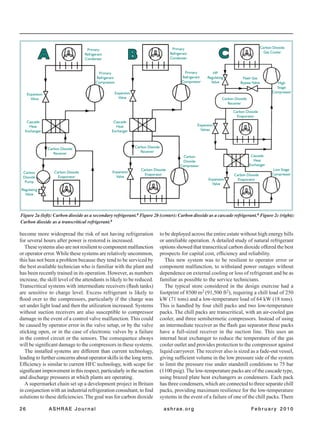
Use of carbon dioxide has evolved into three distinct groups:
1.		 As a phase-changing secondary fluid for chiller and
low-temperature applications;
2.		 In a cascade, where a carbon dioxide compressor raises
the gas from low-temperature conditions up to an inter-
mediate temperature and a separate refrigerating system
provides the heat extraction from the carbon dioxide
condenser; and
3.		 In a transcritical arrangement, where there is no need
for an additional refrigerating system (as heat is rejected
from the carbon dioxide to ambient in a supercritical gas
cooler).
These systems are described in detail in a comprehensive
review by Madsen6 and are shown in Figure 2. To date, tran-
scritical systems have been widely accepted in Europe, have
been used only in a small number of trial installations in Britain,
and have not yet been deployed in North America.
Variants of each system exist, and sometimes they are used
in combination.A cascade system for low-temperature cabinets
might be coupled to a secondary system for the chill cases, or
to a transcritical chill unit. Some novel approaches to pumping
have also been used, such as a secondary system using subcool-
ing of the high-stage liquid line to generate the driving force for
the carbon dioxide liquid circulation without using a pump.7
Secondary loops are the simplest to operate but are expen-
sive to install, if the cost of the high-stage plant is included.
However, installations that retain the existing system, and are
reconfigured to work with an adjacent carbon dioxide pump set,
offer a relatively low cost route into carbon dioxide use while
the sales floor is being refurbished.
Cascade systems are more complex, but for low-temperature
applications, a cascade plant will be cheaper than a second-
ary, which requires the primary refrigerant to run at very
low temperature. Transcritical
systems offer the lowest cost
alternative, but the technol-
ogy is generally viewed as too
experimental in Britain and
America, despite the hundreds
of systems already in operation
in Denmark, Sweden, Norway,
Germany, Luxembourg, Bel-
gium, Switzerland and Italy.
Concerns are regularly voiced
about the energy efficiency of
these systems.
Madsen6 showed that in
Northern Europe air-cooled
systems can be up to 5% more
efficient, but in the south,
there was a penalty of up to
5%. Adiabatic cooling has
been used to overcome this.8
Hybrid condensers or compact
evaporative units offer further
improvement. It is also probable that greater use will be made
of the high temperature water heating capability of transcritical
units, offering a utility not currently available from standard
supermarket packs.9
These systems share some common disadvantages. The de-
sign pressure of the low pressure side of the system is around
40 bar (580 psig) for chill and either 40 bar (580 psig) or 27
bar (390 psig) for low temperature. It is necessary to limit the
pressure in the event of a prolonged plant stoppage.This might
be a standby generator powering a small condensing unit, or a
thermal storage tank somewhere in the system. Often, it was
simply a pressure relief arrangement that would gradually blow
the charge to atmosphere to provide the necessary cooling effect.
This is acceptable when a refrigeration technician is on hand to
recharge the system once power is restored, but once the systems
Figure 1: Carbon dioxide as a secondary refrigerant.
10	 Carbon Dioxide Return Pipe	
12	 Primary Refrigerant Liquid Pipe
14	 Carbon Dioxide Liquid Pipe	
16	 Cascade Heat Exchanger
18	 Primary Refrigerant Condenser	
20	 Primary Refrigerant Compressor
21	 Defrost Gas Generator		
22	 Primary Refrigerant Expansion Valve
26	 Cascade Heat Exchanger		
28	 Carbon Dioxide Liquid Pump
30	 Carbon Dioxide Evaporators	
32	 Carbon Dioxide Regulating Valves
36	 Primary Defrost Hot Gas Pipes	
37	 Primary Defrost Control Valves
38	 Carbon Dioxide Defrost Pipes	
40	 Carbon Dioxide Isolating Valves
26	 ASHRAE Journal	 ashrae.org	 	 Fe b r u a r y 2 0 1 0
Figure 2a (left): Carbon dioxide as a secondary refrigerant.6 Figure 2b (center): Carbon dioxide as a cascade refrigerant.6 Figure 2c (right):
Carbon dioxide as a transcritical refrigerant.6
Expansion
Valve
Cascade
Heat
Exchanger
Carbon Dioxide
Receiver
Carbon Dioxide
Evaporator
Carbon
Dioxide
Pump
Regulating
Valve
Primary
Refrigerant
Condenser
Primary
Refrigerant
Compressor
A
Expansion
Valve
Cascade
Heat
Exchanger
Carbon Dioxide
Receiver
Carbon Dioxide
Evaporator
Primary
Refrigerant
Condenser
Expansion
Valve
Carbon
Dioxide
Compressor
Primary
Refrigerant
Compressor
Cascade
Heat
Exchanger
Carbon Dioxide
Evaporator
Carbon Dioxide
Gas Cooler
High
Stage
Compressor
Flash Gas
Bypass Valve
Carbon Dioxide
Receiver
Low Stage
CompressorCarbon Dioxide
EvaporatorExpansion
Valve
Expansion
Valves
HP
Regulating
Valve
B C
become more widespread the risk of not having refrigeration
for several hours after power is restored is increased.
These systems also are not resilient to component malfunction
or operator error.While these systems are relatively uncommon,
this has not been a problem because they tend to be serviced by
the best available technician who is familiar with the plant and
has been recently trained in its operation. However, as numbers
increase, the skill level of the attendants is likely to be reduced.
Transcritical systems with intermediate receivers (flash tanks)
are sensitive to charge level. Excess refrigerant is likely to
flood over to the compressors, particularly if the charge was
set under light load and then the utilization increased. Systems
without suction receivers are also susceptible to compressor
damage in the event of a control valve malfunction. This could
be caused by operator error in the valve setup, or by the valve
sticking open, or in the case of electronic valves by a failure
in the control circuit or the sensors. The consequence always
will be significant damage to the compressors in these systems.
The installed systems are different than current technology,
leading to further concerns about operator skills in the long term.
Efficiency is similar to current HFC technology, with scope for
significant improvement in this respect, particularly in the suction
and discharge pressures at which plants are operating.
A supermarket chain set up a development project in Britain
in conjunction with an industrial refrigeration consultant, to find
solutions to these deficiencies.The goal was for carbon dioxide
to be deployed across the entire estate without high energy bills
or unreliable operation. A detailed study of natural refrigerant
options showed that transcritical carbon dioxide offered the best
prospects for capital cost, efficiency and reliability.
This new system was to be resilient to operator error or
component malfunction, to withstand power outages without
dependence on external cooling or loss of refrigerant and be as
familiar as possible to the service technicians.
The typical store considered in the design exercise had a
footprint of 8500 m2 (91,500 ft2), requiring a chill load of 250
kW (71 tons) and a low-temperature load of 64 kW (18 tons).
This is handled by four chill packs and two low-temperature
packs. The chill packs are transcritical, with an air-cooled gas
cooler, and three semihermetic compressors. Instead of using
an intermediate receiver as the flash gas separator these packs
have a full-sized receiver in the suction line. This uses an
internal heat exchanger to reduce the temperature of the gas
cooler outlet and provides protection to the compressor against
liquid carryover.The receiver also is sized as a fade-out vessel,
giving sufficient volume in the low pressure side of the system
to limit the pressure rise under standstill conditions to 75 bar
(1100 psig).The low-temperature packs are of the cascade type,
using brazed plate heat exchangers as condensers. Each pack
has three condensers, which are connected to three separate chill
packs, providing maximum resilience for the low-temperature
systems in the event of a failure of one of the chill packs.There
February 2010	 ASHRAE Journal	 27
Figure 3: Transcritical supermarket system, from patent application, 2010.
1	 Carbon Dioxide Compressors
2 	 Gas Cooler
3 	 Flash Gas Separator
4	 Suction Receiver Vessel
5 	 Chill Display Cases
6 	 Carbon Dioxide Pipes
7	 Hp Regulating Valve
8	 Flash Gas Bypass Valve
9 	 Pressure Relief Valve
10	 Pressure Vent Valve
11	 Refrigerant Drier
12	 Oil Separator
13	 Oil Return Pipes
14	 Expansion Valve Controller
15	 Electronic Expansion Valve
P 	 Pressure Sensor
T 	 Temperature Sensor
S1	 EEV Control Inlet Sensor
S2	 EEV Control Outlet Sensor
6D
P
T
6C
12
13
1A 1B 1C
6B
6G
6A
11
3
6F 4
10
9
P
6E
2
8
6H
14
5A
S1 S2
14
14
is a receiver on the high pressure side of
the low-temperature packs, which also
provides fade-out capability.
In warmer weather the chill plants will
operate in transcritical mode, with the
refrigerant flow from the gas cooler regu-
lated by an expansion valve, which is set to
maintain optimum compressor discharge
pressure. The expanded refrigerant, a
mixture of liquid and gas, passes through
a gas separator to electronic expansion
valves at each of the evaporators. The gas
separator is a small in-line fitting. It does
not have to separate all liquid out of the
gas stream, but only to ensure that there is
no gas in the liquid stream.The expansion
valves at the evaporators are of a standard
pulse-modulated type and use a standard
controller, but with slightly different soft-
ware. Whereas a normal controller is set
to optimize superheat, with a minimum
superheat value of 2 K (3.6°F), the revised
software is configured to aim for a maxi-
mum value of 2 K (3.6°F).The evaporators
are, on average, overfed with some liquid
returning to the suction receiver. This,
together with the small amount of liquid from the gas separator,
provides the cooling for the gas cooler outlet. The result is that
the enthalpy of the liquid fed to the expansion valves is as low
as possible, the evaporator surface is more effectively used and
the suction pressure can be a few degrees higher as there is no
need for superheat at the evaporator outlet.
When the weather is colder the main expansion valve drives
wide open, allowing the compressor discharge gas to condense
in the gas cooler. The condensed liquid is fed at higher pres-
sure to the case expansion valves, which operate in the same
control mode as before. Although the evaporators are always
flooded, and return some liquid in the suction line, the com-
pressors are protected by the suction receiver, which is large
enough to act as a liquid separator. A patent application for
the design of the chill system was submitted in February 2009.
Figure 3, from the patent application, shows the schematic
circuit of the system.
The low-temperature packs also have three semihermetic
compressors, operating sub-critically with a constant discharge
pressure of about 35 bar (about 500 psig). The evaporating
condition is about 15 bar (about 220 psig). The three brazed
plate condensers are controlled using pulse modulated elec-
tronic expansion valves. If one of the condensers fails the
discharge pressure only has to rise by 2 K (3.6°F) for the other
units to carry the full load, giving maximum resilience on the
low-temperature side. One of the compressors on each pack is
speed controlled and the other two are fixed speed.
The pack capacity is controlled by an industry-standard sys-
tem, which also provides a graphic user interface for the system.
The control is modular, so that failure of any one component
does not prevent the rest of the system from running.
A test unit was constructed in Derby, England late in 2008
and has provided stable and reliable operation since then. This
system has six chill cases and three low-temperature cabinets,
representing about one-third of the capacity of the standard
packs. This means that it is not possible to give reliable per-
formance figures for the design concept as it is only lightly
loaded, but the control philosophy and evaporator performance
are meeting the design intent, and it is expected that overall
running costs (without allowing for any heat recovery) will be
up to 10% lower than a typical HFC system. The test unit for
the chill system is shown in Photo 1.
The major challenges in constructing the test unit were to
find control components suitable for the design pressure of 75
bar (1100 psig) and to install a suitably rated piping system.
Components including the expansion valves were adapted to
meet the pressure requirement, and operated satisfactorily
throughout the test.The piping was installed using a permanent
type of compression fitting capable of withstanding over 100
bar (1450 psig). The joints can be made as quickly as a brazed
joint, and unlike the joints used in 1991 there were no leaks
when the piping was down to temperature. A section through
one of the fittings is shown in Photo 2. A modest investment in
tooling is required, but this can be reused many times, so the
cost per project is not significant.
The first two supermarkets were equipped with the new sys-
tem at the end of 2009. Early indications are that the predicted
performance improvement over more conventional transcritical
Chill Display Case
Chill Display Case
Chill Display Case
5B
5C
Setat
90bar
Set at
72 bar
Set at 75 bar
S1 S2
S1 S2
15
15
Set at
65 bar
15
7
28	 ASHRAE Journal	 ashrae.org	 	 Fe b r u a r y 2 0 1 0
designs is being achieved, with the saturated suction temperature
of the chill cases about 7 K (12.6°F) higher than the conventional
designs.Thissuggeststhattheannualenergyconsumptionwillbe
about 20% less than for other CO2 transcritical systems. Further
development is planned, including testing scroll compressors
for the low-temperature packs and incorporating the parallel
compression method of economizing to the chill packs to provide
increased capacity and improved efficiency. Although initially
there will be a premium on the capital cost of about 40% com-
pared to conventional systems, the supermarket aims to achieve
cost parity within 18 months. The initial additional cost will be
recouped through improved efficiency and reduced repair costs
(including the cost of replacement refrigerant) in less than three
years. (The system types are summarized in Table 1.)
The majority of supermarkets around the world do not use
carbon dioxide, but the transition from HFCs is gathering
pace. Most users who decide to adopt carbon dioxide choose to
implement a combination of secondary and cascade systems,
but continued development of products and system design for
transcritical plants make CO2 an increasingly attractive option.
Transcritical plants probably will become the norm for European
supermarkets within five years, and NorthAmerica will not be far
behind.This transition may be faster if additional restrictions on
the use of HFCs are introduced, or if the price of HFCs is raised
significantly through taxation or reduced production quotas.
The only development likely to stop this progress is the
introduction of a new fluorocarbon that is suitable as a replace-
ment for R-404A in large commercial systems, and offers low
global warning potential and better efficiency. However, no such
product is close to being placed on the market.
If carbon dioxide system cost cannot be reduced, then the
progress will be slower, but higher capital cost will not stop
the transition, only slow it down. Higher energy costs will tend
to encourage the adoption of carbon dioxide, perhaps in more
highly integrated systems that offer heat recovery for on-site or
neighborhood use. The widely held belief that carbon dioxide
systems are inherently less efficient than typical HFC instal-
lations will be shown to be false as system designers become
more familiar with the techniques required to optimize systems.
References
1.	Pearson, S.F. 1993. “Development of improved secondary re-
frigerants.” Proceedings of the Institute of Refrigeration (89):65 – 80.
2.	Rolfsman, L. 1999. “Plant design considerations for cascade
systems using CO2.” Proceedings 20th Int. Congress of Refrigeration.
3.	Hinde, D.K., S. Zha. 2009. “Natural refrigerant applications in
North American supermarkets.” IIAR Annual Meeting.
4.	Pearson, A.B. 2007. “Possibilities and pitfalls in carbon dioxide
refrigeration.” Proceedings of the Institute of Refrigeration (104).
5.	Rieberer, R., M. Gassler, H. Halozan. 2000. “Control of CO2 heat
pumps.” Proceedings of the 4th IIR Conference.
6.	Madsen, K. 2009. “Living without HFCs: the danish experience.”
Proceedings of the Institute of Refrigeration (106).
7.	Johansen, B. 2008. “Applications and experience with natural
refrigerants carbon dioxide/CO2 and hydro carbon R-1270.” Proceed-
ings of the 8th IIR Conference.
8.	Heinbokel, B., A. Gernemann. 2005. “Eine neuentwickelte
CO2-Kälteanlage für den Normal und Tiefkühlbereich in einem
Schweizer Hypermarkt.” DKV, Würzburg.
9.	Campbell,A.,J.F.Missenden,G.G.Maidment.2007.“Carbondiox-
ideforsupermarkets.”ProceedingsoftheInstituteofRefrigeration(104).
Chill Cases Frozen Cases
Secondary
System
Cheapest and simplest option if
existing high side equipment is reused.
Can be as efficient as existing HFC systems.
Expensive and less efficient than other
CO2 options, but easier to install.
Simplest system to service and maintain.
Cascade
System
Not used for chill systems.
Requires 40 bar (580 psig) compressor and condenser.
Can be served by any high side equipment (HFC, glycol,
HC, ammonia or transcritical CO2).
Transcritical
System
Cheapest option for new installations
or if all existing equipment is to be replaced.
Less familiar for service and maintenance.
Requires higher pressure components.
There is scope for further improvements in
gas cooling techniques, capacity and efficiency.
Can be the low stage of a two-stage system, or served
by a separate cascade plant. This requires an extra heat
exchanger, but gives the benefit of higher reliability. Each
low-stage pack can be served by several high-stage packs
in parallel, giving further reliability.
Table 1: Summary of secondary, cascade and transcritical systems used for chill and frozen cases.
Photo 2: Section of compression fitting.
Photo 1: Transcritical chill unit on test, Derby, England.

Pearson Campbell Ashrae

  • 1.
    24 ASHRAE Journal ashrae.org Fe b r u a r y 2 0 1 0 By Andy Pearson, Ph.D., CEng., Member ASHRAE, and Andy Campbell, Member ASHRAE T  he timing of supermarkets’ transition from CFCs to HCFCs in the 1990s and then on to HFCs is location specific. For instance, the shift to HFCs came much later in North America than Europe. However, in parts of Scandinavia and Central Europe, carbon dioxide systems appeared in the early 1990s and became commonplace by 2000. A trial installation constructed in 1991 in Kilmarnock, Scotland,1 provided valuable learning experience, but the concept was shelved. One difficulty was the installation of site pipe work, which used compression fittings.The change in temperature from installation to operation was too great, so many of the fittings leaked when cold. The installation used ammonia as the high side refrigerant of the cascade sys- tem, but it was too small to be economical with ammonia. The plant was oversized using the smallest available ammonia screw compressor running at half speed. Carbon dioxide was condensed in the am- monia evaporator on the roof of the store and was pumped to display cabinets and cold storage rooms, with no compressor in the carbon dioxide circuit.This concept was published in patents in Great Britain, France, Germany and the United States, but was not commercialized. The basic system is shown in the illustration from the patent (Figure 1). Although the idea stalled in Britain, it was adopted in Sweden where it quickly gained acceptance.2 Further installations followed in Norway, Denmark and Swit- zerland, giving these countries a leading position in the use of carbon dioxide. In Britain the search for alternatives to fluorocarbons continued with many alter- natives tested, but none achieving general acceptance. Such systems included instal- lations with ammonia chillers circulating About the Authors Andy Pearson, Ph.D., CEng., is managing director—contracts at Star Refrigeration and an associate of Star Technical Solutions in Glasgow, Scotland. Andy Campbell is head of refrigera- tion—environmental at Tesco Stores in Welwyn Garden City, Hertfordshire, United Kingdom. Using CO2 in Supermarkets This article was published in ASHRAE Journal, February 2010. Copyright 2010 American Society of Heating, Refrigerating and Air-Conditioning Engineers, Inc. Posted at www.ashrae.org. This article may not be copied and/or distributed electronically or in paper form without permission of ASHRAE. For more information about ASHRAE Journal, visit www.ashrae.org.
  • 2.
    February 2010 ASHRAEJournal 25 glycol to the shop floor, and chillers with heat transfer fluids such as polydimethylsiloxane or potassium formate solution and water-cooled integral units with low charge propane plant. Meanwhile, the conversion from R-12 in North America was mainly to R-22 with some stores experimenting with glycol or the other heat transfer fluids.3 Scandinavia and Central Europe led the way on further devel- opment. In these systems carbon dioxide is compressed to a high pressure and rejects heat directly to ambient. The evaporating pressure is below the critical point, but the heat rejection stage is above it, so these are called transcritical systems. This requires a completely new way of thinking about equipment design and configuration even to the vocabulary used.4 Transcritical opera- tion presents some significant challenges to the system designer, and many system designs were produced to overcome them. A great difficulty is that there is no scope for refrigerant inventory in the high-pressure side as the heat rejection is ac- complished by gas cooling, not by condensation. Most designers incorporate a receiver some- where on the low-pressure side, either as an intermediate flash tank part way through a two-stage expansion or as a suction trap after the evapora- tor.5 The heat rejection side of the system must also be able to switch from operation as a gas cooler in higher ambient to operation as a more traditional condenser in colder weather to achieve best efficiency. The high operating pressure required does not present a problem, but if the design pressure for site installed pipe work is above 40 bar (580 psig), then brazed joints cannot be used due to the an- nealing effect of the brazing process on the copper tube. Use of carbon dioxide has evolved into three distinct groups: 1. As a phase-changing secondary fluid for chiller and low-temperature applications; 2. In a cascade, where a carbon dioxide compressor raises the gas from low-temperature conditions up to an inter- mediate temperature and a separate refrigerating system provides the heat extraction from the carbon dioxide condenser; and 3. In a transcritical arrangement, where there is no need for an additional refrigerating system (as heat is rejected from the carbon dioxide to ambient in a supercritical gas cooler). These systems are described in detail in a comprehensive review by Madsen6 and are shown in Figure 2. To date, tran- scritical systems have been widely accepted in Europe, have been used only in a small number of trial installations in Britain, and have not yet been deployed in North America. Variants of each system exist, and sometimes they are used in combination.A cascade system for low-temperature cabinets might be coupled to a secondary system for the chill cases, or to a transcritical chill unit. Some novel approaches to pumping have also been used, such as a secondary system using subcool- ing of the high-stage liquid line to generate the driving force for the carbon dioxide liquid circulation without using a pump.7 Secondary loops are the simplest to operate but are expen- sive to install, if the cost of the high-stage plant is included. However, installations that retain the existing system, and are reconfigured to work with an adjacent carbon dioxide pump set, offer a relatively low cost route into carbon dioxide use while the sales floor is being refurbished. Cascade systems are more complex, but for low-temperature applications, a cascade plant will be cheaper than a second- ary, which requires the primary refrigerant to run at very low temperature. Transcritical systems offer the lowest cost alternative, but the technol- ogy is generally viewed as too experimental in Britain and America, despite the hundreds of systems already in operation in Denmark, Sweden, Norway, Germany, Luxembourg, Bel- gium, Switzerland and Italy. Concerns are regularly voiced about the energy efficiency of these systems. Madsen6 showed that in Northern Europe air-cooled systems can be up to 5% more efficient, but in the south, there was a penalty of up to 5%. Adiabatic cooling has been used to overcome this.8 Hybrid condensers or compact evaporative units offer further improvement. It is also probable that greater use will be made of the high temperature water heating capability of transcritical units, offering a utility not currently available from standard supermarket packs.9 These systems share some common disadvantages. The de- sign pressure of the low pressure side of the system is around 40 bar (580 psig) for chill and either 40 bar (580 psig) or 27 bar (390 psig) for low temperature. It is necessary to limit the pressure in the event of a prolonged plant stoppage.This might be a standby generator powering a small condensing unit, or a thermal storage tank somewhere in the system. Often, it was simply a pressure relief arrangement that would gradually blow the charge to atmosphere to provide the necessary cooling effect. This is acceptable when a refrigeration technician is on hand to recharge the system once power is restored, but once the systems Figure 1: Carbon dioxide as a secondary refrigerant. 10 Carbon Dioxide Return Pipe 12 Primary Refrigerant Liquid Pipe 14 Carbon Dioxide Liquid Pipe 16 Cascade Heat Exchanger 18 Primary Refrigerant Condenser 20 Primary Refrigerant Compressor 21 Defrost Gas Generator 22 Primary Refrigerant Expansion Valve 26 Cascade Heat Exchanger 28 Carbon Dioxide Liquid Pump 30 Carbon Dioxide Evaporators 32 Carbon Dioxide Regulating Valves 36 Primary Defrost Hot Gas Pipes 37 Primary Defrost Control Valves 38 Carbon Dioxide Defrost Pipes 40 Carbon Dioxide Isolating Valves
  • 3.
    26 ASHRAE Journal ashrae.org Fe b r u a r y 2 0 1 0 Figure 2a (left): Carbon dioxide as a secondary refrigerant.6 Figure 2b (center): Carbon dioxide as a cascade refrigerant.6 Figure 2c (right): Carbon dioxide as a transcritical refrigerant.6 Expansion Valve Cascade Heat Exchanger Carbon Dioxide Receiver Carbon Dioxide Evaporator Carbon Dioxide Pump Regulating Valve Primary Refrigerant Condenser Primary Refrigerant Compressor A Expansion Valve Cascade Heat Exchanger Carbon Dioxide Receiver Carbon Dioxide Evaporator Primary Refrigerant Condenser Expansion Valve Carbon Dioxide Compressor Primary Refrigerant Compressor Cascade Heat Exchanger Carbon Dioxide Evaporator Carbon Dioxide Gas Cooler High Stage Compressor Flash Gas Bypass Valve Carbon Dioxide Receiver Low Stage CompressorCarbon Dioxide EvaporatorExpansion Valve Expansion Valves HP Regulating Valve B C become more widespread the risk of not having refrigeration for several hours after power is restored is increased. These systems also are not resilient to component malfunction or operator error.While these systems are relatively uncommon, this has not been a problem because they tend to be serviced by the best available technician who is familiar with the plant and has been recently trained in its operation. However, as numbers increase, the skill level of the attendants is likely to be reduced. Transcritical systems with intermediate receivers (flash tanks) are sensitive to charge level. Excess refrigerant is likely to flood over to the compressors, particularly if the charge was set under light load and then the utilization increased. Systems without suction receivers are also susceptible to compressor damage in the event of a control valve malfunction. This could be caused by operator error in the valve setup, or by the valve sticking open, or in the case of electronic valves by a failure in the control circuit or the sensors. The consequence always will be significant damage to the compressors in these systems. The installed systems are different than current technology, leading to further concerns about operator skills in the long term. Efficiency is similar to current HFC technology, with scope for significant improvement in this respect, particularly in the suction and discharge pressures at which plants are operating. A supermarket chain set up a development project in Britain in conjunction with an industrial refrigeration consultant, to find solutions to these deficiencies.The goal was for carbon dioxide to be deployed across the entire estate without high energy bills or unreliable operation. A detailed study of natural refrigerant options showed that transcritical carbon dioxide offered the best prospects for capital cost, efficiency and reliability. This new system was to be resilient to operator error or component malfunction, to withstand power outages without dependence on external cooling or loss of refrigerant and be as familiar as possible to the service technicians. The typical store considered in the design exercise had a footprint of 8500 m2 (91,500 ft2), requiring a chill load of 250 kW (71 tons) and a low-temperature load of 64 kW (18 tons). This is handled by four chill packs and two low-temperature packs. The chill packs are transcritical, with an air-cooled gas cooler, and three semihermetic compressors. Instead of using an intermediate receiver as the flash gas separator these packs have a full-sized receiver in the suction line. This uses an internal heat exchanger to reduce the temperature of the gas cooler outlet and provides protection to the compressor against liquid carryover.The receiver also is sized as a fade-out vessel, giving sufficient volume in the low pressure side of the system to limit the pressure rise under standstill conditions to 75 bar (1100 psig).The low-temperature packs are of the cascade type, using brazed plate heat exchangers as condensers. Each pack has three condensers, which are connected to three separate chill packs, providing maximum resilience for the low-temperature systems in the event of a failure of one of the chill packs.There
  • 4.
    February 2010 ASHRAEJournal 27 Figure 3: Transcritical supermarket system, from patent application, 2010. 1  Carbon Dioxide Compressors 2   Gas Cooler 3   Flash Gas Separator 4 Suction Receiver Vessel 5  Chill Display Cases 6   Carbon Dioxide Pipes 7  Hp Regulating Valve 8  Flash Gas Bypass Valve 9  Pressure Relief Valve 10 Pressure Vent Valve 11 Refrigerant Drier 12 Oil Separator 13 Oil Return Pipes 14  Expansion Valve Controller 15 Electronic Expansion Valve P  Pressure Sensor T  Temperature Sensor S1 EEV Control Inlet Sensor S2  EEV Control Outlet Sensor 6D P T 6C 12 13 1A 1B 1C 6B 6G 6A 11 3 6F 4 10 9 P 6E 2 8 6H 14 5A S1 S2 14 14 is a receiver on the high pressure side of the low-temperature packs, which also provides fade-out capability. In warmer weather the chill plants will operate in transcritical mode, with the refrigerant flow from the gas cooler regu- lated by an expansion valve, which is set to maintain optimum compressor discharge pressure. The expanded refrigerant, a mixture of liquid and gas, passes through a gas separator to electronic expansion valves at each of the evaporators. The gas separator is a small in-line fitting. It does not have to separate all liquid out of the gas stream, but only to ensure that there is no gas in the liquid stream.The expansion valves at the evaporators are of a standard pulse-modulated type and use a standard controller, but with slightly different soft- ware. Whereas a normal controller is set to optimize superheat, with a minimum superheat value of 2 K (3.6°F), the revised software is configured to aim for a maxi- mum value of 2 K (3.6°F).The evaporators are, on average, overfed with some liquid returning to the suction receiver. This, together with the small amount of liquid from the gas separator, provides the cooling for the gas cooler outlet. The result is that the enthalpy of the liquid fed to the expansion valves is as low as possible, the evaporator surface is more effectively used and the suction pressure can be a few degrees higher as there is no need for superheat at the evaporator outlet. When the weather is colder the main expansion valve drives wide open, allowing the compressor discharge gas to condense in the gas cooler. The condensed liquid is fed at higher pres- sure to the case expansion valves, which operate in the same control mode as before. Although the evaporators are always flooded, and return some liquid in the suction line, the com- pressors are protected by the suction receiver, which is large enough to act as a liquid separator. A patent application for the design of the chill system was submitted in February 2009. Figure 3, from the patent application, shows the schematic circuit of the system. The low-temperature packs also have three semihermetic compressors, operating sub-critically with a constant discharge pressure of about 35 bar (about 500 psig). The evaporating condition is about 15 bar (about 220 psig). The three brazed plate condensers are controlled using pulse modulated elec- tronic expansion valves. If one of the condensers fails the discharge pressure only has to rise by 2 K (3.6°F) for the other units to carry the full load, giving maximum resilience on the low-temperature side. One of the compressors on each pack is speed controlled and the other two are fixed speed. The pack capacity is controlled by an industry-standard sys- tem, which also provides a graphic user interface for the system. The control is modular, so that failure of any one component does not prevent the rest of the system from running. A test unit was constructed in Derby, England late in 2008 and has provided stable and reliable operation since then. This system has six chill cases and three low-temperature cabinets, representing about one-third of the capacity of the standard packs. This means that it is not possible to give reliable per- formance figures for the design concept as it is only lightly loaded, but the control philosophy and evaporator performance are meeting the design intent, and it is expected that overall running costs (without allowing for any heat recovery) will be up to 10% lower than a typical HFC system. The test unit for the chill system is shown in Photo 1. The major challenges in constructing the test unit were to find control components suitable for the design pressure of 75 bar (1100 psig) and to install a suitably rated piping system. Components including the expansion valves were adapted to meet the pressure requirement, and operated satisfactorily throughout the test.The piping was installed using a permanent type of compression fitting capable of withstanding over 100 bar (1450 psig). The joints can be made as quickly as a brazed joint, and unlike the joints used in 1991 there were no leaks when the piping was down to temperature. A section through one of the fittings is shown in Photo 2. A modest investment in tooling is required, but this can be reused many times, so the cost per project is not significant. The first two supermarkets were equipped with the new sys- tem at the end of 2009. Early indications are that the predicted performance improvement over more conventional transcritical Chill Display Case Chill Display Case Chill Display Case 5B 5C Setat 90bar Set at 72 bar Set at 75 bar S1 S2 S1 S2 15 15 Set at 65 bar 15 7
  • 5.
    28 ASHRAE Journal ashrae.org Fe b r u a r y 2 0 1 0 designs is being achieved, with the saturated suction temperature of the chill cases about 7 K (12.6°F) higher than the conventional designs.Thissuggeststhattheannualenergyconsumptionwillbe about 20% less than for other CO2 transcritical systems. Further development is planned, including testing scroll compressors for the low-temperature packs and incorporating the parallel compression method of economizing to the chill packs to provide increased capacity and improved efficiency. Although initially there will be a premium on the capital cost of about 40% com- pared to conventional systems, the supermarket aims to achieve cost parity within 18 months. The initial additional cost will be recouped through improved efficiency and reduced repair costs (including the cost of replacement refrigerant) in less than three years. (The system types are summarized in Table 1.) The majority of supermarkets around the world do not use carbon dioxide, but the transition from HFCs is gathering pace. Most users who decide to adopt carbon dioxide choose to implement a combination of secondary and cascade systems, but continued development of products and system design for transcritical plants make CO2 an increasingly attractive option. Transcritical plants probably will become the norm for European supermarkets within five years, and NorthAmerica will not be far behind.This transition may be faster if additional restrictions on the use of HFCs are introduced, or if the price of HFCs is raised significantly through taxation or reduced production quotas. The only development likely to stop this progress is the introduction of a new fluorocarbon that is suitable as a replace- ment for R-404A in large commercial systems, and offers low global warning potential and better efficiency. However, no such product is close to being placed on the market. If carbon dioxide system cost cannot be reduced, then the progress will be slower, but higher capital cost will not stop the transition, only slow it down. Higher energy costs will tend to encourage the adoption of carbon dioxide, perhaps in more highly integrated systems that offer heat recovery for on-site or neighborhood use. The widely held belief that carbon dioxide systems are inherently less efficient than typical HFC instal- lations will be shown to be false as system designers become more familiar with the techniques required to optimize systems. References 1. Pearson, S.F. 1993. “Development of improved secondary re- frigerants.” Proceedings of the Institute of Refrigeration (89):65 – 80. 2. Rolfsman, L. 1999. “Plant design considerations for cascade systems using CO2.” Proceedings 20th Int. Congress of Refrigeration. 3. Hinde, D.K., S. Zha. 2009. “Natural refrigerant applications in North American supermarkets.” IIAR Annual Meeting. 4. Pearson, A.B. 2007. “Possibilities and pitfalls in carbon dioxide refrigeration.” Proceedings of the Institute of Refrigeration (104). 5. Rieberer, R., M. Gassler, H. Halozan. 2000. “Control of CO2 heat pumps.” Proceedings of the 4th IIR Conference. 6. Madsen, K. 2009. “Living without HFCs: the danish experience.” Proceedings of the Institute of Refrigeration (106). 7. Johansen, B. 2008. “Applications and experience with natural refrigerants carbon dioxide/CO2 and hydro carbon R-1270.” Proceed- ings of the 8th IIR Conference. 8. Heinbokel, B., A. Gernemann. 2005. “Eine neuentwickelte CO2-Kälteanlage für den Normal und Tiefkühlbereich in einem Schweizer Hypermarkt.” DKV, Würzburg. 9. Campbell,A.,J.F.Missenden,G.G.Maidment.2007.“Carbondiox- ideforsupermarkets.”ProceedingsoftheInstituteofRefrigeration(104). Chill Cases Frozen Cases Secondary System Cheapest and simplest option if existing high side equipment is reused. Can be as efficient as existing HFC systems. Expensive and less efficient than other CO2 options, but easier to install. Simplest system to service and maintain. Cascade System Not used for chill systems. Requires 40 bar (580 psig) compressor and condenser. Can be served by any high side equipment (HFC, glycol, HC, ammonia or transcritical CO2). Transcritical System Cheapest option for new installations or if all existing equipment is to be replaced. Less familiar for service and maintenance. Requires higher pressure components. There is scope for further improvements in gas cooling techniques, capacity and efficiency. Can be the low stage of a two-stage system, or served by a separate cascade plant. This requires an extra heat exchanger, but gives the benefit of higher reliability. Each low-stage pack can be served by several high-stage packs in parallel, giving further reliability. Table 1: Summary of secondary, cascade and transcritical systems used for chill and frozen cases. Photo 2: Section of compression fitting. Photo 1: Transcritical chill unit on test, Derby, England.