PDSA Cycle
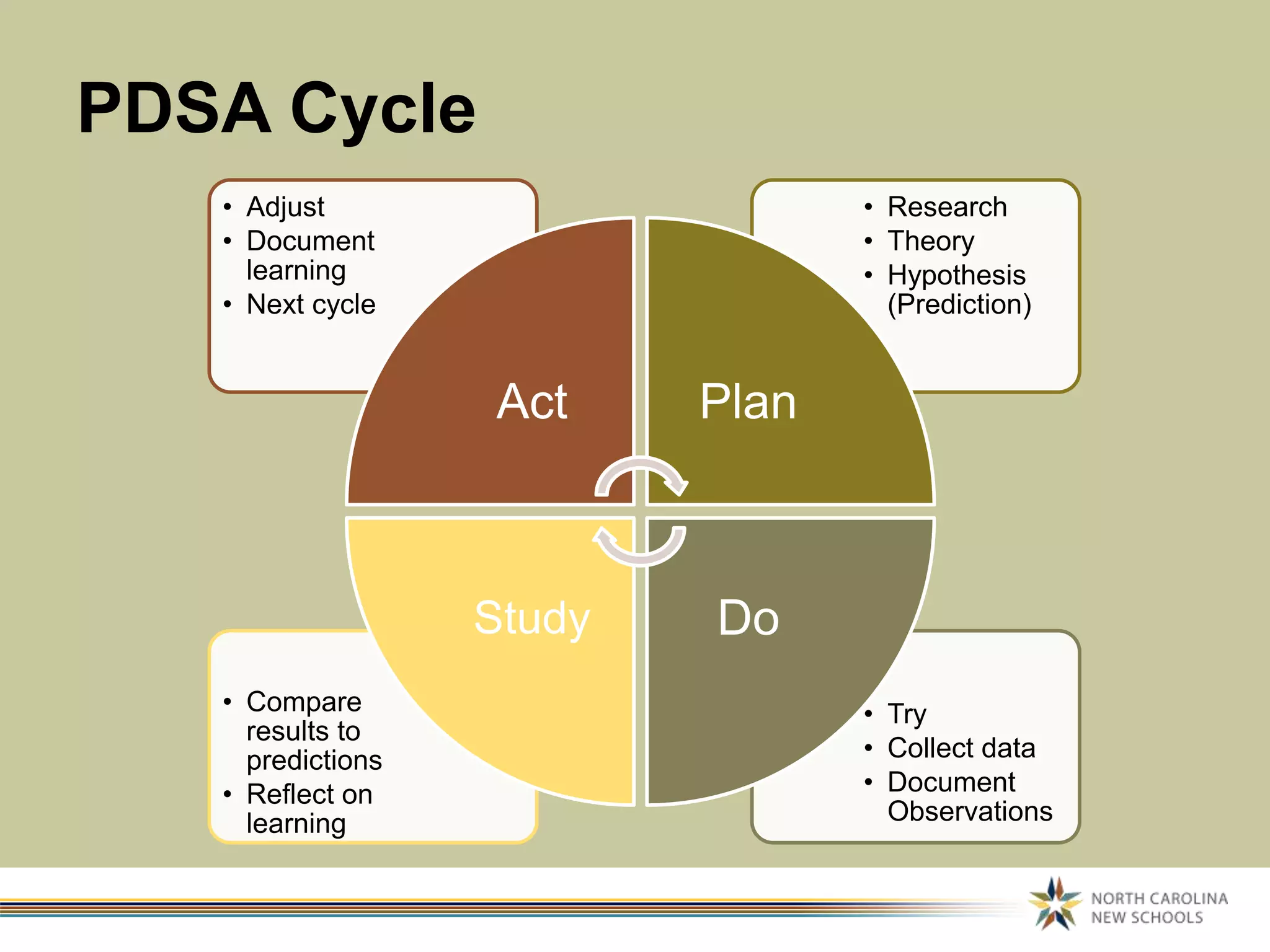
• Try
• Collect data
• Document
Observations
• Compare
results to
predictions
• Reflect on
learning
• Research
• Theory
• Hypothesis
(Prediction)
• Adjust
• Document
learning
• Next cycle
Act Plan
DoStudy
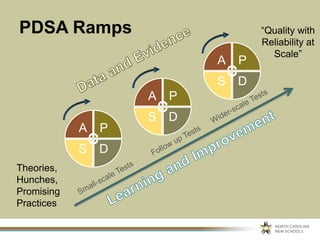
PDSA Ramps
Theories,
Hunches,
Promising
Practices
A P
DS
A P
DS
A P
DS
“Quality with
Reliability at
Scale”

PDSA graphics

Editor's Notes

  • #2 Simplified version – of course, plan phase also includes planning to execute on D-S-A phases. Act: includes knowledge management – at some point, may determine that it’s time to abandon (idea is to know this quickly, before investing and wasting too much time, energy and money)
  • #3 Otherwise, keep building on learning each cycle, increasing size of test over time – e.g., an innovation might begin with one or two coaches with one or two teachers each through several cycles, then as refined, these coaches may expand the number the number of teachers, then the number of coaches – don’t get to quality by jumping to scale. ITERATION is the key – once you’ve completed a PDSA cycle, not done. Part of Act phase is planning the next cycle, based on learning from the previous cycle. May not be in immediate succession, may not be same players  importance of knowledge management to ensure continuously building on learning. Just because it “works,” doesn’t mean you’re done – could we do it better, more efficiently, less expensively? Break large projects into smaller cycles, roughly 90 days each. e.g., KM Pulse Check – in first iteration, completed Planning, about to Do, will Study, then Act; similarly with the design you’re about to see