Are you healthy?
•
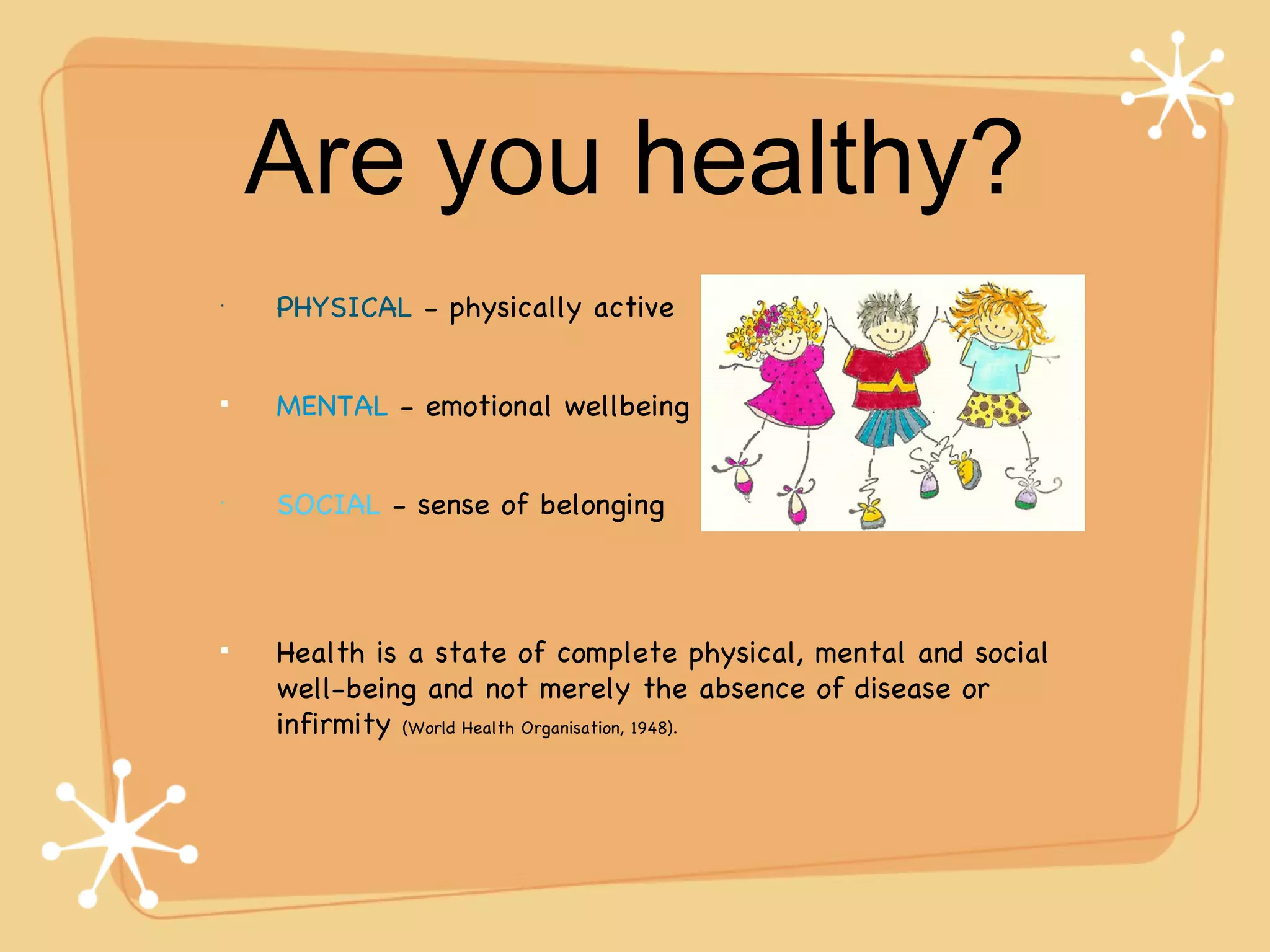
    PHYSICAL - physically active


    MENTAL - emotional wellbeing


•
    SOCIAL - sense of belonging


    Health is a state of complete physical, mental and social
    well-being and not merely the absence of disease or
    infirmity (World Health Organisation, 1948).
What is PDHPE?
•
    Personal
    Development,
•
    Health and
•
    Physical Education
    The teaching of PDHPE is essential so that primary school students can learn
    and develop fun physical education activities and adopt healthy lifestyles.
    PDHPE is one of the six Key Learning Areas (KLAs) along English, Mathematics,
    Science and Technology, Human Society and its Environment, and Creative and
    Practical Arts (PDHPE K-6 Syllabus, 1999). (to parents and community members).
    Schools are required to include 2 hours per week for planned physical
    activity, including in Years 3-6, a minimum of 1 hour for sport (NSW K-6
    Curriculum PDHPE, 2007).

•   Children should get at least 60 minutes of physical activity every day,
    including vigorous activities that make them ‘huff and puff’ (Healthy Kids,
    2012).
PDHPE in Schools
•   Children learn from Role-models: PARENTS, COMMUNI TY MEMBERS and
    TEACHERS
    encourages an understanding and valuing of self and others;
•   develops an ability in students to make informed decisions in their lives;
•   promotes lifelong involvement in physical activity (PDHPE K-6 Syllabus, 1999). (to parents and
    community members).
    PDHPE is concerned wit h:
•   physical, social, cognitive and emotional growth and development patterns;
•   the development and maintenance of positive interpersonal relationships;
    the factors influencing personal health choices;
•   living and learning in a safe secure environment;
•   the adoption of an active lifestyle;
    fundamental movement patterns and coordinated actions of the body;
•   skills that enable action for better health and movement outcomes (PDHPE K-6 Syllabus, 2007).
Sport!
                  We teach
                    We
                    We
•   Being healthy is important!
    You cannot learn if you are not healthy.


                    We
•   A healthy lifestyle starts from childhood.
    It determines your ability to achieve success later in life.
•   PDHPE enhances your ability to overcome barriers.
    A Healthy Body is a Healthy Mind!!!
    Keys components:
    STRAND: Active Lifestyle, Dance, Game and Sports, Growth and Development,
    Gymnastics, Interpersonal Relationships, Personal Health Choices, Safe Living;
    SKI LLS: Communicating, Decision Making, Interacting, Moving, Problem Solving
    (PDHPE K-6 Syllabus, 2007).
References

•
    Board of Studies NSW PDHPE K-6 Introducing the PDHPE K-6 Syllabus to Parents and Community Members. (1999). Retrieved May 01, 20
    Board of Studies NSW PDHPE K-6 Syllabus. (2007). Retrieved May 01, 2012, from http://k6.boardofstudies.nsw.edu.au/files/pdhpe/k6_pdhp
•
    Education and Communities NSW Government. (n.d.). Retrieved May 07, 2012, from https://www.det.nsw.edu.au
•
    Healthy Kids eat well, get active. (2012). Retrieved May 07, 2012, from http://www.healthykids.nsw.gov.au
•
    Neal, & Leandra. (2010). Catch a falling star [Video file]. Retrieved from
    http://www.youtube.com/watch?v=D1asTj9SEq4
•
    Office of Communities Sport and Recreation NSW Government. (n.d.). Retrieved May 07, 2012, from
    http://www.dsr.nsw.gov.au

Pdhpe in schools

  • 1.
    Are you healthy? • PHYSICAL - physically active MENTAL - emotional wellbeing • SOCIAL - sense of belonging Health is a state of complete physical, mental and social well-being and not merely the absence of disease or infirmity (World Health Organisation, 1948).
  • 2.
    What is PDHPE? • Personal Development, • Health and • Physical Education The teaching of PDHPE is essential so that primary school students can learn and develop fun physical education activities and adopt healthy lifestyles. PDHPE is one of the six Key Learning Areas (KLAs) along English, Mathematics, Science and Technology, Human Society and its Environment, and Creative and Practical Arts (PDHPE K-6 Syllabus, 1999). (to parents and community members). Schools are required to include 2 hours per week for planned physical activity, including in Years 3-6, a minimum of 1 hour for sport (NSW K-6 Curriculum PDHPE, 2007). • Children should get at least 60 minutes of physical activity every day, including vigorous activities that make them ‘huff and puff’ (Healthy Kids, 2012).
  • 3.
    PDHPE in Schools • Children learn from Role-models: PARENTS, COMMUNI TY MEMBERS and TEACHERS encourages an understanding and valuing of self and others; • develops an ability in students to make informed decisions in their lives; • promotes lifelong involvement in physical activity (PDHPE K-6 Syllabus, 1999). (to parents and community members). PDHPE is concerned wit h: • physical, social, cognitive and emotional growth and development patterns; • the development and maintenance of positive interpersonal relationships; the factors influencing personal health choices; • living and learning in a safe secure environment; • the adoption of an active lifestyle; fundamental movement patterns and coordinated actions of the body; • skills that enable action for better health and movement outcomes (PDHPE K-6 Syllabus, 2007).
  • 4.
    Sport! We teach We We • Being healthy is important! You cannot learn if you are not healthy. We • A healthy lifestyle starts from childhood. It determines your ability to achieve success later in life. • PDHPE enhances your ability to overcome barriers. A Healthy Body is a Healthy Mind!!! Keys components: STRAND: Active Lifestyle, Dance, Game and Sports, Growth and Development, Gymnastics, Interpersonal Relationships, Personal Health Choices, Safe Living; SKI LLS: Communicating, Decision Making, Interacting, Moving, Problem Solving (PDHPE K-6 Syllabus, 2007).
  • 5.
    References • Board of Studies NSW PDHPE K-6 Introducing the PDHPE K-6 Syllabus to Parents and Community Members. (1999). Retrieved May 01, 20 Board of Studies NSW PDHPE K-6 Syllabus. (2007). Retrieved May 01, 2012, from http://k6.boardofstudies.nsw.edu.au/files/pdhpe/k6_pdhp • Education and Communities NSW Government. (n.d.). Retrieved May 07, 2012, from https://www.det.nsw.edu.au • Healthy Kids eat well, get active. (2012). Retrieved May 07, 2012, from http://www.healthykids.nsw.gov.au • Neal, & Leandra. (2010). Catch a falling star [Video file]. Retrieved from http://www.youtube.com/watch?v=D1asTj9SEq4 • Office of Communities Sport and Recreation NSW Government. (n.d.). Retrieved May 07, 2012, from http://www.dsr.nsw.gov.au