Why does 1C love PDHPE?
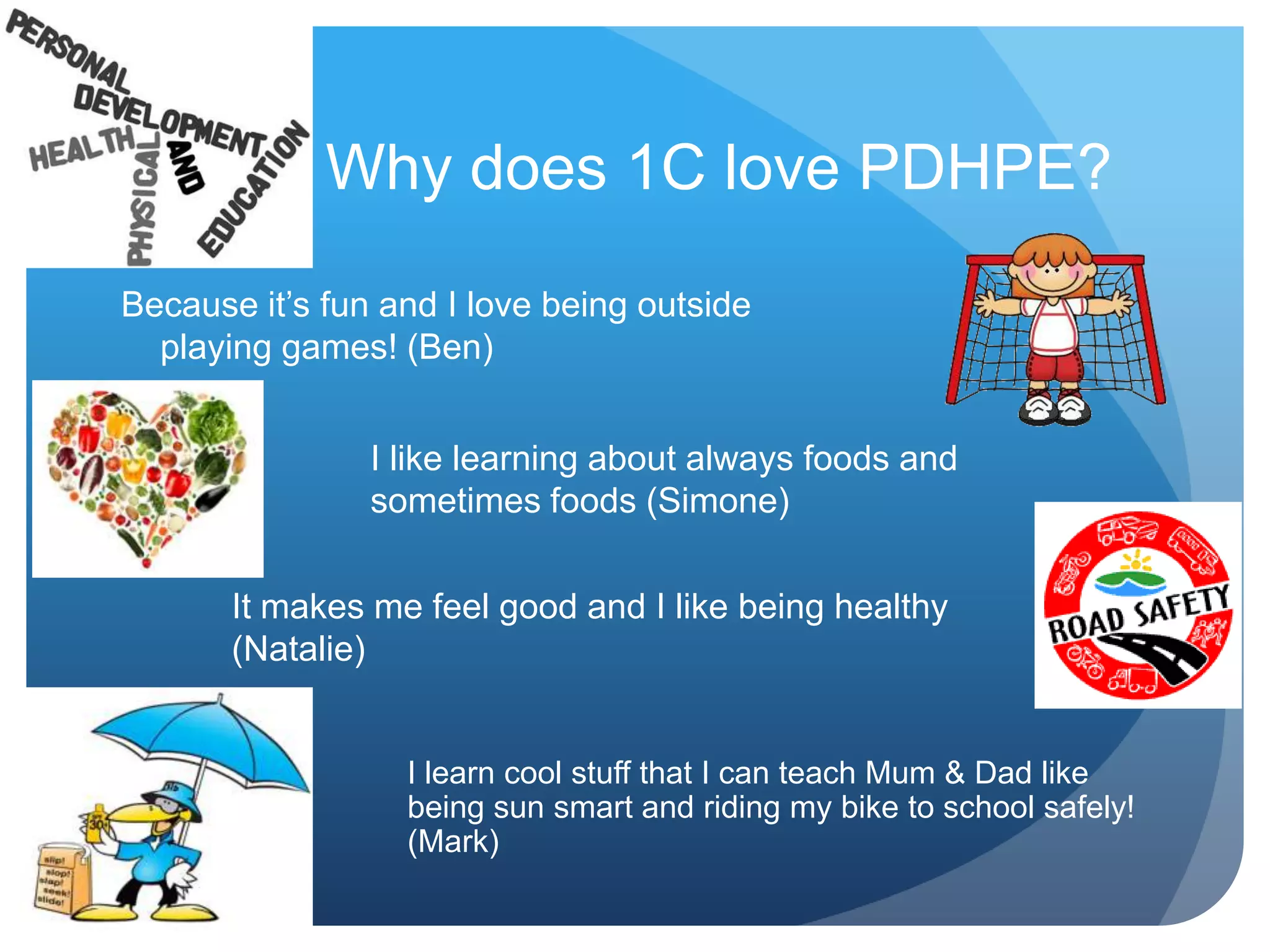
Because it’s fun and I love being outside
playing games! (Ben)
I like learning about always foods and
sometimes foods (Simone)
It makes me feel good and I like being healthy
(Natalie)
I learn cool stuff that I can teach Mum & Dad like
being sun smart and riding my bike to school safely!
(Mark)
What do we learn about in
The PDHPE Syllabus ensures students learn about
knowledge, skills and values to lead healthy and fullfilling
lives, not just physically but mental, social and spiritual health.
Children learn about valuing
themselves and others, the
importance of daily physical
activity, making
decisions, positive
relationships, fundamental
movement skills and making
personal health choices.
Board of Studies (1999) Personal development, health and physical education K-6: Modules. Sydney, Australia: Board of Studies NSW.
In IC, we will be learning about the following in PDHPE this year:
Recycling & the environment
People who keep me healthy
Healthy food choices
Relationships, families and feelings
The body
Fundamental movement skills
Gymnastics
Dance
Roadsafety
Swimming
Sun safety
Board of Studies (1999) Personal development, health and physical education K-6: Modules. Sydney, Australia: Board of Studies NSW.
As sedentary lifestyles and worlwide obesity are increasingly becoming a
global concern, it is vital that we teach children the importance of health
and fitness.
The Department of Health & Ageing in Australia recommends at least 60
minutes a day of moderate and vigorous activities for 5-12 year olds.
To lead a healthy and fulfilling life, children need to develop the skills and
knowledge to make healthy choices and decisions, maintain an active
lifestyle, and most importantly, know that being healthy and active feels
good and is fun too!
important?
“Studies demonstrate the positive effects daily physical activity
has on student performance and academic achievement in
terms of memory, observation, problem-solving and decision-
making, as well as significant improvements in
attitudes, discipline, behaviours and creativity.”
Keays, J. J. & Allison, K. R., (1995) “The Effects of Regular Moderate to Vigorous Physical Activity on Student Outcomes: A
Review”, Canadian Journal of Public Health 86, 1, p. 64.

1C loves PDHPE

  • 1.
    Why does 1Clove PDHPE? Because it’s fun and I love being outside playing games! (Ben) I like learning about always foods and sometimes foods (Simone) It makes me feel good and I like being healthy (Natalie) I learn cool stuff that I can teach Mum & Dad like being sun smart and riding my bike to school safely! (Mark)
  • 2.
    What do welearn about in The PDHPE Syllabus ensures students learn about knowledge, skills and values to lead healthy and fullfilling lives, not just physically but mental, social and spiritual health. Children learn about valuing themselves and others, the importance of daily physical activity, making decisions, positive relationships, fundamental movement skills and making personal health choices. Board of Studies (1999) Personal development, health and physical education K-6: Modules. Sydney, Australia: Board of Studies NSW.
  • 3.
    In IC, wewill be learning about the following in PDHPE this year: Recycling & the environment People who keep me healthy Healthy food choices Relationships, families and feelings The body Fundamental movement skills Gymnastics Dance Roadsafety Swimming Sun safety Board of Studies (1999) Personal development, health and physical education K-6: Modules. Sydney, Australia: Board of Studies NSW.
  • 4.
    As sedentary lifestylesand worlwide obesity are increasingly becoming a global concern, it is vital that we teach children the importance of health and fitness. The Department of Health & Ageing in Australia recommends at least 60 minutes a day of moderate and vigorous activities for 5-12 year olds. To lead a healthy and fulfilling life, children need to develop the skills and knowledge to make healthy choices and decisions, maintain an active lifestyle, and most importantly, know that being healthy and active feels good and is fun too! important?
  • 5.
    “Studies demonstrate thepositive effects daily physical activity has on student performance and academic achievement in terms of memory, observation, problem-solving and decision- making, as well as significant improvements in attitudes, discipline, behaviours and creativity.” Keays, J. J. & Allison, K. R., (1995) “The Effects of Regular Moderate to Vigorous Physical Activity on Student Outcomes: A Review”, Canadian Journal of Public Health 86, 1, p. 64.