Accelerating the Deployment of Practical,
Programmable Transport Networks
Dave Brown
OIF VP of Marketing
Alcatel-Lucent
IIR NGON
Dallas, Texas
October 7, 2015
About the OIF
The Optical Internetworking Forum:
• Represents an end-to-end ecosystem
membership base…
• Focused on multi-layer and multi- domain
transport interoperability…
• Optimized for IA development and
interop testing…
• Fills gaps, removes obstacles…
• Accelerates market adoption and ROI for
new technologies…
• Improves network efficiency, lowers
Opex/Capex for network operators…
• Unlike any other forum or SDO
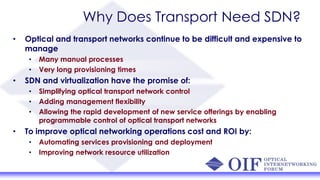
Why Does Transport Need SDN?
• Optical and transport networks continue to be difficult and expensive to
manage
• Many manual processes
• Very long provisioning times
• SDN and virtualization have the promise of:
• Simplifying optical transport network control
• Adding management flexibility
• Allowing the rapid development of new service offerings by enabling
programmable control of optical transport networks
• To improve optical networking operations cost and ROI by:
• Automating services provisioning and deployment
• Improving network resource utilization
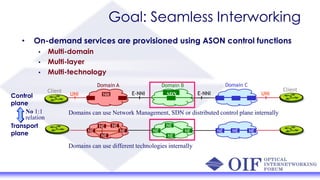
Goal: Seamless Interworking
• On-demand services are provisioned using ASON control functions
• Multi-domain
• Multi-layer
• Multi-technology
Domain CDomain A Domain B
NE
NE
NE
NE
NE NE NE
NE
NE
NE NENE
UNI E-NNI UNIE-NNIClient Client
Control
plane
Transport
plane
NM SDN
Domains can use Network Management, SDN or distributed control plane internally
Domains can use different technologies internally
No 1:1
relation
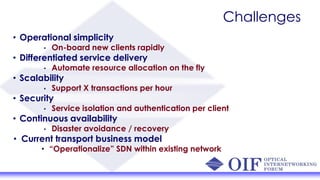
Challenges
• Operational simplicity
• On-board new clients rapidly
• Differentiated service delivery
• Automate resource allocation on the fly
• Scalability
• Support X transactions per hour
• Security
• Service isolation and authentication per client
• Continuous availability
• Disaster avoidance / recovery
• Current transport business model
• “Operationalize” SDN within existing network
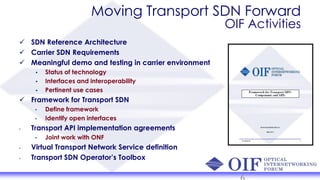
Moving Transport SDN Forward
OIF Activities
 SDN Reference Architecture
 Carrier SDN Requirements
 Meaningful demo and testing in carrier environment
• Status of technology
• Interfaces and interoperability
• Pertinent use cases
 Framework for Transport SDN
• Define framework
• Identify open interfaces
• Transport API implementation agreements
• Joint work with ONF
• Virtual Transport Network Service definition
• Transport SDN Operator’s Toolbox
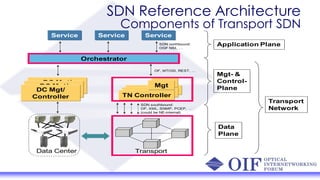
SDN Reference Architecture
Components of Transport SDN
Data Center
DC Mgt/
Controller
Orchestrator
Service
Application Plane
Mgt- &
Control-
Plane
Data
Plane
Service Service
Transport
TN Controller
Transport
Network
TN Controller
Mgt
TN Controller
Mgt
SDN southbound:
OF, XML, SNMP, PCEP, …
(could be NE-internal)
OF, MTOSI, REST, …
SDN northbound:
OGF NSI, …
DC Mgt/
Controller
DC Mgt/
Controller
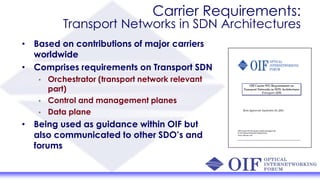
Carrier Requirements:
Transport Networks in SDN Architectures
• Based on contributions of major carriers
worldwide
• Comprises requirements on Transport SDN
• Orchestrator (transport network relevant
part)
• Control and management planes
• Data plane
• Being used as guidance within OIF but
also communicated to other SDO’s and
forums
General Requirements
• Requirements are not aimed at a particular set of protocols, HW
and SW implementations
• Packet & circuit switching
• Centralized & distributed control instances
• Allow multiple protocols
• Modular SW and HW (COTS)
• Decoupling of network layers
• Guarantee interoperability among different vendor
implementations, carrier network domains, data center functions
• Well defined interfaces for an increased level of interoperability
• Goal - accelerate the deployment of practical, programmable transport
networks that enable a new era of dynamic services
• Test prototype transport SDN technologies in real-world applications
• Application: Cloud bursting over optical networks
• Features:
• Subset of OTWG OpenFlow Extensions (ONF lead)
• CDPI and CVNI
• Experimental encoding of extensions
• Northbound Interface Protocols – Service Request and Topology network APIs (OIF
lead)
• Multi-domain controller hierarchy (OIF lead)
OIF/ONF Global Transport SDN Demo
• Testing conducted in carrier labs
over 7 week period August-
September
• China Mobile, China Telecom, Deutsche
Telekom, TELUS, Verizon
• Participating vendors
• ADVA, Alcatel-Lucent, Ciena, Coriant,
FiberHome, Fujitsu, Huawei, NEC, ZTE
• Consulting members
• China Academy of Telecommunications
Research, KDDI R&D Laboratories, Orange
OIF/ONF Global Transport SDN Demo
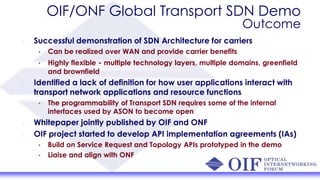
Outcome
Successful demonstration of SDN Architecture for carriers
• Can be realized over WAN and provide carrier benefits
• Highly flexible - multiple technology layers, multiple domains, greenfield
and brownfield
Identified a lack of definition for how user applications interact with
transport network applications and resource functions
• The programmability of Transport SDN requires some of the internal
interfaces used by ASON to become open
Whitepaper jointly published by OIF and ONF
OIF project started to develop API implementation agreements (IAs)
• Build on Service Request and Topology APIs prototyped in the demo
• Liaise and align with ONF
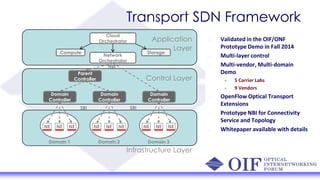
Transport SDN Framework
Validated in the OIF/ONF
Prototype Demo in Fall 2014
Multi-layer control
Multi-vendor, Multi-domain
Demo
• 5 Carrier Labs
• 9 Vendors
OpenFlow Optical Transport
Extensions
Prototype NBI for Connectivity
Service and Topology
Whitepaper available with details
Application
Layer
Control Layer
Infrastructure Layer
Domain 1
NE NE NE
Domain 2
NE NE NE
Domain 3
NE NE NE
Network
Orchestrator
Parent
Controller
Domain
Controller
Domain
Controller
Domain
Controller
SBI
NBI
SBI
Cloud
Orchestrator
Compute Storage
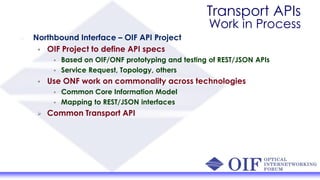
Transport APIs
Work in Process
Northbound Interface – OIF API Project
• OIF Project to define API specs
• Based on OIF/ONF prototyping and testing of REST/JSON APIs
• Service Request, Topology, others
• Use ONF work on commonality across technologies
• Common Core Information Model
• Mapping to REST/JSON interfaces
 Common Transport API
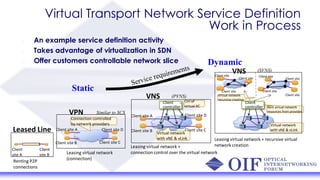
Virtual Transport Network Service Definition
Work in Process
An example service definition activity
Takes advantage of virtualization in SDN
Offer customers controllable network slice
Leased Line
VPN
VNS
Client
site A
Client
site B
Client site A
Client site B
Client site D
Client site C
Client site A
Client site B
Client site D
Client site C
Virtual network
with vNE & vLink
Client
controller
Ctrl of
virtual XC
Connection controlled
by network providers
Renting P2P
connections
Leasing virtual network
(connection)
Leasing virtual network +
connection control over the virtual network
Similar to SCS
(PVNS)
Static
Dynamic
VNS
Virtual network
with vNE & vLink
Client
controller Rent virtual network
resources from provider
(SVNS)
Client site
Virtual network
recursive creation
Client site
Client site
Client site
Client site
Client siteClient site
Leasing virtual network + recursive virtual
network creation
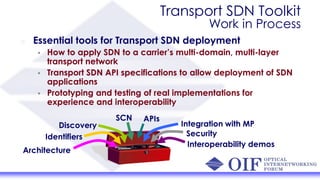
Transport SDN Toolkit
Work in Process
Essential tools for Transport SDN deployment
• How to apply SDN to a carrier’s multi-domain, multi-layer
transport network
• Transport SDN API specifications to allow deployment of SDN
applications
• Prototyping and testing of real implementations for
experience and interoperability
Architecture
Identifiers
Discovery
SCN APIs
Integration with MP
Interoperability demos
Security
Summary
• SDN has great promise to improve transport control
• Programmability
• Simplified multi-layer control
• Common behaviors in heterogeneous NE deployments
• Application awareness
• OIF is providing guidance to accelerate deployment
• Use cases and architecture
• Carrier requirements
• Framework document
• Demonstrations
• Implementation Agreements
Thank You!
www.oiforum.com
18

Accelerating the Deployment of Practical, Programmable Transport Networks

  • 1.
    Accelerating the Deploymentof Practical, Programmable Transport Networks Dave Brown OIF VP of Marketing Alcatel-Lucent IIR NGON Dallas, Texas October 7, 2015
  • 2.
    About the OIF TheOptical Internetworking Forum: • Represents an end-to-end ecosystem membership base… • Focused on multi-layer and multi- domain transport interoperability… • Optimized for IA development and interop testing… • Fills gaps, removes obstacles… • Accelerates market adoption and ROI for new technologies… • Improves network efficiency, lowers Opex/Capex for network operators… • Unlike any other forum or SDO
  • 3.
    Why Does TransportNeed SDN? • Optical and transport networks continue to be difficult and expensive to manage • Many manual processes • Very long provisioning times • SDN and virtualization have the promise of: • Simplifying optical transport network control • Adding management flexibility • Allowing the rapid development of new service offerings by enabling programmable control of optical transport networks • To improve optical networking operations cost and ROI by: • Automating services provisioning and deployment • Improving network resource utilization
  • 4.
    Goal: Seamless Interworking •On-demand services are provisioned using ASON control functions • Multi-domain • Multi-layer • Multi-technology Domain CDomain A Domain B NE NE NE NE NE NE NE NE NE NE NENE UNI E-NNI UNIE-NNIClient Client Control plane Transport plane NM SDN Domains can use Network Management, SDN or distributed control plane internally Domains can use different technologies internally No 1:1 relation
  • 5.
    Challenges • Operational simplicity •On-board new clients rapidly • Differentiated service delivery • Automate resource allocation on the fly • Scalability • Support X transactions per hour • Security • Service isolation and authentication per client • Continuous availability • Disaster avoidance / recovery • Current transport business model • “Operationalize” SDN within existing network
  • 6.
    Moving Transport SDNForward OIF Activities  SDN Reference Architecture  Carrier SDN Requirements  Meaningful demo and testing in carrier environment • Status of technology • Interfaces and interoperability • Pertinent use cases  Framework for Transport SDN • Define framework • Identify open interfaces • Transport API implementation agreements • Joint work with ONF • Virtual Transport Network Service definition • Transport SDN Operator’s Toolbox
  • 7.
    SDN Reference Architecture Componentsof Transport SDN Data Center DC Mgt/ Controller Orchestrator Service Application Plane Mgt- & Control- Plane Data Plane Service Service Transport TN Controller Transport Network TN Controller Mgt TN Controller Mgt SDN southbound: OF, XML, SNMP, PCEP, … (could be NE-internal) OF, MTOSI, REST, … SDN northbound: OGF NSI, … DC Mgt/ Controller DC Mgt/ Controller
  • 8.
    Carrier Requirements: Transport Networksin SDN Architectures • Based on contributions of major carriers worldwide • Comprises requirements on Transport SDN • Orchestrator (transport network relevant part) • Control and management planes • Data plane • Being used as guidance within OIF but also communicated to other SDO’s and forums
  • 9.
    General Requirements • Requirementsare not aimed at a particular set of protocols, HW and SW implementations • Packet & circuit switching • Centralized & distributed control instances • Allow multiple protocols • Modular SW and HW (COTS) • Decoupling of network layers • Guarantee interoperability among different vendor implementations, carrier network domains, data center functions • Well defined interfaces for an increased level of interoperability
  • 10.
    • Goal -accelerate the deployment of practical, programmable transport networks that enable a new era of dynamic services • Test prototype transport SDN technologies in real-world applications • Application: Cloud bursting over optical networks • Features: • Subset of OTWG OpenFlow Extensions (ONF lead) • CDPI and CVNI • Experimental encoding of extensions • Northbound Interface Protocols – Service Request and Topology network APIs (OIF lead) • Multi-domain controller hierarchy (OIF lead) OIF/ONF Global Transport SDN Demo
  • 11.
    OIF/ONF Global TransportSDN Demo • Testing conducted in carrier labs over 7 week period August- September • China Mobile, China Telecom, Deutsche Telekom, TELUS, Verizon • Participating vendors • ADVA, Alcatel-Lucent, Ciena, Coriant, FiberHome, Fujitsu, Huawei, NEC, ZTE • Consulting members • China Academy of Telecommunications Research, KDDI R&D Laboratories, Orange
  • 12.
    OIF/ONF Global TransportSDN Demo Outcome Successful demonstration of SDN Architecture for carriers • Can be realized over WAN and provide carrier benefits • Highly flexible - multiple technology layers, multiple domains, greenfield and brownfield Identified a lack of definition for how user applications interact with transport network applications and resource functions • The programmability of Transport SDN requires some of the internal interfaces used by ASON to become open Whitepaper jointly published by OIF and ONF OIF project started to develop API implementation agreements (IAs) • Build on Service Request and Topology APIs prototyped in the demo • Liaise and align with ONF
  • 13.
    Transport SDN Framework Validatedin the OIF/ONF Prototype Demo in Fall 2014 Multi-layer control Multi-vendor, Multi-domain Demo • 5 Carrier Labs • 9 Vendors OpenFlow Optical Transport Extensions Prototype NBI for Connectivity Service and Topology Whitepaper available with details Application Layer Control Layer Infrastructure Layer Domain 1 NE NE NE Domain 2 NE NE NE Domain 3 NE NE NE Network Orchestrator Parent Controller Domain Controller Domain Controller Domain Controller SBI NBI SBI Cloud Orchestrator Compute Storage
  • 14.
    Transport APIs Work inProcess Northbound Interface – OIF API Project • OIF Project to define API specs • Based on OIF/ONF prototyping and testing of REST/JSON APIs • Service Request, Topology, others • Use ONF work on commonality across technologies • Common Core Information Model • Mapping to REST/JSON interfaces  Common Transport API
  • 15.
    Virtual Transport NetworkService Definition Work in Process An example service definition activity Takes advantage of virtualization in SDN Offer customers controllable network slice Leased Line VPN VNS Client site A Client site B Client site A Client site B Client site D Client site C Client site A Client site B Client site D Client site C Virtual network with vNE & vLink Client controller Ctrl of virtual XC Connection controlled by network providers Renting P2P connections Leasing virtual network (connection) Leasing virtual network + connection control over the virtual network Similar to SCS (PVNS) Static Dynamic VNS Virtual network with vNE & vLink Client controller Rent virtual network resources from provider (SVNS) Client site Virtual network recursive creation Client site Client site Client site Client site Client siteClient site Leasing virtual network + recursive virtual network creation
  • 16.
    Transport SDN Toolkit Workin Process Essential tools for Transport SDN deployment • How to apply SDN to a carrier’s multi-domain, multi-layer transport network • Transport SDN API specifications to allow deployment of SDN applications • Prototyping and testing of real implementations for experience and interoperability Architecture Identifiers Discovery SCN APIs Integration with MP Interoperability demos Security
  • 17.
    Summary • SDN hasgreat promise to improve transport control • Programmability • Simplified multi-layer control • Common behaviors in heterogeneous NE deployments • Application awareness • OIF is providing guidance to accelerate deployment • Use cases and architecture • Carrier requirements • Framework document • Demonstrations • Implementation Agreements
  • 18.