A/Prof. Terry J. Hannan MBBS;FRACP;FACHI;FACMI UNDERSTANDING e-HEALTH AND WHY WE NEED IT. NETTAB 2011 (Network Tools and Applications in Biology workshop) PAVIA, Italy, 13 th  October 2011 “ To improve care you have to measure it.  Information management is care” (Don Berwick)
Clinical computing 1976-2011. Current/Future data demands on CDM Technology of clinical computing . Storage, interoperability and standards, forms, data capture, CPOE. Translocating health information technologies MMRS-AMPATH-OpenMRS. Effective CDS tools (MSAccess) show how HIT and CDS works. Meeting the needs of scalability. Role of the internet, WWW, m-Health to meet the  demands of modern health care. [VIDEOS]
Some Definitions. Information is not a necessary adjunct to care,  it is care , and effective patient management requires effective management of patients’ clinical data.  Donald M. Berwick President and CEO, Institute for Healthcare Improvement There is no health without management, and there is no management without information.  WHO-Gonzalo Vecina Neto, head of the Brazilian National Health Regulatory Agency Information is  necessary  to provide and manage health care  at all levels , from individual patients to health care systems to national Ministries of Health (MOH).  W.Tierney. Dir. Regenstrief Institute. So what is eHealth? The World Health Organization (WHO) definition: “ e-Health is the combined use of electronic communication and information technology in the health sector.”
Health Informaticians.  “ Informaticians should understand that our first contribution is to see healthcare as a complex system, full of information flows and feedback loops, and we also should understand that our role is to help others ''see' the system, and re-conceive it in new ways.”  E. Coiera. April 2009, Centre for Health Informatics, Institute of Health Innovation, University of New South Wales, Australia
Functions of Clinical Informaticians Clinical informaticians use their knowledge of patient care combined with their understanding of informatics concepts, methods, and tools to:  Assess information and knowledge needs of health care professionals and patients;  Characterize, evaluate, and refine clinical processes;  Develop, implement, and refine clinical decision support systems;  Lead or participate in the procurement, customization, development, implementation, management, evaluation, and continuous improvement of clinical information systems.
Goals of Computerized Clinical Decision Support Systems (for EMR) International Journal of Medical Informatics 54 (1999) 183–196 The CCC system in two teaching hospitals: a progress report. Warner V. Slack  Howard L. Bleich 1. Information :  captured directly at computer terminals located at the point of each transaction, not on pieces of paper.   2.  Information  captured at a terminal or automated device: anywhere in the hospital should be available immediately, if needed, at any other terminal.    3.The  response time  of the computer should be rapid-blink times.  4. The computer should be  reliable and accurate .   5.  Confidentiality  should be protected.    6.The  computer programs should be friendly to the user and reinforce the user’s behavior .   7. There should be a  common registry  for all patients.  
The Regenstrief Medical Record System. IJMI 54 (1999) 225-253 Goals of implementation. Eliminate logistic problems of paper record- clinical data timely, reliable, complete. 2. Reduce the work of clinical bookeeping-no more missed Dx, or forgotten preventive care. 3. Information ‘gold’ within medical records available to clinical, epidemiological, outcomes and management research.
Four key functions of electronic clinical decision support systems "Administrative”:  Supporting clinical coding and documentation,  authorization of procedures, and referrals.  "Managing clinical complexity and details”:  Keeping patients on research and chemotherapy protocols  tracking orders,  referrals follow-up,  and preventive care.  "Cost control’:  Monitoring medication orders;  avoiding duplicate or unnecessary tests.  "Decision support”:  Supporting clinical diagnosis and treatment plan processes;  promoting use of best practices,  condition-specific guidelines,  population-based management.  http ://www.openclinical.org/dss.html
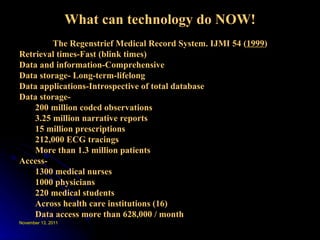
What can technology do NOW! The Regenstrief Medical Record System. IJMI 54 ( 1999 ) Retrieval times-Fast (blink times) Data and information-Comprehensive Data storage- Long-term-lifelong Data applications-Introspective of total database Data storage- 200 million coded observations 3.25 million narrative reports 15 million prescriptions 212,000 ECG tracings More than 1.3 million patients Access- 1300 medical nurses 1000 physicians 220 medical students Across health care institutions (16) Data access more than 628,000 / month
 
 
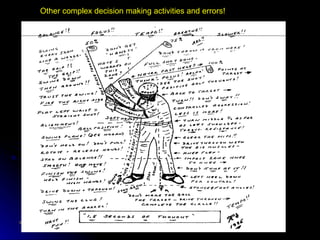
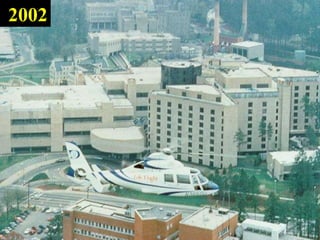
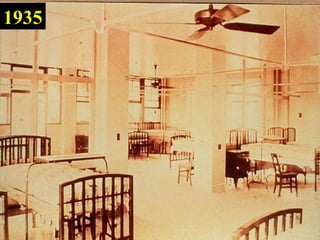
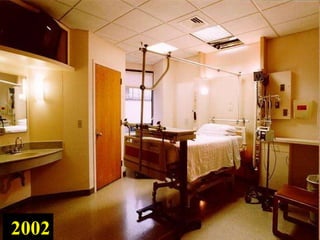
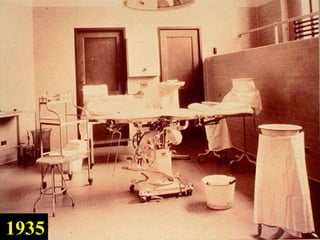
Other complex decision making activities and errors!
 
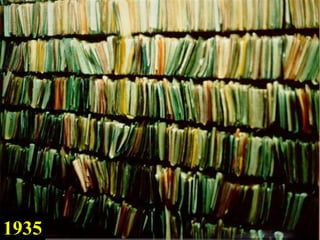
1935
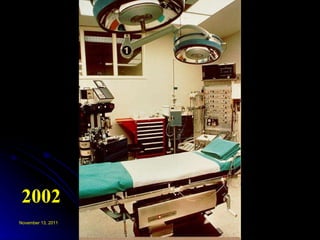
2002
1935
2002
1935
2002
1935
2002
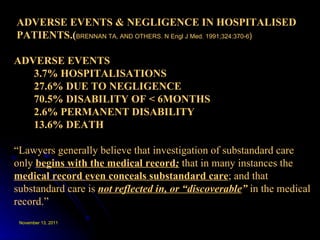
ADVERSE EVENTS & NEGLIGENCE IN HOSPITALISED PATIENTS.( BRENNAN TA, AND OTHERS. N Engl J Med. 1991;324:370-6 ) ADVERSE EVENTS  3.7% HOSPITALISATIONS 27.6% DUE TO NEGLIGENCE 70.5% DISABILITY OF < 6MONTHS 2.6% PERMANENT DISABILITY 13.6% DEATH “ Lawyers generally believe that investigation of substandard care only  begins with the medical record ;   that in many instances the  medical record even conceals substandard care ; and that substandard care is  not reflected in, or “discoverable ”  in the medical record.”
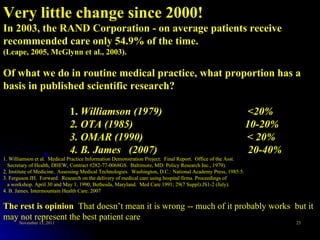
Very little change since 2000! In 2003, the RAND Corporation - on average patients receive recommended care only 54.9% of the time.  (Leape, 2005, McGlynn et al., 2003). Of what we do in routine medical practice, what proportion has a basis in published scientific research? 1.  Williamson (1979)  <20% 2. OTA (1985)  10-20% 3. OMAR (1990)  < 20% 4. B. James  (2007)  20-40% 1. Williamson et al.  Medical Practice Information Demonstration Project:  Final Report.  Office of the Asst.     Secretary of Health, DHEW, Contract #282-77-0068GS.  Baltimore, MD: Policy Research Inc., 1979). 2. Institute of Medicine.  Assessing Medical Technologies.  Washington, D.C.: National Academy Press, 1985:5. 3. Ferguson JH.  Forward.  Research on the delivery of medical care using hospital firms. Proceedings of     a workshop. April 30 and May 1, 1990, Bethesda, Maryland.  Med Care 1991; 29(7 Suppl):JS1-2 (July). 4. B. James. Intermountain Health Care. 2007 The rest is opinion  That doesn’t mean it is wrong -- much of it probably works  but it may not represent the best patient care
 
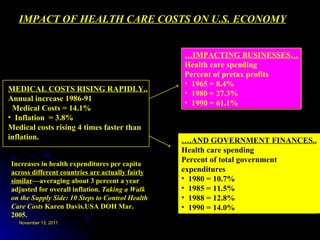
IMPACT OF HEALTH CARE COSTS ON U.S. ECONOMY MEDICAL COSTS RISING RAPIDLY.. Annual increase 1986-91 Medical Costs = 14.1% Inflation  = 3.8% Medical costs rising 4 times faster than inflation. … IMPACTING BUSINESSES… Health care spending Percent of pretax profits 1965 = 8.4% 1980 = 27.3% 1990 = 61.1% … .AND GOVERNMENT FINANCES.. Health care spending Percent of total government  expenditures 1980 = 10.7% 1985 = 11.5% 1988 = 12.8% 1990 = 14.0% Increases in health expenditures per capita  across different countries are actually fairly similar —averaging about 3 percent a year adjusted for overall inflation.  Taking a Walk on the Supply Side: 10 Steps to Control Health Care Costs  Karen Davis.USA DOH Mar. 2005.
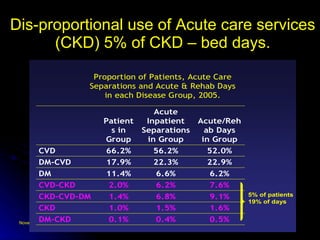
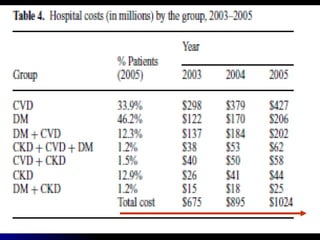
Dis-proportional use of Acute care services (CKD) 5% of CKD – bed days.
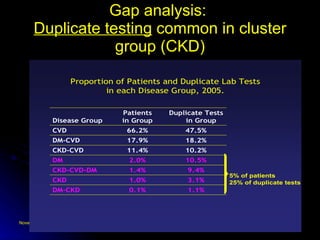
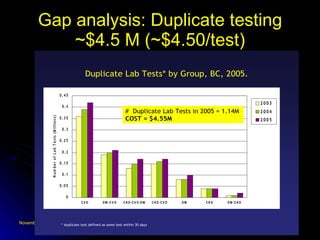
Gap analysis:  Duplicate testing  common in cluster group (CKD)
Gap analysis: Duplicate testing ~$4.5 M (~$4.50/test)
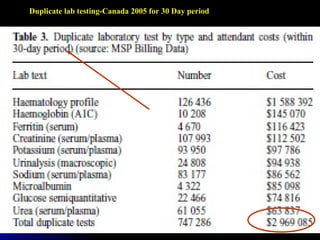
Duplicate lab testing-Canada 2005 for 30 Day period
 
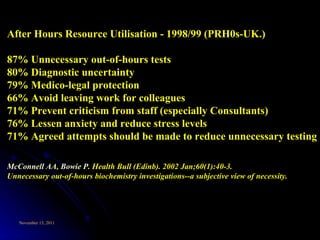
After Hours Resource Utilisation - 1998/99 (PRH0s-UK.) 87% Unnecessary out-of-hours tests  80% Diagnostic uncertainty 79% Medico-legal protection 66% Avoid leaving work for colleagues 71% Prevent criticism from staff (especially Consultants) 76% Lessen anxiety and reduce stress levels 71% Agreed attempts should be made to reduce unnecessary testing McConnell AA ,  Bowie P . Health Bull (Edinb). 2002 Jan;60(1):40-3.  Unnecessary out-of-hours biochemistry investigations--a subjective view of necessity.
THE VARIATION PHENOMENON “ The variation phenomenon in modern  medicine -the observation of differences  in the way apparently similar patients are treated from one health care setting to another.” D. Blumenthal. Editorial NEJM 331:1994;1017-8
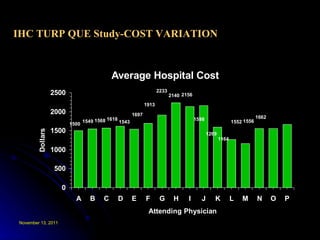
IHC TURP QUE Study-COST VARIATION 1500 1549 1568 1618 1543 1697 1913 2233 2140 2156 1598 1269 1164 1552 1556 1662
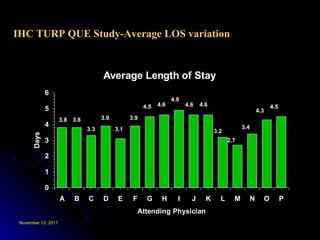
IHC TURP QUE Study-Average LOS variation 3.8 3.8 3.3 3.9 3.1 3.9 4.5 4.6 4.9 4.6 4.6 3.2 2.7 3.4 4.3 4.5
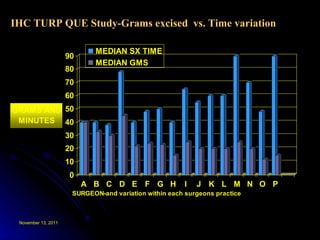
IHC TURP QUE Study-Grams excised  vs. Time variation
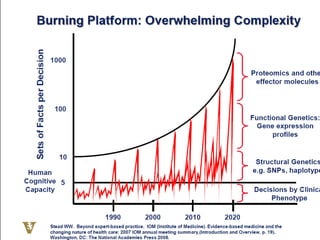
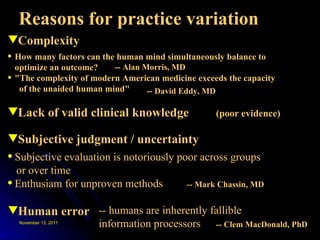
Reasons for practice variation Complexity Subjective judgment / uncertainty Lack of valid clinical knowledge How many factors can the human mind simultaneously balance to optimize an outcome? &quot;The complexity of modern American medicine exceeds the capacity  of the unaided human mind&quot; (poor evidence) -- Alan Morris, MD -- David Eddy, MD Subjective evaluation is notoriously poor across groups  or over time Enthusiam for unproven methods -- Mark Chassin, MD Human error -- humans are inherently fallible information processors -- Clem MacDonald, PhD
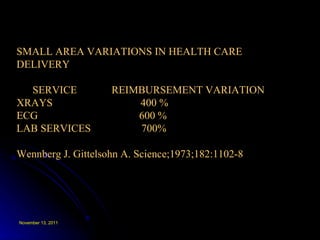
SMALL AREA VARIATIONS IN HEALTH CARE DELIVERY SERVICE  REIMBURSEMENT VARIATION XRAYS  400 % ECG  600 % LAB SERVICES  700% Wennberg J. Gittelsohn A. Science;1973;182:1102-8
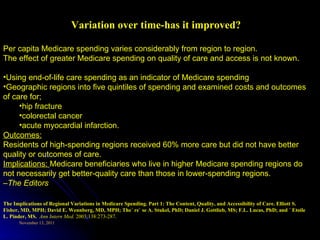
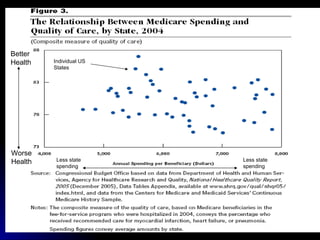
Variation over time-has it improved? Per capita Medicare spending varies considerably from region to region.  The effect of greater Medicare spending on quality of care and access is not known. Using end-of-life care spending as an indicator of Medicare spending Geographic regions into five quintiles of spending and examined costs and outcomes of care for; hip fracture colorectal cancer acute myocardial infarction.  Outcomes: Residents of high-spending regions received 60% more care but did not have better quality or outcomes of care. Implications:  Medicare beneficiaries who live in higher Medicare spending regions do not necessarily get better-quality care than those in lower-spending regions. – The Editors The Implications of Regional Variations in Medicare Spending. Part 1: The Content, Quality, and Accessibility of Care. Elliott S. Fisher, MD, MPH; David E. Wennberg, MD, MPH; The´ re` se A. Stukel, PhD; Daniel J. Gottlieb, MS; F.L. Lucas, PhD; and ´ Etoile L. Pinder, MS.  Ann Intern Med.  2003;138:273-287.
Better Health Worse Health Less state spending Less state spending Individual US States
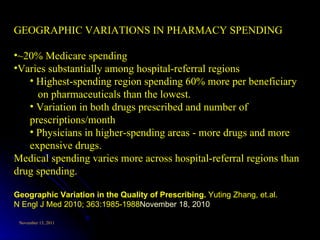
GEOGRAPHIC VARIATIONS IN PHARMACY SPENDING ~20% Medicare spending Varies substantially among hospital-referral regions H ighest-spending region spending 60% more per beneficiary  on pharmaceuticals than the lowest.  V ariation in both drugs prescribed and number of prescriptions/month Physicians in higher-spending areas - more drugs and more expensive drugs. Medical spending varies more across hospital-referral regions than drug spending.  Geographic Variation in the Quality of Prescribing.  Yuting Zhang, et.al. N Engl J Med 2010; 363:1985-1988 November 18, 2010
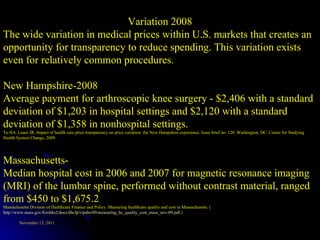
Variation 2008 The wide variation in medical prices within U.S. markets that creates an opportunity for transparency to reduce spending. This variation exists even for relatively common procedures.  New Hampshire-2008 Average payment for arthroscopic knee surgery - $2,406 with a standard deviation of $1,203 in hospital settings and $2,120 with a standard deviation of $1,358 in nonhospital settings. Tu HA, Lauer JR. Impact of health care price transparency on price variation: the New Hampshire experience. Issue brief no. 128. Washington, DC: Center for Studying Health System Change, 2009.  Massachusetts- Median hospital cost in 2006 and 2007 for magnetic resonance imaging (MRI) of the lumbar spine, performed without contrast material, ranged from $450 to $1,675.2 Massachusetts Division of Healthcare Finance and Policy. Measuring healthcare quality and cost in Massachusetts. ( http://www.mass.gov/Eeohhs2/docs/dhcfp/r/pubs/09/measuring_hc_quality_cost_mass_nov-09.pdf .)
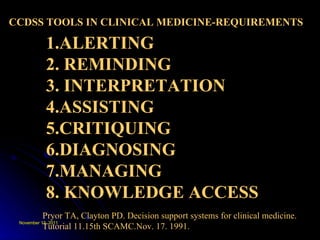
CCDSS TOOLS IN CLINICAL MEDICINE-REQUIREMENTS ALERTING  REMINDING INTERPRETATION ASSISTING CRITIQUING DIAGNOSING MANAGING KNOWLEDGE ACCESS Pryor TA, Clayton PD. Decision support systems for clinical medicine.  Tutorial 11.15th SCAMC.Nov. 17. 1991.
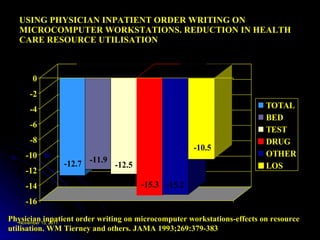
USING PHYSICIAN INPATIENT ORDER WRITING ON MICROCOMPUTER WORKSTATIONS. REDUCTION IN HEALTH CARE RESOURCE UTILISATION Physician inpatient order writing on microcomputer workstations-effects on resource utilisation. WM Tierney and others. JAMA 1993;269:379-383
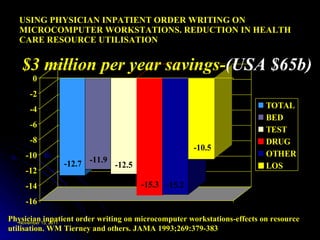
USING PHYSICIAN INPATIENT ORDER WRITING ON MICROCOMPUTER WORKSTATIONS. REDUCTION IN HEALTH CARE RESOURCE UTILISATION Physician inpatient order writing on microcomputer workstations-effects on resource utilisation. WM Tierney and others. JAMA 1993;269:379-383 $3 million per year savings- (USA $65b)
High Tech – High Touch-Personal Computing Foreign or Familiar territory? Age Gender Previous computer experience -NOT factors in usage [W.Slack 1976 and 2010]
ADULT INTERNET ACCESS – 2007 USA adults > 50 years-54% use Internet (38% in 2002) 25% high speed Internet access (5% in 2002) Greatest use  50-69 yrs. Rapid fall > 70 years Of those > 50 years who use Internet  - 87% use email -  81% use Google - Average 9 hrs/week on line “ The idea of being able to discover your own world is very exciting … the computer enables us to stay in the work force longer.”  Senior Netizens-D. Kadlec, TIME, February 12. 2007
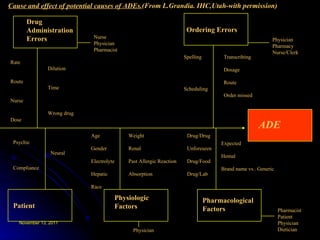
Nurse Physician Pharmacist Physician Pharmacy Nurse/Clerk Physician Pharmacist Patient Physician Dietician ADE Rate Route Nurse Dose Dilution Time Wrong drug Spelling Scheduling Transcribing Dosage Route Order missed Psychic Compliance Neural Age Gender Electrolyte Hepatic Race Weight Renal Past Allergic Reaction Absorption Drug/Drug Unforeseen Drug/Food Drug/Lab Expected Hemal Brand name vs.. Generic Drug Administration Errors Ordering Errors Patient Physiologic Factors Pharmacological Factors Cause and effect of potential causes of ADEs. (From L.Grandia. IHC,Utah-with permission)
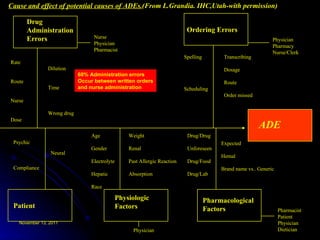
Nurse Physician Pharmacist Physician Pharmacy Nurse/Clerk Physician Pharmacist Patient Physician Dietician ADE Rate Route Nurse Dose Dilution Time Wrong drug Spelling Scheduling Transcribing Dosage Route Order missed Psychic Compliance Neural Age Gender Electrolyte Hepatic Race Weight Renal Past Allergic Reaction Absorption Drug/Drug Unforeseen Drug/Food Drug/Lab Expected Hemal Brand name vs.. Generic Drug Administration Errors Ordering Errors Patient Physiologic Factors Pharmacological Factors Cause and effect of potential causes of ADEs. (From L.Grandia. IHC,Utah-with permission) 60% Administration errors Occur between written orders and nurse administration
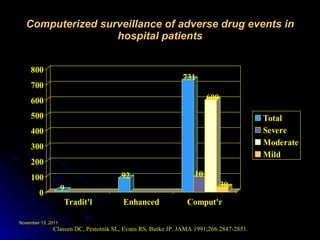
Computerized surveillance of adverse drug events in hospital patients Classen DC, Pestotnik SL, Evans RS, Burke JP. JAMA 1991;266:2847-2851.
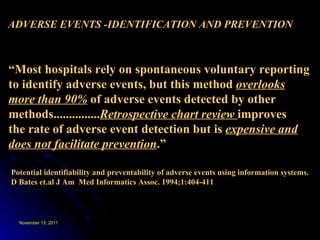
ADVERSE EVENTS -IDENTIFICATION AND PREVENTION Potential identifiability and preventability of adverse events using information systems. D Bates et.al J Am  Med Informatics Assoc. 1994;1:404-411 “ Most hospitals rely on spontaneous voluntary reporting to identify adverse events, but this method  overlooks more than 90%  of adverse events detected by other methods............... Retrospective chart review  improves the rate of adverse event detection but is  expensive and does not facilitate prevention .”
 
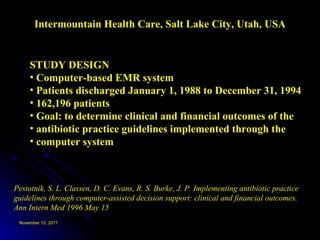
Intermountain Health Care, Salt Lake City, Utah, USA Pestotnik, S. L. Classen, D. C. Evans, R. S. Burke, J. P. Implementing antibiotic practice guidelines through computer-assisted decision support: clinical and financial outcomes. Ann Intern Med 1996 May 15 STUDY DESIGN Computer-based EMR system Patients discharged January 1, 1988 to December 31, 1994 162,196 patients Goal: to determine clinical and financial outcomes of the antibiotic practice guidelines implemented through the  computer system
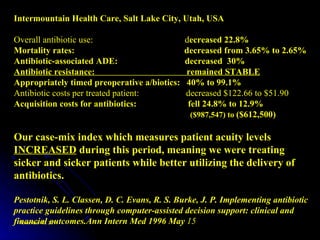
Intermountain Health Care, Salt Lake City, Utah, USA Overall antibiotic use:  d ecreased 22.8% Mortality rates:  decreased from 3.65% to 2.65% Antibiotic-associated ADE:  decreased  30% Antibiotic resistance:  remained STABLE Appropriately timed preoperative a/biotics:  40% to 99.1% Antibiotic costs per treated patient:  decreased $122.66 to $51.90 Acquisition costs for antibiotics:  fell 24.8% to 12.9%  ($987,547) to  ($612,500) Our case-mix index which measures patient acuity levels  INCREASED  during this period, meaning we were treating sicker and sicker patients while better utilizing the delivery of antibiotics. Pestotnik, S. L. Classen, D. C. Evans, R. S. Burke, J. P. Implementing antibiotic practice guidelines through computer-assisted decision support: clinical and financial outcomes.Ann Intern Med 1996 May  15
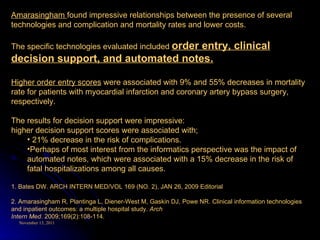
Amarasingham  found impressive relationships between the presence of several technologies and complication and mortality rates and lower costs.  The specific technologies evaluated included  order entry, clinical decision support, and automated notes. Higher order entry scores  were associated with 9% and 55% decreases in mortality rate for patients with myocardial infarction and coronary artery bypass surgery, respectively.  The results for decision support were impressive:  higher decision support scores were associated with; 21% decrease in the risk of complications.  Perhaps of most interest from the informatics perspective was the impact of automated notes, which were associated with a 15% decrease in the risk of fatal hospitalizations among all causes. 1. Bates DW. ARCH INTERN MED/VOL 169 (NO. 2), JAN 26, 2009 Editorial 2. Amarasingham R, Plantinga L, Diener-West M, Gaskin DJ, Powe NR. Clinical information technologies and inpatient outcomes: a multiple hospital study.  Arch Intern Med . 2009;169(2):108-114.
Not all HIT are beneficial. There were also some instances in which relationships in the opposite direction were found; for example, electronic documentation was associated with a 35% increase in the risk of complications in patients with heart failure, though this may have been present because it was easier to find these events since better documentation was present. 1. Bates DW. ARCH INTERN MED/VOL 169 (NO. 2), JAN 26, 2009 Editorial 2. Amarasingham R, Plantinga L, Diener-West M, Gaskin DJ, Powe NR. Clinical information technologies and inpatient outcomes: a multiple hospital study.  Arch Intern Med . 2009;169(2):108-114.
Questions. 1. Are the technologies—computer order entry, decision support, and clinical documentation—sufficiently mature that hospitals should be adopting them now?  Bates: the answer is a clear yes for large hospitals.  For smaller hospitals, which use a different set of vendors, the answer is less clear, but studies are currently under way that should provide additional information regarding this.  2. For clinical documentation, the benefits are still only beginning to be determined and are likely to be spread across a wide range of areas, but this will likely prove to be beneficial as well. Bates DW. REPRINTED) ARCH INTERN MED/VOL 169 (NO. 2), JAN 26, 2009 WWW.ARCHINTERNMED.COM Amarasingham R, Plantinga L, Diener-West M, Gaskin DJ, Powe NR. Clinical information technologies and inpatient outcomes: a multiple hospital study.  Arch Intern Med . 2009;169(2):108-114.
Do the negative consequences of implementing HIT in hospitals overwhelm or wash out the positive ones? Current evidence is that they do not overall. EVALUATION  is critical with technology after implementation and making multiple   changes to it—points that are all too often ignored. Bates DW. ARCH INTERN MED/VOL 169 (NO. 2), JAN 26, 2009


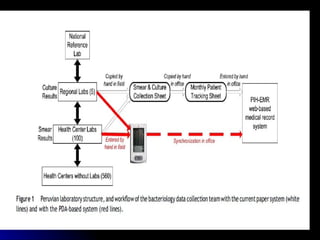
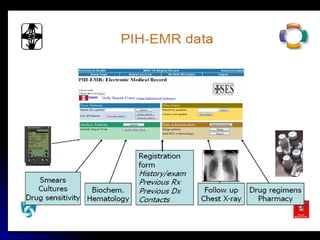
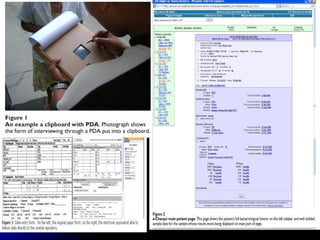
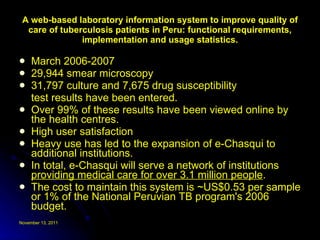
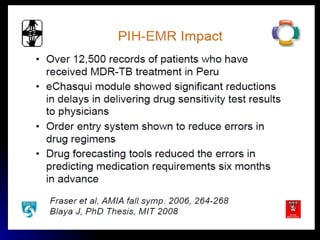
A web-based laboratory information system to improve quality of care of tuberculosis patients in Peru: functional requirements, implementation and usage statistics. March 2006-2007 29,944 smear microscopy 31,797 culture and 7,675 drug susceptibility test results have been entered.  Over 99% of these results have been viewed online by the health centres.  High user satisfaction Heavy use has led to the expansion of e-Chasqui to additional institutions.  In total, e-Chasqui will serve a network of institutions  providing medical care for over 3.1 million people .  The cost to maintain this system is ~US$0.53 per sample or 1% of the National Peruvian TB program's 2006 budget.
 
40 million PLWA  (People Living With AIDS) Limited resources
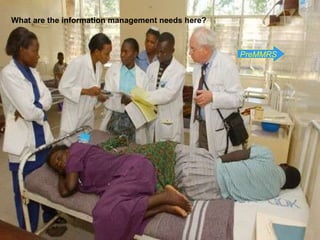
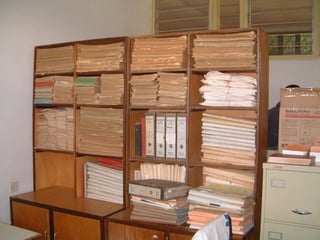
PreMMRS What are the information management needs here?
 
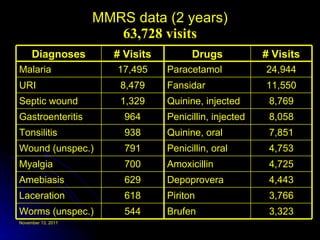
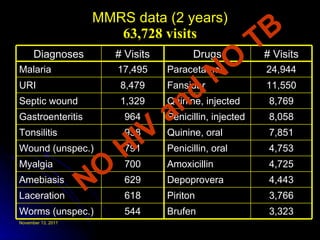
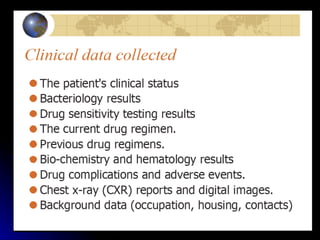
MMRS data (2 years) 63,728 visits 3,323 Brufen 544 Worms (unspec.) 3,766 Piriton 618 Laceration 4,443 Depoprovera 629 Amebiasis 4,725 Amoxicillin 700 Myalgia 4,753 Penicillin, oral 791 Wound (unspec.) 7,851 Quinine, oral 938 Tonsilitis 8,058 Penicillin, injected 964 Gastroenteritis 8,769 Quinine, injected 1,329 Septic wound 11,550 Fansidar 8,479 URI 24,944 Paracetamol 17,495 Malaria # Visits Drugs # Visits Diagnoses
MMRS data (2 years) 63,728 visits NO HIV and NO TB 3,323 Brufen 544 Worms (unspec.) 3,766 Piriton 618 Laceration 4,443 Depoprovera 629 Amebiasis 4,725 Amoxicillin 700 Myalgia 4,753 Penicillin, oral 791 Wound (unspec.) 7,851 Quinine, oral 938 Tonsilitis 8,058 Penicillin, injected 964 Gastroenteritis 8,769 Quinine, injected 1,329 Septic wound 11,550 Fansidar 8,479 URI 24,944 Paracetamol 17,495 Malaria # Visits Drugs # Visits Diagnoses
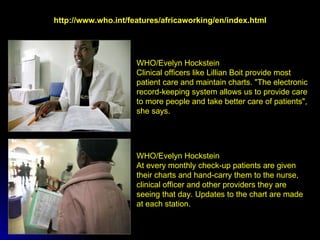
WHO/Evelyn Hockstein At every monthly check-up patients are given their charts and hand-carry them to the nurse, clinical officer and other providers they are seeing that day. Updates to the chart are made at each station. WHO/Evelyn Hockstein Clinical officers like Lillian Boit provide most patient care and maintain charts. &quot;The electronic record-keeping system allows us to provide care to more people and take better care of patients&quot;, she says.   http://www.who.int/features/africaworking/en/index.html
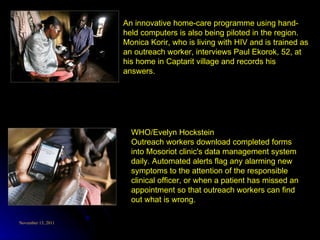
WHO/Evelyn Hockstein Outreach workers download completed forms into Mosoriot clinic's data management system daily. Automated alerts flag any alarming new symptoms to the attention of the responsible clinical officer, or when a patient has missed an appointment so that outreach workers can find out what is wrong. An innovative home-care programme using hand-held computers is also being piloted in the region. Monica Korir, who is living with HIV and is trained as an outreach worker, interviews Paul Ekorok, 52, at his home in Captarit village and records his answers.
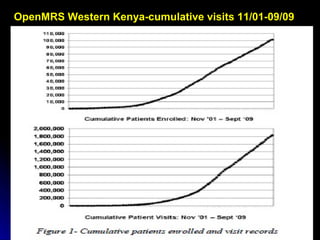
OpenMRS Western Kenya-cumulative visits 11/01-09/09
Besides antiretroviral drugs (which are provided by USAID), care by AMPATH cost only $175/patient/year in 2007 and is now less than $100/patient/year in 2009. P. Park, et al.,  Case Report: The Academic Model for the Prevention and Treatment of HIV/AIDS . Harvard Business School, Boston, 2008. In addition to the monthly, quarterly, and annual reports required by funding and agencies and the MOH, the AMRS also provides data to a robust multidisciplinary research program:  Researchers from more than a dozen North American universities and Moi University currently have more than 30 ongoing studies in East Africa, supported by >$26 million in grants from U.S. federal granting agencies and various foundations.
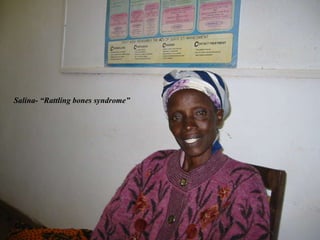
Salina- “Rattling bones syndrome”
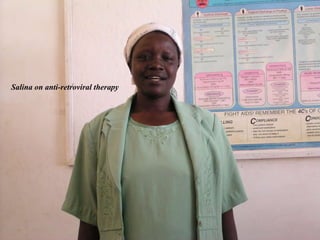
Salina on anti-retroviral therapy
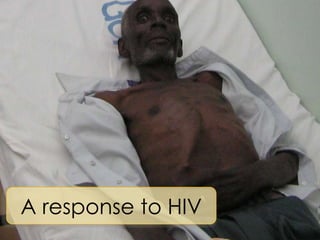
A response to HIV
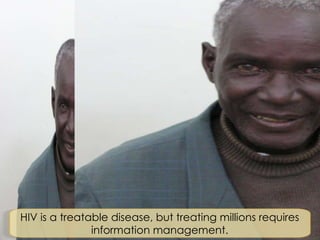
HIV is a treatable disease, but treating millions requires information management.
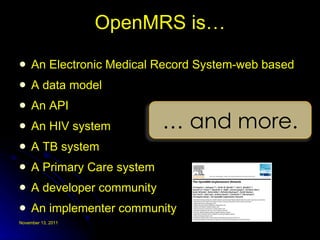
OpenMRS is… An Electronic Medical Record System-web based A data model An API An HIV system A TB system A Primary Care system A developer community An implementer community …  and more.
 
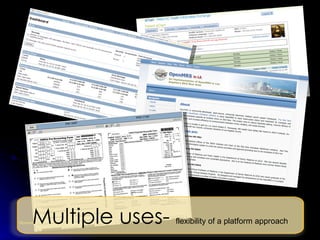
Multiple uses-  flexibility of a platform approach
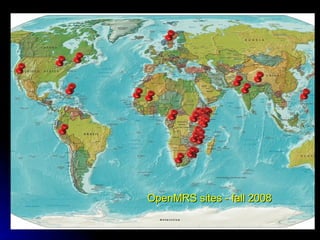
OpenMRS sites - fall 2008
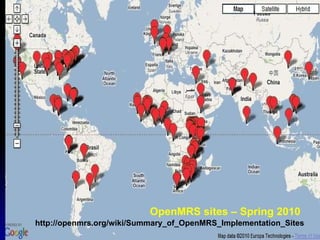
OpenMRS sites – Spring 2010 http://openmrs.org/wiki/Summary_of_OpenMRS_Implementation_Sites
 
Implementation Time Frames and support. It took us about 6 weeks … to configure our ER and Surgery modules in OpenMRS. … Thanks again to Andy at MVP and James at HAS among others for considerable guidance and support … There are only a couple of us working on this project at MSF with limited resources, and without the help of the implementers group we would have been stopped in our tracks.  On June 1 we went live with the production database in Port au Prince. …  the system is run by local staff with limited technical training . … Overall we have been impressed with the stability of OpenMRS on Linux; server reboots are sometimes necessary once or twice a day because of Tomcat memory errors. With three months of data in the system now and stability and output tried and true … Thanks. John John Brooks. Médecins Sans Frontières (MSF)/Doctors Without Borders
 
Collaborators and Funders  Partners In Health Regenstrief institute Medical Research Council, South Africa World Health Organization US Centers for Disease Control Brigham and Women hospital Harvard Medical School University of KwaZulu-Natal Millennium Villages Project International Development Research Centre, Ottawa Rockefeller Foundation Fogarty International Center, NIH Boston Consulting Group Google Inc
eHealth Nigeria:  http://www.youtube.com/watch?v=UIpqE5WoufE MDRTB Pakistan:  http://www.youtube.com/watch?v=U7RoBIO1xaU   http:// openmrs.org
Features This is an incomplete list of OpenMRS features “out of the box”. Our many  add-on modules  make it easy to infinitely expand and extend the system. Central concept dictionary:  Definitions of all data (both questions and answers) are defined in a centralized dictionary, allowing for robust, coded data  Currently, the AMRS (Kenya) contains 50 million observations from 2 million visits to 23 AMPATH clinics by >100,000 HIV-infected patients. (Oct 2010) Google Workshop-OpenMRS® - Is a community-developed, open-source, enterprise  electronic medical record system  platform and  the most widely used EMR  in the developing world.
Features of OpenMRS Security:  User authentication  Privilege-based access:  User roles and permission system  Patient repository:  Creation and maintenance of all patient data,  Multiple identifiers per patient:  A single patient may have multiple medical record numbers  Data entry:  With the FormEntry module, clients with InfoPath (included in Microsoft Office 2003 and later) can design and enter data using flexible, electronic forms. With the HTML FormEntry module, forms can be created with customized HTML and run directly within the web application.  Data export:  Data can be exported into a spreadsheet format for use in other tools (Excel, Access, etc.)  Standards support:  HL7 engine for data import  Modular architecture:  An OpenMRS Module can extend and add any type of functionality to the existing API and web app.
Patient workflows:  An embedded patient workflow service allows patient to be put into programs (studies, treatment programs, etc.) and tracked through various states.  Cohort management:  The cohort builder allows you to create groups of patients for data exports, reporting, etc.  Relationships:  Relationships between any two people (patients, relatives, caretakers, etc.)  Patient merging:  Merging duplicate patients  Localization / internationalization:  Multiple language support and the possibility to extend to other languages with full UTF-8 support.  Support for complex data:   Radiology images, sound files, etc. can be stored as “complex” observations  Reporting tools :  Flexible reporting tools  Person attributes:  The attributes of a person can be extended to meet local needs
Not all smooth sailing! A number of unintended adverse consequences that have followed CPOE implementation.  Unfavourable workflow issues,  Continuous demands for system change,  Untoward changes in communications patterns and practices Generation of new kinds of medical errors,  Negative emotional responses to the system by clinicians.  Physician resistance can derail costly, complex CPOE projects .  Campbell EM, Sittig, DF, Ash JS, et al.  Types of unintended consequences related to computerized provider order entry. J Am Med Inform Assoc. 2006 Sept-Oct;13(5):547-556.
One of the answers to these questions are to be found in the  CULTURE OF MEDICINE   Deeply rooted customs and training High standards of autonomous individual performance A commitment to progress through research-lead to advances in biomedical science and cures to millions.  However ……. These advances have created challenges to safety not faced by other hazardous industries.  Five Years After  To Err Is Human.  What Have We Learned?  JAMA. 2005;293:2384-2390
“ It must be remembered that there is nothing more difficult to plan, more doubtful of success, nor more dangerous to manage than the creation of a new system.  For the initiator has the enmity of all who would profit  by the preservation of an old institution and merely lukewarm defenders in those who would gain by the new ones,”  Machiavelli., Niccolo 1532.
Thank you.
 

Pavia wsp october 2011

  • 1.
    A/Prof. Terry J.Hannan MBBS;FRACP;FACHI;FACMI UNDERSTANDING e-HEALTH AND WHY WE NEED IT. NETTAB 2011 (Network Tools and Applications in Biology workshop) PAVIA, Italy, 13 th October 2011 “ To improve care you have to measure it. Information management is care” (Don Berwick)
  • 2.
    Clinical computing 1976-2011.Current/Future data demands on CDM Technology of clinical computing . Storage, interoperability and standards, forms, data capture, CPOE. Translocating health information technologies MMRS-AMPATH-OpenMRS. Effective CDS tools (MSAccess) show how HIT and CDS works. Meeting the needs of scalability. Role of the internet, WWW, m-Health to meet the demands of modern health care. [VIDEOS]
  • 3.
    Some Definitions. Informationis not a necessary adjunct to care, it is care , and effective patient management requires effective management of patients’ clinical data. Donald M. Berwick President and CEO, Institute for Healthcare Improvement There is no health without management, and there is no management without information. WHO-Gonzalo Vecina Neto, head of the Brazilian National Health Regulatory Agency Information is necessary to provide and manage health care at all levels , from individual patients to health care systems to national Ministries of Health (MOH). W.Tierney. Dir. Regenstrief Institute. So what is eHealth? The World Health Organization (WHO) definition: “ e-Health is the combined use of electronic communication and information technology in the health sector.”
  • 4.
    Health Informaticians. “ Informaticians should understand that our first contribution is to see healthcare as a complex system, full of information flows and feedback loops, and we also should understand that our role is to help others ''see' the system, and re-conceive it in new ways.” E. Coiera. April 2009, Centre for Health Informatics, Institute of Health Innovation, University of New South Wales, Australia
  • 5.
    Functions of ClinicalInformaticians Clinical informaticians use their knowledge of patient care combined with their understanding of informatics concepts, methods, and tools to: Assess information and knowledge needs of health care professionals and patients; Characterize, evaluate, and refine clinical processes; Develop, implement, and refine clinical decision support systems; Lead or participate in the procurement, customization, development, implementation, management, evaluation, and continuous improvement of clinical information systems.
  • 6.
    Goals of ComputerizedClinical Decision Support Systems (for EMR) International Journal of Medical Informatics 54 (1999) 183–196 The CCC system in two teaching hospitals: a progress report. Warner V. Slack Howard L. Bleich 1. Information : captured directly at computer terminals located at the point of each transaction, not on pieces of paper.   2. Information captured at a terminal or automated device: anywhere in the hospital should be available immediately, if needed, at any other terminal.   3.The response time of the computer should be rapid-blink times. 4. The computer should be reliable and accurate .   5. Confidentiality should be protected.   6.The computer programs should be friendly to the user and reinforce the user’s behavior .   7. There should be a common registry for all patients.  
  • 7.
    The Regenstrief MedicalRecord System. IJMI 54 (1999) 225-253 Goals of implementation. Eliminate logistic problems of paper record- clinical data timely, reliable, complete. 2. Reduce the work of clinical bookeeping-no more missed Dx, or forgotten preventive care. 3. Information ‘gold’ within medical records available to clinical, epidemiological, outcomes and management research.
  • 8.
    Four key functionsof electronic clinical decision support systems &quot;Administrative”: Supporting clinical coding and documentation, authorization of procedures, and referrals. &quot;Managing clinical complexity and details”: Keeping patients on research and chemotherapy protocols tracking orders, referrals follow-up, and preventive care. &quot;Cost control’: Monitoring medication orders; avoiding duplicate or unnecessary tests. &quot;Decision support”: Supporting clinical diagnosis and treatment plan processes; promoting use of best practices, condition-specific guidelines, population-based management. http ://www.openclinical.org/dss.html
  • 9.
    What can technologydo NOW! The Regenstrief Medical Record System. IJMI 54 ( 1999 ) Retrieval times-Fast (blink times) Data and information-Comprehensive Data storage- Long-term-lifelong Data applications-Introspective of total database Data storage- 200 million coded observations 3.25 million narrative reports 15 million prescriptions 212,000 ECG tracings More than 1.3 million patients Access- 1300 medical nurses 1000 physicians 220 medical students Across health care institutions (16) Data access more than 628,000 / month
  • 10.
  • 11.
  • 12.
    Other complex decisionmaking activities and errors!
  • 13.
  • 14.
  • 15.
  • 16.
  • 17.
  • 18.
  • 19.
  • 20.
  • 21.
  • 22.
    ADVERSE EVENTS &NEGLIGENCE IN HOSPITALISED PATIENTS.( BRENNAN TA, AND OTHERS. N Engl J Med. 1991;324:370-6 ) ADVERSE EVENTS 3.7% HOSPITALISATIONS 27.6% DUE TO NEGLIGENCE 70.5% DISABILITY OF < 6MONTHS 2.6% PERMANENT DISABILITY 13.6% DEATH “ Lawyers generally believe that investigation of substandard care only begins with the medical record ; that in many instances the medical record even conceals substandard care ; and that substandard care is not reflected in, or “discoverable ” in the medical record.”
  • 23.
    Very little changesince 2000! In 2003, the RAND Corporation - on average patients receive recommended care only 54.9% of the time. (Leape, 2005, McGlynn et al., 2003). Of what we do in routine medical practice, what proportion has a basis in published scientific research? 1. Williamson (1979) <20% 2. OTA (1985) 10-20% 3. OMAR (1990) < 20% 4. B. James (2007) 20-40% 1. Williamson et al.  Medical Practice Information Demonstration Project:  Final Report.  Office of the Asst.    Secretary of Health, DHEW, Contract #282-77-0068GS.  Baltimore, MD: Policy Research Inc., 1979). 2. Institute of Medicine.  Assessing Medical Technologies.  Washington, D.C.: National Academy Press, 1985:5. 3. Ferguson JH.  Forward.  Research on the delivery of medical care using hospital firms. Proceedings of    a workshop. April 30 and May 1, 1990, Bethesda, Maryland.  Med Care 1991; 29(7 Suppl):JS1-2 (July). 4. B. James. Intermountain Health Care. 2007 The rest is opinion That doesn’t mean it is wrong -- much of it probably works but it may not represent the best patient care
  • 24.
  • 25.
    IMPACT OF HEALTHCARE COSTS ON U.S. ECONOMY MEDICAL COSTS RISING RAPIDLY.. Annual increase 1986-91 Medical Costs = 14.1% Inflation = 3.8% Medical costs rising 4 times faster than inflation. … IMPACTING BUSINESSES… Health care spending Percent of pretax profits 1965 = 8.4% 1980 = 27.3% 1990 = 61.1% … .AND GOVERNMENT FINANCES.. Health care spending Percent of total government expenditures 1980 = 10.7% 1985 = 11.5% 1988 = 12.8% 1990 = 14.0% Increases in health expenditures per capita across different countries are actually fairly similar —averaging about 3 percent a year adjusted for overall inflation. Taking a Walk on the Supply Side: 10 Steps to Control Health Care Costs Karen Davis.USA DOH Mar. 2005.
  • 26.
    Dis-proportional use ofAcute care services (CKD) 5% of CKD – bed days.
  • 27.
    Gap analysis: Duplicate testing common in cluster group (CKD)
  • 28.
    Gap analysis: Duplicatetesting ~$4.5 M (~$4.50/test)
  • 29.
    Duplicate lab testing-Canada2005 for 30 Day period
  • 30.
  • 31.
    After Hours ResourceUtilisation - 1998/99 (PRH0s-UK.) 87% Unnecessary out-of-hours tests 80% Diagnostic uncertainty 79% Medico-legal protection 66% Avoid leaving work for colleagues 71% Prevent criticism from staff (especially Consultants) 76% Lessen anxiety and reduce stress levels 71% Agreed attempts should be made to reduce unnecessary testing McConnell AA , Bowie P . Health Bull (Edinb). 2002 Jan;60(1):40-3. Unnecessary out-of-hours biochemistry investigations--a subjective view of necessity.
  • 32.
    THE VARIATION PHENOMENON“ The variation phenomenon in modern medicine -the observation of differences in the way apparently similar patients are treated from one health care setting to another.” D. Blumenthal. Editorial NEJM 331:1994;1017-8
  • 33.
    IHC TURP QUEStudy-COST VARIATION 1500 1549 1568 1618 1543 1697 1913 2233 2140 2156 1598 1269 1164 1552 1556 1662
  • 34.
    IHC TURP QUEStudy-Average LOS variation 3.8 3.8 3.3 3.9 3.1 3.9 4.5 4.6 4.9 4.6 4.6 3.2 2.7 3.4 4.3 4.5
  • 35.
    IHC TURP QUEStudy-Grams excised vs. Time variation
  • 36.
    Reasons for practicevariation Complexity Subjective judgment / uncertainty Lack of valid clinical knowledge How many factors can the human mind simultaneously balance to optimize an outcome? &quot;The complexity of modern American medicine exceeds the capacity of the unaided human mind&quot; (poor evidence) -- Alan Morris, MD -- David Eddy, MD Subjective evaluation is notoriously poor across groups or over time Enthusiam for unproven methods -- Mark Chassin, MD Human error -- humans are inherently fallible information processors -- Clem MacDonald, PhD
  • 37.
    SMALL AREA VARIATIONSIN HEALTH CARE DELIVERY SERVICE REIMBURSEMENT VARIATION XRAYS 400 % ECG 600 % LAB SERVICES 700% Wennberg J. Gittelsohn A. Science;1973;182:1102-8
  • 38.
    Variation over time-hasit improved? Per capita Medicare spending varies considerably from region to region. The effect of greater Medicare spending on quality of care and access is not known. Using end-of-life care spending as an indicator of Medicare spending Geographic regions into five quintiles of spending and examined costs and outcomes of care for; hip fracture colorectal cancer acute myocardial infarction. Outcomes: Residents of high-spending regions received 60% more care but did not have better quality or outcomes of care. Implications: Medicare beneficiaries who live in higher Medicare spending regions do not necessarily get better-quality care than those in lower-spending regions. – The Editors The Implications of Regional Variations in Medicare Spending. Part 1: The Content, Quality, and Accessibility of Care. Elliott S. Fisher, MD, MPH; David E. Wennberg, MD, MPH; The´ re` se A. Stukel, PhD; Daniel J. Gottlieb, MS; F.L. Lucas, PhD; and ´ Etoile L. Pinder, MS. Ann Intern Med. 2003;138:273-287.
  • 39.
    Better Health WorseHealth Less state spending Less state spending Individual US States
  • 40.
    GEOGRAPHIC VARIATIONS INPHARMACY SPENDING ~20% Medicare spending Varies substantially among hospital-referral regions H ighest-spending region spending 60% more per beneficiary on pharmaceuticals than the lowest. V ariation in both drugs prescribed and number of prescriptions/month Physicians in higher-spending areas - more drugs and more expensive drugs. Medical spending varies more across hospital-referral regions than drug spending. Geographic Variation in the Quality of Prescribing. Yuting Zhang, et.al. N Engl J Med 2010; 363:1985-1988 November 18, 2010
  • 41.
    Variation 2008 Thewide variation in medical prices within U.S. markets that creates an opportunity for transparency to reduce spending. This variation exists even for relatively common procedures. New Hampshire-2008 Average payment for arthroscopic knee surgery - $2,406 with a standard deviation of $1,203 in hospital settings and $2,120 with a standard deviation of $1,358 in nonhospital settings. Tu HA, Lauer JR. Impact of health care price transparency on price variation: the New Hampshire experience. Issue brief no. 128. Washington, DC: Center for Studying Health System Change, 2009. Massachusetts- Median hospital cost in 2006 and 2007 for magnetic resonance imaging (MRI) of the lumbar spine, performed without contrast material, ranged from $450 to $1,675.2 Massachusetts Division of Healthcare Finance and Policy. Measuring healthcare quality and cost in Massachusetts. ( http://www.mass.gov/Eeohhs2/docs/dhcfp/r/pubs/09/measuring_hc_quality_cost_mass_nov-09.pdf .)
  • 42.
    CCDSS TOOLS INCLINICAL MEDICINE-REQUIREMENTS ALERTING REMINDING INTERPRETATION ASSISTING CRITIQUING DIAGNOSING MANAGING KNOWLEDGE ACCESS Pryor TA, Clayton PD. Decision support systems for clinical medicine. Tutorial 11.15th SCAMC.Nov. 17. 1991.
  • 43.
    USING PHYSICIAN INPATIENTORDER WRITING ON MICROCOMPUTER WORKSTATIONS. REDUCTION IN HEALTH CARE RESOURCE UTILISATION Physician inpatient order writing on microcomputer workstations-effects on resource utilisation. WM Tierney and others. JAMA 1993;269:379-383
  • 44.
    USING PHYSICIAN INPATIENTORDER WRITING ON MICROCOMPUTER WORKSTATIONS. REDUCTION IN HEALTH CARE RESOURCE UTILISATION Physician inpatient order writing on microcomputer workstations-effects on resource utilisation. WM Tierney and others. JAMA 1993;269:379-383 $3 million per year savings- (USA $65b)
  • 45.
    High Tech –High Touch-Personal Computing Foreign or Familiar territory? Age Gender Previous computer experience -NOT factors in usage [W.Slack 1976 and 2010]
  • 46.
    ADULT INTERNET ACCESS– 2007 USA adults > 50 years-54% use Internet (38% in 2002) 25% high speed Internet access (5% in 2002) Greatest use 50-69 yrs. Rapid fall > 70 years Of those > 50 years who use Internet - 87% use email - 81% use Google - Average 9 hrs/week on line “ The idea of being able to discover your own world is very exciting … the computer enables us to stay in the work force longer.” Senior Netizens-D. Kadlec, TIME, February 12. 2007
  • 47.
    Nurse Physician PharmacistPhysician Pharmacy Nurse/Clerk Physician Pharmacist Patient Physician Dietician ADE Rate Route Nurse Dose Dilution Time Wrong drug Spelling Scheduling Transcribing Dosage Route Order missed Psychic Compliance Neural Age Gender Electrolyte Hepatic Race Weight Renal Past Allergic Reaction Absorption Drug/Drug Unforeseen Drug/Food Drug/Lab Expected Hemal Brand name vs.. Generic Drug Administration Errors Ordering Errors Patient Physiologic Factors Pharmacological Factors Cause and effect of potential causes of ADEs. (From L.Grandia. IHC,Utah-with permission)
  • 48.
    Nurse Physician PharmacistPhysician Pharmacy Nurse/Clerk Physician Pharmacist Patient Physician Dietician ADE Rate Route Nurse Dose Dilution Time Wrong drug Spelling Scheduling Transcribing Dosage Route Order missed Psychic Compliance Neural Age Gender Electrolyte Hepatic Race Weight Renal Past Allergic Reaction Absorption Drug/Drug Unforeseen Drug/Food Drug/Lab Expected Hemal Brand name vs.. Generic Drug Administration Errors Ordering Errors Patient Physiologic Factors Pharmacological Factors Cause and effect of potential causes of ADEs. (From L.Grandia. IHC,Utah-with permission) 60% Administration errors Occur between written orders and nurse administration
  • 49.
    Computerized surveillance ofadverse drug events in hospital patients Classen DC, Pestotnik SL, Evans RS, Burke JP. JAMA 1991;266:2847-2851.
  • 50.
    ADVERSE EVENTS -IDENTIFICATIONAND PREVENTION Potential identifiability and preventability of adverse events using information systems. D Bates et.al J Am Med Informatics Assoc. 1994;1:404-411 “ Most hospitals rely on spontaneous voluntary reporting to identify adverse events, but this method overlooks more than 90% of adverse events detected by other methods............... Retrospective chart review improves the rate of adverse event detection but is expensive and does not facilitate prevention .”
  • 51.
  • 52.
    Intermountain Health Care,Salt Lake City, Utah, USA Pestotnik, S. L. Classen, D. C. Evans, R. S. Burke, J. P. Implementing antibiotic practice guidelines through computer-assisted decision support: clinical and financial outcomes. Ann Intern Med 1996 May 15 STUDY DESIGN Computer-based EMR system Patients discharged January 1, 1988 to December 31, 1994 162,196 patients Goal: to determine clinical and financial outcomes of the antibiotic practice guidelines implemented through the computer system
  • 53.
    Intermountain Health Care,Salt Lake City, Utah, USA Overall antibiotic use: d ecreased 22.8% Mortality rates: decreased from 3.65% to 2.65% Antibiotic-associated ADE: decreased 30% Antibiotic resistance: remained STABLE Appropriately timed preoperative a/biotics: 40% to 99.1% Antibiotic costs per treated patient: decreased $122.66 to $51.90 Acquisition costs for antibiotics: fell 24.8% to 12.9% ($987,547) to ($612,500) Our case-mix index which measures patient acuity levels INCREASED during this period, meaning we were treating sicker and sicker patients while better utilizing the delivery of antibiotics. Pestotnik, S. L. Classen, D. C. Evans, R. S. Burke, J. P. Implementing antibiotic practice guidelines through computer-assisted decision support: clinical and financial outcomes.Ann Intern Med 1996 May 15
  • 54.
    Amarasingham foundimpressive relationships between the presence of several technologies and complication and mortality rates and lower costs. The specific technologies evaluated included order entry, clinical decision support, and automated notes. Higher order entry scores were associated with 9% and 55% decreases in mortality rate for patients with myocardial infarction and coronary artery bypass surgery, respectively. The results for decision support were impressive: higher decision support scores were associated with; 21% decrease in the risk of complications. Perhaps of most interest from the informatics perspective was the impact of automated notes, which were associated with a 15% decrease in the risk of fatal hospitalizations among all causes. 1. Bates DW. ARCH INTERN MED/VOL 169 (NO. 2), JAN 26, 2009 Editorial 2. Amarasingham R, Plantinga L, Diener-West M, Gaskin DJ, Powe NR. Clinical information technologies and inpatient outcomes: a multiple hospital study. Arch Intern Med . 2009;169(2):108-114.
  • 55.
    Not all HITare beneficial. There were also some instances in which relationships in the opposite direction were found; for example, electronic documentation was associated with a 35% increase in the risk of complications in patients with heart failure, though this may have been present because it was easier to find these events since better documentation was present. 1. Bates DW. ARCH INTERN MED/VOL 169 (NO. 2), JAN 26, 2009 Editorial 2. Amarasingham R, Plantinga L, Diener-West M, Gaskin DJ, Powe NR. Clinical information technologies and inpatient outcomes: a multiple hospital study. Arch Intern Med . 2009;169(2):108-114.
  • 56.
    Questions. 1. Arethe technologies—computer order entry, decision support, and clinical documentation—sufficiently mature that hospitals should be adopting them now? Bates: the answer is a clear yes for large hospitals. For smaller hospitals, which use a different set of vendors, the answer is less clear, but studies are currently under way that should provide additional information regarding this. 2. For clinical documentation, the benefits are still only beginning to be determined and are likely to be spread across a wide range of areas, but this will likely prove to be beneficial as well. Bates DW. REPRINTED) ARCH INTERN MED/VOL 169 (NO. 2), JAN 26, 2009 WWW.ARCHINTERNMED.COM Amarasingham R, Plantinga L, Diener-West M, Gaskin DJ, Powe NR. Clinical information technologies and inpatient outcomes: a multiple hospital study. Arch Intern Med . 2009;169(2):108-114.
  • 57.
    Do the negativeconsequences of implementing HIT in hospitals overwhelm or wash out the positive ones? Current evidence is that they do not overall. EVALUATION is critical with technology after implementation and making multiple changes to it—points that are all too often ignored. Bates DW. ARCH INTERN MED/VOL 169 (NO. 2), JAN 26, 2009
  • 58.
  • 59.
  • 60.
  • 61.
  • 62.
    A web-based laboratoryinformation system to improve quality of care of tuberculosis patients in Peru: functional requirements, implementation and usage statistics. March 2006-2007 29,944 smear microscopy 31,797 culture and 7,675 drug susceptibility test results have been entered. Over 99% of these results have been viewed online by the health centres. High user satisfaction Heavy use has led to the expansion of e-Chasqui to additional institutions. In total, e-Chasqui will serve a network of institutions providing medical care for over 3.1 million people . The cost to maintain this system is ~US$0.53 per sample or 1% of the National Peruvian TB program's 2006 budget.
  • 63.
  • 64.
    40 million PLWA (People Living With AIDS) Limited resources
  • 65.
    PreMMRS What arethe information management needs here?
  • 66.
  • 67.
    MMRS data (2years) 63,728 visits 3,323 Brufen 544 Worms (unspec.) 3,766 Piriton 618 Laceration 4,443 Depoprovera 629 Amebiasis 4,725 Amoxicillin 700 Myalgia 4,753 Penicillin, oral 791 Wound (unspec.) 7,851 Quinine, oral 938 Tonsilitis 8,058 Penicillin, injected 964 Gastroenteritis 8,769 Quinine, injected 1,329 Septic wound 11,550 Fansidar 8,479 URI 24,944 Paracetamol 17,495 Malaria # Visits Drugs # Visits Diagnoses
  • 68.
    MMRS data (2years) 63,728 visits NO HIV and NO TB 3,323 Brufen 544 Worms (unspec.) 3,766 Piriton 618 Laceration 4,443 Depoprovera 629 Amebiasis 4,725 Amoxicillin 700 Myalgia 4,753 Penicillin, oral 791 Wound (unspec.) 7,851 Quinine, oral 938 Tonsilitis 8,058 Penicillin, injected 964 Gastroenteritis 8,769 Quinine, injected 1,329 Septic wound 11,550 Fansidar 8,479 URI 24,944 Paracetamol 17,495 Malaria # Visits Drugs # Visits Diagnoses
  • 69.
    WHO/Evelyn Hockstein Atevery monthly check-up patients are given their charts and hand-carry them to the nurse, clinical officer and other providers they are seeing that day. Updates to the chart are made at each station. WHO/Evelyn Hockstein Clinical officers like Lillian Boit provide most patient care and maintain charts. &quot;The electronic record-keeping system allows us to provide care to more people and take better care of patients&quot;, she says. http://www.who.int/features/africaworking/en/index.html
  • 70.
    WHO/Evelyn Hockstein Outreachworkers download completed forms into Mosoriot clinic's data management system daily. Automated alerts flag any alarming new symptoms to the attention of the responsible clinical officer, or when a patient has missed an appointment so that outreach workers can find out what is wrong. An innovative home-care programme using hand-held computers is also being piloted in the region. Monica Korir, who is living with HIV and is trained as an outreach worker, interviews Paul Ekorok, 52, at his home in Captarit village and records his answers.
  • 71.
  • 72.
    Besides antiretroviral drugs(which are provided by USAID), care by AMPATH cost only $175/patient/year in 2007 and is now less than $100/patient/year in 2009. P. Park, et al., Case Report: The Academic Model for the Prevention and Treatment of HIV/AIDS . Harvard Business School, Boston, 2008. In addition to the monthly, quarterly, and annual reports required by funding and agencies and the MOH, the AMRS also provides data to a robust multidisciplinary research program: Researchers from more than a dozen North American universities and Moi University currently have more than 30 ongoing studies in East Africa, supported by >$26 million in grants from U.S. federal granting agencies and various foundations.
  • 73.
  • 74.
  • 75.
  • 76.
    HIV is atreatable disease, but treating millions requires information management.
  • 77.
    OpenMRS is… AnElectronic Medical Record System-web based A data model An API An HIV system A TB system A Primary Care system A developer community An implementer community … and more.
  • 78.
  • 79.
    Multiple uses- flexibility of a platform approach
  • 80.
    OpenMRS sites -fall 2008
  • 81.
    OpenMRS sites –Spring 2010 http://openmrs.org/wiki/Summary_of_OpenMRS_Implementation_Sites
  • 82.
  • 83.
    Implementation Time Framesand support. It took us about 6 weeks … to configure our ER and Surgery modules in OpenMRS. … Thanks again to Andy at MVP and James at HAS among others for considerable guidance and support … There are only a couple of us working on this project at MSF with limited resources, and without the help of the implementers group we would have been stopped in our tracks. On June 1 we went live with the production database in Port au Prince. … the system is run by local staff with limited technical training . … Overall we have been impressed with the stability of OpenMRS on Linux; server reboots are sometimes necessary once or twice a day because of Tomcat memory errors. With three months of data in the system now and stability and output tried and true … Thanks. John John Brooks. Médecins Sans Frontières (MSF)/Doctors Without Borders
  • 84.
  • 85.
    Collaborators and Funders Partners In Health Regenstrief institute Medical Research Council, South Africa World Health Organization US Centers for Disease Control Brigham and Women hospital Harvard Medical School University of KwaZulu-Natal Millennium Villages Project International Development Research Centre, Ottawa Rockefeller Foundation Fogarty International Center, NIH Boston Consulting Group Google Inc
  • 86.
    eHealth Nigeria: http://www.youtube.com/watch?v=UIpqE5WoufE MDRTB Pakistan: http://www.youtube.com/watch?v=U7RoBIO1xaU http:// openmrs.org
  • 87.
    Features This isan incomplete list of OpenMRS features “out of the box”. Our many add-on modules make it easy to infinitely expand and extend the system. Central concept dictionary: Definitions of all data (both questions and answers) are defined in a centralized dictionary, allowing for robust, coded data Currently, the AMRS (Kenya) contains 50 million observations from 2 million visits to 23 AMPATH clinics by >100,000 HIV-infected patients. (Oct 2010) Google Workshop-OpenMRS® - Is a community-developed, open-source, enterprise electronic medical record system platform and the most widely used EMR in the developing world.
  • 88.
    Features of OpenMRSSecurity: User authentication Privilege-based access: User roles and permission system Patient repository: Creation and maintenance of all patient data, Multiple identifiers per patient: A single patient may have multiple medical record numbers Data entry: With the FormEntry module, clients with InfoPath (included in Microsoft Office 2003 and later) can design and enter data using flexible, electronic forms. With the HTML FormEntry module, forms can be created with customized HTML and run directly within the web application. Data export: Data can be exported into a spreadsheet format for use in other tools (Excel, Access, etc.) Standards support: HL7 engine for data import Modular architecture: An OpenMRS Module can extend and add any type of functionality to the existing API and web app.
  • 89.
    Patient workflows: An embedded patient workflow service allows patient to be put into programs (studies, treatment programs, etc.) and tracked through various states. Cohort management: The cohort builder allows you to create groups of patients for data exports, reporting, etc. Relationships: Relationships between any two people (patients, relatives, caretakers, etc.) Patient merging: Merging duplicate patients Localization / internationalization: Multiple language support and the possibility to extend to other languages with full UTF-8 support. Support for complex data: Radiology images, sound files, etc. can be stored as “complex” observations Reporting tools : Flexible reporting tools Person attributes: The attributes of a person can be extended to meet local needs
  • 90.
    Not all smoothsailing! A number of unintended adverse consequences that have followed CPOE implementation. Unfavourable workflow issues, Continuous demands for system change, Untoward changes in communications patterns and practices Generation of new kinds of medical errors, Negative emotional responses to the system by clinicians. Physician resistance can derail costly, complex CPOE projects . Campbell EM, Sittig, DF, Ash JS, et al. Types of unintended consequences related to computerized provider order entry. J Am Med Inform Assoc. 2006 Sept-Oct;13(5):547-556.
  • 91.
    One of theanswers to these questions are to be found in the CULTURE OF MEDICINE Deeply rooted customs and training High standards of autonomous individual performance A commitment to progress through research-lead to advances in biomedical science and cures to millions. However ……. These advances have created challenges to safety not faced by other hazardous industries. Five Years After To Err Is Human. What Have We Learned? JAMA. 2005;293:2384-2390
  • 92.
    “ It mustbe remembered that there is nothing more difficult to plan, more doubtful of success, nor more dangerous to manage than the creation of a new system. For the initiator has the enmity of all who would profit by the preservation of an old institution and merely lukewarm defenders in those who would gain by the new ones,” Machiavelli., Niccolo 1532.
  • 93.
  • 94.

Editor's Notes

  • #7 These are defined goals required for any EMR system and are taken from the review if effective EMR developments that have occurred during the last 25-30 years,in Volume 54 of the IJMI in 1999.
  • #8 Compliments previous slide.
  • #10 In a 1999 review of the major EMR systems in the world that are the models for future EMRs, these were the data/information and performance values for the Regenstrief system in Indian. They emphasize that technology is not the problem for EMRs and information retrieval must function at these levels of recall time.
  • #23 The next two slides document the results of the studies (I &amp; II) into negligence by the Harvard group and reflect outcomes of the clinical decision making process. Clinical decision making is not the sole element here but can be seen as a major factor.
  • #26 Slide taken from the keynote address by Larry Grandia (IHC, Utah) demonstrating the relationship of health care costs to the remainder of the economy. In Western economies the effect of health costs on the economy are virtually the same and are not dependent upon the health funding mechanisms whether public, private or both.
  • #33 Another manifestation of the information overload problem is variation in health care. Brent James from IHC in Utah (based on the HELP computer-based record) defines random variation and inappropriate variation and the reasons why this occurs and possible solutions.
  • #34 The variation found in average hospital costs for UNCOMPLICATED TURP. All patients had the same co-morbidities.
  • #35 Same TURP group with LOS variation.
  • #36 Same group demonstrating the variation in surgeons relating the time taken to remove a specific mass of prostate tissue. The study demonstrated that there was variation within the individual surgeons activities. All surgeons considered they were performing the same prior to the study.
  • #37 Brent James summary of the the reasons for practice variation. All these factors involve complex decision making in an information rich environment.
  • #38 This study in 1973 looked a the variation in health care across 20 health care locations in Vermont where it was considered care was of similar standards. The authors found a wide variation in the use of clinical resources for items that cost less than $20 each-refer to study by Johns and Blum. We see here the continuing link between decisions-resource utilization-costs.
  • #43 Core decision support tools for all E.H.Rs regardless of the complexity of the decision support required.
  • #44 Tierney’s study into the use of of a longitudinal CBPR to reduce resource utilization. (Refer to the Johns and Blum study on costs, resource utilization, and clinical decision making)
  • #45 Tierney’s study into the use of of a longitudinal CBPR to reduce resource utilization. (Refer to the Johns and Blum study on costs, resource utilization, and clinical decision making)
  • #46 Title change to match next slide.
  • #48 This is a flow diagram of all the elements that are potentially involved in the production of and Adverse Drug Event. It demonstrates all the points where decision making can fail.
  • #50 This is a study of 38,000+ patients over an 18 month period comparing ADE detection between the paper record and the EMR which is able to integrate most of the data and information contributing to ADE. Column 1-traditional paper record. Column 2-nurse enhanced reporting from the paper record. Column 3- Computer surveillance-columns 2 &amp; 3 (610) are life-threatening events. Column 1.-traditional record 9 ADE Column 2. – Nurse scrtutinization of the record 21 ADE Column 3 – EMR integration of ALL elements contributing to the ADE. 731 ADE of which 703 were considered life-threatening!
  • #51 Conclusions drawn from a similar study to the previous slide by Bates from Brigham&apos;s &amp; Women&apos;s Hospital in Boston. It is self-explanatory and confirms the inadequacy of the paper chart and its ability to support clinical decision making and is costly.
  • #53 Slides 114-122 display the results of the above study. It is important to look at this study from many aspects. The size of the study (not possible with a paper-based record-time, costs, data accuracy), the alteration of process, the measurements of outcome, the definition of patient cohorts. This is the only institution that has shown the stabilization of antibiotic resistance – a major problem with antibiotic usage. The study also demonstrates that the rewards from CBPR systems are the result of an INCREMENTAL process with verification of benefits and or failures along the way.
  • #65 At the time, there was a lot of work to be done.
  • #76 OpenMRS was created in response to HIV/AIDS. Indiana University School of Medicine had been collaborating with Moi University Faculty of Health Sciences (Eldoret, Kenya) for over a decade when their focus, by necessity, turned toward the HIV pandemic.
  • #77 But patients like Musa, who you’ve already met, showed that HIV was a treatable disease. The problem wasn’t how to treat HIV, but how to scale that up to 100,000 and millions of patients. That kind of scale could only be obtained through effective information management.
  • #78 So, OpenMRS is an EMR, a data model (some folks have chosen to simply use our data model and build their own system), an API, an HIV system, a TB system, a Primary Care system, a strong developer community, and a vibrant implementer community. We’re all in this together.
  • #80 And we’ve already seen evidence of the flexibility of a platform approach. Folks in Maryland have wired a different primary care system atop the OpenMRS API, so docs work within another system, but all data are stored within an instance of OpenMRS. Shaun Grannis developed a disease surveillance system using OpenMRS. In Skid Row of Los Angeles, OpenMRS is being used to manage data for homeless patients with TB. And Paul’s pediatric decision support system has been rebuilt and now runs within OpenMRS.