



Rebellions Against British in Indian-subcontinent: Causes and Consequences
The document provides background information on British rule in India and rebellions against British colonial rule. It discusses how the British East India Company established trading posts in India in the 1600s and eventually took control of the country's administration. It then lists several popular resistances and rebellions against British colonial rule from the 18th to early 20th centuries, including the Sepoy Mutiny of 1857 and the Quit India Movement of 1942. The causes of the rebellions are described as political, economic, social, religious, and discontent in the army. The consequences of British rule included developments in infrastructure, education, social reforms, the military, railways, textiles industry, land policies, agriculture, and the administration system
Background
Vasco daGama, was the first European to reach India by sea, linking
Europe and Asia for the first time by ocean route, as well as linking the
Atlantic and the Indian oceans entirely (1497–1499).
His discovery was significant and opened the way for an age of global
imperialism and for the Portuguese to establish a long-lasting colonial
empire in Asia.
Then They were followed by the Dutch, French and the British.
7.
Background
In 1600s,the British East India Company (BEIC) established trading posts at
Bombay (Mumbai), Madras (Chennai), and Calcutta.
At first, India’s ruling Mughal Empire kept European traders under control,
but already weakened by civil war and misrule, few Indians wished to
defend it.
By 1707, however, the Mughal Empire was collapsing. Dozens of small
states, each headed by a ruler or maharajah, broke away from Mughal
control.
Starting of BritishRule
British claimed the ruling power in Indian sub-continent after their historic win
at Plassey’s battle against Nawab Siraj-ud-daulah with the help of Mir Jafar Ali
Khan, Jagat Seth and Rai Durlav who on the other hand betrayed Siraj-ud-
daulah in the evening of 23 June, 1757. In this way British became rulers of
Bengal, richest province of India.
11.
Company Rule
1757-1857period is known as
Company Rule.
Company first took power indirectly by
approving their puppet ruler and then
took full control in India from 1764 and
continued its rule until 1857.
12.
British Raj
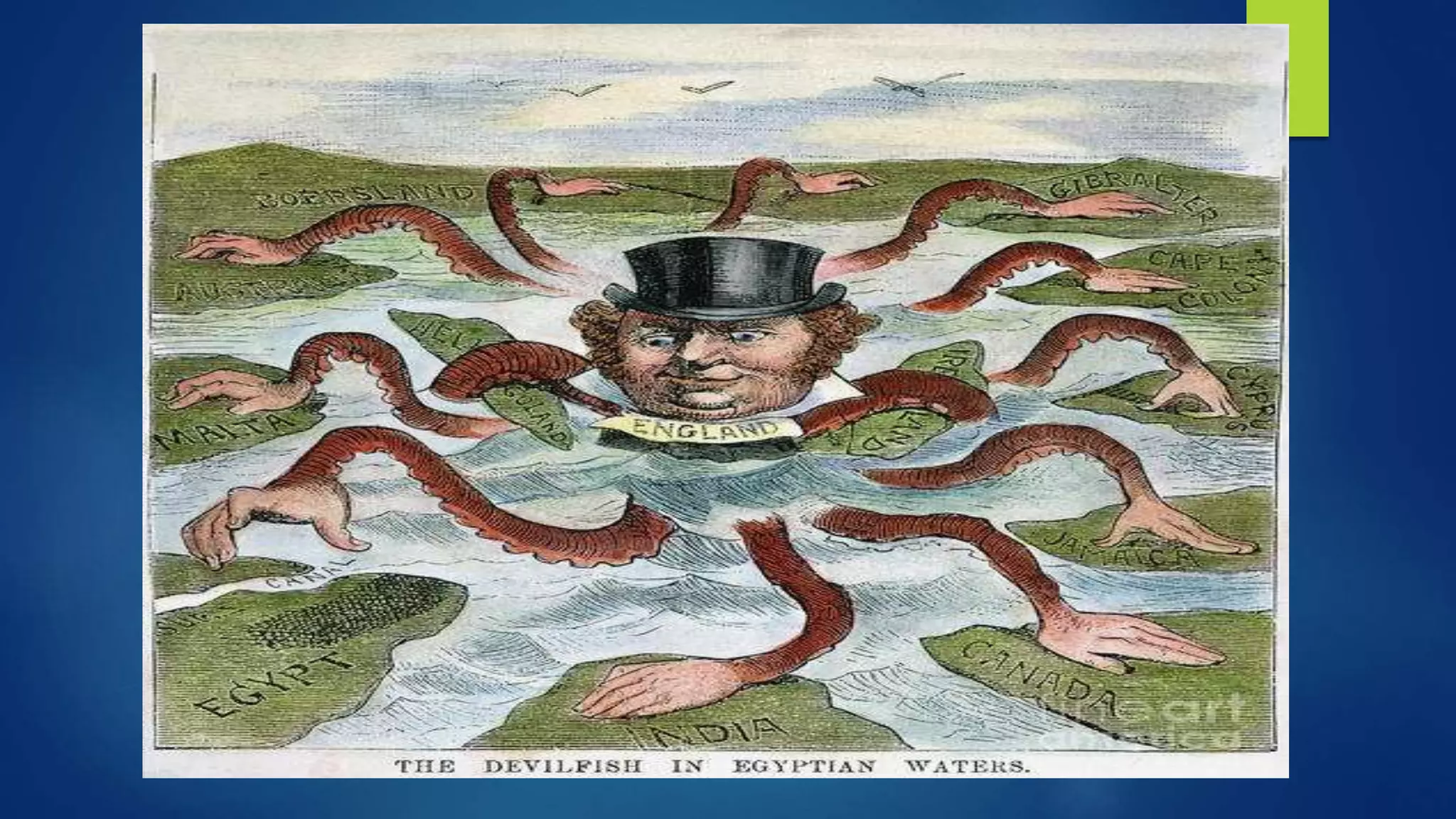
Thehistory of the British Raj refers to the period of British rule on the
Indian sub-continent between 1858 and 1947. The system of governance
was instituted in 1858 when the rule of the East India Company was
transferred to the Crown in the person of Queen Victoria (who in 1876 was
proclaimed Empress of India).
It lasted until 1947, when the British provinces of India were partitioned
into two sovereign dominion states: the Dominion of India and the
Dominion of Pakistan, leaving the princely states to choose between them.
Popular Resistances toColonial Rule
Battle of Buxar (1764): First campaign against British by Mir Qasim Ali. He
didn’t accept British as the ruler of the country.
The Faqir and Sanyasi Rebellions (1770–1820): The Bengal famine of 1770
led peasants whose lands were confiscated, displaced zamindars,
disbanded soldiers and poor to come together in a rebellion. They were
joined by the Sanyasis and Fakirs.
The Indigo Rebellion (1859-1862): The discontent of the farmers growing
indigo was mainly for three reasons: i) They were paid very low prices for
growing indigo; ii)Indigo was not lucrative as it was planted at the same
time as food crops; iii)And loss of fertility of the soil because of planting
indigo.
16.
Popular Resistances toColonial Rule
Farazi Movement (1838-1848): This was the first ever no-tax campaign
against the British led by Shariatullah Khan and Dadu Mian. Their band of
volunteers fought heroically with the armed group of Indigo planters and
zamindars. It brought together all the cultivators of Bengal against the
tyranny and illegal extractions by the landlords.
Sepoy Mutiny (1857): The Sepoy Mutiny was a violent and very bloody
uprising against British in India in 1857. Events of 1857 have been
considered the first outbreak of an independence movement against
British rule.
The Quit India Movement (1942): The Quit India Movement was a Civil
Disobedience movement launched by Gandhi for Satyagraha
(independence) which was accompanied by a mass protest on non-violent
lines.
17.
Some Other PopularResistances to
Colonial Rule
Anglo-mysore Wars (1799 )
Battle of Titumir (19 November 1831)
Wahabi Movement (1830-1860)
The Santhal Rebellion (1855-57
Garo Rebellion (1860-1870)
Munda Rebellion (1899-1900)
Non-Cooperation Movement (1920-1922)
The Civil Disobedience Movement(1930-1931)
Anglo-Maratha Battle
Because of……..
Participationof large number of people
Sometimes protestants gained temporary victory
Message of protestants to the oppressors
20.
Causes of thoseRebellions
Political Causes: The nature of colonial expansion became a major source of
discontent among the Indian rulers. British wanted to acquire and collect as
much wealth for England as they could. Their policy of annexation led to a
number of independent kingdoms being annexed to the British Empire. This
interference by the East India Company was disliked by many Indians.
Economic Causes: The British came to trade with India but soon decided to
exploit and impoverish the country. They tried to take away as much raw material
from here as they could. Britishers kept high posts and salaries for themselves.
They used political control to increase their trade. All means were used to drain
India of her wealth. Since they worked against the interests of Indian trade and
industry, Indian handicrafts completely collapsed.
21.
Causes of thoseRebellions
Social and Religious Causes: With an objective to convert people the
Christian missionaries opened schools and colleges. They also needed a
population which was educated and modern enough to buy their goods,
but not enough to prove detrimental to British interests. Religious
sentiments of the sepoys were hurt. Hindus were asked to remove their
caste marks and the Muslims were asked to trim their beards.
Discontent in the Army: Indian soldiers were not given posts above that of
subedars. Sometimes they were paid, but most of the time they were not.
When soldiers refused to cross the oceans and seas because their religion
forbade it, the British were ruthless on them.
22.
Consequences…..
Development ininfrastructure
Educational Development
Social reform
Modern Military
Development of Railway road
Textile Industry and Trade
Land Revenue Policy and Land Settlements
Commercialization of Agriculture
Rise of the New Money-lending Class
Transport and Communication
British Administration and Judicial System