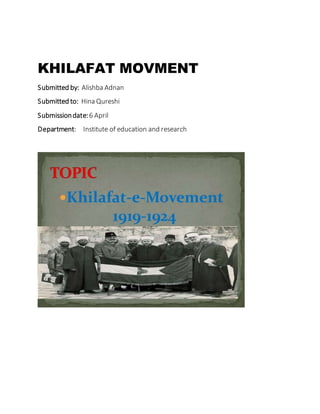
KHILAFAT MOVMENT
Submitted by: Alishba Adnan
Submitted to: Hina Qureshi
Submissiondate:6 April
Department: Institute of education and research
INTRODUCTION
The Khilafat movement, also known as the Indian Muslim Movement (1919-1924)
launched by the Muslims of India for the retention of the Ottoman Caliphate and
for not handing over the controlof Muslim holy places to non-Muslims.
BACKGROUND
Turkey sided with Germanyin world war. As it began to lose the war, concerns
were expressed in India about the futureof Turkey. It was a peak period from 1919
to 1922 casting demonstrations, boycottand other pressure by the two major
communities, the Hindusand the Muslims. Being brothers, the Indian Muslims
realized their religious duty to help the Muslims country. It was the extra territorial
attachments based on Islam. Another factor sameto the firstwas that the Indian
Muslims considered Ottoman Caliphate a symbol of unity of the Muslim world as
Ummah.
MUSLIM SENTIMENTS
Muslims had profound respectfor the Holyinstitution .Therefor, they demanded
protection of holy places in Turkey and on the condition that Turkey will not to be
deprived of its territories. British Governmentcould not fulfill both of these
promises.
REACTION OF NATION
Muslim leaders like Moulana AbdulKalam Azad, Moulana Muhammad AliJohar,
Moulana ShoukatAli and other reacted against British Governmentpolicy and
were put behind the bars.
AIMS OF KHILAFAT
Thus, Muslims organized a mass movement, which come to be known as Khilafat
Movement. The aims of this movement were:
 To protect the Holy place of Turkey.
 To restore the Territoriesof Turkey.
 To restore the Ottoman Empire.
 In December 1919, delegation wasprepared which was sent to England in
1920, under theleadership of Maulana Mohammad AliJohar to see the
British PrimeMinister and to explain the Indian pointof view regarding the
khilafat.
NON-COOPERATION MOVEMENT
 The visit to England was unsuccessful. Therefore, they decided to launch a
movement of Non-Cooperation.
 The congress extended its full support.
 The leader of two met at Amritsar and resolved to launch a countrywide
agitation under the leadership of Mr. Gandhi.
 The agitation was against the British Government
TARK-E-MAWALAT
The Jamiat Ul-Ulama hind issued a fatwa of Tark-e-Mawalat. Itincluded:
1. Renunciation of all Governmenttitles.
2. Boycott of legislature and court.
3. Withdrawalof students from educationalinstitutions.
4. Resignation from governmentposts.
5. Generalcivil disobedience.
MIGRATION TO AFGHANISTAN
 Under the hypnotism of Mr.Ghandhi, Muslim ulama had issued a verdict and
declared India as Dar-ul-Harab and theMuslims thereforeneeded to migrate
to some other country or Dar-ul-Salam.
 Thousandsof families sold out their propertiesand hastily for Afghanistan, in
August 1920.
As many as eighteen thousand people marched toward Afghanistan, which was
unable to bear the influx of the people. Thus, the Afghan authorities closed their
frontiers. Eventually the Muhajarinshad to return to their homes .A great number
of old man , woman and children died on their way during returning to homes and
those who luckily reach alive their former places. They found themselves homeless
and penniless.
CHAURA CHAURI INCICENT
 An incident of arson happened on February 1921, when a violent mob
set on fire a police choki at Chora Churiat district Gorakhpur, burning
twenty one constables to death.
 Gandhiused an excuse to call of the non – cooperation movement
which adversely affected the movement.
OUTCOMESOF NON
COOPERATIONMOVEMENT
 The khilafat movement come to an end when thousands of Indians
were put behind the bar.
 The leaders in spite of their best effortcould not maintain the Hindu-
Muslim unity
 Dueto Chaura Chauriincidentthe Ali brother and other Muslim
leader were arrested and Mr.Ghandhiputof the movement.
CONCLUSION
 The khilafat movement proved that Hindusand Muslim were two
differentnations.
 The khilafat movement created political consciousness among the
Indian Muslims for their independence.

Khilafat movement

  • 1.
    KHILAFAT MOVMENT Submitted by:Alishba Adnan Submitted to: Hina Qureshi Submissiondate:6 April Department: Institute of education and research
  • 2.
    INTRODUCTION The Khilafat movement,also known as the Indian Muslim Movement (1919-1924) launched by the Muslims of India for the retention of the Ottoman Caliphate and for not handing over the controlof Muslim holy places to non-Muslims. BACKGROUND Turkey sided with Germanyin world war. As it began to lose the war, concerns were expressed in India about the futureof Turkey. It was a peak period from 1919 to 1922 casting demonstrations, boycottand other pressure by the two major communities, the Hindusand the Muslims. Being brothers, the Indian Muslims realized their religious duty to help the Muslims country. It was the extra territorial attachments based on Islam. Another factor sameto the firstwas that the Indian Muslims considered Ottoman Caliphate a symbol of unity of the Muslim world as Ummah. MUSLIM SENTIMENTS Muslims had profound respectfor the Holyinstitution .Therefor, they demanded protection of holy places in Turkey and on the condition that Turkey will not to be deprived of its territories. British Governmentcould not fulfill both of these promises. REACTION OF NATION Muslim leaders like Moulana AbdulKalam Azad, Moulana Muhammad AliJohar, Moulana ShoukatAli and other reacted against British Governmentpolicy and were put behind the bars.
  • 3.
    AIMS OF KHILAFAT Thus,Muslims organized a mass movement, which come to be known as Khilafat Movement. The aims of this movement were:  To protect the Holy place of Turkey.  To restore the Territoriesof Turkey.  To restore the Ottoman Empire.  In December 1919, delegation wasprepared which was sent to England in 1920, under theleadership of Maulana Mohammad AliJohar to see the British PrimeMinister and to explain the Indian pointof view regarding the khilafat. NON-COOPERATION MOVEMENT  The visit to England was unsuccessful. Therefore, they decided to launch a movement of Non-Cooperation.  The congress extended its full support.  The leader of two met at Amritsar and resolved to launch a countrywide agitation under the leadership of Mr. Gandhi.  The agitation was against the British Government TARK-E-MAWALAT The Jamiat Ul-Ulama hind issued a fatwa of Tark-e-Mawalat. Itincluded: 1. Renunciation of all Governmenttitles. 2. Boycott of legislature and court. 3. Withdrawalof students from educationalinstitutions. 4. Resignation from governmentposts. 5. Generalcivil disobedience. MIGRATION TO AFGHANISTAN
  • 4.
     Under thehypnotism of Mr.Ghandhi, Muslim ulama had issued a verdict and declared India as Dar-ul-Harab and theMuslims thereforeneeded to migrate to some other country or Dar-ul-Salam.  Thousandsof families sold out their propertiesand hastily for Afghanistan, in August 1920. As many as eighteen thousand people marched toward Afghanistan, which was unable to bear the influx of the people. Thus, the Afghan authorities closed their frontiers. Eventually the Muhajarinshad to return to their homes .A great number of old man , woman and children died on their way during returning to homes and those who luckily reach alive their former places. They found themselves homeless and penniless. CHAURA CHAURI INCICENT  An incident of arson happened on February 1921, when a violent mob set on fire a police choki at Chora Churiat district Gorakhpur, burning twenty one constables to death.  Gandhiused an excuse to call of the non – cooperation movement which adversely affected the movement. OUTCOMESOF NON COOPERATIONMOVEMENT  The khilafat movement come to an end when thousands of Indians were put behind the bar.  The leaders in spite of their best effortcould not maintain the Hindu- Muslim unity  Dueto Chaura Chauriincidentthe Ali brother and other Muslim leader were arrested and Mr.Ghandhiputof the movement.
  • 5.
    CONCLUSION  The khilafatmovement proved that Hindusand Muslim were two differentnations.  The khilafat movement created political consciousness among the Indian Muslims for their independence.