Bayesian Decision Theory
Selim Aksoy
Department of Computer Engineering
Bilkent University
saksoy@cs.bilkent.edu.tr
CS 551, Fall 2018
CS 551, Fall 2018 c 2017, Selim Aksoy (Bilkent University) 1 / 46
Bayesian Decision Theory
Bayesian Decision Theory is a fundamental statistical
approach that quantifies the tradeoffs between various
decisions using probabilities and costs that accompany
such decisions.
First, we will assume that all probabilities are known.
Then, we will study the cases where the probabilistic
structure is not completely known.
CS 551, Fall 2018 c 2017, Selim Aksoy (Bilkent University) 2 / 46
Fish Sorting Example Revisited
State of nature is a random variable.
Define w as the type of fish we observe (state of nature,
class) where
w = w1 for sea bass,
w = w2 for salmon.
P(w1) is the a priori probability that the next fish is a sea
bass.
P(w2) is the a priori probability that the next fish is a salmon.
CS 551, Fall 2018 c 2017, Selim Aksoy (Bilkent University) 3 / 46
Prior Probabilities
Prior probabilities reflect our knowledge of how likely each
type of fish will appear before we actually see it.
How can we choose P(w1) and P(w2)?
Set P(w1) = P(w2) if they are equiprobable (uniform priors).
May use different values depending on the fishing area, time
of the year, etc.
Assume there are no other types of fish
P(w1) + P(w2) = 1
(exclusivity and exhaustivity).
CS 551, Fall 2018 c 2017, Selim Aksoy (Bilkent University) 4 / 46
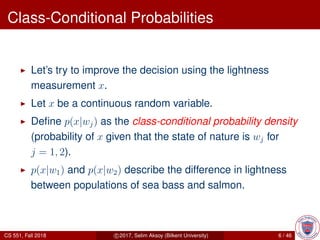
Making a Decision
How can we make a decision with only the prior
information?
Decide



w1 if P(w1) > P(w2)
w2 otherwise
What is the probability of error for this decision?
P(error) = min{P(w1), P(w2)}
CS 551, Fall 2018 c 2017, Selim Aksoy (Bilkent University) 5 / 46
Class-Conditional Probabilities
Let’s try to improve the decision using the lightness
measurement x.
Let x be a continuous random variable.
Define p(x|wj) as the class-conditional probability density
(probability of x given that the state of nature is wj for
j = 1, 2).
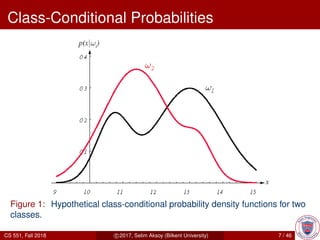
p(x|w1) and p(x|w2) describe the difference in lightness
between populations of sea bass and salmon.
CS 551, Fall 2018 c 2017, Selim Aksoy (Bilkent University) 6 / 46
Class-Conditional Probabilities
Figure 1: Hypothetical class-conditional probability density functions for two
classes.
CS 551, Fall 2018 c 2017, Selim Aksoy (Bilkent University) 7 / 46
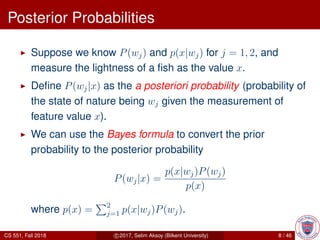
Posterior Probabilities
Suppose we know P(wj) and p(x|wj) for j = 1, 2, and
measure the lightness of a fish as the value x.
Define P(wj|x) as the a posteriori probability (probability of
the state of nature being wj given the measurement of
feature value x).
We can use the Bayes formula to convert the prior
probability to the posterior probability
P(wj|x) =
p(x|wj)P(wj)
p(x)
where p(x) = 2
j=1 p(x|wj)P(wj).
CS 551, Fall 2018 c 2017, Selim Aksoy (Bilkent University) 8 / 46
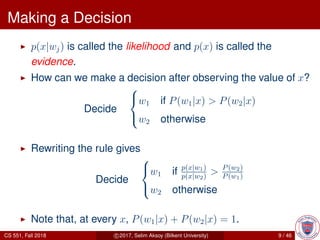
Making a Decision
p(x|wj) is called the likelihood and p(x) is called the
evidence.
How can we make a decision after observing the value of x?
Decide



w1 if P(w1|x) > P(w2|x)
w2 otherwise
Rewriting the rule gives
Decide



w1 if p(x|w1)
p(x|w2)
> P(w2)
P(w1)
w2 otherwise
Note that, at every x, P(w1|x) + P(w2|x) = 1.
CS 551, Fall 2018 c 2017, Selim Aksoy (Bilkent University) 9 / 46
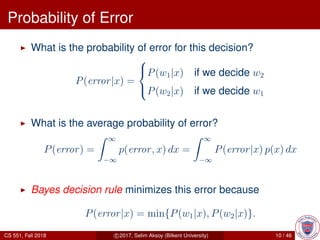
Probability of Error
What is the probability of error for this decision?
P(error|x) =



P(w1|x) if we decide w2
P(w2|x) if we decide w1
What is the average probability of error?
P(error) =
∞
−∞
p(error, x) dx =
∞
−∞
P(error|x) p(x) dx
Bayes decision rule minimizes this error because
P(error|x) = min{P(w1|x), P(w2|x)}.
CS 551, Fall 2018 c 2017, Selim Aksoy (Bilkent University) 10 / 46
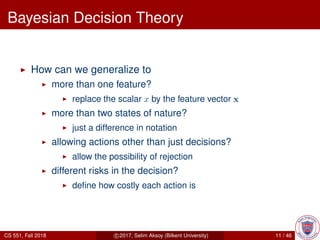
Bayesian Decision Theory
How can we generalize to
more than one feature?
replace the scalar x by the feature vector x
more than two states of nature?
just a difference in notation
allowing actions other than just decisions?
allow the possibility of rejection
different risks in the decision?
define how costly each action is
CS 551, Fall 2018 c 2017, Selim Aksoy (Bilkent University) 11 / 46
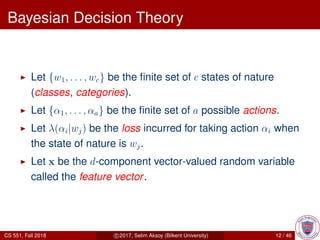
Bayesian Decision Theory
Let {w1, . . . , wc} be the finite set of c states of nature
(classes, categories).
Let {α1, . . . , αa} be the finite set of a possible actions.
Let λ(αi|wj) be the loss incurred for taking action αi when
the state of nature is wj.
Let x be the d-component vector-valued random variable
called the feature vector.
CS 551, Fall 2018 c 2017, Selim Aksoy (Bilkent University) 12 / 46
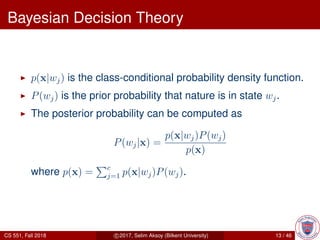
Bayesian Decision Theory
p(x|wj) is the class-conditional probability density function.
P(wj) is the prior probability that nature is in state wj.
The posterior probability can be computed as
P(wj|x) =
p(x|wj)P(wj)
p(x)
where p(x) = c
j=1 p(x|wj)P(wj).
CS 551, Fall 2018 c 2017, Selim Aksoy (Bilkent University) 13 / 46
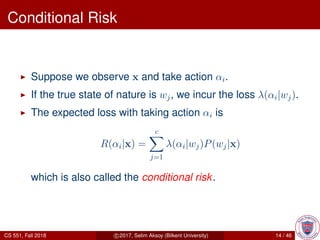
Conditional Risk
Suppose we observe x and take action αi.
If the true state of nature is wj, we incur the loss λ(αi|wj).
The expected loss with taking action αi is
R(αi|x) =
c
j=1
λ(αi|wj)P(wj|x)
which is also called the conditional risk.
CS 551, Fall 2018 c 2017, Selim Aksoy (Bilkent University) 14 / 46
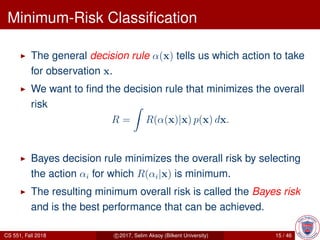
Minimum-Risk Classification
The general decision rule α(x) tells us which action to take
for observation x.
We want to find the decision rule that minimizes the overall
risk
R = R(α(x)|x) p(x) dx.
Bayes decision rule minimizes the overall risk by selecting
the action αi for which R(αi|x) is minimum.
The resulting minimum overall risk is called the Bayes risk
and is the best performance that can be achieved.
CS 551, Fall 2018 c 2017, Selim Aksoy (Bilkent University) 15 / 46
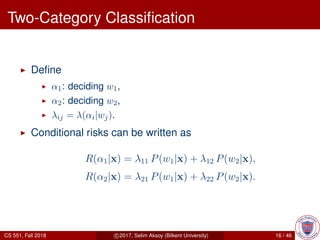
Two-Category Classification
Define
α1: deciding w1,
α2: deciding w2,
λij = λ(αi|wj).
Conditional risks can be written as
R(α1|x) = λ11 P(w1|x) + λ12 P(w2|x),
R(α2|x) = λ21 P(w1|x) + λ22 P(w2|x).
CS 551, Fall 2018 c 2017, Selim Aksoy (Bilkent University) 16 / 46
Two-Category Classification
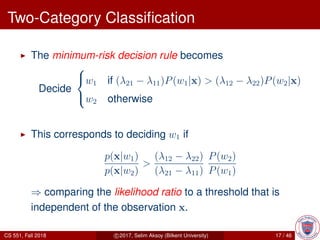
The minimum-risk decision rule becomes
Decide



w1 if (λ21 − λ11)P(w1|x) > (λ12 − λ22)P(w2|x)
w2 otherwise
This corresponds to deciding w1 if
p(x|w1)
p(x|w2)
>
(λ12 − λ22)
(λ21 − λ11)
P(w2)
P(w1)
⇒ comparing the likelihood ratio to a threshold that is
independent of the observation x.
CS 551, Fall 2018 c 2017, Selim Aksoy (Bilkent University) 17 / 46
Minimum-Error-Rate Classification
Actions are decisions on classes (αi is deciding wi).
If action αi is taken and the true state of nature is wj, then
the decision is correct if i = j and in error if i = j.
We want to find a decision rule that minimizes the
probability of error.
CS 551, Fall 2018 c 2017, Selim Aksoy (Bilkent University) 18 / 46
Minimum-Error-Rate Classification
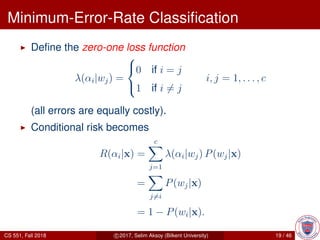
Define the zero-one loss function
λ(αi|wj) =



0 if i = j
1 if i = j
i, j = 1, . . . , c
(all errors are equally costly).
Conditional risk becomes
R(αi|x) =
c
j=1
λ(αi|wj) P(wj|x)
=
j=i
P(wj|x)
= 1 − P(wi|x).
CS 551, Fall 2018 c 2017, Selim Aksoy (Bilkent University) 19 / 46
Minimum-Error-Rate Classification
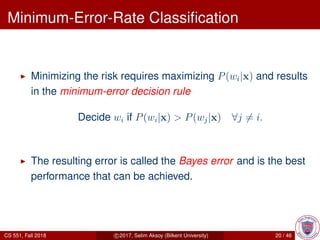
Minimizing the risk requires maximizing P(wi|x) and results
in the minimum-error decision rule
Decide wi if P(wi|x) > P(wj|x) ∀j = i.
The resulting error is called the Bayes error and is the best
performance that can be achieved.
CS 551, Fall 2018 c 2017, Selim Aksoy (Bilkent University) 20 / 46
Minimum-Error-Rate Classification
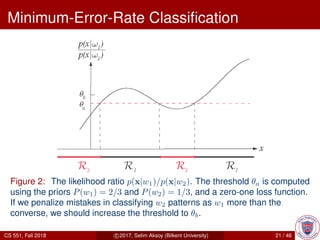
Figure 2: The likelihood ratio p(x|w1)/p(x|w2). The threshold θa is computed
using the priors P(w1) = 2/3 and P(w2) = 1/3, and a zero-one loss function.
If we penalize mistakes in classifying w2 patterns as w1 more than the
converse, we should increase the threshold to θb.
CS 551, Fall 2018 c 2017, Selim Aksoy (Bilkent University) 21 / 46
Discriminant Functions
A useful way of representing classifiers is through
discriminant functions gi(x), i = 1, . . . , c, where the classifier
assigns a feature vector x to class wi if
gi(x) > gj(x) ∀j = i.
For the classifier that minimizes conditional risk
gi(x) = −R(αi|x).
For the classifier that minimizes error
gi(x) = P(wi|x).
CS 551, Fall 2018 c 2017, Selim Aksoy (Bilkent University) 22 / 46
Discriminant Functions
These functions divide the feature space into c decision
regions (R1, . . . , Rc), separated by decision boundaries.
Note that the results do not change even if we replace every
gi(x) by f(gi(x)) where f(·) is a monotonically increasing
function (e.g., logarithm).
This may lead to significant analytical and computational
simplifications.
CS 551, Fall 2018 c 2017, Selim Aksoy (Bilkent University) 23 / 46
The Gaussian Density
Gaussian can be considered as a model where the feature
vectors for a given class are continuous-valued, randomly
corrupted versions of a single typical or prototype vector.
Some properties of the Gaussian:
Analytically tractable.
Completely specified by the 1st and 2nd moments.
Has the maximum entropy of all distributions with a given
mean and variance.
Many processes are asymptotically Gaussian (Central Limit
Theorem).
Linear transformations of a Gaussian are also Gaussian.
Uncorrelatedness implies independence.
CS 551, Fall 2018 c 2017, Selim Aksoy (Bilkent University) 24 / 46
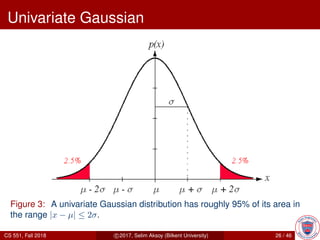
Univariate Gaussian
For x ∈ R:
p(x) = N(µ, σ2
)
=
1
√
2πσ
exp −
1
2
x − µ
σ
2
where
µ = E[x] =
∞
−∞
x p(x) dx,
σ2
= E[(x − µ)2
] =
∞
−∞
(x − µ)2
p(x) dx.
CS 551, Fall 2018 c 2017, Selim Aksoy (Bilkent University) 25 / 46
Univariate Gaussian
Figure 3: A univariate Gaussian distribution has roughly 95% of its area in
the range |x − µ| ≤ 2σ.
CS 551, Fall 2018 c 2017, Selim Aksoy (Bilkent University) 26 / 46
Multivariate Gaussian
For x ∈ Rd
:
p(x) = N(µ, Σ)
=
1
(2π)d/2|Σ|1/2
exp −
1
2
(x − µ)T
Σ−1
(x − µ)
where
µ = E[x] = x p(x) dx,
Σ = E[(x − µ)(x − µ)T
] = (x − µ)(x − µ)T
p(x) dx.
CS 551, Fall 2018 c 2017, Selim Aksoy (Bilkent University) 27 / 46
Multivariate Gaussian
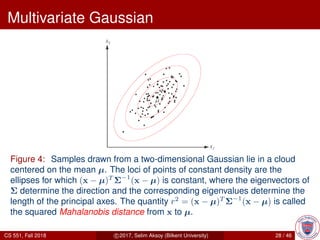
Figure 4: Samples drawn from a two-dimensional Gaussian lie in a cloud
centered on the mean µ. The loci of points of constant density are the
ellipses for which (x − µ)T
Σ−1
(x − µ) is constant, where the eigenvectors of
Σ determine the direction and the corresponding eigenvalues determine the
length of the principal axes. The quantity r2
= (x − µ)T
Σ−1
(x − µ) is called
the squared Mahalanobis distance from x to µ.
CS 551, Fall 2018 c 2017, Selim Aksoy (Bilkent University) 28 / 46
Linear Transformations
Recall that, given x ∈ Rd
, A ∈ Rd×k
, y = AT
x ∈ Rk
,
if x ∼ N(µ, Σ), then y ∼ N(AT
µ, AT
ΣA).
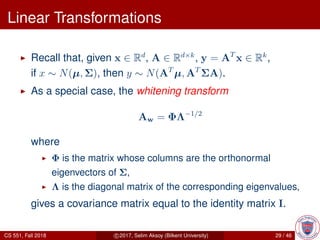
As a special case, the whitening transform
Aw = ΦΛ−1/2
where
Φ is the matrix whose columns are the orthonormal
eigenvectors of Σ,
Λ is the diagonal matrix of the corresponding eigenvalues,
gives a covariance matrix equal to the identity matrix I.
CS 551, Fall 2018 c 2017, Selim Aksoy (Bilkent University) 29 / 46
Discriminant Functions for the Gaussian
Density
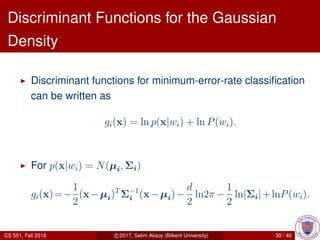
Discriminant functions for minimum-error-rate classification
can be written as
gi(x) = ln p(x|wi) + ln P(wi).
For p(x|wi) = N(µi, Σi)
gi(x)=−
1
2
(x−µi)T
Σ−1
i (x−µi)−
d
2
ln2π −
1
2
ln|Σi|+lnP(wi).
CS 551, Fall 2018 c 2017, Selim Aksoy (Bilkent University) 30 / 46
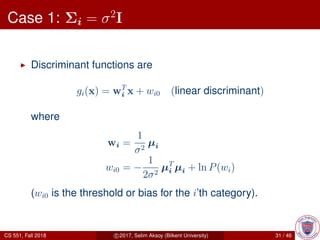
Case 1: Σi = σ2
I
Discriminant functions are
gi(x) = wT
i x + wi0 (linear discriminant)
where
wi =
1
σ2
µi
wi0 = −
1
2σ2
µT
i µi + ln P(wi)
(wi0 is the threshold or bias for the i’th category).
CS 551, Fall 2018 c 2017, Selim Aksoy (Bilkent University) 31 / 46
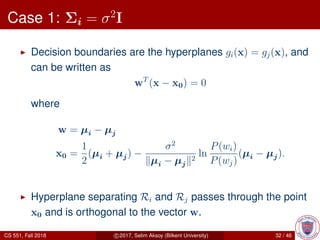
Case 1: Σi = σ2
I
Decision boundaries are the hyperplanes gi(x) = gj(x), and
can be written as
wT
(x − x0) = 0
where
w = µi − µj
x0 =
1
2
(µi + µj) −
σ2
µi − µj
2
ln
P(wi)
P(wj)
(µi − µj).
Hyperplane separating Ri and Rj passes through the point
x0 and is orthogonal to the vector w.
CS 551, Fall 2018 c 2017, Selim Aksoy (Bilkent University) 32 / 46
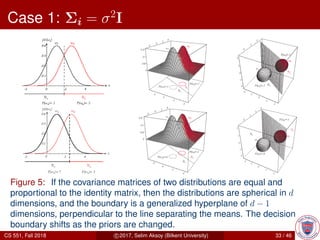
Case 1: Σi = σ2
I
Figure 5: If the covariance matrices of two distributions are equal and
proportional to the identity matrix, then the distributions are spherical in d
dimensions, and the boundary is a generalized hyperplane of d − 1
dimensions, perpendicular to the line separating the means. The decision
boundary shifts as the priors are changed.
CS 551, Fall 2018 c 2017, Selim Aksoy (Bilkent University) 33 / 46
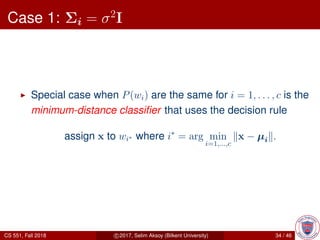
Case 1: Σi = σ2
I
Special case when P(wi) are the same for i = 1, . . . , c is the
minimum-distance classifier that uses the decision rule
assign x to wi∗ where i∗
= arg min
i=1,...,c
x − µi .
CS 551, Fall 2018 c 2017, Selim Aksoy (Bilkent University) 34 / 46
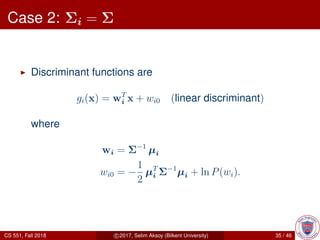
Case 2: Σi = Σ
Discriminant functions are
gi(x) = wT
i x + wi0 (linear discriminant)
where
wi = Σ−1
µi
wi0 = −
1
2
µT
i Σ−1
µi + ln P(wi).
CS 551, Fall 2018 c 2017, Selim Aksoy (Bilkent University) 35 / 46
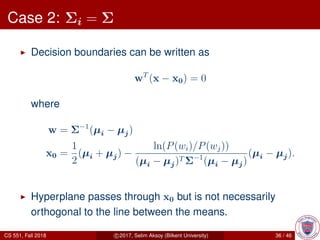
Case 2: Σi = Σ
Decision boundaries can be written as
wT
(x − x0) = 0
where
w = Σ−1
(µi − µj)
x0 =
1
2
(µi + µj) −
ln(P(wi)/P(wj))
(µi − µj)T Σ−1
(µi − µj)
(µi − µj).
Hyperplane passes through x0 but is not necessarily
orthogonal to the line between the means.
CS 551, Fall 2018 c 2017, Selim Aksoy (Bilkent University) 36 / 46
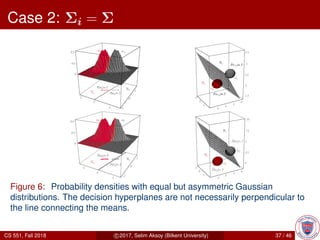
Case 2: Σi = Σ
Figure 6: Probability densities with equal but asymmetric Gaussian
distributions. The decision hyperplanes are not necessarily perpendicular to
the line connecting the means.
CS 551, Fall 2018 c 2017, Selim Aksoy (Bilkent University) 37 / 46
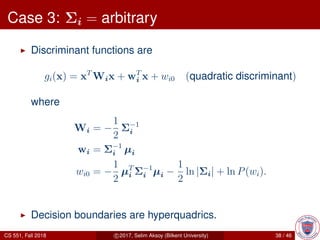
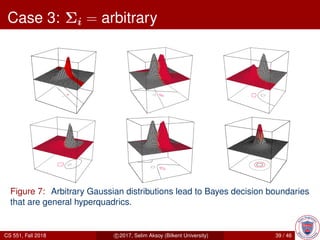
Case 3: Σi = arbitrary
Discriminant functions are
gi(x) = xT
Wix + wT
i x + wi0 (quadratic discriminant)
where
Wi = −
1
2
Σ−1
i
wi = Σ−1
i µi
wi0 = −
1
2
µT
i Σ−1
i µi −
1
2
ln |Σi| + ln P(wi).
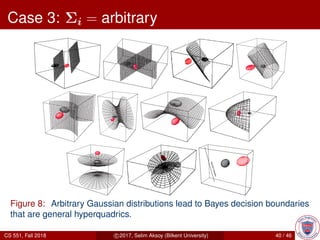
Decision boundaries are hyperquadrics.
CS 551, Fall 2018 c 2017, Selim Aksoy (Bilkent University) 38 / 46
Case 3: Σi = arbitrary
Figure 7: Arbitrary Gaussian distributions lead to Bayes decision boundaries
that are general hyperquadrics.
CS 551, Fall 2018 c 2017, Selim Aksoy (Bilkent University) 39 / 46
Case 3: Σi = arbitrary
Figure 8: Arbitrary Gaussian distributions lead to Bayes decision boundaries
that are general hyperquadrics.
CS 551, Fall 2018 c 2017, Selim Aksoy (Bilkent University) 40 / 46
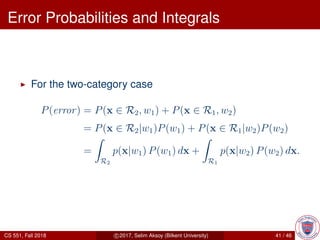
Error Probabilities and Integrals
For the two-category case
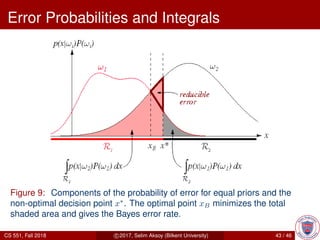
P(error) = P(x ∈ R2, w1) + P(x ∈ R1, w2)
= P(x ∈ R2|w1)P(w1) + P(x ∈ R1|w2)P(w2)
=
R2
p(x|w1) P(w1) dx +
R1
p(x|w2) P(w2) dx.
CS 551, Fall 2018 c 2017, Selim Aksoy (Bilkent University) 41 / 46
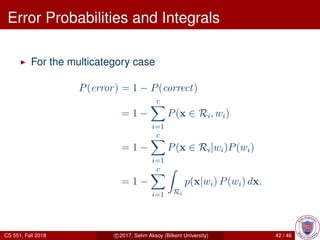
Error Probabilities and Integrals
For the multicategory case
P(error) = 1 − P(correct)
= 1 −
c
i=1
P(x ∈ Ri, wi)
= 1 −
c
i=1
P(x ∈ Ri|wi)P(wi)
= 1 −
c
i=1 Ri
p(x|wi) P(wi) dx.
CS 551, Fall 2018 c 2017, Selim Aksoy (Bilkent University) 42 / 46
Error Probabilities and Integrals
Figure 9: Components of the probability of error for equal priors and the
non-optimal decision point x∗
. The optimal point xB minimizes the total
shaded area and gives the Bayes error rate.
CS 551, Fall 2018 c 2017, Selim Aksoy (Bilkent University) 43 / 46
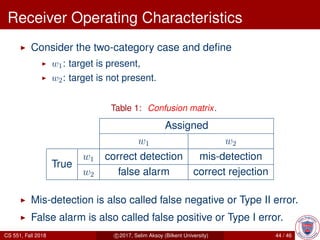
Receiver Operating Characteristics
Consider the two-category case and define
w1: target is present,
w2: target is not present.
Table 1: Confusion matrix.
Assigned
w1 w2
True
w1 correct detection mis-detection
w2 false alarm correct rejection
Mis-detection is also called false negative or Type II error.
False alarm is also called false positive or Type I error.
CS 551, Fall 2018 c 2017, Selim Aksoy (Bilkent University) 44 / 46
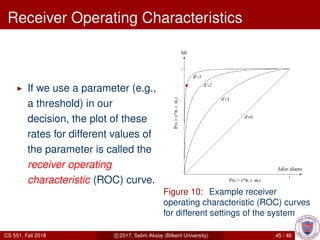
Receiver Operating Characteristics
If we use a parameter (e.g.,
a threshold) in our
decision, the plot of these
rates for different values of
the parameter is called the
receiver operating
characteristic (ROC) curve.
Figure 10: Example receiver
operating characteristic (ROC) curves
for different settings of the system.
CS 551, Fall 2018 c 2017, Selim Aksoy (Bilkent University) 45 / 46
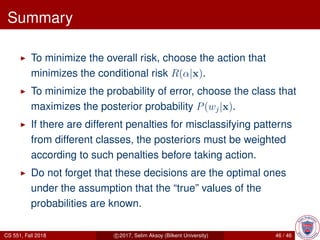
Summary
To minimize the overall risk, choose the action that
minimizes the conditional risk R(α|x).
To minimize the probability of error, choose the class that
maximizes the posterior probability P(wj|x).
If there are different penalties for misclassifying patterns
from different classes, the posteriors must be weighted
according to such penalties before taking action.
Do not forget that these decisions are the optimal ones
under the assumption that the “true” values of the
probabilities are known.
CS 551, Fall 2018 c 2017, Selim Aksoy (Bilkent University) 46 / 46

Pattern baysin

  • 1.
    Bayesian Decision Theory SelimAksoy Department of Computer Engineering Bilkent University saksoy@cs.bilkent.edu.tr CS 551, Fall 2018 CS 551, Fall 2018 c 2017, Selim Aksoy (Bilkent University) 1 / 46
  • 2.
    Bayesian Decision Theory BayesianDecision Theory is a fundamental statistical approach that quantifies the tradeoffs between various decisions using probabilities and costs that accompany such decisions. First, we will assume that all probabilities are known. Then, we will study the cases where the probabilistic structure is not completely known. CS 551, Fall 2018 c 2017, Selim Aksoy (Bilkent University) 2 / 46
  • 3.
    Fish Sorting ExampleRevisited State of nature is a random variable. Define w as the type of fish we observe (state of nature, class) where w = w1 for sea bass, w = w2 for salmon. P(w1) is the a priori probability that the next fish is a sea bass. P(w2) is the a priori probability that the next fish is a salmon. CS 551, Fall 2018 c 2017, Selim Aksoy (Bilkent University) 3 / 46
  • 4.
    Prior Probabilities Prior probabilitiesreflect our knowledge of how likely each type of fish will appear before we actually see it. How can we choose P(w1) and P(w2)? Set P(w1) = P(w2) if they are equiprobable (uniform priors). May use different values depending on the fishing area, time of the year, etc. Assume there are no other types of fish P(w1) + P(w2) = 1 (exclusivity and exhaustivity). CS 551, Fall 2018 c 2017, Selim Aksoy (Bilkent University) 4 / 46
  • 5.
    Making a Decision Howcan we make a decision with only the prior information? Decide    w1 if P(w1) > P(w2) w2 otherwise What is the probability of error for this decision? P(error) = min{P(w1), P(w2)} CS 551, Fall 2018 c 2017, Selim Aksoy (Bilkent University) 5 / 46
  • 6.
    Class-Conditional Probabilities Let’s tryto improve the decision using the lightness measurement x. Let x be a continuous random variable. Define p(x|wj) as the class-conditional probability density (probability of x given that the state of nature is wj for j = 1, 2). p(x|w1) and p(x|w2) describe the difference in lightness between populations of sea bass and salmon. CS 551, Fall 2018 c 2017, Selim Aksoy (Bilkent University) 6 / 46
  • 7.
    Class-Conditional Probabilities Figure 1:Hypothetical class-conditional probability density functions for two classes. CS 551, Fall 2018 c 2017, Selim Aksoy (Bilkent University) 7 / 46
  • 8.
    Posterior Probabilities Suppose weknow P(wj) and p(x|wj) for j = 1, 2, and measure the lightness of a fish as the value x. Define P(wj|x) as the a posteriori probability (probability of the state of nature being wj given the measurement of feature value x). We can use the Bayes formula to convert the prior probability to the posterior probability P(wj|x) = p(x|wj)P(wj) p(x) where p(x) = 2 j=1 p(x|wj)P(wj). CS 551, Fall 2018 c 2017, Selim Aksoy (Bilkent University) 8 / 46
  • 9.
    Making a Decision p(x|wj)is called the likelihood and p(x) is called the evidence. How can we make a decision after observing the value of x? Decide    w1 if P(w1|x) > P(w2|x) w2 otherwise Rewriting the rule gives Decide    w1 if p(x|w1) p(x|w2) > P(w2) P(w1) w2 otherwise Note that, at every x, P(w1|x) + P(w2|x) = 1. CS 551, Fall 2018 c 2017, Selim Aksoy (Bilkent University) 9 / 46
  • 10.
    Probability of Error Whatis the probability of error for this decision? P(error|x) =    P(w1|x) if we decide w2 P(w2|x) if we decide w1 What is the average probability of error? P(error) = ∞ −∞ p(error, x) dx = ∞ −∞ P(error|x) p(x) dx Bayes decision rule minimizes this error because P(error|x) = min{P(w1|x), P(w2|x)}. CS 551, Fall 2018 c 2017, Selim Aksoy (Bilkent University) 10 / 46
  • 11.
    Bayesian Decision Theory Howcan we generalize to more than one feature? replace the scalar x by the feature vector x more than two states of nature? just a difference in notation allowing actions other than just decisions? allow the possibility of rejection different risks in the decision? define how costly each action is CS 551, Fall 2018 c 2017, Selim Aksoy (Bilkent University) 11 / 46
  • 12.
    Bayesian Decision Theory Let{w1, . . . , wc} be the finite set of c states of nature (classes, categories). Let {α1, . . . , αa} be the finite set of a possible actions. Let λ(αi|wj) be the loss incurred for taking action αi when the state of nature is wj. Let x be the d-component vector-valued random variable called the feature vector. CS 551, Fall 2018 c 2017, Selim Aksoy (Bilkent University) 12 / 46
  • 13.
    Bayesian Decision Theory p(x|wj)is the class-conditional probability density function. P(wj) is the prior probability that nature is in state wj. The posterior probability can be computed as P(wj|x) = p(x|wj)P(wj) p(x) where p(x) = c j=1 p(x|wj)P(wj). CS 551, Fall 2018 c 2017, Selim Aksoy (Bilkent University) 13 / 46
  • 14.
    Conditional Risk Suppose weobserve x and take action αi. If the true state of nature is wj, we incur the loss λ(αi|wj). The expected loss with taking action αi is R(αi|x) = c j=1 λ(αi|wj)P(wj|x) which is also called the conditional risk. CS 551, Fall 2018 c 2017, Selim Aksoy (Bilkent University) 14 / 46
  • 15.
    Minimum-Risk Classification The generaldecision rule α(x) tells us which action to take for observation x. We want to find the decision rule that minimizes the overall risk R = R(α(x)|x) p(x) dx. Bayes decision rule minimizes the overall risk by selecting the action αi for which R(αi|x) is minimum. The resulting minimum overall risk is called the Bayes risk and is the best performance that can be achieved. CS 551, Fall 2018 c 2017, Selim Aksoy (Bilkent University) 15 / 46
  • 16.
    Two-Category Classification Define α1: decidingw1, α2: deciding w2, λij = λ(αi|wj). Conditional risks can be written as R(α1|x) = λ11 P(w1|x) + λ12 P(w2|x), R(α2|x) = λ21 P(w1|x) + λ22 P(w2|x). CS 551, Fall 2018 c 2017, Selim Aksoy (Bilkent University) 16 / 46
  • 17.
    Two-Category Classification The minimum-riskdecision rule becomes Decide    w1 if (λ21 − λ11)P(w1|x) > (λ12 − λ22)P(w2|x) w2 otherwise This corresponds to deciding w1 if p(x|w1) p(x|w2) > (λ12 − λ22) (λ21 − λ11) P(w2) P(w1) ⇒ comparing the likelihood ratio to a threshold that is independent of the observation x. CS 551, Fall 2018 c 2017, Selim Aksoy (Bilkent University) 17 / 46
  • 18.
    Minimum-Error-Rate Classification Actions aredecisions on classes (αi is deciding wi). If action αi is taken and the true state of nature is wj, then the decision is correct if i = j and in error if i = j. We want to find a decision rule that minimizes the probability of error. CS 551, Fall 2018 c 2017, Selim Aksoy (Bilkent University) 18 / 46
  • 19.
    Minimum-Error-Rate Classification Define thezero-one loss function λ(αi|wj) =    0 if i = j 1 if i = j i, j = 1, . . . , c (all errors are equally costly). Conditional risk becomes R(αi|x) = c j=1 λ(αi|wj) P(wj|x) = j=i P(wj|x) = 1 − P(wi|x). CS 551, Fall 2018 c 2017, Selim Aksoy (Bilkent University) 19 / 46
  • 20.
    Minimum-Error-Rate Classification Minimizing therisk requires maximizing P(wi|x) and results in the minimum-error decision rule Decide wi if P(wi|x) > P(wj|x) ∀j = i. The resulting error is called the Bayes error and is the best performance that can be achieved. CS 551, Fall 2018 c 2017, Selim Aksoy (Bilkent University) 20 / 46
  • 21.
    Minimum-Error-Rate Classification Figure 2:The likelihood ratio p(x|w1)/p(x|w2). The threshold θa is computed using the priors P(w1) = 2/3 and P(w2) = 1/3, and a zero-one loss function. If we penalize mistakes in classifying w2 patterns as w1 more than the converse, we should increase the threshold to θb. CS 551, Fall 2018 c 2017, Selim Aksoy (Bilkent University) 21 / 46
  • 22.
    Discriminant Functions A usefulway of representing classifiers is through discriminant functions gi(x), i = 1, . . . , c, where the classifier assigns a feature vector x to class wi if gi(x) > gj(x) ∀j = i. For the classifier that minimizes conditional risk gi(x) = −R(αi|x). For the classifier that minimizes error gi(x) = P(wi|x). CS 551, Fall 2018 c 2017, Selim Aksoy (Bilkent University) 22 / 46
  • 23.
    Discriminant Functions These functionsdivide the feature space into c decision regions (R1, . . . , Rc), separated by decision boundaries. Note that the results do not change even if we replace every gi(x) by f(gi(x)) where f(·) is a monotonically increasing function (e.g., logarithm). This may lead to significant analytical and computational simplifications. CS 551, Fall 2018 c 2017, Selim Aksoy (Bilkent University) 23 / 46
  • 24.
    The Gaussian Density Gaussiancan be considered as a model where the feature vectors for a given class are continuous-valued, randomly corrupted versions of a single typical or prototype vector. Some properties of the Gaussian: Analytically tractable. Completely specified by the 1st and 2nd moments. Has the maximum entropy of all distributions with a given mean and variance. Many processes are asymptotically Gaussian (Central Limit Theorem). Linear transformations of a Gaussian are also Gaussian. Uncorrelatedness implies independence. CS 551, Fall 2018 c 2017, Selim Aksoy (Bilkent University) 24 / 46
  • 25.
    Univariate Gaussian For x∈ R: p(x) = N(µ, σ2 ) = 1 √ 2πσ exp − 1 2 x − µ σ 2 where µ = E[x] = ∞ −∞ x p(x) dx, σ2 = E[(x − µ)2 ] = ∞ −∞ (x − µ)2 p(x) dx. CS 551, Fall 2018 c 2017, Selim Aksoy (Bilkent University) 25 / 46
  • 26.
    Univariate Gaussian Figure 3:A univariate Gaussian distribution has roughly 95% of its area in the range |x − µ| ≤ 2σ. CS 551, Fall 2018 c 2017, Selim Aksoy (Bilkent University) 26 / 46
  • 27.
    Multivariate Gaussian For x∈ Rd : p(x) = N(µ, Σ) = 1 (2π)d/2|Σ|1/2 exp − 1 2 (x − µ)T Σ−1 (x − µ) where µ = E[x] = x p(x) dx, Σ = E[(x − µ)(x − µ)T ] = (x − µ)(x − µ)T p(x) dx. CS 551, Fall 2018 c 2017, Selim Aksoy (Bilkent University) 27 / 46
  • 28.
    Multivariate Gaussian Figure 4:Samples drawn from a two-dimensional Gaussian lie in a cloud centered on the mean µ. The loci of points of constant density are the ellipses for which (x − µ)T Σ−1 (x − µ) is constant, where the eigenvectors of Σ determine the direction and the corresponding eigenvalues determine the length of the principal axes. The quantity r2 = (x − µ)T Σ−1 (x − µ) is called the squared Mahalanobis distance from x to µ. CS 551, Fall 2018 c 2017, Selim Aksoy (Bilkent University) 28 / 46
  • 29.
    Linear Transformations Recall that,given x ∈ Rd , A ∈ Rd×k , y = AT x ∈ Rk , if x ∼ N(µ, Σ), then y ∼ N(AT µ, AT ΣA). As a special case, the whitening transform Aw = ΦΛ−1/2 where Φ is the matrix whose columns are the orthonormal eigenvectors of Σ, Λ is the diagonal matrix of the corresponding eigenvalues, gives a covariance matrix equal to the identity matrix I. CS 551, Fall 2018 c 2017, Selim Aksoy (Bilkent University) 29 / 46
  • 30.
    Discriminant Functions forthe Gaussian Density Discriminant functions for minimum-error-rate classification can be written as gi(x) = ln p(x|wi) + ln P(wi). For p(x|wi) = N(µi, Σi) gi(x)=− 1 2 (x−µi)T Σ−1 i (x−µi)− d 2 ln2π − 1 2 ln|Σi|+lnP(wi). CS 551, Fall 2018 c 2017, Selim Aksoy (Bilkent University) 30 / 46
  • 31.
    Case 1: Σi= σ2 I Discriminant functions are gi(x) = wT i x + wi0 (linear discriminant) where wi = 1 σ2 µi wi0 = − 1 2σ2 µT i µi + ln P(wi) (wi0 is the threshold or bias for the i’th category). CS 551, Fall 2018 c 2017, Selim Aksoy (Bilkent University) 31 / 46
  • 32.
    Case 1: Σi= σ2 I Decision boundaries are the hyperplanes gi(x) = gj(x), and can be written as wT (x − x0) = 0 where w = µi − µj x0 = 1 2 (µi + µj) − σ2 µi − µj 2 ln P(wi) P(wj) (µi − µj). Hyperplane separating Ri and Rj passes through the point x0 and is orthogonal to the vector w. CS 551, Fall 2018 c 2017, Selim Aksoy (Bilkent University) 32 / 46
  • 33.
    Case 1: Σi= σ2 I Figure 5: If the covariance matrices of two distributions are equal and proportional to the identity matrix, then the distributions are spherical in d dimensions, and the boundary is a generalized hyperplane of d − 1 dimensions, perpendicular to the line separating the means. The decision boundary shifts as the priors are changed. CS 551, Fall 2018 c 2017, Selim Aksoy (Bilkent University) 33 / 46
  • 34.
    Case 1: Σi= σ2 I Special case when P(wi) are the same for i = 1, . . . , c is the minimum-distance classifier that uses the decision rule assign x to wi∗ where i∗ = arg min i=1,...,c x − µi . CS 551, Fall 2018 c 2017, Selim Aksoy (Bilkent University) 34 / 46
  • 35.
    Case 2: Σi= Σ Discriminant functions are gi(x) = wT i x + wi0 (linear discriminant) where wi = Σ−1 µi wi0 = − 1 2 µT i Σ−1 µi + ln P(wi). CS 551, Fall 2018 c 2017, Selim Aksoy (Bilkent University) 35 / 46
  • 36.
    Case 2: Σi= Σ Decision boundaries can be written as wT (x − x0) = 0 where w = Σ−1 (µi − µj) x0 = 1 2 (µi + µj) − ln(P(wi)/P(wj)) (µi − µj)T Σ−1 (µi − µj) (µi − µj). Hyperplane passes through x0 but is not necessarily orthogonal to the line between the means. CS 551, Fall 2018 c 2017, Selim Aksoy (Bilkent University) 36 / 46
  • 37.
    Case 2: Σi= Σ Figure 6: Probability densities with equal but asymmetric Gaussian distributions. The decision hyperplanes are not necessarily perpendicular to the line connecting the means. CS 551, Fall 2018 c 2017, Selim Aksoy (Bilkent University) 37 / 46
  • 38.
    Case 3: Σi= arbitrary Discriminant functions are gi(x) = xT Wix + wT i x + wi0 (quadratic discriminant) where Wi = − 1 2 Σ−1 i wi = Σ−1 i µi wi0 = − 1 2 µT i Σ−1 i µi − 1 2 ln |Σi| + ln P(wi). Decision boundaries are hyperquadrics. CS 551, Fall 2018 c 2017, Selim Aksoy (Bilkent University) 38 / 46
  • 39.
    Case 3: Σi= arbitrary Figure 7: Arbitrary Gaussian distributions lead to Bayes decision boundaries that are general hyperquadrics. CS 551, Fall 2018 c 2017, Selim Aksoy (Bilkent University) 39 / 46
  • 40.
    Case 3: Σi= arbitrary Figure 8: Arbitrary Gaussian distributions lead to Bayes decision boundaries that are general hyperquadrics. CS 551, Fall 2018 c 2017, Selim Aksoy (Bilkent University) 40 / 46
  • 41.
    Error Probabilities andIntegrals For the two-category case P(error) = P(x ∈ R2, w1) + P(x ∈ R1, w2) = P(x ∈ R2|w1)P(w1) + P(x ∈ R1|w2)P(w2) = R2 p(x|w1) P(w1) dx + R1 p(x|w2) P(w2) dx. CS 551, Fall 2018 c 2017, Selim Aksoy (Bilkent University) 41 / 46
  • 42.
    Error Probabilities andIntegrals For the multicategory case P(error) = 1 − P(correct) = 1 − c i=1 P(x ∈ Ri, wi) = 1 − c i=1 P(x ∈ Ri|wi)P(wi) = 1 − c i=1 Ri p(x|wi) P(wi) dx. CS 551, Fall 2018 c 2017, Selim Aksoy (Bilkent University) 42 / 46
  • 43.
    Error Probabilities andIntegrals Figure 9: Components of the probability of error for equal priors and the non-optimal decision point x∗ . The optimal point xB minimizes the total shaded area and gives the Bayes error rate. CS 551, Fall 2018 c 2017, Selim Aksoy (Bilkent University) 43 / 46
  • 44.
    Receiver Operating Characteristics Considerthe two-category case and define w1: target is present, w2: target is not present. Table 1: Confusion matrix. Assigned w1 w2 True w1 correct detection mis-detection w2 false alarm correct rejection Mis-detection is also called false negative or Type II error. False alarm is also called false positive or Type I error. CS 551, Fall 2018 c 2017, Selim Aksoy (Bilkent University) 44 / 46
  • 45.
    Receiver Operating Characteristics Ifwe use a parameter (e.g., a threshold) in our decision, the plot of these rates for different values of the parameter is called the receiver operating characteristic (ROC) curve. Figure 10: Example receiver operating characteristic (ROC) curves for different settings of the system. CS 551, Fall 2018 c 2017, Selim Aksoy (Bilkent University) 45 / 46
  • 46.
    Summary To minimize theoverall risk, choose the action that minimizes the conditional risk R(α|x). To minimize the probability of error, choose the class that maximizes the posterior probability P(wj|x). If there are different penalties for misclassifying patterns from different classes, the posteriors must be weighted according to such penalties before taking action. Do not forget that these decisions are the optimal ones under the assumption that the “true” values of the probabilities are known. CS 551, Fall 2018 c 2017, Selim Aksoy (Bilkent University) 46 / 46