PHARMACISTSโ€™ PATIENT CARE
PROCESS
Objectives
๏‚จ Review the development of the
Pharmacistsโ€™ Patient Care Process
๏‚จ Describe the elements of the Pharmacistsโ€™
Patient Care Process
๏‚จ Discuss current strategies underway for
implementation
๏‚จ Discuss case examples applying the
process
2
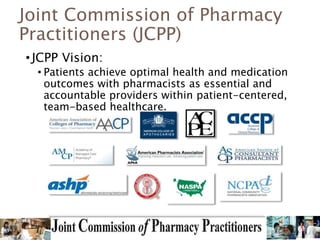
Joint Commission of Pharmacy
Practitioners (JCPP)
โ€ขJCPP Vision:
โ€ข Patients achieve optimal health and medication
outcomes with pharmacists as essential and
accountable providers within patient-centered,
team-based healthcare.
3
Pharmacistsโ€™ Patient Care
Process
๏‚จ JCPP Strategic Plan: Consistent patient care
process identified as key driver for achieving the
JCPP vision
๏ฎ Supports the professionโ€™s provider status activities
๏ฎ Needed to meet demands of evolving health care
system focused on triple aim
๏‚จ Collaboration of national pharmacy
organizations working to develop a standardized
pharmacist patient care process
๏ฎ Purpose: to stimulate consistency, predictability, and
measurability in pharmacistsโ€™ service delivery
4
JCPP Pharmacistsโ€™ Patient Care
Process Workgroup
๏‚จ Activities: January 2012-May 2014
๏‚ค Workgroup meetings
๏‚ค Environmental scan
๏‚ค Testing among clinicians
๏‚ค Organizational feedback
5
Pharmacistsโ€™ Patient Care Process
Development
๏‚จ Review of key resources
๏‚ค Pharmaceutical care โ€“ Strand & Cipolle
๏‚ค Professionโ€™s MTM definition and MTM Core Elements
๏‚ค PCPCC Medication Management Resource Guide
๏‚ค ACA language
๏‚ค Nurse Practitionerโ€™s Practice Standards
๏‚จ Should apply to the wide variety of patient care
services provided by pharmacists AND the
pharmacistโ€™s medication expertise
๏‚ค Level of intensity varies depending on the service
๏‚ค One pharmacist might be responsible for all the steps in some
settings where in others more than one pharmacist may be
involved at different stages of the process.
6
Goals
๏‚จ Pharmacistsโ€™ Patient Care Process created to:
๏‚ค Promote consistency across the profession.
๏‚ค Provide a framework for delivering patient care in
any practice setting.
๏‚ค Be a contemporary and comprehensive approach
to patient-centered care delivered in collaboration
with other members of the health care team.
๏‚ค Be applicable to a variety of patient care services
delivered by pharmacists, including medication
management
7
Pharmacistsโ€™ Patient Care
Process
๏‚จ Foundational Components:
โ€ข Establishment of patient-pharmacist relationship
โ€ข Engagement and effective communication with
patient, family, caregivers
โ€ข Continually collaborate, document, and
communicate with physicians and other health
care providers
โ€ข Process enhanced by interoperable information
technology systems that facilitate effective and
efficient communication
8
Pharmacistsโ€™ Patient Care
Process
๏‚จ Approved by JCPP
organizations in May
2014
๏‚จ Supported by 13
national pharmacy
organizations
http://www.pharmacist.com/sites/default/files/JCPP_Pharmacists_Patient_Care_Process.pdf
9
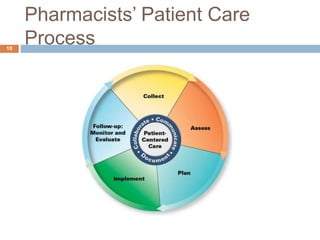
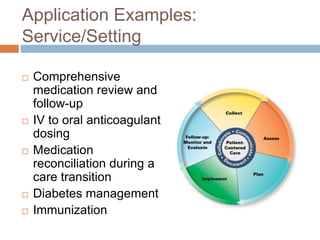
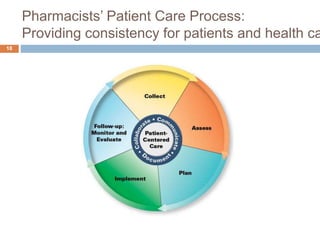
Pharmacistsโ€™ Patient Care
Process
10
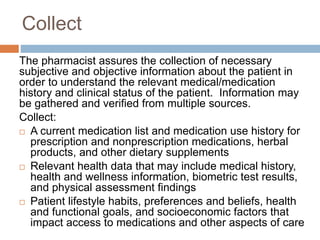
Collect
The pharmacist assures the collection of necessary
subjective and objective information about the patient in
order to understand the relevant medical/medication
history and clinical status of the patient. Information may
be gathered and verified from multiple sources.
Collect:
๏‚จ A current medication list and medication use history for
prescription and nonprescription medications, herbal
products, and other dietary supplements
๏‚จ Relevant health data that may include medical history,
health and wellness information, biometric test results,
and physical assessment findings
๏‚จ Patient lifestyle habits, preferences and beliefs, health
and functional goals, and socioeconomic factors that
impact access to medications and other aspects of care
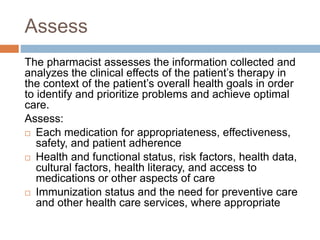
Assess
The pharmacist assesses the information collected and
analyzes the clinical effects of the patientโ€™s therapy in
the context of the patientโ€™s overall health goals in order
to identify and prioritize problems and achieve optimal
care.
Assess:
๏‚จ Each medication for appropriateness, effectiveness,
safety, and patient adherence
๏‚จ Health and functional status, risk factors, health data,
cultural factors, health literacy, and access to
medications or other aspects of care
๏‚จ Immunization status and the need for preventive care
and other health care services, where appropriate
Plan
The pharmacist develops an individualized patient-centered
care plan, in collaboration with other health care
professionals and the patient or caregiver that is evidence-
based and cost-effective.
The plan:
๏‚จ Addresses medication-related problems and optimizes
medication therapy
๏‚จ Sets goals of therapy for achieving clinical outcomes in the
context of the patientโ€™s overall health care goals and access
to care
๏‚จ Engages the patient through education, empowerment, and
self-management
๏‚จ Supports care continuity, including follow-up and transitions
Implement
The pharmacist implements the care plan in collaboration
with other health care professionals and the patient or
caregiver.
The pharmacist:
๏‚จ Addresses medication- and health-related problems,
and engages in preventive care strategies, including
vaccine administration
๏‚จ Initiates, modifies, discontinues, or administers
medication therapy as authorized
๏‚จ Provides education and self-management training to the
patient or caregiver
๏‚จ Contributes to coordination of care, including the referral
or transition of the patient to another health care
professional
๏‚จ Schedules follow-up care as needed to achieve goals of
therapy
Follow-up: Monitor and
Evaluate
The pharmacist monitors and evaluates the
effectiveness of the care plan and modifies the
plan in collaboration with other health care
professionals and the patient or caregiver as
needed.
Monitor and evaluate:
๏‚จ Medication appropriateness, effectiveness, and safety
and patient adherence through available health data,
biometric test results and patient feedback
๏‚จ Clinical endpoints that contribute to the patientโ€™s
overall health
๏‚จ Outcomes of care, including progress toward or the
achievement of goals of therapy
Application Examples:
Service/Setting
๏‚จ Comprehensive
medication review and
follow-up
๏‚จ IV to oral anticoagulant
dosing
๏‚จ Medication
reconciliation during a
care transition
๏‚จ Diabetes management
๏‚จ Immunization
16
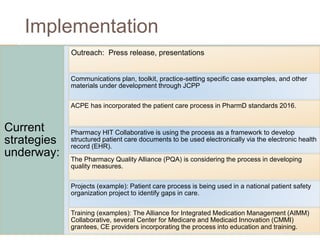
Implementation
Current
strategies
underway:
Outreach: Press release, presentations
Communications plan, toolkit, practice-setting specific case examples, and other
materials under development through JCPP
ACPE has incorporated the patient care process in PharmD standards 2016.
Pharmacy HIT Collaborative is using the process as a framework to develop
structured patient care documents to be used electronically via the electronic health
record (EHR).
The Pharmacy Quality Alliance (PQA) is considering the process in developing
quality measures.
Projects (example): Patient care process is being used in a national patient safety
organization project to identify gaps in care.
Training (examples): The Alliance for Integrated Medication Management (AIMM)
Collaborative, several Center for Medicare and Medicaid Innovation (CMMI)
grantees, CE providers incorporating the process into education and training.
Pharmacistsโ€™ Patient Care Process:
Providing consistency for patients and health ca
18
Questions
19

Patient_Care_Process_Template_Presentation-Final.pptx

  • 1.
  • 2.
    Objectives ๏‚จ Review thedevelopment of the Pharmacistsโ€™ Patient Care Process ๏‚จ Describe the elements of the Pharmacistsโ€™ Patient Care Process ๏‚จ Discuss current strategies underway for implementation ๏‚จ Discuss case examples applying the process 2
  • 3.
    Joint Commission ofPharmacy Practitioners (JCPP) โ€ขJCPP Vision: โ€ข Patients achieve optimal health and medication outcomes with pharmacists as essential and accountable providers within patient-centered, team-based healthcare. 3
  • 4.
    Pharmacistsโ€™ Patient Care Process ๏‚จJCPP Strategic Plan: Consistent patient care process identified as key driver for achieving the JCPP vision ๏ฎ Supports the professionโ€™s provider status activities ๏ฎ Needed to meet demands of evolving health care system focused on triple aim ๏‚จ Collaboration of national pharmacy organizations working to develop a standardized pharmacist patient care process ๏ฎ Purpose: to stimulate consistency, predictability, and measurability in pharmacistsโ€™ service delivery 4
  • 5.
    JCPP Pharmacistsโ€™ PatientCare Process Workgroup ๏‚จ Activities: January 2012-May 2014 ๏‚ค Workgroup meetings ๏‚ค Environmental scan ๏‚ค Testing among clinicians ๏‚ค Organizational feedback 5
  • 6.
    Pharmacistsโ€™ Patient CareProcess Development ๏‚จ Review of key resources ๏‚ค Pharmaceutical care โ€“ Strand & Cipolle ๏‚ค Professionโ€™s MTM definition and MTM Core Elements ๏‚ค PCPCC Medication Management Resource Guide ๏‚ค ACA language ๏‚ค Nurse Practitionerโ€™s Practice Standards ๏‚จ Should apply to the wide variety of patient care services provided by pharmacists AND the pharmacistโ€™s medication expertise ๏‚ค Level of intensity varies depending on the service ๏‚ค One pharmacist might be responsible for all the steps in some settings where in others more than one pharmacist may be involved at different stages of the process. 6
  • 7.
    Goals ๏‚จ Pharmacistsโ€™ PatientCare Process created to: ๏‚ค Promote consistency across the profession. ๏‚ค Provide a framework for delivering patient care in any practice setting. ๏‚ค Be a contemporary and comprehensive approach to patient-centered care delivered in collaboration with other members of the health care team. ๏‚ค Be applicable to a variety of patient care services delivered by pharmacists, including medication management 7
  • 8.
    Pharmacistsโ€™ Patient Care Process ๏‚จFoundational Components: โ€ข Establishment of patient-pharmacist relationship โ€ข Engagement and effective communication with patient, family, caregivers โ€ข Continually collaborate, document, and communicate with physicians and other health care providers โ€ข Process enhanced by interoperable information technology systems that facilitate effective and efficient communication 8
  • 9.
    Pharmacistsโ€™ Patient Care Process ๏‚จApproved by JCPP organizations in May 2014 ๏‚จ Supported by 13 national pharmacy organizations http://www.pharmacist.com/sites/default/files/JCPP_Pharmacists_Patient_Care_Process.pdf 9
  • 10.
  • 11.
    Collect The pharmacist assuresthe collection of necessary subjective and objective information about the patient in order to understand the relevant medical/medication history and clinical status of the patient. Information may be gathered and verified from multiple sources. Collect: ๏‚จ A current medication list and medication use history for prescription and nonprescription medications, herbal products, and other dietary supplements ๏‚จ Relevant health data that may include medical history, health and wellness information, biometric test results, and physical assessment findings ๏‚จ Patient lifestyle habits, preferences and beliefs, health and functional goals, and socioeconomic factors that impact access to medications and other aspects of care
  • 12.
    Assess The pharmacist assessesthe information collected and analyzes the clinical effects of the patientโ€™s therapy in the context of the patientโ€™s overall health goals in order to identify and prioritize problems and achieve optimal care. Assess: ๏‚จ Each medication for appropriateness, effectiveness, safety, and patient adherence ๏‚จ Health and functional status, risk factors, health data, cultural factors, health literacy, and access to medications or other aspects of care ๏‚จ Immunization status and the need for preventive care and other health care services, where appropriate
  • 13.
    Plan The pharmacist developsan individualized patient-centered care plan, in collaboration with other health care professionals and the patient or caregiver that is evidence- based and cost-effective. The plan: ๏‚จ Addresses medication-related problems and optimizes medication therapy ๏‚จ Sets goals of therapy for achieving clinical outcomes in the context of the patientโ€™s overall health care goals and access to care ๏‚จ Engages the patient through education, empowerment, and self-management ๏‚จ Supports care continuity, including follow-up and transitions
  • 14.
    Implement The pharmacist implementsthe care plan in collaboration with other health care professionals and the patient or caregiver. The pharmacist: ๏‚จ Addresses medication- and health-related problems, and engages in preventive care strategies, including vaccine administration ๏‚จ Initiates, modifies, discontinues, or administers medication therapy as authorized ๏‚จ Provides education and self-management training to the patient or caregiver ๏‚จ Contributes to coordination of care, including the referral or transition of the patient to another health care professional ๏‚จ Schedules follow-up care as needed to achieve goals of therapy
  • 15.
    Follow-up: Monitor and Evaluate Thepharmacist monitors and evaluates the effectiveness of the care plan and modifies the plan in collaboration with other health care professionals and the patient or caregiver as needed. Monitor and evaluate: ๏‚จ Medication appropriateness, effectiveness, and safety and patient adherence through available health data, biometric test results and patient feedback ๏‚จ Clinical endpoints that contribute to the patientโ€™s overall health ๏‚จ Outcomes of care, including progress toward or the achievement of goals of therapy
  • 16.
    Application Examples: Service/Setting ๏‚จ Comprehensive medicationreview and follow-up ๏‚จ IV to oral anticoagulant dosing ๏‚จ Medication reconciliation during a care transition ๏‚จ Diabetes management ๏‚จ Immunization 16
  • 17.
    Implementation Current strategies underway: Outreach: Press release,presentations Communications plan, toolkit, practice-setting specific case examples, and other materials under development through JCPP ACPE has incorporated the patient care process in PharmD standards 2016. Pharmacy HIT Collaborative is using the process as a framework to develop structured patient care documents to be used electronically via the electronic health record (EHR). The Pharmacy Quality Alliance (PQA) is considering the process in developing quality measures. Projects (example): Patient care process is being used in a national patient safety organization project to identify gaps in care. Training (examples): The Alliance for Integrated Medication Management (AIMM) Collaborative, several Center for Medicare and Medicaid Innovation (CMMI) grantees, CE providers incorporating the process into education and training.
  • 18.
    Pharmacistsโ€™ Patient CareProcess: Providing consistency for patients and health ca 18
  • 19.