Product Lifecycle Initiative
Laura Acosta & John E. Mroczek
• Business Model of Patagonia
                         • Situation Analysis
                         • Dilemma at Patagonia
                         • Action Plan
                             • Project Scope
                             • Implementation & Marketing
                         • Challenges and Risks
                         • Recommendation

AGENDA
Patagonia represents a way to “challenge conventional wisdom and
present a new style of responsible business” - Yvon Chouinard
BUSINESS MODEL
WHO? Worldwide Leader of environmentally responsible business.

WHAT? Offer products that are simple, functional and
multifunctional.

HOW? Leader in Technological Innovation to develop and test
raw materials to cause the least amount of harm to the
environment as possible.
SITUATION ANALYSIS
 Company: Focusing on the production of simple, functional and
  multifunctional product to encourage customers to consume less by
  consuming better.

 Customer: someone who was an avid climber and took temporary jobs in
  order to pay for climbing expenses

 Competition: All of the competitors targeted the middle to high end outdoor
  apparel customer demographic of 38 years old. Using Mass Market retailers
  to distribute their product.

 Collaborator: chosen in regards to their alignment to the value of the Patagonia
   corporate culture.

 Climate: Corporate Social Responsibility has become a must for any
   successful company.
   ** The experience Patagonia has created something that is rare,
      valuable, non-substitutable, and inimitable

                                                                                     4
Product Life Cycle Initiative
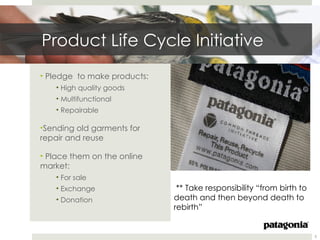
• Pledge to make products:
    • High quality goods
    • Multifunctional
    • Repairable

•Sending old garments for
repair and reuse

• Place them on the online
market:
    • For sale
    • Exchange                ** Take responsibility “from birth to
    • Donation               death and then beyond death to
                             rebirth”


                                                                      5
Dilemma at Patagonia
“Environmental decisions were not at
odds with the optimal financial
performance”

 • Target of increasing a 10%
 annual sales growth.

 • Requires evaluation of the
 sacrifices it is willing to make:
     • Company Values & Purpose
     • Scope of the project
     • Costs & Resources
     • Time


                                       6
Dilemma at Patagonia
 Alternative 1. Establish the 10% Sales Growth Strategy

“to lead corporate America by example, it had to be
   profitable”

Pros-
   Increase 1% for the Planet contribution by 64%.

Cons-
   Diverge from its core values, quality products and reduction
    of environmental sustainability.
   Focus towards a revenue growth focus company.
   Effectively translated into the company image.


                                                                   7
Dilemma at Patagonia
 Alternative 1. Establish the 10% Sales Growth Strategy


                            “Forget about the goal and
                            instead focus on the individual
                            movements involved in shooting
                            an arrow- if [the elements are
                            perfected, one] can’t help but
                            to hit the center of the target”
                            - Yvon Chouinard


                                                               8
Dilemma at Patagonia
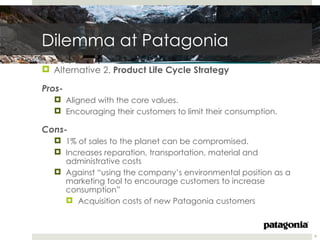
 Alternative 2. Product Life Cycle Strategy

Pros-
   Aligned with the core values.
   Encouraging their customers to limit their consumption.

Cons-
   1% of sales to the planet can be compromised.
   Increases reparation, transportation, material and
    administrative costs
   Against “using the company’s environmental position as a
    marketing tool to encourage customers to increase
    consumption”
     Acquisition costs of new Patagonia customers


                                                               9
Dilemma at Patagonia
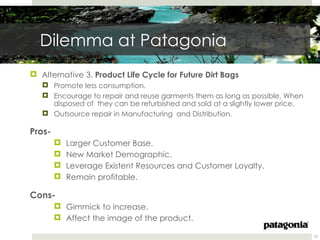
 Alternative 3. Product Life Cycle for Future Dirt Bags
    Promote less consumption.
    Encourage to repair and reuse garments them as long as possible. When
     disposed of they can be refurbished and sold at a slightly lower price.
    Outsource repair in Manufacturing and Distribution.

Pros-
           Larger Customer Base.
           New Market Demographic.
           Leverage Existent Resources and Customer Loyalty.
           Remain profitable.

Cons-
         Gimmick to increase.
         Affect the image of the product.

                                                                               10
Dilemma at Patagonia
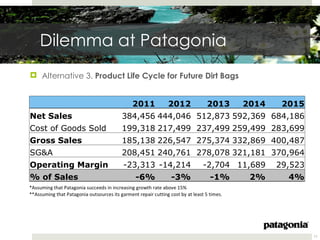
 Alternative 3. Product Life Cycle for Future Dirt Bags


                           2011      2012      2013        2014    2015
Net Sales               384,456 444,046 512,873 592,369 684,186
Cost of Goods Sold      199,318 217,499 237,499 259,499 283,699
Gross Sales             185,138 226,547 275,374 332,869 400,487
SG&A                    208,451 240,761 278,078 321,181 370,964
Operating Margin         -23,313 -14,214      -2,704 11,689       29,523
% of Sales                  -6%      -3%        -1%         2%      4%


                                                                           11
ACTION PLAN
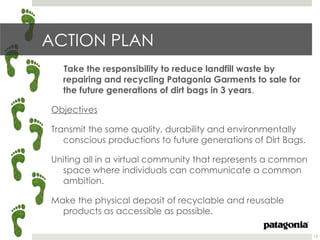
  Take the responsibility to reduce landfill waste by
  repairing and recycling Patagonia Garments to sale for
  the future generations of dirt bags in 3 years.

Objectives

Transmit the same quality, durability and environmentally
   conscious productions to future generations of Dirt Bags.

Uniting all in a virtual community that represents a common
  space where individuals can communicate a common
  ambition.

Make the physical deposit of recyclable and reusable
  products as accessible as possible.

                                                               12
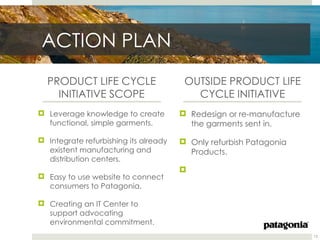
ACTION PLAN
  PRODUCT LIFE CYCLE                    OUTSIDE PRODUCT LIFE
    INITIATIVE SCOPE                      CYCLE INITIATIVE
 Leverage knowledge to create          Redesign or re-manufacture
  functional, simple garments.           the garments sent in.

 Integrate refurbishing its already    Only refurbish Patagonia
  existent manufacturing and             Products.
  distribution centers.
                                       
 Easy to use website to connect
  consumers to Patagonia.

 Creating an IT Center to
  support advocating
  environmental commitment.
                                                                      13
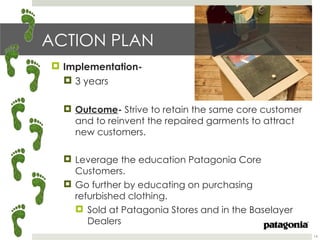
ACTION PLAN
 Implementation-
   3 years

   Outcome- Strive to retain the same core customer
    and to reinvent the repaired garments to attract
    new customers.

   Leverage the education Patagonia Core
    Customers.
   Go further by educating on purchasing
    refurbished clothing.
     Sold at Patagonia Stores and in the Baselayer
       Dealers
                                                       14
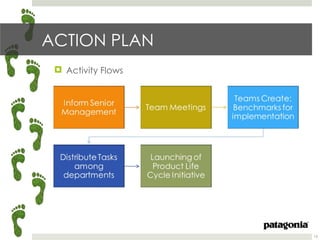
ACTION PLAN
  Activity Flows


                    15
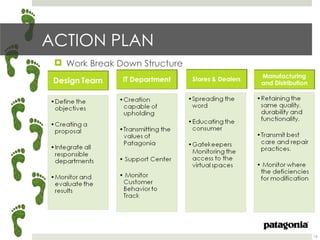
ACTION PLAN
  Work Break Down Structure


                               16
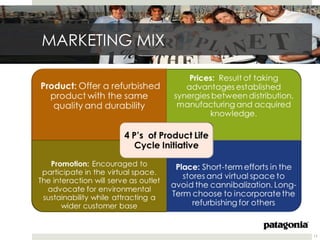
MARKETING MIX


                17
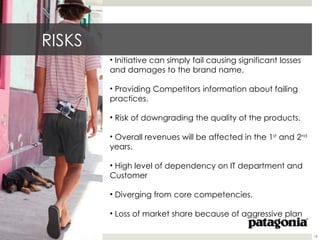
RISKS
        • Initiative can simply fail causing significant losses
        and damages to the brand name.

        • Providing Competitors information about failing
        practices.

        • Risk of downgrading the quality of the products.

        • Overall revenues will be affected in the 1st and 2nd
        years.

        • High level of dependency on IT department and
        Customer

        • Diverging from core competencies.

        • Loss of market share because of aggressive plan

                                                                  18
BENEFITS
• Decision is rooted with core competencies of Patagonia

• Reach broader customer base

• Online network will foster sense of community

• Patagonia will maintain position of innovative and industry
leading company.

• Tax Incentives and over all reduced costs.

• Educate and enhance customer knowledge further.

                                                                19
RECOMMENDATIONS

• Product Life Cycle
Initiative offered only for
Patagonia Products.

• Outsourcing Repairs to
facilities abroad.

• Selling of refurbished
items to younger Dirt Bags


                              20
Thank You !!!

                21

Patagonia Ppt

  • 1.
    Product Lifecycle Initiative LauraAcosta & John E. Mroczek
  • 2.
    • Business Modelof Patagonia • Situation Analysis • Dilemma at Patagonia • Action Plan • Project Scope • Implementation & Marketing • Challenges and Risks • Recommendation AGENDA Patagonia represents a way to “challenge conventional wisdom and present a new style of responsible business” - Yvon Chouinard
  • 3.
    BUSINESS MODEL WHO? WorldwideLeader of environmentally responsible business. WHAT? Offer products that are simple, functional and multifunctional. HOW? Leader in Technological Innovation to develop and test raw materials to cause the least amount of harm to the environment as possible.
  • 4.
    SITUATION ANALYSIS  Company:Focusing on the production of simple, functional and multifunctional product to encourage customers to consume less by consuming better.  Customer: someone who was an avid climber and took temporary jobs in order to pay for climbing expenses  Competition: All of the competitors targeted the middle to high end outdoor apparel customer demographic of 38 years old. Using Mass Market retailers to distribute their product.  Collaborator: chosen in regards to their alignment to the value of the Patagonia corporate culture.  Climate: Corporate Social Responsibility has become a must for any successful company. ** The experience Patagonia has created something that is rare, valuable, non-substitutable, and inimitable 4
  • 5.
    Product Life CycleInitiative • Pledge to make products: • High quality goods • Multifunctional • Repairable •Sending old garments for repair and reuse • Place them on the online market: • For sale • Exchange ** Take responsibility “from birth to • Donation death and then beyond death to rebirth” 5
  • 6.
    Dilemma at Patagonia “Environmentaldecisions were not at odds with the optimal financial performance” • Target of increasing a 10% annual sales growth. • Requires evaluation of the sacrifices it is willing to make: • Company Values & Purpose • Scope of the project • Costs & Resources • Time 6
  • 7.
    Dilemma at Patagonia Alternative 1. Establish the 10% Sales Growth Strategy “to lead corporate America by example, it had to be profitable” Pros-  Increase 1% for the Planet contribution by 64%. Cons-  Diverge from its core values, quality products and reduction of environmental sustainability.  Focus towards a revenue growth focus company.  Effectively translated into the company image. 7
  • 8.
    Dilemma at Patagonia Alternative 1. Establish the 10% Sales Growth Strategy “Forget about the goal and instead focus on the individual movements involved in shooting an arrow- if [the elements are perfected, one] can’t help but to hit the center of the target” - Yvon Chouinard 8
  • 9.
    Dilemma at Patagonia Alternative 2. Product Life Cycle Strategy Pros-  Aligned with the core values.  Encouraging their customers to limit their consumption. Cons-  1% of sales to the planet can be compromised.  Increases reparation, transportation, material and administrative costs  Against “using the company’s environmental position as a marketing tool to encourage customers to increase consumption”  Acquisition costs of new Patagonia customers 9
  • 10.
    Dilemma at Patagonia Alternative 3. Product Life Cycle for Future Dirt Bags  Promote less consumption.  Encourage to repair and reuse garments them as long as possible. When disposed of they can be refurbished and sold at a slightly lower price.  Outsource repair in Manufacturing and Distribution. Pros-  Larger Customer Base.  New Market Demographic.  Leverage Existent Resources and Customer Loyalty.  Remain profitable. Cons-  Gimmick to increase.  Affect the image of the product. 10
  • 11.
    Dilemma at Patagonia Alternative 3. Product Life Cycle for Future Dirt Bags   2011 2012 2013 2014 2015 Net Sales 384,456 444,046 512,873 592,369 684,186 Cost of Goods Sold  199,318 217,499 237,499 259,499 283,699 Gross Sales 185,138 226,547 275,374 332,869 400,487 SG&A  208,451 240,761 278,078 321,181 370,964 Operating Margin -23,313 -14,214 -2,704 11,689 29,523 % of Sales -6% -3% -1% 2% 4% 11
  • 12.
    ACTION PLAN Take the responsibility to reduce landfill waste by repairing and recycling Patagonia Garments to sale for the future generations of dirt bags in 3 years. Objectives Transmit the same quality, durability and environmentally conscious productions to future generations of Dirt Bags. Uniting all in a virtual community that represents a common space where individuals can communicate a common ambition. Make the physical deposit of recyclable and reusable products as accessible as possible. 12
  • 13.
    ACTION PLAN PRODUCT LIFE CYCLE OUTSIDE PRODUCT LIFE INITIATIVE SCOPE CYCLE INITIATIVE  Leverage knowledge to create  Redesign or re-manufacture functional, simple garments. the garments sent in.  Integrate refurbishing its already  Only refurbish Patagonia existent manufacturing and Products. distribution centers.   Easy to use website to connect consumers to Patagonia.  Creating an IT Center to support advocating environmental commitment. 13
  • 14.
    ACTION PLAN  Implementation-  3 years  Outcome- Strive to retain the same core customer and to reinvent the repaired garments to attract new customers.  Leverage the education Patagonia Core Customers.  Go further by educating on purchasing refurbished clothing.  Sold at Patagonia Stores and in the Baselayer Dealers 14
  • 15.
    ACTION PLAN Activity Flows 15
  • 16.
    ACTION PLAN Work Break Down Structure 16
  • 17.
  • 18.
    RISKS • Initiative can simply fail causing significant losses and damages to the brand name. • Providing Competitors information about failing practices. • Risk of downgrading the quality of the products. • Overall revenues will be affected in the 1st and 2nd years. • High level of dependency on IT department and Customer • Diverging from core competencies. • Loss of market share because of aggressive plan 18
  • 19.
    BENEFITS • Decision isrooted with core competencies of Patagonia • Reach broader customer base • Online network will foster sense of community • Patagonia will maintain position of innovative and industry leading company. • Tax Incentives and over all reduced costs. • Educate and enhance customer knowledge further. 19
  • 20.
    RECOMMENDATIONS • Product LifeCycle Initiative offered only for Patagonia Products. • Outsourcing Repairs to facilities abroad. • Selling of refurbished items to younger Dirt Bags 20
  • 21.