1- Form
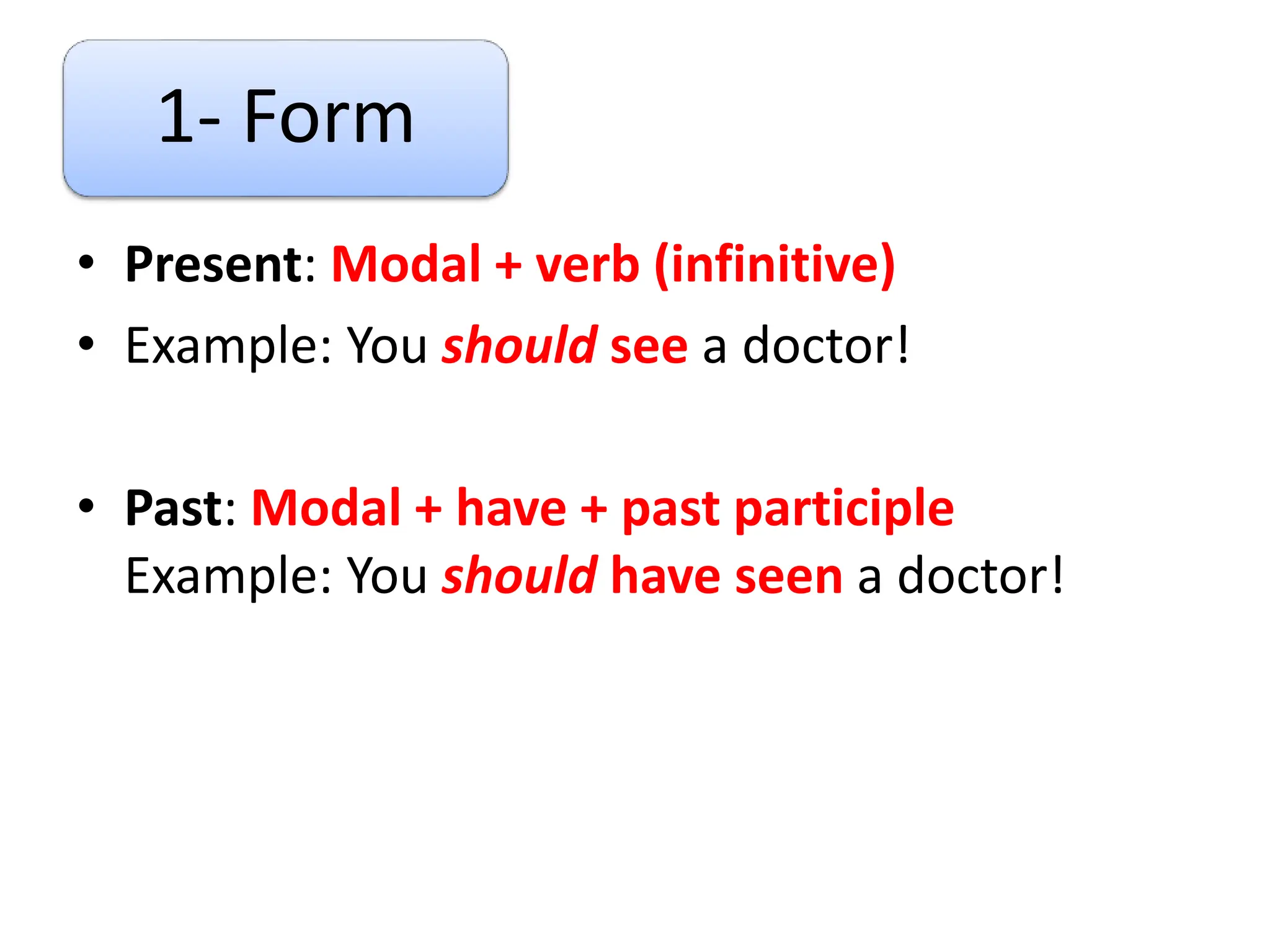
• Present: Modal + verb (infinitive)
• Example: You should see a doctor!
• Past: Modal + have + past participle
Example: You should have seen a doctor!
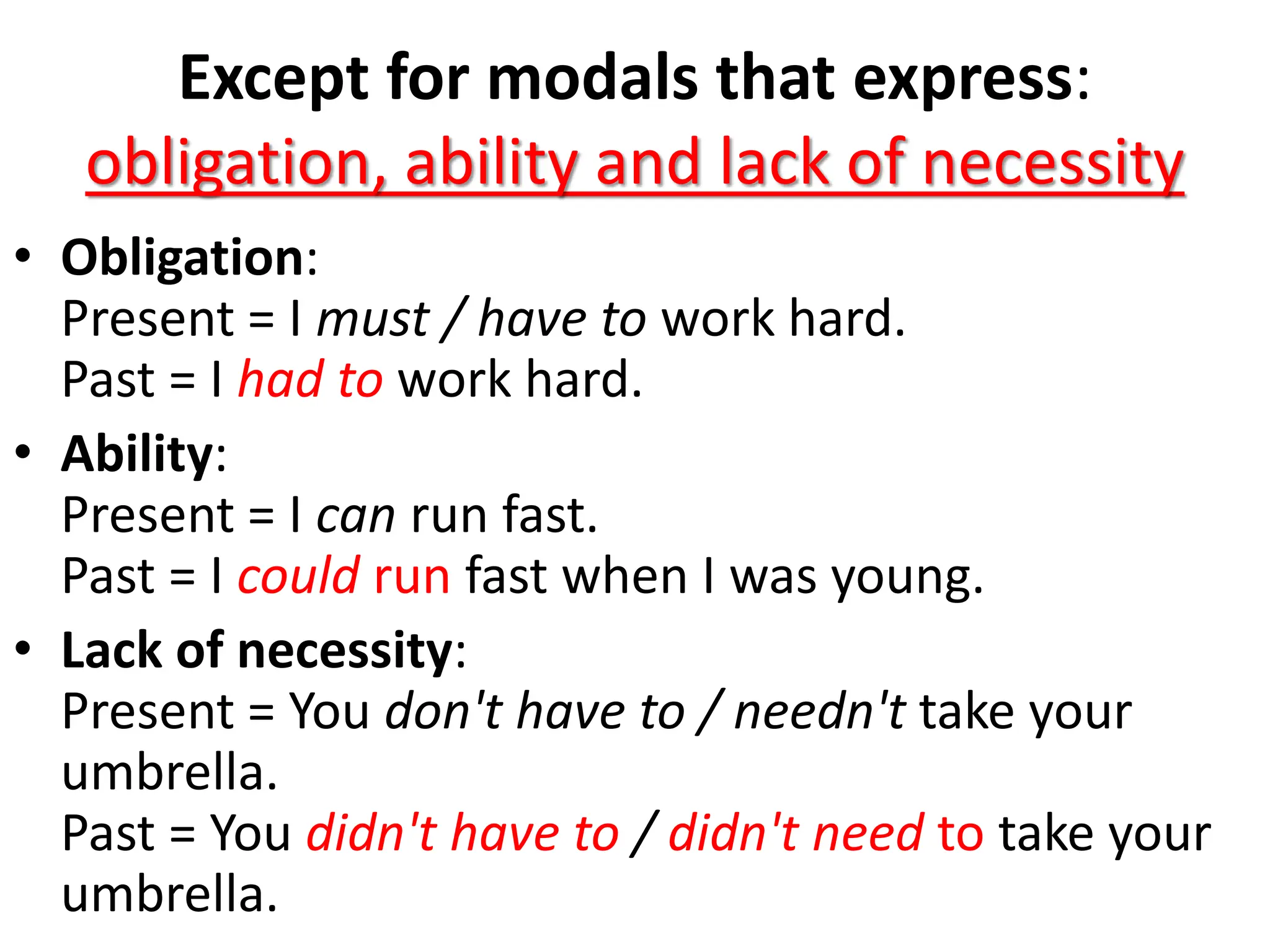
Except for modals that express:
obligation, ability and lack of necessity
• Obligation:
Present = I must / have to work hard.
Past = I had to work hard.
• Ability:
Present = I can run fast.
Past = I could run fast when I was young.
• Lack of necessity:
Present = You don't have to / needn't take your
umbrella.
Past = You didn't have to / didn't need to take your
umbrella.
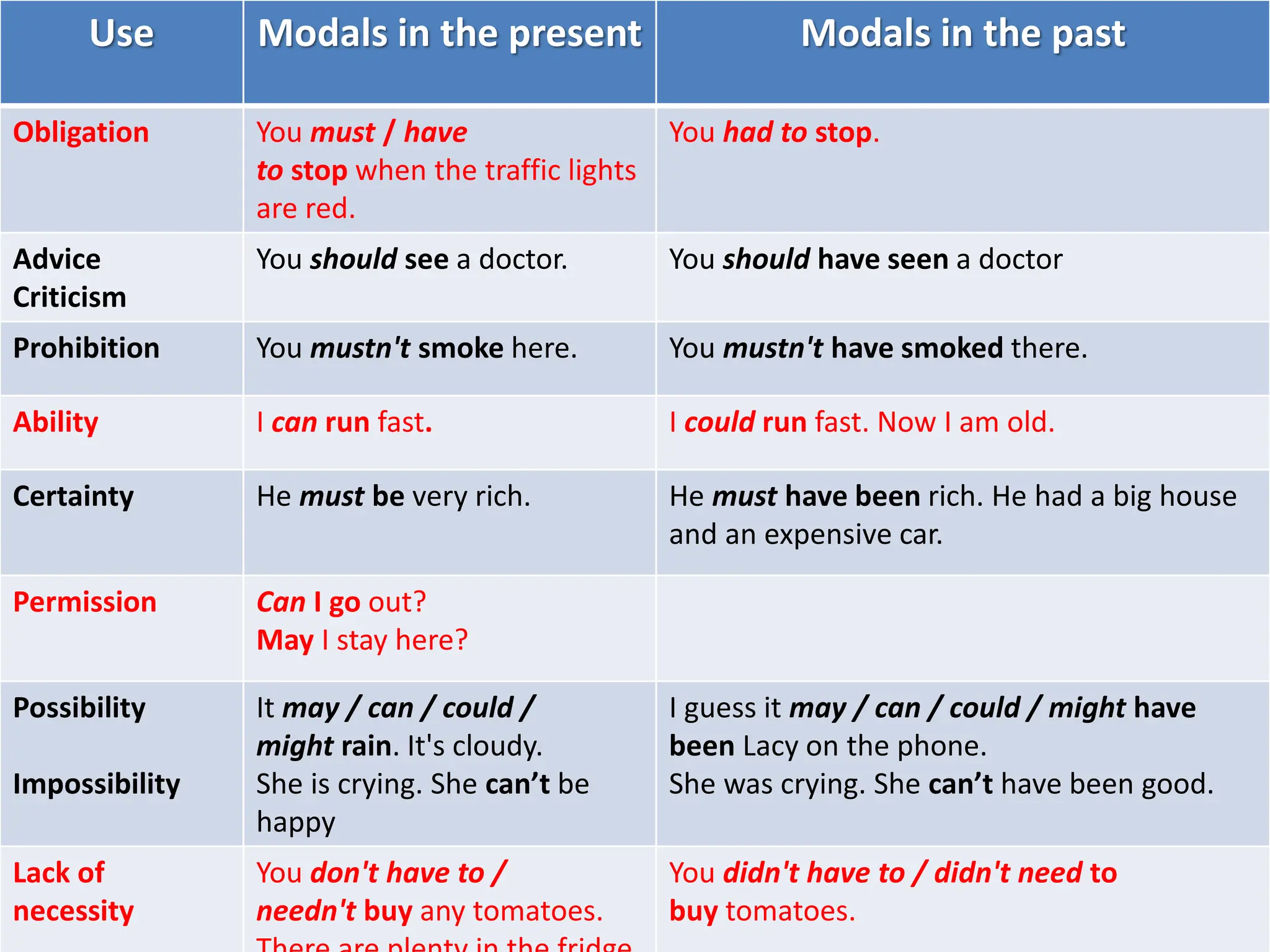
Use Modals in the present Modals in the past
Obligation You must / have
to stop when the traffic lights
are red.
You had to stop.
Advice
Criticism
You should see a doctor. You should have seen a doctor
Prohibition You mustn't smoke here. You mustn't have smoked there.
Ability I can run fast. I could run fast. Now I am old.
Certainty He must be very rich. He must have been rich. He had a big house
and an expensive car.
Permission Can I go out?
May I stay here?
Possibility
Impossibility
It may / can / could /
might rain. It's cloudy.
She is crying. She can’t be
happy
I guess it may / can / could / might have
been Lacy on the phone.
She was crying. She can’t have been good.
Lack of
necessity
You don't have to /
needn't buy any tomatoes.
You didn't have to / didn't need to
buy tomatoes.
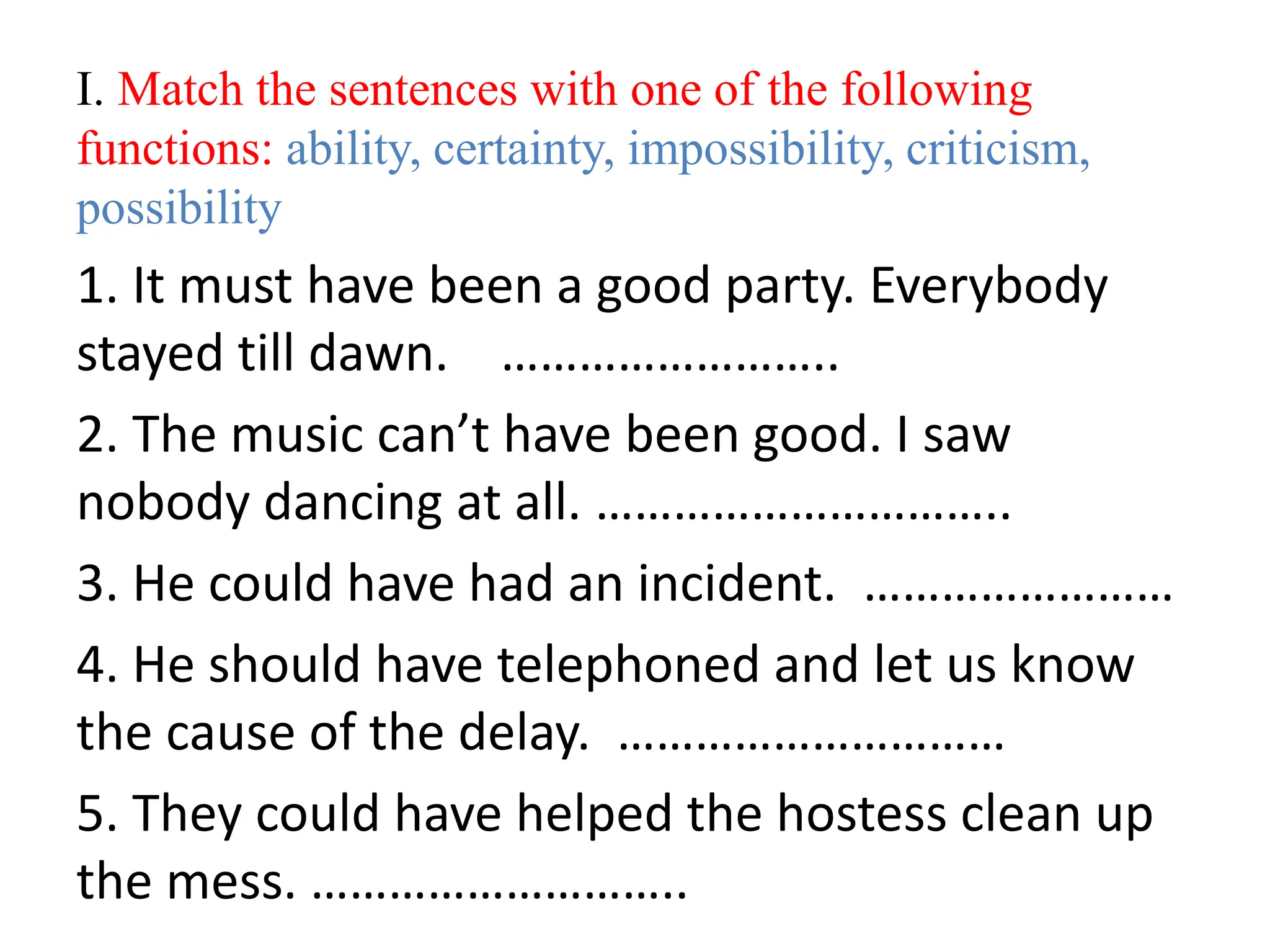
I. Match the sentences with one of the following
functions: ability, certainty, impossibility, criticism,
possibility
1. It must have been a good party. Everybody
stayed till dawn. ……………………..
2. The music can’t have been good. I saw
nobody dancing at all. …………………………..
3. He could have had an incident. ……………………
4. He should have telephoned and let us know
the cause of the delay. …………………………
5. They could have helped the hostess clean up
the mess. ………………………..
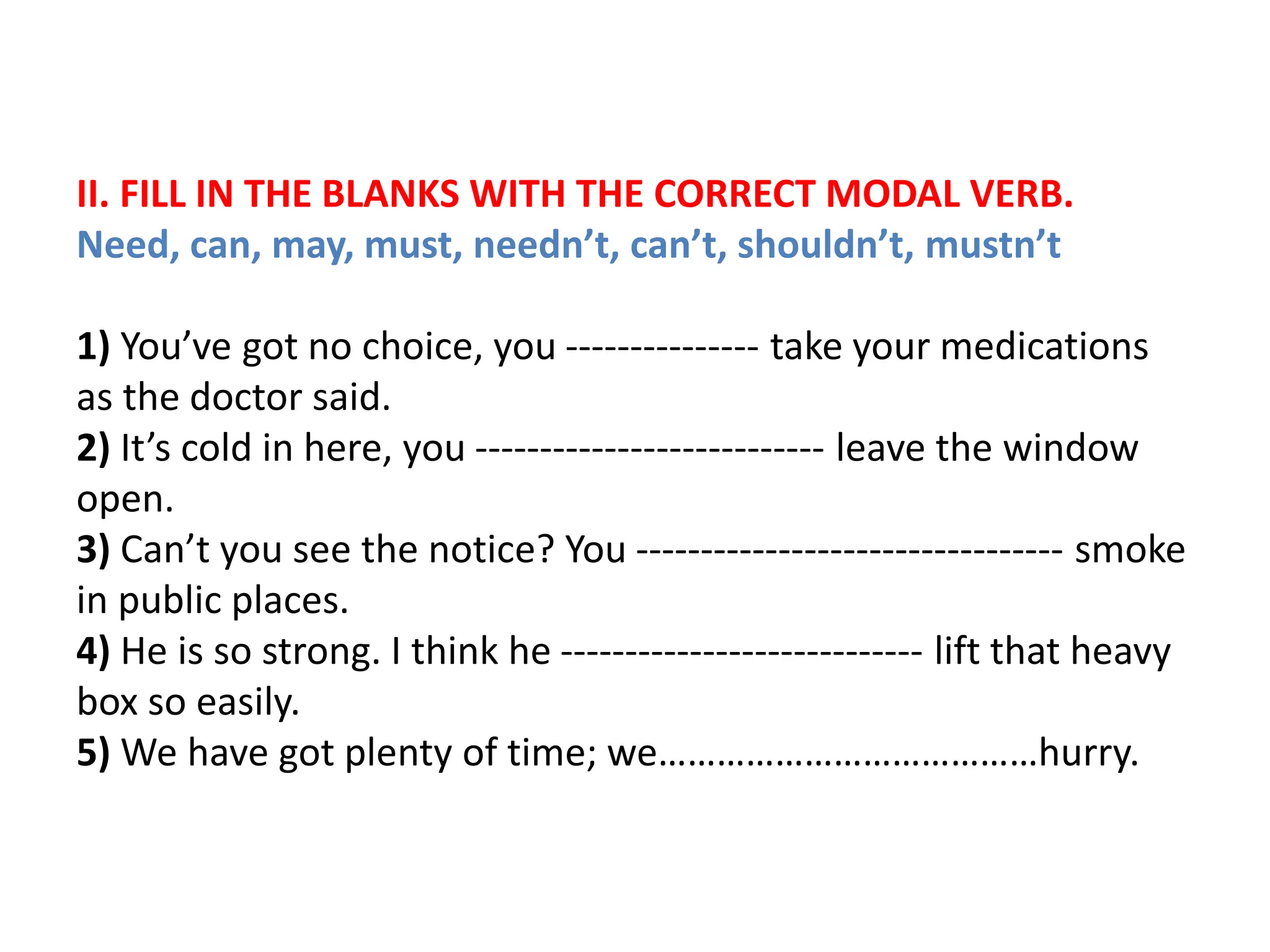
II. FILL IN THE BLANKS WITH THE CORRECT MODAL VERB.
Need, can, may, must, needn’t, can’t, shouldn’t, mustn’t
1) You’ve got no choice, you --------------- take your medications
as the doctor said.
2) It’s cold in here, you --------------------------- leave the window
open.
3) Can’t you see the notice? You --------------------------------- smoke
in public places.
4) He is so strong. I think he ---------------------------- lift that heavy
box so easily.
5) We have got plenty of time; we…………………………………hurry.
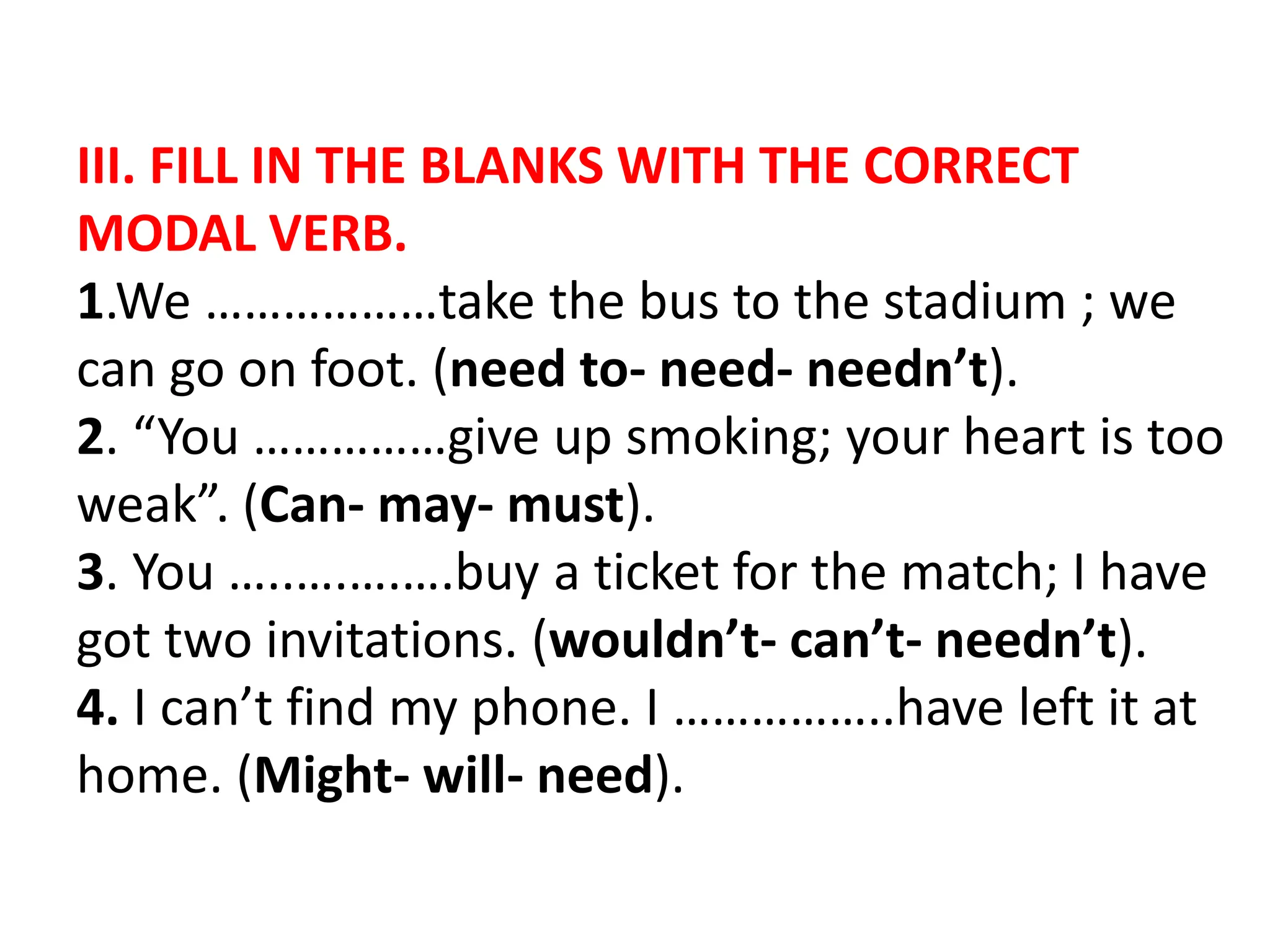
III. FILL IN THE BLANKS WITH THE CORRECT
MODAL VERB.
1.We ………………take the bus to the stadium ; we
can go on foot. (need to- need- needn’t).
2. “You ……………give up smoking; your heart is too
weak”. (Can- may- must).
3. You …..….….….buy a ticket for the match; I have
got two invitations. (wouldn’t- can’t- needn’t).
4. I can’t find my phone. I ……………..have left it at
home. (Might- will- need).
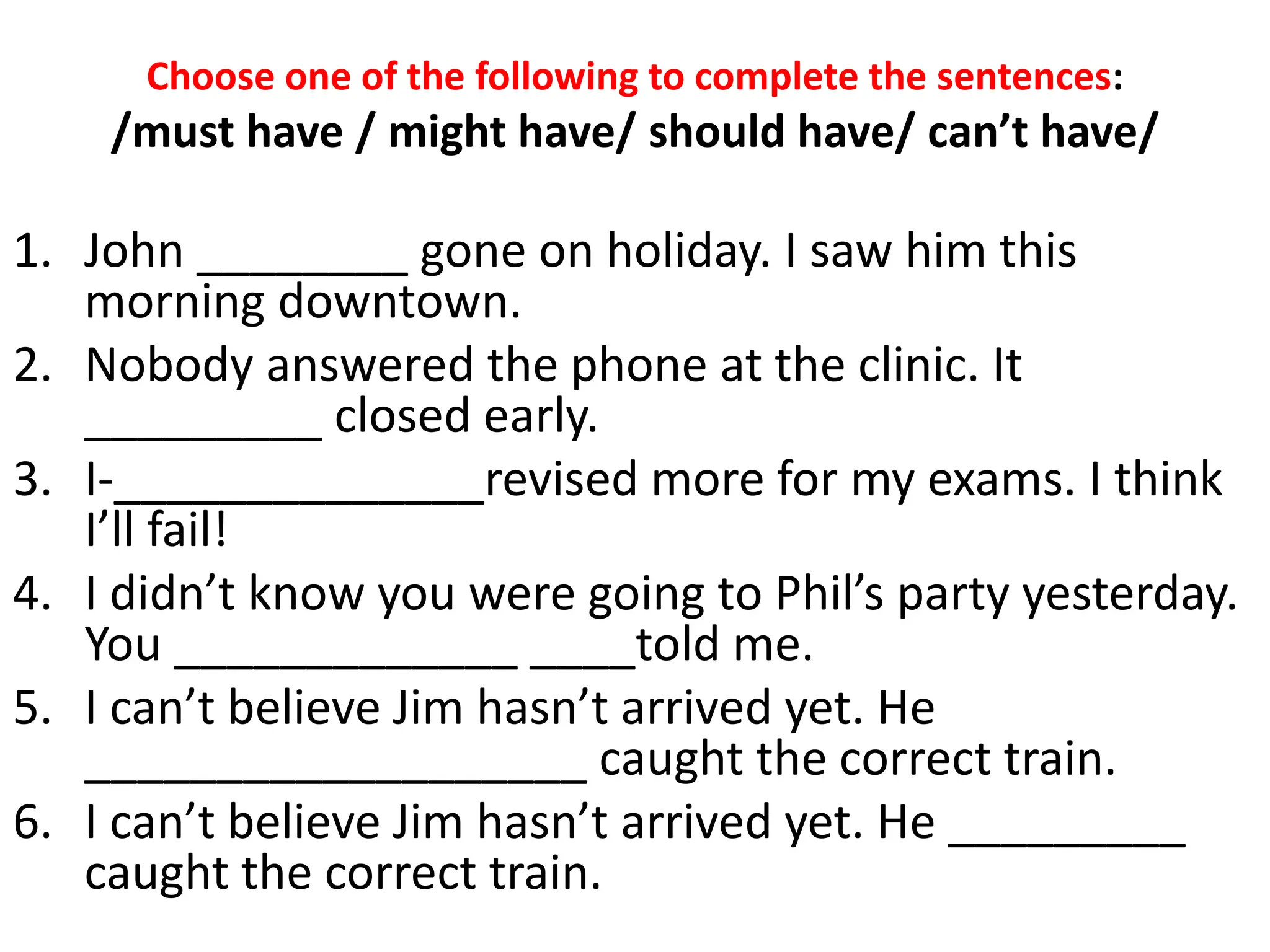
Choose one of the following to complete the sentences:
/must have / might have/ should have/ can’t have/
1. John ________ gone on holiday. I saw him this
morning downtown.
2. Nobody answered the phone at the clinic. It
_________ closed early.
3. I-______________revised more for my exams. I think
I’ll fail!
4. I didn’t know you were going to Phil’s party yesterday.
You _____________ ____told me.
5. I can’t believe Jim hasn’t arrived yet. He
___________________ caught the correct train.
6. I can’t believe Jim hasn’t arrived yet. He _________
caught the correct train.
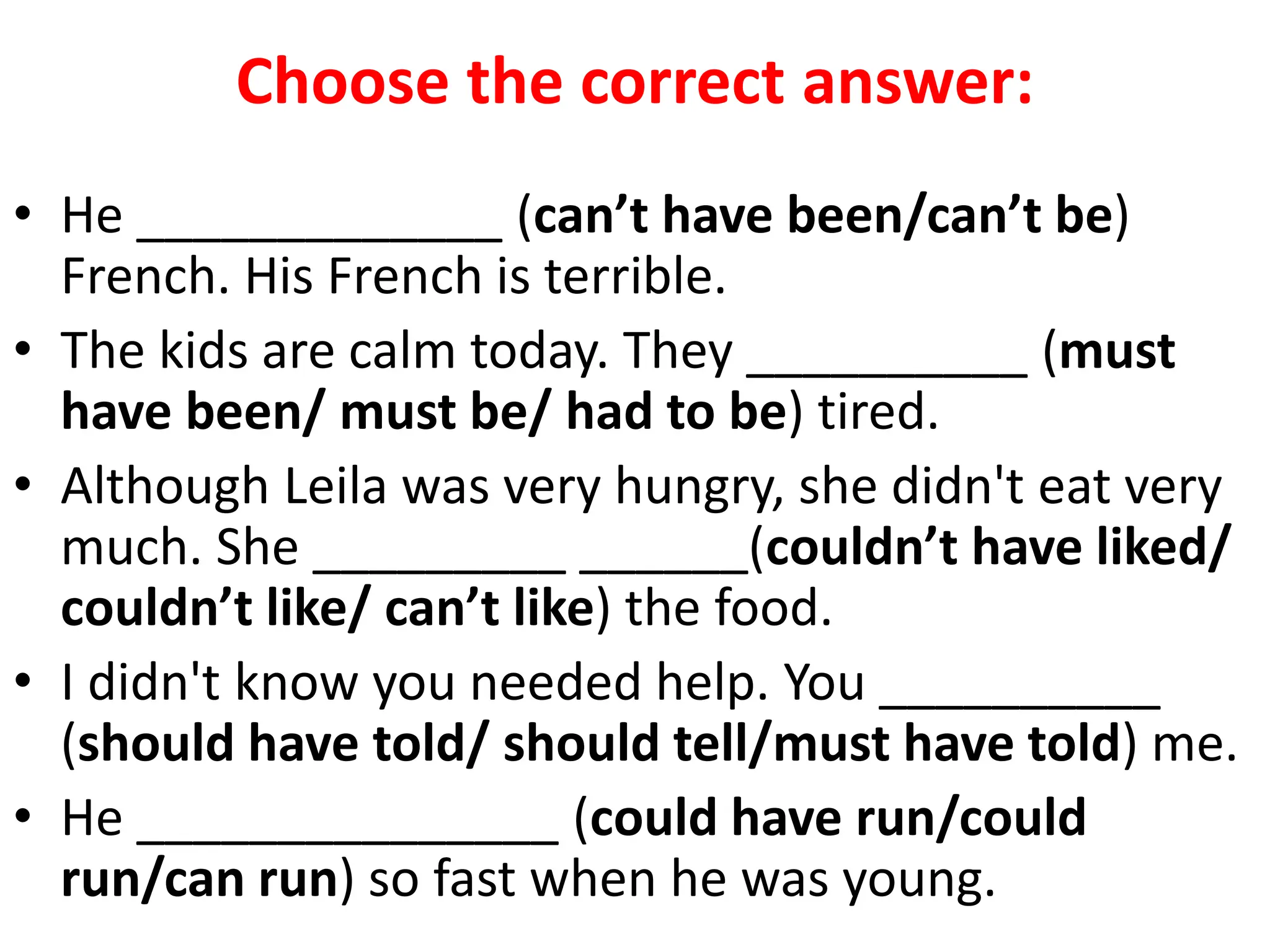
Choose the correct answer:
• He _____________ (can’t have been/can’t be)
French. His French is terrible.
• The kids are calm today. They __________ (must
have been/ must be/ had to be) tired.
• Although Leila was very hungry, she didn't eat very
much. She _________ ______(couldn’t have liked/
couldn’t like/ can’t like) the food.
• I didn't know you needed help. You __________
(should have told/ should tell/must have told) me.
• He _______________ (could have run/could
run/can run) so fast when he was young.

Modals_present&past200.pptx

  • 2.
    1- Form • Present:Modal + verb (infinitive) • Example: You should see a doctor! • Past: Modal + have + past participle Example: You should have seen a doctor!
  • 3.
    Except for modalsthat express: obligation, ability and lack of necessity • Obligation: Present = I must / have to work hard. Past = I had to work hard. • Ability: Present = I can run fast. Past = I could run fast when I was young. • Lack of necessity: Present = You don't have to / needn't take your umbrella. Past = You didn't have to / didn't need to take your umbrella.
  • 4.
    Use Modals inthe present Modals in the past Obligation You must / have to stop when the traffic lights are red. You had to stop. Advice Criticism You should see a doctor. You should have seen a doctor Prohibition You mustn't smoke here. You mustn't have smoked there. Ability I can run fast. I could run fast. Now I am old. Certainty He must be very rich. He must have been rich. He had a big house and an expensive car. Permission Can I go out? May I stay here? Possibility Impossibility It may / can / could / might rain. It's cloudy. She is crying. She can’t be happy I guess it may / can / could / might have been Lacy on the phone. She was crying. She can’t have been good. Lack of necessity You don't have to / needn't buy any tomatoes. You didn't have to / didn't need to buy tomatoes.
  • 5.
    I. Match thesentences with one of the following functions: ability, certainty, impossibility, criticism, possibility 1. It must have been a good party. Everybody stayed till dawn. …………………….. 2. The music can’t have been good. I saw nobody dancing at all. ………………………….. 3. He could have had an incident. …………………… 4. He should have telephoned and let us know the cause of the delay. ………………………… 5. They could have helped the hostess clean up the mess. ………………………..
  • 6.
    II. FILL INTHE BLANKS WITH THE CORRECT MODAL VERB. Need, can, may, must, needn’t, can’t, shouldn’t, mustn’t 1) You’ve got no choice, you --------------- take your medications as the doctor said. 2) It’s cold in here, you --------------------------- leave the window open. 3) Can’t you see the notice? You --------------------------------- smoke in public places. 4) He is so strong. I think he ---------------------------- lift that heavy box so easily. 5) We have got plenty of time; we…………………………………hurry.
  • 7.
    III. FILL INTHE BLANKS WITH THE CORRECT MODAL VERB. 1.We ………………take the bus to the stadium ; we can go on foot. (need to- need- needn’t). 2. “You ……………give up smoking; your heart is too weak”. (Can- may- must). 3. You …..….….….buy a ticket for the match; I have got two invitations. (wouldn’t- can’t- needn’t). 4. I can’t find my phone. I ……………..have left it at home. (Might- will- need).
  • 8.
    Choose one ofthe following to complete the sentences: /must have / might have/ should have/ can’t have/ 1. John ________ gone on holiday. I saw him this morning downtown. 2. Nobody answered the phone at the clinic. It _________ closed early. 3. I-______________revised more for my exams. I think I’ll fail! 4. I didn’t know you were going to Phil’s party yesterday. You _____________ ____told me. 5. I can’t believe Jim hasn’t arrived yet. He ___________________ caught the correct train. 6. I can’t believe Jim hasn’t arrived yet. He _________ caught the correct train.
  • 9.
    Choose the correctanswer: • He _____________ (can’t have been/can’t be) French. His French is terrible. • The kids are calm today. They __________ (must have been/ must be/ had to be) tired. • Although Leila was very hungry, she didn't eat very much. She _________ ______(couldn’t have liked/ couldn’t like/ can’t like) the food. • I didn't know you needed help. You __________ (should have told/ should tell/must have told) me. • He _______________ (could have run/could run/can run) so fast when he was young.