Passive voice
Uses 
• We use passive voice when we don’t know 
who performed the action. 
• Also we use passive voice when we want 
to give more importance to what 
happened, that who performed the action.
Form of passive voice 
The passive voice is formed with the 
auxiliary verb “to be” and the past participle 
of the verb form of the sentence in active 
voice. 
Subject + am/is/are + verb (past participle)
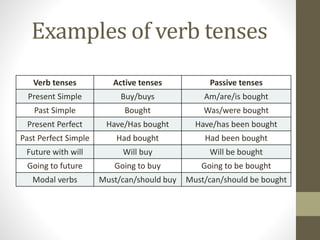
Examples of verb tenses 
Verb tenses Active tenses Passive tenses 
Present Simple Buy/buys Am/are/is bought 
Past Simple Bought Was/were bought 
Present Perfect Have/Has bought Have/has been bought 
Past Perfect Simple Had bought Had been bought 
Future with will Will buy Will be bought 
Going to future Going to buy Going to be bought 
Modal verbs Must/can/should buy Must/can/should be bought
Active to passive 
transformation 
The steps to transform an active sentence 
to passive are: 
1. The object of the active sentence becomes the 
subject of the passive. 
Peter writes a letter. 
A letter is written by Peter.
Active to passive 
transformation (cont.) 
2. The main verb is replaced by the auxiliary verb 
“to be” at his same tense, followed the main 
verb in past participle tense. 
Peter writes a letter. 
A letter is written by Peter.
Active to passive 
transformation (cont.) 
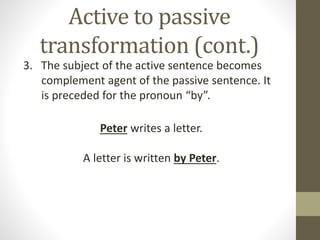
3. The subject of the active sentence becomes 
complement agent of the passive sentence. It 
is preceded for the pronoun “by”. 
Peter writes a letter. 
A letter is written by Peter.
Turn Active voice into 
passive voice 
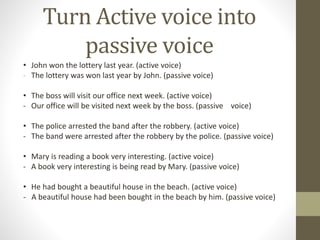
• John won the lottery last year. (active voice) 
- The lottery was won last year by John. (passive voice) 
• The boss will visit our office next week. (active voice) 
- Our office will be visited next week by the boss. (passive voice) 
• The police arrested the band after the robbery. (active voice) 
- The band were arrested after the robbery by the police. (passive voice) 
• Mary is reading a book very interesting. (active voice) 
- A book very interesting is being read by Mary. (passive voice) 
• He had bought a beautiful house in the beach. (active voice) 
- A beautiful house had been bought in the beach by him. (passive voice)

Passive voice

  • 1.
  • 2.
    Uses • Weuse passive voice when we don’t know who performed the action. • Also we use passive voice when we want to give more importance to what happened, that who performed the action.
  • 3.
    Form of passivevoice The passive voice is formed with the auxiliary verb “to be” and the past participle of the verb form of the sentence in active voice. Subject + am/is/are + verb (past participle)
  • 4.
    Examples of verbtenses Verb tenses Active tenses Passive tenses Present Simple Buy/buys Am/are/is bought Past Simple Bought Was/were bought Present Perfect Have/Has bought Have/has been bought Past Perfect Simple Had bought Had been bought Future with will Will buy Will be bought Going to future Going to buy Going to be bought Modal verbs Must/can/should buy Must/can/should be bought
  • 5.
    Active to passive transformation The steps to transform an active sentence to passive are: 1. The object of the active sentence becomes the subject of the passive. Peter writes a letter. A letter is written by Peter.
  • 6.
    Active to passive transformation (cont.) 2. The main verb is replaced by the auxiliary verb “to be” at his same tense, followed the main verb in past participle tense. Peter writes a letter. A letter is written by Peter.
  • 7.
    Active to passive transformation (cont.) 3. The subject of the active sentence becomes complement agent of the passive sentence. It is preceded for the pronoun “by”. Peter writes a letter. A letter is written by Peter.
  • 8.
    Turn Active voiceinto passive voice • John won the lottery last year. (active voice) - The lottery was won last year by John. (passive voice) • The boss will visit our office next week. (active voice) - Our office will be visited next week by the boss. (passive voice) • The police arrested the band after the robbery. (active voice) - The band were arrested after the robbery by the police. (passive voice) • Mary is reading a book very interesting. (active voice) - A book very interesting is being read by Mary. (passive voice) • He had bought a beautiful house in the beach. (active voice) - A beautiful house had been bought in the beach by him. (passive voice)