When do I use passive voice?
• The actor is unknown:
The paintings were made in the twentieth century. [We don't know who
made them.]
• The actor is irrelevant:
An experimental solar power plant will be built in the Australian desert. [We
are not interested in who is building it.]
• You want to be vague about who is responsible:
Mistakes were made. [Common in bureaucratic writing!]
• You are talking about a general truth:
Rules are made to be broken. [By whomever, whenever.]
• You want to emphasize the person or thing acted on. For example, it may be
your main topic:
Insulin was first discovered in 1921 by researchers at the University of
Toronto. It is still the only treatment available for diabetes.
• You are writing in a scientific genre that traditionally relies on passive voice.
Passive voice is often preferred in lab reports and scientific research
papers, most notably in the Materials and Methods section:
The sodium hydroxide was dissolved in water. This solution was then
titrated with hydrochloric acid.
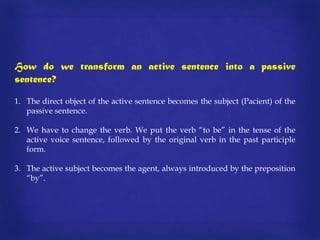
How do we transform an active sentence into a passive
sentence?
1. The direct object of the active sentence becomes the subject (Pacient) of the
passive sentence.

2. We have to change the verb. We put the verb “to be” in the tense of the
active voice sentence, followed by the original verb in the past participle
form.
3. The active subject becomes the agent, always introduced by the preposition
“by”.
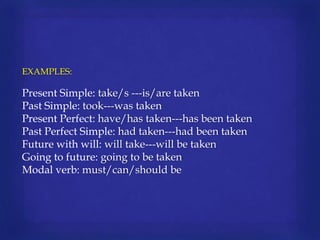
EXAMPLES:

Present Simple: take/s ---is/are taken
Past Simple: took---was taken
Present Perfect: have/has taken---has been taken
Past Perfect Simple: had taken---had been taken
Future with will: will take---will be taken
Going to future: going to be taken
Modal verb: must/can/should be
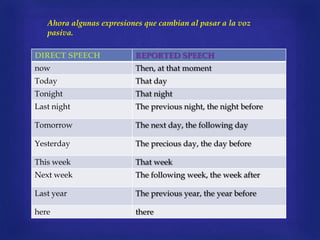
Ahora algunas expresiones que cambian al pasar a la voz
pasiva.
DIRECT SPEECH

REPORTED SPEECH

now

Then, at that moment

Today

That day

Tonight

That night

Last night

The previous night, the night before

Tomorrow

The next day, the following day

Yesterday

The precious day, the day before

This week

That week

Next week

The following week, the week after

Last year

The previous year, the year before

here

there
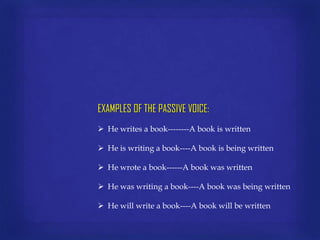
EXAMPLES OF THE PASSIVE VOICE:
 He writes a book--------A book is written
 He is writing a book----A book is being written
 He wrote a book------A book was written

 He was writing a book----A book was being written
 He will write a book----A book will be written

Tarea 3 de inglés

  • 2.
    When do Iuse passive voice? • The actor is unknown: The paintings were made in the twentieth century. [We don't know who made them.] • The actor is irrelevant: An experimental solar power plant will be built in the Australian desert. [We are not interested in who is building it.] • You want to be vague about who is responsible: Mistakes were made. [Common in bureaucratic writing!]
  • 3.
    • You aretalking about a general truth: Rules are made to be broken. [By whomever, whenever.] • You want to emphasize the person or thing acted on. For example, it may be your main topic: Insulin was first discovered in 1921 by researchers at the University of Toronto. It is still the only treatment available for diabetes. • You are writing in a scientific genre that traditionally relies on passive voice. Passive voice is often preferred in lab reports and scientific research papers, most notably in the Materials and Methods section: The sodium hydroxide was dissolved in water. This solution was then titrated with hydrochloric acid.
  • 4.
    How do wetransform an active sentence into a passive sentence? 1. The direct object of the active sentence becomes the subject (Pacient) of the passive sentence. 2. We have to change the verb. We put the verb “to be” in the tense of the active voice sentence, followed by the original verb in the past participle form. 3. The active subject becomes the agent, always introduced by the preposition “by”.
  • 5.
    EXAMPLES: Present Simple: take/s---is/are taken Past Simple: took---was taken Present Perfect: have/has taken---has been taken Past Perfect Simple: had taken---had been taken Future with will: will take---will be taken Going to future: going to be taken Modal verb: must/can/should be
  • 6.
    Ahora algunas expresionesque cambian al pasar a la voz pasiva. DIRECT SPEECH REPORTED SPEECH now Then, at that moment Today That day Tonight That night Last night The previous night, the night before Tomorrow The next day, the following day Yesterday The precious day, the day before This week That week Next week The following week, the week after Last year The previous year, the year before here there
  • 7.
    EXAMPLES OF THEPASSIVE VOICE:  He writes a book--------A book is written  He is writing a book----A book is being written  He wrote a book------A book was written  He was writing a book----A book was being written  He will write a book----A book will be written