U N I T 1 5 : S T A T I V E P A S S I V E & R E P O R T I N G
P A S S I V E
Paul Nicklas
Inlingua DC, ILI MD
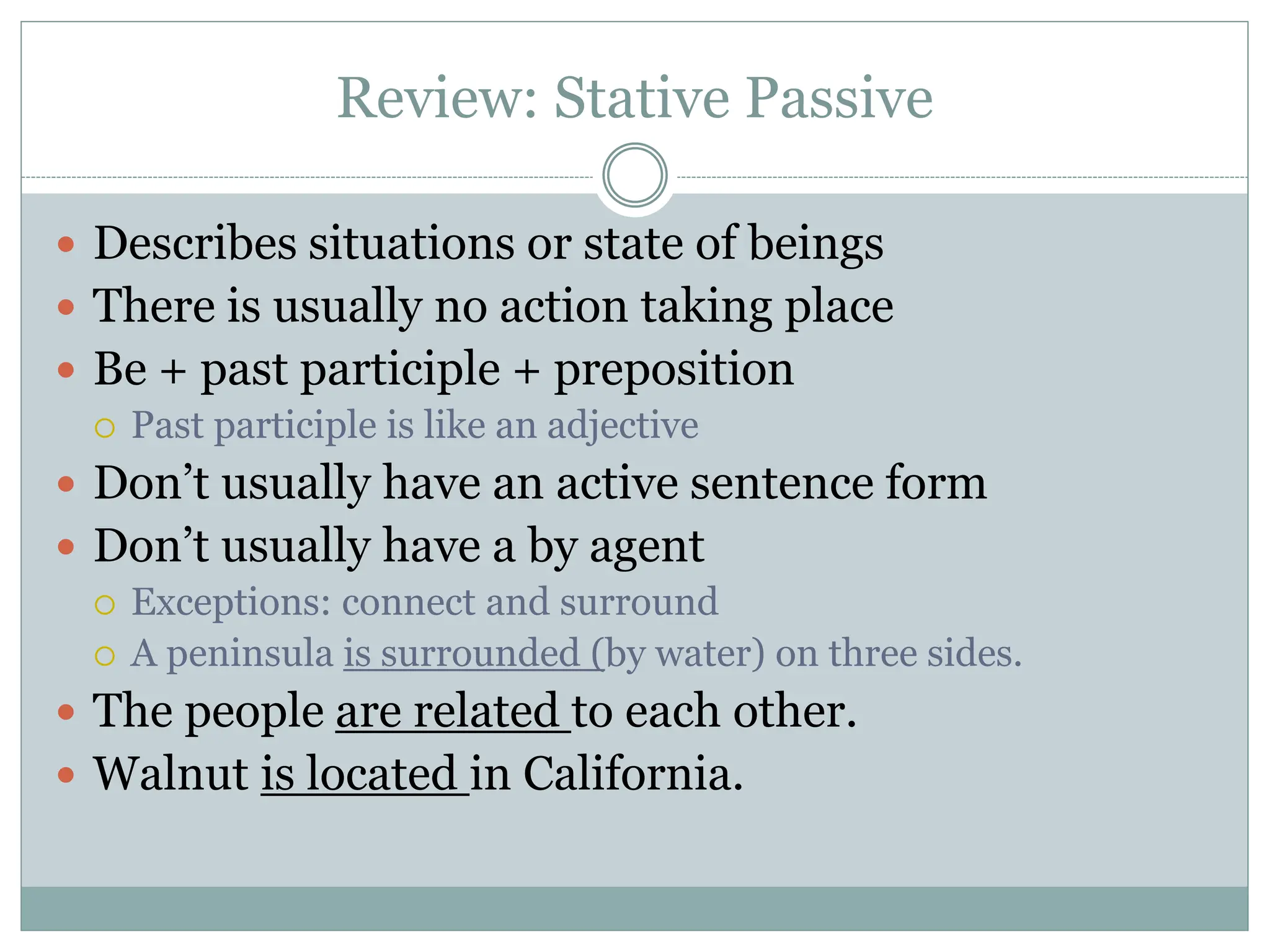
Review: Stative Passive
 Describes situations or state of beings
 There is usually no action taking place
 Be + past participle + preposition
 Past participle is like an adjective
 Don’t usually have an active sentence form
 Don’t usually have a by agent
 Exceptions: connect and surround
 A peninsula is surrounded (by water) on three sides.
 The people are related to each other.
 Walnut is located in California.
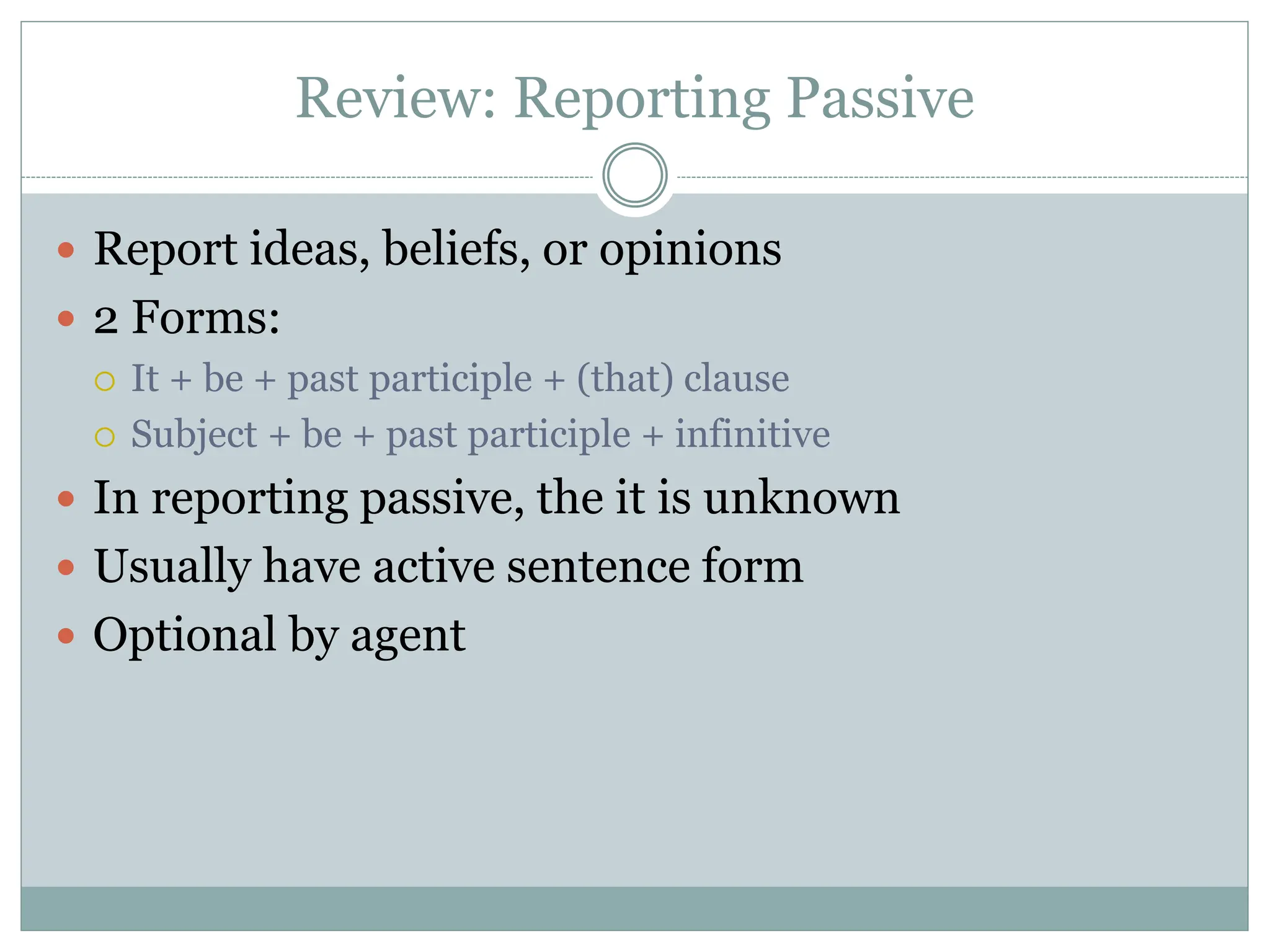
Review: Reporting Passive
 Report ideas, beliefs, or opinions
 2 Forms:
 It + be + past participle + (that) clause
 Subject + be + past participle + infinitive
 In reporting passive, the it is unknown
 Usually have active sentence form
 Optional by agent
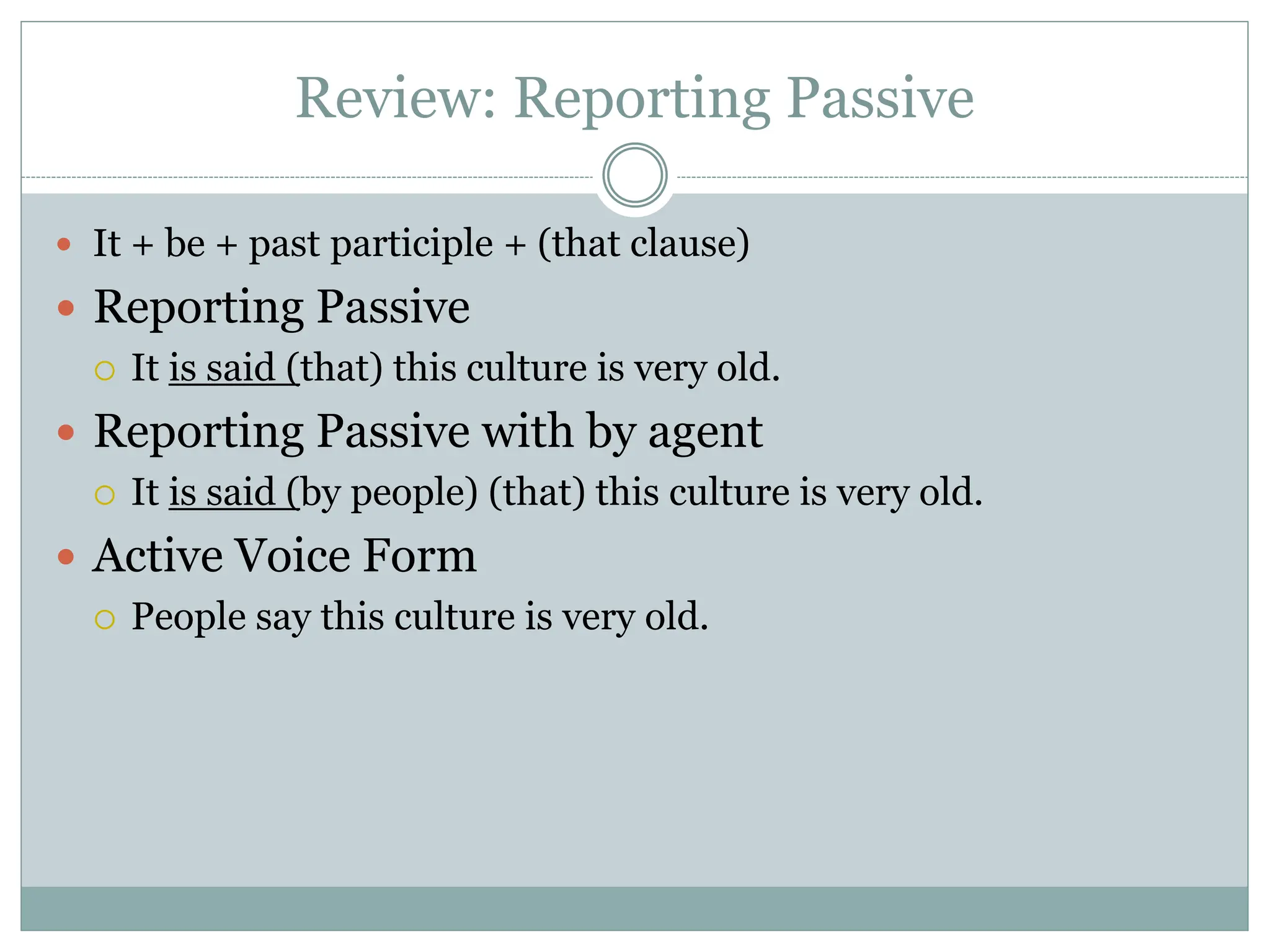
Review: Reporting Passive
 It + be + past participle + (that clause)
 Reporting Passive
 It is said (that) this culture is very old.
 Reporting Passive with by agent
 It is said (by people) (that) this culture is very old.
 Active Voice Form
 People say this culture is very old.
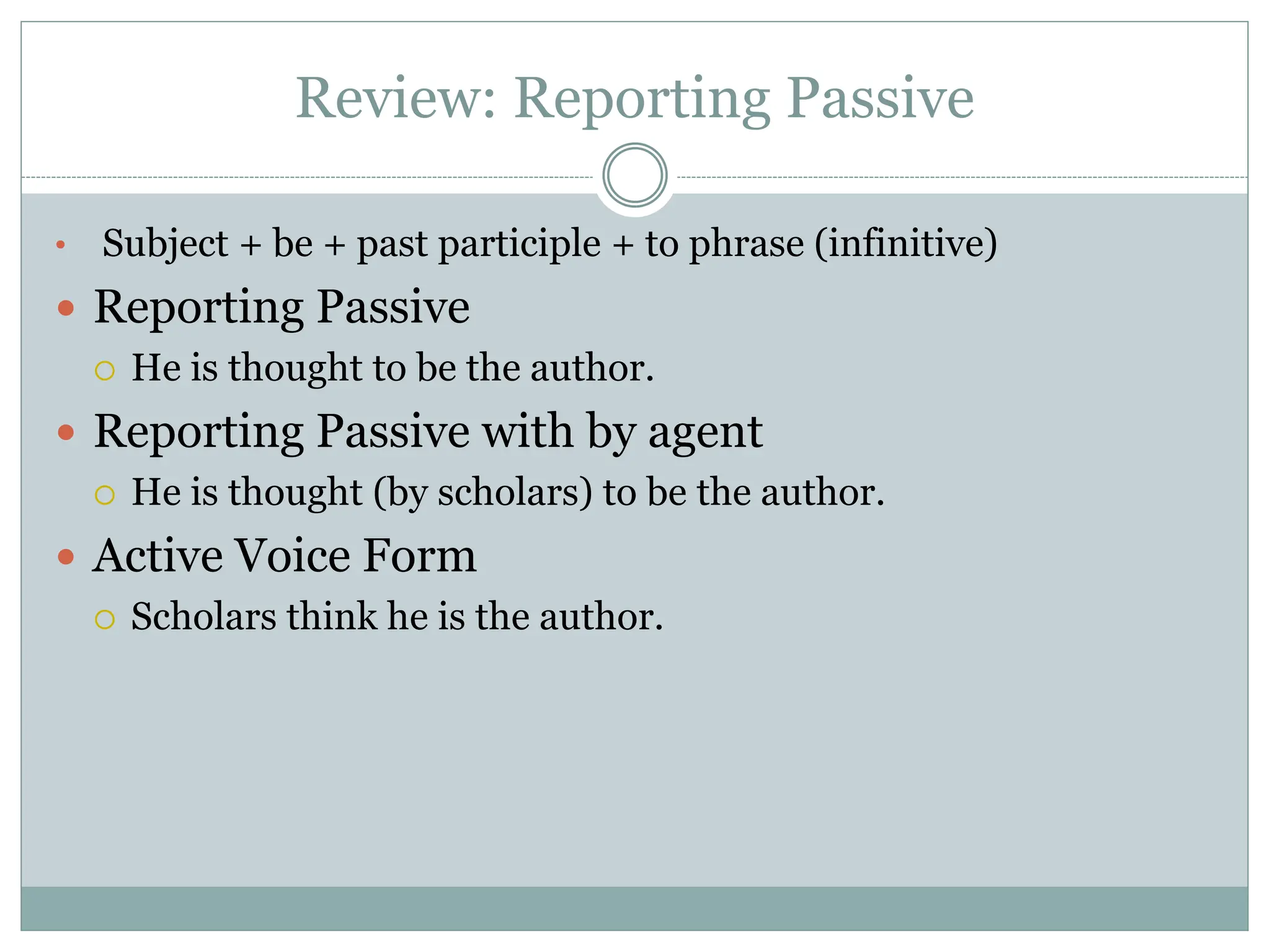
Review: Reporting Passive
• Subject + be + past participle + to phrase (infinitive)
 Reporting Passive
 He is thought to be the author.
 Reporting Passive with by agent
 He is thought (by scholars) to be the author.
 Active Voice Form
 Scholars think he is the author.
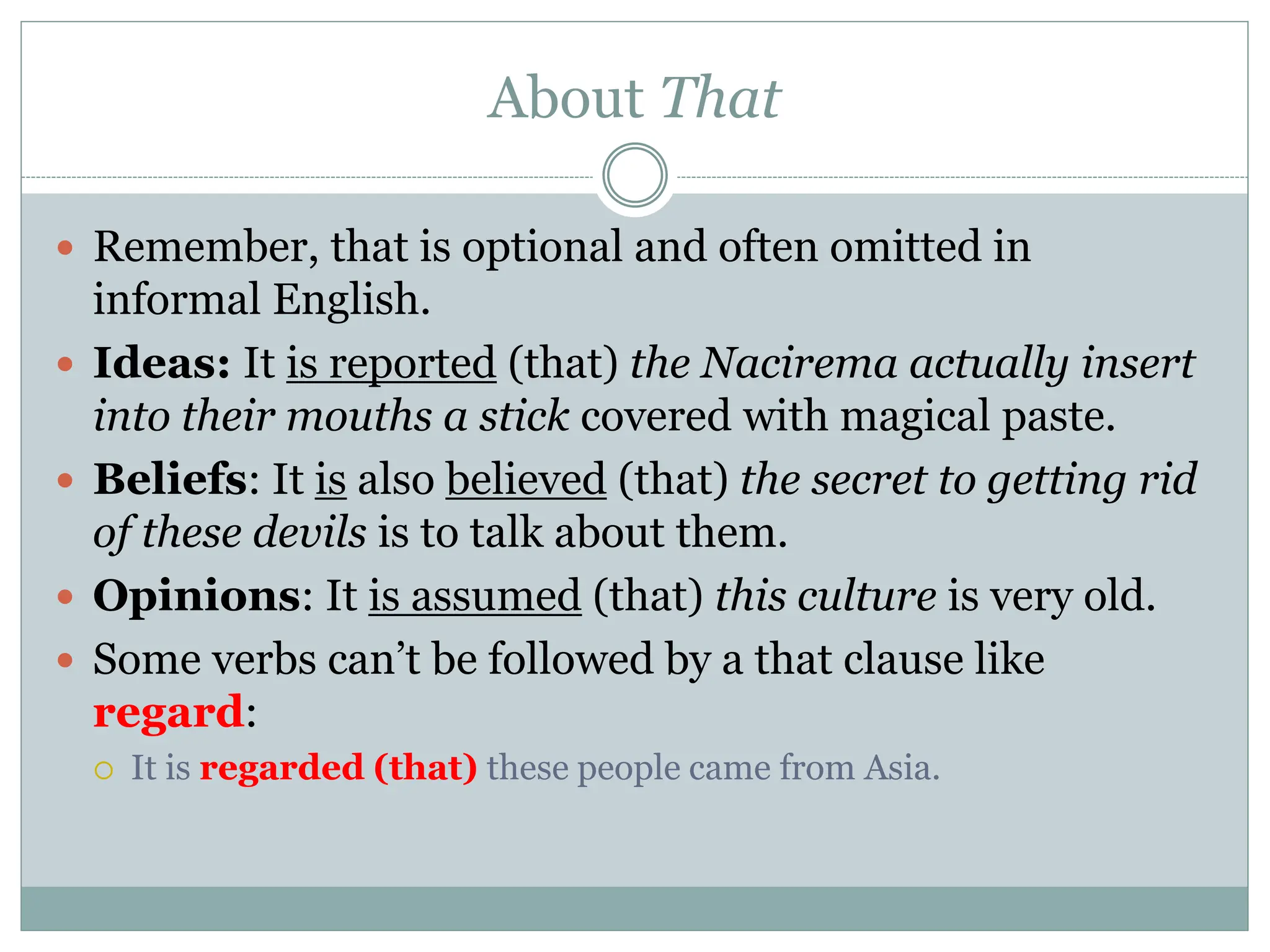
About That
 Remember, that is optional and often omitted in
informal English.
 Ideas: It is reported (that) the Nacirema actually insert
into their mouths a stick covered with magical paste.
 Beliefs: It is also believed (that) the secret to getting rid
of these devils is to talk about them.
 Opinions: It is assumed (that) this culture is very old.
 Some verbs can’t be followed by a that clause like
regard:
 It is regarded (that) these people came from Asia.
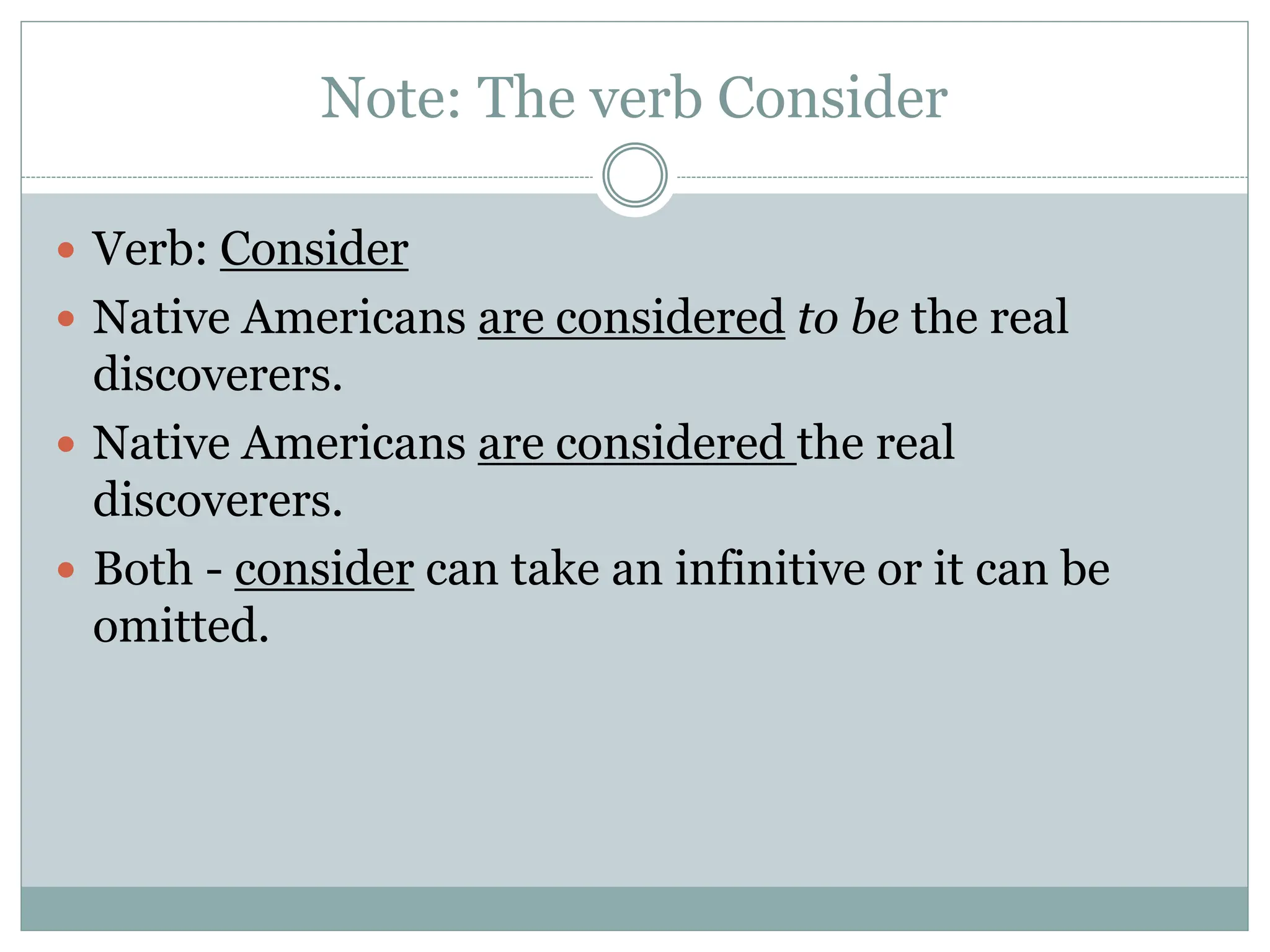
Note: The verb Consider
 Verb: Consider
 Native Americans are considered to be the real
discoverers.
 Native Americans are considered the real
discoverers.
 Both - consider can take an infinitive or it can be
omitted.
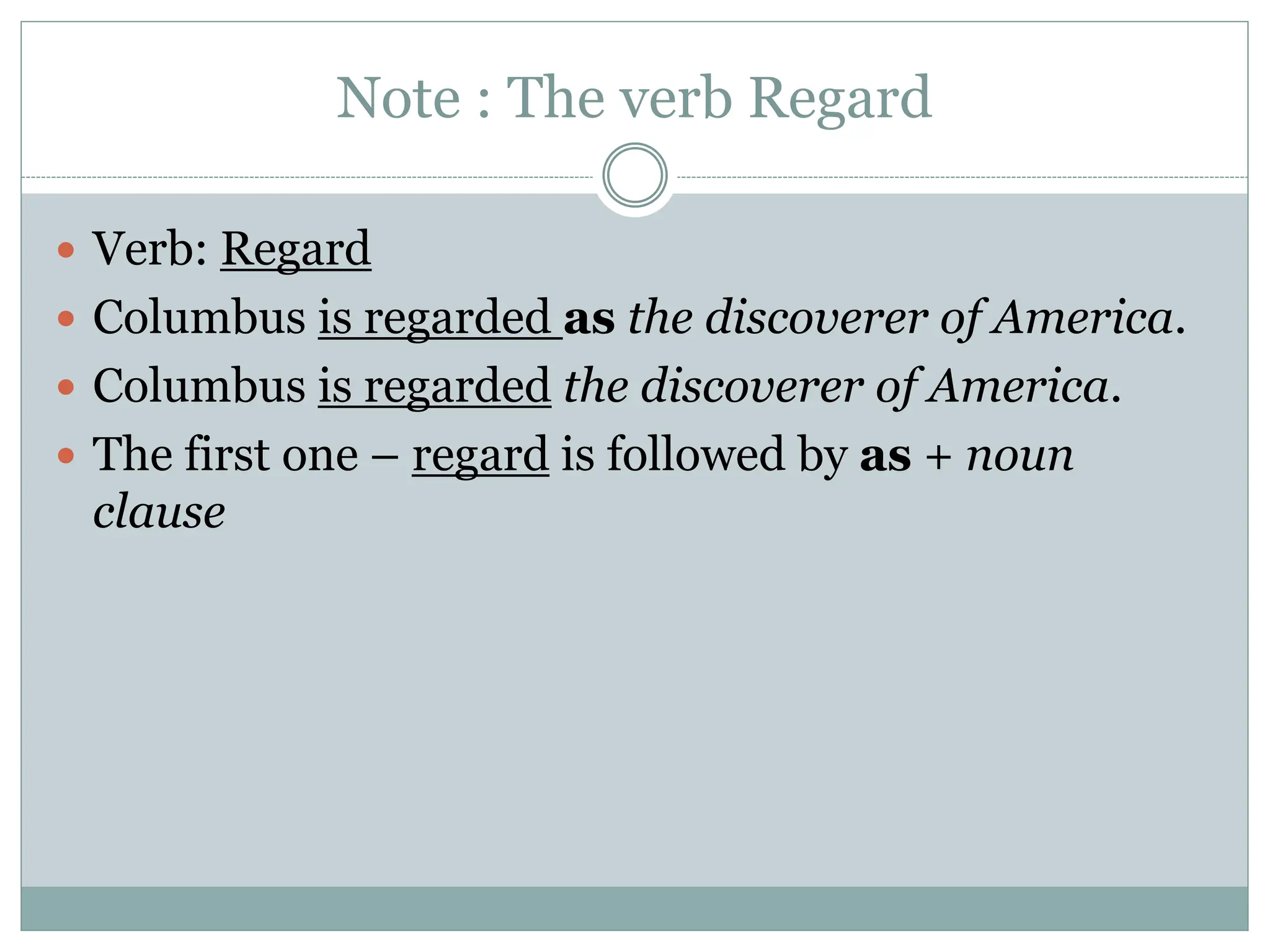
Note : The verb Regard
 Verb: Regard
 Columbus is regarded as the discoverer of America.
 Columbus is regarded the discoverer of America.
 The first one – regard is followed by as + noun
clause
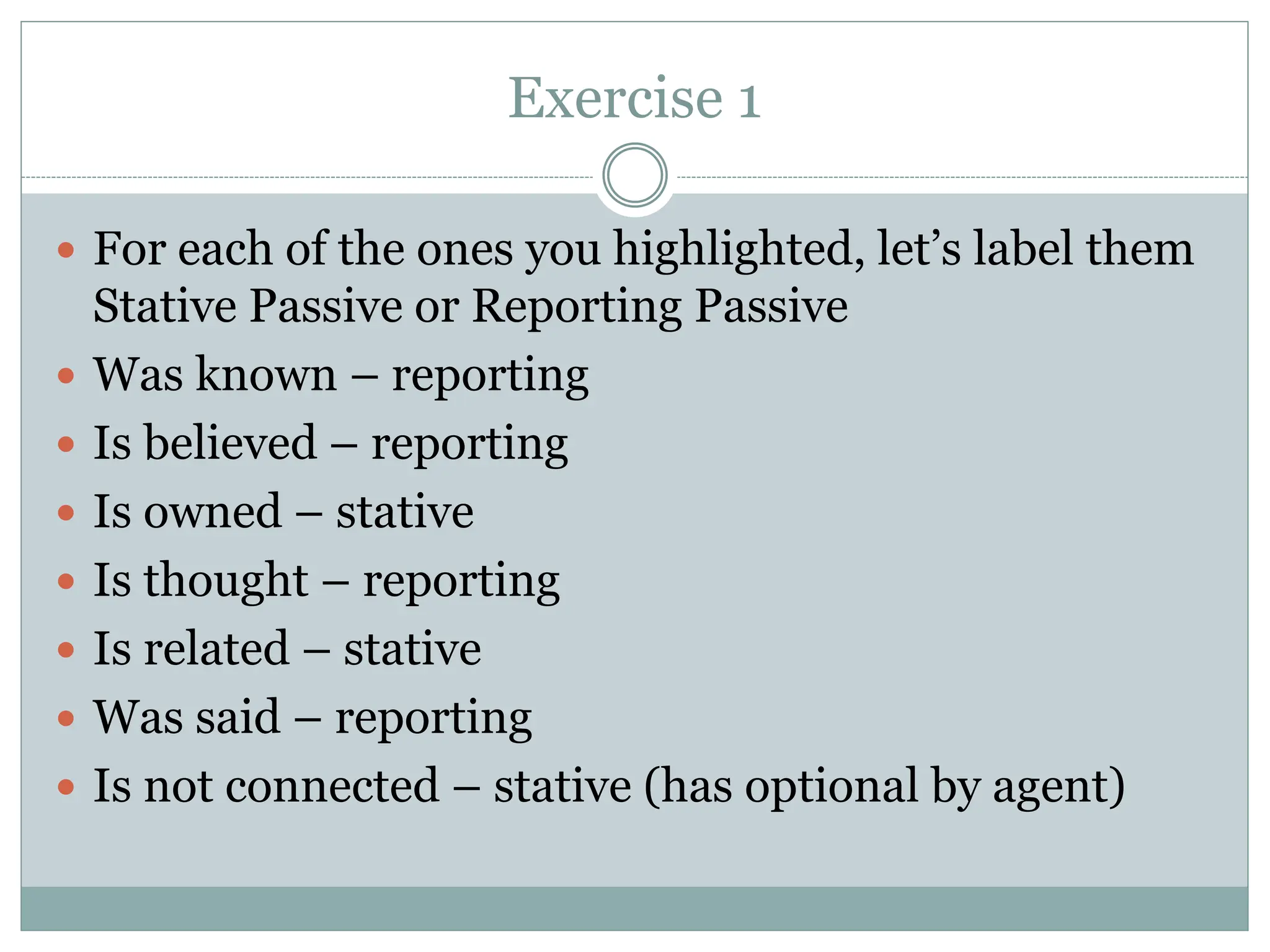
Exercise 1
 For each of the ones you highlighted, let’s label them
Stative Passive or Reporting Passive
 Was known – reporting
 Is believed – reporting
 Is owned – stative
 Is thought – reporting
 Is related – stative
 Was said – reporting
 Is not connected – stative (has optional by agent)
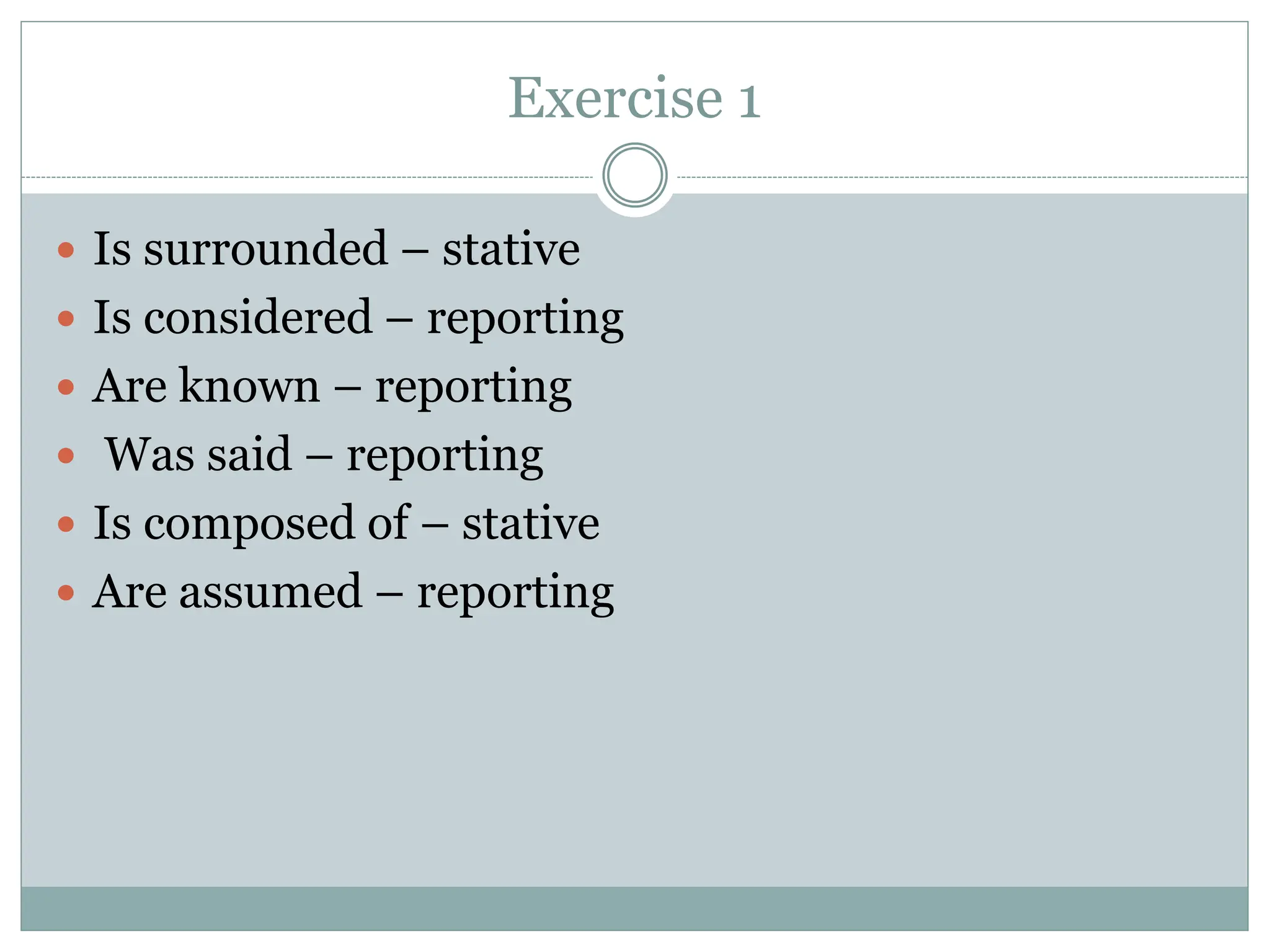
Exercise 1
 Is surrounded – stative
 Is considered – reporting
 Are known – reporting
 Was said – reporting
 Is composed of – stative
 Are assumed – reporting
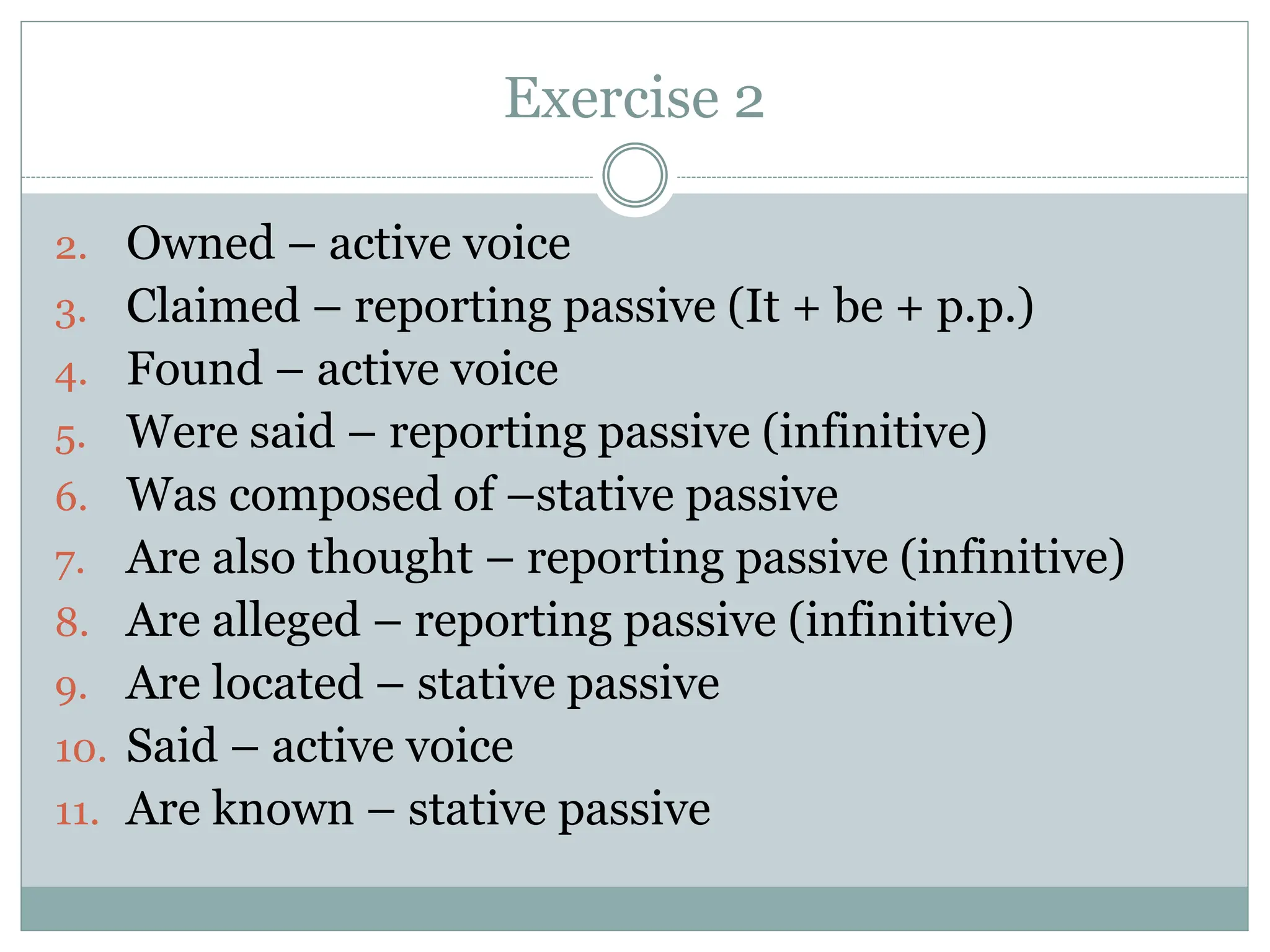
Exercise 2
2. Owned – active voice
3. Claimed – reporting passive (It + be + p.p.)
4. Found – active voice
5. Were said – reporting passive (infinitive)
6. Was composed of –stative passive
7. Are also thought – reporting passive (infinitive)
8. Are alleged – reporting passive (infinitive)
9. Are located – stative passive
10. Said – active voice
11. Are known – stative passive
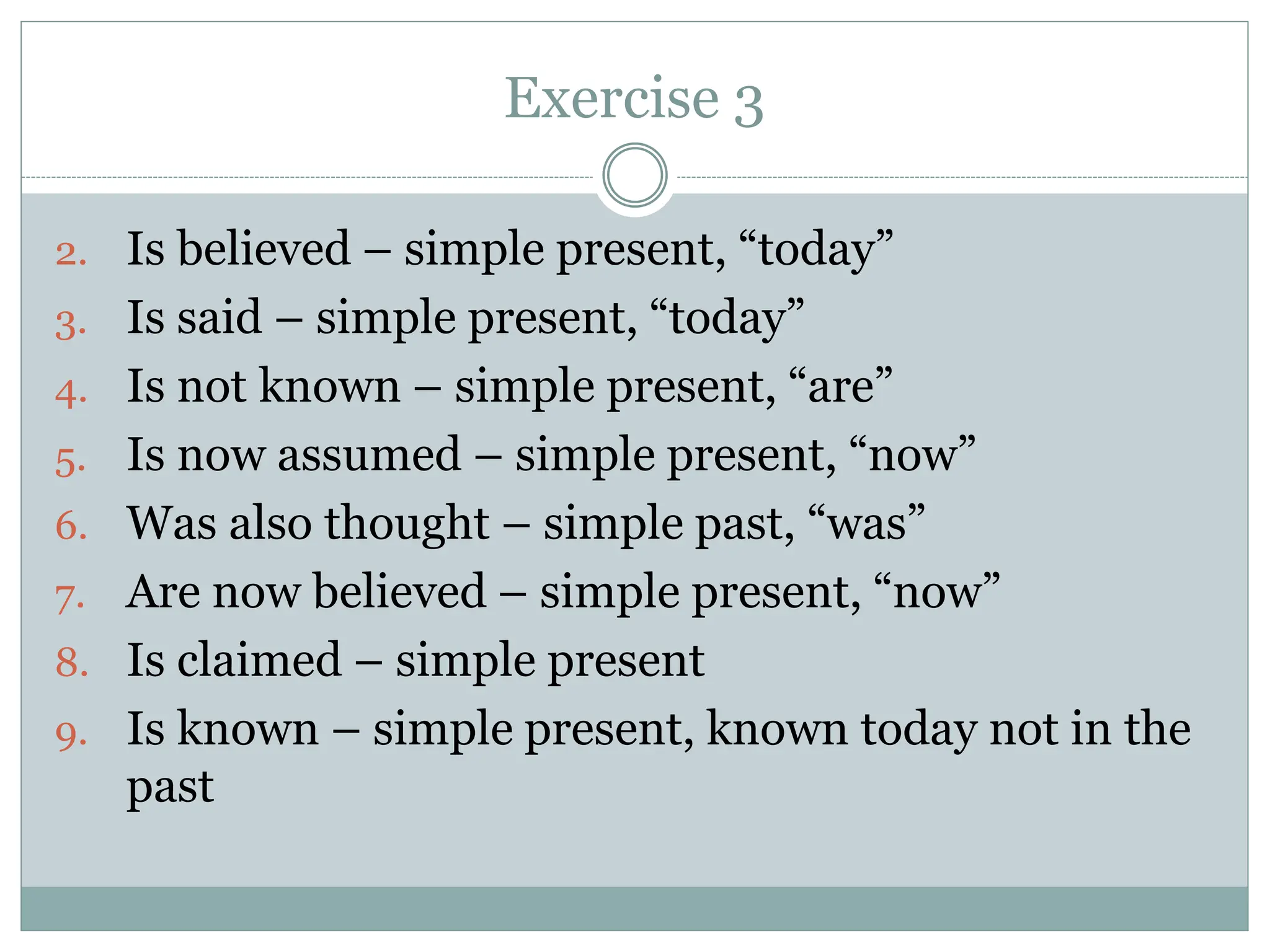
Exercise 3
2. Is believed – simple present, “today”
3. Is said – simple present, “today”
4. Is not known – simple present, “are”
5. Is now assumed – simple present, “now”
6. Was also thought – simple past, “was”
7. Are now believed – simple present, “now”
8. Is claimed – simple present
9. Is known – simple present, known today not in the
past
Exercise 3
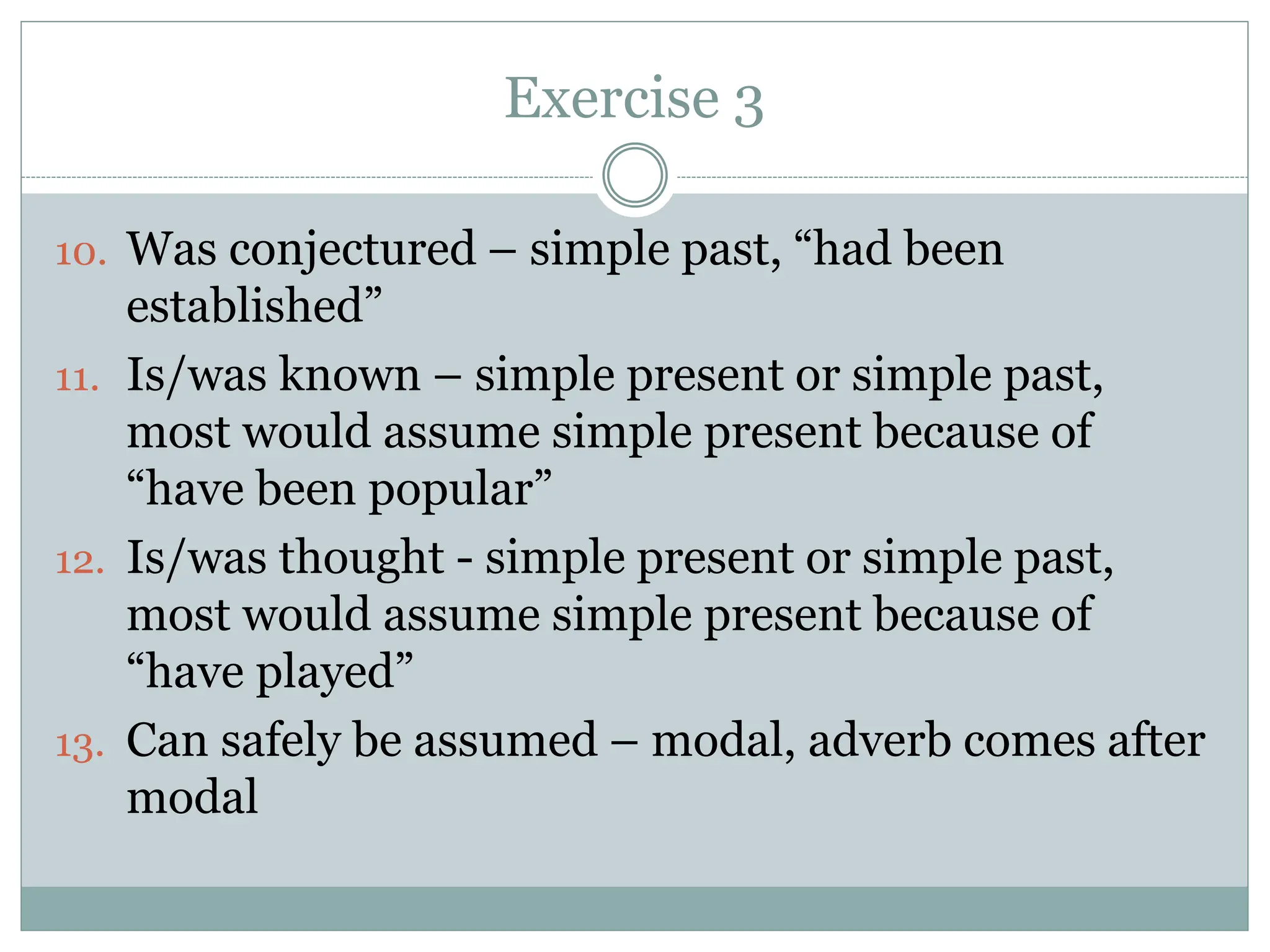
10. Was conjectured – simple past, “had been
established”
11. Is/was known – simple present or simple past,
most would assume simple present because of
“have been popular”
12. Is/was thought - simple present or simple past,
most would assume simple present because of
“have played”
13. Can safely be assumed – modal, adverb comes after
modal
Exercise 4
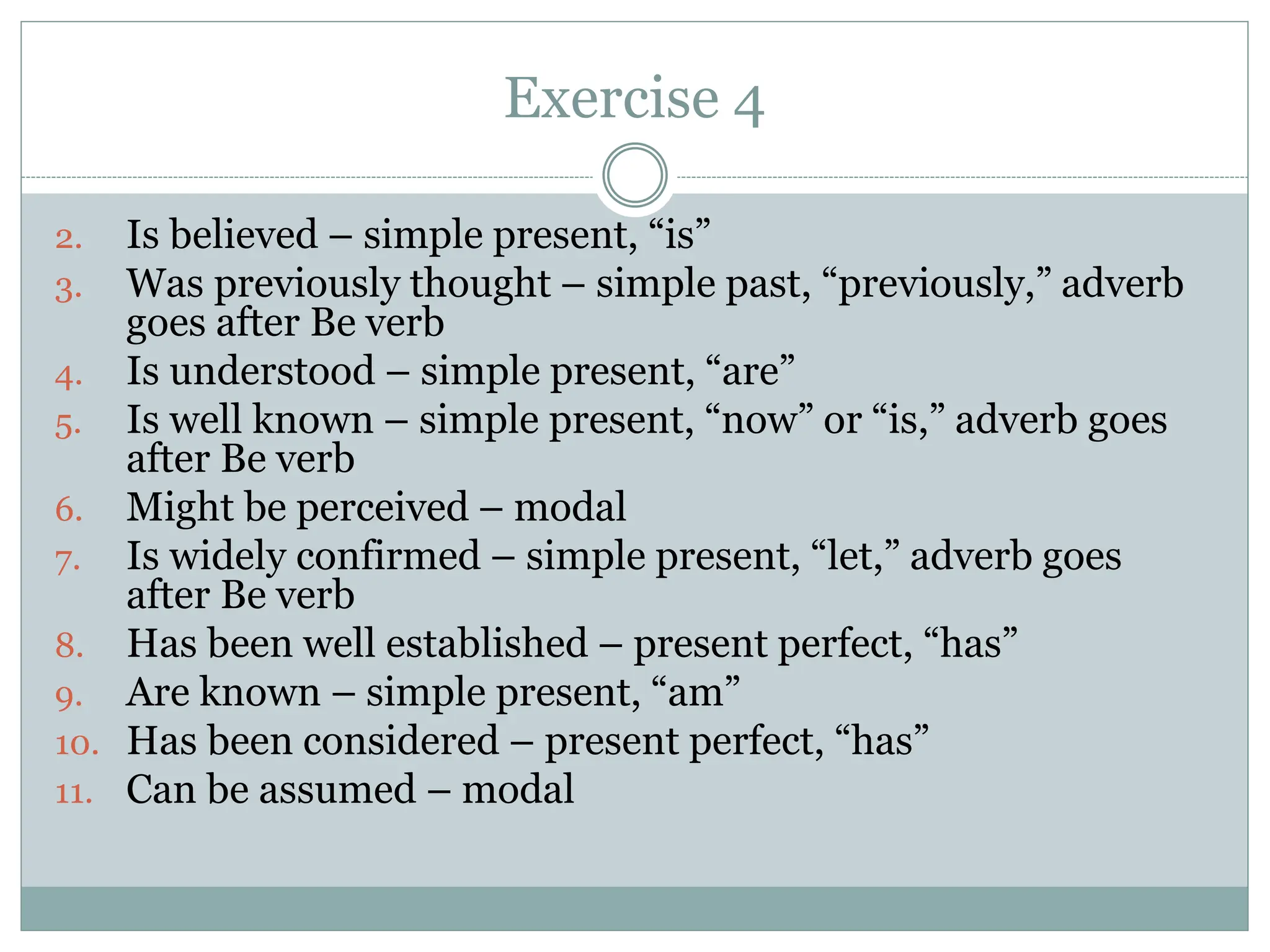
2. Is believed – simple present, “is”
3. Was previously thought – simple past, “previously,” adverb
goes after Be verb
4. Is understood – simple present, “are”
5. Is well known – simple present, “now” or “is,” adverb goes
after Be verb
6. Might be perceived – modal
7. Is widely confirmed – simple present, “let,” adverb goes
after Be verb
8. Has been well established – present perfect, “has”
9. Are known – simple present, “am”
10. Has been considered – present perfect, “has”
11. Can be assumed – modal

Passive Stative PowerPoint; Inlingua DC; Level 4; Grammar 1A.pptx

  • 1.
    U N IT 1 5 : S T A T I V E P A S S I V E & R E P O R T I N G P A S S I V E Paul Nicklas Inlingua DC, ILI MD
  • 2.
    Review: Stative Passive Describes situations or state of beings  There is usually no action taking place  Be + past participle + preposition  Past participle is like an adjective  Don’t usually have an active sentence form  Don’t usually have a by agent  Exceptions: connect and surround  A peninsula is surrounded (by water) on three sides.  The people are related to each other.  Walnut is located in California.
  • 3.
    Review: Reporting Passive Report ideas, beliefs, or opinions  2 Forms:  It + be + past participle + (that) clause  Subject + be + past participle + infinitive  In reporting passive, the it is unknown  Usually have active sentence form  Optional by agent
  • 4.
    Review: Reporting Passive It + be + past participle + (that clause)  Reporting Passive  It is said (that) this culture is very old.  Reporting Passive with by agent  It is said (by people) (that) this culture is very old.  Active Voice Form  People say this culture is very old.
  • 5.
    Review: Reporting Passive •Subject + be + past participle + to phrase (infinitive)  Reporting Passive  He is thought to be the author.  Reporting Passive with by agent  He is thought (by scholars) to be the author.  Active Voice Form  Scholars think he is the author.
  • 6.
    About That  Remember,that is optional and often omitted in informal English.  Ideas: It is reported (that) the Nacirema actually insert into their mouths a stick covered with magical paste.  Beliefs: It is also believed (that) the secret to getting rid of these devils is to talk about them.  Opinions: It is assumed (that) this culture is very old.  Some verbs can’t be followed by a that clause like regard:  It is regarded (that) these people came from Asia.
  • 7.
    Note: The verbConsider  Verb: Consider  Native Americans are considered to be the real discoverers.  Native Americans are considered the real discoverers.  Both - consider can take an infinitive or it can be omitted.
  • 8.
    Note : Theverb Regard  Verb: Regard  Columbus is regarded as the discoverer of America.  Columbus is regarded the discoverer of America.  The first one – regard is followed by as + noun clause
  • 9.
    Exercise 1  Foreach of the ones you highlighted, let’s label them Stative Passive or Reporting Passive  Was known – reporting  Is believed – reporting  Is owned – stative  Is thought – reporting  Is related – stative  Was said – reporting  Is not connected – stative (has optional by agent)
  • 10.
    Exercise 1  Issurrounded – stative  Is considered – reporting  Are known – reporting  Was said – reporting  Is composed of – stative  Are assumed – reporting
  • 11.
    Exercise 2 2. Owned– active voice 3. Claimed – reporting passive (It + be + p.p.) 4. Found – active voice 5. Were said – reporting passive (infinitive) 6. Was composed of –stative passive 7. Are also thought – reporting passive (infinitive) 8. Are alleged – reporting passive (infinitive) 9. Are located – stative passive 10. Said – active voice 11. Are known – stative passive
  • 12.
    Exercise 3 2. Isbelieved – simple present, “today” 3. Is said – simple present, “today” 4. Is not known – simple present, “are” 5. Is now assumed – simple present, “now” 6. Was also thought – simple past, “was” 7. Are now believed – simple present, “now” 8. Is claimed – simple present 9. Is known – simple present, known today not in the past
  • 13.
    Exercise 3 10. Wasconjectured – simple past, “had been established” 11. Is/was known – simple present or simple past, most would assume simple present because of “have been popular” 12. Is/was thought - simple present or simple past, most would assume simple present because of “have played” 13. Can safely be assumed – modal, adverb comes after modal
  • 14.
    Exercise 4 2. Isbelieved – simple present, “is” 3. Was previously thought – simple past, “previously,” adverb goes after Be verb 4. Is understood – simple present, “are” 5. Is well known – simple present, “now” or “is,” adverb goes after Be verb 6. Might be perceived – modal 7. Is widely confirmed – simple present, “let,” adverb goes after Be verb 8. Has been well established – present perfect, “has” 9. Are known – simple present, “am” 10. Has been considered – present perfect, “has” 11. Can be assumed – modal