passivevoice
form
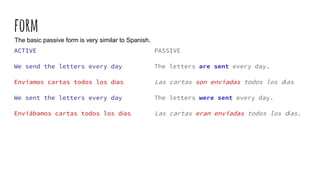
ACTIVE
We send the letters every day
Enviamos cartas todos los días
We sent the letters every day
Enviábamos cartas todos los días
PASSIVE
The letters are sent every day.
Las cartas son enviadas todos los días
The letters were sent every day.
Las cartas eran enviadas todos los días.
The basic passive form is very similar to Spanish.
Form
We form the passive sentence with the verb to be and the past
participle (-ed/third column).
The “tense” name indicates the tense of the verb to be. For
example:
Present simple passive:
People make omelettes with eggs → Omelettes are made of
eggs.
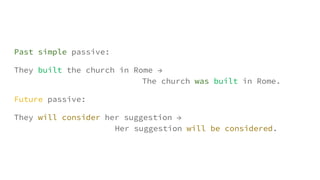
Past simple passive:
They built the church in Rome →
The church was built in Rome.
Future passive:
They will consider her suggestion →
Her suggestion will be considered.
If the verb has a modal, it modifies the verb to be as well:
You must not restart the computer
→ The computer must not be restarted
You should clean your room
→ Your room should be cleaned
A great writer must have written that poem
→ That poem must have been written by a great writer
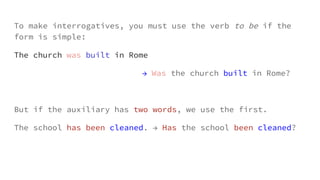
To make interrogatives, you must use the verb to be if the
form is simple:
The church was built in Rome
→ Was the church built in Rome?
But if the auxiliary has two words, we use the first.
The school has been cleaned. → Has the school been cleaned?
howweusethepassive
1)Passive sentences are more common in English than in
Spanish
2)We use them to give more importance to the passive
subject, or because the agent is unknown or irrelevant.
3)We use “by” to refer to the person doing the action. It
can be ommitted.
The book was written in 1670
The book was written in 1670 by an Italian poet.
Howweusethepassive
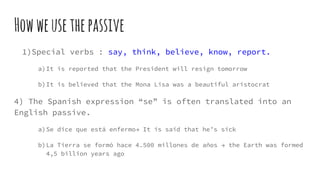
1)Special verbs : say, think, believe, know, report.
a)It is reported that the President will resign tomorrow
b)It is believed that the Mona Lisa was a beautiful aristocrat
4) The Spanish expression “se” is often translated into an
English passive.
a)Se dice que está enfermo→ It is said that he’s sick
b)La Tierra se formó hace 4.500 millones de años → the Earth was formed
4,5 billion years ago
Doublepassives
We make two passive sentences with some verbs. For example:
Mr. Johnson sent Martha a letter.
A letter was sent to Martha (by Mr. Johnson)
Martha was sent a letter (by Mr. Johnson)
The Spanish translation will be different:
Una carta fue enviada a Martha (por Mr. Johnson).
*Marta fue enviada una carta A Marta le enviaron una carta.
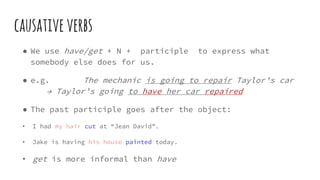
causativeverbs
● We use have/get + N + participle to express what
somebody else does for us.
● e.g. The mechanic is going to repair Taylor’s car
→ Taylor’s going to have her car repaired
● The past participle goes after the object:
• I had my hair cut at “Jean David”.
• Jake is having his house painted today.
• get is more informal than have
Passive

Passive

  • 1.
  • 2.
    form ACTIVE We send theletters every day Enviamos cartas todos los días We sent the letters every day Enviábamos cartas todos los días PASSIVE The letters are sent every day. Las cartas son enviadas todos los días The letters were sent every day. Las cartas eran enviadas todos los días. The basic passive form is very similar to Spanish.
  • 3.
    Form We form thepassive sentence with the verb to be and the past participle (-ed/third column). The “tense” name indicates the tense of the verb to be. For example: Present simple passive: People make omelettes with eggs → Omelettes are made of eggs.
  • 4.
    Past simple passive: Theybuilt the church in Rome → The church was built in Rome. Future passive: They will consider her suggestion → Her suggestion will be considered.
  • 5.
    If the verbhas a modal, it modifies the verb to be as well: You must not restart the computer → The computer must not be restarted You should clean your room → Your room should be cleaned A great writer must have written that poem → That poem must have been written by a great writer
  • 6.
    To make interrogatives,you must use the verb to be if the form is simple: The church was built in Rome → Was the church built in Rome? But if the auxiliary has two words, we use the first. The school has been cleaned. → Has the school been cleaned?
  • 7.
    howweusethepassive 1)Passive sentences aremore common in English than in Spanish 2)We use them to give more importance to the passive subject, or because the agent is unknown or irrelevant. 3)We use “by” to refer to the person doing the action. It can be ommitted. The book was written in 1670 The book was written in 1670 by an Italian poet.
  • 8.
    Howweusethepassive 1)Special verbs :say, think, believe, know, report. a)It is reported that the President will resign tomorrow b)It is believed that the Mona Lisa was a beautiful aristocrat 4) The Spanish expression “se” is often translated into an English passive. a)Se dice que está enfermo→ It is said that he’s sick b)La Tierra se formó hace 4.500 millones de años → the Earth was formed 4,5 billion years ago
  • 9.
    Doublepassives We make twopassive sentences with some verbs. For example: Mr. Johnson sent Martha a letter. A letter was sent to Martha (by Mr. Johnson) Martha was sent a letter (by Mr. Johnson) The Spanish translation will be different: Una carta fue enviada a Martha (por Mr. Johnson). *Marta fue enviada una carta A Marta le enviaron una carta.
  • 10.
    causativeverbs ● We usehave/get + N + participle to express what somebody else does for us. ● e.g. The mechanic is going to repair Taylor’s car → Taylor’s going to have her car repaired ● The past participle goes after the object: • I had my hair cut at “Jean David”. • Jake is having his house painted today. • get is more informal than have