Canada A powerpoint presentation
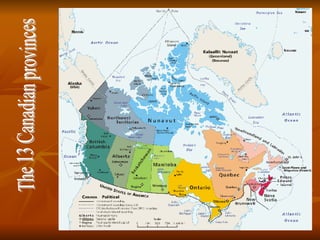
The 13 Canadian provinces
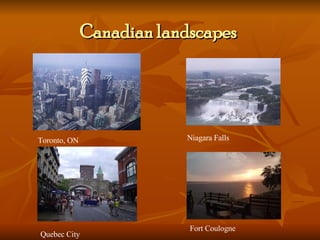
Canadian landscapes  Toronto, ON Niagara Falls Quebec City Fort Coulogne
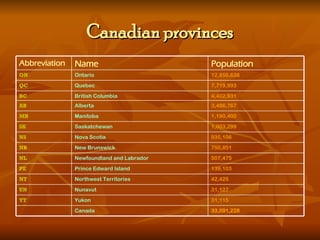
Canadian provinces 33,091,228 Canada 31,115 Yukon YT 31,127 Nunavut UN 42,425 Northwest Territories NT 139,103 Prince Edward Island PE 507,475 Newfoundland and Labrador NL 750,851 New Brunswick NB 935,106 Nova Scotia NS 1,003,299 Saskatchewan SK 1,190,400 Manitoba MB 3,486,767 Alberta AB 4,402,931 British Columbia BC 7,719,993 Quebec QC 12,850,636   Ontario ON Population Name Abbreviation
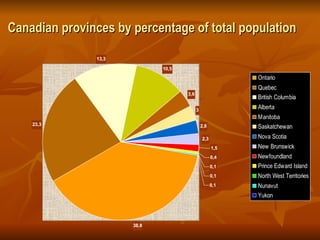
Canadian provinces by percentage of total population
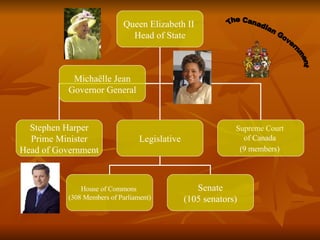
The Canadian Government Queen Elizabeth II  Head of State Stephen Harper Prime Minister Head of Government Legislative Supreme   Court   of   Canada   (9 members)   House of Commons  (308 Members of Parliament) Senate (105 senators) Michaëlle Jean Governor General
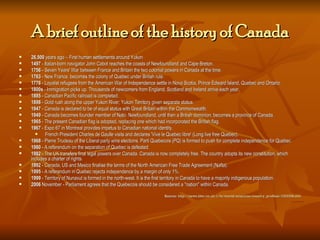
A brief outline of the history of Canada 26,500  years ago – First human settlements around Yukon 1497  - Italian-born navigator John Cabot reaches the coasts of Newfoundland and Cape Breton.  1756  - Seven Years' War between France and Britain the two colonial powers in Canada at the time. 1763  - New France, becomes the colony of Quebec under British rule.  1776  - Loyalist refugees from the American War of Independence settle in Nova Scotia, Prince Edward Island, Quebec and Ontario.  1800s  - Immigration picks up. Thousands of newcomers from England, Scotland and Ireland arrive each year.  1885  - Canadian Pacific railroad is completed.  1898  - Gold rush along the upper Yukon River; Yukon Territory given separate status.  1947  - Canada is declared to be of equal status with Great Britain within the Commonwealth.  1949  - Canada becomes founder member of Nato. Newfoundland, until then a British dominion, becomes a province of Canada.  1965  - The present Canadian flag is adopted, replacing one which had incorporated the British flag.  1967  - Expo 67 in Montreal provides impetus to Canadian national identity.  French President Charles de Gaulle visits and declares 'Vive le Quebec libre' (Long live free Quebec).  1968  - Pierre Trudeau of the Liberal party wins elections. Parti Quebecois (PQ) is formed to push for complete independence for Quebec.  1980  - A referendum on the separation of Quebec is defeated.  1982  - The UK transfers final legal powers over Canada. Canada is now completely free. The country adopts its new constitution, which includes a charter of rights.  1992  - Canada, US and Mexico finalise the terms of the North American Free Trade Agreement (Nafta).  1995  - A referendum in Quebec rejects independence by a margin of only 1%.  1999  - Territory of Nunavut is formed in the north-west. It is the first territory in Canada to have a majority indigenous population.  2006  November - Parliament agrees that the Quebecois should be considered a "nation" within Canada.   Source:  http://news.bbc.co.uk/1/hi/world/americas/country_profiles/1203358.stm
Sources and extra information http://news.bbc.co.uk/1/hi/world/americas/country_profiles/1203358.stm http://en.wikipedia.org/wiki/Canada http://hdrstats.undp.org/countries/country_fact_sheets/cty_fs_CAN.html http://www.gc.ca/

Proyectofinal

  • 1.
    Canada A powerpointpresentation
  • 2.
    The 13 Canadianprovinces
  • 3.
    Canadian landscapes Toronto, ON Niagara Falls Quebec City Fort Coulogne
  • 4.
    Canadian provinces 33,091,228Canada 31,115 Yukon YT 31,127 Nunavut UN 42,425 Northwest Territories NT 139,103 Prince Edward Island PE 507,475 Newfoundland and Labrador NL 750,851 New Brunswick NB 935,106 Nova Scotia NS 1,003,299 Saskatchewan SK 1,190,400 Manitoba MB 3,486,767 Alberta AB 4,402,931 British Columbia BC 7,719,993 Quebec QC 12,850,636 Ontario ON Population Name Abbreviation
  • 5.
    Canadian provinces bypercentage of total population
  • 6.
    The Canadian GovernmentQueen Elizabeth II Head of State Stephen Harper Prime Minister Head of Government Legislative Supreme Court of Canada (9 members) House of Commons (308 Members of Parliament) Senate (105 senators) Michaëlle Jean Governor General
  • 7.
    A brief outlineof the history of Canada 26,500 years ago – First human settlements around Yukon 1497 - Italian-born navigator John Cabot reaches the coasts of Newfoundland and Cape Breton. 1756 - Seven Years' War between France and Britain the two colonial powers in Canada at the time. 1763 - New France, becomes the colony of Quebec under British rule. 1776 - Loyalist refugees from the American War of Independence settle in Nova Scotia, Prince Edward Island, Quebec and Ontario. 1800s - Immigration picks up. Thousands of newcomers from England, Scotland and Ireland arrive each year. 1885 - Canadian Pacific railroad is completed. 1898 - Gold rush along the upper Yukon River; Yukon Territory given separate status. 1947 - Canada is declared to be of equal status with Great Britain within the Commonwealth. 1949 - Canada becomes founder member of Nato. Newfoundland, until then a British dominion, becomes a province of Canada. 1965 - The present Canadian flag is adopted, replacing one which had incorporated the British flag. 1967 - Expo 67 in Montreal provides impetus to Canadian national identity. French President Charles de Gaulle visits and declares 'Vive le Quebec libre' (Long live free Quebec). 1968 - Pierre Trudeau of the Liberal party wins elections. Parti Quebecois (PQ) is formed to push for complete independence for Quebec. 1980 - A referendum on the separation of Quebec is defeated. 1982 - The UK transfers final legal powers over Canada. Canada is now completely free. The country adopts its new constitution, which includes a charter of rights. 1992 - Canada, US and Mexico finalise the terms of the North American Free Trade Agreement (Nafta). 1995 - A referendum in Quebec rejects independence by a margin of only 1%. 1999 - Territory of Nunavut is formed in the north-west. It is the first territory in Canada to have a majority indigenous population. 2006 November - Parliament agrees that the Quebecois should be considered a "nation" within Canada. Source: http://news.bbc.co.uk/1/hi/world/americas/country_profiles/1203358.stm
  • 8.
    Sources and extrainformation http://news.bbc.co.uk/1/hi/world/americas/country_profiles/1203358.stm http://en.wikipedia.org/wiki/Canada http://hdrstats.undp.org/countries/country_fact_sheets/cty_fs_CAN.html http://www.gc.ca/