Development of GIs in Eastern European countries Lessons learned from experiences and projects in southeast Europe Kiev, 25 August 2011
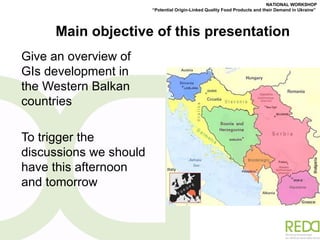
Main objective of this presentation  Give an overview of GIs development in the Western Balkan countries To trigger the discussions we should have this afternoon and tomorrow
Food and agriculture sector transition Yugoslavian agro-industrial sector,  formal marketing channels were mostly supplied by Agrokombinats and cooperatives 85% of land owned by small-scale farmers who sold to products through informal channel or cooperatives kombinats were the only users of protected geographic indications As of 1990 emergence of new types of farmers and food  processors product quality in the benefit of consumers
What Yugoslavia breakdown changed at institutional level? During Yugoslav period:  Geographical Indications as a intellectual property tool at international level… only !  Part of all relevant international treaties (Paris, Madrid, Lisbon) sui generis  protection system  Post-Yugoslav period:  Main reforms driven by EU accession process GIs become a tool for RD and food quality  Increased role and competence of the Ministries of Agriculture
Projects in support to sector transition and institutional reforms FAO Case studies (see  http://www.foodquality-origin.org ) Research projects in Serbia and Macedonia Product identification survey in Croatia (Paski sir, Drniski Prsut, Istarski Prsut)  Bi-lateral assistance project in Bosnia (Cheese from Livno and Cheese in the sack) Technical assistance project in Serbia Support to quality food products in Croatia for improved backward linkages between local agrifood companies and farmers (FAO)
Protection and valorisation of traditional cheeses in Herzegovina: Phases of the project Activate, protect local resources  (sensibilization of the producers and other stakeholders) Qualify a product  (definition of technical specification of the product, certification, etc.) Commercialization  (promotion, education on food, events, fairs, etc..) Integration with the territory  (gastronomic itineraries, inclusion in regional brand, etc.) The applied approach is very close to the one proposed by FAO guide  “ Linking people, places and products (http://www.foodquality-origin.org/guide/guide.pdf)
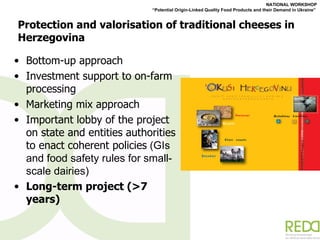
Protection and valorisation of traditional cheeses in Herzegovina Bottom-up approach Investment support to on-farm processing Marketing mix approach Important lobby of the project on state and entities authorities to enact coherent policies  (GIs and food safety rules for small-scale dairies) Long-term project (>7 years)
Support to quality food products in Croatia for improved backward linkages between local agrifood companies and farmers  Objectives :  support development of sustainable GIs in Croatia by: enhancing the capacity of public actors in supporting GI development and protection, and strengthening dialogue and cooperation with producers enhancing marketing organization and development of GI strategies along the value chain and within the territory Supporting qualification of GI products (a sausage and a mandarine)
Support to quality food products in Croatia for improved backward linkages between local agrifood companies and farmers Approach and challenges Address in parallel producers and institutions needs  Very advanced reform process – project focusing on the GI commission At producer level, main challenge is to find common interests of large and small scale stakeholders, farmers and post-harvest players.
Lessons learned from EU experiences and research Important preliminary note No significant socio-economic impacts with GIs that make compromise with the  quality  of the products No significant impact without strong collective organisations able to act as  one unique firm Rural development  dimension implies an increased role of the institutions in charge of RD (e.g. MinAgri)
Lessons learned Shift from intellectual property to RD and quality tool: a slow process Competition between governmental organisations (Intellectual Property and Ministries of Agriculture) Objective of authorities is often to register as many GI as possible  The lack of patience of GI producers who want quick results after engaging in a registration process Lack of understanding of the GI concept as it is perceived and used in the frame of EU policy General consensus to register as quickly as possible GIs with low economic, social or environment impact
Lessons learned Government institutions fear to loose control and power  Reluctance to place the producers at the centre of the process Reluctance to give other stakeholders decisive role (e.g. for certification and control, opposition procedure) Tendency to keep the procedures non-transparent (secret code of practices)
Lessons learned What is quality? Technocratic approach: quality is measured with quantitative indicators (use of laboratory, chemical analysis) Normative approach: quality labels perceived as tools to solve the food safety challenges to comply with EU regulations and access international markets  The organoleptic aspects start to be part of quality
Lessons learned Legislation reform does not imply automatic enforcement  In many countries legislation and regulations reforms progress without new rules being implemented especially in the field of  control and certification . This result in: Use of geographic indications by non authorised producers Non respect of the code of practices  No traceability of products Lack of trust of consumers
Lessons learned Modus operandi of implemented projects Projects assist: institutions in reforming legal framework and defining efficient procedures specific GI producers in their effort of registration and management of GI products But iterative processes in which both levels  “ feed ”  each other Recommended duration: ≥ 3 years
Lesson learned Needs and possible assistance Clarification of legal status and roles of institutions  Clarification and transparency of registration procedures (Application analysis, GI commission, Registration guide for producers) Empowerment to producer organisations  Networking, coordination between institutions  Implementation of certification and control  Official label  Information and promotion to consumers
Thanks for your attention Pascal Bernardoni [email_address] REDD SA Avenue Charles-Dickens 6 - 1006 Lausanne – Switzerland

Pascal redd experiences and project in southeast europe 0

  • 1.
    Development of GIsin Eastern European countries Lessons learned from experiences and projects in southeast Europe Kiev, 25 August 2011
  • 2.
    Main objective ofthis presentation Give an overview of GIs development in the Western Balkan countries To trigger the discussions we should have this afternoon and tomorrow
  • 3.
    Food and agriculturesector transition Yugoslavian agro-industrial sector, formal marketing channels were mostly supplied by Agrokombinats and cooperatives 85% of land owned by small-scale farmers who sold to products through informal channel or cooperatives kombinats were the only users of protected geographic indications As of 1990 emergence of new types of farmers and food processors product quality in the benefit of consumers
  • 4.
    What Yugoslavia breakdownchanged at institutional level? During Yugoslav period: Geographical Indications as a intellectual property tool at international level… only ! Part of all relevant international treaties (Paris, Madrid, Lisbon) sui generis protection system Post-Yugoslav period: Main reforms driven by EU accession process GIs become a tool for RD and food quality Increased role and competence of the Ministries of Agriculture
  • 5.
    Projects in supportto sector transition and institutional reforms FAO Case studies (see http://www.foodquality-origin.org ) Research projects in Serbia and Macedonia Product identification survey in Croatia (Paski sir, Drniski Prsut, Istarski Prsut) Bi-lateral assistance project in Bosnia (Cheese from Livno and Cheese in the sack) Technical assistance project in Serbia Support to quality food products in Croatia for improved backward linkages between local agrifood companies and farmers (FAO)
  • 6.
    Protection and valorisationof traditional cheeses in Herzegovina: Phases of the project Activate, protect local resources (sensibilization of the producers and other stakeholders) Qualify a product (definition of technical specification of the product, certification, etc.) Commercialization (promotion, education on food, events, fairs, etc..) Integration with the territory (gastronomic itineraries, inclusion in regional brand, etc.) The applied approach is very close to the one proposed by FAO guide “ Linking people, places and products (http://www.foodquality-origin.org/guide/guide.pdf)
  • 7.
    Protection and valorisationof traditional cheeses in Herzegovina Bottom-up approach Investment support to on-farm processing Marketing mix approach Important lobby of the project on state and entities authorities to enact coherent policies (GIs and food safety rules for small-scale dairies) Long-term project (>7 years)
  • 8.
    Support to qualityfood products in Croatia for improved backward linkages between local agrifood companies and farmers Objectives : support development of sustainable GIs in Croatia by: enhancing the capacity of public actors in supporting GI development and protection, and strengthening dialogue and cooperation with producers enhancing marketing organization and development of GI strategies along the value chain and within the territory Supporting qualification of GI products (a sausage and a mandarine)
  • 9.
    Support to qualityfood products in Croatia for improved backward linkages between local agrifood companies and farmers Approach and challenges Address in parallel producers and institutions needs Very advanced reform process – project focusing on the GI commission At producer level, main challenge is to find common interests of large and small scale stakeholders, farmers and post-harvest players.
  • 10.
    Lessons learned fromEU experiences and research Important preliminary note No significant socio-economic impacts with GIs that make compromise with the quality of the products No significant impact without strong collective organisations able to act as one unique firm Rural development dimension implies an increased role of the institutions in charge of RD (e.g. MinAgri)
  • 11.
    Lessons learned Shiftfrom intellectual property to RD and quality tool: a slow process Competition between governmental organisations (Intellectual Property and Ministries of Agriculture) Objective of authorities is often to register as many GI as possible The lack of patience of GI producers who want quick results after engaging in a registration process Lack of understanding of the GI concept as it is perceived and used in the frame of EU policy General consensus to register as quickly as possible GIs with low economic, social or environment impact
  • 12.
    Lessons learned Governmentinstitutions fear to loose control and power Reluctance to place the producers at the centre of the process Reluctance to give other stakeholders decisive role (e.g. for certification and control, opposition procedure) Tendency to keep the procedures non-transparent (secret code of practices)
  • 13.
    Lessons learned Whatis quality? Technocratic approach: quality is measured with quantitative indicators (use of laboratory, chemical analysis) Normative approach: quality labels perceived as tools to solve the food safety challenges to comply with EU regulations and access international markets The organoleptic aspects start to be part of quality
  • 14.
    Lessons learned Legislationreform does not imply automatic enforcement In many countries legislation and regulations reforms progress without new rules being implemented especially in the field of control and certification . This result in: Use of geographic indications by non authorised producers Non respect of the code of practices No traceability of products Lack of trust of consumers
  • 15.
    Lessons learned Modusoperandi of implemented projects Projects assist: institutions in reforming legal framework and defining efficient procedures specific GI producers in their effort of registration and management of GI products But iterative processes in which both levels “ feed ” each other Recommended duration: ≥ 3 years
  • 16.
    Lesson learned Needsand possible assistance Clarification of legal status and roles of institutions Clarification and transparency of registration procedures (Application analysis, GI commission, Registration guide for producers) Empowerment to producer organisations Networking, coordination between institutions Implementation of certification and control Official label Information and promotion to consumers
  • 17.
    Thanks for yourattention Pascal Bernardoni [email_address] REDD SA Avenue Charles-Dickens 6 - 1006 Lausanne – Switzerland

Editor's Notes

  • #3 All the countries Part of YUGOSLAVIA until 1990. COMMON BACKGROUND! BREAKDOWN of Yugoslavia in the 90’s and MARKET ECONOMY
  • #4 REORGANISATION OF THE VALUE CHAINS and CHANGE OF THE ROLE OF THE STATE
  • #5 Existence of number of GEOGRAPHIC INDICATIONS. Changes have taken and are taking place at DIFFERENT PACES. Considering the assessment of the UKRAINIAN SYSTEM, worth to look at SLOVENIA, CROATIA, SERBIA
  • #6 Will present Bosnian the most comprehensive and Croatian project, an FAO project as it could be imagined in the case of Ukraine There are both illustrative of the parallel work to be done at producers and institutions level
  • #7 IDENTIFICATION – QUALIFICATION – REMUNARATION – REPRODUCTION OF LOCAL RESOURCES
  • #8 LIKE IN FAO ROLE OF PUBLIC ACTORS
  • #9 Legal framework is in place, but ENFORCEMENT We are still at the beginning of the project but DIFFERENT INTEREST GROUPS with different practices Lack of TRUST between big players and small and medium scale producers
  • #11 Based on research implemented in EU and Switzerland (Barjolle)
  • #12 Everybody wins except CONSUMERS and some producers (the one producing the real GIs
  • #14 Inheritance of the old System like in Ukraine.
  • #15 This crucial if we want to make sure that the promise to the consumer is respected
  • #16 HIGHLY RECCOMENDED
  • #17 The existing GAPS are very similar to the one in Ukraine 1 USER UNCLEAR COMPETENCES OF OFFICIAL BODIES NO TRANSITIONAL PERIOD NO CONTROL AND CERTIFICATION