DIRECT INVESTMENT IN FARMER-LED RESEARCH

                Ann Waters-Bayer
      PROLINNOVA Secretariat, ETC Foundation
PROLINNOVA: PROmoting Local INNOVAtion
            in ecologically oriented agriculture and NRM


“Global Partnership Programme” under GFAR –
initiated by CSOs

Multi-stakeholder community of practice (CoP)
focused on smallholder farming

Seeks to make farmer-led joint innovation
processes an everyday part of formal
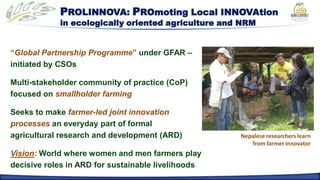
agricultural research and development (ARD)         Nepalese researchers learn
                                                       from farmer innovator
Vision: World where women and men farmers play
decisive roles in ARD for sustainable livelihoods
International CoP of diverse actors
                               who see that:
                                          Farmers are creative and generate relevant
                                           local innovations = locally new & better
                                           ways of doing things
                                          Linking local creativity with other sources
                                           of new ideas builds more resilient
                                           innovation systems to deal with change
Pastoral women in Ethiopia developed      Recognising local capacities lays basis for
new dairy marketing arrangements
                                           successful and equitable partnership with
                                           other knowledge-holders in ARD
Main activities of PROLINNOVA partners

 Strengthening national & subnational multistakeholder platforms
  to work and learn together

 Showing the potential of decentralised farmer-led ARD:
 - Identifying processes of local technical and social innovation
 - Using these as entry points for Participatory Innovation Development (PID)

 Building capacity of scientists, rural advisors, collage/university staff,
 farmers and other local entrepreneurs to engage in PID

 Engaging in policy dialogue to mainstream this approach
Challenge
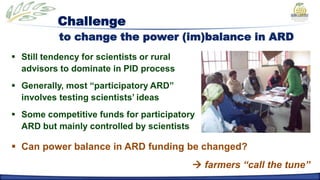
           to change the power (im)balance in ARD
 Still tendency for scientists or rural
  advisors to dominate in PID process
 Generally, most “participatory ARD”
  involves testing scientists’ ideas
 Some competitive funds for participatory
  ARD but mainly controlled by scientists

 Can power balance in ARD funding be changed?
                                            farmers “call the tune”
Experiences with decentralised ARD funding

        Local Innovation Support Funds (LISFs)
 so smallholders can decide what will
  be researched, how and by whom

 to make ARD more accountable to
  and relevant for smallholders

 to develop and test models of investment
  in farmer-governed ARD to be scaled up

 as a complement to conventional investment in ARD
Fund management committees’ criteria
           for screening farmers’ proposals

 Idea driven by farmer applicant(s)

 Innovation sound in economic,
  environmental & social terms

 Applicable by resource-poor

 Applicants willing to share results       Fund Management Committee (FMC)
                                            screening applications in South Africa

 Proposal for experimentation and learning, not farm investment
Grants in 8 pilot countries over 4 years

 No. of applications        Percentage       Average grant size   Range in grant size
      received               approved             (Euro)               (Euro)
          1224                 64%                  84                 5 - 1670

                                         Use of funds as decided by FMCs:
                                         1. Farmers’ own experimentation
                                         2. Improving farmer innovations

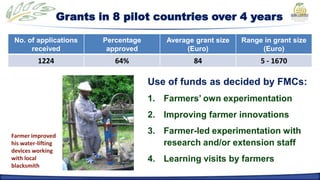
Farmer improved
                                         3. Farmer-led experimentation with
his water-lifting                           research and/or extension staff
devices working
with local                               4. Learning visits by farmers
blacksmith
Participatory impact assessment

                              Involvement of different actors in LISF piloting:
                              • Strengthened social organisation around
                                managing local ARD and funds for it
                              • Built smallholders’ capacities to formulate
                                own needs and access relevant information
                              • Increased smallholders’ confidence to
                                interact with “outsiders” in joint innovation
                              • Stimulated interest of rural advisors and (some)
Ethiopian farmer explains
his experiment to MoA staff     scientists to support farmer-led PID
Some challenges remain ….

 Difficult to generate in-country funding:
   – trying partial repayment by farmers: private investment in public goods
   – but should (also) be public funds available for this local learning
 Still high transaction costs while piloting:
   – 30–40% of total budget actually goes to farmers
   – rest for coordination, training, advisory support, M&E etc
 Difficult to involve scientists
   – farmers initially want to experiment on own, using local advice / partners
   – scientists have own agenda & little room to support farmer initiatives
But encouraging response from rural advisors exposed to LISFs
Steps towards scaling up LISFs

Partners are documenting workable models and preparing to scale them up
while retaining their smallholder focus and farmer-led character
Scenarios being explored in different countries:
                            Establishing LISF within national farmer organisation
                            Integration into local government administration
                            Integration into MoA extension service
                            Integration into government research
                            Establishing National Innovation Fund (new entity)
                            Based in self-managed and self-resourced CBOs
What action is needed from us in GFAR?

 To support smallholder agriculture, focus attention in public-
  private-civil mechanisms on linkages of formal ARD sector with
  farmers (PS + community actors), SMEs and CSOs at local level

 Seek ways to support manifold and locally appropriate
  mechanisms instead of centralising and homogenising ARD for
  smallholders – and create spaces to learn from the diversity

 Create widespread awareness that sustainable smallholder
  agriculture needs multitude of local learning platforms to develop
  site-appropriate innovations – and to continue to do so.
What do we in PROLINNOVA offer?

Examples of alternative ways to approach ARD partnerships and
funding that give smallholders a chance for more say, to learn with
other knowledge holders and to contribute their knowledge to
continuous and enhanced innovation processes

         Towards action for scaling up by GFAR
 Seriously consider these alternative / complementary approaches
 Try them out in appropriately adapted forms in different settings
 Assess them together with local smallholders
 Learn from this & and from each other’s experiences to improve
  what we have started, so that:
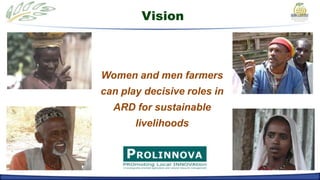
Vision


Women and men farmers
can play decisive roles in
  ARD for sustainable
       livelihoods

C1.2. Direct investment in farmers'led research

  • 1.
    DIRECT INVESTMENT INFARMER-LED RESEARCH Ann Waters-Bayer PROLINNOVA Secretariat, ETC Foundation
  • 2.
    PROLINNOVA: PROmoting LocalINNOVAtion in ecologically oriented agriculture and NRM “Global Partnership Programme” under GFAR – initiated by CSOs Multi-stakeholder community of practice (CoP) focused on smallholder farming Seeks to make farmer-led joint innovation processes an everyday part of formal agricultural research and development (ARD) Nepalese researchers learn from farmer innovator Vision: World where women and men farmers play decisive roles in ARD for sustainable livelihoods
  • 3.
    International CoP ofdiverse actors who see that:  Farmers are creative and generate relevant local innovations = locally new & better ways of doing things  Linking local creativity with other sources of new ideas builds more resilient innovation systems to deal with change Pastoral women in Ethiopia developed  Recognising local capacities lays basis for new dairy marketing arrangements successful and equitable partnership with other knowledge-holders in ARD
  • 4.
    Main activities ofPROLINNOVA partners  Strengthening national & subnational multistakeholder platforms to work and learn together  Showing the potential of decentralised farmer-led ARD: - Identifying processes of local technical and social innovation - Using these as entry points for Participatory Innovation Development (PID)  Building capacity of scientists, rural advisors, collage/university staff, farmers and other local entrepreneurs to engage in PID  Engaging in policy dialogue to mainstream this approach
  • 5.
    Challenge to change the power (im)balance in ARD  Still tendency for scientists or rural advisors to dominate in PID process  Generally, most “participatory ARD” involves testing scientists’ ideas  Some competitive funds for participatory ARD but mainly controlled by scientists  Can power balance in ARD funding be changed?  farmers “call the tune”
  • 6.
    Experiences with decentralisedARD funding Local Innovation Support Funds (LISFs)  so smallholders can decide what will be researched, how and by whom  to make ARD more accountable to and relevant for smallholders  to develop and test models of investment in farmer-governed ARD to be scaled up  as a complement to conventional investment in ARD
  • 7.
    Fund management committees’criteria for screening farmers’ proposals  Idea driven by farmer applicant(s)  Innovation sound in economic, environmental & social terms  Applicable by resource-poor  Applicants willing to share results Fund Management Committee (FMC) screening applications in South Africa  Proposal for experimentation and learning, not farm investment
  • 8.
    Grants in 8pilot countries over 4 years No. of applications Percentage Average grant size Range in grant size received approved (Euro) (Euro) 1224 64% 84 5 - 1670 Use of funds as decided by FMCs: 1. Farmers’ own experimentation 2. Improving farmer innovations Farmer improved 3. Farmer-led experimentation with his water-lifting research and/or extension staff devices working with local 4. Learning visits by farmers blacksmith
  • 9.
    Participatory impact assessment Involvement of different actors in LISF piloting: • Strengthened social organisation around managing local ARD and funds for it • Built smallholders’ capacities to formulate own needs and access relevant information • Increased smallholders’ confidence to interact with “outsiders” in joint innovation • Stimulated interest of rural advisors and (some) Ethiopian farmer explains his experiment to MoA staff scientists to support farmer-led PID
  • 10.
    Some challenges remain….  Difficult to generate in-country funding: – trying partial repayment by farmers: private investment in public goods – but should (also) be public funds available for this local learning  Still high transaction costs while piloting: – 30–40% of total budget actually goes to farmers – rest for coordination, training, advisory support, M&E etc  Difficult to involve scientists – farmers initially want to experiment on own, using local advice / partners – scientists have own agenda & little room to support farmer initiatives But encouraging response from rural advisors exposed to LISFs
  • 11.
    Steps towards scalingup LISFs Partners are documenting workable models and preparing to scale them up while retaining their smallholder focus and farmer-led character Scenarios being explored in different countries:  Establishing LISF within national farmer organisation  Integration into local government administration  Integration into MoA extension service  Integration into government research  Establishing National Innovation Fund (new entity)  Based in self-managed and self-resourced CBOs
  • 12.
    What action isneeded from us in GFAR?  To support smallholder agriculture, focus attention in public- private-civil mechanisms on linkages of formal ARD sector with farmers (PS + community actors), SMEs and CSOs at local level  Seek ways to support manifold and locally appropriate mechanisms instead of centralising and homogenising ARD for smallholders – and create spaces to learn from the diversity  Create widespread awareness that sustainable smallholder agriculture needs multitude of local learning platforms to develop site-appropriate innovations – and to continue to do so.
  • 13.
    What do wein PROLINNOVA offer? Examples of alternative ways to approach ARD partnerships and funding that give smallholders a chance for more say, to learn with other knowledge holders and to contribute their knowledge to continuous and enhanced innovation processes Towards action for scaling up by GFAR  Seriously consider these alternative / complementary approaches  Try them out in appropriately adapted forms in different settings  Assess them together with local smallholders  Learn from this & and from each other’s experiences to improve what we have started, so that:
  • 14.
    Vision Women and menfarmers can play decisive roles in ARD for sustainable livelihoods

Editor's Notes

  • #3 Seeks to promote PPC partnerships at the local level
  • #4 Smallholders: both private-sector + community actors; farmer experimentation/innovation as form of “privately funded” ag research. Successful partnership based on mutual respect.
  • #5 MSPs in 20 countries in Africa, Asia + SA: farmers, rural advisors, local PS, NGOs, scientists, college/ university staff
  • #9 1. + 2. in collaboration with local private sector, such as FIKesMalede working with local blacksmith cum car mechanic to improve water-lifting devices
  • #13 Action for public-private-civil mechanisms to support smallholder agriculture