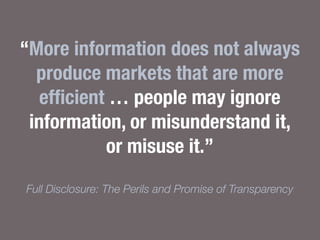
“More information doesnot always
produce markets that are more
efficient … people may ignore
information, or misunderstand it,
or misuse it.”
Full Disclosure: The Perils and Promise of Transparency
29.
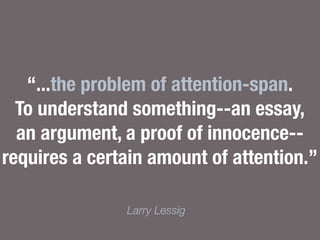
“...the problem ofattention-span.
To understand something--an essay,
an argument, a proof of innocence--
requires a certain amount of attention.”
Larry Lessig
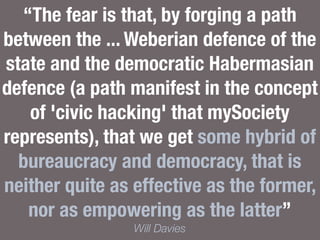
“The fear isthat, by forging a path
between the ... Weberian defence of the
state and the democratic Habermasian
defence (a path manifest in the concept
of 'civic hacking' that mySociety
represents), that we get some hybrid of
bureaucracy and democracy, that is
neither quite as effective as the former,
nor as empowering as the latter”
Will Davies
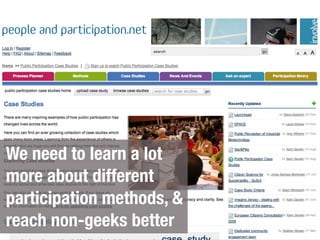
We need tolearn a lot
more about different
participation methods, &
reach non-geeks better
39.
Thanks for listening!
Iam lee@headshift.com
I live at http://www.headshift.com
Except where otherwise stated, photos courtesy of Flickr using Creative Commons license.
Thanks to the following photographers:
http://www.flickr.com/photos/greenpeace_italia/2430328823/
http://www.flickr.com/photos/markrjones/47761183/
http://www.flickr.com/photos/marcn/2174935053/sizes/l/
http://www.flickr.com/photos/wili/1999071010/sizes/l/
http://www.flickr.com/photos/andyarmstrong/4035014763/in/pool-stopthebnp
http://www.flickr.com/photos/arenamontanus/375127836/sizes/o/
http://www.flickr.com/photos/pushandplay/2586461185/in/set-72157603886536530/
http://www.flickr.com/photos/pushandplay/2968259379/
Other references:
http://potlatch.typepad.com/weblog/2009/10/what-is-the-postbureaucratic-state.html
http://www.tnr.com/print/article/books-and-arts/against-transparency


![Mass Collaboration [Policy]: What, Why, and Choices](https://cdn.slidesharecdn.com/ss_thumbnails/mass-collaboration-data-policy-2012-codata-121029212338-phpapp01-thumbnail.jpg?width=640&height=640&fit=bounds)


