Discrete Structures for
Computer Science
Ruoming Jin
MW 2:15 – 3:00pm
Spring 2010
rm MSB115
Course Material
 Textbook: Discrete Mathematics and Its Applications
 Kenneth H. Rosen, McGraw Hill
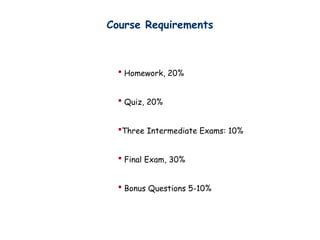
Course Requirements
 Homework, 20%
 Quiz, 20%
Three Intermediate Exams: 10%
 Final Exam, 30%
 Bonus Questions 5-10%
Why Discrete Math?
Design efficient computer systems.
•How did Google manage to build a fast search engine?
•What is the foundation of internet security?
algorithms, data structures, database,
parallel computing, distributed systems,
cryptography, computer networks…
Logic, sets/functions, counting, graph theory…
What is discrete mathematics?
logic, sets, functions, relations, etc
Logic: artificial intelligence (AI), database, circuit design
Counting: probability, analysis of algorithm
Graph theory: computer network, data structures
Number theory: cryptography, coding theory
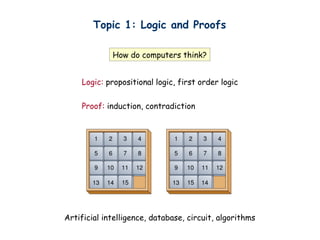
Topic 1: Logic and Proofs
Logic: propositional logic, first order logic
Proof: induction, contradiction
How do computers think?
Artificial intelligence, database, circuit, algorithms
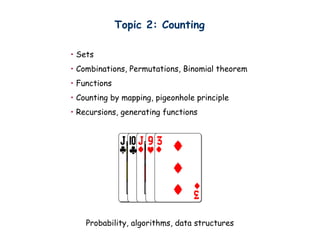
Topic 2: Counting
• Sets
• Combinations, Permutations, Binomial theorem
• Functions
• Counting by mapping, pigeonhole principle
• Recursions, generating functions
Probability, algorithms, data structures
Topic 2: Counting
How many steps are needed to sort n numbers?
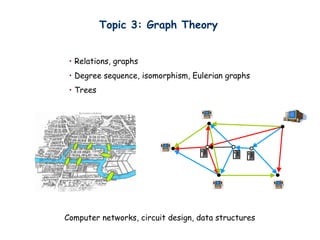
Topic 3: Graph Theory
• Relations, graphs
• Degree sequence, isomorphism, Eulerian graphs
• Trees
Computer networks, circuit design, data structures
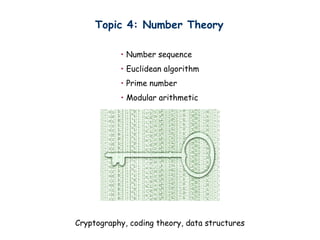
Topic 4: Number Theory
• Number sequence
• Euclidean algorithm
• Prime number
• Modular arithmetic
Cryptography, coding theory, data structures
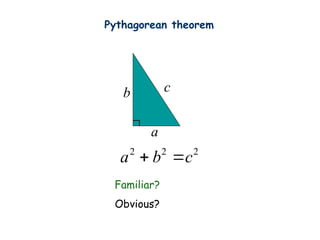
2 2 2
a b c
 
Familiar?
Obvious?
c
b
a
Pythagorean theorem
c
b
a
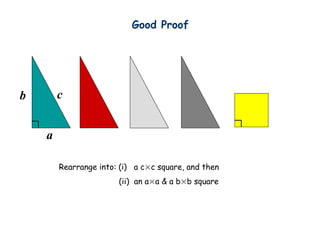
Rearrange into: (i) a cc square, and then
(ii) an aa & a bb square
Good Proof
c
c
c
a b
c
b
-
a
Good Proof
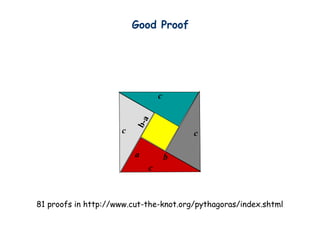
81 proofs in http://www.cut-the-knot.org/pythagoras/index.shtml

Lattice Introduction Discrete Mathematics.ppt

  • 1.
    Discrete Structures for ComputerScience Ruoming Jin MW 2:15 – 3:00pm Spring 2010 rm MSB115
  • 2.
    Course Material  Textbook:Discrete Mathematics and Its Applications  Kenneth H. Rosen, McGraw Hill
  • 3.
    Course Requirements  Homework,20%  Quiz, 20% Three Intermediate Exams: 10%  Final Exam, 30%  Bonus Questions 5-10%
  • 4.
    Why Discrete Math? Designefficient computer systems. •How did Google manage to build a fast search engine? •What is the foundation of internet security? algorithms, data structures, database, parallel computing, distributed systems, cryptography, computer networks… Logic, sets/functions, counting, graph theory…
  • 5.
    What is discretemathematics? logic, sets, functions, relations, etc Logic: artificial intelligence (AI), database, circuit design Counting: probability, analysis of algorithm Graph theory: computer network, data structures Number theory: cryptography, coding theory
  • 6.
    Topic 1: Logicand Proofs Logic: propositional logic, first order logic Proof: induction, contradiction How do computers think? Artificial intelligence, database, circuit, algorithms
  • 7.
    Topic 2: Counting •Sets • Combinations, Permutations, Binomial theorem • Functions • Counting by mapping, pigeonhole principle • Recursions, generating functions Probability, algorithms, data structures
  • 8.
    Topic 2: Counting Howmany steps are needed to sort n numbers?
  • 9.
    Topic 3: GraphTheory • Relations, graphs • Degree sequence, isomorphism, Eulerian graphs • Trees Computer networks, circuit design, data structures
  • 10.
    Topic 4: NumberTheory • Number sequence • Euclidean algorithm • Prime number • Modular arithmetic Cryptography, coding theory, data structures
  • 11.
    2 2 2 ab c   Familiar? Obvious? c b a Pythagorean theorem
  • 12.
    c b a Rearrange into: (i)a cc square, and then (ii) an aa & a bb square Good Proof
  • 13.
    c c c a b c b - a Good Proof 81proofs in http://www.cut-the-knot.org/pythagoras/index.shtml