Supporting exploration and use of
digital cultural heritage materials
Paul Clough
Information School, University of Sheffield, UK
http://www.paths-project.eu/
Presented at the EuropeanaTech conference 2015
The PATHS project
• PATHS (Personalised Access To cultural Heritage Spaces)
project funded under EU FP7
• Multidisciplinary project involving academic and industrial
partners from various disciplines
– Cultural Heritage, Library and Information Science and
Computer Science
• Developed techniques to support expert and non-expert
users with navigating and using records cultural heritage
materials from Europeana
• Investigated use of trails/paths to facilitate narrative-like
structures through digital collections for use as guides and
learning aids (like exhibitions/guides in physical space)
Presented at the EuropeanaTech conference 2015
The PATHS system
• More generally the PATHS system aims to support
information seeking and the information journey
– Recognising an information need
– Acquiring information
– Interpreting and validating this information
– Using the information
• PATHS also aims to support exploration (exploratory
search) and help users to make sense of concepts and
items in a digital library collection (sense-making)
– Providing functionalities to overview collections, aid
interpretation of information, use information to create paths
Presented at the EuropeanaTech conference 2015
Semantic enrichment
• Selection of 1,701,672 English and Spanish records from
Europeana used as dataset but had to deal with a number
of issues
– Limited information associated with items, and lack of unified
indexing scheme
• Additional semantic enrichment used to enable searching
and browsing functionalities
– Identification of key entities (e.g. people and dates)
– Identification of ‘similar’ artefacts and relationship types
– Identification of links to related Wikipedia articles
– Automatic creation of data-driven subject hierarchies
• Enriched data encoded using custom schema (ESEPaths)
based on Europeana Semantic Elements (ESE)
Presented at the EuropeanaTech conference 2015
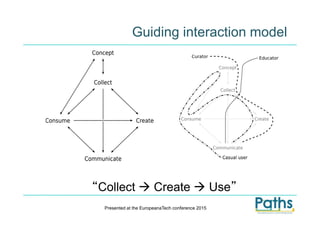
Guiding interaction model
“Collect Create Use”
Presented at the EuropeanaTech conference 2015
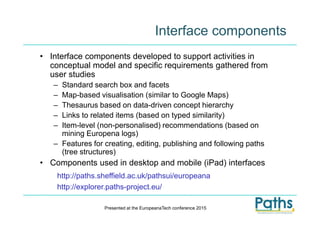
Interface components
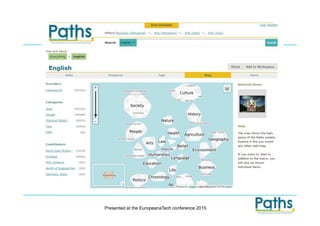
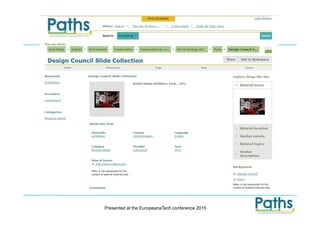
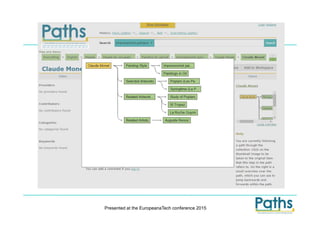
• Interface components developed to support activities in
conceptual model and specific requirements gathered from
user studies
– Standard search box and facets
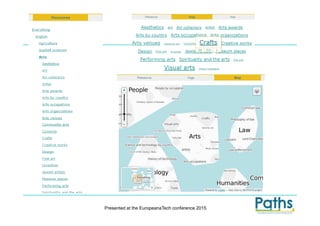
– Map-based visualisation (similar to Google Maps)
– Thesaurus based on data-driven concept hierarchy
– Links to related items (based on typed similarity)
– Item-level (non-personalised) recommendations (based on
mining Europena logs)
– Features for creating, editing, publishing and following paths
(tree structures)
• Components used in desktop and mobile (iPad) interfaces
Presented at the EuropeanaTech conference 2015
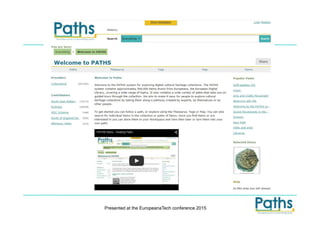
http://paths.sheffield.ac.uk/pathsui/europeana
http://explorer.paths-project.eu/
Presented at the EuropeanaTech conference 2015
• Need to recognise and understand the needs of end users,,
especially non-expert users (e.g. the general public)
• Need to develop information access systems that allow different
types of user to unlock potential of rich content in digital collections
– Require functionalities to help users navigate and make sense of
information in the collections
• Design and development must be multi-disciplinary
• Use of NLP and text mining can enable semantic enrichment
creating opportunities to support the identification, interpretation and
use of relevant items from large-scale collections
Summary
“Cultural heritage involves rich and highly heterogeneous collections that are
challenging to archive and convey to the general public”
(Hardman et al., 2009:23).
Hardman, L., Aroyo, L., van Ossenbruggen, J. and Hyvönen, E. (2009) Using AI to Access and Experience
Cultural Heritage, IEEE Intelligent Systems, 24(2), pp. 23-25.
Presented at the EuropeanaTech conference 2015
Otegi, A.; Agirre, E.; Clough, P., "Personalised PageRank for making recommendations in digital
cultural heritage collections," Digital Libraries (JCDL), 2014 IEEE/ACM Joint Conference on , vol.,
no., pp.49,52, 8-12 Sept. 2014 [Recommendations]
Hall, M., Fernando, S., Clough, P., Soroa, A., Agirre, E., and Stevenson, M. (2014) Evaluating
hierarchical organisation structures for exploring digital libraries, Information Retrieval, Volume
17(4), pp. 351-379. [Automatic hierarchy induction]
Aletras, N., Stevenson, M. and Clough, P. (2013) Computing Similarity between Items in a Digital
Library of Cultural Heritage, Journal on Computing and Cultural Heritage, Volume 5(4), Article 16.
[Similarity of items]
Goodale, P., Clough, P., Hall, M., Stevenson, M, Fernie, K., Griffiths, J., and Agirre, E.
(2013) Pathways to Discovery: Supporting Exploration and Information Use in Cultural Heritage
Collections. In Proceedings of Museums and the Web Asia 2013, Hong Kong, 9-12 December,
2013. [Analysis of manually-created paths]
Agirre, E., Aletras, N., Clough, P., Fernando, S., Goodale, P., Hall, M., Soroa, A., and Stevenson,
M.,(2013) PATHS: A System for Accessing Cultural Heritage Collections, In Proceedings of 51st
Annual Meeting of the Association for Computational Linguistics (ACL'13), Sofia, Bulgaria, August
4-9 2013. pp. 151-166. [Project overview]
Hall, M. and Clough, P. (2013) Exploring Large Digital Library Collections using a Map-based
Visualisation, In Proceedings of The International Conference on Theory and Practice of Digital
Libraries (TPDL 2013), pp. 216-227. [Collection visualisations]

Paul Clough Europeanatech2015

  • 1.
    Supporting exploration anduse of digital cultural heritage materials Paul Clough Information School, University of Sheffield, UK http://www.paths-project.eu/ Presented at the EuropeanaTech conference 2015
  • 2.
    The PATHS project •PATHS (Personalised Access To cultural Heritage Spaces) project funded under EU FP7 • Multidisciplinary project involving academic and industrial partners from various disciplines – Cultural Heritage, Library and Information Science and Computer Science • Developed techniques to support expert and non-expert users with navigating and using records cultural heritage materials from Europeana • Investigated use of trails/paths to facilitate narrative-like structures through digital collections for use as guides and learning aids (like exhibitions/guides in physical space) Presented at the EuropeanaTech conference 2015
  • 3.
    The PATHS system •More generally the PATHS system aims to support information seeking and the information journey – Recognising an information need – Acquiring information – Interpreting and validating this information – Using the information • PATHS also aims to support exploration (exploratory search) and help users to make sense of concepts and items in a digital library collection (sense-making) – Providing functionalities to overview collections, aid interpretation of information, use information to create paths Presented at the EuropeanaTech conference 2015
  • 4.
    Semantic enrichment • Selectionof 1,701,672 English and Spanish records from Europeana used as dataset but had to deal with a number of issues – Limited information associated with items, and lack of unified indexing scheme • Additional semantic enrichment used to enable searching and browsing functionalities – Identification of key entities (e.g. people and dates) – Identification of ‘similar’ artefacts and relationship types – Identification of links to related Wikipedia articles – Automatic creation of data-driven subject hierarchies • Enriched data encoded using custom schema (ESEPaths) based on Europeana Semantic Elements (ESE) Presented at the EuropeanaTech conference 2015
  • 5.
    Guiding interaction model “CollectCreate Use” Presented at the EuropeanaTech conference 2015
  • 6.
    Interface components • Interfacecomponents developed to support activities in conceptual model and specific requirements gathered from user studies – Standard search box and facets – Map-based visualisation (similar to Google Maps) – Thesaurus based on data-driven concept hierarchy – Links to related items (based on typed similarity) – Item-level (non-personalised) recommendations (based on mining Europena logs) – Features for creating, editing, publishing and following paths (tree structures) • Components used in desktop and mobile (iPad) interfaces Presented at the EuropeanaTech conference 2015 http://paths.sheffield.ac.uk/pathsui/europeana http://explorer.paths-project.eu/
  • 7.
    Presented at theEuropeanaTech conference 2015
  • 8.
    Presented at theEuropeanaTech conference 2015
  • 9.
    Presented at theEuropeanaTech conference 2015
  • 10.
    Presented at theEuropeanaTech conference 2015
  • 11.
    Presented at theEuropeanaTech conference 2015
  • 12.
    • Need torecognise and understand the needs of end users,, especially non-expert users (e.g. the general public) • Need to develop information access systems that allow different types of user to unlock potential of rich content in digital collections – Require functionalities to help users navigate and make sense of information in the collections • Design and development must be multi-disciplinary • Use of NLP and text mining can enable semantic enrichment creating opportunities to support the identification, interpretation and use of relevant items from large-scale collections Summary “Cultural heritage involves rich and highly heterogeneous collections that are challenging to archive and convey to the general public” (Hardman et al., 2009:23). Hardman, L., Aroyo, L., van Ossenbruggen, J. and Hyvönen, E. (2009) Using AI to Access and Experience Cultural Heritage, IEEE Intelligent Systems, 24(2), pp. 23-25. Presented at the EuropeanaTech conference 2015
  • 13.
    Presented at theEuropeanaTech conference 2015 Otegi, A.; Agirre, E.; Clough, P., "Personalised PageRank for making recommendations in digital cultural heritage collections," Digital Libraries (JCDL), 2014 IEEE/ACM Joint Conference on , vol., no., pp.49,52, 8-12 Sept. 2014 [Recommendations] Hall, M., Fernando, S., Clough, P., Soroa, A., Agirre, E., and Stevenson, M. (2014) Evaluating hierarchical organisation structures for exploring digital libraries, Information Retrieval, Volume 17(4), pp. 351-379. [Automatic hierarchy induction] Aletras, N., Stevenson, M. and Clough, P. (2013) Computing Similarity between Items in a Digital Library of Cultural Heritage, Journal on Computing and Cultural Heritage, Volume 5(4), Article 16. [Similarity of items] Goodale, P., Clough, P., Hall, M., Stevenson, M, Fernie, K., Griffiths, J., and Agirre, E. (2013) Pathways to Discovery: Supporting Exploration and Information Use in Cultural Heritage Collections. In Proceedings of Museums and the Web Asia 2013, Hong Kong, 9-12 December, 2013. [Analysis of manually-created paths] Agirre, E., Aletras, N., Clough, P., Fernando, S., Goodale, P., Hall, M., Soroa, A., and Stevenson, M.,(2013) PATHS: A System for Accessing Cultural Heritage Collections, In Proceedings of 51st Annual Meeting of the Association for Computational Linguistics (ACL'13), Sofia, Bulgaria, August 4-9 2013. pp. 151-166. [Project overview] Hall, M. and Clough, P. (2013) Exploring Large Digital Library Collections using a Map-based Visualisation, In Proceedings of The International Conference on Theory and Practice of Digital Libraries (TPDL 2013), pp. 216-227. [Collection visualisations]