
COMPLY WITH WORKPLACE
HYGIENE PROCEDURES
Unit Code: D1.HRS.CL1.05
D1.HOT.CL1.04
D2.TTO.CL4.10
Slide 1
Comply with workplace hygiene
procedures
This unit comprises three Elements:
• Follow hygiene procedures
• Identify and prevent hygiene risks
• Maintain safe personal food handling
and personal presentation standards.
Slide 2
Assessment
Assessment for this unit may include:
• Oral questions
• Written questions
• Work projects
• Workplace observation of practical skills
• Practical exercises
• Formal report from employer or
supervisor.
Slide 3
Follow hygiene procedures
Performance Criteria for this Element are:
• Identify relevant workplace hygiene procedures
that need to be adhered to
• Identify enterprise standards and legislated
requirements that apply to relevant workplace
hygiene procedures
• Follow workplace hygiene procedures
in accordance with enterprise standards
and legislated requirements
(Continued)
Slide 4
Follow hygiene procedures
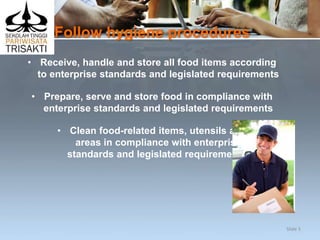
• Receive, handle and store all food items according
to enterprise standards and legislated requirements
• Prepare, serve and store food in compliance with
enterprise standards and legislated requirements
• Clean food-related items, utensils and
areas in compliance with enterprise
standards and legislated requirements.
Slide 5
Identify relevant workplace
hygiene procedures to be adhered
to
To ensure the safety of food you will need to comply
with:
• Legislation
• Enterprise policies and procedures
• Internal food safety systems.
Slide 6
Identify relevant workplace
hygiene procedures to be adhered
to
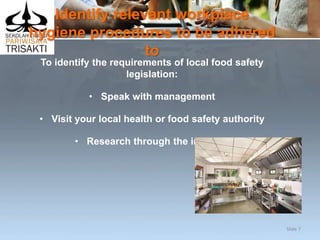
To identify the requirements of local food safety
legislation:
• Speak with management
• Visit your local health or food safety authority
• Research through the internet.
Slide 7
Identify relevant workplace
hygiene procedures to be adhered
to
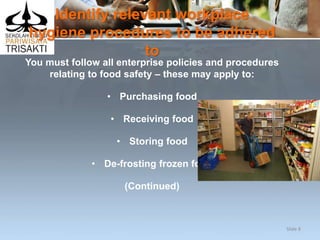
You must follow all enterprise policies and procedures
relating to food safety – these may apply to:
• Purchasing food
• Receiving food
• Storing food
• De-frosting frozen food
(Continued)
Slide 8
Identify relevant workplace
hygiene procedures to be adhered
to
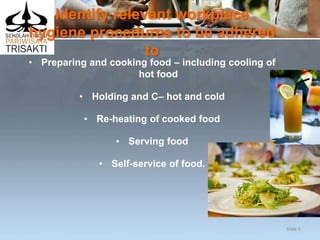
• Preparing and cooking food – including cooling of
hot food
• Holding and C– hot and cold
• Re-heating of cooked food
• Serving food
• Self-service of food.
Slide 9
Identify relevant workplace
hygiene procedures to be adhered
to
Workplaces may also require you to comply with
house rules regarding:
• Cleaning and sanitising
• Food handling techniques
• Personal hygiene
(Continued)
Slide 10
Identify relevant workplace
hygiene procedures to be adhered
to
• Equipment maintenance
• Use of food thermometers
• Pest control
• Waste disposal
• Food recalls.
Slide 11
Identify relevant workplace
hygiene procedures to be adhered
to
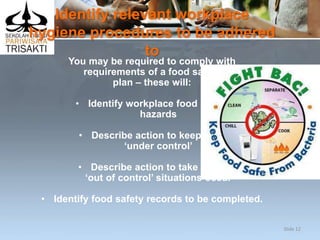
You may be required to comply with
requirements of a food safety
plan – these will:
• Identify workplace food safety
hazards
• Describe action to keep food
‘under control’
• Describe action to take when
‘out of control’ situations occur
• Identify food safety records to be completed.
Slide 12
Identify relevant workplace
hygiene procedures to be adhered
to
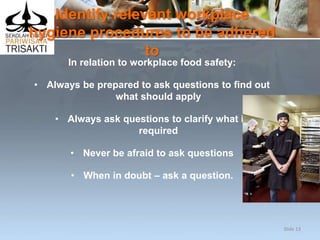
In relation to workplace food safety:
• Always be prepared to ask questions to find out
what should apply
• Always ask questions to clarify what is
required
• Never be afraid to ask questions
• When in doubt – ask a question.
Slide 13
Identify standards or requirements
applying to workplace hygiene
procedures
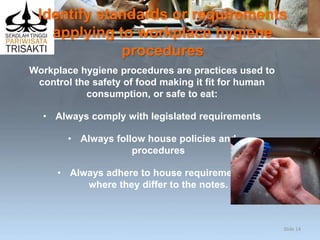
Workplace hygiene procedures are practices used to
control the safety of food making it fit for human
consumption, or safe to eat:
• Always comply with legislated requirements
• Always follow house policies and
procedures
• Always adhere to house requirements
where they differ to the notes.
Slide 14
Identify standards or requirements
applying to workplace hygiene
procedures
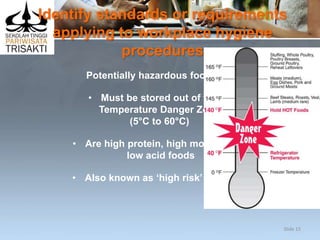
Potentially hazardous foods:
• Must be stored out of the
Temperature Danger Zone
(5°C to 60°C)
• Are high protein, high moisture,
low acid foods
• Also known as ‘high risk’ foods.
Slide 15
Identify standards or requirements
applying to workplace hygiene
procedures
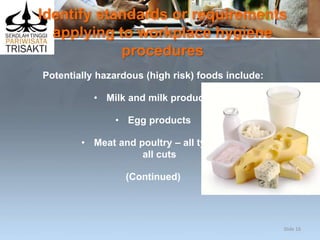
Potentially hazardous (high risk) foods include:
• Milk and milk products
• Egg products
• Meat and poultry – all types,
all cuts
(Continued)
Slide 16
Identify standards requirements applying
to workplace hygiene procedures
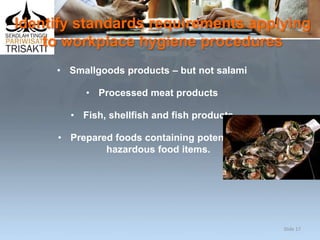
• Smallgoods products – but not salami
• Processed meat products
• Fish, shellfish and fish products
• Prepared foods containing potentially
hazardous food items.
Slide 17
Identify standards/requirements applying
to workplace hygiene procedures
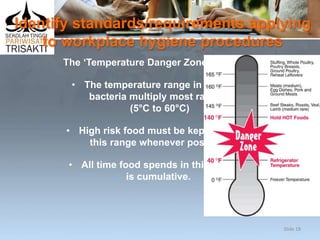
The ‘Temperature Danger Zone’ (TDZ):
• The temperature range in which
bacteria multiply most rapidly
(5°C to 60°C)
• High risk food must be kept out of
this range whenever possible
• All time food spends in this Zone
is cumulative.
Slide 18
Identify standards or requirements
applying to workplace hygiene
procedures
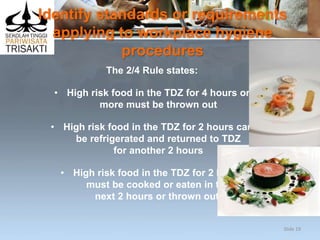
The 2/4 Rule states:
• High risk food in the TDZ for 4 hours or
more must be thrown out
• High risk food in the TDZ for 2 hours can
be refrigerated and returned to TDZ
for another 2 hours
• High risk food in the TDZ for 2 hours
must be cooked or eaten in the
next 2 hours or thrown out.
Slide 19
Identify standards or requirements
applying to workplace hygiene
procedures
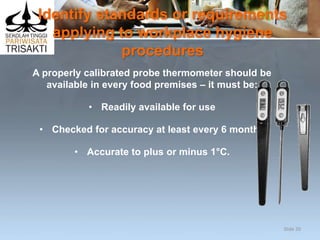
A properly calibrated probe thermometer should be
available in every food premises – it must be:
• Readily available for use
• Checked for accuracy at least every 6 months
• Accurate to plus or minus 1°C.
Slide 20
Identify standards or requirements
applying to workplace hygiene
procedures
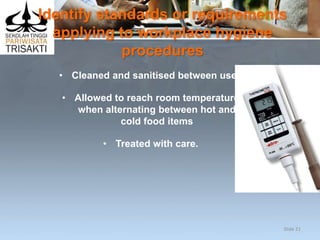
• Cleaned and sanitised between uses
• Allowed to reach room temperature
when alternating between hot and
cold food items
• Treated with care.
Slide 21
Identify standards or requirements
applying to workplace hygiene
procedures
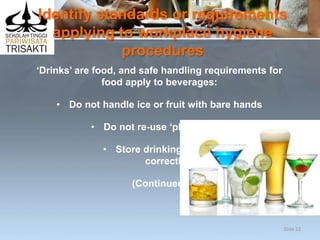
‘Drinks’ are food, and safe handling requirements for
food apply to beverages:
• Do not handle ice or fruit with bare hands
• Do not re-use ‘plate waste’
• Store drinking straws
correctly
(Continued)
Slide 22
Identify standards or requirements
applying to workplace hygiene
procedures
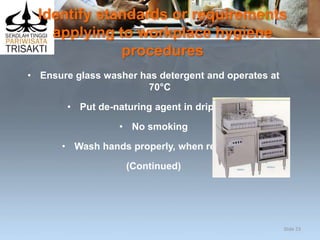
• Ensure glass washer has detergent and operates at
70°C
• Put de-naturing agent in drip trays
• No smoking
• Wash hands properly, when required
(Continued)
Slide 23
Identify standards or requirements
applying to workplace hygiene
procedures
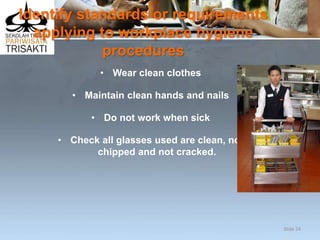
• Wear clean clothes
• Maintain clean hands and nails
• Do not work when sick
• Check all glasses used are clean, not
chipped and not cracked.
Slide 24
Follow workplace hygiene
procedures
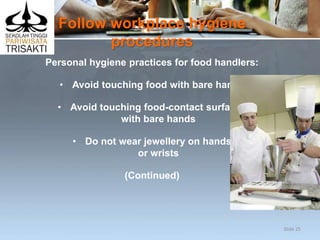
Personal hygiene practices for food handlers:
• Avoid touching food with bare hands
• Avoid touching food-contact surfaces
with bare hands
• Do not wear jewellery on hands
or wrists
(Continued)
Slide 25
Follow workplace hygiene
procedures
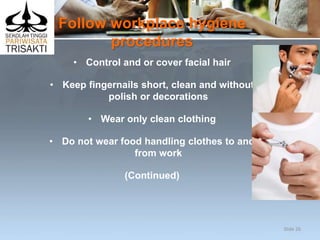
• Control and or cover facial hair
• Keep fingernails short, clean and without
polish or decorations
• Wear only clean clothing
• Do not wear food handling clothes to and
from work
(Continued)
Slide 26
Follow workplace hygiene
procedures
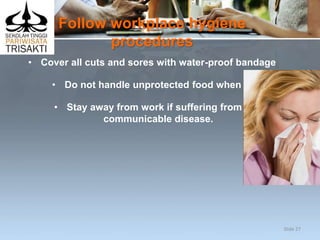
• Cover all cuts and sores with water-proof bandage
• Do not handle unprotected food when ill
• Stay away from work if suffering from a
communicable disease.
Slide 27
Follow workplace hygiene
procedures
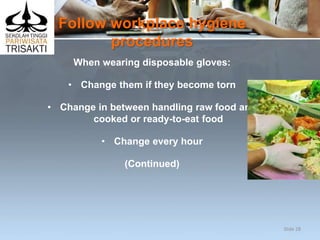
When wearing disposable gloves:
• Change them if they become torn
• Change in between handling raw food and
cooked or ready-to-eat food
• Change every hour
(Continued)
Slide 28
Follow workplace hygiene
procedures
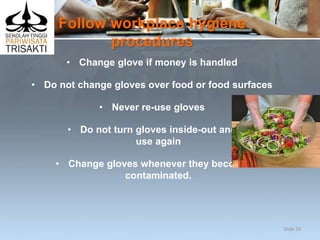
• Change glove if money is handled
• Do not change gloves over food or food surfaces
• Never re-use gloves
• Do not turn gloves inside-out and
use again
• Change gloves whenever they become
contaminated.
Slide 29
Follow workplace hygiene
procedures
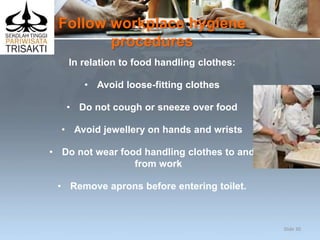
In relation to food handling clothes:
• Avoid loose-fitting clothes
• Do not cough or sneeze over food
• Avoid jewellery on hands and wrists
• Do not wear food handling clothes to and
from work
• Remove aprons before entering toilet.
Slide 30
Follow workplace hygiene
procedures
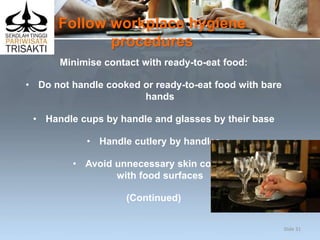
Minimise contact with ready-to-eat food:
• Do not handle cooked or ready-to-eat food with bare
hands
• Handle cups by handle and glasses by their base
• Handle cutlery by handles
• Avoid unnecessary skin contact
with food surfaces
(Continued)
Slide 31
Follow workplace hygiene
procedures
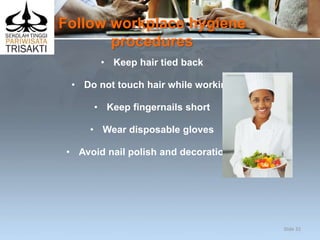
• Keep hair tied back
• Do not touch hair while working
• Keep fingernails short
• Wear disposable gloves
• Avoid nail polish and decorations.
Slide 32
Follow workplace hygiene
procedures
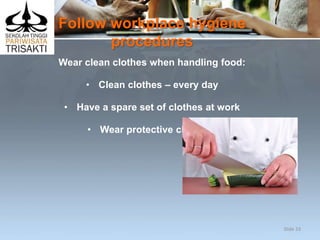
Wear clean clothes when handling food:
• Clean clothes – every day
• Have a spare set of clothes at work
• Wear protective clothing.
Slide 33
Follow workplace hygiene
procedures
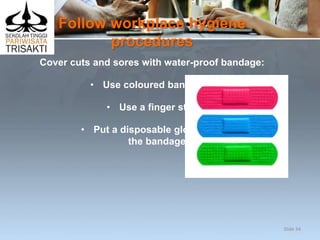
Cover cuts and sores with water-proof bandage:
• Use coloured band-aids
• Use a finger stall
• Put a disposable glove over
the bandage.
Slide 34
Follow workplace hygiene
procedures
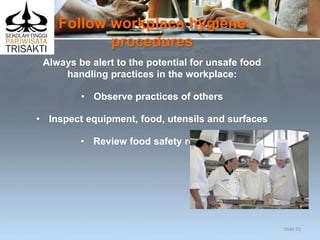
Always be alert to the potential for unsafe food
handling practices in the workplace:
• Observe practices of others
• Inspect equipment, food, utensils and surfaces
• Review food safety records.
Slide 35
Follow workplace hygiene
procedures
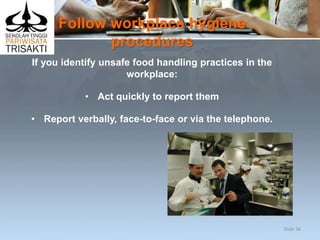
If you identify unsafe food handling practices in the
workplace:
• Act quickly to report them
• Report verbally, face-to-face or via the telephone.
Slide 36
Follow workplace hygiene
procedures
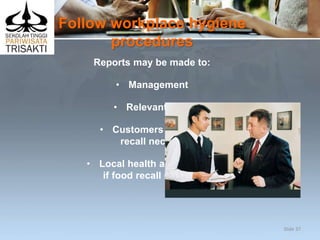
Reports may be made to:
• Management
• Relevant staff
• Customers – if food
recall necessary
• Local health authorities –
if food recall necessary.
Slide 37
Follow workplace hygiene
procedures
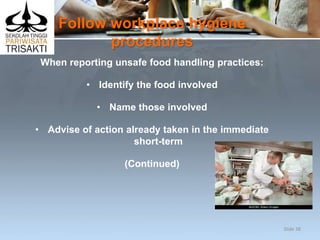
When reporting unsafe food handling practices:
• Identify the food involved
• Name those involved
• Advise of action already taken in the immediate
short-term
(Continued)
Slide 38
Follow workplace hygiene
procedures
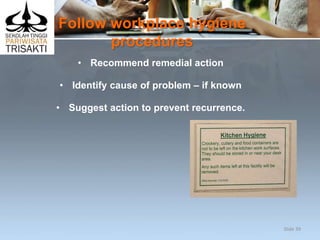
• Recommend remedial action
• Identify cause of problem – if known
• Suggest action to prevent recurrence.
Slide 39
Receive, handle and store food
items
When taking delivery of food:
• Inspect all deliveries
• Free from visible contamination
• No pests
• Use-by dates are OK
• Compare food to specifications (where used)
(Continued)
Slide 40
Receive, handle and store food
items
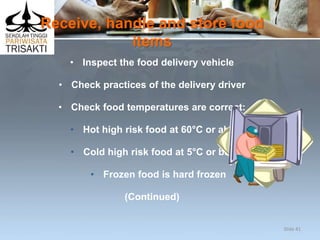
• Inspect the food delivery vehicle
• Check practices of the delivery driver
• Check food temperatures are correct:
• Hot high risk food at 60°C or above
• Cold high risk food at 5°C or below
• Frozen food is hard frozen
(Continued)
Slide 41
Receive, handle and store food
items
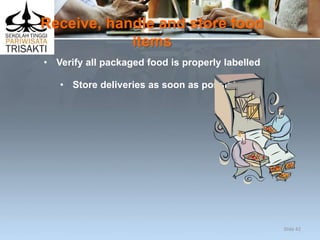
• Verify all packaged food is properly labelled
• Store deliveries as soon as possible.
Slide 42
Receive, handle and store food
items
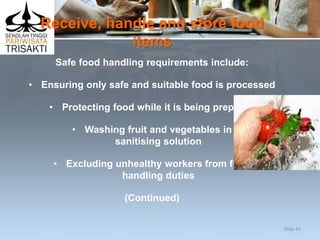
Safe food handling requirements include:
• Ensuring only safe and suitable food is processed
• Protecting food while it is being prepared
• Washing fruit and vegetables in
sanitising solution
• Excluding unhealthy workers from food
handling duties
(Continued)
Slide 43
Receive, handle and store food
items
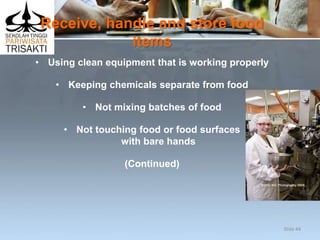
• Using clean equipment that is working properly
• Keeping chemicals separate from food
• Not mixing batches of food
• Not touching food or food surfaces
with bare hands
(Continued)
Slide 44
Receive, handle and store food
items
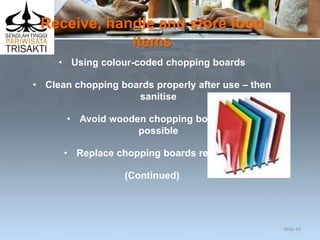
• Using colour-coded chopping boards
• Clean chopping boards properly after use – then
sanitise
• Avoid wooden chopping boards if
possible
• Replace chopping boards regularly
(Continued)
Slide 45
Receive, handle and store food
items
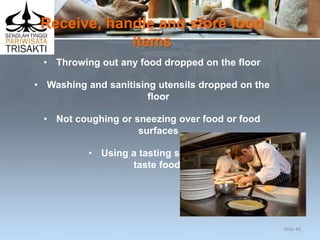
• Throwing out any food dropped on the floor
• Washing and sanitising utensils dropped on the
floor
• Not coughing or sneezing over food or food
surfaces
• Using a tasting spoon to
taste food.
Slide 46
Receive, handle and store food
items
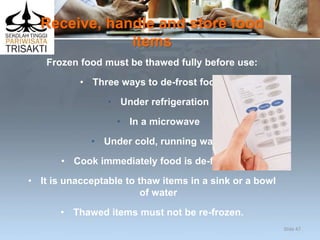
Frozen food must be thawed fully before use:
• Three ways to de-frost food:
• Under refrigeration
• In a microwave
• Under cold, running water
• Cook immediately food is de-frosted
• It is unacceptable to thaw items in a sink or a bowl
of water
• Thawed items must not be re-frozen.
Slide 47
Receive, handle and store food
items
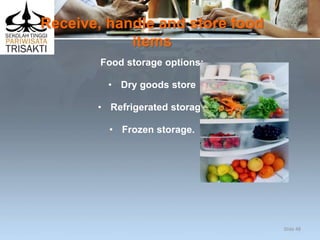
Food storage options:
• Dry goods store
• Refrigerated storage
• Frozen storage.
Slide 48
Receive, handle and store food
items
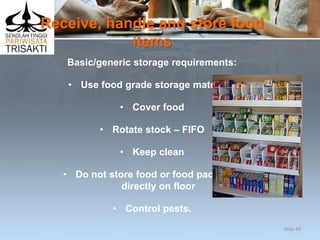
Basic/generic storage requirements:
• Use food grade storage materials
• Cover food
• Rotate stock – FIFO
• Keep clean
• Do not store food or food packages
directly on floor
• Control pests.
Slide 49
Receive, handle and store food
items
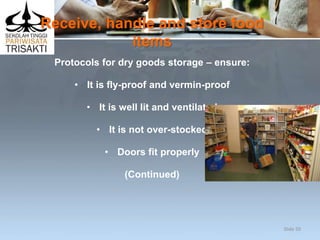
Protocols for dry goods storage – ensure:
• It is fly-proof and vermin-proof
• It is well lit and ventilated
• It is not over-stocked
• Doors fit properly
(Continued)
Slide 50
Receive, handle and store food
items
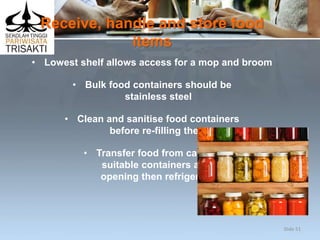
• Lowest shelf allows access for a mop and broom
• Bulk food containers should be
stainless steel
• Clean and sanitise food containers
before re-filling them
• Transfer food from cans to
suitable containers after
opening then refrigerate.
Slide 51
Receive, handle and store food
items
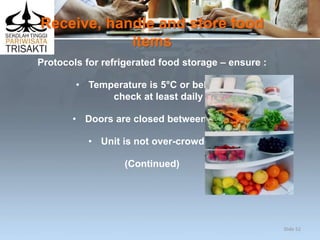
Protocols for refrigerated food storage – ensure :
• Temperature is 5°C or below –
check at least daily
• Doors are closed between uses
• Unit is not over-crowded
(Continued)
Slide 52
Prepare, serve and store food
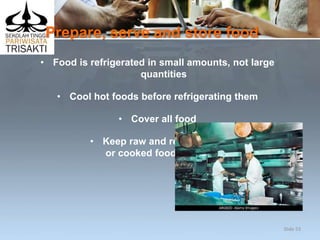
• Food is refrigerated in small amounts, not large
quantities
• Cool hot foods before refrigerating them
• Cover all food
• Keep raw and ready-to-eat
or cooked food separate.
Slide 53
Prepare, serve and store food
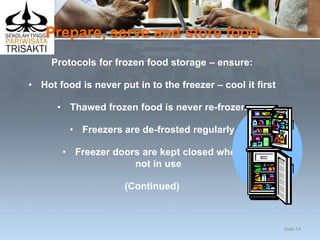
Protocols for frozen food storage – ensure:
• Hot food is never put in to the freezer – cool it first
• Thawed frozen food is never re-frozen
• Freezers are de-frosted regularly
• Freezer doors are kept closed when
not in use
(Continued)
Slide 54
Prepare, serve and store food
• Freezer temperature is
checked at least daily
• Large items are not frozen
• Manufacturer’s instructions
for
specific foods are complied
with
when freezing them.
Slide 55
Identify potential food and other
risks in the workplace promptly
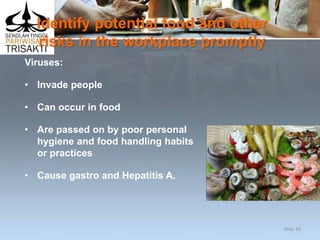
Viruses:
• Invade people
• Can occur in food
• Are passed on by poor personal
hygiene and food handling habits
or practices
• Cause gastro and Hepatitis A.
Slide 56
Identify potential food and other
risks in the workplace promptly
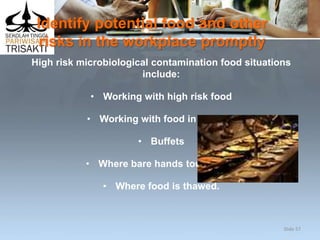
High risk microbiological contamination food situations
include:
• Working with high risk food
• Working with food in the TDZ
• Buffets
• Where bare hands touch food
• Where food is thawed.
Slide 57
Identify potential food and other
risks in the workplace promptly
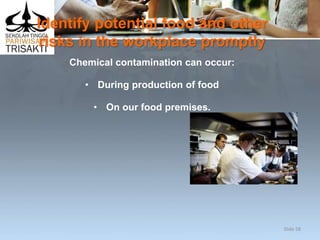
Chemical contamination can occur:
• During production of food
• On our food premises.
Slide 58
Identify potential food and other
risks in the workplace promptly
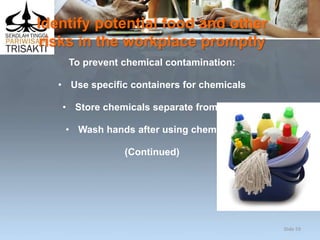
To prevent chemical contamination:
• Use specific containers for chemicals
• Store chemicals separate from food
• Wash hands after using chemicals
(Continued)
Slide 59
Identify potential food and other
risks in the workplace promptly
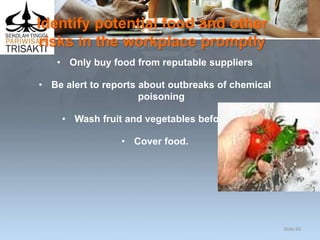
• Only buy food from reputable suppliers
• Be alert to reports about outbreaks of chemical
poisoning
• Wash fruit and vegetables before use
• Cover food.
Slide 60
Identify potential food and other
risks in the workplace promptly
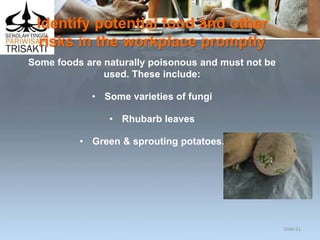
Some foods are naturally poisonous and must not be
used. These include:
• Some varieties of fungi
• Rhubarb leaves
• Green & sprouting potatoes.
Slide 61
Identify potential food and other
risks in the workplace promptly
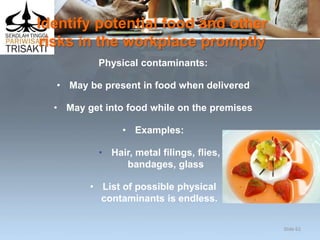
Physical contaminants:
• May be present in food when delivered
• May get into food while on the premises
• Examples:
• Hair, metal filings, flies,
bandages, glass
• List of possible physical
contaminants is endless.
Slide 62
Identify potential food and other
risks in the workplace promptly
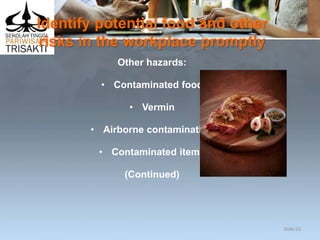
Other hazards:
• Contaminated food
• Vermin
• Airborne contamination
• Contaminated items
(Continued)
Slide 63
Identify potential food and other
risks in the workplace promptly
• Dirty equipment and utensils
• Garbage
• Out-of-date food handling practices
• Poor or ineffective training
• Equipment not working as intended.
Slide 64
Identify potential food and other
risks in the workplace promptly
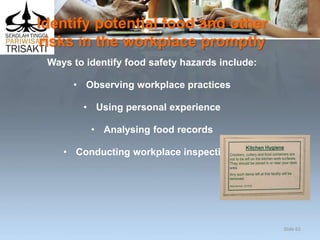
Ways to identify food safety hazards include:
• Observing workplace practices
• Using personal experience
• Analysing food records
• Conducting workplace inspections.
Slide 65
Identify potential food and other
risks in the workplace promptly
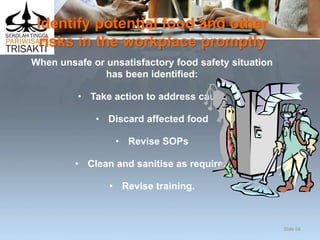
When unsafe or unsatisfactory food safety situation
has been identified:
• Take action to address cause
• Discard affected food
• Revise SOPs
• Clean and sanitise as required
• Revise training.
Slide 66
Identify potential food and other
risks in the workplace promptly
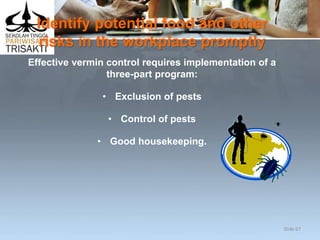
Effective vermin control requires implementation of a
three-part program:
• Exclusion of pests
• Control of pests
• Good housekeeping.
Slide 67
Identify potential food and other
risks in the workplace promptly
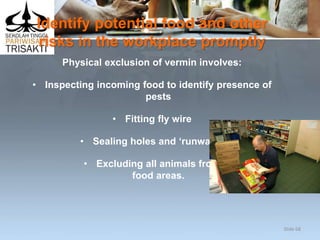
Physical exclusion of vermin involves:
• Inspecting incoming food to identify presence of
pests
• Fitting fly wire
• Sealing holes and ‘runways’
• Excluding all animals from
food areas.
Slide 68
Identify potential food and other
risks in the workplace promptly
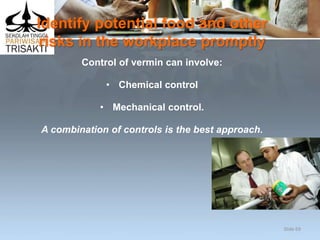
Control of vermin can involve:
• Chemical control
• Mechanical control.
A combination of controls is the best approach.
Slide 69
Identify potential food and other
risks in the workplace promptly
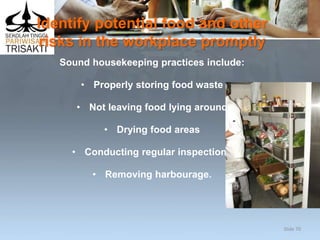
Sound housekeeping practices include:
• Properly storing food waste
• Not leaving food lying around
• Drying food areas
• Conducting regular inspections
• Removing harbourage.
Slide 70
Identify potential food and other
risks in the workplace promptly
Food recalls:
• May be initiated by others:
• Health authorities
• Manufacturers of food
• May be initiated by the venue itself.
Slide 71
Identify potential food and other
risks in the workplace promptly
The aims of a recall plan are:
• Stop distribution and sale of the product
• Remove product from sale
• Notify customers about the product
• Give advice and direction to customers.
Slide 72
Identify potential food and other
risks in the workplace promptly
Factors to consider when deciding if a food recall is
necessary:
• Gravity of risk posed
• Number of complaints received
• Probability of risk
• Size and dispersion of items involved
• Whether officials and or media have been notified
Always err on the side of caution
Hope for the best – plan for the worst.
Slide 73
Identify potential food and other
risks in the workplace promptly
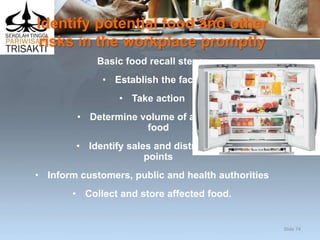
Basic food recall steps:
• Establish the facts
• Take action
• Determine volume of affected
food
• Identify sales and distribution
points
• Inform customers, public and health authorities
• Collect and store affected food.
Slide 74
Take action to minimise or remove
the risk of food contamination
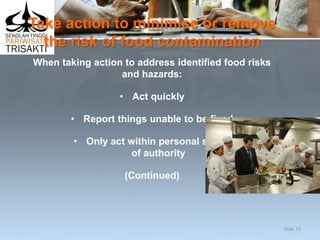
When taking action to address identified food risks
and hazards:
• Act quickly
• Report things unable to be fixed
• Only act within personal scope
of authority
(Continued)
Slide 75
Take action to minimise or remove
the risk of food contamination
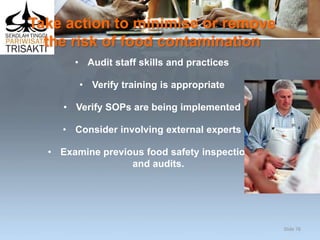
• Audit staff skills and practices
• Verify training is appropriate
• Verify SOPs are being implemented
• Consider involving external experts
• Examine previous food safety inspections
and audits.
Slide 76
Take action to minimise or remove
the risk of food contamination
All action taken to address identified food safety risks
and hazards MUST reflect and address each situation
Corrective action regarding food purchasing
problems:
• Verify suppliers are safe food handlers – get proof
• Add new and verified suppliers to Suppliers List
• Create purchase specifications
• Only buy from approved suppliers.
Slide 77
Take action to minimise or remove
the risk of food contamination
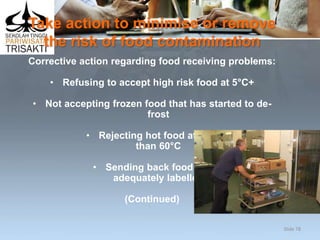
Corrective action regarding food receiving problems:
• Refusing to accept high risk food at 5°C+
• Not accepting frozen food that has started to de-
frost
• Rejecting hot food at less
than 60°C
• Sending back food not
adequately labelled
(Continued)
Slide 78
Take action to minimise or remove
the risk of food contamination
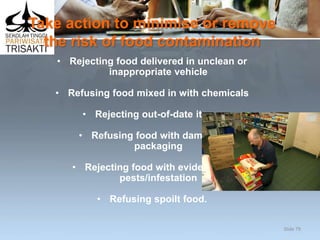
• Rejecting food delivered in unclean or
inappropriate vehicle
• Refusing food mixed in with chemicals
• Rejecting out-of-date items
• Refusing food with damaged
packaging
• Rejecting food with evidence of
pests/infestation
• Refusing spoilt food.
Slide 79
Take action to minimise or remove
the risk of food contamination
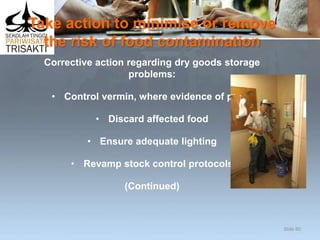
Corrective action regarding dry goods storage
problems:
• Control vermin, where evidence of pests
• Discard affected food
• Ensure adequate lighting
• Revamp stock control protocols
(Continued)
Slide 80
Take action to minimise or remove
the risk of food contamination
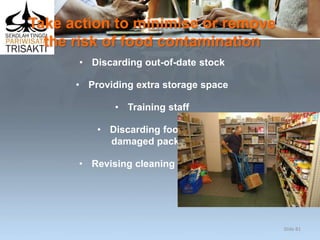
• Discarding out-of-date stock
• Providing extra storage space
• Training staff
• Discarding food with
damaged packaging
• Revising cleaning protocols.
Slide 81
Take action to minimise or remove
the risk of food contamination
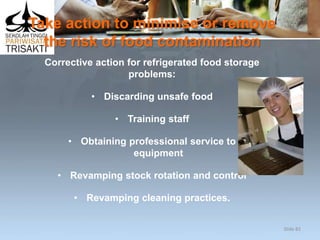
Corrective action for refrigerated food storage
problems:
• Discarding unsafe food
• Training staff
• Obtaining professional service to
equipment
• Revamping stock rotation and control
• Revamping cleaning practices.
Slide 82
Take action to minimise or remove
the risk of food contamination
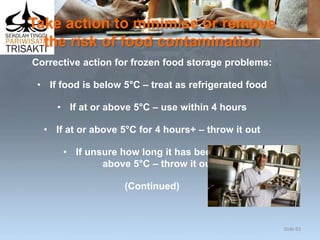
Corrective action for frozen food storage problems:
• If food is below 5°C – treat as refrigerated food
• If at or above 5°C – use within 4 hours
• If at or above 5°C for 4 hours+ – throw it out
• If unsure how long it has been at or
above 5°C – throw it out
(Continued)
Slide 83
Take action to minimise or remove
the risk of food contamination
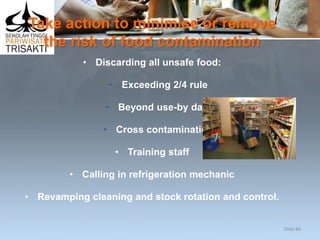
• Discarding all unsafe food:
• Exceeding 2/4 rule
• Beyond use-by date
• Cross contamination
• Training staff
• Calling in refrigeration mechanic
• Revamping cleaning and stock rotation and control.
Slide 84
Take action to minimise or remove
the risk of food contamination
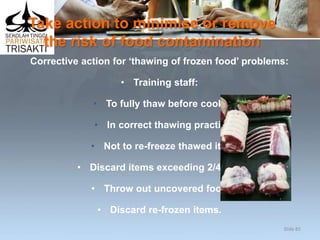
Corrective action for ‘thawing of frozen food’ problems:
• Training staff:
• To fully thaw before cooking
• In correct thawing practices
• Not to re-freeze thawed items
• Discard items exceeding 2/4 rule
• Throw out uncovered food
• Discard re-frozen items.
Slide 85
Take action to minimise or remove
the risk of food contamination
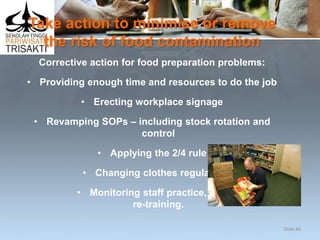
Corrective action for food preparation problems:
• Providing enough time and resources to do the job
• Erecting workplace signage
• Revamping SOPs – including stock rotation and
control
• Applying the 2/4 rule
• Changing clothes regularly
• Monitoring staff practice, and
re-training.
Slide 86
Take action to minimise or remove
the risk of food contamination
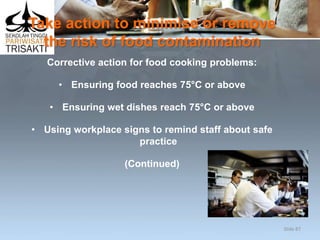
Corrective action for food cooking problems:
• Ensuring food reaches 75°C or above
• Ensuring wet dishes reach 75°C or above
• Using workplace signs to remind staff about safe
practice
(Continued)
Slide 87
Take action to minimise or remove
the risk of food contamination
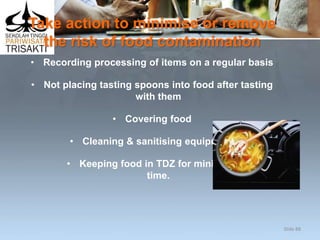
• Recording processing of items on a regular basis
• Not placing tasting spoons into food after tasting
with them
• Covering food
• Cleaning & sanitising equipment
• Keeping food in TDZ for minimum
time.
Slide 88
Take action to minimise or remove
the risk of food contamination
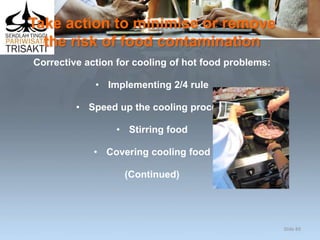
Corrective action for cooling of hot food problems:
• Implementing 2/4 rule
• Speed up the cooling process
• Stirring food
• Covering cooling food
(Continued)
Slide 89
Take action to minimise or remove
the risk of food contamination
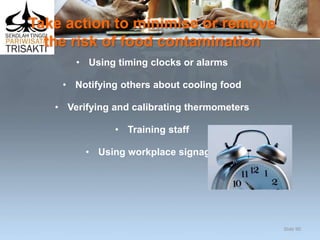
• Using timing clocks or alarms
• Notifying others about cooling food
• Verifying and calibrating thermometers
• Training staff
• Using workplace signage.
Slide 90
Take action to minimise or remove
the risk of food contamination
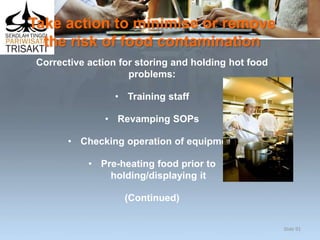
Corrective action for storing and holding hot food
problems:
• Training staff
• Revamping SOPs
• Checking operation of equipment
• Pre-heating food prior to
holding/displaying it
(Continued)
Slide 91
Take action to minimise or remove
the risk of food contamination
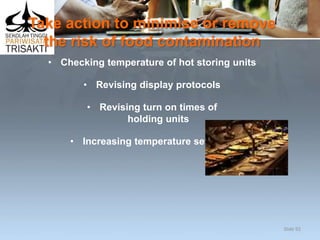
• Checking temperature of hot storing units
• Revising display protocols
• Revising turn on times of
holding units
• Increasing temperature settings.
Slide 92
Take action to minimise or remove
the risk of food contamination
Corrective action for storing and holding cold food
problems:
• Training staff
• Revamping cold holding
procedures
• Checking operation of units
• Pre-chilling food before placing into units
(Continued)
Slide 93
Take action to minimise or remove
the risk of food contamination
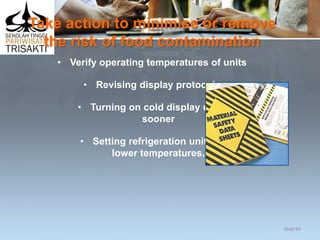
• Verify operating temperatures of units
• Revising display protocols
• Turning on cold display units
sooner
• Setting refrigeration units at
lower temperatures.
Slide 94
Take action to minimise or remove
the risk of food contamination
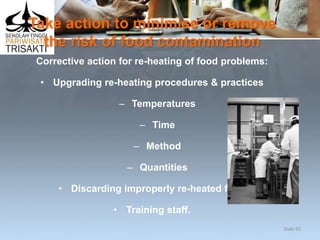
Corrective action for re-heating of food problems:
• Upgrading re-heating procedures & practices
– Temperatures
– Time
– Method
– Quantities
• Discarding improperly re-heated food
• Training staff.
Slide 95
Take action to minimise or remove
the risk of food contamination
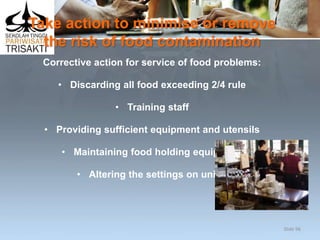
Corrective action for service of food problems:
• Discarding all food exceeding 2/4 rule
• Training staff
• Providing sufficient equipment and utensils
• Maintaining food holding equipment
• Altering the settings on units.
Slide 96
Take action to minimise or remove
the risk of food contamination
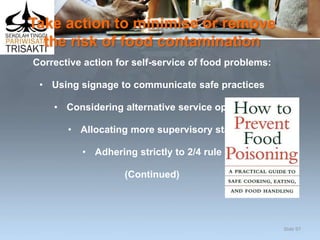
Corrective action for self-service of food problems:
• Using signage to communicate safe practices
• Considering alternative service options
• Allocating more supervisory staff
• Adhering strictly to 2/4 rule
(Continued)
Slide 97
Take action to minimise or remove
the risk of food contamination
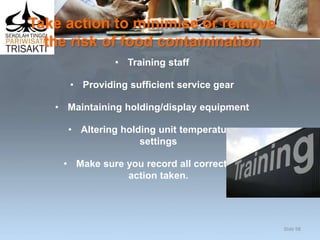
• Training staff
• Providing sufficient service gear
• Maintaining holding/display equipment
• Altering holding unit temperature
settings
• Make sure you record all corrective
action taken.
Slide 98
Handle and dispose of food waste
and rubbish
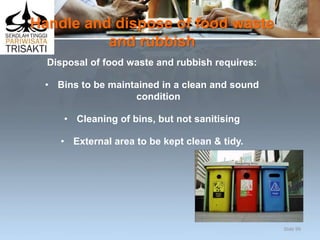
Disposal of food waste and rubbish requires:
• Bins to be maintained in a clean and sound
condition
• Cleaning of bins, but not sanitising
• External area to be kept clean & tidy.
Slide 99
Handle and dispose of food waste
and rubbish
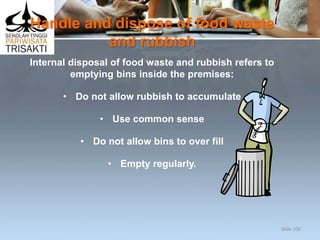
Internal disposal of food waste and rubbish refers to
emptying bins inside the premises:
• Do not allow rubbish to accumulate
• Use common sense
• Do not allow bins to over fill
• Empty regularly.
Slide 100
Handle and dispose of food waste
and rubbish
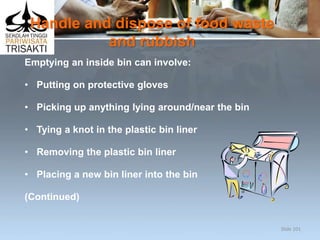
Emptying an inside bin can involve:
• Putting on protective gloves
• Picking up anything lying around/near the bin
• Tying a knot in the plastic bin liner
• Removing the plastic bin liner
• Placing a new bin liner into the bin
(Continued)
Slide 101
Handle and dispose of food waste
and rubbish
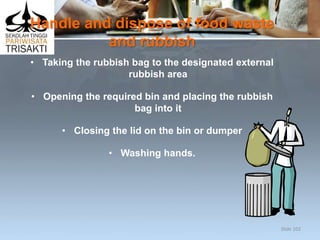
• Taking the rubbish bag to the designated external
rubbish area
• Opening the required bin and placing the rubbish
bag into it
• Closing the lid on the bin or dumper
• Washing hands.
Slide 102
Handle and dispose of food waste
and rubbish
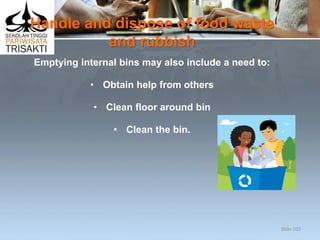
Emptying internal bins may also include a need to:
• Obtain help from others
• Clean floor around bin
• Clean the bin.
Slide 103
Handle and dispose of food waste
and rubbish
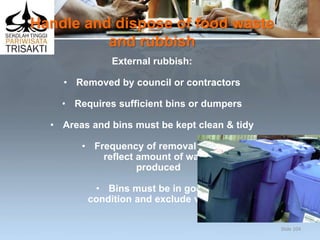
External rubbish:
• Removed by council or contractors
• Requires sufficient bins or dumpers
• Areas and bins must be kept clean & tidy
• Frequency of removal must
reflect amount of waste
produced
• Bins must be in good
condition and exclude vermin.
Slide 104
Handle and dispose of food waste
and rubbish
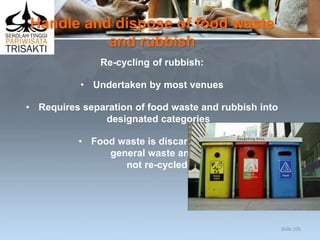
Re-cycling of rubbish:
• Undertaken by most venues
• Requires separation of food waste and rubbish into
designated categories
• Food waste is discarded into
general waste and is
not re-cycled.
Slide 105
Summary – Element 2
When identifying and preventing hygiene risks:
• Be constantly alert for workplace food hygiene and
safety risks and hazards
• Understand food safety can be compromised
from microbiological sources, chemical
sources, physical sources, and other
sources such as airborne contamination
(Continued)
Slide 106
Summary – Element 2
• Use observation and experience to identify possible
hygiene risks in the workplace
• Physically exclude vermin from food areas, use
chemical and other controls to eradicate them and
implement sound housekeeping practices to
deter them
• Plan for the possibility of food recalls
(Continued)
Slide 107
Summary – Element 2
• Report any food safety problem you cannot fix
• Ensure corrective action in relation to food safety is
taken promptly and addresses identified cause as
well as all food, items, equipment, utensils and food
contact surfaces involved
• Record corrective action taken
(Continued)
Slide 108
Summary – Element 2
• Dispose of internal and external waste in
accordance with house requirements
• Wash hands after handling waste
• Keep external waste areas clean and vermin free
(Continued)
Slide 109
Summary – Element 2
• Clean and maintain all internal and external rubbish
containers
• Do not allow the accumulation of waste either
internally or externally
• Re-cycle waste as appropriate.
Slide 110
Maintain safe personal food handling
and personal presentation standards
Performance Criteria for this Element are:
• Identify the enterprise standards and legislated
requirements that apply to personal practices and
presentation for food handling staff
• Follow enterprise standards and legislated
requirements that apply to personal practices and
presentation for food handling staff.
Slide 111
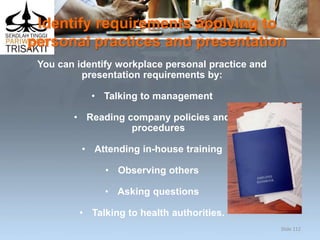
Identify requirements applying to
personal practices and presentation
You can identify workplace personal practice and
presentation requirements by:
• Talking to management
• Reading company policies and
procedures
• Attending in-house training
• Observing others
• Asking questions
• Talking to health authorities.
Slide 112
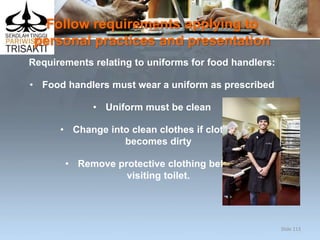
Follow requirements applying to
personal practices and presentation
Requirements relating to uniforms for food handlers:
• Food handlers must wear a uniform as prescribed
• Uniform must be clean
• Change into clean clothes if clothing
becomes dirty
• Remove protective clothing before
visiting toilet.
Slide 113
Follow requirements applying to
personal practices and presentation
Make sure clothing and other items do not
contaminate food:
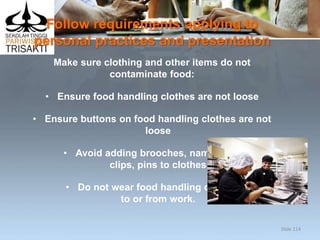
• Ensure food handling clothes are not loose
• Ensure buttons on food handling clothes are not
loose
• Avoid adding brooches, name tags,
clips, pins to clothes
• Do not wear food handling clothes
to or from work.
Slide 114
Follow requirements applying to
personal practices and presentation
Food handlers & jewellery:
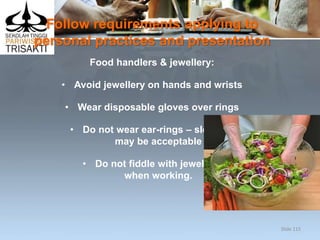
• Avoid jewellery on hands and wrists
• Wear disposable gloves over rings
• Do not wear ear-rings – sleepers
may be acceptable
• Do not fiddle with jewellery
when working.
Slide 115
Follow requirements applying to
personal practices and presentation
Food handlers hair ornaments:
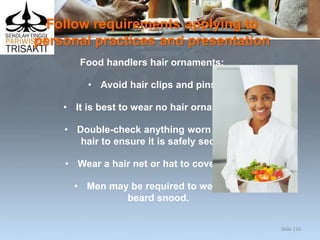
• Avoid hair clips and pins
• It is best to wear no hair ornaments
• Double-check anything worn in the
hair to ensure it is safely secured
• Wear a hair net or hat to cover hair
• Men may be required to wear a
beard snood.
Slide 116
Follow requirements applying to
personal practices and presentation
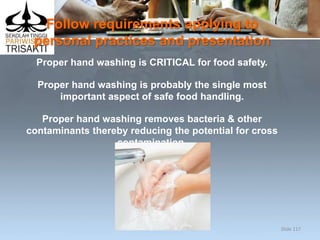
Proper hand washing is CRITICAL for food safety.
Proper hand washing is probably the single most
important aspect of safe food handling.
Proper hand washing removes bacteria & other
contaminants thereby reducing the potential for cross
contamination.
Slide 117
Follow requirements applying to
personal practices and presentation
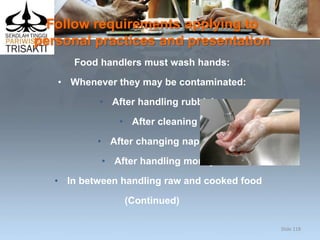
Food handlers must wash hands:
• Whenever they may be contaminated:
• After handling rubbish
• After cleaning
• After changing nappies
• After handling money
• In between handling raw and cooked food
(Continued)
Slide 118
Follow requirements applying to
personal practices and presentation
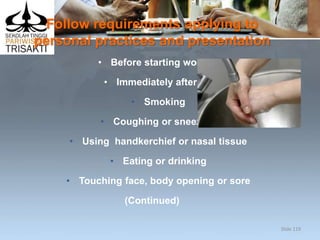
• Before starting work
• Immediately after:
• Smoking
• Coughing or sneezing
• Using handkerchief or nasal tissue
• Eating or drinking
• Touching face, body opening or sore
(Continued)
Slide 119
Follow requirements applying to
personal practices and presentation
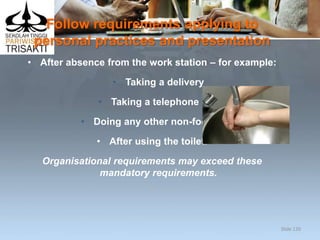
• After absence from the work station – for example:
• Taking a delivery
• Taking a telephone call
• Doing any other non-food task
• After using the toilet.
Organisational requirements may exceed these
mandatory requirements.
Slide 120
Follow requirements applying to
personal practices and presentation
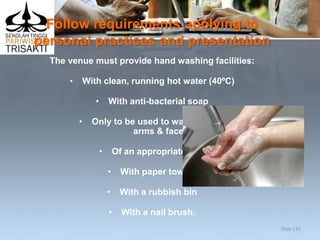
The venue must provide hand washing facilities:
• With clean, running hot water (40ºC)
• With anti-bacterial soap
• Only to be used to wash hands,
arms & face
• Of an appropriate size
• With paper towels
• With a rubbish bin
• With a nail brush.
Slide 121
Follow requirements applying to
personal practices and presentation
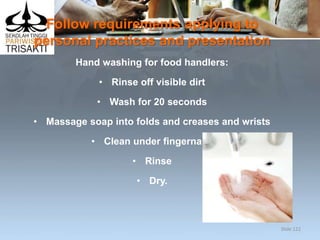
Hand washing for food handlers:
• Rinse off visible dirt
• Wash for 20 seconds
• Massage soap into folds and creases and wrists
• Clean under fingernails
• Rinse
• Dry.
Slide 122
Follow requirements applying to
personal practices and presentation
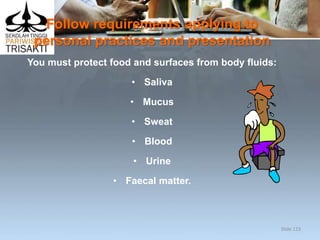
You must protect food and surfaces from body fluids:
• Saliva
• Mucus
• Sweat
• Blood
• Urine
• Faecal matter.
Slide 123
Follow requirements applying to
personal practices and presentation
To guard against contamination by body fluids:
• Wash hands after toilet and handling handkerchief
or nasal tissue
• Do not spit in food areas
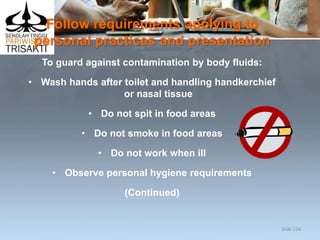
• Do not smoke in food areas
• Do not work when ill
• Observe personal hygiene requirements
(Continued)
Slide 124
Follow requirements applying to
personal practices and presentation
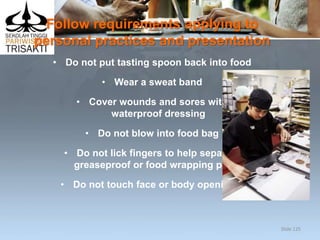
• Do not put tasting spoon back into food
• Wear a sweat band
• Cover wounds and sores with
waterproof dressing
• Do not blow into food bag
• Do not lick fingers to help separate
greaseproof or food wrapping paper
• Do not touch face or body openings.
Slide 125
Follow requirements applying to
personal practices and presentation
Food handlers have obligations if they:
• Have a foodborne disease
• Have symptoms of a foodborne disease
• Are a carrier of a foodborne disease.
A foodborne disease = a disease likely
to be transmitted through food, such as:
• Hepatitis A
• Typhoid
• Cholera.
Slide 126
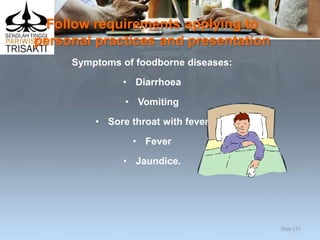
Follow requirements applying to
personal practices and presentation
Symptoms of foodborne diseases:
• Diarrhoea
• Vomiting
• Sore throat with fever
• Fever
• Jaundice.
Slide 127
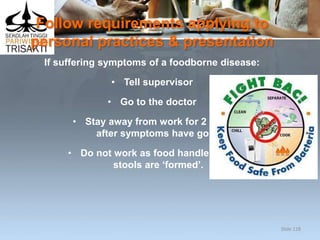
Follow requirements applying to
personal practices & presentation
If suffering symptoms of a foodborne disease:
• Tell supervisor
• Go to the doctor
• Stay away from work for 2 days
after symptoms have gone
• Do not work as food handler until
stools are ‘formed’.
Slide 128
Follow requirements applying to
personal practices and presentation
If diagnosed as suffering a foodborne disease or
being a ‘carrier’:
• Notify supervisor
• Follow medical advice
• Protect food and food contact
surfaces from contamination by the
affected food handler
• Stay away from work and food
handling duties.
Slide 129
Follow requirements applying to
personal practices and presentation
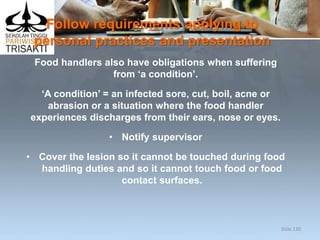
Food handlers also have obligations when suffering
from ‘a condition’.
‘A condition’ = an infected sore, cut, boil, acne or
abrasion or a situation where the food handler
experiences discharges from their ears, nose or eyes.
• Notify supervisor
• Cover the lesion so it cannot be touched during food
handling duties and so it cannot touch food or food
contact surfaces.
Slide 130
Follow requirements applying to
personal practices and presentation
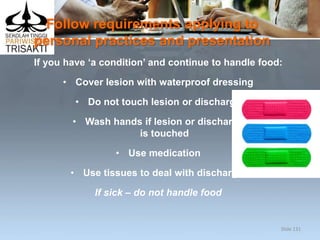
If you have ‘a condition’ and continue to handle food:
• Cover lesion with waterproof dressing
• Do not touch lesion or discharge
• Wash hands if lesion or discharge
is touched
• Use medication
• Use tissues to deal with discharge.
If sick – do not handle food
Slide 131
Follow requirements applying to
personal practices and presentation
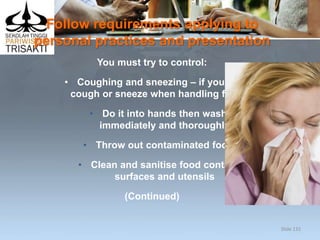
You must try to control:
• Coughing and sneezing – if you do
cough or sneeze when handling food:
• Do it into hands then wash
immediately and thoroughly
• Throw out contaminated food
• Clean and sanitise food contact
surfaces and utensils
(Continued)
Slide 132
Follow requirements applying to
personal practices and presentation
Be aware of unacceptable personal habits when
handling food:
• Scratching an itch, head or face
• Picking nose, scabs, cuts or sores
• Sticking fingers in ears or mouth
• Take appropriate remedial action if the above are
done
• Make an effort to control these actions.
Slide 133
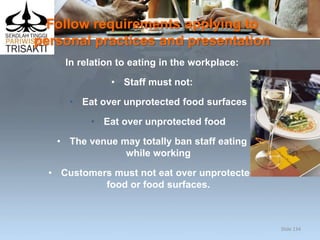
Follow requirements applying to
personal practices and presentation
In relation to eating in the workplace:
• Staff must not:
• Eat over unprotected food surfaces
• Eat over unprotected food
• The venue may totally ban staff eating
while working
• Customers must not eat over unprotected
food or food surfaces.
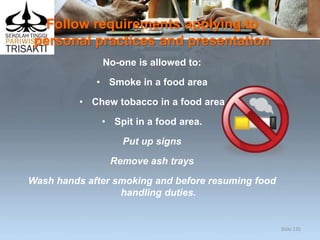
Slide 134
Follow requirements applying to
personal practices and presentation
No-one is allowed to:
• Smoke in a food area
• Chew tobacco in a food area
• Spit in a food area.
Put up signs
Remove ash trays
Wash hands after smoking and before resuming food
handling duties.
Slide 135
Summary – Element 3
When maintaining safe personal food handling and
personal presentation standards:
• Learn the legislated and house rules applying to
safe personal activities and presentation in the
workplace
• Wear a clean uniform when handling food as
required by the business
• Do not wear food handling clothes to or
from work
(Continued)
Slide 136
Summary – Element 3
• Limit or eliminate jewellery, hair ornaments and nail
polish or nail decorations when working as a food
handler
• Wash hands when and as required using only designated
hand washing facilities – always wash hands before
starting work and when
returning to work after an absence from
the work station
• Do not work with food when ill or
suffering from symptoms of foodborne
illnesses
(Continued)
Slide 137
Summary – Element 3
• Obtain a doctor’s certificate stating you are fit to
return to work as a food handler if you have been
away from work due to illness or sickness
• Control personal habits which can give rise to food
contamination when handling food.
Slide 138

Part 1 comply with workplace hygiene procedures

  • 1.
    COMPLY WITH WORKPLACE HYGIENEPROCEDURES Unit Code: D1.HRS.CL1.05 D1.HOT.CL1.04 D2.TTO.CL4.10 Slide 1
  • 2.
    Comply with workplacehygiene procedures This unit comprises three Elements: • Follow hygiene procedures • Identify and prevent hygiene risks • Maintain safe personal food handling and personal presentation standards. Slide 2
  • 3.
    Assessment Assessment for thisunit may include: • Oral questions • Written questions • Work projects • Workplace observation of practical skills • Practical exercises • Formal report from employer or supervisor. Slide 3
  • 4.
    Follow hygiene procedures PerformanceCriteria for this Element are: • Identify relevant workplace hygiene procedures that need to be adhered to • Identify enterprise standards and legislated requirements that apply to relevant workplace hygiene procedures • Follow workplace hygiene procedures in accordance with enterprise standards and legislated requirements (Continued) Slide 4
  • 5.
    Follow hygiene procedures •Receive, handle and store all food items according to enterprise standards and legislated requirements • Prepare, serve and store food in compliance with enterprise standards and legislated requirements • Clean food-related items, utensils and areas in compliance with enterprise standards and legislated requirements. Slide 5
  • 6.
    Identify relevant workplace hygieneprocedures to be adhered to To ensure the safety of food you will need to comply with: • Legislation • Enterprise policies and procedures • Internal food safety systems. Slide 6
  • 7.
    Identify relevant workplace hygieneprocedures to be adhered to To identify the requirements of local food safety legislation: • Speak with management • Visit your local health or food safety authority • Research through the internet. Slide 7
  • 8.
    Identify relevant workplace hygieneprocedures to be adhered to You must follow all enterprise policies and procedures relating to food safety – these may apply to: • Purchasing food • Receiving food • Storing food • De-frosting frozen food (Continued) Slide 8
  • 9.
    Identify relevant workplace hygieneprocedures to be adhered to • Preparing and cooking food – including cooling of hot food • Holding and C– hot and cold • Re-heating of cooked food • Serving food • Self-service of food. Slide 9
  • 10.
    Identify relevant workplace hygieneprocedures to be adhered to Workplaces may also require you to comply with house rules regarding: • Cleaning and sanitising • Food handling techniques • Personal hygiene (Continued) Slide 10
  • 11.
    Identify relevant workplace hygieneprocedures to be adhered to • Equipment maintenance • Use of food thermometers • Pest control • Waste disposal • Food recalls. Slide 11
  • 12.
    Identify relevant workplace hygieneprocedures to be adhered to You may be required to comply with requirements of a food safety plan – these will: • Identify workplace food safety hazards • Describe action to keep food ‘under control’ • Describe action to take when ‘out of control’ situations occur • Identify food safety records to be completed. Slide 12
  • 13.
    Identify relevant workplace hygieneprocedures to be adhered to In relation to workplace food safety: • Always be prepared to ask questions to find out what should apply • Always ask questions to clarify what is required • Never be afraid to ask questions • When in doubt – ask a question. Slide 13
  • 14.
    Identify standards orrequirements applying to workplace hygiene procedures Workplace hygiene procedures are practices used to control the safety of food making it fit for human consumption, or safe to eat: • Always comply with legislated requirements • Always follow house policies and procedures • Always adhere to house requirements where they differ to the notes. Slide 14
  • 15.
    Identify standards orrequirements applying to workplace hygiene procedures Potentially hazardous foods: • Must be stored out of the Temperature Danger Zone (5°C to 60°C) • Are high protein, high moisture, low acid foods • Also known as ‘high risk’ foods. Slide 15
  • 16.
    Identify standards orrequirements applying to workplace hygiene procedures Potentially hazardous (high risk) foods include: • Milk and milk products • Egg products • Meat and poultry – all types, all cuts (Continued) Slide 16
  • 17.
    Identify standards requirementsapplying to workplace hygiene procedures • Smallgoods products – but not salami • Processed meat products • Fish, shellfish and fish products • Prepared foods containing potentially hazardous food items. Slide 17
  • 18.
    Identify standards/requirements applying toworkplace hygiene procedures The ‘Temperature Danger Zone’ (TDZ): • The temperature range in which bacteria multiply most rapidly (5°C to 60°C) • High risk food must be kept out of this range whenever possible • All time food spends in this Zone is cumulative. Slide 18
  • 19.
    Identify standards orrequirements applying to workplace hygiene procedures The 2/4 Rule states: • High risk food in the TDZ for 4 hours or more must be thrown out • High risk food in the TDZ for 2 hours can be refrigerated and returned to TDZ for another 2 hours • High risk food in the TDZ for 2 hours must be cooked or eaten in the next 2 hours or thrown out. Slide 19
  • 20.
    Identify standards orrequirements applying to workplace hygiene procedures A properly calibrated probe thermometer should be available in every food premises – it must be: • Readily available for use • Checked for accuracy at least every 6 months • Accurate to plus or minus 1°C. Slide 20
  • 21.
    Identify standards orrequirements applying to workplace hygiene procedures • Cleaned and sanitised between uses • Allowed to reach room temperature when alternating between hot and cold food items • Treated with care. Slide 21
  • 22.
    Identify standards orrequirements applying to workplace hygiene procedures ‘Drinks’ are food, and safe handling requirements for food apply to beverages: • Do not handle ice or fruit with bare hands • Do not re-use ‘plate waste’ • Store drinking straws correctly (Continued) Slide 22
  • 23.
    Identify standards orrequirements applying to workplace hygiene procedures • Ensure glass washer has detergent and operates at 70°C • Put de-naturing agent in drip trays • No smoking • Wash hands properly, when required (Continued) Slide 23
  • 24.
    Identify standards orrequirements applying to workplace hygiene procedures • Wear clean clothes • Maintain clean hands and nails • Do not work when sick • Check all glasses used are clean, not chipped and not cracked. Slide 24
  • 25.
    Follow workplace hygiene procedures Personalhygiene practices for food handlers: • Avoid touching food with bare hands • Avoid touching food-contact surfaces with bare hands • Do not wear jewellery on hands or wrists (Continued) Slide 25
  • 26.
    Follow workplace hygiene procedures •Control and or cover facial hair • Keep fingernails short, clean and without polish or decorations • Wear only clean clothing • Do not wear food handling clothes to and from work (Continued) Slide 26
  • 27.
    Follow workplace hygiene procedures •Cover all cuts and sores with water-proof bandage • Do not handle unprotected food when ill • Stay away from work if suffering from a communicable disease. Slide 27
  • 28.
    Follow workplace hygiene procedures Whenwearing disposable gloves: • Change them if they become torn • Change in between handling raw food and cooked or ready-to-eat food • Change every hour (Continued) Slide 28
  • 29.
    Follow workplace hygiene procedures •Change glove if money is handled • Do not change gloves over food or food surfaces • Never re-use gloves • Do not turn gloves inside-out and use again • Change gloves whenever they become contaminated. Slide 29
  • 30.
    Follow workplace hygiene procedures Inrelation to food handling clothes: • Avoid loose-fitting clothes • Do not cough or sneeze over food • Avoid jewellery on hands and wrists • Do not wear food handling clothes to and from work • Remove aprons before entering toilet. Slide 30
  • 31.
    Follow workplace hygiene procedures Minimisecontact with ready-to-eat food: • Do not handle cooked or ready-to-eat food with bare hands • Handle cups by handle and glasses by their base • Handle cutlery by handles • Avoid unnecessary skin contact with food surfaces (Continued) Slide 31
  • 32.
    Follow workplace hygiene procedures •Keep hair tied back • Do not touch hair while working • Keep fingernails short • Wear disposable gloves • Avoid nail polish and decorations. Slide 32
  • 33.
    Follow workplace hygiene procedures Wearclean clothes when handling food: • Clean clothes – every day • Have a spare set of clothes at work • Wear protective clothing. Slide 33
  • 34.
    Follow workplace hygiene procedures Covercuts and sores with water-proof bandage: • Use coloured band-aids • Use a finger stall • Put a disposable glove over the bandage. Slide 34
  • 35.
    Follow workplace hygiene procedures Alwaysbe alert to the potential for unsafe food handling practices in the workplace: • Observe practices of others • Inspect equipment, food, utensils and surfaces • Review food safety records. Slide 35
  • 36.
    Follow workplace hygiene procedures Ifyou identify unsafe food handling practices in the workplace: • Act quickly to report them • Report verbally, face-to-face or via the telephone. Slide 36
  • 37.
    Follow workplace hygiene procedures Reportsmay be made to: • Management • Relevant staff • Customers – if food recall necessary • Local health authorities – if food recall necessary. Slide 37
  • 38.
    Follow workplace hygiene procedures Whenreporting unsafe food handling practices: • Identify the food involved • Name those involved • Advise of action already taken in the immediate short-term (Continued) Slide 38
  • 39.
    Follow workplace hygiene procedures •Recommend remedial action • Identify cause of problem – if known • Suggest action to prevent recurrence. Slide 39
  • 40.
    Receive, handle andstore food items When taking delivery of food: • Inspect all deliveries • Free from visible contamination • No pests • Use-by dates are OK • Compare food to specifications (where used) (Continued) Slide 40
  • 41.
    Receive, handle andstore food items • Inspect the food delivery vehicle • Check practices of the delivery driver • Check food temperatures are correct: • Hot high risk food at 60°C or above • Cold high risk food at 5°C or below • Frozen food is hard frozen (Continued) Slide 41
  • 42.
    Receive, handle andstore food items • Verify all packaged food is properly labelled • Store deliveries as soon as possible. Slide 42
  • 43.
    Receive, handle andstore food items Safe food handling requirements include: • Ensuring only safe and suitable food is processed • Protecting food while it is being prepared • Washing fruit and vegetables in sanitising solution • Excluding unhealthy workers from food handling duties (Continued) Slide 43
  • 44.
    Receive, handle andstore food items • Using clean equipment that is working properly • Keeping chemicals separate from food • Not mixing batches of food • Not touching food or food surfaces with bare hands (Continued) Slide 44
  • 45.
    Receive, handle andstore food items • Using colour-coded chopping boards • Clean chopping boards properly after use – then sanitise • Avoid wooden chopping boards if possible • Replace chopping boards regularly (Continued) Slide 45
  • 46.
    Receive, handle andstore food items • Throwing out any food dropped on the floor • Washing and sanitising utensils dropped on the floor • Not coughing or sneezing over food or food surfaces • Using a tasting spoon to taste food. Slide 46
  • 47.
    Receive, handle andstore food items Frozen food must be thawed fully before use: • Three ways to de-frost food: • Under refrigeration • In a microwave • Under cold, running water • Cook immediately food is de-frosted • It is unacceptable to thaw items in a sink or a bowl of water • Thawed items must not be re-frozen. Slide 47
  • 48.
    Receive, handle andstore food items Food storage options: • Dry goods store • Refrigerated storage • Frozen storage. Slide 48
  • 49.
    Receive, handle andstore food items Basic/generic storage requirements: • Use food grade storage materials • Cover food • Rotate stock – FIFO • Keep clean • Do not store food or food packages directly on floor • Control pests. Slide 49
  • 50.
    Receive, handle andstore food items Protocols for dry goods storage – ensure: • It is fly-proof and vermin-proof • It is well lit and ventilated • It is not over-stocked • Doors fit properly (Continued) Slide 50
  • 51.
    Receive, handle andstore food items • Lowest shelf allows access for a mop and broom • Bulk food containers should be stainless steel • Clean and sanitise food containers before re-filling them • Transfer food from cans to suitable containers after opening then refrigerate. Slide 51
  • 52.
    Receive, handle andstore food items Protocols for refrigerated food storage – ensure : • Temperature is 5°C or below – check at least daily • Doors are closed between uses • Unit is not over-crowded (Continued) Slide 52
  • 53.
    Prepare, serve andstore food • Food is refrigerated in small amounts, not large quantities • Cool hot foods before refrigerating them • Cover all food • Keep raw and ready-to-eat or cooked food separate. Slide 53
  • 54.
    Prepare, serve andstore food Protocols for frozen food storage – ensure: • Hot food is never put in to the freezer – cool it first • Thawed frozen food is never re-frozen • Freezers are de-frosted regularly • Freezer doors are kept closed when not in use (Continued) Slide 54
  • 55.
    Prepare, serve andstore food • Freezer temperature is checked at least daily • Large items are not frozen • Manufacturer’s instructions for specific foods are complied with when freezing them. Slide 55
  • 56.
    Identify potential foodand other risks in the workplace promptly Viruses: • Invade people • Can occur in food • Are passed on by poor personal hygiene and food handling habits or practices • Cause gastro and Hepatitis A. Slide 56
  • 57.
    Identify potential foodand other risks in the workplace promptly High risk microbiological contamination food situations include: • Working with high risk food • Working with food in the TDZ • Buffets • Where bare hands touch food • Where food is thawed. Slide 57
  • 58.
    Identify potential foodand other risks in the workplace promptly Chemical contamination can occur: • During production of food • On our food premises. Slide 58
  • 59.
    Identify potential foodand other risks in the workplace promptly To prevent chemical contamination: • Use specific containers for chemicals • Store chemicals separate from food • Wash hands after using chemicals (Continued) Slide 59
  • 60.
    Identify potential foodand other risks in the workplace promptly • Only buy food from reputable suppliers • Be alert to reports about outbreaks of chemical poisoning • Wash fruit and vegetables before use • Cover food. Slide 60
  • 61.
    Identify potential foodand other risks in the workplace promptly Some foods are naturally poisonous and must not be used. These include: • Some varieties of fungi • Rhubarb leaves • Green & sprouting potatoes. Slide 61
  • 62.
    Identify potential foodand other risks in the workplace promptly Physical contaminants: • May be present in food when delivered • May get into food while on the premises • Examples: • Hair, metal filings, flies, bandages, glass • List of possible physical contaminants is endless. Slide 62
  • 63.
    Identify potential foodand other risks in the workplace promptly Other hazards: • Contaminated food • Vermin • Airborne contamination • Contaminated items (Continued) Slide 63
  • 64.
    Identify potential foodand other risks in the workplace promptly • Dirty equipment and utensils • Garbage • Out-of-date food handling practices • Poor or ineffective training • Equipment not working as intended. Slide 64
  • 65.
    Identify potential foodand other risks in the workplace promptly Ways to identify food safety hazards include: • Observing workplace practices • Using personal experience • Analysing food records • Conducting workplace inspections. Slide 65
  • 66.
    Identify potential foodand other risks in the workplace promptly When unsafe or unsatisfactory food safety situation has been identified: • Take action to address cause • Discard affected food • Revise SOPs • Clean and sanitise as required • Revise training. Slide 66
  • 67.
    Identify potential foodand other risks in the workplace promptly Effective vermin control requires implementation of a three-part program: • Exclusion of pests • Control of pests • Good housekeeping. Slide 67
  • 68.
    Identify potential foodand other risks in the workplace promptly Physical exclusion of vermin involves: • Inspecting incoming food to identify presence of pests • Fitting fly wire • Sealing holes and ‘runways’ • Excluding all animals from food areas. Slide 68
  • 69.
    Identify potential foodand other risks in the workplace promptly Control of vermin can involve: • Chemical control • Mechanical control. A combination of controls is the best approach. Slide 69
  • 70.
    Identify potential foodand other risks in the workplace promptly Sound housekeeping practices include: • Properly storing food waste • Not leaving food lying around • Drying food areas • Conducting regular inspections • Removing harbourage. Slide 70
  • 71.
    Identify potential foodand other risks in the workplace promptly Food recalls: • May be initiated by others: • Health authorities • Manufacturers of food • May be initiated by the venue itself. Slide 71
  • 72.
    Identify potential foodand other risks in the workplace promptly The aims of a recall plan are: • Stop distribution and sale of the product • Remove product from sale • Notify customers about the product • Give advice and direction to customers. Slide 72
  • 73.
    Identify potential foodand other risks in the workplace promptly Factors to consider when deciding if a food recall is necessary: • Gravity of risk posed • Number of complaints received • Probability of risk • Size and dispersion of items involved • Whether officials and or media have been notified Always err on the side of caution Hope for the best – plan for the worst. Slide 73
  • 74.
    Identify potential foodand other risks in the workplace promptly Basic food recall steps: • Establish the facts • Take action • Determine volume of affected food • Identify sales and distribution points • Inform customers, public and health authorities • Collect and store affected food. Slide 74
  • 75.
    Take action tominimise or remove the risk of food contamination When taking action to address identified food risks and hazards: • Act quickly • Report things unable to be fixed • Only act within personal scope of authority (Continued) Slide 75
  • 76.
    Take action tominimise or remove the risk of food contamination • Audit staff skills and practices • Verify training is appropriate • Verify SOPs are being implemented • Consider involving external experts • Examine previous food safety inspections and audits. Slide 76
  • 77.
    Take action tominimise or remove the risk of food contamination All action taken to address identified food safety risks and hazards MUST reflect and address each situation Corrective action regarding food purchasing problems: • Verify suppliers are safe food handlers – get proof • Add new and verified suppliers to Suppliers List • Create purchase specifications • Only buy from approved suppliers. Slide 77
  • 78.
    Take action tominimise or remove the risk of food contamination Corrective action regarding food receiving problems: • Refusing to accept high risk food at 5°C+ • Not accepting frozen food that has started to de- frost • Rejecting hot food at less than 60°C • Sending back food not adequately labelled (Continued) Slide 78
  • 79.
    Take action tominimise or remove the risk of food contamination • Rejecting food delivered in unclean or inappropriate vehicle • Refusing food mixed in with chemicals • Rejecting out-of-date items • Refusing food with damaged packaging • Rejecting food with evidence of pests/infestation • Refusing spoilt food. Slide 79
  • 80.
    Take action tominimise or remove the risk of food contamination Corrective action regarding dry goods storage problems: • Control vermin, where evidence of pests • Discard affected food • Ensure adequate lighting • Revamp stock control protocols (Continued) Slide 80
  • 81.
    Take action tominimise or remove the risk of food contamination • Discarding out-of-date stock • Providing extra storage space • Training staff • Discarding food with damaged packaging • Revising cleaning protocols. Slide 81
  • 82.
    Take action tominimise or remove the risk of food contamination Corrective action for refrigerated food storage problems: • Discarding unsafe food • Training staff • Obtaining professional service to equipment • Revamping stock rotation and control • Revamping cleaning practices. Slide 82
  • 83.
    Take action tominimise or remove the risk of food contamination Corrective action for frozen food storage problems: • If food is below 5°C – treat as refrigerated food • If at or above 5°C – use within 4 hours • If at or above 5°C for 4 hours+ – throw it out • If unsure how long it has been at or above 5°C – throw it out (Continued) Slide 83
  • 84.
    Take action tominimise or remove the risk of food contamination • Discarding all unsafe food: • Exceeding 2/4 rule • Beyond use-by date • Cross contamination • Training staff • Calling in refrigeration mechanic • Revamping cleaning and stock rotation and control. Slide 84
  • 85.
    Take action tominimise or remove the risk of food contamination Corrective action for ‘thawing of frozen food’ problems: • Training staff: • To fully thaw before cooking • In correct thawing practices • Not to re-freeze thawed items • Discard items exceeding 2/4 rule • Throw out uncovered food • Discard re-frozen items. Slide 85
  • 86.
    Take action tominimise or remove the risk of food contamination Corrective action for food preparation problems: • Providing enough time and resources to do the job • Erecting workplace signage • Revamping SOPs – including stock rotation and control • Applying the 2/4 rule • Changing clothes regularly • Monitoring staff practice, and re-training. Slide 86
  • 87.
    Take action tominimise or remove the risk of food contamination Corrective action for food cooking problems: • Ensuring food reaches 75°C or above • Ensuring wet dishes reach 75°C or above • Using workplace signs to remind staff about safe practice (Continued) Slide 87
  • 88.
    Take action tominimise or remove the risk of food contamination • Recording processing of items on a regular basis • Not placing tasting spoons into food after tasting with them • Covering food • Cleaning & sanitising equipment • Keeping food in TDZ for minimum time. Slide 88
  • 89.
    Take action tominimise or remove the risk of food contamination Corrective action for cooling of hot food problems: • Implementing 2/4 rule • Speed up the cooling process • Stirring food • Covering cooling food (Continued) Slide 89
  • 90.
    Take action tominimise or remove the risk of food contamination • Using timing clocks or alarms • Notifying others about cooling food • Verifying and calibrating thermometers • Training staff • Using workplace signage. Slide 90
  • 91.
    Take action tominimise or remove the risk of food contamination Corrective action for storing and holding hot food problems: • Training staff • Revamping SOPs • Checking operation of equipment • Pre-heating food prior to holding/displaying it (Continued) Slide 91
  • 92.
    Take action tominimise or remove the risk of food contamination • Checking temperature of hot storing units • Revising display protocols • Revising turn on times of holding units • Increasing temperature settings. Slide 92
  • 93.
    Take action tominimise or remove the risk of food contamination Corrective action for storing and holding cold food problems: • Training staff • Revamping cold holding procedures • Checking operation of units • Pre-chilling food before placing into units (Continued) Slide 93
  • 94.
    Take action tominimise or remove the risk of food contamination • Verify operating temperatures of units • Revising display protocols • Turning on cold display units sooner • Setting refrigeration units at lower temperatures. Slide 94
  • 95.
    Take action tominimise or remove the risk of food contamination Corrective action for re-heating of food problems: • Upgrading re-heating procedures & practices – Temperatures – Time – Method – Quantities • Discarding improperly re-heated food • Training staff. Slide 95
  • 96.
    Take action tominimise or remove the risk of food contamination Corrective action for service of food problems: • Discarding all food exceeding 2/4 rule • Training staff • Providing sufficient equipment and utensils • Maintaining food holding equipment • Altering the settings on units. Slide 96
  • 97.
    Take action tominimise or remove the risk of food contamination Corrective action for self-service of food problems: • Using signage to communicate safe practices • Considering alternative service options • Allocating more supervisory staff • Adhering strictly to 2/4 rule (Continued) Slide 97
  • 98.
    Take action tominimise or remove the risk of food contamination • Training staff • Providing sufficient service gear • Maintaining holding/display equipment • Altering holding unit temperature settings • Make sure you record all corrective action taken. Slide 98
  • 99.
    Handle and disposeof food waste and rubbish Disposal of food waste and rubbish requires: • Bins to be maintained in a clean and sound condition • Cleaning of bins, but not sanitising • External area to be kept clean & tidy. Slide 99
  • 100.
    Handle and disposeof food waste and rubbish Internal disposal of food waste and rubbish refers to emptying bins inside the premises: • Do not allow rubbish to accumulate • Use common sense • Do not allow bins to over fill • Empty regularly. Slide 100
  • 101.
    Handle and disposeof food waste and rubbish Emptying an inside bin can involve: • Putting on protective gloves • Picking up anything lying around/near the bin • Tying a knot in the plastic bin liner • Removing the plastic bin liner • Placing a new bin liner into the bin (Continued) Slide 101
  • 102.
    Handle and disposeof food waste and rubbish • Taking the rubbish bag to the designated external rubbish area • Opening the required bin and placing the rubbish bag into it • Closing the lid on the bin or dumper • Washing hands. Slide 102
  • 103.
    Handle and disposeof food waste and rubbish Emptying internal bins may also include a need to: • Obtain help from others • Clean floor around bin • Clean the bin. Slide 103
  • 104.
    Handle and disposeof food waste and rubbish External rubbish: • Removed by council or contractors • Requires sufficient bins or dumpers • Areas and bins must be kept clean & tidy • Frequency of removal must reflect amount of waste produced • Bins must be in good condition and exclude vermin. Slide 104
  • 105.
    Handle and disposeof food waste and rubbish Re-cycling of rubbish: • Undertaken by most venues • Requires separation of food waste and rubbish into designated categories • Food waste is discarded into general waste and is not re-cycled. Slide 105
  • 106.
    Summary – Element2 When identifying and preventing hygiene risks: • Be constantly alert for workplace food hygiene and safety risks and hazards • Understand food safety can be compromised from microbiological sources, chemical sources, physical sources, and other sources such as airborne contamination (Continued) Slide 106
  • 107.
    Summary – Element2 • Use observation and experience to identify possible hygiene risks in the workplace • Physically exclude vermin from food areas, use chemical and other controls to eradicate them and implement sound housekeeping practices to deter them • Plan for the possibility of food recalls (Continued) Slide 107
  • 108.
    Summary – Element2 • Report any food safety problem you cannot fix • Ensure corrective action in relation to food safety is taken promptly and addresses identified cause as well as all food, items, equipment, utensils and food contact surfaces involved • Record corrective action taken (Continued) Slide 108
  • 109.
    Summary – Element2 • Dispose of internal and external waste in accordance with house requirements • Wash hands after handling waste • Keep external waste areas clean and vermin free (Continued) Slide 109
  • 110.
    Summary – Element2 • Clean and maintain all internal and external rubbish containers • Do not allow the accumulation of waste either internally or externally • Re-cycle waste as appropriate. Slide 110
  • 111.
    Maintain safe personalfood handling and personal presentation standards Performance Criteria for this Element are: • Identify the enterprise standards and legislated requirements that apply to personal practices and presentation for food handling staff • Follow enterprise standards and legislated requirements that apply to personal practices and presentation for food handling staff. Slide 111
  • 112.
    Identify requirements applyingto personal practices and presentation You can identify workplace personal practice and presentation requirements by: • Talking to management • Reading company policies and procedures • Attending in-house training • Observing others • Asking questions • Talking to health authorities. Slide 112
  • 113.
    Follow requirements applyingto personal practices and presentation Requirements relating to uniforms for food handlers: • Food handlers must wear a uniform as prescribed • Uniform must be clean • Change into clean clothes if clothing becomes dirty • Remove protective clothing before visiting toilet. Slide 113
  • 114.
    Follow requirements applyingto personal practices and presentation Make sure clothing and other items do not contaminate food: • Ensure food handling clothes are not loose • Ensure buttons on food handling clothes are not loose • Avoid adding brooches, name tags, clips, pins to clothes • Do not wear food handling clothes to or from work. Slide 114
  • 115.
    Follow requirements applyingto personal practices and presentation Food handlers & jewellery: • Avoid jewellery on hands and wrists • Wear disposable gloves over rings • Do not wear ear-rings – sleepers may be acceptable • Do not fiddle with jewellery when working. Slide 115
  • 116.
    Follow requirements applyingto personal practices and presentation Food handlers hair ornaments: • Avoid hair clips and pins • It is best to wear no hair ornaments • Double-check anything worn in the hair to ensure it is safely secured • Wear a hair net or hat to cover hair • Men may be required to wear a beard snood. Slide 116
  • 117.
    Follow requirements applyingto personal practices and presentation Proper hand washing is CRITICAL for food safety. Proper hand washing is probably the single most important aspect of safe food handling. Proper hand washing removes bacteria & other contaminants thereby reducing the potential for cross contamination. Slide 117
  • 118.
    Follow requirements applyingto personal practices and presentation Food handlers must wash hands: • Whenever they may be contaminated: • After handling rubbish • After cleaning • After changing nappies • After handling money • In between handling raw and cooked food (Continued) Slide 118
  • 119.
    Follow requirements applyingto personal practices and presentation • Before starting work • Immediately after: • Smoking • Coughing or sneezing • Using handkerchief or nasal tissue • Eating or drinking • Touching face, body opening or sore (Continued) Slide 119
  • 120.
    Follow requirements applyingto personal practices and presentation • After absence from the work station – for example: • Taking a delivery • Taking a telephone call • Doing any other non-food task • After using the toilet. Organisational requirements may exceed these mandatory requirements. Slide 120
  • 121.
    Follow requirements applyingto personal practices and presentation The venue must provide hand washing facilities: • With clean, running hot water (40ºC) • With anti-bacterial soap • Only to be used to wash hands, arms & face • Of an appropriate size • With paper towels • With a rubbish bin • With a nail brush. Slide 121
  • 122.
    Follow requirements applyingto personal practices and presentation Hand washing for food handlers: • Rinse off visible dirt • Wash for 20 seconds • Massage soap into folds and creases and wrists • Clean under fingernails • Rinse • Dry. Slide 122
  • 123.
    Follow requirements applyingto personal practices and presentation You must protect food and surfaces from body fluids: • Saliva • Mucus • Sweat • Blood • Urine • Faecal matter. Slide 123
  • 124.
    Follow requirements applyingto personal practices and presentation To guard against contamination by body fluids: • Wash hands after toilet and handling handkerchief or nasal tissue • Do not spit in food areas • Do not smoke in food areas • Do not work when ill • Observe personal hygiene requirements (Continued) Slide 124
  • 125.
    Follow requirements applyingto personal practices and presentation • Do not put tasting spoon back into food • Wear a sweat band • Cover wounds and sores with waterproof dressing • Do not blow into food bag • Do not lick fingers to help separate greaseproof or food wrapping paper • Do not touch face or body openings. Slide 125
  • 126.
    Follow requirements applyingto personal practices and presentation Food handlers have obligations if they: • Have a foodborne disease • Have symptoms of a foodborne disease • Are a carrier of a foodborne disease. A foodborne disease = a disease likely to be transmitted through food, such as: • Hepatitis A • Typhoid • Cholera. Slide 126
  • 127.
    Follow requirements applyingto personal practices and presentation Symptoms of foodborne diseases: • Diarrhoea • Vomiting • Sore throat with fever • Fever • Jaundice. Slide 127
  • 128.
    Follow requirements applyingto personal practices & presentation If suffering symptoms of a foodborne disease: • Tell supervisor • Go to the doctor • Stay away from work for 2 days after symptoms have gone • Do not work as food handler until stools are ‘formed’. Slide 128
  • 129.
    Follow requirements applyingto personal practices and presentation If diagnosed as suffering a foodborne disease or being a ‘carrier’: • Notify supervisor • Follow medical advice • Protect food and food contact surfaces from contamination by the affected food handler • Stay away from work and food handling duties. Slide 129
  • 130.
    Follow requirements applyingto personal practices and presentation Food handlers also have obligations when suffering from ‘a condition’. ‘A condition’ = an infected sore, cut, boil, acne or abrasion or a situation where the food handler experiences discharges from their ears, nose or eyes. • Notify supervisor • Cover the lesion so it cannot be touched during food handling duties and so it cannot touch food or food contact surfaces. Slide 130
  • 131.
    Follow requirements applyingto personal practices and presentation If you have ‘a condition’ and continue to handle food: • Cover lesion with waterproof dressing • Do not touch lesion or discharge • Wash hands if lesion or discharge is touched • Use medication • Use tissues to deal with discharge. If sick – do not handle food Slide 131
  • 132.
    Follow requirements applyingto personal practices and presentation You must try to control: • Coughing and sneezing – if you do cough or sneeze when handling food: • Do it into hands then wash immediately and thoroughly • Throw out contaminated food • Clean and sanitise food contact surfaces and utensils (Continued) Slide 132
  • 133.
    Follow requirements applyingto personal practices and presentation Be aware of unacceptable personal habits when handling food: • Scratching an itch, head or face • Picking nose, scabs, cuts or sores • Sticking fingers in ears or mouth • Take appropriate remedial action if the above are done • Make an effort to control these actions. Slide 133
  • 134.
    Follow requirements applyingto personal practices and presentation In relation to eating in the workplace: • Staff must not: • Eat over unprotected food surfaces • Eat over unprotected food • The venue may totally ban staff eating while working • Customers must not eat over unprotected food or food surfaces. Slide 134
  • 135.
    Follow requirements applyingto personal practices and presentation No-one is allowed to: • Smoke in a food area • Chew tobacco in a food area • Spit in a food area. Put up signs Remove ash trays Wash hands after smoking and before resuming food handling duties. Slide 135
  • 136.
    Summary – Element3 When maintaining safe personal food handling and personal presentation standards: • Learn the legislated and house rules applying to safe personal activities and presentation in the workplace • Wear a clean uniform when handling food as required by the business • Do not wear food handling clothes to or from work (Continued) Slide 136
  • 137.
    Summary – Element3 • Limit or eliminate jewellery, hair ornaments and nail polish or nail decorations when working as a food handler • Wash hands when and as required using only designated hand washing facilities – always wash hands before starting work and when returning to work after an absence from the work station • Do not work with food when ill or suffering from symptoms of foodborne illnesses (Continued) Slide 137
  • 138.
    Summary – Element3 • Obtain a doctor’s certificate stating you are fit to return to work as a food handler if you have been away from work due to illness or sickness • Control personal habits which can give rise to food contamination when handling food. Slide 138