BASIC  HYGIENE
INTRODUCTION Welcome to the Centara Basic hygiene Training. This Training covers some of the hygiene issues which affect you every day as a food handler. Centara defines a food handler as anyone who handles food in the course of work, as part of their duties. Cleanliness is an integral part of your working day and it is essential that you have an understanding of the results and consequences of poor hygiene standards. You have a moral and legal responsibility to maintain high standards of personal hygiene in line with the food safety (general food hygiene).
AS FOOD IS YOUR BUSINESS GOOD HYGIENE  IS PART OF  YOUR JOB
YOUR PERSONAL HYGIENE High standards of personal hygiene are fundamental in reducing the risks of food poisoning within catering areas. You must be in good health and understand the need for exceptional hygiene standards at Centara . We know that germs that can cause food poisoning can be carried in our: bowels, noses, throats, ears, eyes and hair. They can also be carried in cuts and sores, boils and spots. As dirt harbors germs, you must keep your body and clothes extremely clean. A good personal hygiene routine is essential, washing your hair and body at least once every day. Your clothing must also be kept clean and changed every day.
WHEN YOU ARRIVE AT WORK YOU MUST: put on your clean protective uniform  put on clean, closed shoes with non-slip soles keep your hair tied up, if it is shoulder-length or longer, and, if necessary, covered remove all jewelers, apart from plain wedding bands cover all cuts/sores/boils with a clean, water proof dressing-these dressing should be changed regularly  wash your hands REGULARLY!!
WASHING YOUR HANDS PROPERLY MUST BECOME A SECOND NATURE TO YOU!!!! The hand is the most dangerous part of the body because it touches all other parts and everything in and around the food premises. Salmonella can be transferred from a source to a high-risk food, via unwashed hands.
You must wash then before starting work after visiting the toilet after blowing your nose after smoking or eating after preparing food after using cleaning fluids after handling rubbish
But how should you wash your hands? under hot running water using soap or suitable bactericide only wash hand basins should be used, not food preparation or washing up sinks  use a nails brush to scrub hands dry your hands with hot air driers, roller towel or, preferably, disposable paper towels
WHAT NOT TO DO: Chewing gum or eating whilst handling food Dipping fingers into food and liking fingers,  always use a clean spoon Coughing into food Spitting into food Smoking near food Scratching yourself Sneezing over food Over handling food
ALSO always keep your finger nail short and clean perfume must not be worm as it may taint food Ornate jewelers must be removed as it can harbors bacteria, fall into food and can also be a safety hazard when handling knives or using machinery.
WHAT SHOULD YOU DO IF YOU ARE ILL? As food handler, you can appreciate it can be extremely dangerous for you, your colleagues and your customer if you feel, or recently have been, ill. It is essential you tell your manager if you do not feel well and especially if you:
have been sick have diarrhea have a skin irritations or allergies think you have lice or a scalp irritation have infected sores or cuts feel unwell were ill while on holiday or anyone you live with is sick, or as diarrhea have ear, nose or throat infections have an upset stomach have food poisoning
YOU’RE WORKING HYGIENE Remember, dirt carries germs, so all working area must be kept immaculately clean and free from even the tiniest food. All surfaces and equipment which comes into contact with the food should be thoroughly cleaned once every day Constantly used surfaces and equipment need cleaning after each operation, for example chopping board, utensil and slicing machines. If you do not use clean, sterilized equipment you are inviting germs to spread to the food, to multiply and possibly affect your customer.
Dirt, bad food and scrap carrying germs end up in your bins, so bins must be stored away from food premises and must be covered and cleaned immediately after emptying. Never lean or sit on a table used for preparing food. Never leave cooked food uncovered in a warm kitchen to cool, always put food away in a cold room or into a blast chiller. Remember that germs are not killed by cold temperatures, even by freezing they are still there, but they cannot grow.
Always keep food covered. Always reheat food at the same high temperature as the first cooking Bacteria are tiny living beings with an incredibly fast breeding rate, you cannot stop them getting into your kitchen areas, but you can stop them becoming dangerous when they are present. Bacteria are dangerous when they reach large numbers, all they need is
THE RIGHT FOOD THE RIGHT TEMPERATURE A LITTLI TIME If you can remove at least one of these conditions, a germ cannot readily breed.
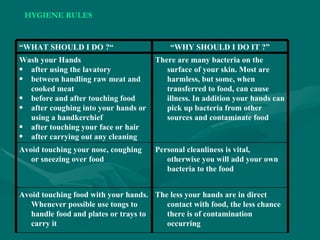
HYGIENE RULES The less your hands are in direct contact with food, the less chance there is of contamination occurring  Avoid touching food with your hands. Whenever possible use tongs to handle food and plates or trays to carry it  Personal cleanliness is vital, otherwise you will add your own bacteria to the food  Avoid touching your nose, coughing or sneezing over food There are many bacteria on the surface of your skin. Most are harmless, but some, when transferred to food, can cause illness. In addition your hands can pick up bacteria from other sources and contaminate food  Wash your Hands after using the lavatory between handling raw meat and cooked meat before and after touching food  after coughing into your hands or using a handkerchief  after touching your face or hair  after carrying out any cleaning  “ WHY SHOULD I DO IT ?” “ WHAT SHOULD I DO ?“
There is always the risk in the work place that utensils and equipment can become contaminated with bacteria  Clean kitchen utensils and Equipment thoroughly, before and after use  Play safe! Always regard raw meat and poultry as contaminated. Don’t spread infection  Keep raw and cooked food separate, especially raw meat/ poultry and cooked meat/ poultry  Wounds such as these are often infected with bacteria. They must be properly covered to prevent the spread of bacteria. Brightly coloured dressings will be easily spotted if they fall into food Keep cuts, grazes and boils covered with a waterproof dressing that is brightly coloured blue is a good colour  Bacteria can collect beneath long nails, and pass into the food you handle  Keep fingernails short and clean  Your hair and scalp carry many bacteria which can fall into food  Keep hair covered with a net or Disposable hat
Thorough cleaning is necessary to kill any bacteria already present Always ensure that the workplace is clean before preparing food To protect it against contamination Keep food covered whenever possible Thorough thawing is essential if the centre of the food is to reach the temperature required to destroy bacteria during cooking  Be sure that certain frozen food is thawed thoroughly before cooking – especially poultry and large joints of meat  High Risk foods (e.g. meat, poultry, gravy etc) provide bacteria with the nutrients and moisture needed to grow. In the temperature “ Danger Zone” (5’C to 63’C) bacteria multiply at a very fast rate Keep food at the correct temperature – in storage and preparation remember the “High Risk” foods remember the temperature “Danger Zone”

Basic hygiene centara 21 06 10

  • 1.
  • 2.
    INTRODUCTION Welcome tothe Centara Basic hygiene Training. This Training covers some of the hygiene issues which affect you every day as a food handler. Centara defines a food handler as anyone who handles food in the course of work, as part of their duties. Cleanliness is an integral part of your working day and it is essential that you have an understanding of the results and consequences of poor hygiene standards. You have a moral and legal responsibility to maintain high standards of personal hygiene in line with the food safety (general food hygiene).
  • 3.
    AS FOOD ISYOUR BUSINESS GOOD HYGIENE IS PART OF YOUR JOB
  • 4.
    YOUR PERSONAL HYGIENEHigh standards of personal hygiene are fundamental in reducing the risks of food poisoning within catering areas. You must be in good health and understand the need for exceptional hygiene standards at Centara . We know that germs that can cause food poisoning can be carried in our: bowels, noses, throats, ears, eyes and hair. They can also be carried in cuts and sores, boils and spots. As dirt harbors germs, you must keep your body and clothes extremely clean. A good personal hygiene routine is essential, washing your hair and body at least once every day. Your clothing must also be kept clean and changed every day.
  • 5.
    WHEN YOU ARRIVEAT WORK YOU MUST: put on your clean protective uniform put on clean, closed shoes with non-slip soles keep your hair tied up, if it is shoulder-length or longer, and, if necessary, covered remove all jewelers, apart from plain wedding bands cover all cuts/sores/boils with a clean, water proof dressing-these dressing should be changed regularly wash your hands REGULARLY!!
  • 6.
    WASHING YOUR HANDSPROPERLY MUST BECOME A SECOND NATURE TO YOU!!!! The hand is the most dangerous part of the body because it touches all other parts and everything in and around the food premises. Salmonella can be transferred from a source to a high-risk food, via unwashed hands.
  • 7.
    You must washthen before starting work after visiting the toilet after blowing your nose after smoking or eating after preparing food after using cleaning fluids after handling rubbish
  • 8.
    But how shouldyou wash your hands? under hot running water using soap or suitable bactericide only wash hand basins should be used, not food preparation or washing up sinks use a nails brush to scrub hands dry your hands with hot air driers, roller towel or, preferably, disposable paper towels
  • 9.
    WHAT NOT TODO: Chewing gum or eating whilst handling food Dipping fingers into food and liking fingers, always use a clean spoon Coughing into food Spitting into food Smoking near food Scratching yourself Sneezing over food Over handling food
  • 10.
    ALSO always keepyour finger nail short and clean perfume must not be worm as it may taint food Ornate jewelers must be removed as it can harbors bacteria, fall into food and can also be a safety hazard when handling knives or using machinery.
  • 11.
    WHAT SHOULD YOUDO IF YOU ARE ILL? As food handler, you can appreciate it can be extremely dangerous for you, your colleagues and your customer if you feel, or recently have been, ill. It is essential you tell your manager if you do not feel well and especially if you:
  • 12.
    have been sickhave diarrhea have a skin irritations or allergies think you have lice or a scalp irritation have infected sores or cuts feel unwell were ill while on holiday or anyone you live with is sick, or as diarrhea have ear, nose or throat infections have an upset stomach have food poisoning
  • 13.
    YOU’RE WORKING HYGIENERemember, dirt carries germs, so all working area must be kept immaculately clean and free from even the tiniest food. All surfaces and equipment which comes into contact with the food should be thoroughly cleaned once every day Constantly used surfaces and equipment need cleaning after each operation, for example chopping board, utensil and slicing machines. If you do not use clean, sterilized equipment you are inviting germs to spread to the food, to multiply and possibly affect your customer.
  • 14.
    Dirt, bad foodand scrap carrying germs end up in your bins, so bins must be stored away from food premises and must be covered and cleaned immediately after emptying. Never lean or sit on a table used for preparing food. Never leave cooked food uncovered in a warm kitchen to cool, always put food away in a cold room or into a blast chiller. Remember that germs are not killed by cold temperatures, even by freezing they are still there, but they cannot grow.
  • 15.
    Always keep foodcovered. Always reheat food at the same high temperature as the first cooking Bacteria are tiny living beings with an incredibly fast breeding rate, you cannot stop them getting into your kitchen areas, but you can stop them becoming dangerous when they are present. Bacteria are dangerous when they reach large numbers, all they need is
  • 16.
    THE RIGHT FOODTHE RIGHT TEMPERATURE A LITTLI TIME If you can remove at least one of these conditions, a germ cannot readily breed.
  • 17.
    HYGIENE RULES Theless your hands are in direct contact with food, the less chance there is of contamination occurring Avoid touching food with your hands. Whenever possible use tongs to handle food and plates or trays to carry it Personal cleanliness is vital, otherwise you will add your own bacteria to the food Avoid touching your nose, coughing or sneezing over food There are many bacteria on the surface of your skin. Most are harmless, but some, when transferred to food, can cause illness. In addition your hands can pick up bacteria from other sources and contaminate food Wash your Hands after using the lavatory between handling raw meat and cooked meat before and after touching food after coughing into your hands or using a handkerchief after touching your face or hair after carrying out any cleaning “ WHY SHOULD I DO IT ?” “ WHAT SHOULD I DO ?“
  • 18.
    There is alwaysthe risk in the work place that utensils and equipment can become contaminated with bacteria Clean kitchen utensils and Equipment thoroughly, before and after use Play safe! Always regard raw meat and poultry as contaminated. Don’t spread infection Keep raw and cooked food separate, especially raw meat/ poultry and cooked meat/ poultry Wounds such as these are often infected with bacteria. They must be properly covered to prevent the spread of bacteria. Brightly coloured dressings will be easily spotted if they fall into food Keep cuts, grazes and boils covered with a waterproof dressing that is brightly coloured blue is a good colour Bacteria can collect beneath long nails, and pass into the food you handle Keep fingernails short and clean Your hair and scalp carry many bacteria which can fall into food Keep hair covered with a net or Disposable hat
  • 19.
    Thorough cleaning isnecessary to kill any bacteria already present Always ensure that the workplace is clean before preparing food To protect it against contamination Keep food covered whenever possible Thorough thawing is essential if the centre of the food is to reach the temperature required to destroy bacteria during cooking Be sure that certain frozen food is thawed thoroughly before cooking – especially poultry and large joints of meat High Risk foods (e.g. meat, poultry, gravy etc) provide bacteria with the nutrients and moisture needed to grow. In the temperature “ Danger Zone” (5’C to 63’C) bacteria multiply at a very fast rate Keep food at the correct temperature – in storage and preparation remember the “High Risk” foods remember the temperature “Danger Zone”