To the Workshop of
US AID
W E L C O M E
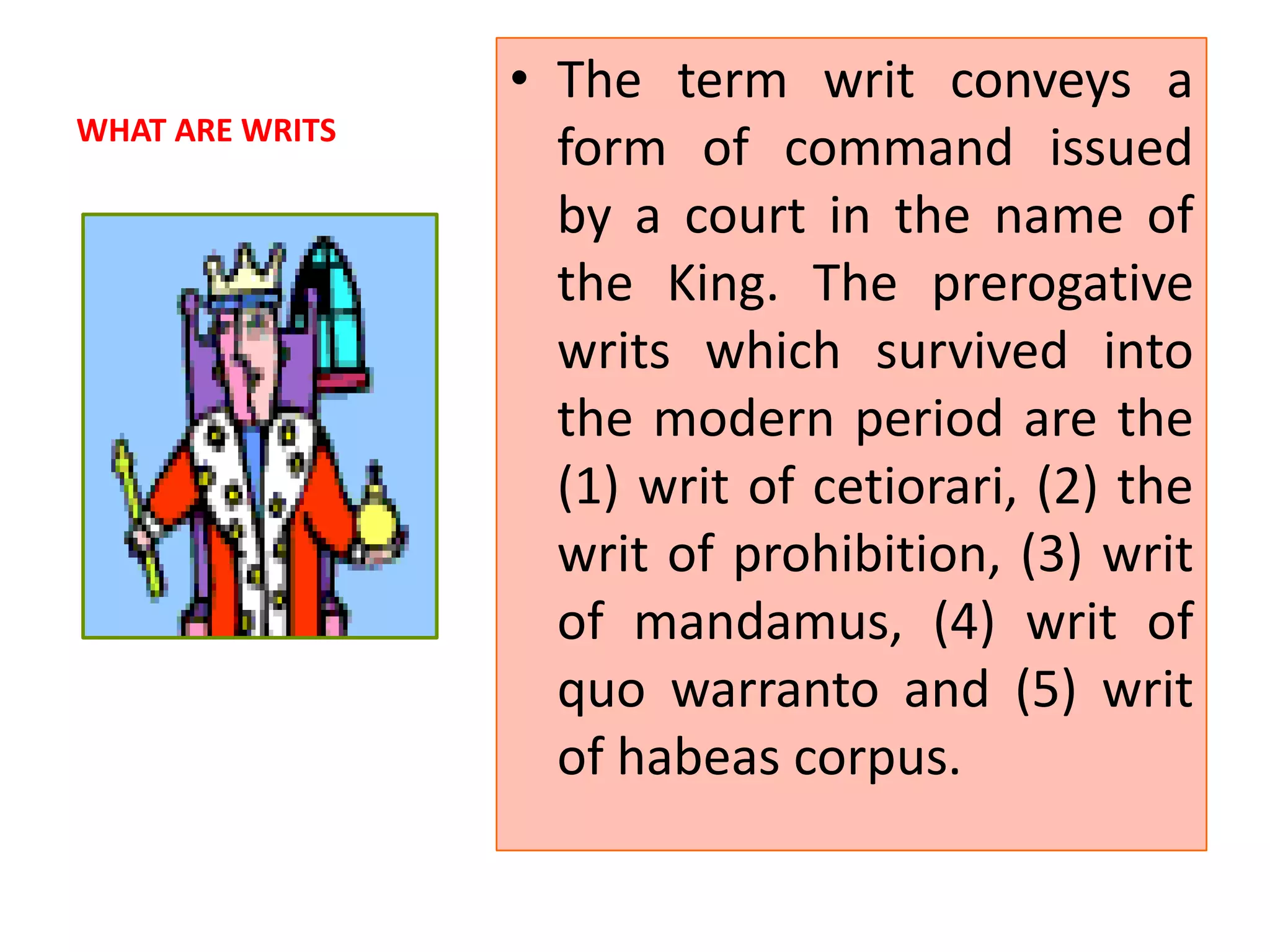
WHAT ARE WRITS
• The term writ conveys a
form of command issued
by a court in the name of
the King. The prerogative
writs which survived into
the modern period are the
(1) writ of cetiorari, (2) the
writ of prohibition, (3) writ
of mandamus, (4) writ of
quo warranto and (5) writ
of habeas corpus.
Nature of Prerogative Remedies
Why are they termed “Prerogative Remedies”
• originally available only to the Crown in England, and
not to the subject.
• The Crown could ensure that Public Authorities carried
out their duties, and the inferior tribunals kept within
their proper jurisdiction.
• Essentially these remedies are for ensuring efficiency
and maintaining order in the hierarchy of Courts,
Commissions and authorities of all kinds.
• By the end of the sixteenth century, these remedies had
become generally available to ordinary litigants.
3
The Development of the Law since 1923 :-
a) The requirement of ‘legal authority’ is no longer invariable,
since extra-legal bodies are now sometimes subject to
remedies;
b) The remedies are now not limited only to rights of subjects
in the sense of legal rights;
c) Nor are the remedies limited to ‘subjects’ since non citizens
also may make use of these remedies.
d) This formula also refers to a ‘body of persons’ - plural – this
is not the case with the principle applying equally to an
individual official as well.
The Development of the Law
since 1923
In this respect, the Sri Lankan Case of Harjani and Another
Vs. Indian Overseas Bank and Other [2005] 1 Sri L. R. 167 is
relevant, which sets out several aspects of the development
of the law, in the Sri Lankan context.
Harjani and Another V. Indian Overseas Bank
and Other
[2005] 1 Sri. L. R. 167
READ THE FULL JUDGMENT
LAND MARK CASE
5
judicial review is interwoven
with the preservation of the
rule of law. It demarcates the
checks, balances and
permissible area of an exercise
of control, authority and
jurisdiction over administrative
actions of the Government and
its organs
Certiorari
Certiorari is a Latin term meaning to inform. It was a
royal demand for information. Certiorari can be
described as “one of the most valuable and efficient
remedies.” Certiorari is an important prerogative writs
in our Courts adopted under Constitution against the
decisions of the authorities exercising judicial or quasi
judicial powers. Such powers are exercised when the
authorities fail to exercise the jurisdiction though
vested in it/him or fail to correct the apparent error
on the face of record or there is violation of the
principle of natural justice.
WRIT OF PROHOHIBTION
The writ of Prohibition is
issued preventing from
continuing the proceedings, as
basically such authority has no
power or jurisdiction to decide
a case. Prohibition is an extra
ordinary prerogative writ of a
preventive nature.
The underlying principle of PROHIBITION IS
prevention is better than cure'.
1. Similar to a restraining injunction in Civil
Law. 2. A writ of prohibition is an order
directed to an inferior Tribunal or other
bodies forbidding it from continuing with a
proceeding on the grounds
(i) proceedings are without jurisdiction or
(ii) in excess of jurisdiction or
(iii) contrary to the laws of the land,
statutory or otherwise
Mandamus is an order to
any Government agency,
court or public authority
issued whenever a public
authority fails to perform a
statutory duty
Quo Warranto•
• X DON’T FUNCTION
Quo Warranto means “by what
warrant or authority”. Writ of Quo
Warranto is issued against a person
who occupies a public seat without
any qualification for the
appointment. It is issued to restrain
the authority or candidate from
discharging the functions of public
office.
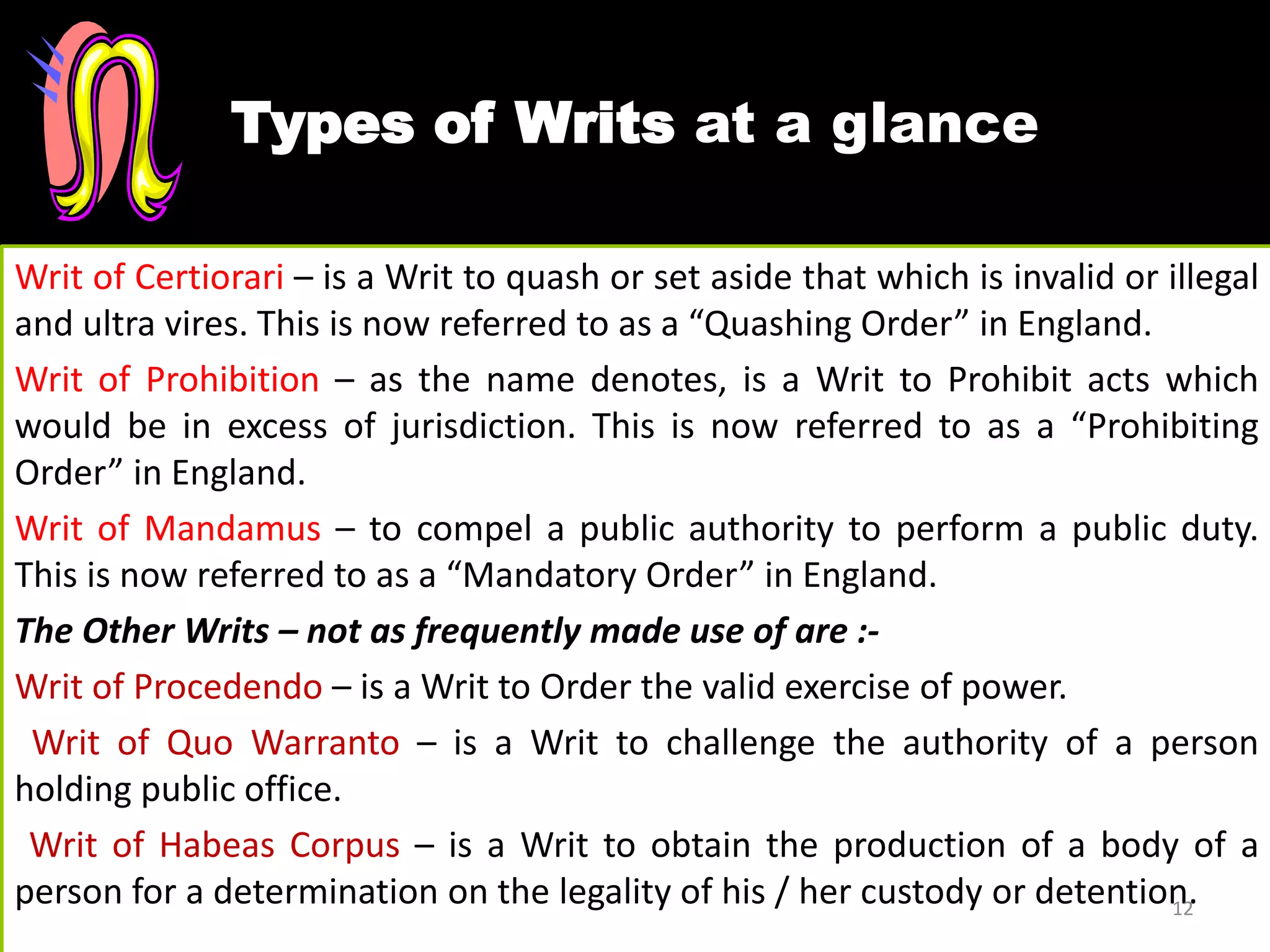
Types of Writs at a glance
Writ of Certiorari – is a Writ to quash or set aside that which is invalid or illegal
and ultra vires. This is now referred to as a “Quashing Order” in England.
Writ of Prohibition – as the name denotes, is a Writ to Prohibit acts which
would be in excess of jurisdiction. This is now referred to as a “Prohibiting
Order” in England.
Writ of Mandamus – to compel a public authority to perform a public duty.
This is now referred to as a “Mandatory Order” in England.
The Other Writs – not as frequently made use of are :-
Writ of Procedendo – is a Writ to Order the valid exercise of power.
Writ of Quo Warranto – is a Writ to challenge the authority of a person
holding public office.
Writ of Habeas Corpus – is a Writ to obtain the production of a body of a
person for a determination on the legality of his / her custody or detention.12
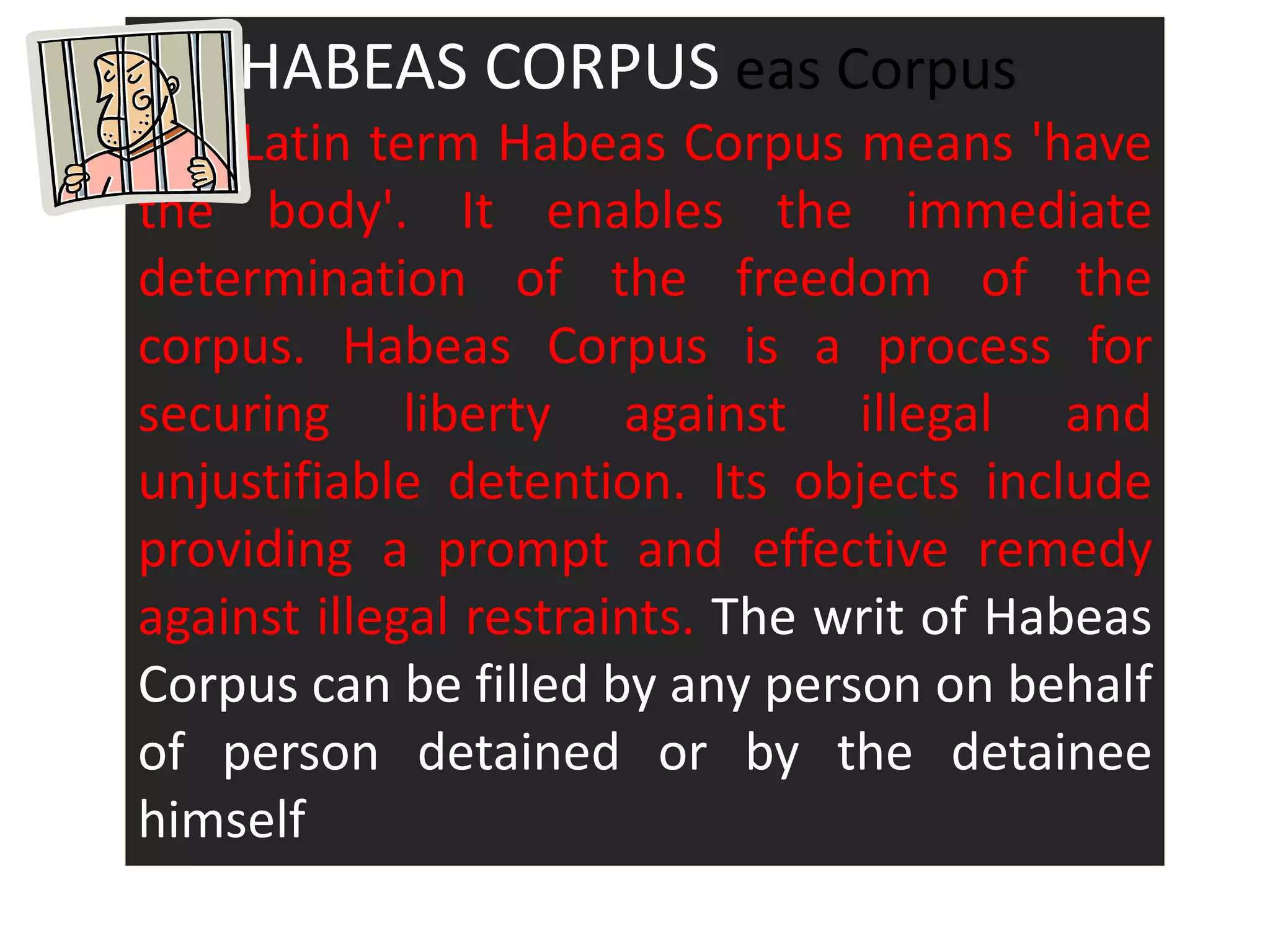
HA HABEAS CORPUS eas Corpus
The Latin term Habeas Corpus means 'have
the body'. It enables the immediate
determination of the freedom of the
corpus. Habeas Corpus is a process for
securing liberty against illegal and
unjustifiable detention. Its objects include
providing a prompt and effective remedy
against illegal restraints. The writ of Habeas
Corpus can be filled by any person on behalf
of person detained or by the detainee
himself
COCNSTITUTION
140. Subject to the provisions of the
Constitution, the Court of Appeal
shall have full power and authority
to inspect examine the records of
any Court of First Instance or tribunal
or other institution, and grant and
issue, according to law, orders in the
nature of writs of certiorari,
prohibition, procedendo, mandamus
and quo warranto against the judge
of any Court of First Instance or
tribunal or other institution or any
other person:
154 P (4) every such High Court shall have jurisdiction to
issue, according to law
(a) Orders in the nature of habeas corpus, in respect of
persons illegally detained within the Province; and
(b) Order in the nature of writs of certiorari, prohibition,
procedendo, mandamus and quo warranto against any person
exercising, within the Province, any power under
(i) any law; or
(ii) any statutes made by the Provincial Council established for
that Province
MENDIS VS FOUZY 1978-
79 2 SLR 322
An important decision
which lays down the rules
as to who are subject to
the control of writ
jurisdiction.
The Writ Jurisdiction
in Sri Lanka
However, there is still a concurrent jurisdiction for
the Court of Appeal.
Weragama V. Eksath Lanka Wathu Kamkaru Samithiya
(1994) 1 Sri. L. R. 293
Nilwala Vidulibala Company (Pvt.) Ltd V. Kotapola
Pradehsiya Sabha
(2005) 1 Sri. L.R. 296
Timely Justice
Effecting Change through building the Capacity of the Junior Bar
17
NILWALAVIDULIBALA COMPANY (PVT) LTD. Vs KOTAPOLA PRADESHIYA SAB
2005 SLR 1V 296.
In terms of the 13th Amendment, any subject not specified in the
Provincial List (List 1) or the Concurrent List (List III) is deemed to be
included in the Reserved List. In this Instance as there is no reference to
hydro power or grid connected power in List 1 or List III, it is clear that
these are Reserved Subjects.
Writ jurisdiction conferred on the Provincial High Court, is concurrent
with. the jurisdiction of the Court of Appeal under Article 140, and the
latter has not been diminished by the 13th Amendment.
"Relief sought is for the exercise of power in relation to hydro power
generation which is not a subject in the Provincial List of the 13th
Amendment, therefore the Provincial High Court has no jurisdiction to
entertain this application under Article 140, of the constitution the
Court of Appeal could hear and determine applications of this nature."
The phraseology "according to law"
appearing in the enabling Article 154P of
the Constitution should be interpreted to
mean as according to English law. The
writs specified in section 42 of the Courts
Ordinance are unknown to Roman-Dutch
and Ceylon law and should be issued
according to English law.
Abdul Thassim v. Edmund Rodrigo
(Controller of Textiles) [1 (1947) 48 N. L.
R. 121.]
Amenability to judicial review
• The decision complained of must have been taken by a
public body, i.e. a body established by statute or
otherwise exercising a public function.
• In R v Panel for Takeovers and Mergers Ex p Datafin
[1987] 1 QB 815, the Court of Appeal held that a
privately established panel was amenable to judicial
review because it is in fact operated as an integral part
of a governmental framework for regulating Mergers
and Takeover, while those affected had no choice but
to submit to its jurisdiction.
Ouster clauses
Sometimes the legislator may want to exclude
the powers of the court to review
administrative decision, making them 'final',
'binding' and not appealable. R (Cowl) v
Plymouth City Council.
However, the courts have consistently held
that none but the clearest words can exclude
judicial review
The Grounds of Review for
Certiorari
1) Want or Excess of Jurisdiction – the doctrine of Ultra Vires
What is outside jurisdiction is liable to be set-aside.
Offending acts are condemned simply because they are
unauthorized.
Bangamuwa V. S.M.J. Senaratne, Director General of Customs
[2000] 1 Sri. L.R. 106
Wijepala Mendis V. P.R.P. Perera and Others
[1999] 2 Sri. L.R. 110
Vallibel Lanka (Pvt.) Ltd V. Director General of Customs
[S.C. Minutes of 29/8/2008]
Timely Justice
Effecting Change through building the Capacity of the Junior Bar
22
The Grounds of Review for
Certiorari
2) Contravention of the Principles of Natural Justice
The three expressions of Natural Justice
a) The right to be heard – Audi Alteram Partem
This is an aspect of participatory democracy. Before a person is deprived of
certain privileges / liberties / property / livelihood etc., he must be allowed to
present his side of the picture.
This includes :-
•Notice of the Charge;
•Disclosure of all relevant material;
•Oral hearing;
•Time to prepare;
•Right to representation;
•Right to summon witnesses;
•Availability of an Appeal and time
Timely Justice
Effecting Change through building the Ca
23
The Grounds of Review for
Certiorari
The right to be heard – Audi Alteram Partem ……
Latiff V. Land Reform Commission
[1984] 1 Sri. L.R. 118
Manawadu V. Attorney General
[1987] 2 Sri. L.R. 31
Blanka Diamonds (Pvt.) Ltd. V. Coeme
[1996] 1 Sri. L.R. 200
Kegalle Plantations Ltd V. Silva and Others
[1996] 2 Sri. L.R. 180
Premaratne V. University Grants Commission and Others
[1998] 3 Sri. L.R. 397
Pure Beverages Company Executive Officers Association V. Commissioner of Labour
[2001] 2 Sri. L.R.258
Timely Justice
Effecting Change through building the Capacity of the Junior Bar
24
The Grounds of Review for
Certiorari
b) The Rule Against Bias – Nemo Judex in Causa sua potest
This rule lays down that no man should be a judge of his own cause.
J.B. Textiles Industries V. Minister of Finance and Planning
[1981] 1 Sri. L.R. 156
Geeganage V. Director General of Customs
[2001] 3 Sri. L.R. 179
Neidra Fernando V. Ceylon Tourist Board and Others
[2002] 2 Sri. L.R. 169
Circumstances which cause bias
a) Pecuniary Interest by a decision maker in a matter subject to his discretion
b) Professional or family interest
c) Intermingling of Functions – where the subordinate body and the appellate
body have common members
d) Previous knowledge of the issues or persons concerned
Timely Justice
Effecting Change through building the Capacity of the Junior Bar
25
The Grounds of Review for
Certiorari
c) The right to receive reasons.
Courts have been of the consistent view that the
requirement to provide reasons is an integral part of good
administration.
The Court have further developed this concept, and now
demand that not only should there be reasons provided,
but also that the reasons provided must be adequate.
M. Deepthi Kumara Gunaratne and Other V. Dayananda
Dissanayake, Commissioner of Elections and Another
[Supreme Court Minutes of 19/3/2009]
26
Sirimasiri Hapuarachchi and Others V. Dayananda Dissanayake,
Commissioner of Elections and Another [Supreme Court Minutes of
19/3/2009]
“On a consideration of our case law in the light of the attitude taken
by Court in other Countries, it is quite clear that giving reasons to an
administrative decision is an important feature in today’s context
which cannot be lightly disregarded. Moreover, in a situation where
giving reasons have been ignored, such a body would run the risk of
having acted arbitrarily, in coming to their conclusion.”
“In such circumstances to deprive a person of knowing the reasons
for a decision which affects him would not only be arbitrary but also
a violation of his right to equal protection of the Law”.
Central Bank of Sri Lanka and Others V. Lankem Tea and Rubber
Plantations (Pvt.) Ltd.
[Supreme Court Minutes of 5/6/2009]
The Grounds of Review for
Certiorari
3) Error on the face of the record
This can be classified as an ancient head of judicial review, and to some extent one could
say this is now redundant in view of the wide interpretation given in the Anisminic Case by
the House of Lords where it has been held that Error of Law on the face of the Record is a
species of Ultra Vires in the wider sense.
Brought in the question of ‘right’ or ‘wrong’ as opposed to ‘lawful’ or ‘unlawful’.
Dissanayake V. Kulatillake
59 NLR 310
Kundanmals Industries V. Commissioner of Labour.
[1994] 3 Sri L.R. 20
“material other than which appears in the record could not be used by an inferior tribunal”
Jayawardena and anther V. Pegasus Hotel of Ceylon Ltd.
[2004] Vol. X Part II BALJR 21
Timely Justice
Effecting Change through building the Capacity of the Junior Bar
29
The Grounds of Review for
Certiorari
4) Unreasonableness
The Wednesbury Test of Unreasonableness
Associated Provincial Picture Houses Ltd. v. Wednesbury Corporation (1948) 1 KB 223 at
229
Lord Greene:
"It is true that discretion must be exercised reasonably. Now what does that mean? Lawyers
familiar with the phraseology used in relation to exercise of statutory discretions often use the
word "unreasonable" in a rather comprehensive sense. It has frequently been used and is
frequently used as a general description of the things that must not be done. For instance, a
person entrusted with a discretion must, so to speak, direct himself properly in law. He must call
his own attention to the matters which he is bound to consider. He must exclude from his
consideration matters which are irrelevant to what he has to consider. If he does not obey these
rules, he may be truly said, and often is said, to be acting 'unreasonably'. Similarly, there may be
something so absurd that no sensible person could ever dream that it lay within the powers of the
authority. Warrington LJ in Short v. Poole Corporation (1926) Ch. 66 gave the example of the red
haired teacher, dismissed because she had red hair. This is unreasonable in one sense. In another it
is taking into consideration extraneous matters. It is so unreasonable that it might almost be
described as being done in bad faith; and, in fact, all these things run into one another,"
Podimahaththaya V. The Land Reform Commission and Another
(1990) 2 Sri L.R. 416
Timely Justice
Effecting Change through building the Capacity of the Junior Bar
30
The Grounds of Review for
Certiorari
5) Legitimate Expectation
First mentioned in the English Case of Schmidt V. Secretary of Home Affairs in 1969
The basic principle behind the doctrine is rather like the idea behind estoppel in private law; that
if possible the law ought to require people to keep to their promises or representations, even
where the promise does not constitute a contract.
More, specifically where a public body has represented to an individual that it will or will not do
something, then [even though the body has not bound itself to follow that representation] it
ought not to be allowed to disappoint the representation at least unless it gives the individual a
hearing first.
Mowjood V. Pussadeniya and Another
1987 2 Sri. L.R. 287
Sannasgala V. The University of Kelaniya and Members of the University Senate
1991 2 Sri. L.R. 193 at 186
Wickremaratne V. Jayaratne and Other
2001 3 Sri. L.R. 161
Bastian Thirimawithana and Others V. The Urban Development Authority and Others C.A. (Writ)
Application No. 3782005 – C.A. Minutes of 26/10/2006
Timely Justice
Effecting Change through building the Capacity of the Junior Bar
31
The Grounds of Review for
Certiorari
6) Proportionality
Emerging ground of review - and is very relevant in the modern context.
This is a balancing act by Court between the restrictions to the individual right as a
result of the administrative action and the corresponding advantage to the State.
Lord Diplock in R v. Goldsmith
[1983] 1 WLR 151 at 155
made an indirect reference to a “Steam hammer to crack a nut”
R V. Barnsley, ex p. Hook
[1976] 1 WLR 1052 (CA
R V. Secretary of State for the Home Department ex parte Benwell
[1984] 1 CR 723 at p. 736
But in R v. Home Secretary ex p. Brind
[1991] 1 AC 696
Timely Justice
Effecting Change through building the Capacity of the Junior Bar
32
The Grounds of Review for
Certiorari
Proportionality …..
‘structured proportionality’ test
a) Whether the legislative objective is sufficiently important to justify limiting a
fundamental right.
b) Whether the measures designed to meet the legislative objective are rationally
connected to it.
c) Whether the means used to impair the right or freedom are no more than is
necessary to accomplish the objective. [the necessity question].
d) Whether a fair balance has been struck between the rights of the individual and
the interests of the community which is inherent in the whole of the convention.
[Sometimes called narrow proportionality]
Premaratne V. University Grants Commission and Other
[1998] 3 Sri. L.R. 395 at 414
Caldera V. University of Peradeniya and Others
[C.A. Writ No. 572/2004 C.A. Minutes of 25/4/2005]
Neidra Fernando V. Ceylon Tourist Board and Others
[2002] 2 Sri. L.R. 169
Timely Justice
Effecting Change through building the Capacity of the Junior Bar
33
The Grounds of Review for
Certiorari
Proportionality….
An Article titled “Proportionality : Neither novel nor dangerous” by Jeffrey
Jowell and Anthony Lester Q.C., in its concluding paragraph states :
“The use of proportionality under so many different labels and in so man
different contexts in English law demonstrates its general acceptance as a
general principle of law. Like all grounds of judicial review, it cannot be
mechanically applied. Its application requires judgment in the light of the
circumstances of the particular case. However, its application would affirm
an important principle of justice by which all administrative action should
be expected to be judged : that the decision maker must exercise a proper
sense of proportion in making a decision and that individuals affected by
decisions should not be required to bear a burden that is unnecessary or
disproportionate to the ends being pursued”
Timely Justice
Effecting Change through building the Capacity of the Junior Bar
34
Defences to
Writ Applications
1) Delay – Laches
One cannot sleep over one’s rights.
The relevance of the matter also could get diluted with the passing of time.
Biso Menika V. Alwis
[1982] 1 Sri. L.R. 368
Trustees of the Taiyabbhai Children’s Trust V. Attorney General
[1997] 2 Sri. L.R. 341
However, in the case of a patent want of jurisdiction, the issue of delay may be overcome.
Sebastian Fernando V. Katana Multi-Purpose Co-operative Society and Others
[1990] 1 Sri. L.R. 342
“Delay by itself will not defeat an application. It is only a discretionary bar to be applied
having regard to the conduct of parties, the issues involved and the substantial prejudice
which may result in varying the impugned order”.
Timely Justice
Effecting Change through building the Capacity of the Junior Bar
35
Defences to
Writ Applications
Delay – Laches….
Dissanayake V. I.O.K. Fernando and another
71 NLR 356
“Where there has been delay in seeking relief by way of Certiorari, it
is essential that the reasons for the delay should be set out in the
papers filed …”
Timely Justice
Effecting Change through building the Capacity of the Junior Bar
36
Defences to
Writ Applications
2) Necessary Parties
Necessary parties include the parties making the Order, those benefiting
from the Order and those aggrieved by the Order.
Gnanasambanthan V. Rear Admiral Perera and Others
[1998] 3 Sri L.R.169
Abaydeera and Others V. Dr. Stanley Wijesundera
[1983] 2 Sri L.R. 267
Rawaya Publishers and Other V. Wijedasa Rajapaksha, Chairman Sri Lanka
Press Council and Others
[2001] 3 Sri L.R. 213
Farook V. Siriwardena and Others
[1997] 1 Sri L.R. 145
Timely Justice
Effecting Change through building the Capacity of the Junior Bar
37
Defences to
Writ Applications
3) Alternative Remedies
There is a requirement to exhaust alternative remedies, before
invoking the Writ Jurisdiction.
But the Alternative Remedy must be an adequate remedy.
Linus Silva V. the University Council of the Vidyodaya University
64 NLR 104
Somasunderam Vanniasingham V. Forbes and Another
[1993] 2 Sri. L.R. 362
Timely Justice
Effecting Change through building the Capacity of the Junior Bar
38
Defences to
Writ Applications
4) Futility
If the grant of relief will be futile, then the Court will not grant
relief.
Sethu Ramasamy V. A.E.G. Moregoda
63 NLR 115
Siddeek V. Jacolyn Seneviratne and Others
[1984] 1 Sri. L.R. 83
Wijesiri V. Siriwardena
[1982] 1 Sri. L.R. 171
Timely Justice
Effecting Change through building the Capacity of the Junior Bar
39
Defences to
Writ Applications
5) Preclusive Clauses
The Proviso to Article 140 of the Constitution :
“Provided that Parliament may by law provide that in any such category of
cases as may be specified in such law, the jurisdiction conferred on the Court
of Appeal by the preceding provisions of this Article shall be exercised by the
Supreme Court and not by the Court of Appeal”.
For example by Section 24(1) of the Commission to Investigate Allegations of
Bribery or Corruption Act No. 19 of 1994 – the Writ Jurisdiction is vested with
the Supreme Court.
Article 61A of the Constitution, introduced by the 17th Amendment – If
challenging an Order of the Public Service Commission, that must be before
the Supreme Court.
But in the recent decision of Priyadarshini V. the Commissioner General of
Inland Revenue and Others [C.A. (Writ) Application No. 540/2011, C.A.
Minutes of 29/6/2012], the Court of Appeal, in a Writ Application went as far
as to issue a Writ of Mandamus on the Public Service Commission, to
antedate the appointment of the Petitioner.
Timely Justice
Effecting Change through building the Capacity of the Junior Bar
40
Defences to
Writ Applications
6) Uberrimae fides
You have to come to Court with clean hand and utmost good faith.
There can be no Suppression or Misrepresentation of material Facts
and Circumstances.
Alphonso Appuhamy V. Hettiarachchi
77 NLR 131
The State Graphite Corporation V. K.S.D.P. Fernando
[1981] 2 Sri L.R. 401
Sumith Kalugala V. Y.P. De Silva
[1998] 3 Sri L.R. 141
Timely Justice
Effecting Change through building the Capacity of the Junior Bar
41
Defences to
Writ Applications
7) Acquiescence or Waiver
If there is found to be acquiescence by the Petitioner, in the
matter under review, then Writ will not lie.
However, Courts will look at this Defense, in conjunction
with the other Defenses before denying relief.
Kandy Omnibus Co. Ltd. V. Roberts
56 NLR 293
Timely Justice
Effecting Change through building the Capacity of the Junior Bar
42
Defences to
Writ Applications
8) Lack of Standing – Locus Standi
Traditionally Courts looked at the nexus between the Petitioner and the
Complaint.
However, the Courts of Sri Lanka, like so many other jurisdictions have
expanded the boundaries of standing and this has been further fuelled by the
popularity of Public Interest Litigation.
Wijesiri V. Siriwardene
[1982] 1 Sri L.R. 171
Environmental Foundation V. Minister of Public Administration
[1997] 2 Sri L.R. 306
National Olympic Committee Case
[C.A. (Writ) Application No. 1312/2004 reported in the BASL News of August
2004
Timely Justice
Effecting Change through building the Capacity of the Junior Bar
43
Common Mistakes made in a
Writ Application
Timely Justice
Effecting Change through building the Capacity of the Junior Bar
44
Timely Justice
Effecting Change through building the Capacity of the Junior Bar
45

Judicial review a power point presentation (1)

  • 1.
    To the Workshopof US AID W E L C O M E
  • 2.
    WHAT ARE WRITS •The term writ conveys a form of command issued by a court in the name of the King. The prerogative writs which survived into the modern period are the (1) writ of cetiorari, (2) the writ of prohibition, (3) writ of mandamus, (4) writ of quo warranto and (5) writ of habeas corpus.
  • 3.
    Nature of PrerogativeRemedies Why are they termed “Prerogative Remedies” • originally available only to the Crown in England, and not to the subject. • The Crown could ensure that Public Authorities carried out their duties, and the inferior tribunals kept within their proper jurisdiction. • Essentially these remedies are for ensuring efficiency and maintaining order in the hierarchy of Courts, Commissions and authorities of all kinds. • By the end of the sixteenth century, these remedies had become generally available to ordinary litigants. 3
  • 4.
    The Development ofthe Law since 1923 :- a) The requirement of ‘legal authority’ is no longer invariable, since extra-legal bodies are now sometimes subject to remedies; b) The remedies are now not limited only to rights of subjects in the sense of legal rights; c) Nor are the remedies limited to ‘subjects’ since non citizens also may make use of these remedies. d) This formula also refers to a ‘body of persons’ - plural – this is not the case with the principle applying equally to an individual official as well.
  • 5.
    The Development ofthe Law since 1923 In this respect, the Sri Lankan Case of Harjani and Another Vs. Indian Overseas Bank and Other [2005] 1 Sri L. R. 167 is relevant, which sets out several aspects of the development of the law, in the Sri Lankan context. Harjani and Another V. Indian Overseas Bank and Other [2005] 1 Sri. L. R. 167 READ THE FULL JUDGMENT LAND MARK CASE 5
  • 6.
    judicial review isinterwoven with the preservation of the rule of law. It demarcates the checks, balances and permissible area of an exercise of control, authority and jurisdiction over administrative actions of the Government and its organs
  • 7.
    Certiorari Certiorari is aLatin term meaning to inform. It was a royal demand for information. Certiorari can be described as “one of the most valuable and efficient remedies.” Certiorari is an important prerogative writs in our Courts adopted under Constitution against the decisions of the authorities exercising judicial or quasi judicial powers. Such powers are exercised when the authorities fail to exercise the jurisdiction though vested in it/him or fail to correct the apparent error on the face of record or there is violation of the principle of natural justice.
  • 8.
    WRIT OF PROHOHIBTION Thewrit of Prohibition is issued preventing from continuing the proceedings, as basically such authority has no power or jurisdiction to decide a case. Prohibition is an extra ordinary prerogative writ of a preventive nature.
  • 9.
    The underlying principleof PROHIBITION IS prevention is better than cure'. 1. Similar to a restraining injunction in Civil Law. 2. A writ of prohibition is an order directed to an inferior Tribunal or other bodies forbidding it from continuing with a proceeding on the grounds (i) proceedings are without jurisdiction or (ii) in excess of jurisdiction or (iii) contrary to the laws of the land, statutory or otherwise
  • 10.
    Mandamus is anorder to any Government agency, court or public authority issued whenever a public authority fails to perform a statutory duty
  • 11.
    Quo Warranto• • XDON’T FUNCTION Quo Warranto means “by what warrant or authority”. Writ of Quo Warranto is issued against a person who occupies a public seat without any qualification for the appointment. It is issued to restrain the authority or candidate from discharging the functions of public office.
  • 12.
    Types of Writsat a glance Writ of Certiorari – is a Writ to quash or set aside that which is invalid or illegal and ultra vires. This is now referred to as a “Quashing Order” in England. Writ of Prohibition – as the name denotes, is a Writ to Prohibit acts which would be in excess of jurisdiction. This is now referred to as a “Prohibiting Order” in England. Writ of Mandamus – to compel a public authority to perform a public duty. This is now referred to as a “Mandatory Order” in England. The Other Writs – not as frequently made use of are :- Writ of Procedendo – is a Writ to Order the valid exercise of power. Writ of Quo Warranto – is a Writ to challenge the authority of a person holding public office. Writ of Habeas Corpus – is a Writ to obtain the production of a body of a person for a determination on the legality of his / her custody or detention.12
  • 13.
    HA HABEAS CORPUSeas Corpus The Latin term Habeas Corpus means 'have the body'. It enables the immediate determination of the freedom of the corpus. Habeas Corpus is a process for securing liberty against illegal and unjustifiable detention. Its objects include providing a prompt and effective remedy against illegal restraints. The writ of Habeas Corpus can be filled by any person on behalf of person detained or by the detainee himself
  • 14.
    COCNSTITUTION 140. Subject tothe provisions of the Constitution, the Court of Appeal shall have full power and authority to inspect examine the records of any Court of First Instance or tribunal or other institution, and grant and issue, according to law, orders in the nature of writs of certiorari, prohibition, procedendo, mandamus and quo warranto against the judge of any Court of First Instance or tribunal or other institution or any other person:
  • 15.
    154 P (4)every such High Court shall have jurisdiction to issue, according to law (a) Orders in the nature of habeas corpus, in respect of persons illegally detained within the Province; and (b) Order in the nature of writs of certiorari, prohibition, procedendo, mandamus and quo warranto against any person exercising, within the Province, any power under (i) any law; or (ii) any statutes made by the Provincial Council established for that Province
  • 16.
    MENDIS VS FOUZY1978- 79 2 SLR 322 An important decision which lays down the rules as to who are subject to the control of writ jurisdiction.
  • 17.
    The Writ Jurisdiction inSri Lanka However, there is still a concurrent jurisdiction for the Court of Appeal. Weragama V. Eksath Lanka Wathu Kamkaru Samithiya (1994) 1 Sri. L. R. 293 Nilwala Vidulibala Company (Pvt.) Ltd V. Kotapola Pradehsiya Sabha (2005) 1 Sri. L.R. 296 Timely Justice Effecting Change through building the Capacity of the Junior Bar 17
  • 18.
    NILWALAVIDULIBALA COMPANY (PVT)LTD. Vs KOTAPOLA PRADESHIYA SAB 2005 SLR 1V 296. In terms of the 13th Amendment, any subject not specified in the Provincial List (List 1) or the Concurrent List (List III) is deemed to be included in the Reserved List. In this Instance as there is no reference to hydro power or grid connected power in List 1 or List III, it is clear that these are Reserved Subjects. Writ jurisdiction conferred on the Provincial High Court, is concurrent with. the jurisdiction of the Court of Appeal under Article 140, and the latter has not been diminished by the 13th Amendment. "Relief sought is for the exercise of power in relation to hydro power generation which is not a subject in the Provincial List of the 13th Amendment, therefore the Provincial High Court has no jurisdiction to entertain this application under Article 140, of the constitution the Court of Appeal could hear and determine applications of this nature."
  • 19.
    The phraseology "accordingto law" appearing in the enabling Article 154P of the Constitution should be interpreted to mean as according to English law. The writs specified in section 42 of the Courts Ordinance are unknown to Roman-Dutch and Ceylon law and should be issued according to English law. Abdul Thassim v. Edmund Rodrigo (Controller of Textiles) [1 (1947) 48 N. L. R. 121.]
  • 20.
    Amenability to judicialreview • The decision complained of must have been taken by a public body, i.e. a body established by statute or otherwise exercising a public function. • In R v Panel for Takeovers and Mergers Ex p Datafin [1987] 1 QB 815, the Court of Appeal held that a privately established panel was amenable to judicial review because it is in fact operated as an integral part of a governmental framework for regulating Mergers and Takeover, while those affected had no choice but to submit to its jurisdiction.
  • 21.
    Ouster clauses Sometimes thelegislator may want to exclude the powers of the court to review administrative decision, making them 'final', 'binding' and not appealable. R (Cowl) v Plymouth City Council. However, the courts have consistently held that none but the clearest words can exclude judicial review
  • 22.
    The Grounds ofReview for Certiorari 1) Want or Excess of Jurisdiction – the doctrine of Ultra Vires What is outside jurisdiction is liable to be set-aside. Offending acts are condemned simply because they are unauthorized. Bangamuwa V. S.M.J. Senaratne, Director General of Customs [2000] 1 Sri. L.R. 106 Wijepala Mendis V. P.R.P. Perera and Others [1999] 2 Sri. L.R. 110 Vallibel Lanka (Pvt.) Ltd V. Director General of Customs [S.C. Minutes of 29/8/2008] Timely Justice Effecting Change through building the Capacity of the Junior Bar 22
  • 23.
    The Grounds ofReview for Certiorari 2) Contravention of the Principles of Natural Justice The three expressions of Natural Justice a) The right to be heard – Audi Alteram Partem This is an aspect of participatory democracy. Before a person is deprived of certain privileges / liberties / property / livelihood etc., he must be allowed to present his side of the picture. This includes :- •Notice of the Charge; •Disclosure of all relevant material; •Oral hearing; •Time to prepare; •Right to representation; •Right to summon witnesses; •Availability of an Appeal and time Timely Justice Effecting Change through building the Ca 23
  • 24.
    The Grounds ofReview for Certiorari The right to be heard – Audi Alteram Partem …… Latiff V. Land Reform Commission [1984] 1 Sri. L.R. 118 Manawadu V. Attorney General [1987] 2 Sri. L.R. 31 Blanka Diamonds (Pvt.) Ltd. V. Coeme [1996] 1 Sri. L.R. 200 Kegalle Plantations Ltd V. Silva and Others [1996] 2 Sri. L.R. 180 Premaratne V. University Grants Commission and Others [1998] 3 Sri. L.R. 397 Pure Beverages Company Executive Officers Association V. Commissioner of Labour [2001] 2 Sri. L.R.258 Timely Justice Effecting Change through building the Capacity of the Junior Bar 24
  • 25.
    The Grounds ofReview for Certiorari b) The Rule Against Bias – Nemo Judex in Causa sua potest This rule lays down that no man should be a judge of his own cause. J.B. Textiles Industries V. Minister of Finance and Planning [1981] 1 Sri. L.R. 156 Geeganage V. Director General of Customs [2001] 3 Sri. L.R. 179 Neidra Fernando V. Ceylon Tourist Board and Others [2002] 2 Sri. L.R. 169 Circumstances which cause bias a) Pecuniary Interest by a decision maker in a matter subject to his discretion b) Professional or family interest c) Intermingling of Functions – where the subordinate body and the appellate body have common members d) Previous knowledge of the issues or persons concerned Timely Justice Effecting Change through building the Capacity of the Junior Bar 25
  • 26.
    The Grounds ofReview for Certiorari c) The right to receive reasons. Courts have been of the consistent view that the requirement to provide reasons is an integral part of good administration. The Court have further developed this concept, and now demand that not only should there be reasons provided, but also that the reasons provided must be adequate. M. Deepthi Kumara Gunaratne and Other V. Dayananda Dissanayake, Commissioner of Elections and Another [Supreme Court Minutes of 19/3/2009] 26
  • 27.
    Sirimasiri Hapuarachchi andOthers V. Dayananda Dissanayake, Commissioner of Elections and Another [Supreme Court Minutes of 19/3/2009] “On a consideration of our case law in the light of the attitude taken by Court in other Countries, it is quite clear that giving reasons to an administrative decision is an important feature in today’s context which cannot be lightly disregarded. Moreover, in a situation where giving reasons have been ignored, such a body would run the risk of having acted arbitrarily, in coming to their conclusion.” “In such circumstances to deprive a person of knowing the reasons for a decision which affects him would not only be arbitrary but also a violation of his right to equal protection of the Law”. Central Bank of Sri Lanka and Others V. Lankem Tea and Rubber Plantations (Pvt.) Ltd. [Supreme Court Minutes of 5/6/2009]
  • 29.
    The Grounds ofReview for Certiorari 3) Error on the face of the record This can be classified as an ancient head of judicial review, and to some extent one could say this is now redundant in view of the wide interpretation given in the Anisminic Case by the House of Lords where it has been held that Error of Law on the face of the Record is a species of Ultra Vires in the wider sense. Brought in the question of ‘right’ or ‘wrong’ as opposed to ‘lawful’ or ‘unlawful’. Dissanayake V. Kulatillake 59 NLR 310 Kundanmals Industries V. Commissioner of Labour. [1994] 3 Sri L.R. 20 “material other than which appears in the record could not be used by an inferior tribunal” Jayawardena and anther V. Pegasus Hotel of Ceylon Ltd. [2004] Vol. X Part II BALJR 21 Timely Justice Effecting Change through building the Capacity of the Junior Bar 29
  • 30.
    The Grounds ofReview for Certiorari 4) Unreasonableness The Wednesbury Test of Unreasonableness Associated Provincial Picture Houses Ltd. v. Wednesbury Corporation (1948) 1 KB 223 at 229 Lord Greene: "It is true that discretion must be exercised reasonably. Now what does that mean? Lawyers familiar with the phraseology used in relation to exercise of statutory discretions often use the word "unreasonable" in a rather comprehensive sense. It has frequently been used and is frequently used as a general description of the things that must not be done. For instance, a person entrusted with a discretion must, so to speak, direct himself properly in law. He must call his own attention to the matters which he is bound to consider. He must exclude from his consideration matters which are irrelevant to what he has to consider. If he does not obey these rules, he may be truly said, and often is said, to be acting 'unreasonably'. Similarly, there may be something so absurd that no sensible person could ever dream that it lay within the powers of the authority. Warrington LJ in Short v. Poole Corporation (1926) Ch. 66 gave the example of the red haired teacher, dismissed because she had red hair. This is unreasonable in one sense. In another it is taking into consideration extraneous matters. It is so unreasonable that it might almost be described as being done in bad faith; and, in fact, all these things run into one another," Podimahaththaya V. The Land Reform Commission and Another (1990) 2 Sri L.R. 416 Timely Justice Effecting Change through building the Capacity of the Junior Bar 30
  • 31.
    The Grounds ofReview for Certiorari 5) Legitimate Expectation First mentioned in the English Case of Schmidt V. Secretary of Home Affairs in 1969 The basic principle behind the doctrine is rather like the idea behind estoppel in private law; that if possible the law ought to require people to keep to their promises or representations, even where the promise does not constitute a contract. More, specifically where a public body has represented to an individual that it will or will not do something, then [even though the body has not bound itself to follow that representation] it ought not to be allowed to disappoint the representation at least unless it gives the individual a hearing first. Mowjood V. Pussadeniya and Another 1987 2 Sri. L.R. 287 Sannasgala V. The University of Kelaniya and Members of the University Senate 1991 2 Sri. L.R. 193 at 186 Wickremaratne V. Jayaratne and Other 2001 3 Sri. L.R. 161 Bastian Thirimawithana and Others V. The Urban Development Authority and Others C.A. (Writ) Application No. 3782005 – C.A. Minutes of 26/10/2006 Timely Justice Effecting Change through building the Capacity of the Junior Bar 31
  • 32.
    The Grounds ofReview for Certiorari 6) Proportionality Emerging ground of review - and is very relevant in the modern context. This is a balancing act by Court between the restrictions to the individual right as a result of the administrative action and the corresponding advantage to the State. Lord Diplock in R v. Goldsmith [1983] 1 WLR 151 at 155 made an indirect reference to a “Steam hammer to crack a nut” R V. Barnsley, ex p. Hook [1976] 1 WLR 1052 (CA R V. Secretary of State for the Home Department ex parte Benwell [1984] 1 CR 723 at p. 736 But in R v. Home Secretary ex p. Brind [1991] 1 AC 696 Timely Justice Effecting Change through building the Capacity of the Junior Bar 32
  • 33.
    The Grounds ofReview for Certiorari Proportionality ….. ‘structured proportionality’ test a) Whether the legislative objective is sufficiently important to justify limiting a fundamental right. b) Whether the measures designed to meet the legislative objective are rationally connected to it. c) Whether the means used to impair the right or freedom are no more than is necessary to accomplish the objective. [the necessity question]. d) Whether a fair balance has been struck between the rights of the individual and the interests of the community which is inherent in the whole of the convention. [Sometimes called narrow proportionality] Premaratne V. University Grants Commission and Other [1998] 3 Sri. L.R. 395 at 414 Caldera V. University of Peradeniya and Others [C.A. Writ No. 572/2004 C.A. Minutes of 25/4/2005] Neidra Fernando V. Ceylon Tourist Board and Others [2002] 2 Sri. L.R. 169 Timely Justice Effecting Change through building the Capacity of the Junior Bar 33
  • 34.
    The Grounds ofReview for Certiorari Proportionality…. An Article titled “Proportionality : Neither novel nor dangerous” by Jeffrey Jowell and Anthony Lester Q.C., in its concluding paragraph states : “The use of proportionality under so many different labels and in so man different contexts in English law demonstrates its general acceptance as a general principle of law. Like all grounds of judicial review, it cannot be mechanically applied. Its application requires judgment in the light of the circumstances of the particular case. However, its application would affirm an important principle of justice by which all administrative action should be expected to be judged : that the decision maker must exercise a proper sense of proportion in making a decision and that individuals affected by decisions should not be required to bear a burden that is unnecessary or disproportionate to the ends being pursued” Timely Justice Effecting Change through building the Capacity of the Junior Bar 34
  • 35.
    Defences to Writ Applications 1)Delay – Laches One cannot sleep over one’s rights. The relevance of the matter also could get diluted with the passing of time. Biso Menika V. Alwis [1982] 1 Sri. L.R. 368 Trustees of the Taiyabbhai Children’s Trust V. Attorney General [1997] 2 Sri. L.R. 341 However, in the case of a patent want of jurisdiction, the issue of delay may be overcome. Sebastian Fernando V. Katana Multi-Purpose Co-operative Society and Others [1990] 1 Sri. L.R. 342 “Delay by itself will not defeat an application. It is only a discretionary bar to be applied having regard to the conduct of parties, the issues involved and the substantial prejudice which may result in varying the impugned order”. Timely Justice Effecting Change through building the Capacity of the Junior Bar 35
  • 36.
    Defences to Writ Applications Delay– Laches…. Dissanayake V. I.O.K. Fernando and another 71 NLR 356 “Where there has been delay in seeking relief by way of Certiorari, it is essential that the reasons for the delay should be set out in the papers filed …” Timely Justice Effecting Change through building the Capacity of the Junior Bar 36
  • 37.
    Defences to Writ Applications 2)Necessary Parties Necessary parties include the parties making the Order, those benefiting from the Order and those aggrieved by the Order. Gnanasambanthan V. Rear Admiral Perera and Others [1998] 3 Sri L.R.169 Abaydeera and Others V. Dr. Stanley Wijesundera [1983] 2 Sri L.R. 267 Rawaya Publishers and Other V. Wijedasa Rajapaksha, Chairman Sri Lanka Press Council and Others [2001] 3 Sri L.R. 213 Farook V. Siriwardena and Others [1997] 1 Sri L.R. 145 Timely Justice Effecting Change through building the Capacity of the Junior Bar 37
  • 38.
    Defences to Writ Applications 3)Alternative Remedies There is a requirement to exhaust alternative remedies, before invoking the Writ Jurisdiction. But the Alternative Remedy must be an adequate remedy. Linus Silva V. the University Council of the Vidyodaya University 64 NLR 104 Somasunderam Vanniasingham V. Forbes and Another [1993] 2 Sri. L.R. 362 Timely Justice Effecting Change through building the Capacity of the Junior Bar 38
  • 39.
    Defences to Writ Applications 4)Futility If the grant of relief will be futile, then the Court will not grant relief. Sethu Ramasamy V. A.E.G. Moregoda 63 NLR 115 Siddeek V. Jacolyn Seneviratne and Others [1984] 1 Sri. L.R. 83 Wijesiri V. Siriwardena [1982] 1 Sri. L.R. 171 Timely Justice Effecting Change through building the Capacity of the Junior Bar 39
  • 40.
    Defences to Writ Applications 5)Preclusive Clauses The Proviso to Article 140 of the Constitution : “Provided that Parliament may by law provide that in any such category of cases as may be specified in such law, the jurisdiction conferred on the Court of Appeal by the preceding provisions of this Article shall be exercised by the Supreme Court and not by the Court of Appeal”. For example by Section 24(1) of the Commission to Investigate Allegations of Bribery or Corruption Act No. 19 of 1994 – the Writ Jurisdiction is vested with the Supreme Court. Article 61A of the Constitution, introduced by the 17th Amendment – If challenging an Order of the Public Service Commission, that must be before the Supreme Court. But in the recent decision of Priyadarshini V. the Commissioner General of Inland Revenue and Others [C.A. (Writ) Application No. 540/2011, C.A. Minutes of 29/6/2012], the Court of Appeal, in a Writ Application went as far as to issue a Writ of Mandamus on the Public Service Commission, to antedate the appointment of the Petitioner. Timely Justice Effecting Change through building the Capacity of the Junior Bar 40
  • 41.
    Defences to Writ Applications 6)Uberrimae fides You have to come to Court with clean hand and utmost good faith. There can be no Suppression or Misrepresentation of material Facts and Circumstances. Alphonso Appuhamy V. Hettiarachchi 77 NLR 131 The State Graphite Corporation V. K.S.D.P. Fernando [1981] 2 Sri L.R. 401 Sumith Kalugala V. Y.P. De Silva [1998] 3 Sri L.R. 141 Timely Justice Effecting Change through building the Capacity of the Junior Bar 41
  • 42.
    Defences to Writ Applications 7)Acquiescence or Waiver If there is found to be acquiescence by the Petitioner, in the matter under review, then Writ will not lie. However, Courts will look at this Defense, in conjunction with the other Defenses before denying relief. Kandy Omnibus Co. Ltd. V. Roberts 56 NLR 293 Timely Justice Effecting Change through building the Capacity of the Junior Bar 42
  • 43.
    Defences to Writ Applications 8)Lack of Standing – Locus Standi Traditionally Courts looked at the nexus between the Petitioner and the Complaint. However, the Courts of Sri Lanka, like so many other jurisdictions have expanded the boundaries of standing and this has been further fuelled by the popularity of Public Interest Litigation. Wijesiri V. Siriwardene [1982] 1 Sri L.R. 171 Environmental Foundation V. Minister of Public Administration [1997] 2 Sri L.R. 306 National Olympic Committee Case [C.A. (Writ) Application No. 1312/2004 reported in the BASL News of August 2004 Timely Justice Effecting Change through building the Capacity of the Junior Bar 43
  • 44.
    Common Mistakes madein a Writ Application Timely Justice Effecting Change through building the Capacity of the Junior Bar 44
  • 45.
    Timely Justice Effecting Changethrough building the Capacity of the Junior Bar 45