Evolving Good Practice for PACs
Rick Stapenhurst
Professor of Practice, McGill University
Evolving Good Practice for PACs
• CPA-WBI Study Group (Toronto, 1999)
• McGee “The Overseers” (2002)
• Various additional studies (2002-2011)
• WBI survey 2008-13 & research
• Kerry-Pelizzo-Stapenhurst revision of “The
Overseers” (to be published this month)
“The Old Story”
“The Overseers” - content
• State of the art
• Ecology of the PAC
• Committee’s purpose, scope and functions
• Structure of PAC
• Relationship between PAC and Auditor General
• Special problems of PACs in small parliaments
• Methods of PAC operations
• Position of PAC in overall committee structure
• The future of the PAC
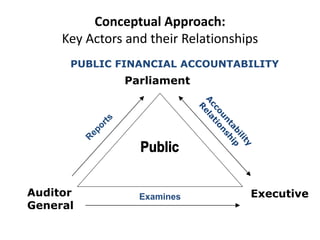
Conceptual Approach:
Key Actors and their Relationships
Auditor
General
Parliament
ExecutiveExamines
PUBLIC FINANCIAL ACCOUNTABILITY
“The Overseers” – conclusions (1)
• First PAC: UK House of Commons, 1862
• Copied by most countries with a
“Westminster” tradition
• Considerable variation in modus operandi
across the Commonwealth
“The Overseers” – conclusions (2)
• Most effective when bipartisan
• Chaired by the senior Opposition (67%)
• Copied by most countries with a “Westminster”
tradition
• Considerable variation in modus operandi across
the Commonwealth
“The Overseers” – conclusions (3)
• Need to build capacity of Parliaments, PACs
and AGs
• Critical: independence of AG from political,
and legal constraints
• PACs need to develop the means to exchange
information on developments, standards and
best practice
More Specifically: PACs (1)
• Bipartisan
• Terms of reference (wide vs. narrow)
• Work based on AG report, but free to undertake
own inquiries
• McGee: sole focus on ex-post budget cycle
• Focus on policy implementation, not policy
• Some members reluctant to serve on committee
• Average size: 11 members; “adequate”
representation of opposition (av: 30%)
• Need for training & adequate staff
PACs (2)
• Historically, PACs have not sought publicity –
more recently, public hearings (55%)
• Use of sub-committees
• Do not examine individual complaints (refer to
Minister or Ombuds)
• Divergence of reporting practices
• Deal with individual public servants?
• Problems with government implementation/PAC
follow-up
“The New Story”
• Size: 2 (Anguilla) to 25 (Ghana); av: 11.6
• Opposition: 0 (Singapore) to 12 (Ghana); av:
42%
• Staff: 0 (Fiji, Maldives) to 20 (India); av: 3.45
• Opposition Chair: 70%
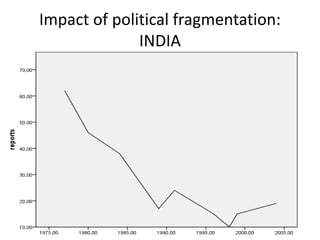
• Emerging problem: political fragmentation
• Key issues: Training; Measuring PAC
Effectiveness
Impact of political fragmentation:
INDIA
Quality of Members & Training
• For Liberia, the most pressing needs are proper
secretariat “and to provide training for members on
our committee too”
• For Tanzania, training is the solution for many of the
problems confronting PACs. “Training, training,
training. All Members of Parliament… need training.
One piece of training you need to tell Members of
Parliament who come to the Public Accounts
Committee is that public money has no party (…) The
people who should be most annoyed for money not
being utilized properly are the people in power. If you
are a Member of Parliament in power, you should be
the first person to frown at or rebuke any public
officer who misuses money, because he’s not carrying
out the promises that were made out to the people”
Measuring PAC Effectiveness
• McGee: Number of meetings and reports
• Add: Number of inquiries, hearings
• Key findings:
 PACs make a positive contribution to reducing
corruption & hence, development
What works in some settings does not work on
others -> one size does not fit all
Opposition chair, # of staff are important
variables
New Important Factors
• PAC right of access
• PAC Powers
Changing World of PACs
TRADITIONAL MODEL
Associated with Westminster/Commonwealth
Reactive/Ex-post institutions
-> Many PACs have retained these features,
but….
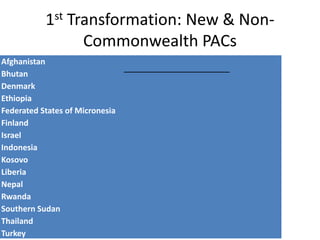
1st Transformation: New & Non-
Commonwealth PACs
Afghanistan
Bhutan
Denmark
Ethiopia
Federated States of Micronesia
Finland
Israel
Indonesia
Kosovo
Liberia
Nepal
Rwanda
Southern Sudan
Thailand
Turkey
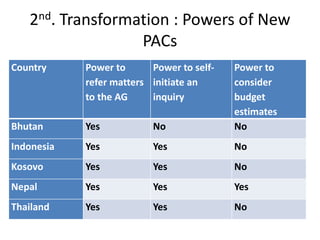
2nd. Transformation : Powers of New
PACs
Country Power to
refer matters
to the AG
Power to self-
initiate an
inquiry
Power to
consider
budget
estimates
Bhutan Yes No No
Indonesia Yes Yes No
Kosovo Yes Yes No
Nepal Yes Yes Yes
Thailand Yes Yes No
3rd. Transformation: Ad Hoc PACs
• Bangladesh
• Pakistan
• Fiji
• Nigeria
New “Good Practice Guide” (2013)
• The Committee is small; committees seem to work
well with 5-11 members, none of whom should be
government Ministers;
• Senior opposition figures are associated with the
PAC’s work, and probably chair the Committee;
• The Chair is a senior parliamentarian, fair minded
and respected by parliament;
• The Committee is appointed for the full term of the
parliament;
• The Committee is adequately resourced, with an
experienced clerk and a competent researcher(s);
• There is clarity on the Committee’s role and
responsibilities;
• The Committee meets frequently and regularly;
• Hearings are open to the public; a full verbatim
transcript and summary minutes are quickly
available for public distribution;
• A steering committee plans the Committee’s work
in advance and prepares an agenda for each
meeting to the full Committee;
• The typical witness is a senior public servant (the
“accounting officer”) accompanied by the officials
that have detailed understanding of the issues
under examination;
• The Auditor’s Report is automatically referred to
the Committee and the Auditor meets with the
Committee to go over the highlights of the report;
• In addition to issues raised by the Auditor, the Committee
occasionally decides to investigate other matters;
 In addition to issues raised by the Auditor, the
Committee has the power to investigate other matters.
• The Committee strives for some consensus in their
reports;
• The Committee issues formal substantive reports to
parliament at least annually;
• The Committee has established a procedure with the
government for following up its recommendations and is
informed about what, if any, action has been taken;
• In all its deliberations, the Committee uses the Auditor as
an expert advisor;
• Parliaments hold an annual debate on the work of the
New (1)
1) A Committee should asses its performance
annually.
2) Committees should be involved in determining
their own budgets. Such budgets should provide
financial resources for member allowances, site
visits and costs related to public hearings.
3) Specialized training (including orientation and
mentoring) should be provided to new PAC
members.
New (2)
4) The Committee should have unconditional access to
all government agencies and have the power to
“follow” government money provided to non-
government service providers.
5) In smaller jurisdictions, there may be benefit in
combining ex-post and ex-ante budget review within
the remit of the PAC.
6) Committee membership should provide for adequate
participation by opposition MPs; their proportion of PAC
membership should at least represent their proportion of
the seats in Parliament.

Evolving Good Practices for PACs

  • 1.
    Evolving Good Practicefor PACs Rick Stapenhurst Professor of Practice, McGill University
  • 2.
    Evolving Good Practicefor PACs • CPA-WBI Study Group (Toronto, 1999) • McGee “The Overseers” (2002) • Various additional studies (2002-2011) • WBI survey 2008-13 & research • Kerry-Pelizzo-Stapenhurst revision of “The Overseers” (to be published this month)
  • 3.
  • 4.
    “The Overseers” -content • State of the art • Ecology of the PAC • Committee’s purpose, scope and functions • Structure of PAC • Relationship between PAC and Auditor General • Special problems of PACs in small parliaments • Methods of PAC operations • Position of PAC in overall committee structure • The future of the PAC
  • 5.
    Conceptual Approach: Key Actorsand their Relationships Auditor General Parliament ExecutiveExamines PUBLIC FINANCIAL ACCOUNTABILITY
  • 6.
    “The Overseers” –conclusions (1) • First PAC: UK House of Commons, 1862 • Copied by most countries with a “Westminster” tradition • Considerable variation in modus operandi across the Commonwealth
  • 7.
    “The Overseers” –conclusions (2) • Most effective when bipartisan • Chaired by the senior Opposition (67%) • Copied by most countries with a “Westminster” tradition • Considerable variation in modus operandi across the Commonwealth
  • 8.
    “The Overseers” –conclusions (3) • Need to build capacity of Parliaments, PACs and AGs • Critical: independence of AG from political, and legal constraints • PACs need to develop the means to exchange information on developments, standards and best practice
  • 9.
    More Specifically: PACs(1) • Bipartisan • Terms of reference (wide vs. narrow) • Work based on AG report, but free to undertake own inquiries • McGee: sole focus on ex-post budget cycle • Focus on policy implementation, not policy • Some members reluctant to serve on committee • Average size: 11 members; “adequate” representation of opposition (av: 30%) • Need for training & adequate staff
  • 10.
    PACs (2) • Historically,PACs have not sought publicity – more recently, public hearings (55%) • Use of sub-committees • Do not examine individual complaints (refer to Minister or Ombuds) • Divergence of reporting practices • Deal with individual public servants? • Problems with government implementation/PAC follow-up
  • 11.
    “The New Story” •Size: 2 (Anguilla) to 25 (Ghana); av: 11.6 • Opposition: 0 (Singapore) to 12 (Ghana); av: 42% • Staff: 0 (Fiji, Maldives) to 20 (India); av: 3.45 • Opposition Chair: 70% • Emerging problem: political fragmentation • Key issues: Training; Measuring PAC Effectiveness
  • 12.
    Impact of politicalfragmentation: INDIA
  • 13.
    Quality of Members& Training • For Liberia, the most pressing needs are proper secretariat “and to provide training for members on our committee too” • For Tanzania, training is the solution for many of the problems confronting PACs. “Training, training, training. All Members of Parliament… need training. One piece of training you need to tell Members of Parliament who come to the Public Accounts Committee is that public money has no party (…) The people who should be most annoyed for money not being utilized properly are the people in power. If you are a Member of Parliament in power, you should be the first person to frown at or rebuke any public officer who misuses money, because he’s not carrying out the promises that were made out to the people”
  • 14.
    Measuring PAC Effectiveness •McGee: Number of meetings and reports • Add: Number of inquiries, hearings • Key findings:  PACs make a positive contribution to reducing corruption & hence, development What works in some settings does not work on others -> one size does not fit all Opposition chair, # of staff are important variables
  • 15.
    New Important Factors •PAC right of access • PAC Powers
  • 16.
    Changing World ofPACs TRADITIONAL MODEL Associated with Westminster/Commonwealth Reactive/Ex-post institutions -> Many PACs have retained these features, but….
  • 17.
    1st Transformation: New& Non- Commonwealth PACs Afghanistan Bhutan Denmark Ethiopia Federated States of Micronesia Finland Israel Indonesia Kosovo Liberia Nepal Rwanda Southern Sudan Thailand Turkey
  • 18.
    2nd. Transformation :Powers of New PACs Country Power to refer matters to the AG Power to self- initiate an inquiry Power to consider budget estimates Bhutan Yes No No Indonesia Yes Yes No Kosovo Yes Yes No Nepal Yes Yes Yes Thailand Yes Yes No
  • 19.
    3rd. Transformation: AdHoc PACs • Bangladesh • Pakistan • Fiji • Nigeria
  • 20.
    New “Good PracticeGuide” (2013) • The Committee is small; committees seem to work well with 5-11 members, none of whom should be government Ministers; • Senior opposition figures are associated with the PAC’s work, and probably chair the Committee; • The Chair is a senior parliamentarian, fair minded and respected by parliament; • The Committee is appointed for the full term of the parliament; • The Committee is adequately resourced, with an experienced clerk and a competent researcher(s); • There is clarity on the Committee’s role and responsibilities;
  • 21.
    • The Committeemeets frequently and regularly; • Hearings are open to the public; a full verbatim transcript and summary minutes are quickly available for public distribution; • A steering committee plans the Committee’s work in advance and prepares an agenda for each meeting to the full Committee; • The typical witness is a senior public servant (the “accounting officer”) accompanied by the officials that have detailed understanding of the issues under examination; • The Auditor’s Report is automatically referred to the Committee and the Auditor meets with the Committee to go over the highlights of the report;
  • 22.
    • In additionto issues raised by the Auditor, the Committee occasionally decides to investigate other matters;  In addition to issues raised by the Auditor, the Committee has the power to investigate other matters. • The Committee strives for some consensus in their reports; • The Committee issues formal substantive reports to parliament at least annually; • The Committee has established a procedure with the government for following up its recommendations and is informed about what, if any, action has been taken; • In all its deliberations, the Committee uses the Auditor as an expert advisor; • Parliaments hold an annual debate on the work of the
  • 23.
    New (1) 1) ACommittee should asses its performance annually. 2) Committees should be involved in determining their own budgets. Such budgets should provide financial resources for member allowances, site visits and costs related to public hearings. 3) Specialized training (including orientation and mentoring) should be provided to new PAC members.
  • 24.
    New (2) 4) TheCommittee should have unconditional access to all government agencies and have the power to “follow” government money provided to non- government service providers. 5) In smaller jurisdictions, there may be benefit in combining ex-post and ex-ante budget review within the remit of the PAC. 6) Committee membership should provide for adequate participation by opposition MPs; their proportion of PAC membership should at least represent their proportion of the seats in Parliament.