Parkinson’s Disease
By: Jenn Derasmo
What is Parkinson’s Disease?
• One of most common movement disorders; termed
hypokinetic, meaning that movement is difficult to initiate
and once started, difficult to terminate
• A person's brain slowly stops producing a neurotransmitter
called dopamine. With less and less dopamine, a person has
less and less ability to regulate their movements, body and
emotions.
• When approximately 60% to 80% of the dopamine-
producing cells are damaged, and do not produce enough
dopamine, the motor symptoms of Parkinson's disease
appear.
Symptoms and Signs
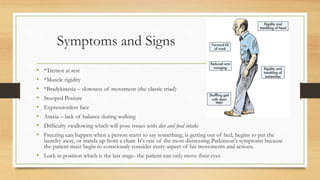
• *Tremor at rest
• *Muscle rigidity
• *Bradykinesia – slowness of movement (the classic triad)
• Stooped Posture
• Expressionless face
• Ataxia – lack of balance during walking
• Difficulty swallowing which will pose issues with diet and food intake
• Freezing can happen when a person starts to say something, is getting out of bed, begins to put the
laundry away, or stands up from a chair. It's one of the most distressing Parkinson's symptoms because
the patient must begin to consciously consider every aspect of his movements and actions.
• Lock in position which is the last stage- the patient can only move their eyes
What is “Dopamine”?
• Biogenic amines:
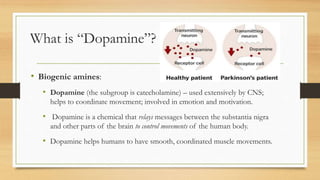
• Dopamine (the subgroup is catecholamine) – used extensively by CNS;
helps to coordinate movement; involved in emotion and motivation.
• Dopamine is a chemical that relays messages between the substantia nigra
and other parts of the brain to control movements of the human body.
• Dopamine helps humans to have smooth, coordinated muscle movements.
Etiology of
Parkinson’s Disease
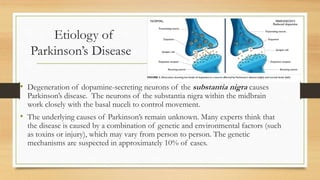
• Degeneration of dopamine-secreting neurons of the substantia nigra causes
Parkinson’s disease. The neurons of the substantia nigra within the midbrain
work closely with the basal nuceli to control movement.
• The underlying causes of Parkinson’s remain unknown. Many experts think that
the disease is caused by a combination of genetic and environmental factors (such
as toxins or injury), which may vary from person to person. The genetic
mechanisms are suspected in approximately 10% of cases.
Pathogenesis of
Parkinson’s Disease
• The progression of Parkinson’s disease varies
among different individuals. Parkinson's is
chronic and slowly progressive, meaning that
symptoms continue and worsen over a period of
years. Parkinson's is not considered a fatal
disease. And the way that it progresses is different
for everyone
• There are scales used to access the severity of
this disease such as the United Parkinson’s
Disease Rating Scale (UPDRS)- this will assess
detail for cognition, behavior, mood, ADL, and
motor skills.
Treatment for Parkinson’s
• “El-dopa” (Duopa™) which is converted to dopamine, is given because it can pass through
the Blood Brain Barrier- it is considered the gold standard drug for this disease.
• Parkinson’s drugs are aimed at either temporarily replenishing dopamine or mimicking the
action of dopamine.
• These types of drugs are called dopaminergic medications. They generally help reduce
muscle rigidity, improve speed and coordination of movement and lessen tremor.
• Surgery is performed to insert a tube in the small intestine, which delivers a gel formulation
of carbidopa/levodopa (Duopa™).
• Sometimes Deep Brain Stimulation can occur. Like all brain surgeries, DBS carries a
small risk of infection, stroke, bleeding or seizures.
Medical Nutrition Therapy
(MNT) for Parkinson’s Disease
• Esophageal motor abnormalities, constipation and unintended weight loss are frequent in PD patients which
can result in morbidity and mortality. Weight loss occurs from increased energy expenditure due to tremor,
dyskinesia's and rigidity and many more.
• Reduced energy intake can occur from olfactory dysfunction, depression, dysphagia, anorexia, insomnia and
disability just to name a few
• High intake of protein diminishes the effectiveness of levodopa; you have to use the 0.5 g/kg of body
weight (lower than average).
• Timing of the medication is crucial, avoid conflicting responses to protein with meals
• Cut, soften foods, or mince foods. Use small frequent meals.
• Education for the patients and the family is critical.
• Regular exercise is very important.

Parkinson’s Disease

  • 1.
  • 2.
    What is Parkinson’sDisease? • One of most common movement disorders; termed hypokinetic, meaning that movement is difficult to initiate and once started, difficult to terminate • A person's brain slowly stops producing a neurotransmitter called dopamine. With less and less dopamine, a person has less and less ability to regulate their movements, body and emotions. • When approximately 60% to 80% of the dopamine- producing cells are damaged, and do not produce enough dopamine, the motor symptoms of Parkinson's disease appear.
  • 3.
    Symptoms and Signs •*Tremor at rest • *Muscle rigidity • *Bradykinesia – slowness of movement (the classic triad) • Stooped Posture • Expressionless face • Ataxia – lack of balance during walking • Difficulty swallowing which will pose issues with diet and food intake • Freezing can happen when a person starts to say something, is getting out of bed, begins to put the laundry away, or stands up from a chair. It's one of the most distressing Parkinson's symptoms because the patient must begin to consciously consider every aspect of his movements and actions. • Lock in position which is the last stage- the patient can only move their eyes
  • 4.
    What is “Dopamine”? •Biogenic amines: • Dopamine (the subgroup is catecholamine) – used extensively by CNS; helps to coordinate movement; involved in emotion and motivation. • Dopamine is a chemical that relays messages between the substantia nigra and other parts of the brain to control movements of the human body. • Dopamine helps humans to have smooth, coordinated muscle movements.
  • 5.
    Etiology of Parkinson’s Disease •Degeneration of dopamine-secreting neurons of the substantia nigra causes Parkinson’s disease. The neurons of the substantia nigra within the midbrain work closely with the basal nuceli to control movement. • The underlying causes of Parkinson’s remain unknown. Many experts think that the disease is caused by a combination of genetic and environmental factors (such as toxins or injury), which may vary from person to person. The genetic mechanisms are suspected in approximately 10% of cases.
  • 6.
    Pathogenesis of Parkinson’s Disease •The progression of Parkinson’s disease varies among different individuals. Parkinson's is chronic and slowly progressive, meaning that symptoms continue and worsen over a period of years. Parkinson's is not considered a fatal disease. And the way that it progresses is different for everyone • There are scales used to access the severity of this disease such as the United Parkinson’s Disease Rating Scale (UPDRS)- this will assess detail for cognition, behavior, mood, ADL, and motor skills.
  • 7.
    Treatment for Parkinson’s •“El-dopa” (Duopa™) which is converted to dopamine, is given because it can pass through the Blood Brain Barrier- it is considered the gold standard drug for this disease. • Parkinson’s drugs are aimed at either temporarily replenishing dopamine or mimicking the action of dopamine. • These types of drugs are called dopaminergic medications. They generally help reduce muscle rigidity, improve speed and coordination of movement and lessen tremor. • Surgery is performed to insert a tube in the small intestine, which delivers a gel formulation of carbidopa/levodopa (Duopa™). • Sometimes Deep Brain Stimulation can occur. Like all brain surgeries, DBS carries a small risk of infection, stroke, bleeding or seizures.
  • 8.
    Medical Nutrition Therapy (MNT)for Parkinson’s Disease • Esophageal motor abnormalities, constipation and unintended weight loss are frequent in PD patients which can result in morbidity and mortality. Weight loss occurs from increased energy expenditure due to tremor, dyskinesia's and rigidity and many more. • Reduced energy intake can occur from olfactory dysfunction, depression, dysphagia, anorexia, insomnia and disability just to name a few • High intake of protein diminishes the effectiveness of levodopa; you have to use the 0.5 g/kg of body weight (lower than average). • Timing of the medication is crucial, avoid conflicting responses to protein with meals • Cut, soften foods, or mince foods. Use small frequent meals. • Education for the patients and the family is critical. • Regular exercise is very important.