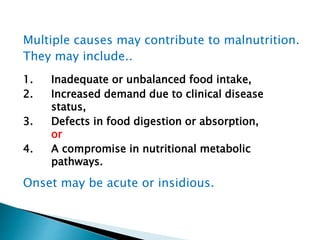
Multiple causes may contribute to malnutrition.
They may include..
1. Inadequate or unbalanced food intake,
2. Increased demand due to clinical disease
status,
3. Defects in food digestion or absorption,
or
4. A compromise in nutritional metabolic
pathways.

Onset may be acute or insidious.

Examples for malnutrition,
1. impaired immune response,
2. reduced skeletal muscle strength and fatigue,
3. reduced respiratory muscle strength, impaired
thermoregulation,
4. impaired skin barrier and wound healing may
all be a consequence of mild malnutrition.
In turn, these predispose the patient to a
wide range of problems including
1. infection,
2. delayed clinical recovery,
3. increased clinical complications,
4. inactivity,
5. psychological decline and
6. reduced quality of life.
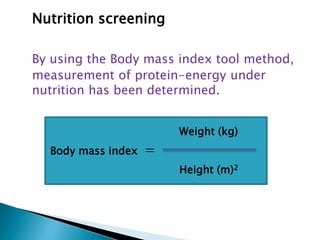
Nutrition screening
By using the Body mass index tool method,
measurement of protein-energy under
nutrition has been determined.
Weight (kg)
Body mass index =
Height (m)2
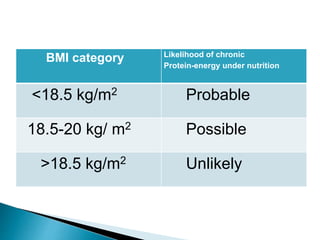
BMI category Likelihood of chronic
Protein-energy under nutrition
<18.5 kg/m2 Probable
18.5-20 kg/ m2 Possible
>18.5 kg/m2 Unlikely
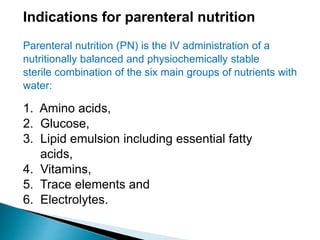
Indications for parenteral nutrition
Parenteral nutrition (PN) is the IV administration of a
nutritionally balanced and physiochemically stable
sterile combination of the six main groups of nutrients with
water:
1. Amino acids,
2. Glucose,
3. Lipid emulsion including essential fatty
acids,
4. Vitamins,
5. Trace elements and
6. Electrolytes.
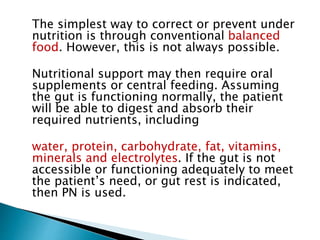
The simplest way to correct or prevent under
nutrition is through conventional balanced
food. However, this is not always possible.
Nutritional support may then require oral
supplements or central feeding. Assuming
the gut is functioning normally, the patient
will be able to digest and absorb their
required nutrients, including
water, protein, carbohydrate, fat, vitamins,
minerals and electrolytes. If the gut is not
accessible or functioning adequately to meet
the patient’s need, or gut rest is indicated,
then PN is used.
 Close monitoring should ensure the
patient’s needs are met; a
combination of nutrition routes is
sometimes the best course.
 Where possible, PN patients should
also receive enteral (GI track) intake.
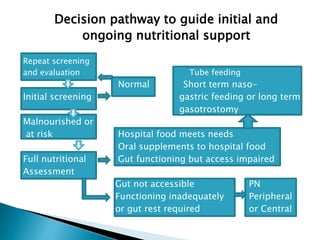
Decision pathway to guide initial and
ongoing nutritional support
Repeat screening
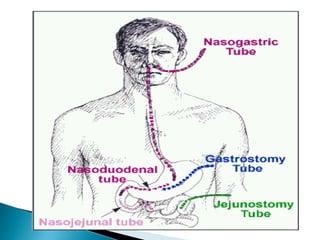
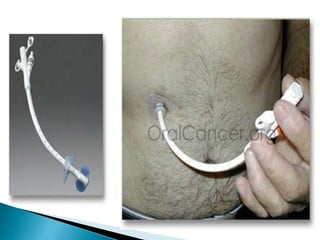
and evaluation Tube feeding
Normal Short term naso-
Initial screening gastric feeding or long term
gasotrostomy
Malnourished or
at risk Hospital food meets needs
Oral supplements to hospital food
Full nutritional Gut functioning but access impaired
Assessment
Gut not accessible PN
Functioning inadequately Peripheral
or gut rest required or Central
Nutrition team
Multidisciplinary nutrition teams have been
formed in many hospitals, notably the
larger tertiary central and teaching
hospitals.
Oral diet Parenteral nutrition source
Water/volume Water/volume
Protein Amino acid mixture
Carbohydrate Glucose
Fat with essential fatty acids Lipid emulsions with essential fatty
acids
Vitamins Vitamins
Minerals Trace elements
Electrolytes Electrolytes
Components of a parenteral nutrition regimen
Water volume
Water is the principal component of the body
and accounts for approximately 60% and 55% of
total body weight in men and women,
respectively.
Usually homeostasis maintains appropriate fluid
levels and electrolyte balance and thirst drives
the healthy person to drink. Some patients are
not able physically to respond by drinking and
so this homeostasis can readily be disrupted.
In general, an adult patient will require 20-40
ml/kg/day fluid.
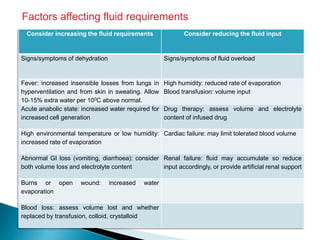
Consider increasing the fluid requirements Consider reducing the fluid input
Signs/symptoms of dehydration Signs/symptoms of fluid overload
Fever: increased insensible losses from lungs in
hyperventilation and from skin in sweating. Allow
10-15% extra water per 100C above normal.
High humidity: reduced rate of evaporation
Blood transfusion: volume input
Acute anabolic state: increased water required for
increased cell generation
Drug therapy: assess volume and electrolyte
content of infused drug
High environmental temperature or low humidity:
increased rate of evaporation
Cardiac failure: may limit tolerated blood volume
Abnormal GI loss (vomiting, diarrhoea): consider
both volume loss and electrolyte content
Renal failure: fluid may accumulate so reduce
input accordingly, or provide artificial renal support
Burns or open wound: increased water
evaporation
Blood loss: assess volume lost and whether
replaced by transfusion, colloid, crystalloid
Factors affecting fluid requirements
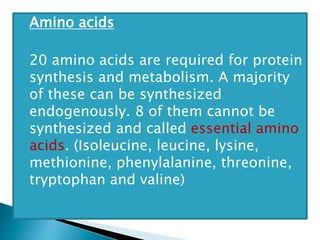
Amino acids
20 amino acids are required for protein
synthesis and metabolism. A majority
of these can be synthesized
endogenously. 8 of them cannot be
synthesized and called essential amino
acids. (Isoleucine, leucine, lysine,
methionine, phenylalanine, threonine,
tryptophan and valine)
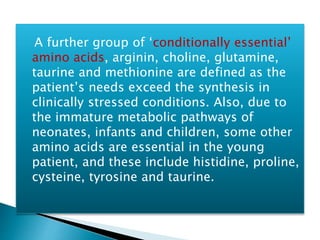
A further group of ‘conditionally essential’
amino acids, arginin, choline, glutamine,
taurine and methionine are defined as the
patient’s needs exceed the synthesis in
clinically stressed conditions. Also, due to
the immature metabolic pathways of
neonates, infants and children, some other
amino acids are essential in the young
patient, and these include histidine, proline,
cysteine, tyrosine and taurine.
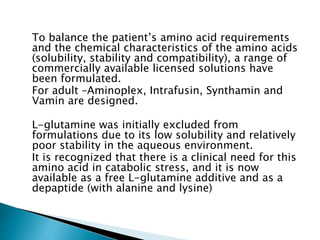
To balance the patient’s amino acid requirements
and the chemical characteristics of the amino acids
(solubility, stability and compatibility), a range of
commercially available licensed solutions have
been formulated.
For adult –Aminoplex, Intrafusin, Synthamin and
Vamin are designed.
L-glutamine was initially excluded from
formulations due to its low solubility and relatively
poor stability in the aqueous environment.
It is recognized that there is a clinical need for this
amino acid in catabolic stress, and it is now
available as a free L-glutamine additive and as a
depaptide (with alanine and lysine)
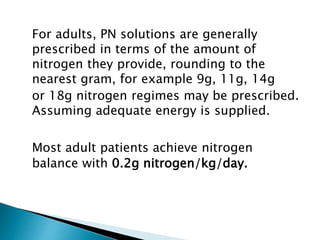
For adults, PN solutions are generally
prescribed in terms of the amount of
nitrogen they provide, rounding to the
nearest gram, for example 9g, 11g, 14g
or 18g nitrogen regimes may be prescribed.
Assuming adequate energy is supplied.
Most adult patients achieve nitrogen
balance with 0.2g nitrogen/kg/day.
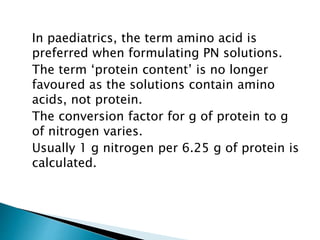
In paediatrics, the term amino acid is
preferred when formulating PN solutions.
The term ‘protein content’ is no longer
favoured as the solutions contain amino
acids, not protein.
The conversion factor for g of protein to g
of nitrogen varies.
Usually 1 g nitrogen per 6.25 g of protein is
calculated.
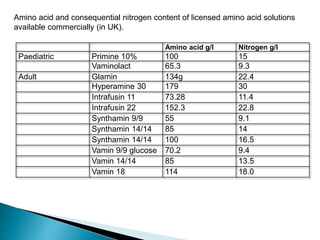
Amino acid and consequential nitrogen content of licensed amino acid solutions
available commercially (in UK).
Amino acid g/l Nitrogen g/l
Paediatric Primine 10% 100 15
Vaminolact 65.3 9.3
Adult Glamin 134g 22.4
Hyperamine 30 179 30
Intrafusin 11 73.28 11.4
Intrafusin 22 152.3 22.8
Synthamin 9/9 55 9.1
Synthamin 14/14 85 14
Synthamin 14/14 100 16.5
Vamin 9/9 glucose 70.2 9.4
Vamin 14/14 85 13.5
Vamin 18 114 18.0
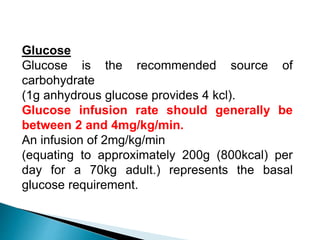
Glucose
Glucose is the recommended source of
carbohydrate
(1g anhydrous glucose provides 4 kcl).
Glucose infusion rate should generally be
between 2 and 4mg/kg/min.
An infusion of 2mg/kg/min
(equating to approximately 200g (800kcal) per
day for a 70kg adult.) represents the basal
glucose requirement.
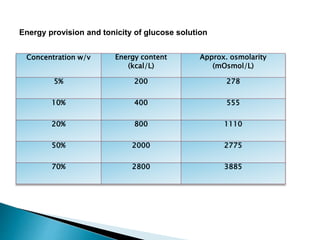
Energy provision and tonicity of glucose solution
Concentration w/v Energy content
(kcal/L)
Approx. osmolarity
(mOsmol/L)
5% 200 278
10% 400 555
20% 800 1110
50% 2000 2775
70% 2800 3885
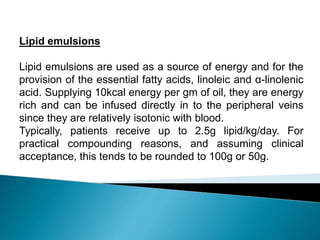
Lipid emulsions
Lipid emulsions are used as a source of energy and for the
provision of the essential fatty acids, linoleic and α-linolenic
acid. Supplying 10kcal energy per gm of oil, they are energy
rich and can be infused directly in to the peripheral veins
since they are relatively isotonic with blood.
Typically, patients receive up to 2.5g lipid/kg/day. For
practical compounding reasons, and assuming clinical
acceptance, this tends to be rounded to 100g or 50g.
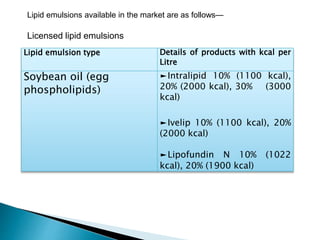
Lipid emulsions available in the market are as follows—
Licensed lipid emulsions
Lipid emulsion type Details of products with kcal per
Litre
Soybean oil (egg
phospholipids)
►Intralipid 10% (1100 kcal),
20% (2000 kcal), 30% (3000
kcal)
►Ivelip 10% (1100 kcal), 20%
(2000 kcal)
►Lipofundin N 10% (1022
kcal), 20% (1900 kcal)
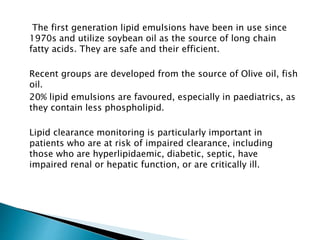
The first generation lipid emulsions have been in use since
1970s and utilize soybean oil as the source of long chain
fatty acids. They are safe and their efficient.
Recent groups are developed from the source of Olive oil, fish
oil.
20% lipid emulsions are favoured, especially in paediatrics, as
they contain less phospholipid.
Lipid clearance monitoring is particularly important in
patients who are at risk of impaired clearance, including
those who are hyperlipidaemic, diabetic, septic, have
impaired renal or hepatic function, or are critically ill.
Micronutrients & Trace elements
Micronutrients have a key role in intermediary
metabolism, as both co-factors and co-
enzymes.
For example: zinc is required by over 200
enzyme systems and affects many diverse
body functions including acid-base balance,
immune function and nuclic acid synthesis.
It is evident, therefore, that the availability of
micronutrients can affect enzyme activity and
total metabolism.
Micronutrients & Trace elements
Trace elements are generally maintained at a
relatively constant tissue concentration and
are present to a level of less than 1mg/kg
body weight.
They are essential; difficiency results in
structural and physiological disorders, but if
identified early enough, can be resolved by
re-administration.
Ten essential trace elements are known: iron,
copper, zinc, fluorine, manganese, iodine,
cobalt (or as hydroxycobalamine), selenium,
molybdenum and chromium.
 Vitamins
Two groups of vitamins, water soluble and fat
soluble. Fat-soluble vitamins are stored in the
body, whereas excess water-soluble vitamins are
renally cleared. Therefore, if there is inadequate
provision, deficiency states for the water-soluble
vitamins reveal themselves first.
Vitamin Recommended
P/D
Vitamin Recommended
P/D
A (retinal) 1.0mg B1 (thiamin) 6.0mg
B2 (riboflavin) 3.6mg B6 (pyridoxine) 4.0mg
B12 5.0 mcgm C 200mg
D 5.0 mcgm E(α-tocoferol) 10.0mg
K1 150.0mcgm Folic acid 600mcgm
Pantothenic
acid
15.0mg Biotin 60.0mcgm
Niacin 40.0mg
Electrolytes
Sodium, potassium, calcium, magnesium, and phosphate are
included to meet patient needs. Depending upon the stability
of the patient’s clinical state, they are kept relatively constant
or adjusted on a near daily basis, reflecting changes in blood
biochemistry.
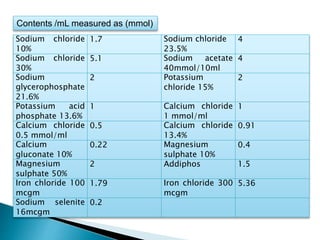
Recommended dose below can be used to guide electrolyte
replacement if there are excessive GI waste or high losses
through burns
Sodium chloride
10%
1.7 Sodium chloride
23.5%
4
Sodium chloride
30%
5.1 Sodium acetate
40mmol/10ml
4
Sodium
glycerophosphate
21.6%
2 Potassium
chloride 15%
2
Potassium acid
phosphate 13.6%
1 Calcium chloride
1 mmol/ml
1
Calcium chloride
0.5 mmol/ml
0.5 Calcium chloride
13.4%
0.91
Calcium
gluconate 10%
0.22 Magnesium
sulphate 10%
0.4
Magnesium
sulphate 50%
2 Addiphos 1.5
Iron chloride 100
mcgm
1.79 Iron chloride 300
mcgm
5.36
Sodium selenite
16mcgm
0.2
Contents /mL measured as (mmol)
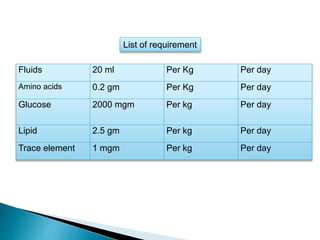
Fluids 20 ml Per Kg Per day
Amino acids 0.2 gm Per Kg Per day
Glucose 2000 mgm Per kg Per day
Lipid 2.5 gm Per kg Per day
Trace element 1 mgm Per kg Per day
List of requirement
Routes of Administration
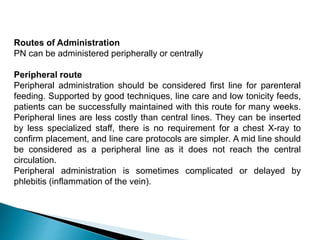
PN can be administered peripherally or centrally
Peripheral route
Peripheral administration should be considered first line for parenteral
feeding. Supported by good techniques, line care and low tonicity feeds,
patients can be successfully maintained with this route for many weeks.
Peripheral lines are less costly than central lines. They can be inserted
by less specialized staff, there is no requirement for a chest X-ray to
confirm placement, and line care protocols are simpler. A mid line should
be considered as a peripheral line as it does not reach the central
circulation.
Peripheral administration is sometimes complicated or delayed by
phlebitis (inflammation of the vein).
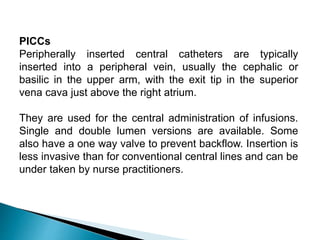
PICCs
Peripherally inserted central catheters are typically
inserted into a peripheral vein, usually the cephalic or
basilic in the upper arm, with the exit tip in the superior
vena cava just above the right atrium.
They are used for the central administration of infusions.
Single and double lumen versions are available. Some
also have a one way valve to prevent backflow. Insertion is
less invasive than for conventional central lines and can be
under taken by nurse practitioners.
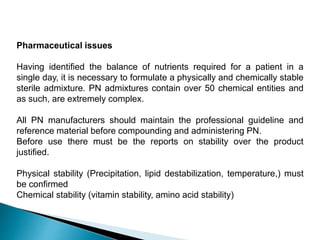
Pharmaceutical issues
Having identified the balance of nutrients required for a patient in a
single day, it is necessary to formulate a physically and chemically stable
sterile admixture. PN admixtures contain over 50 chemical entities and
as such, are extremely complex.
All PN manufacturers should maintain the professional guideline and
reference material before compounding and administering PN.
Before use there must be the reports on stability over the product
justified.
Physical stability (Precipitation, lipid destabilization, temperature,) must
be confirmed
Chemical stability (vitamin stability, amino acid stability)
Microbial stability
Shelf-life and temperature control
Drug stability
Light protection
Thank You
for your patience hearing

Parenteral nutrition ish

  • 2.
    Multiple causes maycontribute to malnutrition. They may include.. 1. Inadequate or unbalanced food intake, 2. Increased demand due to clinical disease status, 3. Defects in food digestion or absorption, or 4. A compromise in nutritional metabolic pathways. Onset may be acute or insidious.
  • 3.
    Examples for malnutrition, 1.impaired immune response, 2. reduced skeletal muscle strength and fatigue, 3. reduced respiratory muscle strength, impaired thermoregulation, 4. impaired skin barrier and wound healing may all be a consequence of mild malnutrition. In turn, these predispose the patient to a wide range of problems including 1. infection, 2. delayed clinical recovery, 3. increased clinical complications, 4. inactivity, 5. psychological decline and 6. reduced quality of life.
  • 4.
    Nutrition screening By usingthe Body mass index tool method, measurement of protein-energy under nutrition has been determined. Weight (kg) Body mass index = Height (m)2
  • 5.
    BMI category Likelihoodof chronic Protein-energy under nutrition <18.5 kg/m2 Probable 18.5-20 kg/ m2 Possible >18.5 kg/m2 Unlikely
  • 6.
    Indications for parenteralnutrition Parenteral nutrition (PN) is the IV administration of a nutritionally balanced and physiochemically stable sterile combination of the six main groups of nutrients with water: 1. Amino acids, 2. Glucose, 3. Lipid emulsion including essential fatty acids, 4. Vitamins, 5. Trace elements and 6. Electrolytes.
  • 7.
    The simplest wayto correct or prevent under nutrition is through conventional balanced food. However, this is not always possible. Nutritional support may then require oral supplements or central feeding. Assuming the gut is functioning normally, the patient will be able to digest and absorb their required nutrients, including water, protein, carbohydrate, fat, vitamins, minerals and electrolytes. If the gut is not accessible or functioning adequately to meet the patient’s need, or gut rest is indicated, then PN is used.
  • 8.
     Close monitoringshould ensure the patient’s needs are met; a combination of nutrition routes is sometimes the best course.  Where possible, PN patients should also receive enteral (GI track) intake.
  • 9.
    Decision pathway toguide initial and ongoing nutritional support Repeat screening and evaluation Tube feeding Normal Short term naso- Initial screening gastric feeding or long term gasotrostomy Malnourished or at risk Hospital food meets needs Oral supplements to hospital food Full nutritional Gut functioning but access impaired Assessment Gut not accessible PN Functioning inadequately Peripheral or gut rest required or Central
  • 12.
    Nutrition team Multidisciplinary nutritionteams have been formed in many hospitals, notably the larger tertiary central and teaching hospitals.
  • 13.
    Oral diet Parenteralnutrition source Water/volume Water/volume Protein Amino acid mixture Carbohydrate Glucose Fat with essential fatty acids Lipid emulsions with essential fatty acids Vitamins Vitamins Minerals Trace elements Electrolytes Electrolytes Components of a parenteral nutrition regimen
  • 14.
    Water volume Water isthe principal component of the body and accounts for approximately 60% and 55% of total body weight in men and women, respectively. Usually homeostasis maintains appropriate fluid levels and electrolyte balance and thirst drives the healthy person to drink. Some patients are not able physically to respond by drinking and so this homeostasis can readily be disrupted. In general, an adult patient will require 20-40 ml/kg/day fluid.
  • 15.
    Consider increasing thefluid requirements Consider reducing the fluid input Signs/symptoms of dehydration Signs/symptoms of fluid overload Fever: increased insensible losses from lungs in hyperventilation and from skin in sweating. Allow 10-15% extra water per 100C above normal. High humidity: reduced rate of evaporation Blood transfusion: volume input Acute anabolic state: increased water required for increased cell generation Drug therapy: assess volume and electrolyte content of infused drug High environmental temperature or low humidity: increased rate of evaporation Cardiac failure: may limit tolerated blood volume Abnormal GI loss (vomiting, diarrhoea): consider both volume loss and electrolyte content Renal failure: fluid may accumulate so reduce input accordingly, or provide artificial renal support Burns or open wound: increased water evaporation Blood loss: assess volume lost and whether replaced by transfusion, colloid, crystalloid Factors affecting fluid requirements
  • 16.
    Amino acids 20 aminoacids are required for protein synthesis and metabolism. A majority of these can be synthesized endogenously. 8 of them cannot be synthesized and called essential amino acids. (Isoleucine, leucine, lysine, methionine, phenylalanine, threonine, tryptophan and valine)
  • 17.
    A further groupof ‘conditionally essential’ amino acids, arginin, choline, glutamine, taurine and methionine are defined as the patient’s needs exceed the synthesis in clinically stressed conditions. Also, due to the immature metabolic pathways of neonates, infants and children, some other amino acids are essential in the young patient, and these include histidine, proline, cysteine, tyrosine and taurine.
  • 18.
    To balance thepatient’s amino acid requirements and the chemical characteristics of the amino acids (solubility, stability and compatibility), a range of commercially available licensed solutions have been formulated. For adult –Aminoplex, Intrafusin, Synthamin and Vamin are designed. L-glutamine was initially excluded from formulations due to its low solubility and relatively poor stability in the aqueous environment. It is recognized that there is a clinical need for this amino acid in catabolic stress, and it is now available as a free L-glutamine additive and as a depaptide (with alanine and lysine)
  • 19.
    For adults, PNsolutions are generally prescribed in terms of the amount of nitrogen they provide, rounding to the nearest gram, for example 9g, 11g, 14g or 18g nitrogen regimes may be prescribed. Assuming adequate energy is supplied. Most adult patients achieve nitrogen balance with 0.2g nitrogen/kg/day.
  • 20.
    In paediatrics, theterm amino acid is preferred when formulating PN solutions. The term ‘protein content’ is no longer favoured as the solutions contain amino acids, not protein. The conversion factor for g of protein to g of nitrogen varies. Usually 1 g nitrogen per 6.25 g of protein is calculated.
  • 21.
    Amino acid andconsequential nitrogen content of licensed amino acid solutions available commercially (in UK). Amino acid g/l Nitrogen g/l Paediatric Primine 10% 100 15 Vaminolact 65.3 9.3 Adult Glamin 134g 22.4 Hyperamine 30 179 30 Intrafusin 11 73.28 11.4 Intrafusin 22 152.3 22.8 Synthamin 9/9 55 9.1 Synthamin 14/14 85 14 Synthamin 14/14 100 16.5 Vamin 9/9 glucose 70.2 9.4 Vamin 14/14 85 13.5 Vamin 18 114 18.0
  • 22.
    Glucose Glucose is therecommended source of carbohydrate (1g anhydrous glucose provides 4 kcl). Glucose infusion rate should generally be between 2 and 4mg/kg/min. An infusion of 2mg/kg/min (equating to approximately 200g (800kcal) per day for a 70kg adult.) represents the basal glucose requirement.
  • 23.
    Energy provision andtonicity of glucose solution Concentration w/v Energy content (kcal/L) Approx. osmolarity (mOsmol/L) 5% 200 278 10% 400 555 20% 800 1110 50% 2000 2775 70% 2800 3885
  • 24.
    Lipid emulsions Lipid emulsionsare used as a source of energy and for the provision of the essential fatty acids, linoleic and α-linolenic acid. Supplying 10kcal energy per gm of oil, they are energy rich and can be infused directly in to the peripheral veins since they are relatively isotonic with blood. Typically, patients receive up to 2.5g lipid/kg/day. For practical compounding reasons, and assuming clinical acceptance, this tends to be rounded to 100g or 50g.
  • 25.
    Lipid emulsions availablein the market are as follows— Licensed lipid emulsions Lipid emulsion type Details of products with kcal per Litre Soybean oil (egg phospholipids) ►Intralipid 10% (1100 kcal), 20% (2000 kcal), 30% (3000 kcal) ►Ivelip 10% (1100 kcal), 20% (2000 kcal) ►Lipofundin N 10% (1022 kcal), 20% (1900 kcal)
  • 26.
    The first generationlipid emulsions have been in use since 1970s and utilize soybean oil as the source of long chain fatty acids. They are safe and their efficient. Recent groups are developed from the source of Olive oil, fish oil. 20% lipid emulsions are favoured, especially in paediatrics, as they contain less phospholipid. Lipid clearance monitoring is particularly important in patients who are at risk of impaired clearance, including those who are hyperlipidaemic, diabetic, septic, have impaired renal or hepatic function, or are critically ill.
  • 27.
    Micronutrients & Traceelements Micronutrients have a key role in intermediary metabolism, as both co-factors and co- enzymes. For example: zinc is required by over 200 enzyme systems and affects many diverse body functions including acid-base balance, immune function and nuclic acid synthesis. It is evident, therefore, that the availability of micronutrients can affect enzyme activity and total metabolism.
  • 28.
    Micronutrients & Traceelements Trace elements are generally maintained at a relatively constant tissue concentration and are present to a level of less than 1mg/kg body weight. They are essential; difficiency results in structural and physiological disorders, but if identified early enough, can be resolved by re-administration. Ten essential trace elements are known: iron, copper, zinc, fluorine, manganese, iodine, cobalt (or as hydroxycobalamine), selenium, molybdenum and chromium.
  • 29.
     Vitamins Two groupsof vitamins, water soluble and fat soluble. Fat-soluble vitamins are stored in the body, whereas excess water-soluble vitamins are renally cleared. Therefore, if there is inadequate provision, deficiency states for the water-soluble vitamins reveal themselves first.
  • 30.
    Vitamin Recommended P/D Vitamin Recommended P/D A(retinal) 1.0mg B1 (thiamin) 6.0mg B2 (riboflavin) 3.6mg B6 (pyridoxine) 4.0mg B12 5.0 mcgm C 200mg D 5.0 mcgm E(α-tocoferol) 10.0mg K1 150.0mcgm Folic acid 600mcgm Pantothenic acid 15.0mg Biotin 60.0mcgm Niacin 40.0mg
  • 31.
    Electrolytes Sodium, potassium, calcium,magnesium, and phosphate are included to meet patient needs. Depending upon the stability of the patient’s clinical state, they are kept relatively constant or adjusted on a near daily basis, reflecting changes in blood biochemistry. Recommended dose below can be used to guide electrolyte replacement if there are excessive GI waste or high losses through burns
  • 32.
    Sodium chloride 10% 1.7 Sodiumchloride 23.5% 4 Sodium chloride 30% 5.1 Sodium acetate 40mmol/10ml 4 Sodium glycerophosphate 21.6% 2 Potassium chloride 15% 2 Potassium acid phosphate 13.6% 1 Calcium chloride 1 mmol/ml 1 Calcium chloride 0.5 mmol/ml 0.5 Calcium chloride 13.4% 0.91 Calcium gluconate 10% 0.22 Magnesium sulphate 10% 0.4 Magnesium sulphate 50% 2 Addiphos 1.5 Iron chloride 100 mcgm 1.79 Iron chloride 300 mcgm 5.36 Sodium selenite 16mcgm 0.2 Contents /mL measured as (mmol)
  • 33.
    Fluids 20 mlPer Kg Per day Amino acids 0.2 gm Per Kg Per day Glucose 2000 mgm Per kg Per day Lipid 2.5 gm Per kg Per day Trace element 1 mgm Per kg Per day List of requirement
  • 34.
    Routes of Administration PNcan be administered peripherally or centrally Peripheral route Peripheral administration should be considered first line for parenteral feeding. Supported by good techniques, line care and low tonicity feeds, patients can be successfully maintained with this route for many weeks. Peripheral lines are less costly than central lines. They can be inserted by less specialized staff, there is no requirement for a chest X-ray to confirm placement, and line care protocols are simpler. A mid line should be considered as a peripheral line as it does not reach the central circulation. Peripheral administration is sometimes complicated or delayed by phlebitis (inflammation of the vein).
  • 35.
    PICCs Peripherally inserted centralcatheters are typically inserted into a peripheral vein, usually the cephalic or basilic in the upper arm, with the exit tip in the superior vena cava just above the right atrium. They are used for the central administration of infusions. Single and double lumen versions are available. Some also have a one way valve to prevent backflow. Insertion is less invasive than for conventional central lines and can be under taken by nurse practitioners.
  • 36.
    Pharmaceutical issues Having identifiedthe balance of nutrients required for a patient in a single day, it is necessary to formulate a physically and chemically stable sterile admixture. PN admixtures contain over 50 chemical entities and as such, are extremely complex. All PN manufacturers should maintain the professional guideline and reference material before compounding and administering PN. Before use there must be the reports on stability over the product justified. Physical stability (Precipitation, lipid destabilization, temperature,) must be confirmed Chemical stability (vitamin stability, amino acid stability)
  • 37.
    Microbial stability Shelf-life andtemperature control Drug stability Light protection
  • 38.
    Thank You for yourpatience hearing