TOTAL
PARENTERAL
NUTRITION
Presenter : Dr Bilal Zaib
Malnutrition can be
as common in
poverty as in wealth
One for the lack of
food, the other for
the lack of
knowledge of food
Aims and Objectives
To understand parenteral nutritio
Indications and contraindications
The routes of administration
Constituents
Calculate the requirements
Infusion schedules
Complications
MALNUTRITION
Acc to bailey and love almost 50 % surgical
patients suffer from malnutrition
Resulting in :
Increased morbidity and mortality
Delayed wound healing
Fistula formation
High chance of infections
Increased ventilatory support
Delayed callus formation
LONGER RECOVERY PERIOD AND PROLONGED DURATION OF
HOSPITAL STAY
Poor quality of life
Definition of nutrition
is the provision, to cells and organisms, of
the materials necessary (in the form of
food) to support life.
Essential nutrients
Proteins
Carbs
Fat
Vitamins
Minerals
Water and electrolytes
Trace elements
Assessment of nutritional status
patients should be assessed for PEM as well as specific nutrient deficiencies
HISTORY
1)Change in diet patterns
2)Unintentional weight loss
3)Evidence of malabsorption
4)Look for factors which may increase metabolic stress such as
infections inflammation malignancies.
EXAM & ANTHROPOMETRY
.Weight loss
.BMI (weight corrected for height)
BMI less than 14 are extremely underweight and should
be considered for admission To hospital for nutritional support
.look for tissue depletion (loss of fat and skeletal muscle wasting)
.fluid status for dehydration or overload
LAB PARAMETERS: plasma albumin , lymphocytes etc
Specialized nutritional support
Critical illness induces anorexia and the inability to eat normally
predisposing the patients to serious nutritional deficiencies so
provision of SNS is a major advancement in modern medicine
SNS is provided either enterally or parenterally and decision to use SNS
should be based on the likelihood that preventing PEM will increase the
chances of recovery , reduce infection rate , improve healing and shorten
the stay in hospital.
SNS should only be used only when potential benefits exceed risks and it
should be undertaken with consent of the patient
What are the types of
nutrition?
Enteral
Parenteral
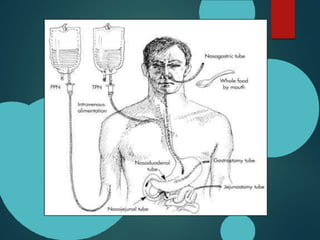
◗ Refers to feeding via a tube placed into the gut to deliver
liquid formulas containing all essential nutrients
◗ Preferred route because of benefits derived from
maintaining the digestive, absorptive and
immunological barrier function of GIT
◗ Enteral/tube feeding is useful in pts who have
functional GIT, but who cannot digest or ingest
adequate amount of nutrients
◗ Short term (<6 weeks) tube feeding can b
e
achieved by nasogastric, nasoduodenal or
nasojejunal tubes
Enteralfeeding
What is parenteral nutrition?
It involves the continuous infusion of a
hyperosmolar solution containing
carbohydrates, proteins, fat and other
necessary electrolytes through an indwelling
catheter inserted into (usually) SVC to meet
the nutritional needs of the patient.
PN through a peripheral vein is limited by
osmolality and volume constraints
Solutions that contain more than 3%
aminoacid and 5% glucose are poorly
tolerated peripherally
Parenteral Nutrition
Given through intravenous route
avoiding gastrointestines
Components are in elemental or “pre digested” form
P r o t e i n as amino acids
Car bohydr at e as dextrose
F a t as lipid emulsion
Electrolytes, vitamins andmInerals
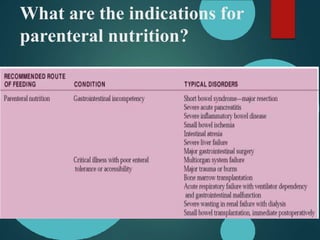
What are the indications for
parenteral nutrition?
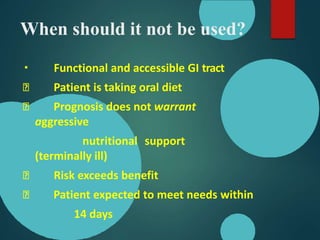
When should it not be used?
Functional and accessible GI tract
Patient is taking oral diet
Prognosis does not warrant
aggressive
nutritional support
(terminally ill)
Risk exceeds benefit
Patient expected to meet needs within
14 days
How can it be delivered?
C e n t r a l Parenteral Nutrition: oftencalled
Total Parenteral Nutrition (TPN);or total nutrient
admixture, delivered into a central vein
Peripheral Parenteral Nutrition(Ppn )
delivered into a smaller or peripheral vein
Peripheral parenteral nutrition
(PPN)
administered through a peripheral intravenous
catheter.
The osmolarity of PPN solutions generally is
limited
to 1,000 mOsm (approximately 12% dextrose
solution) to avoid phlebitis.
Thus, large volumes (>2,500 mL) are needed.
Temporary nutritional supplementation with PPN
may be useful
Generally intended as supplement to oral feeding
and is not optimal for critically ill pts
When can parenteral nutrition
be given through a peripheral
line?
Therapy is expected to be short term (
1
0
-
1
4
days)
Energy and protein needs are moderate
Formulation osmolarity is less than
600 -900 mosm/L
Fluid restriction is not necessary
Central Parenteral Nutrition
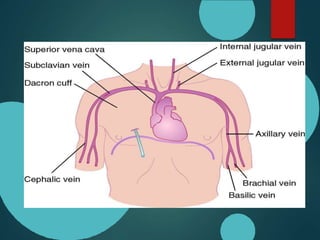
May be delivered via femoral lines, internal
jugular lines, and subclavian vein catheters in the
hospital setting
Peripherally inserted central catheters (PICC) are
inserted via the cephalic and basilic veins
Central access required for infusions that are toxic to
small veins due to medication, pH, osmolarity, and
volume
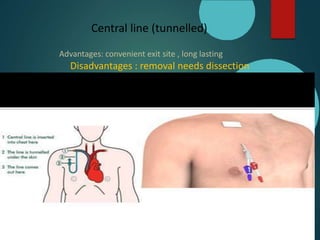
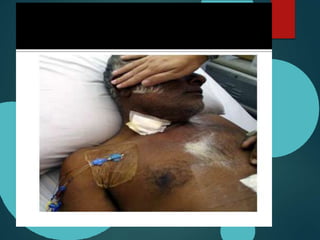
Central line (tunnelled)
Advantages: convenient exit site , long lasting
Disadvantages : removal needs dissection
PICC Lines (peripherally inserted
central catheter)
PICC lines may be used in ambulatory settings or for
long term therapy
Used for delivery of medication as well as PN
Inserted in the cephalic, basilic, median basilic, or median
cephalic veins and threaded into the superior vena cava
Can remain in place for up to 1 year with proper
maintenance and without complications
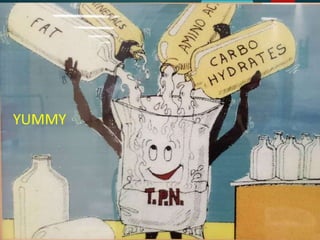
What does it contain?
YUMMY
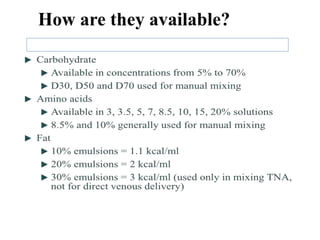
Carbohydrate
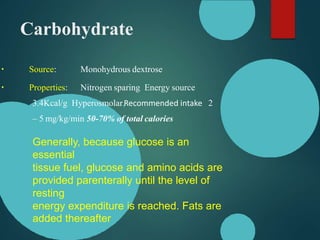
Source: Monohydrous dextrose
Properties: Nitrogen sparing Energy source
3.4Kcal/g Hyperosmolar,Recommended intake 2
– 5 mg/kg/min 50-70% of total calories
Generally, because glucose is an
essential
tissue fuel, glucose and amino acids are
provided parenterally until the level of
resting
energy expenditure is reached. Fats are
added thereafter
Amino Acids
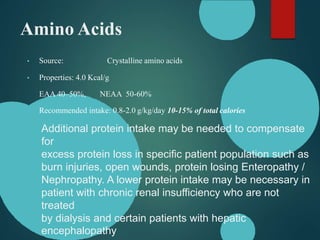
• Source: Crystalline amino acids
• Properties: 4.0 Kcal/g
EAA 40–50%, NEAA 50-60%
Recommended intake: 0.8-2.0 g/kg/day 10-15% of total calories
Additional protein intake may be needed to compensate
for
excess protein loss in specific patient population such as
burn injuries, open wounds, protein losing Enteropathy /
Nephropathy. A lower protein intake may be necessary in
patient with chronic renal insufficiency who are not
treated
by dialysis and certain patients with hepatic
encephalopathy
Amino Acids
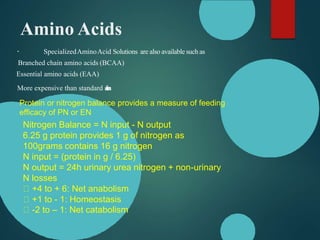
SpecializedAminoAcid Solutions are also available such as
Branched chain amino acids (BCAA)
Essential amino acids (EAA)
More expensive than standard s
o
l
u
t
i
o
n
s
Protein or nitrogen balance provides a measure of feeding
efficacy of PN or EN
Nitrogen Balance = N input - N output
6.25 g protein provides 1 g of nitrogen as
100grams contains 16 g nitrogen
N input = (protein in g / 6.25)
N output = 24h urinary urea nitrogen + non-urinary
N losses
+4 to + 6: Net anabolism
+1 to - 1: Homeostasis
-2 to – 1: Net catabolism
Lipids
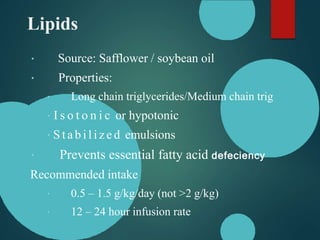
Source: Safflower / soybean oil
Properties:
Long chain triglycerides/Medium chain trig
I s o t o n i c or hypotonic
S t a b i l i z e d emulsions
Prevents essential fatty acid defeciency
Recommended intake
0.5 – 1.5 g/kg/day (not >2 g/kg)
12 – 24 hour infusion rate
Lipids
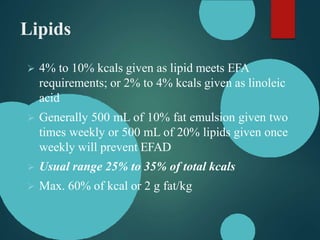
 4% to 10% kcals given as lipid meets EFA
requirements; or 2% to 4% kcals given as linoleic
acid
 Generally 500 mL of 10% fat emulsion given two
times weekly or 500 mL of 20% lipids given once
weekly will prevent EFAD
 Usual range 25% to 35% of total kcals
 Max. 60% of kcal or 2 g fat/kg
Types of formulations
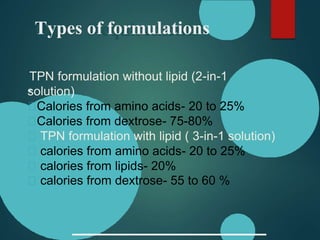
TPN formulation without lipid (2-in-1
solution)
Calories from amino acids- 20 to 25%
Calories from dextrose- 75-80%
TPN formulation with lipid ( 3-in-1 solution)
calories from amino acids- 20 to 25%
calories from lipids- 20%
calories from dextrose- 55 to 60 %
Fluid requirement
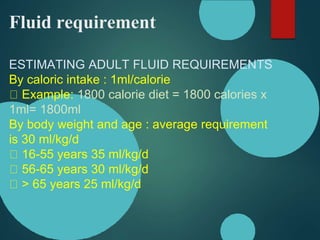
ESTIMATING ADULT FLUID REQUIREMENTS
By caloric intake : 1ml/calorie
Example: 1800 calorie diet = 1800 calories x
1ml= 1800ml
By body weight and age : average requirement
is 30 ml/kg/d
16-55 years 35 ml/kg/d
56-65 years 30 ml/kg/d
> 65 years 25 ml/kg/d
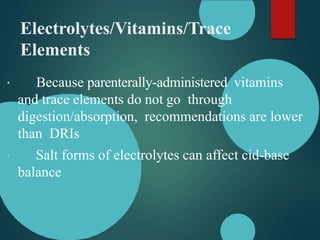
Electrolytes/Vitamins/Trace
Elements
Because parenterally-administered vitamins
and trace elements do not go through
digestion/absorption, recommendations are lower
than DRIs
Salt forms of electrolytes can affect cid-base
balance
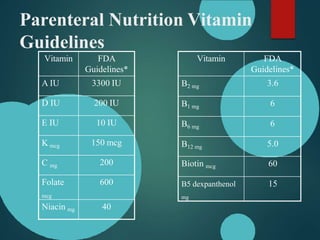
Parenteral Nutrition Vitamin
Guidelines
Vitamin FDA
Guidelines*
A IU 3300 IU
D IU 200 IU
E IU 10 IU
K mcg 150 mcg
C mg 200
Folate
mcg
600
Niacin mg 40
Vitamin FDA
Guidelines*
B2 mg 3.6
B1 mg 6
B6 mg 6
B12 mg 5.0
Biotin mcg 60
B5 dexpanthenol
mg
15
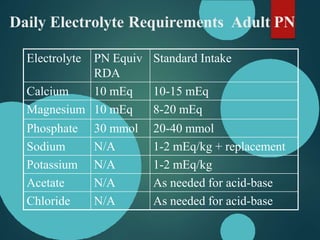
Daily Electrolyte Requirements Adult PN
Electrolyte PN Equiv
RDA
Standard Intake
Calcium 10 mEq 10-15 mEq
Magnesium 10 mEq 8-20 mEq
Phosphate 30 mmol 20-40 mmol
Sodium N/A 1-2 mEq/kg + replacement
Potassium N/A 1-2 mEq/kg
Acetate N/A As needed for acid-base
Chloride N/A As needed for acid-base
How to calculate?
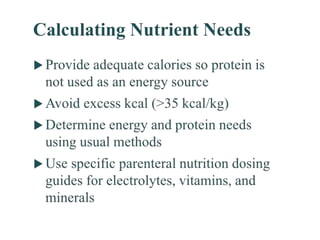
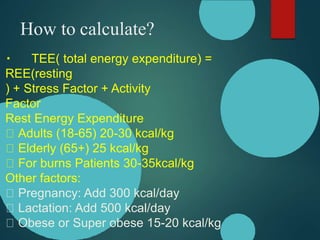
TEE( total energy expenditure) =
REE(resting
) + Stress Factor + Activity
Factor
Rest Energy Expenditure
Adults (18-65) 20-30 kcal/kg
Elderly (65+) 25 kcal/kg
For burns Patients 30-35kcal/kg
Other factors:
Pregnancy: Add 300 kcal/day
Lactation: Add 500 kcal/day
Obese or Super obese 15-20 kcal/kg
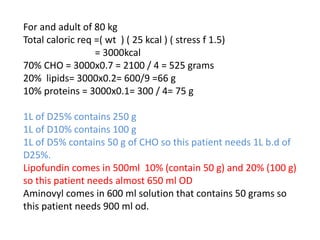
For and adult of 80 kg
Total caloric req =( wt ) ( 25 kcal ) ( stress f 1.5)
= 3000kcal
70% CHO = 3000x0.7 = 2100 / 4 = 525 grams
20% lipids= 3000x0.2= 600/9 =66 g
10% proteins = 3000x0.1= 300 / 4= 75 g
1L of D25% contains 250 g
1L of D10% contains 100 g
1L of D5% contains 50 g of CHO so this patient needs 1L b.d of
D25%.
Lipofundin comes in 500ml 10% (contain 50 g) and 20% (100 g)
so this patient needs almost 650 ml OD
Aminovyl comes in 600 ml solution that contains 50 grams so
this patient needs 900 ml od.
Initiation of Parenteral
Nutrition
Adults should be hemodynamically
stable, able to tolerate the fluid
volume necessary to deliver
significant support, and have central
venous access
Start slowly
(1 L 1st day; 2 L 2ndday)
Initiation of Parenteral Nutrition
As proteins are associated with few
metabolic side effects, maximum amount of protein
can be given on the first day, up to 60-70 grams/liter
Maximum CHO given first day 150-200 g/day or
a 15-20% final dextrose concentration
In pts with glucose intolerance, 100-150 g dextrose
or 10-15% glucose concentration may be given
initially
Initiation of Parenteral
Nutrition
Dextrose content of PN can be
increased if capillary blood glucose
levels are consistently <180 mg/dL
Lipids can be increased if
triglycerides are <400 mg/dL
Parenteral Nutrition
INFUSION SCHEDULES
Infusion Schedules
Continuous Parenteral Nutrition
Non-interrupted infusion of a PN
solution over 24 hours via a central
venous access
Continuous Parenteral
Nutrition
Advantages
Well tolerated by most patients
Requires less manipulation
d e c r e a s e d nursing time
d e c r e a s e d potential for ‘touch’
contamination
Continuous Parenteral
Nutrition
Disadvantages
Persistent anabolic state
a l t e r e d insulin : glucagon ratios
i n c r e a s e d lipid storage by theliver
Reduces mobility in ambulatory p
a
t
i
e
n
t
s
Cyclic Parenteral Nutrition
The intermittent administration of PN via
a central or peripheral venous access,
usually over a period of 12 – 18 hours
Patients on continuous therapy may be
converted to cyclic PN over 24-48 hours
Cyclic Parenteral Nutrition
Advantages
Approximates normalphysiology
of intermittent feeding
I d e a l for ambulatory patients
A l l o w s normal activity
I m p r o v e s quality of life
Cyclic Parenteral Nutrition
Disadvantages
N o t tolerated by critically ill p
a
t
i
e
n
t
s
R e q u i r e s more nursing manipulation
I n c r e a s e d potential for "touch”
“contamination
I n c r e a s e d nursing time
monitoring
Daily
Vitals , weight ,input output record, hb,Rbs, rfts ,Na
,Potassium , chloride
Entry site of catheter
Weekly
Fbc,lfts,ca,mg,po4
Fortnightly
Zn,copper,selenium
◗ Discontinuation of TPN should take place when the patient can
satisfy 75% of his or her caloric and protein needs with oral
intake or enteral feeding.
◗ To discontinue TPN, the infusion rate should be halved for 1
hour, halved again the next hour, and then discontinued.
◗ Tapering in this manner prevents rebound hypoglycemia
from hyperinsulinemia.
◗ It is not necessary to taper the rate if t
h
epatient
demonstrates glycemic stability
Discontinuation of TPN
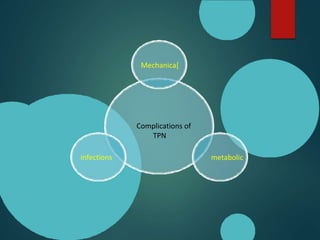
Complications of
TPN
Mechanica[
metabolic
infections
Air embolism
 Pneumothorax
Hemothorax (a type of
pleural effusion in which
blood accumulates in the
pleural cavity).
Cardiac tamponade
(compression of the heart by
an
accumulation of fluid in the
pericardial sac).
Injuries to arteries and veins
Injury to thoracic duct
Mechanical complications…
◗ Early or nutrient related
 hyperglycemia
 hypoglycemia
 hyperlipidemia
 refeeding syndrome
◗ late or related to long term administration
 hepatic dysfunction
Steatosis (accumulation of fat in the liver), steatohepatitis,
 Lipidosis (any disorder of lipid metabolism involving
abnormal accumulation of lipids, including GAUCHER'S
DISEASE)
Cholestasis (a decrease in bile flow due to impaired
secretion by hepatocytes),
cirrhosis
 biliary complications: cholecystitis (Inflammation of gall
bladder), cholelithiasis (Gallstones in biliary tract).
Metabolic bone disease: osteomalacia, osteopenia
METABOLIC COMPLI…….
◗ Fluid overload
◗ Hypo/hypernatremia
◗ Hypercalcemia
◗ Hypo/hyperkalemia
Infection :
 Catheter related sepsis is most
common life threatening
complication
 Causes: staph epidermidis and
staph aureus, enterococcus,
candida, E coli, psuedomonas,
klebsiella etc in
immunocompromised pts
Thank you

Updated tpn last

  • 1.
  • 2.
    Malnutrition can be ascommon in poverty as in wealth One for the lack of food, the other for the lack of knowledge of food
  • 3.
    Aims and Objectives Tounderstand parenteral nutritio Indications and contraindications The routes of administration Constituents Calculate the requirements Infusion schedules Complications
  • 4.
    MALNUTRITION Acc to baileyand love almost 50 % surgical patients suffer from malnutrition Resulting in : Increased morbidity and mortality Delayed wound healing Fistula formation High chance of infections Increased ventilatory support Delayed callus formation LONGER RECOVERY PERIOD AND PROLONGED DURATION OF HOSPITAL STAY Poor quality of life
  • 5.
    Definition of nutrition isthe provision, to cells and organisms, of the materials necessary (in the form of food) to support life.
  • 6.
  • 7.
    Assessment of nutritionalstatus patients should be assessed for PEM as well as specific nutrient deficiencies HISTORY 1)Change in diet patterns 2)Unintentional weight loss 3)Evidence of malabsorption 4)Look for factors which may increase metabolic stress such as infections inflammation malignancies. EXAM & ANTHROPOMETRY .Weight loss .BMI (weight corrected for height) BMI less than 14 are extremely underweight and should be considered for admission To hospital for nutritional support .look for tissue depletion (loss of fat and skeletal muscle wasting) .fluid status for dehydration or overload LAB PARAMETERS: plasma albumin , lymphocytes etc
  • 9.
    Specialized nutritional support Criticalillness induces anorexia and the inability to eat normally predisposing the patients to serious nutritional deficiencies so provision of SNS is a major advancement in modern medicine SNS is provided either enterally or parenterally and decision to use SNS should be based on the likelihood that preventing PEM will increase the chances of recovery , reduce infection rate , improve healing and shorten the stay in hospital. SNS should only be used only when potential benefits exceed risks and it should be undertaken with consent of the patient
  • 10.
    What are thetypes of nutrition? Enteral Parenteral
  • 11.
    ◗ Refers tofeeding via a tube placed into the gut to deliver liquid formulas containing all essential nutrients ◗ Preferred route because of benefits derived from maintaining the digestive, absorptive and immunological barrier function of GIT ◗ Enteral/tube feeding is useful in pts who have functional GIT, but who cannot digest or ingest adequate amount of nutrients ◗ Short term (<6 weeks) tube feeding can b e achieved by nasogastric, nasoduodenal or nasojejunal tubes Enteralfeeding
  • 12.
    What is parenteralnutrition? It involves the continuous infusion of a hyperosmolar solution containing carbohydrates, proteins, fat and other necessary electrolytes through an indwelling catheter inserted into (usually) SVC to meet the nutritional needs of the patient. PN through a peripheral vein is limited by osmolality and volume constraints Solutions that contain more than 3% aminoacid and 5% glucose are poorly tolerated peripherally
  • 13.
    Parenteral Nutrition Given throughintravenous route avoiding gastrointestines Components are in elemental or “pre digested” form P r o t e i n as amino acids Car bohydr at e as dextrose F a t as lipid emulsion Electrolytes, vitamins andmInerals
  • 15.
    What are theindications for parenteral nutrition?
  • 16.
    When should itnot be used? Functional and accessible GI tract Patient is taking oral diet Prognosis does not warrant aggressive nutritional support (terminally ill) Risk exceeds benefit Patient expected to meet needs within 14 days
  • 17.
    How can itbe delivered? C e n t r a l Parenteral Nutrition: oftencalled Total Parenteral Nutrition (TPN);or total nutrient admixture, delivered into a central vein Peripheral Parenteral Nutrition(Ppn ) delivered into a smaller or peripheral vein
  • 18.
    Peripheral parenteral nutrition (PPN) administeredthrough a peripheral intravenous catheter. The osmolarity of PPN solutions generally is limited to 1,000 mOsm (approximately 12% dextrose solution) to avoid phlebitis. Thus, large volumes (>2,500 mL) are needed. Temporary nutritional supplementation with PPN may be useful Generally intended as supplement to oral feeding and is not optimal for critically ill pts
  • 19.
    When can parenteralnutrition be given through a peripheral line? Therapy is expected to be short term ( 1 0 - 1 4 days) Energy and protein needs are moderate Formulation osmolarity is less than 600 -900 mosm/L Fluid restriction is not necessary
  • 20.
    Central Parenteral Nutrition Maybe delivered via femoral lines, internal jugular lines, and subclavian vein catheters in the hospital setting Peripherally inserted central catheters (PICC) are inserted via the cephalic and basilic veins Central access required for infusions that are toxic to small veins due to medication, pH, osmolarity, and volume
  • 22.
    Central line (tunnelled) Advantages:convenient exit site , long lasting Disadvantages : removal needs dissection
  • 24.
    PICC Lines (peripherallyinserted central catheter) PICC lines may be used in ambulatory settings or for long term therapy Used for delivery of medication as well as PN Inserted in the cephalic, basilic, median basilic, or median cephalic veins and threaded into the superior vena cava Can remain in place for up to 1 year with proper maintenance and without complications
  • 25.
    What does itcontain?
  • 26.
  • 27.
    Carbohydrate Source: Monohydrous dextrose Properties:Nitrogen sparing Energy source 3.4Kcal/g Hyperosmolar,Recommended intake 2 – 5 mg/kg/min 50-70% of total calories Generally, because glucose is an essential tissue fuel, glucose and amino acids are provided parenterally until the level of resting energy expenditure is reached. Fats are added thereafter
  • 28.
    Amino Acids • Source:Crystalline amino acids • Properties: 4.0 Kcal/g EAA 40–50%, NEAA 50-60% Recommended intake: 0.8-2.0 g/kg/day 10-15% of total calories Additional protein intake may be needed to compensate for excess protein loss in specific patient population such as burn injuries, open wounds, protein losing Enteropathy / Nephropathy. A lower protein intake may be necessary in patient with chronic renal insufficiency who are not treated by dialysis and certain patients with hepatic encephalopathy
  • 29.
    Amino Acids SpecializedAminoAcid Solutionsare also available such as Branched chain amino acids (BCAA) Essential amino acids (EAA) More expensive than standard s o l u t i o n s Protein or nitrogen balance provides a measure of feeding efficacy of PN or EN Nitrogen Balance = N input - N output 6.25 g protein provides 1 g of nitrogen as 100grams contains 16 g nitrogen N input = (protein in g / 6.25) N output = 24h urinary urea nitrogen + non-urinary N losses +4 to + 6: Net anabolism +1 to - 1: Homeostasis -2 to – 1: Net catabolism
  • 30.
    Lipids Source: Safflower /soybean oil Properties: Long chain triglycerides/Medium chain trig I s o t o n i c or hypotonic S t a b i l i z e d emulsions Prevents essential fatty acid defeciency Recommended intake 0.5 – 1.5 g/kg/day (not >2 g/kg) 12 – 24 hour infusion rate
  • 31.
    Lipids  4% to10% kcals given as lipid meets EFA requirements; or 2% to 4% kcals given as linoleic acid  Generally 500 mL of 10% fat emulsion given two times weekly or 500 mL of 20% lipids given once weekly will prevent EFAD  Usual range 25% to 35% of total kcals  Max. 60% of kcal or 2 g fat/kg
  • 33.
    Types of formulations TPNformulation without lipid (2-in-1 solution) Calories from amino acids- 20 to 25% Calories from dextrose- 75-80% TPN formulation with lipid ( 3-in-1 solution) calories from amino acids- 20 to 25% calories from lipids- 20% calories from dextrose- 55 to 60 %
  • 34.
    Fluid requirement ESTIMATING ADULTFLUID REQUIREMENTS By caloric intake : 1ml/calorie Example: 1800 calorie diet = 1800 calories x 1ml= 1800ml By body weight and age : average requirement is 30 ml/kg/d 16-55 years 35 ml/kg/d 56-65 years 30 ml/kg/d > 65 years 25 ml/kg/d
  • 35.
    Electrolytes/Vitamins/Trace Elements Because parenterally-administered vitamins andtrace elements do not go through digestion/absorption, recommendations are lower than DRIs Salt forms of electrolytes can affect cid-base balance
  • 36.
    Parenteral Nutrition Vitamin Guidelines VitaminFDA Guidelines* A IU 3300 IU D IU 200 IU E IU 10 IU K mcg 150 mcg C mg 200 Folate mcg 600 Niacin mg 40 Vitamin FDA Guidelines* B2 mg 3.6 B1 mg 6 B6 mg 6 B12 mg 5.0 Biotin mcg 60 B5 dexpanthenol mg 15
  • 37.
    Daily Electrolyte RequirementsAdult PN Electrolyte PN Equiv RDA Standard Intake Calcium 10 mEq 10-15 mEq Magnesium 10 mEq 8-20 mEq Phosphate 30 mmol 20-40 mmol Sodium N/A 1-2 mEq/kg + replacement Potassium N/A 1-2 mEq/kg Acetate N/A As needed for acid-base Chloride N/A As needed for acid-base
  • 39.
    How to calculate? TEE(total energy expenditure) = REE(resting ) + Stress Factor + Activity Factor Rest Energy Expenditure Adults (18-65) 20-30 kcal/kg Elderly (65+) 25 kcal/kg For burns Patients 30-35kcal/kg Other factors: Pregnancy: Add 300 kcal/day Lactation: Add 500 kcal/day Obese or Super obese 15-20 kcal/kg
  • 40.
    For and adultof 80 kg Total caloric req =( wt ) ( 25 kcal ) ( stress f 1.5) = 3000kcal 70% CHO = 3000x0.7 = 2100 / 4 = 525 grams 20% lipids= 3000x0.2= 600/9 =66 g 10% proteins = 3000x0.1= 300 / 4= 75 g 1L of D25% contains 250 g 1L of D10% contains 100 g 1L of D5% contains 50 g of CHO so this patient needs 1L b.d of D25%. Lipofundin comes in 500ml 10% (contain 50 g) and 20% (100 g) so this patient needs almost 650 ml OD Aminovyl comes in 600 ml solution that contains 50 grams so this patient needs 900 ml od.
  • 41.
    Initiation of Parenteral Nutrition Adultsshould be hemodynamically stable, able to tolerate the fluid volume necessary to deliver significant support, and have central venous access Start slowly (1 L 1st day; 2 L 2ndday)
  • 42.
    Initiation of ParenteralNutrition As proteins are associated with few metabolic side effects, maximum amount of protein can be given on the first day, up to 60-70 grams/liter Maximum CHO given first day 150-200 g/day or a 15-20% final dextrose concentration In pts with glucose intolerance, 100-150 g dextrose or 10-15% glucose concentration may be given initially
  • 43.
    Initiation of Parenteral Nutrition Dextrosecontent of PN can be increased if capillary blood glucose levels are consistently <180 mg/dL Lipids can be increased if triglycerides are <400 mg/dL
  • 44.
  • 45.
    Infusion Schedules Continuous ParenteralNutrition Non-interrupted infusion of a PN solution over 24 hours via a central venous access
  • 46.
    Continuous Parenteral Nutrition Advantages Well toleratedby most patients Requires less manipulation d e c r e a s e d nursing time d e c r e a s e d potential for ‘touch’ contamination
  • 47.
    Continuous Parenteral Nutrition Disadvantages Persistent anabolicstate a l t e r e d insulin : glucagon ratios i n c r e a s e d lipid storage by theliver Reduces mobility in ambulatory p a t i e n t s
  • 48.
    Cyclic Parenteral Nutrition Theintermittent administration of PN via a central or peripheral venous access, usually over a period of 12 – 18 hours Patients on continuous therapy may be converted to cyclic PN over 24-48 hours
  • 49.
    Cyclic Parenteral Nutrition Advantages Approximatesnormalphysiology of intermittent feeding I d e a l for ambulatory patients A l l o w s normal activity I m p r o v e s quality of life
  • 50.
    Cyclic Parenteral Nutrition Disadvantages No t tolerated by critically ill p a t i e n t s R e q u i r e s more nursing manipulation I n c r e a s e d potential for "touch” “contamination I n c r e a s e d nursing time
  • 51.
    monitoring Daily Vitals , weight,input output record, hb,Rbs, rfts ,Na ,Potassium , chloride Entry site of catheter Weekly Fbc,lfts,ca,mg,po4 Fortnightly Zn,copper,selenium
  • 52.
    ◗ Discontinuation ofTPN should take place when the patient can satisfy 75% of his or her caloric and protein needs with oral intake or enteral feeding. ◗ To discontinue TPN, the infusion rate should be halved for 1 hour, halved again the next hour, and then discontinued. ◗ Tapering in this manner prevents rebound hypoglycemia from hyperinsulinemia. ◗ It is not necessary to taper the rate if t h epatient demonstrates glycemic stability Discontinuation of TPN
  • 53.
  • 54.
    Air embolism  Pneumothorax Hemothorax(a type of pleural effusion in which blood accumulates in the pleural cavity). Cardiac tamponade (compression of the heart by an accumulation of fluid in the pericardial sac). Injuries to arteries and veins Injury to thoracic duct Mechanical complications…
  • 55.
    ◗ Early ornutrient related  hyperglycemia  hypoglycemia  hyperlipidemia  refeeding syndrome ◗ late or related to long term administration  hepatic dysfunction Steatosis (accumulation of fat in the liver), steatohepatitis,  Lipidosis (any disorder of lipid metabolism involving abnormal accumulation of lipids, including GAUCHER'S DISEASE) Cholestasis (a decrease in bile flow due to impaired secretion by hepatocytes), cirrhosis  biliary complications: cholecystitis (Inflammation of gall bladder), cholelithiasis (Gallstones in biliary tract). Metabolic bone disease: osteomalacia, osteopenia METABOLIC COMPLI…….
  • 56.
    ◗ Fluid overload ◗Hypo/hypernatremia ◗ Hypercalcemia ◗ Hypo/hyperkalemia Infection :  Catheter related sepsis is most common life threatening complication  Causes: staph epidermidis and staph aureus, enterococcus, candida, E coli, psuedomonas, klebsiella etc in immunocompromised pts
  • 57.