Stephen Tindi, Dept of Comm & Media. University of
Education, Winneba
PARASOCIAL INTERACTION THEORY
-Befriending people whom we may never really know
In this presentation…
i. Basics of Parasocial Interaction theory
ii. What is Parasocial Interaction?
iii. Features of Parasocial Interaction
iv. Factors influencing Parasocial Interaction
v. Effects of Parasocial Interaction
vi. Parasocial Interaction Research
vii. Implications
Basics of Parasocial Theory
 Parasocial interaction was introduced by Horton and
Wohl in 1956.
 Parasocial interaction theory is a media effects
theory
 Interpersonal (face to face) interaction and mediated
communication are governed by the same principles
(empathy, sociability, aphability)
 Media audience may be enthralled by media content
and are drawn to media personae
 The perception of interaction between media
audiences and personalities known through the
media is unidirectional and not real.
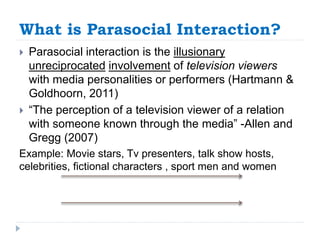
What is Parasocial Interaction?
 Parasocial interaction is the illusionary
unreciprocated involvement of television viewers
with media personalities or performers (Hartmann &
Goldhoorn, 2011)
 “The perception of a television viewer of a relation
with someone known through the media” -Allen and
Gregg (2007)
Example: Movie stars, Tv presenters, talk show hosts,
celebrities, fictional characters , sport men and women
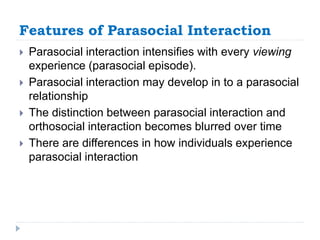
Features of Parasocial Interaction
 Parasocial interaction intensifies with every viewing
experience (parasocial episode).
 Parasocial interaction may develop in to a parasocial
relationship
 The distinction between parasocial interaction and
orthosocial interaction becomes blurred over time
 There are differences in how individuals experience
parasocial interaction
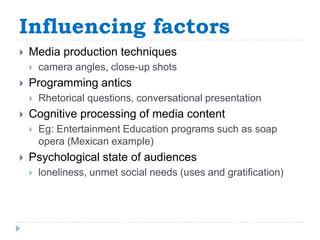
Influencing factors
 Media production techniques
 camera angles, close-up shots
 Programming antics
 Rhetorical questions, conversational presentation
 Cognitive processing of media content
 Eg: Entertainment Education programs such as soap
opera (Mexican example)
 Psychological state of audiences
 loneliness, unmet social needs (uses and gratification)
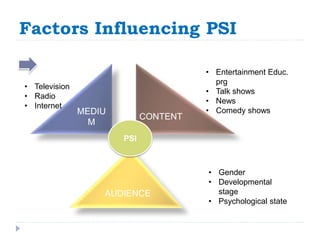
Factors Influencing PSI
AUDIENCE
MEDIU
M
CONTENT
PSI
• Television
• Radio
• Internet
• Gender
• Developmental
stage
• Psychological state
• Entertainment Educ.
prg
• Talk shows
• News
• Comedy shows
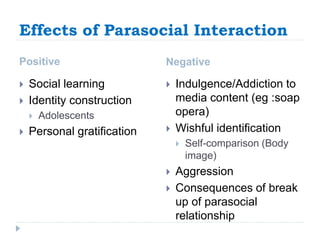
Effects of Parasocial Interaction
Positive Negative
 Social learning
 Identity construction
 Adolescents
 Personal gratification
 Indulgence/Addiction to
media content (eg :soap
opera)
 Wishful identification
 Self-comparison (Body
image)
 Aggression
 Consequences of break
up of parasocial
relationship
PSI and Research
 Gender difference in parasocial interaction
 Cole & Leets, 1999; Davila-Rosado, 2001
 PSI and attachment style
 Greenwood, Pietromonaco and Long (2008)
 Parasocial interaction and co-presence
 PSI and uses and gratification
 PSI in online communities
Conclusion and Implications
The line between interpersonal and
mediated communication continues to
blur.
Oh, is there really any line?
PSI is useful for;
 Media Content production
 Marketing communication and brand
endorsements
 Change communication (Entertainment
Education)
GOT QUESTIONS?
 Don’t stop talking!
Tweet at me @xtindi
 Download and share
THANK YOU!

Parasocial interaction theory

  • 1.
    Stephen Tindi, Deptof Comm & Media. University of Education, Winneba PARASOCIAL INTERACTION THEORY -Befriending people whom we may never really know
  • 2.
    In this presentation… i.Basics of Parasocial Interaction theory ii. What is Parasocial Interaction? iii. Features of Parasocial Interaction iv. Factors influencing Parasocial Interaction v. Effects of Parasocial Interaction vi. Parasocial Interaction Research vii. Implications
  • 3.
    Basics of ParasocialTheory  Parasocial interaction was introduced by Horton and Wohl in 1956.  Parasocial interaction theory is a media effects theory  Interpersonal (face to face) interaction and mediated communication are governed by the same principles (empathy, sociability, aphability)  Media audience may be enthralled by media content and are drawn to media personae  The perception of interaction between media audiences and personalities known through the media is unidirectional and not real.
  • 4.
    What is ParasocialInteraction?  Parasocial interaction is the illusionary unreciprocated involvement of television viewers with media personalities or performers (Hartmann & Goldhoorn, 2011)  “The perception of a television viewer of a relation with someone known through the media” -Allen and Gregg (2007) Example: Movie stars, Tv presenters, talk show hosts, celebrities, fictional characters , sport men and women
  • 5.
    Features of ParasocialInteraction  Parasocial interaction intensifies with every viewing experience (parasocial episode).  Parasocial interaction may develop in to a parasocial relationship  The distinction between parasocial interaction and orthosocial interaction becomes blurred over time  There are differences in how individuals experience parasocial interaction
  • 6.
    Influencing factors  Mediaproduction techniques  camera angles, close-up shots  Programming antics  Rhetorical questions, conversational presentation  Cognitive processing of media content  Eg: Entertainment Education programs such as soap opera (Mexican example)  Psychological state of audiences  loneliness, unmet social needs (uses and gratification)
  • 7.
    Factors Influencing PSI AUDIENCE MEDIU M CONTENT PSI •Television • Radio • Internet • Gender • Developmental stage • Psychological state • Entertainment Educ. prg • Talk shows • News • Comedy shows
  • 8.
    Effects of ParasocialInteraction Positive Negative  Social learning  Identity construction  Adolescents  Personal gratification  Indulgence/Addiction to media content (eg :soap opera)  Wishful identification  Self-comparison (Body image)  Aggression  Consequences of break up of parasocial relationship
  • 9.
    PSI and Research Gender difference in parasocial interaction  Cole & Leets, 1999; Davila-Rosado, 2001  PSI and attachment style  Greenwood, Pietromonaco and Long (2008)  Parasocial interaction and co-presence  PSI and uses and gratification  PSI in online communities
  • 10.
    Conclusion and Implications Theline between interpersonal and mediated communication continues to blur. Oh, is there really any line? PSI is useful for;  Media Content production  Marketing communication and brand endorsements  Change communication (Entertainment Education)
  • 11.
    GOT QUESTIONS?  Don’tstop talking! Tweet at me @xtindi  Download and share THANK YOU!

Editor's Notes