

Can’t Live Without It!
Our relationship with the media
by. Ichsan Rasyid
CONTENT
 Prologue
 Learning from media theories
 Media system dependencies theory
 Uses and gratification theory
 Thoughts on ‘audience – media’ relationship
Prologue
Why ‘audience – media’ relationship?
Prologue
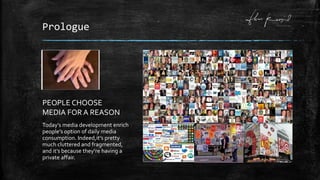
Today’s media development enrich
people’s option of daily media
consumption. Indeed,it’s pretty
much cluttered and fragmented,
and it’s because they’re having a
private affair.
PEOPLE CHOOSE
MEDIA FOR A REASON
Prologue
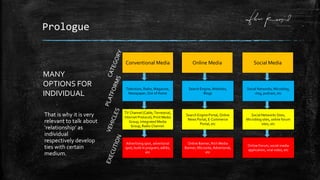
Conventional Media Online Media Social Media
Television, Radio, Magazine,
Newspaper, Out of Home
Search Engine, Websites,
Blogs
Social Networks, Microblog,
vlog, podcast, etc
TV Channel (Cable, Terrestrial,
Internet Protocol), Print Media
Group, Integrated Media
Group, Radio Channel.
Search Engine Portal, Online
News Portal, E-Commerce
Portal, etc
Social Networks Sites,
Microblog sites, online forum
sites, etc
Advertising spot, advertorial
spot, build in program, adlibs,
etc
Online Banner, Rich Media
Banner, Microsite, Advertorial,
etc
Online Forum, social media
application, viral video, etc
That is why it is very
relevant to talk about
‘relationship’ as
individual
respectively develop
ties with certain
medium.
MANY
OPTIONS FOR
INDIVIDUAL
Learning from media theory
Media system dependency theory
What the theory said?
#1 Media System Dependency
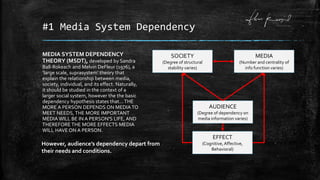
MEDIA SYSTEM DEPENDENCY
THEORY (MSDT), developed by Sandra
Ball-Rokeach and Melvin DeFleur (1976), a
‘large scale, suprasystem’ theory that
explain the relationship between media,
society, individual, and its effect. Naturally,
it should be studied in the context of a
larger social system, however the the basic
dependency hypothesis states that...THE
MORE A PERSON DEPENDS ON MEDIATO
MEET NEEDS, THE MORE IMPORTANT
MEDIA WILL BE IN A PERSON'S LIFE, AND
THEREFORE THE MORE EFFECTS MEDIA
WILL HAVE ON A PERSON.
SOCIETY
(Degree of structural
stability varies)
MEDIA
(Number and centrality of
info function varies)
AUDIENCE
(Degree of dependency on
media information varies)
EFFECT
(Cognitive, Affective,
Behavioral)
However, audience’s dependency depart from
their needs and conditions.
#1 Media System Dependency
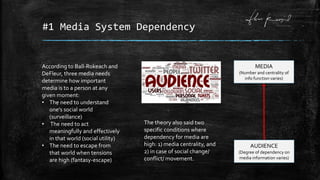
MEDIA
(Number and centrality of
info function varies)
AUDIENCE
(Degree of dependency on
media information varies)
According to Ball-Rokeach and
DeFleur, three media needs
determine how important
media is to a person at any
given moment:
• The need to understand
one's social world
(surveillance)
• The need to act
meaningfully and effectively
in that world (social utility)
• The need to escape from
that world when tensions
are high (fantasy-escape)
The theory also said two
specific conditions where
dependency for media are
high: 1) media centrality, and
2) in case of social change/
conflict/ movement.
Learning from media theory
Uses and gratification theory
What the theory said?
#2 Uses and Gratification
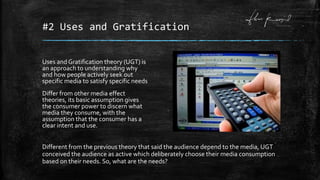
Uses and Gratification theory (UGT) is
an approach to understanding why
and how people actively seek out
specific media to satisfy specific needs
Differ from other media effect
theories, its basic assumption gives
the consumer power to discern what
media they consume, with the
assumption that the consumer has a
clear intent and use.
Different from the previous theory that said the audience depend to the media, UGT
conceived the audience as active which deliberately choose their media consumption
based on their needs. So, what are the needs?
#2 Uses and Gratification
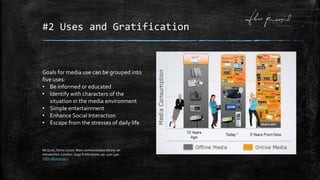
Goals for media use can be grouped into
five uses:
• Be informed or educated
• Identify with characters of the
situation in the media environment
• Simple entertainment
• Enhance Social Interaction
• Escape from the stresses of daily life
McQuail, Denis (2010). Mass communication theory: an
introduction. London: Sage Publications. pp. 420–430.
ISBN 1849202923.
Thoughts on ‘audience – media’ relationship
What we can conclude from the theory?
Relationship with the Media
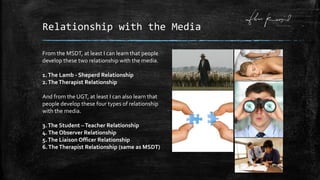
From the MSDT, at least I can learn that people
develop these two relationship with the media.
1.The Lamb - Sheperd Relationship
2.TheTherapist Relationship
And from the UGT, at least I can also learn that
people develop these four types of relationship
with the media.
3.The Student –Teacher Relationship
4.The Observer Relationship
5.The Liaison Officer Relationship
6.TheTherapist Relationship (same as MSDT)
Relationship with the Media
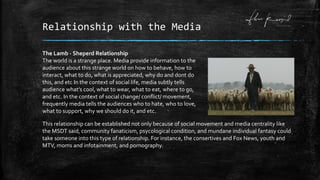
The Lamb - Sheperd Relationship
The world is a strange place. Media provide information to the
audience about this strange world on how to behave, how to
interact, what to do, what is appreciated, why do and dont do
this, and etc In the context of social life, media subtly tells
audience what’s cool, what to wear, what to eat, where to go,
and etc. In the context of social change/ conflict/ movement,
frequently media tells the audiences who to hate, who to love,
what to support, why we should do it, and etc.
This relationship can be established not only because of social movement and media centrality like
the MSDT said, community fanaticism, psycological condition, and mundane individual fantasy could
take someone into this type of relationship. For instance, the consertives and Fox News, youth and
MTV, moms and infotainment, and pornography.
Relationship with the Media
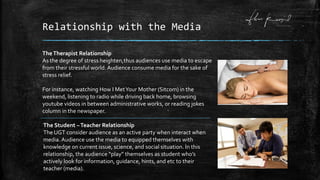
TheTherapist Relationship
As the degree of stress heighten,thus audiences use media to escape
from their stressful world. Audience consume media for the sake of
stress relief.
For instance, watching How I MetYour Mother (Sitcom) in the
weekend, listening to radio while driving back home, browsing
youtube videos in between administrative works, or reading jokes
column in the newspaper.
The Student –Teacher Relationship
The UGT consider audience as an active party when interact when
media. Audience use the media to equipped themselves with
knowledge on current issue, science, and social situation. In this
relationship, the audience “play” themselves as student who’s
actively look for information, guidance, hints, and etc to their
teacher (media).
Relationship with the Media
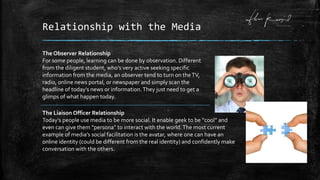
The Observer Relationship
For some people, learning can be done by observation. Different
from the diligent student, who’s very active seeking specific
information from the media, an observer tend to turn on theTV,
radio, online news portal, or newspaper and simply scan the
headline of today’s news or information.They just need to get a
glimps of what happen today.
The Liaison Officer Relationship
Today’s people use media to be more social. It enable geek to be “cool” and
even can give them “persona” to interact with the world.The most current
example of media’s social facilitation is the avatar, where one can have an
online identity (could be different from the real identity) and confidently make
conversation with the others.
CONCLUSION
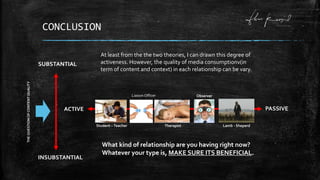
ACTIVE PASSIVE
SUBSTANTIAL
INSUBSTANTIAL
Lamb - Sheperd
Observer
Therapist
Liaison Officer
Student –Teacher
At least from the the two theories, I can drawn this degree of
activeness. However, the quality of media consumptionv(in
term of content and context) in each relationship can be vary.
What kind of relationship are you having right now?
Whatever your type is, MAKE SURE ITS BENEFICIAL.
THEQUESTIONOFCONTENTQUALITY
Thanks!
Image Links
▪ http://blog.creamglobal.com/.a/6a
00e5506f08e888340176151ed71697
0c-500wi
▪ http://www.entrepreneur.com/dbi
mages/blog/h1/7_effective_market
ing_methods_for_our_ad-
cluttered_digital_age.jpg
▪ http://frankjkenny.com/wp-
content/uploads/2011/04/Twitter-
Friends.jpg
▪ http://www.queeninheels.com/wp-
content/uploads/2012/03/Social-
Networking.jpg
▪ http://www.marriagemax.com/blo
g/wp-
content/uploads/2012/02/how-to-
tell-if-your-husband-is-having-an-
affair.jpg
▪ http://ferswriteshoe.files.wordpres
s.com/2011/07/tag-cloud1.png
▪ http://ppl.ug/NbOJWCzxFi0/fv
▪ http://blog.wsidigitalmarketing.co
m/wp-
content/uploads/2010/05/MediaCo
nsumptionChart_CUSTOMER.jpg
▪ http://1.bp.blogspot.com/-2Y-
4gHn1Ikg/UKbm7JV-
OsI/AAAAAAAAAU0/uVD6O65qG
O8/s1600/shepherd-sheep-10.jpg
▪ http://catchwork.co.uk/wp-
content/uploads/2012/04/spa-
therapist-600x386.jpg
▪ http://www.dockhs.org/filerequest/
3416
▪ http://alleecreative.com/wp-
content/uploads/2012/06/hand-in-
hand.jpg

Can't Live Without It! --- The 'Audience-Media Relationship

  • 1.
    Can’t Live WithoutIt! Our relationship with the media by. Ichsan Rasyid CONTENT  Prologue  Learning from media theories  Media system dependencies theory  Uses and gratification theory  Thoughts on ‘audience – media’ relationship
  • 2.
    Prologue Why ‘audience –media’ relationship?
  • 3.
    Prologue Today’s media developmentenrich people’s option of daily media consumption. Indeed,it’s pretty much cluttered and fragmented, and it’s because they’re having a private affair. PEOPLE CHOOSE MEDIA FOR A REASON
  • 4.
    Prologue Conventional Media OnlineMedia Social Media Television, Radio, Magazine, Newspaper, Out of Home Search Engine, Websites, Blogs Social Networks, Microblog, vlog, podcast, etc TV Channel (Cable, Terrestrial, Internet Protocol), Print Media Group, Integrated Media Group, Radio Channel. Search Engine Portal, Online News Portal, E-Commerce Portal, etc Social Networks Sites, Microblog sites, online forum sites, etc Advertising spot, advertorial spot, build in program, adlibs, etc Online Banner, Rich Media Banner, Microsite, Advertorial, etc Online Forum, social media application, viral video, etc That is why it is very relevant to talk about ‘relationship’ as individual respectively develop ties with certain medium. MANY OPTIONS FOR INDIVIDUAL
  • 5.
    Learning from mediatheory Media system dependency theory What the theory said?
  • 6.
    #1 Media SystemDependency MEDIA SYSTEM DEPENDENCY THEORY (MSDT), developed by Sandra Ball-Rokeach and Melvin DeFleur (1976), a ‘large scale, suprasystem’ theory that explain the relationship between media, society, individual, and its effect. Naturally, it should be studied in the context of a larger social system, however the the basic dependency hypothesis states that...THE MORE A PERSON DEPENDS ON MEDIATO MEET NEEDS, THE MORE IMPORTANT MEDIA WILL BE IN A PERSON'S LIFE, AND THEREFORE THE MORE EFFECTS MEDIA WILL HAVE ON A PERSON. SOCIETY (Degree of structural stability varies) MEDIA (Number and centrality of info function varies) AUDIENCE (Degree of dependency on media information varies) EFFECT (Cognitive, Affective, Behavioral) However, audience’s dependency depart from their needs and conditions.
  • 7.
    #1 Media SystemDependency MEDIA (Number and centrality of info function varies) AUDIENCE (Degree of dependency on media information varies) According to Ball-Rokeach and DeFleur, three media needs determine how important media is to a person at any given moment: • The need to understand one's social world (surveillance) • The need to act meaningfully and effectively in that world (social utility) • The need to escape from that world when tensions are high (fantasy-escape) The theory also said two specific conditions where dependency for media are high: 1) media centrality, and 2) in case of social change/ conflict/ movement.
  • 8.
    Learning from mediatheory Uses and gratification theory What the theory said?
  • 9.
    #2 Uses andGratification Uses and Gratification theory (UGT) is an approach to understanding why and how people actively seek out specific media to satisfy specific needs Differ from other media effect theories, its basic assumption gives the consumer power to discern what media they consume, with the assumption that the consumer has a clear intent and use. Different from the previous theory that said the audience depend to the media, UGT conceived the audience as active which deliberately choose their media consumption based on their needs. So, what are the needs?
  • 10.
    #2 Uses andGratification Goals for media use can be grouped into five uses: • Be informed or educated • Identify with characters of the situation in the media environment • Simple entertainment • Enhance Social Interaction • Escape from the stresses of daily life McQuail, Denis (2010). Mass communication theory: an introduction. London: Sage Publications. pp. 420–430. ISBN 1849202923.
  • 11.
    Thoughts on ‘audience– media’ relationship What we can conclude from the theory?
  • 12.
    Relationship with theMedia From the MSDT, at least I can learn that people develop these two relationship with the media. 1.The Lamb - Sheperd Relationship 2.TheTherapist Relationship And from the UGT, at least I can also learn that people develop these four types of relationship with the media. 3.The Student –Teacher Relationship 4.The Observer Relationship 5.The Liaison Officer Relationship 6.TheTherapist Relationship (same as MSDT)
  • 13.
    Relationship with theMedia The Lamb - Sheperd Relationship The world is a strange place. Media provide information to the audience about this strange world on how to behave, how to interact, what to do, what is appreciated, why do and dont do this, and etc In the context of social life, media subtly tells audience what’s cool, what to wear, what to eat, where to go, and etc. In the context of social change/ conflict/ movement, frequently media tells the audiences who to hate, who to love, what to support, why we should do it, and etc. This relationship can be established not only because of social movement and media centrality like the MSDT said, community fanaticism, psycological condition, and mundane individual fantasy could take someone into this type of relationship. For instance, the consertives and Fox News, youth and MTV, moms and infotainment, and pornography.
  • 14.
    Relationship with theMedia TheTherapist Relationship As the degree of stress heighten,thus audiences use media to escape from their stressful world. Audience consume media for the sake of stress relief. For instance, watching How I MetYour Mother (Sitcom) in the weekend, listening to radio while driving back home, browsing youtube videos in between administrative works, or reading jokes column in the newspaper. The Student –Teacher Relationship The UGT consider audience as an active party when interact when media. Audience use the media to equipped themselves with knowledge on current issue, science, and social situation. In this relationship, the audience “play” themselves as student who’s actively look for information, guidance, hints, and etc to their teacher (media).
  • 15.
    Relationship with theMedia The Observer Relationship For some people, learning can be done by observation. Different from the diligent student, who’s very active seeking specific information from the media, an observer tend to turn on theTV, radio, online news portal, or newspaper and simply scan the headline of today’s news or information.They just need to get a glimps of what happen today. The Liaison Officer Relationship Today’s people use media to be more social. It enable geek to be “cool” and even can give them “persona” to interact with the world.The most current example of media’s social facilitation is the avatar, where one can have an online identity (could be different from the real identity) and confidently make conversation with the others.
  • 16.
    CONCLUSION ACTIVE PASSIVE SUBSTANTIAL INSUBSTANTIAL Lamb -Sheperd Observer Therapist Liaison Officer Student –Teacher At least from the the two theories, I can drawn this degree of activeness. However, the quality of media consumptionv(in term of content and context) in each relationship can be vary. What kind of relationship are you having right now? Whatever your type is, MAKE SURE ITS BENEFICIAL. THEQUESTIONOFCONTENTQUALITY
  • 17.
  • 18.
    Image Links ▪ http://blog.creamglobal.com/.a/6a 00e5506f08e888340176151ed71697 0c-500wi ▪http://www.entrepreneur.com/dbi mages/blog/h1/7_effective_market ing_methods_for_our_ad- cluttered_digital_age.jpg ▪ http://frankjkenny.com/wp- content/uploads/2011/04/Twitter- Friends.jpg ▪ http://www.queeninheels.com/wp- content/uploads/2012/03/Social- Networking.jpg ▪ http://www.marriagemax.com/blo g/wp- content/uploads/2012/02/how-to- tell-if-your-husband-is-having-an- affair.jpg ▪ http://ferswriteshoe.files.wordpres s.com/2011/07/tag-cloud1.png ▪ http://ppl.ug/NbOJWCzxFi0/fv ▪ http://blog.wsidigitalmarketing.co m/wp- content/uploads/2010/05/MediaCo nsumptionChart_CUSTOMER.jpg ▪ http://1.bp.blogspot.com/-2Y- 4gHn1Ikg/UKbm7JV- OsI/AAAAAAAAAU0/uVD6O65qG O8/s1600/shepherd-sheep-10.jpg ▪ http://catchwork.co.uk/wp- content/uploads/2012/04/spa- therapist-600x386.jpg ▪ http://www.dockhs.org/filerequest/ 3416 ▪ http://alleecreative.com/wp- content/uploads/2012/06/hand-in- hand.jpg