Parasitic Infections of Skin, Soft
Tissue and Musculoskeletal
System
Dr Bhavika patel
MBBS,MD Microbiology,DIPC
Assistant Professor
Department of microbiology
GMERS MC, Valsad.
Learning objectives
2
At the end of the session, the students will be able to understand:
▰ Life cycle, pathogenesis, clinical features, lab diagnosis, treatment and
prevention of cutaneous leishmaniasis, cutaneous filariasis, Dracunculiasis,
trichinellosis, cutaneous larva migrans.
Parasitic infections of skin, soft tissue and
musculoskeletal system
3
Protozoan infections
 Cutaneous leishmaniasis
 Cutaneous amoebiasis
 Acanthamoeba skin lesions
 Trypanosoma chancre and chagoma
 Sarcocystosis
Cestode infections
 Muscular cysticercosis
 Sparganosis (Spirometra)
Trematode infections
 Cercarial dermatitis
 Cutaneous paragonimiasis
Nematode infections
 Cutaneous filariasis
 Dracunculiasis
 Trichinellosis
 Cutaneous larva migrans
The Major cutaneous parasites
▰ 1. CUTANEOUS LEISHMANIASIS
▰ 2. CUTANEOUS FILARIASIS
▰ 3. DRACUNCULIASIS
▰ 4.TRICHINELLOSIS
▰ 5.CUTANEOUS LARVA MIGRANS
4
CUTANEOUS
LEISHMANIASIS
(oriental sore,aleppo avil,Delhi boil,Baghdad
sore,Rose of jericho,uta,Espundia,Kala
azar,Black fever) 5
6
a 36-year-old lady, presented with a large disfiguring lesion on her left arm
expanding during the last three months. Systemic examination was
unremarkable. Examination of her arm showed a 6x6cm erythematous
crusted plaque covering her medial aspect of the distal forearm.
Resolution of the original plaques leaving scar and hyperpigmentation
after cryotherapy
7
A
B
C
D
CUTANEOUS LEISHMANIASIS
8
▰ CL: Cutaneous leishmaniasis (CL) - most common form of leishmaniasis.
▰ Global annual incidence of 6-10 lakh new cases.
▰ About 95% of CL cases - America, the Mediterranean basin, the Middle East
and Central Asia
CUTANEOUS LEISHMANIASIS (Cont..)
9
▰ MCL: Over 90% of mucocutaneous leishmaniasis (MCL) cases - Bolivia, Brazil,
Ethiopia and Peru.
▰ Post kala-azar dermal leishmaniasis (PKDL) - another cutaneous
manifestation - occurs few months to years following VL
10
• L.tropica,
• L.aethiopica
• L. major
Old World
Cutaneous
Leishmaniasis
(CL)
• Leishmania Leishmania (L.L.)
mexicana complex
• Leishmania Viannia (L.V.)
braziliensis complex
• Leishmania Leishmania (L.L.)
chagasi:
New World
cutaneous
leishmaniasis
Various agents of cutaneous leishmaniasis
11
Species Geographical
distribution
Clinicalsyndrome Vector (sandfly) Reservoir Transmission
L. L. tropica
(Oriental sore)
Western India, North
Africa, and Middle
East
CL, LR Phlebotomus
sergenti
Humans Anthroponotic
(human)
L. L. aethiopica Ethiopia, Uganda,
and Kenya
CL, DCL P. longipes Hyraxes Zoonotic
L. L. major Middle East, India,
China, Africa, Central
and Western Asia
CL P. papatasi Rodents Zoonotic
Old World Cutaneous Leishmaniasis (CL)
12
▰ Old world CL is caused by Leishmania tropica complex - comprises of three
species—L. tropica, L. aethiopica and L. major.
Life Cycle
13
Life cycle of the L. tropica complex is same
as L. donovani , except that:
 Vector: Sandfly, but different species of
Phlebotomus.
 Habitat: In humans, the amastigote forms
reside in reticuloendothelial cells of skin
(they do not migrate to viscera).
Clinical Features
14
▰ 1.Cutaneous leishmaniasis: Also known as “Oriental
sore”, Delhi boil, Aleppo boil and Baghdad Button, etc.
▰ Occurs on face and hands – painless papule, becomes
nodular and finally it ulcerates.
▰ Heals spontaneously or - leaves behind disfigurement
or scar.
Clinical Features (Cont..)
15
▰ 2.Leishmaniasis recidivans (LR): Granulomatous
response producing new lesions - occur years after
healing of primary sore due to L. tropica. It is
▰ Characterized by scaly, erythematous papules and
nodules - develop in center or periphery of a
previously healed sore.
Clinical Features (Cont..)
16
▰ 3.Diffuse cutaneous leishmaniasis (DCL): Caused by L.
aethiopica. It is
▰ Characterized by - lack of CMI response to the parasite,
resulting in widespread cutaneous lesions
▰ Rare -100 cases have been reported so far - Kenya and
Ethiopia
▰ Responds poorly to treatment; disease may last long.
Laboratory Diagnosis of CL
17
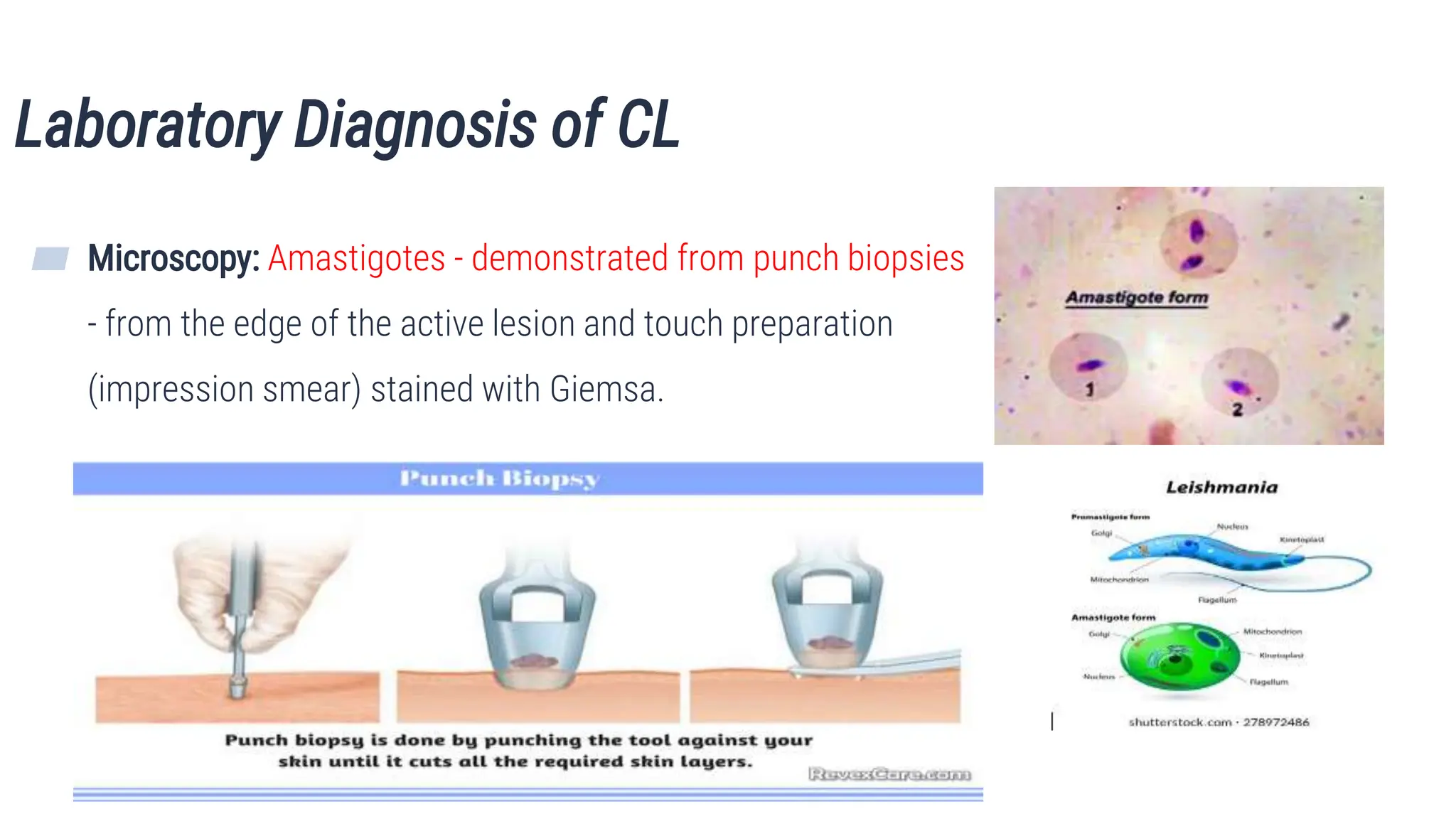
▰ Microscopy: Amastigotes - demonstrated from punch biopsies
- from the edge of the active lesion and touch preparation
(impression smear) stained with Giemsa.
Laboratory Diagnosis of CL
18
▰ Culture: Aspiration from the ulcers - cultured in NNN medium and Schneider’s
Drosophila medium - isolation of promastigote forms
Laboratory Diagnosis of CL (Cont..)
19
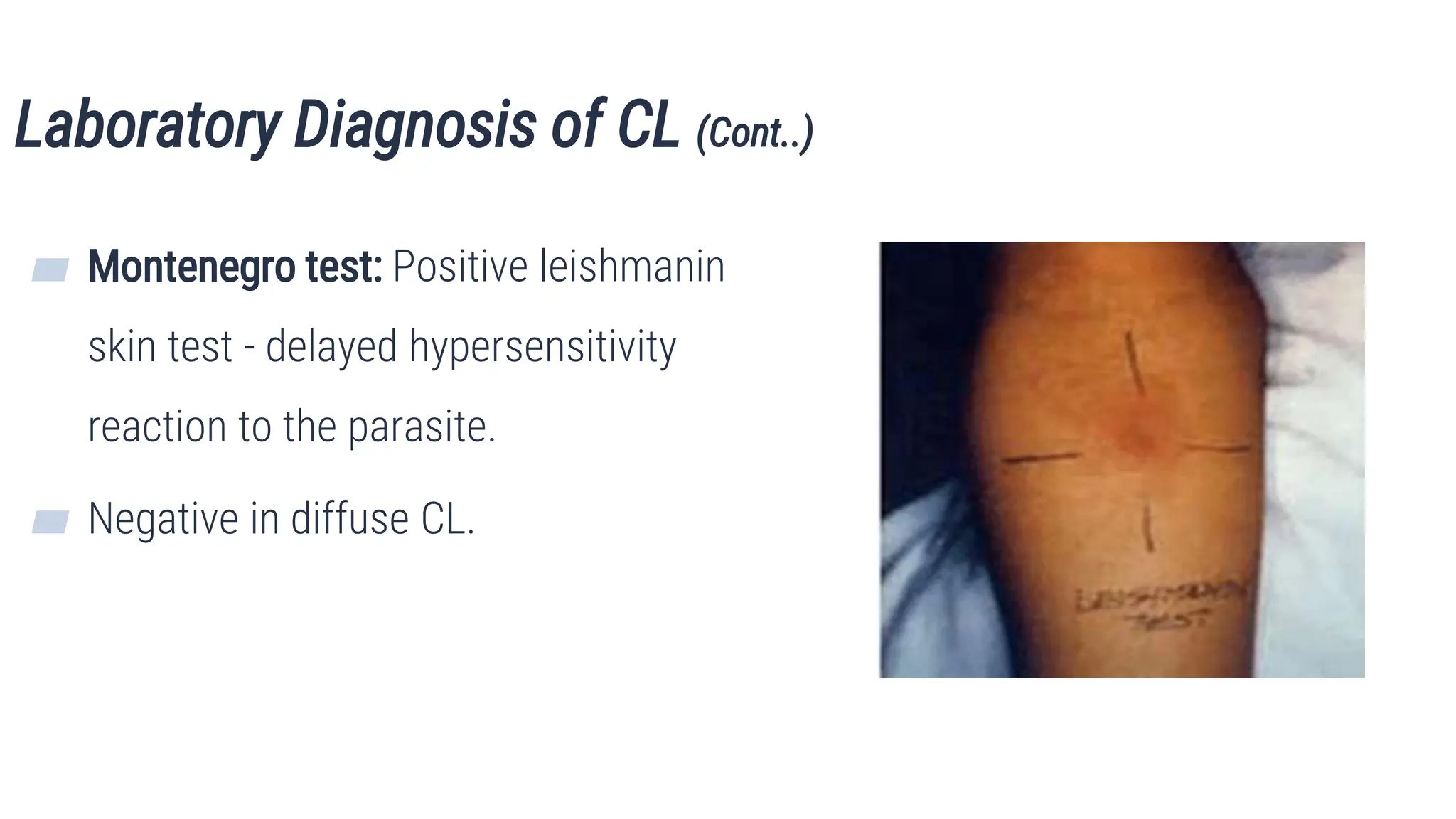
▰ Montenegro test: Positive leishmanin
skin test - delayed hypersensitivity
reaction to the parasite.
▰ Negative in diffuse CL.
Treatment of Cutaneous Leishmaniasis (Old
World)
20
▰ Local therapy - usually recommended. Options available are:
 (i) paromomycin (15%) or methyl benzethonium (12%) ointment - 20 days
 (ii) intralesional antimonials
 (iii) cryotherapy
 (iv) thermotherapy.
Treatment of Cutaneous Leishmaniasis (Old
World) (Cont..)
21
▰ Systemic therapy: Only for disfiguring or scarring lesions.
 L. major—(i) fluconazole for 6 weeks, (ii) pentavalent antimonials with or
without pentoxifylline for 10–20 days
 L. tropica—pentavalent antimonials for 10–20 days. In LR cases -
combined with oral allopurinol
 L. aethiopica—pentavalent antimonials + paramomycin for 60 days or
longer.
New World Cutaneous Leishmaniasis
22
▰ Mainly caused by:
 Leishmania Leishmania (L.L.) mexicana complex
 Leishmania Viannia (L.V.) braziliensis complex
 Leishmania Leishmania (L.L.) chagasi - Causes atypical CL and American
VL.
New World Cutaneous Leishmaniasis (Cont..)
23
▰ Morphology and life cycle - identical to L.
donovani, except:
▰ Vector: Lutzomyia species
▰ Reservoir of infection: Dogs, foxes (zoonotic)
▰ Amastigote forms - reside in reticuloendothelial
cells of skin and mucous membrane (do not
invade viscera).
Leishmania Leishmania mexicana complex and
Leishmania Viannia braziliensis complex
24
Leishmania Leishmania mexicana complex Leishmania Viannia braziliensis complex
Species Geographical
distribution
Clinical syndrome Species Geographical
distribution
Clinical syndrome
L. L. mexicana Central America
and
northern parts of
South
America (the
Amazon
basin)
CL (chiclero ulcer)
DCL
L. V. braziliensis Brazil CL, MCL (espundia),
LR (rare)
L. L. amazonensis CL, DCL and VL
(rare)
L. V. panamensis Panama,
Colombia
CL, MCL
L. L. venezuelensis
L. L.garnhami
CL L.V. guyanensis Guyana CL(forest yaws),
MCL
L. L. pifanoi CL, DCL L. V. peruviana Peru CL(Uta), MCL
Reservoir: Forest rodents, marsupial and humans Reservoir: Dogs, foxes, forest rodents and humans
Vector: Lutzomyia species and Transmission: Zoonotic (for both complexes)
Chiclero ulcer
25
▰ L. mexicana causes - specific form of CL - chiclero
ulcer (or bay sore).
▰ Characterized by persistent ulcerations in pinna.
▰ Seen in Central America - workers living in forests
harvesting chicle plants to collect chewing gum
latex.
Espundia (mucocutaneous leishmaniasis or MCL)
26
▰ L. braziliensis infects mucous membrane of the nose, oral
cavity, pharynx or larynx.
▰ Presents months to years after the CL.
▰ Ulcerative lesions - formed with erosion of the soft tissue and
the cartilages - loss of lips, soft part of nose and soft palate
▰ Gradually, the nasal septum - destroyed, resulting in nasal
collapse with hypertrophy of upper lip and nose leading to
development of “tapir nose”.
Treatment New World cutaneous leishmaniasis
(Cont..)
27
▰ The regimen for systemic therapy depends upon - causative agent.
 L. mexicana: Ketoconazole or miltefosine for 28 days
 L. guyanensis and L. panamensis: Pentamidine or pentavalent antimonials
or miltefosine for 28 days
 L. braziliensis: Pentavalent antimonials for 20 days; or amphotericin B
Treatment New World cutaneous leishmaniasis
(Cont..)
28
 L. amazonensis, L. peruviana and L. venezuelensis: Pentavalent
antimonials for 20 days
 Relapse treatment: Amphotericin B or pentavalent antimonials + topical
imiquimod.
Treatment New World cutaneous leishmaniasis
(Cont..)
29
▰ For MCL (all species):
 (i) pentavalent antimonials with or without oral pentoxifylline for 30 days
 (ii) amphotericin B
 (iii) Bolivia - miltefosine - agent of choice.
CUTANEOUS
FILARIASIS 30
CUTANEOUS FILARIASIS
31
▰ Filarial nematodes - Wuchereria and Brugia cause lymphatic filariasis
▰ Many other filarial nematodes - reside in skin and subcutaneous tissue -
several cutaneous manifestations—Loa loa, Onchocerca volvulus, and
Mansonella species.
1.Loa loa
32
▰ Also called - African eye worm.
▰ Cause infection of subcutaneous tissue and eyes.
▰ Infection - restricted to West and Central Africa.
Life Cycle
33
▰ Similar to- W. bancrofti except for the vector - female Chrysops species (deer
flies, or tabanid flies).
▰ Following mosquito bite (during day time) - L3 larvae - transmitted to man and
transform into adult worms - migrate to subcutaneous tissues and eyes
▰ Microfilariae - from gravid female worms migrate to blood - exhibit diurnal
periodicity.
Clinical Features
34
▰ Calabar swellings: Most common form of loiasis
- called fugitive swelling - subcutaneous swelling
developing on the extremities (knee or wrist).
Clinical Features
35
▰ Ocular manifestations - conjunctival
granuloma, edema of the eye lid.
proptosis (bulging)
▰ Complications: Meningoencephalitis,
nephropathy and cardiomyopathy
Laboratory Diagnosis
36
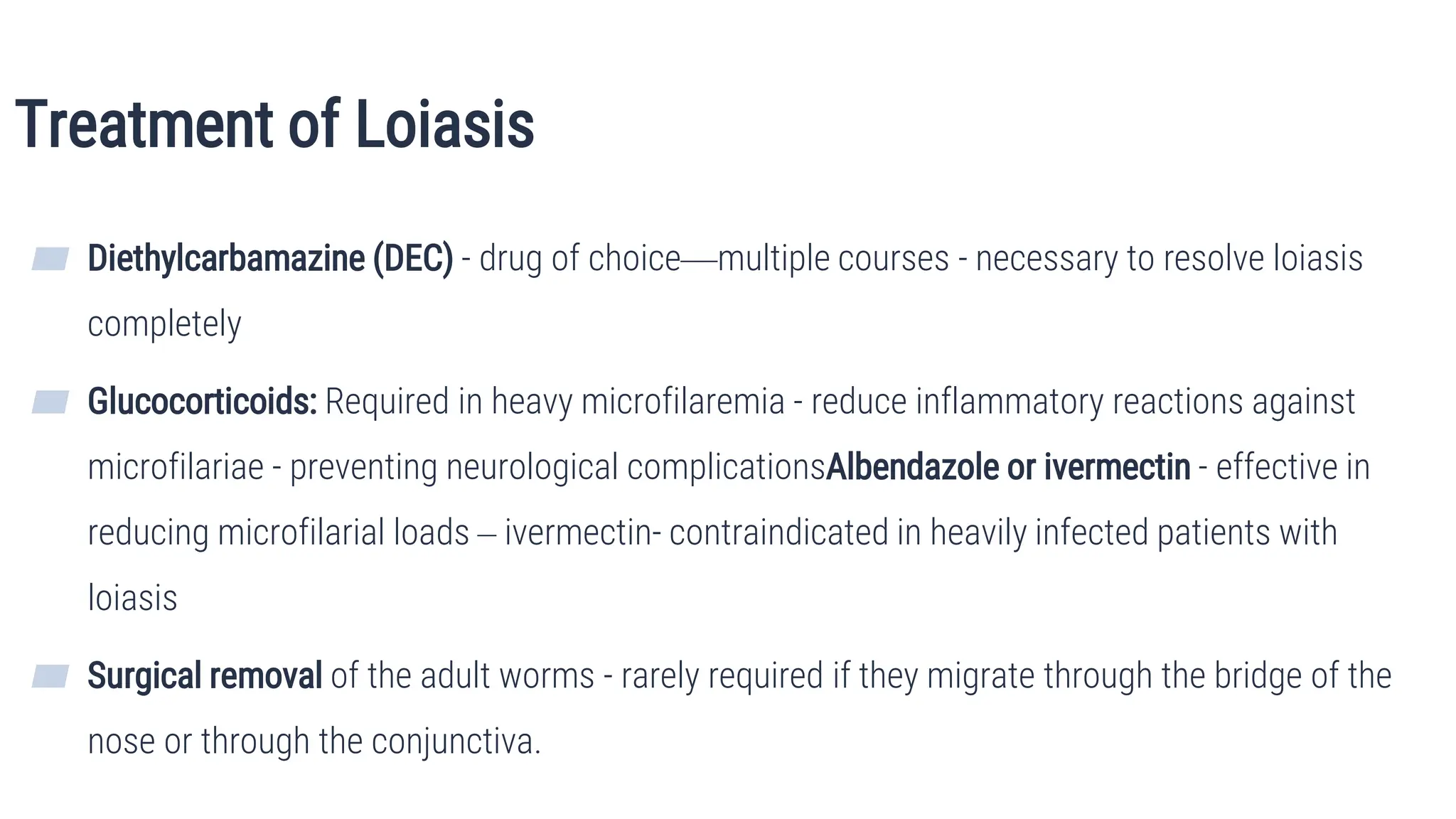
▰ Peripheral blood smear examination reveals -
characteristic microfilariae.
 Microfilaria shows diurnal periodicity - blood
collected in day time between 10 am to 3 pm
 Sheathed, measure 275 (250–300) μm long and
bear a column of nuclei extending till the tail tip
 Adult worms - isolated from the eye or biopsy of
the subcutaneous swelling.
Laboratory Diagnosis (Cont..)
37
▰ Other methods include—
 (1) molecular method - nested PCR-based assays for the detection of specific
DNA, and
 (2) antibody detection: Lateral flow assay (ICT) - detects antibodies to Ll-SXP-
1 antigen.
Treatment of Loiasis
38
▰ Diethylcarbamazine (DEC) - drug of choice—multiple courses - necessary to resolve loiasis
completely
▰ Glucocorticoids: Required in heavy microfilaremia - reduce inflammatory reactions against
microfilariae - preventing neurological complicationsAlbendazole or ivermectin - effective in
reducing microfilarial loads – ivermectin- contraindicated in heavily infected patients with
loiasis
▰ Surgical removal of the adult worms - rarely required if they migrate through the bridge of the
nose or through the conjunctiva.
2.Onchocerca volvulus
39
▰ Causative agent of “river blindness” in man.
▰ Endemic in West Africa and also in South and Central America.
Life Cycle
40
▰ Life cycle - similar to - W. bancrofti, except the vector is Simulium (black flies).
▰ Following the bite of black flies - L3 larvae - transmitted to man and transform
into adult worms - migrate to subcutaneous tissues and eyes
▰ Gravid female worms release microfilariae - migrate to the blood - infective to
the black flies.
Clinical Features
41
▰ Skin (Dermatitis)
 Leopard skin
 Sowda
▰ Onchocercoma
▰ Ocular lesions
▰ Lymphadenopathy
Laboratory Diagnosis
42
Detection of the Parasite:
▰ In a skin snip smear - gold
standard method for diagnosis
of onchocerciasis.
▰ Microfilariae - found either in the
skin (90%) or in the nodules
(10%).
Laboratory Diagnosis (Cont..)
43
▰ Microfilariae: Measure 254 μm long, pointed tail tip without any nuclei -
unsheathed and nonperiodic.
▰ Adult worms - detected from the biopsy of the subcutaneous nodules - less
sensitive
Laboratory Diagnosis (Cont..)
44
▰ Other Methods:
 Serology
 Molecular methods
 Mazzotti skin test
Treatment of Onchocerciasis
45
▰ Ivermectin - drug of choice for onchocerciasis.
▰ Active against the microfilariae but not against the adult worms
▰ Given orally in a single dose of 150 μg/kg - yearly or biannually.
▰ Contraindicated - areas of Africa co-endemic for O. volvulus and L. loa.
▰ Surgical excision - recommended when nodules are located on the head.
3.Mansonella Species
46
▰ Named after Patric Manson.
▰ Rarely infect humans - either nonpathogenic or asymptomatic in most of the
individuals.
Mansonella perstans
47
▰ Transmission: By Culicoides (midges).
▰ Adult worms reside in serous cavities, mesentery and perirenal tissues.
▰ Microfilariae circulate in – blood without periodicity
▰ Clinical features: Nonpathogenic – occasionally cause - angioedema, urticaria,
pruritus and calbar-like swelling - also produces acute periorbital
inflammation - bung-eye or bulge-eye
Mansonella perstans (Cont..)
48
▰ Laboratory diagnosis: Microfilariae in peripheral blood are nonperiodic,
nonsheathed, measures 195 μm long - straight tail and blunt end.
▰ Body nuclei - extended till the tail tip
▰ Treatment: DEC or albendazole.
Mansonella streptocerca
49
▰ Transmission: Biting midges (Culicoides grahami)
▰ Clinical feature: Asymptomatic - some people develop - inguinal
lymphadenopathy, pruritus, dermatitis with hypopigmented macule - no
sensory loss
Mansonella streptocerca (Cont..)
50
▰ Laboratory diagnosis: Detection of the characteristic microfilariae in skin
snips - nonperiodic, nonsheathed, measures 210 μm with a curved tail (looks
like Shepherd’s crook). Nuclei - extended till the blunt tail tip
▰ Treatment: DEC - effective for streptocerciasis.
4.Dirofilaria Species
51
▰ Parasites of lower animals.
▰ Humans - unusual hosts.
▰ Parasite undergoes - incomplete development in humans either in the lungs,
eyes and or subcutaneous tissue, producing various lesions.
▰ Man acquires infection by the bite of mosquito (Aedes, Culex, Anopheles, or
Mansonia) containing L3 filariform larvae.
Prevention of Cutaneous Filariasis
52
▰ Vector control - useful in highly endemic areas.
▰ Insecticide spraying - destroy the breeding sites.
▰ Mass administration of ivermectin every 6–12 months is being used to
interrupt the transmission in endemic areas.
3.DRACUNCULIASIS
53
DRACUNCULIASIS
54
▰ It is a parasitic infection by the somatic nematode - Dracunculus medinensis.
▰ Also called as Guinea worm disease or dracunculiasis, characterized by
cutaneous blisters.
Epidemiology
55
▰ Crippling parasitic disease on the verge of eradication,
▰ Currently endemic to only to 3-4 countries in Sub-Saharan Africa.
▰ About 187 countries including India - already declared free of transmission.
▰ In 2019, only 54 human cases reported in 2019.
Life Cycle
56
57
▰ Signs and symptoms appear - 1 year after the
infection - when gravid adult female worm emerges
near the surface of the skin.
▰ Characterized by painful blister  female worm
emerges  local erythema, fever, nausea and
pruritus.
▰ Most common sites  lower leg, ankle and foot
▰ Secondary bacterial infections may occur at the
blister site.
A B
Pathogenesis and Clinical Features
Laboratory Diagnosis
58
Detection of adult worm:
▰ Possible when the gravid female worms
appear in the blisters.
▰ Calcified adult worms from the deeper
tissue - detected by X-ray
A B
Laboratory Diagnosis (Cont..)
59
▰ Detection of L1 larvae: When the leg with
ulcer is placed in a container with cold water
- large number of motile larvae - discharged
- examined under the microscope
▰ Antibody detection: Antibodies to D.
medinensis - detected by ELISA
▰ Peripheral blood Eosinophilia.
Treatment of Dracunculiasis
60
Worm removal:
▰ Slowly and gently extracted over a period
of 15–20 days using a small stick and
wounding out daily with small traction.
▰ Heavy pressure – avoided because
breaking the worm - lead to allergic
reactions and secondary bacterial
infection.
Treatment of Dracunculiasis (Cont..)
61
Symptomatic treatment:
▰ Application of wet compresses to the affected skin, administration of
analgesics and prevention of secondary bacterial infection by the use of
topical antibiotics.
▰ No anti-helminthic drugs known to be effective against D. medinensis.
Reasons for Eradication from India
62
▰ The national Guinea worm eradication program - launched in 1984 with
technical assistance from World Health Organization (WHO).
▰ Provision of safe drinking water
▰ Cyclops control: Killing copepods in sources of drinking water by application
of abate (temephos) larvicide
Reasons for Eradication from India (Cont..)
63
▰ Provision of clean drinking water from boreholes or wells (was a major source
of infection)
▰ Health education about boiling or filtering of drinking water
▰ Treatment of cases.
4.TRICHINELLOSIS
64
TRICHINELLOSIS
65
▰ Trichinella spiralis causes trichinellosis (or trichinosis) - zoonotic infection
acquired from domestic pigs or other carnivores.
Morphology
66
▰ Like other somatic nematodes, it has an adult worm (1.5– 3 mm long), and
four stages of larvae.
▰ No egg stage.
▰ L1 larva - infective form - forms cysts in muscles.
Life Cycle
67
Larva of Trichinella liberated from bear meat
68
Pathogenicity and Clinical Features
69
▰ Clinical symptoms - depend on the phase of parasitic invasion.
▰ Intestinal stage: Most of the infections – asymptomatic - heavy load of
parasite - provoke watery diarrhea (most common feature) during the first
week after infection.
Pathogenicity and Clinical Features (Cont..)
70
▰ Larval migration: Symptoms appear in the second
week after infection
 Periorbital and facial edema is common
 Hemorrhages in the subconjunctiva, retina and
nail beds (“splinter” hemorrhages)
 Maculopapular rash
 Migration to heart, CNS and lungs - rare.
Pathogenicity and Clinical Features (Cont..)
71
▰ Muscle encystment: Occurs 2–3 weeks after infection.
▰ Common symptoms - myositis with myalgia, muscle edema, and weakness.
▰ Extraocular muscles - common to be involved, followed by biceps, muscles of the jaw, neck,
lower back, and diaphragm.
Laboratory Diagnosis - Demonstration of Larvae
72
▰ Definite diagnosis - demonstration of larvae in muscle biopsy - from
gastrocnemius, deltoid, and biceps.
▰ Direct slide technique: Fresh muscle tissue - compressed between glass
slides and examined under low power microscope
Laboratory Diagnosis - Demonstration of Larvae
(Cont..)
73
▰ Histopathologic examination:
Performed either on fresh muscle
tissues directly or after artificial
digestion of muscle mass by pepsin
Trichinella cysts in the human muscle
biopsy (hemotoxylin and eosin stain).
Laboratory Diagnosis - Antibody Detection
74
▰ ELISA - detecting parasite specific IgG antibody against excretory secretory
antigen of muscle larvae.
▰ Confirms the diagnosis but cannot differentiate past and present infection.
▰ Also cross reacts with other nematodes.
Laboratory Diagnosis - Coproantigen Detection
75
▰ Modified double sandwich ELISA – developed using polyclonal antibodies
raised in rabbit to detect larval somatic antigens in stool.
▰ Detectable from first day of infection up to third week.
Laboratory Diagnosis - Bachman Intradermal Test
76
▰ Intradermal injection of Bachman antigen (prepared from Trichinella larvae) -
immediate induration and erythema.
▰ Becomes positive in 2–3 weeks of infection and persists for life - cannot
differentiate past infection present infection.
Laboratory Diagnosis - Other Tests
77
▰ Blood eosinophilia: Elevated in more than 90% symptomatic patients
▰ Elevated muscle enzymes: Elevated serum creatine phosphokinase
▰ X-ray to detect the calcified muscle cyst.
Treatment of Trichinellosis
78
▰ Mild infection: Symptomatic treatment – with bed rest, antipyretics, and
analgesics.
▰ Moderate infection: Mebendazole and albendazole - active against enteric
stages of the parasite.
▰ Severe infection: Glucocorticoid is added - beneficial for severe myositis and
myocarditis.
Prevention
79
▰ Direct inspection of pork and microscopic examination of small tissue
samples of pig diaphragm before use.
▰ Maintenance of strict standards for freezing, cooking, and curing of pork and
pork products.
▰ All parts of pork muscle tissue - heated to >58.3°C.
▰ Microwaving might not kill the parasite.
5.CUTANEOUS LARVA
MIGRANS 80
Cutaneous larvae migrans
▰ CLM  skin lesions  produced by nematodes of lower animals 
infect man accidently.
▰ Agents
▻ Mainly by nonhuman hookworm species (A. brasiliensis, A.
caninum and A. ceylanicum)
▻ Rarely by strongyloides stercoralis, Ancylostoma duodenale and
Nector americanus.
▰ Another form of larvae migrans occurs called as “visceral larva
migrans”  life cycle arrested when larvae migrate to various
viscera.
Cutaneous larvae migrans
▰ In lower animals: nematodes inf lower animals  larvae into various
organs (intestine) develop in adult worms  lay eggs  cycle
continues
▰ In humans: larvae of lower animal nematodes  accidently infect
man  not able to complete normal development (because of
unsulal host for them)  life cycle get arrested larvae wander 
skin & subcutaneous tissue producing a condition  called
cutaneous larva migrans (CLM) or creeping eruption.
▰ Another form of larvae migrans occurs called as “visceral larva
migrans”  life cycle arrested when larvae migrate to various
viscera.
▰ Clinical Features
▻ Ground itch:- Pruritic maculopapular dermatitis and rashes (ground itch) at the site of skin penetration of
hookworm larvae.
▻ Larva currens:- Migrating strongyloides larvae produce the pathognomic serpiginous urticarial rash called as
larva currens near the legs.
▰ Lab Diagnosis
▻ Larvae are usually not detected in skin biopsy.
▻ PCR
▻ Elevated Eosinophilia in PBS or sputum.
▻ Charcot-leyden crystals in sputum may be seen.
CUTANEOUS LARVA MIGRANS
84
▰ Cutaneous larva migrans - skin lesions produced by nematodes of lower
animals, when they accidentally infect man.
Laboratory Diagnosis
85
▰ Diagnosis - made by clinical feature (presence of the linear tracks) and history
of exposure.
▰ Larvae - not detected in skin biopsy.
▰ PCR - detection of larval DNA in human tissues
▰ Elevated eosinophilia - seen in peripheral blood or sputum - Charcot-Leyden
crystals in sputum.
Treatment of Cutaneous larva migrans
86
▰ Oral and topical thiabendazole is effective
▰ Freezing the advancing end of creeping eruption in ethyl chloride is useful.
PARASITIC AGENTS THAT
RARELY CAUSE SSTI
87
PARASITIC AGENTS THAT RARELY CAUSE SSTI
88
▰ Cutaneous amoebiasis
▰ Acanthamoeba skin lesions
▰ Trypanosoma chancre
▰ Chagoma
▰ Muscular sarcocystosis
PARASITIC AGENTS THAT RARELY CAUSE SSTI
(Cont..)
89
▰ Cysticercosis
▰ Sparganosis
▰ Cercarial dermatitis
▰ Cutaneous paragonimiasis
90

Parasitic Infections of Skin, Soft tissue and musculoskeletal system dr bhavika.pptx

  • 1.
    Parasitic Infections ofSkin, Soft Tissue and Musculoskeletal System Dr Bhavika patel MBBS,MD Microbiology,DIPC Assistant Professor Department of microbiology GMERS MC, Valsad.
  • 2.
    Learning objectives 2 At theend of the session, the students will be able to understand: ▰ Life cycle, pathogenesis, clinical features, lab diagnosis, treatment and prevention of cutaneous leishmaniasis, cutaneous filariasis, Dracunculiasis, trichinellosis, cutaneous larva migrans.
  • 3.
    Parasitic infections ofskin, soft tissue and musculoskeletal system 3 Protozoan infections  Cutaneous leishmaniasis  Cutaneous amoebiasis  Acanthamoeba skin lesions  Trypanosoma chancre and chagoma  Sarcocystosis Cestode infections  Muscular cysticercosis  Sparganosis (Spirometra) Trematode infections  Cercarial dermatitis  Cutaneous paragonimiasis Nematode infections  Cutaneous filariasis  Dracunculiasis  Trichinellosis  Cutaneous larva migrans
  • 4.
    The Major cutaneousparasites ▰ 1. CUTANEOUS LEISHMANIASIS ▰ 2. CUTANEOUS FILARIASIS ▰ 3. DRACUNCULIASIS ▰ 4.TRICHINELLOSIS ▰ 5.CUTANEOUS LARVA MIGRANS 4
  • 5.
    CUTANEOUS LEISHMANIASIS (oriental sore,aleppo avil,Delhiboil,Baghdad sore,Rose of jericho,uta,Espundia,Kala azar,Black fever) 5
  • 6.
    6 a 36-year-old lady,presented with a large disfiguring lesion on her left arm expanding during the last three months. Systemic examination was unremarkable. Examination of her arm showed a 6x6cm erythematous crusted plaque covering her medial aspect of the distal forearm.
  • 7.
    Resolution of theoriginal plaques leaving scar and hyperpigmentation after cryotherapy 7 A B C D
  • 8.
    CUTANEOUS LEISHMANIASIS 8 ▰ CL:Cutaneous leishmaniasis (CL) - most common form of leishmaniasis. ▰ Global annual incidence of 6-10 lakh new cases. ▰ About 95% of CL cases - America, the Mediterranean basin, the Middle East and Central Asia
  • 9.
    CUTANEOUS LEISHMANIASIS (Cont..) 9 ▰MCL: Over 90% of mucocutaneous leishmaniasis (MCL) cases - Bolivia, Brazil, Ethiopia and Peru. ▰ Post kala-azar dermal leishmaniasis (PKDL) - another cutaneous manifestation - occurs few months to years following VL
  • 10.
    10 • L.tropica, • L.aethiopica •L. major Old World Cutaneous Leishmaniasis (CL) • Leishmania Leishmania (L.L.) mexicana complex • Leishmania Viannia (L.V.) braziliensis complex • Leishmania Leishmania (L.L.) chagasi: New World cutaneous leishmaniasis
  • 11.
    Various agents ofcutaneous leishmaniasis 11 Species Geographical distribution Clinicalsyndrome Vector (sandfly) Reservoir Transmission L. L. tropica (Oriental sore) Western India, North Africa, and Middle East CL, LR Phlebotomus sergenti Humans Anthroponotic (human) L. L. aethiopica Ethiopia, Uganda, and Kenya CL, DCL P. longipes Hyraxes Zoonotic L. L. major Middle East, India, China, Africa, Central and Western Asia CL P. papatasi Rodents Zoonotic
  • 12.
    Old World CutaneousLeishmaniasis (CL) 12 ▰ Old world CL is caused by Leishmania tropica complex - comprises of three species—L. tropica, L. aethiopica and L. major.
  • 13.
    Life Cycle 13 Life cycleof the L. tropica complex is same as L. donovani , except that:  Vector: Sandfly, but different species of Phlebotomus.  Habitat: In humans, the amastigote forms reside in reticuloendothelial cells of skin (they do not migrate to viscera).
  • 14.
    Clinical Features 14 ▰ 1.Cutaneousleishmaniasis: Also known as “Oriental sore”, Delhi boil, Aleppo boil and Baghdad Button, etc. ▰ Occurs on face and hands – painless papule, becomes nodular and finally it ulcerates. ▰ Heals spontaneously or - leaves behind disfigurement or scar.
  • 15.
    Clinical Features (Cont..) 15 ▰2.Leishmaniasis recidivans (LR): Granulomatous response producing new lesions - occur years after healing of primary sore due to L. tropica. It is ▰ Characterized by scaly, erythematous papules and nodules - develop in center or periphery of a previously healed sore.
  • 16.
    Clinical Features (Cont..) 16 ▰3.Diffuse cutaneous leishmaniasis (DCL): Caused by L. aethiopica. It is ▰ Characterized by - lack of CMI response to the parasite, resulting in widespread cutaneous lesions ▰ Rare -100 cases have been reported so far - Kenya and Ethiopia ▰ Responds poorly to treatment; disease may last long.
  • 17.
    Laboratory Diagnosis ofCL 17 ▰ Microscopy: Amastigotes - demonstrated from punch biopsies - from the edge of the active lesion and touch preparation (impression smear) stained with Giemsa.
  • 18.
    Laboratory Diagnosis ofCL 18 ▰ Culture: Aspiration from the ulcers - cultured in NNN medium and Schneider’s Drosophila medium - isolation of promastigote forms
  • 19.
    Laboratory Diagnosis ofCL (Cont..) 19 ▰ Montenegro test: Positive leishmanin skin test - delayed hypersensitivity reaction to the parasite. ▰ Negative in diffuse CL.
  • 20.
    Treatment of CutaneousLeishmaniasis (Old World) 20 ▰ Local therapy - usually recommended. Options available are:  (i) paromomycin (15%) or methyl benzethonium (12%) ointment - 20 days  (ii) intralesional antimonials  (iii) cryotherapy  (iv) thermotherapy.
  • 21.
    Treatment of CutaneousLeishmaniasis (Old World) (Cont..) 21 ▰ Systemic therapy: Only for disfiguring or scarring lesions.  L. major—(i) fluconazole for 6 weeks, (ii) pentavalent antimonials with or without pentoxifylline for 10–20 days  L. tropica—pentavalent antimonials for 10–20 days. In LR cases - combined with oral allopurinol  L. aethiopica—pentavalent antimonials + paramomycin for 60 days or longer.
  • 22.
    New World CutaneousLeishmaniasis 22 ▰ Mainly caused by:  Leishmania Leishmania (L.L.) mexicana complex  Leishmania Viannia (L.V.) braziliensis complex  Leishmania Leishmania (L.L.) chagasi - Causes atypical CL and American VL.
  • 23.
    New World CutaneousLeishmaniasis (Cont..) 23 ▰ Morphology and life cycle - identical to L. donovani, except: ▰ Vector: Lutzomyia species ▰ Reservoir of infection: Dogs, foxes (zoonotic) ▰ Amastigote forms - reside in reticuloendothelial cells of skin and mucous membrane (do not invade viscera).
  • 24.
    Leishmania Leishmania mexicanacomplex and Leishmania Viannia braziliensis complex 24 Leishmania Leishmania mexicana complex Leishmania Viannia braziliensis complex Species Geographical distribution Clinical syndrome Species Geographical distribution Clinical syndrome L. L. mexicana Central America and northern parts of South America (the Amazon basin) CL (chiclero ulcer) DCL L. V. braziliensis Brazil CL, MCL (espundia), LR (rare) L. L. amazonensis CL, DCL and VL (rare) L. V. panamensis Panama, Colombia CL, MCL L. L. venezuelensis L. L.garnhami CL L.V. guyanensis Guyana CL(forest yaws), MCL L. L. pifanoi CL, DCL L. V. peruviana Peru CL(Uta), MCL Reservoir: Forest rodents, marsupial and humans Reservoir: Dogs, foxes, forest rodents and humans Vector: Lutzomyia species and Transmission: Zoonotic (for both complexes)
  • 25.
    Chiclero ulcer 25 ▰ L.mexicana causes - specific form of CL - chiclero ulcer (or bay sore). ▰ Characterized by persistent ulcerations in pinna. ▰ Seen in Central America - workers living in forests harvesting chicle plants to collect chewing gum latex.
  • 26.
    Espundia (mucocutaneous leishmaniasisor MCL) 26 ▰ L. braziliensis infects mucous membrane of the nose, oral cavity, pharynx or larynx. ▰ Presents months to years after the CL. ▰ Ulcerative lesions - formed with erosion of the soft tissue and the cartilages - loss of lips, soft part of nose and soft palate ▰ Gradually, the nasal septum - destroyed, resulting in nasal collapse with hypertrophy of upper lip and nose leading to development of “tapir nose”.
  • 27.
    Treatment New Worldcutaneous leishmaniasis (Cont..) 27 ▰ The regimen for systemic therapy depends upon - causative agent.  L. mexicana: Ketoconazole or miltefosine for 28 days  L. guyanensis and L. panamensis: Pentamidine or pentavalent antimonials or miltefosine for 28 days  L. braziliensis: Pentavalent antimonials for 20 days; or amphotericin B
  • 28.
    Treatment New Worldcutaneous leishmaniasis (Cont..) 28  L. amazonensis, L. peruviana and L. venezuelensis: Pentavalent antimonials for 20 days  Relapse treatment: Amphotericin B or pentavalent antimonials + topical imiquimod.
  • 29.
    Treatment New Worldcutaneous leishmaniasis (Cont..) 29 ▰ For MCL (all species):  (i) pentavalent antimonials with or without oral pentoxifylline for 30 days  (ii) amphotericin B  (iii) Bolivia - miltefosine - agent of choice.
  • 30.
  • 31.
    CUTANEOUS FILARIASIS 31 ▰ Filarialnematodes - Wuchereria and Brugia cause lymphatic filariasis ▰ Many other filarial nematodes - reside in skin and subcutaneous tissue - several cutaneous manifestations—Loa loa, Onchocerca volvulus, and Mansonella species.
  • 32.
    1.Loa loa 32 ▰ Alsocalled - African eye worm. ▰ Cause infection of subcutaneous tissue and eyes. ▰ Infection - restricted to West and Central Africa.
  • 33.
    Life Cycle 33 ▰ Similarto- W. bancrofti except for the vector - female Chrysops species (deer flies, or tabanid flies). ▰ Following mosquito bite (during day time) - L3 larvae - transmitted to man and transform into adult worms - migrate to subcutaneous tissues and eyes ▰ Microfilariae - from gravid female worms migrate to blood - exhibit diurnal periodicity.
  • 34.
    Clinical Features 34 ▰ Calabarswellings: Most common form of loiasis - called fugitive swelling - subcutaneous swelling developing on the extremities (knee or wrist).
  • 35.
    Clinical Features 35 ▰ Ocularmanifestations - conjunctival granuloma, edema of the eye lid. proptosis (bulging) ▰ Complications: Meningoencephalitis, nephropathy and cardiomyopathy
  • 36.
    Laboratory Diagnosis 36 ▰ Peripheralblood smear examination reveals - characteristic microfilariae.  Microfilaria shows diurnal periodicity - blood collected in day time between 10 am to 3 pm  Sheathed, measure 275 (250–300) μm long and bear a column of nuclei extending till the tail tip  Adult worms - isolated from the eye or biopsy of the subcutaneous swelling.
  • 37.
    Laboratory Diagnosis (Cont..) 37 ▰Other methods include—  (1) molecular method - nested PCR-based assays for the detection of specific DNA, and  (2) antibody detection: Lateral flow assay (ICT) - detects antibodies to Ll-SXP- 1 antigen.
  • 38.
    Treatment of Loiasis 38 ▰Diethylcarbamazine (DEC) - drug of choice—multiple courses - necessary to resolve loiasis completely ▰ Glucocorticoids: Required in heavy microfilaremia - reduce inflammatory reactions against microfilariae - preventing neurological complicationsAlbendazole or ivermectin - effective in reducing microfilarial loads – ivermectin- contraindicated in heavily infected patients with loiasis ▰ Surgical removal of the adult worms - rarely required if they migrate through the bridge of the nose or through the conjunctiva.
  • 39.
    2.Onchocerca volvulus 39 ▰ Causativeagent of “river blindness” in man. ▰ Endemic in West Africa and also in South and Central America.
  • 40.
    Life Cycle 40 ▰ Lifecycle - similar to - W. bancrofti, except the vector is Simulium (black flies). ▰ Following the bite of black flies - L3 larvae - transmitted to man and transform into adult worms - migrate to subcutaneous tissues and eyes ▰ Gravid female worms release microfilariae - migrate to the blood - infective to the black flies.
  • 41.
    Clinical Features 41 ▰ Skin(Dermatitis)  Leopard skin  Sowda ▰ Onchocercoma ▰ Ocular lesions ▰ Lymphadenopathy
  • 42.
    Laboratory Diagnosis 42 Detection ofthe Parasite: ▰ In a skin snip smear - gold standard method for diagnosis of onchocerciasis. ▰ Microfilariae - found either in the skin (90%) or in the nodules (10%).
  • 43.
    Laboratory Diagnosis (Cont..) 43 ▰Microfilariae: Measure 254 μm long, pointed tail tip without any nuclei - unsheathed and nonperiodic. ▰ Adult worms - detected from the biopsy of the subcutaneous nodules - less sensitive
  • 44.
    Laboratory Diagnosis (Cont..) 44 ▰Other Methods:  Serology  Molecular methods  Mazzotti skin test
  • 45.
    Treatment of Onchocerciasis 45 ▰Ivermectin - drug of choice for onchocerciasis. ▰ Active against the microfilariae but not against the adult worms ▰ Given orally in a single dose of 150 μg/kg - yearly or biannually. ▰ Contraindicated - areas of Africa co-endemic for O. volvulus and L. loa. ▰ Surgical excision - recommended when nodules are located on the head.
  • 46.
    3.Mansonella Species 46 ▰ Namedafter Patric Manson. ▰ Rarely infect humans - either nonpathogenic or asymptomatic in most of the individuals.
  • 47.
    Mansonella perstans 47 ▰ Transmission:By Culicoides (midges). ▰ Adult worms reside in serous cavities, mesentery and perirenal tissues. ▰ Microfilariae circulate in – blood without periodicity ▰ Clinical features: Nonpathogenic – occasionally cause - angioedema, urticaria, pruritus and calbar-like swelling - also produces acute periorbital inflammation - bung-eye or bulge-eye
  • 48.
    Mansonella perstans (Cont..) 48 ▰Laboratory diagnosis: Microfilariae in peripheral blood are nonperiodic, nonsheathed, measures 195 μm long - straight tail and blunt end. ▰ Body nuclei - extended till the tail tip ▰ Treatment: DEC or albendazole.
  • 49.
    Mansonella streptocerca 49 ▰ Transmission:Biting midges (Culicoides grahami) ▰ Clinical feature: Asymptomatic - some people develop - inguinal lymphadenopathy, pruritus, dermatitis with hypopigmented macule - no sensory loss
  • 50.
    Mansonella streptocerca (Cont..) 50 ▰Laboratory diagnosis: Detection of the characteristic microfilariae in skin snips - nonperiodic, nonsheathed, measures 210 μm with a curved tail (looks like Shepherd’s crook). Nuclei - extended till the blunt tail tip ▰ Treatment: DEC - effective for streptocerciasis.
  • 51.
    4.Dirofilaria Species 51 ▰ Parasitesof lower animals. ▰ Humans - unusual hosts. ▰ Parasite undergoes - incomplete development in humans either in the lungs, eyes and or subcutaneous tissue, producing various lesions. ▰ Man acquires infection by the bite of mosquito (Aedes, Culex, Anopheles, or Mansonia) containing L3 filariform larvae.
  • 52.
    Prevention of CutaneousFilariasis 52 ▰ Vector control - useful in highly endemic areas. ▰ Insecticide spraying - destroy the breeding sites. ▰ Mass administration of ivermectin every 6–12 months is being used to interrupt the transmission in endemic areas.
  • 53.
  • 54.
    DRACUNCULIASIS 54 ▰ It isa parasitic infection by the somatic nematode - Dracunculus medinensis. ▰ Also called as Guinea worm disease or dracunculiasis, characterized by cutaneous blisters.
  • 55.
    Epidemiology 55 ▰ Crippling parasiticdisease on the verge of eradication, ▰ Currently endemic to only to 3-4 countries in Sub-Saharan Africa. ▰ About 187 countries including India - already declared free of transmission. ▰ In 2019, only 54 human cases reported in 2019.
  • 56.
  • 57.
    57 ▰ Signs andsymptoms appear - 1 year after the infection - when gravid adult female worm emerges near the surface of the skin. ▰ Characterized by painful blister  female worm emerges  local erythema, fever, nausea and pruritus. ▰ Most common sites  lower leg, ankle and foot ▰ Secondary bacterial infections may occur at the blister site. A B Pathogenesis and Clinical Features
  • 58.
    Laboratory Diagnosis 58 Detection ofadult worm: ▰ Possible when the gravid female worms appear in the blisters. ▰ Calcified adult worms from the deeper tissue - detected by X-ray A B
  • 59.
    Laboratory Diagnosis (Cont..) 59 ▰Detection of L1 larvae: When the leg with ulcer is placed in a container with cold water - large number of motile larvae - discharged - examined under the microscope ▰ Antibody detection: Antibodies to D. medinensis - detected by ELISA ▰ Peripheral blood Eosinophilia.
  • 60.
    Treatment of Dracunculiasis 60 Wormremoval: ▰ Slowly and gently extracted over a period of 15–20 days using a small stick and wounding out daily with small traction. ▰ Heavy pressure – avoided because breaking the worm - lead to allergic reactions and secondary bacterial infection.
  • 61.
    Treatment of Dracunculiasis(Cont..) 61 Symptomatic treatment: ▰ Application of wet compresses to the affected skin, administration of analgesics and prevention of secondary bacterial infection by the use of topical antibiotics. ▰ No anti-helminthic drugs known to be effective against D. medinensis.
  • 62.
    Reasons for Eradicationfrom India 62 ▰ The national Guinea worm eradication program - launched in 1984 with technical assistance from World Health Organization (WHO). ▰ Provision of safe drinking water ▰ Cyclops control: Killing copepods in sources of drinking water by application of abate (temephos) larvicide
  • 63.
    Reasons for Eradicationfrom India (Cont..) 63 ▰ Provision of clean drinking water from boreholes or wells (was a major source of infection) ▰ Health education about boiling or filtering of drinking water ▰ Treatment of cases.
  • 64.
  • 65.
    TRICHINELLOSIS 65 ▰ Trichinella spiraliscauses trichinellosis (or trichinosis) - zoonotic infection acquired from domestic pigs or other carnivores.
  • 66.
    Morphology 66 ▰ Like othersomatic nematodes, it has an adult worm (1.5– 3 mm long), and four stages of larvae. ▰ No egg stage. ▰ L1 larva - infective form - forms cysts in muscles.
  • 67.
  • 68.
    Larva of Trichinellaliberated from bear meat 68
  • 69.
    Pathogenicity and ClinicalFeatures 69 ▰ Clinical symptoms - depend on the phase of parasitic invasion. ▰ Intestinal stage: Most of the infections – asymptomatic - heavy load of parasite - provoke watery diarrhea (most common feature) during the first week after infection.
  • 70.
    Pathogenicity and ClinicalFeatures (Cont..) 70 ▰ Larval migration: Symptoms appear in the second week after infection  Periorbital and facial edema is common  Hemorrhages in the subconjunctiva, retina and nail beds (“splinter” hemorrhages)  Maculopapular rash  Migration to heart, CNS and lungs - rare.
  • 71.
    Pathogenicity and ClinicalFeatures (Cont..) 71 ▰ Muscle encystment: Occurs 2–3 weeks after infection. ▰ Common symptoms - myositis with myalgia, muscle edema, and weakness. ▰ Extraocular muscles - common to be involved, followed by biceps, muscles of the jaw, neck, lower back, and diaphragm.
  • 72.
    Laboratory Diagnosis -Demonstration of Larvae 72 ▰ Definite diagnosis - demonstration of larvae in muscle biopsy - from gastrocnemius, deltoid, and biceps. ▰ Direct slide technique: Fresh muscle tissue - compressed between glass slides and examined under low power microscope
  • 73.
    Laboratory Diagnosis -Demonstration of Larvae (Cont..) 73 ▰ Histopathologic examination: Performed either on fresh muscle tissues directly or after artificial digestion of muscle mass by pepsin Trichinella cysts in the human muscle biopsy (hemotoxylin and eosin stain).
  • 74.
    Laboratory Diagnosis -Antibody Detection 74 ▰ ELISA - detecting parasite specific IgG antibody against excretory secretory antigen of muscle larvae. ▰ Confirms the diagnosis but cannot differentiate past and present infection. ▰ Also cross reacts with other nematodes.
  • 75.
    Laboratory Diagnosis -Coproantigen Detection 75 ▰ Modified double sandwich ELISA – developed using polyclonal antibodies raised in rabbit to detect larval somatic antigens in stool. ▰ Detectable from first day of infection up to third week.
  • 76.
    Laboratory Diagnosis -Bachman Intradermal Test 76 ▰ Intradermal injection of Bachman antigen (prepared from Trichinella larvae) - immediate induration and erythema. ▰ Becomes positive in 2–3 weeks of infection and persists for life - cannot differentiate past infection present infection.
  • 77.
    Laboratory Diagnosis -Other Tests 77 ▰ Blood eosinophilia: Elevated in more than 90% symptomatic patients ▰ Elevated muscle enzymes: Elevated serum creatine phosphokinase ▰ X-ray to detect the calcified muscle cyst.
  • 78.
    Treatment of Trichinellosis 78 ▰Mild infection: Symptomatic treatment – with bed rest, antipyretics, and analgesics. ▰ Moderate infection: Mebendazole and albendazole - active against enteric stages of the parasite. ▰ Severe infection: Glucocorticoid is added - beneficial for severe myositis and myocarditis.
  • 79.
    Prevention 79 ▰ Direct inspectionof pork and microscopic examination of small tissue samples of pig diaphragm before use. ▰ Maintenance of strict standards for freezing, cooking, and curing of pork and pork products. ▰ All parts of pork muscle tissue - heated to >58.3°C. ▰ Microwaving might not kill the parasite.
  • 80.
  • 81.
    Cutaneous larvae migrans ▰CLM  skin lesions  produced by nematodes of lower animals  infect man accidently. ▰ Agents ▻ Mainly by nonhuman hookworm species (A. brasiliensis, A. caninum and A. ceylanicum) ▻ Rarely by strongyloides stercoralis, Ancylostoma duodenale and Nector americanus. ▰ Another form of larvae migrans occurs called as “visceral larva migrans”  life cycle arrested when larvae migrate to various viscera.
  • 82.
    Cutaneous larvae migrans ▰In lower animals: nematodes inf lower animals  larvae into various organs (intestine) develop in adult worms  lay eggs  cycle continues ▰ In humans: larvae of lower animal nematodes  accidently infect man  not able to complete normal development (because of unsulal host for them)  life cycle get arrested larvae wander  skin & subcutaneous tissue producing a condition  called cutaneous larva migrans (CLM) or creeping eruption. ▰ Another form of larvae migrans occurs called as “visceral larva migrans”  life cycle arrested when larvae migrate to various viscera.
  • 83.
    ▰ Clinical Features ▻Ground itch:- Pruritic maculopapular dermatitis and rashes (ground itch) at the site of skin penetration of hookworm larvae. ▻ Larva currens:- Migrating strongyloides larvae produce the pathognomic serpiginous urticarial rash called as larva currens near the legs. ▰ Lab Diagnosis ▻ Larvae are usually not detected in skin biopsy. ▻ PCR ▻ Elevated Eosinophilia in PBS or sputum. ▻ Charcot-leyden crystals in sputum may be seen.
  • 84.
    CUTANEOUS LARVA MIGRANS 84 ▰Cutaneous larva migrans - skin lesions produced by nematodes of lower animals, when they accidentally infect man.
  • 85.
    Laboratory Diagnosis 85 ▰ Diagnosis- made by clinical feature (presence of the linear tracks) and history of exposure. ▰ Larvae - not detected in skin biopsy. ▰ PCR - detection of larval DNA in human tissues ▰ Elevated eosinophilia - seen in peripheral blood or sputum - Charcot-Leyden crystals in sputum.
  • 86.
    Treatment of Cutaneouslarva migrans 86 ▰ Oral and topical thiabendazole is effective ▰ Freezing the advancing end of creeping eruption in ethyl chloride is useful.
  • 87.
  • 88.
    PARASITIC AGENTS THATRARELY CAUSE SSTI 88 ▰ Cutaneous amoebiasis ▰ Acanthamoeba skin lesions ▰ Trypanosoma chancre ▰ Chagoma ▰ Muscular sarcocystosis
  • 89.
    PARASITIC AGENTS THATRARELY CAUSE SSTI (Cont..) 89 ▰ Cysticercosis ▰ Sparganosis ▰ Cercarial dermatitis ▰ Cutaneous paragonimiasis
  • 90.

Editor's Notes

  • #4 A number of parasites can cause skin and soft tissue infections (SSTIs) and musculoskeletal infections (MSIs).The major cutaneous parasites are discussed first, followed by the agents that rarely cause SSTI-MSI
  • #7 Ref:Kuwait (Copy Right, IJAR, 2022,ISSN: 2320-5407,Int. J. Adv. Res. 10(06), 503-509)
  • #8 social stigma
  • #11 Vary from each other in - geographical distribution, reservoir (human or animal) and species of sandfly vector involved in transmission and the type of cutaneous lesions produced.
  • #28 In contrast to Old World CL - systemic therapy – recommended for New World CL - as lesions are more chronic, multiple and have tendency for mucosal involvement. Local therapy - given in addition - agents used for treatment - same as used for Old World CL
  • #30 Case: for india ,any adult age group/lesion/biopsy/ amatigotes form is observed
  • #42 Onchocercoma:formation of subcutaneous nodules, tend to develop on head, neck and shoulders Ocular lesion:- bilateral blindness (river blindness), photophobia, keratitis Lymphadenopathy:the inguinal and femoral areas is commonly noted. The enlarged nodes may hang down (“hanging groin”) and may predispose to hernia.
  • #43 This picture demonstrates how the skin snip is done. The skin is prepared with an antiseptic and then a fold is squeezed between the physicians' thumb and forefinger. A tiny slice of skin is then removed.
  • #45  Topical application of DEC on the skin leads to local reaction (erythema and itching) to the dead worm. It is also called as DEC patch test
  • #57 Lesion that are commonly found in lower limb region because that came frequently in contact with water