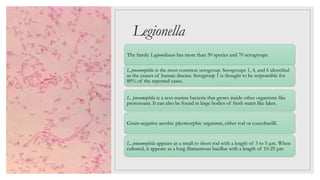
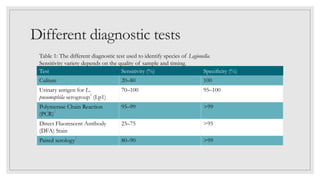
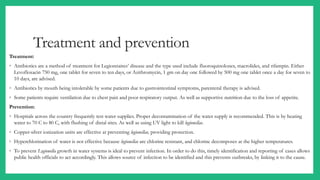
Legionnaires' disease is caused by Legionella bacteria, which can cause pneumonia. The bacteria infects the lungs by entering respiratory cells and inhibiting normal acidification, allowing proliferation. This causes inflammation and cell death, recruiting neutrophils and depositing fibrin in the lungs. L. pneumophila is the most common cause, found in water sources. It was first identified after an outbreak in 1976 infected 182 people and killed 29. Symptoms include fever, cough, and muscle aches. Diagnosis involves urine or sputum tests. Treatment uses antibiotics like fluoroquinolones or azithromycin. Prevention focuses on proper water system maintenance to eliminate bacterial growth.





![PERI-PROSTHETIC FRACTURE NAIL-PLATE CONSTRUCT [NPC].pptx](https://cdn.slidesharecdn.com/ss_thumbnails/drarunkumardrmohamedashrafperiprostheticfrasturenail-plateconstructnpc-260209164459-7e9d15a1-thumbnail.jpg?width=640&height=640&fit=bounds)


![CTEV [ clubfoot] DR ARUN LAL ,DR MOHAMED ASHRAF travancore medical college k...](https://cdn.slidesharecdn.com/ss_thumbnails/ctevclubfootdrarunlaldrmohamedashraftravancoremedicalcollegekollamkeralaindia-260208063247-18fc466c-thumbnail.jpg?width=640&height=640&fit=bounds)


![ONFH[AVN HIP] -TRIPLE REGIME -A NOVAL SURGICAL CONCEPT .pptx](https://cdn.slidesharecdn.com/ss_thumbnails/onfhavnhip2026koaconcalicutdrgokuldevdrmashraf-260210064517-213ec005-thumbnail.jpg?width=640&height=640&fit=bounds)


