Electric Circuits II
Resonance
1
Dr. Firas Obeidat
Dr. Firas Obeidat – Philadelphia University
2
1
• Parallel Resonance
Table of Contents
Dr. Firas Obeidat – Philadelphia University
3
Parallel Resonance
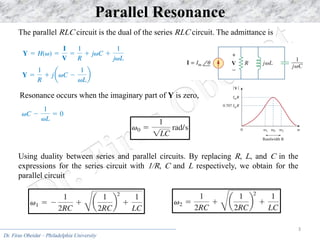
The parallel RLC circuit is the dual of the series RLC circuit. The admittance is
Resonance occurs when the imaginary part of Y is zero,
Using duality between series and parallel circuits. By replacing R, L, and C in the
expressions for the series circuit with 1/R, C and L respectively, we obtain for the
parallel circuit
Dr. Firas Obeidat – Philadelphia University
4
Parallel Resonance
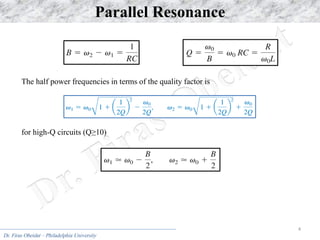
The half power frequencies in terms of the quality factor is
for high-Q circuits (Q≥10)
Dr. Firas Obeidat – Philadelphia University
5
Parallel Resonance
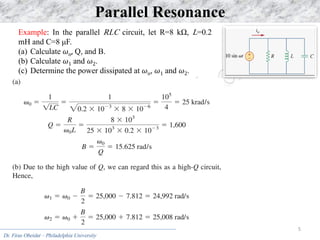
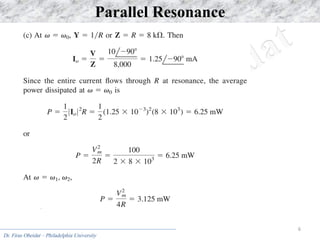
Example: In the parallel RLC circuit, let R=8 kΩ, L=0.2
mH and C=8 μF.
(a) Calculate 𝜔o, Q, and B.
(b) Calculate 𝜔1 and 𝜔2.
(c) Determine the power dissipated at 𝜔o, 𝜔1 and 𝜔2.
Dr. Firas Obeidat – Philadelphia University
6
Parallel Resonance
Dr. Firas Obeidat – Philadelphia University
7
Parallel Resonance
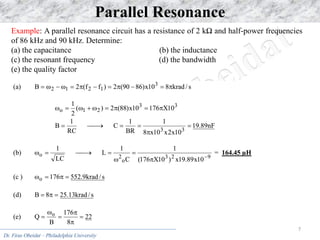
Example: A parallel resonance circuit has a resistance of 2 kΩ and half-power frequencies
of 86 kHz and 90 kHz. Determine:
(a) the capacitance (b) the inductance
(c) the resonant frequency (d) the bandwidth
(e) the quality factor
Dr. Firas Obeidat – Philadelphia University
8
Parallel Resonance
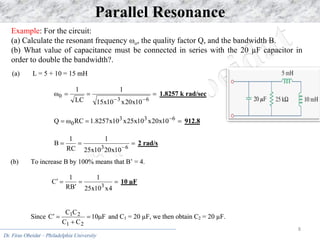
Example: For the circuit:
(a) Calculate the resonant frequency ωo, the quality factor Q, and the bandwidth B.
(b) What value of capacitance must be connected in series with the 20 µF capacitor in
order to double the bandwidth?.
Dr. Firas Obeidat – Philadelphia University
9
Series-Parallel Resonance
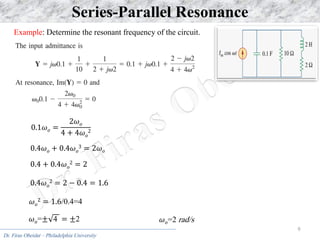
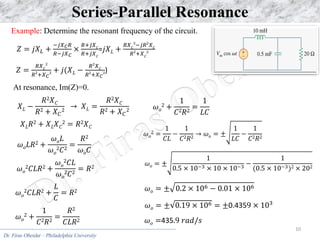
Example: Determine the resonant frequency of the circuit.
0.1𝜔𝑜 =
2𝜔𝑜
4 + 4𝜔𝑜
2
0.4𝜔𝑜 + 0.4𝜔𝑜
3 = 2𝜔𝑜
0.4 + 0.4𝜔𝑜
2 = 2
0.4𝜔𝑜
2 = 2 − 0.4 = 1.6
𝜔𝑜
2 = 1.6/0.4=4
𝜔𝑜=± 4 = ±2 𝜔𝑜=2 rad/s
Dr. Firas Obeidat – Philadelphia University
10
Series-Parallel Resonance
𝑋𝐿𝑅2 + 𝑋𝐿𝑋𝐶
2 = 𝑅2𝑋𝐶
𝜔𝑜𝐿𝑅2 +
𝜔𝑜𝐿
𝜔𝑜
2𝐶2
=
𝑅2
𝜔𝑜𝐶
𝜔𝑜
2𝐶𝐿𝑅2 +
𝜔𝑜
2𝐶𝐿
𝜔𝑜
2𝐶2
= 𝑅2
𝜔𝑜
2𝐶𝐿𝑅2 +
𝐿
𝐶
= 𝑅2
𝜔𝑜
2 +
1
𝐶2𝑅2
=
𝑅2
𝐶𝐿𝑅2
𝜔𝑜
2 +
1
𝐶2𝑅2
=
1
𝐿𝐶
𝜔𝑜
2 =
1
𝐶𝐿
−
1
𝐶2𝑅2
→ 𝜔𝑜 = ±
1
𝐿𝐶
−
1
𝐶2𝑅2
𝜔𝑜 = ±
1
0.5 × 10−3 × 10 × 10−3
−
1
(0.5 × 10⁻³)2 × 202
𝜔𝑜 = ± 0.2 × 10⁶ − 0.01 × 10⁶
𝜔𝑜 = ± 0.19 × 106 = ±0.4359 × 10³
𝜔𝑜 =435.9 𝑟𝑎𝑑/𝑠
Example: Determine the resonant frequency of the circuit.
𝑍 = 𝑗𝑋𝐿 +
−𝑗𝑋𝐶𝑅
𝑅−𝑗𝑋𝐶
×
𝑅+𝑗𝑋𝐶
𝑅+𝑗𝑋𝐶
=𝑗𝑋𝐿 +
𝑅𝑋𝐶
2
−𝑗𝑅2
𝑋𝐶
𝑅2
+𝑋𝐶
2
𝑍 =
𝑅𝑋𝐶
2
𝑅2
+𝑋𝐶
2 + 𝑗(𝑋𝐿 −
𝑅2
𝑋𝐶
𝑅2
+𝑋𝐶
2)
At resonance, Im(Z)=0.
𝑋𝐿 −
𝑅2𝑋𝐶
𝑅2 + 𝑋𝐶
2
→ 𝑋𝐿 =
𝑅2𝑋𝐶
𝑅2 + 𝑋𝐶
2
Dr. Firas Obeidat – Philadelphia University
11
Series-Parallel Resonance
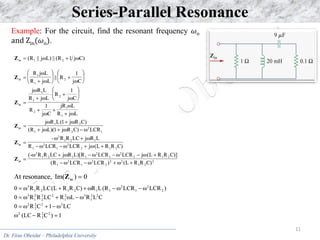
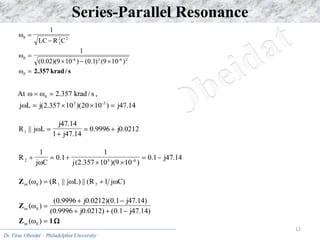
Example: For the circuit, find the resonant frequency 𝜔o
and Zin(𝜔o).
Dr. Firas Obeidat – Philadelphia University
12
Series-Parallel Resonance
Dr. Firas Obeidat – Philadelphia University
13
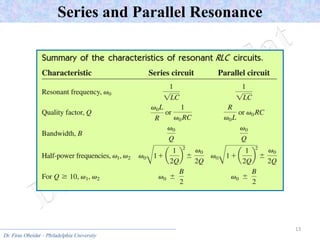
Series and Parallel Resonance
14

Parallel resonance circuits of science.pdf

  • 1.
  • 2.
    Dr. Firas Obeidat– Philadelphia University 2 1 • Parallel Resonance Table of Contents
  • 3.
    Dr. Firas Obeidat– Philadelphia University 3 Parallel Resonance The parallel RLC circuit is the dual of the series RLC circuit. The admittance is Resonance occurs when the imaginary part of Y is zero, Using duality between series and parallel circuits. By replacing R, L, and C in the expressions for the series circuit with 1/R, C and L respectively, we obtain for the parallel circuit
  • 4.
    Dr. Firas Obeidat– Philadelphia University 4 Parallel Resonance The half power frequencies in terms of the quality factor is for high-Q circuits (Q≥10)
  • 5.
    Dr. Firas Obeidat– Philadelphia University 5 Parallel Resonance Example: In the parallel RLC circuit, let R=8 kΩ, L=0.2 mH and C=8 μF. (a) Calculate 𝜔o, Q, and B. (b) Calculate 𝜔1 and 𝜔2. (c) Determine the power dissipated at 𝜔o, 𝜔1 and 𝜔2.
  • 6.
    Dr. Firas Obeidat– Philadelphia University 6 Parallel Resonance
  • 7.
    Dr. Firas Obeidat– Philadelphia University 7 Parallel Resonance Example: A parallel resonance circuit has a resistance of 2 kΩ and half-power frequencies of 86 kHz and 90 kHz. Determine: (a) the capacitance (b) the inductance (c) the resonant frequency (d) the bandwidth (e) the quality factor
  • 8.
    Dr. Firas Obeidat– Philadelphia University 8 Parallel Resonance Example: For the circuit: (a) Calculate the resonant frequency ωo, the quality factor Q, and the bandwidth B. (b) What value of capacitance must be connected in series with the 20 µF capacitor in order to double the bandwidth?.
  • 9.
    Dr. Firas Obeidat– Philadelphia University 9 Series-Parallel Resonance Example: Determine the resonant frequency of the circuit. 0.1𝜔𝑜 = 2𝜔𝑜 4 + 4𝜔𝑜 2 0.4𝜔𝑜 + 0.4𝜔𝑜 3 = 2𝜔𝑜 0.4 + 0.4𝜔𝑜 2 = 2 0.4𝜔𝑜 2 = 2 − 0.4 = 1.6 𝜔𝑜 2 = 1.6/0.4=4 𝜔𝑜=± 4 = ±2 𝜔𝑜=2 rad/s
  • 10.
    Dr. Firas Obeidat– Philadelphia University 10 Series-Parallel Resonance 𝑋𝐿𝑅2 + 𝑋𝐿𝑋𝐶 2 = 𝑅2𝑋𝐶 𝜔𝑜𝐿𝑅2 + 𝜔𝑜𝐿 𝜔𝑜 2𝐶2 = 𝑅2 𝜔𝑜𝐶 𝜔𝑜 2𝐶𝐿𝑅2 + 𝜔𝑜 2𝐶𝐿 𝜔𝑜 2𝐶2 = 𝑅2 𝜔𝑜 2𝐶𝐿𝑅2 + 𝐿 𝐶 = 𝑅2 𝜔𝑜 2 + 1 𝐶2𝑅2 = 𝑅2 𝐶𝐿𝑅2 𝜔𝑜 2 + 1 𝐶2𝑅2 = 1 𝐿𝐶 𝜔𝑜 2 = 1 𝐶𝐿 − 1 𝐶2𝑅2 → 𝜔𝑜 = ± 1 𝐿𝐶 − 1 𝐶2𝑅2 𝜔𝑜 = ± 1 0.5 × 10−3 × 10 × 10−3 − 1 (0.5 × 10⁻³)2 × 202 𝜔𝑜 = ± 0.2 × 10⁶ − 0.01 × 10⁶ 𝜔𝑜 = ± 0.19 × 106 = ±0.4359 × 10³ 𝜔𝑜 =435.9 𝑟𝑎𝑑/𝑠 Example: Determine the resonant frequency of the circuit. 𝑍 = 𝑗𝑋𝐿 + −𝑗𝑋𝐶𝑅 𝑅−𝑗𝑋𝐶 × 𝑅+𝑗𝑋𝐶 𝑅+𝑗𝑋𝐶 =𝑗𝑋𝐿 + 𝑅𝑋𝐶 2 −𝑗𝑅2 𝑋𝐶 𝑅2 +𝑋𝐶 2 𝑍 = 𝑅𝑋𝐶 2 𝑅2 +𝑋𝐶 2 + 𝑗(𝑋𝐿 − 𝑅2 𝑋𝐶 𝑅2 +𝑋𝐶 2) At resonance, Im(Z)=0. 𝑋𝐿 − 𝑅2𝑋𝐶 𝑅2 + 𝑋𝐶 2 → 𝑋𝐿 = 𝑅2𝑋𝐶 𝑅2 + 𝑋𝐶 2
  • 11.
    Dr. Firas Obeidat– Philadelphia University 11 Series-Parallel Resonance Example: For the circuit, find the resonant frequency 𝜔o and Zin(𝜔o).
  • 12.
    Dr. Firas Obeidat– Philadelphia University 12 Series-Parallel Resonance
  • 13.
    Dr. Firas Obeidat– Philadelphia University 13 Series and Parallel Resonance
  • 14.