Resonance
Unit 5
Contents
Series Resonance
Parallel Resonance
Series Resonance
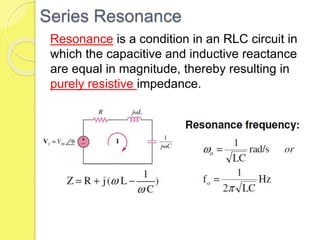
Resonance is a condition in an RLC circuit in
which the capacitive and inductive reactance
are equal in magnitude, thereby resulting in
purely resistive impedance.
Series Resonance
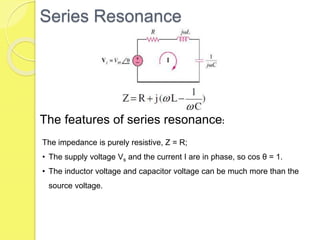
The features of series resonance:
The impedance is purely resistive, Z = R;
• The supply voltage Vs and the current I are in phase, so cos θ = 1.
• The inductor voltage and capacitor voltage can be much more than the
source voltage.
Series Resonance
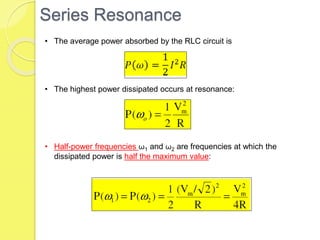
• The average power absorbed by the RLC circuit is
• The highest power dissipated occurs at resonance:
• Half-power frequencies ω1 and ω2 are frequencies at which the
dissipated power is half the maximum value:
Series Resonance
Bandwidth B
Cut-off frequencies
Series Resonance
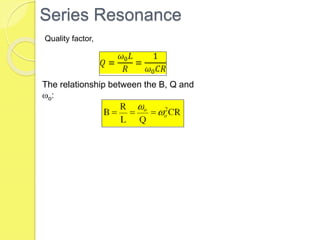
Quality factor,
The relationship between the B, Q and
ωo:
Problem: 1
A series-connected circuit has R = 4 Ω and L = 25 mH.
a) Calculate the value of C that will produce a quality factor of 50.
b) Find ω1, ω2 and B.
c) Determine the average power dissipated at ω= ωo , ω1 and ω2 . Take Vm
=100 V
A circuit consisting of a coil with inductance 10 mH and resistance 20 Ω
is connected in series with a capacitor and a generator with an rms
voltage of 120 V. Find:
(a) the value of the capacitance that will cause the circuit to be in
resonance at 15k Hz
(b) the current through the coil at resonance
(c) the Q of the circuit
Problem: 2
Parallel Resonance
Resonance frequency:
Parallel Resonance
Problem: 3
A parallel RLC resonant circuit has a resistance of 200 Ω. If it is
known that the bandwidth is 80 rad/s and the lower half-power
frequency is 800 rad/sec, Determine the values of the parameters L
and C.
Problem: 4
A certain electronic test circuit produced a resonant curve with half-
power points at 432 Hz and 454 Hz. If Q = 20, what is the resonant
frequency of the circuit?
Problem: 5
Determine the resonant frequency for the circuit shown in Figure.
Problem: 6
A parallel RLC circuit, which is driven by a variable – frequency 2A
current source, has the following values:
R = 1 kΩ, L = 400 mH and C = 10 µF. Determine the,
a) bandwidth of the network;
b) Half – power frequencies; and
c) Voltage across the network at half – power frequencies.
Problem: 7
Given a series circuit with R = 2 Ω, L :: 2 mH, and C = 5 µf, determine
the resonant frequency, the quality factor, and the bandwidth for the
circuit. Then determine the change in Q and the BW if R is changed
from 2 to 0.2 Ω.
Problem: 8
Determine the parameters of a parallel resonant circuit that has the
following propert ies:
ωo = 2 Mrad/ s, BW = 20 rad/s. and an impedance at resonance of
2000 Ω.
Problem: 9
a) Determine the quality factor(Q) and bandwidth(BW) for the
response curve shown below.
b) For C=10.1 nF, determine L and R for the series resonant circuit.
c) Determine the applied voltage.
Problem:
10
A series-tuned antenna circuit of a variable capacitor (40 pF to 360 pF) and a
240 𝜇𝐻 antenna coil that has a dc resistance of 12 Ω.
a) Find the frequency range of radio signals to which the radio is tunable.
b) Determine the value of Q at each end of the frequency range.

Unit 5 - Resonance.pptx

  • 1.
  • 2.
  • 3.
    Series Resonance Resonance isa condition in an RLC circuit in which the capacitive and inductive reactance are equal in magnitude, thereby resulting in purely resistive impedance.
  • 4.
    Series Resonance The featuresof series resonance: The impedance is purely resistive, Z = R; • The supply voltage Vs and the current I are in phase, so cos θ = 1. • The inductor voltage and capacitor voltage can be much more than the source voltage.
  • 5.
    Series Resonance • Theaverage power absorbed by the RLC circuit is • The highest power dissipated occurs at resonance: • Half-power frequencies ω1 and ω2 are frequencies at which the dissipated power is half the maximum value:
  • 6.
  • 7.
    Series Resonance Quality factor, Therelationship between the B, Q and ωo:
  • 8.
    Problem: 1 A series-connectedcircuit has R = 4 Ω and L = 25 mH. a) Calculate the value of C that will produce a quality factor of 50. b) Find ω1, ω2 and B. c) Determine the average power dissipated at ω= ωo , ω1 and ω2 . Take Vm =100 V
  • 9.
    A circuit consistingof a coil with inductance 10 mH and resistance 20 Ω is connected in series with a capacitor and a generator with an rms voltage of 120 V. Find: (a) the value of the capacitance that will cause the circuit to be in resonance at 15k Hz (b) the current through the coil at resonance (c) the Q of the circuit Problem: 2
  • 10.
  • 11.
  • 12.
    Problem: 3 A parallelRLC resonant circuit has a resistance of 200 Ω. If it is known that the bandwidth is 80 rad/s and the lower half-power frequency is 800 rad/sec, Determine the values of the parameters L and C.
  • 13.
    Problem: 4 A certainelectronic test circuit produced a resonant curve with half- power points at 432 Hz and 454 Hz. If Q = 20, what is the resonant frequency of the circuit?
  • 14.
    Problem: 5 Determine theresonant frequency for the circuit shown in Figure.
  • 15.
    Problem: 6 A parallelRLC circuit, which is driven by a variable – frequency 2A current source, has the following values: R = 1 kΩ, L = 400 mH and C = 10 µF. Determine the, a) bandwidth of the network; b) Half – power frequencies; and c) Voltage across the network at half – power frequencies.
  • 16.
    Problem: 7 Given aseries circuit with R = 2 Ω, L :: 2 mH, and C = 5 µf, determine the resonant frequency, the quality factor, and the bandwidth for the circuit. Then determine the change in Q and the BW if R is changed from 2 to 0.2 Ω.
  • 17.
    Problem: 8 Determine theparameters of a parallel resonant circuit that has the following propert ies: ωo = 2 Mrad/ s, BW = 20 rad/s. and an impedance at resonance of 2000 Ω.
  • 18.
    Problem: 9 a) Determinethe quality factor(Q) and bandwidth(BW) for the response curve shown below. b) For C=10.1 nF, determine L and R for the series resonant circuit. c) Determine the applied voltage.
  • 19.
    Problem: 10 A series-tuned antennacircuit of a variable capacitor (40 pF to 360 pF) and a 240 𝜇𝐻 antenna coil that has a dc resistance of 12 Ω. a) Find the frequency range of radio signals to which the radio is tunable. b) Determine the value of Q at each end of the frequency range.