Parallel Patterns for Window-based
Stateful Operators on Data Streams: an
Algorithmic Skeleton Approach
University of Pisa
Italy
Tiziano De Matteis, Gabriele Mencagli
INTRODUCTION
The recent years have been characterized by an explosion of data
streams generated by a variety of sources
Over the Web in 60 seconds we have (2014):
○ 2.6 M searches on Google
○ 430K new tweets
○ 25K purchases on Amazon
○ 290K FB status updates
○ 5M videos views on YouTube
○ ...
Same story for Stock Market Feed, Sensor Networks and much more
Translating this information into decision in real-time has become a
valuable opportunity
DATA STREAM PROCESSING
Data Stream Processing (DaSP): a new paradigm characterized by:
○ unbounded input and no control on how elements (tuples) arrive;
○ stringent performance requirements in terms of throughput and latency.
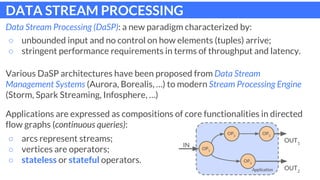
Applications are expressed as compositions of core functionalities in directed
flow graphs (continuous queries):
○ arcs represent streams;
○ vertices are operators;
○ stateless or stateful operators.
Application
OP1
OP2
OP3
OP4
IN
OUT1
OUT2
Various DaSP architectures have been proposed from Data Stream
Management Systems (Aurora, Borealis, …) to modern Stream Processing Engine
(Storm, Spark Streaming, Infosphere, …)
WHAT ABOUT PARALLELISM?
Parallelism in existing SPEs is expressed at different levels:
○ query level: inter-query parallelism;
○ operator level: inter-/intra-operator parallelism.
Stateful operators deserve special attentions from a parallelization p.o.v. but
a methodology for intra-operator parallelism is still lacking.
Goal: show how parallelization issues of DaSP operators can be dealt
with the algorithmic skeletons:
○ it is a well known methodology;
○ simplifies the reasoning on properties of the parallel solution;
○ may be integrated in existing SPE.
WINDOW-BASED OPERATORS
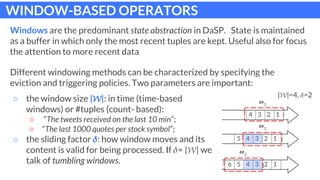
Different windowing methods can be characterized by specifying the
eviction and triggering policies. Two parameters are important:
○ the window size | |: in time (time-based
windows) or #tuples (count- based):
○ “The tweets received on the last 10 min”;
○ “The last 1000 quotes per stock symbol”;
○ the sliding factor : how window moves and its
content is valid for being processed. If = | | we
talk of tumbling windows. 124 36 5
124 3
124 35
| |=4, =2
Windows are the predominant state abstraction in DaSP. State is maintained
as a buffer in which only the most recent tuples are kept. Useful also for focus
the attention to more recent data
1
2
1
Stateful Operator
MULTI-KEYED OPERATORS
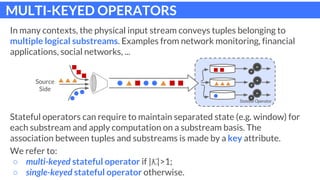
In many contexts, the physical input stream conveys tuples belonging to
multiple logical substreams. Examples from network monitoring, financial
applications, social networks, ...
Stateful operators can require to maintain separated state (e.g. window) for
each substream and apply computation on a substream basis. The
association between tuples and substreams is made by a key attribute.
Source
Side
We refer to:
○ multi-keyed stateful operator if | |>1;
○ single-keyed stateful operator otherwise.
PARALLEL PATTERNS FOR WINDOW OPERATORS
In the following we assume a generic window based stateful operator working
on a single physical input stream and producing one output stream.
Patterns can be categorized in various ways:
○ depending on how compute tasks: window parallel or data parallel
○ on the basis of task distributions: the granularity of the distribution to
the parallel executors (Workers) and the assignment policy, of
windows to the Workers;
○ considering window management: active vs agnostic Workers
A task is a segment of the input stream corresponding to all the tuples belonging
to the same window on which the operator applies a computation .
4 patterns exemplified on count-based windows
WINDOW FARMING
Intuition: each window can be processed independently. We can adopt a
classical farm skeleton, in which full windows are distributed to Workers
E
W1
W2
C
112
1
1
2
123
x
1
3 12
y
1
234
x
2
6 45
y
2 ( x
1
)
( y
2
)
( y
1
)
( x
2
)
( x
1
)( y
1
)
SubStream X
SubStream Y
| |=3, =1
○ Emitter: buffer tuples, update windows and send them to Workers;
○ Workers: receive data, apply , transmit results and discard data. They
are agnostic of the window management;
○ Collector: receive results, (re-order them), forward.
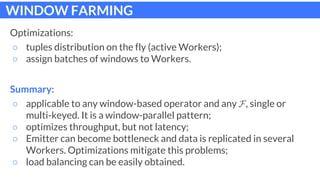
WINDOW FARMING
Optimizations:
○ tuples distribution on the fly (active Workers);
○ assign batches of windows to Workers.
Summary:
○ applicable to any window-based operator and any , single or
multi-keyed. It is a window-parallel pattern;
○ optimizes throughput, but not latency;
○ Emitter can become bottleneck and data is replicated in several
Workers. Optimizations mitigate this problems;
○ load balancing can be easily obtained.
KEY PARTITIONING
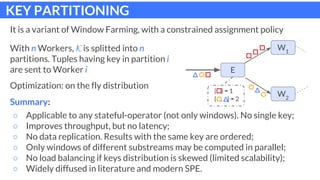
It is a variant of Window Farming, with a constrained assignment policy
With n Workers, is splitted into n
partitions. Tuples having key in partition i
are sent to Worker i E
W1
W2
{ }➛1
{ , }➛2
Optimization: on the fly distribution
Summary:
○ Applicable to any stateful-operator (not only windows). No single key;
○ Improves throughput, but no latency;
○ No data replication. Results with the same key are ordered;
○ Only windows of different substreams may be computed in parallel;
○ No load balancing if keys distribution is skewed (limited scalability);
○ Widely diffused in literature and modern SPE.
PANE FARMING
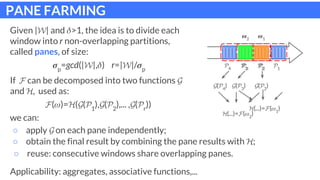
Given | | and >1, the idea is to divide each
window into r non-overlapping partitions,
called panes, of size:
p
=gcd(| |, ) r=| |/ p
1
( 2
) ( 1
)( 3
)
If can be decomposed into two functions
and , used as:
( )= ( ( 1
), ( 2
),... , ( r
))
we can:
○ apply on each pane independently;
(...)= ( 1
)
2
○ obtain the final result by combining the pane results with ;
○ reuse: consecutive windows share overlapping panes.
3 24
( 4
)
(...)= ( 2
)
3 2 1
Applicability: aggregates, associative functions,...
PANE FARMING
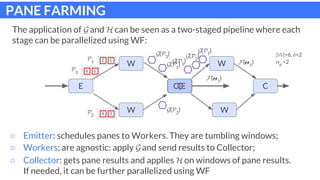
The application of and can be seen as a two-staged pipeline where each
stage can be parallelized using WF:
E
W
W
C
121
32 4
563
| |=6, =2
p
=2
○ Emitter: schedules panes to Workers. They are tumbling windows;
○ Workers: are agnostic: apply and send results to Collector;
○ Collector: gets pane results and applies on windows of pane results.
If needed, it can be further parallelized using WF
( 1
)
( 2
)
( 3
)
( 1
)
C|E
W
W
C
( 1
)
( 2
)
( 3
) ( 1
)
PANE FARMING
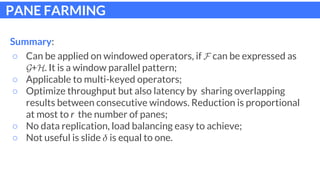
Summary:
○ Can be applied on windowed operators, if can be expressed as
+ . It is a window parallel pattern;
○ Applicable to multi-keyed operators;
○ Optimize throughput but also latency by sharing overlapping
results between consecutive windows. Reduction is proportional
at most to r the number of panes;
○ No data replication, load balancing easy to achieve;
○ Not useful is slide is equal to one.
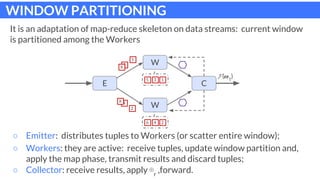
WINDOW PARTITIONING
It is an adaptation of map-reduce skeleton on data streams: current window
is partitioned among the Workers
E
W
W
C
1
2
3
4
135
246
( 1
)
○ Emitter: distributes tuples to Workers (or scatter entire window);
○ Workers: they are active: receive tuples, update window partition and,
apply the map phase, transmit results and discard tuples;
○ Collector: receive results, apply ⊕r
,forward.
X
X
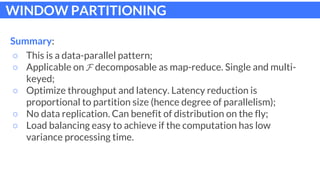
WINDOW PARTITIONING
Summary:
○ This is a data-parallel pattern;
○ Applicable on decomposable as map-reduce. Single and multi-
keyed;
○ Optimize throughput and latency. Latency reduction is
proportional to partition size (hence degree of parallelism);
○ No data replication. Can benefit of distribution on the fly;
○ Load balancing easy to achieve if the computation has low
variance processing time.
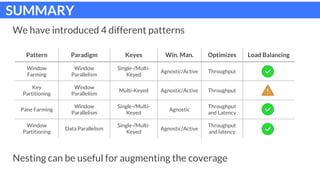
SUMMARY
We have introduced 4 different patterns
Pattern Paradigm Keyes Win. Man. Optimizes Load Balancing
Window
Farming
Window
Parallelism
Single-/Multi-
Keyed
Agnostic/Active Throughput
Key
Partitioning
Window
Parallelism
Multi-Keyed Agnostic/Active Throughput
Pane Farming
Window
Parallelism
Single-/Multi-
Keyed
Agnostic
Throughput
and Latency
Window
Partitioning
Data Parallelism
Single-/Multi-
Keyed
Agnostic/Active
Throughput
and latency
Nesting can be useful for augmenting the coverage
EXPERIMENTS
A prototypal implementation of the 4 patterns have been done in Fastflow, a
C++ framework for skeleton-based parallel patterns:
○ parallel entities have been implemented as pthreads, pinned on cores;
○ they interact through non-blocking lock-free queues
Target architecture: dual CPU Intel Sandy Bridge Xeon E5-2650
16 cores (32 with SMT) running at 2GHz. 32 GB of Ram
In addition to the entities required by the
patterns, we have a Generator and a Consumer
threads. Therefore we can have up to 12
Workers
G C
w
E
w
C
EXPERIMENTS
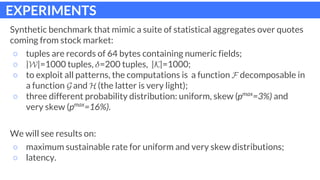
Synthetic benchmark that mimic a suite of statistical aggregates over quotes
coming from stock market:
○ tuples are records of 64 bytes containing numeric fields;
○ | |=1000 tuples, =200 tuples, | |=1000;
○ to exploit all patterns, the computations is a function decomposable in
a function and (the latter is very light);
○ three different probability distribution: uniform, skew (pmax
=3%) and
very skew (pmax
=16%).
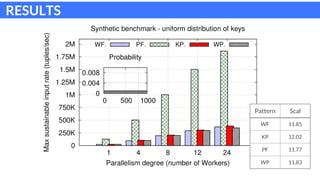
We will see results on:
○ maximum sustainable rate for uniform and very skew distributions;
○ latency.
RESULTS
Pattern Scal
WF 11.85
KP 12.02
PF 11.77
WP 11.83
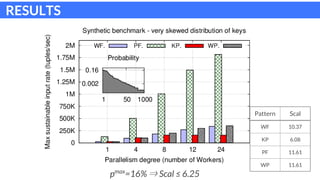
RESULTS
Pattern Scal
WF 10.37
KP 6.08
PF 11.61
WP 11.61
pmax
=16% ⇒ Scal ≤ 6.25
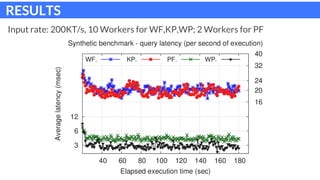
RESULTS
Input rate: 200KT/s, 10 Workers for WF,KP,WP; 2 Workers for PF
CONCLUSIONS
DaSP is a paradigm focusing on real-time processing of flows of data. Intra-
operator parallelism is necessary but still not completely exploited:
○ we have characterized 4 different patterns, that cover a wide variety of
situations;
○ they can be implemented on top of existing skeleton framework or SPE;
○ proof-of-concept implementation in Fastflow.
Extensions:
○ distributed implementation;
○ autonomic management: scaling and load balancing.
Thank you!
Questions?
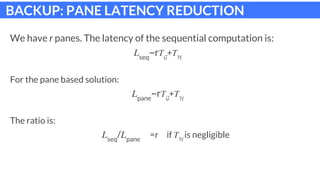
BACKUP: PANE LATENCY REDUCTION
We have r panes. The latency of the sequential computation is:
seq
~r +
For the pane based solution:
pane
~r +
The ratio is:
seq
/ pane
=r if is negligible
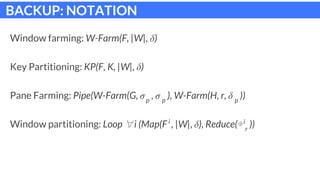
BACKUP: NOTATION
Window farming: W-Farm(F, |W|, δ)
Key Partitioning: KP(F, K, |W|, δ)
Pane Farming: Pipe(W-Farm(G, σp
, σ p
), W-Farm(H, r, δ p
))
Window partitioning: Loop ∀i (Map(Fi
, |W|, δ), Reduce(⊕i
r
))
BACKUP: SKYLINE
Compute the skyline set on tuples received in the last | | units of time. The
skyline set are tuples that are not dominated by any other point in the
window. Implemented with WF. Feedback from Collector for pruning:
Case Scal
Corr 8.16
Indep 10.7
AntiCorr 11.65

Parallel Patterns for Window-based Stateful Operators on Data Streams: an Algorithmic Skeleton Approach

  • 1.
    Parallel Patterns forWindow-based Stateful Operators on Data Streams: an Algorithmic Skeleton Approach University of Pisa Italy Tiziano De Matteis, Gabriele Mencagli
  • 2.
    INTRODUCTION The recent yearshave been characterized by an explosion of data streams generated by a variety of sources Over the Web in 60 seconds we have (2014): ○ 2.6 M searches on Google ○ 430K new tweets ○ 25K purchases on Amazon ○ 290K FB status updates ○ 5M videos views on YouTube ○ ... Same story for Stock Market Feed, Sensor Networks and much more Translating this information into decision in real-time has become a valuable opportunity
  • 3.
    DATA STREAM PROCESSING DataStream Processing (DaSP): a new paradigm characterized by: ○ unbounded input and no control on how elements (tuples) arrive; ○ stringent performance requirements in terms of throughput and latency. Applications are expressed as compositions of core functionalities in directed flow graphs (continuous queries): ○ arcs represent streams; ○ vertices are operators; ○ stateless or stateful operators. Application OP1 OP2 OP3 OP4 IN OUT1 OUT2 Various DaSP architectures have been proposed from Data Stream Management Systems (Aurora, Borealis, …) to modern Stream Processing Engine (Storm, Spark Streaming, Infosphere, …)
  • 4.
    WHAT ABOUT PARALLELISM? Parallelismin existing SPEs is expressed at different levels: ○ query level: inter-query parallelism; ○ operator level: inter-/intra-operator parallelism. Stateful operators deserve special attentions from a parallelization p.o.v. but a methodology for intra-operator parallelism is still lacking. Goal: show how parallelization issues of DaSP operators can be dealt with the algorithmic skeletons: ○ it is a well known methodology; ○ simplifies the reasoning on properties of the parallel solution; ○ may be integrated in existing SPE.
  • 5.
    WINDOW-BASED OPERATORS Different windowingmethods can be characterized by specifying the eviction and triggering policies. Two parameters are important: ○ the window size | |: in time (time-based windows) or #tuples (count- based): ○ “The tweets received on the last 10 min”; ○ “The last 1000 quotes per stock symbol”; ○ the sliding factor : how window moves and its content is valid for being processed. If = | | we talk of tumbling windows. 124 36 5 124 3 124 35 | |=4, =2 Windows are the predominant state abstraction in DaSP. State is maintained as a buffer in which only the most recent tuples are kept. Useful also for focus the attention to more recent data 1 2 1
  • 6.
    Stateful Operator MULTI-KEYED OPERATORS Inmany contexts, the physical input stream conveys tuples belonging to multiple logical substreams. Examples from network monitoring, financial applications, social networks, ... Stateful operators can require to maintain separated state (e.g. window) for each substream and apply computation on a substream basis. The association between tuples and substreams is made by a key attribute. Source Side We refer to: ○ multi-keyed stateful operator if | |>1; ○ single-keyed stateful operator otherwise.
  • 7.
    PARALLEL PATTERNS FORWINDOW OPERATORS In the following we assume a generic window based stateful operator working on a single physical input stream and producing one output stream. Patterns can be categorized in various ways: ○ depending on how compute tasks: window parallel or data parallel ○ on the basis of task distributions: the granularity of the distribution to the parallel executors (Workers) and the assignment policy, of windows to the Workers; ○ considering window management: active vs agnostic Workers A task is a segment of the input stream corresponding to all the tuples belonging to the same window on which the operator applies a computation . 4 patterns exemplified on count-based windows
  • 8.
    WINDOW FARMING Intuition: eachwindow can be processed independently. We can adopt a classical farm skeleton, in which full windows are distributed to Workers E W1 W2 C 112 1 1 2 123 x 1 3 12 y 1 234 x 2 6 45 y 2 ( x 1 ) ( y 2 ) ( y 1 ) ( x 2 ) ( x 1 )( y 1 ) SubStream X SubStream Y | |=3, =1 ○ Emitter: buffer tuples, update windows and send them to Workers; ○ Workers: receive data, apply , transmit results and discard data. They are agnostic of the window management; ○ Collector: receive results, (re-order them), forward.
  • 9.
    WINDOW FARMING Optimizations: ○ tuplesdistribution on the fly (active Workers); ○ assign batches of windows to Workers. Summary: ○ applicable to any window-based operator and any , single or multi-keyed. It is a window-parallel pattern; ○ optimizes throughput, but not latency; ○ Emitter can become bottleneck and data is replicated in several Workers. Optimizations mitigate this problems; ○ load balancing can be easily obtained.
  • 10.
    KEY PARTITIONING It isa variant of Window Farming, with a constrained assignment policy With n Workers, is splitted into n partitions. Tuples having key in partition i are sent to Worker i E W1 W2 { }➛1 { , }➛2 Optimization: on the fly distribution Summary: ○ Applicable to any stateful-operator (not only windows). No single key; ○ Improves throughput, but no latency; ○ No data replication. Results with the same key are ordered; ○ Only windows of different substreams may be computed in parallel; ○ No load balancing if keys distribution is skewed (limited scalability); ○ Widely diffused in literature and modern SPE.
  • 11.
    PANE FARMING Given || and >1, the idea is to divide each window into r non-overlapping partitions, called panes, of size: p =gcd(| |, ) r=| |/ p 1 ( 2 ) ( 1 )( 3 ) If can be decomposed into two functions and , used as: ( )= ( ( 1 ), ( 2 ),... , ( r )) we can: ○ apply on each pane independently; (...)= ( 1 ) 2 ○ obtain the final result by combining the pane results with ; ○ reuse: consecutive windows share overlapping panes. 3 24 ( 4 ) (...)= ( 2 ) 3 2 1 Applicability: aggregates, associative functions,...
  • 12.
    PANE FARMING The applicationof and can be seen as a two-staged pipeline where each stage can be parallelized using WF: E W W C 121 32 4 563 | |=6, =2 p =2 ○ Emitter: schedules panes to Workers. They are tumbling windows; ○ Workers: are agnostic: apply and send results to Collector; ○ Collector: gets pane results and applies on windows of pane results. If needed, it can be further parallelized using WF ( 1 ) ( 2 ) ( 3 ) ( 1 ) C|E W W C ( 1 ) ( 2 ) ( 3 ) ( 1 )
  • 13.
    PANE FARMING Summary: ○ Canbe applied on windowed operators, if can be expressed as + . It is a window parallel pattern; ○ Applicable to multi-keyed operators; ○ Optimize throughput but also latency by sharing overlapping results between consecutive windows. Reduction is proportional at most to r the number of panes; ○ No data replication, load balancing easy to achieve; ○ Not useful is slide is equal to one.
  • 14.
    WINDOW PARTITIONING It isan adaptation of map-reduce skeleton on data streams: current window is partitioned among the Workers E W W C 1 2 3 4 135 246 ( 1 ) ○ Emitter: distributes tuples to Workers (or scatter entire window); ○ Workers: they are active: receive tuples, update window partition and, apply the map phase, transmit results and discard tuples; ○ Collector: receive results, apply ⊕r ,forward. X X
  • 15.
    WINDOW PARTITIONING Summary: ○ Thisis a data-parallel pattern; ○ Applicable on decomposable as map-reduce. Single and multi- keyed; ○ Optimize throughput and latency. Latency reduction is proportional to partition size (hence degree of parallelism); ○ No data replication. Can benefit of distribution on the fly; ○ Load balancing easy to achieve if the computation has low variance processing time.
  • 16.
    SUMMARY We have introduced4 different patterns Pattern Paradigm Keyes Win. Man. Optimizes Load Balancing Window Farming Window Parallelism Single-/Multi- Keyed Agnostic/Active Throughput Key Partitioning Window Parallelism Multi-Keyed Agnostic/Active Throughput Pane Farming Window Parallelism Single-/Multi- Keyed Agnostic Throughput and Latency Window Partitioning Data Parallelism Single-/Multi- Keyed Agnostic/Active Throughput and latency Nesting can be useful for augmenting the coverage
  • 17.
    EXPERIMENTS A prototypal implementationof the 4 patterns have been done in Fastflow, a C++ framework for skeleton-based parallel patterns: ○ parallel entities have been implemented as pthreads, pinned on cores; ○ they interact through non-blocking lock-free queues Target architecture: dual CPU Intel Sandy Bridge Xeon E5-2650 16 cores (32 with SMT) running at 2GHz. 32 GB of Ram In addition to the entities required by the patterns, we have a Generator and a Consumer threads. Therefore we can have up to 12 Workers G C w E w C
  • 18.
    EXPERIMENTS Synthetic benchmark thatmimic a suite of statistical aggregates over quotes coming from stock market: ○ tuples are records of 64 bytes containing numeric fields; ○ | |=1000 tuples, =200 tuples, | |=1000; ○ to exploit all patterns, the computations is a function decomposable in a function and (the latter is very light); ○ three different probability distribution: uniform, skew (pmax =3%) and very skew (pmax =16%). We will see results on: ○ maximum sustainable rate for uniform and very skew distributions; ○ latency.
  • 19.
    RESULTS Pattern Scal WF 11.85 KP12.02 PF 11.77 WP 11.83
  • 20.
    RESULTS Pattern Scal WF 10.37 KP6.08 PF 11.61 WP 11.61 pmax =16% ⇒ Scal ≤ 6.25
  • 21.
    RESULTS Input rate: 200KT/s,10 Workers for WF,KP,WP; 2 Workers for PF
  • 22.
    CONCLUSIONS DaSP is aparadigm focusing on real-time processing of flows of data. Intra- operator parallelism is necessary but still not completely exploited: ○ we have characterized 4 different patterns, that cover a wide variety of situations; ○ they can be implemented on top of existing skeleton framework or SPE; ○ proof-of-concept implementation in Fastflow. Extensions: ○ distributed implementation; ○ autonomic management: scaling and load balancing.
  • 23.
  • 24.
    BACKUP: PANE LATENCYREDUCTION We have r panes. The latency of the sequential computation is: seq ~r + For the pane based solution: pane ~r + The ratio is: seq / pane =r if is negligible
  • 25.
    BACKUP: NOTATION Window farming:W-Farm(F, |W|, δ) Key Partitioning: KP(F, K, |W|, δ) Pane Farming: Pipe(W-Farm(G, σp , σ p ), W-Farm(H, r, δ p )) Window partitioning: Loop ∀i (Map(Fi , |W|, δ), Reduce(⊕i r ))
  • 26.
    BACKUP: SKYLINE Compute theskyline set on tuples received in the last | | units of time. The skyline set are tuples that are not dominated by any other point in the window. Implemented with WF. Feedback from Collector for pruning: Case Scal Corr 8.16 Indep 10.7 AntiCorr 11.65