1 | Special Olympics
Parallel Learning Resource
for Adult Allies
Welcome to the 2014 Special Olympics USA Games Youth Summit! We are excited for you to learn and share with
young people of all abilities and peer adult allies from throughout the United States! This resource includes
prompts to consider in reflection and proposals to enhance the connection with your team – all leading to a fully
engaged Youth Summit experience.
A Commitment to Lifelong Learning and Sharing
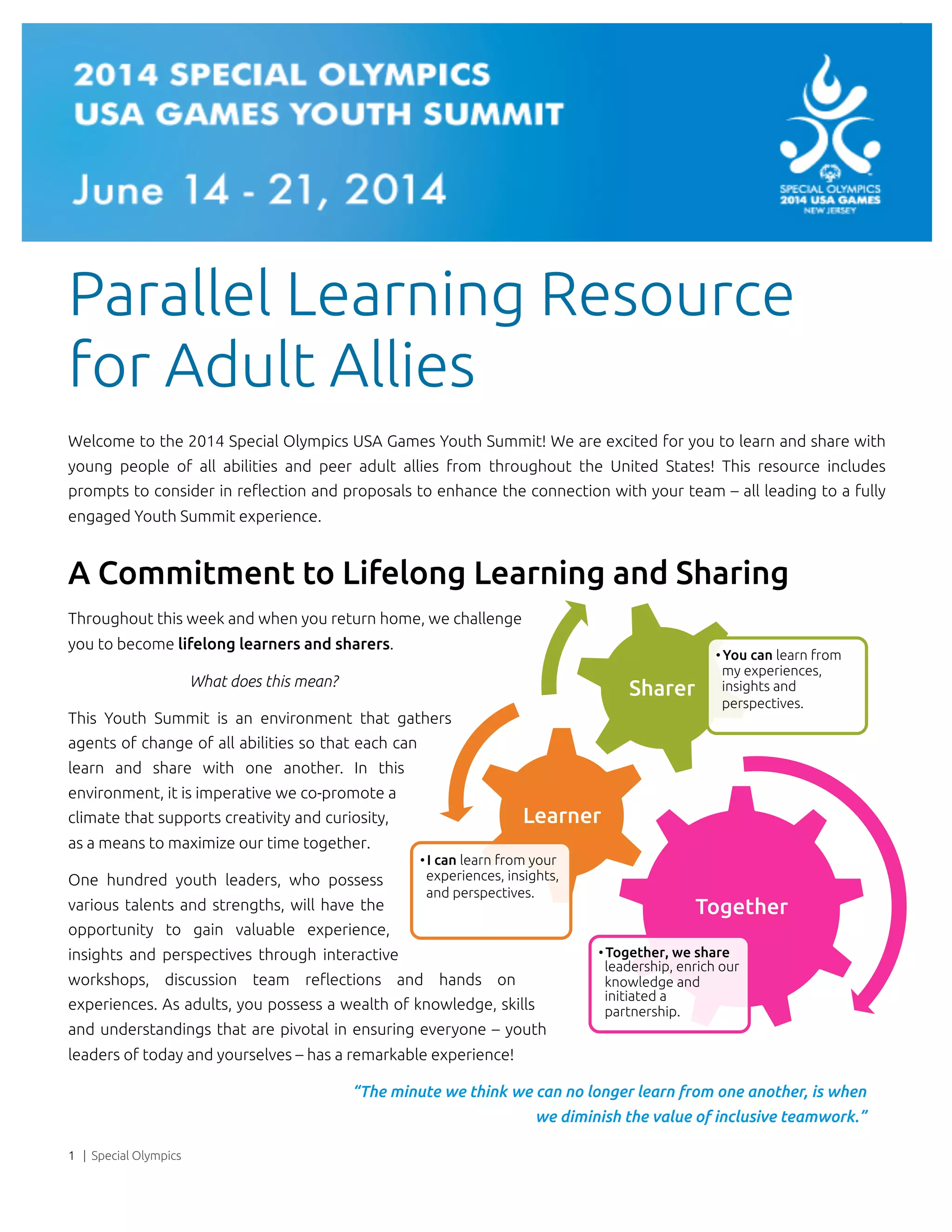
Throughout this week and when you return home, we challenge
you to become lifelong learners and sharers.
What does this mean?
This Youth Summit is an environment that gathers
agents of change of all abilities so that each can
learn and share with one another. In this
environment, it is imperative we co-promote a
climate that supports creativity and curiosity,
as a means to maximize our time together.
One hundred youth leaders, who possess
various talents and strengths, will have the
opportunity to gain valuable experience,
insights and perspectives through interactive
workshops, discussion team reflections and hands on
experiences. As adults, you possess a wealth of knowledge, skills
and understandings that are pivotal in ensuring everyone – youth
leaders of today and yourselves – has a remarkable experience!
“The minute we think we can no longer learn from one another, is when
we diminish the value of inclusive teamwork.”
Together
• Together, we share
leadership, enrich our
knowledge and
initiated a
partnership.
Learner
• I can learn from your
experiences, insights,
and perspectives.
Sharer
• You can learn from
my experiences,
insights and
perspectives.
2 | Special Olympics
Being a Mentor and an Ally
As believers in the powerful impact
youth leaders of all abilities create
every single day, we celebrate your
role as both a mentor and an ally!
We all have opportunities to be
both an ally and a mentor!
THROUGHOUT THE YOUTH SUMMIT, YOU CAN EMBODY THE ROLE OF A MENTOR IN THE
FOLLOWING WAYS
ü Share the goals and plans of the State Program. Throughout the week, share pre-existing initiatives of the
State Program that can connect with what is currently being discussed.
ü Articulate your personal experiences, which include the successes,
challenges and implications it may have for today.
ü Undertake responsibilities of a chaperone, to ensure group safety and
adherence to the Youth Summit expectations.
TOGETHER, WE ARE ALL ALLIES IN THE LEARNING JOURNEY. YOU ALSO EMBODY THE ROLE
OF BEING AN ALLY IN THE FOLLOWING WAYS
ü View collaboration as an equitable process, where all views are shared.
ü Promote a discussion of roles and how to be the best learners and sharers.
ü Strive to ‘struggle with’ rather then ‘struggle against’ when encountering
challenging situations or discussions with the group.
Who would you
consider an ally?
What made them
an ally to you?
Who would you
consider a mentor?
How have they
mentored you?
3 | Special Olympics
Being an Ally is about a Disposition
Being an ally is about a disposition. Through our daily individual endeavors and insights, we craft our dispositions.
You will be asked to share your personal dispositions below. Dispositions represent our beliefs, values and skills
that influence our actions.
• Beliefs are assumptions we have for others, the world and ourselves that determine our outlook.
• Values are ideas and principles we perceive as important that influence our decision-making.
• Skills are talents and strengths we can utilize to express our beliefs and values.
• Actions are elicited from the development of our dispositions, which is shown in how we share and learn
with one another.
Dispositions can change over time, as we experience new situations and reflect on our leadership. The following is a
disposition that an ally might embody:
Beliefs
Determine our
Feelings
Values
Guide our
Action
Skills
Provide
Opportunity
for Expression
Actions
Our
Dispositions,
Catalyze our
Actions
Beliefs
•  It is important to
me to be helpful.
Values
•  I possess
experience in
certain areas, while
others have
experience in areas
I do not have.
Skills
•  I am able to be
helpful to
someone who may
be new to an idea
or experience.
Actions
•  I will ask how I can
be helpful and
provide responses
to questions the
individual may
have.
4 | Special Olympics
You, as an Ally
As we initiate conversations on what it means to
be an ally, consider how you are an ally.
In the following blue boxes, identify the
dispositions you possess (beliefs, values, skills),
and articulate the actions that accompany each
disposition in the purple dotted arrow. You are
welcome to consider starting this prior to the
Youth Summit, as this will be a guide for our first
Mentor Meeting.
If you have challenges identifying the action(s), you can identify questions to ask fellow allies during scheduled
Mentor Meetings.
• I express eagerness to help. When asked for help, I fulfill our shared
agreements. (action)
• I provide constructive feedback and proposed enhancements. (action)
Authenticity
(disposition)
5 | Special Olympics
Agenda
Learning Objectives & Action Items for Adult Allies
Your 2014 Special Olympics USA Games Youth Summit Workbook includes the detailed agenda for our journey
together. Below is an agenda that details learning objectives and action items for the adult allies.
WELCOME SESSION
ü Learning Objective: Attain a shared understanding of social inclusion within the Youth Summit.
ü Action Item: Enrich how both youth and adult allies communicate the message of social inclusion and Project
UNIFY to elicit support and initiate partnerships to advance Project UNIFY at the state level.
INCLUSIVE YOUTH LEADERSHIP AND STUDENT-LED UNIFIED SPORTS GUIDE REFLECTION
SESSIONS
ü Learning Objective: Identify challenges to Inclusive Youth Leadership in schools and the State Program Level.
Engage in brainstorming sessions around what is needed to overcome those challenges.
ü Action Item: Share State Program goals for expanding Project UNIFY and Inclusive Youth Leadership to
support youth leaders in strategy development for Project UNIFY within the State Program.
LEADERSHIP DEVELOPMENT SESSION: TEAMWORK
ü Learning Objective: Embody the dispositions needed to be a good ally, both adult ally to youth ally, and adult
ally to adult ally.
ü Action Item: Through utilization of the strengths and talents, commit that every person can be engaged in
meaningful ways.
LEADERSHIP DEVELOPMENT SESSION: COMMUNICATION
ü Learning Objective: Deepen skill growth in being an effective communicator and discussion co-facilitator.
ü Action Item: Construct practices on how to adapt a message -- for any given audience with diverse abilities --
as an advocate.
LEADERSHIP DEVELOPMENT SESSION: ENVIRONMENT
ü Learning Objective: Develop a greater understanding of how to promote a supportive and engaging school
climate.
ü Action Item: Identify strategies to implement during informal and formal gatherings in schools, to cultivate a
culture where all feel comfortable to contribute and questions are encouraged.
LEADERSHIP DEVELOPMENT SESSION: CO-LEADERSHIP
ü Learning Objective: Classify the similarities and differences between leadership and co-leadership.
ü Action Item: Examine ways adult allies can be helpful to youth leaders who serve in both leadership and co-
leadership opportunities.
6 | Special Olympics
VOLUNTEER TRAINING FOR UNIFIED SPORTS FESTIVAL
ü Learning Objective: Establish clear understandings of co-leadership roles for the Unified Sports Festival.
ü Action item: Discuss how a similar event could advance Project UNIFY in your state and how co-leadership is
an essential component of the design and implementation.
YOUTH EXPO
ü Learning Objective: In partnership with your student leaders, construct a plan for further activation of Special
Olympics Project UNIFY within your state.
ü Action Item: Determine how the State Program can support its implementation and identify ways to gauge
effectiveness through individual and collective reflection.
UNIFIED SPORTS FESTIVAL
ü Learning Objective: Identify meaningful co-leadership situations and use them as teachable moments for
oneself during the Unified Sports Festival.
ü Action Item: Gain knowledge and awareness of the festival operations: what worked, what did not work,
when were people having the most fun, how the experience can be improved and generate ideas for a
similar event in your state.
FINAL DISCUSSION TEAM MEETING
ü Learning Objective: Celebrate the shared and individual
learning experiences from the week to take back home.
ü Action Item: Revisit our shared commitment to lifelong
learning and sharing.
Mentor Meetings
On the agenda, time has been allotted for adult mentors to gather, reflect and discuss their individual journeys at
the Youth Summit. While part of the meeting will cover logistical information, it also will be a place to synthesize
shared learning and engage in conversations about the Youth Summit. Refer to the agenda in the Youth Summit
Workbook for the times and location of these meetings.
Prompts
Prompts will be shared at the Mentor Meetings,
such as the ones below, for you to consider for
personal and state delegation reflection.
Throughout the week, you can use the provided
prompts or devise your own to engage fellow
attendees and ignite fantastic sharing!
ü What was your comfort level when you first
shared power with a young person? How
has your comfort level in sharing the power changed since then?
ü Consider the individuals who are allies in your life. What makes them great allies?
Group Reflection
With your delegation, determine appropriate means and
expectations for communication throughout the week.
When youth visit with a delegation in another room, what
should the process be to ensure that everyone is in the loop
and given responsibilities (e.g., youth provide call/text
updates every X amount of minutes). Co-create these
expectations to ensure that every person feels comfortable.
7 | Special Olympics
Top Three Engagement Strategies
Throughout the week, it is encouraged to utilize the three strategies below and adapt them to meet your needs.
1. Empower me, but do not ‘do’ for me – The outcome is just as important as the process. Support youth
leaders in helping organize their thinking and ideas.
2. Re-phrase directed questions into open-ended prompts to stimulate conversation – Sometimes, youth
can feel interrogated with questions that elicit a “you versus me” type of partnership. Turn questions such
as, “What did you do that made the event successful?” to the prompt, “Let’s consider what happened that
made the event successful,” “Are there other ways we could have designed the event to be even more
successful?”
3. Be Cautious with the words agree and disagree – As a partner in learning and sharing with youth, seek to
share what you understand and those areas in which you have difficulties. This promotes an ongoing
conversation while helping the individual further describe his or her thoughts.
Reflection
Reflection is an ongoing practice that we all will
engage in together, both formally and informally,
throughout this week. This reflection provides
the opportunity to consider your experiences
during the entire Youth Summit.
Looking back on the words you identified on
page four to depict yourself as an ally, reflect
on the following questions:
ü What stayed the same?
ü What was enhanced?
ü What surprised you?
What
stayed the
same?
What was
enhanced?
What
suprised
you?

Parallel Learning Resource for Adult Allies

  • 1.
    1 | SpecialOlympics Parallel Learning Resource for Adult Allies Welcome to the 2014 Special Olympics USA Games Youth Summit! We are excited for you to learn and share with young people of all abilities and peer adult allies from throughout the United States! This resource includes prompts to consider in reflection and proposals to enhance the connection with your team – all leading to a fully engaged Youth Summit experience. A Commitment to Lifelong Learning and Sharing Throughout this week and when you return home, we challenge you to become lifelong learners and sharers. What does this mean? This Youth Summit is an environment that gathers agents of change of all abilities so that each can learn and share with one another. In this environment, it is imperative we co-promote a climate that supports creativity and curiosity, as a means to maximize our time together. One hundred youth leaders, who possess various talents and strengths, will have the opportunity to gain valuable experience, insights and perspectives through interactive workshops, discussion team reflections and hands on experiences. As adults, you possess a wealth of knowledge, skills and understandings that are pivotal in ensuring everyone – youth leaders of today and yourselves – has a remarkable experience! “The minute we think we can no longer learn from one another, is when we diminish the value of inclusive teamwork.” Together • Together, we share leadership, enrich our knowledge and initiated a partnership. Learner • I can learn from your experiences, insights, and perspectives. Sharer • You can learn from my experiences, insights and perspectives.
  • 2.
    2 | SpecialOlympics Being a Mentor and an Ally As believers in the powerful impact youth leaders of all abilities create every single day, we celebrate your role as both a mentor and an ally! We all have opportunities to be both an ally and a mentor! THROUGHOUT THE YOUTH SUMMIT, YOU CAN EMBODY THE ROLE OF A MENTOR IN THE FOLLOWING WAYS ü Share the goals and plans of the State Program. Throughout the week, share pre-existing initiatives of the State Program that can connect with what is currently being discussed. ü Articulate your personal experiences, which include the successes, challenges and implications it may have for today. ü Undertake responsibilities of a chaperone, to ensure group safety and adherence to the Youth Summit expectations. TOGETHER, WE ARE ALL ALLIES IN THE LEARNING JOURNEY. YOU ALSO EMBODY THE ROLE OF BEING AN ALLY IN THE FOLLOWING WAYS ü View collaboration as an equitable process, where all views are shared. ü Promote a discussion of roles and how to be the best learners and sharers. ü Strive to ‘struggle with’ rather then ‘struggle against’ when encountering challenging situations or discussions with the group. Who would you consider an ally? What made them an ally to you? Who would you consider a mentor? How have they mentored you?
  • 3.
    3 | SpecialOlympics Being an Ally is about a Disposition Being an ally is about a disposition. Through our daily individual endeavors and insights, we craft our dispositions. You will be asked to share your personal dispositions below. Dispositions represent our beliefs, values and skills that influence our actions. • Beliefs are assumptions we have for others, the world and ourselves that determine our outlook. • Values are ideas and principles we perceive as important that influence our decision-making. • Skills are talents and strengths we can utilize to express our beliefs and values. • Actions are elicited from the development of our dispositions, which is shown in how we share and learn with one another. Dispositions can change over time, as we experience new situations and reflect on our leadership. The following is a disposition that an ally might embody: Beliefs Determine our Feelings Values Guide our Action Skills Provide Opportunity for Expression Actions Our Dispositions, Catalyze our Actions Beliefs •  It is important to me to be helpful. Values •  I possess experience in certain areas, while others have experience in areas I do not have. Skills •  I am able to be helpful to someone who may be new to an idea or experience. Actions •  I will ask how I can be helpful and provide responses to questions the individual may have.
  • 4.
    4 | SpecialOlympics You, as an Ally As we initiate conversations on what it means to be an ally, consider how you are an ally. In the following blue boxes, identify the dispositions you possess (beliefs, values, skills), and articulate the actions that accompany each disposition in the purple dotted arrow. You are welcome to consider starting this prior to the Youth Summit, as this will be a guide for our first Mentor Meeting. If you have challenges identifying the action(s), you can identify questions to ask fellow allies during scheduled Mentor Meetings. • I express eagerness to help. When asked for help, I fulfill our shared agreements. (action) • I provide constructive feedback and proposed enhancements. (action) Authenticity (disposition)
  • 5.
    5 | SpecialOlympics Agenda Learning Objectives & Action Items for Adult Allies Your 2014 Special Olympics USA Games Youth Summit Workbook includes the detailed agenda for our journey together. Below is an agenda that details learning objectives and action items for the adult allies. WELCOME SESSION ü Learning Objective: Attain a shared understanding of social inclusion within the Youth Summit. ü Action Item: Enrich how both youth and adult allies communicate the message of social inclusion and Project UNIFY to elicit support and initiate partnerships to advance Project UNIFY at the state level. INCLUSIVE YOUTH LEADERSHIP AND STUDENT-LED UNIFIED SPORTS GUIDE REFLECTION SESSIONS ü Learning Objective: Identify challenges to Inclusive Youth Leadership in schools and the State Program Level. Engage in brainstorming sessions around what is needed to overcome those challenges. ü Action Item: Share State Program goals for expanding Project UNIFY and Inclusive Youth Leadership to support youth leaders in strategy development for Project UNIFY within the State Program. LEADERSHIP DEVELOPMENT SESSION: TEAMWORK ü Learning Objective: Embody the dispositions needed to be a good ally, both adult ally to youth ally, and adult ally to adult ally. ü Action Item: Through utilization of the strengths and talents, commit that every person can be engaged in meaningful ways. LEADERSHIP DEVELOPMENT SESSION: COMMUNICATION ü Learning Objective: Deepen skill growth in being an effective communicator and discussion co-facilitator. ü Action Item: Construct practices on how to adapt a message -- for any given audience with diverse abilities -- as an advocate. LEADERSHIP DEVELOPMENT SESSION: ENVIRONMENT ü Learning Objective: Develop a greater understanding of how to promote a supportive and engaging school climate. ü Action Item: Identify strategies to implement during informal and formal gatherings in schools, to cultivate a culture where all feel comfortable to contribute and questions are encouraged. LEADERSHIP DEVELOPMENT SESSION: CO-LEADERSHIP ü Learning Objective: Classify the similarities and differences between leadership and co-leadership. ü Action Item: Examine ways adult allies can be helpful to youth leaders who serve in both leadership and co- leadership opportunities.
  • 6.
    6 | SpecialOlympics VOLUNTEER TRAINING FOR UNIFIED SPORTS FESTIVAL ü Learning Objective: Establish clear understandings of co-leadership roles for the Unified Sports Festival. ü Action item: Discuss how a similar event could advance Project UNIFY in your state and how co-leadership is an essential component of the design and implementation. YOUTH EXPO ü Learning Objective: In partnership with your student leaders, construct a plan for further activation of Special Olympics Project UNIFY within your state. ü Action Item: Determine how the State Program can support its implementation and identify ways to gauge effectiveness through individual and collective reflection. UNIFIED SPORTS FESTIVAL ü Learning Objective: Identify meaningful co-leadership situations and use them as teachable moments for oneself during the Unified Sports Festival. ü Action Item: Gain knowledge and awareness of the festival operations: what worked, what did not work, when were people having the most fun, how the experience can be improved and generate ideas for a similar event in your state. FINAL DISCUSSION TEAM MEETING ü Learning Objective: Celebrate the shared and individual learning experiences from the week to take back home. ü Action Item: Revisit our shared commitment to lifelong learning and sharing. Mentor Meetings On the agenda, time has been allotted for adult mentors to gather, reflect and discuss their individual journeys at the Youth Summit. While part of the meeting will cover logistical information, it also will be a place to synthesize shared learning and engage in conversations about the Youth Summit. Refer to the agenda in the Youth Summit Workbook for the times and location of these meetings. Prompts Prompts will be shared at the Mentor Meetings, such as the ones below, for you to consider for personal and state delegation reflection. Throughout the week, you can use the provided prompts or devise your own to engage fellow attendees and ignite fantastic sharing! ü What was your comfort level when you first shared power with a young person? How has your comfort level in sharing the power changed since then? ü Consider the individuals who are allies in your life. What makes them great allies? Group Reflection With your delegation, determine appropriate means and expectations for communication throughout the week. When youth visit with a delegation in another room, what should the process be to ensure that everyone is in the loop and given responsibilities (e.g., youth provide call/text updates every X amount of minutes). Co-create these expectations to ensure that every person feels comfortable.
  • 7.
    7 | SpecialOlympics Top Three Engagement Strategies Throughout the week, it is encouraged to utilize the three strategies below and adapt them to meet your needs. 1. Empower me, but do not ‘do’ for me – The outcome is just as important as the process. Support youth leaders in helping organize their thinking and ideas. 2. Re-phrase directed questions into open-ended prompts to stimulate conversation – Sometimes, youth can feel interrogated with questions that elicit a “you versus me” type of partnership. Turn questions such as, “What did you do that made the event successful?” to the prompt, “Let’s consider what happened that made the event successful,” “Are there other ways we could have designed the event to be even more successful?” 3. Be Cautious with the words agree and disagree – As a partner in learning and sharing with youth, seek to share what you understand and those areas in which you have difficulties. This promotes an ongoing conversation while helping the individual further describe his or her thoughts. Reflection Reflection is an ongoing practice that we all will engage in together, both formally and informally, throughout this week. This reflection provides the opportunity to consider your experiences during the entire Youth Summit. Looking back on the words you identified on page four to depict yourself as an ally, reflect on the following questions: ü What stayed the same? ü What was enhanced? ü What surprised you? What stayed the same? What was enhanced? What suprised you?