Relational DAC Practices Project:
Review and Input
Cindy McCauley
Senior Fellow
Center for Creative Leadership
CONNECTED Community Webinar Series
Featuring the Big Idea of Relational Leadership
17 February 2017
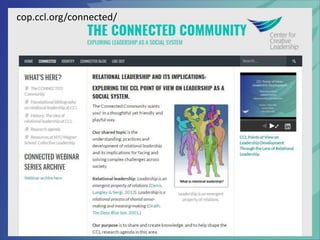
cop.ccl.org/connected/
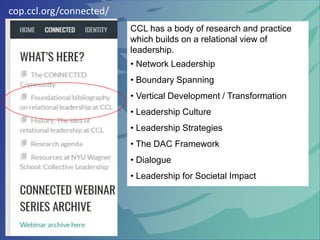
CCL has a body of research and practice
which builds on a relational view of
leadership.
• Network Leadership
• Boundary Spanning
• Vertical Development / Transformation
• Leadership Culture
• Leadership Strategies
• The DAC Framework
• Dialogue
• Leadership for Societal Impact
cop.ccl.org/connected/
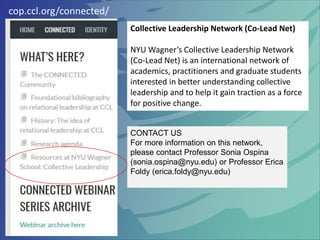
Collective Leadership Network (Co-Lead Net)
NYU Wagner’s Collective Leadership Network
(Co-Lead Net) is an international network of
academics, practitioners and graduate students
interested in better understanding collective
leadership and to help it gain traction as a force
for positive change.
CONTACT US
For more information on this network,
please contact Professor Sonia Ospina
(sonia.ospina@nyu.edu) or Professor Erica
Foldy (erica.foldy@nyu.edu)
cop.ccl.org/connected/
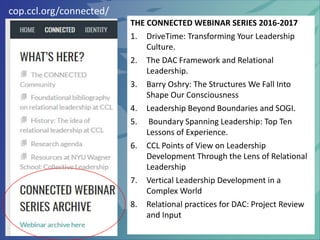
THE CONNECTED WEBINAR SERIES 2016-2017
1. DriveTime: Transforming Your Leadership
Culture.
2. The DAC Framework and Relational
Leadership.
3. Barry Oshry: The Structures We Fall Into
Shape Our Consciousness
4. Leadership Beyond Boundaries and SOGI.
5. Boundary Spanning Leadership: Top Ten
Lessons of Experience.
6. CCL Points of View on Leadership
Development Through the Lens of Relational
Leadership
7. Vertical Leadership Development in a
Complex World
8. Relational practices for DAC: Project Review
and Input
©2014 Center for Creative Leadership. All rights reserved.
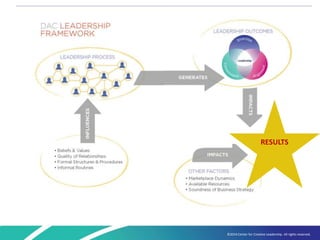
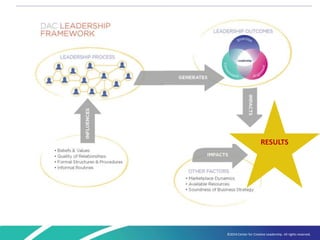
RESULTS
©2014 Center for Creative Leadership. All rights reserved.
Love the DAC framework. I get it. Now how can I enhance DAC in
our group?
A Less-Than-Satisfactory Answer
As to what specific changes your group should make, the
answer will vary depending on a whole host of factors that
distinguish it from other groups, including its size, the work it is
engaged in, the degree of task interdependency in doing the
work, what its members value, the organization it is embedded
in, and the constraints and expectations imposed by that
organization.
There are no formulas for strengthening DAC; in fact there are
an infinite number of ways that DAC might be enhanced. You
have to discover what works in your context.
McCauley. C.D. & Fick-Cooper, L. (2016). Direction, alignment, commitment: Achieving better results
through leadership. Greensboro, NC: Center for Creative Leadership
©2014 Center for Creative Leadership. All rights reserved.
• In what ways does a shift in perspective and practice—from
leadership as solely the capacity and actions of individuals to
leadership as the capacity and actions of a social system—yield
better results for individuals, groups, teams, organizations,
partnerships, coalitions, and communities?
• What relational practices increase direction,
alignment, and commitment?
• What development practices foster more adaptive leadership
cultures?
Research Agenda:
Leadership as a Social Process
©2014 Center for Creative Leadership. All rights reserved.©2014 Center for Creative Leadership. All rights reserved.
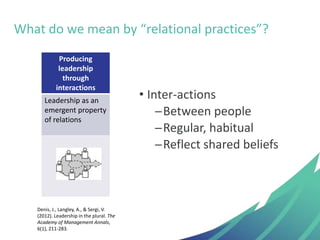
• Inter-actions
─Between people
─Regular, habitual
─Reflect shared beliefs
What do we mean by “relational practices”?
Producing
leadership
through
interactions
Leadership as an
emergent property
of relations
Denis, J., Langley, A., & Sergi, V.
(2012). Leadership in the plural. The
Academy of Management Annals,
6(1), 211-283.
©2014 Center for Creative Leadership. All rights reserved.
RESULTS
©2014 Center for Creative Leadership. All rights reserved.
Assumption: There’s a lot of existing knowledge about how DAC can be
increased in various contexts.
Already explicitly linked to DAC framework
• Boundary Spanning Leadership
• Strategic Leadership
• Interdependent Leadership
Fairly easy to link to DAC framework, for example
• Team Effectiveness
• Collaboration
Beyond the obvious, for example
• Family Systems
• Charismatic Leadership
A Place to Start:
Harvesting Existing Knowledge
©2014 Center for Creative Leadership. All rights reserved.©2014 Center for Creative Leadership. All rights reserved.
• What literatures should we take a look at?
• What specific research studies, models, or theories
already provide answers (even if only partially) to our
research question?
• What leadership contexts are NOT well-covered in the
literature?
What relational practices increase direction,
alignment, and commitment?
What do you think?
©2014 Center for Creative Leadership. All rights reserved.©2014 Center for Creative Leadership. All rights reserved.© 2009 Center for Creative Leadership. All Rights Reserved.
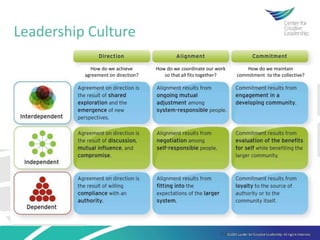
Leadership Culture
How do we achieve
agreement on direction?
How do we coordinate our work
so that all fits together?
How do we maintain
commitment to the collective?
©2014 Center for Creative Leadership. All rights reserved.
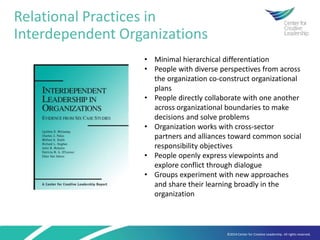
Relational Practices in
Interdependent Organizations
• Minimal hierarchical differentiation
• People with diverse perspectives from across
the organization co-construct organizational
plans
• People directly collaborate with one another
across organizational boundaries to make
decisions and solve problems
• Organization works with cross-sector
partners and alliances toward common social
responsibility objectives
• People openly express viewpoints and
explore conflict through dialogue
• Groups experiment with new approaches
and share their learning broadly in the
organization
©2014 Center for Creative Leadership. All rights reserved.
• Planning
─ Team establishes clear goals and strategies to achieve goals
─ Members agree on roles and norms
• Execution
─ Members sequence and coordinate tasks
─ Team collaborates with stakeholders
─ Team monitors progress of their work
• Interpersonal
─ Members openly “speak their minds” without fear of rebuke or retaliation
─ Members have healthy debate without personal acrimony
─ Members contribute actively in team meetings and receive encouragements for
their contributions
─ Members demonstrate personal accountability to each other
Relational Practices in
Effective Teams
Source: Morgeson, F.P., Lindoerfer, D., & Loring, D.J. (2010). Developing team leadership capacity. In E. Van Velsor, C.D.,
McCauley, & M.N. Ruderman (Eds.), The CCL Handbook of Leadership Development. San Francisco, CA: Jossey-Bass.
©2014 Center for Creative Leadership. All rights reserved.
• Elements of Charisma (based on Weber’s writings)
─Shared recognition of a crisis situation
─An individual with extraordinary personal qualities
and gifts
─A radical vision offering a solution to the crisis
─A set of followers attracted to the leader who come
to believe in the radical vision
─Validation of the vision through success
Relational Practices in
Charismatic Leadership
Source: Beyer, J.M. & Browning, L.D. (1999). Transforming an industry in crisis: Charisma, routinization, and supportive
cultural leadership. Leadership Quarterly, 10, 483-520.
©2014 Center for Creative Leadership. All rights reserved.©2014 Center for Creative Leadership. All rights reserved.
• What literatures should we take a look at?
• What specific research studies, models, or theories
already provide answers (even if only partially) to our
research question?
• What leadership contexts are NOT well-covered in the
literature?
How can we work on this together?
What do you think?

Relational DAC Practices Project

  • 1.
    Relational DAC PracticesProject: Review and Input Cindy McCauley Senior Fellow Center for Creative Leadership CONNECTED Community Webinar Series Featuring the Big Idea of Relational Leadership 17 February 2017
  • 2.
  • 3.
    cop.ccl.org/connected/ CCL has abody of research and practice which builds on a relational view of leadership. • Network Leadership • Boundary Spanning • Vertical Development / Transformation • Leadership Culture • Leadership Strategies • The DAC Framework • Dialogue • Leadership for Societal Impact
  • 4.
    cop.ccl.org/connected/ Collective Leadership Network(Co-Lead Net) NYU Wagner’s Collective Leadership Network (Co-Lead Net) is an international network of academics, practitioners and graduate students interested in better understanding collective leadership and to help it gain traction as a force for positive change. CONTACT US For more information on this network, please contact Professor Sonia Ospina (sonia.ospina@nyu.edu) or Professor Erica Foldy (erica.foldy@nyu.edu)
  • 5.
    cop.ccl.org/connected/ THE CONNECTED WEBINARSERIES 2016-2017 1. DriveTime: Transforming Your Leadership Culture. 2. The DAC Framework and Relational Leadership. 3. Barry Oshry: The Structures We Fall Into Shape Our Consciousness 4. Leadership Beyond Boundaries and SOGI. 5. Boundary Spanning Leadership: Top Ten Lessons of Experience. 6. CCL Points of View on Leadership Development Through the Lens of Relational Leadership 7. Vertical Leadership Development in a Complex World 8. Relational practices for DAC: Project Review and Input
  • 6.
    ©2014 Center forCreative Leadership. All rights reserved. RESULTS
  • 7.
    ©2014 Center forCreative Leadership. All rights reserved. Love the DAC framework. I get it. Now how can I enhance DAC in our group? A Less-Than-Satisfactory Answer As to what specific changes your group should make, the answer will vary depending on a whole host of factors that distinguish it from other groups, including its size, the work it is engaged in, the degree of task interdependency in doing the work, what its members value, the organization it is embedded in, and the constraints and expectations imposed by that organization. There are no formulas for strengthening DAC; in fact there are an infinite number of ways that DAC might be enhanced. You have to discover what works in your context. McCauley. C.D. & Fick-Cooper, L. (2016). Direction, alignment, commitment: Achieving better results through leadership. Greensboro, NC: Center for Creative Leadership
  • 8.
    ©2014 Center forCreative Leadership. All rights reserved. • In what ways does a shift in perspective and practice—from leadership as solely the capacity and actions of individuals to leadership as the capacity and actions of a social system—yield better results for individuals, groups, teams, organizations, partnerships, coalitions, and communities? • What relational practices increase direction, alignment, and commitment? • What development practices foster more adaptive leadership cultures? Research Agenda: Leadership as a Social Process
  • 9.
    ©2014 Center forCreative Leadership. All rights reserved.©2014 Center for Creative Leadership. All rights reserved. • Inter-actions ─Between people ─Regular, habitual ─Reflect shared beliefs What do we mean by “relational practices”? Producing leadership through interactions Leadership as an emergent property of relations Denis, J., Langley, A., & Sergi, V. (2012). Leadership in the plural. The Academy of Management Annals, 6(1), 211-283.
  • 10.
    ©2014 Center forCreative Leadership. All rights reserved. RESULTS
  • 11.
    ©2014 Center forCreative Leadership. All rights reserved. Assumption: There’s a lot of existing knowledge about how DAC can be increased in various contexts. Already explicitly linked to DAC framework • Boundary Spanning Leadership • Strategic Leadership • Interdependent Leadership Fairly easy to link to DAC framework, for example • Team Effectiveness • Collaboration Beyond the obvious, for example • Family Systems • Charismatic Leadership A Place to Start: Harvesting Existing Knowledge
  • 12.
    ©2014 Center forCreative Leadership. All rights reserved.©2014 Center for Creative Leadership. All rights reserved. • What literatures should we take a look at? • What specific research studies, models, or theories already provide answers (even if only partially) to our research question? • What leadership contexts are NOT well-covered in the literature? What relational practices increase direction, alignment, and commitment? What do you think?
  • 13.
    ©2014 Center forCreative Leadership. All rights reserved.©2014 Center for Creative Leadership. All rights reserved.© 2009 Center for Creative Leadership. All Rights Reserved. Leadership Culture How do we achieve agreement on direction? How do we coordinate our work so that all fits together? How do we maintain commitment to the collective?
  • 14.
    ©2014 Center forCreative Leadership. All rights reserved. Relational Practices in Interdependent Organizations • Minimal hierarchical differentiation • People with diverse perspectives from across the organization co-construct organizational plans • People directly collaborate with one another across organizational boundaries to make decisions and solve problems • Organization works with cross-sector partners and alliances toward common social responsibility objectives • People openly express viewpoints and explore conflict through dialogue • Groups experiment with new approaches and share their learning broadly in the organization
  • 15.
    ©2014 Center forCreative Leadership. All rights reserved. • Planning ─ Team establishes clear goals and strategies to achieve goals ─ Members agree on roles and norms • Execution ─ Members sequence and coordinate tasks ─ Team collaborates with stakeholders ─ Team monitors progress of their work • Interpersonal ─ Members openly “speak their minds” without fear of rebuke or retaliation ─ Members have healthy debate without personal acrimony ─ Members contribute actively in team meetings and receive encouragements for their contributions ─ Members demonstrate personal accountability to each other Relational Practices in Effective Teams Source: Morgeson, F.P., Lindoerfer, D., & Loring, D.J. (2010). Developing team leadership capacity. In E. Van Velsor, C.D., McCauley, & M.N. Ruderman (Eds.), The CCL Handbook of Leadership Development. San Francisco, CA: Jossey-Bass.
  • 16.
    ©2014 Center forCreative Leadership. All rights reserved. • Elements of Charisma (based on Weber’s writings) ─Shared recognition of a crisis situation ─An individual with extraordinary personal qualities and gifts ─A radical vision offering a solution to the crisis ─A set of followers attracted to the leader who come to believe in the radical vision ─Validation of the vision through success Relational Practices in Charismatic Leadership Source: Beyer, J.M. & Browning, L.D. (1999). Transforming an industry in crisis: Charisma, routinization, and supportive cultural leadership. Leadership Quarterly, 10, 483-520.
  • 17.
    ©2014 Center forCreative Leadership. All rights reserved.©2014 Center for Creative Leadership. All rights reserved. • What literatures should we take a look at? • What specific research studies, models, or theories already provide answers (even if only partially) to our research question? • What leadership contexts are NOT well-covered in the literature? How can we work on this together? What do you think?