1 | Special Olympics
Inclusive Youth Leadership
Welcome to the 2014 Special Olympics Project UNIFY® Inclusive
Youth Leadership Workshop! This document encompasses a
comprehensive overview of the core characteristics of Inclusive
Youth Leadership. You will also be provided links to resources
mentioned throughout the presentation
Inclusive Youth Leadership
There are many models of leadership that are currently exercised today. Below are three common models:
Transactional Model
Adult-Driven, Youth
Input Model
Servant Model
Traits
! List of completed and
uncompleted items.
! Hyper-focus on the outcome(s).
! Youth are given options
to decide upon.
! Youth and adults may
not communicate
effectively, due to
power struggles.
! Objective is to serve
others – to help them.
! Can be ad-hoc or
activity-based, type of
engagement.
Mindset
! Getting things done.
! Let’s follow the plans as they are
given to us.
! I want to support the
youth so they don’t feel
stressed or overworked.
! Youth are given power to
decide, so their voice is
heard.
! I’m here to help you, to
support your growth.
! It’s nice for me to help
others.
Actions
! One person constructs the
vision, outcomes and strategy.
! Colleagues are to implement
the plan, without the
opportunity to give
input/enhancements.
! Adults set the vision,
possibly with the youth
present.
! Youth may feel
discouraged to share
their ideas, and feel like
they are not valued.
! The intention may be
first to support others,
but soon one may notice
his or her growth, too!
! It can focus on ‘one
helping others’ verses
‘helping one another.’
2 | Special Olympics
We see these models on a continuum, where one can progress in embodying the skills, dispositions
and values of Inclusive Youth Leadership. However, Inclusive Youth Leadership entails a change in mindset and
actions, but augments the growth within all.
Adult Allies Supporting Inclusive Youth Leadership
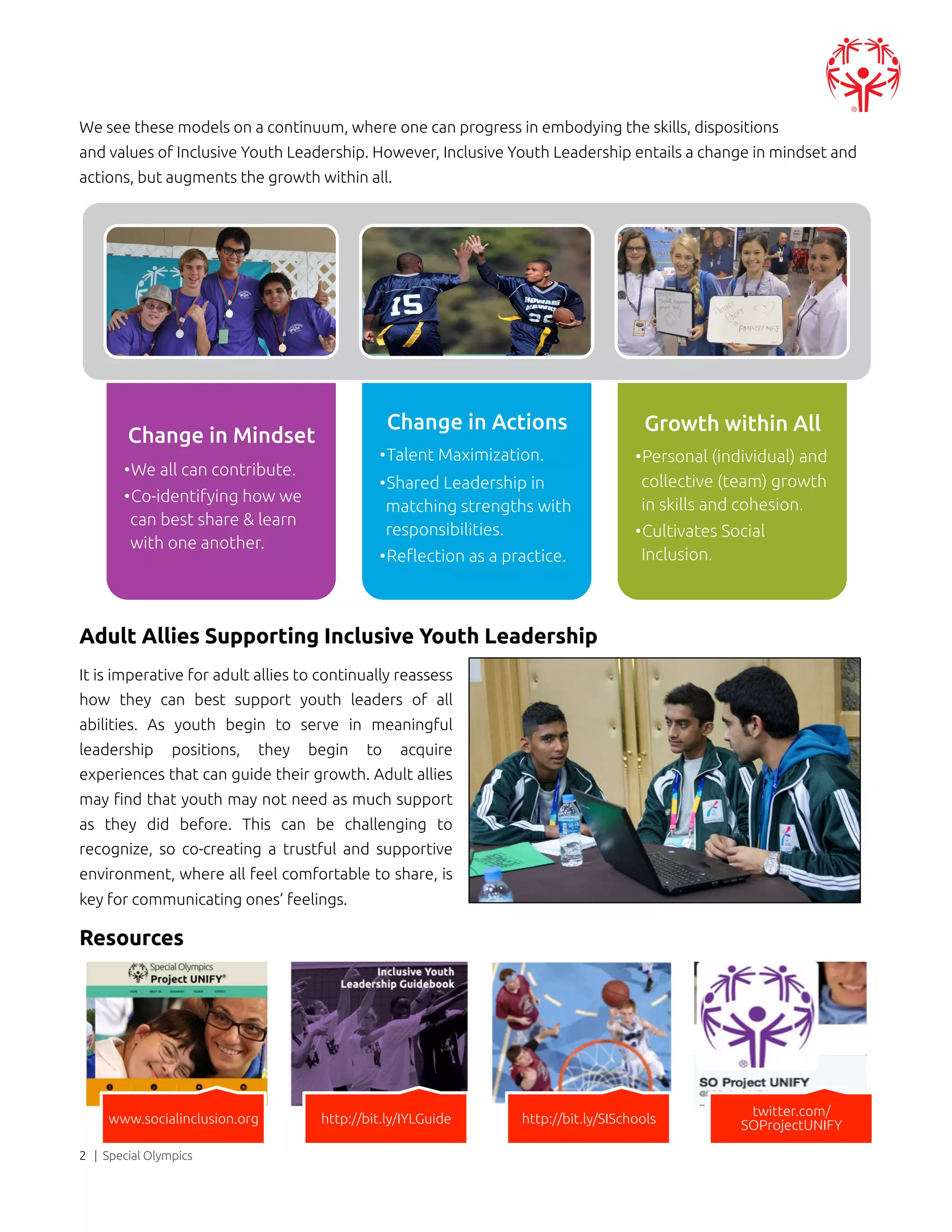
It is imperative for adult allies to continually reassess
how they can best support youth leaders of all
abilities. As youth begin to serve in meaningful
leadership positions, they begin to acquire
experiences that can guide their growth. Adult allies
may find that youth may not need as much support
as they did before. This can be challenging to
recognize, so co-creating a trustful and supportive
environment, where all feel comfortable to share, is
key for communicating ones’ feelings.
Resources
Change in Mindset	
• We all can contribute.	
• Co-identifying how we
can best share & learn
with one another.	
Change in Actions	
• Talent Maximization. 	
• Shared Leadership in
matching strengths with
responsibilities.	
• Reflection as a practice.	
Growth within All	
• Personal (individual) and
collective (team) growth
in skills and cohesion.	
• Cultivates Social
Inclusion.	
www.socialinclusion.org	
 http://bit.ly/IYLGuide 	
 http://bit.ly/SISchools	
twitter.com/
SOProjectUNIFY

Special Olympics Project UNIFY® Inclusive Youth Leadership Workshop

  • 1.
    1 | SpecialOlympics Inclusive Youth Leadership Welcome to the 2014 Special Olympics Project UNIFY® Inclusive Youth Leadership Workshop! This document encompasses a comprehensive overview of the core characteristics of Inclusive Youth Leadership. You will also be provided links to resources mentioned throughout the presentation Inclusive Youth Leadership There are many models of leadership that are currently exercised today. Below are three common models: Transactional Model Adult-Driven, Youth Input Model Servant Model Traits ! List of completed and uncompleted items. ! Hyper-focus on the outcome(s). ! Youth are given options to decide upon. ! Youth and adults may not communicate effectively, due to power struggles. ! Objective is to serve others – to help them. ! Can be ad-hoc or activity-based, type of engagement. Mindset ! Getting things done. ! Let’s follow the plans as they are given to us. ! I want to support the youth so they don’t feel stressed or overworked. ! Youth are given power to decide, so their voice is heard. ! I’m here to help you, to support your growth. ! It’s nice for me to help others. Actions ! One person constructs the vision, outcomes and strategy. ! Colleagues are to implement the plan, without the opportunity to give input/enhancements. ! Adults set the vision, possibly with the youth present. ! Youth may feel discouraged to share their ideas, and feel like they are not valued. ! The intention may be first to support others, but soon one may notice his or her growth, too! ! It can focus on ‘one helping others’ verses ‘helping one another.’
  • 2.
    2 | SpecialOlympics We see these models on a continuum, where one can progress in embodying the skills, dispositions and values of Inclusive Youth Leadership. However, Inclusive Youth Leadership entails a change in mindset and actions, but augments the growth within all. Adult Allies Supporting Inclusive Youth Leadership It is imperative for adult allies to continually reassess how they can best support youth leaders of all abilities. As youth begin to serve in meaningful leadership positions, they begin to acquire experiences that can guide their growth. Adult allies may find that youth may not need as much support as they did before. This can be challenging to recognize, so co-creating a trustful and supportive environment, where all feel comfortable to share, is key for communicating ones’ feelings. Resources Change in Mindset • We all can contribute. • Co-identifying how we can best share & learn with one another. Change in Actions • Talent Maximization. • Shared Leadership in matching strengths with responsibilities. • Reflection as a practice. Growth within All • Personal (individual) and collective (team) growth in skills and cohesion. • Cultivates Social Inclusion. www.socialinclusion.org http://bit.ly/IYLGuide http://bit.ly/SISchools twitter.com/ SOProjectUNIFY