12/20/2013

Predicting the mobility of
tracked forestry machines
operating on Nordic forest
soil
Natchammai Revathi Palaniappan, A. Pirnazarov, U. Sellgren, B. Löfgren
Forest Machine Technology Academy, KTH

1

1
12/20/2013

Agenda
•
•
•
•
•
•
•
•
•

Background
Purpose
Division of the project task
Delimitations
Terminologies
Field test data
Comparative study of tracked and wheeled forest machines
Conclusion
Future Work
2

2
12/20/2013

Background
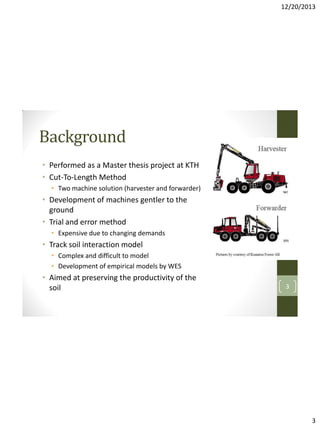
• Performed as a Master thesis project at KTH
• Cut-To-Length Method
• Two machine solution (harvester and forwarder)

• Development of machines gentler to the
ground
• Trial and error method
• Expensive due to changing demands

• Track soil interaction model
• Complex and difficult to model
• Development of empirical models by WES

• Aimed at preserving the productivity of the
soil

3

3
12/20/2013

Purpose
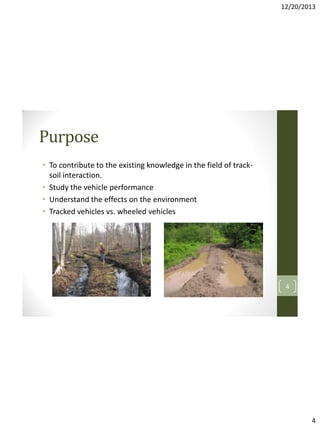
• To contribute to the existing knowledge in the field of tracksoil interaction.
• Study the vehicle performance
• Understand the effects on the environment
• Tracked vehicles vs. wheeled vehicles

4

4
12/20/2013

Division of the project task
1. Calculate ground pressure, performance parameters, rut
depth for tracked and wheeled vehicles. Compare results.
2. Study the field test data and theoretical model results to
find out how efficiently the measured data match with the
real data.

5

5
12/20/2013

Delimitations
• Entire focus is on soft soil – Uplands Sandy Loam, Rubicon
Sandy Loam and North Gower Clayey Loam
• Limited to the use of three types of rigid steel tracks (ECO,
EVO and MAGNUM)
• The roots present in the soil bed are not considered for the
analysis.

6

6
12/20/2013

Terminologies
• Rutting
• Ruts are formed due to repeated heavy vehicle passes along the
same path.
• Rutted area becomes too wet due to water logging.

• Soil compaction
• Physical degradation of the soil.
• Porosity, permeability and biological activity is reduced.
• Risk of soil erosion.

• Ground bearing capacity
• Ability of the soil to carry the pressure exerted on it without
undergoing shear.

• Mobility
• Quality or capability of the machine which permits them to move
from place to place.

7

7
12/20/2013

Field test data analysis
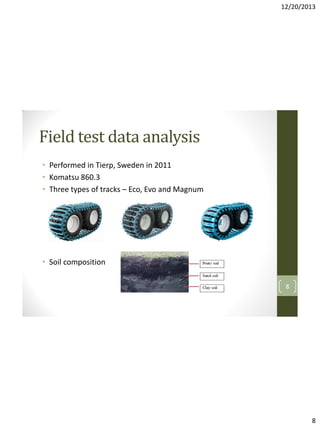
• Performed in Tierp, Sweden in 2011
• Komatsu 860.3
• Three types of tracks – Eco, Evo and Magnum

• Soil composition
8

8
12/20/2013

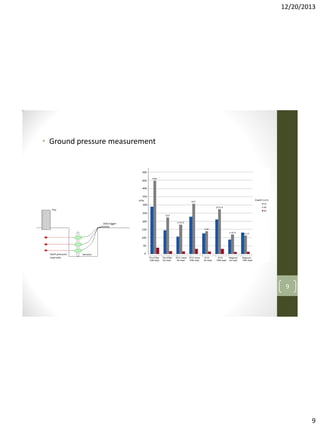
• Ground pressure measurement

9

9
12/20/2013

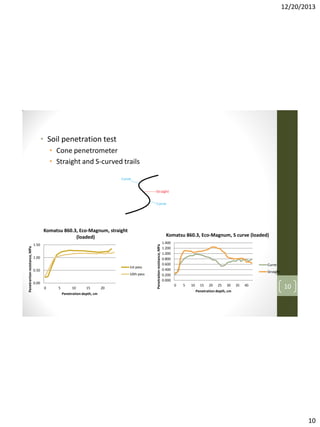
• Soil penetration test
• Cone penetrometer
• Straight and S-curved trails

Komatsu 860.3, Eco-Magnum, S curve (loaded)

1.50
1.00
1st pass

0.50

10th pass

0.00
0

5

10

15

Penetration depth, cm

20

Penetration resistance, MPa

Penetrartion resistance, MPa

Komatsu 860.3, Eco-Magnum, straight
(loaded)

1.400
1.200
1.000
0.800
0.600
0.400
0.200
0.000

Curve
Straight

0

5

10

15

20

25

30

Penetration depth, cm

35

40

10

10
12/20/2013

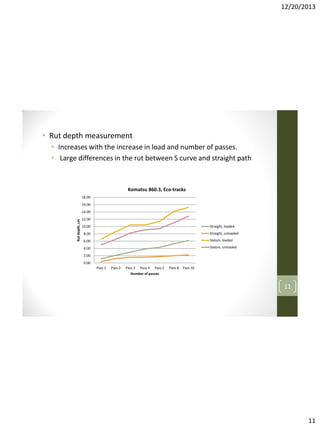
• Rut depth measurement
• Increases with the increase in load and number of passes.
• Large differences in the rut between S curve and straight path

Komatsu 860.3, Eco-tracks
18.00
16.00

Rut depth, cm

14.00
12.00
10.00

Straight, loaded

8.00

Straight, unloaded

6.00

Slalom, loaded

4.00

Slalom, unloaded

2.00
0.00
Pass 1

Pass 2

Pass 3

Pass 4

Pass 5

Pass 8

Pass 10

Number of passes

11

11
12/20/2013

Comparative study of tracked
and wheeled forest machines
•
•
•
•

Ground pressure
WES mobility models
Performance parameters
Rut depth analysis

12

12
12/20/2013

Ground Pressure Models, Tracks

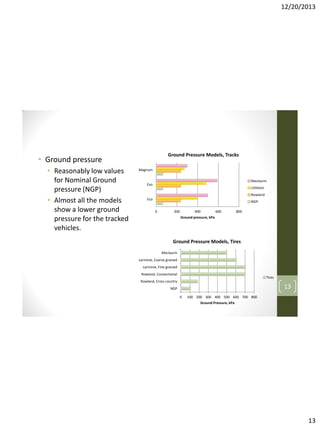
• Ground pressure
• Reasonably low values
for Nominal Ground
pressure (NGP)
• Almost all the models
show a lower ground
pressure for the tracked
vehicles.

Magnum
Maclaurin

Evo

Littleton
Rowland

Eco

NGP
0

200

400

600

800

Ground pressure, kPa

Ground Pressure Models, Tires
Maclaurin
Larminie, Coarse grained
Larminie, Fine grained
Rowland, Conventional

Tires

Rowland, Cross country

13

NGP
0

100 200 300 400 500 600 700 800
Ground Pressure, kPa

13
12/20/2013

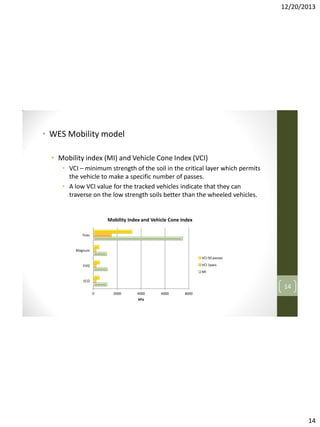
• WES Mobility model
• Mobility index (MI) and Vehicle Cone Index (VCI)
• VCI – minimum strength of the soil in the critical layer which permits
the vehicle to make a specific number of passes.
• A low VCI value for the tracked vehicles indicate that they can
traverse on the low strength soils better than the wheeled vehicles.

Mobility Index and Vehicle Cone Index
Tires

Magnum
VCI 50 passes
VCI 1pass

EVO

MI
ECO

14
0

2000

4000

6000

8000

kPa

14
12/20/2013

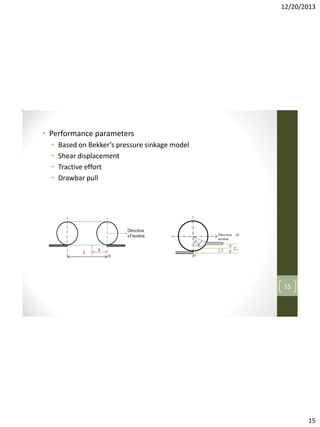
• Performance parameters
•
•
•
•

Based on Bekker’s pressure sinkage model
Shear displacement
Tractive effort
Drawbar pull

15

15
12/20/2013

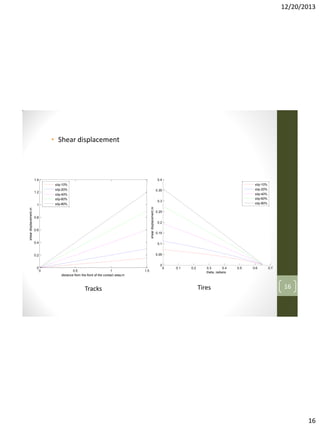
• Shear displacement

SHEAR DISPLACEMENT DUE TO TRACKS

SHEAR DISPLACEMENT DUE TO Tires ON USL

1.4

0.4

slip-10%
slip-20%
slip-40%
slip-60%
slip-80%

1.2

0.3
shear displacement,m

shear displacement,m

1

slip-10%
slip-20%
slip-40%
slip-60%
slip-80%

0.35

0.8

0.6

0.25
0.2
0.15

0.4

0.1

0.2

0.05

0

0

0

0.5
1
distance from the front of the contact area,m

Tracks

1.5

0

0.1

0.2

0.3
0.4
theta, radians

Tires

0.5

0.6

0.7

16

16
12/20/2013

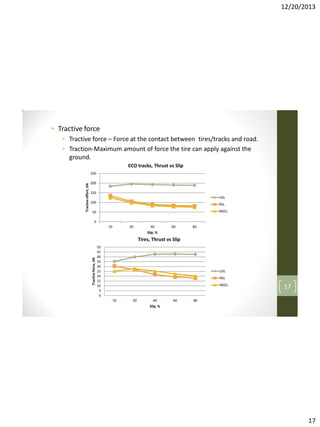
• Tractive force
• Tractive force – Force at the contact between tires/tracks and road.
• Traction-Maximum amount of force the tire can apply against the
ground.
ECO tracks, Thrust vs Slip
200
150
USL
100

RSL
NGCL

50
0
10

20

40

60

80

Slip, %

Tires, Thrust vs Slip

Tractive force, kN

Tractive effort, kN

250

50
45
40
35
30
25
20
15
10
5
0

USL
RSL
NGCL

10

20

40

60

17

80

Slip, %

17
12/20/2013

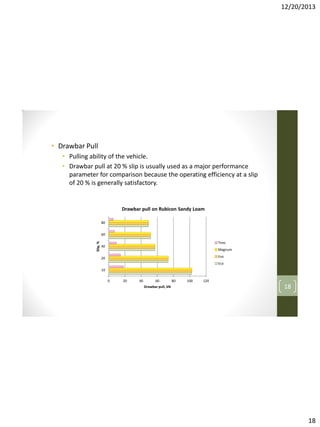
• Drawbar Pull
• Pulling ability of the vehicle.
• Drawbar pull at 20 % slip is usually used as a major performance
parameter for comparison because the operating efficiency at a slip
of 20 % is generally satisfactory.

Drawbar pull on Rubicon Sandy Loam
80

Slip, %

60
Tires

40

Magnum
Evo

20

Eco
10
0

20

40

60
Drawbar pull, kN

80

100

120

18

18
12/20/2013

• Rut depth analysis
• Willoughby and Turnage
• Single pass rut depth models
• Multi-pass rut depth models

19

19
12/20/2013

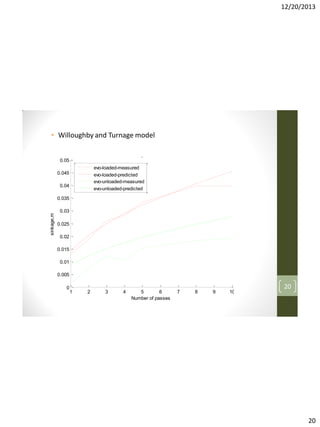
• Willoughby and Turnage model
WES sinkage model, Evo tracks
0.05
evo-loaded-measured
evo-loaded-predicted
evo-unloaded-measured
evo-unloaded-predicted

0.045
0.04

sinkage,m

0.035
0.03
0.025
0.02
0.015
0.01
0.005
0

1

2

3

4

5
6
Number of passes

7

8

9

10

20

20
12/20/2013

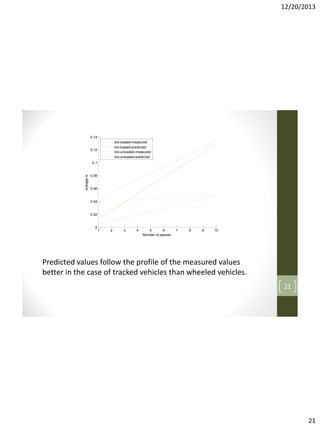
WES Sinkage model, tires
0.14
tire-loaded-measured
tire-loaded-predicted
tire-unloaded-measured
tire-unloaded-predicted

0.12

sinkage,m

0.1

0.08

0.06

0.04

0.02

0

1

2

3

4

5
6
Number of passes

7

8

9

10

Predicted values follow the profile of the measured values
better in the case of tracked vehicles than wheeled vehicles.
21

21
12/20/2013

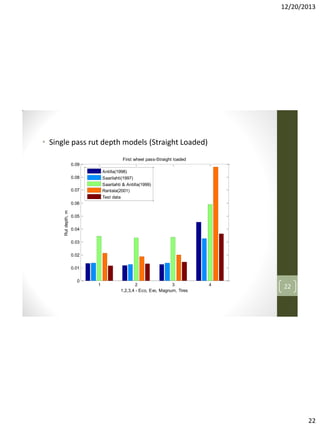
• Single pass rut depth models (Straight Loaded)
First wheel pass-Straight loaded
0.09
Antilla(1998)
Saarilahti(1997)
Saarilahti & Antilla(1999)
Rantala(2001)
Test data

0.08
0.07

Rut depth, m

0.06
0.05
0.04
0.03
0.02
0.01
0

1

2
3
1,2,3,4 - Eco, Evo, Magnum, Tires

4

22

22
12/20/2013

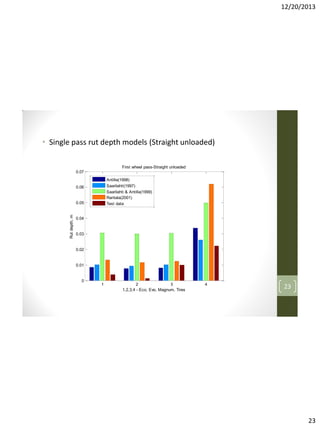
• Single pass rut depth models (Straight unloaded)
First wheel pass-Straight unloaded
0.07
Antilla(1998)
Saarilahti(1997)
Saarilahti & Antilla(1999)
Rantala(2001)
Test data

0.06

Rut depth, m

0.05

0.04

0.03

0.02

0.01

0

1

2
3
1,2,3,4 - Eco, Evo, Magnum, Tires

4

23

23
12/20/2013

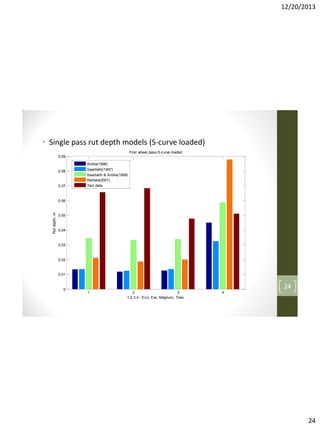
• Single pass rut depth models (S-curve loaded)
First wheel pass-S-curve loaded
0.09

0.08

0.07

Antilla(1998)
Saarilahti(1997)
Saarilahti & Antilla(1999)
Rantala(2001)
Test data

Rut depth, m

0.06

0.05

0.04

0.03

0.02

0.01

0

24
1

2
3
1,2,3,4 - Eco, Evo, Magnum, Tires

4

24
12/20/2013

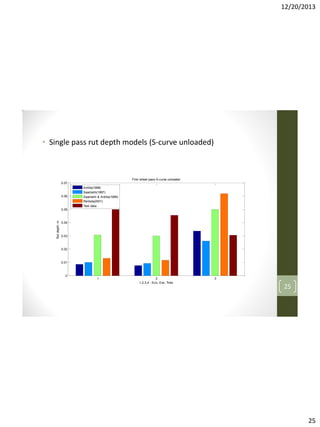
• Single pass rut depth models (S-curve unloaded)

First wheel pass-S-curve unloaded
0.07

0.06

Antilla(1998)
Saarilahti(1997)
Saarilahti & Antilla(1999)
Rantala(2001)
Test data

Rut depth, m

0.05

0.04

0.03

0.02

0.01

0

1

2
1,2,3,4 - Eco, Evo, Tires

3

25

25
12/20/2013

Tires

Tracks

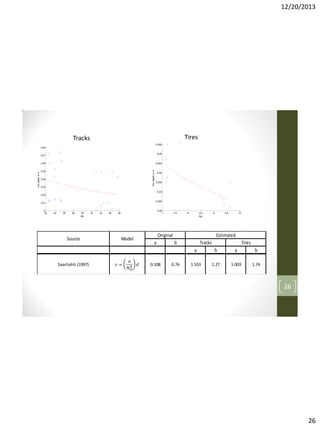
regression analysis for Saarilahti(1997) model
0.055

regression analysis for Saarilahti(1997) model
0.08

0.05

0.07

0.045
Rut depth in m

Rut depth in m

0.06
0.05
0.04

0.04

0.035

0.03

0.03
0.02

0.025

0.01
0
22

24

26

28

30
Nci

32

Source

Source

34

36

0.02

38

Model

Model

7

7.5

8

8.5
Nci

9

Original
a

b

10

Tracks
a

Original
a

9.5

Estimated

b

Tires
bEstimateda

Tracks
0.8060
b

b

Tires 0.366
b

Antilla (1998)

(-0.001)

0.248

(-0.0061)

Antilla (1998)
Saarilahti (1997)

(-0.001)
0.108

0.248
0.76

(-0.0061)
1.553

0.8060
1.27

(-0.0187)
1.003

0.366
1.74

Saarilahti & Antilla(1999)
Saarilahti (1997)

0.023
0.108

0.256
0.76

(-0.0082)
1.553

1.08
1.27

(-0.025)
1.003

0.491
1.74

a

(-0.0187)

a

Rantala (2001)

0.989

1.23

2.08

1.27

1.344

1.741

Saarilahti & Antilla(1999)

0.023

0.256

(-0.0082)

1.08

(-0.025)

0.491

Rantala (2001)

0.989

1.23

2.08

1.27

1.344

26

1.741

26
12/20/2013

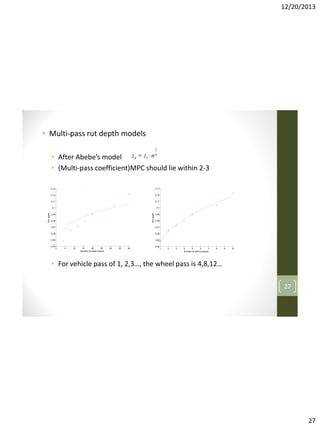
• Multi-pass rut depth models
1

• After Abebe’s model
• (Multi-pass coefficient)MPC should lie within 2-3
zn

z1 n a

magnum loaded-slalom

magnum loaded-slalom
0.13

0.13

0.12

0.12

0.11

0.11
0.1
Rut depth

Rut depth

0.1
0.09
0.08

0.09
0.08

0.07

0.07

0.06

0.06

0.05
0.04

0.05

0

5

10

15
20
25
Number of wheel passes

30

35

40

0.04

1

2

3

4
5
6
7
Number of vehicle passes

8

9

10

• For vehicle pass of 1, 2,3…, the wheel pass is 4,8,12…
27

27
12/20/2013

Conclusion
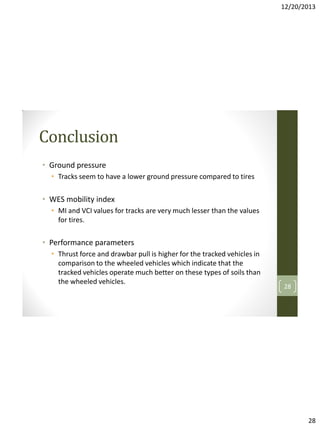
• Ground pressure
• Tracks seem to have a lower ground pressure compared to tires

• WES mobility index
• MI and VCI values for tracks are very much lesser than the values
for tires.

• Performance parameters
• Thrust force and drawbar pull is higher for the tracked vehicles in
comparison to the wheeled vehicles which indicate that the
tracked vehicles operate much better on these types of soils than
the wheeled vehicles.

28

28
12/20/2013

• Rut depth
• The existing models were developed for specific vehicle
conditions and soil conditions. Though the rut depth test data
didn’t match very well with the existing models, they didn’t
deviate so much either.
• Rut depth values can be related to the WES models.

29

29
12/20/2013

Future work
• FEM analysis could be done to see how much the track sinks
and how the pressure will be distributed beneath the tracks.
• In depth analysis on the position and size of the grouser could
be made.

30

30
12/20/2013

Thank you

31

31

Predicting the mobility of tracked forestry machines operating on Nordic forest soil

  • 1.
    12/20/2013 Predicting the mobilityof tracked forestry machines operating on Nordic forest soil Natchammai Revathi Palaniappan, A. Pirnazarov, U. Sellgren, B. Löfgren Forest Machine Technology Academy, KTH 1 1
  • 2.
    12/20/2013 Agenda • • • • • • • • • Background Purpose Division of theproject task Delimitations Terminologies Field test data Comparative study of tracked and wheeled forest machines Conclusion Future Work 2 2
  • 3.
    12/20/2013 Background • Performed asa Master thesis project at KTH • Cut-To-Length Method • Two machine solution (harvester and forwarder) • Development of machines gentler to the ground • Trial and error method • Expensive due to changing demands • Track soil interaction model • Complex and difficult to model • Development of empirical models by WES • Aimed at preserving the productivity of the soil 3 3
  • 4.
    12/20/2013 Purpose • To contributeto the existing knowledge in the field of tracksoil interaction. • Study the vehicle performance • Understand the effects on the environment • Tracked vehicles vs. wheeled vehicles 4 4
  • 5.
    12/20/2013 Division of theproject task 1. Calculate ground pressure, performance parameters, rut depth for tracked and wheeled vehicles. Compare results. 2. Study the field test data and theoretical model results to find out how efficiently the measured data match with the real data. 5 5
  • 6.
    12/20/2013 Delimitations • Entire focusis on soft soil – Uplands Sandy Loam, Rubicon Sandy Loam and North Gower Clayey Loam • Limited to the use of three types of rigid steel tracks (ECO, EVO and MAGNUM) • The roots present in the soil bed are not considered for the analysis. 6 6
  • 7.
    12/20/2013 Terminologies • Rutting • Rutsare formed due to repeated heavy vehicle passes along the same path. • Rutted area becomes too wet due to water logging. • Soil compaction • Physical degradation of the soil. • Porosity, permeability and biological activity is reduced. • Risk of soil erosion. • Ground bearing capacity • Ability of the soil to carry the pressure exerted on it without undergoing shear. • Mobility • Quality or capability of the machine which permits them to move from place to place. 7 7
  • 8.
    12/20/2013 Field test dataanalysis • Performed in Tierp, Sweden in 2011 • Komatsu 860.3 • Three types of tracks – Eco, Evo and Magnum • Soil composition 8 8
  • 9.
  • 10.
    12/20/2013 • Soil penetrationtest • Cone penetrometer • Straight and S-curved trails Komatsu 860.3, Eco-Magnum, S curve (loaded) 1.50 1.00 1st pass 0.50 10th pass 0.00 0 5 10 15 Penetration depth, cm 20 Penetration resistance, MPa Penetrartion resistance, MPa Komatsu 860.3, Eco-Magnum, straight (loaded) 1.400 1.200 1.000 0.800 0.600 0.400 0.200 0.000 Curve Straight 0 5 10 15 20 25 30 Penetration depth, cm 35 40 10 10
  • 11.
    12/20/2013 • Rut depthmeasurement • Increases with the increase in load and number of passes. • Large differences in the rut between S curve and straight path Komatsu 860.3, Eco-tracks 18.00 16.00 Rut depth, cm 14.00 12.00 10.00 Straight, loaded 8.00 Straight, unloaded 6.00 Slalom, loaded 4.00 Slalom, unloaded 2.00 0.00 Pass 1 Pass 2 Pass 3 Pass 4 Pass 5 Pass 8 Pass 10 Number of passes 11 11
  • 12.
    12/20/2013 Comparative study oftracked and wheeled forest machines • • • • Ground pressure WES mobility models Performance parameters Rut depth analysis 12 12
  • 13.
    12/20/2013 Ground Pressure Models,Tracks • Ground pressure • Reasonably low values for Nominal Ground pressure (NGP) • Almost all the models show a lower ground pressure for the tracked vehicles. Magnum Maclaurin Evo Littleton Rowland Eco NGP 0 200 400 600 800 Ground pressure, kPa Ground Pressure Models, Tires Maclaurin Larminie, Coarse grained Larminie, Fine grained Rowland, Conventional Tires Rowland, Cross country 13 NGP 0 100 200 300 400 500 600 700 800 Ground Pressure, kPa 13
  • 14.
    12/20/2013 • WES Mobilitymodel • Mobility index (MI) and Vehicle Cone Index (VCI) • VCI – minimum strength of the soil in the critical layer which permits the vehicle to make a specific number of passes. • A low VCI value for the tracked vehicles indicate that they can traverse on the low strength soils better than the wheeled vehicles. Mobility Index and Vehicle Cone Index Tires Magnum VCI 50 passes VCI 1pass EVO MI ECO 14 0 2000 4000 6000 8000 kPa 14
  • 15.
    12/20/2013 • Performance parameters • • • • Basedon Bekker’s pressure sinkage model Shear displacement Tractive effort Drawbar pull 15 15
  • 16.
    12/20/2013 • Shear displacement SHEARDISPLACEMENT DUE TO TRACKS SHEAR DISPLACEMENT DUE TO Tires ON USL 1.4 0.4 slip-10% slip-20% slip-40% slip-60% slip-80% 1.2 0.3 shear displacement,m shear displacement,m 1 slip-10% slip-20% slip-40% slip-60% slip-80% 0.35 0.8 0.6 0.25 0.2 0.15 0.4 0.1 0.2 0.05 0 0 0 0.5 1 distance from the front of the contact area,m Tracks 1.5 0 0.1 0.2 0.3 0.4 theta, radians Tires 0.5 0.6 0.7 16 16
  • 17.
    12/20/2013 • Tractive force •Tractive force – Force at the contact between tires/tracks and road. • Traction-Maximum amount of force the tire can apply against the ground. ECO tracks, Thrust vs Slip 200 150 USL 100 RSL NGCL 50 0 10 20 40 60 80 Slip, % Tires, Thrust vs Slip Tractive force, kN Tractive effort, kN 250 50 45 40 35 30 25 20 15 10 5 0 USL RSL NGCL 10 20 40 60 17 80 Slip, % 17
  • 18.
    12/20/2013 • Drawbar Pull •Pulling ability of the vehicle. • Drawbar pull at 20 % slip is usually used as a major performance parameter for comparison because the operating efficiency at a slip of 20 % is generally satisfactory. Drawbar pull on Rubicon Sandy Loam 80 Slip, % 60 Tires 40 Magnum Evo 20 Eco 10 0 20 40 60 Drawbar pull, kN 80 100 120 18 18
  • 19.
    12/20/2013 • Rut depthanalysis • Willoughby and Turnage • Single pass rut depth models • Multi-pass rut depth models 19 19
  • 20.
    12/20/2013 • Willoughby andTurnage model WES sinkage model, Evo tracks 0.05 evo-loaded-measured evo-loaded-predicted evo-unloaded-measured evo-unloaded-predicted 0.045 0.04 sinkage,m 0.035 0.03 0.025 0.02 0.015 0.01 0.005 0 1 2 3 4 5 6 Number of passes 7 8 9 10 20 20
  • 21.
    12/20/2013 WES Sinkage model,tires 0.14 tire-loaded-measured tire-loaded-predicted tire-unloaded-measured tire-unloaded-predicted 0.12 sinkage,m 0.1 0.08 0.06 0.04 0.02 0 1 2 3 4 5 6 Number of passes 7 8 9 10 Predicted values follow the profile of the measured values better in the case of tracked vehicles than wheeled vehicles. 21 21
  • 22.
    12/20/2013 • Single passrut depth models (Straight Loaded) First wheel pass-Straight loaded 0.09 Antilla(1998) Saarilahti(1997) Saarilahti & Antilla(1999) Rantala(2001) Test data 0.08 0.07 Rut depth, m 0.06 0.05 0.04 0.03 0.02 0.01 0 1 2 3 1,2,3,4 - Eco, Evo, Magnum, Tires 4 22 22
  • 23.
    12/20/2013 • Single passrut depth models (Straight unloaded) First wheel pass-Straight unloaded 0.07 Antilla(1998) Saarilahti(1997) Saarilahti & Antilla(1999) Rantala(2001) Test data 0.06 Rut depth, m 0.05 0.04 0.03 0.02 0.01 0 1 2 3 1,2,3,4 - Eco, Evo, Magnum, Tires 4 23 23
  • 24.
    12/20/2013 • Single passrut depth models (S-curve loaded) First wheel pass-S-curve loaded 0.09 0.08 0.07 Antilla(1998) Saarilahti(1997) Saarilahti & Antilla(1999) Rantala(2001) Test data Rut depth, m 0.06 0.05 0.04 0.03 0.02 0.01 0 24 1 2 3 1,2,3,4 - Eco, Evo, Magnum, Tires 4 24
  • 25.
    12/20/2013 • Single passrut depth models (S-curve unloaded) First wheel pass-S-curve unloaded 0.07 0.06 Antilla(1998) Saarilahti(1997) Saarilahti & Antilla(1999) Rantala(2001) Test data Rut depth, m 0.05 0.04 0.03 0.02 0.01 0 1 2 1,2,3,4 - Eco, Evo, Tires 3 25 25
  • 26.
    12/20/2013 Tires Tracks regression analysis forSaarilahti(1997) model 0.055 regression analysis for Saarilahti(1997) model 0.08 0.05 0.07 0.045 Rut depth in m Rut depth in m 0.06 0.05 0.04 0.04 0.035 0.03 0.03 0.02 0.025 0.01 0 22 24 26 28 30 Nci 32 Source Source 34 36 0.02 38 Model Model 7 7.5 8 8.5 Nci 9 Original a b 10 Tracks a Original a 9.5 Estimated b Tires bEstimateda Tracks 0.8060 b b Tires 0.366 b Antilla (1998) (-0.001) 0.248 (-0.0061) Antilla (1998) Saarilahti (1997) (-0.001) 0.108 0.248 0.76 (-0.0061) 1.553 0.8060 1.27 (-0.0187) 1.003 0.366 1.74 Saarilahti & Antilla(1999) Saarilahti (1997) 0.023 0.108 0.256 0.76 (-0.0082) 1.553 1.08 1.27 (-0.025) 1.003 0.491 1.74 a (-0.0187) a Rantala (2001) 0.989 1.23 2.08 1.27 1.344 1.741 Saarilahti & Antilla(1999) 0.023 0.256 (-0.0082) 1.08 (-0.025) 0.491 Rantala (2001) 0.989 1.23 2.08 1.27 1.344 26 1.741 26
  • 27.
    12/20/2013 • Multi-pass rutdepth models 1 • After Abebe’s model • (Multi-pass coefficient)MPC should lie within 2-3 zn z1 n a magnum loaded-slalom magnum loaded-slalom 0.13 0.13 0.12 0.12 0.11 0.11 0.1 Rut depth Rut depth 0.1 0.09 0.08 0.09 0.08 0.07 0.07 0.06 0.06 0.05 0.04 0.05 0 5 10 15 20 25 Number of wheel passes 30 35 40 0.04 1 2 3 4 5 6 7 Number of vehicle passes 8 9 10 • For vehicle pass of 1, 2,3…, the wheel pass is 4,8,12… 27 27
  • 28.
    12/20/2013 Conclusion • Ground pressure •Tracks seem to have a lower ground pressure compared to tires • WES mobility index • MI and VCI values for tracks are very much lesser than the values for tires. • Performance parameters • Thrust force and drawbar pull is higher for the tracked vehicles in comparison to the wheeled vehicles which indicate that the tracked vehicles operate much better on these types of soils than the wheeled vehicles. 28 28
  • 29.
    12/20/2013 • Rut depth •The existing models were developed for specific vehicle conditions and soil conditions. Though the rut depth test data didn’t match very well with the existing models, they didn’t deviate so much either. • Rut depth values can be related to the WES models. 29 29
  • 30.
    12/20/2013 Future work • FEManalysis could be done to see how much the track sinks and how the pressure will be distributed beneath the tracks. • In depth analysis on the position and size of the grouser could be made. 30 30
  • 31.