12/20/2013

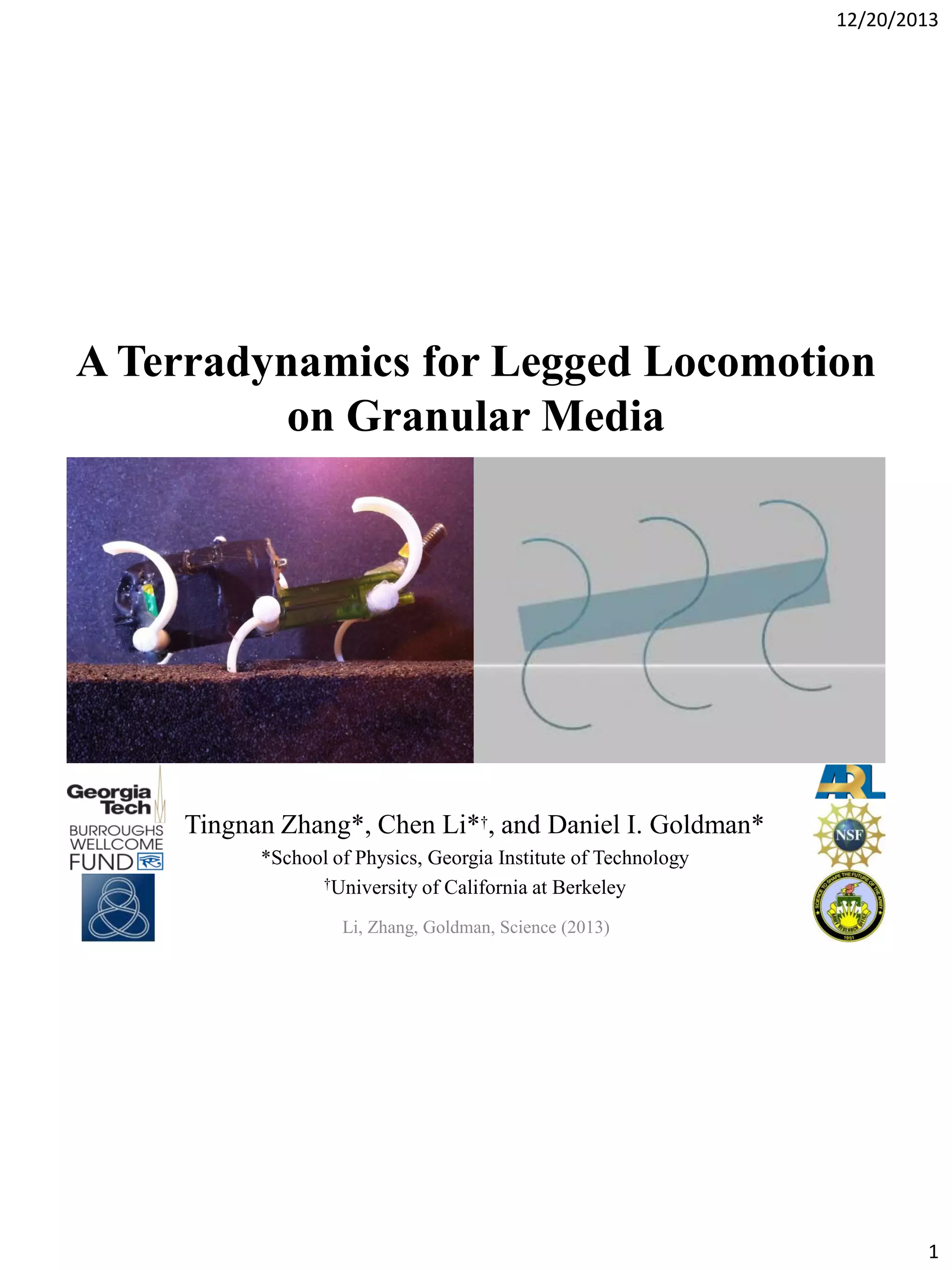
A Terradynamics for Legged Locomotion
on Granular Media

Tingnan Zhang*, Chen Li*†, and Daniel I. Goldman*
*School of Physics, Georgia Institute of Technology
†University of California at Berkeley
Li, Zhang, Goldman, Science (2013)

1
12/20/2013

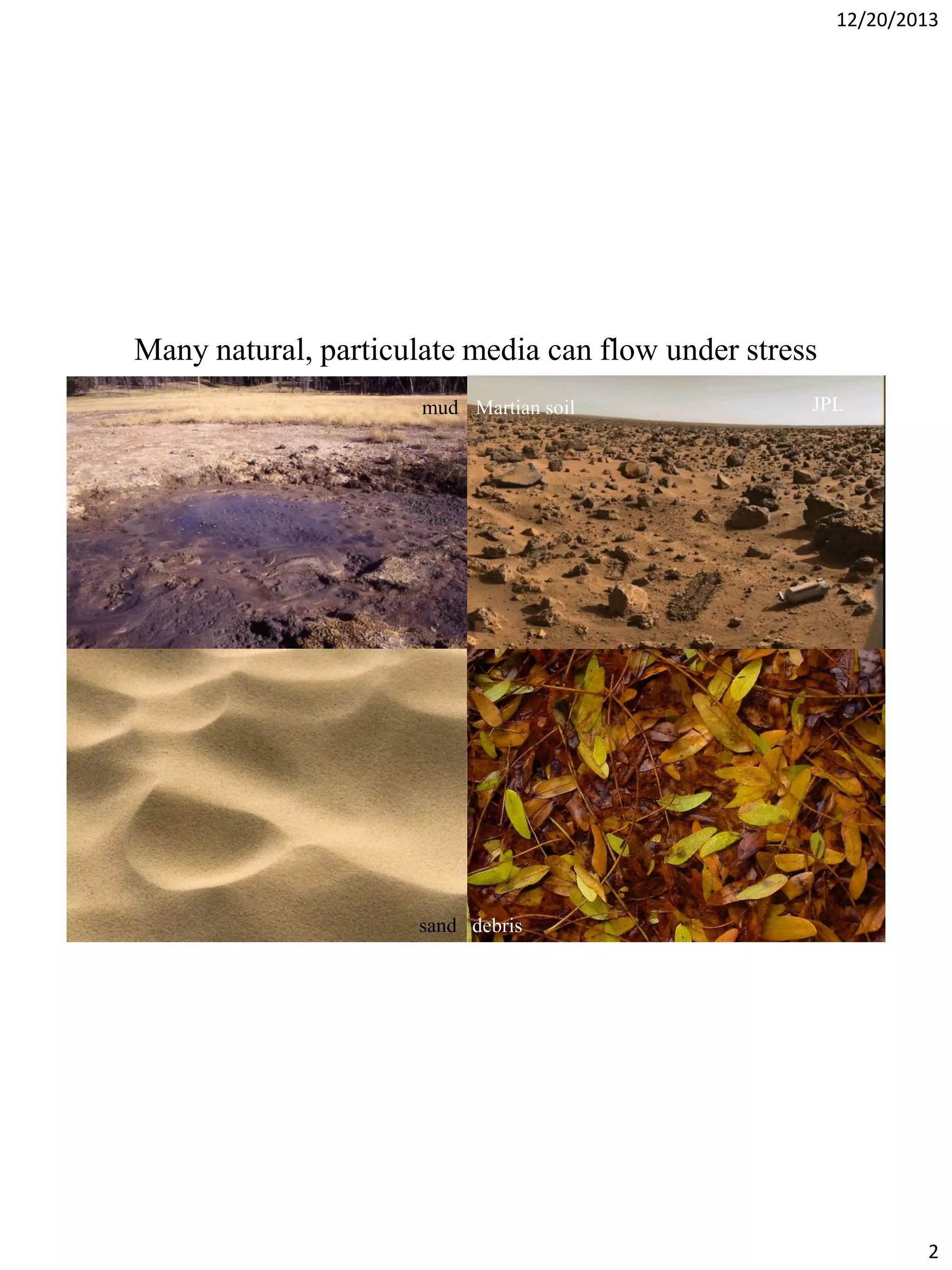
Many natural, particulate media can flow under stress
mud Martian soil

JPL

sand debris

2
12/20/2013

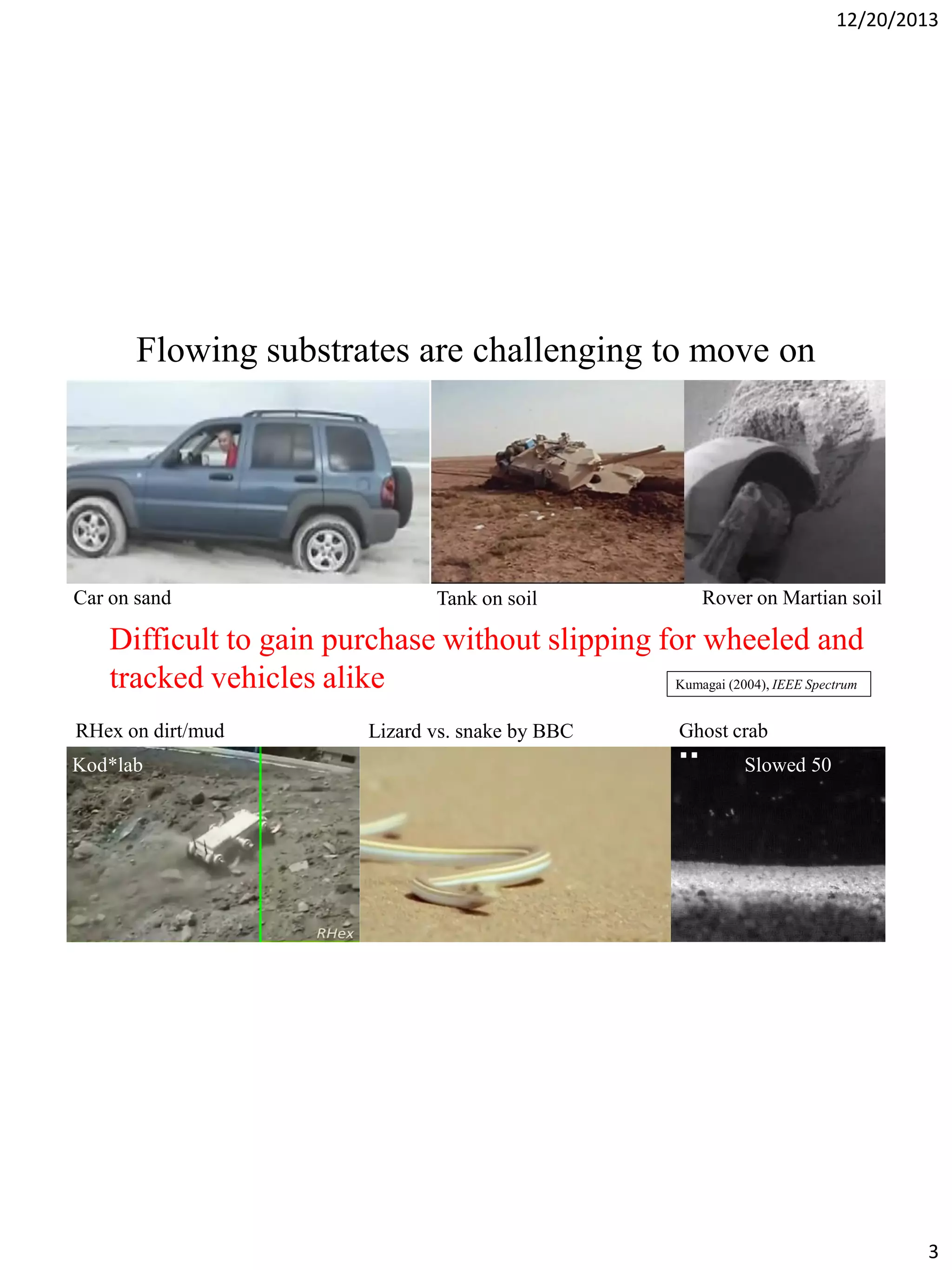
Flowing substrates are challenging to move on

JPL
Car on sand

Tank on soil

Rover on Martian soil

Difficult to gain purchase without slipping for wheeled and
tracked vehicles alike
Kumagai (2004), IEEE Spectrum
RHex on dirt/mud
Kod*lab

Lizard vs. snake by BBC

Ghost crab
Slowed 50

3
12/20/2013

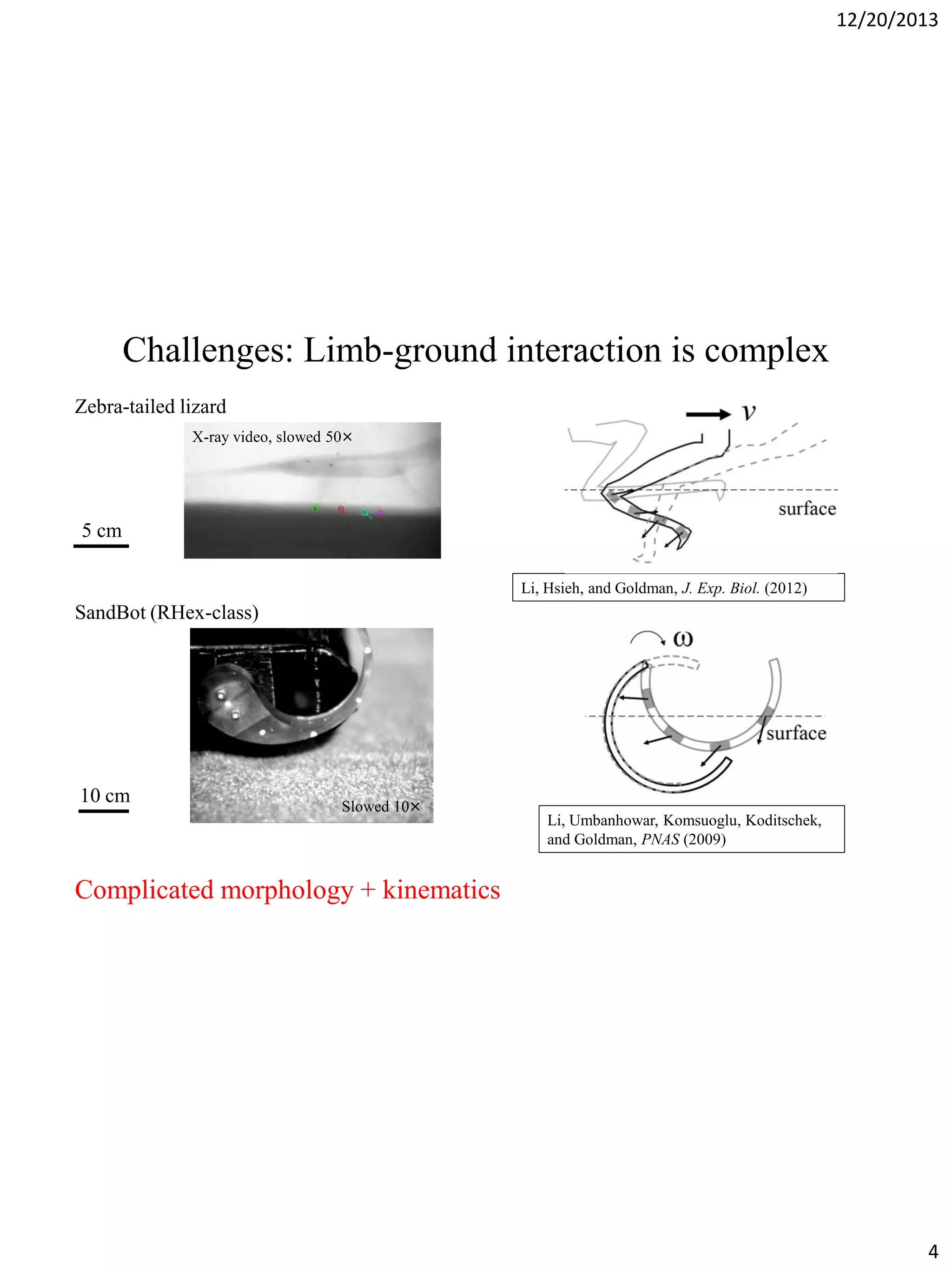
Challenges: Limb-ground interaction is complex
Zebra-tailed lizard
X-ray video, slowed 50×

5 cm
Li, Hsieh, and Goldman, J. Exp. Biol. (2012)

SandBot (RHex-class)

10 cm

Slowed 10×

Li, Umbanhowar, Komsuoglu, Koditschek,
and Goldman, PNAS (2009)

Complicated morphology + kinematics

4
12/20/2013

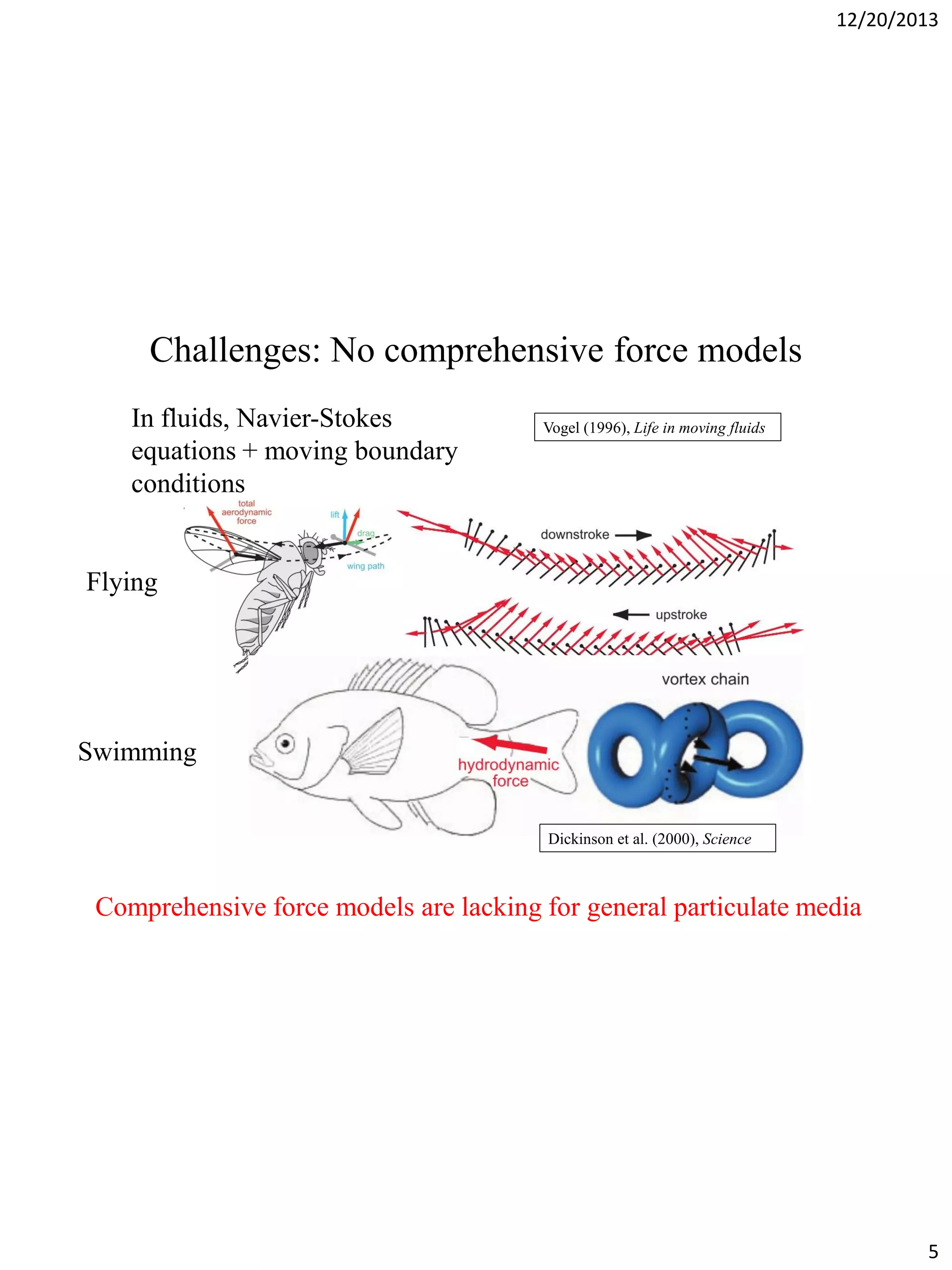
Challenges: No comprehensive force models
In fluids, Navier-Stokes
equations + moving boundary
conditions

Vogel (1996), Life in moving fluids

Flying

Swimming
Dickinson et al. (2000), Science

Comprehensive force models are lacking for general particulate media

5
12/20/2013

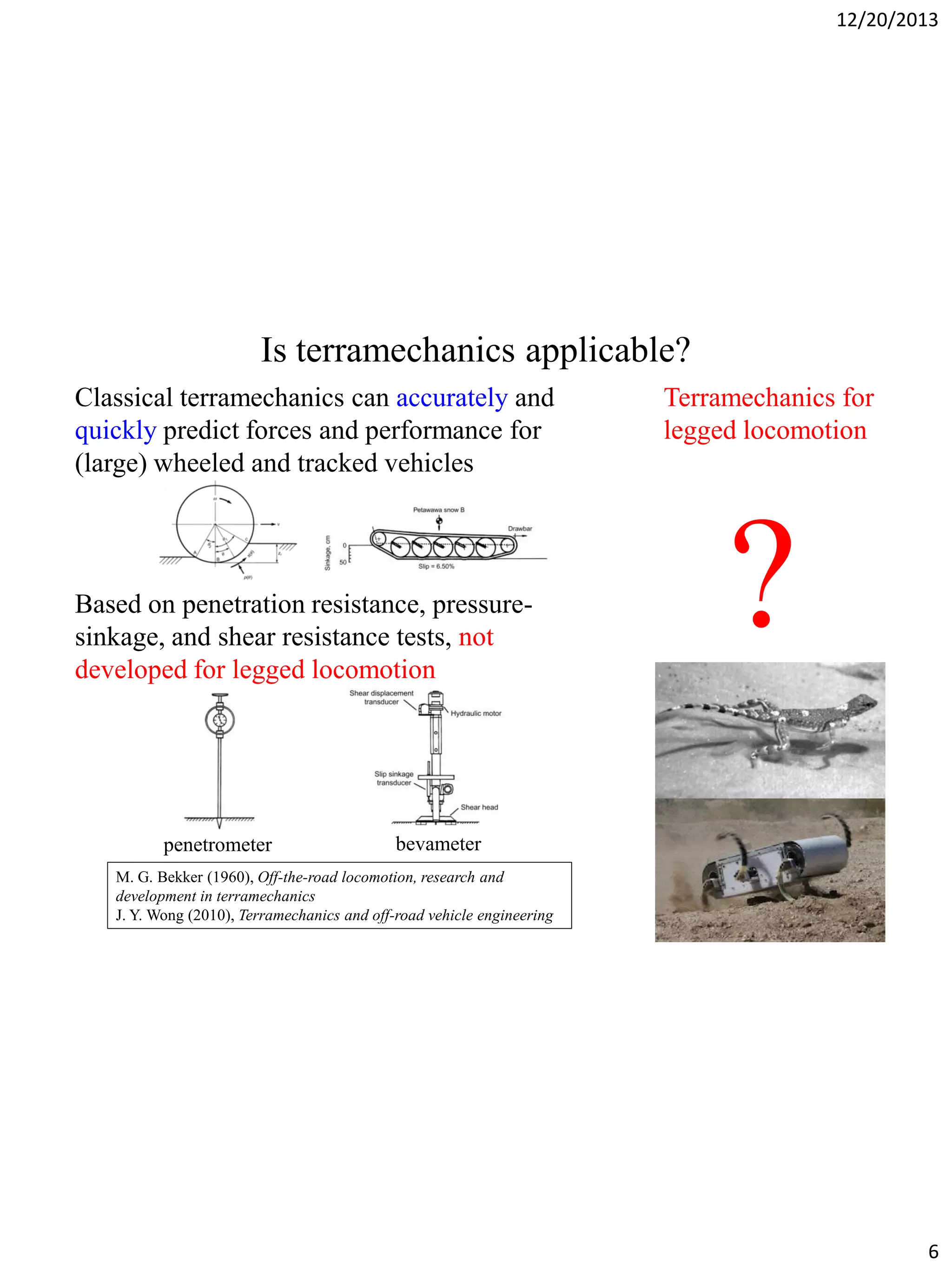
Is terramechanics applicable?
Classical terramechanics can accurately and
quickly predict forces and performance for
(large) wheeled and tracked vehicles

Based on penetration resistance, pressuresinkage, and shear resistance tests, not
developed for legged locomotion

penetrometer

Terramechanics for
legged locomotion

?

bevameter

M. G. Bekker (1960), Off-the-road locomotion, research and
development in terramechanics
J. Y. Wong (2010), Terramechanics and off-road vehicle engineering

6
12/20/2013

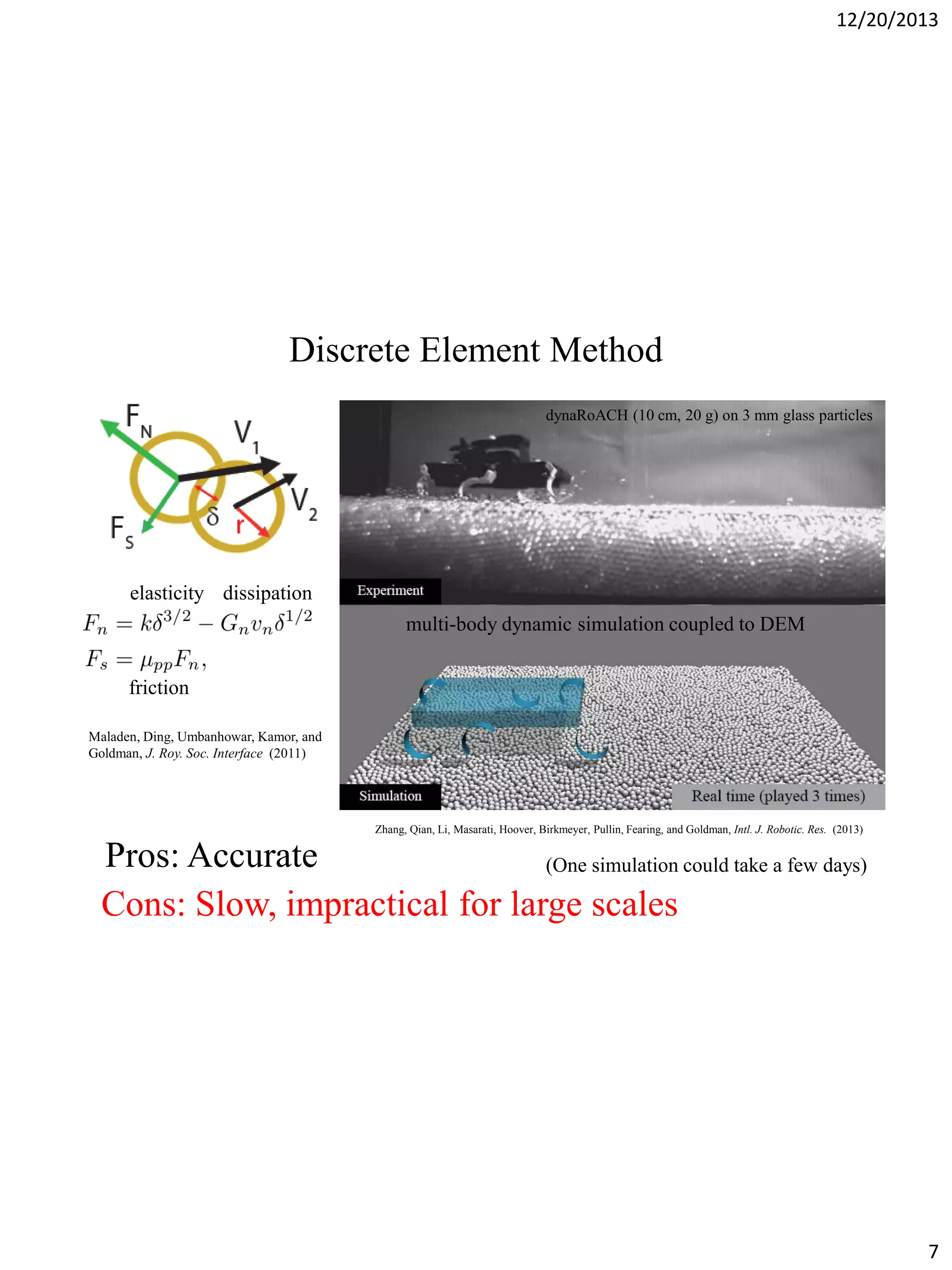
Discrete Element Method
dynaRoACH (10 cm, 20 g) on 3 mm glass particles

elasticity dissipation
multi-body dynamic simulation coupled to DEM
friction
Maladen, Ding, Umbanhowar, Kamor, and
Goldman, J. Roy. Soc. Interface (2011)

Zhang, Qian, Li, Masarati, Hoover, Birkmeyer, Pullin, Fearing, and Goldman, Intl. J. Robotic. Res. (2013)

Pros: Accurate
(One simulation could take a few days)
Cons: Slow, impractical for large scales

7
12/20/2013

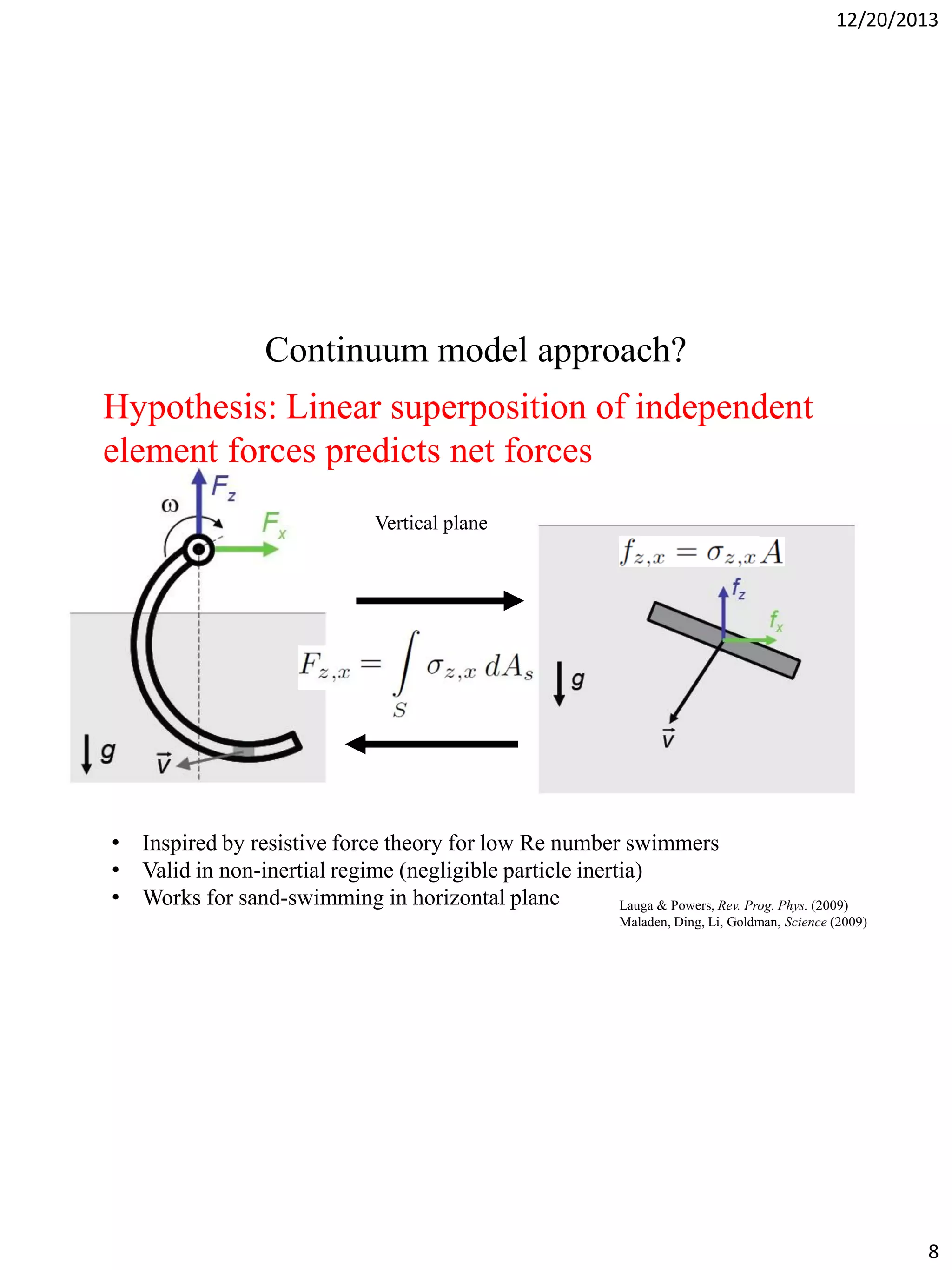
Continuum model approach?
Hypothesis: Linear superposition of independent
element forces predicts net forces
Vertical plane

• Inspired by resistive force theory for low Re number swimmers
• Valid in non-inertial regime (negligible particle inertia)
• Works for sand-swimming in horizontal plane
Lauga & Powers, Rev. Prog. Phys. (2009)
Maladen, Ding, Li, Goldman, Science (2009)

8
12/20/2013

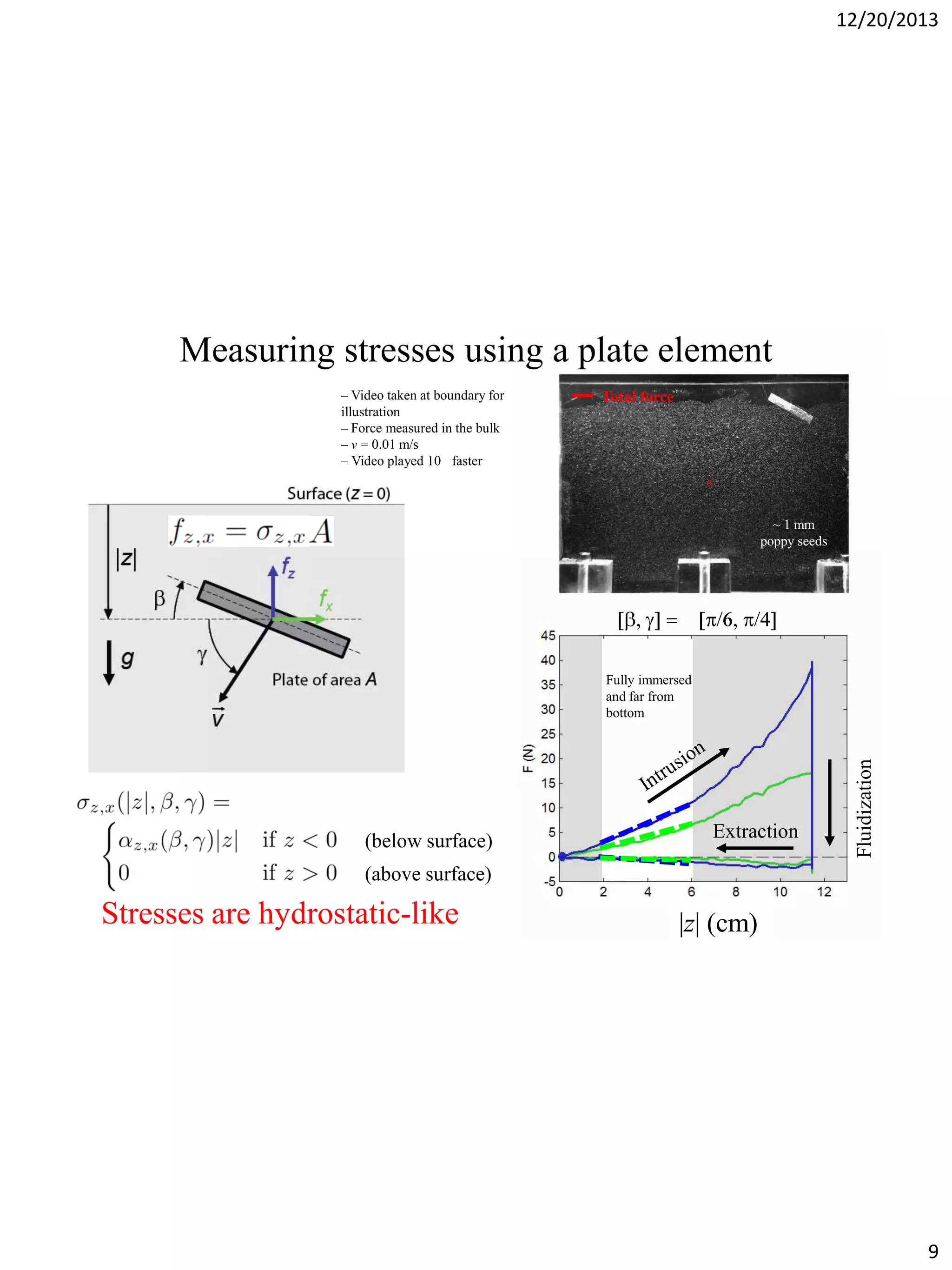
Measuring stresses using a plate element
– Video taken at boundary for
illustration
– Force measured in the bulk
– v = 0.01 m/s
– Video played 10 faster

Total force

~ 1 mm
poppy seeds

(below surface)

Extraction

Fluidization

Fully immersed
and far from
bottom

(above surface)

Stresses are hydrostatic-like

z (cm)

9
12/20/2013

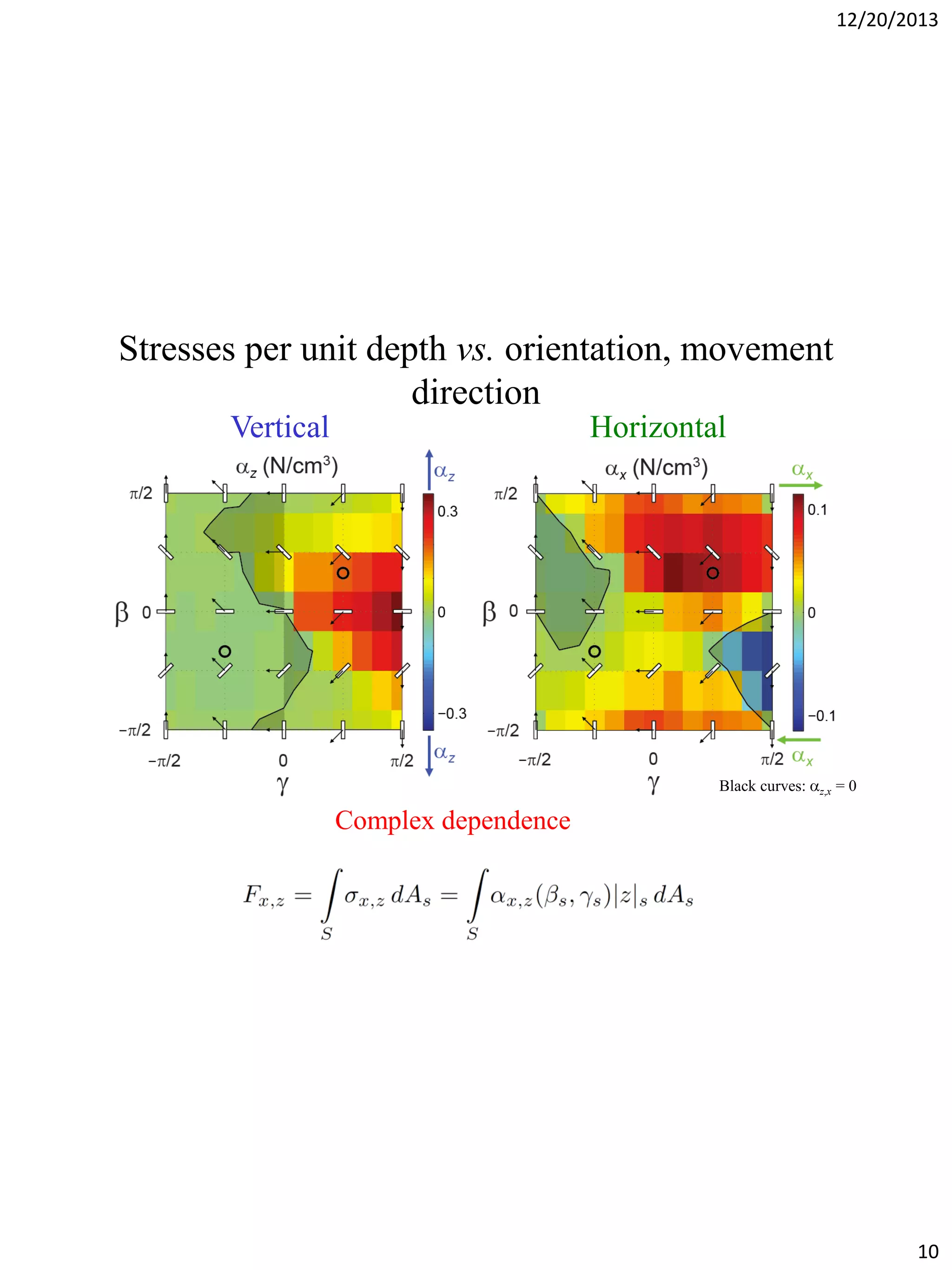
Stresses per unit depth vs. orientation, movement
direction
Vertical

Horizontal

Black curves:

z,x

=0

Complex dependence

10
12/20/2013

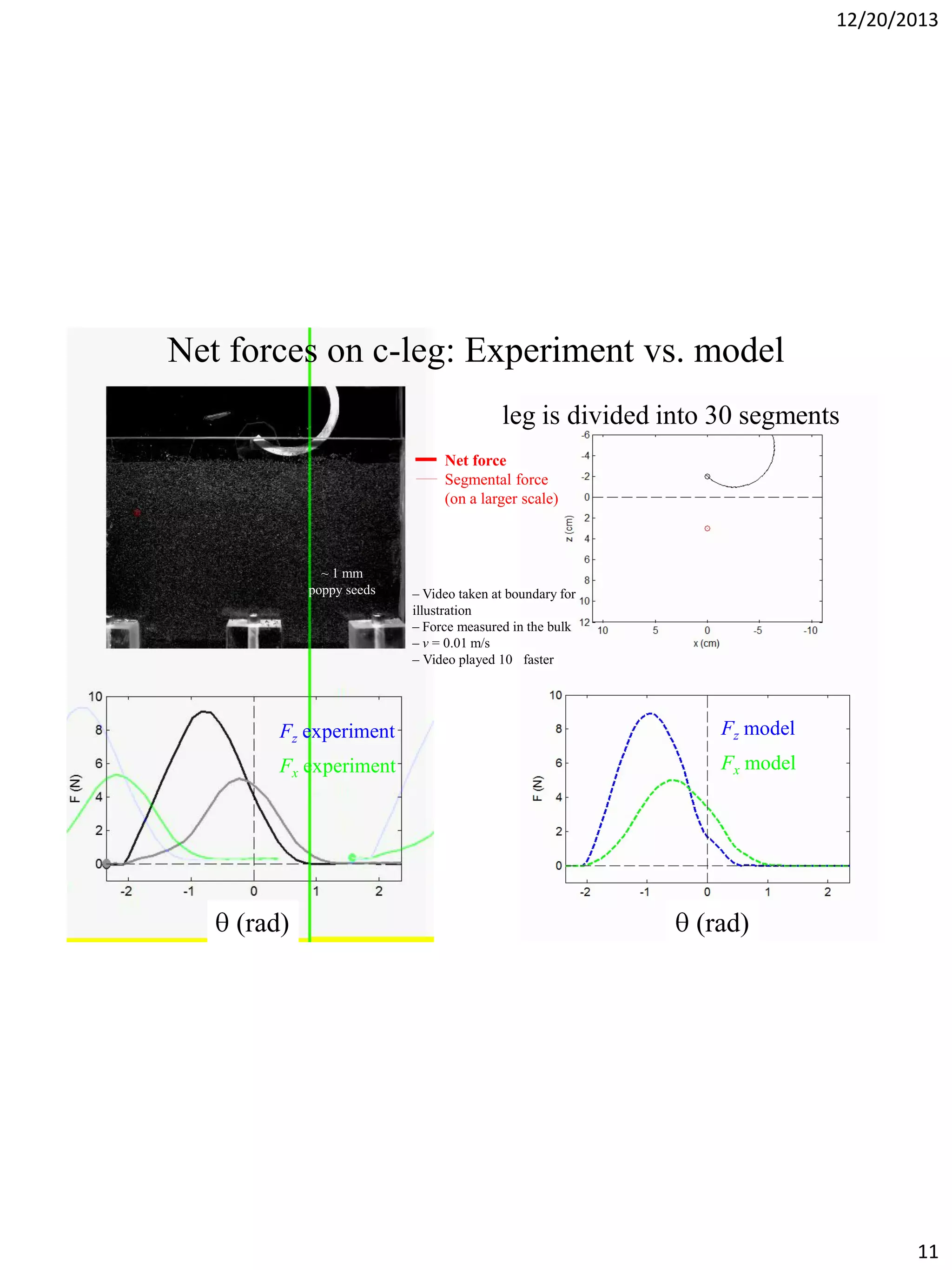
Net forces on c-leg: Experiment vs. model
leg is divided into 30 segments
Net force
Segmental force
(on a larger scale)

~ 1 mm
poppy seeds

– Video taken at boundary for
illustration
– Force measured in the bulk
– v = 0.01 m/s
– Video played 10 faster

Fz experiment

Fz model

Fx experiment

Fx model

(rad)

(rad)

11
12/20/2013

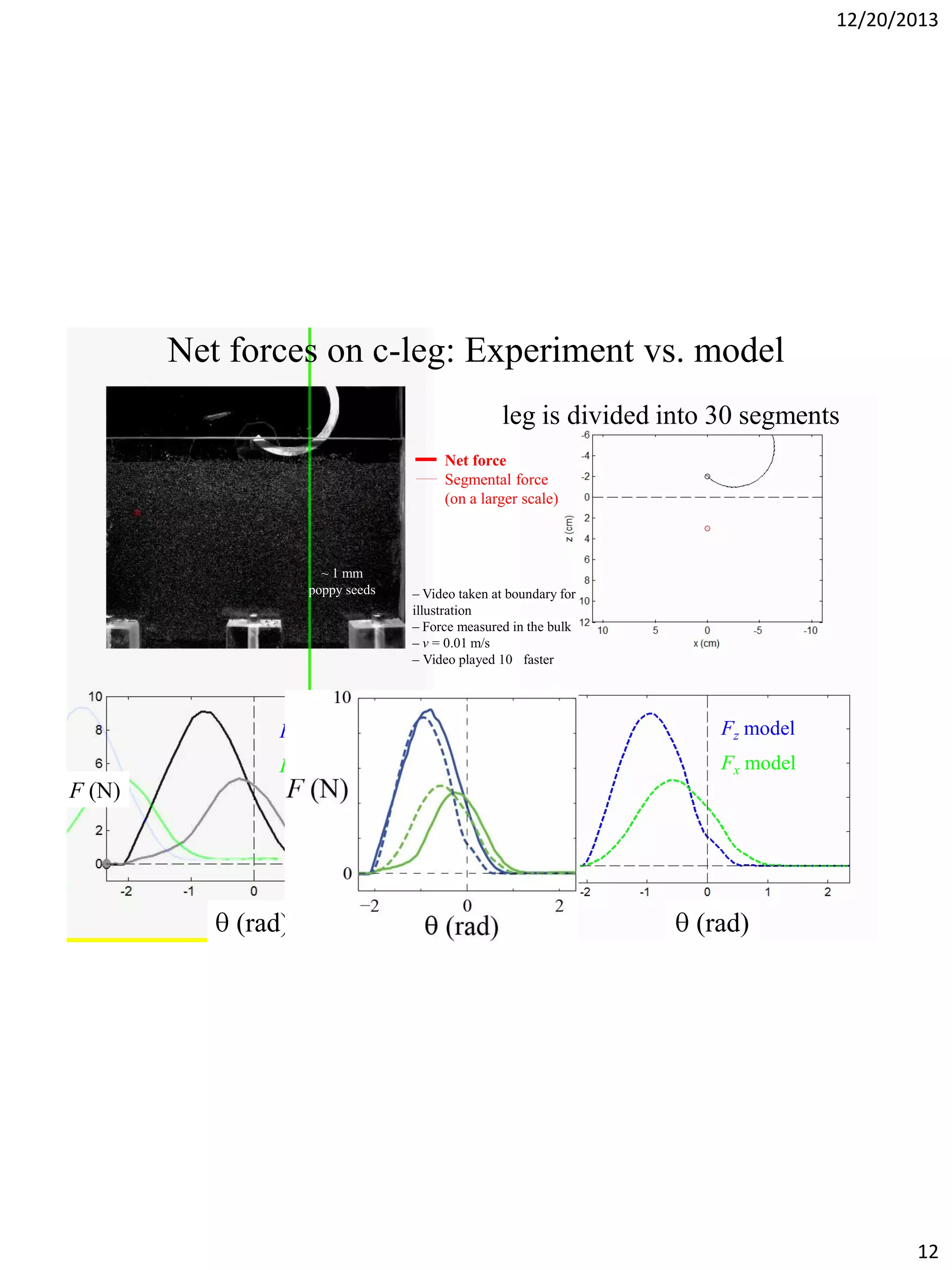
Net forces on c-leg: Experiment vs. model
leg is divided into 30 segments
Net force
Segmental force
(on a larger scale)

~ 1 mm
poppy seeds

– Video taken at boundary for
illustration
– Force measured in the bulk
– v = 0.01 m/s
– Video played 10 faster

Fz model

Fz experiment

F (N)

Fx experiment

(rad)

F (N)

Fx model

(rad)

12
12/20/2013

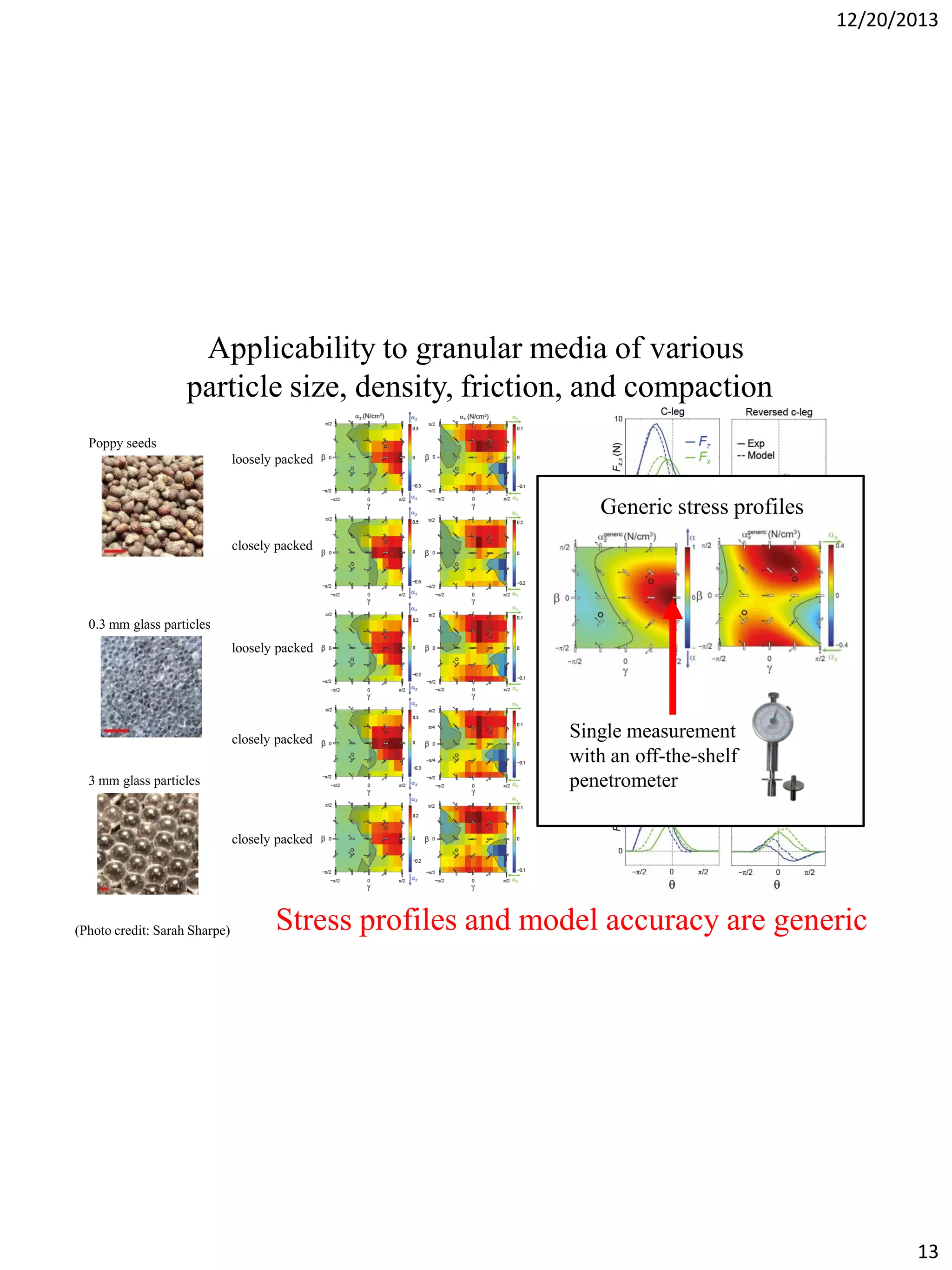
Applicability to granular media of various
particle size, density, friction, and compaction
Poppy seeds
loosely packed

Generic stress profiles
closely packed

0.3 mm glass particles
loosely packed

closely packed
3 mm glass particles

Single measurement
with an off-the-shelf
penetrometer

closely packed

(Photo credit: Sarah Sharpe)

Stress profiles and model accuracy are generic

13
12/20/2013

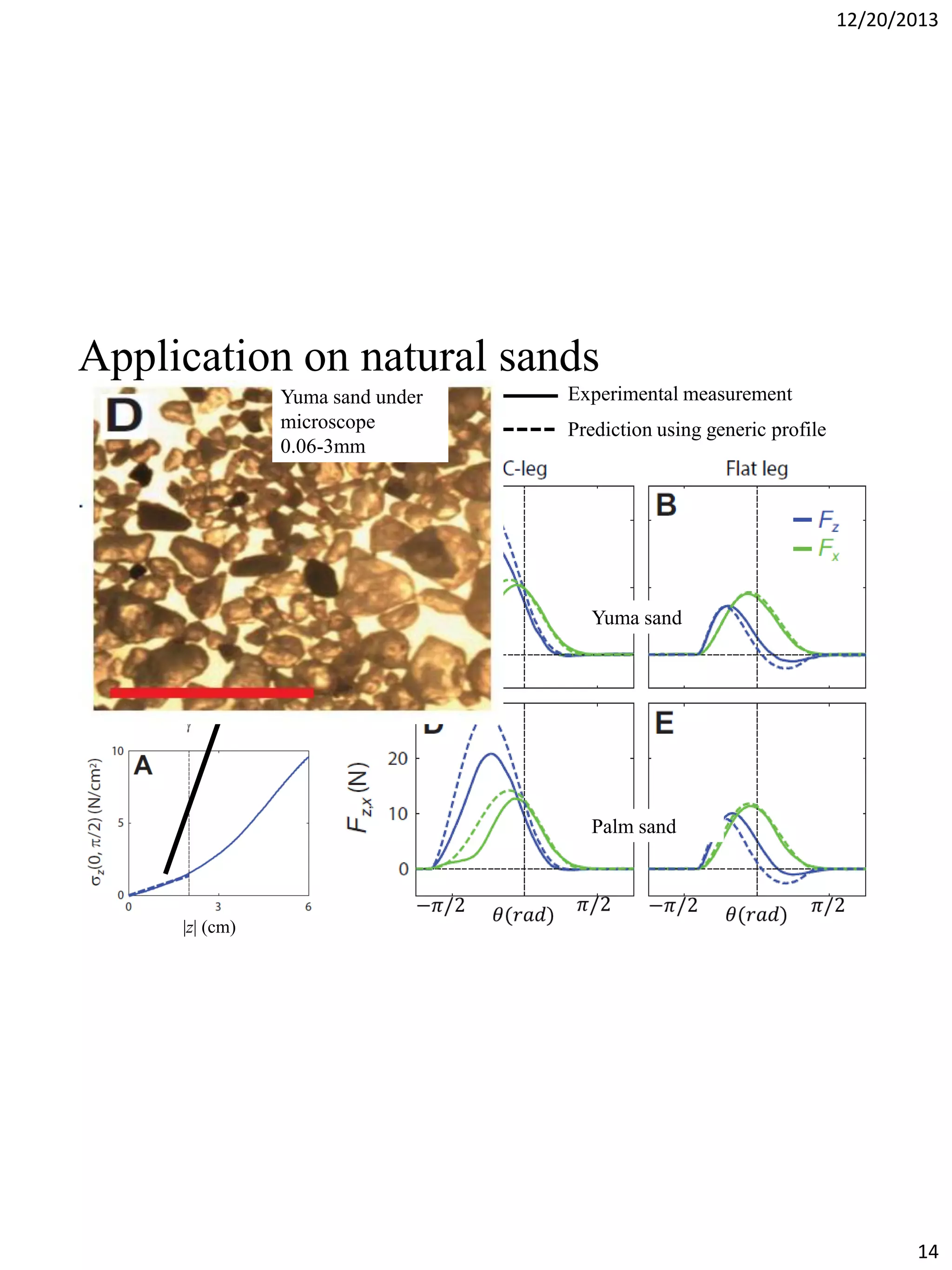
Application on natural sands
Yuma sand under
microscope
0.06-3mm

Experimental measurement
Prediction using generic profile

Yuma sand

Palm sand

z (cm)

14
12/20/2013

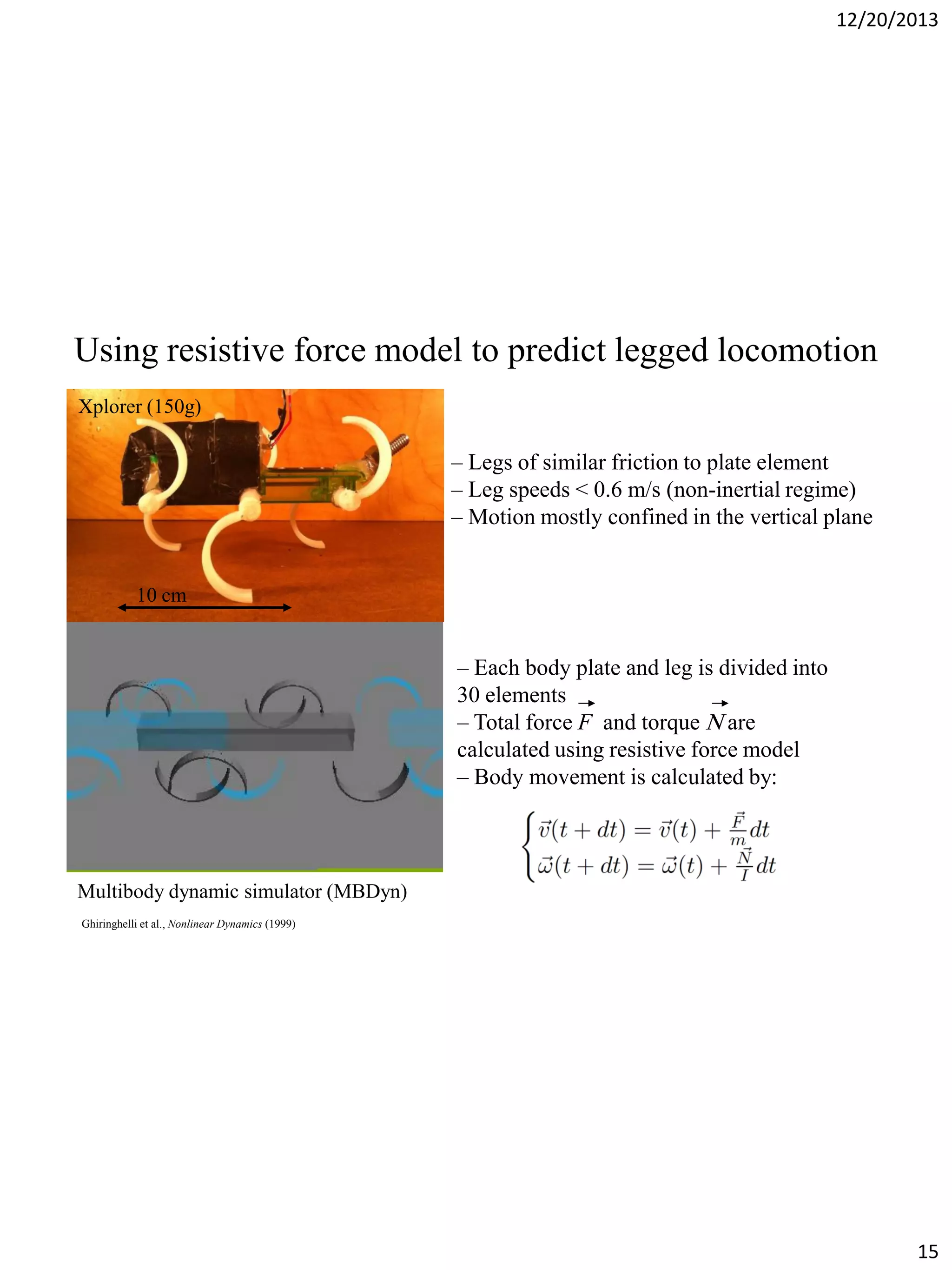
Using resistive force model to predict legged locomotion
Xplorer (150g)

– Legs of similar friction to plate element
– Leg speeds < 0.6 m/s (non-inertial regime)
– Motion mostly confined in the vertical plane

10 cm

– Each body plate and leg is divided into
30 elements
– Total force F and torque are
calculated using resistive force model
– Body movement is calculated by:

Multibody dynamic simulator (MBDyn)
Ghiringhelli et al., Nonlinear Dynamics (1999)

15
12/20/2013

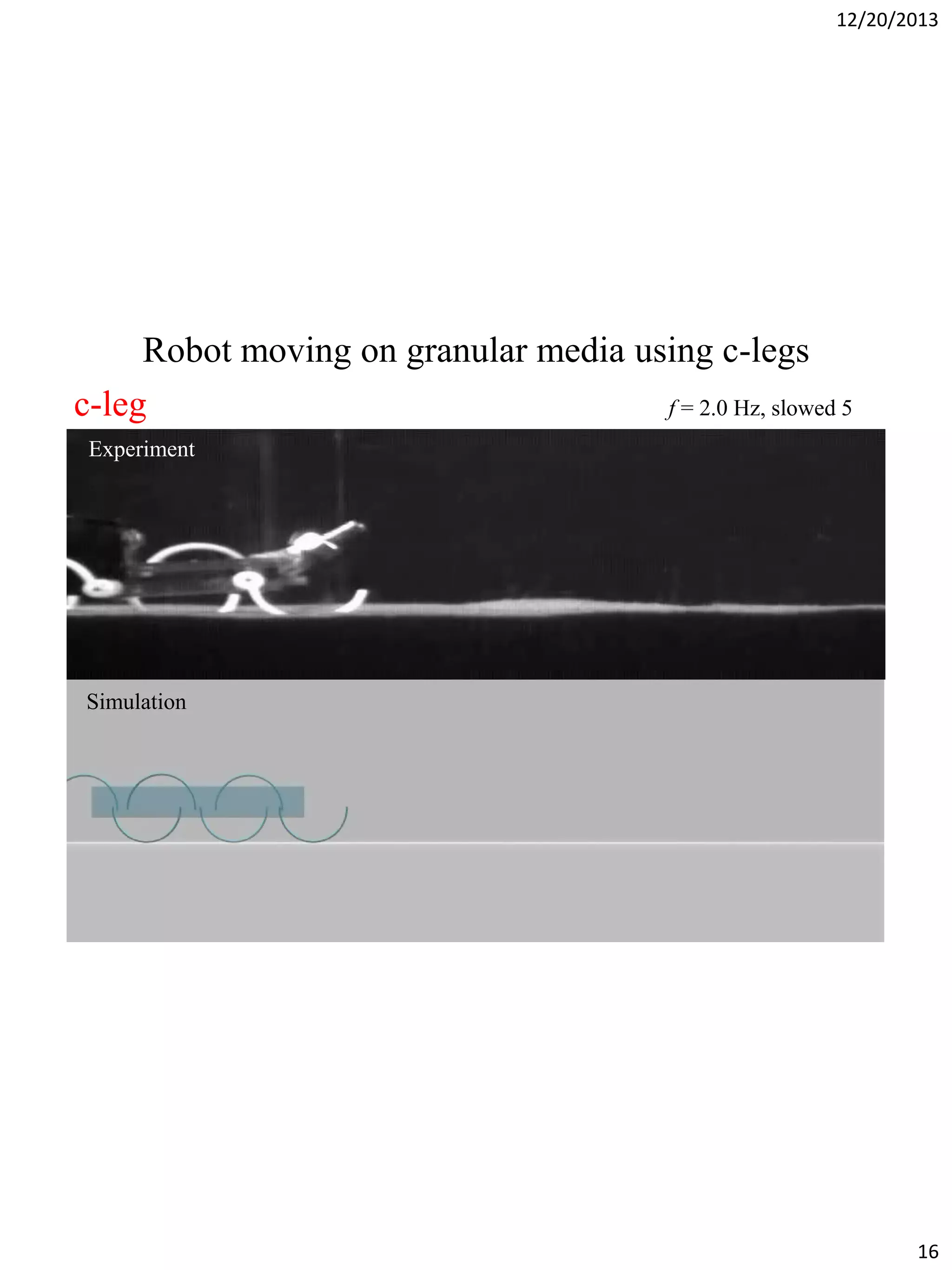
Robot moving on granular media using c-legs
f = 2.0 Hz, slowed 5
c-leg
Experiment

Simulation

16
12/20/2013

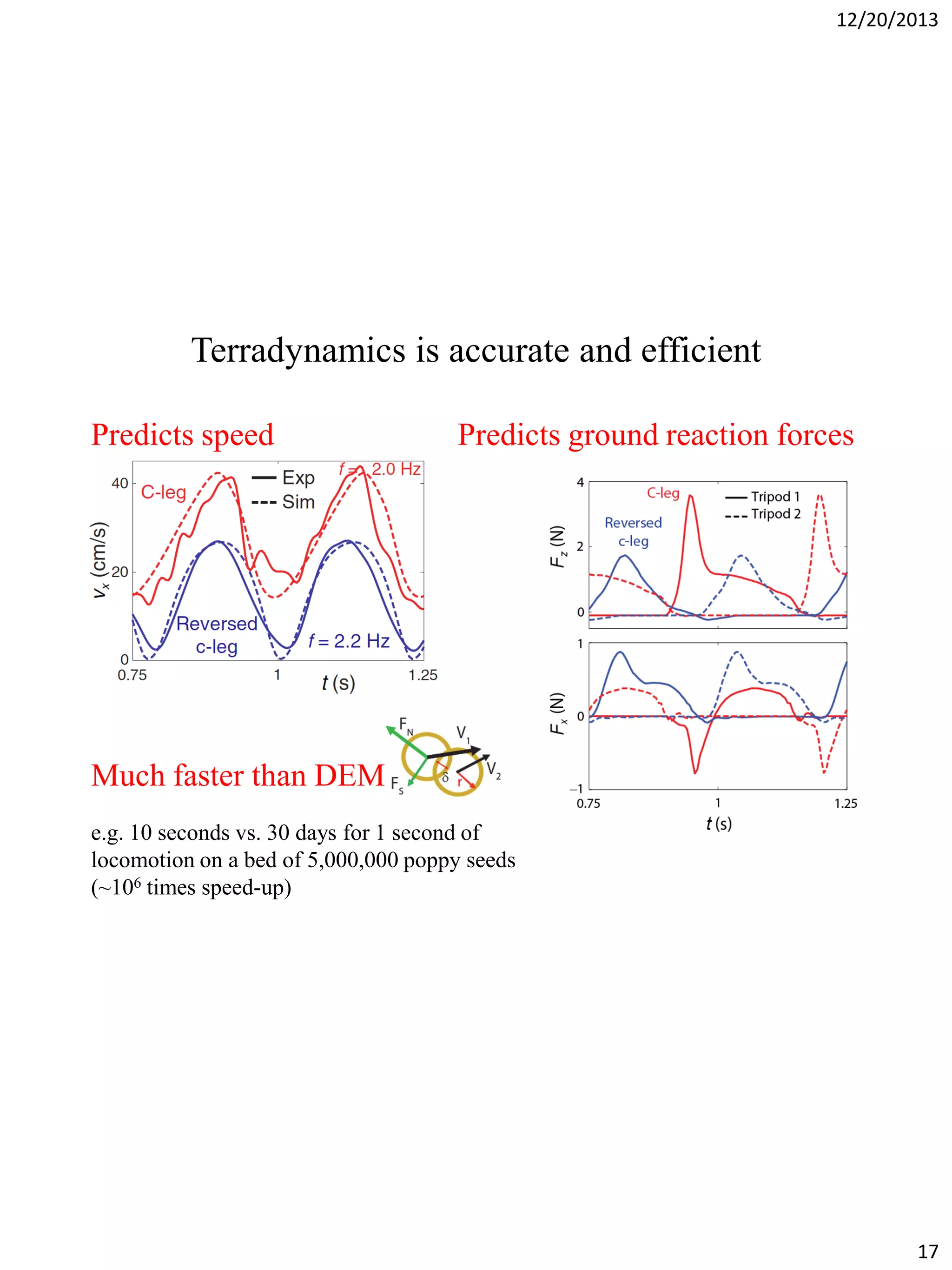
Terradynamics is accurate and efficient
Predicts speed

Predicts ground reaction forces

Much faster than DEM
e.g. 10 seconds vs. 30 days for 1 second of
locomotion on a bed of 5,000,000 poppy seeds
(~106 times speed-up)

17
12/20/2013

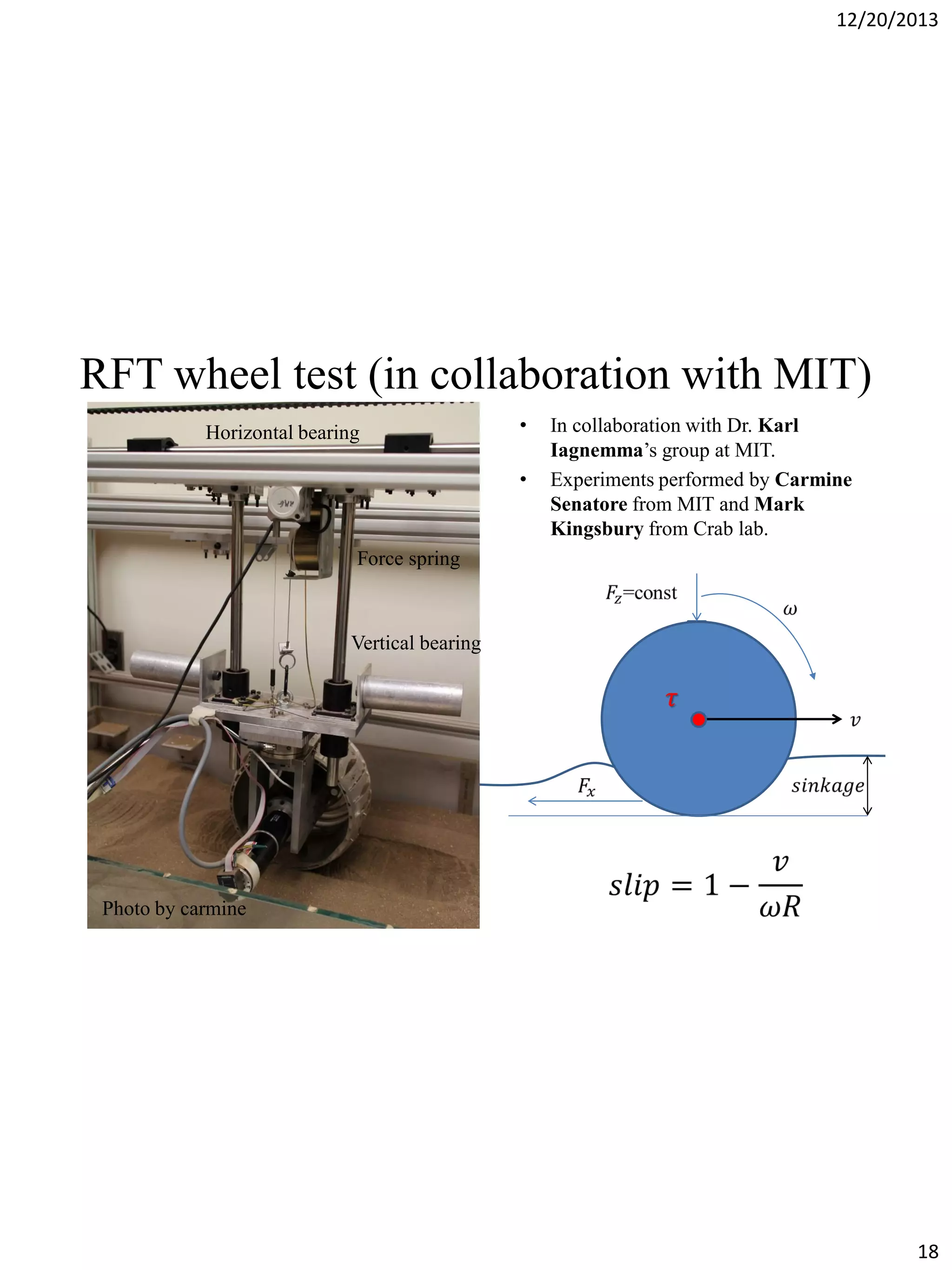
RFT wheel test (in collaboration with MIT)
Horizontal bearing

•
•

In collaboration with Dr. Karl
Iagnemma’s group at MIT.
Experiments performed by Carmine
Senatore from MIT and Mark
Kingsbury from Crab lab.

Force spring

Vertical bearing

Photo by carmine

18
12/20/2013

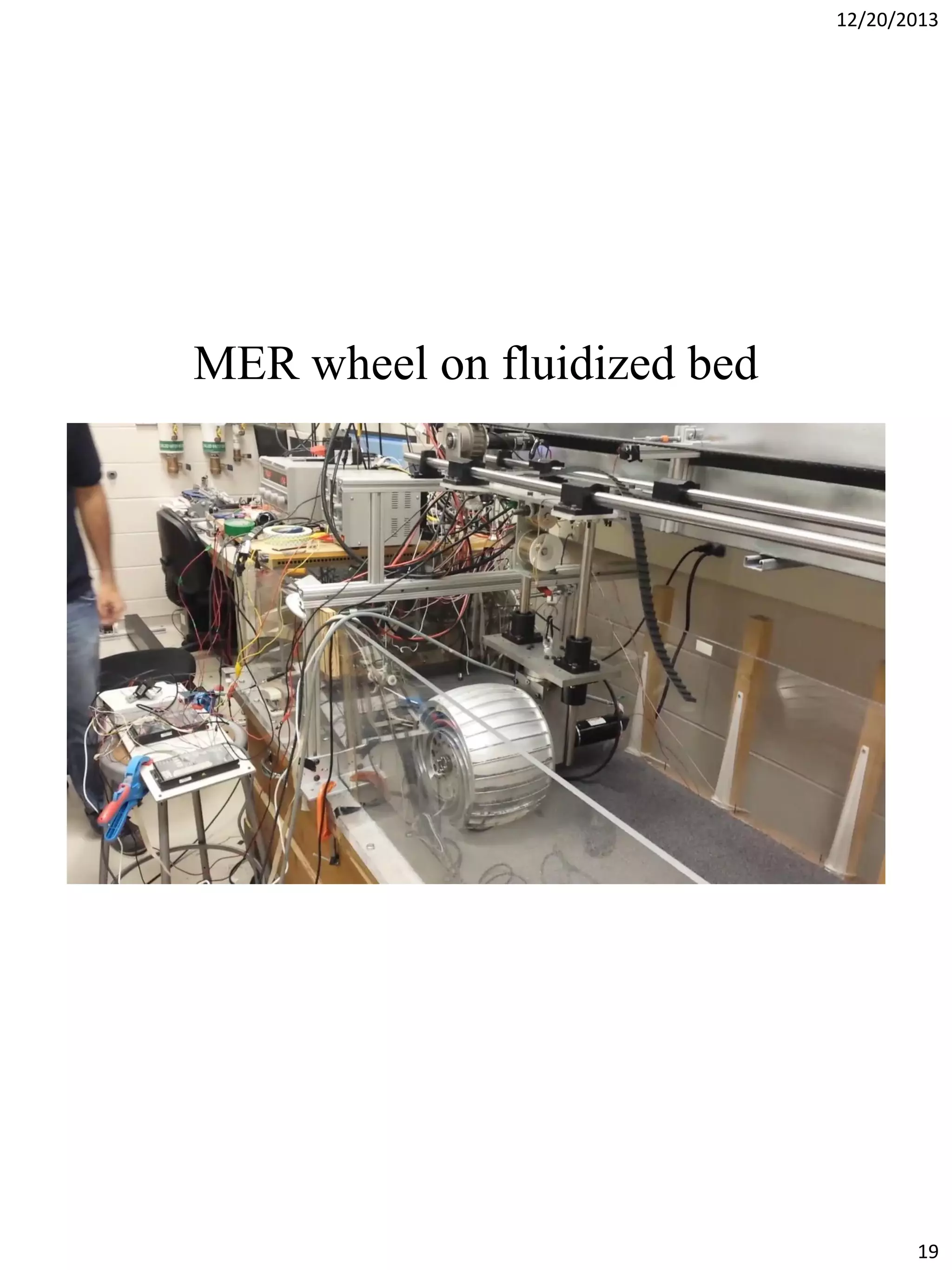
MER wheel on fluidized bed

19
12/20/2013

Wheels and testing conditions
McMaster
Small

McMaster
Large

3D Printed

MIT Smooth

Diameter [mm]

152.4

203.2

145 (to lug tips)

260

Width [mm]

44.5

50.8

76.2

160

Fz Tested [N]

7

20

10, 18

60, 120

Loose

Loose and
Compact

Loose and compact
(only for 18 N)

Loose and
Compact

Terrain State Tested
(Poppy seeds)
McMaster
Small

McMaster
Large

3D Printed

MIT Smooth (approx. to scale)

20
12/20/2013

Drawbar vs. slip ratio in experiment and model
Experiment
WR
RFT

10

Drawbar [N]

5

0

-5

-0.5

0

0.5

Slip

21
12/20/2013

Experiment
WR
RFT

10

3D Printed
Fz = 18 N
Compact

Drawbar [N]

5

0

-5

-0.5

0

0.5

Slip

0.8

25
Sinkage [mm]

Torque [Nm]

0.6
0.4
0.2

15
10

0
-0.2

20

-0.6 -0.4 -0.2

0
Slip

0.2

0.4

0.6

-0.6 -0.4 -0.2

0

0.2

0.4

0.6

Slip

22
12/20/2013

Experiment
WR
RFT

6
4

McMaster
Large
Fz = 20 N
Compact

Drawbar [N]

2
0
-2
-4
-6
-8
-10

-0.6

-0.4

-0.2

0

0.2

0.4

0.6

Slip

35

1

30
Sinkage [mm]

Torque [Nm]

0.8
0.6
0.4
0.2

25
20
15

0

10

-0.2
-0.6 -0.4 -0.2

0
Slip

0.2

0.4

0.6

5

-0.6 -0.4 -0.2

0

0.2

0.4

0.6

Slip

23
12/20/2013

Summary

1. Developed a resistive force model in the vertical plane for legged
locomotion on granular media (for slow intrusions)
2. Resistive force model predicts forces (without any fitting
parameters) on intruders of complex morphology and kinematics
3. Resistive force model + multi-body simulation predicts legged robot
performance
4. RFT is able to predict wheel performance under a wide range of
conditions.

24
12/20/2013

Acknowledgements:
Yang Ding, Nick Gravish, Paul Umbanhowar, Gareth Meirion-Griffith, and Hal Komsuoglu for
discussion. Jeff Shen for robot modification. Pierangelo Masarati for MBDyn support. Sarah
Sharpe for taking the photos of granular materials. Paul Umbanhowar and Hamid Marvi for
assistance with natural sand collection.
Funded by: Burrough’s Wellcome Fund, ARL MAST CTA, ARO, NSF PoLS and Miller Research
Fellowship (C.L.).

25
12/20/2013

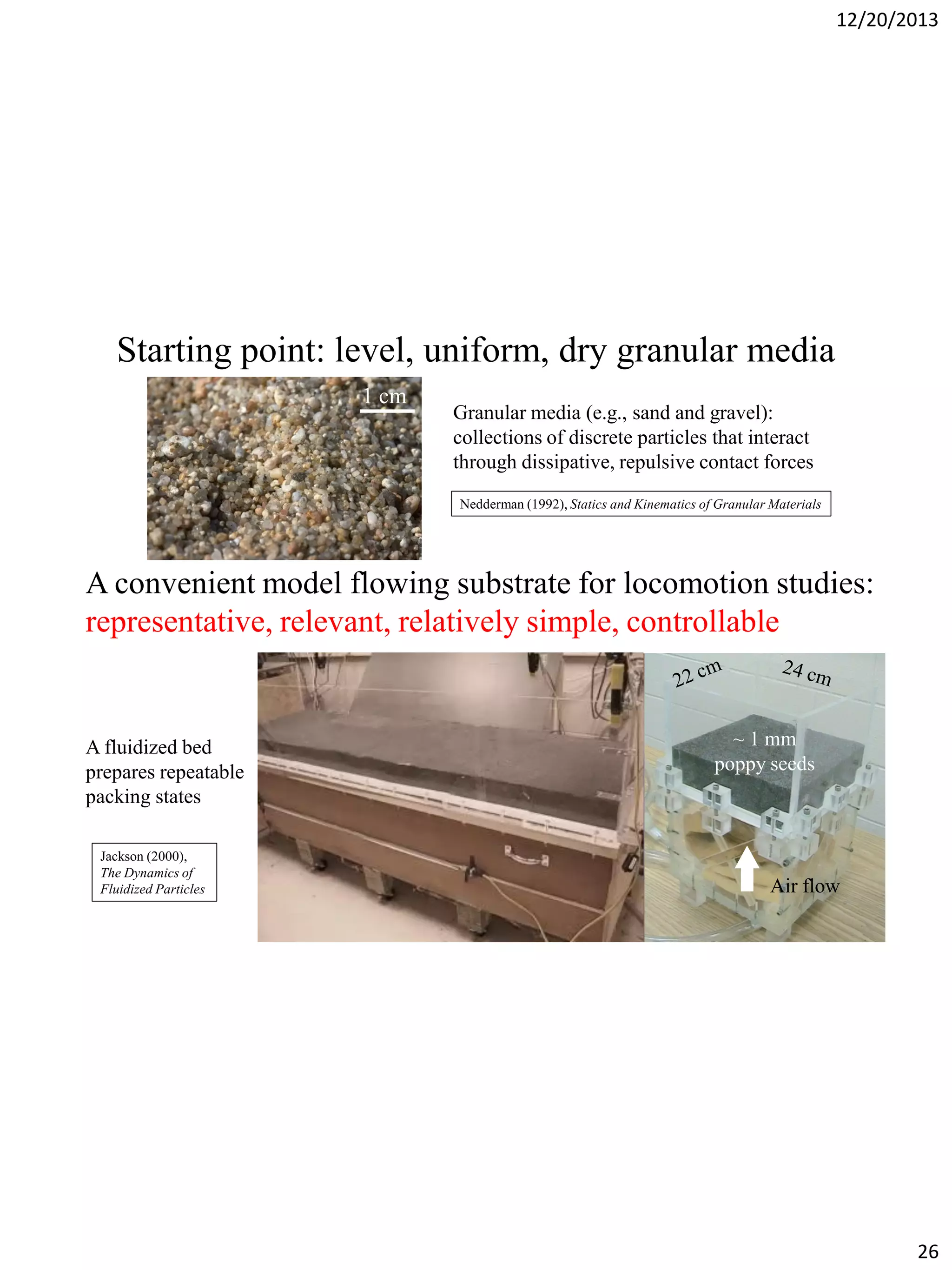
Starting point: level, uniform, dry granular media
1 cm

Granular media (e.g., sand and gravel):
collections of discrete particles that interact
through dissipative, repulsive contact forces
Nedderman (1992), Statics and Kinematics of Granular Materials

A convenient model flowing substrate for locomotion studies:
representative, relevant, relatively simple, controllable

~ 1 mm
poppy seeds

A fluidized bed
prepares repeatable
packing states
Air flow
Jackson (2000),
The Dynamics of
Fluidized Particles

Air flow

26
12/20/2013

3

McMaster
Small
Fz = 7 N
Loose

Experiment
WR
RFT

2

Drawbar [N]

1
0
-1
-2
-3
-4
-0.6

-0.4

-0.2

0

0.2

0.4

0.6

Slip

0.3

30

0.25
25
Sinkage [mm]

Torque [Nm]

0.2
0.15
0.1
0.05
0

20
15
10

-0.05
-0.5

0
Slip

0.5

-0.6 -0.4 -0.2

0

0.2

0.4

0.6

Slip

27
12/20/2013

Drawbar [N]

5

Experiment
WR
RFT

McMaster
Large
Fz = 20 N
Loose

0

-5

-10
-0.6 -0.4 -0.2

0

0.2

0.4

0.6

Slip

1.2

50

1
Sinkage [mm]

Torque [Nm]

0.8
0.6
0.4
0.2

40
30
20

0

10

-0.2
-0.6 -0.4 -0.2

0
Slip

0.2

0.4

0.6

-0.6

-0.4

-0.2

0

0.2

0.4

0.6

Slip

28
12/20/2013

Experiment
WR
RFT

6
4

McMaster
Large
Fz = 20 N
Compact

Drawbar [N]

2
0
-2
-4
-6
-8
-10

-0.6

-0.4

-0.2

0

0.2

0.4

0.6

Slip

35

1

30
Sinkage [mm]

Torque [Nm]

0.8
0.6
0.4
0.2

25
20
15

0

10

-0.2
-0.6 -0.4 -0.2

0
Slip

0.2

0.4

0.6

5

-0.6 -0.4 -0.2

0

0.2

0.4

0.6

Slip

29
12/20/2013

3
Experiment
WR
RFT

2

Drawbar [N]

1

3D Printed
Fz = 10 N
Loose

0
-1
-2
-3
-4
-5
-0.6

-0.4

-0.2

0

0.2

0.4

0.6

Slip

25

0.4

Sinkage [mm]

20

Torque [Nm]

0.3
0.2
0.1

15

10

0
-0.1
-0.6 -0.4 -0.2

0
Slip

0.2

0.4

0.6

-0.5

0

0.5

Slip

30
12/20/2013

Experiment
WR
RFT

Drawbar [N]

5

3D Printed
Fz = 18 N
Loose

0

-5

-10
-0.6 -0.4 -0.2

0

0.2

0.4

0.6

Slip

35
30
Sinkage [mm]

Torque [Nm]

0.6
0.4
0.2

25
20
15

0

10
-0.2
-0.6 -0.4 -0.2

0
Slip

0.2

0.4

0.6

-0.5

0

0.5

Slip

31
12/20/2013

Experiment
WR
RFT

10

3D Printed
Fz = 18 N
Compact

Drawbar [N]

5

0

-5

-0.5

0

0.5

Slip

0.8

25
Sinkage [mm]

Torque [Nm]

0.6
0.4
0.2

15
10

0
-0.2

20

-0.6 -0.4 -0.2

0
Slip

0.2

0.4

0.6

-0.6 -0.4 -0.2

0

0.2

0.4

0.6

Slip

32
12/20/2013

30

Experiment L
Experiment C
WR L
WR C
RFT L
RFT C

Drawbar [N]

20
10
0

MIT Wheel
Fz = 60 N
Compact/Loose

-10
-20
-30
-0.6

-0.4

-0.2

0

0.2

0.4

0.6

50

Slip

4

40
Sinkage [mm]

Torque [Nm]

3
2
1
0

30
20
10

-1
-0.5

0
Slip

0.5

-0.6 -0.4 -0.2

0

0.2

0.4

0.6

Slip

33
12/20/2013

Experiment L
Experiment C
WR L
WR C
RFT L
RFT C

40

Drawbar [N]

20
0

MIT Wheel
Fz = 120 N
Compact/Loose

-20
-40
-60
-0.6 -0.4 -0.2

0

0.2

0.4

8

60
50
Sinkage [mm]

6
Torque [Nm]

0.6

Slip

4
2

40
30
20

0
10
-2

-0.6 -0.4 -0.2
-0.5

0

0.5

0

0.2

0.4

0.6

Slip

Slip

34

A Terradynamics for Legged Locomotion on Granular Media

  • 1.
    12/20/2013 A Terradynamics forLegged Locomotion on Granular Media Tingnan Zhang*, Chen Li*†, and Daniel I. Goldman* *School of Physics, Georgia Institute of Technology †University of California at Berkeley Li, Zhang, Goldman, Science (2013) 1
  • 2.
    12/20/2013 Many natural, particulatemedia can flow under stress mud Martian soil JPL sand debris 2
  • 3.
    12/20/2013 Flowing substrates arechallenging to move on JPL Car on sand Tank on soil Rover on Martian soil Difficult to gain purchase without slipping for wheeled and tracked vehicles alike Kumagai (2004), IEEE Spectrum RHex on dirt/mud Kod*lab Lizard vs. snake by BBC Ghost crab Slowed 50 3
  • 4.
    12/20/2013 Challenges: Limb-ground interactionis complex Zebra-tailed lizard X-ray video, slowed 50× 5 cm Li, Hsieh, and Goldman, J. Exp. Biol. (2012) SandBot (RHex-class) 10 cm Slowed 10× Li, Umbanhowar, Komsuoglu, Koditschek, and Goldman, PNAS (2009) Complicated morphology + kinematics 4
  • 5.
    12/20/2013 Challenges: No comprehensiveforce models In fluids, Navier-Stokes equations + moving boundary conditions Vogel (1996), Life in moving fluids Flying Swimming Dickinson et al. (2000), Science Comprehensive force models are lacking for general particulate media 5
  • 6.
    12/20/2013 Is terramechanics applicable? Classicalterramechanics can accurately and quickly predict forces and performance for (large) wheeled and tracked vehicles Based on penetration resistance, pressuresinkage, and shear resistance tests, not developed for legged locomotion penetrometer Terramechanics for legged locomotion ? bevameter M. G. Bekker (1960), Off-the-road locomotion, research and development in terramechanics J. Y. Wong (2010), Terramechanics and off-road vehicle engineering 6
  • 7.
    12/20/2013 Discrete Element Method dynaRoACH(10 cm, 20 g) on 3 mm glass particles elasticity dissipation multi-body dynamic simulation coupled to DEM friction Maladen, Ding, Umbanhowar, Kamor, and Goldman, J. Roy. Soc. Interface (2011) Zhang, Qian, Li, Masarati, Hoover, Birkmeyer, Pullin, Fearing, and Goldman, Intl. J. Robotic. Res. (2013) Pros: Accurate (One simulation could take a few days) Cons: Slow, impractical for large scales 7
  • 8.
    12/20/2013 Continuum model approach? Hypothesis:Linear superposition of independent element forces predicts net forces Vertical plane • Inspired by resistive force theory for low Re number swimmers • Valid in non-inertial regime (negligible particle inertia) • Works for sand-swimming in horizontal plane Lauga & Powers, Rev. Prog. Phys. (2009) Maladen, Ding, Li, Goldman, Science (2009) 8
  • 9.
    12/20/2013 Measuring stresses usinga plate element – Video taken at boundary for illustration – Force measured in the bulk – v = 0.01 m/s – Video played 10 faster Total force ~ 1 mm poppy seeds (below surface) Extraction Fluidization Fully immersed and far from bottom (above surface) Stresses are hydrostatic-like z (cm) 9
  • 10.
    12/20/2013 Stresses per unitdepth vs. orientation, movement direction Vertical Horizontal Black curves: z,x =0 Complex dependence 10
  • 11.
    12/20/2013 Net forces onc-leg: Experiment vs. model leg is divided into 30 segments Net force Segmental force (on a larger scale) ~ 1 mm poppy seeds – Video taken at boundary for illustration – Force measured in the bulk – v = 0.01 m/s – Video played 10 faster Fz experiment Fz model Fx experiment Fx model (rad) (rad) 11
  • 12.
    12/20/2013 Net forces onc-leg: Experiment vs. model leg is divided into 30 segments Net force Segmental force (on a larger scale) ~ 1 mm poppy seeds – Video taken at boundary for illustration – Force measured in the bulk – v = 0.01 m/s – Video played 10 faster Fz model Fz experiment F (N) Fx experiment (rad) F (N) Fx model (rad) 12
  • 13.
    12/20/2013 Applicability to granularmedia of various particle size, density, friction, and compaction Poppy seeds loosely packed Generic stress profiles closely packed 0.3 mm glass particles loosely packed closely packed 3 mm glass particles Single measurement with an off-the-shelf penetrometer closely packed (Photo credit: Sarah Sharpe) Stress profiles and model accuracy are generic 13
  • 14.
    12/20/2013 Application on naturalsands Yuma sand under microscope 0.06-3mm Experimental measurement Prediction using generic profile Yuma sand Palm sand z (cm) 14
  • 15.
    12/20/2013 Using resistive forcemodel to predict legged locomotion Xplorer (150g) – Legs of similar friction to plate element – Leg speeds < 0.6 m/s (non-inertial regime) – Motion mostly confined in the vertical plane 10 cm – Each body plate and leg is divided into 30 elements – Total force F and torque are calculated using resistive force model – Body movement is calculated by: Multibody dynamic simulator (MBDyn) Ghiringhelli et al., Nonlinear Dynamics (1999) 15
  • 16.
    12/20/2013 Robot moving ongranular media using c-legs f = 2.0 Hz, slowed 5 c-leg Experiment Simulation 16
  • 17.
    12/20/2013 Terradynamics is accurateand efficient Predicts speed Predicts ground reaction forces Much faster than DEM e.g. 10 seconds vs. 30 days for 1 second of locomotion on a bed of 5,000,000 poppy seeds (~106 times speed-up) 17
  • 18.
    12/20/2013 RFT wheel test(in collaboration with MIT) Horizontal bearing • • In collaboration with Dr. Karl Iagnemma’s group at MIT. Experiments performed by Carmine Senatore from MIT and Mark Kingsbury from Crab lab. Force spring Vertical bearing Photo by carmine 18
  • 19.
    12/20/2013 MER wheel onfluidized bed 19
  • 20.
    12/20/2013 Wheels and testingconditions McMaster Small McMaster Large 3D Printed MIT Smooth Diameter [mm] 152.4 203.2 145 (to lug tips) 260 Width [mm] 44.5 50.8 76.2 160 Fz Tested [N] 7 20 10, 18 60, 120 Loose Loose and Compact Loose and compact (only for 18 N) Loose and Compact Terrain State Tested (Poppy seeds) McMaster Small McMaster Large 3D Printed MIT Smooth (approx. to scale) 20
  • 21.
    12/20/2013 Drawbar vs. slipratio in experiment and model Experiment WR RFT 10 Drawbar [N] 5 0 -5 -0.5 0 0.5 Slip 21
  • 22.
    12/20/2013 Experiment WR RFT 10 3D Printed Fz =18 N Compact Drawbar [N] 5 0 -5 -0.5 0 0.5 Slip 0.8 25 Sinkage [mm] Torque [Nm] 0.6 0.4 0.2 15 10 0 -0.2 20 -0.6 -0.4 -0.2 0 Slip 0.2 0.4 0.6 -0.6 -0.4 -0.2 0 0.2 0.4 0.6 Slip 22
  • 23.
    12/20/2013 Experiment WR RFT 6 4 McMaster Large Fz = 20N Compact Drawbar [N] 2 0 -2 -4 -6 -8 -10 -0.6 -0.4 -0.2 0 0.2 0.4 0.6 Slip 35 1 30 Sinkage [mm] Torque [Nm] 0.8 0.6 0.4 0.2 25 20 15 0 10 -0.2 -0.6 -0.4 -0.2 0 Slip 0.2 0.4 0.6 5 -0.6 -0.4 -0.2 0 0.2 0.4 0.6 Slip 23
  • 24.
    12/20/2013 Summary 1. Developed aresistive force model in the vertical plane for legged locomotion on granular media (for slow intrusions) 2. Resistive force model predicts forces (without any fitting parameters) on intruders of complex morphology and kinematics 3. Resistive force model + multi-body simulation predicts legged robot performance 4. RFT is able to predict wheel performance under a wide range of conditions. 24
  • 25.
    12/20/2013 Acknowledgements: Yang Ding, NickGravish, Paul Umbanhowar, Gareth Meirion-Griffith, and Hal Komsuoglu for discussion. Jeff Shen for robot modification. Pierangelo Masarati for MBDyn support. Sarah Sharpe for taking the photos of granular materials. Paul Umbanhowar and Hamid Marvi for assistance with natural sand collection. Funded by: Burrough’s Wellcome Fund, ARL MAST CTA, ARO, NSF PoLS and Miller Research Fellowship (C.L.). 25
  • 26.
    12/20/2013 Starting point: level,uniform, dry granular media 1 cm Granular media (e.g., sand and gravel): collections of discrete particles that interact through dissipative, repulsive contact forces Nedderman (1992), Statics and Kinematics of Granular Materials A convenient model flowing substrate for locomotion studies: representative, relevant, relatively simple, controllable ~ 1 mm poppy seeds A fluidized bed prepares repeatable packing states Air flow Jackson (2000), The Dynamics of Fluidized Particles Air flow 26
  • 27.
    12/20/2013 3 McMaster Small Fz = 7N Loose Experiment WR RFT 2 Drawbar [N] 1 0 -1 -2 -3 -4 -0.6 -0.4 -0.2 0 0.2 0.4 0.6 Slip 0.3 30 0.25 25 Sinkage [mm] Torque [Nm] 0.2 0.15 0.1 0.05 0 20 15 10 -0.05 -0.5 0 Slip 0.5 -0.6 -0.4 -0.2 0 0.2 0.4 0.6 Slip 27
  • 28.
    12/20/2013 Drawbar [N] 5 Experiment WR RFT McMaster Large Fz =20 N Loose 0 -5 -10 -0.6 -0.4 -0.2 0 0.2 0.4 0.6 Slip 1.2 50 1 Sinkage [mm] Torque [Nm] 0.8 0.6 0.4 0.2 40 30 20 0 10 -0.2 -0.6 -0.4 -0.2 0 Slip 0.2 0.4 0.6 -0.6 -0.4 -0.2 0 0.2 0.4 0.6 Slip 28
  • 29.
    12/20/2013 Experiment WR RFT 6 4 McMaster Large Fz = 20N Compact Drawbar [N] 2 0 -2 -4 -6 -8 -10 -0.6 -0.4 -0.2 0 0.2 0.4 0.6 Slip 35 1 30 Sinkage [mm] Torque [Nm] 0.8 0.6 0.4 0.2 25 20 15 0 10 -0.2 -0.6 -0.4 -0.2 0 Slip 0.2 0.4 0.6 5 -0.6 -0.4 -0.2 0 0.2 0.4 0.6 Slip 29
  • 30.
    12/20/2013 3 Experiment WR RFT 2 Drawbar [N] 1 3D Printed Fz= 10 N Loose 0 -1 -2 -3 -4 -5 -0.6 -0.4 -0.2 0 0.2 0.4 0.6 Slip 25 0.4 Sinkage [mm] 20 Torque [Nm] 0.3 0.2 0.1 15 10 0 -0.1 -0.6 -0.4 -0.2 0 Slip 0.2 0.4 0.6 -0.5 0 0.5 Slip 30
  • 31.
    12/20/2013 Experiment WR RFT Drawbar [N] 5 3D Printed Fz= 18 N Loose 0 -5 -10 -0.6 -0.4 -0.2 0 0.2 0.4 0.6 Slip 35 30 Sinkage [mm] Torque [Nm] 0.6 0.4 0.2 25 20 15 0 10 -0.2 -0.6 -0.4 -0.2 0 Slip 0.2 0.4 0.6 -0.5 0 0.5 Slip 31
  • 32.
    12/20/2013 Experiment WR RFT 10 3D Printed Fz =18 N Compact Drawbar [N] 5 0 -5 -0.5 0 0.5 Slip 0.8 25 Sinkage [mm] Torque [Nm] 0.6 0.4 0.2 15 10 0 -0.2 20 -0.6 -0.4 -0.2 0 Slip 0.2 0.4 0.6 -0.6 -0.4 -0.2 0 0.2 0.4 0.6 Slip 32
  • 33.
    12/20/2013 30 Experiment L Experiment C WRL WR C RFT L RFT C Drawbar [N] 20 10 0 MIT Wheel Fz = 60 N Compact/Loose -10 -20 -30 -0.6 -0.4 -0.2 0 0.2 0.4 0.6 50 Slip 4 40 Sinkage [mm] Torque [Nm] 3 2 1 0 30 20 10 -1 -0.5 0 Slip 0.5 -0.6 -0.4 -0.2 0 0.2 0.4 0.6 Slip 33
  • 34.
    12/20/2013 Experiment L Experiment C WRL WR C RFT L RFT C 40 Drawbar [N] 20 0 MIT Wheel Fz = 120 N Compact/Loose -20 -40 -60 -0.6 -0.4 -0.2 0 0.2 0.4 8 60 50 Sinkage [mm] 6 Torque [Nm] 0.6 Slip 4 2 40 30 20 0 10 -2 -0.6 -0.4 -0.2 -0.5 0 0.5 0 0.2 0.4 0.6 Slip Slip 34