International Journal of Embedded Systems and Applications (IJESA) Vol.4, No.1, March 2014
DOI : 10.5121/ijesa.2014.4102 19
SOCS BASED OPENRISC AND MICROBLAZE SOFT
PROCESSORS
COMPARISON STUDY CASES: AUDIO
IMPLEMENTATION AND NETWORK
IMPLEMENTATION BASED SOCS
Faroudja Abid, Nouma Izeboudjen, Dalila Lazib, Mohamed Bakiri, Sabrina Titri
and Fatiha Louiz
Microelectronic and Nanotechnology Laboratory, advanced technology development
center, Algiers, Algeria
ABSTRACT
The IP reuse approach and FPGA-platform-based SoC (System on Chip) with an embedded soft
processor is an alternative to design SoCs that allows fast creation and verification. In this paper we
address a comparison study between two SoCs architectures based OpenRISC (OpenCores) and
MicroBlaze (proprietary) soft processors. The comparison is done for two applications, namely the audio
and network applications based SoCs. The SoCs have been prototyped using the Virtex5 XC5VLX50
FPGA. Regarding the SoCs for audio application, the results show that slices are more used in the
OpenRISC based SoC while BRAM memories are more used in the SoC based MicroBlaze. Concerning
the SoCs for Network application used slices register are slightly different in the two SoCs, BRAM
memories and slice LUTs are more used in the OpenRISC based SoC. We notice that power consumption
is better for the SoCs based MicroBlaze for the both applications.
KEYWORDS
Audio, AC97 controller, Embedded system, FPGA, MicroBlaze, Power consumption, System on Chip
(SoC), OpenCores, OpenRISC
1. INTRODUCTION
SoC concept is based on integrating all components involved in the design in a single chip.
Several and critical design constraints are involved when designing SoCs. Namely power
consumption, area usage, device size, chip interconnection, design cost (this constraint is
critical, mainly for academic research) and time to market. All aspects related to SoCs concept
are given in [1]. To overcome the increasing complexity to design SoCs, embedded system
developers seek for solutions allowing flexibility and efficiency. The Soft processor based
platform for designing SoCs is an attractive way for implementing embedded applications,
while reducing power consumption and design cost compared to ASIC. Soft processor is a
hardware description language (HDL) model of a specific processor (CPU) that can be
customized for a given application and synthesized for an ASIC or FPGA target [2]. There are
several soft processor provided by commercial vendors, namely Nios processor, Xilinx
MicroBlaze processor and PicoBlaze microcontroller, the IBM processor and Xtensa by
International Journal of Embedded Systems and Applications (IJESA) Vol.4, No.1, March 2014
20
respectively Altera, Xilinx, IBM, Tensilica. Other soft processors are Opensources provided by
Opensource community, namely the OpenRISC processor by OpenCores and LEON by Gaisler
Research. Both of Opensource and proprietary soft processors are used in academic and
industrial research to design embedded systems. A comparison study has been done by Jason G
et al. [2] and [3], where several soft processors are presented and compared. In this work we
focus on the OpenRISC and MicroBlaze processors since the SoCs compared herein are based
on these two processors for the both applications: namely the audio and network applications
used as cases study. In SoC for audio application, the processor read and plays back audio using
the AC97 controller, through the line out audio port. The SoC based OpenRISC is a part of the
SoC platform based on Opencores and Opensources design concepts for Voice over Internet
Protocol application [4] [5]. A presentation of the OpenRISC and MicroBlaze soft processors is
given in previous work [6] that exposes a comparison study between two SoCs architectures
based OpenRISC and MicroBlaze for network application [7] and [8].
In Section II, we give features comparison of the two soft processors. Section III, deals with the
Hardware architectures of the two SoCs for audio application. The synthesis and
implementation results for both OpenRISC and MicroBlaze based SoCs for audio applications
are given in this section. In Section IV, The synthesis and implementation results for the two
SoCs for network applications are exposed. Finally, we give a conclusion in section V.
2. FEATURES COMPARISON OF THE TWO SOFT PROCESSORS
Table 1 shows a comparison of the two soft processors namely the OpenRISC and MicroBlaze.
The results summarized in table I show that, the MicroBlaze processor has a highest operating
frequency than the OpenRISC processor in FPGA target, while the OpenRISC has higher
operating frequency for ASIC target. MicroBlaze is Xilinx proprietary, so it is targeted for
Xilinx FPGA only, while OpenRISC is technology independent, it can be implemented in
different FPGA (it is implemented in Xilinx and Altera FPGA) or ASIC target. The two
processors have the FPU unit included in their architectures. Regarding the area, the OpenRISC
uses more LUTs than the MicroBlaze.
Table 1. Features Comparison
Features OpenRISC 1200 MicroBlaze(Xilinx)
License Opensource (GPL) Proprietary (Xilinx)
Pipeline depth 5 3/5
Architecture 32-bit RISC 32-bit RISC
Speed MHz 250(ASIC)/60
(5VLX50 FPGA)
235MHz (5VLX50 FPGA)
Area LUTs 4125 LUTs 1027 LUTs
Implementation/technology FPGA/ASIC
0.18μm
Xilinx FPGA only
FPU IEEE 754 IEEE 754
Performance DMIPs 250 DMIPs 280 DMIPs
International Journal of Embedded Systems and Applications (IJESA) Vol.4, No.1, March 2014
21
3. AUDIO SOCS HARDWARE ARCHITECTURE PRESENTATION
3.1. OpenRISC based SoC Hardware Architecture for audio application
Figure 1 shows the block diagram of the SoC architecture based OpenRISC soft processor. The
embedded SoC includes OR1200 core and a minimum set of elements needed to provide
functionality of audio application. These elements are the debug unit for debugging purpose, a
memory controller that controls an external memory, a Universal Asynchronous Receiver
Transmitter (UART), the MAC/Ethernet that transmits voice packets over the Internet. All the
cores are connected through the wishbone bus interface. The AC97 controller core is also
selected for audio processing application. For the integration of all the cores we have created a
SoC Verilog description.
MAC
Ethernet
PHY
CPU
OpenRISC
RTP
Switch
Audio
Codec
Control
PCM
RTP
Audio
Codec
PCM
Ext/RAM
AC97
Controller
SDRAM
Controller
FLASH
Figure 1. SoC based OpenRISC hardware architecture for audio application
3.2. System based OpenRISC Prototyping
The architecture has been prototyped using the Xilinx development platform ML501-Virtex5,
The operating frequency is 66MHz. The development tool used for the design and
implementation is ISE 13.1 tool by Xilinx [9]. Table 2 summarizes the synthesis results. The
SoC uses 63% of BRAM memories, 55 % of slices. It is noticeable that the BRAM memories
are the most used resources. The power estimation is done using the XPower Analyzer by
Xilinx [10] which support detailed power estimation based on characterized resource
capacitance, design-specific resource utilization and data switching activity. Table 3
summarizes the power consumption of the design; the total power consumption is 5.160W.
Embedded
Part
International Journal of Embedded Systems and Applications (IJESA) Vol.4, No.1, March 2014
22
Table 2. Synthesis results (SoC based OpenRISC).Target device XC5VLX50- 1FF676
Table 3. Power consumption (SoC based OpenRISC)
3.3. MicroBlaze Based SoC Hardware Architecture for audio application
Figure 2 shows the block diagram of the SoC architecture based MicroBlaze soft processor for
audio application [11]. The SoC is designed using Xilinx EDK platform. The Hardware
architecture includes mainly, the MicroBlaze core, an AC97 module, UART and the Ethernet
EMC.
Figure 2. SoC based MicroBlaze hardware architecture for audio application
Slice Logic
resources
Used Slice Logic Available Slice Logic % Occupied
resources
Used Slice 15979 28800 55
Number of bonded
IOBs
174 440 40
Number of BRAMs 30 48 63
Total estimated power consumption Power (W)
Logic 0.003
IO (W) 3.203
BRAM (W) 0.022
Quiescent 4.686
Dynamic (W) 0.474
Total(W) 5.160
International Journal of Embedded Systems and Applications (IJESA) Vol.4, No.1, March 2014
23
3.4. System based MicroBlaze Prototyping
The same tools and target are used to prototype the architecture of the SoC based MicroBlaze.
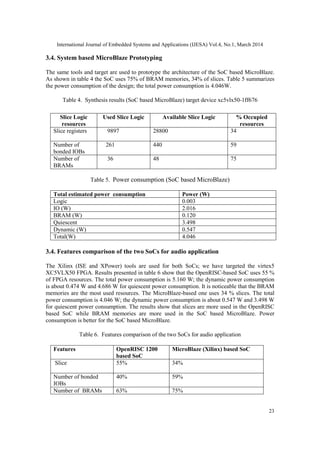
As shown in table 4 the SoC uses 75% of BRAM memories, 34% of slices. Table 5 summarizes
the power consumption of the design; the total power consumption is 4.046W.
Table 4. Synthesis results (SoC based MicroBlaze) target device xc5vlx50-1ff676
Table 5. Power consumption (SoC based MicroBlaze)
3.4. Features comparison of the two SoCs for audio application
The Xilinx (ISE and XPower) tools are used for both SoCs; we have targeted the virtex5
XC5VLX50 FPGA. Results presented in table 6 show that the OpenRISC-based SoC uses 55 %
of FPGA resources. The total power consumption is 5.160 W; the dynamic power consumption
is about 0.474 W and 4.686 W for quiescent power consumption. It is noticeable that the BRAM
memories are the most used resources. The MicroBlaze-based one uses 34 % slices. The total
power consumption is 4.046 W; the dynamic power consumption is about 0.547 W and 3.498 W
for quiescent power consumption. The results show that slices are more used in the OpenRISC
based SoC while BRAM memories are more used in the SoC based MicroBlaze. Power
consumption is better for the SoC based MicroBlaze.
Table 6. Features comparison of the two SoCs for audio application
Features OpenRISC 1200
based SoC
MicroBlaze (Xilinx) based SoC
Slice 55% 34%
Number of bonded
IOBs
40% 59%
Number of BRAMs 63% 75%
Slice Logic
resources
Used Slice Logic Available Slice Logic % Occupied
resources
Slice registers 9897 28800 34
Number of
bonded IOBs
261 440 59
Number of
BRAMs
36 48 75
Total estimated power consumption Power (W)
Logic 0.003
IO (W) 2.016
BRAM (W) 0.120
Quiescent 3.498
Dynamic (W) 0.547
Total(W) 4.046
International Journal of Embedded Systems and Applications (IJESA) Vol.4, No.1, March 2014
24
Power consumption
Total(W)
5.160 4.046
Dynamic (W) 0.474 0.547
Quiescent 4.686 3.498
BRAM (W) 0.022 0.120
4. NETWORK SOCS PROTOTYPING
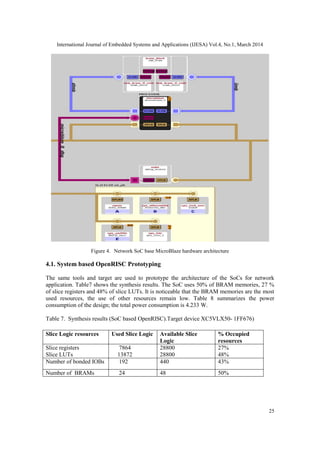
Figures 3 and 4 show respectively the hardware architecture of the network SoC architecture
based OpenRISC and MicroBlaze based one [6].
Figure 3. Network SoC based OpenRISC hardware architecture
International Journal of Embedded Systems and Applications (IJESA) Vol.4, No.1, March 2014
25
Figure 4. Network SoC base MicroBlaze hardware architecture
4.1. System based OpenRISC Prototyping
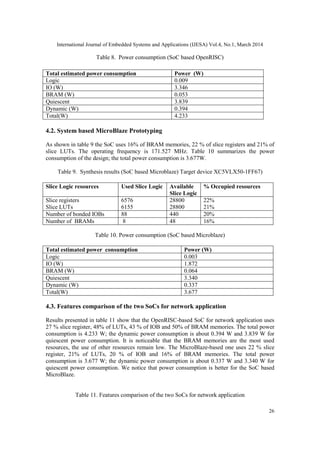
The same tools and target are used to prototype the architecture of the SoCs for network
application. Table7 shows the synthesis results. The SoC uses 50% of BRAM memories, 27 %
of slice registers and 48% of slice LUTs. It is noticeable that the BRAM memories are the most
used resources, the use of other resources remain low. Table 8 summarizes the power
consumption of the design; the total power consumption is 4.233 W.
Table 7. Synthesis results (SoC based OpenRISC).Target device XC5VLX50- 1FF676)
Slice Logic resources Used Slice Logic Available Slice
Logic
% Occupied
resources
Slice registers
Slice LUTs
7864
13872
28800
28800
27%
48%
Number of bonded IOBs 192 440 43%
Number of BRAMs 24 48 50%
International Journal of Embedded Systems and Applications (IJESA) Vol.4, No.1, March 2014
26
Table 8. Power consumption (SoC based OpenRISC)
4.2. System based MicroBlaze Prototyping
As shown in table 9 the SoC uses 16% of BRAM memories, 22 % of slice registers and 21% of
slice LUTs. The operating frequency is 171.527 MHz. Table 10 summarizes the power
consumption of the design; the total power consumption is 3.677W.
Table 9. Synthesis results (SoC based Microblaze) Target device XC5VLX50-1FF67)
Table 10. Power consumption (SoC based Microblaze)
4.3. Features comparison of the two SoCs for network application
Results presented in table 11 show that the OpenRISC-based SoC for network application uses
27 % slice register, 48% of LUTs, 43 % of IOB and 50% of BRAM memories. The total power
consumption is 4.233 W; the dynamic power consumption is about 0.394 W and 3.839 W for
quiescent power consumption. It is noticeable that the BRAM memories are the most used
resources, the use of other resources remain low. The MicroBlaze-based one uses 22 % slice
register, 21% of LUTs, 20 % of IOB and 16% of BRAM memories. The total power
consumption is 3.677 W; the dynamic power consumption is about 0.337 W and 3.340 W for
quiescent power consumption. We notice that power consumption is better for the SoC based
MicroBlaze.
Table 11. Features comparison of the two SoCs for network application
Total estimated power consumption Power (W)
Logic 0.009
IO (W) 3.346
BRAM (W) 0.053
Quiescent 3.839
Dynamic (W) 0.394
Total(W) 4.233
Slice Logic resources Used Slice Logic Available
Slice Logic
% Occupied resources
Slice registers
Slice LUTs
6576
6155
28800
28800
22%
21%
Number of bonded IOBs 88 440 20%
Number of BRAMs 8 48 16%
Total estimated power consumption Power (W)
Logic 0.003
IO (W) 1.872
BRAM (W) 0.064
Quiescent 3.340
Dynamic (W) 0.337
Total(W) 3.677
International Journal of Embedded Systems and Applications (IJESA) Vol.4, No.1, March 2014
27
Features OpenRISC 1200 based SoC MicroBlaze (Xilinx) based SoC
Slice registers
Slice LUTs
27%
48%
22%
21%
Number of bonded
IOBs
43% 20%
Number of BRAMs 50% 16%
Power consumption
Total(W)
4.233 3.677
Dynamic (W) 0.394 0.337
Quiescent 3.839 3.340
BRAM (W) 0.053 0.064
Logic 0.009 0.003
5. CONCLUSIONS
SoCs based soft processors, namely OpenRISC-based SoC and MicroBlaze-based one are
presented in this paper. Two comparison cases study are given. The first case is the audio
application the second is the network application based SoCs. In the SoCs for audio
application, the slices are more used in the OpenRISC based SoC while BRAM memories are
more used in the SoC based MicroBlaze. For the Network application based SoCs, used slice
registers are slightly different, BRAM memories and slice LUTs are more used in the
OpenRISC based one.
The total power consumption is 5.160W for the SoC based OpenRISC for audio application and
4.046 W for the MicroBlaze based one. Regarding the SoC for Network application, the total
power consumption is 4.233 W for the SoC based OpenRISC and 3.677 W for the MicroBlaze
based one. We notice that power consumption is better for the SoC based MicroBlaze for the
both applications. In FPGA target, the MicoBlaze processor has a highest operating frequency
than the OpenRISC processor which is more efficient in ASIC implementation with 250 MHz.
MicroBlaze is Xilinx proprietary, targeted for Xilinx FPGA only, while OpenRISC is an
Opensource IP-core freely available and technology independent, it can be implemented in
different FPGA or ASIC. The Register Transfer Level (RTL) descriptions for all the IPs
components included in the proposed SoCs based OpenRISC are free, so it is mainly suitable
for academic research.
REFERENCES
[1] Reinaldo A.Bergamashi, “The A to Z of SoCs”, ICCAD’02, IEEE/ACM International Conference
on Computer Aided Design, November 10 - 14, 2002. San Jose, CA, USA. ISBN: 0-7803-7607-2.
[2] Jason G. Tong, Ian D. L. Anderson and Mohammed A. S. Khalid,”Soft-Core Processors for
Embedded Systems”, ICM, the 18th International Conference on Microelectronics, December 16-
19, 2006, Saudi Arabia.
[3] Daniel Mattsson, Marcus Christensson, “Evaluation of synthesizable CPU cores”, Master’s Thesis
Computer Engineer Computer Science an d Engineering Program CHALMERS UNIVERSITY OF
TECHNOLOGY Department of Computer Engineer Computer Gothenburg, 20 0 4.
International Journal of Embedded Systems and Applications (IJESA) Vol.4, No.1, March 2014
28
[4] Abid Faroudja, Nouma. Izeboudjen, Sabrina. Titri, Leila.Salhi, Fatiha.Louiz, Dalila.Lazib,
“Hardware /Software Development of System on Chip Platform for VoIP Application “, ICM,
International Conference on Microelectronics, December 19-22, 2009, Marakech, Morocco, pp 62-
65.
[5] Titri, N. izeboudjen, F. Louiz, M. Bakiri, F. Abid, D. lazib, L. rekab, “An Opencores /Opensource
based Embedded System-on-Chip platform for Voice over Internet”, book: VOIP Technologies,
pp: 145-172, INTECH, ISBN: 978-953-307-549-5, 2011.
[6] Faroudja Abid, Nouma Izeboudjen , Dalila Lazib, Mohamed Bakiri ,Sabrina Titri ,Fatiha Louiz
“Performances Evaluation of Network SoC based Embedded RISC Processor Comparison study :
Microblaze and OpenRISC based SoCs“,CGE’08, Conference on Electrical Engineering, April 16-
17, 2013, Algiers, Algeria
[7] F. ABID, N. IZEBOUDJEN, L. SAHLI, D. LAZIB, S. TITRI, F. LOUIZ, M. BAKIRI, “Towards an
Open Embedded System on Chip for Network Applications” WSEAS 2010, Latest Trends on
Circuits, Systems and Signals. The 4th international conference on Circuits, Systems and Signals,
CSS'10. Greece, July 22-25, 2010, pp 163-168. ISSN: 1792-4324, ISBN: 978-960-474-208-0.
[8] F.Abid, N.Izeboudjen, L.Sahli, S.Titri, D.Lazib, F.Louiz, “Embedded Network SoC Application
Based on the OpenRISC Soft Processor “, ICMOSS, Embedded System Conference, Mai 29-31,
2010. Tiaret (Algeria), pp 161-166.
[9] ISE Design Suite 13: Release Notes Guide, March 2011,
http://www.xilinx.com/support/documentation/sw_manuals/xilinx13_1/irn.pdf
[10] XPower Estimator User Guide , UG440 , January 18, 2012
[11] ML501 Reference Design User Guide UG227, Xilinx (v1.0) June 18, 2007

Paper Title: Socs Based Openrisc and Microblaze Soft Processors Comparison Study Cases: Audio Implementation and Network Implementation Based Socs

  • 1.
    International Journal ofEmbedded Systems and Applications (IJESA) Vol.4, No.1, March 2014 DOI : 10.5121/ijesa.2014.4102 19 SOCS BASED OPENRISC AND MICROBLAZE SOFT PROCESSORS COMPARISON STUDY CASES: AUDIO IMPLEMENTATION AND NETWORK IMPLEMENTATION BASED SOCS Faroudja Abid, Nouma Izeboudjen, Dalila Lazib, Mohamed Bakiri, Sabrina Titri and Fatiha Louiz Microelectronic and Nanotechnology Laboratory, advanced technology development center, Algiers, Algeria ABSTRACT The IP reuse approach and FPGA-platform-based SoC (System on Chip) with an embedded soft processor is an alternative to design SoCs that allows fast creation and verification. In this paper we address a comparison study between two SoCs architectures based OpenRISC (OpenCores) and MicroBlaze (proprietary) soft processors. The comparison is done for two applications, namely the audio and network applications based SoCs. The SoCs have been prototyped using the Virtex5 XC5VLX50 FPGA. Regarding the SoCs for audio application, the results show that slices are more used in the OpenRISC based SoC while BRAM memories are more used in the SoC based MicroBlaze. Concerning the SoCs for Network application used slices register are slightly different in the two SoCs, BRAM memories and slice LUTs are more used in the OpenRISC based SoC. We notice that power consumption is better for the SoCs based MicroBlaze for the both applications. KEYWORDS Audio, AC97 controller, Embedded system, FPGA, MicroBlaze, Power consumption, System on Chip (SoC), OpenCores, OpenRISC 1. INTRODUCTION SoC concept is based on integrating all components involved in the design in a single chip. Several and critical design constraints are involved when designing SoCs. Namely power consumption, area usage, device size, chip interconnection, design cost (this constraint is critical, mainly for academic research) and time to market. All aspects related to SoCs concept are given in [1]. To overcome the increasing complexity to design SoCs, embedded system developers seek for solutions allowing flexibility and efficiency. The Soft processor based platform for designing SoCs is an attractive way for implementing embedded applications, while reducing power consumption and design cost compared to ASIC. Soft processor is a hardware description language (HDL) model of a specific processor (CPU) that can be customized for a given application and synthesized for an ASIC or FPGA target [2]. There are several soft processor provided by commercial vendors, namely Nios processor, Xilinx MicroBlaze processor and PicoBlaze microcontroller, the IBM processor and Xtensa by
  • 2.
    International Journal ofEmbedded Systems and Applications (IJESA) Vol.4, No.1, March 2014 20 respectively Altera, Xilinx, IBM, Tensilica. Other soft processors are Opensources provided by Opensource community, namely the OpenRISC processor by OpenCores and LEON by Gaisler Research. Both of Opensource and proprietary soft processors are used in academic and industrial research to design embedded systems. A comparison study has been done by Jason G et al. [2] and [3], where several soft processors are presented and compared. In this work we focus on the OpenRISC and MicroBlaze processors since the SoCs compared herein are based on these two processors for the both applications: namely the audio and network applications used as cases study. In SoC for audio application, the processor read and plays back audio using the AC97 controller, through the line out audio port. The SoC based OpenRISC is a part of the SoC platform based on Opencores and Opensources design concepts for Voice over Internet Protocol application [4] [5]. A presentation of the OpenRISC and MicroBlaze soft processors is given in previous work [6] that exposes a comparison study between two SoCs architectures based OpenRISC and MicroBlaze for network application [7] and [8]. In Section II, we give features comparison of the two soft processors. Section III, deals with the Hardware architectures of the two SoCs for audio application. The synthesis and implementation results for both OpenRISC and MicroBlaze based SoCs for audio applications are given in this section. In Section IV, The synthesis and implementation results for the two SoCs for network applications are exposed. Finally, we give a conclusion in section V. 2. FEATURES COMPARISON OF THE TWO SOFT PROCESSORS Table 1 shows a comparison of the two soft processors namely the OpenRISC and MicroBlaze. The results summarized in table I show that, the MicroBlaze processor has a highest operating frequency than the OpenRISC processor in FPGA target, while the OpenRISC has higher operating frequency for ASIC target. MicroBlaze is Xilinx proprietary, so it is targeted for Xilinx FPGA only, while OpenRISC is technology independent, it can be implemented in different FPGA (it is implemented in Xilinx and Altera FPGA) or ASIC target. The two processors have the FPU unit included in their architectures. Regarding the area, the OpenRISC uses more LUTs than the MicroBlaze. Table 1. Features Comparison Features OpenRISC 1200 MicroBlaze(Xilinx) License Opensource (GPL) Proprietary (Xilinx) Pipeline depth 5 3/5 Architecture 32-bit RISC 32-bit RISC Speed MHz 250(ASIC)/60 (5VLX50 FPGA) 235MHz (5VLX50 FPGA) Area LUTs 4125 LUTs 1027 LUTs Implementation/technology FPGA/ASIC 0.18μm Xilinx FPGA only FPU IEEE 754 IEEE 754 Performance DMIPs 250 DMIPs 280 DMIPs
  • 3.
    International Journal ofEmbedded Systems and Applications (IJESA) Vol.4, No.1, March 2014 21 3. AUDIO SOCS HARDWARE ARCHITECTURE PRESENTATION 3.1. OpenRISC based SoC Hardware Architecture for audio application Figure 1 shows the block diagram of the SoC architecture based OpenRISC soft processor. The embedded SoC includes OR1200 core and a minimum set of elements needed to provide functionality of audio application. These elements are the debug unit for debugging purpose, a memory controller that controls an external memory, a Universal Asynchronous Receiver Transmitter (UART), the MAC/Ethernet that transmits voice packets over the Internet. All the cores are connected through the wishbone bus interface. The AC97 controller core is also selected for audio processing application. For the integration of all the cores we have created a SoC Verilog description. MAC Ethernet PHY CPU OpenRISC RTP Switch Audio Codec Control PCM RTP Audio Codec PCM Ext/RAM AC97 Controller SDRAM Controller FLASH Figure 1. SoC based OpenRISC hardware architecture for audio application 3.2. System based OpenRISC Prototyping The architecture has been prototyped using the Xilinx development platform ML501-Virtex5, The operating frequency is 66MHz. The development tool used for the design and implementation is ISE 13.1 tool by Xilinx [9]. Table 2 summarizes the synthesis results. The SoC uses 63% of BRAM memories, 55 % of slices. It is noticeable that the BRAM memories are the most used resources. The power estimation is done using the XPower Analyzer by Xilinx [10] which support detailed power estimation based on characterized resource capacitance, design-specific resource utilization and data switching activity. Table 3 summarizes the power consumption of the design; the total power consumption is 5.160W. Embedded Part
  • 4.
    International Journal ofEmbedded Systems and Applications (IJESA) Vol.4, No.1, March 2014 22 Table 2. Synthesis results (SoC based OpenRISC).Target device XC5VLX50- 1FF676 Table 3. Power consumption (SoC based OpenRISC) 3.3. MicroBlaze Based SoC Hardware Architecture for audio application Figure 2 shows the block diagram of the SoC architecture based MicroBlaze soft processor for audio application [11]. The SoC is designed using Xilinx EDK platform. The Hardware architecture includes mainly, the MicroBlaze core, an AC97 module, UART and the Ethernet EMC. Figure 2. SoC based MicroBlaze hardware architecture for audio application Slice Logic resources Used Slice Logic Available Slice Logic % Occupied resources Used Slice 15979 28800 55 Number of bonded IOBs 174 440 40 Number of BRAMs 30 48 63 Total estimated power consumption Power (W) Logic 0.003 IO (W) 3.203 BRAM (W) 0.022 Quiescent 4.686 Dynamic (W) 0.474 Total(W) 5.160
  • 5.
    International Journal ofEmbedded Systems and Applications (IJESA) Vol.4, No.1, March 2014 23 3.4. System based MicroBlaze Prototyping The same tools and target are used to prototype the architecture of the SoC based MicroBlaze. As shown in table 4 the SoC uses 75% of BRAM memories, 34% of slices. Table 5 summarizes the power consumption of the design; the total power consumption is 4.046W. Table 4. Synthesis results (SoC based MicroBlaze) target device xc5vlx50-1ff676 Table 5. Power consumption (SoC based MicroBlaze) 3.4. Features comparison of the two SoCs for audio application The Xilinx (ISE and XPower) tools are used for both SoCs; we have targeted the virtex5 XC5VLX50 FPGA. Results presented in table 6 show that the OpenRISC-based SoC uses 55 % of FPGA resources. The total power consumption is 5.160 W; the dynamic power consumption is about 0.474 W and 4.686 W for quiescent power consumption. It is noticeable that the BRAM memories are the most used resources. The MicroBlaze-based one uses 34 % slices. The total power consumption is 4.046 W; the dynamic power consumption is about 0.547 W and 3.498 W for quiescent power consumption. The results show that slices are more used in the OpenRISC based SoC while BRAM memories are more used in the SoC based MicroBlaze. Power consumption is better for the SoC based MicroBlaze. Table 6. Features comparison of the two SoCs for audio application Features OpenRISC 1200 based SoC MicroBlaze (Xilinx) based SoC Slice 55% 34% Number of bonded IOBs 40% 59% Number of BRAMs 63% 75% Slice Logic resources Used Slice Logic Available Slice Logic % Occupied resources Slice registers 9897 28800 34 Number of bonded IOBs 261 440 59 Number of BRAMs 36 48 75 Total estimated power consumption Power (W) Logic 0.003 IO (W) 2.016 BRAM (W) 0.120 Quiescent 3.498 Dynamic (W) 0.547 Total(W) 4.046
  • 6.
    International Journal ofEmbedded Systems and Applications (IJESA) Vol.4, No.1, March 2014 24 Power consumption Total(W) 5.160 4.046 Dynamic (W) 0.474 0.547 Quiescent 4.686 3.498 BRAM (W) 0.022 0.120 4. NETWORK SOCS PROTOTYPING Figures 3 and 4 show respectively the hardware architecture of the network SoC architecture based OpenRISC and MicroBlaze based one [6]. Figure 3. Network SoC based OpenRISC hardware architecture
  • 7.
    International Journal ofEmbedded Systems and Applications (IJESA) Vol.4, No.1, March 2014 25 Figure 4. Network SoC base MicroBlaze hardware architecture 4.1. System based OpenRISC Prototyping The same tools and target are used to prototype the architecture of the SoCs for network application. Table7 shows the synthesis results. The SoC uses 50% of BRAM memories, 27 % of slice registers and 48% of slice LUTs. It is noticeable that the BRAM memories are the most used resources, the use of other resources remain low. Table 8 summarizes the power consumption of the design; the total power consumption is 4.233 W. Table 7. Synthesis results (SoC based OpenRISC).Target device XC5VLX50- 1FF676) Slice Logic resources Used Slice Logic Available Slice Logic % Occupied resources Slice registers Slice LUTs 7864 13872 28800 28800 27% 48% Number of bonded IOBs 192 440 43% Number of BRAMs 24 48 50%
  • 8.
    International Journal ofEmbedded Systems and Applications (IJESA) Vol.4, No.1, March 2014 26 Table 8. Power consumption (SoC based OpenRISC) 4.2. System based MicroBlaze Prototyping As shown in table 9 the SoC uses 16% of BRAM memories, 22 % of slice registers and 21% of slice LUTs. The operating frequency is 171.527 MHz. Table 10 summarizes the power consumption of the design; the total power consumption is 3.677W. Table 9. Synthesis results (SoC based Microblaze) Target device XC5VLX50-1FF67) Table 10. Power consumption (SoC based Microblaze) 4.3. Features comparison of the two SoCs for network application Results presented in table 11 show that the OpenRISC-based SoC for network application uses 27 % slice register, 48% of LUTs, 43 % of IOB and 50% of BRAM memories. The total power consumption is 4.233 W; the dynamic power consumption is about 0.394 W and 3.839 W for quiescent power consumption. It is noticeable that the BRAM memories are the most used resources, the use of other resources remain low. The MicroBlaze-based one uses 22 % slice register, 21% of LUTs, 20 % of IOB and 16% of BRAM memories. The total power consumption is 3.677 W; the dynamic power consumption is about 0.337 W and 3.340 W for quiescent power consumption. We notice that power consumption is better for the SoC based MicroBlaze. Table 11. Features comparison of the two SoCs for network application Total estimated power consumption Power (W) Logic 0.009 IO (W) 3.346 BRAM (W) 0.053 Quiescent 3.839 Dynamic (W) 0.394 Total(W) 4.233 Slice Logic resources Used Slice Logic Available Slice Logic % Occupied resources Slice registers Slice LUTs 6576 6155 28800 28800 22% 21% Number of bonded IOBs 88 440 20% Number of BRAMs 8 48 16% Total estimated power consumption Power (W) Logic 0.003 IO (W) 1.872 BRAM (W) 0.064 Quiescent 3.340 Dynamic (W) 0.337 Total(W) 3.677
  • 9.
    International Journal ofEmbedded Systems and Applications (IJESA) Vol.4, No.1, March 2014 27 Features OpenRISC 1200 based SoC MicroBlaze (Xilinx) based SoC Slice registers Slice LUTs 27% 48% 22% 21% Number of bonded IOBs 43% 20% Number of BRAMs 50% 16% Power consumption Total(W) 4.233 3.677 Dynamic (W) 0.394 0.337 Quiescent 3.839 3.340 BRAM (W) 0.053 0.064 Logic 0.009 0.003 5. CONCLUSIONS SoCs based soft processors, namely OpenRISC-based SoC and MicroBlaze-based one are presented in this paper. Two comparison cases study are given. The first case is the audio application the second is the network application based SoCs. In the SoCs for audio application, the slices are more used in the OpenRISC based SoC while BRAM memories are more used in the SoC based MicroBlaze. For the Network application based SoCs, used slice registers are slightly different, BRAM memories and slice LUTs are more used in the OpenRISC based one. The total power consumption is 5.160W for the SoC based OpenRISC for audio application and 4.046 W for the MicroBlaze based one. Regarding the SoC for Network application, the total power consumption is 4.233 W for the SoC based OpenRISC and 3.677 W for the MicroBlaze based one. We notice that power consumption is better for the SoC based MicroBlaze for the both applications. In FPGA target, the MicoBlaze processor has a highest operating frequency than the OpenRISC processor which is more efficient in ASIC implementation with 250 MHz. MicroBlaze is Xilinx proprietary, targeted for Xilinx FPGA only, while OpenRISC is an Opensource IP-core freely available and technology independent, it can be implemented in different FPGA or ASIC. The Register Transfer Level (RTL) descriptions for all the IPs components included in the proposed SoCs based OpenRISC are free, so it is mainly suitable for academic research. REFERENCES [1] Reinaldo A.Bergamashi, “The A to Z of SoCs”, ICCAD’02, IEEE/ACM International Conference on Computer Aided Design, November 10 - 14, 2002. San Jose, CA, USA. ISBN: 0-7803-7607-2. [2] Jason G. Tong, Ian D. L. Anderson and Mohammed A. S. Khalid,”Soft-Core Processors for Embedded Systems”, ICM, the 18th International Conference on Microelectronics, December 16- 19, 2006, Saudi Arabia. [3] Daniel Mattsson, Marcus Christensson, “Evaluation of synthesizable CPU cores”, Master’s Thesis Computer Engineer Computer Science an d Engineering Program CHALMERS UNIVERSITY OF TECHNOLOGY Department of Computer Engineer Computer Gothenburg, 20 0 4.
  • 10.
    International Journal ofEmbedded Systems and Applications (IJESA) Vol.4, No.1, March 2014 28 [4] Abid Faroudja, Nouma. Izeboudjen, Sabrina. Titri, Leila.Salhi, Fatiha.Louiz, Dalila.Lazib, “Hardware /Software Development of System on Chip Platform for VoIP Application “, ICM, International Conference on Microelectronics, December 19-22, 2009, Marakech, Morocco, pp 62- 65. [5] Titri, N. izeboudjen, F. Louiz, M. Bakiri, F. Abid, D. lazib, L. rekab, “An Opencores /Opensource based Embedded System-on-Chip platform for Voice over Internet”, book: VOIP Technologies, pp: 145-172, INTECH, ISBN: 978-953-307-549-5, 2011. [6] Faroudja Abid, Nouma Izeboudjen , Dalila Lazib, Mohamed Bakiri ,Sabrina Titri ,Fatiha Louiz “Performances Evaluation of Network SoC based Embedded RISC Processor Comparison study : Microblaze and OpenRISC based SoCs“,CGE’08, Conference on Electrical Engineering, April 16- 17, 2013, Algiers, Algeria [7] F. ABID, N. IZEBOUDJEN, L. SAHLI, D. LAZIB, S. TITRI, F. LOUIZ, M. BAKIRI, “Towards an Open Embedded System on Chip for Network Applications” WSEAS 2010, Latest Trends on Circuits, Systems and Signals. The 4th international conference on Circuits, Systems and Signals, CSS'10. Greece, July 22-25, 2010, pp 163-168. ISSN: 1792-4324, ISBN: 978-960-474-208-0. [8] F.Abid, N.Izeboudjen, L.Sahli, S.Titri, D.Lazib, F.Louiz, “Embedded Network SoC Application Based on the OpenRISC Soft Processor “, ICMOSS, Embedded System Conference, Mai 29-31, 2010. Tiaret (Algeria), pp 161-166. [9] ISE Design Suite 13: Release Notes Guide, March 2011, http://www.xilinx.com/support/documentation/sw_manuals/xilinx13_1/irn.pdf [10] XPower Estimator User Guide , UG440 , January 18, 2012 [11] ML501 Reference Design User Guide UG227, Xilinx (v1.0) June 18, 2007